Chrissy Beckles – Giving New Life to Stray Dogs in Puerto Rico
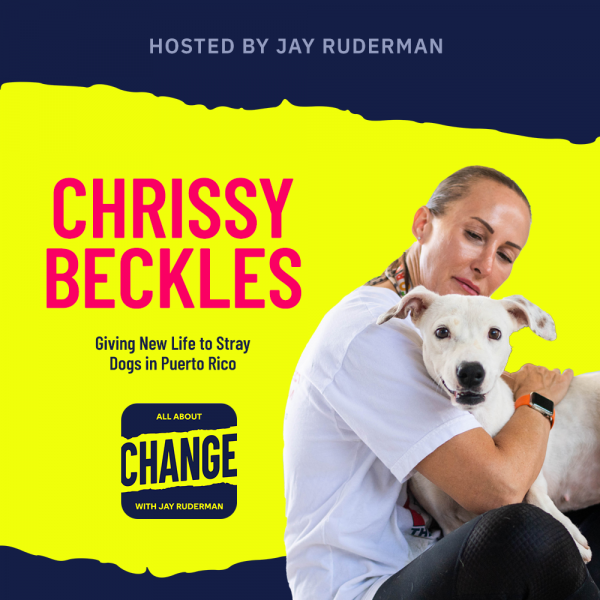
The correlation between boxing and rescuing stray dogs isn’t one that’s clear at first glance. But for Chrissy Beckles, founder of the Sato Project, the connection is one she makes each and every day. Since 2011, The Sato Project has rescued more than 8,000 dogs in Puerto Rico. With nearly half a million stray dogs roaming the island, there’s no one knockout solution.
About:
Listen to the latest episode of All About Change as Chrissy discusses her long journey, from gaining feral dogs’ trust, to finding funding and weathering a category 5 hurricane. To learn more about the Sato Project.
TRANSCRIPTION:
Jay Ruderman:
Hey, this is Jay. I’m so excited to share that we’ve recently doubled our audience. This is an incredible milestone and I’m so grateful to all of you for listening and sharing the show. We’re a growing community of people who are passionate about activism, and this growth has us trending at the top of the Apple Podcast charts. I feel incredibly proud of this achievement, especially considering we’re a small independent production. If you’re one of the many listeners to our show, first of all, welcome. I encourage you to check out our back catalog. Here are a few of my favorite episodes. Episode 24, filmmaker Olivier Bernier fights for his son’s enrollment in the regular school system and shows us how everyone, especially the quote on quote, regular students, stands to gain from such inclusion. Episode 20. Lise Deguirre, a psychologist and burn survivor shares her inspiring resilience journey and commitment to helping others to find their own strength. Episode 27, Evon Benson-Idahosa, a leading expert on modern day slavery, discusses her efforts to heal survivors and advocate for change. And lastly, episode 19. Jason Docton is a gamer who’s on a mission to increase awareness and provide aid to a mental health pandemic that’s hitting the gaming community especially hard. I love hearing from listeners and I’m always looking for new ideas and topics to cover on the show. I’m curious to hear about what activism you’re involved in. Are you working on any projects or campaigns that you’re passionate about? Please feel free to reach out to me with your thoughts and suggestions by filling out our listener feedback form linked in our show notes. Lastly, as the old podcasting trope goes, if you’re enjoying the show, please leave us a review on Apple Podcasts. It’s one of the most effective ways to help new people find our show and learn about activism. Thank you for being part of the All About Change community. Your support means the world to us. May we all grow together from strength to strength and now onto our show.
Chrissy Beckles:
I will never forget the first day I walked on that beach. It was a life-changing moment for me because I walked onto there and there were just dogs everywhere, like hundreds of them running in packs. We put them there, but we’re the ones that can help them because we’ve taken away a lot of their original instincts to hunt and to fend for themselves, to feed themselves.
Jay Ruderman:
Hi, I’m Jay Ruderman and welcome to All About Change, a podcast showcasing individuals who leverage the hardships that have been thrown at them to better other people’s lives.
Montage:
This is all wrong. I shouldn’t…I say put mental health first because if you don’t…This generation of Americans has already had enough.I stand before you, not as an expert, but as a concerned citizen.Yes, we can. Yes, we can.Louder.Yes, we can.Louder.Yes, we can. Yes, we can.
Jay Ruderman:
Chrissy Beckles never expected to be where she’s today, but after a fateful trip to Puerto Rico, she felt she had no choice.
Chrissy Beckles:
I flew back to New York and I just spent the entire plane ride thinking, “What am I going to do? I don’t know what I’m going to do, what it’s going to look like, but I know I need to do something. I can’t get back to Brooklyn and forget what I’ve seen.”
Jay Ruderman:
What she’d seen were packs of starving stray dogs, hundreds of them, roaming the beaches and streets in Puerto Rico. In the weeks following her visit, she was inspired to start The Sato Project.
Chrissy Beckles:
There are currently estimated to be in excess of half a million here on island, and to give you a metric and a visual, Puerto Rico is roughly the size of the state of Connecticut.
Jay Ruderman:
In the years since then, in the face of underfunding, a pandemic, and a category-five hurricane, Chrissy and The Sato Project have rescued more than 8,000 dogs. Chrissy Beckles, thank you so much for being my guest on All About Change. I really look forward to this discussion, as I am a dog lover, as many of us are, and I know you are. Maybe you could take a step back and talk about why there’s such a strong connection between humans and canines?
Chrissy Beckles:
From my personal perspective, I grew up with animals. So, I’ve always had an affinity and a connection. I think if I take a step back and look at the larger picture, it’s something that we, as a species, have started, and I think in some cases we’ve taken it a little bit too far, our reliance on other species and try to mold them to what we believe they should be, and I see that a lot with dogs. The canine and human connection started when dogs were trying to get warmth around a campfire. Then, hundreds of millions of years later, we’ve essentially positioned those animals to be reliant on us, and that’s something that I see in our day-to-day work that the stray and the abandoned dogs we’re dealing with are in that scenario because of us, because of humans. It’s a conflicting position to be in. We’ve put them there, but we’re the ones that can help them, because we’ve taken away a lot of their original instincts to hunt and to fend for themselves, to feed themselves.
Jay Ruderman:
Right. I happen to have been in South Africa on safari once and encountered some wild dogs, and they are a completely different species than our domesticated dogs.
Chrissy Beckles:
Yeah, absolutely. It’s not just we’ve made them reliant on us. It’s what we’ve done to them with differing breeds. If you look at what bulldogs look like even 100 years ago, they looked very different to what they look like. Now we have them to look cuter and to be more appealing to us as a species at a detriment to them and how they can survive.
Jay Ruderman:
What did you do professionally before you started this endeavor?
Chrissy Beckles:
My background was advertising and marketing, so I had my own consulting business, but I was also a champion amateur boxer that was competing in New York. I didn’t get paid for what I did, but I had a couple of titles. I boxed in Madison Square Garden three times. Won New York Golden Gloves, a couple of other titles. And crazily enough, there is a huge correlation in boxing and rescue, believe it or not. There’s a lot of things that I take from my training. My coaches would always instill in me that the fight should be the easiest part of what you do. The training has to be the hardest, and that’s what we do every day in rescue. It’s like we’re training for the big moments, and that’s where all of your effort has to go. You can’t be afraid to take a knee. It’s not a bad thing if in the ring you get hit and you’re seeing the birds playing around your head or whatever, stars, disco lights, whatever you want to call it, taking that knee is not a sign of weakness. It’s actually a sign of strength to give you a beat, to give you a moment, to gather yourself, to listen to your corner and then get up and continue with either a better plan or stronger. And then, the other thing is that boxing, you enter the ring on your own, but you have a team in your corner and you should always listen to your corner, because they can win a fight for you. And they can see things that you might not be able to see in that moment. And so, by listening to them, it can change the entire nature of a fight and the result of a fight. So, a lot of my boxing training has had a huge impact on what we do in rescue. And one of our taglines is that we fight for the dogs of Puerto Rico and we do. If I get in a ring now and I fight, it’s to raise money and to raise awareness of what’s going on on the island.
Jay Ruderman:
So, paint us a picture of your first visit to Puerto Rico. I understand you visited with your husband, who was a stunt man at the time.
Chrissy Beckles:
Correct. Yeah. So, he quickly transitioned from boxing into stunt work. He’s smart, and he soon realized that he could get a lot more money for pretending to get hit than actually being hit. So, yeah, he’s been working in the stunt industry for almost 25 years now, and he’s very successful. He does a tremendous job. And he was filming in Puerto Rico, it was 2007. He was filming a movie called Che with Benicio del Toro. And him and a group of other stunt guys were living in Puerto Rico. They were down here for a couple of months. He had never been to the island before. I had never visited before, and I was coming to spend a week with him. And he said to me before I arrived like, “You’re going to freak out when you see the dogs here.” And I was like, “Oh, that doesn’t sound good.”
Chrissy Beckles:
We had one dog at the time, a little Jack Russell named Basher. And so, I arrived on island and was completely immediately overwhelmed with what I saw. There were dogs everywhere. It’s something that in day-to-day life, depending on where you are in the US, you don’t ordinarily see. I know this is a situation that is not unique to Puerto Rico, and I’ve traveled Europe and I’ve seen stray situations in Greece and other areas, but it was different here. There was definitely kind another level to… There was a lot of indifference to the animals, to the dogs that we were seeing. And if I picked one up, I could literally see the looks of horror on people’s faces that are like, “Ugh, why are you touching that dog? It looks like a rat or it’s got a skin disease, and you’re going to get it.” There was a definitive lack of empathy.
Chrissy Beckles:
And again, not from everybody. It’s a certain amount of people. And if that happens often enough, it becomes the norm. If you’ve grown up and you’re used to seeing animals on the street, then it’s not shocking to you. If it goes from generation to generation, then it’s nothing new and it’s something that is the norm. To me, it was incredibly overwhelming and I spent a week wondering, “What the heck do I do here?” I flew back to New York and I just spent the entire plane ride thinking, “What am I going to do? I don’t know what I’m going to do, what it’s going to look like, but I know I need to do something. I can’t get back to Brooklyn and forget what I’ve seen.”
Chrissy Beckles:
And so, I did some research. I reached out to every organization I could find that had a website. And I think 100% of them, it was literally a static page with a general email address, some photographs, and that was it. And I wrote to everybody and two organizations got back to me and I started volunteering for them. I mean, it’s kind of the complete 360 is those are the emails, I get hundreds of them now every day. It’s like came, I saw, what can I do? I was in a position where I have my own consulting organization. I earn a very good amount of money, so I could donate a lot of money to these organizations. I got what I like to call my Harvard education in rescue over like an 18-month period of coming to Puerto Rico, volunteering, learning what went into rescuing dogs, transporting, vetting, et cetera.
Chrissy Beckles:
And about a year into that, we adopted our first Sato, who we named Boom-Boom, which is my ring name, my boxing name. She was a puppy that came from one of the five municipal shelters on island, and she was the only member of her family that survived. So, we gave her a fighter’s name, which was mine. And the minute she arrived in Brooklyn, it was like game over. I said to Bobby, “I can’t half-ass this anymore. I need to do more.” And I am incredibly lucky that I have a wonderfully supportive and understanding husband that I turned around to him and said, “I want to do this full time.” And he said to me, “Well… The Beckles’ family motto is, “If you’re going to do something, you don’t (beep) it up.”
Jay Ruderman:
So, I want to ask you about stray dogs. These are dogs that are just either abandoned or have been born as strays and are just scavenging. How do they live? How do these dogs survive? And the other thing that I would ask you is this problem more exacerbated in Puerto Rico as opposed to other countries in the Caribbean or other places around the world?
Chrissy Beckles:
I can’t think of another area that small that has a concentration of stray and abandoned animals this large. So, I would say, I think it’s really bad here. Satos, that’s the colloquial term for stray dog or street dog, as they’re known in Puerto Rico. There are currently estimated to be in excess of half a million here on island. And to give you a metric and a visual, Puerto Rico is roughly the size of the state of Connecticut. So if you think of it in those terms that if Connecticut had half-a-million stray dogs running around, it would be front page news in every newspaper. It would be the ticker on every news channel, but it’s not. It’s something that is widely ignored here in PR.
Chrissy Beckles:
Obviously, my organization is working incredibly hard to change the situation down here, as are many others, but it’s overwhelming. I always say with the island that can’t get a breakdown here, I started rescuing in 2007, so 10 years later, Hurricane Maria hits, it hits the island as a Category 5 hurricane. It makes landfall at Dead Dog Beach where we have always concentrated our work, so it was very, very personal to us. In that moment, I lost not only the 10 years of work that we had done as an organization, I lost my home. I lost everything I owned. We were set back over a decade in one day, and we had to pick ourselves up and keep moving forward.
Chrissy Beckles:
It’s that adage that this wasn’t a need. This was almost like a KO to us if you look at it in boxing terms. So when that happened, a lot of people, like 5% of the island’s population left and not everybody took their animals with them. So you have a large number of dogs and cats entering an already huge stray and abandoned population. Sadly, there is not a culture of spaying and neutering here in Puerto Rico. It’s something that, again, we as an organization are working very, very hard to change. So you’ve got all this new population entering into an already large population and there’s an explosion. I could see it from day one. I said, “In six weeks we’re going to be inundated with puppies and it’s going to be the same thing six weeks after that,” and that’s what happened. But it’s really hard to get ahead of it when it’s a very few amount of people that are fighting to make these changes, and we can’t get the government to get on board.
Jay Ruderman:
So with all of these challenges—the number of dogs, lack of funding, natural disasters—what keeps you going? What motivates you every day to continue this work?
Chrissy Beckles:
The dogs. It’s always the dogs. Once you see it, once you’ve experienced it, you can’t unsee it. You can’t walk away from it. For me, it’s a responsibility. It’s something that I feel I have to do.
Chrissy Beckles:
And it’s also the small wins. Every single dog that we rescue, every dog that we get off the streets, every dog that we get into a loving home, that’s a victory. You have to focus on those moments because if you focus on the bigger picture all the time, it can feel overwhelming.
Chrissy Beckles:
We’ve rescued over 8,000 dogs, and that number is incredible, but at the same time, you look at the scale of the problem and you realize how much more there is to do. So you take it one dog at a time.
Jay Ruderman:
What role do adoption and awareness play in solving this crisis?
Chrissy Beckles:
They’re critical. Adoption saves lives, obviously, but awareness is what drives adoption. People need to understand the problem. They need to see what’s happening.
Chrissy Beckles:
Social media has been a huge tool for us in that regard. It allows us to show the reality of what’s happening on the ground and to connect with people all over the world who want to help.
Chrissy Beckles:
We transport a lot of dogs to the mainland United States for adoption because there simply aren’t enough homes on the island. So building that network, building those partnerships, is essential.
Jay Ruderman:
What can listeners do if they want to help?
Chrissy Beckles:
There are a lot of ways to help. You can adopt, you can foster, you can donate, you can volunteer. Even just sharing our content helps because it raises awareness.
Chrissy Beckles:
And beyond that, people can look at what’s happening in their own communities. This isn’t just a Puerto Rico problem. There are animals in need everywhere. So get involved locally as well.
Jay Ruderman:
Chrissy, thank you so much for the incredible work that you do and for sharing your story. It’s truly inspiring.
Chrissy Beckles:
Thank you so much for having me. I really appreciate it.
Jay Ruderman:
Thank you so much for listening to All About Change. Today’s episode was produced by Tani Levitt and Mijon Zulu. Stay tuned for our next episode. Spread the word, tell a friend or family member, or leave us a review on your favorite podcasting app. We’d really appreciate it. That’s all for now. I’m Jay Ruderman, and we’ll see you soon with another episode of All About Change.