%201.avif)
Shining the light on activism
All About Change podcast is where I sit down with activists, artists, athletes, and advocates who keep showing up, even when it’s hard.
Stories of activism, courage, and change.
Each episode shines a light on voices driving progress.

2025 Digiday Greater Good Award Winner Social Justice Category
2024 Anthem Awards Medal Winner in Human & Civil Rights
2024 Anthem Awards Nominee Diversity, Equity, & Inclusion Awareness
Shorty Impact Awards Finalist

Ranked #3 in Apple Podcast rating in Society and Culture
feature episode
Alexis Tutunnique of United Ukrainian Ballet - Ukrainian Cultural Resistance
Ballet is a soft power… we use it to bring attention and awareness to the war in Ukraine
– Alexis Tutunnique

Alexis Tutunnique of United Ukrainian Ballet - Ukrainian Cultural Resistance
In this episode Jay speaks with Ukrainian ballet dancer Alexis Tutunnique about how art can become a form of activism. Alexis reflects on representing Ukraine through the United Ukrainian Ballet, preserving Ukrainian culture in the face of war, and using performance to raise awareness, build support, and keep the world engaged with what is happening in his country.
Browse by theme
Pick a thread you care about, then explore episodes that go deeper than headlines.
Animal Rights
Civil Rights
Human Rights
Social Justice
Veterans
War
The archive
Past conversations, stories of courage, clarity, and what it means to keep showing up.

Jay Ruderman:
Welcome to All About Change. Hey, All About Change listeners, it’s Jay here, and I wanted to tell you my book, Find Your Fight is now available in 800 Walmart stores.
In the book, I talk about my biggest successes and those of others and also failures as an activist, and my personal philosophy on how to make a difference. It’s the perfect gift for friends and family who care about making a positive change in our society.
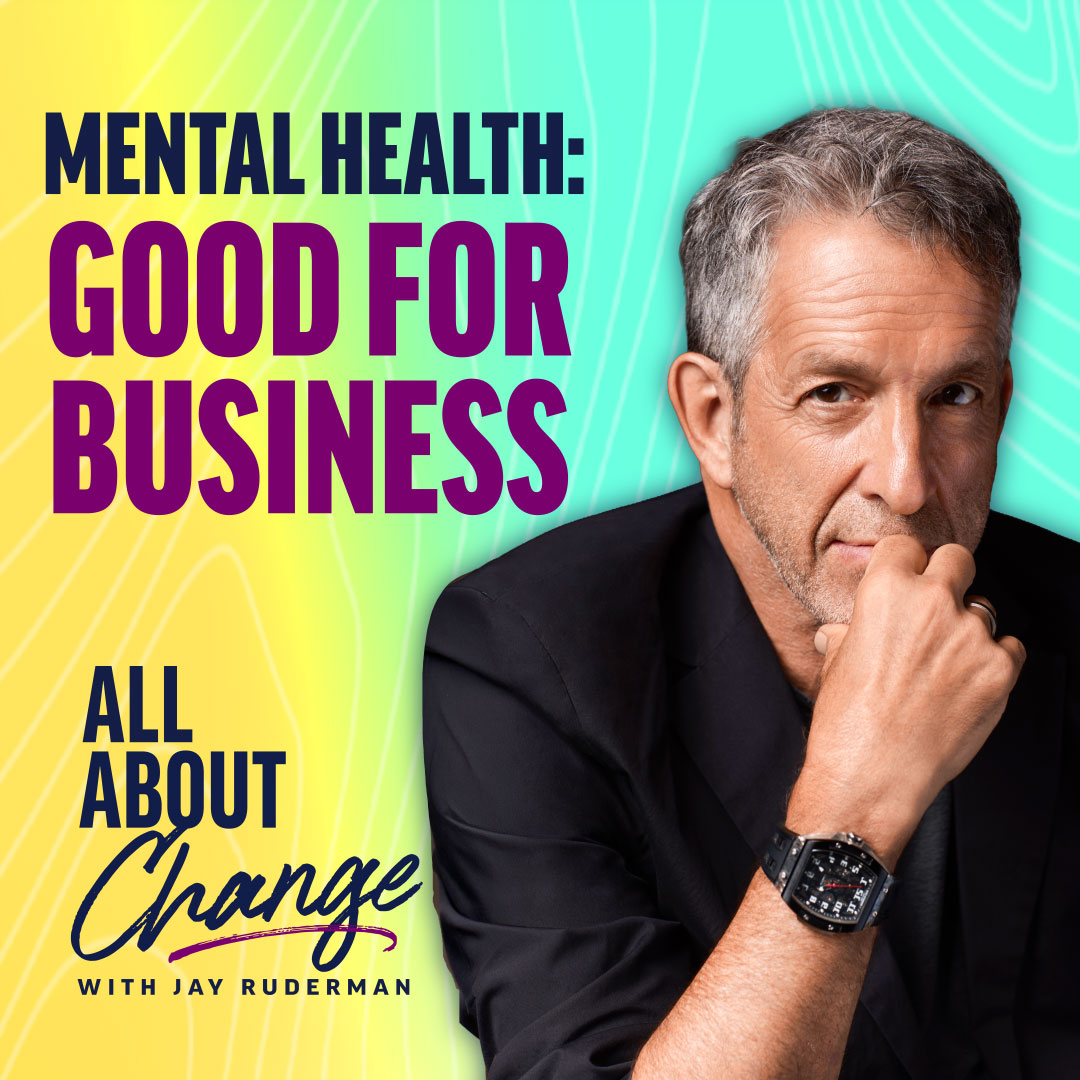
Today, I have a special interview for you that’s been a long time in the making. My guest, Kenneth Cole, has been a fashion icon for decades, innovating a unique and lasting style for which he is known. But he’s joining me today to talk about another of his great passions, mental health awareness.
Kenneth won the 2025 Morton E. Ruderman Award in Inclusion, an award my foundation presents to an individual who’s made an extraordinary contribution to the inclusion of people with disabilities.
The award recognized Kenneth’s transformative leadership in confronting mental health stigma and building a national movement for inclusion through storytelling, awareness, and action as the founder of the Mental Health Coalition.
Now, I’m lucky to be sitting in Kenneth’s showroom and talk with him about some of the crucial work he and his team at the Mental Health Coalition are up to. Kenneth Cole, welcome to All About Change.
Kenneth Cole:
Thank you, Jay.
Jay Ruderman:
It’s my pleasure having you, and I’m really looking forward to our discussion about mental health. For the guests listening, we’re recording this interview in December, but you’re hearing it in May, which is Mental Health Awareness Month. Kenneth, how do you think about Mental Health Awareness Month as part of the effort to de-stigmatize mental health struggles and the process of them seeking and receiving mental health support?
Kenneth Cole:
So those are a few different questions in one. So first of all, what do I think of Mental Health Awareness Month? As a concept I like it a lot. I think it’s a social media event, but it’s a mechanism to aggregate thoughts to large audiences because the whole process on social media and the hashtags and the conversations that ensue bring together large amounts of points of view and perspectives, and you have a chance to connect meaningfully at that singular moment in time. And I always encourage people to participate if they can.
Jay Ruderman:
It’s akin to when celebrities come out and they talk about their own mental health struggles. We’ve, as a foundation, have awarded Kevin Love, Selena Gomez and Michael Phelps. And when they speak out about their own mental health issues, I think it gets a lot of people to say, one, it’s okay to talk about it, and two, maybe I should look into my own mental health.
Kenneth Cole:
The idea of normalizing the conversation around mental health is crucial. Ultimately, that is the single and most important way to address the pervasive and destructive stigma that is making it so hard for people to address their struggles. We say at the Mental Health Coalition, they say one in four will have a mental health condition in their lifetime. We say it’s four out of four because if it isn’t you, it’s somebody you love, somebody in your family, in the community, the workplace, but everybody’s going to live with it and going to confront it in a profound way.
The problem is not that in and of itself. It’s more so that two out of three of those people do so in the proverbial shadows because of the pervasive stigma. They’re reluctant to want to talk about it and they’re reluctant… They feel they’re likely to be judged or to be diminished socially and because of the choices that they’ll use to describe their struggles and the circumstances there.
And there isn’t really today a safe narrative that people can default to. And that’s what we’re trying to work on at the coalition.
Jay Ruderman:
But you can remember back to a time when social issues were hidden, especially by celebrities. I mean, I’m thinking about the example of Rock Hudson in AIDS, and until the end, did not want to come out and speak about it because he thought it would affect his status as someone in the movie industry. But you’ve always been out in front speaking out and you own a business and you have shareholders. So as a longtime activist, how as a business leader, you were able to also become an activist and how did you balance that between running a business and being out there and speaking out about social issues?
Kenneth Cole:
It was a little easier for me than it is for other people because HIV, AIDS, clearly there was an at-risk group that were severely stigmatized and they were gay men, they were intravenous drug users, and to a degree they were Haitians. I mean, that’s where the largest population groups in the earlier stages of the most likely to be… Likely infected or infectors or infected, that’s where it was emanating.
And I wasn’t in one of those at-risk groups. So it was a little easier for me, I think, I wasn’t as concerned about being stigmatized. And maybe it was also for that reason, there weren’t many people that were willing to do what I wasn’t concerned about doing. And it was on everybody’s minds, but nobody’s lips in those days because people were petrified that they were going to be diminished as a result. To your point right now, it wasn’t just in the early days.
Even to this day, there was countless people in parts of Africa and other parts of the world where they still would rather live with AIDS than get diagnosed and get treated, than be open about their status and avail themselves of all the therapies and treatments that are available. They would rather be quiet and live with the consequences, which is what’s so frightening.
Jay Ruderman:
So stigma is a huge part of what we deal with.
Kenneth Cole:
Yeah. As I used to say then and believed, and it’s probably still today, more people are dying from the stigma of AIDS than from AIDS itself. And that’s certainly the case with mental health related issues.
Jay Ruderman:
A lot of your colleagues or competitors, they don’t do that. They talk about their products. They have nice pictures that are attracting people with models and so forth, celebrities, you’re an activist and why do you think you’re an activist and others don’t join you in that?
Kenneth Cole:
I made a decision early on in my career that fashion is a relative expression. What’s fashionable to you may not be to me. And what’s fashionable today may not be tomorrow. And heel heights and hem lengths change every 15 minutes. But if I can make our relationship more about what you stand for rather than what you stand in and not just of what you wear, what’s on your body, but what’s on your mind, then I can have such a… Then our relationship is likely to be so much more sustainable and meaningful over time. And frankly, it’s what’s on your mind that will eventually influence what’s on your body and what you stand for will eventually influence what you stand in.
So that’s just a decision I made early on. And I came to realize that everything felt so much more fulfilling and meaningful once we started doing that.
Jay Ruderman:
Because you’re speaking out about social issues and because you’re addressing things that people are dealing with, the people who have worked for you, do they feel like they’re not just involved in selling clothing and shoes, but they’re involved in a bigger cause?
Kenneth Cole:
I think they do. I mean, I’m sure there’s cases where they don’t, but I believe in my heart most do. And social impact isn’t something we do here. It’s part of, as I say, who we are, and it’s embedded in the business model. It doesn’t exist in a corner office, it exists in every office. And everybody here hopefully touches it in one way or another in their ordinary course, and that’s the goal.
And then we have in here in the business as well, we have a mental health 501C3 not for-profit, and we have a handful of people that work only for it, and they have very clear business goals and deliverables, and transparent, objective, and attainable goals.
And they have an ROI, return on investment needs, as does the business people. And I do think everybody kind of inherently supports each other, works together, but has their own clear goals and objectives.
And I think we’ve created something, I think, bigger than some of its parts by doing it the way we do it.
Jay Ruderman:
Can you talk about the Mental Health Coalition and why it was important to you to try to pull together all of these different organizations that are working on mental health to try to create a larger impact?
Kenneth Cole:
So initially, actually, my daughter was working here at the time. She was working with the HR and she wanted to institute a program, a stigma-free workplace. It was a program that was created and administered by NAMI, National Institute for Mental Illness, the largest mental service program in this country to my knowledge. And I said, fine, we did it and everybody felt good about it. And I had a conversation with the people at NAMI, and they said, “Well, why don’t you carry the torch and do something bigger with this like you did with HIV and help de-stigmatize mental illness?” And upon reflection and conversation, we determined that this is so much bigger than NAMI and it’s so much bigger than us.
And it’s almost culture changing because it requires, if you’re going to address this debilitating stigma, it needs to be such a bigger collaboration and coordination and cooperation unlike anything I think that we’ve seen.
And I said to them, “If we’re going to do this, it needs to be bigger and this tent needs to be wide open and we need to bring in other people because…” And they said, “Bring in anyone you want.” That was basically the feedback and we’re on board, we’ll support it, spoke to the board, they’re on board, loved the idea.
So we started doing that. We reached out to about, at the end, 50 different organizations, all representing disproportionately impacted communities and asked them if they’d want to be part of this coalition. And they basically all said, yes. So the mental health coalition was formed. And with the goal ultimately of circling the wagons and addressing first and foremost, stigma, the debilitating stigma and anything else that nobody else could do individually that felt that maybe we could do collectively. I use the adage often that, alone you can go fast, together you can go far.
And there’s so much strength in numbers and viability and capacity building that you can’t create otherwise. So everybody said they’re in and I spoke to people at Pentagram and they donated generously a lot of the creative branding stuff and then we had a lot here and branding is very much… Messaging is what I’ve always done in my career, but it became apparent very quickly that it isn’t what was appropriate necessarily here for the mental health effort because everybody was doing their own and my goal was to amplify everybody else’s work, not to compete with it. So we’ve created a platform that does that.
Speaker 3:
We all feel like a square peg in a round hole sometimes. One in four of us will have a diagnosable mental health condition at some point in our lives. Four in four of us aren’t okay all the time. The Mental Health Coalition exists to de-stigmatize mental health so people can get the care and support they need.
Spearheaded by fashion designer and social justice advocate, Kenneth Cole, we are the world’s most influential alliance of mental health providers. We work with nonprofits, corporations, and everyday people to change the conversation through campaigns that meet people where they are in bite-sized info that’s easy to apply. Offer fresh resources developed by experts for anyone and everyone to access and understand. Build community, to scale awareness and support online and offline. MHC’s approach is working. Since 2019, MHC’s programs have reached an estimated one billion people. So while there is no normal, there is care, there is support, and there is a role for all of us to play. Join us.
Jay Ruderman:
In my book, Find Your Fight, I talk a lot about allyship, and I agree with you. When you can have like-minded organizations or people who are trying to work on the same thing, it makes sense to bring them together, unless you can’t trust them. But let’s say you can trust people. Organizations can be very territorial. Did you deal with that at all where organizations were saying, “Well, listen, we do this and I don’t want to work with them because…”
Kenneth Cole:
Everybody is territorial. By nature, they need to be. They need to justify their existence and everybody is proprietary. Everybody has to serve the hand that feeds them. And if it’s through a funder or if it’s through some sort of an enabler, and as long as you understand that and you can figure out how to align interests, then you can overcome it. And branding was one of the first things that became clear. And fundraising was a, everybody kind of is going to the same place.
So with the biggest of hearts and best of intentions, everybody’s often tripping all over each other. So how do you create that efficiency? And one of the ways is, first of all, is put them all around the same table. Most of these people had never even spoken to each other, but yet they’re competing with each other with the same goals and objectives.
And I think a lot of that just democratizes itself. I find the opportunities, if there’s redundancy, you become clear on that too. Nobody wants to put more resources behind efforts that are already being addressed. And as long as you also just create that awareness and that access to that knowledge, then people will find their opportunities to have the impact they uniquely can make.
Jay Ruderman:
But does it take someone like you, an outsider who has had success in advocacy to be able to… And has some celebrity to take these organizations together and to say, “I want to do this. It’s important.”
Kenneth Cole:
I think it’s easier for me because I make very clear, I’m not a doctor, I’m not a mental health expert, I’m not a public health expert, I’m not a psychiatrist. I am the least qualified person around almost every table I sit when we’re talking about MHC, Mental Health Coalition, and I make that very clear.
But what I am good at is convening people who are qualified, and that’s what that conference was that we had yesterday. It was bringing experts to the table, empowering them, giving them a pedestal. And I’m good at… I’m a good convener and enabler in that regard. And I make very clear, I’m not here to compete with anybody. I’m here to help you be the best version of yourself.
Jay Ruderman:
One idea in the Jewish tradition is that if you do a mitzvah, if you do a good deed, that it will bring another mitzvah. And the story of the Mental Health Coalition’s founding, like we talked about, you wanted to create a healthy workspace. And as part of that process, you learned about prevalence of mental health issues in the country, in the workspace. Can you talk about some of the positive outcomes and good deeds that have come as a result of the mental health coalition coming together?
Kenneth Cole:
We’re all about transparent, quantitative outcomes, and everything we do is with clear goals and deliverables. And otherwise, we wonder, is this the best use of… Is there a reason for us to even exist in this space?
So the first initiative that we undertook, or one of the earliest ones was actually spearheaded by my daughter, Katie. And it was, “How are you really?” Which is arguably the most asked question everywhere in the world in every language and the one most rarely ever answered, and howareyoureally.org, and we set that up and challenged people to answer that question and allow others to engage in conversation.
And I think we had 300 million people engaged with that content the first weekend. So the ability to reach a lot of people, trigger, initiate conversation that might not happen otherwise, positive conversation, encourage people, show people how to be, myself included, how to be there for each other, how to show up for each other, how to be empathetic, how to be vulnerable.
Vulnerability is a hard thing, especially for a guy and we’re bred not to be vulnerable, and men of color more than Caucasian, and Asian men even more than that. It’s just culturally, it’s just not something that’s encouraged and promoted. So how do you be that? And it’s okay to be that. And we’ve done that. We’ve brought together these one-to-ones. We had this massive conversations with Instagram, and now we’ve launched this tech platform that I think is going to change people’s lives everywhere.
Jay Ruderman:
So yesterday, you had a convening of the Mental Health Coalition, and Jay Glazer got up and spoke, and he has a history in the NFL and professional wrestling, and he talked about getting hurt, and that when you’re hurt, you don’t show it. You can break an… He gave an example of breaking an arm and you don’t show your opponent that you broke your arm. But then he also talked about how he was in a really dark place, and he came to the point where he was able to speak about depression, anxiety, being bipolar.
I thought that was really moving. I thought that was moving for someone to speak about their vulnerability and use it as a power. That goes to your point of the fact that sometimes men don’t want to show that they’re vulnerable, but as part of what you’re trying to get at with the coalition is we have to be more open and honest and not worry about what the consequences are going to be.
Kenneth Cole:
Well, hopefully there are no consequences. I mean, hopefully it enables you to address your consequences in a positive way because if you’re not open about them, you can’t address them and they’re going to fester and they’re only going to arguably get worse. And our goal is to normalize it, to formalize it, to institutionalize it, and to be okay to talk about your struggles. I mean, if you have a broken foot, you wear a cast and you tell the world, and it’s okay. So if I have a broken heart, I have a broken soul, I need to be able to share that.
And what about it is encumbering me and making it hard for me to get out of bed in the morning? And I think that needs to be an open discussion. And if you’re not well emotionally, you’re not well. If your heart isn’t working, your mind isn’t working, your body isn’t working, you’re not working, you’re not whole.
Jay Ruderman:
Kenneth, I’ve heard you talk about the impact that mental health and not addressing mental health has on the business community and the amount of money that’s lost as a result of that. Can you elaborate on that a little bit?
Kenneth Cole:
Yeah. So look, I try to make this an easier conversation because the compassionate case for mental health breaks down almost consistently, I have found. And you try to have that conversation with people and it doesn’t go very far because we all have this empathy, so called empathy quotient I read years ago.
And it is exhausted before you get out of bed in the morning, if you check your social media and if you look at your algorithms, and there’s only so much empathy you can have for so many people, but the world is divided and the world is in pain. And you go to work and you walk past people who are homeless and people who are needy, and you’ve become hardened. It’s the only way you get through your days and only way you get to where you’re going. But the business case works almost consistently, oddly.
And because, A, nobody has money that they can throw at anything, but if you can make a rational case that any sort of allocation of resources is not in fact an expense, but it’s an investment that will pay itself back over time, that’s all of our jobs. And I run a big business, relatively large business, and I’ve been doing it for a lot of years, and I do think and understand the impact of resource allocation. And I do think that, and it has become very clear that, and I have learned that there is unequivocal evidence that an allocation of resources towards mental health initiatives realizes an improvement in retention, recruitment, morale, and ultimate productivity. And that’s my job, that’s every CEO’s job. And it’s an easy decision to make if you can put it contextually in that regard and not making it.
So you can say why it’s a good thing to do, but you can also say why it’s an awful thing not to make it because it’s such a huge drain on our economy.
$1.3 trillion is spent annually by corporate America, which by the way, more Americans get their healthcare from their employer than from Medicaid and Medicare put together. And it’s a drain on your balance sheet, it’s a drain on your income statement and your operating statement.
And not to reapportion it is, A it’s irresponsible and it’s ineffective and it’s inappropriate in your capacity as a CEO and even more so as a human being.
Jay Ruderman:
When I was coming in here this morning, I was reading a news story about a major corporation where the CEO came out and said, “All employees have to come back five days a week.” And I was sort of taken aback and I’m like, “That sounds like going backwards a little bit.” I can’t remember who, I don’t want to name the person because I can’t really remember it, but I think that that is sort of a thing of the past. I think the way I run my organization is, if you can get your work done, I don’t care where you are, I don’t care what you’re doing, I can tell if you’re producing or if you’re not producing, but this whole thing of like, no, everyone has to come back. We have to go back to what we had pre-COVID seems a little outdated.
Kenneth Cole:
Yeah. Look, I think some industries it’s more important than others and in certain areas and responsibilities within certain businesses is more… I mean, if you’re involved with product, it’s hard to do that remotely. But I think the world will never be the way it was pre-COVID. And I think people will work remote and they’ll find jobs where they can be remote because they’re going to look to balance their personal and professional lives uniquely and they’ll make those decisions uniquely.
But I do think there’s a hybrid formula that people will settle on and companies will settle on and individuals will settle on it, and they’ll find something that works for them.
Jay Ruderman:
Kenneth, I want to end by saying, we talked about this a little bit, you’re an incredibly ambitious person and you’re really trying to make a change in this world. What are your hopes for the mental health coalition’s next steps?
Kenneth Cole:
I think we can be a bridge and create something greater, as I often say than the sum of its parts, because there’s so much capacity out there for good and there’s so many people who are well-intended and if we somehow create a mechanism to leverage all of that, and now with AI, you have the capacity to do that much exponentially more than we could have ever imagined before.
I think you can connect with people everywhere and all the time, and you can do it meaningfully if you’re programmed to do so. I think healthcare has changed profoundly because of AI and the ability diagnostically, it’s thousands percent more capable. Healthcare and access to psychological support is 24/7 now, and it’s everywhere. It didn’t used to be. But it can also be, if not used in a good way, it can also be destructive. But I do think everybody’s intentions, way more people’s intentions are to do this thing the right way.
And I do think, and I do believe that we can help encourage that and support that.
Jay Ruderman:
So Kenneth, thank you so much for being my guest on All About Change.
Kenneth Cole:
Thank you, Jay. Congratulations for your book.
Jay Ruderman:
Thank you.
Kenneth Cole:
Congratulations on what you guys are doing and-
Jay Ruderman:
Thank you.
Kenneth Cole:
And encouraging and promoting, and happy to be a part of it.
Jay Ruderman:
And I just want to say that you are one of my heroes because not only have you built a successful company, but you’ve become an outstanding activist who really knew how to use marketing to get the message out there. And you’ve changed our country and our world in terms of reducing stigma on AIDS and now focusing on mental health, which is the biggest issue I think people are facing right now. So it’s my distinct honor to have spent some time with you, and I wish that you will go from strength to strength. Thank you so much.
Kenneth Cole:
Thank you very much, Jay, to you and your family. And thank you for what you guys do for so many.
Jay Ruderman:
Thank you for being part of the All About Change community. We aim to spark ideas for personal activism, helping you find your pathway to action beyond awareness. So thank you for investing your time with us, learning and thinking about how just one person can make the choice to build a community and improve our world. I believe in the empower of informed people like you to drive real change, and I know that what we explore today will be a tool for you in that effort.
All right, I’ll see you in two weeks for our next conversation, but just one small ask, please hit subscribe and leave us a comment below. It lets us know that you value this content and it supports our mission to widely share these perspectives. If you’re looking for more inspiration, check out this next video. I chose it for you and I know you’re going to enjoy it.
I’m Jay Ruderman. Let’s continue working towards meaningful change together.
Today’s episode was produced by Tani Levitt and Mijon Zulu. To check out more episodes or to learn more about the show, you can visit our website Allaboutchangepodcast.com. If you like our show, spread the word, tell a friend or family member, or leave us a review on your favorite podcasting app. We really appreciate it. All About Change is produced by the Ruderman Family Foundation.
Jay Ruderman:
It is Jay here. I want to share that "Find Your Fight" is now available wherever you get your books. It is my personal guide on how to make a difference, a perfect gift for the change makers in your life.
We’ve been committed to covering the human rights crisis in Iran for a long time. During the height of the “Women, Life, Freedom protests, we spoke with Hadi Ghaemi, the Executive Director for the Center of Human Rights in Iran, about the brutal reality on the ground and the resilience of those fighting for change as the situation remains as urgent as ever.
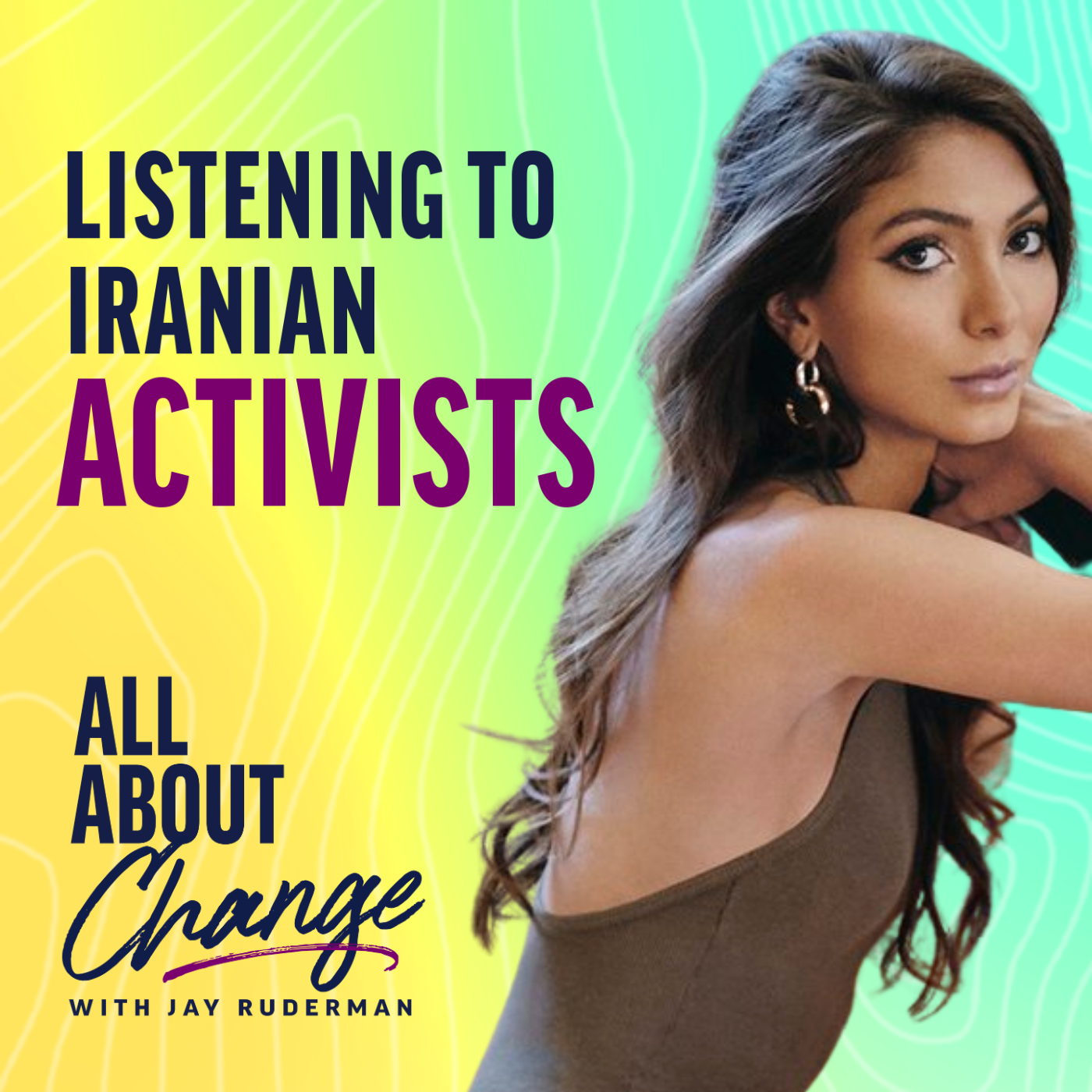
We wanted to revisit a more recent and vital conversation with another powerful voice for the Iranian people. Noor Pahlavi is a member of the exiled Iranian royal family, but she’s carved out her own path as a modern advocate born in the United States, she could have opted for a life in the shadows.
Instead, she chose to leverage her unique heritage and platform. To amplify the voices of our homeland. We’re returning to this discussion to talk about gender equality under an oppressive regime, the critical state of women’s health, and why it’s essential to remember the hope and courage of the Iranian people.
Noor it’s an honor to have you back on the show. Welcome to all about change.
Princess Noor:
Thank you for having me.
Jay Ruderman:
So Noor, your father as the Crown Prince has been a symbol and an advocate for democracy in Iran to Iranians who are living outside of Iran and those living inside Iran. When you were growing up, what type of stories, what did you learn about your grandfather, the Shah?
Princess Noor:
I mostly heard about who he was rather than what he did. So a person who was very kind of soft-spoken, loved his wife, loved his dogs, loved his kids, kind of had a sensitive stomach, was very low maintenance, and also kind of a suffer-on-the-inside type, but definitely sensitive to his people, their sentiment. And I’d heard a few things. I had a high school teacher who worked for the Carter administration, and I remember hearing some things in that class that I went and asked my grandmother about when I came home. And she is not a reactive person, and I’ve never actually seen her stirred apart from in this conversation where she was just… She sat me down and just laid it all out, all of the misconceptions in the United States that they have about what happened then, the US’s role in the revolution, and what people who worked in the Carter administration have said to her since, expressing apologies and stuff like that for the way they really turned their backs on him when he needed them most.
And I think that that was also the conversation where she talked a lot about what he did for Iran as a country for his people, for women, for families, for the environment, for the progress of the economy, the vision he had of a country that isn’t solely reliant on oil for fossil fuels, but treats it as a precious resource, bringing people from the cities to the rural areas to expand access to education, sending people abroad to get access to other countries and bring back what they know and really trying to integrate Iran into the global landscape and build bridges.
And I think it’s such a shame now because if he could see what Iran’s become, it’s the complete antithesis of what he had in mind. It’s now a passport you don’t want to have, it’s a country that’s feared and a country that shuts its people off, even if it involves cutting off internet access from anything that doesn’t align with its really rigid ideology. My grandfather wanted minorities to have a voice. He welcomed Jewish people, he welcomed people of all faiths. He was open to anyone having a voice in government, in leading educational institutions, in business. And I think, again, the laws that are in place now, everything that makes life for these people in Iran, for women, for religious minorities, for gay people, for everything, I think if he could see what’s become of this country, he would die all over again.
Jay Ruderman:
Right. I want to switch and talk about your grandmother, the Empress Farah Pahlavi, and what influence she’s had on you in terms of fashion, in terms of advocating for the Iranian people. What do you remember at a young age the messages that she gave you?
Princess Noor:
She’s a really, really special person. I think what messages she gave me when I was growing up usually had to do with making sure I understood Iranian culture for what it was and the truth behind its people and the beauty, the openness, the art, the intelligence, the education, everything that was true about the people when she was there and that still is, and the warmth of this culture. And beyond that, it was a lot of messages about treating all other living things with kindness, with respect, trees, animals, and not to value material things at all. I think that really came from her leaving Iran with nothing but jean shorts and her photo albums. The way that she never talks about things she used to have, she’s very in the moment and just very grateful for her family and for the love she still feels from the Iranian people who reach out to her all the time.
And what I’ve learned most from watching her though is the grace with which she faced unbearable loss, first her country, then her husband, and more recently her two children to suicide. I think there’s this theme in my family of duty to their countrymen transcending any pain that one person might feel in the moment and a bigger picture they’re all fighting for. And I think being a mother to Iran has always pulled her through the trials that she’s faced in her personal life. And I understand her. It’s such a unique privilege for us to be in a position to help others on this scale and to play an active role in bringing about change, and I think that really has been something she’s clung to to pull her through.
Jay Ruderman:
Well, she seems like a beautiful person. I want to talk about the current Islamic regime in Iran. How would you describe them, and in your opinion, what are their goals? I remember the revolution, and I remember that Iran was a fairly modern country with a modern outlook, with people who were happy. And now to see the repressive nature, not only of the Islamic Republic, but also the export of terrorism is problematic for the region and for the world. And I saw a post that you put up, and maybe you can talk about this, that when we say Iran, you don’t want us to refer to Iran as Iran, but as the Islamic Republic.
Princess Noor:
Right.
Jay Ruderman:
Can you talk about that a little bit, about what that means to you?
Princess Noor:
Yeah. First, I feel it’s really important to clarify for those who are less familiar with Iran that this government should only be referred to really in the context of it being Iran’s occupiers. They’re in no way representative at Iran’s population. They represent their own pursuit of fundamentalist Islam, which they want to export and impose on the rest of the world, its proliferation both domestically and abroad, and they’re constantly preaching to this effect. If you watch videos of clerics inside Iran and what they’re saying, our Western values are the enemy that threaten that. When foreign countries address them or negotiate with them as Iran’s representative, it legitimizes them, and this legitimacy is a slap in the face to all who are risking their lives and giving them every day inside Iran to fight this government.
And secondly, there’s a huge misconception here that this government has been democratically elected. Despite appearances of having elections, these are heavily controlled by the radical Islamic clerics and the supreme leader as holding the ultimate authority. Since 1979 through propaganda, through brutal force against its people, they maintained their grip on power, and the elections are not free or fair. Only candidates approved by the regime can participate to ensure that this ruling class remains in control. And make no mistake, the supreme leader pulls these strings, and the regime’s priorities are not the welfare of its people, but in maintaining this ideological and political dominance. And all the proof is there. They’re lining their own pockets, funding terrorism, and letting their own people starve. They’re the enemy of any freedom-loving person. And so when I hear people apologizing for them or attributing their actions to a different source, I really ask that they educate themselves or listen to the speeches they give to galvanize people against the West.
And they wreak havoc on all of us through their proxies every day. They’re the head of an octopus, and organizations like Hamas are the legs. And I want to say to Americans that you’re not untouchable. If you think you’ve not been affected by Iran, in some way you have. Think again. And if things continue down this track with nobody supporting the Iranian people to stop them, being stripped of freedoms won’t just be an Iran problem, it’ll come right to your doorstep, because they view America as the devil, and they’ll do whatever they can to infiltrate it. It started in Israel, it’s going to happen here. It’s already started on university campuses here and election meddling, and it will only get worse as they get emboldened as they approach a nuclear weapon.
Jay Ruderman:
Noor, let’s talk about life for Iranians in the Islamic Republic. I’ve seen many videos during protests, and there’s a love, I remember during the hijab protest, women walking in the street without the hijab, giving each other gifts, hugging each other, smiling. There was a story of, you probably know this story, of a man who was dancing, it was a shopkeeper, and his dance went viral all over Iran. So can you talk about the Iranian people and what their lives look like?
Princess Noor:
Yeah. So because they live under a government that’s more interested in holding on to power and spreading radical Islam than helping its own country and people thrive, they’re facing severe economic challenges and oppressive social conditions. Basic necessities like bread and eggs have become luxuries for many Iranians because of rampant inflation, the devaluation of their currency, infrastructure, electricity, and water systems is severely outdated, dating back to when my grandfather was there. This has led to frequent power outages, water shortages, which I talked about a bit on my Instagram. And I frequently get videos from Iranians in sweltering heat struggling to keep their businesses running with no power in the middle of the day and no AC.
And one thing the regime especially doesn’t care about, which those who overthrew my grandfather pointed to as a sign that he was delusional when he attempted to prioritize it, is the environment. Iranians often joked that soon the regime would charge them for oxygen. And now after decades of severe neglect, pollution issues have made the air in so many cities dangerously toxic, and it breaks my heart to see the toll that this is taking physically on Iranian people. And beyond mismanagement of funds. The social conditions in Iran, as you know, are dire. They have the highest per-capita execution rate in the world, and there’s been a significant increase in the executions following the 2022 protests that Mahsa Amini’s death triggered.
And the regime also routinely persecutes religious minorities and ethnic minorities where they’re contributing to this atmosphere of fear of oppression. And there’s also the highest child execution rate in the world, and you can be jailed or killed for leaving the Islamic faith and denied education. Unmarried men and women are banned from being together in public or showing affection. Dogs are considered illegal. They’re rounded up and killed by the regime. Anyone who speaks out against this government is at risk of brutal repression. And Iran’s prisons are now filled with intellectuals and some of Iran’s bravest and brightest, because they have no basic protection. Even lawyers for political prisoners or families demanding answers for their loved ones are being thrown in jail. So this regime is doing this with impunity, and their policies are emboldened by Western weakness and appeasement in regards to this government.
Jay Ruderman:
It’s a horrific situation. Maybe you can talk a little bit about what freedoms were present when your grandparents were ruling the country.
Princess Noor:
It’d be so much harder to even talk about what freedoms were not present, because my grandpa made my grandma the first female regent, which empowered her to stand in as a leader should anything happen to… until my father came of age, which was extremely progressive for the time. A good amount of family law had been passed that some Western countries don’t even have today. We don’t have that much help sometimes with family planning, child care, maternity leave, but that was a priority. My grandpa banned polygamy, unilateral male divorce. He allowed mothers custody of children, he raised the legal marriage age. The mandatory headscarf was removed by my great-grandfather. He gave women the right to choose if they want to be covered or not.
And there were a bunch of other freedoms granted that I think we might take for granted over here in the US back then, but the Islamic Republic revoked every single one of these provisions in 1979. Women were the first casualties of the Iranian Revolution. And we talked a bit about it before, but my grandfather really wanted to open Iran up to the rest of the world and make sure that his people progressed with the rest of the world and played an active role in the global economy, and I think it’s such a shame.
Jay Ruderman:
So we’ve all seen these horrific videos of women being taken off the street and pushed into vans. Can you talk a little bit about the state of affairs for women currently in the Islamic Republic?
Princess Noor:
Yeah. I’ve always been surprised that this wasn’t talked about more before the Mahsa Amini protests kicked off. But Iran ranks near the bottom of the World Economic Forum’s Global Gender Gap Index. They’re 143rd out of 146 countries. Women in Iran have no laws to protect them against gender-based violence. Their testimony in court is worth half of the man’s. They receive half of the inheritance of their male counterparts. The legal marriage age was lowered from I think between 15 and 18 to 9 after the revolution, and later raised to 13, but younger marriages are still allowed with a judge or father’s permission, and I think that it probably it was only raised to 13 because they realized nine-year-olds can’t produce children right away. But women need their husband or male guardians’ permission to travel or get a passport. Men have the unilateral right to divorce while women can face significantly legal obstacles to do so.
They’re segregated from men in the workplace, classrooms, and public spaces like beaches. They’re banned from certain fields of study and job roles that are deemed inappropriate by the regime, Banned from attending sports events and stadiums. They can’t ride bikes or sing alone in public, which is super strange. They have no legal protections against honor killing, or if there is a punishment, it’s minor. Gender-based violence pervades them, and the perpetrators often face minimal consequences. Sexual assault is used as a tool of repression against female protesters regularly, and they’re constantly monitored by the morality police who enforce dress codes and other gender-specific laws.
So the regime has engaged in a ton of campaigns of intimidation, including poisoning schoolgirls or actively shooting protesters in the eyes to blind them. And women in religious minorities face additional discrimination, including denial of education and employment opportunities. So the situation for women in Iran is dire, and the current protests have shown the world, I think, that Iranian women are not willing to be silenced. They’re fighting back against a regime that seeks to erase our identity, their autonomy, and the world really needs to recognize the severity of their struggle and support this quest for women, life, freedom that you keep hearing chanted throughout this revolution.
Jay Ruderman:
Right.
Crowd:
[chanting in foreign language].
Jay Ruderman:
You’ve talked in the past about gender inequality in the Islamic Republic, including in healthcare, and yet you’ve been very open, your mother’s been open about talking about her own health and her experience with breast cancer. Can you talk a little bit about health care and where you think things are right now?
Princess Noor:
Sure. So my mom’s a pretty private person when it comes to her personal life. We’re not really the people who speak comfortably in front of a camera feel natural sharing aspects of our day-to-day, so a lot went into her decision to share this journey at a time that was very scary for her. And she did a lot of research into the state of healthcare in Iran and women’s access to it by speaking both to women inside and getting connected through various sources, as well as doctors who are trying to get care to these patients or trying to raise awareness in the region. And her reasoning for sharing her struggle was providing a lens into it might help combat some of the taboos associated with women’s health discussions in Iran, and she hoped it would empower women to talk more about this and raise awareness. And so many people face this in their lives, and investment in proper healthcare, particularly in rural areas, isn’t something that’s been prioritized in Iran as we’ve discussed.
What they prioritize is lining their own pockets and funding their interests of spreading radical Islam through terrorism. So in these areas, both the lack of access to the infrastructure as well as the culture, which is one where there are so many taboos surrounding talking about the female body, really, women are spoken about in the media by the government as tools to procreate and nothing more. And they started associating some kind of shame with anything to do with talking about something like their breasts or breast cancer, and that is something that my mother really wanted to change. She didn’t want people to shy away from it because this is actually a preventable illness. And being educated about it and monitoring it is something that could save lives. So she wanted to combat that moratorium around the vocabulary that the Islamic Republic has.
Jay Ruderman:
So we’ve talked about what you see in videos about the beautiful nature of how people interact with each other, but talk a little bit about your dream for women in Iran.
Princess Noor:
Yeah. My dream is it’s for them to have the freedom and autonomy over their lives that I have. I can’t think of anyone who deserves that more after the hardship they have faced and the bravery they’ve shown. And to see someday free and their elections take place in Iran and for people to have a choice in who governs them or a government that actually represents them and works for them. And my dream is for the rest of the world to stand up to this bully and to set their differences aside and hear the cries of the Iranian people and acknowledge them. This dream started to come true when I saw actors, musicians, artists, and other people with platforms highlighting the plight of Iranian women on their platforms and reposting these videos that these women have risked their lives and very often sacrificed their lives to put out into the world.
So I would love to see the US get behind them by easing sanctions or releasing frozen assets because those funds do not touch the Iranian people. They line the pockets of the few who are in charge and fund the terrorism that we’re sending troops to fight. And I would love to see them stop negotiating with a government that the people say doesn’t represent them, one who makes a mockery of us and the agreements openly and has been proven to ignore them, a case in point, the nuclear progress they’ve made. This legitimizes them, like I said, and it’s a slap in the face to all who continue to give their lives in peaceful resistance. And we shouldn’t be inviting them to speak at the United Nations. These are the number one human rights violators in the world, and assigning guards with our taxpayer dollars to protect them is ridiculous. And government shouldn’t be able to do what the regime does with impunity. It simply can’t continue. And my dream is to see that and to see Iranians freed.
Jay Ruderman:
Well, I think we stand at a pivotal time right now regarding the Islamic Republic and the world, and we’ll see what the weeks and months ahead bring. I also want to touch on your advocacy for Iranian women abroad, and what are you doing to advocate for women who are not living in Iran.
Princess Noor:
Yeah. I think some of the work that I do, it’s difficult to give too much detail on since the people I try to help, they take great personal risk to reach out to me and getting anything-
Jay Ruderman:
True.
Princess Noor:
… into Iran is so sensitive and so challenging, and it’s been a lot of work trying to create the channels for that. One initiative, for example, was, when the internet was shut down, trying to get drones in to get people back online to make sure that people continue to hear their stories and that the government isn’t able to cut Iran off from the rest of the world. But using my platform to shed light on their issues I think has helped somewhat to get their voices heard globally. I want to be a megaphone for them since they’ve been systematically silenced. And I think it’s important, though, to go beyond that as well. And there are some people here in the States who are working for the Iranian people and trying to get their stories to the right people in government and trying to influence policy here so that our policy leaders actually understand the voice of Iranians and aren’t just listening to the regime and its proxies.
And those are groups like the National Union for Democracy in Iran. It’s comprised of a mix of Iranians from all over, all ages and genders, many of whom have escaped Iran. They’re very smart, they could have chosen any path here in the States, but they choose to dedicate their lives to this, and I found them very inspiring, and I think that they’re making meaningful strides in policy in the States. And then I also work with a group called the Persian American Women’s Conference, which does a lot of work to empower women who have suffered in Iran and refugees through mental health services, and also by giving them platforms to speak about what they went through when they were in the country, and for those who still are, trying to get them the resources that they can. And yeah, I often think of what my life would’ve been like growing under different circumstances, and I just feel really strong ties to these women, especially the ones my age, and I feel it’s really important to magnify their struggle.
Jay Ruderman:
Well, thank you for everything that you’ve done in terms of your advocacy, but let’s shift to your present-day life, and tell us about your work as a member of the global advisory board at Acumen. What about their mission draws you?
Princess Noor:
So I was initially drawn to Acumen when I heard that its founder, Jacqueline Novogratz speak. She has such a deep sense of empathy and her decision to dedicate her life to bettering this world reminded me, actually, a lot of my father. I read her book, The Blue Sweater, and heard her speak and was just deeply moved by her vision. If you ever find yourself losing faith in humanity, picking up one of Jacqueline’s books will bring you home.
Jacqueline Novogratz:
On the one hand, people say the time for change is now. They want to be part of it. They talk about wanting lives of purpose and greater meaning. But on the other hand, I hear people talking about fear, a sense of risk aversion. They say, I really want to follow a life of purpose, but I don’t know where to start.
Jay Ruderman:
That’s good to know.
Princess Noor:
Yeah. It goes back to this sense of the circumstances to which we’re all born are nowhere near equal, but working to create a world where all human beings have… [inaudible 00:26:19] opportunity, a more fair world is of paramount importance, and more importantly, it can be done. And when you hear Jacqueline speak and lay out Acumen’s vision, you really feel like you can get behind it and that this business model might work if people cooperate and open up to these possibilities. And the world really needs people who are willing to redefine success through inclusion, fairness, and dignity, and it takes community, it takes courage in the face of conformity, and listening to voices unheard to redefine the rules of success.
So Acumen isn’t working on band-aid solutions to acute problems. Basically, they invest in entrepreneurs in developing countries who are tackling the most challenging issues, such as environment, healthcare, agriculture, women’s issues, and it’s helping lift these people from these communities out of poverty in a sustainable way and provides them with the tools to move their missions forward and lift up their communities. And I believe that it’s creating a deeply meaningful impact. I wish we could do this in Iran. Unfortunately, the infrastructure isn’t there yet, but hopefully one day, and part of Acumen’s model involves connecting dots across government, civil society, and the private sector to build markets for greater impact. It’s just been an incredible journey being on their advisory board, and I’m really proud of the work that they’re doing.
Jay Ruderman:
It sounds like a very empowering organization, and very vital in our world, the work that they’re doing. Finally, I want to ask you about how you conceptualize and leverage your platform, because you have a foot in two different worlds.
Princess Noor:
Yeah.
Jay Ruderman:
So what does your platform mean to you?
Princess Noor:
It’s an odd situation because I’m not an influencer. I have a day job, and it’s kind of been an accident in a way that it’s garnered a following, and there was no strategy there. It’s just kind of a place where I post things that I care about, and now that the situation in Iran has become so dire, what I care about is magnifying the voices of the people inside who are being oppressed. And I’m fortunate that it seems people see the stuff that I put out there, and I view it as a platform to broadcast the bravery of those still resisting a weapon against this regime that’s done nothing but try to smother and silence its people. And yeah, it’s just a place I talk about things I care about now.
Jay Ruderman:
Yeah. Well, Noor, I really want to thank you for being our guest in All About Change. I want to thank you for your activism and for your family’s activism on behalf of democracy in Iran and the people of Iran. Your voice is vital, along with that of your father and your grandmother and the rest of your family. And I hope someday the situation will change in Iran, the work that you’re doing will bring about change where you’ll be able to be there and to visit and to be part of that society in person.
Princess Noor:
Thank you.
Jay Ruderman:
Thank you so much for being my guest in All About Change, and I wish you to go from strength to strength.
Jay Ruderman:
Welcome to All About Change.
Hey, All About Change listeners, it’s Jay here, and I wanted to tell you my book, Find Your Fight, is now available in 800 Walmart stores. In the book, I talk about my biggest successes and those of others and also failures as an activist and my personal philosophy on how to make a difference. It’s the perfect gift for friends and family who care about making a positive change in our society.
Sometimes the hardest type of activism is the activism that happens inside ourselves. It’s easier for us to give others support and grace when they need it than it is for us to look in the mirror and do the same for ourselves.
For recent guests, Jeffrey Marsh and Jackie Goldschneider, this internal activism became a platform from which they were able to support others. And today’s guess, Ari’el Stachel, is doing that same work.
Ari’el is an award-winning actor of Ashkenazi and Yemenite Jewish descent, and he has long struggled with his mixed identity. After 9/11, he was called slurs for his Middle Eastern heritage, which caused an internal crisis. He pretended he was anything but Middle Eastern to avoid scrutiny, and even pretend his Yemenite father was not his actual father.
But after realizing he could embrace his Middle Eastern identity in a professional capacity, his eyes were opened. Ari’el is now challenging his fear of himself in a brave one-man show called Other. In it, he tackles family history, his mental health challenges, and his profuse sweating, all of which are things that make him him. Ari’el, welcome to All About Change.
Ari’el, I wanted to start at the end of your show, Other. And it’s been playing for some time, to much acclaim. And one of the favorite parts that you talk about is your ability at the end to speak to audience members. And for me as an activist, these intimate discussions really hit home. I’m wondering, what moments have you taken away from speaking to audience members that have really had an impact on you and had an impact on others who’ve seen the show?
Ari’el Stachel:
One of the things that was really scary about creating my show Other, which was centering my anxiety as opposed to my ethnicity. And that was at the urging of my director, Tony Taccone, who thought that there was something realer underneath.
In framing the show as a story of a person who’s on a journey to overcome or try to overcome their mental health struggles, of course, the conclusion is that one doesn’t overcome it, they hold hands with it. The portal that it opened up for audience members was pretty sensational. Going back as early as the first production in Berkeley Repertory Theatre where people would come to me from a myriad of backgrounds, whether it was people who were in their 70s, who were of Japanese descent and who said, “I remember when my parents were in internment camps, and I had so much shame about being Japanese and I wanted to hide my ethnicity, and I see myself in your story.” There were people who came who were in wheelchairs, and because the focus of my show was on OCD, they felt like it was a show about disabilities. And so everyone had a different moment of entry.
I mean, for me personally, what was most impactful is when there were other Mizrahi American young people, who had been grappling with finding a place in the world, who felt like there was nowhere for them to feel accepted, and that watching me just share my story meant something, made them feel seen, made them feel visible.
It’s a pretty amazing thing to share your story and have it impact people’s lives. But I would say that, and you were just sharing the story about your son who’s dealing with something similar as I am, those are the kinds of things that really mean something to me. And I end up staying in contact with a lot of them on social media and just checking up on them and making sure that they’re good.
Jay Ruderman:
That’s amazing. So you make yourself available at the end of your show and keeping in touch with people. I know many artists and a lot of times they have many buffers and they’re not as accessible. What I love about what you’ve done in your career and in Other is that you’ve made yourself really vulnerable. You’ve talked about things that most people in your industry and other industries don’t want to talk about. They want to keep it silent. They deal with it internally or maybe they talk to someone like a therapist, but you’re dealing with this in the open.
I’m just wondering, how you decided to just bring up what happened in the past and deal with it instead of just saying, “Well, I don’t want to talk about that. I don’t want to tell you anything that could be vulnerable to me.”
Ari’el Stachel:
You may have watched Bad Bunny’s Super Bowl show, and that’s something that a lot of people have been talking about like, what is the responsibility for somebody who comes from a culture that is maybe underappreciated, marginalized? What is that person’s responsibility? And I think for me as an actor, I have two strands of my life. I have the part of myself that set out to become an actor. And then there’s a part of me that is from a very small, misunderstood community at a really, really tense cultural moment for our people as Jews. And for me, it feels like it is a responsibility to tell the story of my people and share it openly.
So I think that when I went to school, when I studied at NYU, the mission for everyone was to be a star. And when I entered into the industry, the mission was to be a star. It was like, how can you get the most high-profile job around the most famous people? So that was the metric that the industry was looking at everything from. And that felt very antithetical to the reason why I got into the arts and the reason why art exists.
And I feel like a lot of people say, “You really expose yourself, you talk about your mental health struggles, you talk about your struggles with your identity. Why do you do that?” For me, I see it as it’s no other option. It is the responsibility to my culture, to what I’m going through. And I think that we all have our responsibilities in society. And I think if you listen very acutely to that voice, which I try to listen to very acutely, that voice says, “The way you make an impact is through your art. And through your art, you try to deal with these things that we’re all hiding, we’re all dealing with in real time, but we’re not talking about.”
And I just think of that as the responsibility of the artist. And I also think of it as maybe the tikkun olam of my Judaism, which is to say that what I am after as an artist isn’t necessarily just self-serving. I mean, of course, there are wonderful moments, and it’s great to win awards and all these things, but more importantly, how can I use my God-given talents and what I used, what I sharpened for years and years in training to try to make the world a slightly better place? And for me, it was to be out in the open, proud about my community and my culture, and also about the struggles that I go through that I think a lot of young people are going through.
Jay Ruderman:
I want to get into that a little bit more about the time we’re living in. And you talked about, in the aftermath of 9/11, that victims of an act of terrorism, a worldwide act of terrorism, that out of their fear, they start inflicting their negative feelings on others. And you talked about being on a basketball court and people calling you a terrorist, and so many people of Arab descent were picked on and accosted post-9/11. And now we’re living at a time where it feels like every week, almost every day, there’s something on the world stage, on domestic stage that is creating a new set of people who, out of fear, could be inflicting their pain onto others. And I’m wondering what advice you would have to people who all of a sudden both are victimizing other people maybe because out of fear and those that are being victimized, and how would you recommend they handle the situation?
Ari’el Stachel:
I just to harken back to what you said, I was 10 years old when 9/11 happened, and my dad, as a Yemeni man, resembled the Osama bin Laden, and so he was called the Osama bin Laden. And so I did everything I could to avoid being associated with that because I wanted to just be a kid and be cool.
And so it took me about 8 to 10 years to feel comfortable saying that I was Middle Eastern and that I was of Yemenite heritage. It took 10 years. And in those 10 years, a lot of hiding, a lot of concealing.
And I felt after that, coming out 10 years after that, that that would be the last time that I would wrestle as intensely with my own identity. I was mistaken because our identities are always in conversation with the world.
And of course, in the aftermath of October 7th, living in a Yemenite Israeli Jewish body has become far more complicated even than what it was when I was a kid, but I’m an adult now, and so you deal with it in a different way.
I hope this doesn’t sound pessimistic, but I think for some people of some backgrounds, there takes a bit of audacity to be who you are in the world. And so to those who feel victimized, I mean, I think the sooner that we wrap our heads around the fact that we can’t please everyone and we can’t be liked by everyone, the better.
But I’ve also noticed that the negative atmosphere has led a lot of people to behaving in a way that’s very antagonistic and the energy is very, very negative. I’ve seen a lot of Jewish activists feel very negative and angry. I choose to just celebrate what I am. I choose to lean into the elements of my culture that I feel very proud of.
Though there is a lot of ignorance and hatred in the world, I find that for me, the way that I can live and enjoy every day is to simply celebrate what I am, which is audacious.
In my show, I opened my show Other prior to October 7th. And in the show, it was just the fact that I was Israeli. It wasn’t really a political statement. And there was a moment that I dramatized earlier in my life where I was at a Jewish day school and I start using an Israeli accent to make other kids laugh.
Well, after October 7th, when I made that joke, I would have a little quiver in my soul because I wondered what kind of judgment am I getting from the audience by simply stating that I was a fourth grader imitating my Israeli father’s accent.
And so after I felt that little bit of tension, I went home, and then I thought about it, and I was like, “Well, you have to be audacious.” And it’s also audacious to not lean into hatred. It’s audacious to celebrate what you are because in spite of all the hatred, my sense, and I’m speaking specifically of my background, when I think of Israel, I don’t think of war. I think of my beautiful family who arrived from Yemen, I think about wonderful summers, I think about my father growing up on the beach. And I think about my grandfather who arrived from Yemen, who was so happy just to be able to pray in peace and who felt like he was following his holy mission. And so there’s real beauty in those memories. There’s real beauty in my grandfather’s story.
And so this is a very roundabout way of answering your question, but our history, in many ways, is beautiful, our cultures are beautiful. And I think that the way that those who feel victimized celebrate with love.
Jay Ruderman:
I want to talk about something that’s very beautiful about you and your ability to adapt and change. Post-October 7th, you made some updates to Other and you decided to leave The Visitor in 2021. You’re constantly making choices that reflect the changing reality in the world. And I see that you have a resolve that reflects your values and that meet you as you move, and that your ability to take your philosophy and art and have it to adapt to the time of what you’re feeling and what you’re experiencing then.
Can you talk about how you came to that? Because there’s so many people that says, “Well, I’ve always believed in this, and this is my position. I never change my position.” But you’re like the opposite, saying, “Well, yeah, things are different, and I’m now going to change and talk about how it’s impacting me.” How’d you come to that beautiful sort of way of adapting to the world?
Ari’el Stachel:
First of all, that’s an honor to hear you frame it in that way. Thank you for that.
Jay Ruderman:
Thanks.
Ari’el Stachel:
One of the reasons why I’ve adapted so much is because I left school … Well, I had a dream of being an actor, start there. I was 15 years old when I wanted to be an actor. I got into NYU, and you look around your class and you decide, “Well, three of us might make it to Broadway out of 50.” That’s the odds. And I ended up not only making it to Broadway, but winning a Tony Award my first outing on Broadway. And it is a great blessing and a great curse. And the curse is that it happened at such an early age that you kind of … the goalposts had to change. And I would say that for me, it really, really quickly, and I think a lot of people who experienced these pinnacles of success come to this conclusion, I think I’m one of many who realizes, “Oh, this hasn’t solved anything. Shit.” And so your body, if you’re listening to your body and your instinct, leads you in different directions.
And so when I won that award, that’s a rare moment for an actor. And my agents and my managers wanted to cash in on it, just try to get a Marvel film or make money. And I wanted to sit in a corner and write a little play. And that’s not the most lucrative path to go on.
I can’t seem to live inauthentically. The cost is too great to move against my instincts. And so the answer to your question is that not only have I changed and adapted, I’ve also adapted mediums. And I’ve found that as I get older and as the world changes, there are new mediums that speak more to where I am in a particular moment. So one is interpreting as an actor, and then the next stage for me was writing and performing. Now I’m in the process of writing a book. I have interest in doing podcasts.
And I think that the question that I ask myself is, how can I be additive? How can I be additive? And when I ask that question, the medium reveals itself naturally.
I’m an artist, I’m not a neurosurgeon. The only way that I can change the world is by articulating something in a way that is not heavy-handed, but that is through expression and through vulnerability. And so I just, without sounding really precious about what it means to be an artist, I do think that that is what the artist’s role is in society.
Jay Ruderman:
Ari’el, I want to talk to you about and ask you if you’ve had any reaction about your show in Israel. As recently as 2023, there was a Sephardic member of Knesset who was talking about Ashkenazim, saying, “They’ll give us some things, but they won’t let us rule.” And reflecting the sentiment that Sephardim have a less-than status in Israeli culture and politics. And obviously their experience is not the same as yours, but with many prominent Sephardim in Israel, have they connected to your show and your message and what you’ve talked about?
Ari’el Stachel:
This is a great question and it’s very loaded, and I’m going to answer it as truthfully as I can. As far as Israel is concerned, it hasn’t necessarily penetrated in Israel yet. I mean, there has been conversations about bringing it into Israel, and I likely will, and so that will probably make it more of a conversation.
But as far as the Sephardic community in the United States is concerned, my desire to not fight and be unifying, I think to many members in Sephardic community, is seen as maybe weak. And I think that, and I’m just being honest, I think that I started to call myself an Arab Jew on Instagram, which really incensed people, but it mostly incensed Mizrahi Americans and Mizrahi people who felt like we had lived for centuries in these lands and we’re always second-class citizens. How dare you connect yourself in name to communities that abused us?
So how that relates to my show is like, it was very interesting to do my show because, to be frank with you, I mean, the theater-going audience is New York and Ashkenazi. So that was my biggest demographic in the audience. And it was really, really interesting to share a Mizrahi American story because it seemed like there were a lot, more often than not, a lot of people who were really receptive and really got it, but then there were a lot of other people who didn’t get it. And they didn’t get it because there was an element of my story that is about what it means to try to belong as a person of color in this country.
There were people who just couldn’t empathize with that experience of what it meant to try on new identities over and over. And so some people said, “Oh, it was a little cyclical. You’re doing the same thing.” But I also found a lot of people of color, African Americans would say, “Oh, I really get your story.” So that’s almost why it’s called Other, because it really is about not exactly fitting into any specific community.
But specifically when it comes to what it means for Jews of the Arab world to feel like second-class citizens, I’m still fighting that fight. And as successful as the show was, it still didn’t fit in a palatable way into the way that we see Jews. And so it was still almost a fight to make it clear that this was a Jewish story.
Jay Ruderman:
Right. It’s interesting, what you said resonates with me as someone who’s married to a Sephardic woman and spends most of my time in Israel in the Sephardic community. I’ve heard this sentiment: “No, we’re Jews, we’re not Arabs.” But when I look at the culture and the music and the food, it’s exactly the same as the Arab community. There’s a lot of connections there. And I think for political reasons, because of what’s happened since the establishment of the state of Israel and before, I understand where someone like your father may say, “What do you mean? I’m Yemenite and I’m Jewish.” But the connections, the foods, it’s just, there’s too many overlaps there.
Ari’el Stachel:
The overlap is unbelievable. And I do a lot of my writing at a cafe called Qahwah House, which is this new chain of Yemeni cafes that is actually now almost all over the country, but it started in Williamsburg in Brooklyn. I go there almost every day, and all of the guys who work there are Yemeni Muslims, and there’s a feeling in our eyes of connection.
And there’s one particular guy, actually two of them came to the show, and they learned that I was Jewish during the show. And I was a little bit nervous about their reaction, and nothing changed, nothing changed.
Nation states and politics make things really, really complicated, but people, on smaller interactions, are able to overcome and bridge these differences. But I have always felt, particularly my life was so affected by the perception of my being Arab, which was also a complication because I go home and I say, “Ab, they’re calling me a terrorist.” He’s like, “What do you mean? We’re Jewish, we’re Israeli.” So he’s completely disconnected from the reality of his son who’s experiencing the world as an Arab American kid.
I mean, so I do have good news. I am going to start a social media series that’s being sponsored, and I’m going to work with a researcher to uncover the DNA and get to the bottom of this. And so I’ll have more answers soon.
Jay Ruderman:
That’s awesome.
Ari’el Stachel:
I wish that we could look at our similarities more because I see things how you see things.
Jay Ruderman:
Yeah. I want to transition a little bit and talk about anxiety. I had Kevin Love on the show a while back, and I think you know his story about having a panic attack in the middle of a game and coming out and talking about his anxiety and being very forthright. And you’ve also talked about it. What I’m very curious about is how does having anxiety go along with being a performer and getting up on stage, which is, to me, would be the most anxious situation? How do you marry the two together?
Ari’el Stachel:
First of all, I want to say that Kevin Love, each time somebody who I admire comes out, it makes my shoulders drop a little bit. So that really meant a lot to me when he came out. And so I stand on his shoulders in some way.
The way that I’ll answer it is not the way that you might expect the answer to be, which is that there are so many different ways that anxiety is an incredible asset to a performer and other ways in which it’s in hindrance.
Living with OCD, as far as it lives in my body, means that you are attuned to a level of detail that is abnormal. And so when I was a kid, I would observe things about how people would speak or an accent or the way my dad would speak, and I would get obsessed with it, and I would repeat the dialect and the accent over and over until I learned how to play these characters.
Then, of course, in the aftermath of 9/11 and trying to conceal my Middle Eastern identity, that also required a level of character-playing. And so I survived by having to be really, really aware of how I was coming across, how I was speaking, and how other people were speaking. And so on that level, when you have that level of ability to focus, it is a great asset towards being an actor because you have to pick up on things that other people aren’t picking up on.
And then here’s the other side of it that people don’t understand. People say, “How can you go on stage in front of thousands of people but be anxious?” I say that when you have anxiety like I do, you’re living at a time signature that is very, very intense. I don’t know if you know anything about music, but if it’s like one person at 4/4, this is like 12/9. It’s the beat is moving more quickly than the average person. I’ve come to understand that later in life.
And so when you go on stage or, in my case, a solo show for 90 minutes, that level of intensity is where I feel calm because it’s matching my tempo. So it’s actually in more normal settings where I’m uncomfortable. It’s dinners, it’s cafe, it’s places where I don’t get to live at the depth of my soul. And so I live and look for places where I can be my full, unbridled self. One of those places is on stage.
Jay Ruderman:
Right. It’s interesting.
Ari’el Stachel:
And so that’s kind of the kind of weird answer that I would have for you, that it’s normal life that feels uncomfortable.
Jay Ruderman:
So that makes sense because I guess when you won the Tony, you were up on stage, that felt really exhilarating. And then in the aftermath of, “Well, I won it and now people are approaching me,” that feels uncomfortable for you.
Ari’el Stachel:
It’s so funny, and I’m writing this book now, so I’m starting to explain it with greater depth and explore it with greater depth. But people will ask, “How can you give a speech like that? You look so confident.” But here’s the thing about a speech: a speech, anything can happen and it’s acceptable. You can cry, you can snot. We love it, we love it. And so that’s one of the spaces where you can be anything that you want to be and it’s acceptable. And so for someone like me, that’s give me a lot of freedom.
On stage, there’s a lot of freedom, especially when I’m talking about my mental health, because for the first two years of development of my play was all about ethnicity. And my director said, “Focus on your anxiety.” And when I talk about it in the first three minutes of my play, now I’m free. And so you look for places where you feel free.
And yeah, it’s where you’re wanting to be something that you’re not where the anxiety hits. It’s like, “God, I wish I was actually as smooth and as confident and as cool. I wish I was all these things.” And when you feel like there’s a gap between those, that’s when it hits. And so it’s an ongoing process of self-acceptance.
And yeah, the only thing that I’ve come to through the exploration of my play is that I’ll be dealing with it for the rest of my life, and that that level of acceptance has been a huge step towards healing.
Jay Ruderman:
But you’re also pushing yourself, which, as an artist, you’re constantly putting yourself out there. I remember Michael Douglas saying that before he used to perform, he would throw up, and then he would go on stage. So it’s like you’re experiencing things, but you’re also … it’s not stopping you, it’s pushing you forward, which is a lot of people wouldn’t react that way. A lot of people would say … In terms of activism, people say to me, “Well, I don’t know how to start.” And I remember when I was interviewing Jonah Platt, he’s just like, what he tells people is, “Just do it. Just start something, do something, and it’ll turn into something.”
Ari’el Stachel:
Totally. I mean, yeah, pushing oneself to … I mean, it takes audacity, it takes audacity. You’re taking up space in the world, and it’s vulnerable to do it. And I always say that, I think we spoke about it when we first spoke and when we first started this podcast and now, there’s the fear and then there’s the mission. And if the mission and your belief is stronger than the fear, then you’re going to push forward.
And I think for me, it’s these missions that I feel are in my DNA. This mission to say, “Hey, I’ve been dealing with this thing, OCD, my whole life. I’ve been ashamed of it, I’ve been embarrassed by it. It’s been haunting me, it’s controlled so many elements of my life. The one thing I’ve never done is talked about it with people and been open about it.” And so on some level, that’s another battle for it. But my God, I think there’s nothing more freeing than truth and revealing yourself and just that everlasting journey of self-acceptance.
Jay Ruderman:
Well, Ari’el Stachel, thank you so much for being my guest in All About Change. I really enjoyed this conversation, and I wish you to go from strength to strength.
Ari’el Stachel:
Me too. Thank you so, so much for having me.
Jay Ruderman:
Thank you.
Thank you for being part of the All About Change community. We aim to spark ideas for personal activism, helping you find your pathway to action beyond awareness. So thank you for investing your time with us, learning and thinking about how just one person can make the choice to build a community and improve our world. I believe in the power of informed people like you to drive real change, and I know that what we explored today will be a tool for you in that effort.
All right, I’ll see you in two weeks for our next conversation, but just one small ask, please hit subscribe and leave us a comment below. It lets us know that you value this content and it supports our mission to widely share these perspectives.
If you’re looking for more inspiration, check out this next video. I chose it for you and I know you’re going to enjoy it. I’m Jay Ruderman. Let’s continue working towards meaningful change together.
Today’s episode was produced by Tani Levitt and Mijon Zulu. To check out more episodes or to learn more about the show, you can visit our website Allaboutchangepodcast.com. If you like our show, spread the word, tell a friend or family member, or leave us a review on your favorite podcasting app. We really appreciate it. All About Change is produced by the Ruderman Family Foundation.

Jay Ruderman:
Welcome to ALL ABOUT CHANGE. Hey, ALL ABOUT CHANGE listeners. It’s Jay here, and I wanted to tell you my book, Find Your Fight, is now available in 800 Walmart stores. In the book, I talk about my biggest successes and those of others, and also failures as an activist, and my personal philosophy on how to make a difference. It’s the perfect gift for friends and family who care about making a positive change in our society.
Some of the biggest challenges we face follow us through generations. And when Jackie Goldschneider sat down to write her memoir, she found two of her activist causes dated back multiple generations in her family. Jackie, a writer, lawyer, and cast member on Real Housewives of New Jersey, dealt all her life with anorexia that nearly killed her.
She traced this unhealthy relationship to food back to her ancestors, who survived the Holocaust, and she’s only now, decades later, unraveling that trauma. Jackie now raises awareness for eating disorder recovery and combats antisemitism using her public platform as a reality television star, author, and podcaster to share her personal story and advocacy. And I’m so glad to have her here on ALL ABOUT CHANGE. Jackie Goldschneider, thank you so much for being my guest on ALL ABOUT CHANGE.
Jackie Goldschneider:
Thank you for having me.
Jay Ruderman:
So I want to start with your advocacy on antisemitism and over the past two years, which have been a difficult two years, and where it continues to be a difficult time for the Jewish people with the rise of antisemitism.
And you really leaned into your Jewish identity, especially during the hostage crisis. And now thank God the hostages, except for one who at this point in time has not been returned, but most of them are home. Do you plan on continuing after this crisis to lean into your Jewish identity and advocate on behalf of antisemitism and other issues facing the community?
Jackie Goldschneider:
Yeah, I mean, in fact, I feel like now that the hostages are back, with the exception of one, that I can really concentrate on antisemitism, and I have no intention of stopping. I feel like I have a really loud, powerful platform in this space, and I can use that to try my best.
I mean, listen, I have four kids who are all teenagers who are going off to college and just every time I think about do I want to take part in this event or that event, I think about the fact that when I’m looking at schools for them, I have to see which ones are protecting them against people informing human swastikas on the football field, right. So the fact that we live in that world right now and that I have a platform to try to affect change, how could I not?
Jay Ruderman:
So I was not surprised to see the intersection in your book between your Jewish identity and eating disorder, and you write about a kid when you were young, calling you Zaftik, which is a Yiddish term for meaning large or fat, that it had a largely negative impact on you and your relationship with your body.
And for people who are not familiar with the way Jews interact with food, we all… all of us Americans see posts around Thanksgiving and the holidays, and around food, and how triggering those times can be.
But for those of us in the Jewish community, we face this once every seven days with Shabbat, and you have Friday night dinners, and you have a Kiddush or reception after a synagogue, and food during the weekend. So could you talk a little bit about this interplay between your Jewishness and eating disorder and how that’s worked out for you over time?
Jackie Goldschneider:
Yeah. Well, I was very surprised to know that there’s something called generational food trauma, which is passed down disordered eating habits from generation to generation. And I always had assumed that my very Jewish mother, my mother’s from Israel, and she would always plough me with food, like always wanted me to eat everything in sight. And I always felt like, and I have a great relationship with her, but she sort of sabotaged me.
And then while I was running… writing my book, I asked her about it, and she explained to me that these ideas about overeating were so ingrained in her because her parents were Holocaust survivors. They met on a train to Russia, they had no food, they lived in a refugee camp in Siberia. And she was raised with this idea of when you have food, you eat all of it because you don’t know the next time you’re getting it. And she was never able to get rid of that mentality, and that’s how she raised me.
So I learned to let go of a lot of these ideas of her sabotaging me or her trying to make me fat. And I understood that her trauma became my trauma. Her parents’ trauma became my trauma. And I know that other cultures are similar to the Jewish culture when it comes to eating, but I think it’s a distinctly Jewish mother thing to really want to feed your kids to capacity and to not take no for an answer around food.
Like, “Try this, try that, try this, try that,” a lot of my life was very difficult because when I was younger, I said yes to everything because I wanted to make everyone happy, and I thought that’s how you were supposed to eat. And then when I got older, and I developed a really horrific eating disorder, I said no to everything. And that was my way of rebelling, and I wouldn’t eat anything that anybody wanted me to eat. And it drove my mother crazy, but Jewishness has always played a part in my eating disorder.
Jay Ruderman:
Tell us about your story, about how you go from being a loved child whose mother’s taking care of you and feeding you to developing an eating disorder.
Jackie Goldschneider:
I never really felt that special as a kid. And my parents made me feel special. They were very loving, but I sort of felt pretty ordinary throughout my life, and I was always looking for something to make me feel prettier and special. And I felt like I’ve always lived in a bigger body, and I just couldn’t seem to lose weight. And I was on every diet, and when I was… and I didn’t have many boyfriends. I’d never felt like I looked good.
And then in my… when I was about 26 years old, I decided to try to cut as much as possible out of my diet, just one of the many diets I would go on, and it stuck, and it spiraled so quickly. But what happened during that spiral was that I got more positive reinforcement than you can imagine. I mean, every… with every pound that I lost, people were just lavishing me with attention.
I was going on dates. I had people asking me how I was doing it, and I got very scared to stop. And before I knew it, I was terrified of food, and I was terrified of not exercising. And in order to keep it going, I created this whole system of rules that I had to stick by. And eventually, there were more and more rules. And then I met my husband.
I met my husband about six months into my anorexia, and he was the most beautiful man who ever wanted to date me. And I was terrified of losing him, which obviously I wouldn’t have, but I was terrified of gaining weight. I felt like it would be a bait and switch to finally date him and then to start gaining weight back. So I convinced myself that I would stick it out for just a little longer, and a little longer turned into 18 years.
Jay Ruderman:
So did your husband know at this point? I mean, did he know what was going on, and did you talk to him about it?
Jackie Goldschneider:
He knew what was happening. I don’t think that he really understood eating disorders. His mom and his sister have a very normal relationship with food, and no one in his family is terribly thin and I think he’s never had exposure to it. So he knew something very unhealthy was going on, but he really had no idea how to stop it. The very few times that he tried to intervene, I bit his head off. So I mean, eventually you’re going to stop, right. I mean, you want to protect your marriage, and you have to…
At some point, when your wife is telling you, “I’m just not a hungry person, I’m fine.” And all around you are different diets. There’s people doing paleo and keto, and at what point do you say that what I’m doing is less healthy than what they’re doing? So I think he got confused, overwhelmed. I don’t think he knew how to help me. And you get yelled at enough times, you give up. So he always knew, and it always bothered him, but there wasn’t really much he could do.
Jay Ruderman:
But we all… those of us who deal with addiction, sometimes people have to hit rock bottom until they’re like, “Oh my God, this is… I can’t. I’m going to die if I don’t take care of myself.” What was that point like for you?
Jackie Goldschneider:
I think I hit about three rock bottoms throughout the course of this, and two of them scared the hell out of me, but didn’t make me change. Those were terrifying. And one of them was after that trip, I came home and got on my scale, and the number was so low, I said, “I think I’m going to die. I know I’m going to die if I don’t stop.” And the second rock bottom was a doctor’s appointment where the doctor didn’t even flag anything, but my heart rate was so low that I remember thinking, “This can’t be normal, and this can’t be good for me.”
But the third rock bottom I had, it wasn’t the worst rock bottom. It was a body pain that I insisted on running through because I had a rule among my hundreds of rules that kept me going with my eating disorder. One of them had to do with calories in, calories out. So if I didn’t exercise that day, I really couldn’t eat that day. So I was running through an injury, and I was just in so much pain, and I found myself on the floor. But the thing is, I was already 45 years old, and I have a little bit different perspective on life.
I could see the 18th hole. I know that life is not forever. I’ve known people who died young, and I didn’t want that for myself. I had four young children, and I sort of, in that moment, said, “Am I still going to be doing this when I’m 65?” And then I realized I might not even make it to 65 if I keep doing this. So that was the moment, the first time where I really said, “You know what? I got to stop.”
Jay Ruderman:
How do you make that change? Because so many people can’t make that change. They get to the point where they’re sick, or they die, or whatever. And I do believe about addiction, no matter how many people tell you or can have that discussion with you, like, “Hey, you got to make a change. Something’s wrong.”
It’s not until you decide that, “I’m going to make that change,” that it happens. So how did that happen to you? And I know there’s going to be people listening to this who are going through the same thing, and they’re going to want to know the answer to this question.
Jackie Goldschneider:
Okay, so the first thing I would say is do not try to do it alone. Open up to a loved one because once you open that door, you can’t close it. Went upstairs, asked my husband if I could speak to him, and for the first time ever, I said, “I’m really sick.” And I tear up thinking you matter, because it was such a pivotal moment in my life and a conversation that he had been waiting for so long, and I said, “I’m really sick. I need to get help. I need to stop.” And he was so happy. And he said, we’ll do it together, and whatever help you need.
And then I actually called the producers of my show, and I said, “I know what I want to do next season on the show, and I need your help. I need you to help me find a treatment center.” And together we found a treatment center, and I would tell anybody who wants to make a change but is scared and doesn’t know how, the first thing you should do is ask people you love to just be in your corner and to help you, not to push you and not to overwhelm you, but to be there to help you because the support system goes a really long way. And then really try to move fast before you change your mind.
There’s lots of resources out there. I work with the National Eating Disorder Association, and they’re nationaleatingdisorders.org, and I think that’s the correct website, but if you put in NEDA into Google, you’ll find it. And they have tons of resources for people you can call, places you can go. And Renfrew set me up with a… Renfrew Center was where I went, and they set me up with a specialized eating disorder therapist, and she set me up with a specialized dietitian. And together the three of us were a team. And I still speak to them weekly to this day, four years later.
Jay Ruderman:
First of all, I’m so happy that you had that support network in your family. Not everyone has that. And you were lucky to have that, and it helped you take the step. How important is therapy to move through this?
Jackie Goldschneider:
It’s so important. I mean, I think actually a dietician is also very important because I started with just the therapist, and she was amazing. The reason why therapy is so crucial to this is because anorexia is a mental illness. It’s not about food. I mean, in part, of course, it’s a little bit about food, but this fear of eating comes from somewhere. You’re trying to fix something, and if you don’t figure out what you are trying to fix by starving yourself, you’re never going to get over it, right.
You’re just going to revert to that because it worked for you. So once she helped me start eating, she gave the job of actually eating food to a dietician to help me figure out what my body needed, how to start feeding myself in ways that didn’t feel too scary, and my therapist and I really got to work trying to figure out what this eating disorder was doing for me, why I was hanging onto it, why I needed it. And once we started to really unravel that, I really didn’t need it anymore.
Jay Ruderman:
So you’re on a television show where your fellow castmates are also thin, and how do you deal with that? I mean, how do you deal with changing your view of your body and also being on a show that highlights people who are fit?
Jackie Goldschneider:
Yeah. Not easy, especially because my recovery started in 2021 and all of the diet drugs started… I mean, they’ve been around, but really started going into mainstream culture in 2022, I think. So the overlap of me gaining weight and everyone else losing weight was really hard for me. My castmates were not always super thin, and now everyone is. And at first, that really threw me. It really did.
It made me feel like, “Well, wait a second. I don’t want to be the only one, and I don’t want to gain weight while everyone’s losing weight, and I don’t want them getting all the praise while I get all the people looking at me with pity.” But I had to make a rule for myself that nothing was getting in the way of this and that there was going to be curveballs along the way, and I would really just have to… I would have to deal with them. And it hasn’t been so bad. I mean, my dad is open about it. He’s on Ozempic, and he’s got diabetes, and he’s also 82 years old, so it’s different.
But I’ll go to dinner with my dad, and he’ll order an empty plate and say, “I’m not hungry. I’ll just take a little bit of what the kids are getting.” And for me, that’s really difficult to watch someone give themselves permission to not eat. And I have these little moments where I’m like, “I don’t want to eat either.” And then I talk myself out of it. I mean, it’s a constant. It’s not easy all the time, but it’s worth it.
Jay Ruderman:
And what’s your body image right now? I know you’ve talked about you don’t weigh yourself any longer.
Jackie Goldschneider:
Right. And I think that that is so important to anybody listening. If you are on a recovery journey, I advise you to not put numbers on it.
Jay Ruderman:
So, how do you look at yourself?
Jackie Goldschneider:
I have good days and bad days, but I have a few things, a few tricks. First of all, I don’t weigh myself, so that’s the first thing, because you can’t hate a number that you don’t know. And number two is if I find myself criticizing my body in the mirror, I walk away from the mirror. I don’t let myself get lost in that moment. I feel good because most of my friends in real life, not show people, but my real close friends, and none of them are really on diet drugs. We’re all normal-looking 50-year-old women. So my body fits in perfectly among them, but I also still exercise.
I know that I’m fit and I know that I’m healthy, so I have to love my body because it’s a fit, healthy body. And I know a lot of 50-year-old women whose bodies are not super healthy. And when I say healthy, I don’t mean exercise healthy. I mean, I’m lucky enough to have good health, and so I can’t take that for granted. So I feel good. I feel like I look good and I’m happy. And I’m sure that if I was weighing myself, I would be giving myself anxiety every day over what the numbers were. So ignorance is bliss, and I feel okay. As long as my pants button, I’m not worrying about it.
Jay Ruderman:
It’s nice that the producers who you contacted supported you.
Jackie Goldschneider:
Yes, it was really important for me. I did find, and I know like you said, not everybody has a husband that they can run to, and who’s going to say, “Okay, I got you. We’ll do this together.”
But finding people to be a support system, including the producers who were, yeah, they were making a show, and this was a good show, but they also… I had known them for many years, and they were very interested in helping me, but I think that anybody could be that support system for you. For me, I had stopped and started a lot of times.
I was one of those people who said, “Monday morning I’m going to start eating more,” and then come Monday morning, I would not know where to begin. So having all of the audience of the show hold me accountable was really helpful to me.
Jay Ruderman:
What message do you have to younger people, or maybe not young people, who are listening to the show, who are… they’re listening to you, and they’re like, “Yes, I’m going through an eating disorder, or there’s something wrong about the way I’m eating.” What’s your message to them about what they should do early on?
Jackie Goldschneider:
First, I would let them know that social media and the diet companies who are very invested in you being on diets, they feed you a lot of lies. Your body is very efficient. It can handle food. You don’t need to go on extreme diets. You don’t need to do the fad diets. I think I’ve learned, and one of the reasons why I don’t go on diet drugs for many reasons, but the main reason is because I want, for the first time in my life, I want to have a healthy relationship with food, which means I want to be able to recognize my hunger to eat what I’m in the mood for when I’m hungry, and to stop when I’m not hungry anymore or when I’m full.
And I think I would tell people that if they really lean into that and they learn the right way to feed their bodies, that they don’t need to do anything extreme. I would also tell them that it’s normal to fluctuate, which is not something that I ever allowed myself to do. I had to stay within one pound always. But it’s normal to fluctuate. It’s normal to go up and down, and you deserve to eat. And also, really, to keep in mind that if you don’t feed your body properly, your health will suffer. Your health will suffer. And my health certainly suffered.
Jay Ruderman:
And how do you talk to your kids about eating?
Jackie Goldschneider:
That’s really hard because they’re all teenagers and they all have hang-ups about food. I completely own the fact that by the time I stopped, they were old enough to have seen a lot of terrible habits around food. And so I did talk to them about what I’ve done and how I’ve changed. And I try to model good behavior about eating anytime I am with them. But I get caught up sometimes. I don’t know how to answer. I have… My three boys are athletes, and they have… they certainly eat me out of house and home, so I’m not so worried about them.
Sometimes they go on healthy kicks, but they never do anything. I’m always watching, and it’s never anything alarming. When my daughter asks me, “Is this healthy? Can I eat this? Should I stop?” I get very nervous. I don’t want to say the right… the wrong thing. And sometimes if she’ll skip a meal, I’ll say, “You have to eat. You have to eat.” Because I get so scared that she’s modeling me and she’ll say, “Mom, I had the biggest lunch. I’m not doing anything bad. I’m just really not hungry,” and I have to trust her. And that’s hard for me because I know the things that I used to do.
So I think I’m always extra vigilant, but talking to my kids about healthy versus non-healthy and what’s good and what’s bad, I try to take a very middle-of-the-line approach. I try to not label foods as all… at all. I tell them that they can have anything they want in moderation, and to really just get… I try to use dietitian verbiage of, “Get in a good mix of protein and fiber, and then stop when you’re not hungry anymore.” And I leave it there. “Get some physical exercise too.”
Jay Ruderman:
Jackie, I want to end by talking about your TV show, and fans look at it, and it’s popular and they see the sass and the drama and the fights. But when you step out as an activist, whether it’s about eating disorders or whether it’s about Jewish representation and safety, what is the reception that… among your fellow cast members to your activism?
Jackie Goldschneider:
Everybody on my cast has their own charities and philanthropies that they work with and their own causes that they work with. And so I think everybody just kind of stays in their lane. But there’s only one other Jewish person on my cast, and for many years, I was the only Jewish person on my cast. So I don’t think it’s something that they really feel like they relate to at all.
I did co-chair a Holocaust events last year, and one of my cast mates came to it, which I thought… And she’s not Jewish. It was Teresa, and she’s not Jewish. And it brought a lot of visibility to the charity and I thought it was so incredible to be an ally like that, and it really meant a lot to me. But in general, it’s not something that I ever hear about from my cast mates, but I mean, I don’t talk to half of them anyway, as is the nature of the Housewives.
Jay Ruderman:
And your producers, they’re okay with you talking and talking about causes that are important to you?
Jackie Goldschneider:
Yeah, I mean, my show is not currently filming. We’ve been on hiatus for two years, so technically, they can’t say anything. But Bravo, no, Bravo is super supportive of anything and everything that I’ve been doing for the Jewish community.
Jay Ruderman:
I want to wish you all the success in the world, and I wish that you’ll go from strength to strength.
Jackie Goldschneider:
Thank you so much. This was really great.
Jay Ruderman:
Thank you. It’s been a pleasure. Thank you for being part of the ALL ABOUT CHANGE community. We aim to spark ideas for personal activism, helping you find your pathway to action beyond awareness. So thank you for investing your time with us, learning and thinking about how just one person can make the choice to build a community and improve our world. I believe in the empower of inform people like you to drive real change, and I know that what we explore today will be a tool for you in that effort.
All right, I’ll see you in two weeks for our next conversation, but just one small ask. Please hit subscribe and leave us a comment below. It lets us know that you value this content, and it supports our mission to widely share these perspectives. If you’re looking for more inspiration, check out this next video. I chose it for you, and I know you’re going to enjoy it. I’m Jay Ruderman. Let’s continue working towards meaningful change together.
Today’s episode was produced by Tani Levitt and Mijon Zulu. To check out more episodes or to learn more about the show, you can visit our website Allaboutchangepodcast.com. If you like our show, spread the word, tell a friend or family member, or leave us a review on your favorite podcasting app. We really appreciate it. All About Change is produced by the Ruderman Family Foundation.
Jay Ruderman:
Welcome to All About Change. Hey, All About Change listeners. It’s Jay here, and I wanted to tell you my book, Find Your Fight, is now available in 800 Walmart stores. In the book, I talk about my biggest successes and those of others, and also failures as an activist, and my personal philosophy on how to make a difference. It’s the perfect gift for friends and family who care about making a positive change in our society.
For some people, activism is an accident. They come into this work by the way of a core issue and either become experts on the matter, or they expand becoming experts in activism. For some, activism is an ethos, a lifelong calling to give and care for others. Angela Williams is one of those activists. Angela is now the president and CEO of United Way Worldwide, one of America’s oldest and most visible charities. And this position is a culmination of a lifetime of service. The child of civil rights activists, Angela is an ordained minister, attorney, and civil society executive. She has served in government and led private efforts at the YMCA, Easterseals, and Season Roebuck. It’s so great to speak with such a seasoned activist.
So Angela Williams, welcome to All About Change. I wanted to jump in because we haven’t met, this is our first time meeting, but my research into you shows me that you are one of the most positive people I’ve ever seen in this field. And as you know, advocacy can be quite heavy. There’s a lot of problems of the world, especially you as president and CEO of United Way Worldwide are dealing with issues every single day. How do you keep smiling and laughing and positive through everything?
Angela Williams:
You know what, Jay? I am a person of faith, and I also recognize that in the valley and between the valley are mountains. And that’s my grounding and my mindset to know that there’s this scripture that says all things work together for the good of those that love the Lord and are called according to his purpose. And as a Christian and as an ordained minister, I am constantly preaching hope. As a lawyer, I have always been that advocate for people. And now sitting in this seat as president and CEO of United Way Worldwide, I still believe in the human heart and the fact that neighbors are always willing to reach out and lend a helping hand to their neighbor that’s in crisis.
Jay Ruderman:
So do you feel that your background, and you’ve had a very diverse background, you’re a minister, you’ve served in the military, you’ve served in the nonprofit world, you worked in the political world, do you feel that your background in many different fields prepared you for tough conversations, for meeting people in the middle, for understanding people maybe a little bit better than people that who take the straight and narrow path?
Angela Williams:
Yes. Let me start, for example, in the military. And when I was on active duty, I was a lawyer in the United States Air Force, and so I was known as a judge advocate general. And in that scenario, and at the time that I was in active duty, there were very few women lawyers on active duty. And so being in the environment that I found myself in, you have to be tough. You have to be able to articulate positions or weigh in or give advice and ensure that people would listen to you.
The same working in a law firm or working in Capitol Hill for example, working for Senator Edward M. Kennedy, Teddy Kennedy, was an awesome life lesson in how do you navigate politics with people that are so divergent from you, but yet remain that friendship and relationship. And that was the secret sauce of Senator Kennedy. And that’s why I will always say that he is one of the greatest statesmen in human history, in the U.S. history, because he could be radically different in terms of his politics. Yet, they would come off the Senate floor, break bread together, have those warm relationships, and that’s what’s key. Never lose sight of humanity.
Jay Ruderman:
So I did, I’m from Massachusetts, and I did have a chance a couple of times to meet Senator Kennedy. I served as a congressional page on Capitol Hill, so I got to spend a little bit of time with him. And I do agree with you, he was a remarkable leader in the Senate. But when he was in the Senate or in Congress, people spoke to each other. He had relationships with Orrin Hatch or people on the other side of the aisle. This is not a show about politics, but there’s an analogy to advocacy. And now it seems that we do not speak to people who do not believe the same as us. Even in our political world, how do we get beyond that? How do we convince people that that’s really the way to go forward? Because I believe that most Americans are in the middle someplace. They’re not on the fringes, and yet our politics, our advocacy is pulling us to the fringes. And how do we get beyond that?
Angela Williams:
That’s a great question. I’m not sure that I have all of the answers, and I think that’s where the dialogue for bringing people together to think through, again, how do we have these conversations and get past extremes? I honestly think it starts in the home. It starts in local communities. It starts with small groups of people coming together just to talk.
I think it’s also about turning off the noise. I will tell you, so this is the insight into my marriage, right? Now, I stay glued to the TV, always look at the news, go through all of the different news channels, and he said, and his thing is, “Angela, turn off the news. It’s just a bunch of noise that’s going on. And that’s all you hear about this extreme or that extreme perspective.” And I said, “I know, but I just like to listen.” And his thing is, he’s a pastor, “Let’s just go out and talk to people. Let’s relate to people.” And so I really do think that’s what we do. We tune out all of the extremes and begin to humanize each other, the other person, understanding that you may not look like me, your socioeconomic status may be different than mine, but let’s talk.
And I’m going to give you, if you don’t mind, just one real example. So as I said, my husband’s a pastor. He’s been doing ministry in Chicago in one of the low-income housing projects in Chicago, and he wanted to make a difference. So he thought, let me go and talk to the drug dealers, the young kids that are on the street corners and say, “Hey, there’s another way for you. You can get your GED. You can graduate from high school. You can go to college. Let me paint a picture and a vision for a future different than your current trajectory.” And at that time, the young kids were like, “Hey, Pastor Rod, thanks. But you know what? People come and go. We need to know that you’re serious. So we’re fine with what we’re doing on the street corners, but if you’re really serious about changing lives, then we want you to spend time with our younger brothers and sisters.”
And so that’s what he did. So he would still walk the streets. He would grab guys on Sundays with, he would get trash bags and he would just clean the streets and talk to the guys on Sunday mornings. And that created this notion of trust. And hey, this guy’s really serious about being in relationship with us and so we want to now start talking to him. And fast-forward four years later, the gangs and everybody else, they protect my husband. It’s like, “Hey, Pastor Rob, we don’t want anything to happen to you. If there’s some shooting going on down the block, they’re making sure he’s okay.”
But it’s about relationships. And we can judge about people’s lifestyles, their backgrounds and experiences. But at the end of the day, when you show them that you care about them as a person and an individual, that opens up all kinds of doors and dialogue.
Jay Ruderman:
That is beautiful. I had recently interviewed an actor or singer, Jonah Platt, and he said people come up to him all the time and say, “How do I do this? How do I get started?” And he said, “Just start. Just do something. Just get out there and do something.” And I know with the United Way, there’s so many different volunteers out there doing so many different things and they’re doing. They’re actually going out into the community and doing things, whether there’s an emergency or whether as part of what’s going on in their community. And doing is a very important part of actually accomplishing things, but also making yourself feel like you’re contributing.
Angela Williams:
As you were talking, I had a flashback with one of my colleagues in the rural part, Mountains of North Carolina. And when Hurricane Helene and Milton hit, and as you recall the news and Asheville, North Carolina was hit unexpectedly, and of all of these towns in North Carolina, some of them were washed away, she talked about how she hopped into her car afterwards, was trying to cross over downed power lines and would go in the mountains to those volunteer fire stations.
And in that part of North Carolina, Appalachia, there’s a culture that says, “We don’t really want to engage with outsiders. We’re okay. We’re just going to handle it ourselves.” And she would go and said, “Hey, I’m here. How can I help? I’m with United Way.” And then she would say, “I’m part of you all.” And then when they realized she’s the one that owned the diner down the mountain, they would invite her in and she would always leave, she said, “With a plate of food.” But she always would say, “I’m here to connect you to resources.” And then she would go another couple of miles to the next volunteer fire station to check on people and say, “Hey, United Way is here.”
And that’s that fortitude, that’s that I’m going to understand that I have my own issues that I’ve got to deal with from the aftermath of the hurricane, but United Way is here. We are here to support you. We’re here to help you. We’re here to bring resources to you. Just let us in and we want to make sure that you’re okay. And that’s how United Way has been for 138 years. And we have been in communities before things happen, during things as they’re happening, and we’re there always long after because we live and work and play in the communities that we serve.
Jay Ruderman:
Excuse me. So I wanted to ask you, Angela, sitting atop the United Way, you really have a brilliant vantage point to assess the needs of people across America and the people that are rising to meet them. What’s your bird’s eye view of American charity, American philanthropy heading into 2026?
Angela Williams:
I truly believe that no other country can surpass American generosity. We have seen it time and time again for decades, how philanthropy has played an important role in the American economy, in local communities, and across the globe. What we’ve seen is that from small acts of charity, whether it’s the child that opens up a lemonade stand to say, “I’m going to sell lemonade so I can raise funds to buy things for people in need,” or what I saw on TV last week, this young girl who looked to be about 10 years old that told her parents, “I’m taking over the garage in our house and I’m going to ask our neighbors to donate clothing so I can give it to people that need clothing and warm coats to organizations like United Way that are 138 years old”, where we work and cover 95% of communities in the United States and operate in 35 countries where our staff are millions of volunteers and employees of corporations that give of their time, talent, and treasure, working alongside us and have done so for over a century, continue day in and day out to focus on their local communities.” And so going back to acts of charity or acts of generosity, we see it on a very small scale, but we also see it on a global scale as well and in a very connected way.
I also want to just mention that there is the 211 Health and Human Services Hotline that has been in existence for 40 years, both in the United States and Canada. People need to know about this resource. If you dial 211, you’re connected to a caring kind operator that will help you with whatever the need is, whether you’re suicidal, whether you’re in a mental health crisis, whether you’re a caregiver that needs resources. Whether you don’t have food, whether you can’t pay your utility bill or you are about to be evicted, whatever the need is, 211 is set up to be able to help people. We take in almost 50,000 calls a day, seven days a week from people that are in need. And it’s not for people that are lower income or whatever. It’s not about your social status, it’s all about what your need is at that moment.
And so again, we show up in communities in all kinds of ways and we are there for people.
Jay Ruderman:
So I did not know about that, and thank you for putting that out there, and I wish more people would know about that. I think what you’re talking about is how the American people are good people and they care about their neighbors and they care about their communities. And you mentioned that United Way has been around for 138 years, and I wanted to ask you about that because as a country, since the past 138 years, we’ve gone through depressions, we’ve gone through some very difficult times, some natural tragedies, how do the first responders without uniforms keep going in moments of crisis when we go through very, very difficult times periodically?
Angela Williams:
Thank you. I love that phrase, first responders without uniforms, because that’s really and truly who we are. As I said, we’re there before, during, and after crises that happen, and have always done that for more than a century.
I think it’s important to recognize that we in the nonprofit sector really recognize, and if you don’t mind, I’m going to bring in a little bit about the framework for my recent release book because I talk about systems are very brittle. We see where we think we can rely on the educational system and something happens, or we can rely on our financial institutions and then something happens, or we can rely on healthcare systems and then something happens. And so we recognize that they’re brittle. But what we see is when systems break and don’t meet needs, or the government, when it’s on shutdown for the longest time in American history and people are on the brink of losing SNAP benefits, meaning their benefits to buy food or whatever the system is, when it’s brittle, we know that systems like nonprofits are looking at ways to be creative and helping to be bendable and not being rigid. And that’s what we have to continue to do.
Or I will talk about, when I talk about we become anxious about what’s happening and people freeze and don’t know what to do, here comes the nonprofit sector. Here comes United Way, because we become really attentive. I mentioned our 211 call center operators or you can go online. There are people that are willing to listen and understand what the trends are and then bring in other people to make sure that we can be creative.
For example, in 12 hours what United Way did when people were losing their food benefits after the government shut down, we created 211.org, a food resource navigation system where people could log onto our website, put in their zip code, and they could see immediately where they could go find food in their community. And that resource now is still available on our website. But that’s where you’re talking about being bendable, where a system breaks down that you constantly relied on, consistently relied on, and is letting you down.
And so I could go on and on about where things just don’t make sense, and yet when things don’t make sense, that’s when you have to be innovative. That’s when you have to think about partnering with unusual partners and do things differently. That’s the moment that we find ourselves in, and that is what is required of all of us. And leadership, and I use that word, you don’t have to have a title of CEO or president. You don’t have to have a title of executive vice president. What you have to be as a leader is one who sees a need and decides to step up and say, “I’m going to come up with a solution for this moment.”
Jay Ruderman:
Well, thank you. Thank you for that. I’m impressed. I’m impressed by how quickly the organization can adapt to the real needs that are out there.
Angela, I want to talk a little bit more about your book. So about a couple of months ago, your book, Navigating The Age of Chaos, was released, and you talked about being brittle, and the book hinges on the term BANI, B-A-N-I. And I wanted you to talk a little bit about that and how that gives us a way to understand a chaotic world at this time.
Angela Williams:
So I will give you one example. So we say the BANI, B stands for systems being brittle, A, anxiety or anxiousness, N is nonlinearity and I is incomprehensible.
And so B, where we see systems are brittle during COVID, and this is going to be a story from Australia, during COVID, Australia was on lockdown and then access to food became hard for some people. And so what did our United Way Glen [inaudible 00:20:26] do? They said, “You know what? In neighborhoods, there are these little boxes where people drop off books and they go in, reach out and grab a book for free, and they do book exchanges.” And in fact, here in Alexandria, Virginia, where our United Way worldwide headquarters are, we have one of those same little book things on our front lawn. And they said, “You know what? Why don’t people who have canned food, instead of putting books in, put food?” And so people that have needed food, they can go to that little box and pull out some food.
That’s where we talk about a system that’s brittle, breaking. And then the positive of the B is being bendable. You take an existing system and reuse it to meet the moment. Isn’t that different? So that where we talk about in the book, where systems are brittle, then we can make them bendable and use other systems to meet that moment and come up with a solution.
The A is anxiety or anxiousness. And in that, we talk about where people become paralyzed. So the positive to the anxiety is attentiveness and being attentive meaning that there are people that are unlike you or partners that could be unique and different that you want to lean in with and partner with.
Nonlinearity is the N that we talk about in the book where systems are so complex and then we can’t see a straight line between cause and effect. And when you can’t see how one plus two equals three, then that’s when you need to become neuroflexible. And by that means what we talk about positively, be agile. Be agile. Don’t get stuck. Well, this is the way we’ve always done it. Well, guess what? The way that you’ve always done it isn’t working, isn’t meeting the moment, that’s when agility is required as a leader, as a human being.
And then finally in the book, we talk about the I, which is incomprehensible. And that’s when you say, “I can’t understand what the heck is going on. We’ve never seen anything like this.” And that’s when you have to have the positive to the incomprehensibility and the positive is inclusion. When you have everybody come to your kitchen table, you include all kinds of different perspectives, backgrounds, and experiences and say, “You know what? None of us have seen this before. Why don’t we sit down and let’s talk about it?”
Jay Ruderman:
It’s so helpful, because I think a lot of us are looking and we’re like, “Wow, this is so different. I don’t understand our politics. I don’t understand the way society’s interacting with each other. I don’t understand the leaps and bounds that we’re making in technology and how that’s going to impact us.” And I was just sitting in a conference on mental health and they were talking about AI and both the positive and negative aspects that that can have on us. So there are so many things that are being thrown at us and I think people are scared.
And the book that you wrote, I think really helps us reframe it and think about it a little bit differently and approach things without being overwhelmed, but actually take today’s life and try to make the best of it and adapt to it. So thank you. And I know that your co-authors are futurists, so they’re thinking about how we can live a better life going into the future.
Angela, thank you so much for being my guest on All About Change. I loved your story. I love your background. I myself have a diverse background and I’m a lawyer and have done many different things in my life, but I think activism is the way to change the world. And I think what’s been so important about your example is coming from the spiritual world, being a minister, being a lawyer, serving in our military, being in the political world, in the corporate world, there’s so many different aspects. And I think that people do not have to pigeonhole themselves. They can have a diverse background and that makes us stronger leaders. It makes us stronger people that contribute to society.
So I really want to thank you for your example. I want to thank you for your service and your dedication because you’ve dedicated your whole life to trying to help our world and you’ve done a fantastic job at that. So I want to thank you and I feel a real kinship with you, even though we haven’t met and we’re doing this over the internet, but thank you so much for being my guest. I really appreciate our conversation.
Angela Williams:
Well, Jay, thank you for your graciousness and I appreciate your kind words. And this is just a wonderful conversation and you continue to be the advocate that you have been and using your platform to encourage others.
Jay Ruderman:
Thank you so much.
Thank you for being part of the All About Change community. We aim to spark ideas for personal activism, helping you find your pathway to action beyond awareness. So thank you for investing your time with us, learning and thinking about how just one person can make the choice to build a community and improve our world. I believe in the empower of informed people like you to drive real change, and I know that what we explore today will be a tool for you in that effort.
All right, I’ll see you in two weeks for our next conversation, but just one small ask, please hit subscribe and leave us a comment below. It lets us know that you value this content and it supports our mission to widely share these perspectives. If you’re looking for more inspiration, check out this next video. I chose it for you and I know you’re going to enjoy it.
I’m Jay Ruderman. Let’s continue working towards meaningful change together.
Today’s episode was produced by Tani Levitt and Mijon Zulu. To check out more episodes or to learn more about the show, you can visit our website Allaboutchangepodcast.com. If you like our show, spread the word, tell a friend or family member, or leave us a review on your favorite podcasting app. We really appreciate it. All About Change is produced by the Ruderman Family Foundation.
Jay Ruderman:
Welcome to All About Change. Hey, All About Change listeners. It's Jay here, and I wanted to tell you my book, Find Your Fight, is now available in 800 Walmart stores. In the book, I talk about my biggest successes and those of others and also failures as an activist, and my personal philosophy on how to make a difference. It's the perfect gift for friends and family who care about making a positive change in our society. There are not enough therapists in America. And even when you can find one, it's hard to schedule an appointment. This is the case despite the fact that America also has a rising mental health crisis. More people are aware of their mental health needs and more people are coming to need mental health support. At the Ruderman Family Foundation, this is one of our main issues and we strive to facilitate changes in our communities that will provide better and healthier futures for those struggling with mental health. That's why I'm so excited to be joined today by Philip Schermer. Philip is the founder of Project Healthy Minds, a nonprofit startup building the world's first digital mental health marketplace to democratize access to life-changing services, partnering with public figures to de-stigmatize mental health and creating the first national standards for businesses to support better employee mental health. Philip Schermer, welcome to All About Change.
Philip Schermer:
Thrilled to be here, thanks for having me.
Jay Ruderman:
You must be coming off a high right now because just two months ago, you had your World Mental Health Day Festival. What are some of the standout moments that you had from that day?
Philip Schermer:
Yeah. Well, maybe I should wind it back first and give a little bit of the origin, because I think it'll give texture for some of the highlights. Project Healthy Minds really began inspired by music. Six years ago, I was at a breakfast with two friends of mine who managed a bunch of well-known musicians, and they told me a story over breakfast that eventually inspired the creation of Project Healthy Minds, which was this. The artist that they became well known for is a hip hop artist by the name of Logic. And he released a song in April of 2017. The title of the song is the phone number of the Suicide Hotline, the 1-800 number, what's now 988, but forever, and at the time was the 1-800 number. And the song was about Logic's own struggle with depression, which is rooted in the fact that he's biracial. And so growing up, he always struggled with a sense of identity and belonging. And so the song was him coming out and talking about the issue. He didn't think that the song would necessarily be a chart topper. Why would a hip hop artist rapping about depression be a number one hit? Well, that song ended up going seven times platinum. It was nominated for two Grammys, Song of the Year, and Music Video of the Year. But perhaps more important than the commercial success and what really inspired me was the day that song was released, the suicide hotline saw the second highest call volume in its history, behind the death of Robin Williams. A few months later, he performs that song at the MTV Video Music Awards. There's a 50% spike in call volume to the hotline. A few months after that, he performs it as the closing set at the 2018 Grammys, there's a 300% spike in call volume. And then when we hit the one-year mark of the song release, April of 2018, the hotline published a report showing that call volume was up 30% year-over-year since the day the song had been released. And years later, there were studies about the impact and the number of people whose lives were saved by it. And so Chris and Harry told me this story and I was inspired by it. And I thought to myself, "It's very unusual."
Philip Schermer:
And the short version of where we landed on all of it was you have two enormous issues in mental health. I mean, you have many, as you know, in mental health, but you've got 65 million Americans with a mental health condition, 60% don't get any form of care. And the first two barriers in the journey to accessing care are, one, people don't feel comfortable talking about mental health, they feel a sense of shame. Even if things are improving, people still feel a sense of shame so they put off seeking help. And then two, when they finally decide, they gen up the courage to go find mental healthcare, discovery is very difficult. Even if you are well-educated and well off and well networked, it's hard to find the right care. And if you're not those three things, it's overwhelming. And so we realized that Logic Song was an amazing public health case study for how you expand the number of Americans accessing care because the song addressed both barriers. A role model was coming out, talking about his own mental health journey. It was creating the permission structure for others to do the same, de-stigmatizing the issue. And by making the title of the song the phone number of the hotline, it solved discovery, gave people somewhere to go to access care. And so out of all of that, we basically realized, okay, well, if you could replicate those two core elements, partnering with culture makers to de-stigmatize mental health and making it easier to actually find care, you could help a lot more people access mental health services. In that framework, that's the origin of the organization. In the context of looking at how you change public attitudes around mental health, one of the things that became very clear to us was that, you know how you have Pride Parade for LGBTQ+ rights and Broadway Cares for HIV AIDS and Race for the Cure for breast cancer? There was no equivalent for World Mental Health Day on October 10th every year. The day's been around for decades and yet, there was no signature community event convening, focused on the day. And our view was that should change and we should lean into role models. You asked the question, what were some of the highlights, who are the most interested people? The first person that comes to mind is Jonathan Haidt, author of The Anxious Generation. I think that anyone who is either under 35 or has kids is extremely interested right now in the role that technology is having on our own mental health. He was a standout, Katie Couric moderated that conversation, but there was a whole set of folks. There was someone named Rich Kleiman, for sports fans, who is Kevin Durant's manager, that most people don't necessarily think of male personalities in sports as the most vulnerable personalities. And Rich did an amazing job talking about his own journey, so there was a lot.
Jay Ruderman:
Let's talk about Project Healthy Minds and as an aggregator. How you differentiate your organization from a for-profit like Talkspace or Better Health?
Philip Schermer:
The first is what you have across the mental health services space, is you have what people would call point solutions, a platform that has therapists on it, a platform that has psychiatrists on it, a platform that is about peer-to-peer support. It's one category of mental health service, but a lot of Americans at the beginning of their journey, don't know if they need a PhD, a PsyD, a licensed social worker. They don't even know if they need therapy. Do they need to see a psychiatrist for medication? Should they be thinking about meditating, should they be journaling? Do they need an eating disorder service? And so the idea is there is a broad set of services that exist within this category of mental health. And it would be the equivalent of if you only had an open table, but it only had restaurants that offered Thai food. If you love Thai, if you want Thai, that's a great place to go. But if you actually might want to see all the options that exist, if you don't even know what all the options are, then you need a broader view on it, so you need something that sits a layer above any one of these point solutions. And we're set up as a nonprofit because a lot of people will ask me, "Well, you worked at BlackRock for eight and a half years. Why not set this up as a for profit? This could be a marketplace play?" And the first question that I was grappling with when we were working on Project Healthy Minds was, if you believe that we are living in an era of rising populism around the world, if you believe that we're living through a time where we're on a 70 year decline of trust in all institutions, if we've been on a five or 10 year decline of trust in technology companies, started with big tech, I'd argue, sort of spilled over more broadly, if we're living in an era of rising social consciousness around data privacy and data rights, then when you take an issue like mental health where there's a stigma, people are so sensitive about how their data's being used. And so the question we had to answer was how the bar to earn and maintain trust, not just at the beginning, but over long periods of time, is incredibly high, how do we do that? How do you earn trust in a low trust environment? And it seemed to me there was no more profound thing you could do than to set up the corporation as a 501(c)(3) not-for-profit so that you would align the incentives of the platform to the people that you're supposed to serve, so that it's not organized around profit maximization, it's organized around improving social outcomes. That's how we came to start the organization.
Jay Ruderman:
I'm sure you have examples of people who come to Project Healthy Minds and they have the resources and they're looking for the best resources. What happens when someone comes and they have a mental health issue, maybe a mental health crisis, but they don't have the resources? What happens in that case?
Philip Schermer:
A few things. One is, it's one of the reasons why, and this is what makes it a little bit different from the straight analogy to OpenTable or Resy, which is that there are also a number of mental health services that are offered by nonprofits in the platform. There's also many services that accept Medicaid and Medicare. There's a number of services that are, for example, there's one that I'm thinking about that allows for Black men, a certain number of therapy visits for free before you have to pay. And so the idea is that you want to be a one stop shop that has all the different types of support. And I think there's a couple of use cases that you might think about. One is the more straightforward use case, which is someone's on Medicaid and so there's a number of services that they can't access. And so, how do you make sure that you have services in the platform? And that's exactly why that's part of when we think about the sourcing of what services go on, we think about it that way. But the second is you can think about another example, which is somebody in rural Idaho who really wants to see a therapist in person and they want a PhD and they have a very narrow set of criteria that to them, don't feel narrow. They feel like it's what they need, right? And they want to see this person in person. Well, the wait might be three months, it might be six months. And in the current environment that we operate in, the way that things are structured, it's basically like if it's a binary. It's either you find that person or you have bupkis. And in my view, the answer should be, okay, well, if the person we're trying to serve wants a PhD that they can go see in person, the wait might be a certain amount of time, but the answer shouldn't be that they get no help in the meantime. It should be, "What's the next best category of care that they could access now until they can visit?" And so that's sort of how we think about it.
Jay Ruderman:
I want to get back to the issue that you mentioned about the cutback in services and how it's becoming more difficult for people to access mental health, but there's another issue I want to talk to you about. The need is so overwhelming. Do we have enough therapists, professionals who can deal and work with people with mental health issues in this country?
Philip Schermer:
No. Any sober analysis of the situation is that you basically have a pretty significant supply side issue, you don't have enough providers in the country. So then you try to get into the details of, "Well, why don't we have enough providers in the country?" There are a number of reasons, but one of them most fundamentally is that the way in which we compensate people who work in this space, the interesting thing is that for the vast majority of Americans who can't afford to pay out of pocket for therapy, they don't even experience exactly, they may not even know exactly what the insurer is paying the therapist for. They might know what they're paying out of pocket or what their copay is, but they may not know exactly what their therapist is getting paid. And so this isn't an issue that necessarily every American interacts with every single day, but they have, I think, a broad understanding that it's way too expensive to find care. That's because we have the shortage of supply, and at the root of that is the reimbursement challenge.
Jay Ruderman:
I want to talk about an important issue that's coming up in the issue of treating mental health, and that's AI. There are tools out there right now where people are turning to AI to address mental health. And a recent Stanford study warned that AI-driven mental health tools can't meet the standards set by human practitioners. And it doesn't even consider people who use AI chatbots as therapists, which has led to a number of people dying by suicide. In fact, I was at a conference this morning and I heard some terrible stories about how, I don't want to name the company, but a person was talking to an AI model. In one case, the model taught the young person how to build a noose. In another case, the person who was considering suicide was advised by the bot not to speak to their parents, and the person subsequently died by suicide. AI is not going to stop. It's here and it's going forward and it's not regulated. What do you think about that? You have these non-human sources and people are turning to them and talking to them and getting advice from them. And sometimes that advice is dangerous, they're not human beings that they're talking to.
Philip Schermer:
Yeah. I mean, the stories are heartbreaking. I feel like you can't open the New York Times and not see another opinion piece from a parent who has lost a kid to suicide. I think that there's a few things. One is, I mean, right now we're living in this era of the Wild West on all of this. And it's one of the reasons we have this clinical and scientific advisory committee that advises Project Healthy Minds and that determines, shapes the criteria, the screening criteria for which services we allow into the marketplace. We don't have any of the AI chatbots that are trying to deliver therapy or whatnot in the platform today because we feel like it is way too early and it is the Wild West and there's too many cases. I mean, these stories are heartbreaking. And by the way, I can't imagine that the people who work at the AI companies intended for that to be the use case for it.
Jay Ruderman:
I don't think it was thought about.
Philip Schermer:
Exactly.
Jay Ruderman:
I think they thought, "Well, this is a great..." I mean, maybe akin to social media.
Philip Schermer:
Totally.
Jay Ruderman:
"This is a great asset for society, it'll help society." And they didn't think of the downside of the problems it could cause society.
Philip Schermer:
Totally. And I think that we are in the bottom of the first inning, or maybe even the top of the first inning, of figuring out what should that look like.
Philip Schermer:
Now, what's interesting is there is the beginnings of work around regulating this stuff. Maybe three months ago, Illinois passed the law banning the use of AI in provisioning therapy services. And I think there's a really interesting question around, first of all, what should the rules be, and then how should they be implemented? Should they be implemented state by state or should they be implemented at a federal level? And I think the reality is that no one really knows. And anyone who is out there saying definitively that it should be this way or it should be that way, I think that it is a little bit too early to be declarative. I think that it's important for the country that there's lots of different policy approaches that we try until we figure out what works. And I don't know today, but as we think about Project Healthy Minds, we've taken a very cautious approach to basically say, "Look, could there be some use case long term where machine learning is helpful for a category of people and a category of use cases with a certain set of safeguards?" Maybe, maybe. We don't feel like the space is mature enough yet to be something that we add to the platform, but we think it's something worth tracking. And I think that there need to be more safeguards, but I think that if you asked most people with specificity, "What do the safeguards need to be," they'd be light on the details because the whole space is too new.
Jay Ruderman:
I don't think government has figured out how to regulate it. And with your organization, obviously it's something that you're going to have to start to think about because it's there and we'll have to wait and see how it all works out.
Philip Schermer:
Totally.
Jay Ruderman:
One of the most interesting insights of Project Healthy Minds' 2024 State of Mental Health survey was that just over half of the people surveyed reported that extreme weather events negatively impacted their mental health that year, even more reported that mass shootings negatively impacted them. These rates imply that lots of people who aren't immediately impacted by these extreme events still suffer some mental health consequences from the shootings and negative effects from climate change. I remember the Boston Marathon bombing and my office was 20 miles away, and someone who was working for me said, "I've been affected by that and I need to seek therapy." At that time, I don't think I really understood, but now so many years later, I get it. Can you talk about how our collective mental health is under siege by these events that hang over our country like a gray cloud?
Philip Schermer:
Yeah. Well, what you're saying is resonant, because do you remember the Tree of Life mass shooting in 2018 in Pittsburgh?
Jay Ruderman:
Sure.
Philip Schermer:
That was my childhood synagogue. I got Bar Mitzvahed there, my younger brother got Bar Mitzvahed there. My childhood home is maybe five blocks away, knew a number of the victims. I wasn't there that day, but I remember where I was. I was in Philadelphia, visiting a friend who was going to grad school. And even today, when I go back to Pittsburgh and I see the, they still have up, or at least as of a couple of months ago when I was last there, they still have the fence up around the synagogue. And I wasn't there that day. I had moved out of Pittsburgh 15, 16 years ago, yeah, that was hugely traumatizing, I mean, even to me, but surely even more to people in the community, even people who weren't there that day. And I think that if you broaden the lens on this and you say, "Okay, well, why do people feel a heightened sense of anxiety even from, whether it's a mass shooting or a climate disaster or things that they're not directly part of," I think one of the through lines that connects it all is that we are living in this era of information overload. The 24/7 news cycle combined with the advent of the mobile phone and social media, the democratization of cameras onto everyone's... Suddenly we're all photographers. And the frictionless ability to share all of that content, not just with one person, but with everyone on the internet at any time of day, during any part of the year. And I think what that means, and the amount of time that we spend consuming this content, I think is more than what human beings are capable of ingesting. And so I think if you open up your phone 50 times a day and you see entire towns on the Eastern Seaboard destroyed because of a hurricane or wildfires out west, destroying neighborhoods, or you see a mass shooting or you're 13 years old and you hear a clip, you see a clip of a 10 year old in Connecticut during a mass shooting, those are extraordinarily traumatizing experiences even if you yourself were not there for any of them. And I think it's part of the reason why I think we live in this era of anxiety, it is overwhelming for people and perhaps not the healthiest.
Jay Ruderman:
I want to get back to something that you talked about before. The current administration canceled $1 billion in grants that were aimed at improving mental health services in schools and their proposed 2026 budget aims to cut another $1 billion from substance abuse and mental health services administration. Does Project Healthy Minds have any projects that address these top down attacks on mental health services?
Philip Schermer:
Yeah. Project Healthy Minds does not have any federal contracts, is not the beneficiary of any of this stuff, so there's no public funding that we are reliant on. But I think sort of my broader view on this issue is, I go back to the time in my life when I was spending every day working on economic policy. And in the root of economic policy, there's a set of economic data about the country that is the lifeblood for how policymakers craft better policy to improve the country, how business leaders, CEOs decide where they're going to place bets for running their own business, how the media knows how to report on what's going on in the economy, how researchers and think tanks do original research that uncovers the economic impacts of different policy approaches, the lifeblood of all of that is data. And it's funny that we're having this conversation now because in the news right now, there's a lot of conversation around how even the inflation data is going to be delayed two weeks. But I go back to, in the first Friday of every month at 8:30 in the morning, you have the jobs report. And I remember during the height of COVID, there was a lot of conversation that even once a month wasn't frequent enough for this unemployment data because the economy was changing so rapidly, and that we should perhaps be releasing data even more frequently than once a month. Well, if you analogize that to mental health, we should be so lucky to get data on a once a month cadence. We get data on a one year lag, over a year lag. Once a year, it's more than a year out of date and it's focused around suicide related data. Now, there are 50,000 suicides a year in the United States, there are 65 million Americans with a mental health condition. If the focus of the data that's being released by the federal government is around less than 1% of the population, it's not the full picture of what we need. And it would be like releasing an unemployment report that is only about the agricultural sector and just saying, "Jay, you should just extrapolate that it's the same in manufacturing and in technology services and in all these other areas." And I think that there's a sort of simple idea that you can't manage what you don't measure and this country does not measure mental health well enough. And so I think one of the important areas, one of the areas that we're focused on is, if you have a lot of people using a platform to find the right mental health services, you can aggregate and anonymize that data and then try to help public health officials and policy makers and researchers accelerate their own work based on a better understanding of what's actually happening in the community. And I will give you a good example of this. If I think back to Tree of Life, if we had existed then, we would be able to see both in the days, weeks, months prior to the mass shooting in the zip codes that make up the Jewish community, Squirrel Hill around Tree of Life, on a daily, weekly, monthly basis, how many people are searching for mental health services? What are the most common challenges people are facing, which services are they using? What's actually helping improve their health outcomes over time? And then you'd be able to see in real time, a day later, a week later, a month later or seven years later, how does all of that change? And it may change differently for single parent households versus two parent households. It may have a different impact on kids at the time who were 10 versus kids who were 16 years old. It may have a different impact on women versus men. It may have a different impact on folks who were in their 60s than folks who were in their 40s. Today, we do not have the national infrastructure to do that. If you were going to do that today, you would have to field a study, you'd have to know where there's going to be a traumatic incident, you'd have to create a baseline beforehand, and then you'd have to fund it for a long time thereafter. And that's just not scalable and not practical and it doesn't happen that way. And so if we're serious about better policy, then I think we also need better data and more data more often. And so in this moment when there's a lot of changes happening from a policy perspective, that's one of the reasons why we're grateful that we're not reliant on public funding to do the work that we're doing, because I think it becomes more important that other people are able to help fill in the gaps.
Jay Ruderman:
Phil, I want to thank you so much. As someone who deals with anxiety, has dealt with depression, has children who are dealing with different mental health issues, I mean, it's just so prevalent out there, I know how important this issue is. I really want to thank you. I think this is an important thing. I appreciate that you have dedicated your life to creating a nonprofit that's trying to tackle a really large issue and help so many people. I really enjoy the conversation, so important. Thank you. And I wish you go from strength to strength.
Philip Schermer:
Well, thank you.
Jay Ruderman:
Thank you for being part of the All About Change community. We aim to spark ideas for personal activism, helping you find your pathway to action beyond awareness. So thank you for investing your time with us, learning and thinking about how just one person can make the choice to build a community and improve our world. I believe in the empower of informed people like you to drive real change, and I know that what we explore today will be a tool for you in that effort. All right, I'll see you in two weeks for our next conversation, but just one small ask. Please hit subscribe and leave us a comment below. It lets us know that you value this content and it supports our mission to widely share these perspectives. If you're looking for more inspiration, check out this next video. I chose it for you and I know you're going to enjoy it. I'm Jay Ruderman. Let's continue working towards meaningful change together. Today's episode was produced by Tani Levitt and Mijon Zulu. To check out more episodes or to learn more about the show, you can visit our website Allaboutchangepodcast.com. If you like our show, spread the word, tell a friend or family member, or leave us a review on your favorite podcasting app. We really appreciate it. All About Change is produced by the Ruderman Family Foundation.
Want to be part of what we build here?
Suggest a guest, leave a review, or subscribe so you never miss an episode.
.avif)
Jay is an activist, author, podcaster, and filmmaker. A listener first, he uses conversation to challenge injustice and amplify voices that need to be heard.