Kalina Silverman: Creating Human Connection in a Disconnected World Through Big Talk
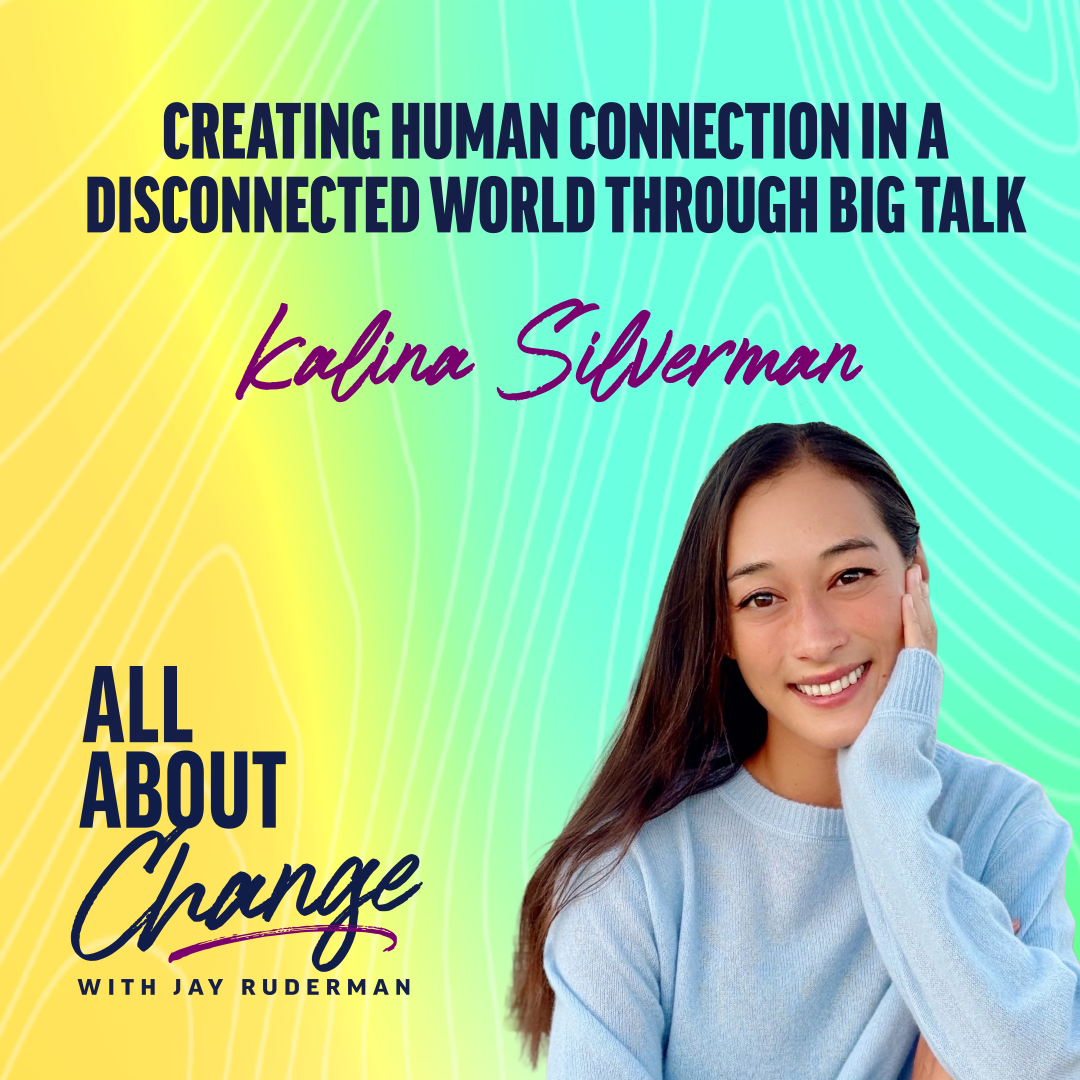
Over the years, people worldwide have shared how Big Talk transformed their lives—from reconnecting with estranged family members and finding love to opening up at work, overcoming depression, finding hope after experiencing loss, and discovering their true purpose. Inspired by this impact, Big Talk evolved into a global initiative to help people connect more openly and meaningfully.
About:
Part of The Ruderman family foundation’s mission statement is “we work to end the stigma surrounding mental health and promote emotional well-being for all” and Kalina is an ally in that project, working on her own towards that same end. Jay and Kalina talk about how we must connect with each other to make sure we can support each other in hard times, and much much more.
TRANSCRIPTION:
Jay Ruderman:
Welcome to All About Change. Now is a great time to check out my new book about activism, Find Your Fight. You can find your fight wherever you buy books and you can learn more about it at jruderman.com. Today, my guest is Kalina Silverman. Kalina is a documentary journalist, entrepreneur, speaker, and creator of Big Talk, an award-winning viral media project that highlights meaningful conversations to foster empathy and human connection. Over the years, people worldwide have shared how Big Talk transformed their lives, from reconnecting with estranged family members and finding love to opening up at work, overcoming depression, finding hope after experiencing loss, and discovering their true purpose. Inspired by this impact, Big Talk evolved into a global initiative to help people connect more openly and meaningfully. Part of the Ruderman Family Foundation's mission statement is we work to end the stigma surrounding mental health and promote emotional wellbeing for all, and Kalina is an ally in that project working on her own towards that same end. Kalina Silverman, I'm so glad to have you as my guest on All About Change. I think that what you've done is so impactful in a world where we live in a lot of superficiality. You've been able to connect with people in a real way and that's resonated, so I commend you for that. I'm really looking forward to this conversation.
Kalina Silverman:
Thanks so much. It's an honor to be on your podcast. I've heard you speak to so many inspiring people, so it's fun to just be here with you today.
Jay Ruderman:
Thank you. Thank you so much.
Jay Ruderman:
Kalina, we're now four years out from the first COVID vaccine, and we lived in a time where we were particularly isolated. There was a tremendous amount of loneliness. What would you say about the state of loneliness right now in 2025?
Kalina Silverman:
I don't think it's changed too much. It seems like every year there's another factor contributing to loneliness. I have received the most messages from people who were suffering with loneliness before COVID. During COVID, I think people actually, if they were lucky, were able to shelter in place with people and actually have that face-to-face contact more often than not. I think now the new factor is AI, technology. It's easier to ask the internet a question than call up someone and ask them a question. I try to stop myself from Googling the answer to everything so I can make sure I have a real conversation about it.
Jay Ruderman:
Yeah, so let's talk about Big Talk because it's become this worldwide phenomena. People really, really connected with it, and it's expanded much beyond yourself. How do you explain that? How do you explain that this is an idea that you had to really cut through the small talk and really get to really what humanity is going through? What resonated with people?
Kalina Silverman:
I call Big Talk a grassroots global movement because it started off with a simple video of me walking up to strangers and skipping small talk. And then people would start messaging me and they'd say, "Hey Kalina, I want to join your Big Talk movement." I never even thought of it that way. I thought it was just a YouTube video that I made in college. And then people started reaching out and sharing examples of how they made big talk in their lives. I received a postcard from Thailand from a group of models who held a pizza party where they wrote down big talk questions and talked about it because they said the modeling industry is superficial. I had soldiers in Korea and Israel reaching out to me saying how the military is super rigid, and it's hard to open up. And so they did big talk in the military. People in prison have written to me talking about how big talk was their solution to opening up about mental health struggles they were going through when they were in the psychiatric ward. I think the reason it's taken off as a movement is because it's such a simple universally resonant idea. It doesn't matter who you are, where you live, what you do, the idea of asking meaningful questions of yourself and others to connect and feel less alone is universal.
Jay Ruderman:
How did you do that breakthrough? How did you take yourself and say, "I'm going to talk to a stranger and I'm going to have a real conversation with that stranger," when maybe that wasn't so comfortable to do?
Kalina Silverman:
It was definitely nerve-racking at first. I remember I was in Germany doing a project about the Holocaust, and I saw a question written on the Berlin Wall. It said, what do you want to do before you die, and that question immediately stirred something emotionally in me. I connected it to this name Big Talk, and that's when I decided to try this experiment. I called it an experiment. I didn't know what would happen. I would approach strangers and skip the small talk to ask them, what do you want to do before you die? The first one was really awkward and I was super nervous, and then I kept walking up to people from all walks of life. It didn't matter if it was a 90-year-old woman, an eight-year-old boy, a businessman in Beverly Hills, a homeless man in Venice Beach. I would ask them all this question and people would break down in tears. People would open up, and their faces would be glowing talking about their dreams in life. I saw how impactful a simple question and approach to conversation could be. That's led me on this journey of 12 years to where I am today.
Jay Ruderman:
One of the brilliant insights that you've had is that people can become lonely in an instant, which I think that we don't think. We think loneliness is something that builds up over time. People are locked away, and they've shut themselves away from the world for whatever reason. Can you talk about an example of how you've talked to these people who are experiencing loneliness and loss and how that went and why that became such a viral moment?
Kalina Silverman:
I think I've learned over time that when you're talking to people about seemingly difficult, taboo, dark, heavy subjects like grief and loss, depression, approach it like you're their friend and don't approach it like it's something heavy. I talk to them with the same tone, something that's optimistic and hopeful and friendly and conversational, and just hear them out. Just listen to them like you're sitting with a friend over drinks chatting about anything, right? And then that way people feel comfortable opening up as well. I think it leads to such profound effects of someone feeling truly heard, comfortable, seen. And then when other people witness these conversations, they too feel like they're just sitting with a friend and hearing about it.
Hazel:
People, they don't realize how blessed they are that they're still here.
Kalina Silverman:
What was the most difficult time of your life, and how did you get through it?
Hazel:
Well, the difficult thing was having my young son... Well, he wasn't all that young, but he was my baby still. He started getting sick. He was going to go into surgery. I said, "Jeffery, I will go downstairs and get something to eat, and I'll be back up." I got back up an hour and a half later, my son had died. It was really hard for me to understand because he had been such a sweet person. He had never been in trouble. He was always trying to help other people, but I wanted to share this with you guys. Be kind. If you are not really out there really touching other people's lives, it doesn't make any difference. I get out here and dance every sunset, and God knows I make a lot of people happy, laugh, and whatever. I just do it. This is me. This is Hazel.
Jay Ruderman:
Do you keep in touch with the people that you've had these conversations with?
Kalina Silverman:
Oh, totally. Not every single one, but a lot of them. I interviewed a woman who recently lost her husband just a few months after they were married. When they got married, they knew he was going to pass away of cancer. And then a few weeks later we met up to play music and jam in the park. I love how a big talk conversation can lead to a real meaningful connection. That was the whole point of Big Talk. Sometimes it's just about a one-off encounter that'll change your perspective or maybe your life. Other times it can lead to a long-lasting friendship, or something else unexpected can come out of it, like an activity or a job opportunity. You never know. Hazel, she's 89 years old now, and she dances at sunset to remember her son. Whenever I go on beach walks, I still see her there every night and she sees me and she goes, "Hey, baby girl." We sit and we talk for a while.
Jay Ruderman:
Wow, that's beautiful. Do you ever feel like when you're interviewing people that you open up yourself and you talk about yourself and what you're going through? Are people able to give you insights and how to maybe see things from a different perspective?
Kalina Silverman:
That's a great question. I find when I'm doing these interviews, I don't really talk too much about myself, but I do feel like each conversation is a mirror. I learn something and take away something profound. Every single conversation leaves behind some sort of life lesson. Maybe because I ask them, if you could share a message with the world or a lesson with the world, what would it be? But it's always surprising, unexpected, and it doesn't matter who it is and what they do in life.
Jay Ruderman:
So Kalina, you've taken this from just a video to a real movement. How are you thinking about scaling Big Talk and what does that look like going forward?
Kalina Silverman:
It's been really exciting to see how Big Talk has grown organically over the years. I never had a business plan when I started, but now I'm thinking more intentionally about how to bring Big Talk into different spaces, like schools, workplaces, and communities. I've started hosting Big Talk workshops and events where people can practice having these kinds of conversations in a guided setting.
Kalina Silverman:
I'm also working on creating resources, like question cards and guides, that people can use on their own. The goal is to make Big Talk accessible to anyone, anywhere, so they can start having more meaningful conversations in their daily lives.
Jay Ruderman:
Do you think that this kind of work can actually help address some of the bigger issues we're facing as a society, like polarization and division?
Kalina Silverman:
I really do. I think when people feel heard and understood, it becomes a lot harder to dehumanize each other. Big Talk creates a space where people can share their stories and listen to others with empathy. And I think that’s a powerful antidote to a lot of the division we’re seeing.
Kalina Silverman:
It doesn’t solve everything, but it’s a starting point. If we can create more spaces for genuine human connection, I believe that can ripple out into larger societal change.
Jay Ruderman:
Before we wrap up, what gives you hope?
Kalina Silverman:
What gives me hope is the people I meet every day. The willingness of strangers to open up, to be vulnerable, to share their stories with me and with each other. It reminds me that beneath all the noise, there’s a deep desire for connection.
Kalina Silverman:
And I think that desire is what will ultimately bring us closer together.
Jay Ruderman:
Kalina, thank you so much for being my guest on All About Change. This has been a really meaningful conversation.
Kalina Silverman:
Thank you so much for having me. I really appreciate it.
Jay Ruderman:
Thank you for being part of the All About Change community. We aim to spark ideas for personal activism, helping you find your pathway to action beyond awareness. So thank you for investing your time with us, learning and thinking about how just one person can make the choice to build a community and improve our world. I believe in the empower of informed people like you to drive real change, and I know that what we explore today will be a tool for you in that effort. All right, I'll see you in two weeks for our next conversation, but just one small ask, please hit subscribe and leave us a comment below. It lets us know that you value this content and it supports our mission to widely share these perspectives. If you're looking for more inspiration, check out this next video. I chose it for you and I know you're going to enjoy it. I'm Jay Ruderman. Let's continue working towards meaningful change together. Today's episode was produced by Tani Levitt and Mijon Zulu. To check out more episodes or to learn more about the show, you can visit our website Allaboutchangepodcast.com. If you like our show, spread the word, tell a friend or family member, or leave us a review on your favorite podcasting app. We really appreciate it. All About Change is produced by the Ruderman Family Foundation.