Emma's Torch’s Kerry Brodie: Cooking Up a New Life for Refugees
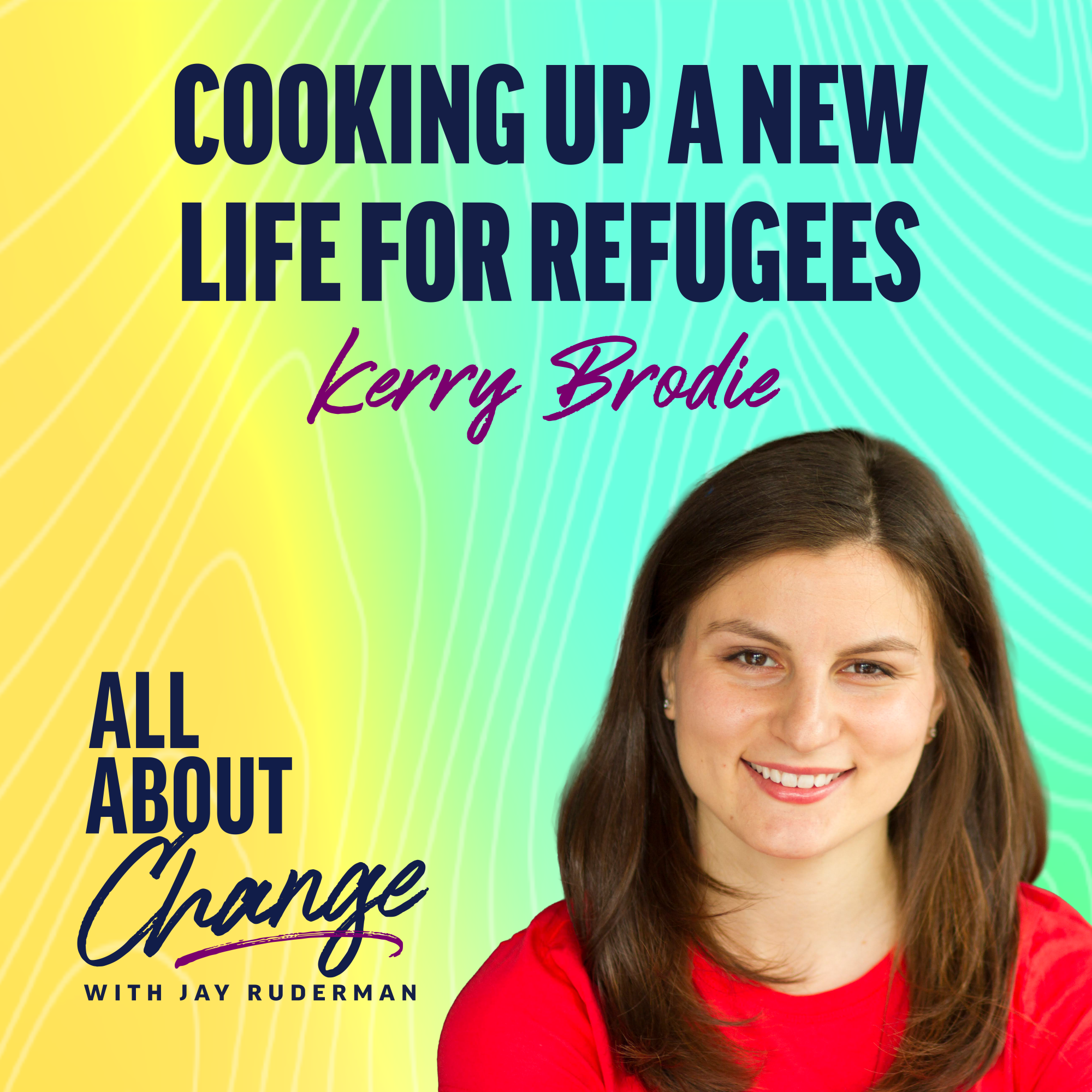
Since its founding in 2016, Emma’s Torch has locations in New York City and recently opened in Washington D.C. and students of the culinary program have gone on to work all over in the restaurant industry.
About:
Kerry and Jay talk about America’s history as a nation of refugees and how the organization is managing the current backlash that refugees in America and other countries are facing.
TRANSCRIPTION:
Jay Ruderman:
Welcome to All About Change. Now is a great time to check out my new book about activism. Find Your Fight. You can find Find Your Fight wherever you buy books, and you can learn more about it at jayruderman.com. Welcome to All About Change. I'm Jay Ruderman. Many years ago, I was involved in opening a program in Boston that trained people with disabilities in food service. The program was a huge success, and they've gone on to work in restaurants across the Boston area. But I remember folks outside our program asking if people in our program could be good employees. This is the same question that my former guest, Steve Preston of Goodwill, is asked when his organization helps folks who are returning to society from prison find work. And it's the same question that today's guest, Kerry Brodie, is asked about her suit employees at Emma's Torch as well. In all three cases, the question is founded on stigma, not facts. People with disabilities, people returning to the workforce, and in Kerry's case, refugees, are all fantastic workers, key parts of our national economy. Kerry Brodie is the founder and executive director of Emma's Torch. Emma's Torch is a non-profit social enterprise that provides refugees with an in-depth culinary training, as well as employability, equity, and empowerment training. Kerry came up with the idea of Emma's Torch while volunteering at a DC homeless shelter. She met refugees looking for jobs, and connected this to report she was reading of understaffing in restaurants. She named her organization after Emma Lazarus, who wrote a poem now emblazoned on the Statue of Liberty that says, "Give me your poor and huddled masses." In a moment where refugees are demonized in our society and others, Kerry is living Emma Lazarus' words, and I'm so excited to have her on the show to talk a bit about community activism and welcoming refugees. So Kerry Brodie, welcome to All About Change. I'm so excited to have you as my guest today.
Kerry Brodie:
Thank you so much for having me. I'm really looking forward to this conversation.
Jay Ruderman:
So let me talk to you about Emma's Torch, which has been recognized this year as part of a growing movement of mission-driven restaurants. And even earlier this summer, Emma's Torch was a finalist for the Rammy Awards, which, Washington DC's recognition of honors for restaurants and bars. Why do you think that food activism has become more of a thing now than when you first had the idea for Emma's Torch?
Kerry Brodie:
I love this question, because I think it speaks to something that's so central to our humanity. I think that people connect over food in ways that can transcend language barriers, backgrounds, trauma, all of these other pieces. But I think to the point about why does it feel so prevalent right now, is I think people are looking for ways in their day-to-day lives, we all eat every single day, hopefully, to live their values. And so I remember during, I was at a protest in the first Trump administration, and somebody said, "Protest is the new brunch." Joking that we don't go to brunch anymore, we go to protest. And I actually think that for many people, brunch is a new protest. If I'm going to buy a cup of coffee, if I'm going to go out on a date, if I'm going to pick up lunch from the workplace, how can that live into my values? Which I think is really a wonderful movement.
Jay Ruderman:
I myself started my career a long time ago in politics, and my feeling back then was, well, politics was really the way to change society. And then I evolved over the years and said, "Well, listen, as an activist who's focused, you can actually have a tremendous impact." So when did you make that switch from saying, "I'm working a public policy and I'm having an impact, but I can have a different kind of impact by being out there in the community and actually starting a business?"
Kerry Brodie:
I think it's important that we all take stock of what our skills are and where we are best suited to serve. I think that everybody in their everyday lives has something to contribute. For me, I thought I was going to be in public policy forever. I grew up watching the West Wing. I wanted to be Sam Seaborn. That was my goal. And I studied for that, and I worked at the Israeli embassy and then the Human Rights Campaign.
Kerry Brodie:
But I learned a lot about myself. One of those things was that I'm not very patient, and I think that that impatience is a challenge when you're working on changing these huge policies. I had the honor of getting to be on the steps of the Supreme Court when marriage equality was announced, and I looked around me and I saw people who had spent decades doing this type of world-changing. And I so deeply admire them, and so many of my colleagues from that period are still very close friends. But it made me realize that that wasn't my skill set. My skill set was how do we do some of those nitty-gritty, on the ground changes that opens up people's hearts and minds, and gives space for those bigger policy changes? And so I think that there's so much space if we think about any of the big challenges facing us, in my case, it was the refugee crisis is really a driving force. There's space along that continuum. There's public policy changes that need to be made, there's local policy changes that need to be made, and then there's that grassroots work. And I think impatience and a real, perhaps sometimes misguided belief that there is always something we can do is why I think I have been so comfortable and been able to find a space in that more grassroots work.
Jay Ruderman:
You make an important point. People think a lot of times that activism has to be on a national level or international level, but sometimes the most effective activism comes on the local level. How did you actually make that change? Because a lot of people can't make that change. And where did you get the idea and also the impetus to really say, "Okay, I'm going to make this change?" Which is a big step.
Kerry Brodie:
I'm very fortunate that I've had amazing mentors at every stage, including in my family. And I think something that I've always appreciated is when we think about activism or just think about, in a very simplistic way, making the world a better place, it requires the humility of recognizing that the world's a very big place and that these are very big problems. And I think sometimes when we get sidetracked, we get into this headspace where it's all or nothing. We must be changing everything at the federal level, otherwise it doesn't count. And for me, it was a very important learning to have a little bit of humility in that, that actually it's good enough if it is changing the story for one person, it's good enough if you're changing the story for one person for one day. Because if everybody focused on changing the story for one person for one day, we'd be in a much better place than we are now.
Jay Ruderman:
Exactly.
Kerry Brodie:
And that's not to say that there's not space on that other end, but you asked about how I made that shift. I think it was a couple of factors. One of them was definitely recognizing my own limitations. I really enjoyed the work that I was doing, but the part that was filling me up and giving me a lot more hope and really motivating me throughout the day was volunteering at a homeless shelter in the mornings on my way to work. And I was just handing out muffins. That, for me, felt world-changing, and really catalyzed a lot of my understanding of interacting with people across barriers. But it's not the most exciting thing to ever happen to somebody at 7:30 in the morning. And so those conversations I was having at that shelter while I was volunteering helped me come to the realization that this jump might be worthwhile. And then very fortunate, I had a crazy idea that I told my husband, and in the naive way of 25-year-olds, he was like, "Well, I don't know. Why don't you give it a shot? What's stopping you?" And I do sometimes think that we don't ask ourselves that question of what's stopping us, because the answer is scary sometimes. The answer is our own insecurities, or our own beliefs, or our own unwillingness to recognize some of that humility. So that was my story, at least, and I'm very grateful that I've had my husband as well as so many great friends and mentors who helped me go from that to starting Emma's Torch.
Jay Ruderman:
So can you talk a little bit about, way back when Kerry's volunteering and handing out muffins. And what were the interactions like? What did you learn from that experience?
Kerry Brodie:
I learned a lot about how similar we all are. I think it's very easy when you're not interacting with people who have different life experiences than you to create distance, and to think, "Oh, that could never be me," or "We're so different." And I think one of the most powerful things about those mornings was realizing that the conversations I was having were conversations that I could have with my friends, with my family, with my coworkers. It was about hopes and dreams and frustrations and fears. And I think that was really powerful.
Kerry Brodie:
I also learned a lot about dignity. I think sometimes when we think about service or volunteering, we can unintentionally strip people of their dignity, because we come in thinking we are the helpers and they are the ones being helped. And I think one of the most important lessons I learned was that it's about mutual respect and mutual dignity. And that really informed how we built Emma's Torch, because we didn't want it to be a charity model where people are coming in and receiving something. We wanted it to be a place where people are gaining skills, building community, and moving forward in their lives with agency and empowerment.
Jay Ruderman:
That's really powerful. And I think that speaks to something that is often missing in conversations about refugees and immigrants, which is that sense of dignity and respect. Can you talk a little bit about the people who come through Emma's Torch? Who are they, and what are some of their stories?
Kerry Brodie:
Absolutely. Our students come from all over the world. We've had students from over 60 countries at this point, and each of them brings such a unique story and set of experiences. Some of our students were chefs in their home countries and are looking to continue that career here. Others have never worked in a kitchen before and are starting completely fresh.
Kerry Brodie:
What unites them is that they are all navigating a new life in a new country, often after experiencing significant trauma or displacement. And they are incredibly resilient. I think resilience is the word that comes to mind over and over again when I think about our students. They show up every day ready to learn, ready to work, ready to build something new for themselves and their families.
Jay Ruderman:
And what does the program actually look like? What do they go through when they come to Emma's Torch?
Kerry Brodie:
Our program is about 11 weeks long, and it's a full-time culinary training program. Students are in the kitchen learning knife skills, cooking techniques, food safety, all of the things that you would expect from a culinary program. But in addition to that, we also focus heavily on what we call wraparound services. So that's English language support, job readiness training, things like resume building, interview skills, workplace culture.
Kerry Brodie:
We also provide things like legal support, case management, and really try to meet students where they are. Because again, it's not just about the technical skills, it's about everything else that goes into being able to succeed in a new environment.
Jay Ruderman:
What have you seen in terms of outcomes? What happens to people after they complete the program?
Kerry Brodie:
We have seen incredible outcomes. The vast majority of our graduates go on to secure employment within a few months of completing the program, often in restaurants, catering companies, or other food service roles. But beyond that, we see people gaining confidence, building networks, and really starting to feel a sense of belonging in their new communities.
Kerry Brodie:
I think one of the most meaningful outcomes is when we see alumni coming back to mentor current students, or when they refer friends or family members to the program. That sense of community and paying it forward is really powerful.
Jay Ruderman:
That’s amazing. And I imagine that there are also challenges. What are some of the biggest challenges that you face in running Emma’s Torch?
Kerry Brodie:
There are definitely challenges. Funding is always a challenge for nonprofits, especially when you're trying to provide comprehensive services. There's also the broader political and social climate around refugees and immigrants, which can impact both our students and our ability to do our work.
Kerry Brodie:
But I think the biggest challenge is making sure that we are always evolving to meet the needs of our students. The world is constantly changing, and the needs of refugees are not static. So we have to be constantly listening, learning, and adapting.
Jay Ruderman:
Before we wrap up, what gives you hope?
Kerry Brodie:
What gives me hope is our students. Every single day, I get to see people who have gone through incredibly difficult experiences show up with courage, determination, and a desire to build a better future. That is incredibly inspiring.
Kerry Brodie:
And beyond that, what gives me hope is the community that surrounds Emma’s Torch. The volunteers, the staff, the partners, the employers who are willing to take a chance on someone and see their potential. It reminds me that there is so much good in the world.
Jay Ruderman:
Kerry, thank you so much for being my guest on All About Change. This has been an incredibly inspiring conversation.
Kerry Brodie:
Thank you so much for having me. I really appreciate it.
Jay Ruderman:
Thank you for being part of the All About Change community. We aim to spark ideas for personal activism, helping you find your pathway to action beyond awareness. So thank you for investing your time with us, learning and thinking about how just one person can make the choice to build a community and improve our world. I believe in the empower of informed people like you to drive real change, and I know that what we explore today will be a tool for you in that effort. All right, I'll see you in two weeks for our next conversation, but just one small ask, please hit subscribe and leave us a comment below. It lets us know that you value this content and it supports our mission to widely share these perspectives. If you're looking for more inspiration, check out this next video. I chose it for you and I know you're going to enjoy it. I'm Jay Ruderman. Let's continue working towards meaningful change together. Today's episode was produced by Tani Levitt and Mijon Zulu. To check out more episodes or to learn more about the show, you can visit our website Allaboutchangepodcast.com. If you like our show, spread the word, tell a friend or family member, or leave us a review on your favorite podcasting app. We really appreciate it. All About Change is produced by the Ruderman Family Foundation.