Gary Sinise: Doing More for Our Veterans with the Gary Sinise Foundation
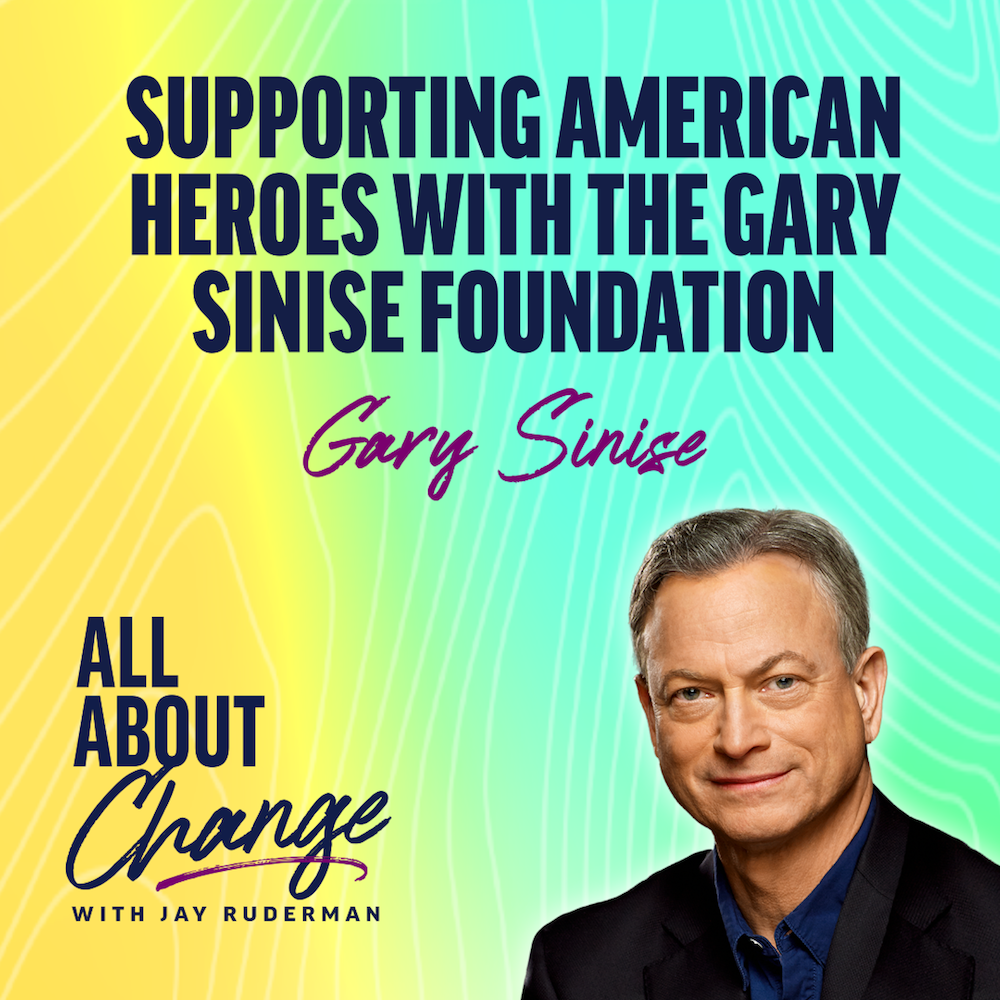
He is best known for playing Lieutenant Dan in Forrest Gump. Inspired by this role and his family members, Gary is now the head of the Gary Sinise Foundation, which offers support for service members who need help with mental wellness, trauma, physical recovery, and loss. He Also plays concerts worldwide for our nation’s defenders and their families, boosting morale and offering gratitude for their sacrifices as part of the Lt. Dan Band.
About:
Jay and Gary discuss the changing needs of American service members and their families, the many services the Gary Sinise Foundation provides, how Gary’s work helped him through personal loss and much more.
TRANSCRIPTION:
Jay Ruderman:
Welcome to All About Change. Now is a great time to check out my new book about activism, Find Your Fight. You can find Find Your Fight wherever you buy books, and you can learn more about it at jayrudermancom. Today my guest is Gary Sinise. Gary is an award-winning actor on stage, TV, and the big screen. He's best known for playing Lieutenant Dan in Forrest Gump. Alongside his acting career, Gary has been an advocate for American service members and their families for the past 40 years, an effort that only grew stronger after his iconic portrayal of Lieutenant Dan. Gary is now the head of the Gary Sinise Foundation, which offers support for service members who need help with mental wellness, trauma, physical recovery, and loss. He also plays concerts worldwide for our nation's defenders and their families, boosting morale and offering gratitude for their services as part of the Lt. Dan Band. Gary Sinise, welcome to All About Change. I'm so excited to have you as my guest today.
Gary Sinise:
Well, thanks for having me. Good to be with you.
Jay Ruderman:
So Gary, you started standing out for American military members a long time ago, and as America's military is engaged in widely different conflicts across the world, when you zoom out, can you paint a picture of the American service members and their families changing needs during the many decades of your activism?
Gary Sinise:
Getting active with supporting veterans started really with the Vietnam veterans in my family back in the '80s. My wife has two brothers who both served in Vietnam. So in the '80s, I got involved with supporting local Vietnam veterans in the Chicago area and supporting them through my theater company. Because of my brothers-in-law, I wanted to do a piece of theater that would speak to the Vietnam veteran experience, and I found one that was written by a group of Vietnam veterans. I did that play in 1984 leading to getting involved with local Vietnam veterans groups in the '80s, supporting them and having them come to the play over and over and over, raising money for them and getting involved. It was from there that I really started to... That created a foundation for which I jumped off, eventually playing Lieutenant Dan in Forrest Gump, who was a Vietnam veteran as you recall. He was a disabled, wounded Vietnam veteran.
Gary Sinise:
So I started working with our wounded at that time. And then September 11, seven years later after Forrest Gump and working with our wounded, I felt like the Vietnam days of the 1980s and getting involved with Vietnam veterans and then playing the wounded veteran, getting involved with supporting our wounded in the '90s, those were just teeing me up for a very active service life supporting the men and women who served our country. And that's what happened after September 11th, 2001. I didn't want the men and women who were deploying to Iraq and Afghanistan to come home to the same kind of reception that our Vietnam veterans had when they came home. So I jumped in and I got very, very active, and all of that led to the creation of my own foundation.
Jay Ruderman:
And you've done so much. You've donated hundreds of millions. I think I heard the figure $500 million.
Gary Sinise:
We've raised that much. I haven't donated that, but we've raised over 500 million in the 15 years.
Jay Ruderman:
How do you see the change over time of how we as Americans see people who have given the ultimate sacrifice to protect us?
Gary Sinise:
That's where I was trying to get to with that long-winded answer, bringing it up to speed there because you asked me that initially, because I wanted to go back to the Vietnam days, because things are significantly different now for folks that are serving in the military versus the way it was then. And of course, World War II veterans in my family, my two uncles, my World War I grandfather, my dad served in the Navy during Korea.
Gary Sinise:
World War II, they came home. It was a difficult time for people coming home from war in World War II because of the severity of what happened there. You could be deployed for four years just seeing all kinds of bad stuff every single day, and then you had to come home from that. But they came home to a grateful nation, a nation that was really behind them and supportive of them for what they had done to keep us all free from tyranny.
Gary Sinise:
Coming home from Vietnam was a very different thing, getting spit on, falling into the shadows, pretending you didn't serve your country just to get by the day. Because if somebody knew you did, they'd call you a baby killer or whatever. I mean, it was just a terrible time to be a service member. It was a difficult time for the Army. I remember learning quite a lot from my Vietnam veteran brother-in-law about what it was like to serve there and then come home.
Gary Sinise:
Very, very difficult time. And I think in some ways, Jay, we've tried to make amends for that. During this period of time after September 11th when we were attacked brutally by Al-Qaeda, we've seen tens of thousands of nonprofits popping up all over the place to give back to the people that are serving our country. That is significantly different from the days of Vietnam when there weren't those kinds of services being provided.
Gary Sinise:
To have served in Vietnam was a thing that our veterans were supposed to be ashamed of. And so they disappeared into the shadows. Now you have multiple services all over the place. And I've supported many, many nonprofits that are trying to give back to our active duty folks and our veterans and our first responders today that are there to ensure and to take up the charge to make sure that what happens to our Vietnam veterans, what happened then does not happen today.
Gary Sinise:
And so there is a significant difference. Is it enough? No, it's never enough because there's too many veterans out there, and there's too many veterans that continue to fall through the cracks because they may not know where these nonprofits are that are there to serve them.
Clip 1:
John believes the burden of helping him cope shouldn't fall on his wife. He says when he turns to his nearest VA location in McAllen, it's understaffed and he cannot get help.
Clip 2:
The only thing that I ask is people come to work. You go to check in, and there's no one. You come to try and walk in and they're full. They don't have enough doctors.
Gary Sinise:
And there are plenty of services out there to provide our veterans beyond the VA system. The VA can do what it does, the government does what it does, but it's not going to be enough because there's just too many veterans. We're building homes for very, very badly wounded service members. And while the VA provides housing grants, it's a small amount. It's not going to build an entire house for millions of veterans.
Gary Sinise:
So thankfully, there are many, many nonprofits that are stepping up to provide specially adapted smart technology housing for very, very severely wounded service members. That's just something that wasn't really done back in the Vietnam days. And you find a lot of services being provided now that you wouldn't have seen then. So things are different, but I always say we can never do enough for the men and women who serve our country. We can always just find ways to do more, and that's what we're doing at the Gary Sinise Foundation.
Jay Ruderman:
After you played Lieutenant Dan in Forrest Gump, the Disabled Veterans Association of America invited you to speak and gave you a standing ovation. How did that feel like to you to be in a room with hundreds, I don't know, maybe thousands of veterans and they're applauding you for the way you portrayed a veteran on screen?
Gary Sinise:
Thank you for asking, Jay. This was a significant moment. It was an impactful moment. No question. It was 1994. It was just weeks after Forrest Gump had come out. In Forrest Gump, of course, I play a wounded Vietnam veteran, a double amputee. The Disabled American Veterans Organization invited me to come to their national convention to receive an award that they wanted to give me for playing what they considered to be a positive portrayal of a wounded veteran.
Gary Sinise:
And it is a positive portrayal because even though Lieutenant Dan goes through a lot of tough stuff in the movie, it's a happy ending at the end of the movie. And we had never seen that before, a Vietnam veteran portrayed in a film as someone who could move on and be very, very successful. It's a hopeful ending. And that was very, very positive to the members of the DAV.
Gary Sinise:
Many of them, of course, real life Lieutenant Dan's. There were a couple of thousand wounded veterans in that ballroom. So it was significantly impactful to me to walk out and see all these folks, everyone who wasn't in a wheelchair who could stand up or standing up and giving me a standing ovation. People with no arms, no legs, really going all the way back to World War II. And up until that point, this was 1994, so it would have been through the Gulf War.
Gary Sinise:
So you had wounded veterans from World War II through the Gulf War all in that ballroom cheering me on. It was a profound moment for me. And from that point on, I stayed very actively involved with supporting the DAV and wanting to do more for our wounded. It was a big moment. I write about it in my book, Grateful American. In fact, the first page of the book begins with that moment that you asked me about walking out on the stage of the DAV Convention.
Jay Ruderman:
One thing that you've talked about that really resonated with me and I think is such an important message is by helping others, we step out of ourselves. We can be very self-absorbed and thinking about what's going on in everyday life, but by helping others, you can step out of that and you can achieve in some ways a higher meaning. I think that is such an important message, and I think that's a message that's lost on many people in society.
Gary Sinise:
Well, it's absolutely true, and I've found it through our own challenges at home when I'm out there helping somebody with a new house or visiting a hospital and seeing somebody who's maybe wounded or challenged in a big way physically and emotionally. Somebody like me walks in and you bring some light in with you. And when you leave, it's a little lighter in there, and I could see that that was happening.
Gary Sinise:
And so you see the impact that just showing up has when you just simply show up to do something for somebody. And it doesn't have to be money. It doesn't have to be providing money. Money is absolutely necessary to get the big job done, the big job, but there's no comparison to the personalized message of support that wrapping your arms around somebody can do when they're going through a difficult thing.
Jay Ruderman:
Growing up, you played in bands. Some have suggested that it was at the expense of your schooling. But all these years later, you get to use that rebellion to help people. You founded the Lt. Dan Band and you play for the country's service members.
Gary Sinise:
I've met a lot of incredible people serving our country. I want to help. I want to be a part of supporting them. I know where my freedom comes from and I don't take it for granted. So we're producing this show today with the generosity of the American people who support my foundation. We can make sure everybody has a good time and knows they're appreciated.
Jay Ruderman:
Do you ever think about how many of your passions that you've had growing up you've been able to incorporate into your activism?
Gary Sinise:
I played music as a kid. I struggled in high school, as you mentioned. Thank you for mentioning that.
Jay Ruderman:
Sorry about that.
Gary Sinise:
No, it's okay. It's in the book. I did. I struggled through academics from an early, early age all the way through high school and everything. But I did find that the arts were something that I kind of fell into and was kind of good at music. I got my first guitar in fourth grade, started to learn how to play it and had bands from sixth grade all the way through my early 20s until I got so busy with acting that I put it away for a while.
Gary Sinise:
And then I stumbled into acting kind of by accident in high school as well. And I found, okay, I'm good at playing music and I'm good at acting. I might not be good at math and science and history and English and everything else in between, but I am pretty good at getting on stage and performing. When I graduated from high school, I just kept doing the acting thing.
Gary Sinise:
But because I got so busy with the acting, I put the guitar away for a long time and didn't play until the late '90s. I just started picking it up again and doing it. And then as I said, September 11th happened, and I started going on USO tours. And Kid Rock was on the first tour that I was on, and he was rocking out. And I was Lieutenant Dan shaking hands and taking pictures. And Kid Rock and others were putting on the show.
Gary Sinise:
And then I'd go out on stage and say hi to the troops and they'd yell, "Lieutenant Dan." And I thought, I have some people that I play with. I'd love to take them on a tour. And then the USO set up a tour, and then another one, and then another one. I've done 100 USO tours since then and many, many more with the Gary Sinise Foundation all over the country and overseas. And I could see what showing up and playing some music on military bases could do for folks.
Gary Sinise:
And I enjoy playing music. I never thought all those years ago that music would be a thing that I would be doing so much. I'm 70 years old. I just turned 70 a couple of weeks ago and I'm still rocking for the troops here. I've been doing it for over 20 years. I do it all for free. It's all part of the mission. So could I have predicted all the way back then that I would be playing music in this way and it would be part of the mission? I could not have. No.
Jay Ruderman:
Gary, I want to thank you for being my guest on All About Change. I want to thank you for your decades of service to our country and your commitment to helping others. You've inspired so many people, and it's really an honor to have you on the show.
Gary Sinise:
Well, thank you, Jay. I appreciate it very much. Thank you for what you're doing as well.
Jay Ruderman:
Thank you for being part of the All About Change community. We aim to spark ideas for personal activism, helping you find your pathway to action beyond awareness. So thank you for investing your time with us, learning and thinking about how just one person can make the choice to build a community and improve our world. I believe in the power of informed people like you to drive real change, and I know that what we explore today will be a tool for you in that effort.
Jay Ruderman:
All right, I'll see you in two weeks for our next conversation, but just one small ask. Please hit subscribe and leave us a comment below. It lets us know that you value this content and it supports our mission to widely share these perspectives. If you're looking for more inspiration, check out this next video. I chose it for you and I know you're going to enjoy it. I'm Jay Ruderman. Let's continue working towards meaningful change together.
Jay Ruderman:
Today's episode was produced by Tani Levitt and Mijon Zulu. To check out more episodes or to learn more about the show, you can visit our website Allaboutchangepodcast.com. If you like our show, spread the word, tell a friend or family member, or leave us a review on your favorite podcasting app. We really appreciate it. All About Change is produced by the Ruderman Family Foundation.