Jane Velez-Mitchell – Sober and Vegan for the Planet
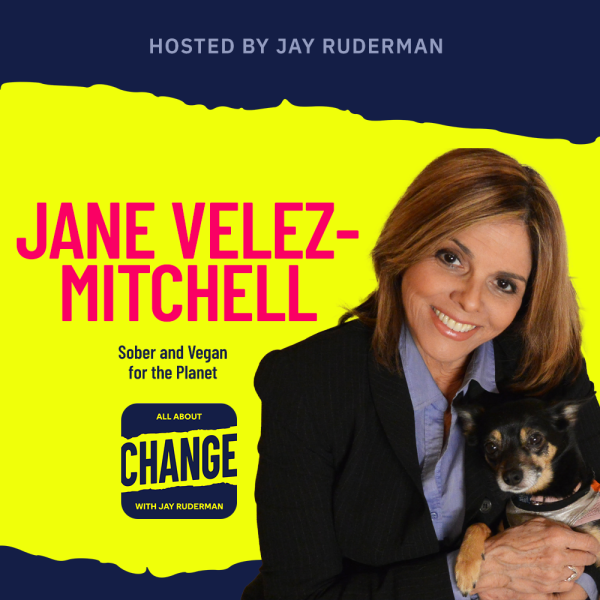
Jane Velez-Mitchell is best-known for her work in broadcast television, but her career – and life – has been a master class in making a change and sticking to it. After confronting her alcoholism as an early career journalist, Jane began living more authentically than she ever had before. She came out as a lesbian, became a vegan, and founded a free streaming platform dedicated to education around the impact diet can have on health – both the body’s, and the planet’s.
About:
Jane joined host Jay Ruderman for a conversation that spanned the wide breadth of her career, and the personal choices she made along the way. To learn more about Unchained TV.
TRANSCRIPTION:
Jane Velez-Mitchell:
I decided I’m just going to be who I want to be and that was a sober, lesbian, vegan. Take it or leave it.
Jay Ruderman:
Hi, I am Jay Ruderman and welcome to All About Change, a podcast showcasing individuals who leveraged the hardships that have been thrown at them to better other people’s lives.
Montage:
I say put mental health first, because if you don’t, then…
Montage:
This generation of America has already had enough.
Montage:
I stand before you not as an expert, but as a concerned citizen.
Montage:
Yes, we can. Yes, we can.
Montage:
Louder.
Montage:
Yes, we can.
Montage:
Louder.
Montage:
Yes, we can.
Montage:
Louder.
Montage:
Yes, we can.
Jay Ruderman:
Before becoming a radio and TV journalist, Jane Velez-Mitchell was raised in Manhattan by a showgirl mom and an ad exec dad who exposed her to alcohol at a very young age.
Jane Velez-Mitchell:
My parents had these big cocktail parties and people were drinking martinis and leaving their glasses around and I would drink some of the alcohol in the glasses.
Jay Ruderman:
After graduating NYU, Jane Velez-Mitchell quickly rose through the broadcast ranks, working in Fort Myers, Minneapolis, Philadelphia, and New York before anchoring in Los Angeles. It was there at a Hollywood party that she was confronted by her own battle with alcohol addiction.
Jane Velez-Mitchell:
Everybody I knew was there. The next day, I woke up feeling incomprehensible demoralization, and I asked a friend who had recently gotten sober for help. Thank God, one day at a time since that moment, I have not had a drink.
Jay Ruderman:
In facing her addiction, Jane realized that it came from not being her authentic self. From then on, her commitment to being authentic helped make some changes like coming out on live radio in 2007.
Jane Velez-Mitchell:
The funny part was that it really wasn’t that big a deal. As my ex-boyfriend, we’re still good friends, and he had a great sense of humor. He said, “It’s worse than that, Jane. Nobody’s thinking about you at all.”
Jay Ruderman:
Confronted with the moral dilemma of industrial animal agriculture, she realized she wanted to be of service to both humans and animals. So she became a vegan and founded UnchainedTV, a free network advocating for the health, ethical, and environmental benefits of plant-based living.
Jane Velez-Mitchell:
You can’t solve the climate crisis without looking at animal agriculture. People are just talking about electric cars. The United Nations itself did a report back in 2006. It said animal agriculture is responsible for more greenhouse gas emissions than all transportation combined.
Jay Ruderman:
Jane Velez-Mitchell, thank you so much for being my guest on All About Change. Let me just jump right into it. You’ve had a very storied career, but what I found inspiring about your story is the incredible change in mindset that you were able to accomplish first with your choice to get sober in 1995. For those of our listeners who are not familiar with your story, let’s start at the beginning. Can you tell us what happened growing up in Manhattan?
Jane Velez-Mitchell:
Well, I grew up in Midtown Manhattan directly across from Carnegie Hall, so you can’t get more Midtown than that, 57th and 7th. I had a very fascinating childhood. My dad was a Madison Avenue advertising executive, straight out of Mad Men. Never knew a pair of jeans, drank the martinis, and smoked the Pall Mall and had a pipe as well. My mom was from Puerto Rico. She was a showgirl, a dancer, and she had her own dance troupe, Anita Velez dancers. My parents met because my father was a great ballroom dancer. He was Irish-American and my mom was a professional dancer and they liked to stop traffic. They liked to go to these parties back when there were live bands and everybody did ballroom dancing and people would watch them because they were so good at it. I was exposed to a lot of cocktail parties as a child. My parents had these big cocktail parties and people were drinking martinis and leaving their glasses around and I would drink some of the alcohol in the glasses.
Jay Ruderman:
When you were finishing off the ends of the drinks of your father and people at the parties, did people understand at that time what addiction was? Were you aware that you could be developing an addiction to alcohol?
Jane Velez-Mitchell:
Well, my father was a high-functioning alcoholic. I mean, it’s a self-diagnosed disease. He’s no longer with us. Sorry, Dad, but, yeah, he was a high-functioning alcoholic. Yeah, I was very lucky. I never got a DUI. I didn’t lose the house, the car, the job, but I also followed my father’s, I would say, method of alcoholism, which was I never drank before work, I never drank on the job. It was always after work. I was sometimes hungover. I went to a party in Hollywood. All my friends were there, my agent was there, and her husband and my ex-husband and my current boyfriend. I started drinking tequila, which was always like the worst thing. I could keep it together if I had chardonnay, but with tequila, all bets were off and I got wasted and went into a blackout. The next thing you know, I was being taken out of the party and I was like, “Why are we leaving? Why are we leaving?” And it was embarrassing because everybody I knew and cared about was there, but that was really good because it was like, “This is your life.” They were all there at once. There was no making it look good. The next day I got help and that was the last day I ever had a drink. Right now, it’s 28 years. By April Fools’ Day it’ll be 29 years. I’ve often said my worst day sober is better than my best day drunk.
Jay Ruderman:
Well, first of all, congratulations on that. That’s a huge accomplishment. Did someone say something to you like, “Jane, you need to get some help,” or was this something that you just came to and you said, “I need to make a change in my life”?
Jane Velez-Mitchell:
No, I think only your good friends, your true friends will tell you you have a problem. A lot of my fair weather friends were like, “Oh, you were fine. Don’t worry about it. It was fun.” But there were a few true friends, like this friend of mine that I went to college with, who had gotten sober himself, who told me, “You’ve got to stop drinking.” First, I said, “You’re not my mother.” But after that experience, I called him up and I said, “You’re right. I’m turning myself in.” That’s literally what I said. I find that in situations like this, only your true friends will tell you, but you know that you can’t drag anybody into sobriety who’s not ready. It’s literally only the person who has the issue can declare that bottom hit.
Jane Velez-Mitchell:
That’s the nature of addiction. The nature of addiction is there’s a substance or a behavior you can never successfully negotiate with, and the only power you have is the power to not negotiate at all, to walk the other way, and so it’s a dichotomy. The power is in admitting you’re powerless. I was very blessed that after I had some clarity and I was able to see, “Wow. Okay, this is life on life’s terms.” Sure, there will be dark moods, but you don’t have to drown them out. You can just sit through the feelings. They don’t last forever.
Jane Velez-Mitchell:
After having some clarity, I make some big changes in my life. I realized that one of the reasons that I was drinking was to suppress my sexuality and I came out as gay. That was another miracle, getting sober, coming out as gay, and then what I did afterwards is realized that I have certain values. I like to consider myself a compassionate, kind person, and I decided to align my behavior more with those values. I became a vegan and I started to do work to wake people up to the horrors of industrialized animal agriculture.
Jane Velez-Mitchell:
All of that would not have happened, none of that would’ve happened had I still been drinking. I was really able to restart my life on a much better footing and be present and figure out who I am. I have this as a refrigerator magnet. Oscar Wilde says, “Be yourself. Everybody else is already taken.” I think that’s one of the best statements, because, well, I’ll speak for myself, I was trying to be whatever my father wanted me to be, my mother wanted me to be, and society wanted me to be. I decided I’m just going to be who I want to be and that was a sober, lesbian, vegan. Take it or leave it.
Jay Ruderman:
Okay. Can you talk about coming out and why you came out? You came out at a time where it wasn’t like it is today. It wasn’t as accepted. What was the fallout from coming out?
Jane Velez-Mitchell:
I was one of the first on-camera TV journalists to come out. Now, I didn’t do a deep dive undercover investigation into this, but there may be people before me, but I don’t know too many as far as especially lesbians. What happened was I fell in love with somebody, a woman, and I was living with her. I was also doing some freelance work at KABC Radio and I was co-hosting with this what they call a log cabin Republican, which is a gay Republican. We were talking about Senator Larry Craig, the toe-tapping senator who was caught in the Minneapolis-Saint Paul Airport bathroom, and who hotly denied that he was doing anything but going to the bathroom. But it was the topic du jour. A lot of people were talking about it and so we were talking about that.
Jane Velez-Mitchell:
You know how radio is, it goes on for hours. TV, you’d have a two-minute or three-minute segment. We were talking about this for an hour and 45 minutes and my co-host was talking about how he came out to his mother and blah, blah, blah. I was just starting to get this horrible feeling of hypocrisy. Here I am, talking about this other person’s alleged hypocrisy, and I’m living with a woman and I haven’t told anybody publicly about it. At that moment, I had a crisis of conscience and I felt icky. I called my girlfriend at the time and I said, “Turn on KABC Radio. I’m going to come out.” After the commercial, I did, I came out. I said, “Well, I live with a woman…” And I don’t even remember what I said after that.
Jane Velez-Mitchell:
The funny part was that it really wasn’t that big a deal. As my ex-boyfriend who we’re still good friends and he had a great sense of humor, he said, “It’s worse than that, Jane. Nobody’s thinking about you at all.” I think a lot of the fear that I had, a huge fear, first of all, to tell myself that I was gay. I gave it the old college try heterosexuality. I was married. I dated men and I am not saying I had bad relationships and I can say that, however, despite all that, I’m gay. It took a lot of basically, well, therapy and getting sober.
Jane Velez-Mitchell:
Once I didn’t have the alcohol to hide behind, it became harder for me to lie to myself. Once that was taken away and I had to live life on life’s terms, I literally started realizing, “Why do I want to go through my life like lying about such a key aspect of my personality?” I don’t think it’s about sex as much as it is about being true to who you are. Again, as Oscar Wilde said, “Be yourself. Everybody else is already taken.” I think that the courage to be myself resulted in me coming out and I’m very happy I did. Sure, there was some gossip, but then when I actually came out, I was just freelance. I’ll be honest, it helped me come out that I was freelance. If I had been under contract somewhere, it might’ve been trickier, but I was freelance and so I took the opportunity.
Jay Ruderman:
So you’ve had this personal transformation—sobriety, coming out, becoming vegan—and you mentioned aligning your behavior with your values. Can you talk a little bit about that moment when you realized that your lifestyle and your values were not aligned, especially when it came to animals?
Jane Velez-Mitchell:
Yeah, absolutely. I think that’s something that happens to a lot of people. We all consider ourselves good people. We don’t want to cause harm. But then when you start to look more closely at certain industries, certain behaviors, you realize, “Wait a second, I’m participating in something that is causing harm.” For me, that moment came when I started to learn about factory farming, about what happens to animals behind closed doors.
Jane Velez-Mitchell:
And I remember thinking, “If this is true, I don’t want to be part of it.” But at the same time, like a lot of people, I didn’t want to know. I think there’s a part of us that resists that information because it’s uncomfortable. But once you see it, once you really understand it, you can’t unsee it. And that was my experience.
Jane Velez-Mitchell:
So I made the decision to become vegan, and it wasn’t just about diet. It was about aligning my life with my values of compassion and nonviolence. And once I did that, I felt a sense of integrity that I hadn’t felt before. It was like, “Okay, now I’m walking the talk.”
Jay Ruderman:
And then you took it a step further by becoming an activist and starting UnchainedTV. What was the motivation behind that?
Jane Velez-Mitchell:
Well, once you see something that you believe is an injustice, it’s very hard to just stay silent. I felt like I had a platform, I had experience in media, and I wanted to use that to make a difference. So I started UnchainedTV as a way to give a voice to this movement, to share information, to inspire people.
Jane Velez-Mitchell:
We’re living in a time where media is so powerful. It shapes how people think, how they feel, what they believe. And I wanted to create a space where people could learn about plant-based living, about the environmental impact, the health benefits, the ethical considerations.
Jane Velez-Mitchell:
It’s not about judging people. It’s about giving them information and letting them make their own choices. But I do believe that once people have the information, many of them will choose compassion.
Jay Ruderman:
You’ve been very outspoken about the connection between animal agriculture and climate change. Why do you think that message hasn’t fully broken through to the mainstream yet?
Jane Velez-Mitchell:
I think there are a lot of powerful interests that don’t want that message to get out. The animal agriculture industry is huge, and there’s a lot of money involved. And when there’s a lot of money involved, there’s often a lot of influence.
Jane Velez-Mitchell:
But I also think it’s a difficult message because it asks people to change their habits, their traditions, their comfort zones. And that’s never easy. People are more comfortable talking about things like electric cars because it doesn’t require as much personal change.
Jane Velez-Mitchell:
But the reality is, if we’re serious about addressing climate change, we have to look at all the factors, including what we eat. And that’s why I continue to speak out about it.
Jay Ruderman:
What advice would you give to someone who is going through their own transformation right now, whether it’s related to addiction, identity, or values?
Jane Velez-Mitchell:
I would say be patient with yourself and be honest with yourself. Change doesn’t happen overnight. It’s a process. And it can be scary because you’re letting go of old identities, old habits, old ways of being.
Jane Velez-Mitchell:
But on the other side of that fear is freedom. When you start living authentically, when you align your actions with your values, there’s a sense of peace that comes with that.
Jane Velez-Mitchell:
And also, don’t be afraid to ask for help. Whether it’s friends, support groups, therapy—whatever it is. We’re not meant to do this alone.
Jay Ruderman:
Jane, as you look back on your journey—from addiction to sobriety, from hiding your identity to living authentically, and from being a journalist to becoming an activist—what does “change” mean to you today?
Jane Velez-Mitchell:
Change means evolution. It means growth. It means being willing to look at yourself honestly and say, “Where can I do better?” And not from a place of shame, but from a place of curiosity and compassion.
Jane Velez-Mitchell:
I think a lot of people resist change because they think it means they were wrong before. But I don’t see it that way. I see it as, “I learned something new, and now I’m going to do better.” That’s a beautiful thing.
Jane Velez-Mitchell:
And I also think change is contagious. When you change, when you live authentically, when you stand up for what you believe in, you inspire other people to do the same. You don’t even have to tell them what to do. Just by being who you are, you give them permission to be who they are.
Jay Ruderman:
That’s powerful. And for people who are listening and maybe feel overwhelmed by the state of the world—there are so many issues, so many problems—what would you say to them? Where do they start?
Jane Velez-Mitchell:
Start where you are. You don’t have to solve everything. You don’t have to save the world overnight. Just pick something that matters to you and take one step.
Jane Velez-Mitchell:
Maybe it’s changing what you eat. Maybe it’s having a conversation with a friend. Maybe it’s volunteering. Maybe it’s just learning more about an issue. Every step counts.
Jane Velez-Mitchell:
And don’t underestimate the power of small actions. Small actions, when multiplied by many people, can create massive change.
Jay Ruderman:
Jane, thank you so much for sharing your story and your insights. It’s been truly inspiring.
Jane Velez-Mitchell:
Thank you so much for having me. I really appreciate it.
Jay Ruderman:
Thank you so much for listening to All About Change. Today’s episode was produced by Tani Levitt and Mijon Zulu. Stay tuned for our next episode. Spread the word, tell a friend or family member, or leave us a review on your favorite podcasting app. We’d really appreciate it. That’s all for now. I’m Jay Ruderman, and we’ll see you soon with another episode of All About Change.