Julianna Margulies – The Vital Importance of Holocaust Education
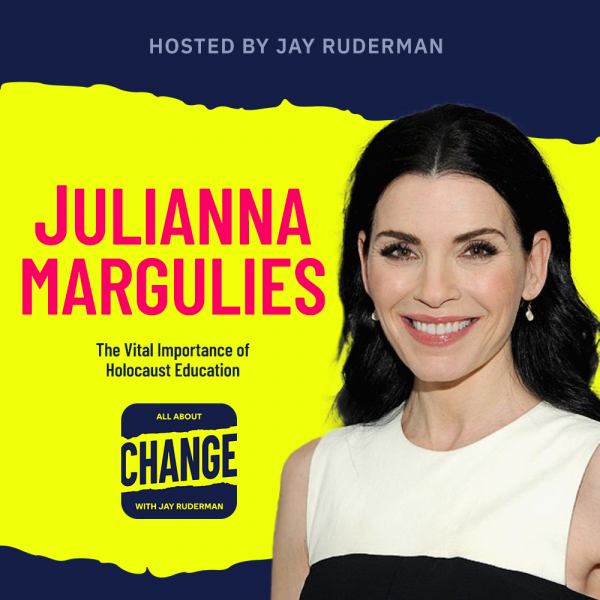
With antisemitism on the rise, the need for Holocaust education has never been more important. That’s where Emmy award-winner Julianna Margulies comes in. In 2022, Julianna helped to found the Holocaust Educator School Partnership, an initiative to help train undergraduate and graduate students in how to teach about the Holocaust in the classroom. In this episode, Julianna Margulies sits down with host Jay Ruderman to discuss the misconceptions and challenges facing the Jewish community today, and what allyship means to her. Today, we learn how Julianna Margulies went from Emmy award-winning actress to co-founding an initiative that trains students how to teach about the Holocaust in the classroom.
About:
Listen to the latest episode of All About Change as Julianna discusses how she went from Emmy award-winning actress to co-founding an initiative that trains students how to teach about the Holocaust in the classroom. To learn more about the Holocaust Educator School Partnership.
TRANSCRIPTION:
Julianna Margulies:
I didn’t want to shame anyone or put anyone on the defensive. I wanted to just explain something that I realized that night when I got home and looked at my husband and I was like, “No one is hurtful. None of my friends are.” They have no idea why their silence is so hurtful.
Jay Ruderman:
Hi, I am Jay Ruderman and welcome to All About Change, a podcast showcasing individuals who leverage the hardships that have been thrown at them to better other people’s lives.
Montage:
This is all wrong.
Montage:
I say put mental health first because if you don’t…
Montage:
This generation of America has already had enough.
Montage:
I stand before you, not as an expert, but as a concerned citizen.
Jay Ruderman:
Julianna Margulies often plays powerful characters on screen, women who don’t back down from a challenge and speak their minds. The woman behind the scenes is no different.
Julianna Margulies:
I think of myself as someone who wants the world to be a better place, and someone who grew up with a family saying, “When you see something, you say something and you always fight for the little guy.”
Jay Ruderman:
That dedication to speaking up is one that’s never wavered, even in the face of horror.
Julianna Margulies:
I was horrified, devastated, scared. It felt surreal. Just hearing about it made me… I just was weeping. It was a nightmare, a nightmare that I feel like we’re all still in.
Jay Ruderman:
Even before the October 7th attacks, Julianna had committed herself to broadening Holocaust education in the United States, her own means of combating the rise in antisemitism.
Julianna Margulies:
It’s still shocking to me to know that I can say something and it makes a difference in someone’s life that severely, and I’m grateful for that. I will use it to the good as best I can and to teach.
Jay Ruderman:
Julianna, thank you so much for being my guest on All About Change. I am really excited to speak to you. Let’s start with your childhood. You had a very diverse and interesting childhood growing up in New York, Sussex, England, Paris, and then New Hampshire. Can you tell us what it was like with your upbringing?
Julianna Margulies:
If I were to sum it up, I would say that had my parents been married and I had been going to all these countries with my parents together and not torn apart away from my father, I think it would’ve been exciting and a little bit exotic and interesting. But because my mother and father were divorced, to be in different countries all the time, I felt a little bit like a gypsy, a little nomad, no belonging, and it felt a little lonely because I always had to reinvent myself. I never fit in anywhere. I was the American girl in England. I was the English girl in America. I never had the right clothing for the school uniform. My mother was just a sort of a free spirited hippie woman who felt like we’d figure it out. In a strange way, as an adult now I actually see some of it and think, oh, I had to fend for myself and I had to learn. Those are good tools to give to children.
Jay Ruderman:
What I was going to ask you is do you think that your upbringing helped shaped you into entering into a career as an actress?
Julianna Margulies:
Absolutely. I mean, when I really started writing about it, I realized writing is very therapeutic and it really helps you uncover things about yourself that you always knew were lurking there, but didn’t quite have the wherewithal to see it. As I was writing about always putting on someone else’s shoes in someone else’s country, in someone else’s school, I kind of was trained at a very young age to be an actress because I was always being someone else. When it came time to do it as a profession, honestly in the beginning I felt like it wasn’t a noble enough profession because my grandmother was such a trailblazer and had been one of the first women to ever graduate NYU Law School in 1924, and started so many things. She was a suffragette without having to march in the streets. She just lived it. She never took no for an answer. She just found a different way to do her life. “Okay, you’re not going to accept women. I’ll start the Women’s Bar Association of the Bronx.” I wanted to follow in her footsteps. But when I got to college and took acting classes, it was the first time, my first play my freshman year, this curtain went up and for the first time in my life felt like I belonged somewhere. I was home.
Jay Ruderman:
It was natural.
Julianna Margulies:
It was that strong, yeah.
Jay Ruderman:
Being from Boston, I just want to ask you about New Hampshire. I saw an interview that I think you did with Seth Meyers when you came from England and you’re in New Hampshire and you had a teacher saying, “Ya tardy.”
Julianna Margulies:
Mrs. Lombardi.
Jay Ruderman:
Right.
Julianna Margulies:
Yeah.
Jay Ruderman:
And you’re like, “What?” Tell me about why New Hampshire. That must’ve been a real culture shock.
Julianna Margulies:
It was such a culture shock. Well, my middle sister and I had been living in England with my mother. My eldest sister was in New York, she was a ballerina, so she was studying at the School of American Ballet, living with my father on 89th Street on the East Side. We just kept begging my mother, “Please, we have to move back to America. We have to move back to America.” I missed my sister, I missed my father. My mother was a teacher and she got a job in Wilton, New Hampshire, and so we ended up in Wilton, New Hampshire, which was not really what we were hoping for. We were hoping to move back to New York. So it was a culture shock to me, not only because of it being so far away from New York City, although I would try to get to New York City on weekends if I could, but also because it was just a different world. It was flannel shirts and blue jeans. I remember my girlfriend, Shauna, the first time we were talking and she said, “Jeez and crow.” I said, “What? Jeez and crow?” And she explained to me, that’s how they say Jesus Christ, “jeez and crow,” but to me it was a different language. Mrs. Lombardi, who was my Latin teacher, and she was from Boston, she told me I was “tady.” I didn’t know what that meant. I really didn’t know what “tady” meant. And she said, “You’re tady, T-A-I-D-Y.” And I remember going home that day and looking at my mother going, “We might’ve left England, but I have no idea what anyone’s saying in this part of the world.” It took a while. Within a year I too was wearing flannel shirts and blue jeans and Timberland boots. Kids are resilient and they learn to fit in, and I ended up loving that school.
Jay Ruderman:
I want to get back to your grandmother because your grandmother from what I’ve read, was a very special person, and as you said, a trailblazer. What impact do you think she had on you?
Julianna Margulies:
Because I’m the youngest, I’m the youngest of three, you have to sort of fight for your place in the family when you’re the youngest. The advantage of being the youngest is that no one’s really paying attention, and the disadvantage is that no one’s really paying attention. My eldest sister was so much like my Great Aunt Marley and my middle sister was sort of a cross between my grandfathers, and I got… My grandma Henrietta Margulies, her family descended from Austria. They were Austrian Jews and I got her green eyes and her wide cheekbones. Not that I liked that as a kid. I wanted to… My Aunt Marley was very tall and she had blue eyes like my eldest sister. But I took after my grandmother and she was also very athletic. My eldest sister was already a ballerina, and my middle sister was already a musician, so I was the athlete. I had to find my own path that wasn’t related to them. I realized at a very young age that my grandmother Henrietta, her path was much more the path I wanted to walk in that she was a feminist before feminism was a word, and she was also incredibly smart. I truly don’t believe I had the brain to be a lawyer. I’m so grateful I got to play one on TV for as many years as I did. But when I got to college and really thought I was going to be a lawyer and started taking pre-law, I didn’t care about the small print in all the contracts. It just bored me. I realized I just didn’t have that. I think what I do have of my grandmother’s is that incredible sense of responsibility. I feel a tremendous sense of responsibility, which I think she carried on her shoulders her whole life.
Jay Ruderman:
Wow. Well, I was also very close to my grandmother who had a tremendous impact on my life, so I really identify with that. As a lawyer, I want to tell you just abuse you of any notion, it’s not that difficult. Let’s talk a little bit about your acting career and how you got started in ER. I heard you tell a story about George Clooney and how he convinced you to stick around and give ER a chance because you might become a regular.
Julianna Margulies:
Yeah, I mean talk about fate. That was an unbelievable time in my life because I was broke and living in a five floor walkup, and I’d done this pilot with the original cast of ER and had such a good time, but I was a guest star in the pilot and my character died. I got on a plane and I went home back to New York. At the time, I had done a couple of episodes of a show called Homicide Life on the Street with Tom Fontana and Barry Levinson, and I had played opposite Ned Beatty. I got home from doing the pilot and Tom Fontana called and said, “We want to make you a series regular on the show.” And it shot in Baltimore, which meant I could basically stay in New York. I said, “Amazing, thank you.” Homicide Life on the Street was a great show. So I said, “Yes, please.” I needed to pay my rent. Right after I said yes, I came home and there was a voice message from George Clooney saying, “Listen, I’m hearing from producers that your character tested really high and none of the audiences like that you died. So don’t take another job.” I remember thinking like, well, that’s a big if. I died in the pilot, how are they going to… And so I called Tom and I said, “I don’t know what to do.” Tom Fontana. I said, “I can’t look a gift horse in the mouth and say no to you, but at the same time, I just don’t know what to do.” He said, “There’ll always be a part here for you. Take the chance.” And I did. A week later, they called and said, “Come on out.”
Jay Ruderman:
Wow. That’s an incredible story. And obviously ER became one of the most successful shows in television history. How did that level of success impact you personally?
Julianna Margulies:
It was overwhelming at first. I mean, nothing really prepares you for that kind of visibility and attention. One day you’re struggling to pay rent and the next day you’re on billboards and people recognize you on the street. It was exciting, but it was also a little disorienting.
Julianna Margulies:
I was very lucky because I had a strong foundation. My family kept me grounded. I also had mentors and colleagues who reminded me to focus on the work and not get caught up in the fame. At the end of the day, it’s about the craft, about telling stories, about connecting with people.
Jay Ruderman:
You’ve spoken out recently about antisemitism and about the importance of using your voice. What prompted you to speak out more publicly?
Julianna Margulies:
I think there comes a moment where silence feels complicit. After October 7th, I was horrified, devastated, scared. It felt surreal. Just hearing about it made me… I just was weeping. It was a nightmare, a nightmare that I feel like we’re all still in.
Julianna Margulies:
And what really struck me was the silence from people I considered friends, from communities that I felt aligned with. It wasn’t that they were saying anything hateful, it was that they weren’t saying anything at all. And that silence was incredibly painful.
Julianna Margulies:
I didn’t want to shame anyone or put anyone on the defensive. I wanted to just explain something that I realized that night when I got home and looked at my husband and I was like, “No one is hurtful. None of my friends are.” They have no idea why their silence is so hurtful.
Jay Ruderman:
What do you hope people understand when you speak about that silence?
Julianna Margulies:
I hope people understand that speaking up matters. Even if you don’t have all the answers, even if you’re afraid of saying the wrong thing, acknowledging pain and standing in solidarity can make a huge difference.
Julianna Margulies:
It’s about empathy. It’s about recognizing that when something terrible happens to a community, silence can feel like indifference. And I think we can all do better in that regard.
Jay Ruderman:
You’ve also been involved in Holocaust education. Why is that so important to you?
Julianna Margulies:
Because history has a way of repeating itself if we don’t learn from it. And I think we’re at a moment where misinformation is rampant, where people are questioning facts that should never be questioned.
Julianna Margulies:
Holocaust education is not just about the past, it’s about understanding the consequences of hate, of dehumanization, of silence. It’s about making sure that future generations understand what can happen when we don’t stand up for each other.
Julianna Margulies:
For me, it’s also personal. It’s part of my identity, part of my family history. And I feel a responsibility to carry that forward, to educate, to speak, to make sure those stories are never forgotten.
Jay Ruderman:
For people who are listening right now and feel overwhelmed by everything happening in the world, what would you say to them?
Julianna Margulies:
I would say start small. You don’t have to fix everything. You don’t have to have all the answers. But you can show up. You can listen. You can support.
Julianna Margulies:
And most importantly, you can speak. When you see something that feels wrong, say something. That’s something that was instilled in me from a very young age. You don’t stay quiet in the face of injustice.
Julianna Margulies:
It doesn’t mean you have to be perfect. It just means you have to be present and willing to engage. I think that’s where change begins.
Jay Ruderman:
Looking back on your journey—from your childhood, to your acting career, to the work you’re doing now—what does “change” mean to you?
Julianna Margulies:
Change means growth. It means being open to learning, to evolving, to seeing things from different perspectives. It’s not always comfortable, but it’s necessary.
Julianna Margulies:
I think the most important thing is to remain curious and compassionate. When you approach the world that way, you’re more likely to create positive change, both in your own life and in the lives of others.
Jay Ruderman:
Julianna, thank you so much for sharing your story and your perspective. It’s been an honor having you on the podcast.
Julianna Margulies:
Thank you so much for having me. I really appreciate it.
Jay Ruderman:
Thank you so much for listening to All About Change. Today’s episode was produced by Tani Levitt and Mijon Zulu. Stay tuned for our next episode. Spread the word, tell a friend or family member, or leave us a review on your favorite podcasting app. We’d really appreciate it. That’s all for now. I’m Jay Ruderman, and we’ll see you soon with another episode of All About Change.