Lee Asher - How Rescuing Dogs Rescue Us
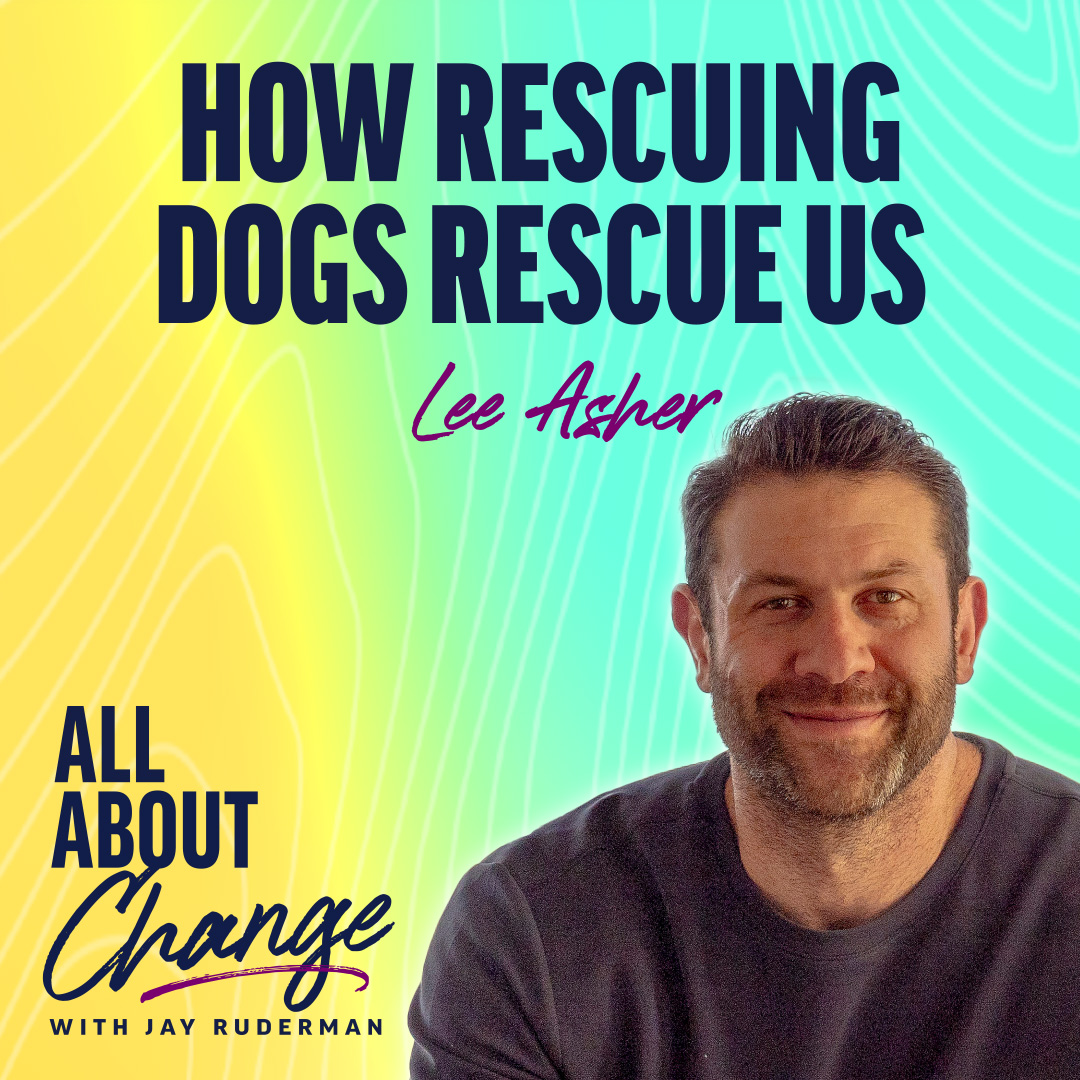
Lee Asher is known for his positive presence. Visit the Asher House page and you'll be met with countless videos of Lee greeting animals getting a second chance at his Oregon sanctuary. But Lee's struggles with mental health don't often get the same spotlight.
About:
All About Change is on break for the holidays. For now, we are re-airing one of our favorite episodes, Jay’s conversation with fellow dog lover, Lee Asher. Lee joined host Jay Ruderman to talk about the importance of pet adoption, resilience, and what it took to go from a 9 to 5 to running a 240-acre animal sanctuary. The two also discuss Lee's long road with depression, and what changes he'd like to see in the animal rescue community To learn more about the Asher House
TRANSCRIPTION:
Jay Ruderman:
Welcome to All About Change. The holidays are upon us, and with the holidays comes the spirit of giving. We know that for Hanukkah or Christmas, many people are looking to add a furry friend to their families. Here at the show, we talk a lot about affecting change and empowering everyday people in their activism. And one way you can make a difference in the life of an animal in need is by adopting your next dog, cat, or other pet from a shelter or a rescue. That's why today we're re-airing one of the team's favorite episodes, my conversation with Lee Asher. Lee is the founder of The Asher House, a nonprofit animal sanctuary that rescues and cares for animals with nowhere else to call home. As Lee explains, coming to run a successful rescue not only has saved countless animals' lives, but in a way, it also saved him. We hope you enjoy this episode. Thank you, Lee Asher, for being my guest on All About Change today. As you can tell, I'm a dog lover. This is Teddy.
Lee Asher:
Hi, Teddy.
Jay Ruderman:
Teddy is with me all the time and loves me and I love him. I wanted to start by asking you a very basic question, something that I think you're uniquely positioned to answer. What is the connection between dogs and humans? And I know you have many other animals in your sanctuary and animals that you've worked with, but the dogs seem to be a little bit different. They seem much more attached.
Lee Asher:
Yeah, it goes back to a long time ago with the wolves and we depend on each other. We're one of the few animals where we depend on each other to survive. For more than just survival, it's for love. It's mental, it's physical. I think the dog and the human bond is one of a kind, and you see it with other animals too. You see it with pigs and you see people have very special bonds with parrots, but with dogs, there's just something very special there, going back to the energy. 99.9% of the time, if you pass away, your dog is going to pass away too. Here's a great example. I think it was six months ago, an awful story, this couple, boyfriend, girlfriend, husband and wife were on a hike with their dog and they died. They died from dehydration.
Jay Ruderman:
I remember this story. I remember this story.
Lee Asher:
The dog died with them.
Jay Ruderman:
Right.
Lee Asher:
Any other animal, a parrot, any other animal would've said, "I need to survive. I'm going to go find water," and they probably would have eventually. They would've found it. The dog definitely could have found water eventually, and he didn't leave his parents' side. He didn't leave the human side, and the dog died too. So it just shows you all animals are special. They really are. All animals have souls and all animals and my opinion are the light of the world. The world can be very dark and animals naturally bring a light to it that makes any sane person, in my opinion, feel some emotion, a better emotion. But dogs in particular, it's like they were really sent here. Dogs are, it's the only animal. It's not going to leave your side. It's just a very, very special, special soul.
Jay Ruderman:
Lee, I want to talk a little bit about growing up, and you've talked about this, about what your experience was growing up and being very uncomfortable interacting with other people, being bullied, having physical issues like scoliosis. Talk a little bit about your childhood and how that impacted you.
Lee Asher:
Everyone has a story and everyone has things that they wish went differently. For me personally, I grew up in a very narcissistic home, and I was able at a very young age to figure out that I didn't want to really be like my parents. And when you figure that out at a young age, it doesn't mean you don't want parents. You just don't want to be like those parents. At a young age, I really began trying to find my way because I could see how lost my parents were and their priorities were just so messed up. Their values were so messed up. So because of that, I became kind of needy to belong. Nothing ever felt like I fit. I always felt like a piece of a puzzle that was out of place, and it was very depressing for me because there weren't many things in my favor that were helping me achieve those goals.
Lee Asher:
As you mentioned, I had scoliosis. I still have it, so I had to wear this huge back brace to school. Everyone was picking on me and throwing me into things and tripping me with it. And in addition to that, I was told that I had severe learning disabilities. I still have very bad ADHD. If anything wasn't fascinating to me, I just couldn't retain it. I really couldn't. And I would try and it just wasn't possible. I was always thinking about animals and nature. So I had to be in these special classes. I was in the classes with the kids with the severe learning disabilities. So at the time I really thought to myself, "Why is this happening to me? Why am I like this?"
Lee Asher:
But my gosh, now going back, I wish I could hug that kid because... and tell him, "Hey, this is all part of what you're going to do with your life. This is all preparing you for the future." And if it wasn't for me feeling like such an outcast, I never would've started running away from school and going to the animal shelters and feeling like I found my purpose with animals. It never would've happened, and that's what people really need to understand. All of it happened for me. It was all such a gift, and everything that happens to you is a part of the recipe for your purpose. And if you don't believe that the alternative makes you a victim. When you have the victim mentality, "I'm not going to help others because nobody helped me."
Jay Ruderman:
Right.
Lee Asher:
It's not the approach for a successful life. And when I say successful, I don't just mean financially, I mean a life worth living. Because of what I do, people tend to ask me how to find their purpose. And a good question in response to that is, well, what are you doing to look for it? And if you're not looking in service, you're not looking at all. You have to know that, Jay, me and you, we have the same purpose. The people who helped facilitate this have the same purpose. Your neighbor, we all have the same purpose. It's an act of service. It's why we're here, to help each other. And if you're doing anything other than that, you're just pushing yourself backwards.
Jay Ruderman:
Right.
Lee Asher:
No one is here to hate. No one is here to troll. We are all born to be creators. So you have to ask yourself every day, "Am I creating today or am I destroying?" And it's really that simple. I learned at a young age that I wanted to create. I was never good at math. I was never really good in school. I always felt like I was stupid, and I just knew what my calling was. I wanted to help people. I wanted to show people the same love that I would show animals, like this unconditional, forgiving love.
Jay Ruderman:
Right. So much of your background has resonated with me. I don't talk about it, but I also had scoliosis growing up. I can tell from looking at you and you're very physically fit and you work out a lot, I could not tell unless you said that out loud. And I have a son with ADHD that he's dealing with a lot of issues.
Lee Asher:
Yeah, it's not easy.
Jay Ruderman:
No, it's not. And I tap into what you're saying, but the way that you have been able to encapsulize the meaning of life, I think that you've been able to cut through all the crap and really see like, "Hey, this is why I'm here. This gives me the most meaning. This gives me the biggest ability to contribute to the world."
Lee Asher:
Right.
Jay Ruderman:
I think that the fact that you've been able to do that, I'm sure it didn't happen right away, but in short time is very impressive 'cause most people can't do that throughout their whole lives.
Lee Asher:
When you say what you're saying, for some reason, I'm not sure if it makes sense, but I have this inner dialogue that keeps saying the word resilience, and I was only able to get to this point. And by the way, as I say that, I have this uncomfortable feeling in my chest, like, "Are you really at that point?" I just want to be clear. I wake up every day and the first thing that I tell myself is, "Remember that you know nothing." I don't know shit. I only know what I think I know. I don't know shit. Nobody knows, and we should never be convinced that we know or this is it. But what I can tell you that I'm convinced of is the beauty of a dog that we share in common with is the resilience. People always mention, "Man, dogs are so resilient. They've been through this, they've been through that." Yeah, but you have been through a lot of shit too, and you're here.
Jay Ruderman:
Right.
Lee Asher:
It's about trying to find... you go for your purpose. You don't care what people think. That's one of the hardest things with social media. Everyone, they're so afraid of what people say about them, who they've never met, who they don't know, have no effect on their life. If you really have a strong purpose, you would never allow the opinion of someone else to interfere with that. Nobody who has ever done something extraordinary didn't have tens of thousands or even millions of people tried to stop them. I have to tell you, it's about being resilient. It's about being defeated, knocked down, hurt, wounded. I've really felt so many times so close to death emotionally I can't express it... I'm really like, "Maybe this is it for me." But you have to not live in those feelings. When you feel this feeling of defeat, remember that you're still in the shallow end of the water and it's up to you which side of the pool you want to be.
Jay Ruderman:
Right.
Lee Asher:
You can stay there or you can get up and start swimming. And it's hard. I'm not going to sit here and pretend like it's easy. It's the hardest thing you'll ever do. But that's where growth happens.
Jay Ruderman:
Let’s talk about The Asher House. You’ve built something that has touched millions of people. How did that start?
Lee Asher:
It started with a van.
Lee Asher:
I literally sold everything that I had, bought a van, and set out to travel across the country rescuing dogs.
Lee Asher:
At the time, I didn’t know what it was going to become. I just knew that I wanted to help animals and share that journey with people.
Lee Asher:
And something magical happened.
Lee Asher:
People connected with it.
Lee Asher:
They saw the love, the authenticity, and they wanted to be a part of it.
Jay Ruderman:
And now you have this sanctuary.
Lee Asher:
Yeah, now we have The Asher House sanctuary where we take in animals that have nowhere else to go.
Lee Asher:
Dogs that are older, that are sick, that have been overlooked their entire lives.
Lee Asher:
And we give them a home.
Lee Asher:
We give them love.
Lee Asher:
We give them a chance to finally experience what it means to be safe.
Jay Ruderman:
What do you say to people who are thinking about adopting a pet?
Lee Asher:
Adopt, don’t shop.
Lee Asher:
There are so many animals out there that need homes.
Lee Asher:
When you adopt, you’re not just changing that animal’s life, you’re changing your own.
Lee Asher:
It’s a relationship that will teach you more about love, patience, and loyalty than anything else.
Jay Ruderman:
And for people who may not be able to adopt, what can they do?
Lee Asher:
There are so many ways to help.
Lee Asher:
You can volunteer.
Lee Asher:
You can donate.
Lee Asher:
You can foster.
Lee Asher:
Even just sharing posts on social media can make a huge difference.
Jay Ruderman:
Lee, when people look at what you’ve built, they see success. But what do you see?
Lee Asher:
I see responsibility.
Lee Asher:
I see a platform that I have to use for good every single day.
Lee Asher:
Because these animals depend on me.
Lee Asher:
And the people who support us, they trust me.
Lee Asher:
So I don’t take that lightly.
Jay Ruderman:
What has this journey taught you about yourself?
Lee Asher:
That I’m capable of more than I ever thought.
Lee Asher:
And that purpose is everything.
Lee Asher:
When you’re living in your purpose, even the hardest days feel meaningful.
Lee Asher:
And when you’re not, even the easiest days feel empty.
Jay Ruderman:
That’s powerful.
Lee Asher:
And I think that’s what I want people to understand.
Lee Asher:
You don’t have to do what I do.
Lee Asher:
But you do have to find something that matters to you.
Lee Asher:
Something bigger than yourself.
Jay Ruderman:
Lee, thank you so much for being my guest on All About Change and for the incredible work that you’re doing.
Lee Asher:
Thank you for having me. It means a lot.
Jay Ruderman:
Thank you so much for listening to All About Change. Today’s episode was produced by Tani Levitt and Mijon Zulu.
Jay Ruderman:
To check out more episodes or learn more about the show, you can visit our website allaboutchangepodcast.com.
Jay Ruderman:
If you like our show, spread the word, tell a friend or family member, or leave us a review on your favorite podcasting app.
Jay Ruderman:
We’d really appreciate it.
Jay Ruderman:
That’s all for now. I’m Jay Ruderman, and we’ll see you soon with another episode of All About Change.