Meggie Palmer – Closing the Gender Pay Gap
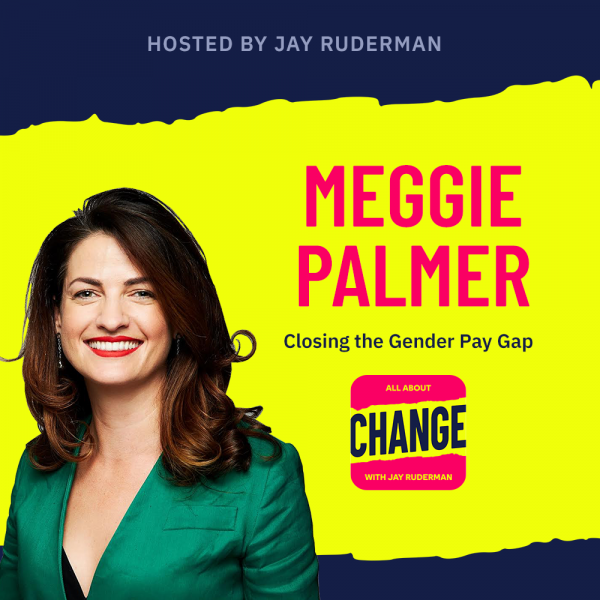
While still finding success as an award-winning journalist, Meggie was surprised to realize that she was facing pay discrimination. This opened her eyes to pay inequality and inspired her to take action not just for herself but for all women around the world. She left journalism to embark on a path of activism. She started her own organization – PepTalkHer – with the mission of closing the gender pay gap. PepTalkHerr App is described as ‘fitbit for your career’, helping professionals track success and navigate their pathway to promotion. Meggie now runs a community of 60,000 professional women focused on elevating performance and supercharging their career success.
About:
In conversation with Jay, they discuss the importance of proactive and positive storytelling and how her life put her on a mission to close the gender pay gap. To learn more about Meggie Palmer and PepTakHer.
TRANSCRIPTION:
Meggie Palmer:
on average, women are paid 15 to 20% less Than men.
Jay Ruderman:
[show intro]
Jay Ruderman:
And today on our show, Meggie Palmer.
Meggie Palmer:
for every entry level man who’s promoted into a manager role, Only 72 women are given that same opportunity,
Jay Ruderman:
While still finding success as an award-winning journalist, Meggie was surprised to find out that she was being paid much less than her male counterpart.
Meggie Palmer:
And so I just naively assumed that there’d been a mistake.
Jay Ruderman:
This personal experience opened her eyes to pay inequality and inspired her to take action not just for herself but for all women around the world.
Meggie Palmer:
I was very much raised, that if you see something, you should say something and there’s no harm in speaking up. And so that’s what I did.
Jay Ruderman:
So, Maggie Palmer, thank you so much for joining me as my guest on all About Change. Uh, I’m really excited about this conversation and it’s nice to meet you.
Meggie Palmer:
Yeah. I’m excited. Looking forward to chatting Jay.
Jay Ruderman:
So let’s start back on. Your background, your, your career, how you started your career and, and how you got to the point where you changed from a journalist to an activist.
Meggie Palmer:
Yeah. It’s funny. I feel like, honestly, Jay, I think maybe I’ve always been a bit of an activist. I don’t know. I’m not sure if it’s something that you’re born with or like For me it was really around inequality. Like, I still remember Jay being like a young kid in the backseat of Mum’s Light Blue Volvo, you know, one of those old school eighties cars, driving with my little brother and sister sometimes someone would cry.See, and I would get blamed because I’m the eldest child and I remember being maybe six or seven thinking that’s so unfair and it’s something little and stupid and it doesn’t matter. But it’s funny, like that feeling of like when something’s not right, when it’s not fair, whenIt’s not just, that’s really been a theme throughout my life, and I think that’s a big part of the reason why I became a journalist, because I, do believe, Jay, that you can use. And the press and the power of story to create change. Because if we didn’t have podcasts like this, if we didn’t have the nightly news, if we didn’t read memoirs, we wouldn’t understand and get that window into other folks’ world. And so that was really, the underpinning reason why I got into journalism.
Meggie Palmer:
And I loved being a journalist. I spent 15 years as a journalist in Australia as a foreign correspondent overseas in London with the BBC world, with CBC, and, then eventually moved over here to New York City.
Meggie Palmer:
And it was during that time as a journalist that I actually experienced. The gender pay gap myself. I was traveling into, into war zones, into national disasters, you know, like Zimbabwe, Philippines, Syria, all those sorts of countries, traveling, doing stories, filming, documentaries. And one day, Jay, I found out quite by accident actually, that my pain conditions.Were quite different to my male colleague, journalist, who I sat next to in the newsroom in terms of how they were being paid and how they were being compensated with their contracts. And so I just naively assumed that there’d been a a mistake. and I was very much raised, that if you see something, you should say something and there’s no harm in speaking up. And so that’s what I did.
Meggie Palmer:
It was actually one of my old bosses, who told me he left. and he was the one who told me, and he said to me, quote unquote, he’s like, you should have negotiated harder. was what he said to me.
Meggie Palmer:
on the one hand maybe there’s some truth in that. I think often you don’t get in life what you deserve, but you do get what you negotiate. But equally, as you know, in most Western countries, it is illegal to pay people different if they are doing the same job with the same qualifications and, the same experience.
Meggie Palmer:
But the problem with that is, is that it’s so hard to prove, and. Often to, to prove that you have to be willing to go to court or you have to be able to afford to get a lawyer.
Meggie Palmer:
And in fact, my employer at the time when I said, what’s going on? Like, probably, can’t I be treated equally please? They said to me, they were like, listen, if you don’t like it, why don’t you quit or we’ll see you in court. And so those were kind of the options, that they gave me.
Jay Ruderman:
And how did you respond to that conversation?
Meggie Palmer:
Honestly, I was a little shocked. Like I was kind, it sort of felt like I was living in an altern universe. I was like, what? Because I just thought like, if, if something was unfair, they’d be like, oh, whoop, sorry. We’ll fix it. and I now know I was pretty naive at the time and, and in fairness, this was, this was almost a decade.At a decade ago, right? And I would like, to think that, a lot has changed, but I’m not sure that it has. And certainly the statistics would tell us that the gender pay gap itself hasn’t really moved much.
Meggie Palmer:
but in that moment I thought, at the time I was single, I had savings. I backed myself and my ability to get another job As a journalist, I knew that I was very good at my job.I’d won a lot of awards like. And I kind of felt, Jay, I was like, if I don’t say something, what’s gonna happen to the next person? And what would happen to someone if they were pregnant or if they had a family to feed or if they had a mortgage and they had no savings and they couldn’t afford to take up the fight.
Meggie Palmer:
And so I, I very much felt like almost obliged to sort of go that next step because I just sort of thought like, if I don’t. Who will, and I’m gonna butcher the quote, but it’s that whole thing of like, bad things in this world happen when people walk by, see it happening and do nothing, you know? So I felt kind of a bludge
Jay Ruderman:
what action did you take as a result of that conversation?
Meggie Palmer:
it’s a long story, but essentially I had to engage a lawyer and it’s not something that I wanted to do, and it’s not something that was an enjoyable process. I found it incredibly stressful. for the first time I experienced anxiety, and I now know, that this is pretty common for folks who go through essentially a dispute with their employer, even though.Even if it’s illegal, even if they’ve been treated unfairly, there are often intimidation tactics. There is bullying that goes on because, ultimately employers don’t necessarily wanna have to pay you out. they would prefer that you just sort of left quietly or maybe just went away and, and didn’t bother to, to have that, conversation, those hard conversations.
Meggie Palmer:
But as I said, I felt, I did feel obliged to do that. And so anyway, at the end of the day, we. I walked away essentially at the, at the end of the day. I did. Eventually I walked away. I stayed in journalism for a little bit longer, but that whole experience stayed with me and Again, I was just so naive at the time.I didn’t realize that this is what happened, and I didn’t realize that whilst this was my experience for folks, people of color, their experience is so much worse.
Meggie Palmer:
And to have been at this point in my mid twenties when I first experienced this discrimination, in many ways, that’s a privilege, right?Because I know that many people experienced that discrimination and that bias a lot earlier in their lives and their careers.
Jay Ruderman:
so do you feel that because you took legal action to address an injustice that you may have been blackballed in the industry?
Meggie Palmer:
Well, certainly that was the, the threat that was given to me. You know, they would say things like, oh, you are never gonna work in this industry again. so-and-so boss hates you and you know, these people, you know, are really angry that you’re doing this, and how dare you? We’ve been so good to you.
Meggie Palmer:
I know now that they were tactics and of course it hurts at the time.And of course, you know, there were relationships that were damaged as a result of that But again, you know, like I really wanna have quality relationships with people who do the right thing. There were many people who, who could have stood up, who could have said something, who could have used their internal power to do something and they chose not to.
Meggie Palmer:
And of course that’s disappointing. but I also appreciate that, that people step up when they can and when they feel like they have that. strategic power, I suppose, or those offers, politics, relationships that they’re able to leverage.
Meggie Palmer:
And so again, like that’s a lesson that I’ve taken with me into my future careers and my future jobs of like when I have power within companies, within organizations.And when I see something, again, I have to do something because if I don’t, how’s that gonna affect the folks coming after me or the person who’s being impacted?
Meggie Palmer:
And I think, all of your listeners today, you have to be, an activist on your LinkedIn profile. You don’t have to be working for Green Peak or a charity to be an activist and to, to create those ripples of change.I think everyone truly has the capacity to support other people, to be an ally in the workplace, to speak up when something’s not right.
Jay Ruderman:
So how did you make the transition from journalism into building something that directly tackles inequality?
Meggie Palmer:
Yeah, it wasn’t overnight. I think for a while I was still kind of processing what had happened to me.
Meggie Palmer:
But I kept coming back to the same question: how can I make sure this doesn’t keep happening to other women?
Meggie Palmer:
And I realized that part of the problem was transparency. People don’t know what they’re worth. They don’t know what others are being paid.
Meggie Palmer:
And if you don’t have that information, it’s really hard to advocate for yourself.
Jay Ruderman:
So what did you do with that realization?
Meggie Palmer:
I started building tools and resources to help women understand their value and negotiate better.
Meggie Palmer:
I also started working with companies to help them close their pay gaps. Because it’s not just an individual issue, it’s a systemic issue.
Meggie Palmer:
And if companies are serious about equality, they need to take responsibility for fixing it.
Jay Ruderman:
Do you think companies are willing to do that?
Meggie Palmer:
Some are.
Meggie Palmer:
But it takes courage. It takes leadership.
Meggie Palmer:
Because when you start looking at your data, you might not like what you see.
Meggie Palmer:
And then you have to make difficult decisions.
Jay Ruderman:
What advice would you give to women who feel like they’re being underpaid or treated unfairly?
Meggie Palmer:
First, gather information.
Meggie Palmer:
Know your market value. Talk to people. Do your research.
Meggie Palmer:
Second, don’t be afraid to speak up.
Meggie Palmer:
I know it’s hard. I know it’s uncomfortable. But your voice matters.
Meggie Palmer:
And third, find allies.
Meggie Palmer:
You don’t have to do it alone.
Meggie Palmer:
There are people who will support you, who will advocate for you, who will stand with you.
Jay Ruderman:
Meggie, thank you so much for sharing your story and for the work that you’re doing to create change.
Meggie Palmer:
Thank you so much for having me.
Jay Ruderman:
Thank you so much for listening to All About Change. Today’s episode was produced by Tani Levitt and Mijon Zulu. Stay tuned for our next episode. Spread the word, tell a friend or family member, or leave us a review on your favorite podcasting app. We’d really appreciate it. That’s all for now. I’m Jay Ruderman, and we’ll see you soon with another episode of All About Change.