Nas Daily and Bringing His Life From Good to Great
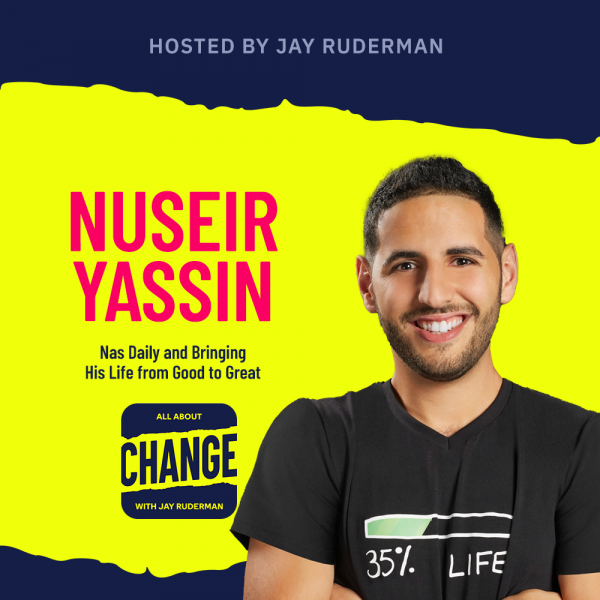
Nas Daily has been an internet sensation since its inception. But the man behind it all is a bit less well known. Nuseir Yassin left a well-paying job at Venmo to travel the world, and do 1,000 videos in 1,000 days about the places and people he encountered. Since then, he’s built a company founded on community, positivity, and storytelling. Nuseir sat down with host Jay Ruderman to talk about growing up in Israel, how he keeps his company community-minded, and how he’s building a culture that lasts.
About:
Listen to the latest episode of All About Change as Nas Daily sits down with Jay to discuss his internet stardom, the philosophies that motivate him, and the man behind it all, Nuseir Yassin. To learn more about the Nas Daily.
TRANSCRIPTION:
Jay Ruderman:
Was there ever a point where you’re like, oh my God, this is just too much. I can’t do this anymore. This is too much work.
Montage:
Roughly 600 times.
Montage:
This is all wrong.
Montage:
I’d say put mental health first because if you don’t…
Montage:
Generation of America has already had enough.
Montage:
I stand before you, not as an expert, but as a concerned citizen.
Jay Ruderman:
Nuseir Yassin, better known as Nas Daily, is famous for his highly produced one-minute videos Nas produced and astounding 1,000 of these videos in 1,000 days.
Nuseir Yassin:
It was a thousand days of torture, but it was the best 1,000 days of my life.
Jay Ruderman:
Those videos were more than a chance for Nuseir to practice his production skills and travel the globe. They were a chance for him to spread the word about all the good there is in the world.
Nuseir Yassin:
No one is there that’s ready to tell you what goes well in the world, what is happening that’s inspiring, that’s positive. I wanted Nas Daily to be that. It’s almost like the antidote to what exists today.
Jay Ruderman:
Nuseir Yassin, thank you so much for being my guest on All About Change. I’m so excited to speak to you and thank you for joining us.
Nuseir Yassin:
Likewise. Thank you for having me.
Jay Ruderman:
So I’d like to start off in the beginning. You did a TED talk where you talked about growing up in Northern Israel in the Galilee, in your village of Arraba, and you said it was a good life. Can you talk a little bit about growing up in your family and what it was like?
Nuseir Yassin:
Yeah, I guess I was lucky. My parents were educated, so we were not poor, we were not rich, we were middle class. I’m lucky in the sense that I got everything I needed, but even from an early age, you could still see that you’re unlucky because you’re born and raised in the Middle East, in general. You’re unlucky because you’re in the Middle East, not in America. You’re unlucky because you’re not Jewish in Israel. You’re unlucky because you’re a middle child. There was some unluckiness happening. But overall, doing better than 95% of the world.
Jay Ruderman:
You spent a lot of time educating yourself, teaching yourself to speak English, teaching yourself the piano, really improving upon your skills. Tell us what led you to decide to apply to Harvard.
Nuseir Yassin:
The issue is that I could see there’s a ceiling back home in Israel. There was a ceiling for me as an Arab-Israeli. I wanted to be where the future was and I wanted to be where there is theoretically no ceiling. That was in America.
Nuseir Yassin:
The reason I wanted to go to Harvard, honestly, is I had a Jewish-American friend in Ohio, and their brother went to Harvard. They suggested I apply there. I never thought I would ever get in. So really, I owe them a lot for putting that idea in my brain. But I applied to Harvard and for me it was like a shot in the dark really. I didn’t know there was anything special about my application. Luckily Harvard saw something and they said yes.
Nuseir Yassin:
So that was really probably the best thing that happened to me. But the big idea here is that I think a lot of people want that mobility. I wanted to be surrounded by smart people. I wanted to be at a place where my nationality, my religion, my origin doesn’t hurt me or doesn’t affect my progress. That I found at Harvard.
Jay Ruderman:
And so Harvard was, I remember this clearly, this TED talk where you talk about going from good to better and you’re always trying to improve your life. Was it better for you at Harvard?
Nuseir Yassin:
Was it better at Harvard than at a 30,000 or 20,000 person village in Israel in the Middle East? 100%. 100% it was better to be surrounded by the world’s smartest people. Now Harvard has a bad rep for anti-antisemitism. But at Harvard I made my first ever Jewish friend. At Harvard, I made my first ever Israeli friend, not in Israel. It was at Harvard. So Harvard really opened my eyes to what diversity looks like, what different opinions look like.
Nuseir Yassin:
I think for the majority of us, we are lost in a way. We don’t know what we want to do or where we want to go, especially as a college person. So for me, education wasn’t what’s important. It was the community. It’s the community of people around you that was important. I knew whatever I learned at Harvard, I was going to forget. What I really wanted to do though is build something of my own and create a company, create something out of nothing. I think that desire has been with me since I was a Harvard student and it’s been like that for the last 13 years.
Jay Ruderman:
So then what led you to take a job at a company? I understand you were working at Venmo. First of all, why take that type of job and what led you to leave that job?
Nuseir Yassin:
I took that job because, one, it was the only job that I could find, and two, it’s the thing that will give you the visa. Also, I wasn’t quite ready to go on my own. I felt I needed a little bit of a shelter, something to lean on. So that’s why I took that job. But after a year and a half in corporate America, I realized this is not for me. It just didn’t make sense to trade your time for money, especially when your life is so valuable, your time is so valuable. It didn’t make sense to trade it for money.
Nuseir Yassin:
I thought the world is much bigger than the office. Funny, I’m talking to you right now from the office, but the world is much bigger than the office, and I wanted really to see the world and that’s why I decided to start Nas Daily.
Jay Ruderman:
Your decision was to make 1,000 videos for 1,000 days, one minute videos. How did you get to that decision?
Nuseir Yassin:
It’s hard answering this question because there is no clear answer. 1,000 is a number that made sense. But what I really wanted, I felt for the majority of my life, for the first 25 years of my life, I didn’t really have a voice. I didn’t have a voice in Israel. I didn’t have a voice at Harvard. I didn’t have a voice at my job. I wanted a voice. I wanted an opinion to be heard. I thought that video making, telling your opinion in video is the best way to be heard.
Nuseir Yassin:
So I thought, I’ll just make those videos. I don’t know how to make videos. So if I don’t know how to make videos, I should practice every day. If I don’t have a job, then I shouldn’t be taking any time off. No weekends for me because I don’t have a job. So it made sense to do it every day, and it made sense to make it as a video, and it made sense to go around the world and do it.
Nuseir Yassin:
Is this your working? I don’t know. I have no clue why I’m doing this, but I think it will be fun. Here’s the idea. Once a day, I’m going to make one video that’s one minute long. That’s it. In New York City. Off to Egypt today.
Nuseir Yassin:
And that’s how Nas Daily was born.
Jay Ruderman:
So Nas Daily, I’ve watched many, many of your videos, but they’re very positive. Was that something that you were purposely trying to do to make positive videos?
Nuseir Yassin:
Yeah, I wanted Nas Daily to be the opposite of what I saw growing up. I think that’s really important for me. What I saw growing up is wars between Israel and Lebanon, between Israel and Hamas, and Israel and Palestine. I saw people labeling themselves, I’m Jewish, I’m Muslim. No, this is this, I’m black, I’m white, I’m Bedouin, I’m a farmer. I saw a lot of casting, I saw a lot of turmoil, and I saw a lot of negativity in the news every single day.
Nuseir Yassin:
I just thought that it seems like if something bad happens in the world, there are at least 10,000 organizations that are ready to talk about it. They are ready to make it bigger, a bigger deal. They’re ready to publicize it, which is the news, the media. But no one is there that’s ready to tell you what goes well in the world, what is happening that’s inspiring, that’s positive.
Nuseir Yassin:
I wanted Nas Daily to be that. It’s almost like the antidote to what exists today. I think that’s why there’s a lot of interest in Nas Daily because it’s not just kumbaya positivity, like let’s all be friends, this is great. It’s more like actionable, real, positive impact that’s happening today and is amplified through Nas Daily that smart people like you and kids that are 10 years old can enjoy watching. That’s what Nas Daily is.
Nuseir Yassin:
This is a condom. It’s cheap, it’s effective, it’s nice, and it can save your life. Meet the Condom King.
Jay Ruderman:
Hi, Nas Daily.
Nuseir Yassin:
This scientist can catch cancer just by smelling your breath.
Jay Ruderman:
So the videos are fascinating and I did learn a lot, but let’s talk about making the videos because they’re a minute long and I guess that was the algorithm at the time in terms of getting views. But what went into making a one minute video?
Nuseir Yassin:
15 hours of torture, that’s what went into it. It’s making a one minute video that’s highly produced is five hours of thinking about the video idea, five hours shooting the video, five hours editing it.
Nuseir Yassin:
… five hours shooting the video, five hours editing it, and one hour uploading it. There’s a significant amount of time that goes into each video, and also each video must have an idea that’s new, that’s unique, that excites you to make it. It wasn’t an easy process. It was 1000 days of torture, but it was the best 1000 days of my life because it really took Nas Daily to the next level, and it allowed me to come here on your podcast, so I’m forever grateful for it.
Jay Ruderman:
Was there ever a point where you’re like, “Oh my God, this is just too much. I can’t do this anymore. This is too much work.”
Nuseir Yassin:
Roughly 600 times, maybe 500 times, roughly half the time I was thinking, “This is too much. I’m tired.” But when you commit, I think that’s really the thing that I have that I think many people may not have is discipline. When I commit to something I never cheat. I’m incredibly disciplined and I learned discipline from this 1000 experience, and now I’m trying to sort of be the same discipline with health, with relationships, with work, with building a business. Discipline is key.
Jay Ruderman:
When you started this challenge with the 1000 videos and Nas Daily, how did your family react? How did your friends react? I mean, you were giving up a good job. You were making, I think you said more money than your parents and your siblings were making, so how did they take this news?
Nuseir Yassin:
Well, look, when I called my parents and I said, “I’m quitting my 120K a year job to go to Kenya, Africa to make one-minute videos on Facebook that make no money,” clearly that was not a good thing for them. I think I learned that parents want their kids to live the most risk-free life possible. Parents want to de-risk their children while children want to risk it. And so that’s the primary difference between me and my parents is that at age 24, I want to take risks for the next six years. For them, they don’t want me to take risks until you have enough money in the bank, and that’s why they were not happy. But again, this is why I’m so lucky because they were able to trust me with this. They said, “Just go for it.” And the fact that they watched the videos, liked, commented, subscribed and all that stuff is all I needed.
Jay Ruderman:
Nuseir, every time I see you, you’re wearing a black T-shirt that has life and a percentage of life that you believe that you have consumed. Can you explain that T-shirt?
Nuseir Yassin:
So my T-shirt says 41% of life. So when I was 24, I asked myself, “When am I going to die?” That’s a weird question. I know. It turns out there’s two people in the world that know when you’re going to die, God and Google, and you type on Google life expectancy, and it says 76 years. And so 24 out of 76 was 32%. That’s when I realized I was 32% done with life, and that was a big realization to be one third dead.
Nuseir Yassin:
And so I decided to just put that on my T-shirt and just only wear the same thing for the last six years. And every eight months I become 1% older. So now I am 41% done with life. And it’s just a nice way to track how precious time is, and it’s a reminder to do something important every single day. And it also makes my life much, much, much easier traveling wise and everything else. So that’s what I wear.
Jay Ruderman:
So it’s not a way that a lot of people look at life because a lot of people say, “Oh, I have time.” I think it’s a very unique way of looking at things, and obviously it keeps you motivated to live the best life possible. Are you suggesting that all of us sort of look at life that way?
Nuseir Yassin:
I mean, definitely 100%. It also, it just doesn’t make sense where we say, “You graduated at age 21, then you retire at age 65, and then you do what you want to do.” It’s like, wait, what? So I just think when you think of time in terms of percentages, time becomes a lot more precious.
Nuseir Yassin:
And that’s really what I want people to understand is we think of our money in terms of percentages, our salary or bonuses in terms of percentages. We think of inflation in terms of percentages. We think of discounts in terms of percentages, but we never think of life in terms of percentages. So would you give 10% of your life to a relationship that you do not like to a wife or a husband that you do not love? That’s the question.
Jay Ruderman:
So looking back on your journey—from growing up in Arraba, to Harvard, to leaving your job, to building Nas Daily—what does “change” mean to you?
Nuseir Yassin:
Change means doing something different even when it doesn’t make sense to other people. It means trusting your instincts and being willing to take risks.
Nuseir Yassin:
For me, change was leaving a stable job to pursue something uncertain. It was traveling the world without a clear plan. It was committing to something that most people thought was crazy. But that’s where growth happens.
Nuseir Yassin:
I think a lot of people wait for the perfect moment to make a change, but that moment never comes. You just have to start. You have to take that first step and figure things out along the way.
Jay Ruderman:
What would you say to someone who wants to create something of their own but feels afraid to take that leap?
Nuseir Yassin:
I would say start small. You don’t have to quit your job tomorrow. You don’t have to make 1,000 videos. Just start with one.
Nuseir Yassin:
The biggest mistake people make is overthinking. They plan and plan and plan, but they never actually do anything. Execution is everything.
Nuseir Yassin:
Also, don’t be afraid to fail. Failure is part of the process. I failed so many times during those 1,000 days. There were videos that didn’t perform well, ideas that didn’t work. But each failure teaches you something.
Jay Ruderman:
And now you’ve expanded beyond Nas Daily. You’ve built a business, a platform, an entire ecosystem. What’s next for you?
Nuseir Yassin:
What’s next is scaling impact. I want to help more people tell their stories. I want to build tools and platforms that allow creators from all over the world to share their voices.
Nuseir Yassin:
I believe everyone has a story worth telling, but not everyone has the resources or the knowledge to tell it effectively. So my goal is to democratize storytelling.
Jay Ruderman:
That’s really powerful. Nuseir, thank you so much for sharing your story and your insights. It’s been a pleasure having you on the podcast.
Nuseir Yassin:
Thank you so much for having me.
Jay Ruderman:
Thank you so much for listening to All About Change. Today’s episode was produced by Tani Levitt and Mijon Zulu. Stay tuned for our next episode. Spread the word, tell a friend or family member, or leave us a review on your favorite podcasting app. We’d really appreciate it. That’s all for now. I’m Jay Ruderman, and we’ll see you soon with another episode of All About Change.