Shane Burcaw – Proud to be Disabled
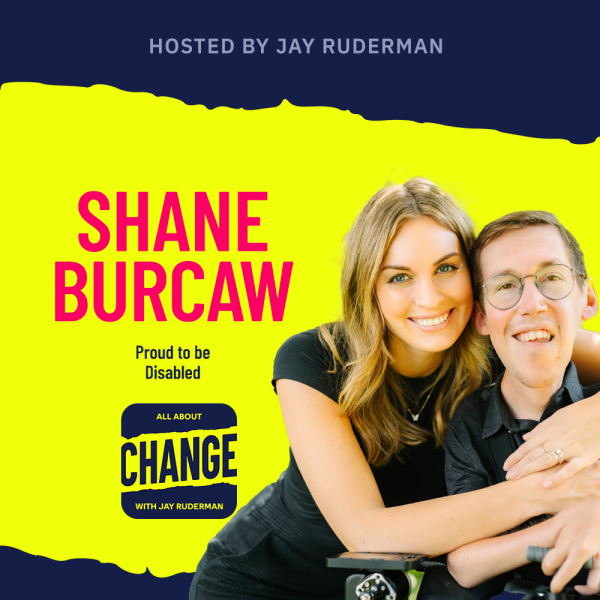
Shane Burcaw grew up in Bethlehem, Pennsylvania, and graduated from Moravian College with an English degree. His bestselling memoir was shortlisted for the ALA Excellence in Nonfiction Award. He also writes as a freelancer for The Morning Call. His blog, Laughing At My Nightmare, talks about the humor of living with Spinal Muscular Atrophy (SMA) and has over half a million followers. Along with his wife, Hannah, the duo started their popular YouTube channel, Squirmy and Grubs, in 2018.
About:
Shane sat down with host Jay Ruderman to talk about his experience growing up as a person with a disability, his advocacy work through his YouTube channel and non-profit, and how he challenges people’s assumptions about what someone living with a disability can do. To learn more about laughing at my nightmare.
TRANSCRIPTION:
Shane Burcaw:
If I’m going to die by 30, then I’m going to live the crap out of life until then to make it worth it, and that idea ultimately carried through the rest of my life.
Jay Ruderman:
Hi, I am Jay Ruderman and welcome to All About Change, a podcast showcasing individuals who leverage the hardships that have been thrown at them to better other people’s lives.
Montage:
I say put mental health first because if you don’t-
Montage:
This generation of America has already had enough.
Montage:
I stand before you, not as an expert, but as a concerned citizen.
Jay Ruderman:
Shane Burcaw never set out to have a massive following. When he started making content about living with spinal muscular atrophy, known as SMA, he rapidly gained online attention.
Shane Burcaw:
As my blog was getting bigger, I began to meet more and more much older disabled people both living with my condition and others, and I began to learn from them that a life with a disability may not be a negative or a shameful experience.
Jay Ruderman:
He’s since written multiple books, founded a landmark nonprofit and built a YouTube channel with more than one and a half million followers.
Shane Burcaw:
It’s a double-edged sword, not to use a cliche, but it’s really effective in showing people the reality of disability. On the other hand, yeah, it’s a very vulnerable thing to let people into that part of your life, and it opens the door for people to make horrible comments and say, “Why do you look so weird in your bed?” And, “How does a woman like that ever want to take care of a man like him?”
Jay Ruderman:
I sat down with Shane to talk about what his journey looked like to get to where he is now.
Shane Burcaw:
I was diagnosed at 11 months old, so my whole life I’ve been disabled, and that’s just been the reality of my existence. My parents found out about my diagnosis, found out that I would be a wheelchair user for my entire life, that I would need significant physical assistance throughout my life, they obviously were not expecting that, but they made a decision in that moment that disability would not have a negative impact on my life. They acknowledged it. Yeah, life is going to be different than we imagined, but we were going to work together and figure out ways to have me live as regular of a life as possible using adaptations and advocating for myself.
Shane Burcaw:
I got my first electric wheelchair at the age of two, so that’s an infant basically. Being handed this 300 pound piece of machinery sounds like a horrible idea, but as I was learning how to navigate this newfound freedom I had at my fingertips, I could now get myself anywhere I wanted to be.
Shane Burcaw:
But as I was growing up as a child, they really encouraged me to go out in the neighborhood like all the other non-disabled kids and play and make friends and get dirty and get in trouble, although they didn’t love that, but they gave me that freedom to figure out for myself how to navigate the world in a wheelchair rather than something that I see all too often, which is a complete opposite of that where a parent of a disabled child feels that they need to overly protect, overly monitor, the classic helicopter parent that you hear about. And I think that that ultimately is a disservice to a child because they feel so separate and differentiated from the kids around them.
Shane Burcaw:
My parents were really good at allowing me to go out and explore the world, make friends, make mistakes, and learn from them. And as I got older, they shifted that into helping me advocate for myself. When I was going to school and I needed maybe a newer different accommodation, it would make sense for my parents to hop on the phone and call the administration and say, “Hey, Shane needs more time on tests because his arms are getting tired.” But instead, they encouraged me to get on the phone and call and say, “Hey, this is what I’m dealing with, and here’s why I need to change my accommodation.”
Shane Burcaw:
So they instilled in me ideas of responsibility and self-awareness, communication skills to be able to explain to the people around me like, “Hey, this is my disability, and this is why I use a wheelchair, and here’s why you should interact with me just as you do anyone else.”
Jay Ruderman:
A phrase prominent in Shane’s work, his blog, his nonprofit is, “Laughing at my nightmare.”
Shane Burcaw:
That came from learning that humor was a way to disarm people’s discomfort with my disability. At a very young age, I began to perceive that other kids and the people around me made assumptions about me based solely on the way that I looked, the fact that I used the wheelchair, and I had to overcome those initial assumptions and judgments by people every day it seemed. And I found that by making a joke, by having open communication, I could get people over their own preconceived notions about disability a lot faster.
Jay Ruderman:
That humor isn’t just for other people’s benefit. Shane told me that laughter is a vital part of his own mental health, something else he attributes to his parents.
Shane Burcaw:
When you live with a disability, even when you don’t live with a disability, life is inevitably difficult. We all face daily and year-long lifelong challenges, and humor does not solve any of them. I think that’s the most important headline is laughing about a problem that you’re experiencing isn’t going to fix the problem. And that’s not the point of it, I don’t think, but rather to help you and maybe those around you be in a better head space to deal with whatever problem you’re experiencing in more practical ways.
Shane Burcaw:
I believe that this mindset of mine came from our family dinner table growing up. My mom and my dad and my brother, we would relentlessly make fun of each other each night at dinner, and we would make fun of the problems we were experiencing all in a loving, lighthearted way. But it taught me and my brother that it was okay to laugh about the more vulnerable parts of life. Nothing was off limits at the family dinner table, so if you couldn’t laugh about it, you were the odd one out.
Shane Burcaw:
And I do think that if you’re able to step back from a problem that you’re facing and laugh about it with a friend, you should move forward in a more productive way.
Jay Ruderman:
But even with all the love, laughter, and support, Shane said there were still difficult times growing up.
Shane Burcaw:
So my disease is progressive, meaning that I get weaker as I get older, and I’ve always known that. But it wasn’t until eighth grade when I really looked that in the eye and realized what it means. I was having trouble chewing my food in eighth grade, which is something that I’d never experienced before. And so I did some doodling of my disability, and it was really the first time I read scientific descriptions of my disability. And they said that people with my condition generally did not make it to 30 years old.
Shane Burcaw:
I entered into this I’ll call it a dark stage of my life. I don’t want to give the idea that I was depressed or anything like that, but there was always this voice and this idea in the back of my mind that I was going to live a short life and that I was always going to be getting worse and that having a disability was awful.
Shane Burcaw:
And I began to resent my disability and really hate it. And I did everything in my power to minimize and distance myself from my disability. It was such a negative thing in my head, and there was just a lot of self-hatred almost that wasn’t properly expressed. It was more it came out in sarcasm and judgments of other disabled people, and it was just a messy mental time for me.
Shane Burcaw:
And then I got a little bit older as I was in college, and as my blog was getting bigger, I began to meet more and more much older disabled people, both living with my condition and others. And I began to learn from them that a life with a disability need not be a negative or a shameful experience, but rather there are hundreds of thousands of disabled people out here in the world living amazing, successful, happy, adventurous lives who embraced and loved their disability.
Shane Burcaw:
And this was a brand new idea for me that you could be happy and proud to be disabled in those years ahead that I began to examine a lot of my own stigmas and misperceptions about disability and questioning them, identifying all of the ableism that I had internalized throughout the years. Today, I’m 31 years old, and I love my life living with a disability. I wouldn’t have it any other way.
Jay Ruderman:
Shane’s done a lot of work to rid himself of those internalized stigmas against disability, but old misconceptions still stick around. I asked him what some of the more common ones about SMA are.
Shane Burcaw:
I think they’re similar to the misconceptions that people have about disability in general, and they are that living a disabled life is inherently negative and sad, less worthy, less valuable than a non-disabled life. And that unfortunately leads to a variety of systemic barriers that we have as institutions in our world today because for so long we excluded and minimized the value of disabled people.
Jay Ruderman:
For many people with disabilities, one of those systematic barriers can keep them from something absolutely vital. Medical care. Shane said he was one of the lucky ones.
Shane Burcaw:
I was fortunate to grow up in an area where I had access to all the medical care that I needed. All the best hospitals were right there in Philadelphia, all the doctors I needed to see. I had case workers that made sure I always had the equipment I need and fought with insurance when they denied the equipment I needed. With that being said, I think I’m an outlier in that way. I’m very fortunate and privileged to have grown up that way because as I got older and met more and more disabled people, I’ve found that that’s often not the case.
Jay Ruderman:
Another important part of Shane’s activism is highlighting the normalcy of his life. One example, his love life.
Shane Burcaw:
Hannah was going to college at Carleton in Minnesota, and I had just graduated from college in Pennsylvania, and my first book had just come out, my non-profit was beginning to grow and help more and more people. And Rainn Wilson, the actor who plays Dwight on the office, had a production company at the time that was making documentaries about disabled people doing interesting things. And they featured me in one of their episodes. And that episode got pretty big on YouTube. It got a couple million views.
Shane Burcaw:
And one night while Hannah was studying, she opened up YouTube to distract herself, found this video about me and felt like we had very similar senses of humor, similar hobbies and passions. And she sent me an email out of the blue just saying, “Hi, I saw your video. We have a lot in common. What’s up?” I read her email, and was instantly captivated by her voice and her interests and her worldview. And I replied, and I was like, “Hey, let’s talk and be friends.”
Shane Burcaw:
So we began to text, and then we began to FaceTime. And very quickly within a few weeks we were like, “Oh, no, we have feelings for one another.” And that’s super inconvenient because we were a thousand miles apart. Thankfully, a few months later, Hannah flew out to Pennsylvania so that we could meet in person. That kicked off two years of long distance dating. Thankfully, we had many visits in between to keep us sane. At the end of two years, Hannah was going into her senior year of college, and I was established as a writer, and I made the move out to Minnesota so that we could get an apartment together, and that began our life. And today we’re married and we live in LA.
Jay Ruderman:
Wow. And so you guys have written a book together called Strangers Assume My Girlfriend is My Nurse. What are some of the misconceptions that you and Hannah deal with on a daily basis about your relationship?
Shane Burcaw:
There’s two main types of misconceptions, and they’re the ones that we get online from people that want to share videos and then ones that we face out in the real world. The real world ones are often not as severe. They’re usually silly when people out in public say to Hannah, “Oh, is this your son?” Because they see me, and they can’t fathom that a non-disabled woman like Hannah would date a disabled man like me.
Shane Burcaw:
But then online it goes a lot further because people are able to hide behind an anonymity. They double down on the idea that I should never be married to a woman like Hannah because it’s not something that people often experience. Our media has done a pretty bad job so far of portraying disability in a positive and enviable way. You never see the disabled character be the hero or be the one that falls in love and wins the girl or anything like that.
Shane Burcaw:
So we have all these ideas in our society that disability is bad, it’s ugly, it’s something that should be avoided at all costs. And people just say that out loud on the internet to us. They say that we’re lying, that I’m paying Hannah to pretend to be my wife because obviously it could never be real love. People say that I am ruining Hannah’s life, that by being with me, I’m holding her back and that she’ll never be able to live a full life. It’s all wrong, and it’s all based in inexperience and even a meaningful or purposeful ignorance and an unwillingness to open up a worldview that maybe you haven’t considered before.
Shane Burcaw:
So, yeah, it’s a lot. There are a lot of misconceptions about disability and dating and romance and all of that. We’ve been doing this together now for six years, making videos that is, and we’ve gotten good at separating our advocacy in our online work from our life. In the beginning we had the camera on almost all the time. We were filming as much as we could because it was reaching people, and we wanted to share our lives and combat those negative ideas that are out there. As we’ve gotten older, as our channel has matured and come into its own, we’ve realized that we don’t need to share every minute of our life in order to affect the same change. So we’re a lot more mindful and purposeful now about having a private life outside of our work.
Jay Ruderman:
Shane, you’ve built this platform, this community, and you’ve turned something very personal into something that helps a lot of people. When you think about your work today, what drives you to keep doing it?
Shane Burcaw:
I think what drives me is the realization that representation matters. Growing up, I didn’t have examples of people like me living the kind of life that I wanted to live. I didn’t see disabled people in relationships, in careers, living independently, being happy and fulfilled. And so if I can be that representation for someone else, if I can help someone see that their life can be full and meaningful, then that’s worth it to me.
Shane Burcaw:
Also, I think there’s still so much work to be done in terms of accessibility, inclusion, and changing societal attitudes. We’ve made progress, but there’s still a long way to go. And I feel like I have a responsibility, given the platform that I have, to keep pushing that forward.
Jay Ruderman:
For people who might be listening and who are dealing with their own challenges—whether it’s a disability, a health issue, or something else—what would you say to them?
Shane Burcaw:
I would say that your life is not defined by your challenges. They are a part of your life, but they don’t have to define your worth or your potential. It’s okay to struggle. It’s okay to have bad days. But it’s also important to recognize the things that bring you joy, the things that give your life meaning, and to focus on those.
Shane Burcaw:
And don’t be afraid to reach out for support. Whether it’s friends, family, online communities—there are people out there who understand what you’re going through and who want to help. You’re not alone in this.
Jay Ruderman:
That’s really powerful. Shane, thank you so much for sharing your story and your perspective. It’s been a pleasure having you on the podcast.
Shane Burcaw:
Thank you for having me. I really appreciate it.
Jay Ruderman:
Thank you so much for listening to All About Change. Today’s episode was produced by Tani Levitt and Mijon Zulu. Stay tuned for our next episode. Spread the word, tell a friend or family member, or leave us a review on your favorite podcasting app. We’d really appreciate it. That’s all for now. I’m Jay Ruderman, and we’ll see you soon with another episode of All About Change.