Tyler Merritt - Before You Call the Cops, Storytelling and Empathy Driven Social Justice
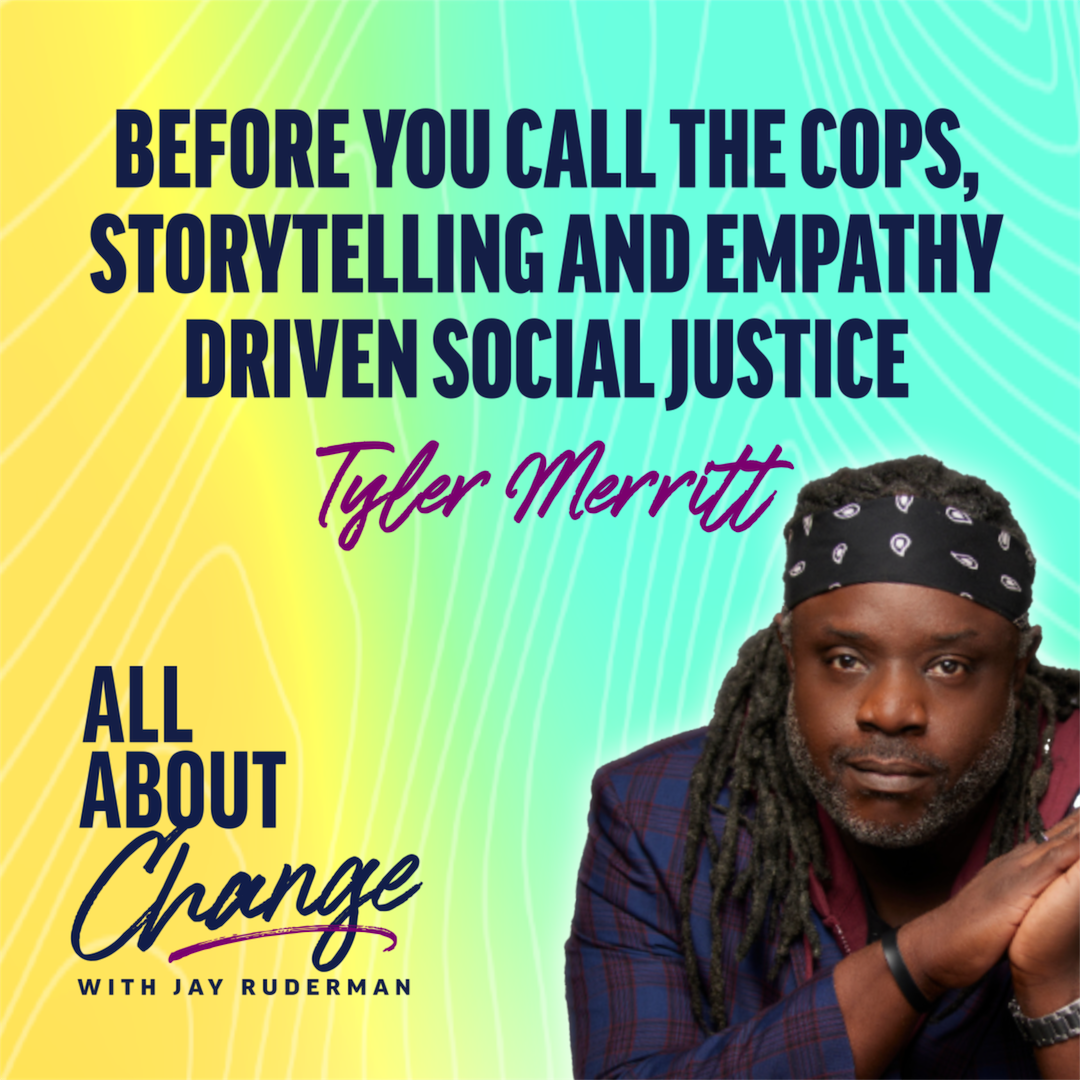
Tyler Merritt is a Nashville-based actor, comedian, vocalist, and creator of The Tyler Merritt Project. He believes empathy is a powerful tool to fight injustice and encourages people to step out of the anonymity of social media and engage in face-to-face conversations. Using his creativity, Tyler Merritt challenges racism and promotes empathy.
About:
In 2018, Tyler's viral video "Before You Call The Cops" (released by The Tyler Merritt Project) was viewed by over 18 million people worldwide and voted one of the Top 20 videos of the year by NowThisPolitics. In 2020, “Before You Call the Cops” recirculated and has since been viewed by over 60 million people and has appeared on Jimmy Kimmel Live, MSNBC Live, and Access Hollywood. <span style="font-weight: 400;">Jay and Tyler discuss the idea of activism through storytelling, the way cancer impacted Tyler’s activist journey, and much more.</span> <a href="https://thetylermerrittproject.com/">Learn more about the Tyler Merritt Project here.</a>
TRANSCRIPTION:
Jay Ruderman:
Welcome to All About Change. Today, my guest is Tyler Merritt. Tyler is a Nashville-based actor, comedian, vocalist, and is the creator of the Tyler Merritt Project, and activist. As he says on his website as a six-two, dreadlocked black man living in the South, Merritt is well aware of the stereotypes and their potentially dangerous consequences. To combat this, Tyler began the Tyler Merritt Project, which brings his ethos of love, learn, create, to life through his words and videos. Tyler's 2018 video, Before you Call the Cops went viral two years after it was released, during the summer of protests following George Floyd's murder. Since then, his reach has grown wide and he has shared his message of coexistence on the podcast and book circuits and on national and local TV nationwide. Recently, Tyler's third book, This Changes Everything, hit bookstores across the country. When Tyler was diagnosed with cancer, everything he thought he knew about what mattered in life changed. This Changes Everything is a humorous and optimistic love letter to this beautiful life. Tyler, welcome to All about Change. So Tyler, I want to tell you that we've never met, but listening to your words, listening to your videos, reading your words, your idea of proximity and getting to know you, and after I get to know you, I'll love you and I feel like I love you. Your message really resonated with me.
Tyler Merritt:
I appreciate that, bro. Also, I know it's not easy, especially nowadays where proximity can oftentimes not even really feel safe. You know what I mean? It can literally not feel safe nowadays. It doesn't feel like when I was in elementary school, you just kind of were like, I'm going to get to know the kid next door and their family. Nowadays, it can be tricky. So I appreciate that, man. It means a lot, for real.
Jay Ruderman:
I want to talk about your new book, This Changes Everything, and there's so much brave vulnerability in the book. I was really impressed about what you were able to share. Now, the book focuses on your cancer diagnosis and recovery, and it could seem like a departure from the other work that you've done over your career. But African-Americans have the highest rate of mortality of any racial or ethnic group for all cancers combined. So, can you talk a little bit about how you see this book as part of your activist project that you've been working on for the past decade?
Tyler Merritt:
To be clear, I did not want to write a book about cancer. I don't ever want anybody to have to write a book about cancer again. It just so happens, people ask me all the time, in I Take My Coffee Black, I never talked about cancer, my first book. And I said well, it's because I didn't know I had it until I turned I Take My Coffee Black in. Almost a week after I turned it in, suddenly I found out that I had a 28 pound cancerous tumor in my abdomen.
Tyler Merritt:
I do okay financially. I am single with no kids, so I've had insurance for quite some time. I have a doctor who I see regularly, but that percentage of black people in America is not really that high. People who are continually checking in on their health, people who are invested in making sure that all parts of their body are taken care of, and it's not because there's not a desire to want to make sure that we are well, but it's all tied into systematic racism, in not trusting doctors feeling as if you have to go to somebody, it can be a sign of weakness. Being looked at like, okay, well your health isn't okay. We really don't care. There's a lot of things that are associated with that.
Tyler Merritt:
Of course, on top of financial costs, the same way that the entirety of America is affected. When I really dug into talking about cancer, it was almost impossible for me not to be able to look at kind of the causes of death, especially amongst people that look like me and why. And I talk about this in my new book. I'm a black man in America, everything is not fine.0
Tyler Merritt:
I walk through a million different things every single day and I don't have the privilege to not have hope as a black man in America. If I wake up and decide I'm just going to leave hope behind, I would never get out of bed. And for me, that funnels into things having to do with my health where I find myself saying it might be a bad day today, but if it's a bad day where I'm getting to spend it with my nieces and my nephews or I'm getting to spend it with someone that I love. Or hell, if I'm just getting to sit and watch a television show that I think is wildly amusing or touching to me, that to me, the still being here. Man, it's that thing that is beyond just good. It's a miracle, and not just if you're sick. If you're healthy, it's a miracle that we are still here and there's a joy in that.
Jay Ruderman:
That's a beautiful message. Is that the same when you wear a mask for health reasons, you're compromised and you're wearing a mask and people are turning to you and saying, "Hey buddy, what do you got the mask on for?" I mean, is that part of it also?
Tyler Merritt:
100%. And I mean this in a literal sense, not in the trying to be a punk sense. People that still question anybody for still wearing a mask to me are just ignorant. And again, and I don't mean that in this negative sense. I mean it literally. I feel like they need to educate themselves. I think they need to think about science. I think that there needs to be a little bit of empathy involved, and know that I don't like wearing a mask. I don't, but I just came back from a six city tour back to back to back to back to back, and in every airport, in every signing I had a mask on. And because a lot of these people were my people, they didn't question me, but I found myself going, you don't know what my story is.
Jay Ruderman:
Exactly.
Tyler Merritt:
And when I see somebody else who has a mask on, I don't know what their story is either, and honestly, how much does my wearing a mask affect you? Which also, bro, goes into the entirety of the concept of empathy and proximity to anyone. Us not being able to understand what other people are doing unless we allow ourselves to take the time to get to know those things. I would argue to say 99.9% of people, if they were to come to me and like, "Bro, come on man. Why you still got a mask on?" If I were to say, "Thanks for asking, I actually have cancer." Right after the word cancer, the whole mood would probably shift.
Jay Ruderman:
But I think we don't understand each other. I mean, I think that's the point that you're trying to get at. We make these assumptions in America and maybe other parts of the world, that you're in this camp, I'm in this camp. This is who you are. This is who I am. I don't like this thing about you, you don't like this thing about me. And what I get from your message is like, hey, just back up and try to understand who I am. I might look different, I might be acting different, whatever, but you don't really know me.
Tyler Merritt:
For me, it goes even deeper. I wish that we had the natural-born empathy to not only want to be curious about another person, but to actually care. If I see somebody who's wearing a mask, my initial thought doesn't go into, why are they wearing a mask? And maybe my initial thought goes into, okay, I don't know who this person is, but I care about them. I care about their wellbeing. And look, I know that that sounds like a whole thing. I know that sounds like make believe of me just going, so what you're saying Tyler, is you want just the world to be better as humans. And kind of in some way I'm saying, no, man, I just want you to see me and I want to be able to see you the way I do about any singular person that I care about.
Jay Ruderman:
And I know you're a religious person, and I also consider myself a religious person. How much does that come into it? Your teachings, what you've learned, your life experience, there's God in here and it changes your appreciation, it changes your perspective. And I know you've talked about different experiences that you've had over your life at a Christian camp and other times when you're like, my perspective has changed. This is a show about activism, not about religion, but I think religion shapes who we are and shapes our activism.
Tyler Merritt:
At a very, very young age, when I was in middle school, high school age, I went to a church camp and I won't get all into that story. It's highly documented in my first book, I Take My Coffee Black, but in that church camp experience, I ended up becoming a Christian and having a spiritual experience with Jesus. Now as a grown person, as an adult in a time period where Christian nationalism is rampant throughout the United States. I'll tell you and I talk about this in my new book, I don't even like saying I'm a Christian. I don't like using that word. And to be really honest with you, I'm not really comfortable really saying the name of Jesus anymore, because I feel like that Jesus that I fell in love with at this quiet summer camp as a young, young child, has been wildly vandalized.
Jay Ruderman:
Really?
Tyler Merritt:
Wildly vandalized. This thing that I care about, this thing to me that is the default of everything having to do with it is love. The idea of this Christianity, which is grace and understanding, accepting all people and loving those who need help and compassion, all of those things has become wildly vandalized into something that it is hard for me to recognize so much that it's hard for me to even say that I am that thing. Now, why that matters in activism, and I know that there are millions of people who feel the same way. When I'm on tour and I talk about this, it's when the audience probably comes the most alive, whether they're Christian or not, they understand what I'm trying to say. That my Jesus isn't an American flag.
Tyler Merritt:
My Jesus isn’t nationalism. My Jesus isn’t hate. My Jesus isn’t exclusion. And when I see people weaponize something that I believe is supposed to be rooted in love, it breaks my heart.
Tyler Merritt:
And so for me, when it comes to activism, it’s not about preaching, it’s not about telling people what to believe, it’s about showing up in love. It’s about showing up in empathy. It’s about saying, “Hey, I see you. I may not understand you fully, but I’m willing to try.”
Jay Ruderman:
That’s incredibly powerful. And I think it ties directly into your idea of proximity, which you’ve spoken about so often. Can you explain that concept a bit more?
Tyler Merritt:
Yeah, proximity is everything to me. Because I think fear lives in distance. When you don’t know someone, it’s easy to make assumptions. It’s easy to believe stereotypes. It’s easy to dehumanize.
Tyler Merritt:
But when you get close to someone, when you hear their story, when you sit across from them and share a meal or a conversation, it becomes really hard to hate them.
Tyler Merritt:
That’s why I always say, get close enough to someone and you’ll find a reason to love them.
Jay Ruderman:
Do you think people are willing to do that today?
Tyler Merritt:
I think some are.
Tyler Merritt:
But I also think we’ve built systems and habits that keep us apart. Social media, news cycles, political divides, they all benefit from keeping us in our own corners.
Tyler Merritt:
And it takes intentional effort to break out of that.
Tyler Merritt:
It takes courage to say, “I’m going to step into a space that’s uncomfortable and try to understand someone different from me.”
Jay Ruderman:
And what role does storytelling play in that? Because clearly, that’s a big part of your work.
Tyler Merritt:
Storytelling is the bridge.
Tyler Merritt:
Stories allow us to step into someone else’s life, even if just for a moment.
Tyler Merritt:
And when we do that, we start to see the world differently.
Tyler Merritt:
We start to realize that people aren’t just headlines or stereotypes. They’re human beings with experiences, fears, hopes, and dreams.
Jay Ruderman:
So when you think about everything you’ve gone through, your diagnosis, your activism, your storytelling, what do you hope people take away from your work?
Tyler Merritt:
I hope people realize that life is fragile and beautiful at the same time.
Tyler Merritt:
I hope they understand that every single day matters.
Tyler Merritt:
And I hope they choose love. Not the easy kind of love, but the kind of love that requires effort, that requires empathy, that requires seeing people as they are and not as we assume them to be.
Jay Ruderman:
That’s a powerful message.
Tyler Merritt:
And I think if we can do that, even just a little bit more each day, the world changes.
Tyler Merritt:
Not overnight, not in some dramatic way, but in small, meaningful ways that add up over time.
Jay Ruderman:
Tyler, thank you so much for sharing your story and for the work that you’re doing.
Tyler Merritt:
Thank you for having me, man. I appreciate you.
Jay Ruderman:
Thank you so much for listening to All About Change. Today’s episode was produced by Tani Levitt and Mijon Zulu. Stay tuned for our next episode. Spread the word, tell a friend or family member, or leave us a review on your favorite podcasting app. We’d really appreciate it. That’s all for now. I’m Jay Ruderman, and we’ll see you soon with another episode of All About Change.