Vicki Sokolik - Fighting for Unhoused Youth
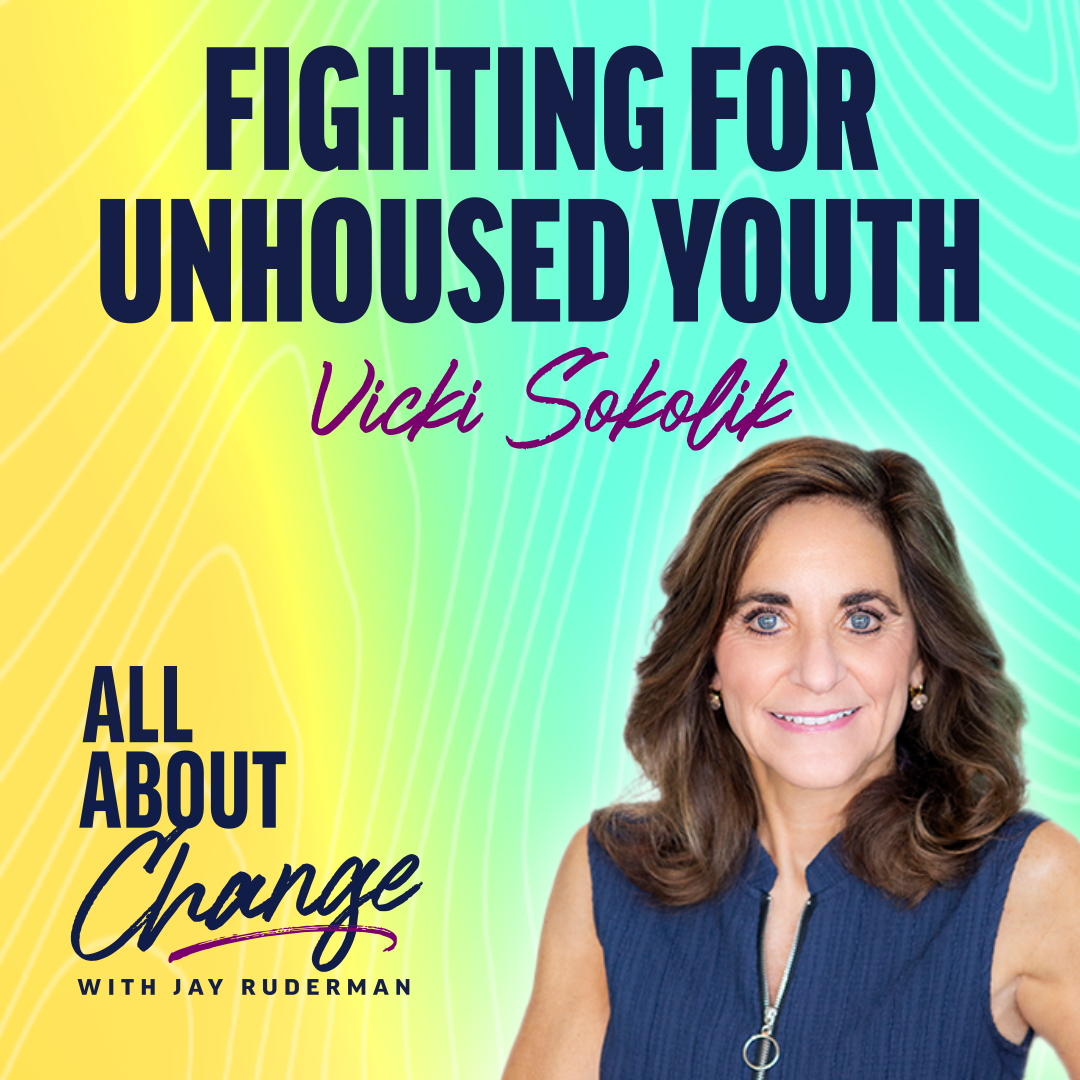
Vicki Sokolik refuses to be an Ostrich. Her son brought to her attention the crisis of unhoused youth — youth unhoused, not living with a parent/guardian, and not in foster care — in America, and she has been fighting to support this vulnerable population every since. Most active in Tampa Bay, Florida, Vicki is the founder and CEO of the nonprofit Starting Right, Now, which removes barriers for unaccompanied homeless youth to cultivate long-term well-being and self-sufficiency. She is also the author of the new book, “If You See Them: Young, Unhoused, and Alone in America.”
About:
Vicki Sokolik joined host Jay Ruderman to discuss the many ways unhoused youth fall through the cracks in our society, how her organization helps them, and also how to build trust with people who could use your help. To learn more about Starting Right Now, click here.
TRANSCRIPTION:
Jay Ruderman:
Welcome to All About Change. Today my guest is Vicki Sokolik.Almost two decades ago, Vicki became aware of the plight of unaccompanied youth. Homeless minors who have left abusive and troubled homes, who are not in foster care and who've taken care of all their basic needs themselves.1.7 million young people fall into this category. A number of Vicki believes is actually an underestimate. In 2007, Vicki founded the nonprofit, Starting Right, Now, an organization that takes a holistic approach to intervening and getting these young people care by housing them, helping them secure resources like food and counseling, and supporting them in graduating high school and going on to higher education and careers.Vicki has also written about her advocacy around this issue in her recently released book, If You See Them: Young, Unhoused, and Alone in America.So Vicki Sokolik, thank you so much for being my guest on All About Change.
Vicki Sokolik:
Thank you so much for having me. I am so honored. You have no idea.
Jay Ruderman:
Let me ask you, a number of our guests have shared origin stories. Peter Egan, Torrey DeVitto come to mind as previous guests and they found their causes by chance.For you, your son brought to your attention a classmate who was unhoused. And this was a chance encounter and you jumped in immediately and helped. But then, it went beyond that and you took this on as a cause.So why do you think you took that path rather than just this being a one-off? Why did you make this your mission?
Vicki Sokolik:
I feel like it wasn't ever my mission. Once my son made me realize that there were these youth that were alone. You can be like an ostrich, you can stick your head in the sand and you can say, "Okay, I saw it, but I'm not going to do anything about it."I couldn't imagine a child that age, 17 years old, navigating life alone and knowing that there were more kids in that same predicament. I couldn't be an ostrich anymore. My daughter had epilepsy and because of that, had an invisible disability. And it seemed to me that these kids had an invisible disability but had no advocate, and I wanted to be their advocate.
Jay Ruderman:
First of all, what does it mean for a youth to be unhoused and how does that happen? Because at one point these children have parents, they were brought into this world. How did they become homeless?
Vicki Sokolik:
We help a very niche population of kids that are classified as unaccompanied homeless youth, which is a federal term, meaning that the student is not living with their parent or guardian. And they're not eligible for foster care because they left home versus being taken from their home.
Narrator:
McKinney-Vento Act is a federal law that protects students experiencing homelessness and their families. The relationship between school and home is integral to student success. If the student loses their home or lives in a place that is dangerous to the people living there, they may qualify for protection under the McKinney-Vento Act.This may look like a student staying in a shelter, hotel, motel, or sharing the housing of others. Or even living in their own home that lacks utilities or is infested with vermin. The McKinney-Vento Act ensures that students receive support in obtaining anything needed for their education, including hygiene items, clothing and educational and medical resources.In addition to support, students have certain rights pertaining to enrollment, attendance, and transportation. Students that qualify for McKinney-Vento are permitted to stay at their home school if it's in their best interest, even if they move to another district during the school year.If this happens, schools are required to provide transportation. If students do have to enroll elsewhere, they are allowed to start the enrollment process even if they don't immediately have the necessary documents. And schools can help them obtain those documents after enrollment.
Vicki Sokolik:
Which doesn't mean that the Department of Children's and Families hasn't gone in and done investigations in the home, but they never felt that the child was in danger to pull them out.Almost 100% of the girls that enter my program have been raped in their home by family members or friends of family members when they have been trafficked by them. And at one point the child just says, "Forget it. I'm not going to stay here and let this happen anymore."And they start what we call couch hopping where they're asking a friend, "Can I sleep at your house?" And then, "Can I sleep at your house?" Until really they run out of options and they end up either too far away from school so they can't get there, or they're sleeping in park benches. Or they do what's called survival sex, where they will have sex just to have a bed and then the next night go do the same thing.And a child ever wants to be away from their parents. The kids that we have still actually really love their parents. It's just a matter of is it safe to be at home? The other main themes that we see are lots of drugs or alcohol in the home and the kids says, "Forget it. If I don't get out of here, I'll never get out of it."It could be their sexual orientation that the parent says, "Nope, if you're going to be gay or trans or whatever, you cannot live here anymore." And it could just be literally, economics where the family really cannot support all the kids. And they just all start disbanding and going different directions.When I first started doing this, if somebody would've said to me, "There's a kid on the street that the mom kicked out of the house." I would've immediately said, "Something's wrong with the kid, bad kid." And I do not think that anymore at all. I think that there's a lot of circumstances that go around that, and until you really understand the story, it's not bad kid and it may not even be bad parent.
Jay Ruderman:
I want you to give some advice to our listeners. What are the signs that people may see in youth? They're coming across a child, they may have some concerns. What should they look for and what should they do once there's concern?
Vicki Sokolik:
Well, I would say a student who constantly gets referrals for bad behavior at school, someone needs to ask, "Hey, what's going on at home? Do you have a home? Is there something I can do to help you?"A student who walks in a classroom immediately puts their head down and is not interested at all. I would guess is probably tired, hungry, emotionally drained. A student who's constantly skipping classes, possibly because they can't do the assignments. Maybe they don't have access to technology or whatever else the teacher wants them to be able to put it on. Those are immediate signs.Other things are kids that are constantly walking in the same clothes. They have a repeat of two or three clothes that you see them constantly wearing. Kids that are loners because a lot of kids do not want anyone to know, so they will isolate themselves and be all alone.I would say those are the main signs. And I think the biggest thing is changing the question. We're so quick to say, "What's wrong with you?" Instead of, "Is something going on that I can help you with? You can trust me, you can tell me I'm going to help you." We're punitive.
Jay Ruderman:
Right. That's wise. That's very wise.You're months into promoting your new book. It came out two decades after your work supporting unhoused youth began. Do you think that the conversations around unhoused youth has changed markedly from the time when you first got started?
Vicki Sokolik:
No, sadly. I still do not think people understand that these kids exist with no safety net. And that was one of the biggest impetuses of the book was that there's 1.9 million of these kids around the country. I can tell you that that number is so inaccurate because when we go in and we're interviewing kids, they have not been coded. And so there's probably double that number.
Jay Ruderman:
What do you mean by coded?
Vicki Sokolik:
Okay, that's a great point.So when you are an unaccompanied homeless youth, if you let someone at the school know, they will literally give you that distinction in the system so you get coded. And the reason that that's important is that in the state of Florida, that allows you to actually get public services that you may not have otherwise been eligible for. It's not true in other states, but in Florida we've changed 10 laws.One of the goals of the book was that I want to change laws on a national level. And the reason for that is we have a student right now who was born in Louisiana. And we can't get his birth certificate or his social security card because that state does not recognize unaccompanied homeless youth as being eligible to have their own personal documents.When you can't get those documents, you can't work. You can't apply it to go to your next goals. You're really dead ended, and that really should be a national law, which we're working on. I'm so happy to say, we're actually working on that. So that was one of the goals of the book.But the other thing is in the state of Florida now, the kids can have access to healthcare. That's not true in other states. It's just horrible. I can't imagine that there's all these kids out there that are literally surviving alone and that we as a country aren't saying, "How did this happen?"
Jay Ruderman:
Do you think the public is aware? I didn't know that figure until I prepared for this conversation. But how can we let more people know that that is such a problem in our country?
Vicki Sokolik:
If we want to have strong communities, we're only as strong as our most vulnerable population.
Jay Ruderman:
Right.
Vicki Sokolik:
This is the most vulnerable population. And usually school, for a short period of time, will be the kids' one thing that they will try to maintain until they can't anymore. Because maybe they have to go to work or maybe they have to go sell drugs or do whatever.We're not identifying them in the schools and catching them before they drop out. And like I said, once you drop out of school, you are limited on what you're doing for the rest of your life and your community won't be as safe.
Jay Ruderman:
So your work is not only about helping individuals, but also about strengthening communities as a whole.
Vicki Sokolik:
Absolutely. When you help one child, you're not just changing that child's life, you're impacting generations to come.
Vicki Sokolik:
These kids are incredibly resilient. They’ve been through things that most adults couldn’t even imagine surviving.
Vicki Sokolik:
And yet, when given the opportunity, the support, and the stability, they thrive.
Jay Ruderman:
Can you share a story that really illustrates that transformation?
Vicki Sokolik:
There are so many, but one that always stays with me is a young woman who came into our program after living on the streets.
Vicki Sokolik:
She had been through unimaginable trauma, but she was determined to finish school.
Vicki Sokolik:
We were able to provide her with housing, counseling, and educational support.
Vicki Sokolik:
And today, she’s not only graduated, but she’s in college and mentoring other young people who are going through similar experiences.
Jay Ruderman:
That’s incredible.
Vicki Sokolik:
It is. And it shows what’s possible when we invest in these kids instead of ignoring them.
Jay Ruderman:
What are the biggest barriers you face in your work?
Vicki Sokolik:
Awareness is a huge one.
Vicki Sokolik:
People don’t see these kids, so they assume they don’t exist.
Vicki Sokolik:
And then there’s funding.
Vicki Sokolik:
It’s always a challenge to secure the resources needed to provide comprehensive support.
Vicki Sokolik:
But honestly, one of the biggest barriers is changing the narrative.
Vicki Sokolik:
We need to stop blaming these kids and start understanding their circumstances.
Jay Ruderman:
What gives you hope as you continue this work?
Vicki Sokolik:
The kids.
Vicki Sokolik:
They give me hope every single day.
Vicki Sokolik:
Seeing their strength, their determination, their ability to overcome so much adversity… it’s inspiring.
Vicki Sokolik:
And it reminds me why this work is so important.
Jay Ruderman:
If someone listening right now wants to help, what can they do?
Vicki Sokolik:
The first thing is to become aware.
Vicki Sokolik:
Learn about this issue, talk about it, share it.
Vicki Sokolik:
If you see a young person who might be struggling, don’t ignore it.
Vicki Sokolik:
Ask questions. Offer support.
Vicki Sokolik:
And if you’re in a position to do so, support organizations that are doing this work.
Jay Ruderman:
Vicki, thank you so much for being my guest on All About Change and for the incredible work that you’re doing.
Vicki Sokolik:
Thank you so much for having me. It truly means a lot.
Jay Ruderman:
Thank you so much for listening to All About Change. Today’s episode was produced by Tani Levitt and Mijon Zulu.
Jay Ruderman:
To check out more episodes or learn more about the show, you can visit our website allaboutchangepodcast.com.
Jay Ruderman:
If you like our show, spread the word, tell a friend or family member, or leave us a review on your favorite podcasting app.
Jay Ruderman:
We’d really appreciate it.
Jay Ruderman:
That’s all for now. I’m Jay Ruderman, and we’ll see you soon with another episode of All About Change.