%201.avif)

Shining the light on activism
All About Change podcast is where I sit down with activists, artists, athletes, and advocates who keep showing up, even when it’s hard.
The archive
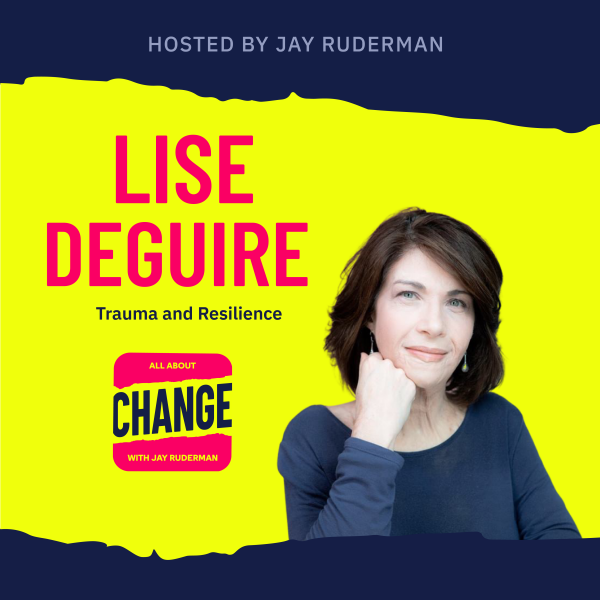
Lise Deguire: Everyone is capable of more resilience than they think they are
.Jay Ruderman: Hi, I’m Jay Ruderman and welcome to All About Change, a podcast showcasing individuals who leverage the hardships that have been thrown at them to better other people’s lives.[show intro]
Jay Ruderman: And today on our show, Lise Deguire.
Lise Deguire: Resilience is actually the common outcome after trauma.
Jay Ruderman: Dr. Lise Deguire is a psychologist, author, and burn survivor who has overcome a lot in life.
Lise Deguire: But she left me in that fire so I am at this point, sort of trapped and abandoned and on flame and more or less my life is in grave danger.
Jay Ruderman: She’s spent years in the hospital undergoing multiple reconstructive surgeries. She experienced bullying, navigated life in a house run by parents who were battling their own demons, and has lost multiple family members to suicide. But, despite everything, I found Lise to be an incredibly happy and optimistic person.
Lise Deguire: It is not an accident that I am a psychologist and that I am. very focused on mental health concerns and trying to help people, have hope and develop their own capacity for resilience.
Jay Ruderman: In her award-winning memoir Flashback Girl: Lessons on Resilience from a Burn Survivor, Lise tells her incredible story of survival. I found our conversation profoundly inspiring. Her hard learned life lessons can help us see that we are stronger than we might give ourselves credit for.
Lise Deguire: We can get through horrible or horrible things. We are much more resilient and stronger than we imagine ourselves to be our fear that we might be.
Jay Ruderman: Lise Deguire, it’s such a pleasure to have you. Welcome to All About Change.
Lise Deguire:Thank you so much for having me. A real honor to be with you today. I’m, I was so looking forward to this.
Jay Ruderman: You became a burn survivor in 1967 at age 4 due to a horrific accident. Could you tell us what happened?
Lise Deguire: So I was on vacation with my little family of four up in Wolfeboro, New Hampshire. and, uh, it was our first night on vacation and my mother decided it was time to start to cook dinner, and she rummaged around our little rented cabin for something she thought was lighter fluid. And with me standing right next to her, I was just four. she poured this lighter fluid on a charcoal grill and attempted to light it, but it didn’t light, so she poured the can again on the charcoal grill, and it turned out it was not lighter fluid.It was a highly flammable household solvent. And so, in that moment, there was this giant eruption of flame, which enveloped both of us and blocked off any exit off the porch. And my mother in that moment realized that there was one way to save herself, which was to dash through the wall of flame and down into Lake Winnipesaukee.And that’s what she did. But she left me in that fire so I am at this point, sort of trapped and abandoned and on flame and more or less my life is in grave danger. But my father was able to find me and he sort of pulled me through the fence on the back way, grabbed me and pulled me through the fence and threw me in the lake and I was saved. But from that, you know, sort of 90 seconds of horror. I was left with, uh, third degree burns on 65% of my body. And, my, my lip was burned away and my chin and my neck and my arms were fused to my sides. and just being burned 65%, third degree in 1967 at the age of four. It was, it’s a miracle that I am here. Uh, that miracle is due to a lot of doctors and nurses who work super hard, but here I am.
Jay Ruderman: Wow! And your mother was in the same hospital as you, but not so eager to see you?
Lise Deguire: So you are right. I, I was fortunate enough to essentially be at the best Burns hospital in the country at the time was Mass General. And then, um, Shriner’s Burns was built right next door and I was there. That’s where I did, many years of, of hospitalization and surgery cuz burn survival is a, a long and messy and painful process.My mother was initially in the hospital next, right? You know, sort of on a different floor. and she was there for about three and a half months, and I was there for five. she did not come to see me in the beginning very much at all. And actually in the beginning, not at all. Um, she was not again, particularly invested in what I was going through.She was very upset about what she was going through. And that’s, that’s my mother. Right. That’s just my mother. but, I will say I’m incredibly grateful to Mass General and to Shriners, those doctors and nurses knocked themselves out to give me a decent life, and which I have managed to have because of them.
Jay Ruderman: That’s just incredible. And I understand that you had to undergo many surgeries before you were released from the hospital.
Lise Deguire: I mean in, in some total now, and I’m talking cuz I still have procedures that’s maybe something that most people, um, who’ve not been burned. And I hope nobody out there has been burned because it’s an awful thing.But it’s sort of a lifelong process really. Recovery, recovering from a severe burn because there’s always need for more and more procedures. So I’ve, at this point I’ve had, I think about 75 procedures.
Jay Ruderman: Wow. There was something that you shared in your book that really struck me because it is sort of inconceivable. You had to go through very painful procedures, as a little girl, and you were not even given painkillers?
Lise Deguire: At the time, for some reason, and I don’t, I cannot, no one can explain this to me. They just didn’t believe in giving painkillers to burn kids. Burn adults got them, but kids didn’t. anybody you talked to who was burned around the time that I was, they’d be like, oh yeah, it was torture and it really was. . I will say nowadays they don’t do that anymore. Nowadays, they’ll even put you in a, um, a twilight sleep for, bandage changes because it, it’s, it’s just the most painful thing in the world really burns.They’ve, they’ve decided that it is the most painful thing, you know, more painful than kidney stones and childbirth. And I’ve done both of those things, so I can attest, it’s an incredibly painful process to recover from burns.
Jay Ruderman: Knowing this, it is just incredible to think that your mother, after leaving you in the fire, still didn’t frequently come and visit you.
Lise Deguire: Yeah, so I think that, it is not necessarily true that just because you are a mother or you’re a father that you are really emotionally equipped to be a good parent.Um, I think it’s sort of a myth that we tell ourselves that, you know, there’s this maternal instinct and for many people there are or there is, but for some people there isn’t. and my mother, unfortunately was one of those people. She meant well, she never meant to hurt anybody. She did actually wind up hurting a lot of people, but her intention was, was honorable. She just, you know, when push came to shove, she worried about herself. And did I talk with her about that? Yeah, I tried to. I’m a psychologist. I’ve been through a lot of therapy. I tried to work through that and many other things. But, you know, not everybody’s capable emotionally of what we think they should be.
Jay Ruderman: And, while your father was the one that saved you, in your book, you show how both your parents had their issues. Did you always know that they weren’t the best at being parents?
Lise Deguire: It took me a long time to understand that because I, I mean, I also really wanna be fair to my parents, they were gifted. They were interesting. They were highly educated and um, brilliant musicians and a lot of fun at a party. You know, like they were really interesting people, but were they emotionally equipped to be parents? They were not. They were not. . and I think, I gradually came to understand that from circumstances I went through, and also my brother, but boy, when I really understood it, Jay, was when I had children of my own and I could contrast my wish and my sort of imperative to keep them safe and take care of them versus what I realized the experiences were for me and my brother. Parenthood pointed all that out to me in really stark relief.
Jay Ruderman: Did you have a better relationship with your father than with your mother?
Lise Deguire: Yes, and he was, I think, more paternally oriented. Little more protective. he did things like, he brought me a record player, so I had music to listen to cuz it was mostly flat on my back for a long time. he was thinking a little bit more about my comfort and what I needed than my mother was, thankfully.
Jay Ruderman: And while he was better there, he also had his own blind spots. You wrote about being the victim of child abuse. Do you feel comfortable telling us about that and your father’s reaction to learning of it?
Lise Deguire: There was a man who, was a friend of my family’s who tried to teach me how to French kiss when I was five. , kind of a, sort of a, did that again when I was 14, sort of forcibly kissed me and held me against my will.And my father completely minimized that and sort of said that I should just get over it because, uh, this man was my father’s friend. If my dad were alive now, he would not do that now. But back in those days, I’m not, you know, I think a lot of fathers would’ve been more protective of, of their kids than my dad was, but even my dad would’ve come along by now.
Jay Ruderman: So sorry for that. Was this person in your family’s life for a long time afterward?
Lise Deguire: Yeah, I saw him now and then, um, the last time I saw him, I was 14 when he had sort of grabbed me right in front of my dad. And, and after that happened, I said to my daddy I am never gonna see that man again. I am not, I am never going to his to be there when he’s there. And my dad was mad at me cuz I wasn’t being friendly towards him. I’m like, I’m done. so I, you know, I was able to stand up for myself and I’m glad I was able to do that. And my dad, to his credit, I will say before he died, that’s actually maybe the one thing he ever apologized to me for was that he realized he was in the wrong.
Jay Ruderman: Your dad had a complex life being married to your mother, divorcing, and eventually coming out as gay. What was it like going through that?
Lise Deguire: I’m struck by these questions that you’re asking me, how, how much the times have changed again in this way, I think for the better. But my dad was born in 1929. To, uh, extremely, devout Catholic family and being gay at that point was a sin. and certainly nothing that one could be with any sort of pride or freedom. And he, was in the closet and then he was sort of a little bit, not in the closet, but he waited until his mother died to really come out and embrace his sexuality. So, you know, that happened when I was in my thirties, I guess, and I supported him. I was very sad for him though cuz he came out and he very promptly got AIDS and died not that much longer after that. So it’s a tragic tale of somebody who held himself in for all those years and then finally had a few years of what he wanted to be and then he died relatively young.
Jay Ruderman: Wow. And you spoke about your sibling. I understand that you also had an older brother and that you had a very close relationship because he was very loving and was almost like a second father to you.
Lise Deguire: Yeah. I always say that my best parent was my. My brother Marc was an awesome older brother, just five years older, but super smart and kind and very caring, and he took really great care of me for a while.
Jay Ruderman: As I learned from your book – he did not have a long life. and even from looking at your baby pictures, you can tell you had two very different temperaments, where you were more happy and he was sort of downcast. Could tell us a little more about your brother?
Lise Deguire: Yes, sure. I, I love talking about my brother. his name was Marc-Emile Deguire and, he was in fact a kind of a sad boy and grew up into a sad young man. Part of that is temperament, some people are like that, and I think also he, recognized really pretty early on that our parents were not what they ought to be, and I think that made him sad. Mm-hmm. , he fell into depression. He. Experimented with a fair amount of drugs. He was, uh, neglected the same way that I was. And at the age of 19, he took his life, which, was, you know, a great tragedy for me and, and, and for other people too, cuz he was a well loved young man.
Jay Ruderman: I am so sorry for your loss. I understand that this is just one of several people close to you who died because of suicide.
Lise Deguire: Yes. There were actually four suicides in my family. I mean that, that includes extended family, but yeah. so it is not an accident that I am a psychologist and that I am. very focused on mental health concerns and trying to help people, have hope and develop their own capacity for resilience. Because I’ve, I’ve lived through the tragedy of when people don’t have that or when they give up on themselves.
Jay Ruderman: At such a young age, how do you think you got through it?
Lise Deguire: So that is a lot of, what the book I wrote is about, my book Flashback Girl, it’s about me, but it’s really about how we all can get through horrible, horrible things the fact that we can get through horrible or horrible things. We are much more resilient and stronger than we imagine ourselves to be. our fear that we might be, and there’s a whole mindset to resilience, some of which I think came naturally to me, but that doesn’t mean that we can’t all learn it really.And the mindset includes things like gratitude and optimism and doing what you can to help yourself and having people who love you around you and being able to form and keep relationships and just keeping going, Hmm. So I think naturally I’m good at that, but I think all of us can be helped to be better at that.
Jay Ruderman: I can definitely see how these things can be powerful mental health tools. But, for a person who doesn’t have a sunny disposition like you have, can these tools work us also?
Lise Deguire: Yes, you are absolutely right. Some people that just seem to be born with a smile on their face and some people wake up, you know, kind. And that might be our personality.But yes, I think we can all get better at noticing what we have as opposed to what we don’t. . I heard it said recently that, gratitude is the capacity to notice, to notice the good around us as opposed to the things that we think are missing, um, and everybody’s missing something and everybody has more than what they think they have.You’re right. I mean, you can say what I went through in the hospital and, and and and how torturous it was. And it was, it was all those things. But look at the other side of it. I was in the best hospital. I had doctors and nurses who were knocking themselves out for me. I was alive.
Jay Ruderman: That is really powerful. I am still impressed by how you have been able to take a situations that could be so destructive and discouraging and still find a bright side. For example, your body was frequently examined, not just by your doctor, but by other medical personnel. At such a young age, how were able to be naked and make yourself feel comfortable and not humiliated?
Lise Deguire: That’s mindset. I, I’m not saying that this is so easy, but I am saying this is what I do. I could concentrate on it the way that you said it, Jay, which is that I’m naked and on display and there’s these strangers around me, and that sounds awful. And it’s true. On the other hand. I’m in a teaching hospital and doctors are trying to learn, and if they can learn from me, then they can help other burn kids when they come along and people weren’t putting me on display for the fun of it. It was so that they could get better at helping me and the other kids.And both of those things are true both ways. I just said, to you are true. I guess I prefer to focus on, on the second one, , the one that talks about sort of the meaning behind it as opposed to just the uncomfort of it in the moment.
Jay Ruderman: For young people especially but also generally since COVID-19, we have been in a sort of mental health crisis. So many of us suffer from or know people who have some sort of sadness or depression. Are there warning signs that we need to look for when? Looking back, were their signs that you didn’t understand then, but, given your work and experience, you see clearer now?
Lise Deguire: The thing that I always listen to very carefully for is if a person starts to say that people would be better off without them.That to me is the most dangerous thing I can hear a person say. lots of people feel sad and lots of people feel discouraged and depressed, and I don’t even think it’s, unfortunately, I don’t think it’s that uncommon for people now and then to think that they’re tired of living where life is too hard.But when you get to the point of thinking people would be better if I’m not here. That is the point that people are in, I think grave danger.
Jay Ruderman: And what do we do at that point? Like, I had a guy who reached out to me on social media and said something like, “I thought the world would be better off without me. And, I don’t feel that way now, but sometimes I do.” I didn’t even know this person, but I wrote back and said, listen, if you’re thinking of hurting yourself, please call 988, which is the National Suicide Hotline. But, while you’re a professional, a lot of us are just civilians. What’s the best thing for us to do?
Lise Deguire: Well, first of all, 988 is a great resource and we’re very lucky to have it. And it’s, it’s an absolutely great thing to, say to that young man. In addition, what I say to somebody having that thought that people are better off without you is a symptom and it’s a symptom of depression.It’s not real. It’s a symptom. like having a fever is a symptom of, of the flu. It’s just a symptom. It feels real cuz it’s in our minds, but it isn’t. And that, they are obviously clearly in need of great help and you would like them to have that. But I point out that the thought itself is a distortion. It’s not real.
Jay Ruderman: Absolutely. And, on top of that, there is just so much stigma against being open and addressing mental health and it is holding a lot people back from getting the help that they need.
Lise Deguire: Absolutely. Yes. So you are mentioning stigma. If I can, jump in and say something that I, uh, really wanted to share with you.
Jay Ruderman: Of course, please.
Lise Deguire: Cause again, your foundation does so much work on disability and how disability is portrayed. And I mean, I am blown away really by everything that your foundation has done in that area.
Jay Ruderman: Thank you.
Lise Deguire: I am really hoping to, be able to talk a little bit about disfigurement and how that is portrayed in the media and the need for change in that area because, Disfigurement is, it’s like it’s part of disability. It’s, it is according to the ada, it’s part of disability, but we are not getting traction on that area the way, I’d like to see.
Jay Ruderman: I totally agree. I mean, for all disabilities, and we’ve worked on this with several major studios to change their policy. For a long time, there was this mindset, in the entertainment community, that “real acting” was playing a character that was very different from you. And in fact, in the last 30 years, half the men that have won the best male Oscar, have won for playing a disability. Which is crazy but also demonstrates the need for representation. People with disabilities are able to see themselves in film and tv played by someone who actually has that disability. What sort of traction would like to see for disfigurement?
Lise Deguire: Yeah. I, I know for myself, I would be, well, I would be thrilled if, facial difference were portrayed by p-by actors with facial-difference. That would, to me, that’s like the best possible outcome. Mm-hmm. , the, the, the change I would like to see first is just that scripts are not written. That, disfigured people are evil villains, Darth Vader and. Scar in the Lion King and basically every James Bond villain you can think of.And I could go on and on and on. You know, all these villains are are evil or disfigured and like the disfigurement is this like cheap trope to say like, Ooh, bad person. And like, boy, we don’t allow that for any other disadvantaged group in this country. But somehow for, disfigured people we’re like, fair game. It’s. So discouraging.
Jay Ruderman: Right. And, changing this is really about calling them out on the carpet, and also – getting the showrunners, the ones creating the shows and writers in the room to be more inclusive and get more authentic, human, and appropriate representation. That’s the way to start really changing the historical mindset that calls for cheap tropes. But it does take a certain amount of activism. It’s not gonna happen on its own.
Lise Deguire: Yeah. No, and, and again, I think your foundation has done an incredible job in this space and, all of us are so grateful for the work that you’ve done.
Jay Ruderman: Thank you. Thinking of the impact of these tropes and how they model behavior, I remember in your book, you write about being a young burn survivor, going back to school, and you had all types of reactions from fellow students and teachers. How did that impact you?
Lise Deguire: Yeah. It, it was brutal. it was a, a brutal time in my life. I will say that, if I could get to know the kids, usually I could make. but it was the kids that I didn’t know, who could just be brutal. You know, they would run past me screaming like, ugh. And I mean this just every day. It was like that every day. so it was a, a very unhappy and challenging time. And this is back in the day where there was no intervention around bullying.
- I don’t recall a single school assembly that ever talked about bullying or that even that you shouldn’t bully. It was just something, it was just how it was. I remember the, the only advice being given was probably, you remember the phrase, sticks and stones will break my bones, but words will never hurt me. And you know, being told that and sort of. All right. I guess, but I, they aren’t me, you know, so. Right. it was a, it was a really, really challenging and difficult time for me.
Jay Ruderman: Was there a teacher that you could turn to and say, “Hey, listen, these kids are relentless. I’m being bullied every single day?”
Lise Deguire: I, I would’ve never even, that would’ve never crossed my mind at the time, Jay. I, you know, I was a little kid and, and I just don’t remember schools being like that back then.I, I feel like maybe that’s one good change that has happened in our society is schools seem to be a little bit more caring about what kids are going through. But it was not the case when I was a kid. Not at all. It was sort of dog eat dog.
Jay Ruderman: That’s so unfortunate. I mean bullying is so dangerous. especially in this age of social media it can lead to serious problems and even suicide. Were there also some good examples of kindness from the other students?
Lise Deguire: Yes. again, if I could get to know people, You know, I’m a ni… I’m a nice person. Like I’m, I’m nice. I, I, yeah, I’m, I’m interested in folks. And so if I could just have the chance to talk to people, usually I would become just a person like anybody else, and they, the bullying would stop. it was the, it was the immediate reaction to how I looked at the time and the reaction that is the case for a lot of people who are, facially different. We get judged just on that and, and often the judgment is quite harsh.
Jay Ruderman: Were you ever able to completely reconcile with your parents? confront your mother and, you know, deal with these issues before they passed on?
Lise Deguire: Uh, I mean, uh, you know, I will say I’ve, I’ve been in a lot of therapy, so I, I have gotten healthy myself and I’m I’m a psychologist myself, I’m also a huge proponent of, of therapy for just about everybody. I think it helps a lot get through this thing called life, but my mom was not someone who was open to talking about ways that she had ever made a mistake. So , it was not, she was not somebody that you could, uh, have a heart to heart with and have that go well.And honestly, my dad wasn’t too great at it either. So I have come to peace with things for. and I have come to a good understanding of what I’ve been through and how it shaped me and how I can use that for positive. But did I sooth things out with them, you know, the best I could, but they weren’t great at that stuff.
Jay Ruderman: Too bad for them, but I am so impressed by how, with all the trauma that you had in your life, you are still so incredibly vulnerable in sharing your story in your book and interviews. Why did you write in such an honest and open way?
Lise Deguire: Because I actually think that life is challenging for almost all of us. And if it isn’t for you right now, at some point it will be. I think life is nowhere near as easy as we think it’s gonna be, and that most of us hide that.And we do ourselves no favors because then when you’re going through something, you feel alone. And also if you have gone through something, you’re hiding your wisdom and your strength and your ability to help other people. So I feel. an honest story about, being essentially at the one time, you know, the most unfortunate kid you would’ve ever seen in your life, and how I made it through all these things to build a really great life for myself. That’s the kind of inspiration and hope that I think sometimes we really need
Jay Ruderman: That’s so true. And, you mention this a lot: the need to really hear other people and to practice “attuned listening” – because listening is healing and it can impact our lives on a much larger scale. Could you talk about what you mean by that? how it can really help us at a time when we are so divided as a country?
Lise Deguire: Well, yeah, I, first of all, I think attuned listening is like the greatest gift that we can give each other just to be present for somebody and give them space to share what they’re thinking and feeling without judging that or trying to fix it or change it. I think we all desperately need that. And boy, goodness knows in this country, as you say, there is such a divide and the divide is like it.With an electrified fence going through it, where if you just even touch it, people are like, oh, you know, there’s such shock. if you possibly have a difference of opinion, . So I really think, you know, most of the people who I work with in my practice, so much of healing is just listening to people respectfully and with care and concern. half the time they don’t even need solutions or problem solving. They even know what to do, but they’re just so upset and feel so alone or misunderstood or traumatized that they can’t get to solving the problem. So I think listening is so much more powerful than we give it credit for.
Jay Ruderman: Thank you and I hope that we can get there. It seems like we’re not listening to each other and we’re talking in echo chambers. But I do remember a life in America where people did listen more to each other and maybe social media has not really helped that in many ways.
Lise Deguire: And I remember those times too, Jay. And I also think that we’ve kind of gotten pushed into our little silos where, you know, if you click on this kind of story, that’s the kind of story you’ll get in your Google newsfeed from then on. And are you listening to news that is saying the opposite point of view? Probably you’re not. And, and that’s happening to everybody. So we’re getting more and more down our own little tunnels of perception and it’s not healthy.
Jay Ruderman: That’s so right. [pause] I want to end with something to help combat that unhealthy thinking. In your book you talk about the importance of building a resilient mindset. Can you tell us a little bit about what you mean by that? how do we go about doing it?
Lise Deguire: So the good news is that everyone is capable of more resilience than they think they are, and that resilience is actually the common outcome after trauma.Maybe not right away, but it is the common outcome that people bounce back. Not everybody, most people. And there’s genetic components of resilience, which we have no control over, and there’s economic components of resilience in terms of being able to access great therapists or great doctors or whatever, can’t control that much either. But the mindset of resilience, we can control, build on and improve. and I have a mnemonic for that and it’s G.O.A.L.S. + M.M. The G and goal stands for gratitude, The O is for optimism, which is not necessarily like everything’s great, but it is the ability to say, you know, it could turn out, okay, I have a problem. It could go fine.Actually. It’s the ability to imagine the positive. The A in goals stands for active. So that’s the ability to have your problem and say, well, what can I do about this problem? Well, I’ll, I’ll call this person, I’ll get their advice, or, you know, I’ll start saving for the, you know, it’s, it’s the ability to break down a problem and say, what can I do about it?And do it. The L in goals stands for love. And people who are resilient tend to have people who love. I will say that, some people are blessed to have fathers like you, or I’ll even say mothers like me. I’m a good mom and some people aren’t. you don’t necessarily have to be loved by everybody , and you don’t even necessarily have to have a great mom and a great dad in order to be resilient as long as you have somebody who loves you.I have my brother, some people it’s their grandmother, just somebody who loves them, who’s looking out. The S in goals stands for social skills. You know, it’s people who can make a friend and keep a friend and make a contact and keep a contact cuz we help each other hopefully in life. We help each other.And then the M.M. in G.O.A.L.S. + M.M stands for meaning making. And that’s the, uh, that’s maybe the most in depth thing. It’s after you’ve been through something really challenging, it’s the ability to look back on it and say, “well, what can I learn from that?” Or, “what good can I make out of that?” I think actually you’re, you’re, as I understand your life a little bit, Jay, your foundation is an excellent example of meaning making.You know, you’ve taken things, you’ve been through and you’ve, you’ve, you’ve changed the world because of them. That’s meaning making. I make meaning from what I went through with my brother by trying. keep people alive, so anyway, that’s the resilient mindset. And every one of those things I mentioned can be worked on and improved every single one. You’re not stuck.
Jay Ruderman: Right and thank you. That’s so powerful. And I think we can all take so much from this conversation. I would urge everyone listening to get a copy of Flashback Girl, read this memoir, and learn from you. You’ve gone through so much and have really managed to create something that helps people find the silver linings that make life worth living. Thank you so much for being on All About Change and I hope that you keep going from strength to strength.
Lise Deguire: Thank you so much. It’s been such an honor to meet with you today, Jay. Thank you for having me.
Jay Ruderman: The honor is mine. Thank you so much.
Jay VO: All About Change is a production of The Ruderman Family Foundation. Our show is produced by Yochai Maital and Mijon Zulu.As always – be sure to come back in two weeks for another inspiring story. In our next episode, we are going on a deep dive of the troubled teen industry with Meg Appelgate. I wont lie – It’s going to be a rough ride, but certainly if you are a parent, especially a parent to teens, a ride you’re going to want to strap in for. In the meantime, you can go check out all of our previous content – live on our feed and linked on our website – allaboutchangepodcast.comLastly – If you enjoy our show, please help us spread the word. Tell a friend or family member, or consider writing a review on your favorite podcasting app. I’m Jay Ruderman and I’ll catch you next time on “All About Change”.

[Eleanor singing in Yiddish] Jay Ruderman: Hi, I’m Jay Ruderman and welcome to All About Change, a podcast showcasing individuals who leverage the hardships that have been thrown at them to better other people’s lives.[Show Intro]Jay Ruderman: Because activism is the mission of the Ruderman Family foundation. Today on our show, Eleanor Reissa.Eleanor Reissa: I thought I was the daughter of that guy, the guy with the false teeth and the number who didn’t belong here.Jay Ruderman: Eleanor Reissa is a prize-winning actress, director, playwright, author she is also the daughter of two holocaust survivors – though she doesn’t like that term. And we will get into why.Eleanor Reissa: I learned that he was the only guy on his transport to Auschwitz to come out alive.Jay Ruderman: After her mother’s death, she discovered a private treasure – 56 letters written from her father to her mother. They were penned in German directly after the war and before his move to America. Both an emotional and language barrier caused her to shelve the letters. Storing them for safekeeping and basically forgetting about them. Many years later she finally decided to have them translated. What she found out blew her mind.Eleanor Reissa: My parents engaged in a world that was trying to beat them to a pulp and kill them.Jay Ruderman: This set her off on a personal quest to uncover her parents’ past. A quest that would turn into a fascinating memoir, THE LETTERS PROJECT: A Daughter’s Journey.The Hampton Synagogue’s “Author Discussion Series” for Jewish Book Month: Eleanor Reissa book excerpt: In the cattle cars, up the chimneys. In the ats. Tunnels. Sewers. They fought for their lives. For our lives. For my life. I am not the child of Holocaust survivors. No. I reject that Passive, minimizing head-bowing term. My father never bowed down his head. He said, well, why should I? Why should we words count?I, Eleanor Risa Schlissel, I’m [00:02:00] the daughter of Holocaust fighters.Jay Ruderman: Eleanor it’s a pleasure to speak with you and welcome to All About Change.Eleanor Reissa: Thank you.Jay Ruderman: You have a fascinating story, that’s contained in your book, The Letters Project. And maybe you could tell us from the beginning how it started about finding some letters in your mother’s lingerie drawer.Eleanor Reissa: When my mother died in 1986 in her lingerie drawer, when I was cleaning out her apartment, I found this beautiful purse, and inside the purse was this baggy, a plastic baggy of letters. I opened up the baggy and there were a bunch. At that time, I didn’t even count them. I, I didn’t count them.I looked at them and they were dated 1949 and they were addressed to her, in what I thought was Yiddish. They were addressed to my mother and they were signed by the guy who was my father. My father I knew was in Auschwitz, but that’s kind of all I knew about him and my mother, during the war, had spent her, they were both married to other people and both had children with other people, and she had spent the war years in Uzbekistan, with her parents and her one son. My father, after the war went back to Stuttgart, which was where he had been living since 1918.Jay Ruderman: You grew up in Brooklyn, in EasternNew York,Eleanor Reissa: Yes.Jay Ruderman: Did you know a lot about your parents when you grew up?Eleanor Reissa: First of all, I intuited many things, but in terms of what I factually knew, my father had a number. He was tattooed when he entered Auschwitz. And I knew that my mother and her family were in Tashkent, and I knew they were later in a displaced person’s camp in Ulm, Germany. and I knew my mother had typhus but I didn’t know anything hardly.I knew mainly things from photographs, Jay. It was like all these black and white photographs and it would be like, “Well that person, you know, cousin so-and-so Tanta and so-and-so, uncle, so-and-so, gone, gone, gone, gone. Dead unknown. On Jewish holidays, it was, it was mostly crying. It was, like, you know, you’d wish someone a happy holiday and, and it would be with crying. because there was some sense of a, who was missing and b, a kind of fear of who knows when we shall see each other again.Book Excerpt: There was so much I didn’t know and hadn’t bothered to find out. When my family was alive, I accepted whatever incomplete slivers of explanations they provided. I didn’t press them, although on more thoughtful reflection, I definitely had inquired. But their responses were fractured, scattershot. Speaking of the past was clearly painful. I was intuitively aware of that for as long as I could remember, and I didn’t want to contribute to any additional heartache.Jay Ruderman: Could you tell as a child that they were broken by the Holocaust?Eleanor Reissa: My father was very clearly broken. so they divorced or separated when I was like six or seven, and I would only see my father on Sundays, for lunch. And, he was 50 when I was born. So from the time like that, he was 57 till 70 when he died, He was a man who didn’t have much of a life here. He worked in a sweatshop. He made me lunch. He went to shul, I don’t think he had friends.I, I mean, I didn’t really know how broken he was until this book. And, in terms of my mother, who was 20 years, his junior and was in her thirties, You know, thirties/forties, when I was young, she was pretty and bright, but also others worked in a sweatshop also. it just wasn’t like Dick and Jane and Spot and Puff. It, it was not like fathers knows Best or some American family. There was clearly something off, but I didn’t know it was Holocaust-related, oddly, I mean, I didn’t, you know, normal, you know, however weird your family is, it’s the only one you have and you think everybody is like that.Jay Ruderman: Your parents were really refugees and despite the common view that Jews are wealthy and elite, this was not your experience growing up at all in Brooklyn.Eleanor Reissa: No, not at all. We lived in a neighborhood with black and bispanic people. And the white people that lived in the neighborhood were all immigrants.They were all from somewhere else. I don’t think there was one, white waspy, all-American family that lived anywhere nearby or that was in school, public school with me. I would say we were lower from the lower class economic class of New York.Jay Ruderman: But I understand from listening to interviews that you’ve done, that you yourself, as a child, had a very happy childhood in Brooklyn.Eleanor Reissa: I would say I had a happy childhood. I had a happy childhood with sad parents, but they were aware of the joys of life and they appreciated life. And they were grateful for little things, like something that tasted delicious or a fantastic meal, or a flower or a plant. My grandparents, who also lived through the war in Tashkent with my mother. They were broken, but they were full of life and full of love and baked and made things. And, it was a simple life, but, gosh, it was rich. I mean, they were poor, but it was a rich life.Jay Ruderman: Your father dies in, 1976, and Your mother dies in 1986. You find letters that your mother had hidden that your father had written and then 2018 comes around and you start to have these letters translatedEleanor Reissa: Right.Jay Ruderman: What happens at that time?Eleanor Reissa: At that time I was working on a show called Indecent on Broadway, and so I was making some good money I felt somehow privileged to be in this show with these, uh, a Tony winner, a Pulitzer Prize winner who had spent like 10 years pursuing this dream of this play. I thought, well, maybe I should pursue my things of interest. And so I found – but it turns out there were 56 letters in that plastic bag, in that, in that purse. And it turns out that those letters were like, you know, July 24th, 1949, July 26th, 1949, you know, they were some separated by a day or two others separated by a week.And they were on letter, legal size paper. And on every letter was on both sides written and on every corner. And there was not hardly a piece of paper that was not covered in words.Book Excerpt: I didn’t know where or how to begin. I wasn’t even sure in what language the letters were written. It looked like German, but that didn’t make any sense to me. Why would my father write to my mother in German?Eleanor Reissa: I didn’t think my mother spoke German. I knew she spoke Polish and Russian and Yiddish, and probably Ukrainian, but not German. I, I thought, who can I get to translate this? I found a young woman who was the girlfriend of a Yiddish performer who lived in Berlin Book Excerpt: In an email a few days later, I received her translation. She sent it as an attached document that looked like this:Ch. Schlüsselberg • StuttgartIMPORT von Südfrüchten, Obst, Gemüse, Eier u. GeflügelElisabethenstraße 5 Telephone No. 69437 Bank account: Bankhaus Anselm & Co., Stuttgart24th July 1949My very dearest Ruchale!Please don’t cry, it has to be this way. I’m longing these several weeks now to talk to you so that I can find some peace. I was happy about your detailed letter and I hurried to answer you, so that you would have a sign of life in front of you, my love, as you begin your big journey.Yesterday, I had a boring Sabbath except for the letter from you. It was very, very empty here. Write to me often, my beloved Ruchale, as only this one joy remains for me. And we don’t want to lose this. Please keep this last fragment of our lives safe. I don’t want to overwhelm you with big letters, but they serve as a reminder that I am alive and that you are my only light.Send my warmest regards to your beloved parents and Shamale. I am sending you greetings and kisses with all my heart,From your loving Chaskel SchlüsselbergI read the letter again and again. I felt like the ground had opened up and my father, who had been silent for over 40 years was now. Poetic words of love, no less.His voice was unrecognizable to me. Eleanor Reissa: And this woman, Yeva, Yeva Lapsker, who was the first one that dealt with the letters, lived in Berlin. And I had a singing gig in Berlin in November of 2018. She had begun translating, I think in September of 2018 and we were going to meet. We went to have coffee. And, when we were sitting there, she said to me, my brother lives in Stuttgart and that’s where all the letters are, the stationary from my father had an address from Stuttgart. And she said, yeah, my brother lives in Stuttgart. And I said, “Well, that’s nice, you know, good for you, good for him.” “And I’ll be going there in January.” I said, “Well, you know, great, have a good time.” And she said, “The address is around the corner from where your father had his stationery. And if you wanna come with me, I’ll leave early and we can spend a few days there and go to Ulm as well, where the displaced person’s camp was, which is nearby.” And I just, I thought, what, What I mean, go, go, go there for what? isn’t everybody dead? Is what? Is what’s gonna be there? A friend of mine, a writer in, uh, Israel, who had this hotel, and he called me as I was trying to figure out if I should go to Germany or not, and he said, “Uh, I’m gonna shut the hotel down for two weeks and bring in writers. Are you working on anything?” And the date of those two weeks was two days after I would be finished with Ava in Germany. And I just thought, okay, okay, forget it. I’m gonna go. I mean, everything is telling me to go. I’ll go to Germany for a week and then I’ll go to Israel for two and we’ll see what happens.Jay Ruderman: And so you go to Germany and, and it is, to say the least, an intensive visit in Germany.Eleanor Reissa: Yeah, I was only there for four days, but it turned out to feel like a lifetime, really. Germany has great archives and if you wanna know anything about anybody who was ever in Germany, they have paperwork on it. And in this one particular archive, there were stacks and stacks about my father. There was, in particular, one of the more devastating pieces of paper were…my father had applied for a Widergutmachung, which means it’s restitution,to make good again is literally, literally what it means. And, um, so when you apply for restitution, you have to prove somehow that the Nazis ruined your life, that they took your money, that they killed your wife, that they made you wear a yellow star for how many days and can you prove it? And how many suits did you have and how much money did you have? How did it hurt you? How did it hurt you psychologically? How all of these things that you had to, give, testimony to. And Yeva, my translator, found in one of these archives, 30 pages of my father, 30, 30, 30, pages of my father’s testimony where he speaks about his parents, who I knew little about, his first wife, his first daughter, who I knew nothing about. And speaks about the train to Auschwitz about the beginning of, the Nuremberg Laws where Jews were forbidden to hold jobs and to have anything, you know, what if you had money, good for you, but too bad cuz you couldn’t buy anything with it, cuz as a Jew you weren’t allowed to shop here or there or there or there. And all my life I’ve looked at those photos of, of the Jews in the ghetto of the Jews with the yellow star of the Jews in the cattle cars in Auschwitz. I mean, I’ve seen every photo of the guys on the ba laying down in their striped, horrible, thin-out uniforms looking gaunt and with their sunken eyes. And, and I’ve looked always for my father In those photos. is that him? Is that him? And at a certain point, I stopped looking cuz I didn’t think I would find him. This. These 30 pages is his story of when he wore the yellow star, when he took the cattle car, when he landed in Auschwitz, when he was beaten, when, you know, he had, he had false teeth when I knew him, and I always wondered, I, I assumed I didn’t wonder anything. I just assumed that he hadn’t taken good care of his teeth. That’s what I thought. But in fact, you know, he’d been slugged in the face with a rifle butt by a Nazi. So now he has false teeth. So I found all these documents and there were some documents from the sixties, 1960s, cuz he was, uh, something with reparations and this was later, after the trip to Germany, cuz it took a while to get all these papers together. And then I discover that I’m in these papers. And I’m woven into this history, legitimately. Not just cuz I’m neurotic or something, you know, but I am in this history even though I didn’t live through that time. You know, I knew him the last third of his life. Two-thirds had been spent before I knew him. And I didn’t meet him until he was, as you say, broken. And so I thought I was the daughter of that guy, the guy with the false teeth and the number who didn’t belong here. Maybe I don’t belong here. He works in a factory. Is he smart? Yeah, he lived through the Holocaust, but I guess he was just lucky. I learned that was the only guy on his transport to Auschwitz to come out alive from Stuttgart. I mean, that’s who he was. That’s who I’m the daughter of. I’m the daughter of that guy.Jay Ruderman: I’m reeling from the story there. There’s so much here and, and I imagine that when you went to Germany, and you read, his testimony.. this must have hit you like a sledgehammer.Book Excerpt:I am certain, even though I am not a scientist and even though I have done little research—I am consistent in that regard—that my own rage, of which there is plenty, and my existential fear and consciousness of death, and my sarcasm and greed and empathy, all of these things and more, come directly from the womb in which I was born. My genes contain the chromosomes of memory. Their memory. My parents’ memory. Inherited trauma. My chromosomes remember. The years of starvation, the years of freezing, the years of beatings. The constant flinching waiting for the next blow, preparing for the pain. The trauma of being whipped on the bock.The hiding and the smoking and the clipping of hair and sleeping on the wooden shoes, and the being secretive and being wily and being scared to death and scared of death. My radar is locked onto the stink of anti-Semitism and racism, as well as the cruel arbitrariness of extermination—a simple turn to the right or the left can hasten the end, or can equal the end. How can you ever be careful enough?Eleanor Reissa: For me, learning, learning the specifics of what happened to my father from the testimony that I read, were the most powerful things that I had ever experienced. In other words, like hearing, cuz these were his words, these were the words he himself said about being pushed into the cattle car and about how he was saved from a transport earlier because he was a good worker and they pulled him out of that particular transport that wound up transporting his soon to be murdered wife and soon to be murdered six year old daughter.Book Excerpt: That my father felt that I was the reincarnation of his first daughter, Frida, saddened and surprised me—and yet I felt that too; that I had been given her life, that all of her bits and pieces had magically, karmi- cally recombined to become me; that the Cosmos would not permit her to die forever because her life was stolen. The crime was corrected.I am the correction. I am Frida’s justice. Frida’s Revenge. My life is revenge.Eleanor Reissa: I went to Auschwitz very reluctantly. I didn’t want to be there. I was there with a bunch of people. [00:24:00] We were shooting a movie about, a woman who lived through the Holocaust, Eva Lebiski. And so we were there from morning till sunset and the sky, was about as beautiful a a, a sunset as I had ever seen. it, it hadn’t occurred to me really that they did have sky. You know, when I think about was there any kind of real life or real joy? And I don’t mean joy, but real existence and. and there’s a big sky in Auschwitz. and I thought to myself, at least they had sky. At least some days as awful as it was, Perhaps there was some relief in a sunset or a sunrise. I had always thought the sky was smoke. You know, I had always thought of an Auschwitz sky is the smell of death and smoke. but it moved me that there was maybe Skye for some of those people on some of those days.Jay Ruderman: You described your parents as Holocaust fighters, not survivors. Can you explain what you mean by that?Eleanor Reissa: Yeah, So what I learned from my father’s testimony from the way he managed to stay alive and how he spent his days in Auschwitz by looking forward and not back, and the death march, which was inhuman horrifying. And he speaks about that and the particulars about that and of the freezing and the starving and, and the hiding and the beating and all of that.And it occurred to me finally that my father fought like hell to live. he didn’t survive. He somehow surviving has always seemed sort of a passive, a verb. And being a survivor seemed to be a passive noun.Book Excerpt:I will repeat these words again and again until the very end of my days.My father and the others, who lived and died during that time, in that place, were not survivors. No. I reject that term. Those people did not survive. Dogs survive. Cows survive. What those people did— all of them—not just the ones in the ghettos or the forests or the basements or the camps—was fight. They were fighters. Whether they lived or were killed, they fought. With every molecule of their breath and brain and brawn. They fought. To live. With all their might and their heart and prayers and selflessness and selfishness and guns and books and pens and bread. They were Holocaust fighters, not survi- vors. In the cattle cars, up the chimneys, in the attics and tunnels and sewers. They fought for their lives. For our lives. For my life. I am not the child of Holocaust survivors. Fuck that. Fuck that passive, mini- mizing, head-bowing term. My father never bowed down his head, he said. Well, why should I? Why should we? Words count. I, Eleanor Reissa Schlusselberg, am the daughter of Holocaust fighters, coura- geous humans who fought the Devil like hell for life to the death.Can you imagine if the world had called them Holocaust fighters? To have been the daughter of fighters rather than the daughter of survivors? I would have been Supergirl, for goodness sake. Strong and proud rather than an ashamed, hidden light.Eleanor Reissa: To me, every one of those 6 million plus the, the ones who killed and the ones who lived, they fought them. the, the mother who spit into the mouth of their daughter so that she should feel some moisture. The, the Hasidic guy who prayed on his way to, to the gas chamber, everybody, whatever they did, they fought like hell. They fought like hell. Just some of them were not successful. And, as a child of survivors, people who survived, I spent my life thinking that I was not particularly entitled to anything. That my parents Didn’t have much, and they may do, and I can make do too,Book Excerpt: I spent my life as an embarrassed child of an “Other,” of a man I perceived as a powerless victim with false teeth and a funny accent, who accidentally had some good, horrible luck and lived. Sheep? No way. Tenacious. Instinctual. Smart. Brave. Greedy to live. That is where I come from, who I come from, who so many Jews come from.Can this new perspective impact my life so late in the game? The thought of it makes me chuckle as I weep.What is the daughter of a survivor entitled to? Nothing. Not a thing. Whatever I had was more than I needed and way more than they had. It was all gravy. My life was gravy and that was enough.But the daughter of a fighter? What is the daughter of a fighter entitled to? Everything! Eleanor Reissa: My parents were fighters, parents engaged in a world that was trying to beat them to a pulp and kill them. The daughter of such people is entitled, the daughter of people like that is entitled to have a rich life a, meaningful life because my parents fought, they fought for a meaningful life for me. It’s been interesting, people who’ve read the book, uh, some children of, Holocaust People, I can’t call them survivors anymore. And so they write me and, and they thank me because they hadn’t thought of it that wayJay Ruderman: You know, first of all, that’s beautiful. do you still believe that teaching about the Holocaust has any ability to counteract the growing antisemitism that we’re facing today?Eleanor Reissa: The short answer is yes, but I think it’s a complex question and issue. And I think you have to really teach it. It’s not like some surface schmear on a bagel that you can just kind of say a couple of numbers and say 6 million, blah, blah, blah, and expect people to understand the depth of what happened. It’s like how did it happen – is probably as important as what happened? like a medical test. I mean, if you’re coughing and sneezing and you take your temperature, well, maybe you have the flu. if laws become meaningless or are changed to hurt certain kinds of citizens. I mean, there’s a description and a prescription. You could probably look at a list of what leads to fascism. I think that’s the thing to teach more than anything. How Do you get to that place? And, I think there were German citizens who were very nice people, and maybe they weren’t Nazis the first month or week or year, but they became Nazis. And what happens in a society that takes people who are they…they don’t want no trouble, they don’t want no problem, they just wanna live. And then they turn into.. into beasts. And I think that is the thing to teach.Jay Ruderman: Thank you for sharing that I think that that’s, uh, profound. Eleanor, I want to end with Yiddish because you’ve devoted your life to being a Yiddish performer and the love of the language of the How It’s Spoken I’m wondering, you know, if you could share a little Yiddish with us.Eleanor Reissa: There’s a little song and it’s called Zol Zeyn, which means – let it be. I’ll translate it first so that you know, and he says, “Let it be that I build my castles in the air. Let it be that my God is not even there. My dreams are better. My dreams are bluer than blue. Let it be that my ship never comes to shore. Let it be that I never achieve my goals. What matters in this life is that we walk along a sunny path” and it goes like this.[Eleanor singing]Jay Ruderman: beautiful. I could listen to you for hours.Eleanor Reissa: Oh god Thank you, Jay. Thank youJay Ruderman: Eleanor, it was a pleasure having you as a guest and all about change. thank you for your activism, on behalf of the children of people who’ve experienced the holocaust, of those who have gone through the Holocaust. And thank you for you know, bringing, um, our culture to lifeEleanor Reissa: Thank you.Book Excerpt:I wish they could have seen it, lived it. Their lives were so hard, too hard, and yet so driven, so strong and relentless, and determined so that I could have this moment.

Becky Margiotta: Thousands of people who are trying to lead large scale social change in the world, I’ve seen the same thing in them. they’ve got great strategies, they’ve got plenty of resources, they get in their own wayHi, I’m Jay Ruderman and welcome to All About Change, a podcast showcasing individuals who leverage the hardships that have been thrown at them to better other people’s lives.[Show Intro]Today on our show, Becky Margiotta.Becky Margiotta: The problem was never the strategy or the tactics or lack of resources. I mean, certainly those were problems, but the real problem underneath it was my own limitations as a leader.Becky Margiotta is an author, change-maker, inspirational leader, veteran, and an outspoken member of the LBGTQIA community.Becky Margiotta: My experiences were of, like kind of mild joking homophobia. Barry Winchell’s was of being bludgeoned to death.A graduate of West Point, she served for nine years as an officer in the US Army during the Don’t Ask Don’t Tell period. She thought it was working fine for her, but then she went to see a play called “Another American: Asking and Telling.”Insert from the play: A person who I knew had left his phone number in the bathroom, and I’ll call him Steve, the guy who left a number. The CID people called his number and set up a date with him. And as soon as they were together, he was arrested for making a move on the CID agent. As an agreement not to be court-martialed or have it proceed any further, he agreed to turn in other people that he knew were gay. He turned in twelve of us. One of the people committed suicide, I was court-martialed, I believe there was another court-martial, and the rest of the people were dishonorably discharged.Becky Margiotta: And I was just sobbing at the end of, I can’t, I can’t be p.. I can’t be complicit in this another day. The narrative that there’s something wrong with being gay is enabling this kind of violence, and I put in my resignation the next day.Since then, she has reinvented herself as an activist, and mentor – training thousands of people the world over on how to design and lead large-scale social change.Becky Margiotta: I’ve seen so many leaders be held back and with a little bit of help and tweaking in that, the difference is completely different out in the world.Jay Ruderman: Becky, thank you so much for joining me today as my guest on All About Change. It’s a pleasure to meet you.Becky Margiotta: Likewise. Thank you for having me, Jay.Jay Ruderman: So Becky, I’d like to bring you back to the beginning, cause your story is an amazing story.West Point. How did you decide to go to West Point, which is not the easiest place to go to school, and then end up serving for nine years in the military?Becky Margiotta: So I was the oldest of seven kids and my parents said, you have to go to college and we don’t really have any money saved for you to do it, but you have to go. So good luck. West Point is a full scholarship. There are a few other scholarships I had too. But, I was very drawn to West Point because of, in some ways the mystique, but also that I thought it would just be a really hard challenge.It was, it, and, just holistically, you know, with the athletics and the leadership development, the, the academics and, got in early admission and that was it. Oh, this is, this is where I’m gonna go. Now, did not really fully understand what it would mean to be an officer in the Army, or any of those things.And learned that while, while I was at West Point. And didn’t come from a particularly, like, martial family in any way, right? Like my grandfather had been drafted, but, but, but not a long history of, of military service in my family. So it was somewhat of a shock. [laughs]Jay Ruderman: Mm-hmm.Becky Margiotta: But it was a great education and I met for the most part really great people and, and um really, wanted to be of service. The value, the ethos of being of service is absolutely nurtured and, and developed while you’re there. And, when I got out into the army and then had to pay back my, my college education, I was stationed on Oahu, as a 23 year old, and it just ruined me for life.And then the people that I met were some still to this day, some of the best people I’ve ever met in my life. And, I wanted to stay.There’s really two reasons that I ultimately left. I served in, I was the fourth woman ever to serve in a special operations unit, special mission unit, the first woman to command in the special operations Signal Battalion. So I was really succeeding in that world, but I didn’t wanna lie about being gay anymore. And it was before the end of Don’t Ask Don’t Tell.It was weird though. I really felt like I belonged, and I got out on National Coming Out Day and then called all my friends who I had served with. And it was like, this is like, before email was even big. I was like, hey, I just wanted to let you know that I was gay. And all, but one person was like, oh, we knew that and [laughs].Jay Ruderman: Hmm.Becky Margiotta: But I couldn’t tolerate lying about that anymore. At West Point it was especially difficult and there were rumors about me and I was investigated and I even lied about being gay to not have to get kicked out. I didn’t have any Plan B at all, which totally violates, you know, the honor code there. Although, you know, in retrospect I just really think it was unjust that they even asked, right?That that really was an invasion of my privacy. But, that was incredibly difficult and, and a difficult coming of age time in, in those ways. But then once I got out into the Army, it was, people were definitely kind of more chill, more cool, kind of already doing Don’t Ask Don’t Tell, before it was a thing.Um, and even in these really elite units, one day, I’ll never forget this, I was the company commander. I was 27 years old. I had a hundred soldiers. We deployed to 18 countries in 18 months, like all over the world supporting special operations on peacekeeping, de-mining missions, things like that.And my lieutenant came up to me, before morning PT and said, Hey, Captain Canis, I, um, I wanna ask you something. And, uh, that’s my maiden name is Canis. And I was like, yeah, what’s up? And he said, hey, are you gay ? And, and in my mind, immediately I was like, I could get kicked out if I answer this honestly.And also, it’s very likely that something could happen and I would have to ask Eric to put, put his life at risk based on an order I was giving him. And it’s so important that he trusts me for, for my leadership to have legitimacy with him. So in a split second, I made the choice and decided to err on being honest with him that it mattered more to me, that he’d be able to trust me as his leader.So then I was like, yeah, what about it?Jay Ruderman: Mm-hmm.Becky Margiotta: And he was like, I thought so. There’s this really cute girl I wanna introduce you to.Jay Ruderman: Oh!Becky Margiotta: And so I had a lot of experiences like that. To where, and the other thing was that because it was, I guess closeted or taboo, the people who were gay, kind of, we found each other and there was a real sense of community in that, that I don’t find as much in the civilian world because it’s not as necessary.Clip of Former President Bill Clinton Before I ran for President, this issue was already upon us. Some of the members of the military returning from the Gulf War announced their coming out to protest the ban…(clip fades out).Becky Margiotta: It was about four or five years after I had entered in the military environment at all that Don’t Ask Don’t Tell, became the, the law of the land basically, or the law of the military. And I did find an easing. I felt a little bit less nervous. I was like, okay, I just need to not tell, you know, that’s all I need to do.But then I felt like I don’t get to be myself, but I can put up with that. I don’t put up with that anymore, but I could put up with that then. And there was just really, for the most part, it, I think I would describe it as, quasi lighthearted, teasing and homophobia, and I don’t even know if you can have lighthearted homophobia, right. Um, it certainly wasn’t, rainbows and unicorns and fun, or enlivening or like, I felt like I could bring my whole self. There’s an, there was an oppression to it of looking over your shoulder. But I think also most of the people in the military really didn’t care about knowing about that, about somebody in a way that would be negative, you know?Clip of Former President Bill Clinton continuing:I stated then what I still believe: that I thought there ought to be a presumption that people who wish to do so should be able to serve in the military…(clip fades out)Jay Ruderman: And I understand that you still have some close mentors and friends that you did serve with in the military.Becky Margiotta: Friends for life. Absolutely. Yes.Jay Ruderman: So tell me about, I, I know you talked about that you went to see a play called Another American Asking and Telling.Becky Margiotta: Thank you for reminding that, because although my experiences were of like kind of mild joking homophobia, Barry Winchell’s was of being bludgeoned to death. That happened while I was in the assessment and selection for the special mission unit.There was such violence also happening, right. And so, this one man play, he, he played Margarethe Cammermeyer, he played Barry Winchell’s mom.He played, you know, he played all these people. And I was just sobbing at the end of, I can’t, I can’t be, I can’t be complicit in this another day. The narrative that there’s something wrong with being gay is enabling this kind of violence, and I put in my resignation the next day. Yeah. There’s no turning back.Jay Ruderman: Wow.Becky Margiotta: And it was very difficult. I actually went to therapy to, because it was such a difficult emotional process for me because that had been my family. That had been my only thing I had known since turning 18 and leaving my family, until 30. And I, I felt like I was abandoning, in some ways like my grownup family, um, and that it was wrong to quit. So I, I needed to work through that, but I did.Jay Ruderman: I can imagine what a difficult experience that was. Do you think that that was the beginning of your development into an activist?Becky Margiotta: I wouldn’t say it comes naturally to me. I feel like I’m much more the community builder aspect of activism, activism versus the kind of the fighting and the part of activism.And so, I got very involved with my wife here in our local community, in 2020 when George Floyd was murdered by the police to support the Black Lives Matter ethos. It’s not a Black Lives Matter chapter, but it does come naturally to my wife. It does not come as naturally to me. I’m, I think I’m more behind the scenes, build the connective tissue and bonds so that people are willing to do those things versus being out in, in the front of any of that.Jay Ruderman: Right. Well, it takes all kinds.News Clip of Anderson Cooper:Giving apartments to homeless people who’ve been on the street for years, before they’ve received treatment for drug or alcohol problems, or mental illness may not sound like a wise idea. But that’s what’s being done in cities across America in an approach that targets those who’ve been homeless the longest and are believed to be at greatest risk of dying, especially with all this cold weather. They’re people who once might have been viewed as unreachable, but cities and counties affiliated with a movement known as the 100,000 homes campaign have so far managed to get 80,000 of them off the streets.Jay Ruderman: I want to talk about homelessness because you had a lot of success, in the hundred thousand homes campaign. And it’d be great if you could talk us through that and, and, you know, what were you doing and how were you able to take homeless people off the street, and get them permanently housed? Not just in New York, but in 186 cities across America.Becky Margiotta: Yeah. When Roseanne Haggerty hired me, my job was to reduce street homelessness by two thirds in three years in Times Square. And there were 30 other non-profit organizations who served the homeless population of that area in, in one way or another. But none of them had, as their charter or their purpose to resolve people’s homelessness.It was more palliative care, to make it more comfortable to give them socks or services or try to get them into a shelter. And there was just, just once this group of people on the streets who didn’t want any of that. And, and I was just learning. I was just outta the army. And so I was like, I went out with these 30 other organizations on street outreach and I’d watch them walk past somebody and just ignore them who was clearly, had been out there forever.And I, and with a total beginner’s mind, I’d say, Hey, why’d you walk? Why’d, why’d you walk past that guy? Not critical or anything. And they’d say, ah, he doesn’t want anything. He’s been out here forever, you know? And they had just kind of given up on that person and what, what we found was, if we wanted to make any dent in street homelessness, we had to go right back to that person and say, I know you don’t want socks. I know you don’t want shelter. What do you want? And because my success is tied up in you getting off getting, getting a home or get, you know, or getting, not being here, you know? And, across the board, everybody that we went to with that humility and that curiosity was like, I want my own place to live.And the truth of the matter is, the way that the system was set up then was if. if you wanted that you had to go through the formal shelter system of New York City. And, they didn’t wanna go to the shelter system. They had gotten beaten up, their stuff got stolen. There was a curfew. They couldn’t be with their lady friends. You know, they had reasons for not going into shelter, but that didn’t mean they didn’t want a home. And all we really did, although it took years, was basically find a way to do the exact same bureaucratic stuff that was done if you had gone into the shelter system with people who had opted out of the shelter system.So that was the innovation, using motivational interviewing, using good street outreach tactics, and we were able to reduce this street homeless population by 87% in four years.Jay Ruderman: Wow.Becky Margiotta: And then other cities wanted to know how we did it. And so we came up with ways to kind of teach our techniques. Before you know it, there was maybe 20 cities around the country adapting our ways of doing street outreach and some of our tools and tactics. And then from there we said, well, what if we could do something even bigger? You know, what, if collectively we could all help a hundred thousand people move off the streets and into housing for good? We built this campaign with the first 20 cities from scratch of like, and, and it was like an us it was always an us. It was never, you know, me or Community Solutions. It was always an us.Jay Ruderman: Right. So who is providing the housing? The municipalities are providing the homes. Is that, is that correct?Becky Margiotta: Basically taxpayers. So as taxpayers, we are, funding a large number of subsidized housing options from public housing in, you know, those big high rises that you see in New York City to Section eight vouchers to all kinds of other specialized things like some just for veterans or things like that.But they’re paid for by taxpayers, and there’s not enough. But, people who have been experiencing homelessness on the streets for a long time, a hundred percent eligible for those vouchers, exactly who those vouchers were designed for, quite frankly, but didn’t have the, probably the capability or the wherewithal or the knowledge to navigate these really complex bureaucracies, which by the way, to get in line for a housing voucher, you need an address.You know, and so, right, like, so there’s all these incongruities built into the systems and structures. We just created a way for, to support people in navigating that despite not having an address or these other things. But these, these units exist and so they’re, they’re subsidized housing, they’re vouchers. Sometimes it’s a rite of passage where people, you know, turn a certain age and they go register for their subsidized housing and wait 15 years. And, and so there’s not enough, there’s structural major systemic problems, but they do exist and people for the most part ended up in, any old, you know, apartment where the landlord would accept section eight.And then you bring in the social workers and help them get connected with the services that’ll help them resolve the issues that made them homeless in the first place. Besides the structural issues.Jay Ruderman: That’s amazing.Let me talk to you about the Billions Institute and, and maybe you could talk a little bit about how you went about founding it and what are you trying to do with this organization?Becky Margiotta: Here’s the, the origin story of the Billions Institute is in the final weeks of the 100,000 Homes campaign. I got an email from the TED Prize people and they said, Becky, you’re a finalist for the TED Prize. And if you win, you’ll get a million dollars to make your wish for the world come true. We need you to submit 50 words or less. What’s your wish for the world? don’t put this all over social media, but by all means, call your friends and bounce the ideas off them and let us know your wish by next Tuesday. I was convinced this was a prank that my staff was pulling on me, that they were like it was a big, practical joke, but it turns out it was real.So I called a couple of people, people I really trusted, and one of the people I called was Joe McCannon. Now, Joe McCannon had run the a hundred thousand Lives campaign for the Institute for Healthcarecare Improvement with Don Berwick, based in Cambridge, Massachusetts. And uh, he had mentored and coached me on how to design and lead the a hundred thousand homes campaign.So we had been friends for five or six years and he was one of my first phone calls and I was like, Hey man, you know, I’m a finalist for this TED Prize and I know they’re gonna want me to do something kind of grandiose around homelessness, but I’m really feeling drawn to train people how to do large scale change more broadly on human trafficking, climate change, gun violence, whatever the case may be.And Joe was like, yeah, they’re definitely gonna want you to do something on homelessness. And I was like, ah, okay. And so, he was like, well, I have some ideas. And I was like, well, what are your ideas? He goes, well, I want, I wanna make a country that solves some of the world’s biggest problems. And I’m like, that’s cool!Jay Ruderman: Mm-hmm.Becky Margiotta: So we both had this just really authentic conversation about our dreams and I wanted to train people how to do social change. He wanted to start a country and, and he helped me kind of craft something that would be acceptable to the TED Prize people that wasn’t either of our dreams really.Jay Ruderman: Hmm.Becky Margiotta: Fast forward.I did not get the, the TED Prize, but literally the next day I called Joe and I said, Hey, I just don’t even really care about the TED Prize. Do you wanna go into business together? And he was like, I was thinking the same thing. And he had for years been kind of working on this idea of the Billions Institute large scale change.And he said, my, my only criteria is it can’t just be any social change, it has to be large scale social change. And I was like, I’m in, let’s do this.And so in 2015 we started that up and started training people. We did a lot of consulting at the time too. And, um, and he started up that country. So, um, and we’ve been busy ever since. I, I did buy him out a couple years subsequent to that in a very friendly way. We still talk on the phone like once a month, you know, um, like family, um, uh, cuz he want, he wanted to pursue other things more wholeheartedly.He’s back in the government now working at, um, HHS at a real high level. But it was just really two friends saying like, I think we could make a difference here. You want to, you wanna go into business together? And I’m so grateful. It’s been seven years now. I mean, very few businesses, very few small businesses survived that long, especially through a global pandemic.And I’m really lucky that I get to do what I do.Jay Ruderman: Right. That’s awesome. That’s awesome.So let me jump right in and talk about your book, which is having a big impact and, it is called Impact With Integrity, how to Repair the World without Breaking Yourself. What I took away from the book is that if you’re seeking to, be involved in social change and, and, and be a good leader, you really have to do the inner work.Becky Margiotta: Yes. Well, a hundred percent, that’s what the book is about, and it’s through both my own lived experience as leading a large scale change initiative, the 100,000 Homes campaign. The problem was never the strategy or the tactics or lack of resources. I mean, certainly those were problems, but the real problem underneath it was my own limitations as a leader.When I would get stuck and have inner work to do as a leader, that would actually hold back the whole effort and the whole campaign.But then in the Billions Institute, as I’ve been training and coaching thousands of people who are trying to lead large scale social change in the world, I’ve seen the same thing in them. They’ve got great strategies, they’ve got plenty of resources, they get in their own way from limiting beliefs, imposter syndrome, inner work that needs to be done, not knowing how to make clear agreements, not knowing what they really want, not be knowing how to ask for that, not knowing what their genius is.All these things that I talk about in the book are the same things that I’ve seen so many leaders be held back and with a little bit of help and tweaking in that the difference is completely different out in the world.Jay Ruderman: So essentially people have a good idea and they’re moving forward, but there’s something that’s hindering them and they don’t quite get it. So when you approach someone, how do you do this in a way that doesn’t immediately turn them off, but says, aha, yes, I should be, you know, maybe paying attention to the way I’m thinking about things and I’m operating.Becky Margiotta: Well, if someone comes to me for coaching, they came to me so I don’t have to worry about turning ’em off in that case. But in our trainings, we’ve been training people since 2015, thousands of people from all over the world on how to design and lead large scale change. And I found I kind of have to sneak it in at the end, that I have to spend a couple of days building rapport with people that yes, we’re gonna take care of the strategy, yes, we’re gonna take care of the tactics.You’re gonna lead here with like a good offense and a good defense, and really having a good plan in place. And then I kind of sneak in at the end, by the way, the thing that’s gonna make this not work might be you. And I find by that point people are more warmed up to that possibility. But we used to do it at the very beginning and it was really hard for people to start with that. So it does require some gentle introduction.Jay Ruderman: And maybe you could talk about some of your own experiences. What were your own epiphanies that you’re like, oh, you know, I’m out there working and I’m trying to change the world and I’m, I’m having some success, but I think there’s something that I could work on.Becky Margiotta: Most clear in my mind is when I was the director of the 100,000 Homes campaign. There were all kinds of things going on behind the scenes that weren’t known or public necessarily, but that really stressed me out and really kept me awake at night or things I would come home from work and wanna process with my partner of like, of like I don’t know what to do about this situation. And the type of concrete things they were, having really prominent leaders in our sector criticize our work. And I took it personally for weeks I would be like, I can’t believe they said that, and be really upset or having people actively try to undermine our work. and then trying to figure out like how to cut ’em off at the pass or like how to out-maneuver them and it was just wasted energy or, and then even within my own organization, I worked for this amazing, amazing, brilliant person, but I had my own issues to work through as a follower in that case, not just as a leader within, being afraid that, you know, I wouldn’t get credit for what I was doing or being afraid that I would get scapegoated if the program didn’t succeed.And the energy that I spent trying to manage my own inner dialogue and monologue around these things that somebody else might not worry about at all. For example, those just happened to be the things that I was worried about, every – minute that I spent kind of trying to figure out how to be sort of safe and secure and get approval needs met in that context was a minute that I wasn’t spending actually trying to solve homelessness.And, and the goal for me is that we’re all human. We’re all gonna bring our humanity and our our other needs, in addition to making a dent in the universe to the work that we do. But, but my hope is that instead of that taking all of your mental bandwidth for two weeks or two days or two hours, that it could take 20 minutes. Two minutes.Jay Ruderman: So is this just human nature? I mean, is this, um, In the world of nonprofit, which is a little bit surprising, but I suppose it’s in any industry that there’s this all this, competition or perceived competition and that people get all worked up about it. Do you find that to be true? And, and how did you actually come to the epiphany that like, Hey, there’s a way to get around this.Becky Margiotta: Yeah, so I think the nonprofit sector is competitive. There are scarce resources and, and hierarchies. And so all of those things can tend to, um, not always bring out the best in folks. Ideally, and, and it certainly happens that, organizations who are within a field can delineate their own areas of responsibility and be complimentary to one another and, not compete, but sometimes just, the same way in a for-profit, there’s competition for grants, competition for resources to be able to do things in the way that you think is the right way to do things.And so, so that’s real. in terms of how I reckoned with that. First of all, I, I learned so much from, from my boss, from Rosanne Heggerty. We learned and grew together and she mentored and, and taught me a lot. The second is I learned a lot from Dr. Kathleen Hendrix, who wrote the forward to my book, and I did a, a two year apprenticeship with her, that was really life-changing in terms of being able to have these skills of, body intelligence, humility, curiosity facing what’s really happening, taking responsibility, taking a hundred percent responsibility for all my choices and actions, making clear agreements. So I was in this almost like cauldron of, in this apprenticeship, this two year cauldron where everyone else who was participating in this was also practicing developing those skills.Jay Ruderman: I saw a video of you, in a class that was being given at Stanford University, and you did something really powerful, which you exhibited, a technique that you call blurt, breathe and move. Can you talk about that technique?Becky Margiotta: Yeah, I just kind of made that up. Certainly inspired by my apprenticeship with Katie Hendrix. When I do executive coaching with folks, sometimes I start to notice that they’re kind of going around and not getting to, to really to the crux of whatever it is that’s keeping them up at night. And, and because we have so much socialization to package things and be professional and be deferential in some cases and all these things, so what I’ll do is I’ll say, hey, listen, let’s just be un enlight.Let’s just be inappropriate. Let’s just use language we’re not supposed to use, let’s do what we gotta do. I’m gonna set the timer for two minutes and then you just stream of consciousness, whatever you’ve been wanting to say, just express. It’s almost like starting to unclog the pipes so that the expression can happen.And if people are willing to do that, when I’m coaching them, I’m able to more accurately discern or start to tease out or detect the underlying emotion and the underlying unconscious commitment of what’s actually happening there in the blurting. But if I’m not there coaching you, that can surface for you even like, oh, I didn’t realize how upset I was, or I didn’t realize how sad I was, or I didn’t realize how scared I was.So that’s what that blurt piece is. And then the idea is the answer isn’t necessarily something rational or thoughtful, right? We can continue down that rabbit hole forever. But really the answer is in returning our own physiology back to a state of where our parasympathetic nervous system is working again.So the breathing and the belly breathing, and then for two minutes, which I also do with my coaching clients, is say if I sense that they’re starting to spiral in some way, I’ll say, Hey, why don’t we set a timer for a minute and just breathe together? And it always just helps. The conversation after that is always better.And then getting up and moving, which activates all kinds of other parts of our brain when literally we’re moving our body, especially if we move our bodies in ways that aren’t habitual for us. That starts to kind of dial in something on an embodiment level and then, okay, fresh playing field. Now let’s reconnect and go from there. And I found it to be really transformative for myself and and so many people.Jay Ruderman: I think it’s so important. And I think what really resonated is I’m going through the same thing. You know, I just finished writing a book and I’m always like, you know, oh, who’s gonna read this book? I have no idea who’s gonna read this book. But in the end, it doesn’t really matter. You don’t know what, what impact the book’s gonna have. I mean, the book could have an impact after you’re gone. It’s just your intuition into people who are just sort of like going full steam ahead, was really, really, I think, powerful and important. And I would encourage people to pick up the book and to read it because there’s so many insights that you have through your life experience that I think people can, can gain from.Becky Margiotta: Thank you Jay. That is my intention for the book is whoever is meant to read it and whoever it’s meant to help that they find each other and so far, so good.Jay Ruderman: So, Becky, I’m wondering if you could tell us what you mean by the drama triangle: Villain, victim and hero. And, and what does that mean?Becky Margiotta: Essentially this comes from the field of transactional analysis that in any human drama for it to be, even to be good television, there has to be, a villain who’s perpetrating, you know, some harm or some evil, a victim who’s just at the effect of, the villain, and then a hero who comes in to save the day.And the gist of this is, as you and I go about our day-to-day, when we’re in our essence, when we’re in our parasympathetic nervous system, when we’re not activated or triggered in some way, that’s good. We have full access to our creativity, our ability to form authentic connections, our wellbeing and our wellness. But invariably, one time a day, ten times a day, a hundred times a day, something happens that disturbs our nervous system, that kind of a glitch in the matrix. Like this is not how it’s supposed to be. And at that moment we’re in a, a very concrete choice point to say, oh, I didn’t, that wasn’t what I wanted.Or that wasn’t what, I, I didn’t anticipate that. Or now I feel scared to kind of come back to ourselves and be present and be like, almost like a, I dunno if you’ve ever seen like a dog walk into a glass door?Jay Ruderman: Yeah.Becky Margiotta: And then they just, they just, it’s shocking to them and they just go and they shake it off and then they’re fine. But for me, when I have a kind of a psychological equivalent of bumping into a glass door, I don’t always shake it off as easily and well, as a dog would. I hold onto it in some way. And when I hold onto it, that activates the drama triangle. And I go either into the hero to try to make everything okay and be comfortable, or the villain of like, whose fault is this?You know, who’s, it’s, or, and you can be a self villain too of like, oh my gosh, I’m terrible and unworthy of things. Or the victim of, I can’t believe I was just innocently walking down the hall and this glass door was in my face. And so, and why has this always happened to me? And when we go into that mindset, that state of being, we lose access to our creativity and our ability to form authentic connections because when we’re committed to being in that drama triangle space, which does produce adrenaline. It has an immediate benefit for survival but it, it is completely detrimental to any sense of thriving. And certainly to being able to lead large scale change, but people can spend their whole careers on the drama triangle you know, and you’ll burn out.Jay Ruderman: Oh sure. Right.Jay Ruderman: And you talk about the reactive against the creative brain. And what does it mean, and how do you, how do you shift from a reactive brain to a creative brain?Becky Margiotta: Our minds are just constantly in a state of trying to protect us, right?They’re trying to keep us safe, they’re trying to help us survive. That’s what our brain does, but it’s not us, right? It’s not the core of who we are. It’s not our soul. It’s not our spirit. It’s just, it’s a part of our, part of us is just trying to keep us safe. And, when we run into something that disturbs us, if we hold onto that and like, that shouldn’t have happened, or, oh, now I’m really upset or whatever, that takes us into our reactive brain. The key to that is nothing good happens in our reactive brain that like, don’t try, don’t try to be creative.Don’t try to solve the problem, that your only job then is to get back into your creative brain. Because when you’re in your creative brain, there’s no problems to be solved. There’s just possibilities and then you have choices, and agency. When you’re feeling scared to ask, what’s the perceived threat?Like your body is telling you there’s a threat and just be like, okay, what’s the threat? You know, let’s, get curious about it, if you’re feeling sad to notice that and say, okay, what’s the loss? What have I lost? Let me take a moment and acknowledge that my body’s trying to tell me I’ve lost something. And if you’re feeling angry or mad or frustrated, that the question is, what am I getting that I don’t want? Or what am I not getting that I do want? And then, you know, maybe you’ll get it or maybe you won’t, but at least you can know, right? Like, okay, this is what’s going on. So there’s something about just slowing down and listening to what our emotions are trying to tell us, asking ourselves good questions as those make themselves known.And then getting back into that creative space of like, oh gosh, I was just feeling really angry for a minute there. And like, I realize I’m getting something I don’t want and I can do something about it. I can choose to do something about it, right? I think that’s the game. That’s the game of life. And, and I fail at it daily. You know, I stub my toe and I, and I’m mad for 10 minutes, you know? Although some people would say you’re mad and then you stub your toe.Jay Ruderman: Right, right.Becky Margiotta: Yeah.Jay Ruderman: You talk about toxic organizational dynamics. I’m wondering if you could define that. How do you address that?Becky Margiotta: Yeah. We have an assessment, a self-assessment on that in the book, and so. This came out of our trainings with the Billions Institute. My co-founder Joe McCannon and I wrote an article for the Stanford Social Innovation Review called Inside the Command Center. And it’s just about contrasting what a really thriving, successful, large scale change organization team looks like and feels like on a day-to-day basis versus one that’s not doing very well.And we articulated some really specific ways of being as a, as a team. And we used to teach those in our school, in our trainings, and have teams do some reflection on do we have any of these kind of toxic dynamics or which of these more, more freeing dynamics would, would, would more suit us in our large-scale change endeavors?And we used to teach that until I read Tema Okun’s article on white supremacy culture. And Tema had worked for decades in the southeast of the United States primarily within organizations on anti-racism. And she saw some particular dynamics again and again and again, and she was like, wow, I know this is actually something I know something about.And I can trace the roots of this to white supremacy culture. And, Jay, even though Joe and I didn’t even know about Tema’s work, I would say there’s about 75% overlap between what Joe and I saw and what Tema was naming. And it’s things like perfectionism, paternalism, fear of open conflict, transactional goals, transactional relationships, you know, right to comfort, things like that. And she just names it. And so in the book one of the things that I think is really important for people who are leading really any organization is you’ve got to assume that if any dysfunctions of the broader culture are going to infiltrate your organization, it would just be unrealistic to think your organization’s gonna be like, miraculously free of any of the kind of broader ills that are part of a, a broader society.But then you can face into it and then you, you can do something about it. As James Baldwin says, you know, nothing, nothing can be changed until you face into it, at least. You’ve got to at the very least do that. And we’ve found in our trainings that, and I’m not by any means an expert in diversity, equity, inclusion, justice, belonging, and any of those things. I just think it’s so essential. Um, we’ve yet to find a single team that does not have 2, 3, 4, 5 of those toxic elements front and center. Regardless of the, the racial or ethnic or gender composition of the teams, we’ve yet to find a team that’s not like, oh my God, we totally do this. And that’s the thing that’s gonna keep you from really being able to unleash one another is these, really dysfunctional ways of being.Jay Ruderman: I feel like in my work, I, I feel a lot of what I’m going through is very transactional. And what I’m looking for is love and connection. I’m in this business to try to make the world a better place. I’ve dedicated my life to it. I wanna meet other good people who are, you know, doing that. But I find too much of my time is dealing with people who are very transactional. And I, it’s okay to have goals and, and, and to say, listen, I, I, I want to get to here, but is there a way to get beyond that?Becky Margiotta: Ooh, yes. Oh, this is like the, the questions that light me up. Yes. So what, what I’m, I’m hearing you say that you’re year, you’re yearning for more meaningful and authentic relationshipsJay Ruderman: Exactly.Becky Margiotta: Even as expressed in your work in creativity for there to be a base note of love, um, and for, transformational relationships or, you know, some other way of relating. And so, yes, I think that can totally change. not knowing all the details of, of your situation, I mean, for you just to decide that, that that’s how you’re gonna roll, that you’re gonna roll transformational, you know, like, I have Jay and I am a transformational change leader, and that this is what this looks like and this is what, these are the, this is the price of admission to be in my, in my circle.That may mean that some of the relationships around you shift, and that could be really uncomfortable, but, a hundred percent, a hundred percent that you, you, I believe that you deciding I’m not playing transactional anymore. I have a no to these things. You know, what are your no’s to, and I have a yes to this way of being, that you could do that and, and I’d be so excited for you.Jay Ruderman: That’s amazing. Thank you.Becky you had such a, or you have such a meaningful life and you’ve, you know, influenced so many people. I wanna urge you know, my listeners to first of all pick up your book, Impact with Integrity: Repair the World Without Breaking Yourself, and to listen to, uh, Becky’s podcast, uh, unleashing Social Change podcast, and check out The Billions Institute.You’re involved in so many things and you’re really impacting so many people in this world. It’s been such a pleasure to speak to you. I’m honored to have you as a guest on All About Change. So thank you so much.Becky Margiotta: Thank you, Jay. The honor’s all mine.Jay Ruderman: All About Change is a production of The Ruderman Family Foundation. This show is produced by Yochai Maital, Jackie Schwartz, Mijon Zulu and Rachel Donner.As always – be sure to come back in two weeks for another inspiring story. In the meantime, you can go check out all of our previous content – live on our feed and linked on our new website – allaboutchangepodcast.comLastly – If you enjoy our show, please help us spread the word. Tell a friend or family member, or consider writing a review on your favorite podcasting app. I’m Jay Ruderman and I’ll catch you next time on “All About Change”.

Jay Ruderman: Hi, I’m Jay Ruderman and welcome to “All About Change”: stories of activism, courage and hope.Greta Thunberg: This is all wrong.Simone Biles: I say put mental health first because…John F. Kennedy: This generation of Americans has already had enough.Leonardo DiCaprio: I stand before you, not as an expert, but as a concerned citizen.Jay Ruderman: Each episode we bring you in-depth and intimate conversations with inspiring individuals trying to change the world. And today on our show: Niambe McIntosh.Niambe McIntosh: People saying like, “Wow, you’re from Dorchester?” You know, almost making it seem like I lived in a warzone. And it was so like, “And you survived?”Jay Ruderman: Niambe McIntosh is the youngest child of Peter Tosh, the legendary reggae musician and together with Bob Marley -a founding member of ‘The Wailers’. Along with his successful musical career, Tosh was known for the fierce political and social messaging in his songs. He was tragically killed during a home invasion in 1987, when Niambe was only five-years old. She grew up in Boston, Massachusetts, with her mother, where she received a masters in education, and taught in Boston’s public school system for ten years.Niambe McIntosh: He chose to take his path and educate people through music, and uplift people through music, and I, you know, chose the classroom.Jay Ruderman: As the executor of the Peter Tosh Estate, Niambe leads various social initiatives. She is inspired by her father’s outspoken views on equal rights, justice, and the legalization of cannabis. But recently, following another family tragedy involving her brother (which we will get to later in our conversation), she has also become active in the field of prison reform:Niambe McIntosh: The front desk told us that we couldn’t visit him, he’s a ward of the state, he’s not authorized to have visitation, you need to call the jail.Jay Ruderman: Our interview with Niambe is a special episode commemorating Juneteenth. I hope you enjoy it.[music posts]Jay Ruderman: Niambe, nice to meet you. And Pleasure to have you as our guest. Peter Tosh was a legendary musician, and unapologetic about his political and social views. Can you tell us a little bit about him?Niambe: Definitely. He was a founding member of the whalers, Bob Marley, Peter Tosh and Bunny Wailer. I’ve met many people that have said that out of the, the members of the whalers my father was one of the most well read and really made a point to kind of educate self educate himself, you know, about the things that were going on in the world and, and to vocalize, you know, an opinion about those things. And so, out of the Wailers, I would say he was the most had the most political voice and so songs like Get up, stand up, you know, were birthed out of, you know, some of my father’s ideas[get up stand up]He was also one that had a lot of the, the musical talent. So he taught Bob Marley how to play the guitar. He My father knew how to play, I don’t know 21, 20+ instruments over the course of his career, but when Chris Blackwell came in the the head of Island Records to manage the whalers, he then changed it to Bob Marley and the Wailers And so when he saw that he was being kind of pushed as a backup vocalist, he realized that wasn’t really his place.Peter Tosh: Well the time came, after 12 years, to see what was inside of me, and that’s what I did. Because I did not come on this earth to be a background vocal.Niambe: He had to, you know, respectfully disagree yet, as he would say it and and transition on to his own career. He never felt like he was supposed to be a background vocalist. He really stepped into his more political voice, you know,writing the iconic song and album, “legalize it” furthering his career with “equal rights and justice”. So throughout his career, he’s always made a had a political voice a voice for the people and wanted to kind of uplift people through his music.[legalize it]Jay Ruderman: Your dad was a devout Rastafarian. But the Rastafari movement was not always accepted in Jamaican society. Can you can you talk about that and, and what your dad faced as as a Rastafarian and being very outspoken in his beliefs?Niambe McIntosh: Yeah, um, although many people left the church in the 1930s to form this kind of to practice, you know, Rastafarian spirituality. They were still a minority in the country. And so most of Jamaica is is Christian. And so black people are choosing to, to not comb their hair anymore and to wear dreadlocks and to not adopt or continue to practice Eurocentric ideals of how they dress. Many people unfortunately, due to their own indoctrination, view that as something that was bad, and then when you look at the colonial rule, the Rastafari movement was a direct opposition to everything that they were trying to enforce. And so Rastas were often targeted by the government. There’s been battles there’s been huge massacres around the Rastafarian movement. And so throughout history, there’s there’s always been a target, unfortunately, of brutality. And when we think about, you know, my father, in the 1970s, and in the 1980s he was constantly targeted by the police, there’s been times when he Police has come into his house into his home over a spliff or draw weed, as he would say, and be pulled out of his house and brutalized he’s been, you know, taken to jail. He’s been almost beaten to death because of his stance on cannabis legalization. He was an outward advocate, he made a point to not only talk the talk, but but walk the walk and embody what cannabis legalization should look like, you know, it was very much a part of his lifestyle. He used it throughout the day, you know, and it was something that he had no shame in.Peter Tosh: The herb. Well the herb is–like, you live in Babylon you see everyone smoke cigarette. 9 out of 10 people smoke cigarette. And although 9 out of 10 people smoke cigarette, it is destructive to the human body. Because herb was created scientific and spiritual for the use of man by the creator. Seen? Then the devil came and said, “It is you and I,” and he invented cigarette, so he can have people on this death trip.Niambe McIntosh: And because of that, that stance unfortunately, he was a target of police brutality. And his views made it difficult for record companies to want to fully promote him. You know, I would say not only was it his views, but also his complexion. colorism is is still and and racism is still prevalent within our entertainment industry. And so he unfortunately, did suffer economically. But it wasn’t because people didn’t want to hear the truth. You know, it was more so the powers that be didn’t want to promote it.Jay Ruderman: Do you think that your dad really didn’t live to see his ultimate success, I mean, winning a Grammy and, you know, becoming recognized by the Jamaican government for the cultural icon that he was.Niambe McIntosh: I believe that the Spirit always lives, you know, past the flesh. And although he’s not physically here with us to see the progress, I know that his spirit, you know, definitely lives on is able to celebrate everything that that his his message and music continues to accomplish. He was a man before his time and he felt that way, you know, he felt that his music will will live longer and inspire, you know, generations to come in a way that he he’s not going to witness but in a way that he knows will happen.Jay Ruderman: So how did your dad’s legacy shape your own path as an educator and activist?Niambe McIntosh: I think that the the educational spirit is something that I definitely inherited. You know, I he didn’t raise me I was too young to be raised by him. But I’ve always loved children. I’ve always loved to help people. And so although prior to becoming an educator, I was an engineer for for several years, I’ve always felt a calling to kind of get into the educational system. And so it wasn’t until after kind of taking over my dad’s estate being an educator for a long time that I started to see the connection that we we definitely are. I chose the path of education, except he had the gift of a voice, you know, and I didn’t get that gene, the singing gene. So he chose to take his path and educate people through music and uplift people through music. And I, you know, chose the classroom.Jay Ruderman: So you were born in Jamaica, but you you were raised in Boston, how did that come about?Niambe McIntosh: My mom is actually a Boston native, born and raised. And so she met my dad in Boston, and fell in love, you know, he, he pursued her very hard. And she at first was like, you know, you’re a musician. And, you know, we all know the story of musicians, but they ended up having a connection, and she moved to Jamaica, and then had my brother and I, and lived there for many years.Jay Ruderman: So as a Bostonian, I mean, I, I’m well aware of the of the history of racism in this city, what was it like growing up as a young black woman, as a child, in this city,Niambe McIntosh: You know, you go through things thinking that they’re the norm, you know, I grew up in inner city, Boston, in the 90s. At the time, there was a lot of gun violence, the Boston Public Schools, very poorly run. And then just low expectations. And my mom always pushed academics first. So we were always looking for the best academic opportunity. But I was able to very much see as I got older, the stark contrast between you know, what more affluent communities had access to when it came to education, and the quality of education and even just a peace of mind, you know, I became accustomed to just hearing noise outside. And it wasn’t until I got older that I realized all of the stresses and the microaggressions that, you know, people within certain communities have to go through an experience and almost and actually normalize, unfortunately, and then have to deal with certain things that really aren’t the norm. And as we get older, we start to realize that we have to, you know, shift, and that’s why I went into education, seeing that there was a need, you know, within my community to see people that look like, for young people to see me. As someone that looked like them, you know, to be able to guide them and have them understand that there is a path out and education is always that tool.Jay Ruderman: And what specific memories do you have of violence in your community when you were growing up as a child?Niambe McIntosh: I remember all of the gangs that were around my neighborhood. I’ve seen shootouts, I’ve witnessed, you know, people being shot and, oddly enough, I became used to hearing gunshots in the 90s, it was something that I didn’t realize wasn’t a normal thing. I think that what allowed me to stay grounded was my mother made a point to keep my home, you know, inside our home, a safe community, and in a safe environment and peaceful. And so although you know I lived in the inner city, I’ve always felt comfortable at home, I’ve always felt safe. And my mother would, we would say hello to a lot of the boys in the neighborhood and they would always treat us with respect. So I never felt like we were a target, you know, or like we were someone that people were after. And so it’s it’s kind of ironic that although I was in the heart of all of this violence, oddly enough, I never felt threatened because of kind of our outlook on life and really trying to dig deeper than the surface, you know. Young lost boys, often they can have this aggression, but it was never towards us. They’ve always treated us with respect, oddly enough. And so I think that when we look at the problems within the community, it’s not just this blanket, you know, one size fits all that makes up the humans that are going through these crises, there’s always a root. And when you kind of can see the root problem, then you can treat people differently and in return, get people to treat you with a level of respect as well. I’m sure I was affected, you know, and I’m but I know that I’m blessed to have had a mom that kept us with a positive outlook on on life and kept us grounded. And, and I’m grateful that we, you know, up until, unfortunately, my brother’s story that we you know, never been a target of violence.Jay Ruderman: Sounds like your mom was a real, you know, pillar in your life?Niambe McIntosh:Definitely. Definitely, definitely. She’s a remarkable woman.Jay Ruderman: I want to talk about your brother Jawara, can you tell us a little bit about him? I mean, he was the one sibling that that you grew up with?Niambe McIntosh: Yes. Um, Jawara and I both kind of grew up in in Boston and very likable, lovable guy and started to kind of dabble in music through just like freestyling hip hop and you know, I would beat box for him in our teen years. And it wasn’t until his early 20s where a friend of my dad’s actually just kind of said hey, you’re gonna do reggae.[Jawarra music]And kind of put them in the studio and put them with a band and I remember the first time I saw him perform I had goosebumps because he had this, he had this natural gift to be able to not only command an audience, but he also sounded just like my dad and I was able to see my dad through my brother. And he was this you know, larger than life personality. Commanded any space he was in to the point where as a little sister, you could definitely be annoyed by it sometimes. But as I got older, I started to respect his ability to always be himself, you know, I think that throughout throughout life, we’re kind of taught to adapt to our environment and conform almost, you know, in to kind of lose a little bit of ourselves. So that we fit in. And Jawara was someone who did just the opposite. He said, I’m gonna be myself no matter what space I’m in and did that without any apology. And so he was just this, this this lovable, individual, but also just very funny and charming. He was extremely charming.[jawarra music peaks back, then fades under]Jay Ruderman: I saw some clips of him singing and you know, he was he was talented. Talk about the fateful Father’s Day weekend in 2013. And what happened to your brother?Niambe McIntosh: Yes, um, I had gotten a call collect call from him Father’s Day weekend in 2013, that he had been arrested. And I honestly initially thought that it was something that would, you know, be put behind us, he was arrested in Bergen County in New Jersey, while driving on the highway, due to possession of cannabis. And so, I received the call, I was definitely annoyed that he had gotten himself in trouble, you know, I was like, kind of frustrated, like, why did you get yourself in trouble, that’s, you know, so reckless of you. And I remember having that kind of initial thought. And then if it wasn’t Massachusetts, he would have actually had a hearing, you know, the next the, the Monday of you know, that that followed, but in New Jersey, where they really have this kind of prison economy, he didn’t have a hearing for another three months. And that’s when my family drove down to New Jersey to kind of support him and, and be there for him. And that’s when we heard the prosecution offer a 20 year plea. Jawara sat there, you know, in an orange jumpsuit, I’ve never seen him. We’ve never been involved in the criminal justice system. And so just the whole energy of the space just had us feeling extremely just abandoned. Fortunately, he was able to make bail three months later, in December of that year, but he had gone back and forth to New Jersey. For pretrial motions, up until 2017, they were constantly saying that, you know, “This is the best deal that you can get. If you don’t take the plea, you know, you’ll you’ll definitely face the full 20 years or full 15 years.” And so they would lower it down to 10. And then, you know, really try to convince them to take it and lower it down to five. And we were torn as a family, you know, it took me a while to recognize that it was our human right to consume cannabis. And it was through that experience where I made that spiritual growth to really want to fight for what we believed in. But we also knew the legacy of Bergen County and so, we decided that it would be a good idea to take the plea. And so in 2016, my brother decided to take the plea and it was in 2017 In January, where he turned himself in to Bergen County Jail. I think the plea had gotten down to around like five years and he was told that he probably only serve maybe a year because he did you know, some time served and unfortunately, he was in there for about a month before I get a call from my mother she was extremely frantic on the phone and she’s she’s crying and she’s she’s like Niambeh, there’s a there’s a surgeon on the phone He’s saying something about Gamel. That’s what we called him. It was his middle name. And and so the surgeon says to me, hi Niambe, I’m calling from Hackensack Medical Center and we need to perform a life saving medical procedure on your brother. He’s been attacked and he’s suffered a traumatic brain injury, he has a lot of bleeding on his brain, are we able to perform this surgery. And so we had no idea what happened, you know, the jail didn’t really call us but we did authorize the surgery. And we immediately went to New Jersey and Hackensack Medical Hospital to to be by his side. And we got there.The front desk told us that we couldn’t visit him, he’s a ward of the state, he’s not authorized to have visitation you need to call the jail. And then when we call the jail, they made a point to say like, we don’t normally allow visitors, you know, even though he was in their custody, and they failed to protect him, we didn’t have the right. He didn’t have the right as a human to have his family by his side to support him while he was fighting for his life. And so we all walked into the ICU. And when we stepped into the room, that’s when we saw that he had half of his locks kind of shaved off, he was connected to oxygen with tubes down his throat. His face was swollen, a neck brace on and he had a handcuff around his ankle. And he was surrounded by correctional officers. And that was the moment that I knew that my life was forever changed, that I had a different purpose. He actually remained in the ICU for for three months before we were able to get him home to Boston. He was at Brigham and Women’s Hospital for over 500 days before we were able to get him home. My mom and I cared for him for roughly two years before he succumbed to his injuries and passed away in July of 2020.Jay Ruderman: I’m so sorry for your loss. And I can tell from our discussion how this still is so difficult for you and your family. Can you talk about what happened to Jawara and what the legalization movement and prison reform and how how you see all these things and what what actions have you in the foundation taken?Niambe McIntosh: I think it’s very important that people recognize that cannabis legalization is so much more about social justice. It’s so much more about equity. The war on drugs has truly decimated communities and broken families. My brother has four children, you know, this is a pain and a trauma that will live with all of us, you know, forever. And so when we look at legalization, and cannabis prohibition, particularly with its dark history, so many people have been criminalized over cannabis. And often the police department has justified the hyper violence and brutality against people of color through cannabis, by saying that they go, I smelled cannabis or this person had cannabis on him. When Trayvon Martin was shot and killed, you know, the police leaked, you know, high school video footage of him, you know, getting in trouble over having cannabis on him, it’s been used to really dehumanize people so that they can justify black deaths. And the power of legalization will allow for that to no longer be used to target you know, people of color in the in this country. And so there has to be a shift where we we recognize that not only has cannabis, you know, never harmed anyone, not only is it a plant that has the power to really put the body in full balance, but it’s also, the legalization also can help to repair the harms that have been impacted on particularly people of color and black families and black communities. And now, you know, we’ve seen it transfer over into more of a white community, and now we see it treated as a health epidemic, you know, unfortunately, but when it was, you know, people of color that were going through these issues, they were criminalized. And so I’ve seen you know, drug addicts and and dealers and all of these people kind of go through this system that really just broke apart part communities and and no one ever came in to really look at how do we change change things? How do we give people access to better education? How do we give people access to jobs so that they don’t have to choose crime to feed their families? How do we help people that are addicted to hard narcotics and drugs, versus criminalizing them and locking them up and ripping and tearing apart families. I’ve seen this all growing up, and I definitely see a shift in how we now look at the drug epidemic and how the addiction problem that we have and and I definitely wish that we had that mindset back when it was you know, predominantly people of color and black faces and, and families that were affected by it.Jay Ruderman: Yeah. You talked about that you were a teacher, but initially, you studied engineering. What? What made you decide to make that transition to become a teacher in the Boston Public Schools?Niambe McIntosh: Well, growing up, I’ve always loved children. I was, you know, would always just find myself hanging with younger family members and cousins that had children and always wanting to just be around young people. But I’ve always had a gift to like, want to do things with my hands and be the person like opening up a VCR to try to see how it works or try to fix things. And in my mind, as a young person, I was like, Okay, if I like, you know, fixing things, I should be an engineer. And so I pursued that, that that path, not really having any guidance on what engineering was, but just kind of hearing about it as a concept of that you do. And I knew that I wanted to at least be able to provide for my family and engineers would be a career that could do that. But as I got into the field that I was in, it was engineering design. And being a black woman, I’ve worked at actually Gloucester engineering, and I was the youngest, I think it was like 21, you know, fresh out of college, youngest person working there, everyone else was like 50 Plus, but I was also the only female engineer. And I was the only black woman engineer I remember people saying, like, wow, you’re from Dorchester, you know, almost making it seem like I lived in a war zone, you know, it was so like, and you survived? And just never really feeling like I fit in, and it was actually one day where I just Googled kind of teaching in Boston and found a program called Boston teacher residency, and the person running the program was my former high school math teacher. And so I pretty much took a leap and applied to the program. And it’s a program pretty much where often marketed towards career changers that want to get into education. And so it’s an accelerated master’s program. And so I transitioned and got my master’s in education. And although I love young, young children and wanted to teach elementary, the need was in high school, math and special education. And so I said, All right, I have the tools to, to serve the the population with the highest need. And although I would love kindergarteners, and little kids, I’ll jump into where the need is needed the most and decided to do high school math and special education.Jay Ruderman: And did you enjoy it?Niambe McIntosh: I did, I did. I love young people, I always say that, um, you got to be a little bit crazy, you know, to teach. And, and kind of demand the respect and but also to be able to be humble, like to be able to apologize to be able to know that nothing is personal when dealing with young people tha are going through what they’re going through and bringing their kind of baggage to school every day. Nothing’s personal. And so when they know that they are respected unconditionally, they often are able to give you that respect as well.Jay Ruderman: When you taught, like, what was one of your memories of like a success or a failure or something that you learned from while you were teaching?Niambe McIntosh: I can give you actually a quick story, I had a student that came into my, my classroom, just extremely angry, this is like first thing in the morning, and he’s complaining about just everything that’s going on. In the day, he’s like, you know, what, I’m just tired of being here, Miss Mac, the schools just aggravating me. And I’m just frustrated. And so I gave this child was like a 14 year old young boy, a banana, you know, and so he eats the banana, and I watch his whole demeanor drastically change within seconds. And so just like that, he’s in this uplift did bubbly spirit, um, he was hungry, he had no idea that he was hungry. but that behavior could have turned into, you know, something that teachers end up, you know, chastising, and getting him in trouble, and eventually probably getting expelled because he didn’t know how to deal with his emotions as a 14 year old, not realizing that he was hungry. But because I was able to say, have a conversation with him, he then was able to, you know, start every day realizing that he needs to eat to be able to, you know, function throughout the rest of the day, as many of us do. And those are the things you know, the lessons that I think are, are just missing from education within the Boston Public School System.Jay Ruderman: And on the other hand, when you see, when you had a student who said, Listen, I’ve decided that, you know, I’ve given up on education, I’m going, you know, into the gangs. Did you? Do you ever take that personally, did that ever, like eat at you and say, wow, you know, I wish I could have turned him around.Niambe McIntosh: You know I can think of a few that we weren’t able to reach. I find that there have been a few that were exceptionally intelligent, young, black, African American boys, but they were very much involved in gangs, but they would come to school in the ninth grade reading at an 11th grade level, you know, able to really tackle the the work effortlessly. But, you know, they found their community, they found their, their nurturing within that gang environment. So no matter what we did, to try to give them every single opportunity. We weren’t able to get them to kind of stay in school and graduate, a lot of them ended up kind of dropping out and falling into that street lifestyle, you know, and were, were articulate enough to say, you know, this is the choice that I’m making, and I choose to deal with the consequences when I get older, you know, I am enjoying this lifestyle.But it’s something that I you know, I reflect on, like, what type of academic environment do we need that can really help truly serve? You know, those that that we lose, you know, that don’t make it through our Boston Public School System? What is it that we need to do as a society to lift up our most vulnerable population?Jay Ruderman: Well, you have a very holistic view of your community and where you grew up and where you served. So I’m going to ask you a big question. But what what would you like to see in terms of reforms for America’s justice system?Niambe McIntosh: Ah, that is a big question. I think that a lot of these prisons in jails need to be completely reformed. Most people that are in jail are dealing with a medical health issue. And that’s a psychological health issue, whether it be you know, people that are dealing with gun violence, or people that are dealing with addiction. And then the second thing is poverty. You know, if we can address this from an equal rights and justice standpoint, we need to serve basically serve our lowest and most vulnerable population and then you will see less crime. Every study has shown that crime has a direct correlation with poverty. And so you see less crime when you give people opportunities to a better education, when you give people opportunities to jobs where they can afford to live, you know. And so that’s another area that I would definitely be promoted a proponent of and then ultimately, the full legalization of cannabis, and not moving towards legalizing but then trying to have so many stipulations and regulations around quantities or, or THC caps or still targeting the unregulated markets so that the cannabis businesses can thrive but really looking at a way to bring the legacy market as I would like to call it, people have called it the an unregulated market, but really the people that have been selling cannabis and making it possible for cannabis to the industry to thrive and be successful, really looking at a way for them to laterally enter into the market. And it shouldn’t be that people that have been the founders of the movement and created the industry no longer have a place in the legal and recreational industry.Jay Ruderman: So powerful. Finally ,Niambe, what’s your favorite Peter Tosh song?Niambe McIntosh: My favorite Peter Tosh song is in Jamaica, this word is considered a actual a bad word. It’s, but it’s called au Bumba clot.[Bumba Clot]And one of the reasons this song is one of my favorites is because it starts off by saying I came upon this land to guide and teach my fellow men but one thing I can’t overstand which is a play on words is why man doesn’t love his brother, man.[Bumba Clot]And so it really speaks and that’s when he just says Oh, but it’s not like saying, you know, damn or, you know, a level of frustration that you know, you come to be an educator, but at the same and help people but at the same time, people just have this lack of desire to, to join in on that good fight and to love one another like and so at times, we can all get frustrated and and although society has called words like that, curse words or bad words, I like to call them power words. You know, it’s words that.. that can sometimes that sometimes we just have to use. there’s no other word that can really have the impact of some of those power words. So it’s one of my favorite because it’s something that resonates with me as an educator and as an activist, you know, I am a lover of all humans and want to see us all, you know, get to a better place together. And it gets frustrating at times when there’s a constant Push against good.Jay Ruderman: Well Niambe I really want to thank you for joining us on all inclusive, you were such a powerful guest. And I learned so much, I wish you and the Peter Tosh foundation to go from strength to strength. Thank you so much for being with us today.Niambe McIntosh: Thank you. Thank you so much for having me. I would say that if anyone wants to continue to learn more, just, you know, check out Peter tosh.com Or at Peter Tosh on any social media platform. So thank you so much for having me.Jay Ruderman: Definitely. Thank you.Jay Ruderman: All About Change is a production of The Ruderman Family Foundation. This show is produced by Yochai Maital, Jackie Schwartz, Matt Litman and Mijon Zulu.If you enjoyed this episode, be sure to come back in two weeks for another inspiring story. In the meantime we still have all of our previous content live on our feed and linked on our new website – Allaboutchangepodcast.comLastly – If you enjoy our show, please help us spread the word. Tell a friend or family member, or consider writing a review on your favorite podcasting app. You’d be surprised by how much that helps – It really makes a difference. I’m Jay Ruderman and I’ll catch you next time on “All About Change”.
Geena Davis: Once we gain ultimate control of our lives, we decide we are never giving it up.Jay VO: Hi, I’m Jay Ruderman and welcome to All About Change, a podcast showcasing individuals who leverage the hardships that have been thrown at them to better other people’s lives.Jay VO: And today on our show, Geena Davis.Geena Davis is an actor, archer, advocate and all around badass! A two time Academy Award winner, she is one of Hollywood’s most respected actors, appearing in several roles that have become landmarks and symbols of feminism, self agency, and empowerment. But she wasn’t always as confident and loud about her beliefs as she is today. Finding her voice took her a while.Geena Davis: I was in a place where I still couldn’t actually say no to anything and I didn’t think about, well, I could just leave or I could just actually say I’m not doing it. but I caved in and I did it and, and oh, felt, ugh,Jay VO: But her rich life experiences, working alongside legends such as Susan Surandon in Thelma and Louise, taught her important life lessons.Geena Davis: I saw what could be possible if you were able to actually. simply say what you think, not, I’m not talking about being controversial or argumentative or anything like that. Simply, a feeling comes to you and you and you say it.Jay VO: After achieving fame and success in Hollywood, starring in ground breaking films such as The Accidental Tourist, A League of their Own, and many others, Geena went on to found and Chair her non-profit the Geena Davis Institute on Gender in Media. Her goal is to engage film and television creators, getting them to dramatically increase the percentage of female characters and reduce gender stereotyping.Geena Davis: Women are not 50% of legislators around the world. but it’s fiction and you can make it up, be anything you want.Jay VO: Geena and I share many of the same goals and values, and I am proud to call her my friend. This is her second appearance on our show, and she is here to talk about her new book, “Dying of Politeness” where she chronicles her “journey to badassery” and makes a powerful case for why Hollywood has a crucial role to play in promoting women’s rights around the globe.Jay Ruderman: So Geena, great to see you and welcome to All About Change. It’s my honor to have you on as a guest and I really, really enjoyed your book. It was, it was, uh, it just flew through it, uh, it was very well written and I loved the story of your life.Geena Davis: I’m so glad. Thank you.Jay Ruderman: Your book really focuses on your lifelong graduation from being unfailingly polite to being a badass. But knowing you, I think you’ve always been a badass. You’re one of the most accomplished people that I have known and have succeeded in everything from acting to archery to activism. How did this happen that you became unfailingly polite in all aspects of your life.Geena Davis: Well, it, it’s my parents. I mean, they were, and, instilled it on me. My mom’s favorite story about me, when I was growing up, was we were in church one day when I was a baby, and I was sitting on her lap and somehow I rocked and hit the pew in front with my head and made a huge crack sound and everything stopped. and my mom hugged me and said, “shh shh shh. And she didn’t say a peep!” And that was my mom’s favorite story, that I was able to suppress my emotions when needed.Jay Ruderman: So that was a value in your family. To be polite, not to disturbGeena Davis: YesJay Ruderman: Not to, impose yourself in any, in anyGeena Davis: Don’t impose in any way, in any way, yeah.Jay Ruderman: You grew up in Massachusetts and, and you had a paper route. And you talk about, delivering a paper to an older man that you would go up to his apartment on the second floor and, and that, you know, he would ask you for a hug and then later inappropriately touch you and, can you talk about what happened when you told your mother about it and what did she do?Geena Davis: Yeah, he touched me inappropriately, repeatedly, uh, you know, every time I, I went there. And I was so naive that I didn’t know anything about anything. I didn’t even know those were parts that weren’t meant to be touched by somebody else. But it was curious to me. I remember my mom was washing dishes and I was standing nearby. And I said, you know what’s weird? This is was what happens to me when I go to his house, Mr. Teller’s house. And I did it, did it on her, I did it to her. I touched her that way. And she blew through the ceiling.I mean, she, I, I didn’t know what had happened to her, what had caused this enormous reaction, but she, um blazed out the front door and strode up the street, uh, in the middle of the road and disappeared, behind the house. And I, I thought, oh my God, what have I done? What is the deal?But she finally came back and said, you are never to go in his house again. You leave the paper down at the bottom of the stairs and that’s all we ever talked. We never talked about it after.Jay Ruderman: And you were young at the time, like, like I think 10 years old,Geena Davis: I was 10. Yeah, I was 10.Jay Ruderman: Why was this never brought to the police?Geena Davis: Oh. I think different age thing. And also, I don’t think my mom would’ve been able to bear talking to police about it or, you know, I, I don’t, she felt that stopping it from continuing to happen would be enough, I think. But uh, but it was probably the whole not don’t stir the pot kind of mentality.Jay Ruderman: Right. you talk in the book about being diagnosed, later in life with ADD. You talk about it as being sort of a power.Geena Davis: Mmm.Jay Ruderman: Do you think that having ADD contributed to your success in life?Geena Davis: I do, I do actually. I didn’t know what it was that was torturing me when I was highly distracted, you know, like, uh, studying for tests or completing the term paper or, or things like that were very difficult for me. And I castigated myself relentlessly about being, um, a bad person because I couldn’t do that stuff. But the tremendous upside for me is that you also hyper focus. You know, when something, when the gears mesh, suddenly you’re in a really great sweet spot where you can accomplish so much. And I think that’s really helped me with the different things that I take up. I always say that, I have to be careful what I get interested in because eventually I will want to go to the Olympics in it, whatever it is.Jay Ruderman: And you have, you’ve really reached the top in almost everything that you’ve attempted to do. In your early forties, you put all your efforts into archery and became extremely successful, was ranked in the, in the top in the, in the thirties in the country. But you were dealing with a negative voice that your coach helped you deal with.Geena Davis (reading from her book): As I tuned into it more, I realized that in fact, I was hearing this negative self-talk about everything. It wasn’t just when I was shooting, the voice was interested in trashing me all day long. I think a lot of people are subject to that, to hearing an ongoing internal monologue about how we’re gonna get laughed at or we’re not good enough, as if life isn’t hard enough already. We need to beat ourselves up. Once Don helped me realize what the self-sabotaging voice in my head can do to archery, I started to work on eradicating it from the rest of my life as well.Jay Ruderman: That’s awesome. That’s awesome. And, and have, have you been successful in negating that, that, negative voice.Geena Davis: Yeah. I’ve taken it all, I’ve taken the power away from it. It’s not like it never happens, but it’s instinctual now. Something happened just this morning, in fact, where I started saying, oh no, you screwed up. And then my other voice says, Nope, you didn’t. It’s all good, So, that’s how I worked on getting it to quiet was to counteract it every time.Jay Ruderman: That’s great. And that’s such an important lesson that people can learn from. When you were, going through as, as a young actress, you obviously experienced sexual harassment. And have handled it in different ways. Can you describe a scene, which I think has happened to a lot of actors where there was an intimate scene that you were going to, perform in a movie, but the director, in the presence of the producer, made you perform it on him.Geena Davis: Yeah. You know, it was actually an audition for a role. And there was a scene, it’s, it was a comedy, and there was a scene in the movie. I played a nymph maniacal vampire, of course.[Movie Clip]There’s a scene in the movie where she’s trying to seduce a news reporter. She gets on his lap and, and is, uh, you know, kissing him.And then she clutches his face to her breast.[Movie Clip]So that was the scene that they chose for the audition. And it was just, the producer and the director there, there wasn’t any casting director. And the director said, okay, let’s do this scene.And I still, I started saying the words and he said, no, no, no, but do it to me. And I just laughed. I said, oh, well, you’re right. Yeah. Okay. and he said, I’m serious to sit on my lap. Do I? I can’t tell how you, I can’t tell how well you can act the scene unless I actually experience you doing it. And I was so frozen and I looked at the producer and he’s just kind of grinning and striking his shoulders, you know, oh, well that’s the way things are.I was in a place where I still couldn’t actually say no to anything and I didn’t think about, well, I could just leave or I could just actually say I’m not doing it. but I caved in and I did it and, and oh, felt, ugh, you know, just thinking about it now, I feel so awful about it.Jay Ruderman: I’m sorry. But I’m sure that that type of thing has happened to so many women over the years.Geena Davis: So much. Yes. Yes. And worse, you know, much worse.Jay Ruderman: Do you think that, things like that have changed in, you know, with the Me Too movement that, people are on guard and it happens less than it used to happen.Geena Davis: I hope that it’s happening less. I know that, there’s this tremendous awareness about it and, when, uh, Harvey Weinstein all that exploded, some people were able to come forward and, share their experience with him and, and talk about it. So I, I, like to think that it’s significantly less now, because we’ve been made aware of it. We have been made somewhat familiarized with it and made comfortable with it. And, for example no agent is ever gonna send their client to a hotel suite anymore, for their auditions. So, I’m hopeful about it.Jay Ruderman: You write about another experience that was not sexual harassment but was definitely made you traumatized, when you’re in this movie Quick Change with Bill Murray and how he screamed at you and, and that really, really made you feel uncomfortable.Geena Davis: Right, right. It was the morning of the first day of shooting in New York and we were shooting a scene outside on, at an intersection and I had gotten all ready to act and I was in the makeup trailer, and the wardrobe people said, “Hey, just wait here a second. We forgot the belt.”So I’m waiting and uh, the assistant director comes and says, we’re ready for you. I said, yeah, they wanna bring me the belt. Should I wait here for it or on the set? He said, yeah, just wait a second. We have time. So, uh, so I’m waiting there and like moments later, the door bangs open and Bill Murray comes storming in, with a ferocious expression on his face. “What the fuck are you doing? Get the fuck out there. What the fuck are you trying to ruin my fucking movie? And he got, came around and got behind me and was like, breathing down my neck. “Move, move, move! Faster!”Ugh, I was just like traumatized. I don’t know what’s happening to me. I, I, just went into a, an altered state or something and we get to the intersection and there’s of course a hundred crew and there’s about 300 extras playing a crowd that gathers. And then there’s a real crowd that gathered behind, behind a tape. so there’s probably 700 people there. And he’s screaming at me at the top of his lungs and points to my mark on the ground and says, stand there, roll it. We started shooting the scene and, and, uh, fortunately I didn’t have any lines in it because I couldn’t have spoken. I was just literally just shaking and teeth, teeth clattering, and after a few takes Bill kind of nudged me with his elbow and said, “What’s with you? Come on. It’s all good.”Jay Ruderman: Wow.Geena Davis: Yeah, and, and then I saw him do that to somebody else. Almost every day. He’d tear somebody apart.Jay Ruderman: I know you described a scene later on in life where you were on a set and, and I believe the director gave you a hug that was completely, like innocent, but said something like, oh, I just felt up Geena Davis. And immediately you responded “oh that’s so inappropriate.”Geena Davis: YeahJay Ruderman: And you were proud of that moment.Geena Davis: RightJay Ruderman: There was no delay between thinking, oh, this doesn’t feel right – to saying something about it. It was immediate.Geena Davis: Right, right. It’s such a small incident, but it was monumental in my life and that’s why I remembered it, and put it in the book was because, I said the right thing at the right time, and I lived as somebody who always thought of something that they should have said later. And I was really gleeful about it when it happened. I said, well, that’s inappropriate. And he was so shocked. “No, no, I’m a feminist, blah, blah, blah.” But, it was very meaningful for me.Jay Ruderman: How did you decide that you wanted to be a badass, and how do you define being a badass?Geena Davis: I knew that there were a lot of things I wanted to do and accomplish and, acting was the thing that I was absolutely ridiculously positive, that would happen, that that would, I was gonna go away and become an actor in film.But there was lots of other things I wanted to do and I kept running into people saying, You can’t do that. You shouldn’t do that. You’re being too loud. You’re being too much. And I kept falling into those traps because I clearly didn’t wanna be shushed, you know, I wanted to expand and do what I wanted and be myself. And you’re right, I always wanted to be a badass. And so by definition of badass, let me think. I guess in my mind it’s just being somebody who lives the way they think.[clip from Thelma & Louise]Jay Ruderman: Do you think that Susan Sarandon was the first person you met, that you’re like, wow, she is a badass.Geena Davis: Yeah, definitely. And the first woman that I’d ever met, that was, that was like that. It was astounding to me meeting her and seeing how she moves through the world was shocking. Just because I’d never seen a woman like that. I’d never been in the extended presence of a woman like that.Jay Ruderman: So when you were in Thelma & Louise with her, that was a transformative experience for you.Geena Davis: It was the most transformative experience in my life. Yes, for sure. It really changed the course of my life, because I saw what could be possible if you were able to actually, simply say what you think. Not, I’m not talking about being controversial or argumentative or anything like that. Simply, a feeling comes to you and you say it. So that became my, my goal was to be like her.Jay Ruderman: Can you just describe the time where Susan Sarandon stood up for you and, there was, an attempt, to have you go topless in the car. And…Geena Davis: It’s a small incident, but it really illustrates how hesitant I was still to speak up for myself. I don’t know where he got the idea, but, we were walking to lunch and Ridley Scott, the director, said, Hey, you know that scene this afternoon where you guys are riding the car and you’re just feeling so free and so liberated and, and, and what, what if you were just to sit up, sit up on the back of the seat in the car and, and just take your t-shirt off and wave it around. Sort of like, was it Brandy Chastain who did that in the, the soccer anyway, um, and I said, uh, I think they want me to have lunch right away so I better go have lunch. Uh, because I just couldn’t think of what to say,Jay Ruderman: How do you get out of it?Geena Davis: To try to get out of it. Yes, exactly.And you know, if I was another person, I would’ve said, oh, come on ,you know, no. But Susan was another person. I told her, I said, ehh, Susan – Ridley wants me to take my top off in the next scene. And she was already eating lunch and she throws down her silverware and says, oh, for heaven’s sake.And she goes, over and says “Ridley. Geena’s not taking her top off.” And came back and continued eating. And I was like why can’t I do that? So easy and natural and non-confrontational. But, you know.Jay Ruderman: That’s beautiful.Geena Davis: YeahJay Ruderman: Why do you think the movie Thelma & Louise has been so important to women for decades?Geena Davis: Right. And I’ll point out that none of us had any clue that it would get the reaction that it got. We had no idea. We were hoping some people would go to it. It was a sort of small budget and, we didn’t know if they’d like it. So anyway. It really exploded. And, and it made me think a lot about why, why is that?How is it that, a movie, where the two lead characters kill themselves at the end, why women are able to come and, and, some men too, come out of it feeling inspired! And empowered!And I realized that it was because once we gain ultimate control of our lives, we decide we are never giving it up.And if we were to, know, let ourselves be arrested or whatever, we’d be giving up control of our lives again. We take it as far as it can possibly go. And I think that’s what speaks to people, you know, that there’s been people over the years who said, oh, I wish they didn’t drive off the cliff. And I’m like, that’s the whole point!Jay Ruderman: Right.Geena Davis: And I think that’s why it still speaks to people and it’s so arresting, you know, that I, maybe that’s why it’s lasted so long.Jay Ruderman: It was shocking and, and it was so, such a beautiful movie. Do you still keep in touch with her? Have you guys remained friends, you know, all these years?Geena Davis: Yes. We are very good friends. Yes. We stay in in close contact.Jay Ruderman: And you’re both very passionate activists.Geena Davis: Right? Exactly. You know, I, I don’t know if I consider what I do being an activist, I think of myself more as an advocate because I don’t try to rouse the public, to get involved. But my technique is to go directly to the people that I want to change, and share data with them, which, which is meant to encourage them to change.[movie clip – A League of Their Own]Jay Ruderman: A League of Their Own was also a real landmark film for women. I, you know, I, I’m a real baseball person. I loved the movie. Could you describe how, when you were interviewed by reporters about being a feminist and what, what, how did you respond to those questions?Geena Davis: A lot of reporters came to the set that wanted to interview us while we were shooting. Everyone invariably said, in a sort of hush, hush, naughty way, would you call this a feminist movie? And I would say, yeah. They said, what? What, it is? Yeah, no, it is. Sure. they said, well wait, so do you mean that you are a feminist? And I said, yeah. Oh, yeah.They reacted like I had two heads. All of a sudden it was like so shocking. But you have to remember that at that time, ‘91 or ‘92, the word feminist was like, toxic. Everybody was saying, I’m not a feminist but… you know, I believe in women’s equal rights. It doesn’t make sense. but I just had decided that I’m gonna just say yes.Jay Ruderman: This is your inner advocate coming out and just saying, Nope, this is what I believe.Geena Davis: I did. See that was another case of saying, I don’t care.Jay Ruderman: You were one of the top actors in the business. You went from Tootsie, you were in Beetlegeuse, Thelma & Louise, The Accidental Tourist for which you won an Oscar, A League of Their Own. What happened when you turned 40?Geena Davis: I was very familiar with this idea that floats around Hollywood that roles for women dry up when you hit 40. Meryl Streep and Jessica Lange and Glenn Close and Sally Field were all sort of a step ahead of me, generation. Uh, not quite a generation, but they were ahead of me, and I thought, well, it’s not gonna happen to them. They’re paving the way, you know, and it’s gonna change for everybody. Uh, if they don’t fix it, it’s not gonna happen to me. Cuz look at the parts that I’m getting. You know, I’ve got incredible roles. but it literally was, once there was a four in front of my age, things started drying up.Jay Ruderman: And I take it that things really haven’t changed all that much.Geena Davis: Well, no. And you know, now obviously I have all this research to go by, and we found in our most recent study of film that only 5% of characters are women 50 and over. So you’re talking about an incredibly small little window for women over 50 to, you know, to get roles, to get work. I have a theory about why that happens, about why women don’t work that much after 40. And it’s because it, if somebody’s writing a script, much larger percentage of scripts are written by men. If there has to be a woman, she’s the girlfriend, she’s the wife, she’s the daughter, whatever, of the lead character. But all the other characters are default male. Because people just have that in their heads. It’s, uh, you know, we’ve been conditioned to think that, well, the plumber’s a man and the police officer’s a man, and the judge and the, you know, whoever it is are male, and so they don’t make those characters female. So what I’m proposing around town is that before they cast a movie, look at the parts and see who could be male or female, and then see both for those roles. So there’s gonna be lots of parts that women could play. As long as you’re not in a sexual relationship with someone, typically won’t matter whether it’s a man or a woman, or a person of color or someone who’s with a disability or someone with a large body type, or over 50.Geena Davis (reading from her book): In the first Stuart Little, there’s a scene with a remote controlled boat race on the lake in Central Park, and I happened to be watching as an assistant director set up the child extras. I noticed he was giving all the remotes to boys and then choosing girls to stand behind the boys to cheer them on.I went over to the AD and quietly said, Hey, what would you think about giving half of the remotes to girls? . He looked at me as though thunderstruck. Yes, yes, of course. He said, and winced. He couldn’t believe that he hadn’t thought of it himself, but the point was he couldn’t. All he was doing was what the culture dictated.Only boys like mechanical things. And he fixed it immediately when he realized how unconsciously he’d followed gender stereotyping. He still talks about it all these years later.Jay Ruderman: I’ve really been impressed with your advocacy, within the industry and, the impact that you’ve had. And you talk about your initial research in that, the three speaking roles that men would have or, or male roles would have, there’d be only one female. And of the occupations that were portrayed, 81% of jobs were held by males. And regarding political office, of the 127 characters in political office, only 12 were female, when actually 21% of global office holders were female. So, it seems like you really were able to concretely point out the disparity that, that was just naturally happening in the industry.Geena Davis: What struck me when I had those numbers was, a lot of the numbers for occupations were lower onscreen than in real life. And 20%, it’s a failure that, that we’re not 50%. Women are not 50% of legislators around the world. But it’s fiction and you can make it up, be anything you want. And unconsciously, people were choosing to make it worse than the abysmal reality, where in fact, if something happens on screen, it’s very likely to happen in real life.Jay Ruderman: Exactly. And you went on to to talk later about how your plan was working, that in the fall of 2019, female leads and male leads reached gender parity in family films. And then in 2020, the same happened for TV for children.Geena Davis: Right.Jay Ruderman: So, these are huge successes. Obviously there’s a lot more to be done.Geena Davis: Yeah.Jay Ruderman: But I’m wondering if you could talk about, because I really believe what you’re saying. That what people see impacts real life. And can you talk a little bit about the CSI effect?Geena Davis: That is a phenomenon where when there were all those CSI programs on TV, and by the way, that was the most well represented occupation of, of female characters was, uh, forensic scientists. Suddenly women were, wanted to study forensic science in droves. Colleges were almost unable to keep up with the demand for courses in forensic science because of the interest of women suddenly just exploding.But I’ll tell you another story about the impact of characters. Fox asked us, a couple of years ago, to study the impact of the character Dana Scully on X-Files played by Gillian Anderson. And so we did a big study. I surveyed, uh thousands of women in STEM and 64% of them said that they were inspired to go into a STEM career because of Dana Scully. One character of one series, and more than half of women are going into the field because of that one character. It is astounding.the impact that they can have.Jay Ruderman: And I think you also talked about how in archery, in addition to your own example, the movie Hunger Games, the character Katniss and, and after that film came out, so many girls went into archery.Geena Davis: Absolutely.Jay Ruderman: Uh, that’s another example of how entertainment really impacts people’s lives.Geena Davis (reading from her book): There are woefully few women CEO’s in the world, but there can be lots of them in films. How long will it take to fix the problem of corporate boards being so unequal? Well, they can be half women tomorrow on screen. How are we possibly gonna get a lot more girls to go into the science, technology, engineering and math careers? There can be droves of women in STEM jobs right now in fiction, and girls and women will see them and say, that could be me too.Jay Ruderman: That’s awesome. Gina, I really want to thank you for your time. Thank you for being my guest on All About Change. I’m sure you’re gonna continue to have a great career, both on screen and as an advocate in the industry. And I look forward to working with you and being in touch with you, and it’s been a real honor to talk with you and to, and to know you.Geena Davis: Oh, Jay, same for me. I’m really, really happy that we, uh, met and we are able to have conversations like this. I really appreciate it. And I admire you boundlessly also.Jay Ruderman: Thank you so much.Jay VO: All About Change is a production of The Ruderman Family Foundation. This show is produced by Yochai Maital, Jackie Schwartz, Mijon Zulu and Rachel Donner.As always – be sure to come back in two weeks for another inspiring story. In the meantime, you can go check out all of our previous content – live on our feed and linked on our new website – allaboutchangepodcast.comLastly – If you enjoy our show, please help us spread the word. Tell a friend or family member, or consider writing a review on your favorite podcasting app. I’m Jay Ruderman and I’ll catch you next time on “All About Change”.
Ben Freeman: My work’s always about a solution, it’s always about empowering, inspiring and educating Jewish people to feel their Jewishness is a source of pride and never shame.Jay VO: Hi, I’m Jay Ruderman and welcome to All About Change: a podcast, showcasing individuals who leverage the hardships that have been thrown at them to better other people’s lives.[Podcast Introduction] Jay VO: Today on our show, Ben Freeman.Ben Freeman: In my opinion, anti-Zionism is Jew hatred. It is antisemitism. It is a modern post-war manifestation of thousands of years of hate.Jay VO: Ben Freeman is an author, internationally renowned educator, and is among the founders of the modern Jewish Pride movement.Ben Freeman: My journey to pride was very long And it wasn’t necessarily because the people that I was surrounded by were homophobic, but the world in which I lived was pretty overtly homophobic.Jay VO: Ben grew up in Glasgow Scotland in a community that was proudly Jewish and Zionist, but, while growing up, he struggled to accept his gay identity. While attending university, he came out and started the journey that he has been on ever since. It’s a journey to find acceptance as a gay man from his peers, his Jewish friends and family, but most important from internalised homophobia within himself. Along the way, his eyes were also opened by the antisemitism that he experienced as a Jew who believed in the movement of self-determination, supporting a Jew’s right to return to their indigenous homeland. Or what we call for short – Zionism.Ben Freeman: I was on Glasgow University campus and it was overtly hostile and at that point it was sink or swim. And I had a choice, and this was a choice I’ve been faced with a few times in my life. you can either shut up or you can fight.Jay VO: Ben as you are sure to find out for yourself from our fascinating conversation, is not one to be silenced.Jay Ruderman: Ben. So thank you so much for joining me on my podcast of All About Change.Ben Freeman: Thank you so much j.Jay Ruderman: Well, I wish you a lot of, successYou’ve written two books and I want to recommend them to the audience – the first book: The first one, Jewish Pride: Rebuilding a People. And the second one, Reclaiming Our Story: The Pursuit of Jewish Pride.VO Reading of selection from Ben Freeman’s work: Jewish Pride: Rebuilding a PeopleJewish people have been in a dysfunctional relationship with the non-Jewish world for over 2000 years. To be accepted, we’ve tried over and over to change who we are.In our thousands of years of history, has this sacrifice ever worked?No.Every time we change ourselves to be accepted, we look at the non-Jewish world with hope. We think that maybe this time, they will accept us and embrace us, yet they continue to reject us and shame us.This cycle has to stop.The way to stop this abusive and destructive, exhausting cycle is to turn to ourselves for that acceptance and love.Our journey is not about finding antisemitism. That is the non-Jewish world’s journey.The Jewish journey is one of self-discovery, self-acceptance and self-love. In the name of our collective pride.Turn inwards, learn our history, understand our diverse experiences and connect to our collective Jewishness in order to define our own identity, rather than basing that identity on the latest fantastical image that the non-Jewish world is trying to impose on us.This is where the journey of our Jewish pride.Jay Ruderman: In just a few sentences, tell us what these books mean to you and, what was your passion behind writing them?Ben Freeman: So my passion behind writing them was to help the Jewish people understand their identities more and to feel pride in their identities. I had personally experienced with internalized homophobia and I had to work through that. So I have, like I already have a framework in how to deal with internalized hate, Jewish Pride Rebuilding A People is the manifesto of the modern Jewish pride movement. It is really what kickstarted this global thing that we’re seeing. It’s a revolution, a global revolution taking place. Where Jews are casting off shame and reclaiming their Jewishness with pride. And the second book, Reclaiming Our Story: The Pursuit of Jewish Pride is a deep dive into internalized Jew hate.VO Reading of selection from Ben Freeman’s work: Jewish Pride: Rebuilding a PeopleTo rebuild a Jewish community that is whole and unified, we have to understand and embrace the specific and unique experiences of various Jewish communities and individuals throughout the world. My seven interviewees were purposely and carefully selected because they each represent various facets within the Jewish community. Each of the seven has had a different Jewish life, in different parts of the world, yet each of their experiences is as valid as the next and are essential for the rebuilding of the Jewish people in Pride.Jay Ruderman: You were born in Glasgow, in Scotland. Can you tell us a little bit about what it was like growing up?Ben Freeman: So growing up in Glasgow, generally speaking, was great. But I had this kind of extra challenge to deal with, and that was my sexual orientation. My journey to pride was, was very long And it wasn’t necessarily because the people that I was surrounded by were homophobic, but the world in which I lived was pretty overtly homophobic. There was no representation of LGBTQ plus people. The only representation that did exist was kind of fairly stereotypical. And I grew up at the tail end of the AIDS epidemic. I was born in 1987 during the AIDS epidemic. So for me, being gay was kind of a life sentence of, of misery and unhappiness. It was a huge challenge for me and, and I was filled with, with huge amounts of kind of self hatred and internalized homophobia.Jay Ruderman: And do you feel that, the community that you grew up in, in Glasgow was accepting at the time that you were coming of age and, and coming out as to who you were?Ben Freeman: You know, I didn’t necessarily talk about it, but I always felt accepted. And I remember after I’d come out, I worked with a Jewish community and I meant to meet, I went to meet a rabbi, and this is a man I’d known for years, and he was just as polite and kind to me as he’d always been. And again, it wasn’t even necessarily that, the school community was overtly anti-gay. It was just that the world was, and I mean at school, then people would say, that’s so gay and that kind of thing. So that was very challenging and there was certainly stigma attached to it at school. But it was, it was the media. And I also think that the language we had, the understanding that we have of these issues today was just so uninvolved then.Jay Ruderman: Right.Ben Freeman: And it wasn’t discussed at school. I remember we did sex education at school. There was no mention of of same sex relationships, which is so damaging.Jay Ruderman: I wanna talk a little bit about Glasgow and what it was like being Jewish in, in a community where the Jewish community was so small. Were you accepted? Was there a level of of antisemitism towards Jews in Glasgow?Ben Freeman: Yes, absolutely. But back then, I don’t know if we had the language to describe the specific experiences that we were having, because I’d say that for the most part, in the UK and especially Scotland, we experienced left wing Jew hatred and it was really focused on Israel. I mean, I remember I was at a JNF function. It was in the Hilton, in the city center of Glasgow, and I was there because I was invited. They always invited, kind of a youth contingent. If we did big events in the community, we’d always have to have CST, which is the community security trust, like the Jewish security. But also the police. the, the anti-Jewish protestors became so violent that they started to try and break into the building to break into the Hilton and the staff who were serving the meal. They left. So there definitely was anti Jewishness.[Audio From Yoni Jenser News Story]Ben Freeman: I remember that the first British person to be killed by a Palestinian suicide bomb was a young man from Glasgow called Yoni Jesner. And he was my youth leader growing up. I remember coming into school and it was either the day he passed away or the next week, and the, some of the Muslim students were wearing pro Palestinian badges. So there were, there were things happening all the time. I mean, my father was told to go back where you come from. But to grow up in, I mean, in a sense growing up in the Glasgow Jewish community was kind of magical. You hang out with other Jewish kids, so you’re kind of like bonded together. You’re fused together. You have very similar experiences. and there is something pretty amazing about it. And in a sense, I don’t really relate to the experience of some North American Jews who grew up in huge Jewish communities with Kosher delis on every corner. That was not our experience. I remember when the Kosher butcher closed. And that was a big deal. And there now is no Kosher butcher, but there is a kosher deli. I guess for my parents it would’ve been a challenge because you’re trying to cultivate a very strong Jewish anchor, a very strong Jewish identity, but you’re in a very small community. I mean, we really were a minority. However, the funny thing is there was about 5,000 Jews living in Glasgow when I was growing up, and five Jewish families lived on my street. So I lived in a very Jewish area, so we were a minority, but within our own community there was lots of Jewish people and you would sometimes see Jewish people kind of walking to shul on Shabbat. I was aware that there were certain areas I would feel less safe in than others, and that, and I didn’t wear a kippah then but my friend’s father who wore a kippah, he was physically attacked.Jay Ruderman: So it was.. the community that you grew up in, while warm and welcoming and tied together. the general community, walking around showing that you’re Jewish carried a certain risk to it.Ben Freeman: For sure. Absolutely, and I think it does for Jews all over the UK. And I would say, especially now the world. But yeah, that was absolutely our experience then. And that is the, the kind of interesting thing about more recent developments in North America, because the experiences that are happening in North America now are the experiences that British Jews, European Jews, Jews in other places have had for a really long time. I mean, my experience at Glasgow University, very much mirrors what’s happening on campuses today.Jay Ruderman: So you went to university in, in Scotland, and you experienced what I would describe as an overt, hostile environment. How did you make it through it?Ben Freeman: I think one of the reasons I made it through was that I had just returned from Israel in a gap here or from a gap here. I was in Israel with RSY Netzer, a British Jewish youth movement, and then I was on Glasgow University campus and it was overtly hostile and at that point it was sink or swim. And I had a choice, and this was a choice I’ve been faced with a few times in my life. you can either shut up or you can fight. And because I had just returned from my gap year, because I had actually a pretty good level of literacy and history and, and Israel, I was able to argue. And I did politics. My degree was politics, political science, so I fought for four years and it was incredibly isolating and incredibly disheartening, and I don’t really think I started to process the trauma until many, many years later, until into my thirties because. it was just something that I accepted. This is just the way it is. And friends at other British universities were experiencing similar things.I guess some of the differences with my friends who say, went to university in Nottingham or Birmingham or Leeds, was that there were sizable Jewish communities there and communities of students, Jewish students. The, you know, I was probably the only out Jew on my course, so it really was my responsibility. And so it wasn’t a choice I kind of consciously made, I just knew, I was like, well, that’s just not true what people are saying. Although back then, I wouldn’t have had the language to describe it the way I would now. Right now I’d say, okay, I experienced leftist Jew hatred that came from the Soviet Union, and anti-Zionism, et cetera. Back then. I just said, well, they’re anti Israel, but I knew that it wasn’t just criticism of Israel. I got it from my professors, from my peers, from university staff. I mean, I think I was failed in an essay, because I wouldn’t demonize Israel because I wouldn’t say that Israel’s the worst country in the world.And it was very interesting because during my time at university is when I came out. That’s when I came out as a gay man. And I, as I said, I really struggled with it and definitely in my final year at university, it affected my ability to work. I like had a very difficult time with regards to my mental health and I remember writing to one of the professors and he was so nice and so sympathetic and empathetic. but only towards me as a gay person. To do with my Zionism, my Jewishness, any support I had was secret. You know, the, the man who, was my tutor for my dissertation was amazing, and I won’t name him because he said to me, how are you? And I was like, oh, I’m okay. And he’s like, no, how are you? Because I know how hard it is to be here on this campus. Because you’re Jewish. And he said, please don’t tell anyone I had this conversation with you because I could get fired.Jay Ruderman: Did you ever approach the authorities at the university and say, Hey, um, as a student experiencing this all the time, I’m not the only one, and this is not a very welcoming academic environment?Ben Freeman: The prejudice came from all parts of the university. So I imagine that I didn’t feel that anyone would listen to me. And there were examples when, Jew hatred was overtly expressed and nothing happened. It wasn’t shut. I mean, the conversation was shut down. The Jew hatred was not. And, this one professor who didn’t help me with my dissertation was the only person that I could talk to about it, um, because a lot of other professors made it clear that it was not, that they didn’t approve.Jay Ruderman: How did you deal with that dichotomy of being accepted as gay and part of part of the progressive community. On the, on the other hand, being very proud of your Jewishness and your connection to Israel and that, and being demonized for that. How, how do the two of those go together?Ben Freeman: So you’re right. I mean, to be a gay Jew is to kind of experience the double standards, which Jews, um, experience all the time, and it’s to experience it firsthand and in living time. The same people at university who accepted me and celebrated me for being gay and supported me, were not so thrilled when it came to my Zionism. LGBTQ+ spaces are unfortunately not always very friendly to Jewish LGBTQ+ people, which is pretty tragic because as I said, I had to work very hard to be proud of my LGBTQ+ identity. To be excluded from those spaces is very, is very hurtful. And only because of another immutable identity. And that’s the thing, I cannot change my Jewishness. It is so much more than just faith. It’s, it’s so much more than that. It is who I am. I was born this way just as I was born as a gay person, I believe. So it’s really sad and it’s kind of interesting because I think a lot of people would expect the Jewish side to be the side that was intolerant. Whereas, actually, I’ve gotta say that is for the most part, not the case. I’ve been very, very, uh, accepted by the Jewish community, not so much by the LGBTQ plus community.Jay Ruderman: I recently had a guest on the podcast, and she said that there are two types of antisemitism and they sort of exist simultaneously at the same time. There is the hitting down at the Jew, uh, like you are a dirty Jew. You’re subhuman. Um, we don’t want you amongst us. And there’s the hitting up at the Jew saying, you are the elite, you’re the super white. You’re supporting an effort that they see as colonialists, suppressing a minority, and your association with that. So it’s coming from the right and the left. And it sounds like your experience was more from the left, more from people saying, you are part of the elite and you’re part of the problem, and being a Zionist in supporting Israel is the problem. Did you also experience that the reverse the the traditional anti-Semitism.Ben Freeman: Absolutely. Yeah. And as your other guest said they exist simultaneously and they absolutely do and, and not, and in a sense, we can’t even really separate them because they can exist within the same person. I mean, Jeremy Corbin’s a very good example of that. Jeremy Corbin was the former leader of the Labor Party in the UK. And he is a leftist Jew hater. But there was a very kind of infamous incident that actually has just been resolved in court, where he said to a British Jew, you may have lived here a long time, but you don’t understand British irony. Which actually is classic Jew hatred. It’s the “you’re foreign, you don’t belong as part of us, you’re this other group. Go away. Get away from us.” Which is quite different than the whole anti-Zionist perspective. So that’s what I meant when I said it can coexist in one person. And that coexisted alongside the anti-Israel perspective.Jay Ruderman: let me dig in a little bit about Zionism. Cause I think Zionism has become demonized whereas many of us see Zionism as the rebirth of, of the Jewish nation. Jews whose homeland is, the land of Israel, which is also, you know, described by the name of Palestine historically before the creation of the of the modern state of Israel, and that we have been dispersed across the world. My wife is, is from a descent of, Indian Jews and Iraqi Jews and, and I’m a descent of, of Eastern European Jews. But we all sort of came from the same place and were dispersed around the world. But, you know, this is our homeland, a homeland that we happen to share with other people who are there. And there’s a political issue that’s been going on for over a hundred years as to how to split this land, how to share this land, and, and it’s still going on. But how did Zionism, which is essentially a very beautiful philosophy that the Jews deserve their own, you know, homeland become so demonized where we don’t demonize other people for saying this particular land is our home land. How did that come about?Ben Freeman: It was a purposeful manipulation by the Soviet Union and the Arab world. Russia has a very complicated history with Jews. And when the Soviet Union was born, that complicated relationship continued and it targeted Zionism and the connection of Jews to our indigenous land.So, the study of Hebrew was banned and let’s just compare and contrast that with the banning of indigenous languages in North America, it’s the same thing. They banned the indigenous language of the Jews in North America, they banned the indigenous language of indigenous people there, the First Nations in Canada, Native Americans. So it’s a similar process of, of trying to strip Jews of their indigeneity, and the Soviet Union was engaged in that for a very long time. But really after 1967, they started a very purposeful campaign where first of all, they reframed anti-Zionism, and then they spread their warped definition as an official part of their policy, foreign policy and domestic policy. And that was deeply encouraged, deeply, um, promoted by the Arab states as well. Then we see Israel being described as a white country. For example, Africa was described as being between a white stranglehold, Israel, the North and southern Africa in the south. So it was being reframed as, as a kind of colonialism imperialism, it was reframed as akin to Nazis, and this was purposeful manipulation. It wasn’t organic, it was the purposeful spread of misinformation. And the Soviet Union targeted universities, they targeted black civil rights campaigners like Angela Davis and kind of brought them into the fold.And that’s one of the reasons Angela Davis’ work is one of the reasons we see the the Palestinian and Israeli conflict, kind of having the North American or the United States binary of race imposed onto it. And it was purposeful and it was manipulation, and they spent money promoting this. So when people today are saying, oh, I’m an anti-Zionist, or, from, or, or, or when they start critiquing Israel as a white colonial imperialist, Nazi state, what they’re doing is parroting Soviet propaganda, and we have to just remind ourselves who were the Soviet Union? The Soviet Union was a totalitarian, dystopian nightmare, you know? Yes. We fought alongside them to defeat the Nazis, but that was, they were not our ideological cousins. They were also an extremist estate. And the only reason they joined the fight against the Nazis is because they were tricked by the Nazis and were invaded in 1941. So that is how Soviet anti-Zionism was reframed and how it was spread.Jay Ruderman: It seems to me that most people who are anti-Zionist don’t really understand the history, the political conflict between Jews who were returning to a Biblical homeland and a Palestinian population that was living on a land that was not a state, that was not a country, and that, the United Nations, the British were very involved in trying to understand, um, and come up with solutions as to how to divide the land. It’s a political issue, just like Northern Ireland or any other conflict around the world, we could probably name dozens of them, were political conflicts that had to be resolved. And unfortunately, this one still has not been resolved. For me it’s a term to be used with pride. You know, that, that I believe that the Jews who were dispersed for thousands of years across the the globe are able to come back to their, you know, historical, biblical homeland. Do you feel that, that the anti-Zionism, that the reason that it’s so strongly felt is directly tied to antisemitism, to a view of a Jew as not deserving of a homeland, not deserving of self determination?Ben Freeman: In my opinion, anti-Zionism is Jew hatred. It is antisemitism. It is a modern post-war manifestation of thousands of years of hate. And there are some people who say, well, you know, an anarchist for example is anti-Zionist because they don’t believe in any state. And it’s like, yes, they might not believe in any state, but to describe them as anti-Zionist, I believe is is kind of misleading. Anti-Zionism is Jew hatred. It is antisemitism. Cause remember, why would people all over the world have a problem with this little state, with this conflict that’s happening thousands of miles away? Do you think anyone cares about Northern Ireland or Southern Ireland or the Basque region in Spain? No one cares. The reason that people care about Israel and the Palestinians is because they are primed to care. Because for thousands of years, Jew hatred has been circulating in our societies. And actually I’d say more than that, Jew hatred is a pillar and is a foundation of Western and Muslim societies. It’s of of our culture, our civilization. So people are primed. People are, are ready and they’re not even aware of it because so much of this goes unsaid. So much of it is subtle or is in dog whistles, but that is why this issue, this conflict has become so important globally. And that’s not to say you can’t criticize Israel or Israel hasn’t done stuff wrong, like whatever. Fine. It’s a country locked in a conflict. Every country does stuff wrong. However, the disproportionate amount of attention given to Israel, the demonization of Israel, the reframing of Zionism as a form of imperialism, colonialism is Jew hatred.Jay Ruderman: I am Jewish. My relatives came from Eastern Europe. I look white. My wife is Middle Eastern from Iran and from India and looks Middle Eastern, like anyone else in the Middle East from any country, you know, would look, friends of ours are Black, uh, and African any mix of colors, what is a Jew? Are we white? Are we not white? Are we, you know, because we seem to be a mix of all different, uh, you know, races and, and, and people from different parts of the world.Ben Freeman: Well, number one, races don’t exist. So there’s no biological basis for race. It’s a social construct. Number two, we’re not from all, all over the world actually. We’re all from one place, and that’s the Levant, and we were dispersed, as you said. And we lived without our homeland for 2000 years. And in 2000 years, skin color can change.And the Jewish people saying that the Jewish people are diverse people, we have people from all over the world, and we should celebrate our diversity, but we cannot celebrate our diversity at the expense of, kind of reimagining Jewish identity. So it’s important to talk about diversity, but it’s really important to talk about diversity through the lens of Am Echad, which is one people. So in terms of whiteness, I do not believe Jews are white. Some Jews do not pass as white. That is clear. But there are Jews like me and like you who would pass as white.Now, sometimes this conversation refers to Ashkenazi Jews. They say Ashkenazi Jews pass as white. That is false. It’s incorrect to define it that way. You know, my brother, same parents, Ashkenazi, he looks Middle Eastern. We look nothing alike. So the reality is much more complex than just Ashkenazi equals white.Now, there are, as I said, there are, however, Jews who pass as white. But I’m using the word pass there because I don’t believe that Jews are white. Why? Because when we discuss whiteness, we’re not talking about skin color. If the conversation was solely about skin color, then yeah, sure, whatever. But it’s not, it’s about the position that Jews occupy in a specific hierarchy of power or oppression, because Jews have been considered not white in the last century. Actually in this century, the far right still doesn’t see Jews as white. So we have this situation where the far right doesn’t see us as white, and the left often sees us as white.For me, a Jew is a, a member of a Middle Eastern diasporic community, some of whom pass as white, or some of whom benefit from the advantage of being perceived as white in certain circumstances. But for me my primary identity is Jewish. In Britain, it’s quite common on the census form for when you have to tick your kind of ethnicity for Jews to tick other. I would always tick other and write Jewish. I would never tick white. And this was before this kind of conversation really emerged. And it’s not really a European or British conversation. It’s very much North American that’s being, or American and being exported. But I will say Jews are not white, but some can benefit from the advantage of being perceived as white in certain circumstances. We have a distinct civilization. We have a distinct culture, we have a distinct religion, and we are to be respected as much as any other civilization or society is, is to be respected.VO Reading of selection from Ben Freeman’s work: Jewish Pride: Rebuilding a PeopleAs a Mizrahi Jew, Hen identifies as a ‘Jew of colour’. This term originated in the United States and is used to describe Ashkenazi Jews who do not pass as white, or Jews who are specifically Beta-Yisrael, Mizrahi or Sephardic or who have other minority ethnicities for various reasons. Hen explains why he uses his label: ‘I don’t think any Jew is white, which obviously shapes their experience, particularly in the US. The label [Jew of colour] makes it clear that not only am I not white because I am Jewish, but I do not even pass as white, which of course, particularly in America, changes my lived experience.’As Hen explains it, Jewish pride is about empowering Jewish people to celebrate themselves while also offering tools to address important internal issues within the Jewish community. ‘No community is perfect,’ he reiterates. ‘People are people, but we have to recognize our failings and work hard to better ourselves.’To me, this is also real love – to love in spite of imperfections while working hard to improve. He describes his Jewish Pride being centered on history, culture and resilience of the Jewish people – specifically his Mizrahi community, but also, of course, the wider Jewish community. The history of the diverse Jewish communities, Hen argues, also contains a common thread, no matter where they were, no matter what was done to them, they kept their Jewish identity.Hen’s eyes shine with pride when he says this, and it is true. It is remarkable that despite everything that we’ve been through, we are still two proud Jews sitting in different countries with different time zones, discussing how much we love being Jewish. ‘One of the ways I express my Jewish pride is through the work that I do,’ he explains, ‘I want to show young people that – despite what many on the left say – you can be progressive and proudly Jewish and Zionist, I want them to be proud and not ashamed.’Jay Ruderman: You know, I look at my, at my grandparents and great grandparents who grew up in, um, in Eastern Europe, in what was considered Russia back then which was probably Lithuania. We were never part of general society, we’re always in a shtetl, a separate community. We’re always seen as the Jew. America as a melting pot, started to redefine them. Obviously they were Jews, but, uh, you look like you are, you know, part of the white society. But I identify with what you’re saying that Jews are, are not really white. We are a separate people. And, I do think because of many, many, many generations we’ve come to take on the aspects of the culture and look like the people amongst, you know, who are living. But we are really, you know, a separate group. I will tell you, and you know, in many societies that we, we end up in. We are not seen as separate. As part of the diverse community. Why are we not seen as diverse as, as someone from a different part of the world?Ben Freeman: Well firstly it’s cause of Jew hatred, and we’re now perceived as being part of the white majority, which is really a fairly recent concept considering, you know, the length of Jewish history. But, there we are. So we are considered white. We’re considered powerful. We’re considered privileged. So that’s one of the reasons. And then also we have, I think the Jewish need to be accepted. So my second book, Reclaiming Our Story: The Pursuit of Jewish Pride, talks about internalized anti Jewishness, and it’s the struggle that Jews have with being accepted, and we warp and we change ourselves to be accepted. And I think that Jews were happy and were eager in a sense, in different societies to join the majority because they wanted to escape persecution. This eagerness and desperation to be accepted is totally understandable given our history.I actually wanna challenge something you said earlier. You said my, my grandparents were eastern. Eastern European Jews, and I would say that that’s probably the wrong descriptor. They were Jews, from my opinion, who lived in Eastern Europe because exactly as you said, they were excluded from Eastern European society. So thousands of years of trauma and hate and in the United States, they get to go to this place and they get to have the possibility of escaping everything that they have experienced. Who can blame them? So I think that’s part of the problem. And this is not to blame Jews for it at all. The primary reason is Jew hatred. But because of Jew hatred and cause of our experiences, Jews are willing to, to warp and change themselves to be accepted. And because of the trauma we’ve experienced, we might not raise her voices up. We might not advocate for ourselves. We might accept that, okay, we’re a white privileged group of people and it’s our job to help others, whereas of course, we should be helping others, but I believe primarily we should be supporting our own people, because the more negative aspects of our experiences are not historic. It’s happening today. This is what. Happened in North America or in the United States, is that Jews were kind of forced to forget or, or put aside their historic experience, because where does that fit in a racial binary?We have to acknowledge the reality in which we live. So a light-skinned Jew in the United States certainly has advantage in that context, so we should not, for one second, deny it, However, there always must be room for us to define our own experience and identity, that is what was taken away from us in America. You know, kind of Jews had to see themselves as white, and in many ways they wanted to because I said they wanted to free themselves from persecution, but it has not been, my opinion, a successful rebranding of identity, and again, it’s not to blame them or to criticize them. I understand why people did what they did. However, we’re dealing with the ramifications today.Jay Ruderman: And I, and I think that the ramifications are not just being uncomfortable and not, and, and, and being attacked verbally, but you know, as we’ve seen in America, with the Tree of Life synagogue in Pittsburgh and the synagogue in Poway, you know, people act on these beliefs. Jews are attacked physically. There’s a heightened sense of, you know, we could face further attacks. And things are changing here. Part of your identity is definitely aligned and feels possibly attached to that community. Part of you feels ostracized from that community. So where are you? Like what? What, what do you do in terms of the progressive community?Ben Freeman: I would say I’m no longer a member of the progressive community, but my values remain the same. And other Jews have different opinions about whether they stay in these spaces or don’t stay in these spaces. My perspective is I’m not gonna go to a party I’m not invited to. For me, I, I want to feel comfortable. I want Jews to feel comfortable. I want Jews to feel safe. And so I would no longer consider myself a progressive, although my values are still progressive, my values have not changed at all. There’s a cost of living crisis in the UK and I’m appalled and horrified by the kind of reality that families are going to be going through. So it’s not that I have actually become right wing, although that is something people describe me as. Because I’m a Zionist, and it’s really unfortunate because they’re using it as a smear and actually listen. People can be right wing if they wanna be right wing, whatever, right? Like who, who are we to judge the political opinions of our fellow Jews, but it’s used as a smear. So when people call me right wing, they’re saying it to try and de-legitimize me to say that I’m a, an imperialist, a colonizer, a fascist, which is, hideous demonization of, of Jews and is in line again with what we’ve seen happening to Israel since, you know, the 1960s. And as you say, Jews are being physically attacked. I’ve not been physically attacked, thank goodness, but I now live in London. I just moved here from Hong Kong, and I have had things said to me in the street because I wear a Magen David, I wear a kippah. This is my reality. I’m aware of my Jewishness all the time. Not just because I put on a kippah, but because I know that putting on that kippah makes me vulnerable.Jay Ruderman: Let me ask you about the warning signs, what were the experiences in Great Britain that, you know, are warning signs to other Jewish communities?Ben Freeman: Well, I mean, really what, what I was referring to when I said that was Corbinism, was left wing Jew hatred, espoused by Jeremy Corbin, who was the former leader of the Labor Party, who was at that time her Majesty’s most loyal opposition. So he had an official role to play in the, in the British state, the British institution. And I said at the time, and, and I believe I was correct, it was coming for the United States. It wasn’t just a British problem, the radicalization of left wing politics, the, the mainstreaming of this Soviet anti Zionism has taken place in American politics as well. And because of that, um, it’s in American society and the warning signs where having high profile individuals talking about Israel in a way which was anti-Jewish and no repercussions taking place, And also the volume. There were always people saying things about Israel, but it’s the volume of people and the boldness of them. That is something that was very striking to me. It wasn’t just about people using code words or dog whistles. This was very overt language and, and they were talking about Zionism and sometimes even they would talk about Jews.VO Reading of selection from Ben Freeman’s work: Jewish Pride: Rebuilding a PeopleIn different places and times different forms of antisemitism, pose different threats. What is certain, and proven historically time and time again, is that all forms of antisemitism endanger the lives of Jews. Despite there being differences to each specific manifestation, they all share the same roots: the economic libel, blood libel, and conspiracy fantasy.These libels and fantasies, all frame Jews as a perverse, inhumane, supranational evil group who are often wealthy and powerful, and who maliciously and immorally manipulate and exploit the non-Jewish world. The racial libel as these tropes come to life in the physical depictions of Jewish people. One crucial aspect of the Jewish experience today is that these specific framings of Jews as an all-powerful group make it difficult for some, particularly on the left, to recognise and address antisemitism. Because they perceive Jews to be powerful and privileged, it also shaped the manner those on the left express their own antisemitism. In other words, antisemitism ‘punches up.’ Jews are hated for their perceived power.Jay Ruderman: Ben, I wanna thank you for your activism, for your education, for what you’ve given, the world and for your courage at standing up and talking real issues that many people are afraid to talk about. Thank you for being our guest on All Bbout Change and I wish you to go from success to success. So thank you. It was a pleasure meeting you.Ben Freeman: Thank you so much, Jay.Jay Ruderman: All About Change is a production of The Ruderman Family Foundation. This show is produced by Yochai Maital, Jackie Schwartz, Mijon Zulu, and Rachel Donner.As always – be sure to come back in two weeks for another inspiring story. In the meantime, you can go check out all of our previous content – live on our feed and linked on our new website – Allaboutchangepodcast.comLastly – If you enjoy our show, please help us spread the word. Tell a friend or family member, or consider writing a review on your favorite podcasting app. I’m Jay Ruderman and I’ll catch you next time on “All About Change”.

[Overlapping Iranian Protest Voices]Hadi Ghaemi: In a public place when you pick on half of the population and show that you can treat them any way you want at any moment without any clear guidelines or laws or definitions of why they are guilty of uh, infringement, you are showing the entire population that we are in charge. You’re really flexing your muscle and women have been victim of that.Jay: hi, I’m Jay Ruderman and welcome to a special episode of All About Change.[Podcast Introduction]Jay VO: We are devoting our show today to the Hijab protests in Iran. To the many brave activists risking their lives to bring about change. Protests that started with the Death of Mahsa Amini at the hands of Iran’s so called ‘morality police’.Hadi Ghaemi: Why couldn’t they say, Okay, we’re gonna identify the agents who put her on that van and we’re gonna find out exactly what happened and maybe hold someone accountable.Jay: And to guide us through it, I’ve invited Hadi Ghaemi, an internationally recognized expert on Iran and the founder and executive director of the Center for Human Rights in Iran.Hadi Ghaemi: Women in Iran already suffer from such a huge discrimination in the workplace, in courthouses, in every public and private place, they’re subjugated to the rule of the state so that they never get to fulfill their individual potential.The death of an ordinary citizen touched on the consciousness of a nation that you see in hundreds of cities and towns began small all over the country. People on their own came out. Nobody made a call for it. And they have continued to do that a month and a half later, every day.[Iranian Protest Voices]Hadi Ghaemi: There is no turning back. It is a moment of change and it is gonna be a marathon.Jay Ruderman: Hadi Ghaemi, thank you so much for being my guest today on all About Change.Hadi Ghaemi: Thank you.Jay Ruderman: You were born in Iran, moved to the United States in 1983. What was Iran like when you were living there?Hadi Ghaemi: I grew up in Iran during the turbulent time of the revolution in 1978, 79, even though I was very young, the whole social scene was very much consumed by the revolution. In September ‘78, when I entered sixth grade, within a few weeks, schools were shut down.They were embroiled in protests. And then the teachers and the entire country went on strike. So we did not have a school basically from September to March of 1978-79, we were on the streets. The streets were our educational spaces and the entire country was embroiled in activism. I personally spent a lot of time on university campuses who had become, again, just like today a major hub of protests, activism. And then experienced the aftermath of the revolution, which was one of the most depressing experiences I would say anyone could have in life. After all the hope and aspirations for freedoms during the revolution, within a few months after the revolution, we started to see completely the opposite of it and of a very, draconian regime of repression taking place, which then really, throughout the 1980s, the country became a very dark place with tens of thousands of people in jail and thousands of people executed and basically consolidation of power by the Islamic, uh, Republic.What I saw there was very formative for my life. I was primarily an academic. I was a professor of physics up to 2000 and, but in the late nineties with the arrival of internet, the country opened up and suddenly I had, much better view of what is happening in the country. And I finally traveled there in October, 2000 for the first time. And that was a time of a relative opening in Iran of what was called the Reform Movement back then, and looked like there is hope for building a better future peacefully through a peaceful transition. And having experienced the revolution and its aftermath, I really felt obligated as a member of that generation to be part of this transition. I realized that the most, uh, unifying demand in Iran is respect for human rights regardless of political persuasions. I, myself, having hoped that human rights would be improved after the ‘79 revolution and it had not, felt obligated to really start focusing on it for the future of the country. So for the past 20 years, I’ve been focusing all my efforts in promoting human rights and the human rights community in Iran on the international stage.Clip of Iranian Woman Protester: They were shooting us from another side. They were waiting to arrest us. We experienced all these moments because of what? What was our fault? We were just, Asking for our basic human rights, for the freedom of our friends who did nothing wrong.Jay Ruderman: And how do you see, what’s your sense from your contacts, I know you’re involved directly with people in Iran. How do you see the situation in the country right now?Hadi Ghaemi: I call it an evolution. Evolution of a protest movement that really started to take shape around 2015, 2016. Basically beginning 2015, it became clear that the ruling class in Iran had decided that they own the country and people are irrelevant and they decoupled themself completely. But what I can tell you that since September 17th of this year when the protests started, the majority of Iranians we talk to are saying there is no turning back. There is no way that even with extreme violence and repression, anyone can go back home and resume relationships between the state and society or even within society, the way it was. It is a moment of change and it is gonna be a marathon.Jay Ruderman: You mentioned the ruling class. We know that the country is, governed by the Ayatollah Khamenei. Who else is in the ruling class?Hadi Ghaemi: The Supreme leader is really the one man who is running the show. And the revolutionary guards as an institution, like an octopus with many tentacles has started to take over every aspect of society. Not only now they control the political class, they basically installed the current President Raisi. They do enjoy full support of the Supreme leader, but he is old and probably on the last legs of his life. But again, for the past decade, the revolutionary guards has made sure to eliminate even the most loyal elements to the point that in the last presidential election in 2021, the revolutionary guards managed to purge the sitting speaker of the Parliament who was going to run for presidency, Ali Larijani.Then they also purged the head of judiciary, Sadeq Larijani, who happens to be Ali Larijani’s brother, who was among them a prominent Ayatollah and a potential replacement for Khamenei. Revolutionary guards now control the executive branch, the judicial branch, and the legislative branch.Jay Ruderman: We mentioned Khamenei and that, that he is old and, and not in great health. What’s the pathway to leadership, when he’s gone?Hadi Ghaemi: Today, there is no single cleric either in terms of religious authority or political authority that is an obvious choice. There is talk of Khamenei’s son whom nobody has ever heard. He never appeared publicly anywhere. There are only some photos and details of who he is, but he’s had no public persona. But he seems to be very close to revolutionary guards. He was the mover and shaker behind the green movement crackdown. But it would be really ironic that after overthrowing a monarchy and criticizing hereditary rule to come and reproduce it. So most probably revolutionary guards are going to have a figurehead to replace Khamenei, who’s really not, um, very much well known or has much power. But honestly given the current situation of the country, if Khamenei were to pass away or die during these times in the coming year, I think the entire Islamic revolution is just going to have a shake up and become a fully militaristic state and doesn’t have to bother with the Supreme leader under the Constitution. There is a possibility of that kind of shakeup and there is a possibility of creating, uh, basically a military conflagration with a neighboring country or an outside power.Again, Iran, Iraq War. Khamenei called it a gift from God because he was engaged in so much political dramas, consolidating power domestically, that the war gave them the right to declare the country, you know, engage in a war and anybody making political noise or dissent in the country was the fifth column of the enemy.So I’ve seen signatures of that in the way they attacked Iraqi Kurdistan early on in this protest, hoping to cause a military conflagration on the border. Then they went and did maneuvers in the border with Azerbaijan trying to provoke some kind of action there. At the end of the day, the issue of succession may be mute, uh,moot, because they will just become, ah, if they are still in power, try to become a fully militaristic dictatorship and a foreign war would be the best gift to make it happen for them.Jay Ruderman: There have been other uprisings in the recent past that were put down by the regime. What do you see as different about this current uprising?Hadi Ghaemi: In physics, we call this a phase transition. Basically, a moment has arrived where you have moved from a given condition to a brand new situation where the past really is not, uh, indicator of the present and the future. And by that I mean if you look at the green movement of 2009, the uprisings of January 2016 and November 2018, and several smaller ones, uh, up to now.They always were very specific, like the green movement was really about electoral fraud and integrity of elections. We had up to a million people in June 2009 in Tehran. but it did not touch on a national consciousness that would make ordinary people take up its mantle. The same thing happened in November 2019. It was the economic grievances. Today, what we saw on September 17 is a vast majority of a nation on their own. Without anyone calling on them, without any politician or events like an election triggering it. The death of an ordinary citizen touched on the consciousness of a nation that you see in hundreds of cities and towns big and small all over the country. People on their own came out. Nobody made a call for it. And they have continued to do that a month and a half later, every day.So in that sense it’s different. It’s much more spontaneous, much more nationwide. And if I may add. It is led by a young generation who has learned the lesson that not being proactive and taking matters into your own hands means that you have no future.Clip of Iranian Woman Protester: We’re protesting for a better life. Of course, a lot of choices were taken away from us, especially women under this regime. It’s not just about hijab, it’s about the choice of living however we want.Jay Ruderman: You’ve been quoted as saying that Mahsa Amini was one of among countless victims of the Islamic Republic’s war on women. Can you talk to us about when you heard about her death and how you took that news?Hadi Ghaemi: We started becoming aware of her when pictures of her in coma came out of a hospital in Tehran, and it was very clear that she had suffered from a concussion to her brain with blood bleeding out of her ears and nose. It became a symbol for war on women because so many hundreds of thousands of women in Iran have been subjected to that humiliation and exertion of authority. Subjugation by the authority in public life. So many women have been picked up by morality police, and have gone through her experience and several have died. I really felt that this was the epic moment when, uh, this war on women had become so intolerable by the Iranian woman. That the protests following it the next day made a lot of sense. And the anger that came out from ordinary people and the chanting of a woman life freedom.Jay Ruderman: What did Mahsa Amini do that drew the attention of the police and, and, and cause them to take her physically and bring her to prison and beat her on the way?Hadi Ghaemi: Very good question because actually if you look at the videos of her published by government itself during the few hours she was alive in the detention center, she’s actually dressed very modestly and has multiple layer of robes and head covering, and you really wonder why, because there are many women already in Tehran who were not obeying hijab and showing their hair or even taking it off more or less for years.It was really questionable that why she would even be considered to be wearing improper hijab. She’s a 22 year old woman from a small town in Kurdistan. It is late summer and just like anywhere else in the world, people travel. She is in Tehran with her family as a tourist. Just the ordinary Iranian woman with no record of activism or political tendencies, nothing. She comes out of a metro station with her brother. The morality police are placed in every corner of large public spaces, such as where she coming out to the street. She was picked up on purely personal decision that is making these security forces so dangerous. So the person who picked on her, starts getting violent and then throws her in a van. We know in the van there was violenc,e and therefore it is not really any procedure or laws being followed. It’s just having thousands of thugs in the name of security and morality force empowered to do whatever they want to individual citizens.To me, it is really an indication of the arbitrary and limitless authority given to security forces to treat people, especially women, uh, based on their whim. And that’s why I say it’s a symbol of state repression. Really in a public place, when you pick on half of the population and show that you can treat them any way you want at any moment without any clear guidelines or laws or definitions of why they are guilty of, uh, infringement, you are showing the entire population that we are in charge. You’re really flexing your muscle and women have been victim of that.Jay Ruderman: So what do you think public opinion is towards the hijab in Iran?Hadi Ghaemi: The public opinion, I would say for more than a decade, is in favor of separation of mosque and politics. Even though people may remain religious in their personal lives, uh, they do not support at all combining religion and politics or somehow giving religious authorities political legitimacy. And the same with hijab, since some people are religious and would like to observe hijab, and others are not, the public opinion has been that it has to be a choice and you cannot make it a political weapon.That’s why you’re seeing actually women with very strict hijab are participating in the anti hijab demonstrations in the past two months. But let me just say as much as this is the core of this uprising and part of it, anything Iranian government would do on hijab will not solve anything. It’s just too little too late.Jay Ruderman: Right. We’ve seen so many groups uniting on this. Uh, people of different ages, genders, ethnic minorities, um, women, unemployed unions, uh, expressing anger and loss of patience with, with the state. If you could boil it all down, what is this protest?Hadi Ghaemi: This is really about the collapse or implosion of every fabric of, that holds the society together and gives legitimacy to its political structure. In the past six years, the word implosion or collapse has entered political discourse in Iran. In Persian it’s called furu pashi, which means things coming apart completely. And why that has happened, let’s just start with the social collapse. And the biggest symbol of it is really this whole issue of morality police, and women’s rights as a social issue that, women in general, religious and non-religious have come to the conclusion that, the hijab and the social contract that the state has put in place between itself and women of the country for the past 44 years, is no longer tenable. Nobody believes in it. It has nothing to do with chastity or vice. And it has everything to do with political terror really. And, subjugation. Then we reach the economic collapse. The fact that revolutionary guards have taken over every pillar of economic activity.I mean, if you were a successful businessman in Iran and got a company going that became successful. As soon as you are making money, you are going to see revolutionary guard send their people saying, we wanna be on your board of directors. We wanna be buying a share into it. Nobody’s been able to have any semblance of economic independence. And meanwhile, the country’s wealth is being robbed and pillaged left and right. The number of economic scandals or financial scandals involving hundreds of millions and even billions of dollars being siphoned out of the treasury has been breaking out the last six years, at least on a regular basis. And again, revolutionary guards and their allies are very much around it. So there’s this economic collapse. Then there is the political collapse. As I mentioned, it started purging even the most loyal members of the political ruling elite. To the point where it is again, just revolutionary guards and their appointed people, such that elections are no longer any semblance of competition. Raisi came to power in an election that didn’t have a single competitor from any faction from within the ruling class. So people boycotted it and really felt like the political structure and the way it had been defined for 44 years as a republic, depending on some kind of voting and legitimizing their power through vote, has collapsed. There is no meaning to politics anymore. And then finally, you have the collapse of the legal system and, uh, what I would call crisis of impunity. The fact that the judiciary, the judges, and the entire system cannot address even the most basic and obvious crimes being committed and no one is ever held accountable.And that has been glaring. Upward of a thousand people were massacred in a matter of three days when internet was completely shut down. It shook even the most loyal parts of society to the Islamic Republic, who started to ask, who ordered this? Who carried this out? Which branch of security forces were there because they were there to shoot to kill from day one. And yet no one answered that. Why, who and would there be any judicial investigation?Because so many of the dead were bystanders, peddlers on the street, people who were going home. It just didn’t make sense that so many people die and nobody be held accountable. Two months later, you have a passenger plane over Tehran shot down by the revolutionary guard’s missiles. Again, over 150 Iranians die on that. And the questions arise. Who ordered it? Why should a civilian plane over our own air space and who is gonna be accountable? Will there be a court or a hearing or any kind of investigation? Again, nothing. And then between then and now you have political prisoners die in prison. You have horrible policies such as banning Covid vaccines from entering the country.Or just look at Mahsa’s own case. Why couldn’t they say, okay, we’re gonna identify the agents who put her on that van and we’re gonna find out exactly what happened and maybe hold someone accountable. Nothing. They produced the 200 page, they’ve been circulating in the UN and domestically in the country where they claim she had brain tumor, she had preexisting conditions, she died of natural death. Her family denying all of that. No independent medical expert been given access to her records or how she died. So it is that crisis of impunity and really the shamelessness of the judicial system, showing that it has no respect for even the semblance of justice that we call it the collapse of the legal system.So it is all these factors that have brought the population to this point.Jay Ruderman: I saw an article, this morning in, in, uh, CNN, where the United Nations is saying that as many as 14,000 people have been arrested in Iran over the last six weeks. Do you think that number is correct and what is going to happen to 14,000 people that have been arrested?Hadi Ghaemi: It’s absolutely correct and it is an under count because there are both when it comes to the number of dead, injured and detained. First of all, there is no independent observers, journalists, or organizations in the country being able to follow up, and that’s why these are the minimum numbers.I know of dozens of people who have been killed. I’ve talked to their families who’ve been told that they better keep quiet or they themselves or their other children will be in danger. Therefore, they are forcing medical professionals to put, uh, fake and false information for the cause of death on their death certificates and forcing, uh, the families to go out and say, yeah, my child died in a car accident or had a, a natural death. So the dead numbers, which now we know for sure is a minimum of 300, could be much higher. And they wanna make an example of them. For the others, they already have announced, uh, over a thousand indictments for a mass trial to take place only in Tehran alone, where they’re charging people with very awkward and ambiguous charges like enmity against God or waging war against the state, which all could carry death sentences with it. Uh, they’re gonna try to intimidate the rest of the population through this show trials and potentially large executions.Jay Ruderman: Obviously we’re living in a, in a geopolitical time where Iran is aligned with Russia and China. What does the West do if all of a sudden there are mass executions in, in Iran?Hadi Ghaemi: Well already some form of international consensus is starting to take shape led by Western countries to isolate Iran and make it clear that its international standing and legitimacy as a member of international community is melting down rapidly. Just yesterday we had an informal session of the Security Council in New York, and it was very impactful. The moral support itself is hugely important. Eventually no government can survive as a private state if it’s killing its own people and the international community in large numbers rejects it. That’s the time when the regime will collapse.Jay Ruderman: But what is your opinion because there are immense human rights violations that have been going on in Iran for many, many years, but the United States at the same time was pursuing a nuclear, uh, agreement with Iran. So does it seem like, in some ways, the United States was rewarding the regime in Iran and ignoring the human rights violations.Hadi Ghaemi: It was a mistake that the last six weeks have exposed, and they’re doing relatively good job in reversing it. Just the fact that the US and its negotiators are very loudly and clearly saying that return to JCPOA is on hold and is not a priority, that is a proper policy. Pressure on human rights really should have started in 2000 when, you know, I started this work. Both Europe and US made a lot of mistakes.What you hear from experts and politicians or foreign policy professionals in power and out of power is that, look, nuclear issue is a security issue. It’s a hard issue. It has to be prominent. Human rights is a soft issue. It’s a moral issue. And you know, we cannot make it, uh, the most important aspect of our policy, And that was really a mistake, and so that we’re facing a revolutionary Iran. If since 2000 there had been a serious focus on human rights, maybe we could have changed the country gradually by the will of the people without having to resort to a revolution.Jay Ruderman: The members of the security forces, the police, the Army are also Iranians. they’re shooting and fighting against their fellow citizens. Do you see a point where the security forces will say, I’m not doing this, I’m not shooting, you know, against my own citizens.Hadi Ghaemi: I think it’s coming. That’s very much what happened in 1978, ‘79, when the Army who was brought down to put down street protests precisely started behaving like that and people started fleeing military bases. They just defected. They went back home. This time it’s a little different because the people who were in the army back then, they were many of them regular citizens who were serving their military service. So they still had very strong ties to their homes and families.Here you do have that, but also since 2009, the regime has been grooming and collecting the most thuggish criminal elements that every society has. They’ve been organizing them and actually letting them carry out their criminal enterprises in parallel to being part-time members of security forces. So we know a lot of these people leading the shooting and beatings in, in Iran, actually have regular jobs or businesses that’s supported by or through money they got from the state to run those enterprises. So they have economic interests. The people leading the beating and killing are, uh, what we call plain clothes agents and militias, the Basij militias, who very much are tied to the bigger security organizations and have economic interests.I think the moment they will pull back is when we are gonna see gatherings of hundreds of thousands or more in large cities. Uh, they need to feel overwhelmed simply by the numbers. Right now, they’re overwhelmed by the number of small protests scattered all over Tehran. Let’s say they cannot be in 20, 30 neighborhoods at once.Jay Ruderman: We see videos of women taking off the hijab, cutting their hair, burning the hijab. You know, at, at great personal risk. What do you make of that, of these, very individualistic, forms of protest?Hadi Ghaemi: Well, again, I see it having two messages. One is that I have nothing to lose anymore. If every woman feels like they could be the next Mahsa. The person doesn’t have to feel like they will be killed to have no future. Women in Iran already suffer from such a huge discrimination in the workplace, in courthouses, in every public and private place, they’re subjugated to the rule of the state so that they never get to fulfill their individual potential. And the hijab has become a symbol of that repression. The women who are doing that are mostly 15 to 25. They’ve seen their mothers and grandmothers and aunts, and older sisters, who have suffered and never able been able to fulfill their individual potential. And now they’re saying, I’ll put my life on the line because this is about the future. It’s about having a vision for a better future without this restriction and this kind of theocracy. So, uh, in a way, they are heroes and heroines of our time that are willing to sacrifice their individual lives so that other people can fulfill their individual potentials in a better Iran.Clip of Iranian Woman Protester: We want them to go. That’s what we want.Jay Ruderman: I’m wondering, do you have any desire to go back to Iran someday yourself?Hadi Ghaemi: It’s not just my hope. There are more than 5 million Iranians in the diaspora who just wanna be able to go back home and forth freely between their adopted countries and their home country.And let me just say, I do not see it as a depressive situation. Actually, this is the most hopeful I’ve seen Iranians inside the country to be, ironically. They were extremely depressed up to this August when things look like completely, they had no initiative and no proactive direction of how they can impact their future as much as they’re getting killed, imprisoned, and violently, um, confronted.They are hopeful. They think they have taken matters to their own hands, and although the cost will be heavy, again the future will be brighter than anything it could have been before these events.Jay Ruderman: Well, Hadi, thank you for your activism, for your deep knowledge of, of what’s going on in, in Iran and it was a pleasure having you as my guest today and all about change.Hadi Ghaemi: Thank you, Jay. Thank you for having me. It was really nice talking to you.Clip of the song “Baraye” plays in the background.Jay Outro: All About Change is a production of The Ruderman Family Foundation. This show is produced by Yochai Maital, Jackie Schwartz, Mijon Zulu, and Rachel Donner.As always – be sure to come back in two weeks for another inspiring story. In the meantime, you can go check out all of our previous content – live on our feed and linked on our new website – Allaboutchangepodcast.comLastly – If you enjoy our show, please help us spread the word. Tell a friend or family member, or consider writing a review on your favorite podcasting app.I’m going to leave you with Baraye – a song by Iranian musician Shervin Hajipour, who strung together tweets by protestors to create this incredibly moving song that has become the anthem of the Hijab protests and is now nominated for a grammy in the newly introduced category of best song for social change. I’m Jay Ruderman and I’ll catch you next time on “All About Change”.
Zack Gottsagen: Right or wrong, but I always find a way to make it more of, um, a better flex to be at.Jay VO: Hi, I’m Jay Ruderman and welcome to All About Change: a podcast, showcasing individuals who leverage the hardships that have been thrown at them to better other people’s lives.This is all wrong. I say put mental health first because… I stand before you, not as an expert, but as a concerned citizen. Jay VO: Today on our show, Zack Gottsagen.Zack Gottsagen: Since I was, um, Three years old, I told, um, my mom about, um, what is my dream is and I was a, um, actor.Jay VO: Zachary Robin Gottsagen is an American actor and producer. He was Discovered at Zeno Mountain Farm, a camp for people with and without disabilities. At the camp he met filmmakers Tyler Nilson and Michael Schwartz. The three clicked, and together, they decided to set out on a mission – to help Zach realize his dream of starring in a movie.Zack Gottsagen: I just told Tyler, Tyler, and Mike, I would say, um, write it and, um, uh, directed and, and for me, I am gonna be the, um, star of it.The Peanut Butter Falcon is the story of an aspiring professional wrestler with Down Syndrome. A sleeper hit, the movie grossed over $23 million. Making it the highest grossing independent film of its year. Zach was recognized as a Breakthrough Entertainer by the Associated Press and other critics. Watching him on film, as well as having the privilege to talk with him directly, I can tell you that Zach is a person that moves hearts and changes minds.Zack Gottsagen:I would say the words, um, be yourself. That’s what does matters to.Jay Ruderman: Zach, it’s a pleasure to meet you. Welcome to all about Change. I actually met you several years ago at the Media Access Awards, and I’m a big fan. I loved Peanut Butter Falcon. I thought it was an awesome movie. So congratulations on that. Maybe you can just tell us how long you wanted to be an actorZack Gottsagen: Since I was, um, three years old. I Told, um, my mom about, um, what is my greenness and I was a, um, actor.Jay Ruderman: Hmm. And you, as I understand, were always involved as an actor from a very young age.Zack Gottsagen: yes, I was. Um, I’m very young.Jay Ruderman: You’re a well known actor having appeared in peanut butter falcon that did very well in the box office, and people love the movie. How do you think the entertainment industry is doing as, as far as, is it being inclusive enough for people with disabilities?Zack Gottsagen: Uh, no. We really. Some more of the opportunity for a lot of people. (Peanut Butter Falcon Audio)Jay Ruderman: There’s many different aspects of, of the industry. There are the executives, the green light projects, but there are also the writers that write parts to make the industry and, and entertainment more authentic. And it’s my understanding that with peanut Butter Falcon, that you had a conversation. With Tyler, uh, Nielsen and Michael Schwartz and, and said it that you wanted to be, uh, in a movie. And they said, Well, there’s not that many parts. And you told them, Well, you should write one. And that’s how, that’s how the movie came about. Can you tell us the story about how. Peanut butter Falcon was written.Zack Gottsagen: We have been friends for like a very long time at the, um, Zino Mountain Barn camp. And um, I just told Tyler, Tyler and Mike, I would say, um, write it and direct it and, and for me, I am gonna be the, um, star of.Jay Ruderman: That’s an amazing story and they did write it, um, and you were the star of it.And I understand that you came up with the name for the movie. Is that true?Zack Gottsagen: Yes, uh, yes, I did name it. Yes.Jay Ruderman: So I understand that, that the movie was shot over 45 days. Those were really. Intensive, uh, days. And, and, and with your stars Shy LaBuff and, and Dakota Johnson, you became very close with them.Zack Gottsagen: Oh, yes they are. Yes.Jay Ruderman: Can you talk a little bit about like, what it was like shooting the movie with them?Zack Gottsagen: Dakota Johnson, um, she is a very nice person and, uh, for me, I just love working, uh, with her and, and I’m. Um, just process our, um, lines and stuff. And I just had a very great time with her and she always tells me about her, um, life and, and, and she always tells me because she, she is so great to, um, get to, um, um, be with. And I just love being on a cell with her. And, um, I would say about, um, shya lebouf , he is a very cool person, and he is more of, um, uh, fun, fun, fun. I just love being on set with him and um he had been, um, um, aspired.Jay Ruderman: So I saw some interviews that he did, um, and Dakota Johnson, um, where they really Gave you a tremendous amount of credit in terms of not only your performance, but um, your impact on them personally, that you really centered them and had a tremendous personal impact on them. Are you still friendly with them?Zack Gottsagen: Oh, yes, I am. Yep. Still am. So yeah. But we always have been in touch and, uh, talking and some stuff and, but we still know about what we have been doing for ourselves and putting some of my things going on.Jay Ruderman: I understand that you did your own stunts in the movie. Is that true?Yeah. Um, um, uh, one stunt I just did well,which one was that? Yeah.Shelly Gottasgen: Now you mean one you didn’t do, you did all the others.Zack Gottsagen: Yeah.Jay Ruderman: Were you nervous at all to do the stunts? because there’s a lot of physical, um, acting in, in this, in this movie.Zack Gottsagen: Actually, no. I actually, I just, I just love it.Jay Ruderman: glad to hear that beautiful movie and a lot of it takes place on the water.Tell, tell us what it was like to, to make a movie out in nature. To be in the water.Zack Gottsagen: I would say it’s kinda like, um, a very warm, and, and I just love, you know, swimming and me, I just having a very, very, um, um, a great time and, and I just, Feel like I keep on doing it and just love doing so many things to do.Jay Ruderman: So Zach, I wanna talk a little bit about growing up, and I understand that you were the first individual that was fully included in your school system with, with a person with a disability. But I understand it was not an easy process. I’ve heard your mother speak about it. What was it like growing up? How did, how did your, you know, fellow classmates make you feel? How’d your teachers make, make you feel?Zack Gottsagen: Good. Good. And in, I. Feel like to be around them and they like to be around me. And, um, but I always love, um, being with my class to, you know, um, uh, learn and just give all the, um, motion to, to the, um, uh, students and, um, our classmate. But they, um, they always be my friends to me.Jay Ruderman: That’s great. Do, do you. Fighting the school system or was that mainly your mother that was fighting the school system?Zack Gottsagen: Actually, I have been fighting for my school because, um, um, what I did had a very good teachers. And, um, uh, some of them I have a very, uh, very, um, um, uh, bad teachers.Jay Ruderman: How did you deal with bullies, people that, that were not respecting you? I, I heard you’re, you’re a diplomat, so how did you, how did you approach a bully?Zack Gottsagen: I just, I. Feel like, um, to be more of, um, spec up, um, like I would say, um, For me, I, I was trying so hard just to be included in schools so I can, you know, just, um, uh, learn and, and discover all the, um, plays and, and for me, I just feel like to be included for all of my schools and, and for me, I just wanna be, you know, I’m a part of it, but Sounds like it’s not getting nowhere.Jay Ruderman: Right, I’m sure you had such a tremendous impact on your fellow students and, and teachers and, and, you know, taught them, um, that, you know, inclusion. Is important and, and is, is natural.Zack Gottsagen: Uh, several, uh, students, actually they have been, um, actually they have been giving me a lot of, um, support for me. I would say students and, but I do have a very good teachers. And They always have my back and, and for me, uh, they would say, Go heck, go do it. Um, just do it no matter what. I always take. So they are very happy and then I just have been moved on, so they are very happy for me. And then I always do so many things with this.Jay Ruderman: Zach, it sounds like you have a tremendous amount of, um, confidence that, that you believe in yourself. Wh where, where does that come from?Zack Gottsagen: Um, comes from my heart.Jay Ruderman: That’s beautifulZack Gottsagen: because for me, I just like to be, um, myself and just to prove one of people always end up doing is right, right or wrong. But I always find a way to make it more of, um, a better place to be at. And that is who I am. Because e I would say the words, um, be yourself. That’s what does matters to me. But for me, I really don’t care about, like some, some people always say to me, but. I don’t care about, uh, most people know about me, but I always stand for myself and I am totally proud about who I am right now before I became, uh, movie star and that’s how I turn out right now because this is my life and this my future.Jay Ruderman: That’s a, a powerful and, and, and a beautiful statement. Um, and, and you sound like a very strong person in, in your beliefs. Um, what advice would you give to someone who is not as strong as you and maybe doesn’t feel as good about, you know, who they are? What, what would you tell them?Zack Gottsagen: Follow your heart and follow your dreams. Don’t give up. Keep on trying and just stay in school and just study. Study very hard and you can find a way to make this happen because I know about so many, so many schools knows about, uh, one of my, um, spots because I know about like, um, I know about all of a thousand thousand of students really wanted to be included. In one of those schools. But I, I am gonna say, uh, I’m gonna say, I’m gonna say to them is, um, um, uh, staying, staying up for yourselves and just to prove this, to prove, uh, what those, one of the, um, uh, teachers wrong and stuff like that. And that’s how I do believe.Jay Ruderman: When Peanut Butter Falcon came. Did you, did you see it in a movie theater?Zack Gottsagen: Uh, yes.Jay Ruderman: And what was it like seeing yourself on the big screen?Zack Gottsagen: Actually good.Jay Ruderman: That’s wonderful. I happened to be at the Academy Awards. When you presented, uh, with Shaya leBuff, um, what was it like getting up on stage? You know, where at, at a, at a, a broadcast that’s being watched by millions, if not a billion people around the world and presenting an award.Zack Gottsagen: I would say about, um, um, being, um, being on stage because for me, I just love, I just love so many people and, and they always give me so many of the, um, aplause and, and stuff like that. They, for me, I just like to be, um, aa person.(Zack at the Academy Awards Audio )Jay Ruderman: You broke new ground. I mean, you were at a, um, the first person with Down Syndrome to present at the Academy Awards. Yes, the first. How’d it feel to be the first?Zack Gottsagen: Actually good and great, and I just love doing the things I love.Jay Ruderman: How do you feel when you see an actor who does not have a disability playing a character with a disability? What does that, what does that mean to you?Zack Gottsagen: It doesn’t make me feel good. And, and did you see, um, did you see, um, so, so many people,Jay Ruderman: Okay. So you, so I, what I hear you saying is that there should be more opportunities for people with disabilitiesZack Gottsagen: Yes.Jay Ruderman: To represent themselves authentically.Zack Gottsagen: Oh, yes.Jay Ruderman: Uh, because when you, when you, when you. Actors who do not have a disability playing a disability, is it in some ways, some sense taking away an opportunity for the disability community to represent themselves?Zack Gottsagen: Yes.Jay Ruderman: What’s your next, um, project that you’re gonna be involved in as an actor?Zack Gottsagen: I would say, uh, at last, and Ian, I’m still doing music Video.Jay Ruderman: I did see your, um, the music video that you start in, um, called.Zack Gottsagen: Oh, Thank you.Jay Ruderman: What is done, uh, is done by Delta Spirit. Sounds, It seems like, uh, you had a really great time making that video.Zack Gottsagen: Uh, yes, I have. Yes, he is very good. And I did, um, did it with, um, uh, Jamie, uh, Brewer.Jay Ruderman: Jamie Brewer’s great. She’s awesome. Oh, yes. Is she a friend of yours?Zack Gottsagen: Uh, yes she is, yes.Jay Ruderman: So let me ask you again, like what, what’s the, anything currently you’re, you’re working on right.Zack Gottsagen: Yes, I am. I would say it’d be, um, label less.Jay Ruderman: Label less. Yeah. Is that a, is that a movie or a TV series?Zack Gottsagen: Actually, I’m not sure what, I’m not sure which one. It’s gonna be .Shelly Gottasgen: Can I clarify? Sure. Yeah. He performed in a show called Label Less in Cincinnati, but they filmed it and were not sure he’s, He’s correct. He’s not sure. They’re talking about making it either into a television show or possibly a movie or keeping it live on stage.Jay Ruderman: Oh, that’s awesome.Shelly Gottasgen: Yeah, it’s, That’s awesome. It’s awesome. And he does spoken word in that.Jay Ruderman: Is it different to act on stage than to perform in a movie?Zack Gottsagen: I would say about, um, um, being on, being on stage, I would say is kind of, um, um, good and, and I just like to be around people.Jay Ruderman: You like to do, uh, live production.Zack Gottsagen: Yeah.Jay Ruderman: That’s great. That’s great. Um, Zach, I finally, maybe I can ask you, in addition to acting, what else are you interested in? What do you dream about doing now?Zack Gottsagen: Actually, I have been doing a lot of thinking this to, um, uh, write, um, this, to write my own movie.Jay Ruderman: You wanna write your own movie? Wow. Yeah. Have, have you started working on that?Zack Gottsagen: Uh, actually not yet, but, uh, I was going to, But for me, I got so many things about her, one of them, um, people. Um, I would say, um, uh, so, so many people needs me for something for them, So I really have anymore time, but, um, just to, uh, write about some stuff about what I feel I could do.Jay Ruderman: Well, you’re a busy guy and that’s understandable, um, because now you’re, You’re a well known actor and, and, um, I hope you do get to write your own movie and, uh, I wish you a lot of success. I, I will urge anyone who has not yet seen Peanut Butter Falcon to go out and, and watch it. Um, you’ll be glad that you did. It’s an amazing movie. And, and Zach, you did an amazing job in it. Um, it was a pleasure to talk to you. Um, it’s an honor. And, and thank you for being on All About Change.Zack Gottsagen: Uh, thank you very much for that. Thank you. I am totally, um, I’m our appreciator and then, and I just love to be, I just, I just love it on the, um, our radio.Jay Ruderman: Thank you. Take care.Jay VO: All About Change is a production of The Ruderman Family Foundation. This show is produced by Yochai Maital, Jackie Schwartz, Mijon Zulu and Rachel Donner .As always – be sure to come back in two weeks for another inspiring story. In the meantime, you can go check out all of our previous content – live on our feed and linked on our new website – Allaboutchangepodcast.comLastly – If you enjoy our show, please help us spread the word. Tell a friend or family member, or consider writing a review on your favorite podcasting app. I’m Jay Ruderman and I’ll catch you next time on “All About Change”.

Gloria Feldt: Yes, you can make a difference. that’s exactly what we saw in Kansas.Jay VO: hi, I’m Jay Ruderman and welcome to All About Change: a podcast, showcasing individuals who leverage the hardships that have been thrown at them to better other people’s lives.This is all wrong. I say put mental health first because… I stand before you, not as an expert, but as a concerned citizen.Jay VO: Today on our show, Gloria FeldtGloria Feldt: Our institutions were designed by men for men who had women at home taking care of the kids and the family.Jay VO: Gloria is a bestselling author, keynote speaker, and an acclaimed expert on women, power, and leadership.Gloria Feldt: Abortion has never been about abortion. Birth control arguments have never been about birth control. They are about whether women will have an equal place in the world.Jay VO: Raised by Jewish Immigrants in rural Texas, Gloria became a teen mom at 16 and had three children by the time she was 20. 4 months after the birth of her third child, she started a new path. She enrolled in community college. One of her final collegiate projects involved researching the Planned Parenthood organization.Gloria Feldt: and 30 years later, I retired as the national president.Jay VO: Gloria grew Planned Parenthood into the powerful nonprofit that you see today. Among her many accomplishments, she was the architect behind getting insurance companies to cover contraception.Gloria Feldt: Don’t wait and just try to fight back bad legislation. Write your own legislation that sets up a world as you want it to be.Jay VO: Today, At 80 years old, Gloria is still as passionate and active as ever. She is cofounder and president of Take The Lead, promoting female leadership across all sectors. The recent Dobbs decision, threatening to unravel years of progress, makes our conversation today all the more urgent and timely.Gloria Feldt: Hey, that could be me, That could be my daughter, that could be, my wife, that could be, you know, a niece or somebody that I really care about. It is unfortunate that we had to wait this long for people to wake up, but I do believe they are waking up. (Dobbs decision “We won’t go back” reaction audio)Jay Ruderman: Gloria, thank you so much for being our guest on all About change, especially at this momentous time in the history of our nation. In light of the Dobbs case, but I thought maybe we would start out with your personal background.You grew up, as a young Jewish girl in the Bible Belt in west Texas. Did that lead you towards, having an infinity for civil rights for others?Gloria Feldt: No question about it. Absolutely. I believe that to this day, I think it’s one of the greatest gifts that I could have possibly had. And also for giving me a certain kind of courage. It takes courage to stand up for what you believe when you’re not the majority. And I had to hone those muscles. And that also stood me in good stead in fighting for reproductive justice and rights.Often this, when I’m making speeches to Jewish audiences, the title of my speech is there was No temple in Temple. Temple was the name of the town where I was born. There were a few Jewish families there, but not manyAnd I went to high school in a town where we were the only Jewish family, and I hated it. At the time, I hated being different, you know, what does a teenager want? Right?It turned out as I got to be an adult, I realized what a gift it was to know what it felt like to be the other, to be it was a gift because it gave me empathy for other people who had been disregarded, disrespected, or in a, in in, some way or another discriminated against.As I began studying judaism as an adult and really got in touch with the social justice values of judaism, I became much more committed to it and to raising my children in the Jewish faith. Uh, their, their father was not Jewish, but, I was very involved in the synagogue in West Texas, 60 families in a hundred mile radius, you know. Uh, but, but we were there.Jay Ruderman: You were a very, very young mother. You had your first child when you were 15.Gloria Feldt: I was barely 16, but yes. Mm-hmm.Jay Ruderman: Can you talk about your decisions at that time and how you became such a young mother?Gloria Feldt: how does anybody become a mother? Right. My father, bless his heart, gave me a book about it, but my mother never said one word and I didn’t really I didn’t really understand, as I think many young people grow up not understanding. Their bodies and understanding the sexuality and sexual desire and how, how, you need to make wise choices about what you do. And it was the 1950s and there was no really reliable birth control. I, was a normal kid and you know, I had a boyfriend who was a normal boy and how does it happen? That’s how it happens. And I, I think that it’s really wonderful that today, while there’s still is more pregnancy among younger people than should be, the rate has gone very far down thanks to more information that’s available to them on the web, even if they don’t have parents who talk to them about sex. But also, uh, more reliable birth control and more understanding of girls have much more vision about what they can be and do with their lives. I didn’t, have that. Although my father always told me, “You can do anything, your pretty little head desires,” the women I saw didn’t really seem to think they had agency over their lives and their decisions. The role models, of women didn’t really teach me that I could or should have a vision for myself beyond being a wife and mother. So was it a choice? I thought So but you know, maybe it was and maybe it wasn’t. maybe it was that I was following the cultural cues.Jay Ruderman: You went on to become the CEO of parenthood. You have written many books, you’re a sought after keynote speaker, and most importantly you are an activist with an incredible track record. Can you help us connect the dots of your journey from mother to advocate?)Gloria Feldt: Well, it’s actually very symmetrical it’s a set of values that really is authentic and consistent and comes from a place of understanding the real-world situations of real-world women and wanting to help them. After I had my third child, it was like a light bulb went off in my head and I realized that.First of all, I had always been a pretty smart kid and I liked to study and I liked to learn, so I decided I wanted to go back to, I wanted to start college. So I, i, started to college when my, when my youngest was four months old, and it took me 12 years to finish. And during that time period, I both was able to start some professional work and also to get involved in community service work. The first thing that I did was I got involved in in some civil rights organizations and a number of interfaith organizations as well. I was living in odessa, Texas by this time, I learned a couple of things from the civil rights movement and one was that people working together can change anything, and you don’t have to have formal power to do that. You don’t have to have a lot of money to do that, but you have to be willing to take risks and have the courage to talk about it, and you have to work together. The other thing that I noticed was that the women were doing all of the frontline work and the men were getting all the leadership positions and all the credit. And I thought to myself at the time, Hey, wait a minute, if there are civil rights, then women must have them too.And that was when I began to get this realization that there were a lot of things in this world that were not necessarily fair to women. And honestly, I had grown up drinking the, Kool-Aid, believing that the, the, you know, that, that, a woman’s role was to be the support system for everybody else. And, you know, you wanted to live behind the picket fence and. A bunch of children and take care of your husband and you know, be susie homemaker, which i, all of which I, learned how to do. But it turned out it wasn’t quite as gratifying as I thought it might be.As I finished my degree, I was serendipitously offered a position as executive director of a small fledgling Planned Parenthood affiliate in West Texas 17 big rural counties and one or two cities that could have been called cities.AndI had planned on being a high school social studies teacher. Frankly, because, as I was growing up, women could be teachers, nurses, or secretaries, and that was about it. So I, couldn’t type and I didn’t like the sight of blood, so I decided teaching would be the thing for me. So I was serendipitously offered this position at just about the time that I was planning to start looking for a teaching job. And I thought, well, it sounded kind of interesting. I’d do it for a few years And 30 years later, I retired as the national president.Jay Ruderman: Wow that’s incredible.Gloria Feldt: Little did I know. Nor would I have known that it was actually a perfect fit for me. I had never imagined myself being the CEO of anything. But it turned out that I just had the right kind of brain for that work and I really loved movement building. And then after I left Planned Parenthood, I started another non-profit organization to get women to parity in leadership within my lifetime, because I believe if we don’t have equal pay, equal power and equal positions, we’ll keep fighting those same battles over and over and over again. As you can see, we are fighting them today.(Abortion Clinic bombing audio)Jay Ruderman: When you took over Planned Parenthood. There was real danger invloved. I mean, clinics were bombed, people were killed. what was it like to build an organization while at the same time receiving personal threats?Bill Clinton: I want to emphasize again, as I had to do just a few days ago, that acts of violence against people who are trying to exercise that constitutional rights are acts of terror. (Abortion Bombing New Audio)Gloria Feldt: I don’t even know how to describe this at this point. You know, I look back on it and I think, my goodness, how in the world, I was very fortunate to have a spouse who had the kind of courage that you have to have in situations like that. And he literally helped me know how to how to muster that courage and how to stand up for what you believe no matter what else was going on in the world. the moral of that is you can’t go it alone. You have to have a support system, number one. The second thing that I realized when I became the national President of planned parenthood – in order for people to refrain from being, just demoralized by what’s going on in the present world, it’s important to help them think about, okay, well why are we here? When we look back 25 years from now, what do we want to have accomplished? And so that we can think on that level of, all right, how are we gonna solve this problem? Not how are we going to, you know, how are we going to hunker down and just survive it? So you have to get outta survival mode. and those were the kinds of things that, that I learned from that time. And I was always just so inspired by the courage of the clinic staff.I mean, I there would be days that I would take bagels and donuts and things, you know, to try to thinking I was going to, you know, buck them up and then just look at me like, hey, we got work to do,My Choice, My Body”)Quote: The idea that our rights can be taken away. It’s like I’m shaking. It makes me, it makes me sick.Jay Ruderman: Did you ever think when you were running Planned Parenthood that, that we would come to this day where Roe was overturned?Gloria Feldt: I actually wrote a book about it, and it wasn’t, uh, intentionally predictive of it, but it, did lay out exactly where we were in 2004 and how it could be possible for the groups that were aligned in opposition to reproductive rights and how they could make that happen. And I also laid out a roadmap for not letting it happen. The human mind is, Much better wired to much more closely wired to respond to crisis than it is to be proactive. And I feel that that is where the movement fell down terribly. I had kind of turned the ship around and we were at the point where we actually were doing a lot of proactive legislation. We got contraceptive coverage by insurance plans. We had, uh, plan b, emergency contraception approved and available in, in, every state. We made a lot of advances. But as soon as you don’t have that kind of a forward looking agenda, you’ll get pushed back. And that’s what happened over And over again. And honestly, I think that one of the things that happens in a movement also is that there is a tendency to to get into survival mode. And also because they can raise a lot more money on being the victims than they can on having this, forward looking agenda. And that’s unfortunate as it’s for the long term a very, very, harmful strategy ultimately for the women and and families of the country. And it was at that point that I concluded if, if I really wanted to solve the problem of that backsliding, that it would be important for me to put what energy and time I had left into getting full equality and parity for women in positions of leadership. So that we could stop fighting these same battles over and over again. And so that it would become more of a given that women should have equal rights. And what’s very different today is that because of the availability of contraceptives, because we’ve had two generations of women now who have been able to plan and space their children, in their own responsible way, they have been able to get an education, they have been able to build careers. There are many women now in powerful executive positions, and those women need to stand up. Those women need to to put their companies on the forefront of taking positions as for the most part, companies have never done. this is, this is a moment what’s gonna test them. So the book that I mentioned to you is called The Ware on Choice, and the name of the book I would like to give you the, the name of is Intentioning, it’s my most recent book, Intentioning: Sex, Power, Pandemics, and How Women Will Take The Lead for (Everyone’s) Good These books are all available any place you get books.Jay Ruderman: I’d like you to talk a little bit about the organization that you co-founded. Called Take The Lead elevating, women in positions of power and why that’s so vital for our future.Gloria Feldt_ Embrace Our Power As Women: I was a teen mom by the time I was 20. I had married my high school sweetheart. We had three children, and then I sort of woke up. but I tell you that because I think it’s important to understand that what we’re talking about with Take the Lead is not just for women who are privileged. Or Have opportunities to go to elite universities. It’s really for everyone.(Take the Lead Gloria Feldt Speech Audio)Gloria Feldt: from a purely, uh, purely economic perspective, one of the things that most interested me when I started studying – why had we opened doors and changed laws and yet women were so far from parity in the top leadership positions across every single sector. And when I started studying it, we were half of the workforce, but 18% of the top leadership. , and that was true wherever you looked, whether it was politics, big companies, little companies, entrepreneurship, it didn’t matter. I had to come to terms with the fact number one, that we all grow up in the same culture. So women ingest a lot of the same values, a lot of the same biases that that men grow up with. And it does things to our heads and women. were, were very, ambivalent about, acknowledging that they had power or seeing that they had power. There was just an ambivalence around owning and claiming power, and I had to help them know that it power is like a hammer. you can build something with or you can break something apart. So it’s what you do with it that counts. . Women have born the broad of many negative aspects of power over the years. So no wonder so many women would say, Well, I don’t like that idea. But as soon as I would get them to realize that it really had no attributes, and that in fact if they would shift thinking about power from power over you to having the power to having the power to make life better for yourself, your family, your community, the world. I was like, masks would fall off of their faces and they’d say, Well, I want that kind of power. So then as I was developing the curriculum that i, I developed, um, for Take the Lead that is form forms the basis of the training and coaching that we do, I realized that we had to start by helping women shift the, their thinking about the paradigm of power and what power actually means. and to be able to analyze the points of power that they have, that, they really don’t realize sometimes that they have, whether it’s knowledge power, whether it’s positional power, whether it’s, uh, you know, what, what money, power, whatever it might be. You have to first realize what you have and acknowledge it and what, and the value that you can bring to any endeavor. And then you need very specific tools and skills in order to operationalize that in a world that wasn’t designed by you, for you. you, know, our institutions were designed by men for men who had women at home taking care of the kids and the family. So it’s functional. It was functional at one time, but it’s not so functional anymore in families where for the most part, there are two earners. And it’s a moment of opportunity for change and Just shifting that thinking. It’s more of a mindset, uh, that we do with, with Take the Lead. we help women know the power they have, know how to use it in ways that are positive, that they feel good about, authentic, about, confident about, and, uh, be able to identify what their own highest intentions are. and, they create strategic leadership action plans for themselves, once I saw that it made such a difference for women to have this, your basic movement builder, I realized that I could only reach so many people as an individual, that we needed to have an organization. And so that’s when I joined with a co-founder and we started to Take the Lead, we are celebrating our eight years right now.Jay Ruderman: I saw yesterday that Eli Lilly, the drug company, which is the largest employer in indiana, essentially said, well, because of the change in law, we’re gonna have to move our business to other places. What role do you think corporate leaders and women corporate leaders especially, should take in speaking out against or in favor of issues that society is facing in real time?Gloria Feldt: I’m so glad you mentioned the Eli Lilly example because they have had a very robust gender equality program within the company for maybe a decade or so, they first recognized that they had to be able to speak authentically to their clients, their customers. And in order to do that, they had to really take on the issue of gender equality And gender parity. And then that also played out in terms of their leadership, their, you know, their, their hiring practices, their promotion practices. So they’re a company that has over a number of years really implemented many of the kinds of, systemic changes that need to be made in companies in general. And the economic power is there. And incidentally, not so coincidentally, the bottom line says a lot. in america, in a capitalistic society, Companies that have more women in their leadership simply are more profitable. They are, you know, the cultures are more appreciated by their employees. And it’s not that women are better than men. It is that we have been socialized differently. And now today that different socialization is actually positive for women. And, so women bring these qualities that have been acculturated into us, not hardwired acculturated into us. And we bring those qualities and it makes for a better, more profitable company. So.. It all makes sense. Uh, we are seeing that people are gravitating toward the states where, where, uh, they’re, they’re saying at least that they’re going to gravitate toward the states where, uh, where there are reproductive rights and freedoms. I, I really thought that their statement was very respectful of the various points of view. You know, it starts out by saying, acknowledging that it’s a contentious issue and that there are people with many different points of view. But the bottom line is that as a healthcare company, they have to keep the best interests of their patients and clients at heart. don’t underestimate the potential power of companies to make a change, uh, for the better they’re going to have, They are not going to be able to get away without taking a position now.Jay Ruderman: Roe was passed by the Supreme court in 1973. In 1974, you became the head of Planned Parenthood, and I saw an interview that you did where you, where you said, you know, the people at planned Parenthood, their attitude was sort of like, well, we won. It’s over. Advocates sometimes can become complacent and, and I think what you’re, what you’re essentially saying is never become complacent, because things can change very. quickly.Gloria Feldt: I call that the wages of winning. And it happens with every social movement. as soon as, as soon as they, they’ve won, or at least won a certain amount, the win goes out of their sales. And it’s harder to get people activated. Our minds are hardwired to respond to, you know, to anger as opposed to vision for a positive future. So what I’m encouraging people to do is to start with the vision for the positive future and then build toward that. Because you can have aspiration energy as well as anger energy, it just takes a lot more work to get that aspiration energy going. You can never, never, never think you have won. You always need to be the insurgent. And by that I mean you always need to be having a vibrant forward looking agenda, call it fighting forward instead of fighting back.Jay Ruderman: And you talked about, um, that there was a period of time where the government was putting a lot of money into supplying contraception, which at this point maybe at threat.Gloria Feldt: One of the most disturbing things about what’s happening today is that it’s not only the Dobbs decision, which it overturned Roe v. Wade, that gave women the right to decide whether or when to have children with regard to abortion. That case was decided based on the same principles of the right to privacy that gave us the right to birth control in 1965. In the case of Griswold versus Connecticut, uh, it’s the same, uh, logic that also has been used to support, gay rights and same sex So people need to understand what’s at stake here. And what’s at stake is whether we will be able to make our own childbearing decisions at all, without government interference and that is, That is huge. That is really huge. And I think that, that, the recent vote in Kansas in which the, ballot initiative that would have codified outlawing abortion in the state’s constitution failed. And I think it’s because people are suddenly waking up and realizing, Hey, that could be me, That could be my daughter, that could be, my wife, that could be, you know, a niece or somebody that I really care about, who finds herself in a very difficult situation, whatever the circumstances might be. It’s basically nobody’s business. .It is unfortunate that we had to wait this long for people to wake up, but I do believe they are waking up.Jay Ruderman: It seems like there could be a domino effect at this time. Do you see a threat to all of these other rights that we have come to accept as Americans?Gloria Feldt: Clarence thomas, Justice Thomas literally wrote that into his opinion that now that we’ve overturned Roe, now we’re going to go after contraception and, same sex marriage. So yes. These are all threatened. The consequences are so immense for the whole social fabric of the country. For example, what’s the impact on the other privacy rights, like, privacy of your medical information?The HIPAA laws, what are the, implications for, apps, that women may use to track their periods?Now that having been said, Ruth Bader Ginsburg was right as she so often was that it would’ve been better if reproductive rights had been decided based on the 14th amendment in equal protection under the law.Jay Ruderman: So you’re saying that, the, um, legal justification for all these rights that we’re talking about, which is built on a, on an inferred right to privacy, should have ideally been decided differently and based on equality.Gloria Feldt: That is my opinion. Yes. And as I said, that was one of the things that Ruth Bader Ginsburg often, often commented on that, the concept of privacy is not as strong, I guess you could say, as a basic civil right.But at the time that Griswold and Roe were decided, there had been no gender equality cases for them to use as stare decisis. And you know, the court likes to build on past precedent. So the precedent that they had and the precedent that they primarily used, although they did allude to the 14th Amendment, but the precedent that they used primarily was this idea of the constitution having giving us the right to privacy. I think it was Justice Brandeis who first, who first talked about it. And, and he said that the, the, first liberty that we all should have is the right to be left alone. And, and then that got built on over the next century.Jay Ruderman: Right.What happens in, a case like this where you have a Supreme Court that’s voting to restrict the rights of Americans, where most Americans don’t agree with these restrictions, What would you recommend an activist do at this point?Gloria Feldt: There’s just no substitute for being deeply engaged in civic life. People don’t always know exactly how they can have an impact. and they, and they have been taught by politicians who want them not to be involved. They have. taught to be cynical about politics and to feel like they can’t make a difference. But yes, you can. Yes, you can make a difference. that’s exactly what we saw in Kansas. , if everyone will simply take that as an object lesson in what you have to do, this, these are the principles of movement building. , You identify the other people who believe as you do, who. share your values, who, who have a vision of, of of a world, of justice that you, that you hold in your in your mind and your heart, and you have the courage to actually talk about these issues, publically .Define the issues, define the message, and then you take action you organize, you you get together with people, you have a strategy. Personally I believe that the most important strategy right now is twofold. Number one is to have a very, very proactive policy agenda.In other words, don’t wait and just try to fight back bad legislation. Write your own legislation that sets up a world as you want it to be. So start with that. Be proactive. Be define the terms, define the issues. Don’t let the other people define them for you. . Then the second piece of it is that, there is no substitute for people actually getting out and voting and voting in an educated way. Educate yourself about where the candidates stand and vote. Make sure that you are registered to vote. Make sure that you know where to vote. and how to vote because there have been so many new laws passed in the last four years that are aimed at depressing the vote. So it’s up to us as citizens to know how to make sure.We’re registered and we know how to vote, there are websites that will show you exactly.You can find this so easily now from so many different places. And then you can align with organizations that share. the goals that you have. and they will help you they will help you know how to be a, an active citizen and how to actually make a difference. It’s very hard to do as an individual. You really need to gather. And I think, you know, there, again, there, there are some Jewish values there about individuals can do a lot, but you have to be part of a community also. exactly, There’s not a dichotomy between the two. You have to be doing both all the time.Jay Ruderman: Right. You’ve talked about how the attack on abortion is not always about abortion, it’s an attack on women in general and, and an attack on denying women equality in society. Can you expand on that?Gloria Feldt: Abortion has never been about abortion. Birth control arguments have never been about birth control. They are about whether women will have an equal place in the world.Because if you cannot have autonomy over your own body, you cannot be an equal citizen in any other respect. You know, that term barefoot and pregnant. it all started at a rotary club meeting in Arkansas when a member of the state legislature said, Well, we don’t have any, This was in the 1950s. He said, Well, we don’t have any of those uppity women around here. If one of our women gets to uppity, we just give her another cow to milk and we keep her barefoot and pregnant in the kitchen. And it got a big uproarious laugh in the 1950s, just as the feminist movement was starting to resurge. I think that is the best example. We have a society that that has historically been defined by men, for men, and people don’t relinquish power easily, but the men who are really smart these days understand that actually it’s better for their family. If women have equal pay. It’s better for their family if everybody has access to the healthcare including reproductive healthcare that they need so that they can have children when they’re prepared to take care of them. And so I think we’re at a turning point and because we’re at a turning point, the reaction is more vicious than ever. The bible says women should be subservient to their husbands. Right? You’re gonna hear that in some places. And so that, I mean, that’s the underlying thread of a patriarchal society that is, is, kind of, may not be on his last legs, but it’s on some legs that are a little shaky right now. And, uh, so there’s a, there’s a reaction.Jay Ruderman: In America, Are we behind the rest of the worldGloria Feldt: Oh my goodness. Yes. Yeah.Jay Ruderman: And, and why, why, is that?Gloria Feldt: one is the structural reason, and one is the cultural reason. The diversity of this country is in my mind a great benefit. It makes this country much richer. All four of my grandparents came here from Eastern europe looking for a different life. a better life. And that energy of the, you know, of the, of the bringing in different cultures and different, different faiths and different, you know, all kinds of ethnicities is really what has made America the vibrant powerhouse that it is. But when you have been the group in power and you’re feeling that power slipping away from you, it doesn’t feel so good. And people just don’t relinquish it very easily. And the people who’ve had it, let’s face it, have been white Christian men. And so that gets me to the other piece of this, which is, that, there is a, uh, strain, and I don’t wanna paint everybody with this brush, but there is certainly a strain of uh, the, of the, fundamentalist right That clings to that so-called traditional idea of subservient women, and dominant men in the culture. As they say, culture, each strategy for lunch, I mean, is really hard to change a culture while you’re living in it and there is also the process of having a pluralistic democracy with a constitutional democracy has resulted in a political system where a loud minority can have influence beyond its numbers. You know, the squeaky wheel gets greased. And so that’s on us. That’s on the rest of us.Oklahoma lawmakers debate bill that would ban nearly all abortions _ May 19, 2022: I’ve said it before when the story was shared, we cannot legislate regret. We can’t, what she may regret, another person may not, but she had the choice. We cannot take the choice away.Gloria Feldt: I think that we have to start demanding civility in these conversations. Those of us who do believe in the idea of a healthy, robust, diverse society uh, Uh, those of us who believe in that, we have to be willing to stand up for it and not let those other loud voices drown us out. I feel like I’m sounding like a one note, uh, person, but it really comes down to being willing to identify what you believe and stand up for it and join with other people with whom you share those, those beliefs and values.(Kansas Ballot initiative reaction)Gloria Feldt: I don’t know any other way. I, could despair, but I don’t believe that despair gets you very far. We’ve never lived through this kind of world changing, pandemic. Those of us who are alive today, these things have happened in the world, but we haven’t lived through them before.And so those moments of extreme disruption are the best moments, maybe the only moments we’ll have for quite a while to make big systemic changes. This is why I’m optimistic right now about the mission that I have of gender equality because I think if we really take this moment, we can make some big systemic changes that we’ve been wanting to make for decades because it’s going to be to the benefit of, our economy, and it’s going to be to the benefit of men and women and families. But you have to, you have to recognize that, and you have to be willing to seize that moment and not step back from it. And it’s can be very painful. Some people will just say, Well, I am moving to another country, or I’m just gonna move to the blue states, and I don’t want my daughters to go to college in states where they don’t have access to, equal rights. But I don’t think that’s the way to go. I mean, I think the way to go is you have to go through it. you have to engage, stand up, and you won’t win everything. But I’m a great believer in, you know, the old fashioned breaking bread with people. sit down, have coffee, have lunch, have dinner, have a potluck. People who do things like that tend to be able to get along across party lines and across other kinds of divides. I think we need to encourage that.Jay Ruderman: Such wise words. Gloria, thank you so much for being my guest on all about change. You’ve really made a difference in our world and I really appreciate all your contributions to our country and our society. So thank you so much.Gloria Feldt: Thank you, jay, for having me. And I I love your topic. It’s so timely. Everybody needs to be thinking about these issues, so thank you for giving me the opportunity.Jay Ruderman: Thank you. Be well.Gloria Feldt: All right, You too.Jay VO: All About Change is a production of The Ruderman Family Foundation. This show is produced by Yochai Maital, Jackie Schwartz and Mijon Zulu.As always – be sure to come back in two weeks for another inspiring story. In the meantime, you can go check out all of our previous content – live on our feed and linked on our new website – Allaboutchangepodcast.comLastly – If you enjoy our show, please help us spread the word. Tell a friend or family member, or consider writing a review on your favorite podcasting app. I’m Jay Ruderman and I’ll catch you next time on “All About Change”.
Jay Ruderman: Hi, I’m Jay Ruderman and welcome to All About Change: a podcast, showcasing individuals who leverage the hardships that have been thrown at them to better other people’s lives.This is all wrong. I say put mental health first because… I stand before you, not as an expert, but as a concerned citizen.Jay Ruderman: In each episode, we bring you in depth and intimate conversations about activism, courage, and change. Today on our show, Kevin Hines.Kevin Hines: Being on the walkway, the Golden Gate Bridge, a woman asked me to take her picture with her camera several times. I did and she walked away and it was at that moment, I thought nobody cared. And you see that was the furthest thing from the truth Jay.Jay: The Frommer’s travel guide describes the Golden Gate Bridge as “possibly the most beautiful, certainly the most photographed, bridge in the world, but the famous suspension bridge also has a darker side. It holds the tragic title of the ‘worlds most popular suicide site’. Since it opened in 1937, thousands of people have taken their own lives by jumping from the golden gate, Colliding with the chilly waters of the Pacific at an estimated 75 MPH. Only 5% survive the impact. Out of those, most die of drowning or hypothermia. But in incredible circumstances that we will get into shortly, Kevin Hines managed to survive.Kevin is now a mental health activist and best-selling author who travels the world, recounting his tale. His captivating story is one I think you should listen to, not only because it involves compassionate sea lions (yup..) but because it is a story of hope, healing and recovery.———————————–.Jay: let’s start on the day that you thought was going to be the end of your life on the morning of September 24th, 2000.Kevin Hines: that morning I believed I was useless. I felt I had no value and I thought I had to die. I thought that suicide was my only answer I was wrong, but I couldn’t see it. And it led me to a devastating place. I was in what’s what I term to be lethal, emotional pain. And that pain was so overwhelming. I wanted that pain to end. I always ask people, what is it that you want to happen when you find yourself in [00:02:00] excruciating physical pain? What do you want that pain to do? And the overwhelming answer is stop, go away or end. And that’s the same for brain pain. And that’s what led me to the golden gate bridge and the attempt to take my life.I was living with severe bipolar disorder and I thought that that was my only option. And I wish I knew back then. What I know today that that was wrong.Jay Ruderman: So just for those listeners who may not know what bipolar disorder is, can you just give us a few words of what it is and how it affected you?Kevin Hines: Sure.Jay Ruderman: How it does continue to affect you?Kevin Hines: Absolutely. And it does, think of skyrocketing, manic, euphoric, natural highs, and then once you go up, you must come down. So coming crashing down into this dark abyss of depression and pain. That was sometimes is the norm for me. Bipolar disorder is a mood disorder, a brain imbalance where you have medic highs and depressive lows, but when you have psychotic features with bipolar disorder like me, or type one, you also have hallucinations, auditory and visual panic attacks, and paranoid delusions. And so I was dealing with all of this simultaneously before I went to the golden gate bridge to try to take my life. And it was just completely mind numbing.Jay Ruderman: I grew up with the term of, someone committed suicide, but I think it’s accepted now to say someone died by suicide. Suicide is not something that you’re intentionally making a decision to do. It is sort of controlling you.Kevin Hines: You’re compelled to take your life by voices in your head or, mental struggle or trauma. And the reality is, saying committed is like someone’s committing a crime or adultery or something. It’s just an old hat way of saying it. “Died by suicide” just like someone would die of any other organ diseased, is the right way to say it and language does matter. It does matter. We say “died by suicide” now because it’s a way to respect the person that passed and the people that have thought of attempting, and let them know that they’re not alone, that their survivorship matters and that they matter.Jay Ruderman: If someone desperately needs help and they’re listening to this, there is a national suicide hotline. , 1 800 2 7 3 8 2 5 5. There’s another method that may be quicker that people can also reach out to if they’re in a place where they’re thinking about suicide.Kevin Hines: Yes, you can text right now. C N Q R to 7 4 1 7 4 1. And that CNQR stands for something. It stands for “Courage to talk about your mental health.” N stands for “Normalized the conversation of it.” Q stands for “Ask the questions: Are you thinking of killing yourself? Have you made plans to take your life? And, do you have the means?”Because that doesn’t put the thought in someone’s mind. It gives them permission to speak on their pain. And the pain shared is a pain halved. And R stands for “Recovery living proof.” And so CNQR to 7 4 1 7 4 1, the crisis text line. Someone will be with you in seconds and you will get the help you need to stay here. We’ve had active rescues from all around the country. And that CNQR keyword, is something we came up with, as part of our CNQR Collective.Jay Ruderman: Tell me about the bus ride over there. You deliberately got on a bus, you wrote a suicide note to your family and loved ones. Tell me about the ride and what you were thinking at the time.Kevin Hines: You know, It was on that bus that I became, what suicidologists, people that studied suicide prevention, call ambivalent. I desperately wanted to live, but I believed I had to die. And those are two categorically different things. On that bus ride.I said to myself in my head, if one person says, “Hey kid, are you okay?” “Brother is something wrong?” Or, “how can I help you?” Or a variation of the three? I would have told them everything, begged them to save me. But instead of that bus, as I cried profusely to myself, as I yelled loud on a crowded bus, filled with people about my inner pain.The only person to react aloud to me was a man to my left, who said to the fellow next to him, “What the hell is wrong with that kid?” With a smile on his face. Complete apathy. This is actually a very common, this if- then scenario with suicidal ideation or suicide attempts, if one person says, or does this, I will, if one person says, or does this, I won’t die today.And my reaction was that if one person says, “Are you okay?” I would have told them everything and pleaded with them to save me.Jay Ruderman: As a human being, living in our society and today’s age, I think people are just in their own worlds and they’re not really attuned to those around them. Especially people that need help. There’s sort of avoiding those types of conversations, which is unfortunate, but that’s something that you experienced and that was [00:09:00] something you were looking for. I even remember, an article where you talked about getting to the Golden Gate Bridge, and looking for people and walking up and down and looking for people to, stop you. But I guess you got to the point where no one really stopped and asked, “Are you okay?”Kevin Hines: Yeah. Besides that, that bus being on the walkway, the golden gate bridge, a woman asked me to take her picture with her camera several times. I did and she walked away and it was at that moment, I thought nobody cared. And you see, that was the furthest thing from the truth, Jay. Everybody cares. Every member of my family, everyone of my friends, my acquaintances would have been there to tear me from that rail to safety because of how much they care. My brain was allowing me to care.My brain was trying to kill me as I desperately tried to clean to life. it wasn’t a decision. It wasn’t like I decided to go take my life. Like I would decide to have this cup of tea. It was a compulsion. I felt I had to die. And that feeling is so overwhelming when it happens.I wish I had the ability that day to tell my father that morning, what I was truly feeling. The one thing that’s come out of this, Jay that’s been positive is that today when I become suicidal, the first thing I do is tell anyone around me what’s going on so that they can help keep me safe.And that’s, usually my wife now, sometimes it’s, my father and my friends. and we assess, is this an acute suicidal ideation? Is this something that I need to go to the hospital for? Or is this something where I just need to talk my way out until I feel better? And usually it’s the latter and I get to a safe place.Jay Ruderman: So you’re on, you’re on the golden gate bridge. Your hands are on the rail. You vault yourself over the rail. What were your thoughts in that second millisecond? As soon as your hands left, the real.Kevin Hines: In that millisecond. My thoughts were these, what have I just done? I don’t want to die. God, please save me. I had an instantaneous regret for my action and this 100% recognition. I just made the greatest mistake of my life. It was too late. And as I fell, I thought this is it. This is where I go. I hit the water. I shattered my T 12 L one L two lower vertebrae into shards like glass. I miss severing my spinal cord by two millimeters. I went down 70 feet below the water surface. I opened my eyes.I swam toward the surface. I got closer and closer to lit circle of water above me. And I thought I’m not going to make it. And this is where I go. And that’s when, uh, I said to myself, Kevin, you can’t die here. If you die here, no one will ever know you didn’t want to. No one will ever know. You knew you made a mistake.[00:12:00]I brought the service to the water, bottled up and down and I prayed God, please save me. I don’t want to die. I made a mistake on repeat and he heard me, uh, that, that at that moment, something began to circle beneath me something large and very slimy and very, very alive. And that you’ve gotta be kidding me. I didn’t die.Jumped off the golden gate bridge and a shark is going to eat me, but it turned out it wasn’t a shark. It was in fact, a sea lion and it was keeping me afloat to the coast guard. Boat arrived behind me. Kosher boat arrived. The sea lion takes off. These officers pulled me onto a flat board, put me in a neck brace and start asking questions.And that’s how my life was physically saved from the waters. And then in the hospital, one of the foremost back surgeons on the west coast, who wasn’t supposed to be there that day happened to stay, to do my surgery the first and only of its particular kind. He had meant it for me, saving me the ability to stand and walk and run. of the 39 Golden Gate Bridge jumps survivors.And there was only 39, the last 85 years that bridge being opened, whereas nearly 3000 or higher people that died there, the highest point for suicide of the world of the 39 that have survived. Only five of us get to stand, walk and run. They call us the most exclusive survivors club in the world. There’s a book of the same name, about our story. So when I say I get to be here, I really do.Jay Ruderman: And what is it about the Golden Gate Bridge? That, I mean, so many thousands of people have taken their lives there. Is it the height? Is it the accessibility? Why did you choose that location?Kevin Hines: It’s not because it’s a beautiful view. It’s not because it’s a fantastic bridge. It’s because it’s easy. People choose the Golden Gate Bridge because of an ease of access to lethal means. It’s a four-foot rail. It’s simple. If you’re tall enough, you can fall over. And one of the things we’re doing right now that we fought for for the last 20 years is raising a net at the golden gate bridge.My father founded the Bridge Rail Foundation in 2006. After the film, The Bridge came out We have legislatively fought for the nets to be put in place. And right now they’re being constructed. And as of 2023, when the nets are finished, not one more beautiful soul will ever again dive off the golden gate bridge and it will then become the largest and brightest speaking for suicide prevention all around.Jay Ruderman: That’s beautiful. And thank you for your role in that. Your story is really miraculous. There are so many things that happened from you not hitting the water head-on, to be able to come to the surface to a sea lion, floating beneath you. And I know there’s been many stories of, sea mammals, helping humans in distress. but as I understand, you didn’t understand it was a sea lion at that time.Kevin Hines: Yeah. I truly thought it was a shark. I was literally punching it, but it wouldn’t go away and it’s just bumping me up and no longer my wadding in the water, I’m lying on top and being kept, boyant it by this creature. Having it circle around underneath me I was on a television program a year later, promoting a suicide prevention campaign in San Francisco and a man named Morgan wrote into the show and said, Kevin, I’m so very glad you’re alive.I was standing less than two feet away from you. And you jumped. It’s haunted me until today. By the way there was no shark like you mentioned on the show, but there was a sea lion that people above looking down lifted to be keeping your body of float into the coast guard, boat arrived behind you.Jay Ruderman: Do you remember when you were picked up by the coast guard? Yes.Kevin Hines: A woman who shall we go over the rail at the moment of my attempt had a car phone, not a cell phone, a car phone, and called her friend and the coast. And the reason the coast guard got to my position within the less than the time I would set hypothermia and drown was because of that woman’s phone call.Jay Ruderman: And do you remember what that coast guard officer said to you?Kevin Hines: Yes. There were several officers on the boat that pulled me out of the water and one of them said, “Kid, do you know what you just did?” And I said, “Yeah, I just took off the golden gate bridge.” I was fully conscious and aware and they [00:16:00] said, “Why?”And I had no reasonable answer. I said, “I don’t know. I thought I had to die today.” And the officer leaned in and said, “Son, do you understand how many people we pull out of these waters that are already dead?” And I said, “No and I don’t want to know.” And he said, “I’m going to tell you anyway.” He said, “Young man, this unit alone has pulled out 26 dead bodies from these waters and one live one. You.”Jay Ruderman: Do you consider yourself a religious person? Kevin?Kevin Hines: I am a religious person. I’ve been a Catholic my whole life. The only time I lost my faith in God was when I left off that bridge but I found him on the way down.Jay Ruderman: You must see everything that happened to you and your survival and becoming a spokesman for suicide prevention to have some sort of divine intervention in your life.Kevin Hines: Personally, I feel I do have that. That’s my perogative I’ve always felt that way. I don’t push down on anybody. You know, there’s people that don’t believe that’s fine. All the things came into play to save my life. It wasn’t just one sequence that it was the woman’s phone call. It was the sea lion. It was the coast guard. It was the doctor at the hospital staying for as long as you did. Had all those miracles not occurred, my life would be a lot different or I wouldn’t exist.Jay Ruderman: Can you tell me what it was like seeing your dad? I mean, he was the first person to show up at the hospital from your family.Kevin Hines: It was so rough because my father is arguably the man that loves me the most in the entire world. And he was devastated. And this is a man who I’d never seen the man cried a tear drop from his eyes. Not at not, , not a visible struggle from his face. He and Debbie Hines adopted me and made me their son, he was just the toughest sob I ever knew like the drill Sergeant who was never in the military, that kind of guy, you know? and he walks into my room.And I remember looking up at him and my bracing structure that was keeping me together. And he looked down at me. He goes, “Kevin, I’m sorry.” I said, “No, dad, I’m sorry.” And waterfalls just poured from his eyes. That was really difficult for both of us. Cause he wasn’t wanting to ever show emotion.Jay Ruderman: I have four teenagers and we worry about them every single day. With social media and what’s out there in the internet and so much time, on their phones. I worry about my kids all the time. I’m sure there are many listeners who have relatives and they’re like, yeah, I’m just, I’m worried.What do you do? There’s so much stigma around the issue of mental health. I mean, what’s your advice?Kevin Hines: You need to be the type of parent that digs deep and asks the hard questions. You need to start off with, “Hey guys, you know, let’s all have a conversation at the dinner table, and let’s be honest about what we’re going through. First of all, have you guys dealt with any students at your school in your experience that have had suicidal ideation, have you, have you ever had thoughts of killing yourself yourselves.? Have you ever made plans to take your life? Do you have the means?” Ask those direct questions. They don’t put the thought in someone’s mind. They give them permission to speak on their pain. As I said before, a pain shared is a pain halved. The fact is that more people give truthful answers to the question – Are you thinking of killing yourself? The question, are you thinking of suicide because of the taboo on the word suicide. The crisis text line algorithm has determined that That language really does matter. Just like when we say died by suicide versus commit and, The reality is if you’re willing as a parent to have that open-ended conversation, with a lack of judgment afterwards, whatever the answer may be.And with a lack of anger afterwards, rather the answer may be. And an understanding and an empathetic tone and kind eyes and saying, look, we care about you so much. We love you so much unconditionally. So, and we want to make sure you’re safe every day. And so many people around the world are taking their lives.More young African American children, ages five and up are taking the lives in ever before in this country. It’s terrifying. We need to be able to ask our kids, no matter what age they are about these questions. So they’re aware of it. I was just in Massachusetts with my godchildren and one of them who’s 10, has a student in his class who’s currently suicidal and he doesn’t know what to do.And so we talked about that and we had an open conversation and one of them, is six. And we had a conversation with her, about what this means It was terrifying to know that she understood what we were saying. So they’re capable. They’re intelligent. They are aware we have to have the conversation.Jay Ruderman: But it’s often said that, the people that are considering suicide, that you never know , from what I have read and understood about you, that you grew up in a loving family. Did they have any inclination that this was going through your head?Kevin Hines: No. To be fair, they didn’t know because I hid it from them. All the more reason parents need to ask the questions. Nobody taught Pat and Debbie Hines suicide prevention techniques.No one taught Pat and Debbie Hines to ask the questions at a young age. About mental health and well being. So how could they know what to ask? I was in treatment. I was seeing a psychiatrist. I was on medications. They didn’t know the medications were toxifying in my system making me worse because I was on too many meds at one time, which is not indicative of psychiatry or the field of medicine. Psychiatry and the field of medicine has helped save my life for 20 years. But this particular regimen of pills was affecting me in a negative way. We didn’t learn that out to later, of course, after my attempt. But now we have the education. Now more people than ever before are talking about mental health.It’s even on the Olympic stage. You’ve got olympic athletes and tennis players talking about their mental health. Michael Phelps talking about his mental health. We need to respect people who take a step back to take care of their mental health and wellbeing, because of their personal mental health struggles.We call it stigma but the reality is we don’t call bigotry and hatred and prejudice stigma. We call it bigotry and hatred and prejudice. Let’s call what’s going on in those with mental illness.Exactly what it is, marginalization and discrimination against them because of their brain pain. Let’s, let’s help them be vocal about their struggle and understand what they’re going through and empathize and lack in any judgment for them.Jay Ruderman: So maybe you can get a little bit about your mental health process and how you went from , the aftermath of being, golden gate bridge to recovering. Being able to deal with on a day-to-day basis, your mental health.Kevin Hines: Absolutely. And, the reality is, is that I live in recovery every single day. it really is a process. It’s something that I’m working on on a regular basis. It’s not something that comes necessarily easy. It’s something that I fight for. There are things people do. Those are some great resources that we have for folks. And I’d love to share them with your audience if that’s okay.Jay Ruderman: Sure.Kevin Hines: The youtube.com/kevinhines has 500 plus videos all designed to help your brain, mind, behavior, mental and physical health and wellbeing. They are dedicated to help helping people stay here. People from all around the world, right? To say that these videos saved their lives.We don’t own that. We just put the message out there. We’re [00:26:00] conduits and the videos do the work they do. We have, a website called KevinHinesstory.com/resources. And this has the 10 step guide to better brain health. And you can train with that PowerPoint. And then there’s a a parent’s guide to teen suicide prevention, and then there’s a guide to the YouTube channel.And what videos help what person with what mental struggle. So there’s three resources there. My new book, The Third Rail: [IN MY MANIA, I BECAME] and you can find that at the3rdrailbook.com and that’s the, and then the number three R D spelled out, and then that book is the story Of a man named Jesse Cohen and it’s written by Jesse Cohen and myself. , and Jesse Cohen was a Tulane law student in his twenties in the height of the organized crime era in the 1990s, in new Orleans. And he in his mania, became a vigilante. He was like, if you will like Batman, he would go on a black suit, black tie and black shirt, and he would stop crimes listening to [00:27:00] police scanners.And he would, he was taught Krav Maga by a Vietnam war veteran. And he went out and he took criminals to task and then left them for the police. and he, in his mania, it just led him to do this, to be this wielder of justice. But the story is absolutely phenomenal. It’s a rollercoaster of a ride.It’s a pretty intense book, but the message is clear. Stay alive from suicidal ideation and keep fighting the pain. Jesse tragically lost his life to depression and suicide. but he left this legacy with this book, um, and it’s, it’s already helped people stay alive. We’ve got messages from pro saying that this book saved their life.And that was the purpose of writing the book and it’s written in Jesse’s first person. And it is powerful. it’s a message that is quite clear. So, those are our resources. We want them to help people stay here, want them to help people fight their pain and want them to help people recognize their true value. That suicide is never the answer.Jay Ruderman: Let’s talk about when you [00:28:00] were, 17 and first diagnosed. And tell me about the resources you had at home and in school. And were they adequate at the time?Kevin Hines: You know, being first diagnosed with bipolar disorder? There weren’t many resources, certainly not at school. There was a good counselor that I had at school, Mr. Marty Picacho and Mr. Uh, Vittorio, Anastasio. They were really helpful and kind to me. But there weren’t like places I could learn about my struggle. One of the things that happened later on is that I went to a family class at NAMI national and a mental illness with my father and we learned about depression together. And that was helpful. My psychiatrist was helpful, but he turned out to be on methamphetamines the entire time he treated me and his other patients. He needed help and he wasn’t getting it. And he would end up taking his life. years later, we wouldn’t learn about his struggles until five years after we started seeing him.But my parents certainly didn’t have the resources that are out there today. And there are plentiful resources out there today. Every time you turn around, there’s a new mental health advocate popping up on Instagram or one of the social medias. but really you need to, do your research and carefully find out who are the leading authorities in mental health and wellbeing.So that you get the best information possible and the best tools to fight your pain and to help your children or help your loved ones who are struggling.Jay Ruderman: I have a personal question. I, and this is just something that I I’ve been dealing with for a while. I have a very good friend. He’s obviously going through some psychosis.I’ve talked to him over and over again. Tried to get him help, try to offer to set up help for him. And he’s in a place now where he’s like, Nope, I’m fine. You know, but when you listen to him, what he’s saying does not make sense to, you know, um, he, he’s not talking like in reality. So how do you get through to a person like that?Who says he’s obviously going through something, but completely denies that there’s something going on.Kevin Hines: So for folks in denial, it’s a tricky situation. But one of the things that seems to work is this thing called the caring letters. You would be sent regular caring letters that said, Hey, thinking about you, wishing you, well, how are you feeling in treatment?Is there anything you need from us? How can we help you? Um, these Kerry letters turned into, uh, caring letters and caring packages and the caring packages would be a whole bunch of things that the person loves in a package plus four or five different letters from four or five different people that love and care for this person. All of them, including five things, a sentence about compassion. Love for the person, lack of judgment, total empathy, all the signs, symptoms, and triggers and issues you were worried about with that person. And so all of those letters included those five things. And what it did was instead of going in one ear and out the other for the person, it ends up showing them rather than telling them they need help.So showing someone you need help rather than telling them can be often, very much more effective than just speaking it. Um, and so this seems to be a very helpful tool for people in denial. And for those who love them.Jay Ruderman: Let’s talk about schools today. are we doing a good enough job at de-stigmatizing mental health and providing the resources that people need?Kevin Hines: Some high schools and colleges are doing a great job doing. And some are not. There’s a group of high school and college leaders that seem to think that,if you talk about it, then it will get worse, which is not the case. If you talk about it, you will deduce who’s in trouble and you will get them to safety.And some folks just don’t comprehend that but there are some schools around the country and around the world. That are really taking it a first step, and have been taking the first steps into acclimating their student population into the mental health foyer, basically saying we are going to cover this topic.We are going to talk about it all year round, and we are going to help benefit your mental health on a regular basis by doing these activities. And they’re really making some great headway in keeping kids safe.Jay Ruderman: Tell me a little bit about the work that you and your wife are doing with the Kevin Margaret Hines Foundation?Kevin Hines: We’re raising funds to give scholarships to students and kids who want to be in the suicide prevention field. So we’re getting them into conferences and events so they can learn and educate themselves about how to be a part of the solution, not a part of the problem. We’re also, uh, raising funds, to give to kids who otherwise couldn’t afford a teletherapy so that they have free teletherapy. so they can get that and be given treatment and time and help for their mental wellbeing.Jay Ruderman: So if someone doesn’t have , that readily available access to mental health counseling, that’s the direction that you’re going to send them in that, there are telemedicine, there are ways to connect to someone to talk about your mental health.Kevin Hines: Yeah. So you don’t feel so alone and so siloed. So you feel like you have someone to fall back on and so you can tell your pain and your struggle to someone who genuinely cares about your wellbeing and your your future.Jay Ruderman: So what’s the one piece of advice, um, that you would tell a person right now who was thinking about taking his or [00:34:00] her own life?Kevin Hines: You know, what I would say to you is you need to be more kind to yourself, compassionate and forgiving of yourself. Uh, suicide is not the answer to your problem. It is the problem. You are a gift to this world. You are meant to be here into your natural end, uh, and you can fight this pain and you can survive it. Pain is inevitable, but suffering is optional, it’s choice. If you recognize that if you call yourself a suffer, you’re becoming a victim of your own story.But if you say you’re living with fighting and battling and thriving, despite of your diagnosis or struggle, you’d have become the hero of your own story fight to become that hero. Recognize your true value and that suicide does not have to be your answer. It is the problem.Jay Ruderman: Thank you, Kevin. Uh, again, if this was triggering for anyone, I want to again, give the national suicide hotline. 1 800 2 7 3 8 2 5 5. And Kevin, you have a, you have a text, uh, where people can text.Kevin Hines: Yes, text, C N Q R to 7 4 1 7 4 1 the crisis Textline. Courage to talk about your mental health, normalize the conversation, ask those questions: Are you thinking of killing yourself. Have you made plans to take your life? Do you have the means and R for recovery because I’m living proof.Jay VO: All About Change is a production of The Ruderman Family Foundation. This show is produced by Yochai Maital, Jackie Schwartz, and Mijon Zulu.As always – be sure to come back in two weeks for another inspiring story. In the meantime, you can go check out all of our previous content – live on our feed and linked on our new website – Allaboutchangepodcast.comLastly – If you enjoy our show, please help us spread the word. Tell a friend or family member, or consider writing a review on your favorite podcasting app. I’m Jay Ruderman and I’ll catch you next time on “All About Change”.

Anastasia Vlasova: There was sunshine, there was happiness, there were good things ahead in life for him. And I just wondered, like what could we have done differently to have kept him here?Jay Ruderman: Hi, I’m Jay Ruderman and welcome to All About Change: a podcast, showcasing individuals who leverage the hardships that have been thrown at them to better other people’s lives.This is all wrong. I say put mental health first because… I stand before you, not as an expert, but as a concerned citizen.Jay Ruderman: In each episode, we bring you in-depth and intimate conversations about activism, courage, and change. Today on our show, Anastasia Vlasova, a mental health advocate, podcast host, and student at NYU who is on a mission to save lives through storytelling. Anastasia first started to garner national attention when she was chosen to be the Keynote Speaker at Our Minds Matter’s Annual Ball.Anastasia Vlasova Our Minds Matter Speech: The mood swings the lack of laughter, the darkness I viewed the world with. The hate I treated myself with.Anastasia Vlasova Our Turn to Talk VO: I remember just feeling such incredible relief after that. It was like nothing I’d ever felt before.Jay Ruderman: Sharing her experiences with anxiety and an eating disorder introduced her to the radical power of storytelling and she wanted to help others tell theirs.Anastasia Vlasova: I could only imagine how claustrophobic and just. Unaccepted, she must have felt for so long because her community just simply would not welcome her. I just wanted to amplify her story to hopefully reach another young person who might be going through a similar thing.Jay Ruderman: She then started an internship at This Is My Brave, a nonprofit that uses performances to combat the stigma against mental health. While working there, Anastasia ran This Is My Brave’s Instagram account, designed mental health webinars, and co-produced This Is My Brave’s first National Teen Show. Now a student at NYU, she has embarked on an even larger project with This Is My Brave…Anastasia Vlasova Our Turn to Talk VO: Hi, I am Anastasia Vlasova. I am 19 and a freshman in college and this is Our Turn to Talk.Jay Ruderman: Our Turn to Talk is a film, podcast, and impact project created by teens for teens. It captures real teen mental health journeys to break stigma and create sustained action to address the teen mental health crisis.Anastasia Vlasova: The more vulnerable aspects of a person’s life, you know, and you hear about, and you see them sharing publicly, the more courage it gives you to embrace all that you’ve been through and also begin or continue sharing your own story and just accepting yourself and not fearing judgment from other people.Jay Ruderman: before we dive in, a *TRIGGER WARNING. This episode contains conversations about suicide, eating disorders, other mental health issues. If you are triggered or would like to talk to a confidential advocate, please dial the 988 Suicide & Crisis Lifeline. If you want to learn more about mental health and find possible resources, you can check out some links we posted in the episode description.Jay Ruderman: Anastasia, it is a pleasure to meet you and have you on all about change.Anastasia Vlasova: Thank you for having me.Jay Ruderman: You immigrated to the United States from Russia at the age of five, you were intensely involved in competitive tennis and used social media to show your success in tennis, but then, you know, it, it evolved into having serious implications on your life. So maybe you can talk a little bit about your personal story and, and how you became aware of your own mental health issues.Anastasia Vlasova: I grew up in a household where the mindset was, “Oh, get over it. It’s all in your head. You’re making it up. Just persevere through.” And I think that all got to me in middle school because one, you know, your body’s changing physically, emotionally. On top of that, I had that Instagram account where I was starting to get super obsessed with the numbers and the likes and the followers. And also I was exposed to the highly unregulated, like side of Instagram, where there were fitness influencers and nutritionists who weren’t necessarily qualified to be giving advice, especially to like a 13, 14 year old who’s on Instagram and their body is changing and they don’t know anything about food or fitness really. And they were just like taking the advice to these people who decide to publicly share that information. And so the culmination of all of these things and also like family issues were happening where my sister was going off to college, so I was kind of the only one in a household that could be toxic at times and caused me a lot of mental distress and just the culmination of all of that resulted in severe anxiety, um, generalized anxiety and also social anxiety, just because I was so scared of what people thought of me. And I always wanted to be perceived as, um, like perfect basically, and someone who had it all together, hence my interest in Instagram and the fact that you can like really curate your life on there and be in total control of how people see you. I also developed an eating disorder because of my time on Instagram and just how deeply influenced I was by all of the, the health misinformation, and just like contradicting information that was out there.Jay Ruderman: What do you think now? Social media: good thing or a bad thing for young people?Anastasia Vlasova: I just think it’s really dangerous to have access to something on a daily, if not hourly basis, which is like what social media is. The average teenager, American teenager spends I think around seven hours and like 44 minutes a day, like strictly on social media or some craziest statistic like that.And it blows my mind because these are some of the most critical years of our lives and they can really be pivotal in terms of either helping you go in a positive or negative trajectory. And it affects our motivation when it comes to academics and to sports and to relationships. And I just think that we’re missing out on so much learning and life and love and laughter and all of the stuff that makes real life so exciting and rewarding by spending. Excessive time on screens. And I personally just think it’s, it’s not so great. So I’m gonna go with, I think social media’s bad and you shouldn’t have it. And so you’re much older and you kind of have that self-control and you have a really strong foundation developed for your life so that you know what your values are.You have real friends and real life. You have the social skills to connect with people in real life. You’ve, you’ve gotten to a point in life where social media can’t have a strong of a hold on you as it would, if you join it at the time, you’re 13, you know, because we’re so vulnerable and changing. And our self-confidence is like wavering and social media companies capitalize on the fact that our self-worth is quite low and we kind of don’t know our place in the world yet.And that’s what they use to keep reeling us in, you know, social media knows how to kick us when we’re down. And I experienced that first hand when I was going through my eating disorder. And it’s almost as though the algorithm recognized the days or moments in which maybe I binged or restricted and knew which content to feed me to keep me in, you know, and it was…it’s just like scary how much, how much they know and how much control they have over us.Jay Ruderman: Yeah. I mean, I think you bring up a really, you know, some really good points, you know, as a parent, we’re not really aware of the impact that it’s having on our children. And, and I agree with you. I think they are spending many, many hours on it, checking people out and seeing people as they want to be portrayed, but not necessarily as they are normally.Based on your experience of talking to so many families, what’s the best way that they can respond to a child who’s going through mental health issues and what shouldn’t they be doing?Anastasia Vlasova: I think parents have the tendency to jump into problem-solving mode because obviously they care about their kid and they just want to fix the problem basically. But while they’re brainstorming all of these solutions that makes the child feel a little bit neglected or unheard in terms of, Hey, my parents, aren’t really listening to what I’m going through.They’re not absorbing, what’s actually happening to me and they’re not listening. They’re just trying to fix it as fast as possible. Sometimes literally just sitting down with your kid, listening and being in the same vicinity as them, and maybe giving them a hug or pieing them on their back or just sitting side by side, I think just surrounding them with your own presence and your energy is something that will make a greater impact than jumping straight into problem-solving mode. And another thing that I was talking to a parent about was try being, getting creative with how you interact with your kid. For example, I know some kids can be kind of closed off to their parents, but it’s like very clear to the parent that their child is going through something because for whatever reason, their behavior has changed. Maybe try writing your Le, your child, um, a letter about how you’re concerned.And you’d like to help them, or maybe try going on a walk with them and talking to them about it. Or maybe try going on a car ride where you don’t have to make direct eye contact and chatting about things that have happened in your child’s life recently. Or just doing something other than asking, Hey, how was your day?Or like, are you okay? Or are you this, you know, cuz these, those questions I think can easily turn people off from being very vulnerable and transparent. Um, just because they’re intimidating questions, you know, when a parent that maybe you’re not super close with or you’re used to being super intimate with asks you, Hey, how are you feeling?That’s a really big question. That’s associated with a lot of big feelings. So maybe try making it less scary for your kid, by doing those things. Like I mentioned before, writing a letter, playing a game, doing something a little bit more chill that kind of eases your child into eventually sharing fully what they’re going through.Jay Ruderman: Yeah. That’s such great advice. As a parent of four teenagers, the first response is, like, what can I do to help them? And as you said, that’s not always gonna come across in the best way. How were you able to, to deal with the issues that you were facing?Anastasia Vlasova: Probably therapy because I think for so long, because I’d kept so many of my emotions suppressed and I had this thing with perfectionism and not wanting other people to perceive me negatively. I really only shared my quote-unquote problems with immediate family members like my mom and my sister and my closest friends. And even with them, I didn’t really talk about it that much. So I think it was super healthy for me to finally seek professional help and someone outside of my social circle, you know, who could provide me a different perspective and look at what I was going through in an unbiased way.And a lot of people say that they, it just makes them uncomfortable thinking about sharing such vulnerable details of their life with a complete stranger, but the way that I look at therapy is just an hour every week or every two weeks, whatever your schedule is to simply work on yourself and get to know yourself better and become a little bit more comfortable with the changes that you’re going through and the imperfections and all of that.Cause I think it’s important to get to know yourself because the more you know yourself, the better able you are to set boundaries, attract people into your life that are good for you, speak up for yourself, and help yourself ultimately. And I think also getting off of social media, I mean, oh my God, did my anxiety reduce or decrease when I got off of social media. I was just able to focus on myself with social media because we’re on it constantly. We’re so used to instant gratification and just things that come quickly to us. We don’t have that grit that it takes to implement activities that will be, that will result in like long-term satisfaction.So I think getting off of social media and teaching myself how to invest in the long term really helped with my mental health.Jay Ruderman: That’s such an important insight. And I think it’s something that, you know, so many people, um, really don’t understand at this point. This is My Brave was started by Jennifer Marshall, who came out about being bipolar and started an organization that essentially was a public forum at live events for people to get up and talk about their own mental health challenges.So I know you’re very involved with, with the organization. Maybe you can say a few words about the organization and the impact that it’s had.Anastasia Vlasova: That organization has changed my life because it was the first, my first experience advocating for mental health, and they really helped me embrace my own mental illness story.But I think what’s so amazing about them is that they foster this culture of utmost inclusivity and they help you accept yourself because the whole point of This is My Brave and their shows is to just have people who have gone through experience that they’ve concealed for so long, share it publicly in front of hundreds of people.And it just seems kind of radical in that way, because in what other environment are you told to, you know, talk about that time in your life when you were super duper depressed and hated your life and all of that? There’s something super hopeful about that because I think that storytelling is part of the healing experience.And This is My Brave helps people heal themselves by allowing them to share their stories and to reach a better point in their life. And they’ve started these different mental health teen initiatives as well. They launched their first This is My Brave teen national show a couple of years ago. I honestly can’t remember which year exactly, because it all blurs together during pandemic times, but I helped co-produce that and see, 8 or 10, uh, young people who shared their stories through that. And that was really inspiring too. Again, cuz we grew up in this culture where especially being on social media from the time that we were 13, we were immersed in this culture of perfection and curation. And, in these shows, we see people be super vulnerable and basically showcase their imperfections.And I think that was really powerful and kind of was a contrast to the culture that exists nowadays among young people.Jay Ruderman: You have a, a very unique quality of being able to relate to people and interview them in a way that that makes them feel very comfortable and makes them able to tell their story. How does someone who dealt with anxiety and panic attacks become such a public figure?Anastasia Vlasova: I was talking to one of my friends about this yesterday. We were talking about what our top three values are and, honestly, one of mine is probably social skills because I realized, for so long, I had wanted to do everything by myself. And I think part of that was the, the mindset of the household that I was raised in. And it was kind of like the Russian Soviet, like, you gotta do everything yourself.Like no help. All of that. And I got to a point where I realized my potential only my, my potential as an individual only went so far. But it got even more amplified when I asked for help. And when I had like a village supporting me. So, I just became really motivated despite my social anxiety to learn how to connect with people, because I realized that relationships are really like the key to happiness and success in life.At least in my opinion. And people just add so much more fulfillment to every experience that you have. I mean, when you’re able to connect with someone on a deep level, it’s just so incredibly rewarding and you feel a little bit more confident. You feel a little bit hopeful and optimistic and just things become more enjoyable when you know how to connect with people.And so I wanted to use this podcast as an opportunity to practice those social skills and overcome that social anxiety and learn how to make people feel comfortable so that they can show all of them and, and, and be okay and accepting towards themselves while in conversation with me, because, I think, you know, going through my own social anxiety and self-criticism and constant perfectionism, I realized how difficult it is when you’re constantly judging yourself, especially in social interactions.And I just never wanted anyone that I was talking to feel that way and to feel that I was judging them in, in any sort of capacity. And so I learned how to navigate all that and apparently make people feel comfortable enough to share these most vulnerable parts of themselves.Jay Ruderman: I want to ask you, you once said that, um, your generation gen Z will be the first generation to put yourself first. Can you explain what you meant by that and why mental health has taken such a, a prominent place, um, within your generation?Anastasia Vlasova: It’s not like we’re the first ones to recognize that so many things are wrong with the world. I think that we’re the first ones to really voice our concern and also demand change and refuse to put up. These astronomical standards and awful working conditions that have been set for centuries basically. That’s our way of putting ourselves first is by learning or is by thinking, okay, how do we build a world in which we can live sustainably and, and in a balanced way in which we don’t overwork ourselves to the point of burnout and in a way where we approach one another empathetically and how do we just nurture healthy relationships among in one another.Jay Ruderman: I wanna talk to you a little bit about our turn, to talk about the podcast. There’s gonna be a film coming out in this year, I believe, in 2022. When you talked to the family of Dylan Buckner, who was a young man who died by suicide, what was that like? How difficult was it to go and, and to interview people who went through a very horrific time in their lives?Anastasia Vlasova: It was really tough specifically with Dylan’s family because Dylan was someone who I resonated a lot with. You know, he was high achieving, always got straight A’s. And so we shared a lot of similarities and our lives obviously turned out very differently. And it was very emotionally difficult to, to hear about his story and all that led up to eventually him taking his life.And, all I could think about was if only he had held on, and if only he had a little bit more hope that kept him going and, and pushed him through that difficult time. Because, as cheesy as the saying is there always is a light at the end of the tunnel. And it was just so sad because, even though I never personally knew him, I could see that there was, there was sunshine, there was happiness, there were good things ahead in life for him. And I just wondered, like what could we have done differently to have kept him here?Jay Ruderman: It’s so powerful when you have these discussions, because you’re not just interviewing the young person who is dealing with issues of, of mental health, but you’re talking to their families and sometimes their friends. I remember Ryver. A young person who’s trans in North Carolina and the emotion that the parents were experiencing of how to deal with it, how they were dealing with it. It was just really, really powerful. And, and, and what was it like for you? I mean, cuz you’re not just talking to them over zoom or, or whatever, you’re, you’re showing up at their house and you’re, you’re meeting them. You’re spending time with them.Anastasia Vlasova: Yeah, I mean, with Ryver it was cool because I had met her prior to our, in-person interview on Instagram and we had chatted back and forth and I think did like an Instagram live or something together. And so I kind of knew her already. And it was cool that I got to hang out with her for basically, I think it was three days in between interviews and just get to know what her life is really like on a day-to-day basis and connect with her as a friend, not just like an interview subject, you know, um, and see her as more than just her mental illness story.I think that’s something that’s really important too, in doing this podcast. And this documentary is understanding that these kids aren’t defined by the mental illnesses that they had. There are people who just happened to go through things that were really difficult and emotionally exhaustingRyver: So when I first came out to my dad he was not supportive at all. Um, he would call me things like, you know, faggot, fairy. Like, like we would always get into like fights, and would like yell and scream. And then we started getting into fist fights. And I remember the cops ended up being called twice. You know we were always fighting, always arguing. You know it just didn’t end the greatest.Anastasia Vlasova: She grew up in this conservative town in North Carolina, which was very unaccepting of her situation as a young trans person. I mean, I think it was very eye-opening and it just made me a lot more aware of the different circumstances in which people are raised and how just the physical environment impacts the way a person becomes.I think it made me reflect on my own privilege of having grown up in a rather liberal town in a really nice part of Northern Virginia/DC area and having access to schools with people that were a lot more inclusive than perhaps the ones in her school situation. And it just made me aware that even though we were all in the same country, even on the same coast, within like, in living in bordering states, the circumstances are just so different and it made me want to to continue doing this advocacy work to hopefully spread our message of inclusivity and acceptance and vulnerability nationwide. So that more, more kids could hear stories that would give them hope, because I could only imagine how like claustrophobic and just unaccepted, she must have felt for so long because her community just simply would not welcome her and just how isolating that is. I just wanted to amplify her story to hopefully reach another young person who might be going through a similar thing, um, and be inspired and, and, and, and given some optimism, given. Her story ended in, in success and eventually finding her footing and embracing her identity.Jay Ruderman: Right. And I should note that you speak to people from very diverse backgrounds. Like the other one that I struck that struck me is when you spoke with young elder in, in, in Baltimore and, and the trauma that her community has gone through through a number of deaths of, uh, African Americans and, and, and the trauma that the community is suffering. And again, you showed up in Baltimore in her neighborhood and you spoke to her and you spoke to people around her. It’s quite impressive that you really take a very hands on approach to telling these stories.Anastasia Vlasova: Thank you. I appreciate it. I think the diversity of them was what was so fascinating and like Young Elder she is just. She’s an amazingly, she’s an amazing activist herself and is just so articulate in such a creative way. She does wrapping too and poetry and just the way she speaks is just so poetic.Young Elder: I am extremely excited and extremely honored to be here, but this act is long overdue. Trauma has been an issue in our city for years. See, there is a lot of love in Baltimore city, but with all of the trauma, it makes it really really hard to find the love. So, that’s why we have all of these incredible healers on this team, so we can dig deep. And we can find the love in our city.Anastasia Vlasova: It was stimulating in an audio way, just hearing how she spoke and conveyed her message and just how engaged she made everyone around her.I remember when we were in Baltimore, she was speaking, um, at this podium, it was like being filmed for the news for the local news channel. And she went up and totally improved everything. And I was blown away because that was probably the most, one of the most like life-changing speeches I’d ever heard. And I just remember standing there, like for even forgetting that I was filming a documentary, I think it was raining.I had like an umbrella and I’m like with my mouth just open. Cause I was like, how is she? Like, what is brewing inside of her head that’s allowing her to just speak so beautifully, um, and inspiring like, like, like, like this. So yeah, I mean they should have freaking hosted the podcast, not me cuz they just are such fantastic speakers.Jay Ruderman: I just wanna ask about stigma and mental health because I think that that’s something that’s still, even though we’ve made some progress, that’s still very prevalent out there. That once you come out and talk about mental health and what you’re going through, that you’re going to be stigmatized. And, and how should people deal with that?Anastasia Vlasova: You almost like stigmatize yourself to the point where you don’t even like, speak up about your problems or like what’s happening in your head. And in terms of that, just this advice is not even advice. It just seems so straightforward, but just, just do it. like, like follow, follow Nike’s advice and just do it, you know?Cause it’s only when you do it, you realize that, oh, that actually wasn’t as big of a, of a deal as I made it out to be in my head and oh, people actually aren’t like isolating or like bullying me for talking about this stuff. And if you can’t talk about it first, maybe try journaling it or like try writing it down and handing that, that little note to your friend and like have them read it, you know, in whatever capacity you can tell your story do it.Jay Ruderman: You have said in the past that storytelling saves lives. Can you tell us why it’s so important for people to share their stories of mental?Anastasia Vlasova: One of the reasons why I got involved with this is my brave in the very beginning was because their whole mission was to storytell, specifically storytell in terms of mental illness experiences. And I thought that this was very effective in helping people heal because hearing other people be so vulnerable and so open about the things that they have kept suppressed and hidden for so long because of shame or whatever. I think it gives you the courage to share your own story.And that’ll inspire someone in the audience to also story tell about their life experiences. It just creates this wave of transparency and utmost vulnerability. And I really think the world needs more of that.The more vulnerable aspects of a person’s life, you know, and you hear about, and you see them sharing publicly, the more courage it gives you to embrace all that you’ve been through and also begin or continue sharing your own story and just accepting yourself and not fearing judgment from other people.Jay Ruderman: Anastasia, that’s such great advice. It’s been a pleasure speaking with you on All About Change, and I wish you to go from strength to strength and I’m sure you’ll have much success in your life. So thank you so much.Anastasia Vlasova: Thank you for having me on this was awesome.Jay VO: All About Change is a production of The Ruderman Family Foundation. This show is produced by Yochai Maital, Jackie Schwartz, Matt Litman and Mijon Zulu.As always – be sure to come back in two weeks for another inspiring story. In the meantime, you can go check out all of our previous content – live on our feed and linked on our new website – Allaboutchangepodcast.comLastly – If you enjoy our show, please help us spread the word. Tell a friend or family member, or consider writing a review on your favorite podcasting app. I’m Jay Ruderman and I’ll catch you next time on “All About Change”.
Jay Ruderman: Hi. I’m Jay Ruderman and welcome to “All About Change”, a podcast showcasing individuals who leverage the hardships that have been thrown at them to better other people’s lives.Greta Thunberg: This is all wrong.Simone Biles: I say put mental health first because…John F. Kennedy: This generation of Americans has already had enough.Leonardo DiCaprio: I stand before you not as an expert, but as a concerned citizen.Jay Ruderman: In each episode, we bring you in-depth and intimate conversations about activism, courage, and change.Erica Rose: It made me feel a purpose. and It made me feel whole again.Jay Ruderman: And today on our show: Erica Rose, an award-winning filmmaker and co-creator of The Lesbian Bar Project.Erica Rose: In terms of my day-to-day life, I had no one. And when I walked into Cubbyhole, it was almost, it was arresting. I not only just saw like amazing, beautiful women around me, but it was more about these people who were unapologetically themselves.Jay Ruderman: In the late 1980s, there were an estimated 200 lesbian bars across the United States. Now, there are only 21 remaining. These bars, often the only safe space for lesbians and other members of the LGBTQ community, are disappearing at an alarming rate.Erica Rose: That really scared me. And it was a wake up call because I consider myself pretty ingrained in the community and I didn’t even know the numbers were so bad.Jay Ruderman: Erica Rose along with fellow director, Elina Street, immediately jumped into action and created The Lesbian Bar Project, which resulted in a viral fundraiser, with hundreds of thousands of dollars raised, and a documentary to celebrate, support, and preserve the remaining lesbian bars in the United States.Erica Rose: Our bars are not just bars, they’re cultural epicenters and spaces for intergenerational dialogue and for queer friendship. and if we don’t have a space that reflects specific groups, then we lose power, we lose validity, we lose a way of life.Jay Ruderman:So Erica, welcome, Thank you for being our guest today.Erica Rose:Thank you for having me. So happy to be here.Jay Ruderman:So, I was able to watch The Lesbian Bar Project and I was really impressed by the quality of the filmmaking. I just want to start off by asking you on a personal level, how did you decide to become a filmmaker?Erica Rose:I wanted to be a filmmaker since I was 10. I was raised by two therapists and they were very, very adamant on introducing me to art and culture and film. And my dad was like, “Okay, you need to be literate in Scorsese by the time you’re 12.” So I was introduced to Mean Streets and Taxi Driver and Raging Bull probably at too young of an age, but that’s neither here nor there. So I was kind of transfixed by filmmaking. And there weren’t that many women that I knew of that were directors. There were a couple of examples, but for the majority of my childhood, I didn’t really see anyone who looked like me behind a camera. So it wasn’t until I got to high school and kind of was doing self-education of like, oh, hey, there’s filmmakers like, Mira Nair or Sally Potter or Jane Campion, who were making waves and they happened to be women. So from there, I was just making my own stuff completely self-taught. And then I got into NYU film school and worked my way up. And after I graduated, I had done a lot of working for other people. And basically when the pandemic hit, I knew that I needed to focus on my directing career. I had pretty much exhausted all of my energy servicing other people’s visions, and I figured it was time to service my own.Jay Ruderman:Well, I really like your work. And I want to just jump into your latest work on The Lesbian Bar Project. And maybe we can start with the history of lesbian bars. From what I understood in the 1980s, there were around 200 lesbian bars. Now, there are something like 21. How did that happen?Erica Rose:It’s hard to pinpoint one reason, but we’ve been able to identify a couple of mitigating factors. So, gentrification is affecting our coastal cities especially, and all businesses owned and operated by marginalized people are affected by gentrification. So lesbian bars are definitely in the midst of not being able to afford rising rents and exorbitant taxes and just all around a kind of city that doesn’t necessarily have the space for them. And so gentrification it’s like a huge issue. Lesbian bars never occupied the same kind of space in real estate that gay bars did. There was a brief period in the nineties, in New York, where Park Slope was called, affectionately, Dyke Slope. And it had a kind of like a lesbian epicenter, but that was really, really fleeting.Assimilation plays a huge factor into it. I think that when gay marriage was legalized by the Supreme Court in 2015, I think the most privileged members of our community were kind of swept away with a bit of complacency. I have the immense privilege that I can walk down the street in my neighborhood and go to a bar that’s not necessarily LGBTQ and feel safe. And that is because of the incredible work of the generations before me. But what’s lost there is that, there’s a feeling that if we accept that, if we accept that we don’t need specifically queer space, we’re essentially saying that space in general can be heteronormative or should be heteronormative and I’m against that, because our bars are not just bars, they’re cultural epicenters and spaces for intergenerational dialogue and for queer friendship and obviously dating sometimes. And if we don’t have a space that reflects specific groups, then we lose power, we lose validity, we lose just a way of life.Jay: So, clear from what you said from the film that the brick and mortar space plays a really important role for the lesbian community, how do you define a lesbian bar and is it different from a gay bar or a queer bar?Erica Rose:It’s a really good question. How we define lesbian bars is that lesbian bars are spaces for all marginalized genders within the LGBTQIA community. So that’s all queer women, regardless if they’re cis or trans, non-binary people and trans men. Gay bars and queer bars in general are not necessarily prioritizing queer women and their experiences. And when I enter gay bars, for example, it’s like, it doesn’t necessarily feel like a 100% safe space for me. I think that there’s a lot of different dynamics happening between gay men and queer women, I’m not saying that it’s always a divisive relationship, but I think that there’s a lot of like kind of misogyny and internalized homophobia against queer women, which is really unfortunate, which I’ve experienced. But one thing that we do say in our film that’s really important is that all of our bars they identify as lesbian bars and. they’ll identify as lesbian bar and queer space, because it’s really, really important that our lesbian bars open their doors for the most vulnerable members of the community. And the most vulnerable members of the community right now are trans brothers and sisters and non-binary folks.[archival reel]As we can see with the local legislation that’s passing throughout the Midwest and South, is that they are not a protected class and it’s unfortunate and it’s something that I think as I said earlier, our more privileged members of the community don’t necessarily have the same kind of energy and motivation to fight for trans rights And I think that’s really disappointing because our community has always been built around activism and has been built around political organization, and we need to support each other. And if we don’t support our trans community, it does affect all of us.Jay Ruderman:So, tell us about the first time you went into a lesbian bar and what that meant to you.Erica Rose:So, I always like to say that Cubbyhole, the lesbian bar in Manhattan knew I was gay before I even did. I walked in in 2009 and I had been like questioning, I kind of like admitted it to myself years prior, but I had been repressing it. And the minute I walked into Cubbyhole, I was so overtaken by this palpable and tangible energy of queer women. Even 2009, which isn’t that long ago, I felt like there was such a missing contingency of representation for our community. In terms of my day-to-day life, I had no one. And when I walked into Cubbyhole, it was almost, it was arresting, it was invigorating, it was electrifying that I not only just saw like obviously amazing, beautiful women around me, but it was more about these people who were unapologetically themselves.Erica Rose: (12:24)And there was queer community, there was queer friendship, So when I walked into Cubbyhole, I knew deep down that the minute I was ready to come out, I would have a safe space to go to. And once I came out, once I started kind of living publicly as a gay woman, I found that going to lesbian bars in the city, whether it was Henrietta Hudson, Cubbyhole, Gingers, I’ve had that space to be unapologetically and unabashedly myself.[clip from documentary of lisa menichino talking about cubby hole]Jay Ruderman:So, if hypothetically Cubbyhole or other lesbian bars in Manhattan or New York did not exist, what do you think your journey of self-acceptance would have looked like?Erica Rose:I can imagine that it would have been a lonely experience. If I didn’t have these bars, I wouldn’t have given myself the opportunity to figure out who I was. I think that these spaces allowed me to kind of not only come out in a way that I was met with community, but to also figure out the nuances of who I am within the LGBTQIA communityJay Ruderman:So, tell me about when you first learned about the decline in lesbian bars in the United States, and when you learned about that, what compelled you to start The Lesbian Bar Project?Erica Rose:So, as we all remember, the pandemic hit New York City in March 2020, and I was on the phone a lot with my friend, Elina, and we were just kind of processing the shutdown of our industry as filmmakers, and just kind of the shutdown of our day-to-day lives. And this coincided with a couple of articles coming out about the dearth of lesbian bars in the country, how that there was only 16 or 15 left. And that really scared me. And it was a wake up call because I consider myself pretty ingrained in the community and I didn’t even know the numbers were so bad. So Elina and I spoke about it and we were like, “Okay, let’s do something about this.” So, she and I kind of like got our heads together and we’re like, “Let’s tell the stories of these bars as filmmakers.” So, we teamed up with a couple of producers too, and we birthed The Lesbian Bar Project. In 2020, we set out to do a PSA and we knew that we wanted it to be also branded because one, brands can pay for it, and as queer artists, we need funding. And two, it would get the kind of exposure that we knew that this project deserved. So we pitched it to a couple of brands. Obviously alcohol brands were an obvious and like symbiotic option. So we also teamed up with Lea DeLaria who… I mean, Lea is such an icon and she has an immense following. It was really important to us to have a voice for the community, and Lea is one of the few like out, queer women celebrities who actually still patronize the bars, like she’s a regular at Cubbyhole and she… Like, that’s like her spot.Lea DeLaria: You know as gay people, we have what we like to call a “chosen family.” You know what I’m talking about. And I always think of the CubbyHole as my chosen family. I mean you’re totally… and every time I hangout with my family I get rip-roaring drunk!Erica Rose: it was really an easy choice to go to her and say, “Hey, can you represent the project?” And she was like, “Of course.” . So we launched our PSA in October 2020 and went on to raise $117,000 that was split evenly amongst the bars. We knew that we weren’t done telling the stories of these bars, we got a couple of emails from the community members saying like, “Oh, you might’ve missed this bar and this bar.” So we did more research. And discovered a couple more. So this year, when we decided to do The Lesbian Bar Project again, we announced a list of 21 bars. And we always say, it’s an estimated number. There’s still like new bars opening, there’s bars closing, like, there’s not many statistics on the amount of lesbian bars in the country, it’s hard to necessarily pinpoint one number, but 21 is the closest we’ve gotten. And earlier this year in June, we released a 20-minute documentary. And this time, we introduced the world to this staggering statistic that there are a few lesbian bars left in the country. And now we wanted to tell the human stories behind these bars. So our film is through the lens of the bar owners, community activists, patrons, and archivists. And they tell the stories of not just the bars themselves, but how it affects our lesbian culture. And I think that if there’s few bars left in the country, it begs the question, do we still need them and what is the future for queer women?Jay Ruderman:So, you mentioned in the film about recent generations not being aware of the struggle and sacrifice that went into places like Cubbyhole, and can you tell me a little bit about the activists who actually laid the groundwork so that these spaces could exist?Erica Rose:Yeah. So there’s people like Stormé DeLarverie[archival interview with Storme]who was arguably the first person who threw a punch at Stonewall and Lisa Cannistraci, owner of Henrietta Hudson talks about her with such reverence. They were friends.One thing to note is that lesbian bars had a divisive history. I think that there’s a lot of cases where these bars were discriminatory against women of color. We talked about that in the film, for example, the bar, Bonnie and Clyde on one hand, the owner, Elaine Romagnoli was revolutionary in the sense that she was able to own and operate a bar in the 1970s as a single woman. Women weren’t even allowed to get a line of credit without the approval of their husbands or fathers, let alone a liquor license. So there was something incredibly admirable about what she did. But on the other hand, her bar had a race-based quota, and they would allow like two or three black women into their doors. And during brunch service on a Sunday, black women were served different food than their white counterparts.So in response to that, folks like Audre Lorde were part of the organizing founding members of the Salsa Soul Sisters, which is the first black and Latina lesbian organization in the country. So we felt it was really important to talk about them in our film, because that is part of lesbian bar culture. And they weren’t able to necessarily occupy space in the same way that white women were in terms of traditional bar settings, but the spaces where they were able to occupy served the same purpose that the lesbian bars brick and mortar spaces did.Jay Ruderman:Well, I know that that one of the bars that is featured in The Lesbian Bar Project is a bar called Herz in Mobile, Alabama run by two African-American women, which is fairly unique, because you make the point in the film that there are almost no bars except for that one and maybe another one that is run by black or brown women. Can you talk a little bit about that? And I mean, to own a bar in Mobile, Alabama, where there’s so much homophobia, that must be a difficult business to run.Erica Rose:So, when we met Rachel, Sheila Smallman, the owners of Hers it was like love at first sight.[clip from documentary about Hers]They have such an effervescent energy and they are just wonderful, wonderful human beings. And we’re obsessed with them and they’re obsessed with us and it’s like a mutual love that’s really exciting, but when we first started talking to them we knew we needed to go down to Mobile because of what you’re saying, because they are the only lesbian bar on our list that is owned and operated by black women. And one thing that they talk about is that they started the bar as a reaction to feeling discriminated, not just by heterosexual people, but by gay men in the south as well. And I think that in the south and in spaces that are not coastal cities in the United States, these bars are really melting pots for the entire community, because there is such a lack of safety in many of the spaces. Yeah I mean Rachel and Sheila are defying a lot of odds by opening that space. I mean, Hers is an electric space. Everyone there is greeted with a hug, Sheila walks people to their cars to ensure safety, the staff is incredibly welcoming. It really is like a home away from home. And that was what we wanted to capture when we were filming. It’s a space where the community can gather and be themselves where they might not necessarily be able to in their day-to-day lives.[clip from documentary about Hers]Jay Ruderman:So, Erica, can you talk a little bit about your own personal activism in the LGBTQ community and maybe how do you believe that younger generations can or will become more involved in activism in the LGBTQ community ?Erica Rose:I think that there’s definitely a generational gap. There’s kind of an older guard that talks about, which we point out in our film, that younger generations don’t know what we went through. And that’s something that it’s important for us to listen and to educate ourselves as younger people about really what older, queer people went through in order to have the rights that we do today. On the flip side of that, I think that older generations can learn something from us too, and learn something that they’re… We don’t have to be so militant in our definition of, for example, lesbianism.one thing we tracked in our film is this disparity between an older guard of what it means to be a gay person and have queer space, versus what our current generation means.Henrietta Hudson changed their logo after 30 years. And it was more of like a fem presenting person and then it changed to something that is gender inclusive, and there was backlash. I mean, Henrietta Hudson got backlash on Instagram, we got backlash for including them in our campaign, Henrietta Hudson started identifying as a queer human bar built by lesbians. And for us, that still met our definition of a lesbian bar. And I think that there were certain people who felt really, really disappointed and felt betrayed because they felt that the women-only spaces were disappearing, and one of the few institutions that still kind of identified as a women-centered space was now using gender-inclusive labels and logos.And Lisa Cannistraci, the owner of Henrietta Hudson had the best response I’ve ever heard to that complaint. She said, “You thought 10, 20, 30 years ago that you were in a women-only space, a gay women-only space, but you were wrong. There were trans men there, there were non-binary people there, there were bisexual and pansexual people there. Those people have always been part of the lesbian community. And now we have the language to include them. And we have the language to make them feel seen and not make them feel isolated. And as I I think that we can open our doors to many different kinds of people. And I think that it’s a responsibility and a wonderful gift that lesbian bars can give to the community.Jay Ruderman:So, let’s talk a little bit about allyship. And do you feel it’s important to have non-queer allies in the effort to save these bars in general?Erica Rose: (35:08)That’s a really good question. And one thing that we just need to talk about in general is that most of these bars survive because of allyship. As I stated before, the wage cap is absolutely devastating and most of these Bars rely on allies and straight people to come to their bars and spend money, especially lesbian bars can’t survive on just queer populations patronizing their spaces. I do however think that there’s a way to support lesbian bars and to support gay bars and queer spaces without overtaking the space. So for example, a lot of the gay bars have banned straight bachelor parties. it’s like you’re, kind of like flaunt your heteronormativity in a space that has fought to kind of like counteract that, and I think that it’s really important that when you are a straight ally, when you come into a space that’s not made for you, you’re a guest and you have to be deferential to the people that are prioritized in that space.I’m not advocating for exclusionary practices in any regard. I think that there’s no check at the door of like, who are you? You can’t be here. I don’t think that there should be mandates at the door about like which genders are allowed into a space. I do think, however, that if you know you’re, as a straight ally, if you know you’re walking into a queer women’s space that you need to realize that, and that you’re not their priority there.Jay Ruderman:So, during the making of the film, what surprised you the most that you learned about lesbian bars and maybe you could give us a favorite story from the bars that you visited?Erica Rose:One of the things that surprised me actually was a bar from the past, Meow Mix, that we covered in the film briefly. And it was around in the nineties, in the lower east side. And obviously I knew that queer bars and queer establishment had a really complicated and often turbulent relationship with the police, but one thing that was interesting talking to Brooke Webster, who was the owner of Meow Mix, is that Giuliani’s administration was actually kind of their biggest foe in terms of their own kind of survival. Basically, there was mandates and there was laws and legislation that was passed to be predatorial to marginalized business owners and that serviced marginalized people. So like, there’d be like code violations that were completely insane, that would essentially enact a shut down. So one thing that she had to navigate there was like kind of this kind of whisper network of people who were in nightlife spaces, that’d be like, “Oh, someone from the mayor’s office is here.” Or like, “Do X, Y, Z.”Giuliani talked a lot about his like cleanup efforts and his cleanup efforts were in a lot of ways, just like completely try to erase marginalized people, whether they are people of color or queer people or women centric-spaces. So that was like really interesting to learn.. I think learning about, as we talked about earlier, just like truly how egregiously racist some of these bars could be. I obviously knew that there was racism in our spaces, but to learn specifically that there were race-based quotas at the door, to me was really disturbing and something that we need to start talking about as a community.And I think that there’s still numerous reparations to be done in order to make queer women of color feel safe in lesbian bars and feel welcome in lesbian bars. Our goal for the future of The Lesbian Bar Project is to tell more of the stories of these bars and kind of go outside of the parameters we set in the 20-minute film. we’re really excited to kind of continue the project to tell more of these stories behind the bars.Jay Ruderman:I know that The Lesbian Bar Project is available to view for free. Maybe you could talk about how people can access that. And also, I know you did a fundraiser and it was successful. Are you continuing to raise funds to help these bars?Erica Rose:So, people can watch the film for free going to lesbianbarproject.com. It’s also on the Jägermeister YouTube page, global YouTube page, and it’s 20 minutes and feel free to watch and enjoy. People can also follow along the project on our Instagram, which is @lesbianbarproject. And in terms of more fundraising, I think the goal right now is to get people to go to the bars. That’s always been a goal of mine and Elina’s is to say like, “Hey, please go to the bars.” You can give money to us, but the most important thing is support our bars. Show up for your bars. So that’s our priority right now.Jay Ruderman:So, I know one of the goals is to help these bars that exist to continue to survive. Do you feel that your project will lead to more bars opening across the country?Erica Rose:Yes. We’re actually already seeing that. We followed Jo McDaniel and Rachel Pike, who are opening As You Are Bar, it was really important to us to follow a new space that’s opening, because often how we talk about lesbian bars is through loss, disappearance, and trauma. And it was really important to us to show like, “Hey, here’s a new lesbian and queer space that’s opening that is filled with optimism and filled with excitement.” And we’re getting so many messages from people around the country, opening new lesbian bars. There’s a spot in Astoria that’s trying to open right now called Dave’s. There’s a spot in LA called Hot Donna’s, that’s trying to open. And so we’re really excited and I think that there’s going to be a lot more in our future and I can’t wait to go to those spaces and to witness them.Jay Ruderman:maybe you could talk about what you learned about yourself through this whole journey of making the film. Like what the whole project did for you personally.Erica Rose: (45:07)I love this question. No one has actually ever asked me this question. I think that it did so much. I mean, it made me feel whole again. It made me feel a purpose and I’m just so excited that I can As a filmmaker, my goal was always to tell stories that are overlooked or forgotten or unseen. And I think that Elina and I set out to tell the stories of these bars, and it’s just really, really exciting that we’re getting so much positive feedback and that people are learning something, but also feel celebrated. And I think that it’s so, as I said earlier, a lot of times we talk about gay experience as that of trauma. And I think it’s really important to show the beauty and the passion and the optimism and the excitement that’s within us. And I think that was really important to do that, especially as this pandemic keeps raging on.We have stories like Blush & Blu in Denver, they told us and they like went on a couple of interviews and said this, that they wouldn’t have been able to survive without us. And I’m like, “Oh my God, we didn’t set out to like save any bars.” We knew that we didn’t necessarily have the tools to do that, but the fact that we were able to keep these doors open for at least a couple of more months, to me just feels like an honor of a lifetime. So I’m really excited to keep on pushing through for the community, and I’m really excited to see what the future holds for us.Jay Ruderman:Well, thank you so much. I just want to leave with telling our audience different things that they can do to support what you’re doing. We said go and watch, and I’ve watched it and I would recommend anyone to watch it because I think it’s a very well-done piece of film with a strong message, The Lesbian Bar Project. Anything else that people can do if they want to get involved and contribute and help lesbian bars to continue in the United States?Erica Rose:Go to our website. There’s a map of the United States. And we show where every lesbian bar is located. Show up for your bars. Our pool fund is closed. And thank you for everyone who donated this year. For now, what folks can do, watch our film, support us on social media, and show up for your bars.Jay Ruderman:Erica, it’s been such a pleasure speaking to you. I think your activism has been extremely impactful and will continue to be impactful and really appreciate having you as my guest today.Erica Rose:Thank you so much for having me. This was wonderful.Jay VO: All About Change is a production of The Ruderman Family Foundation. This show is produced by Yochai Maital, Jackie Schwartz, Matt Litman and Mijon Zulu.If you enjoyed this episode, be sure to come back in two weeks for another inspiring story. In the meantime we still have all of our previous content live on our feed and linked on our new website – Allaboutchangepodcast.comLastly – If you enjoy our show, please help us spread the word. Tell a friend or family member, or consider writing a review on your favorite podcasting app. I’m Jay Ruderman and I’ll catch you next time on “All About Change”.

Eric Marcus:A friend called and asked if I would write this oral history of the movement. And I said, Rick, I don’t know anything about this history. I’m not an academic, why me?Jay VO: Hi, I’m Jay Ruderman and welcome to All About Change: a podcast, showcasing individuals who leverage the hardships that have been thrown at them to better other people’s lives.SFX Greta Thunberg: This is all wrong.Simone Biles: I say put mental health first because…Leonardo DiCaprio: I stand before you, not as an expert, but as a concerned citizen.Jay VO: In each episode, we bring you in depth and intimate conversations about activism, courage, and change.Eric Marcus:We think Rosa parks refuse to go to the back of the bus.Or Stonewall happened and we think that everything came out of that, but the story is almost always more complicated than that.Jay VO: Today on our show, Eric Marcus: celebrated author, journalist, podcast host.Eric Marcus:I have to explain that there was no such thing as the internet in 1988. And there also wasn’t a lot of books on LGBTQ history.Jay VO: In the late 80s, Eric decided to leave his job at CBS and take a leap of faith to pursue a project that required creating an oral history of the Gay and Lesbian Civil Rights movement.Eric Marcus:I’ve often heard over the years from young people saying, I wish we could be a cohesive movement the way we used to be. It was never, it was never a cohesive movement. We are many communities. Jay VO: The result was what would eventually become two editions of a book called Making Gay History.Eric Marcus: It was very dangerous and remains dangerous to this day in many places for people to be out about who they are.Jay VO: Many years later, in the midst of a career change, Eric came back to his oral history archives and decided to create a podcast that would become celebrated as a profound deep dive into all corners of LGBTQ history.Eric Marcus:What I think I experience and people who listen to the podcast experience is a version of time travel. We get to go back in time and hear these people speak, many of whom are long gone, about their experiences in the 20th century.Jay Ruderman: Eric Marcus welcomed All About Change. It’s an honor to have you as my guest on the podcast, and your work is fascinating and I’m anxious to delve into it.Eric Marcus: It’s a pleasure to be with you and happy to answer any questions you might ask.Jay Ruderman: So you had mentioned that you started these into interviews after getting fired.Eric Marcus: Well, there are two stories here. One is how I came to do the interviews in the first place, which was thankfully not because I was fired. The second story is how the podcast came about, which was because I was fired. So I was commissioned in 1988 to write an oral history of what was then called the Gay and Lesbian Civil Rights Movement.I was, at the time, working for CBS morning news on a show called CBS This Morning. And the editor who was also a friend called and asked if I would write this oral history of the movement. And I said, Rick, I don’t know anything about this history. I’m not an academic, why me? And he said, I want somebody who’s fresh to the subject, which I certainly was, cuz I didn’t know anything about it.And he liked the way I did a dialogue. I said yes to the project and the central part of doing that project was doing oral histories, interviews. And thankfully, I thought to ask my boss at CBS news what kind of equipment his colleagues used at NPR? If I hadn’t, I would not have been able to mind my own archive decades later for the Making Gay History Podcast.At the time, I thought that these stories would be important that many of these people had never been interviewed before and their stories hadn’t been recorded. So I thought someday someone, a scholar, somebody might wanna do an audio documentary or just use the archive for their research. And then, in 2015, when I was working for the American Foundation for Suicide Prevention, where I was in charge of all of the programs, rebuilding all of the programs for people who’d lost someone to suicide, I was fired.And I had to figure out at age 55, what to do next. I wasn’t prepared to retire, certainly couldn’t afford to retire. And, I had given my entire audio archive and my video archive to the New York public library in 2008, with an agreement that they digitized my entire collection, which they did so long story short, I started, uh, working on an education project with an organization called History Unerased that developed LGBTQ-inclusive American history resources.And my idea was to use clips for my archive to anchor lessons. I hired a producer who was my neighbor, a woman named Sarah Burningham, who came up with the idea of doing this as a podcast. She said, as she cut the pieces down, she said, “This sounds like a podcast.” And in 2016, we launched the Making Gay History Podcast. That’s nearly six years ago.SFX Eric Marcus: Hi, Eric Marcus here with the Making Gay History podcast. Each week we take a deep dive into my stack of decades-old audio cassettes to share with you the voices of LGBTQ history. In our first episode you’ll meet Sylvia Rivera.Eric Marcus: Since then we’ve produced about a hundred episodes and have had more than 5 million episode downloads in 200 countries and territories around the world.Jay Ruderman: One of the most powerful things about your podcast is we’re hearing stories told by people in their own voices. And maybe you can talk about why that is so powerful and, and maybe some of the favorite guests that you’ve had over the years.Eric Marcus: It’s one thing to read someone’s words.It’s another to hear their actual voices. So I remember when I started revisiting my archive in 2015 and listening to these tapes, I’d forgotten what these people sounded like. I was familiar with their words.I knew their stories from doing the oral history book, but to hear their stories and then to hear their voices, we feel like we’re hearing their voices in the middle of our heads. So when [00:04:00] you have your earbuds in, you’re hearing their voices. So they’re, it’s like, they’re almost literally inside you talking.It’s very powerful to hear their voices and to hear their voices out of the past. And to hear people speak in ways that we no longer speak.I interviewed, a guy named Wendell Sayers who was born in the early 20th century and he was 86 at the time I interviewed him. He was one of my favorite interviews.He was sent to the Mayo Clinic in 1919 when he was 16 years old to be diagnosed as a homosexual. His father was concerned that he was a homosexual and to hear Wendell speak, he uses language and speaks in ways that we don’t hear people speak anymore.SFX Wendell Sayers: I grew up in a very segregated society, which kept me always aware that I was different. If anything went wrong in the town, it was always I who did it.Eric Marcus: Here I was interviewing him in 1989, where he’s talking about stories dating back to the early 20th century. The most striking piece of the interview for me in making the trip from Western Kansas to Rochester, Minnesota, he and his mother drove his father was a lawyer.They were an affluent black family. But they slept on the side of the road in a tent and bought bologna and crackers at gas stations because they couldn’t stay at hotels or eat at restaurants because of segregation. What I think I experience and people who listen to the podcast experience is a version of time travel.We get to go back in time and hear these people speak, many of whom are long gone, about their experiences in the 20th century. I think that’s what makes it special. And because we don’t know this history, even for LGBTQ people, this is all new.Jay Ruderman: Can you talk a little bit about how terminology has changed? Because I think that, historically, the narrative of Gay Rights Movement is centered on white gay men. And how has that changed and, and how have you adapted to that change?Eric Marcus: The language we used today is very different from the language we used, even when I was growing up, we now refer to what I called the Gay and Lesbian Rights Movement to the LGBTQ Civil Rights Movement. But in other parts of the world, it’s LGBTQI or IA +, which is meant to recognize the complexity of the LGBTQ communities.And you also make the point that a lot of the history focused on white gay men, a lot of the movement was formed and led by white gay men, at least initially. And it’s easy to understand why. It was very dangerous and remains dangerous to this day in many places for people to be out about who they are.So the people who have the most risk are the least likely to be upfront and in a leadership position. So you didn’t see many people of color or many women in the early days, you certainly saw some, but also the men who led the movement brought their prejudices to the movement like everybody else.SFXEric Marcus: Were you scared?Wendell Sayers: No, I had nothing to be scared about. No, I think I scared them worse than they scared me.Eric Marcus: Why did you scare them?Wendell Sayers: Well, I was the only Black one.Eric Marcus: Oh, and probably they weren’t accustomed to having any contact with Blacks.Wendell Sayers: They weren’t accustomed to having any contacts with Blacks.Eric Marcus: And so for someone like Wendell Sayers, who was black, he got involved with the Mattachine Society in Denver, Colorado in the 1950s, he was one of the only black people in the organization.And he said he didn’t know if people were uncomfortable with him because he was a lawyer or because he was black. So when I did my original book beginning in the late 1980s, I worked very hard at trying to find a range of voices, And it was very challenging to find people in the early history, people of color who were involved in the early history because they were so few involved.Not that there weren’t, but there were not very many. They had all the more to risk. So in doing the podcast, we’ve really made an effort to feature a range of voices, I hope that we have represented enough of a range of voices to people, for people to feel that their stories are being told from across the spectrum.Jay Ruderman: Is it my understanding that CBS really gave you the ability to go out, to interview the pioneers of the Gay Civil Rights Movement.Eric Marcus: I had thought I would spend a lot of time at CBS. I had wanted to be a correspondent. Correspondents looked like they had the most fun, and they also earned a much better living than producers and I had a lot of college loans to pay off. So I knew at the time that the fact that I was out could be a liability. I’d been warned when I was in graduate school at Columbia, where I did my Master’s in Journalism, that being out could ruin my career. And I knew that nobody on air at any of the national news shows was openly gay.So I asked for a meeting with an executive at CBS at the time and asked whether CBS would ever put an openly gay person on camera. It was a little hard to get a straight answer, but the answer came back. No. They would not put an openly gay person on camera. So I left CBS, took a leap of faith and spent the next year interviewing people in various parts of the country. My budget was so tight that sometimes I would do two or three oral histories in a day. And these interviews were usually around two to three hours each.Jay Ruderman: How did you determine who you needed to speak to?Eric Marcus: I have to explain that there was no such thing as the internet in 1988. And there also wasn’t a lot of books on LGBTQ history. I had to create a timeline. There was no such thing. So I read the handful of books that were out there. And then I also went through every single issue of The Advocate, which was a gay magazine that published beginning in the late 1960s.And also went through earlier publications, a magazine called The Ladder, which was published by a lesbian organization, founded in 1955, and ONE magazine, which was founded in the 1950s. So I created this extensive timeline, which I used to this day for my work, and cross-referenced all of it. And then I made a list of all the people I thought I might want to interview. it wasn’t always easy to track down the people I wanted to interview. So for example, there was a woman Edythe Eyde.SFXEdyth Eyde: Oh, I’m on?Eric Marcus: You can test, and I’ll just…Edyth Eyde: Oh, okay…Eric Marcus: … you’re ready to warm up.Eric Marcus: I only read her pseudonym, which was Lisa Ben, many people involved in the movement or wrote for magazines in those days used [00:10:00] pseudonyms because they knew they could be fired from their jobs or lose their families, or even be evicted if they were found out to be gay or lesbian.SFX Edythe Eyde SongEric Marcus: The reason I wanted to interview Lisa Ben is cause I had read about how she had produced the first magazine for lesbians on our office typewriter in 1947 RKO Radio Pictures in Hollywood, where she was a secretary. She did this on the side when no one was watching. To find her. I had to first find out her real name, which was Edyth Eyde, and then made lots of phone calls.It took about 25 phone calls before I tracked her down. SFX Edyth Eyde: I wrote Vice Versa mainly to keep myself company because I thought that although I don’t know any gay gals now, by the time I finish a couple of these magazines I’m sure I will. I was such a little optimist.Eric Marcus: And when I did pre-interviews, I would have to determine whether someone was capable, even telling a good story, because, for an oral history, you needed people who could tell good stories.So it’s really very much like a jigsaw puzzle. If you had seen my office at the time, I had index cards for all these different people. I needed geographic diversity. I needed all kinds of diversity to make this story work. So, when I put the book together, each person had to move the story forward over a period that initially covered [1945 to 1990.Jay Ruderman: So it seems to me that, at the time that you were able to access people who were really the founders of the moment.Eric Marcus: I was shocked. It was like the dinosaurs were still walking the earth. One of the first organizations founded, the first, I should say was in 1950. And there were five men who gathered in Los Angeles who found this organization. And I was able to interview, I think, three of them. And they were eager to be interviewed. Many of them felt that their stories would be forgotten, that no one would know the contributions they’d made. And I had the chance to sit with them. And almost everybody I interviewed has since died.Jay Ruderman: Who, were, do you think were some of the most important figures that you were able to interview?Eric Marcus: That’s a tough question. There were some great thinkers, people who had to first suss out what were homosexuals. Were we our behavior? Were we a class of people? I grew up in, in a Jewish community. It never occurred to me that I was anything other than a Jewish person. Growing up as a gay kid, I didn’t think of myself as a gay person for a couple of reasons. I irst didn’t understand exactly who I was or at least what my orientation was. Then I first learned that it was something sick and sinful that it was, that was behavior. It wasn’t an identity. there were people who had to first come up with the idea that we were a people that homosexuals were a people and Harry Hay, who was one of the founders of the, um, of the Mattachine Society in 1950 was one of those people as was Chuck Rowland.As I came to discover, though, I didn’t like everyone I interviewed. That was an important lesson for me, that not everyone who was important was someone I would necessarily like.SFX Frank Kameny: So, I was called in and said that we have information that leads us to believe that you are homosecxual do you have any comments?Another favorite was Frank Kameny, who was fired from his job in 1957, with the Army Map Service, he was an astronomer, a Harvard PhD.SFX Frank Kameny: I said, “What’s the information?” They said, “We can’t tell you.” And I said, “Well, then I can’t give you an answer. You don’t deserve it. And in any case, this is none of your business.” Which got them upset because bureaucrats never like to be told that something is none of their business.Eric Marcus: He was fired because he was gay. It was during the 1950s during The Lavender Scare, which was concurrent to The Red Scare. President Eisenhower assigned an executive order in 1953, excluding homosexuals from federal employment, and thousands and thousands of gay people were fired, including Frank Kameny.And he decided that he would fight the government and he came up with the idea of having public protests, of marketing gay people. Well, he founded that, his org, his chapter of the Mattachine Society in 1961, but in 65, along with Barbara Gittings and Kay Lahusen, they organized the first public protests in front of the White House and various other places. But he was very clear about how people had to dress, the signs they had to carry the slogans they used. One person accused him of trying to market gay people like toothpaste. And he said, “Yes.” That this is what we have to do. And he had a very clear vision that homosexuality wasn’t just, wasn’t simply not imoral that it was moral. The government didn’t have the right to regulate who we were and he never lost his focus. I’ll never forget interviewing him in his office in Washington, DC. It was in his house. He spoke to me as if I were an audience of 500 people. SFX Frank Kameny: My answer was, “We are the experts on ourselves and we will tell the experts they have nothing to tell us!” But it took a few years to get that across.Eric Marcus: it took 14 years, but he got the federal government to repeal its discrimination against gay people in federal employment.Jay Ruderman: I know there’s a feeling that in 1969, with the Stonewall Uprising, that, that was the start of the Gay Civil Rights movement. But what you point out through the podcast and your interviews is that that wasn’t the case there. Any people that came before that who were out in the front lines and, and really, you know, making a difference in moving forward, the movement.Eric Marcus: Well, the Stonewall Uprising, which was a, it was a gay bar in New York city called the Stonewall. And the police typically rated gay bars in the 1960s and 50s. And even into the 70s. Most often gay people ran from the police. They were terrified of being arrested because their names could wind up in the paper.They could lose their jobs and their families. But on this particular night, June 28th, 1969, when the police raided the bar, gay people fought back. And it proved to be a major turning point in the movement as the movement grew exponentially. Prior to Stonewall, there were between 40 and 60 gay rights organizations.And within a year after Stonewall, there were hundreds of organizations across the country with thousands of young people who had joined the movement, many of whom brought their experiences from the Women’s movement, the Black Civil Rights Movement, and the Anti-war Movement. I often think Stonewall is overemphasized as talked about as the beginning of the modern gay rights movement or as the star or a pride began.It makes me nuts. Even the New York times still sometimes makes that mistake. Even though I worked with an editor there to try to get the reporters to report accurately on this, that there was a movement long before. It began much earlier in 1950, there was an organization founded in Chicago in 1924, that was broken up by the police.But we did an episode that dates back all the way to 1897. We did an episode about Magnus Hirschfeld, who founded the first gay rights organization in the world in Berlin and then founded a Sexuality Institute in Berlin in 1919. There was a very active Gay Rights Movement in Germany prior to the rise of the Nazis.There’s a famous film of the, one of the first book burnings in Berlin and the Nazis took over and it was Magnus Hirschfeld’s library. No one points out that it was Dr. Magnus Hirschfeld’s Sexuality Institute that was attacked and sacked and his library was burned and who he was. So I had an opportunity [00:16:00] on the 150th anniversary of Magnus Hirschfeld’s birth to go to Berlin for a huge celebration of his birth.We managed to do a whole episode without Magnus Hirschfeld but about Magna Feld who had been largely forgotten. I think it’s very important for people to know that this is not something new, that this is not a new movement.And that it’s also possible for a movement to form and to be destroyed as it was in Germany. It says, really, a warning of what could happen here. If people are not diligent that just because we have won our rights and that we’ve made enormous progress doesn’t mean that these rights can’t be rolled back.Jay Ruderman: Bringing us back to Stonewall what happened there? It was my understanding that a lot of gay bars in New York City at that time were owned by The Mafia and the police were raiding these bars, not so much to arrest gay people who were patrons of the bars, but more to shake down the bars and take money.Eric Marcus:So, yeah, there was a whole ecosystem between the police lawyers and The Mafia controlled the bars or owned the bars at that time because, at least in New York state, it was illegal to serve homosexuals alcohol. And it seems a little crazy, now, but you couldn’t. So the bars were left to organize crime.Typically the owners or the manager of the bar paid off the police, but also the politicians would run on a campaign of cleaning up times square or cleaning up the village. And that meant cleaning up the prostitution and arresting homosexuals. It was a routine. They would go in. Raid the bar. They would arrest the managers.They would take all the alcohol. They might even impound the jukebox. And they would check people’s IDs. And, there was another rule you had to have at least three items of clothing on that were appropriate to your sex. If you didn’t, you could be arrested.So that allowed the police to arrest people who were gender nonconforming and arrest drag Queens. So on this particular night at the Stonewall Inn, the police arrived in the early morning hours of June 28th. Normally they arrived earlier in the evening when people hadn’t been drinking. It was a hot night in New York city.There were a lot of people on the street. And the thing about the Stonewall Inn is it’s located across from Christopher Park. It’s a small triangular park where a lot of street kids hung out. And when I say street kids, I mean kids 15, 16, 17 years old, who are homeless youth, often gender nonconforming, often gay or lesbian or LGBTQ, and often hustling on the street for a living is they’ve been thrown out of their homes.And there were also lots of people walking up and down Christopher street where Stonewall Inn was located because that was a popular place for gay men to cruise. On this night, when the police raided the bar, there were already a lot of people around and, for whatever reason, people decided to fight back and the police were cornered.And it was a rare instance when the police ran from gay people, as opposed to gay people running from the police. The unrest lasted a total of six nights. And what most people don’t know is there was an enormous amount of organizing that went on right after Stonewall that helped channel all of the rage that was released that night.So if not for the organizational structure that existed already, it would’ve been very hard for the movement to take off in the way that it did after 1969. I often say that it’s the organizers who will inherit the earth. You know, we look at these singular events, we think Rosa parks refuse to go to the back of the bus.Or Stonewall happened and we think that everything came out of that, but the story is almost always more complicated than that. There had already been an annual protest beginning in 1965, at independence hall in Philadelphia called reminder day.So it was an annual protest held every July 4th. There was a national meeting of gay organizations in July, just after the Stonewall uprising. In 1969. It was a national umbrella organization called NACHO the North American Conference of Homophile Organizations. They voted at that meeting to move reminder day to the anniversary of Stonewall in 1970, and also urged organizations in cities across the country.To also mark that anniversary with a march. They didn’t call it the Stonewall March. They called it the Christopher Street Liberation Day March. They didn’t want Stonewall to be enshrined necessarily, a gay bar owned by The Mafia, enshrined as this important thing. Really the protest took place in the streets around Stonewall.It took place on Christopher Street and the surrounding streets in Greenwich Village. So, what they did is they voted to hold this March on the last Sunday in June to mark the anniversary of the Stonewall uprising and to do it every year thereafter and to do it in cities, across the country. In fact, the first pride March wasn’t in New York city, it happened the day before in Chicago.So it was Chicago, New York, Los Angeles, San Francisco, the first year. And it has since grown of course to cities all around the world. That mark. Anniversary, even though most people don’t know what Stonewall was. The main gay organization in the UK is called Stonewall UK. And I bet if you ask most people without the history of Stonewall, they wouldn’t know very much. Stonewall came to represent LGBTQ people fighting back against oppression.Or if you want just one word to symbolize what Stonewall came to mean freedom, simply freedom from oppression.Jay Ruderman: You do a beautiful job at sort of talking about the different types of people who were at Stonewall within the, the bar and where they stood and what they wore and how they interacted with each other. And we talk about the gay community, but the gay community is a very diverse community.So maybe you could talk a little bit about what Stonewall was like before the uprising.Eric Marcus:I’ve often heard over the years from young people saying, I wish we could be a cohesive movement the way we used to be. It was never, it was never a cohesive movement. We are many communities. The point of intersection for all of us is that we are sexual minorities. It doesn’t mean that we have necessarily a lot in common.If you had walked into the Stonewall bar in 1969. And first of all, it was managed as a private club, which was how they got around the law about serving homosexuals in those days. So you had to be admitted to the bar and you had to sign a register when you came in. There were a number of different groups of people at the bar at the front.You might have the guys with button-down shirts and fuzzy sweaters coming from work. You also had guys in flannel shirts and jeans, the more Butch guys and in the back were the gender nonconforming kids, and drag Queens controlled the jukebox. And it was an unusual bar in that, that it had a dance floor and they were very few places in New York City where gay people could dance.And that made it special. But it was a dive it didn’t have running water so that the glasses were washed in tubs of water. And rewashed so that there were outbreaks of hepatitis. The place had burned before it became the Stonewall bar. So when The Mafia took over, they just painted the whole place black.It was a dump. People who visit the Stonewall Inn now, there’s a [00:23:00] bar in half the building of what the original Stonewall bar once occupied. And they walk into the Stonewall Inn bar that’s there now, which only opened in the early nineties. And they think that that’s what the Stonewall bar was, but it wasn’t.All bars were subject to raids in those days, but it was a relatively safe place in a safe part of a neighborhood where gay people could gather and be themselves. So that made it special.Jay Ruderman: From what I understood that the initial protest was, “Okay. The police, you’re shaking us down. So we’re gonna start throwing pennies and nickels and dimes at you” and, and say, “Okay, well, you haven’t taken enough? We’re gonna throw our, you know, our change at you. How did it develop from…Eric Marcus: …from there. Yeah, yeah, yeah. I love that detail because I had heard from a number of people about the crowds gathering outside the Stonewall Inn once the police had been chased inside the bar, they barricaded themselves inside the bar cuz they lost control of the situation. They were trying to shame the police by throwing change at them saying, you know, as you said, “You came through your payoff. And now here’s some more.”It was a slow escalation. It grew from that to, as Morty Manford, who’s the son of Jeanne Manford, they co-founded PFLAG. Morty was there that night. He said someone then threw a rock and broke a window on the second floor of the Stonewall Inn. It’s no one thing that causes the crowd to erupt, you know, a riot. I interviewed a number of people who were at the Stonewall Uprising and each had a different perspective based on where they were in the crowd. Morty described a person throwing a rock. Another person talked about someone squirting lighter fluid, Another person talked about a number of people wresting a park parking meter and using it as a battering ram against the front door of the bar. And another person described a drag queen being thrown into a paddy wagon and beaten up and then seeing a foot come out of the paddy wagon a heel and kick a cop. So it wasn’t any one thing. It was a collective action. It was a mob. A mob that had grown sick of police harassment and police brutality and decided to fight back.SFX Morty Manford: For me, there was a slight lancing of the festering wound of anger at this kind of unfair harassment and prejudice.Eric Marcus: And then what happened is because the police weren’t as familiar with the streets of the village as the street kids were. the police couldn’t figure out how to stop the kids from chasing them. You know, they chased the kids down one block, they go around the corner, come back behind the police.And, eventually, the police sent in the, they sent in the guys with the helmets and the, uh, shields and the batons. And a number of the people I interviewed theorized that it would not have been the riot it became if not for the police sending in the riot crew and, actually, provoking the crowd. And we see that today, you know, it’s some things don’t change.Jay Ruderman: Who were the leaders of the uprising? Cause I, I know we hear like Marsha P Johnson and, and Sylvia Rivera.Eric Marcus: You know. You would think from, from the way Marsha and Sylvia are spoken about and Marsha P Johnson and Sylvia Rivera have become icons of the trans activist movement. Both ultimately identified as trans, although it’s complicated. Sylvia Rivera grew up in the Bronx was 11 years old when she left home and lived on the streets of New York. Marsha P Johnson at the time of the Stonewall Uprising was in her twenties and both made a, a living as best they could on the streets as hustlers. Sylvia Rivera, it turns out, was not actually at Stonewall, the Stonewall Inn the first night of the uprising even though she’s often associated with that.And Marsha didn’t get there until two in the morning. And you would think from the stories that are told that they were the only two people at the Stonewall uprising. That wasn’t the case. They both became important figures in the trans rights movement in the years after the Stonewall uprising. But all kinds of people were at Stonewall.There are only a few pictures of the Stonewall uprising. This is not like today where people had cell phones and took pictures. I think there’s one photo from the daily news of the first night of the uprising and just a few photos of the second night. And it’s kids, a range of kids, different races, ranging in age, probably from 15 to 17, 18 years old. And if you think about it, these are the kids who had the least to lose. They didn’t have jobs where they thought they’d lose their jobs or lose their families. And they were the initial ones to fight back against the police.But then all kinds of people joined the fight. Martin Boyce, who was one of the young people who was there that night, who I interviewed, said he overheard to black men who, were, happened by as this riot was taking. And one of them said, “Let’s help them.” And his friend said, “Why?” He said, “This isn’t our fight.”And the other man said, “Well, it’s because they’re fighting the police. So let’s join them.” It was two straight guys. So there are many people who claim to know what happened that night and exactly who was there, but it wasn’t reported on in the way that something might be today because we didn’t record things in the way that we do now.And also it wasn’t seen as that significant an event. If you think about the context: 1969. The riots that had happened in the cities following Dr. Martin Luther King Jr’s murder. And the 1968 Democratic Convention in Chicago, this was a small… I call it an uprising as opposed to a riot because nobody was killed.It’s not like all the stores were looted in The Village. There were some broken windows. There was a taxi cab driver who died of a heart [00:28:00] attack whose cab was shaken up a bit. but it wasn’t on the scale of what we were seeing in the 1960s. But what made it different was that gay people who were thought to be weak and fearful fought back. In fact, Martin Boyce who I had just mentioned who lived on the, on the east side in New York, he said his father said to him the next morning, “It’s about time you fags fought back.” He meant it the most loving way possible of course.Jay Ruderman: What was it like when you later interviewed Marsha P Johnson and silver Rivera and some of the other, you know, leaders at the time I listened to the podcast and, and they’re quite nformative and really entertaining.Eric Marcus:I had never met anybody like Sylvia Rivera before. I come from what I call the Iowa of Queens, Eastern Queens. We came to Manhattan twice a year and I didn’t go out to, to gay clubs where I would come in contact with drag Queens. Um, like Sylvia Rivera. Sylvia would describe herself at the time. I was still naive.So when I went to interview Sylvia at her apartment in Tarrytown, New York. It’s on the, a small river town in, uh, on the Hudson. Sylvia buzzed me into her tenement building. And I remember standing at the bottom of the stairs and I was dressed in my preppy drag as I’ve [00:30:00] now come to understand it, but I just thought of it I was just dressed like, like me. I was wearing green quarter rice, penny loafers, button, blue button-down shirt, and a orange puffy, um, down jacket. Sylvia was, uh, under a bare light bulb and full makeup. Her hair was out. She was wearing some women’s clothing and just looked terrifying. And I thought, how am I ever gonna interview somebody like this?But she invited me into her kitchen, introduced me to her best friend Reny who was as butch, as Sylvia was fem, and introduced me to her boyfriend. And she was making a pot of chili on the stove and we had a conversation. It was one of the lessons for me about my work is that I co I brought all my preconceptions as well to these interviews and just listen to Sylvia’s story, which was a very painful one of growing up as a gender nonconforming kid and having to leave home at an early age.SFX Sylvia Rivera: The only reason that I left home at such an early age was because my grandmother came home crying one day with the tears in her eyes and says, “They’re calling you ‘pato.’” Which means “faggot” in the Spanish language. And it hurt her so bad because they were doing this to me. And she knew where I was coming from. She knew. I had that much respect for my grandmother. I didn’t want her to suffer.Eric Marcus: My interview with Marsha P Johnson was somewhat accidental. I don’t think I knew who Marsha P Johnson was at the time I interviewed her and she, of course, was not the icon she’s become. Since I went to interview a man named Randy Wicker, who was an important figure in the 1960s Gay Rights Movement, and Randy had a lamp shop and he didn’t want me to interview him at the store, which is what the original plan was.He said, I wanna go back to my apartment in Hoboken and you can interview me there. And Marsh P Johnson stepped out of the kitchen. Marsha was making dinner, dressed in jeans and a t-shirt. And I don’t know for a fact that this was the case, but Marsha seemed as stoned as Randy was high on speed, at least that was my impression.Randy spoke a mile a minute, very important figure, but a mile a minute. I could barely keep track of what he was saying. And Marsha spoke like it was like a 78 RPM record and a 33 RPM record played slow. So Marsha was draped on a chair talking very slowly and not always coherently and Randy, and they, they, there was a lot of back and forth between the two of them.SFX Randy Wicker: Randy: Marsha’s the only one, she’s the only one everyone agrees was at the Stonewall riots. [There were a lot of other people, but everyone agrees that Marsha was there, so…]I was uptown and I didn’t get downtown until about two o’clock, because when I got downtown the place was already on fire.]Eric Marcus: Marsha has become such an important figure in the year [00:32:00] since, and there are so few actual interviews with her that this was an exceedingly important episode to produce.Jay Ruderman: Let’s talk about coming out during the time of AIDS, which I remember very well because, you know, I’m somewhat a contemporary and, and I remember the AIDS scare and there was no treatment for AIDS at the time. And maybe you could talk a little bit about what was that like for you?Eric Marcus: At first, I didn’t pay attention to it because the guys who were getting sick lived in the very fast lane.They spent a lot of time on fire island. They went out to sex clubs. [00:33:00] They had lots and lots of partners far more than I did at the time. But once I became aware of what was going on by 1982/83, I volunteered for the Gay Men’s Health Crisis, which was an organization founded to, begin looking after the people who had aids because the government had not stepped up to take care of people.It was absolutely terrifying. I very quickly realized that I had had sexual relationships or had had sex with men who were infected. I’ll never forget the phone call that I got from my mother. My mother, who was not a typical Jewish mother, somehow managed to still do the typical Jewish mother thing. She had a friend who was Jewish, who had a gay son and they thought, “Ah, we have two, we have two gay sons who are Jewish.Let’s introduce them.” So I went on a couple of dates with this guy and we did his young men do, did in those days at least, um, slept together a couple of times. But it didn’t go anywhere. We were, I, I was from the upper east side by then. And he was from Chelsea and we were very two very different gay types.People think that all gay people are alike. We’re not. He was a very nice person, but we were, we were not appropriate for each other, but several [00:34:00] months later, my mother called me and she said, “Have you seen Bob lately?” And I said, “No. Um.” I said, “Why?” And she said, “Because he has that new gay disease.” This was in 1983.And I just about fainted. I didn’t tell my mother what was going on at the time. I didn’t tell her that, that Bob and I had slept together. And there was no test for HIV. And the incubation period, no one really knew at that point, they thought two years, three years. When I got to the three-year mark, I thought, oh, I’m safe but then they said, well, it could be five years. Then it could be up to 10 years. And then they were also recommending that you not get tested that because there was no cure for it. There was no treatment that you could further suppress your immune system if you knew you were going to die. So I didn’t get tested with my then partner until 1988.So, between 83 and 88, every cold, every sniffle, every swollen gland I thought was the end. And, during that time, friends started to die and I started taking care of friends who were dying. I still think about it. I just will have a random thought thinking. It’s a miracle that I’m here that I survived. And that helped also guide who I interviewed for my book and when I interviewed them. Because, by 88, a lot of people had already died who I’d wanted to interview, but I knew there were people I wanted to interview who had AIDS, like, uh, Vito Russo, who was a key figure in the movement. Um, his partner had died three years prior and he was one of the first people I interviewed in 1988 because he was so important for the history. And he died before the book was published.Jay Ruderman: This is a very poignant recording where you talk about waiting three weeks from being tested… to finding the results and the relationship that you develop with the person who was, I guess, the counselor..Eric Marcus: That test was so vivid for me because we, we decided to get tested after reading about AZT, which was one of the drugs that they thought had some effect on slowing, at least slowing the progression of the disease. And we decided to get tested. And if you can imagine, you know, in those days, it’s hard to imagine that if you found out you were positive, the odds were, you were gonna die.And the woman who gave me my test results, her first name was Solveig, S O L V E I G.Eric Marcus: She delivered the news that I was, that I was negative, which was just an………it’s like I went from thinking, you know, I’m gonna die to thinking, oh my God, I’m not gonna die. Actually. I need to start saving money now that I’m not gonna die.So I hadn’t been saving up to that point. My then partner was being, given his results in another room at the same facility on 28th and ninth avenue in Manhattan at the New York City Public Health Clinic. And we met up in the lobby and didn’t know what each other’s results were. And I remember we started giggling and realized each other was that we were both negative.And Solveig had come up behind me. I didn’t realize this. And she said, “Come with me.” And she wanted, uh, she and my partner then partner said, well, why? And, and I said, I don’t know why, but she just wants us to follow her. So we followed her down a hallway. She couldn’t find an empty office. We went to the end of the corridor.She took our hands and she said, “I deliver bad news all day long. I just wanted to share in this moment of happiness with you.”SFX Solveig: I am so grateful for all the people like yourself that I tested and, and, um, that I had the opportunity to connect with. I am the lucky one…So all I had from her was a card with her first name Solveig, and also my code. Cause we didn’t use our names when we got tested, because it was, again, the prejudice and the stigma attached to it.These were anonymous tests. I saved that card all these years. And when I did our season on the history of The AIDS Crisis against the backdrop of my own coming of age, I tried to track Solveig down. This is 1988 when I last saw her. I saw her once. Using social media and a researcher, I found Solveig and interviewed her.And I could tell you, we both cried through the interview. We were so happy to talk to each other again. She, of course, didn’t remember me specifically because she talked to hundreds of people, but for me, I had never forgotten her. And it was such a joy to be able to talk with her and relive that moment. Thank goodness she had an odd name.SFX Eric Marcus: you, um, have stayed with me all of these years.Solveig: We never know, you know, like, how we affect people or what… We don’t ever know how fortunate I am to know that I did something that was meaningful.Jay Ruderman: It’s fascinating. Eric, I feel like we’ve just scratched the surface of the really groundbreaking work that you’ve done and the podcast is continuing to do. And I wish [00:40:00] we had so much more time, but it was a pleasure talking to you. I am very proud to have gotten to know you and, and, and the work that you’ve done because I think it’s, gonna have a long-lasting impact on our society.So thank you so much for being my guest today on All About Change and I wish you to go from success to success.Eric Marcus: Thank you, Jay. Pleasure speaking with you.Jay Ruderman: Thank you so much.——————Jay VO: All About Change is a production of The Ruderman Family Foundation. This show is produced by Yochai Maital, Jackie Schwartz, Matt Litman and Mijon Zulu.If my conversation with Eric has you looking for more, I urge you to go check out – making Gay History. We’ll link to his podcast on our website and in the episode description.As always – be sure to come back in two weeks for another inspiring story. In the meantime you can go check out all of our previous content – live on our feed and linked on our new website – Allaboutchangepodcast.comLastly – If you enjoy our show, please help us spread the word. Tell a friend or family member, or consider writing a review on your favorite podcasting app. I’m Jay Ruderman and I’ll catch you next time on “All About Change”.
Jay: We’re living through crazy political times – from the Supreme Court decision on Roe v. Wade to the January 6 hearings. Of course, we’re wondering how is this going to affect the midterm elections? One of the shows Iv’e been listening to to guide me through this turmoil is Majority 54. While there are many great political podcasts, there are few that engage beyond their echo chambers. No one does this better than the hosts of Majority 54. Jason Kander and Ravi Gupta are political veterans that have run successful Democratic campaigns in deeply red areas. On Majority 54, they welcome guests on both sides of the aisle for meaningful conversations that change minds. Check out Majority 54 every Thursday wherever you get your podcasts.
Jason Kander: When you leave the military, nobody is like, Actually, yeah, that was some crazy shit. And you might need to address it.
Jay: Hi, I’m Jay Ruderman, and welcome to All About Change: a podcast, showcasing individuals who leverage the hardships that have been thrown at them to better other people’s lives.
This is all wrong. I say put mental health first because… I stand before you, not as an expert, but as a concerned citizen.
Jay: In each episode, we bring you in-depth and intimate conversations about activism, courage, and change.
Jason Kander: I have it on good authority that what I did was no big deal. So this can’t be PTSD. This just has to be something that’s wrong with me.
Jay: Today on our show, Jason Kander: attorney, author, politician, veteran, as well as advocate for voting rights, mental health, and veterans affairs.
Jason Kander: I think I was like, I gotta save the world or I’m not worth a shit because I didn’t do enough for my country or, or really I didn’t do enough in Afghanistan compared to the other people who I know who did more.
Jay: In 2008, Jason was an honorably discharged Army Captain who was becoming a Democratic rising star.
Jason Kander: I was constantly in search of something that would make me feel like I was really involved in something greater than myself.
Jay: He then served in the Missouri House of Representatives, was the youngest millennial to be elected to state-wide office as the Secretary of State of Missouri, narrowly lost a Senate race against incumbent Roy Blunt, and, was considering a 2020 presidential campaign with the blessing of the sitting president. From the outside, Jason seemed to have it all together. However, on the inside, it was a very different story.
Jason Kander: I just felt like I’d be better off dead. I felt like a burden to the people around me and that drumbeat in my mind had just been getting steadier and steadier. And that scared me because I didn’t want to want to die.
Jay: Through treatment, Jason developed mental health tools to help him rebuild his life from the ground up. Today, he works to fight veteran suicide and veteran homelessness as President of National Expansion at the Veterans Community Project. He also shares his experience in a powerful and brutally honest memoir, Invisible Storm: A Soldier’s Memoir of Politics and PTSD.
Jason Kander: `I want people to read it and be like, “Wait. I think I should go to therapy ’cause it seems like his life is a lot better.
Jay: Before we dive, just a quick trigger warning that our conversation does touch on the subject of suicide.
Jay Ruderman: Jason, welcome to All About Change. I really enjoyed your latest book, Invisible Storm. How are you doing today?
Jason Kander: I’m doing really well. I’m in a phase of my life that I refer to as post-traumatic growth. I’m having a pretty good time. Thanks for asking.
Jay Ruderman: Can you tell us a little bit about, you know, growing up in Kansas City, what it was like, and maybe what led you to join the army?
Jason Kander: Sure. I’m fifth generation, Kansas City. I grew up in a house where my parents had been juvenile probation officers. That’s how they met. My dad was a cop part-time. As I was growing up. They took in kids whose own families were struggling so the example my parents set was you have an opportunity to help people you do it. I didn’t come from a particularly rich military tradition in my family. I was just like most people my age. My grandfather and my great uncle had been in World War II. And then their dad, my great grandfather, had been in World War I, but I never knew him. But they had just joined up, served, done their duty and then went back to their lives, like a lot of people.
So it wasn’t like expected of me, but then I was going to school in DC at American University when 9/11 happened and it just flipped the equation in my mind. And I decided, well, I’m gonna go serve. And then I’ll get on with my life after that. So rather than becoming like an army lawyer, I did ROTC while I was in law school and I became an army intelligence officer.
Jay Ruderman: Let me ask you about Diana. You guys were high school sweethearts, your wife. How did she take this?
Jason Kander: Well, one of the things we bonded over when we were very young was that we wanted to change the world. We didn’t really like have terms at our disposal of like public service. We just knew we wanted to make a big difference in the world.
I had gone that day down to the capital to try to give blood. And after a long period of waiting in line, they had come out and said, “We can’t take any more blood. Hope you find another way to help.”
And I had decided right then, like, I’m joining the military. And I told her that that night, and I remember she said, “Can’t you just go back tomorrow and see if they can take blood.” my family, they knew my makeup and everybody knew that I, I was probably gonna make that decision at that time.
Like one of my brothers had emailed me that day and said, “I know you’re gonna join the army. Just don’t join today.” So that was who I was. And she understood that. She writes in the book ’cause there’s several, as you know, first-person passages from her in the book. And she wrote that the first day I came back from army training, the way I was just completely lit up about it, and the way I had responded to it, she knew that I had found my thing. While she was worried about what our future would look like with this and she was worried about my safety, she understood how much it meant to me. And so she was really supportive of it.
Jay Ruderman: Did ROTC and The Army become more important to you than law school at a certain point?
Jason Kander: Yeah, law school was like an annoyance. It was getting in the way of all the army training i had been doing. In ROTC, I had been up for days, I had to go be the platoon leader on a training mission and I’d make a mistake.
I’d make the wrong decision. I’d get the coordinates wrong. I’d give the wrong order and somebody would be quote, unquote, killed in the training operation. You know, they’d say, “Oh. You got that person killed.” And that only made me love it more. Just the fact that it seemed really hard. And it was exhausting and it required everything of me, And it was exactly what I’d been looking for. So by, the time I got my commission as a officer in the army, I had gone from a law student and aspiring lawyer and maybe politician to first and foremost at that point, in my mind, a soldier.
Jay Ruderman: Jason, let’s talk about when you’re deployed and you end up in Afghanistan. What were your impressions? And did you ever feel like, wow, what did I get myself into here?
Jason Kander: My idea of what combat was… it was Black Hawk Down or conventional, force-on-force combat. And anything short of that didn’t count. And I also thought, because I’d been through intelligence school and everything that when I went places, there’d be like a convoy of armored vehicles.
We would roll the way we were taught everything was gonna work in training. Neither of those things really turned out to be the case for me. I never fired my weapon my whole deployment. And I had a huge hang-up about that for 11 years and would tell myself I wasn’t a real combat veteran. But the reason I never did is because my job as an intelligence officer was to go out and to have meetings with potentially very unsavory characters, risk walking into a trap, just me and my translator, develop relationships with people who, oftentimes, their allegiance was not to us. You know, it could be to the Taliban, to Al Qaeda, to a mix of all three, but there was a real potential for never being heard from again. And that was what combat was for me. And I would be oftentimes out just me and my translator, more or less alone, with nobody knowing where we were. So nobody was coming to save us if things went bad. That experience being very different than what I had anticipated combined with not being the version of combat that I was raised by movies to believe was combat, for a long time had me believing that I wasn’t a combat veteran and therefore had no right to treat what was going on with me as a reaction to trauma.
Jay Ruderman: There’s a portion of the book where you talk about your typical day in Afghanistan. And you write about it as like, well, it was pretty routine,
Kander excerpt from book: 22: Day in, day out, Salam and I would hit the road in our anonymous midsize SUV, looking for all the world like two regular Kabul dudes in a janky Mitsubishi. Outside the wire, we weren’t on comms, we weren’t being tracked; we were almost entirely free-range. Often I’d be gone for an entire day, and no one would know where I was.*it sounds scary as hell. Like Did you feel that fear at that time?
Jason Kander: It’s interesting how something can become normal. After a while anything becomes a job. It can fade into the background and just become what you do. Particularly when everyone around you is doing it too. Everyone around me was also in Afghanistan.
They had similar jobs to mine. They were going out and they were doing these high stakes meetings and, you know, risking their life to do it. And so if they’re doing it, like how unique can my stuff be? I was aware of the threat, for sure. I was hyper aware of the threat and there were times when yes, I was fearful, but it was also just my job.
And you can get to a point where you go, well, this isn’t that big of a deal. This is also because the army teaches you, that what you’re doing is no big deal. It’s a really necessary form of brainwashing that they start teaching you right away. Because, if you don’t teach somebody like me that what they’re doing is no big deal that compared to what somebody else is doing, then I’m not going into the next meeting to get the valuable information that we need in order to accomplish our mission. And another soldier is not going back out on patrol if they got shot out the day before unless they believe that what they’re doing is really not that big a deal compared to what someone else is doing.
The problem with that is that nobody flips that switch off. That when you leave the military, nobody is like, Actually, yeah, that was some crazy shit. And you might need to address it. So instead you go into civilian life and you’re having these symptoms and you’re going, I have it on good authority that what I did was no big deal.
So this can’t be PTSD. This just has to be something that’s wrong with me. I gotta address it on my own.
Jay Ruderman: Well, you write about an experience where you had a driver who was a new driver, and he took you in a direction that you were not familiar with. And that later impacted you when you were taking an uber on the campaign trail, can you talk a little about what went on there?
Jason Kander: Yeah. At Camp Eggers in Kabul, a lot of us lived in safe houses that were not on the base. And so you had to take these shuttles, but they were driven by local nationals and these little soft skin, little like minivan things. What we were taught was you’re never allowed to get into the shuttle by yourself because you know, there’s a risk of like somebody paying off a driver and taking you somewhere other than where you’re trying to go.
But I’d been working all day. It was really late. I knew I had to get up in a few hours and I was just tired and I wanted to get back to my rack and, and get some rest for like three or four hours. It was just me and this driver who didn’t speak any English. And I was like, “Let’s go.”
So I climb in and we pull out the gate and we turned the opposite direction and I’m… what is going on. And I start yelling at the guy and of course he’s confused, no response.
Kander book reading: P. 94: By this point, I was envisioning the Taliban snatch crew waiting around the corner to tape my mouth, bag my head, and throw me into a trunk for an appointment with a decapitation video. Frantic, I put my pistol to the back of his head and screamed at him to stop the vehicle, but he kept going, shouting back at me something I didn’t understand. I was thinking, Do I really need to blow this man’s head off and run for it? I knew I had only seconds to decide. And just as I was steeling myself to do that, I looked up—there was the back of my safe house. The route had been changed, and no one had told me. I had been threatening to execute a man whose only crime was not speaking English, a language he had no use for until we invaded his country. I caught my breath and holstered my pistol. “Sorry,” I said, because what else was there to say?
I included that story one, because it was something that I would reenact in my mind a lot as I was traveling the country, going to fundraising meetings and that kind of thing, particularly like when I got an Uber and they sort of kind of fit the profile, reminded me of the person. But, also, because the thing about war is it’s not just dangerous and scary and traumatic in those like moments that are the kind that we see in movies. Its also just all sorts of random ways that it’s dangerous and traumatic. And that there’s this hum of danger that is just below the surface all the time.
Jay Ruderman: People who are civilians, who are related to service men and women, they also experience PTSD. So can you talk a little bit, how your deployment affected your family?
Jason Kander: you know I’ve always had a very close family. I’ve always been very close to my parents and my brothers. And over the course of time after I came home, I became more and more isolated and withdrawn from the people closest to me, including my wife and I developed a very low opinion of myself and I was having these problems and I felt like, you know, nobody understood them. And now I was so busy trying to quiet the storm in my mind with my professional pursuits I wasn’t emotionally or mentally present, even when I was on the rare occasion physically present, my mind was elsewhere either.
You know, in my own trauma or more often thinking about my career because that’s what occupied my mind enough to quiet the intrusive thoughts in my mind. And that drove a real wedge. And then on top of that for my wife, she was going to sleep next to a person who was having these really, really severe night terrors.
And then I’m waking up and I’m telling her all about them and they’re about something going wrong. And I get kidnapped in Afghanistan. And then, eventually, they evolved and they became set in my modern environments. So they were about people hurting me or my wife or, or our son. And I was also having these, this symptom that I now know is hyper-vigilance, but I didn’t know it was a symptom.
I just thought the world is a very dangerous place. And all these naive people around us don’t understand how dangerous it is. And we need to be constantly controlling for this danger and thwarting it. And so it was always about safety measures and what we can do to be more safe. And, over time, even though she didn’t go with me to Afghanistan, she developed a lot of my symptoms as well.
Kander reading: PTSD tricks you into feeling that there is something wrong with you, that no one will understand what you are going through, that they will judge you for your dumb thoughts, that they won’t like you anymore. That includes family and significant others. It makes you think that you’re protecting yourself, but really, you’re left all alone with your intrusive thoughts swirling loudly inside your head.
Jay Ruderman: So Jason, When you’re going through 12 years of really not sleeping and, you know, having nightmares, at any point do you say, “Hey, this isn’t normal. There’s something that I have to deal with here.”
Jason Kander: Yeah, I knew it wasn’t normal. I thought that the reason that I was having nightmares, I always thought that it was probably triggered by something. And so, I thought, well, if I don’t consume media about war or about kidnapping, or I don’t read about Afghanistan, then that’s what it’ll stop it.
Right? And I always had a story to tell myself about that because I was thinking about the war all the time so I could tell myself, well, I saw that thing that made me think about this and that must be what caused it. So I would try to avoid that stuff. And so, I mean when you go 11 years without a good night’s sleep, some things happen. One, you get really exhausted all the time. And two, when you’re exhausted all the time, it can eventually be pretty depressing.
And then that depression can lead to other symptoms. I just eventually kind of gave up and I was like, I guess I’m just a person who doesn’t need sleep. That’s the story I told myself. Now, in therapy, what I learned was all that stuff I was avoiding that’s called “avoidance.” And that that was actually causing my nightmares, which was like an M.-Night-Shyamalan-level twist.
My mind wanted to deal with these memories and these intrusive thoughts and these emotions, but I was playing whackamole with them all the time. So I was finding other things to do, distracting myself and what my therapist taught me was what you need to do is you need to deal with that when you’re conscious, because when you don’t, your subconscious is like, “Hey, we are going to deal with this shit. And now that you have let your guard down, ’cause you’re asleep. That’s when we’re gonna deal with it,” which kept me from sleeping. And then I’d wake up with this adrenaline rush and then I had this hyper-vigilance issue. So then I’d be convinced somebody’s in the house. I’d go. I have all this adrenaline I’m ready to fight.
And now I’m searching the house, thinking somebody’s gonna come in and take my kid. This cycle that perpetuated itself. So one of the things I did in therapy is my therapist was like,” Hey, you know, all that stuff over the last 10 years, all that content that’s been created about military stuff that you’ve avoided?” He’s like, “I want you to go watch a bunch of it and read a bunch of that stuff.” And then I found all of a sudden I was sleeping way better, ’cause my brain was processing the stuff during the day.
And so I still get night terrors. Now they’re more like nightmares. And I get ’em, you know, every couple weeks, but I know what to do. Like now I’m like. I have something I’m not dealing with. And so, I’ll just deal with it. I’ll be like, you know what? I’m not gonna distract myself. What is it that’s bothering me. And that helps.
Jay Ruderman: So what was the hardest thing coming back into civilian life? And does it help veterans in general to speak to each other?
Jason Kander: It helps enormously. Like now, I’m the President of National Expansion, Veterans Community Project. And almost all of the leadership of VCP are fellow combat veterans. And almost all of us are also veterans of the Kansas City VA PTSD clinic. So we have lots to talk about, and I like to joke that I work in one of those places where you know that you are loved because you’re treated just the right amount of badly. Because it’s like a barracks, you know, it’s like we just bust on each other all the time, but we can also talk to each other about anything.
And that is valuable to me. It does help. And when I came home, and I think a lot of veterans of my generation have experienced this, you come home to a world where people don’t understand your experience. Sometimes they want to understand your experience. Sometimes they don’t. They’ll ask you questions about it, but you pretty quickly come to recognize that people may act like they want to hear about it, but oftentimes they don’t and you learn which stories you can tell and which stories you can’t. Or, which stories you can tell and sanitize and which you just shouldn’t tell it all because people will see you differently. I came back and I started working at a law firm. Like I didn’t really feel like I could just tell people about the time I almost killed my driver who was totally innocent and have them just see me as just the guy who was in the office next door.
And that’s because, you know, it’s the longest period without some form of mandatory service that we’ve ever had in our history as a country. And so, you’re not around a lot of people that are like you, whereas like my grandfather came home and like his brother had just had a similar experience. His two best friends had just come home. So you have people that talk to about it. But you, also, in his case, didn’t have the feeling that you were so apart from your own community. And I do think that that is something that exacerbates this sort of trauma for returning veterans.
Jay Ruderman: At what point do you decide? You know, I want to get into politics.
Jason Kander: Well, I, you know, I was very politically oriented anyway, in high school, there were two things I cared about. Baseball and debate and sometime around 16, when, uh, I stayed the same size and everybody else kept getting bigger, I realized perhaps I’m not going to make my living playing baseball. And I had already been doing debate for a couple years and I was pretty good at it. And so I started really focusing on that a lot more and it allowed me to kind of fall in love with policy and politics. And then I went to American University as a political science major and it was like, okay, I think what I’m gonna do is I’m gonna be in politics. I think I’m gonna run for office, but I didn’t really know what the heck that meant.
I saw politics as an extension of the competitive juices that I got out of baseball and out of debate growing up. You know, I knew what I believed I was a Democrat. But, like, it was another opportunity to be really like competitive and to compete on a playing field. And then I went to Afghanistan and that was the first time in my life that I’d ever been on the receiving end of decisions made by politicians that negatively affected my life.
I had grown up with enough privilege that nobody could make a decision that would take food off my family’s table. But, now, here I was in vehicles without armor. And having it explained to me that, you know, a lot of the resources were going to Iraq. Or, I can remember doing a mission where we had to go through this pretty dangerous territory through the mountains.
And we had to go over the road. And, initially, we were planning to go via helicopter. And it was explained to me – whether this was correct or not – somebody just said, “Well, look. Those assets are on Iraq now.” And so I felt like I had been put in greater danger by politically driven decisions. And when I came home, I had a good idea of what I was gonna do.
I had already had a committee established. Hadn’t done much with it, but had filed the paperwork to run for a state legislative seat. But it really changed the way I thought about it. It went from, this is the game I want to be in to a through line between the people in my state who had been cut off Medicaid and the vehicles that didn’t have armor overseas that should. I had a really righteous anger.
Jay Ruderman: You had a very successful political career. You went from being a state rep to the Secretary of State of Missouri to running and almost winning a seat in the senate Is there analogy to what you experienced in Afghanistan? Like it’s a series of battles and you’re going from one battle to the next battle?
Jason Kander: I was constantly in search of something that would make me feel like I was really involved in something greater than myself. I had this sense that I hadn’t done enough. My deployment was only four months.
I had friends who had done multiple deployments. I had friends who had been hurt physically. And, I was like, I’ve gotta redeem myself. I look back now. And I think that that is really wrapped up in the American myth. The central message of a lot of American movies that involve somebody who went through a trauma, is you conquer it by singular acts of redemptive heroism. And so, I think I was like, I gotta save the world or I’m not worth a shit because I didn’t do enough for my country or, or really I didn’t do enough in Afghanistan compared to the other people who I know who did more.
And so, I think politics was all those things, but it was also like I wanted to make the world a better place. And I’ve gotten better at not robbing myself of credit for that. You know, I wasn’t just in politics ’cause I had sustained trauma. I went about politics at the breakneck pace that I did probably in part because of Trump definitely in part because I had, I had been through something traumatic, but I was involved in it and I chose the things I cared about because that’s how I was raised.
Jay Ruderman: So after your Senate campaign where you did fairly well and almost beat Roy Blunt, you became a national figure and running for president was a possibility. You write about sitting down with Obama and him saying, yeah, you’d be a good fit. At what point do you say? Yeah, I’m not gonna run for president. I’m gonna run for mayor of Kansas City.
Jason Kander: By this point, we’re in like the first half of 2018. And the one thing I had figured out about my mental health was that if I could string together enough endorphin producing high moments and performances, then I felt okay. I went to, I think, 47 states in period of 18 months. And I gave speeches in all of those places.
And, a lot of those places, I went to more than once, like Iowa and New Hampshire, where I went to each like a dozen times and I had these big moments. Sometimes it was just big meetings with major donors or major media interviews. But a lot of the time it was just big crowds and it was like each one was an opportunity to show like, “Hey, I’m, I’m the guy.”
And those were adrenaline inducing moments. And they would create an endorphin high when they went well. that would usually last me a few days until the next one. And I got to a point where it all kind of came to a head.
McIntyre Shaheen Dinner Speech: New Hampshire Democrats, please pick up those thunder sticks and give a good New Hampshire welcome to, president of Let America Vote, Jason Kander.
Jason Kander: In 2018, I was giving the keynote speech at the McIntyre Shaheen dinner in New Hampshire, which is like this huge deal night in New Hampshire, democratic politics.
Somewhere in that like four year period, it was like Hillary Clinton, Joe Biden, Jason Kander, Elizabeth Warren in some order.
It was the zennith moment of my political career. My parents were watching it at home live, ’cause it was on national television. And I was giving this speech to this room of New Hampshire democrats where I was pretty much saying I was running for president. A bunch of people from Missouri had come up to be there.
It was a special moment. Mayor of Kansas city was there, the future mayor of St. Louis. And I don’t nail all my speeches, but I did nail that speech and I knew I did. And it felt great.
McIntyre Shaheen Dinner Speech: We will not let them roll back the progress that President Obama and so many people before him made. We won’t let it happen because we’re patriots. And because we understand that patriotism is not about making everybody stand and salute the flag. Patriotism is about making this a country where everybody wants to. And we can be that country again. And, in January of 2021, when we get a new president, we will be. Thank you. Thank you. New Hampshire. Thank you.
Jason Kander: And I was totally high on the, that endorphin rush. And the next morning I was still feeling good. I went to the airport in Manchester and the TSA guy looked at my ID and was like,” Ah! Next president of the United States.”
So I’m feeling great. And I get on the plane and it was gone. It all flooded right outta me. I felt numb and just empty. And I remember thinking, well, that’s not good. Because This is the biggest moment. And this really should last a couple of days. That’s really not a good sign. And I wasn’t ready to admit what it was that was going on with me to myself, but I knew something was really wrong.
So a few days later I raised the issue with my campaign manager, Abe. And I was like, “What if I didn’t run?” Because I had just, I was so exhausted at this point and he just kind of threw out there the idea of, you know, you could quit flying everywhere and stay home and run for mayor of Kansas City ’cause there was a mayor’s race coming up. And I just grabbed onto that, like a life raft. In my mind, what I was doing was I was gonna go to the VA and get help.
I wasn’t, again, ready to admit to myself it was PTSD, but I was like, I need something. And then the other thing I was gonna do was I was gonna serve my hometown. You know, I’m fifth generation, Kansas City and I love my hometown. And I was like, well maybe if I can serve my hometown, that’ll be the redemption I’ve been looking for and I’ll feel good.
So I went home, started running for mayor. I didn’t keep my promise to myself of going to the VA. I was afraid of the stigma of it. And everything was going well in the mayoral campaign.
I had a hundred percent face recognition. Like I would knock on doors and people would come to the door with my book, which had just become a best seller. My first book and asked me to sign it. I was talking about running for mayor on Morning Joe and Late Night with Seth Myers. It was like unfair and I knew like this should feel great. I had never been the front runner for anything ever. I’d always been the underdog. Meanwhile, I just was angry all the time and nothing would cheer me up. No amount of good news would make me feel good. And I was increasingly thinking about ending my life. Thankfully, I had not gotten to the point where I like had a plan or anything like that. I just felt like I’d be better off dead. I felt like a burden to the people around me and that drumbeat in my mind had just been getting steadier and steadier. And that scared me because I didn’t want to want to die. I wanted to live and, and have some prospect of being happy. But you know, after 11 years of not getting a good night’s sleep and then developing depression at some point, it’s kind of a natural evolution because I was just so exhausted from all of it.
And that’s when I finally just run out of ideas and I called the veteran’s crisis line.
Kander Reading: p137 : The woman on the other end of the phone line took me by surprise with one of her first questions: “Have you had suicidal thoughts?” she asked. I had never acknowledged this to anyone except Diana. I said yes. I expected the woman to be shocked. She wasn’t fazed at all. She just asked me to walk her through it, to tell her where I served, how I was feeling. I started crying.
the way that lady spoke to me on the other end of the phone, I kind of finally had the realization that I wasn’t different than any other veteran who I had encountered with these problems. ‘Cause I could tell by her reaction to me that I wasn’t, and then I looked up PTSD and finally read it for real.
Instead of trying to read it, to convince myself I didn’t have it. And it was like, it was written about me. And I remember saying to my wife that night, “I got hurt over there. All these years, I had no idea I got hurt over there. And then also saying, I don’t wanna do this anymore. And that’s when I decided to drop outta public life and go get help with the VA.
Jay Ruderman: That must have been quite a shock to everyone around you.
Jason Kander: Yeah, I mean, it had been a kind of a big surprise to people that I was running for mayor in the first place. When I announced for mayor the front page of cnn.com said “Perspective 2020 candidate Jason Kander announces for…mayor?” You know, and then you add onto that like three months later, like I’m gonna vanish for a while and get help and I’ve been having suicidal thoughts. One thing I had figured out at that point was I needed to try to live the experience and not live within the story of the experience. And so I told my wife and the people close to me like, “Hey, I’m sure it’ll make the news. Don’t talk to me about the story. I don’t want to live in the story. I just want to try to start focusing on getting better.” And so it was several days before I knew that it was like an international story.
Jay Ruderman: Can you talk to us about what that was like the first time walking into the VA? I mean, you’re a super famous person. You walk in there and you’re like, I need help.
Jason Kander: When you step back from it, the act of running for president, while you have an untreated secret psychological disorder, there’s no way that that’s not funny. Like once you’ve survived it, like that’s objectively a humorous experience. And so, first day at the VA, I’m one of the best known people in Kansas City.
Granted like, Patrick Mahomes, better known than me, but, you know, I was not that far behind him at that point in terms of people knowing my face. And I look like hell and, and it’s kinda humiliating cuz even though most people are not saying anything to me, like, the staff, they’re doing double takes and now I’m in the emergency room and I’m getting checked into suicide watch. And so then this young psych resident comes in, who, I guess maybe was from outta town. I’m not sure, but he clearly didn’t know who I was, didn’t recognize me. And, at first, it was a huge relief. So we talk for like 30 minutes and I tell him stuff I’d never really told anybody about my night terrors and my feeling of being in danger all the time and all that. We don’t talk about what I do for a living. And then after about a half hour, he decides that I’m, okay for that day. And he’s gonna let me go. And, he asked me, “Do you have like a particularly stressful career or something?”
I was like, “Well, I’m in politics. And he’s like, “What does that mean?” So rather than give him the long version, I said, “Well, I was gonna run for president earlier this year, but I decided not to do that. I’m running for mayor instead, but I’m gonna quit that tomorrow. ‘Cause I’d like to come here to get help.”
And he’s like, “Whoa, whoa, wait. President. You’re president of what?” And, and I’m like, “Of the United States.” And at this point, like I’ve gone from mortified that everybody’s recognizing me to relieved that this guy isn’t too irritated that this guy doesn’t believe me. Then he says, “Well, who told you that you could run for president?”
And I’m like, “I don’t know what to tell you, man. I spent about an hour and a half, just me and Obama in his office. And he seemed to think it was a pretty good idea.” And so, this doctor, he takes a beat and he thinks about that. And then he asked me, he says, “So how often would you say you hear voices?”
Jay Ruderman: Jason, you talk a lot about therapy and you go into a lot of detail about your own therapy. I feel there’s still a lot of stigma in our society about therapy did you do that consciously to be very open about what you went through?
Jason Kander: I did do it very consciously because to me, when I made my announcement about needing to go get help, I know because I heard from so many people that, that made a lot of difference for people and feeling seen and feeling like it made a difference in the stigma about having mental health challenges.
But, even when I went to therapy, I had my doubts about whether I could get better. And I didn’t really know anything about therapy. It didn’t seem particularly accessible to me. It was kind of intimidating. But I did it because I, I just run out of options.
And then, as I went through therapy and started to understand much more of what it was, I realized that one of the reasons that I was so hesitant about it was that I had never really seen any examples on screen or on TV of people who had gone to therapy and achieved post-traumatic growth. Like where I finally felt like I was headed.
So I brought it up to my therapist and I was like, “Hey, how is it that I’m getting better after just a few months and, you know, nobody usually gets better?” And, he’s like, “What are you talking about?” I was like, “There’s like no examples of people getting better.” So he pulls out a bunch of studies from the VA and he shows me that the vast majority of patients who commit to the homework they’re given by the therapist and commit to the treatment, actually do get to a point where PTSD doesn’t disrupt their life anymore.
And that’s why, you know, this book for me is the book that I needed 14 years ago. It’s the book that I want people to be able to read and say, not just, “Oh, well, like, he’s helped normalize that mental health is an issue for a lot of people.” I want people to read it and be like, “Wait. I think I should go to therapy ’cause it seems like his life is a lot better.” It seems like post-traumatic growth is a real and, even, common thing for people who commit to the treatment. And so I wanted to take people inside that room, the therapy room, so that it wouldn’t seem so intimidating so that people could have a sense of what it actually was.
Jay Ruderman: That’s awesome.
Kander Reading: I put my body on the line because I believed that I could help a few more Americans get home safely, but I never felt as though I’d accomplished it. In 2018, in the days after my announcement became a major national news story, I learned that calls to the VA Crisis Line had tripled. When Diana told me that, I became so emotional, I could barely speak, but I did manage to utter these words: “This is the first time I’ve ever felt as though I might have helped someone get home safely.”
Jay Ruderman: Jason, I want to end with some politics. I feel like we’re living in a time where people are really disenchanted and...
Jason Kander: No!, Yes, no, I agree.
Jay Ruderman: It feels like half the country hates the other half of the country. Where do you find hope in the situation that we’re going through right now?
Jason Kander: What makes me feel hopeful is that when I look at the platforms that have changed our lives, particularly, you know, the technological platforms, I see what the more senior generations have done with them. And I see generations that have used those platforms to drive us further apart.
And when I look at Generation Z, when I look at younger millennials, what I see are people who understand that there’s a separateness in America, that there’s a lack of national identity, a lack of shared experience, and it upsets them. And so when other people see like quote unquote “wokeness,” and they see like, you know, a white kid from the suburbs who is putting their pronouns and their profile and talking about their white privilege, you know, some people look at that and they they’re disgusted by it and they see some performative instinct.
I see somebody who has a great desire to use the resources that are available to them, to have a greater understanding and kinship with people who are not like them. And the reason that gives me hope is because, to me, the greatest dysfunction in our politics is a cultural rift. It’s the fact that we are living through a period where it’s not just these technologies that have pushed us apart.
It’s the fact that this is the longest consecutive period in American history without some form of mandatory service. I’m not saying everybody should be in the military, but I do think there is a real thirst among younger people in this country to be called to something. I don’t think that they like the idea that they’re only gonna ever know people who are like them and that those are the only people that they have to care about.
And those are the only people that they have to see humanity in. I see them actively trying to see the humanity in other people and trying to connect with other people. And so, if that’s what ends up happening with those generations, then I think it’s gonna make a huge difference in our politics going forward.
Jay Ruderman: I love that. I love that. Thank you so much. I gotta end with something wich i’m sure every single person that talks to you asks you.
Kander Reading: I can’t tell you how many times a day I see messages telling me what I have to do—I have to be the Stacey Abrams of Missouri, I have to run against whichever proto-fascist clone is trending on Twitter at that moment. And honestly, sometimes I’d like to respond, “No, Idon’t. I don’t have to do a damn thing. You do it.”
Jay Ruderman: Do you think you’ll ever get back into politics again?
Jason Kander: I do get that question pretty frequently. And the answer is, I don’t know. For a really long time, my life was such that what was going on in my mind was so difficult and so to be avoided that it was very natural for me to constantly be thinking about the future and constantly be plotting what I was gonna do politically. And I just felt like I had to keep moving to quiet that storm in my mind. I don’t feel that way anymore. I’m enjoying the hell outta my life.
Number one thing is I’m a dad and a husband. I’m super involved with my kids and with my family, like I coached the little league team. My dad coached my team. His dad coached his team. Like it’s something that’s really important to me.
I play baseball again. There’s an actual league. Believe it or not. That is the National Men’s Adult Baseball League. And it’s super serious. I’m like the only guy who didn’t play college ball. There’s guys who were pros. I’m just really enjoying my life.
I used to feel like I hadn’t done enough because I hadn’t done enough. I just had to keep going and going and giving more of myself. I now have the gift of believing that I’ve actually done quite a lot for my country.
I don’t do things so that I can do other things anymore. And I don’t do anything cuz I think I should. And I don’t feel I have to anymore. Cuz I feel like now America and I are square. So the answer to your question is I might do that one day. I don’t know. But now I’m like really okay with not knowing.
Jay Ruderman: Sounds like a very healthy attitude and thank you for your service.
Jason Kander: Thank you. I enjoyed the conversation, Jay. Thanks so much for having me.
Jay Ruderman: Thank you so much.
Jay: All About Change is a production of The Ruderman Family Foundation. This show is produced by Yochai Maital, Jackie Schwartz, Matt Litman and Mijon Zulu.
As always – be sure to come back in two weeks for another inspiring story. In the meantime you can go check out all of our previous content – live on our feed and linked on our new website – Allaboutchangepodcast.com
Lastly – If you enjoy our show, please help us spread the word. Tell a friend or family member, or consider writing a review on your favorite podcasting app. I’m Jay Ruderman and I’ll catch you next time on “All About Change”.

Free BritneyTess Barker: [00:00:00] It was also like this very surreal moment of like,” Oh God, Britney Spears is in trouble. And I think we might have to do something to help her.”Hi, I’m Jay Ruderman and welcome to All About Change: a podcast, showcasing individuals who leverage the hardships that have been thrown at them to better other people’s lives.Jay VO: Greta Thunberg: This is all wrong. Simone Biles: I say put mental health first because… Leonardo DiCaprio: I stand before you, not as an expert, but as a concerned citizen.Jay Ruderman: In each episode, we bring you in depth and intimate conversations about activism, courage, and change.Barbara Gray: we didn’t think about how it was gonna affect, you know, the entertainment. We didn’t know. Jay Ruderman: Today on our show, Tess Barker and Babs Gray: writers, comedians, podcasters, and Free Britney activists.Barbara Gray: I really doubt that a man in Britney’s situation would’ve ended up in a conservatorship, ended up in a situation where people said, “You know what? Her dad should come in and take over all of her [00:01:00] civil rights.” That would not happen to a man.Jay Ruderman: What started as two friends, comedically dissecting Britney Spear’s quirky social media on their podcast, morphed into something much bigger. As the two dove deeper into Britney’s online presence. They started to wonder how willing a participant was she?Tess Barker: Intuitively we were touching on that there was something going on with her and her life and her situation, but we didn’t know quite what it was yet.Jay Ruderman: Then, they received a voicemail that revealed that Britney was being held against her, will at a mental health facility.Voicemail: hi there. Um, I cannot disclose who I am. Um, I just heard the latest episode you guys are onto something. Um, I used to be a paralegal for an attorney that worked, um, with Britney’s conservatorship. I am no longer with them. Um, and what is happening is disturbing to say the least Britney has been in [00:02:00] the, um, in the mental facility since mid-January, um, of course the, the statement yesterday said she entered last week. That is not true. She’s been in there since mid January. Um, and there is no timeline. Uh, granted I’ve been gone. I, I haven’t worked at the company or at the, at the firm for, uh, about a little over two weeks now, but there is no end, particularly in sight for this stay at this mental facility to, um, to end. Uh, she did not want to go. She, um, I, I, I, of course, uh, I’m just a paralegal. I haven’t had any contact with her, but, um, but what I understand this was, uh, not a decision she made at [00:03:00] all.Jay Ruderman: They courageously sounded the alarm on their podcast and social media. The response was overwhelming and the Free Britney movement was born. I think this is a really important movement. Not only because it provided the public pressure needed to free one pop icon, but because it also shed a light on conservatorship abuse.Tess Barker: When you were placed into a conservatorship, you are essentially de-personed in the eyes of the law. So the law essentially takes away the civil liberties that you have as an adult citizen in this country. Jay Ruderman: Tess and Babs. Thank you so much for joining me. How did you decide to start a podcast following, Britney Spears’ Instagram?Barbara Gray: We have a podcast called Lady to Lady. That’s been like a long run comedy podcast. We were actually at a comedy festival, talking about Britney’s Instagram posts because we just found them super fascinating and we thought, Hey, why don’t we start a podcast about her Instagram as kind of like a joke niche podcast?Tess Barker: Yeah. I think [00:04:00] originally the idea was that the comedy from the show was gonna come from us, taking something that we thought was pretty uneventful or pretty banal I guess in Britney spears’ Instagram, and taking it super seriously. Like that was what we envisioned the sort of crux of the comedy of the show being. And of course, I think in hindsight, we were really interested in Britney’s Instagram because there was clearly like a certain je-ne-sais-qoui going on there. And so I think sort of intuitively we were touching on that there was something going on with her and her life and her situation, but we didn’t know quite what it was yet.Jay Ruderman: But from listening to you, on the podcast, it was clear to me that, in addition to thinking that her posts were interesting, you really liked her.Tess Barker: Oh, definitely. We both love Britney. I’ve been a Britney fan since I was a teenager. She’s always been one of my favorite artists. She’s a celebrity that I’ve always looked up to for how down to earth she seems and how, how unabashedly herself. She’s always been.Barbara Gray: Definitely. We were always coming to it from a place of love and admiration This was really the way that she seemed to be communicating [00:05:00] with the world. So it was a fun way for us to kind of analyze a person who we really adored and kind of this method of communication.Britney’s Gram: Hello and welcome to Britney’s Graham, the happiest place on the internet. I’m Barbara Gray. I’m Tess Barker and uh, oh my goodness. about her posts, drew you or drew her fans and what was it about her that, people just fell in love with?Barbara Gray: It’s just so enigmatic, she’s, this super famous person and just how like easy going and cool she seemed via her Instagram posts.Tess Barker: It was this weird sort of duality that was going on, where she was posting these kind of like mom memes, I guess, for lack of a better word. But at the same time, we were aware that she was in a conservatorship. And so we were always, I think, viewing her situation through that lens.So at the same time we just have these questions, you know, she’s always alone in house. You never see her hanging out with other people. You don’t really see her out and about in the world. Very much. So for someone who was posting these very candid kind of like snapshots of her [00:06:00] life, you’d never really saw her outside of this sort of really restricted setting.And then she would post things that I think if your friend from high school posted, wouldn’t think much of, you know, she posted a meme that said, “Let me shop and no one gets hurt.” But when you have the information that she’s lost, complete control over her own finances and the money that she’s been earning, it sort of takes on this other subtext. And so I think that was what we found so, I guess fascinating.Jay Ruderman: Let me take you to the announcement of her Vegas residency, I guess the second Vegas residency. And you guys dissected that and then at what point did you realize there’s something going on here?Barbara Gray: You know, there are definite like moments you can pinpoint as far as how this whole story’s unraveled that were big moments. And I think that that was definitely one of them in realizing that she seemed extremely uncomfortable and just she did not want to be there. I mean, you could tell on her face, like this was the last place on earth she wanted to be.[00:07:00] And, we were already paying very close attention. So when that happened, it just really peeked our interest even further, as far as like what’s happening behind the scenes here.Tess Barker: Yeah, it seemed sort of like an act of protest.Barbara Gray: Mm-hmm.Tess Barker: Really, because what, yeah. I mean, for those, for anyone who hasn’t seen it, it was like this huge production in Vegas with helicopters and fireworks and, and things projected onto buildings and this huge buildup for Britney to come.She arrived really late to this event, came up on a stage, and didn’t say like, one sentence. She didn’t say, “Hey guys, I’m so excited. Thank you for being…” No kind of canned nothing. She just walked off the stage about three seconds after she came up on this platform. Immediately, walked through a crowd and then got into a car and was driven off. So it felt like a really intentional form of protest on her behalf.Jay Ruderman: I guess there was a line that people could call into and leave messages and feedback. And at what point did you set that up?Barbara Gray: That was the fun of the show was that the people who were into it, they got the game, which was like, let’s take this too seriously. People would [00:08:00] call in to dissect her emojis and just do the kind of silly things that we were also doing and talking about on the show.I think we set it up pretty early to start playing a few at the end of each episode.Jay Ruderman: At one point you get a message that’s I guess, three minutes long and one of you was listening to it late at night and called the other and that sort of really shocked you.Britney’s Gram: Hello everyone. And welcome to Britney’s Graham we’re here. As you’ve already found out, this is a special emergency episode. This is a special emergency episode. We are dropping it early. Um, We usually come out on Thursday mornings, but we decided that this couldn’t wait, basically. Yeah. Uh, this is, this is a big deal, guys.I hope that wherever you are, you’re somewhere that you’re able to receive some big information and feel a lot of things and have your mind blown. pretty much. Yeah, we, um, we basically, we gotta, you know, we have a hotline people call in, they leave us messages. We got a voicemail from an anonymous source, uh, that we have verified worked as a paralegal and an office involved in Brittney’s conservatorship.I don’t know how you could [00:09:00] listen to this podcast and not be absolutely outraged, regardless of your opinion of Britney Spears as an artist or a person, or, I mean, This is completely a violation of someone’s rights and we’ve got to do the right thing. Yeah. And we’re here to . Yeah. So we’re gonna keep, I mean, we’re not, we’re not gonna stop until she’s okay.Yes. So our, our goal and, you know, we don’t know what the next step is, as far as getting her out, that’s what we have to figure out. Obviously we need, you know, we’resomebody needs legally to step on. Uh, it’s been said in the past that to get out of it. She would have to use money, but she doesn’t have access to her money.So we don’t know how that works. Basically. We’re just putting out there right now. The step is putting on the public pressure and getting out as much as possible. And from there, hopefully the next steps can be taken to get her, A, get her out of the mental institution and, B, able to speak for herself. We wanna hear from Brittany, we have not heard from her at all.You know, she’s been put away. We, we need to like, make sure she’s okay. You hear from her own mouth what’s [00:10:00] going on? Well, we know she’s whatever. In this ideal future. Yes. Yeah. Yeah. Uh, also we should say our hotline is still open if you are hearing this. And this is you’re also someone who has some information about what’s going on with Britney Spears over the last 11 years, please give us a call.You can absolutely remain anonymous. 8 1 8 9 2 5 0 0 0 8. I’m gonna repeat that again. Go ahead and put it with your tweets and everything too. 8 1 8 9 2 5 0 0 0 8. We will be checking that regularly. Tweet Instagram, do this. We gotta get this out there. Yeah, put this everywhere. The graphic is on our Instagram right now.It’s on our Twitters. Brittany’s gram. You’re gonna find it easily. Share the shit, share the episode. Uh let’s let’s get her out free, Brittany free. Brittany. We love you, Britney. We love you Brit. Also, one more thing. If Sam hears this, just tell Britney that her fans don’t think she’s crazy. We don’t think she’s crazy.We believe her. We believe in her. We are here for her. We. Whatever she does. She has our full support and we know that she can get through this if anybody has any kind of line into her. Yeah. We [00:11:00] think Sam has to be the closest. So she, he apparently goes to visit her every day. So yeah. We’re hoping that he can tell her that this is going on and give her a line out, basically.Yeah. Okay. Love you, Brett. Bye bye.Tess Barker: So, a little context, what had happened is she announced that Vegas residency that was in, I think, October of 2018. In January of 2019, she posted on her Instagram that she was then canceling that three-year engagement and that she was doing it in order to take care of her father, who we knew she had sort of a fraught relationship with.Then paparazzi photos surfaced of her going through a drive through at In-N-Out looking like happy with her boyfriend. And then she completely disappeared. There were no paparazzi photos, nothing on her Instagram, nothing was going on with Britney for three months. So for like three months on the podcast, we were like, “Where is she?”Like, we called it “the britney shut down” because it was like, where is Britney? So that had sort of been going on.Barbara Gray: And then, at the same time, we were also looking at her legal situation. So it was like the, both she [00:12:00] disappeared and there was like, you know, actual digging into the conservatorship legal files.Tess Barker: Yeah. Yeah. And then, there was a press release put out, I think, to the Hollywood reporter or something that Britney had checked herself into a mental institution that week. And then she posted on her Instagram or somebody posted on her Instagram.“Sometimes you just need a little me time.” And that was the first post that had been on the account for like three months. So literally, I remember driving when that post came. Immediately grabbing my podcast equipment and going to Babs’ house. Cause it was like, what is going on? And on that podcast, we had been having this discussion of, I, I just knowing what we know about her legal situation, knowing how long she’s been missing.I don’t think that she, A, checked herself into a mental institution and, B, that it happened this week. So we put out that podcast. And then I was editing the podcast for the following week and yeah, we always put the little voicemails at the end and the show had started to get a little bit more popular.So we had more voicemails and I thought that’s probably enough for this episode. And that’s when I noticed one that was longer than the rest of ’em. And so I thought, oh, I’ll just [00:13:00] listen to this one real quick and it was a person who was a paralegal for an office associated with Britney’s conservatorship who told us that Britney had been in fact in a mental institution against her will since January.And that there was no plans for her to get out on any sort of timeline. And it was the most, I think probably the most chilling thing that’s ever happened to me. It was like, time slowed down. I felt nauseous. My husband was just like watching Sports Center in the living room and I just came out all shaken cuz it was a confirmation I think of a lot of things that we’ve been worried about, but it was also like this very surreal moment of like,” Oh God, Britney Spears is in trouble. And I think we might have to do something to help her.” It was very surreal.Jay Ruderman: So, can you talk about the sort of ethical dilemma, because I know you talked about this on your podcast about what do we do? What was the process that you guys went through in trying to figure out what to do?Barbara Gray: We talked more to the source who called us and made sure he was legit talked to some friends about legal advice as far as [00:14:00] like putting this information out there and if we could get in trouble, we kind of just tried to like gather our thoughts, but we knew we needed to put it out.I mean, we didn’t think about how it was gonna affect, you know, the entertainment. We didn’t know. We had felt a real sense of urgency that like, This woman has been held against her will in this place for a few months.And they’re pretending she’s okay. Doesn’t seem like she’s okay. And we need to put this info out there. So I think once we kind of like confirmed things on our end and, and felt as good as we could going forward, we just went for it and released the episode.Jay Ruderman: And after that episode is released what was the reaction to that?Tess Barker: It was a sea change in terms of Britney Spears fanship, in terms of the entertainment industry, in terms of pop culture. I mean, we intentionally because we are comedians and, and I think pretty savvy in terms of social media and stuff like that. We did make the intentional decision to release the episode in the middle of the night, because our thought was that maybe it would catch on and get too big for her team to do anything And that’s sort of what happened by, I think, seven or eight [00:15:00] o’clock in the morning. It was everywhere. Everyone was tweeting about it.Britney’s mom had started liking posts about free Britney. She posted sort of like a religious meme that seemed to be a reference to free Britney. So that was very validating.It was like, okay, this is confirmation. I think that we’ve tapped into something. We got contacted fairly soon after that, by other people who were close to Britney who also corroborated the stuff that we had heard. It was crazy.Jay Ruderman: Let’s talk about the, conservatorship Most people didn’t know what it was. So maybe you can talk about what it is and, what you came to learn about it.Tess Barker: We had become more interested in Britney’s case even prior to that happening. I had read the New York times wrote an article in 2016 sort of questioning whether Britney needed to be in a conservatorship. So I was aware that she was in a situation where her civil liberties were restricted and where her access to her finances were restricted.But I called the National Association Against Guardian Abuse and they kind of gave me more details about exactly what a conservatorship entails. They’re called different things from state to state, but essentially what happens in the conservatorship is somebody decides [00:16:00] that a person is incapable of making decisions for themselves, personal decisions, financial decisions, decisions about who they can visit in their healthcare and things like that. And the court appoints someone called a conservator and essentially hands over all of that person’s civil liberties. To that other person. So that other person now has the authority to decide where they can go, what doctors they’re gonna see, whether they can go to the grocery store, who can call them.And then, additionally, if they’re in a financial conservatorship, then there’s also somebody who then has access to all of their bank accounts, have access to what happens with all of their real estate. If they own property can sell, it can do whatever they want.So when you were placed into a conservatorship, you are essentially de-personed in the eyes of the law. So the law essentially takes away the civil liberties that you have as an adult citizen in this country.Jay Ruderman: We think of guardianship or conservatorship as something that people who are very elderly maybe going through dementia or Alzheimer’s, it’s placed on them to help them live their lives. But Britney is young [00:17:00] and famous and successful and working and making a lot of money for a lot of different people. How does this happen to Britney Spears?Barbara Gray: She was in a really unique situation where she’s in a conservatorship and actively working and making money, which is generally not the case at all. What happened was in 2007, 2008, when the tabloids were all over her and she was going through a public divorce and things like that. There were a few incidents with like, her kids and custody things, and she got 5150’d once and then a month later she got 5150’d again.And we found out that actually the second 5150 was planned days in advance and that this conservatorship had started to be planned. And so, they took her and it all happened in one weekend. She went into a hospital one weekend and by that Monday, all of her rights, her dad essentially became her.They got an emergency hearing, which shouldn’t be generally used for something like that. You know, these, hearings are meant for somebody who’s literally like on the brink of death or it ‘ s an extremely serious [00:18:00] situation. And, from all the things we learned, there was nothing serious going on that night at her house, no reason for police ambulance all these people to show up and strap her onto a gurney and take her away. It did not seem like an emergency of any kind, but they treated it like that. And then put her in this conservatorship, which also, you know, we’ve learned a lot about conservatorships and there’s different kinds.Probate conservatorship is the kind that she’s in which generally deals more with the money and is, you know, often for people who are older and an LPS conservatorship, which is a mental health conservatorship, and those are generally supposed to be one year so that you can see, maybe that they’ll get better, they can get out of it in a year. But probate, they call them lifetime basically conservatorships because they’re not really meant to be ended. So she was put into a lifetime conservatorship.Jay Ruderman: For those listeners that don’t know, what is a 5150?Tess Barker: It’s an involuntary, psychiatric hold. It’s instituted usually when someone is presenting a clear danger to themselves or someone else. We spoke to an attorney on our podcast Toxic about this 5150 hold. [00:19:00] And her view was that it’s not really something that can or would be planned by the police because normally it’s a truly emergent situation or someone possibly has a weapon or is threatening someone quite urgently and needs law enforcement to come and take them out of that situation. That was not the case with Britney.Jay Ruderman: If you watch the videos they’re horrifying. There’s like 50 paparazzi trying to photograph her. I know a lot of people in the entertainment world have paparazzi, but it seemed obscene. I don’t know any person that could go through that on a daily basis. The way she was being treated, it struck me as just cruel.Tess Barker: Especially when you consider she was a young mom. She was only 26 years old when this happened. So I don’t know how a 26 year old who doesn’t have two young kids deals with that level of fame and that level of harassment by the paparazzi. I mean, imagine as a young mom trying to keep their babies safe and you’re being pursued by a gaggle of men who aren’t respecting your personal space, who are probably driving recklessly, who are flashing photographs, that you haven’t consented to be taken of yourself.And this was [00:20:00] happening to her from the time she woke up in the morning to the time she got back to her house at night, they were following her everywhere she went.Barbara Gray: I mean yeah. It’s, you know, there’s no question, you look at it. And I really doubt that a man in Britney’s situation would’ve ended up in a conservatorship, ended up in a situation where people said, “You know what? Her dad should come in and take over all of her civil rights.” That would not happen to a man. We’re in this age now where we kind of look back and say like, oh my God, how was she treated this way? But it was very easy to infantalize someone like Britney Spears. You know, she’s beautiful, she’s a pop star, she’s blonde. And I think also she didn’t act the way that people wanted her to act.She was very from a small 10 Louisiana, you know, she went barefoot, she wore what she wanted and that was not like what they were asking for from her. So therefore she had to be punished and I think it was extremely sexist, what she went through and I mean continues to go through, but no question in my mind that if you know, she was a man, I don’t think we would be [00:21:00] looking at the situation at all.One big discovery we made when we were making our podcast was that there is something called a capacity declaration. And that’s the piece of paper that basically you have to show the judge to conserve somebody.You have to get their doctor to sign a declaration saying they don’t have the capacity to take care of themselves. And that was never filed in Britney’s case – ever. Not once in 13 years did they actually get that piece of paper? So that was something that was discovered just last year.Jay Ruderman: Jamie Spears, her father didn’t really have a tremendous amount of success at anything that he was doing in his life. And, in fact, took a loan shortly before the conservatorship, from Lou Taylor and then Lou Taylor becomes Britney’s business manager in the conservatorship.But what were the qualifications that Jamie Spears had to become a conservator of his daughter who was one of the most successful musicians on the planet?Tess Barker: I think that’s another really horrifying aspect to this story is, he was granted, not only control of all her personal decisions, [00:22:00] but also her finances. He had a history of going into bankruptcy, a history of just poor financial management. From our vantage point, I don’t think he had any real qualifications there. And then, in terms of taking over her personal life, at the time that Britney was placed in this conservatorship by Jamie Spears, Jamie Spears was estranged from Britney.Britney had instructed her security not to allow this man in her house. And he essentially broke into her house, a few days before he had her involuntarily detained without her permission and totally violated her consent in terms of who she wanted in her house. So to Babs’ point about the infantalizing, I think that it speaks to our society’s tendencies towards paternalism. That basically just a guy stepped in and was granted complete control over someone else, just because he the dad of a woman who is being severely infantilized.Jay Ruderman: There’s a lawyer, Andrew Wallet, who’s also a conservator. Can you talk about t he role that he played, because I, you know, once it started, it seemed like it was in the financial interest of the [00:23:00] conservators to keep it going.Barbara Gray: He was there from the beginning. He was the co-conservator with Jamie. Basically, it kind of became like Andrew dealt with the finances and Jamie kind of dealt with the personal. Andrew wallet was, along for the ride for a very long time. In late 2018, he asked for a big raise and that’s the first hearing that Tess went to to see in person and that’s kind of when we really started getting deep into it. He asked for a raise of half a million dollars a year. And that’s when we were like, “What? Like, why is this guy making so much money off of this? This is ridiculous.” And then he quit four months later. So we’re like, this guy just asked for a huge raise and he quits out of nowhere.That just gave us more information basically to point out how wrong the conservatorship was because at one point he called it a “hybrid business model,” and this is about something that’s supposed to be helping someone live their life and not be a business model of any kind.Jay Ruderman: At one point, Britney has a meeting with Adam Streisand, who she wants to be her lawyer, and he comes into the court to the [00:24:00] conservatorship and the judge basically says, “Hey, you don’t have capacity, Britney, to hire a lawyer.”And it seems like such a gross violation of due process. I mean, we all grow up saying, oh, you’re arrested by the police or something happens. You end up in court, you have a right to a lawyer.Tess Barker: Once Brittany was detained that weekend in 2007, she’s truly detained in a hospital room that she can’t leave. So jamie spear says to the court, this is an emergency. I need a hearing right now. And, normally when a person is going to be conserved there’s due process and they should receive notice that this hearing is going to take place so that they can come and speak for themselves.Jamie Spears convinces the judge that Britney doesn’t need notice, nor does she need to be at this hearing. So Britney isn’t at this hearing, but she has a meeting with this attorney. That’s like, yeah, I want you to be my lawyer. So Adam Steisand, that lawyer that she had the meeting with shows up to court on Monday while Britney is still detained in the hospital and says, “Hey, I’ve spoken with Britney. She wants to hire me. I’d like to represent her.” Samuel Ingham. The lawyer who the court had appointed says, “Oh, I also talked to Britney this weekend and I don’t think she has the capacity to decide who should be [00:25:00] her lawyer. So this guy can’t be it. It’s gonna be me.” And the judge says, “Yeah, sounds good. Get outta here, Adam Streisand.”Jay Ruderman: So the the court goes along with it and Ingham continues to be her lawyer and this some question as you, mentioned, like, does he have her best interest at heart? but he’s making a lot of money off I think it’s $10,000 a month to serve in this positionTess Barker: A week.Jay Ruderman: Sorry. Wow. That’s a lot of money.And why do you think the court is allowing all of this to happen and not give her a voice? As you said, there’s no medical do cumentation as to what her condition is at this time. It seems like as an outsider, as a money grab. Why does our court system go along with this and why don’t they see through it?Barbara Gray: I think sexism plays into it, but we heard a lot that like, they listened to kind of like the loudest voice or they listened to the person who seems to tell the best story almost. And Britney, wasn’t there to defend herself. No one was in court on her behalf. And, you know, they were also using the excuse that she’s being [00:26:00] manipulated by other people. We need to take care of her cuz outsiders are invading her. So they were saying that, Britney Spears is being manipulated by other people and we have to save her.Tess Barker: I don’t think you can underestimate just how saturated in the media Britney Spears was at this point in history. I mean, this was pre-Twitter, pre-Instagram.There wasn’t this like wide breath of all these celebrities that everybody was kind of paying attention to different genres and music and stuff.What was going on with Britney Spears was on the nightly news every night in Los Angeles. She was on the cover of every magazine. She was on every blog. Her and the hard times she was going through were at the forefront of the American consciousness. So I think the judge was also living in that society and seeing those things, seeing the picture that was being painted of her by the media.And I think, in second part, I think Britney Spears was sort of unequivocally failed by that judge. I don’t know whether it was corruption or just negligence, but I think unequivocally, the judge just failed to protect Britney Spears in that [00:27:00] situation.Jay Ruderman: Britney eventually goes back on tour…Tess Barker: mm-hmmJay Ruderman: …and does a tremendous amount of shows and has put through a very strenuous, work schedule. What was her role in this? What were they holding over her to make her do this? And why wasn’t she, at one of her concerts, just speaking out saying, “Hey, you know, I’m being held against my will and this isn’t right. And, I want this to stop.”Tess Barker: Her kids.Barbara Gray: Yeah her children. Her dad would use her kids. Hold your kids over her head and say, basically, if you act up, then you know you’re not going to see your kids.Jay Ruderman: But I understand there’s also, there was an incident where Jamie Spears, her father threatened the kids and, her ex-husband Kevin Federline took out a restraining order against Jamie Spears during this process.Tess Barker: That was much more recently that happened in, I think 2019, I wanna say spring or early summer of 2019. For a long time, previous to that happening, it was actually, a function of the conservatorship that Britney couldn’t be around her kids unless Jamie was there [00:28:00] to supervise. So while that was happening, Britney was visiting with her kids with Jamie there to quote- unquote supervise. Jamie engaged in what appears to be a domestic violence incident against her oldest son and Britney got the kids out of there safely, took them back over to Kevin’s house, but that ended up in her losing more custody of her kids. And then, yeah, Kevin Federline filed on the kid’s behalf, filed a restraining order against Jamie.Jay Ruderman: So also outside the court, there’s this growing Free Britney movement, which you guys helped spark and, and elevate. But can you talk about this growing movement that was happening outside the court system? That was actually probably influencing the court system.Barbara Gray: We released that free Britney episode. And then we actually held a rally in West Hollywood, the first Free Britney rally. And she did get let out of the mental hospital where she was a week later, I wanna say so.Tess Barker: A couple days later, yeah.Barbara Gray: Yeah. A couple days later. So we, all we knew with releasing it was that public pressure would probably be the only thing that would change [00:29:00] or help the situation. And it seemed like, oh, wow, we actually saw something happen already. You know, she got out. Thank God. Her fans and a lot of people who just heard about the situation were just disgusted with the fact that we’ve been all watching this woman work for years and years and that she has no access to any of the money that she earns, That she’s has no rights. So I think the more people learned about it, the more, you know, pissed off people got and they joined in. There started being rallies, basically, at every one of her hearings and, it grew and grew and the media started paying attention. Then, I think, New York times presents Framing Britney Spears on Hulu in february of 2020, right? Or 2021? 2021.Tess Barker: Mm-hmm.Barbara Gray: That really, took it to the next level because people were calling it a conspiracy theory a little bit before that. Her dad was trying to regard it as that. And then once the general public really saw the truth about what was going on, you know, that kind just legitimized it further.Tess Barker: Yeah. A t every hearing one of us was inside the courtroom. On several [00:30:00] occasions you would be like in the court where these hearings had happened behind closed doors for so many years. And you could literally hear people outside chanting “Free Britney” while the proceedings were going on.The first hearing that I went to the audience was virtually empty. Nobody was really paying attention to what was going on. And, by the time Britney spoke out in court, there would be lines of reporters and people wanting to come look at this hearing. So it became undeniable that eyes were on them and that there was gonna have to be some accountability.Jay Ruderman: We mentioned the taking over of this, media empire and, and the finances, but there was much more to it. There was the drugging, I mean, that she was forced to take, medicine that she did not want to take, that she was forced to use birth control that she did not want to use.Barbara Gray: You know, there’s so many disturbing aspects about this, but I think when she spoke out about the IUD and how they wouldn’t allow her to take it out, I mean, that was just heartbreaking. And so beyond what should be allowed. It did take over her, personal life, you know, they, the conservatorship was in charge of who she got to see, she had [00:31:00] to get permission to like see her boyfriend. Every aspect of her life was controlled.Tess Barker: One hearing, she spoke about how they were not allowing her to have a cup of coffee. It was, an abusive level of control over things that she could or couldn’t consume. And then yeah, forced use of antipsychotic medicine, lithium, which is a very, can be a very toxic drug and can have some really severe side effects. And, and they were forcing her to take that against her will.Jay Ruderman: Since this is developing into a huge story with, a lot of powerful people involved. How did you feel at the time? Did you feel threatened? Did you feel scared?Tess Barker: Yeah.Barbara Gray: Yeah, it was it was terrifying. It was extremely scary the entire time. And once we put that podcast out there, we were very exposed. And, the New York Times has made a second part to their documentary, which I definitely recommend everyone watches called Controlling Britney Spears.And that was all about the controls she was under. And that documentary revealed that they had dossiers on us and other members of the Free Brit ney movement, so we were freaked out. We did like feel [00:32:00] honestly like we were being followed or watched and kind of scared at times.And, you know, we’re in the entertainment industry, we’re poking a big bear and, standing up for something And there was always just this driving force of like, You gotta keep going. Like she, there’s someone who really doesn’t have a voice and I think needs other people to be her voice at this time.Tess Barker: We didn’t think about it before releasing the episode, but it became really apparent really quickly, like, oh, we have, there’s a lot of people making a lot of money off of this situation and we have potentially just disrupted that situation and it was really scary.Jay Ruderman: It’s a tremendous and the role, the role that both of you played. Not only in social justice, but, the risks to your own careers. I think one of you, I can’t remember which one told the story about someone actually saying to them you’re done in this town, which seems so cliche, but that, that actually happened, right?Barbara Gray: Yeah, we got threatened and somebody who did not want us to poke around, said yeah, threatened us and said, you’re never [00:33:00] gonna work in this town again. And , it was extremely….Tess Barker: And that’s And someone who like, in, in the interim, I’ve had professional situations come up where I’m like, oh, oh, that person is involved. So that’s a bridge that I’ve burned. Okay. Cool.Jay Ruderman: Yeah,Barbara Gray: I also think at the same time we were the right people to pursue it because were not in music.We are comedians. We have our own outlet. We don’t work for a newspaper or a magazine where a lot of times the journalists we talked to, the deal would be like, yeah, you can interview Brittany, but it has to be softball basically. Nobody’s asking about the conservatorship. Not that anybody was really questioning at the time. Cause people didn’t really like, think about what was going on, but, we didn’t have to worry about her PR team not giving us access to another person or something like that. So I do think that we were just, in the right place, at the right time, you know, and the right people to do it.Jay Ruderman: So I wanna take you to a very emotional moment where all of the lawyers are, they’re all on zoom, and she speaks for 23 minutes. And it’s the first time that Britney has been heard [00:34:00] in a long time. What happened and what it was like for you?Tess Barker: I first wanna preface this by saying that everything that she said that day in June, she had actually said two years prior to a judge. This was the first time the public had heard this, but again, to the testament of the power of public pressure, this was the first time that, A, Britney I think had felt empowered to say, “Hey, leave the court room open.”But, B, it wasn’t that the judge felt so compelled by what she was saying that she understood something was wrong was happening the first time. But the second time obviously affected some change, Britney had requested a hearing through her then attorney Sam Ingham, and she told the judge that she wanted to address the court as soon as possible.So they gave her a hearing, I think two months after that happened. So we knew that this hearing had been called at Britney’s request.So there was a lot of, kind of buzz around what was gonna happen the day before that had happened. Britney, we now know from a Ronan Farrow piece, that Britney had actually gone to the police to try to report herself as a victim of conservatorship abuse.So we had seen some photos of her at a police station, ostensibly trying to get help. But we had been to so many of these hearings and what normally happens is by [00:35:00] default, all court proceedings are open, right? That’s our public right to be able to observe court proceedings, but you can close or seal a courtroom proceeding if medical information is gonna be discussed, or if there’s some kind of reason what children are involved, or some reason that the public does not have the right to access this information.Normally, what would happen at Britney’s hearings is, one of the lawyers, it would start out open and there’d be reporters in there watching the hearing. But, one of the lawyers, would, at the top of the hearing, say, “Your honor, we’re gonna discuss proprietary information that has to do with Britney’s medical records that has to do with her business secrets. So, because of that, we request that this hearing be sealed.” And the judge would almost always say, “You’re right, everyone out, this is gonna be a sealed hearing.” Even though there was all this buzz around this hearing that Britney had requested and all that, we were fully anticipating that the hearing was gonna be closed. Got into the courtroom, they start to do that song and dance. One of the lawyers says, “Your honor, I think we should close this hearing. It’s gonna be sensitive.” And Britney literally cut off that attorney. And said, ” No, these people have been exploiting me for long enough. I think I’m gonna keep the courtroom open.” And it was, it was just an incredible [00:36:00] moment.I mean, it was like, because I don’t think anyone had told her that she even had that option. Like, it was just such a moment of her asserting her voice and her refusing to stand for this abuse anymore that everybody in the courtroom, I mean, it’s, you have to be very quiet in a courtroom and very respectful, but everybody, you know, we’re all wearing masks and all the journalists are looking at each other like, “Oh my God, this is really happening.”And you could see all the lawyer faces on the zoom. And they, it was like this collage of deer in headlights. Like none of the lawyers knew what to do. Like the train had left the tracks, you know, like it was Britney’s show, and nothing was going according to their plan. It was a very emotional, very powerful moment.Jay Ruderman: Right. I remember the, uh, the scene, that you guys recorded. When I think Tess left the courtroom, you saw Babs and you know, like how emotional you guys were. I mean, having gone through this whole thing and saying like, oh my God, she laid out her case.Barbara Gray: That was like the last, the missing piece, basically, because it was just like, everyone is, you know, [00:37:00] out there trying to fight for her, but people needed to hear it from her. Like, Oh my God, this woman is in a terrible situation. She has to get out. She was so brave and did it, and it was just like, so overwhelming.Jay Ruderman: Is that that where the conservatorship starts to fall apart?Tess Barker: Yeah, people start resigning and then, finally, after many, many attempts over many years to be able to hire her own attorney, the judge allows her to hire her own attorney.That happened a couple months later. So then once she had an attorney who actually was acting on her behalf, wheels were set in motion right away to start to terminate the conservatorship.Jay Ruderman: Ultimately the conservatorship is terminated, which makes you ask, like, why was it around for so many years? Like, why did she need this conservatorship if all of a sudden, very quickly the court decides to terminate it?Barbara Gray: Yeah, I mean, I think no one was truly fighting on her behalf. She came to the court previously talking about her father, drinking and talking about things that she wasn’t happy with in the conservatorship. And they did [00:38:00] not respond to that. Her lawyer didn’t do anything. So she just really needed an actual advocate.Jay Ruderman: Do you feel that our country’s views about mental health changed as a result of this journey? Or, did this happen because the views had started to change in the country about mental health?Tess Barker: I think both. We really think of the Britney story, not really as a Britney story, but it’s really a bigger disability rights story. I think it has shifted the way that we view people with disabilities and the agency that they should be given and the way that so many of their rights are just blanket taken away instead of looking at what is this person able to do, specific areas where they need support, it’s really been standard practice to just really strip people of their rights. And so I think it has shifted the way that we view disability and the rights of disabled people.Jay Ruderman: What would you say to people listening? And I understand this’s about a million people in the United States under conservatorship. How do you view conservatorship abuse. How does someone see that it’s happening and what do they do once they see it’s happening?Barbara Gray: A lot of [00:39:00] times it’s about finding out what’s going on with someone’s finances. There was a huge case in Nevada where, you know, a woman was found guilty of taking advantage of all the people she had conserved because they, got into her finances and found out she was charging people for all these ridiculous things and like buying pants with their credit cards and things like that.If you can get any information about finances and how somebody might be misusing someone’s money or charging things incorrectly, or just any evidence like that, of something going on. But, I mean, number one, they need a good advocate. They need a good lawyer. I mean, the other woman who we interviewed, on Toxic named Dorothy, her son put her in a conservatorship and, she’s a very, spitfire woman, lives in her own home and she was like, “Yeah, sure. I, you know, I, maybe I don’t clean my house sometimes, but I have my shit together basically. She had to go find a lawyer who would actually advocate for her. And once she did, she finally got out. But it’s honestly really takes, like, being able to find [00:40:00] someone who will, who will stick up for you in the courtroom.Tess Barker: The lawyer helped Dorothy told us, I mean, one challenge that people who face conservative abuse, face is that the attorney that’s gonna help you, essentially, isn’t gonna get paid at the beginning of their work because the court needs to decide, “Oh, this is your attorney.” And that needs to be signed off by the person who you’re trying to get rid of.So people in conservatorships are in a real Catch-22 and Dorothy was really lucky to find an advocate who was willing to work, essentially, pro bono for a little bit until, Dorothy was emancipated. Finding someone who is willing to put in that work for you and I would say a big sign of conservatorship abuse is also isolation.If you have someone who their phone calls are being restricted, their visits with their families being restricted. That’s a huge sign of, of domestic violence and I think conservatorship abuse.Jay Ruderman: Where does the free Britney movement go from here?Barbara Gray: I think people are still interested in seeing justice for what happened to her. Seeing her father, pay some kind of consequence, seeing Lou Taylor pay some kind of consequence. So, there’s still [00:41:00] stuff coming up. There’s other hearings coming up and people are still paying attention.So I think everyone’s just hopeful that she’ll get something back for all the kind of years they took away from her and, you know, it’s helping change laws in California now conservative can actually choose their own lawyer. That was a law that got passed last year. I think.So I think that people are being able to use her case as like an example of not using this as a blanket rights restrictions, but trying to go through and, treat each case by case. Hopefully now that more people are aware of the problem, I think that that’s a huge help because a lot of people just didn’t know about it before.Jay Ruderman: Well, thank you for both of you and everyone in the movement for really changing the way we view guardianship conservatorship and the abuses that go on. Do you guys still follow Britney now that she’s out of the conservatorship?Barbara Gray: Oh, yeah, definitely.Tess Barker: Yeah, I’ll probably always follow Britney. You know, I thought I was very happy to see her so happy at her wedding and I’ll always follow her [00:42:00] on Instagram. And if she puts out an album, I’ll be the first in line to buy it.Jay Ruderman: Well, I wanna thank you both for coming on all about change. You really changed our world and, and I know you didn’t get into it initially thinking that was what was gonna happen, but, you really, changed the world and probably changed the world for so many people. You will never even know. So, I wanna thank you. And I really appreciate, what you’re doing out there.Tess Barker: Thanks. Thanks for having us.Barbara Gray: Oh, thank you. That’s very sweet.Jay Ruderman: All About Change is a production of the Ruderman Family Foundation. This show is produced by Yochai Maital, Jackie Schwartz, Matt Litman, and Mijon Zulu. If you enjoyed this episode, be sure to come back in two weeks for another inspiring story. In the meantime, we still have all our previous content live on our feed and linked on our new website allaboutchangepodcast.com. Lastly, if you enjoyed our show, please help us spread the word, tell a friend or family member, or consider writing a review on your favorite podcasting app. I’m Jay Ruderman and I’ll [00:43:00] catch you next time on All About Change.
Jay Ruderman: Hi, I’m Jay Ruderman and welcome to “All About Change”: stories of activism, courage and hope.
Greta Thunberg: This is all wrong.
Simone Biles: I say put mental health first because…
John F. Kennedy: This generation of Americans has already had enough.
Leonardo DiCaprio: I stand before you, not as an expert, but as a concerned citizen.
Jay Ruderman: Each episode we bring you in-depth and intimate conversations with inspiring individuals trying to change the world. And today on our show: Niambe McIntosh.
Niambe McIntosh: People saying like, “Wow, you’re from Dorchester?” You know, almost making it seem like I lived in a warzone. And it was so like, “And you survived?”
Jay Ruderman: Niambe McIntosh is the youngest child of Peter Tosh, the legendary reggae musician and together with Bob Marley -a founding member of ‘The Wailers’. Along with his successful musical career, Tosh was known for the fierce political and social messaging in his songs. He was tragically killed during a home invasion in 1987, when Niambe was only five-years old. She grew up in Boston, Massachusetts, with her mother, where she received a masters in education, and taught in Boston’s public school system for ten years.
Niambe McIntosh: He chose to take his path and educate people through music, and uplift people through music, and I, you know, chose the classroom.
Jay Ruderman: As the executor of the Peter Tosh Estate, Niambe leads various social initiatives. She is inspired by her father’s outspoken views on equal rights, justice, and the legalization of cannabis. But recently, following another family tragedy involving her brother (which we will get to later in our conversation), she has also become active in the field of prison reform:
Niambe McIntosh: The front desk told us that we couldn’t visit him, he’s a ward of the state, he’s not authorized to have visitation, you need to call the jail.
Jay Ruderman: Our interview with Niambe is a special episode commemorating Juneteenth. I hope you enjoy it.
[music posts]
Jay Ruderman: Niambe, nice to meet you. And Pleasure to have you as our guest. Peter Tosh was a legendary musician, and unapologetic about his political and social views. Can you tell us a little bit about him?
Niambe: Definitely. He was a founding member of the whalers, Bob Marley, Peter Tosh and Bunny Wailer. I’ve met many people that have said that out of the, the members of the whalers my father was one of the most well read and really made a point to kind of educate self educate himself, you know, about the things that were going on in the world and, and to vocalize, you know, an opinion about those things. And so, out of the Wailers, I would say he was the most had the most political voice and so songs like Get up, stand up, you know, were birthed out of, you know, some of my father’s ideas
[get up stand up]
He was also one that had a lot of the, the musical talent. So he taught Bob Marley how to play the guitar. He My father knew how to play, I don’t know 21, 20+ instruments over the course of his career, but when Chris Blackwell came in the the head of Island Records to manage the whalers, he then changed it to Bob Marley and the Wailers And so when he saw that he was being kind of pushed as a backup vocalist, he realized that wasn’t really his place.
Peter Tosh: Well the time came, after 12 years, to see what was inside of me, and that’s what I did. Because I did not come on this earth to be a background vocal.
Niambe: He had to, you know, respectfully disagree yet, as he would say it and and transition on to his own career. He never felt like he was supposed to be a background vocalist. He really stepped into his more political voice, you know,writing the iconic song and album, “legalize it” furthering his career with “equal rights and justice”. So throughout his career, he’s always made a had a political voice a voice for the people and wanted to kind of uplift people through his music.
[legalize it]
Jay Ruderman: Your dad was a devout Rastafarian. But the Rastafari movement was not always accepted in Jamaican society. Can you can you talk about that and, and what your dad faced as as a Rastafarian and being very outspoken in his beliefs?
Niambe McIntosh: Yeah, um, although many people left the church in the 1930s to form this kind of to practice, you know, Rastafarian spirituality. They were still a minority in the country. And so most of Jamaica is is Christian. And so black people are choosing to, to not comb their hair anymore and to wear dreadlocks and to not adopt or continue to practice Eurocentric ideals of how they dress. Many people unfortunately, due to their own indoctrination, view that as something that was bad, and then when you look at the colonial rule, the Rastafari movement was a direct opposition to everything that they were trying to enforce. And so Rastas were often targeted by the government. There’s been battles there’s been huge massacres around the Rastafarian movement. And so throughout history, there’s there’s always been a target, unfortunately, of brutality. And when we think about, you know, my father, in the 1970s, and in the 1980s he was constantly targeted by the police, there’s been times when he Police has come into his house into his home over a spliff or draw weed, as he would say, and be pulled out of his house and brutalized he’s been, you know, taken to jail. He’s been almost beaten to death because of his stance on cannabis legalization. He was an outward advocate, he made a point to not only talk the talk, but but walk the walk and embody what cannabis legalization should look like, you know, it was very much a part of his lifestyle. He used it throughout the day, you know, and it was something that he had no shame in.
Peter Tosh: The herb. Well the herb is–like, you live in Babylon you see everyone smoke cigarette. 9 out of 10 people smoke cigarette. And although 9 out of 10 people smoke cigarette, it is destructive to the human body. Because herb was created scientific and spiritual for the use of man by the creator. Seen? Then the devil came and said, “It is you and I,” and he invented cigarette, so he can have people on this death trip.
Niambe McIntosh: And because of that, that stance unfortunately, he was a target of police brutality. And his views made it difficult for record companies to want to fully promote him. You know, I would say not only was it his views, but also his complexion. colorism is is still and and racism is still prevalent within our entertainment industry. And so he unfortunately, did suffer economically. But it wasn’t because people didn’t want to hear the truth. You know, it was more so the powers that be didn’t want to promote it.
Jay Ruderman: Do you think that your dad really didn’t live to see his ultimate success, I mean, winning a Grammy and, you know, becoming recognized by the Jamaican government for the cultural icon that he was.
Niambe McIntosh: I believe that the Spirit always lives, you know, past the flesh. And although he’s not physically here with us to see the progress, I know that his spirit, you know, definitely lives on is able to celebrate everything that that his his message and music continues to accomplish. He was a man before his time and he felt that way, you know, he felt that his music will will live longer and inspire, you know, generations to come in a way that he he’s not going to witness but in a way that he knows will happen.
Jay Ruderman: So how did your dad’s legacy shape your own path as an educator and activist?
Niambe McIntosh: I think that the the educational spirit is something that I definitely inherited. You know, I he didn’t raise me I was too young to be raised by him. But I’ve always loved children. I’ve always loved to help people. And so although prior to becoming an educator, I was an engineer for for several years, I’ve always felt a calling to kind of get into the educational system. And so it wasn’t until after kind of taking over my dad’s estate being an educator for a long time that I started to see the connection that we we definitely are. I chose the path of education, except he had the gift of a voice, you know, and I didn’t get that gene, the singing gene. So he chose to take his path and educate people through music and uplift people through music. And I, you know, chose the classroom.
Jay Ruderman: So you were born in Jamaica, but you you were raised in Boston, how did that come about?
Niambe McIntosh: My mom is actually a Boston native, born and raised. And so she met my dad in Boston, and fell in love, you know, he, he pursued her very hard. And she at first was like, you know, you’re a musician. And, you know, we all know the story of musicians, but they ended up having a connection, and she moved to Jamaica, and then had my brother and I, and lived there for many years.
Jay Ruderman: So as a Bostonian, I mean, I, I’m well aware of the of the history of racism in this city, what was it like growing up as a young black woman, as a child, in this city?
Niambe McIntosh: You know, you go through things thinking that they’re the norm, you know, I grew up in inner city, Boston, in the 90s. At the time, there was a lot of gun violence, the Boston Public Schools, very poorly run. And then just low expectations. And my mom always pushed academics first. So we were always looking for the best academic opportunity. But I was able to very much see as I got older, the stark contrast between you know, what more affluent communities had access to when it came to education, and the quality of education and even just a peace of mind, you know, I became accustomed to just hearing noise outside. And it wasn’t until I got older that I realized all of the stresses and the microaggressions that, you know, people within certain communities have to go through an experience and almost and actually normalize, unfortunately, and then have to deal with certain things that really aren’t the norm. And as we get older, we start to realize that we have to, you know, shift, and that’s why I went into education, seeing that there was a need, you know, within my community to see people that look like, for young people to see me. As someone that looked like them, you know, to be able to guide them and have them understand that there is a path out and education is always that tool.
Jay Ruderman: And what specific memories do you have of violence in your community when you were growing up as a child?
Niambe McIntosh: I remember all of the gangs that were around my neighborhood. I’ve seen shootouts, I’ve witnessed, you know, people being shot and, oddly enough, I became used to hearing gunshots in the 90s, it was something that I didn’t realize wasn’t a normal thing. I think that what allowed me to stay grounded was my mother made a point to keep my home, you know, inside our home, a safe community, and in a safe environment and peaceful. And so although you know I lived in the inner city, I’ve always felt comfortable at home, I’ve always felt safe. And my mother would, we would say hello to a lot of the boys in the neighborhood and they would always treat us with respect. So I never felt like we were a target, you know, or like we were someone that people were after. And so it’s it’s kind of ironic that although I was in the heart of all of this violence, oddly enough, I never felt threatened because of kind of our outlook on life and really trying to dig deeper than the surface, you know. Young lost boys, often they can have this aggression, but it was never towards us. They’ve always treated us with respect, oddly enough. And so I think that when we look at the problems within the community, it’s not just this blanket, you know, one size fits all that makes up the humans that are going through these crises, there’s always a root. And when you kind of can see the root problem, then you can treat people differently and in return, get people to treat you with a level of respect as well. I’m sure I was affected, you know, and I’m but I know that I’m blessed to have had a mom that kept us with a positive outlook on on life and kept us grounded. And, and I’m grateful that we, you know, up until, unfortunately, my brother’s story that we you know, never been a target of violence.
Jay Ruderman: Sounds like your mom was a real, you know, pillar in your life?
Niambe McIntosh:Definitely. Definitely, definitely. She’s a remarkable woman.
Jay Ruderman: I want to talk about your brother Jawara, can you tell us a little bit about him? I mean, he was the one sibling that that you grew up with?
Niambe McIntosh: Yes. Um, Jawara and I both kind of grew up in in Boston and very likable, lovable guy and started to kind of dabble in music through just like freestyling hip hop and you know, I would beat box for him in our teen years. And it wasn’t until his early 20s where a friend of my dad’s actually just kind of said hey, you’re gonna do reggae.
[Jawarra music]
And kind of put them in the studio and put them with a band and I remember the first time I saw him perform I had goosebumps because he had this, he had this natural gift to be able to not only command an audience, but he also sounded just like my dad and I was able to see my dad through my brother. And he was this you know, larger than life personality. Commanded any space he was in to the point where as a little sister, you could definitely be annoyed by it sometimes. But as I got older, I started to respect his ability to always be himself, you know, I think that throughout throughout life, we’re kind of taught to adapt to our environment and conform almost, you know, in to kind of lose a little bit of ourselves. So that we fit in. And Jawara was someone who did just the opposite. He said, I’m gonna be myself no matter what space I’m in and did that without any apology. And so he was just this, this this lovable, individual, but also just very funny and charming. He was extremely charming.
[jawarra music peaks back, then fades under]
Jay Ruderman: I saw some clips of him singing and you know, he was he was talented. Talk about the fateful Father’s Day weekend in 2013. And what happened to your brother?
Niambe McIntosh: Yes, um, I had gotten a call collect call from him Father’s Day weekend in 2013, that he had been arrested. And I honestly initially thought that it was something that would, you know, be put behind us, he was arrested in Bergen County in New Jersey, while driving on the highway, due to possession of cannabis. And so, I received the call, I was definitely annoyed that he had gotten himself in trouble, you know, I was like, kind of frustrated, like, why did you get yourself in trouble, that’s, you know, so reckless of you. And I remember having that kind of initial thought. And then if it wasn’t Massachusetts, he would have actually had a hearing, you know, the next the, the Monday of you know, that that followed, but in New Jersey, where they really have this kind of prison economy, he didn’t have a hearing for another three months. And that’s when my family drove down to New Jersey to kind of support him and, and be there for him. And that’s when we heard the prosecution offer a 20 year plea. Jawara sat there, you know, in an orange jumpsuit, I’ve never seen him. We’ve never been involved in the criminal justice system. And so just the whole energy of the space just had us feeling extremely just abandoned. Fortunately, he was able to make bail three months later, in December of that year, but he had gone back and forth to New Jersey. For pretrial motions, up until 2017, they were constantly saying that, you know, “This is the best deal that you can get. If you don’t take the plea, you know, you’ll you’ll definitely face the full 20 years or full 15 years.” And so they would lower it down to 10. And then, you know, really try to convince them to take it and lower it down to five. And we were torn as a family, you know, it took me a while to recognize that it was our human right to consume cannabis. And it was through that experience where I made that spiritual growth to really want to fight for what we believed in. But we also knew the legacy of Bergen County and so, we decided that it would be a good idea to take the plea. And so in 2016, my brother decided to take the plea and it was in 2017 In January, where he turned himself in to Bergen County Jail. I think the plea had gotten down to around like five years and he was told that he probably only serve maybe a year because he did you know, some time served and unfortunately, he was in there for about a month before I get a call from my mother she was extremely frantic on the phone and she’s she’s crying and she’s she’s like Niambeh, there’s a there’s a surgeon on the phone He’s saying something about Gamel. That’s what we called him. It was his middle name. And and so the surgeon says to me, hi Niambe, I’m calling from Hackensack Medical Center and we need to perform a life saving medical procedure on your brother. He’s been attacked and he’s suffered a traumatic brain injury, he has a lot of bleeding on his brain, are we able to perform this surgery. And so we had no idea what happened, you know, the jail didn’t really call us but we did authorize the surgery. And we immediately went to New Jersey and Hackensack Medical Hospital to to be by his side. And we got there.
The front desk told us that we couldn’t visit him, he’s a ward of the state, he’s not authorized to have visitation you need to call the jail. And then when we call the jail, they made a point to say like, we don’t normally allow visitors, you know, even though he was in their custody, and they failed to protect him, we didn’t have the right. He didn’t have the right as a human to have his family by his side to support him while he was fighting for his life. And so we all walked into the ICU. And when we stepped into the room, that’s when we saw that he had half of his locks kind of shaved off, he was connected to oxygen with tubes down his throat. His face was swollen, a neck brace on and he had a handcuff around his ankle. And he was surrounded by correctional officers. And that was the moment that I knew that my life was forever changed, that I had a different purpose. He actually remained in the ICU for for three months before we were able to get him home to Boston. He was at Brigham and Women’s Hospital for over 500 days before we were able to get him home. My mom and I cared for him for roughly two years before he succumbed to his injuries and passed away in July of 2020.
Jay Ruderman: I’m so sorry for your loss. And I can tell from our discussion how this still is so difficult for you and your family. Can you talk about what happened to Jawara and what the legalization movement and prison reform and how how you see all these things and what what actions have you in the foundation taken?
Niambe McIntosh: I think it’s very important that people recognize that cannabis legalization is so much more about social justice. It’s so much more about equity. The war on drugs has truly decimated communities and broken families. My brother has four children, you know, this is a pain and a trauma that will live with all of us, you know, forever. And so when we look at legalization, and cannabis prohibition, particularly with its dark history, so many people have been criminalized over cannabis. And often the police department has justified the hyper violence and brutality against people of color through cannabis, by saying that they go, I smelled cannabis or this person had cannabis on him. When Trayvon Martin was shot and killed, you know, the police leaked, you know, high school video footage of him, you know, getting in trouble over having cannabis on him, it’s been used to really dehumanize people so that they can justify black deaths. And the power of legalization will allow for that to no longer be used to target you know, people of color in the in this country. And so there has to be a shift where we we recognize that not only has cannabis, you know, never harmed anyone, not only is it a plant that has the power to really put the body in full balance, but it’s also, the legalization also can help to repair the harms that have been impacted on particularly people of color and black families and black communities. And now, you know, we’ve seen it transfer over into more of a white community, and now we see it treated as a health epidemic, you know, unfortunately, but when it was, you know, people of color that were going through these issues, they were criminalized. And so I’ve seen you know, drug addicts and and dealers and all of these people kind of go through this system that really just broke apart part communities and and no one ever came in to really look at how do we change change things? How do we give people access to better education? How do we give people access to jobs so that they don’t have to choose crime to feed their families? How do we help people that are addicted to hard narcotics and drugs, versus criminalizing them and locking them up and ripping and tearing apart families. I’ve seen this all growing up, and I definitely see a shift in how we now look at the drug epidemic and how the addiction problem that we have and and I definitely wish that we had that mindset back when it was you know, predominantly people of color and black faces and, and families that were affected by it.
Jay Ruderman: Yeah. You talked about that you were a teacher, but initially, you studied engineering. What? What made you decide to make that transition to become a teacher in the Boston Public Schools?
Niambe McIntosh: Well, growing up, I’ve always loved children. I was, you know, would always just find myself hanging with younger family members and cousins that had children and always wanting to just be around young people. But I’ve always had a gift to like, want to do things with my hands and be the person like opening up a VCR to try to see how it works or try to fix things. And in my mind, as a young person, I was like, Okay, if I like, you know, fixing things, I should be an engineer. And so I pursued that, that that path, not really having any guidance on what engineering was, but just kind of hearing about it as a concept of that you do. And I knew that I wanted to at least be able to provide for my family and engineers would be a career that could do that. But as I got into the field that I was in, it was engineering design. And being a black woman, I’ve worked at actually Gloucester engineering, and I was the youngest, I think it was like 21, you know, fresh out of college, youngest person working there, everyone else was like 50 Plus, but I was also the only female engineer. And I was the only black woman engineer I remember people saying, like, wow, you’re from Dorchester, you know, almost making it seem like I lived in a war zone, you know, it was so like, and you survived? And just never really feeling like I fit in, and it was actually one day where I just Googled kind of teaching in Boston and found a program called Boston teacher residency, and the person running the program was my former high school math teacher. And so I pretty much took a leap and applied to the program. And it’s a program pretty much where often marketed towards career changers that want to get into education. And so it’s an accelerated master’s program. And so I transitioned and got my master’s in education. And although I love young, young children and wanted to teach elementary, the need was in high school, math and special education. And so I said, All right, I have the tools to, to serve the the population with the highest need. And although I would love kindergarteners, and little kids, I’ll jump into where the need is needed the most and decided to do high school math and special education.
Jay Ruderman: And did you enjoy it?
Niambe McIntosh: I did, I did. I love young people, I always say that, um, you got to be a little bit crazy, you know, to teach. And, and kind of demand the respect and but also to be able to be humble, like to be able to apologize to be able to know that nothing is personal when dealing with young people tha are going through what they’re going through and bringing their kind of baggage to school every day. Nothing’s personal. And so when they know that they are respected unconditionally, they often are able to give you that respect as well.
Jay Ruderman: When you taught, like, what was one of your memories of like a success or a failure or something that you learned from while you were teaching?
Niambe McIntosh: I can give you actually a quick story, I had a student that came into my, my classroom, just extremely angry, this is like first thing in the morning, and he’s complaining about just everything that’s going on. In the day, he’s like, you know, what, I’m just tired of being here, Miss Mac, the schools just aggravating me. And I’m just frustrated. And so I gave this child was like a 14 year old young boy, a banana, you know, and so he eats the banana, and I watch his whole demeanor drastically change within seconds. And so just like that, he’s in this uplift did bubbly spirit, um, he was hungry, he had no idea that he was hungry. but that behavior could have turned into, you know, something that teachers end up, you know, chastising, and getting him in trouble, and eventually probably getting expelled because he didn’t know how to deal with his emotions as a 14 year old, not realizing that he was hungry. But because I was able to say, have a conversation with him, he then was able to, you know, start every day realizing that he needs to eat to be able to, you know, function throughout the rest of the day, as many of us do. And those are the things you know, the lessons that I think are, are just missing from education within the Boston Public School System.
Jay Ruderman: And on the other hand, when you see, when you had a student who said, Listen, I’ve decided that, you know, I’ve given up on education, I’m going, you know, into the gangs. Did you? Do you ever take that personally, did that ever, like eat at you and say, wow, you know, I wish I could have turned him around.
Niambe McIntosh: You know I can think of a few that we weren’t able to reach. I find that there have been a few that were exceptionally intelligent, young, black, African American boys, but they were very much involved in gangs, but they would come to school in the ninth grade reading at an 11th grade level, you know, able to really tackle the the work effortlessly. But, you know, they found their community, they found their, their nurturing within that gang environment. So no matter what we did, to try to give them every single opportunity. We weren’t able to get them to kind of stay in school and graduate, a lot of them ended up kind of dropping out and falling into that street lifestyle, you know, and were, were articulate enough to say, you know, this is the choice that I’m making, and I choose to deal with the consequences when I get older, you know, I am enjoying this lifestyle.
But it’s something that I you know, I reflect on, like, what type of academic environment do we need that can really help truly serve? You know, those that that we lose, you know, that don’t make it through our Boston Public School System? What is it that we need to do as a society to lift up our most vulnerable population?
Jay Ruderman: Well, you have a very holistic view of your community and where you grew up and where you served. So I’m going to ask you a big question. But what what would you like to see in terms of reforms for America’s justice system?
Niambe McIntosh: Ah, that is a big question. I think that a lot of these prisons in jails need to be completely reformed. Most people that are in jail are dealing with a medical health issue. And that’s a psychological health issue, whether it be you know, people that are dealing with gun violence, or people that are dealing with addiction. And then the second thing is poverty. You know, if we can address this from an equal rights and justice standpoint, we need to serve basically serve our lowest and most vulnerable population and then you will see less crime. Every study has shown that crime has a direct correlation with poverty. And so you see less crime when you give people opportunities to a better education, when you give people opportunities to jobs where they can afford to live, you know. And so that’s another area that I would definitely be promoted a proponent of and then ultimately, the full legalization of cannabis, and not moving towards legalizing but then trying to have so many stipulations and regulations around quantities or, or THC caps or still targeting the unregulated markets so that the cannabis businesses can thrive but really looking at a way to bring the legacy market as I would like to call it, people have called it the an unregulated market, but really the people that have been selling cannabis and making it possible for cannabis to the industry to thrive and be successful, really looking at a way for them to laterally enter into the market. And it shouldn’t be that people that have been the founders of the movement and created the industry no longer have a place in the legal and recreational industry.
Jay Ruderman: So powerful. Finally ,Niambe, what’s your favorite Peter Tosh song?
Niambe McIntosh: My favorite Peter Tosh song is in Jamaica, this word is considered a actual a bad word. It’s, but it’s called au Bumba clot.
[Bumba Clot]
And one of the reasons this song is one of my favorites is because it starts off by saying I came upon this land to guide and teach my fellow men but one thing I can’t overstand which is a play on words is why man doesn’t love his brother, man.
[Bumba Clot]
And so it really speaks and that’s when he just says Oh, but it’s not like saying, you know, damn or, you know, a level of frustration that you know, you come to be an educator, but at the same and help people but at the same time, people just have this lack of desire to, to join in on that good fight and to love one another like and so at times, we can all get frustrated and and although society has called words like that, curse words or bad words, I like to call them power words. You know, it’s words that.. that can sometimes that sometimes we just have to use. there’s no other word that can really have the impact of some of those power words. So it’s one of my favorite because it’s something that resonates with me as an educator and as an activist, you know, I am a lover of all humans and want to see us all, you know, get to a better place together. And it gets frustrating at times when there’s a constant Push against good.
Jay Ruderman: Well Niambe I really want to thank you for joining us on all inclusive, you were such a powerful guest. And I learned so much, I wish you and the Peter Tosh foundation to go from strength to strength. Thank you so much for being with us today.
Niambe McIntosh: Thank you. Thank you so much for having me. I would say that if anyone wants to continue to learn more, just, you know, check out Peter tosh.com Or at Peter Tosh on any social media platform. So thank you so much for having me.
Jay Ruderman: Definitely. Thank you.
Jay Ruderman: All About Change is a production of The Ruderman Family Foundation. This show is produced by Yochai Maital, Jackie Schwartz, Matt Litman and Mijon Zulu.
If you enjoyed this episode, be sure to come back in two weeks for another inspiring story. In the meantime we still have all of our previous content live on our feed and linked on our new website – Allaboutchangepodcast.com
Lastly – If you enjoy our show, please help us spread the word. Tell a friend or family member, or consider writing a review on your favorite podcasting app. You’d be surprised by how much that helps – It really makes a difference. I’m Jay Ruderman and I’ll catch you next time on “All About Change”.

Jay Ruderman: Hi, I’m Jay Ruderman and welcome to “All About Change,” stories of activism, courage, and change.Greta Thunberg: This is all wrong.Simone Biles: I say put mental health first because…John F. Kennedy: This generation of Americans has already had enough.Leonardo DiCaprio: I stand before you, not as an expert, but as a concerned citizen.Jay Ruderman: Each episode we bring you in-depth and intimate conversations with inspiring individuals trying to change the world.Maria Garcia: Oh, my goodness, I mean, I have just been like, genuinely obsessed with her my whole life.Jay Ruderman: And today on our show, Maria Garcia creator and host of the award winning podcast “Anything for Selena.”Maria Garcia: She really was, at least for me, the very first person I saw on television who spoke like me. Jay Ruderman: Selena Quintanilla was a famous, groundbreaking and influential Mexican-American singer. On March 31st, 1995, just one year after becoming the first Tejano artist to win a Grammy, on the cusp of national stardom, Selena was tragically shot and killed.26 years later, Maria Garcia sought to track Selena’s journey. In nine thought-provoking episodes Maria illustrates how Selena challenged existing notions of race and body image, and how she became one of the ultimate vessels for change in the Latino and Mexican-American community in the United States.Maria Garcia: She has transcended from artist to individual to sort of cultural heritage that we pass on from generation to generation.Jay Ruderman: Having grown up along the border in El Paso, Texas, as a first generation Mexican-American, Maria weaves her own personal narrative into the podcast, trying to figure out why all these years later she still feels such a strong connection to Selena. This story is as much about Maria’s journey of self discovery, as it is the story of Selena’s impact and legacy as an artist.Maria Garcia: It was like these two worlds of mine that never came together were suddenly paying attention to the same thing. And suddenly, my community was visible, and that was because of Selena.[music posts] Jay Ruderman: Maria Garcia, thank you so much for joining me I so much look forward to this conversation.Maria: Thank you for having me.Jay Ruderman: I want to start by asking you a question about Selena herself. Why do you think after 27 years after her death, she’s more popular than ever?Maria Garcia: I think there are several answers to that. one, she was an extraordinary person. You know, we talk a lot about Selena as a legend as a symbol as an icon. But I really like to ground my conversations about her as a human being. She was a living, breathing woman who walked this earth. And there was something really special about her, like, you know, people talk a lot about, you know, how there’s individuals who walk into a room and just light up a room and that sort of trite and cliche, and we hear that all the time. But with Selena, we actually have the proof, you know, there is like this vast Internet Archive of videos of her[archival videos play]Maria Garcia: You actually see the way that she really activated people, and her warmth just came through. And so, one, I think, you know, in her short time here on Earth, she just made a,a tremendous impression on people with her warmth, and her charisma and her kindness and her humility.. And then the second thing is she has evolved from an individual to what I like to call cultural patrimony, she’s become sort of the ultimate symbol of Latino identity in the United States, her face, her iconography has become sort of a badge of Latinidad, of Latino identity in this country. And so she has transcended from artist to individual to sort of cultural heritage that we pass on from generation to generation. There’s people like myself, there’s a whole generation of people who grew up in the 80s, in the 90s, in the early aughts – and she played such a formidable role in the formation of our identity, she really was, at least for me, the very first person I saw on television, who spoke like me, you know, growing up on the US Mexico border between Mexico and the United States, I always felt like I wasn’t quite enough in either place. And here was Selena, who was both Mexican and American. And it was, it was truly the first person I saw in mass media, who embodied this identity, that I didn’t even have the language to articulate.Jay Ruderman: You delve into the podcast about speaking, how you refer to it as Spanglish, you know that, that you’re speaking English, you know, Spanish, but your Spanish isn’t, isn’t perfect. And also, Selena also had the same type of Spanish, and yet, she went to Mexico. And I think there was a lot of apprehension that she wouldn’t be accepted because her Spanish was not perfect. But she was just embraced and loved as one of the people.[insert clip from selena movie]Jay Ruderman: maybe you could talk a little bit about that about how, you know, she was not ostracized in Mexico. She was loved there, but she was also loved in the Mexican American community in the United States.Maria Garcia: You know, to me growing up on the border, she was already like, a mainstream American pop star in my community, you know, like, we already saw her as a mainstream American icon. She spoke perfect English, you know, she was an American teen, she, she was heavily influenced by black pop, and artists like Taste of Honey and Janet Jackson and Michael Jackson. she was to me, a quintessential American pop icon. But she wasn’t yet, accepted in Mexico. And that’s because, you know, historically, what Mexicans often refer to, as pochos, you know, Mexican Americans who grew up in the United States and who don’t speak perfect Spanish, there’s a history of them being ostracized and really rejected in Mexico. And so, I felt that in my own personal life, but here was this woman, this American woman who spoke like me, who listened to the same music as me, who came from the same sort of Mexican American culture as me, and she didn’t call herself Mexican American, she went to Mexico when she said, I’m proud of my roots, I’m Mexican, you know, I don’t sound like you. I may not be born here. But this culture, you know, this heritage, it’s mine, too, and I’m proud of it. it was really, really impactful for me to see that. And it really gave me an example of how I could, you know, approach speaking Spanish and getting close to my roots, without shame. You know, it provided a roadmap for me. And that was crucial, because, this was in the mid 90s, early to mid 90s. I was in grade school. My parents were undocumented immigrants from Mexico. And, you know, we grew up in a border community. But it was a pretty rural border community and the way the sort of social hierarchy was set up, is you had these white landowners, these white farmers, and then they were sort of, like, at the top of the social hierarchy. And then at the bottom were like, the, the sons and daughters of the farm workers, And so, this was the age where assimilation was highly prized. Like, I remember in grade school, you know, nobody asked me if I wanted to be Mary, you know, nobody asked my parents if they could call me Mary. My mom just went to an open house one day, and they were like, Oh, you’re Mary’s parents. And my mom was like, Who is Mary, you know, who is this little girl you’re speaking of, but she just sort of accepted it and I became Mary And Mary spoke perfect English, Mary, listened to American music, Mary, Mary was like, fully American, and then I would cross the border and, and I wasn’t Mary anymore. And these two worlds were really separate from each other. And I and I really did feel like I was living these two lives and I didn’t have the language for it because I was so young. And it was just the way life was, like, I just thought that that was completely normal that that that’s the way life was until I saw Selena[insert from anything for selena]To me, it provided an example of how to ascend in this country without compromising your roots, without letting go of the things that make you you. And yeah, that that stayed with me my entire life.jay 15:50You know, I also have had a, somewhat of a similar experience that I brought my kids up in Israel. I’m a Bostonian. But now we live in Boston. And my son is machaelle. And yet his his friends call him Michael and his teachers call Michael and every time I see him with his friends, and I’m like, who’s Michael, this is Mikhail. And I just think that there’s this desire to fit in. And it takes a real strong, special person to say, No, this is who I am. And, and I’m proud of who I am. And, and I think that maybe that is what she left us in some way, which left us so many different things. But I want to bring you back to a difficult time. You were nine years old. On March 31 1995, you came home and heard about the news of Selena’s murder. Tell us what you remember about that moment. And, and what impact it had on you at the time.Maria Yeah, that moment is blurry for me. But at the same time, so vivid, Like, I remember the feelings of that Friday afternoon. We lived in a trailer. And I remember being in the living room in the trailer with my mom. And I remember being glued to the television.[news reports]I remember, you know, seeing news reports of a standoff between a woman who had shot Selena and who locked herself in her truck, And I remember not knowing whether Selena was alive or not. And I remember flipping through the channels that day, and seeing Selena’s face, and seeing the news about her death in both English and Spanish. And I remember how much that struck me because I had never experienced that in my life. I had never seen national mainstream network news in the US cover my community like that. And suddenly, girls like me, and people like me and communities like mine, working class, Latino communities, all over the US had these spontaneous vigils.[archival mourners]And suddenly, like, there were all of these images of, of these working class Latino folks like mourning out in the street, and it was, you know, they were communities in the mid 90s that like, in mainstream media and mass media were, were pretty invisible. You know, this was the decade where Latino, the demographics really changed. The Latino population really soared in the US. There was a 60% increase from 1990 to 2000 of the Latino population in the US, and people were talking about like, the next millennium You know, what’s the country going to look like in the year 2000. And there were these like, very, very palpable fears that Latinos were going to take over that they weren’t going to assimilate. And the way that Latinos were portrayed in mass media, they were lost dropouts, or teen moms or dangerous gang members, there were very few, like positive portrayals of Latinos. So I remember it struck me like to see this news coverage of communities like mine, on national us network news, and Mexican network news. And suddenly, like all of my friends in the US were calling me and being like, are you watching this? I can’t believe it, you know, I can’t believe she’s gone. And then like, my relatives from Mexico, were calling me and they also couldn’t believe it. And it was like these two wor lds of mine that never came together, were suddenly paying attention to the same thing. And suddenly, my community was visible. And that was because of Selena.jay I want to delve a little bit deeper into the impact that Selena has had. And you’ve said that anytime you need to find yourself you come back to Selena. What was the impetus for you to create “Anything for Selena?”Maria Oh, my goodness, one, I mean, I have just been like, genuinely obsessed with her my whole life like I am, I’m a real I go OG fan. You know, I’ve been loving her like, I, I can’t remember the first time I discovered her because like, I just discovered her through like osmosis growing up, she was in the air, she was everywhere growing up on the border. So I literally like just grew up, like came into myself with sort of her in like, the recesses of my brain with her already sort of part of like, what I knew about the world. And then I came to love her and understand her in different ways throughout my life.. And there’s so many things about Selena out there. You know, every year on the anniversary of her death, and on the anniversary of her birth, there’s a flurry of news articles and think pieces. And I grew up sort of consuming this Selena media. But as a journalist, I was really hungry for somebody to go really deep on this, I was really hungry for somebody to really take me through her legacy. And show me show me how she became this icon. Like, really show me how she became ultimate symbol of Latino identity in this country, I was hungry for that deep dive. And so it was like this lifelong passion to create it. And so I pitched it for several years. And then finally, somebody said, Okay, let’s do this. And it was just like this lifelong dream, to really make meaning of this icon, who has had this huge influence in my life, and how I make sense of my own place in the world.jay So you were based in Boston. But in order to write anything for Selena, you went back to El Paso, Texas, and in the first episode, you you talk about the smell of the creosote bush, and how it permeates the air after a thunderstorm. Why do you think it was important for you to go back to El Paso to tell this story?Maria That’s a really good question. Part of what drew me to Selena was that I grew up on the border. And growing up between two countries really made me the person who I am, it made me exist in this sort of in between. And it was existing in that sort of in between that drew me to Selena because she existed in that in between, and I had never seen anybody who could traverse both sides and be fully themselves in each country. That’s the basis of my love for Selena. And, you know, I think a lot of the times we talk about the places we’re from in this very metaphorical way, especially the border, people talk about the border in this, you know, there are whole studies about the border as a concept, you know,we talk about it in these abstract ways. But really, to me, my connection to this place is very visceral, like, my body recognizes this land. And when I land in El Paso, I always say that it’s like, my shoulders make peace with my neck, it’s like, something happens inside of me that says, Oh, I know where we are, like, something old and ancestral that was passed down to me from the people in my family who lived here before, it’s just this visceral recognition of this land. And I wanted to really convey that in my podcast, that, that this journey to understand her, it starts in the body,[insert from anything for selena]jay So let’s talk about the border a little bit. And and you talk about how Selena became a potent symbol for political ideology and social causes. And and I’m sure this took on a special significant meaning in the whole era, build the wall. And, Can you talk a little bit about that about how, you know, the political conversation of the border, and and, you know, how Selena and how the podcast, you know, covered that?Maria 34:24One example that I think really illustrates this is when Donald Trump was running for president, there was a Latinos for Trump coalition in Texas and around the US. And they specifically chose the Salina memorial in Corpus Christi as a place to hold one of their rallies, precisely because Selena is sort of the ultimate symbol for Latino identity, like I’ve said in this country. And so it felt potent enough for them, you know, to go to her memorial and to do Latinos for Trump rally there. Then, of course, we saw a backlash to that. And there were so many people who spoke out against that, including her her own father. Selena was not a political person, at least explicitly or publicly. And that’s because her father instilled in her this very old school ideology that the artist must exist for their art, must create their art and must not get involved in religion, or politics. But after her death she transcended from individual into symbol. And now, you know, there have been so many causes, that have really leveraged her symbolism, and when I say her symbolism, I mean, like her actual imagery, like Selenas face, is like a badge that says, like, I stand for something, like, I affirm Latino life. she’s become this potent symbol for immigration causes for social justice causes. She’s become the symbol of solidarity between black Americans and Latino Americans. And, you know, it’s something that that her family struggles with a little bit because like I said, they they, they were purposely and explicitly apolitical and so it’s hard for them to reconcile how much she’s become a political symbol, because they still see her as like Selena, the person not Selena, the symbol, not Selena, the icon, and so there’s this inherent tension in Selena as a person and Selena as a political symbol. And, and there will always be, there will always be that tension.jay So I want to talk a little bit about her family. And you you mentioned in the podcast that your producers told you if you can’t get the family on board, if they can’t get the music, this is not going to happen. So you knew that you had to go and meet Abraham her father, and you had to talk to him. And well, for many Selena fans that are very complicated feelings about her father, did your perspective about him change after you interviewed him?Maria 39:50Oh, my God. Yes. I mean, I was terrified of him. I was terrified of him. I you know, I was really Young when I discovered her and I was nine years old when she died, and I was 11 years old when the, when the biopic of her life came out. And you know, in that biopic he’s portrayed as this really strict, kind of machista really demanding father, and you know, he has a short fuse in the movie. There’s this scene that really stayed with me, of, you know, when he finds out that Selena is dating her guitarist, and he basically threatens her and he says, you know, if you stay with this man, I’m going to disband this group.[scene from movie plays]And here was this dream that Selena had been working on her entire life. To become financially independent, to provide for her family to become a star, you know, to have her art in the world and here he was threatening to take it away from her, if he could not control her. that’s, that’s a really hard legacy that he leaves behind, you know, that, that that that’s out there of him and, and that’s what he’s known for. And so yeah, I was really honestly kind of intimidated and really scared to meet him. And I was really nervous, because at here I was wanting to make this big, beautiful love letter project is ode to his daughter, and, and I had talked to him a few times on the phone, and he was like, nope, not interested. Sorry. You know, a lot of people tell me that not impressed. Um, but I was in Boston, and he was in Texas. And I was like, if I can just get down there, if I can just meet him face to face, if I can just make the case if he can just meet me, you know, if you can just look into my heart a little bit and see that my intentions are pure, but also, I wanted to meet him like I, I wanted to go beyond the stereotype of him. I wanted to go beyond the movie, I wanted to really understand his relationship with his daughter, because she talked about him a lot, a lot. I mean, he wasn’t just her father. He was her mentor, as an artist. They had a very special bond. She talked about it all the time. And I wanted–I knew that to understand her as an artist, as a person, as a daughter as a human being, I needed to understand her family, and I needed to understand him specifically. I knew that he was going to have the ultimate yes or no, and about whether we could we could use this music and ultimately if this project would come to fruition or not, and so I was incredibly nervous. The stakes were really high. And when I met him, there was a lightness to him, a sort of humor. and the more time I spent with him, the more I realized, like what a complicated person he is, and, and what a complicated person Selena was. And just like she didn’t want to be a saint, you know, people talk about St. Selena, like, she was a real woman, and, she didn’t want to be a saint, he didn’t want to be a villain. And he loved her the best way he knew how, which was to protect her. And it wasn’t perfect, and it was deeply flawed. And the scene that I just told you about where he, you know, threatened to take away her career – like he told me, it happened just like that, just like you see it in the movie. Just like they portrayed me in that scene? That’s exactly the way it happened. And yet, getting to know him allowed me to hold on to that truth. And also hold on to the truth of like, the sort of tender side to him and this, the lightness to him and, and, and to realize that he’s a whole person. Like, he’s a, he’s a whole person. Like, he’s not just like this stereotype.jay Do you know how her family has reacted to your podcast?Maria Yeah, um, after listening to it, her father called me and told me that he was really proud of me. And that he really enjoyed it. And he said, he cried with episode two. And yeah, and he told me to keep up the good work. And, yeah, they’ve reacted really positively. I’m really grateful for that.jay speaking about fathers, a very touching part of your podcast is when you talk about your own father, and your relationship, did making anything for Selena, help you find some closure? To understand the relationship that you had with your father?Maria 47:04Yeah absolutely – my father died in a unexpected and tragic accident the year before I met Salinas father. My father was a long distance truck driver, and another truck that was carrying a windmill blade crashed into him. And, and he died on New Year’s Eve, the year before I met Selena’s father, so I was still very much making sense of that loss. Especially because when my father died, we had just started a sort of this new phase of our relationship. I had become a mother a few years prior. And my father and I were rebuilding our relationship after many years of estrangement in my adolescence. And we hadn’t figured it all out, and we hadn’t gotten closure. But we were making steps, you know, we were walking in the direction of healing. And then he was suddenly taken away. And spending time with Selena’s father, when I was still mourning the loss of mine. I could not separate like the journalist, from the daughter, and here was this man who also lost someone unexpectedly, who also lost his daughter in a tragic way. And so speaking with him, and hearing him talk about that loss made me confront my own. like I just, I wanted so badly to make sense of that loss, and I wanted–you know, a year after he died, I think I was still really sort of angry, like, I was angry that I didn’t get to have this closure with my dad, I felt like, like, I didn’t have a chance to solve this mystery with my father to, to make full peace to understand him as a person to understand why he left. why we were estranged for so long. And I think that meeting Abraham, and seeing that he also had unanswered questions about the loss of his daughter really helped me unload that burden that I was carrying, it was one of the most profound things that I experienced while making the podcast.[insert from anything for selena]jay That’s beautiful. And I’m sorry for your loss.I also want to talk about how Selena helped redefine beauty standards, and cultural identity and body image.Maria Yeah, yeah. I mean, she, she really did well, first of all. When she got famous, she never let go of this very specific sort of mix, like working class, Mexican American aesthetic, you know, like, the frizzy hair, the big hoops, the Crimson lips like that aesthetic was found in like working class Mexican American communities all around., that’s how our cousin’s dressed. You know, that’s how our aunt’s dressed. And then also, I remember, since I was a kid, like, there was a lot of attention paid to her body. And particularly, you know, her derriere.[insert from ‘anything for selena’]especially when she died, and there were auditions for the person who was going to play her in her bio pic, I remember like watching, especially Spanish language media. And like, the idea that whoever played her next had to have like a similar body type and very specifically, a similar like, derriere similar behind was like, a very, like legitimate criteria, like people talked about this. like a national like talk shows this was like a very real criteria. And so there was this, like, obsession with her body. And then of course, JLo comes along. And JLo then completely leverages that, like, JL really redefines like the desirable body type in America. And I believe there’s like a cultural lineage. There’s a direct evolution from Salina to the body standards we have now you know, when I was growing up in the 90s, like the ideal beauty standard that we saw in magazines and movies was like very thin, very, very thin, athletic, you know, very slim. And now it’s really it’s, it’s it’s essentially like Kim Kardashian, right? It’s like very curvy. That is that is what we see in magazines. That is what we see in ads, that is what we see in media. like that is now the ideal American beauty standard And so I really do believe that, that it started with Selena and JLo. The problem with that is that, of course, black women had this body forever, and were derided for having big derrieres. On JLO, it’s desirable, but in black women it wasn’t, it was ridiculed.jay So important. And I urge people to listen to that episode, especially. So I want to end by asking you a question that you asked her father. What is your favorite Selena song?Maria Oh my goodness. So people ask me this all the time. And I have like different categories. So like to dance like just like a fun, like, song that embodies like her joy and like, you know, just how fun she was is like La Carchacha. its just such a fun song. For a song that really embodies like her power as a performer and the way she could emote, like, one of the most amazing things about her is the way she could emote onstage like any feeling, it just felt like she was singing it like from deep within it was like this guttural expression of human feelings. And that’s, that’s hard to find in a performer. And so for that one, it’s No Me Queda Mas, which is also her father’s favorite. and then in terms of, like, the power of her as a pop star, that shows her potential, like what could have been like what she was slated for is definitely “I’m getting used to you.” One of her songs in English that was released posthumously, it just shows like, where she was headed, you know, she was headed to be like Beyonce. Because if you remember Beyonce at the beginning of her career was really guided by and managed by her father, very similar to Selena. and then Beyonce came to her own, you know, and I think we lost Selena, right as she was doing that, right as she was doing that. And, and I think I’m getting used to you, gives us a taste of what, what would have beenjay such a loss for us and for the world. Maria Garcia, I want to really thank you for being my guest and all inclusive. I urge anyone who’s listening here to find anything for Selena, wherever you find your podcasts. It is a beautiful podcast and is a must to listen to. So thank you so much for being with us today.Maria Thank you so much. I really enjoyed our conversation. Thank you for such thoughtful questions and it was really great talking to you.Jay: All About Change is a production of The Ruderman Family Foundation. This show is produced by Yochai Maital, Jackie Schwartz, Matt Litman and Mijon Zulu. If you are now in the mood for some Selena tunes, no worries – we have you covered. Jackie, our in house Selena expert, curated a spotify playlist of her favorite Selena songs especially for this episode. we’ll post it in the episode description and on our website.This was our very first installment under our new name – and we are very excited for all the great stories we have coming your way. If you enjoyed this episode, be sure to come back in two weeks for another inspiring story. In the meantime we still have all of our previous content live on our feed and linked on our new website – Allaboutchangepodcast.comLastly – If you enjoy our show, please help us spread the word. Tell a friend or family member, or consider writing a review on your favorite podcasting app. That really goes a long way. I’m Jay Ruderman and I’ll catch you next time on “All About Change”.

Tiahna Pantovich:Whether it be for sexual assault in my case, whether it be for online bullying in other cases, whether it be hazing in other cases, but getting our troops to speak up and not kill themselves seems to be something we’re failing at. And that’s just a fact.Jay VO: Hi, I’m Jay Ruderman and welcome to “All About Change”, a podcast showcasing individuals who leverage the hardships that have been thrown at them to better other people’s lives.Greta Thunberg: This is all wrong.Simone Biles: I say put mental health first because…John F. Kennedy: This generation of Americans has already had enough.Leonardo DiCaprio: I stand before you, not as an expert, but as a concerned citizen.In each episode, we bring you in-depth and intimate conversations about activism, courage, and change.Tiahna Pantovich: It was an awful night. I was very young and I was 20 and I’m very grateful. I was in the army and at the same time, very sad that I was in the army and this occurred to me.Jay VO: And today on our show: Tiahna Pantovich, veteran, therapist, social worker, and activist.Tiahna Pantovich: If your soldier’s coming to tell you that they’ve been sexually assaulted. They need to be able to tell you, and you need to give them a hug, not a “Well, why did you…” Not a, ” Oh geez!” You need to be that support.Jay VO: Tiahna Pantovich joined the US Army after her senior year in high school to become an Arabic Cryptologic Linguist. But, after a traumatic experience with sexual assault, she experienced a systematic failure of the army managing cases like hers.Tiahna Pantovich: Don’t bring this drama over here. We don’t want none of this. Jay VO: Tiahna fought the reprisal and became an advocate for Sexual Assault survivors. While still serving, she worked closely with the Pentagon’s Inspector General to investigate the conditions at Goodfellow Air Force Base in San Angelo, TX, and Fort Hood Army Base in Killeen, TX.Tiahna Pantovich:We really need to be better at this. What are we going to do as a civilized military to stop this?—————————Jay Ruderman: Tiana Pantovich, welcome to All About Change. It’s my pleasure to have you as our guest today.Tiahna Pantovich: Thank you.Jay Ruderman: You grew up in DC. Tell us about your childhood.Tiahna Pantovich: so I grew up in the DC suburbs. I was the child of a single mother of four. I had a stressful childhood, but I was a smart kid back then, too. I was brilliant as a kid and just in bad circumstances.Jay Ruderman: What were the bad circumstances growing up and what caused you to join the United States military at such a young age?Tiahna Pantovich:I was very poor. Like that’s just really, as, as simple as it gets. I just grew up poor with negative net worth. And I knew the military had benefits for a lifetime. I understood that at 18. And after 18 years of struggle, I was really willing to struggle just a little bit more for the benefits on the other side, whether that meant a decade, two decades whatever the case may be. I was willing to do the work in the military to get a lifetime of benefits on the other side.And it was really worth it, even though it was rather hard it was rather difficult and not what I expected when I joined.Jay Ruderman: So talk us about going into the recruiter’s office did you imagine what life would be like being a soldier and, what type of response did they give you once you walked in there?Tiahna Pantovich: I had walked into the recruiter’s office one day, I was with a boyfriend at the time who was not very smart, but I was young influenced by hormones, and following a very handsome, boyfriend around. And, he got a seven out of a hundred on the ASVAB and I got a 92 and he was not allowed to join, but I was a very good recruit per seJay Ruderman: What is an ASVAB?Tiahna Pantovich: Mmm… the ASVAB it’s the aptitude test for the military, Armed Services Vocational Aptitude Battery is what it stands for ASVAB. It’s a test that millions of recruits have to take. There’s a certain threshold to be able to enter the military.The highest you can get is 99, cuz it’s a percentile. So you’ve scored higher than 92% of all people who’ve taken this test and I had quite a few jobs available to me. Unfortunately, cuz my boyfriend couldn’t get in. I walked out and did not necessarily have intentions to go back. Then, I made some unwise decisions with college deadlines and had no funds to make the deposits, although I had gotten into good schools in the area. I had no dollars to make that college dream happen. And so I ended up one day getting dress coded out of the school, and it was summertime. But now I’m 18. I walk in, I tell them I wanted to be a 68 Juliet, which is a lab tech. And I had this plan. They said, ” what about a linguist? Do you know any other languages?” And I was like, “Well, I learned Spanish in high school, and, uh, I’m pretty good at it.”I ended up taking the language aptitude test, which is very similar to the ASVAB. It’s just the Defense Language Aptitude Battery. It’s called the DLAB. And I score very high on it.I got a one 10 and that was decided. I was gonna be an Arabic crypto linguist. I had no say in it, just signed the contract and you’ll be off after you graduate and we’ll wave $15,000 in front of you. And that sounded really good when I was really poor. And I joined and then I shipped off right after high school.Jay Ruderman: So $15,000 upfront…Tiahna Pantovich: After I learned my language, not just for signing. I had to learn my language and then get my $15,000.Jay Ruderman: But you didn’t know Arabic at this time. They believed that you had the aptitude to learn Arabic.Tiahna Pantovich: Correct.Jay Ruderman: What comes first boot camp or your specialty in learning what you’re brought into the army to do?Tiahna Pantovich: Actually every soldier goes through this path. It’s your boot camp and then your specialty and everyone has a specialty.Jay Ruderman: Is it as grueling as people say?Tiahna Pantovich: Yeah. And I was hungry the whole time. I just was not necessarily used to the output of calories and being in such a deficit of calories every single day. The crawling and the mud and the letting soldiers climb across my back to get across bridges. It really felt like that and I changed. If I would’ve had a piece of candy and split it in half, as the big sister, I thought I was entitled to the bigger piece. Now, I’ll split it in two ways and give it to my two hungry friends. And I would do that without a thought and go hungry for the rest of the evening. And now I will literally let a stranger stay on my couch if needed. I’m just a different person now.Jay Ruderman: Did you enter boot camp with any type of physical shape?Tiahna Pantovich: They do prepare you as a high school student. I was required to go into what they called delayed entry program DEP. I felt like Rambo that summer in North Carolina, torrential winds, it felt torrential in the mountains of Appalachia. You’d get such severe downpours and we’d go running in it as like a team of young people willing and ready to go and we’d sing the marches and we were all going to different branches in the recruiting station. Some of them went off to different branches and I still know them. Some of them went off to the army with me. And we remained friends for many years.Jay Ruderman: So you go to Monterey and you’re learning to be a crypto-linguist. What is a crypto-linguist?Tiahna Pantovich: A crypto-linguist translates top-secret intelligence.Jay Ruderman: How long was the process? How long did it take you to become proficient in arabic and to be able to do that job?Tiahna Pantovich: It’s actually a really grueling process cuz it’s only 15 months and you have to be completely able to translate very complex military instructions and discussions and things like that. And it was just 15 months of complete Arabic, eight hours a day. And then you go work out and now, you know, I still know my Arabic. I talk to Arabic-speaking folks on the street throughout my days, if I interact with them in DC, which I do.Jay Ruderman: And did you love your job there at Monteray?Tiahna Pantovich: Monterey was a fascinating experience. I was raised by a lot of the people there. I still remember some of my scoldings and I’m really grateful for them.Jay Ruderman: What’s an example of a scolding that you got? from your fellow soldiers?Tiahna Pantovich: Um.. We were guarding the barracks. And this was the time where females were being allowed into combat units in combat positions and special forces. And my chunky, can’t pass weight, little PFC-having person, that person who I was, who I’m not anymore said that she did not believe that females belonged in those units. And I got chewed out by a very strong female who then ended up becoming airborne, having an excellent career out of Fort Bragg.She embodies army excellence and she chewed me out right there. She just screamed at me as I deserved. I always remember that and I have carried on that light, that torch per se.I remember actually I was talking with someone who I respect very much who’s an artillery soldier and was beginning to say that they did not believe it made sense at the time for females and I knew where they were going and I immediately cut it off.And I said, ” Well, it’s time. We finally put aside that belief that all females are frail and small. Cuz there are many females who are strong and agile and very capable. I may have passed that correction on and maybe that person heard me and now that spirit is still being carried on in 2022.Jay Ruderman: And did you see this as your career?Tiahna Pantovich: I did believe I was gonna be a career soldier probably until about 60 days before I left the military in 2017.Jay Ruderman: Can you tell us what happened?Tiahna Pantovich: So while I was at Monterey, I was sexually assaulted, off the base and it was a traumatic event for me. It was an awful night. I was very young and I was 20 and I’m very grateful. I was in the army and at the same time, very sad that I was in the army and this occurred to me. The first thing I did when I was able to get out of the house, was go to my roommate and tell my roommate how awful it was. And all, I always remember my roommate say, ” Pantovich, that is rape!” And we’re just looking at each other. And we are both knowing what that means, basically, we’re just sitting with weight in that room. and I’m very grateful. She walked with me to report. She stayed with me, for the first long, long hours of my 14 hours stay in the hospital, and she had plans and she still put aside the plans and did support me. But then there became fallout. Like I remember walking in almost as if I was a pariah. it just, it felt weird. Like I felt like I was an omen, like a bed spirit. Like, it just felt very odd when I came back into the barracks after the hospital stay.Jay Ruderman: And were you feeling this from fellow soldiers from superior officers?Tiahna Pantovich: Well people’s eyes speak. And, you know, also I’m dealing with trauma at the same time. I’m 20 dealing with something that was just awful. I just knew the gravity of what was about to occur. I just felt the weight on myself and looking from side to side, I felt the daggers looking at me and that’s really what it was.And I went in my barracks and I just. Ooh, I ate like chocolate lava cakes. I was allowed, the Monday off, but then on Tuesday I went back to work and was supposed to somehow, you know, have my uniform looking nice and standing in the formation like, I still physically hurt. Like I was still physically sore from the event and I had to stand in the formation. And be straight-faced.Jay Ruderman: I’m sure that was so incredibly difficult, as a former assistant district attorney who covered the domestic violence unit for many years. I’m so sorry for what you went through.Tiahna Pantovich: Thanks. I appreciate your support. It means a lot.Jay Ruderman: Was the perpetrator also a member of the military?Tiahna Pantovich: The perpetrator was not, was a member of the local college, but not the local, military. What disturbed me the most of the whole occurrence was the perpetrator made the joke that he had rich parents and thus, he would be fine. he verbalized that, as I kind of grappled in a heap, and I’m not sure if I necessarily was the last person, he would be able to do that too, because later on, after I left in the case, continued, The case got dropped. And I became entangled with a whistleblower reprisal case, which was insane.Took me so much away from going after the real perpetrator, the predator in society, whom I really could have put all my efforts at ensuring this did not happen again, but the army messed up. The incident happened in the summer and I was gone by October.But the following base, the leaders there almost were like in multiple perspectives. Don’t bring this drama over here. We don’t want none of this. Just terrible. Just awful. but then it became reprisal. It became more than just, “We really don’t wanna touch this.”It became a type of retaliation to force, not only myself, but there was a pattern and it was a systemic problem. And now here I am still 20 years old, with a unit that is mishandling multiple people’s cases or a small county in California mishandling my personal case. Now, the self-righteous 30-year-old, would’ve loved to be able to say that I was able to push through both of them.But the reality is I was 20. I was reading thousands of regulations and my army case went all the way up to the Pentagon because there were multiple females involved, multiple people who were experiencing this. I had to put all my efforts into the Inspector General case for whistleblower reprisal on Goodfellow Air Force Base.And I’m very grateful that I did cuz I did win that case. And I am positive that the people who were retaliating against sexual assault survivors will never be able to retaliate against sexual assault survivors again. I can confidently say that.Jay Ruderman: That’s great. And you knoe we did a previous podcast with Ilse Knecht about rape kits and how many rape kits sit on the shelves. Thousands and thousands sit on shelves and state after state and, police just do not pick them up and prosecute. So it sounds like you may have fallen into that category.Tiahna Pantovich: Correct. I remember the call, I was in Texas and, unfortunately, due to it having been two years, which I couldn’t believe it was two years, they were gonna close the case. But such is life, you can’t win them all. And I know it just sounds not. superhero-esque to say that. but, sometimes, you have to remind yourself now I’m a well-educated psychologist and can say that at 20 years old, I did not have the capacity as a human being to take a case to the Pentagon and take the case to the Monterey county.The capacity wasn’t there and that’s fine. because I’m stronger now, I’ve grown from both experiences and I’m an advocate for others to report. I’m even grateful that at 20 years old, I was wise enough to report it. Because at the very least, I can’t be sure he’s not gonna do it again, but I pray that the next person would report and now we have a pattern and we can do something with that.Jay Ruderman: When you show up on base you’ve gone to the hospital and you’ve had the rape kit done. You report to a superior. Are you reporting to a female? Is there someone who is sympathetic?Tiahna Pantovich: I have no clue.. I have no clue who I have no clue who i told first. I have no recollection of what was said in those moments. I have a recollection, days later after I went back to class, like I said that Tuesday, that week I’m in the office of an inspector and I’m going through questions that I can’t even believe are stamped in my brain, but are. ” What were you wearing that night?”And I remember giving a look to him. I couldn’t believe that he had said that. However, as a psychologist, at that time, I was so necessarily vulnerable having just survived a very traumatic event that any subtle indication of blame on me due to my outfit is gonna be perceived as that.And I told him I was wearing a long sleeve sweater, ankle-length leggings in shoes with ties on it. Coincidentally, when all of this occurred, I still was in possession of all of my clothes. They were just torn.And it was just this moment of he writes a note but doesn’t hear, he doesn’t hear what I said. It just was like a note and then moves on. It was just so robotic. ” And why did you go there if you had bad feelings about him?” Well, I mean, I’m a normal person and now I have bad feelings about a rapist, but I didn’t necessarily feel that he was a rapist before I went to his house, because then I probably wouldn’t have gone to the house of a rapist. Actually, I definitely wouldn’t have gone to the house of a person I would’ve known was a rapist, it was just these weird insinuations of, ” I know this now. So why didn’t, you know, this prior to the incident?”Jay Ruderman: So it sounds like blaming the victim.Tiahna Pantovich: Oh. Absolutely.Jay Ruderman: It sounds like you’re talking about a systematic culture in the army of not feeling comfortable and not wanting to deal with this and you’re getting blamed for coming forward and talking about something that happened to you, which is serious and the army is not handling it appropriately.Tiahna Pantovich: I know there’s been changes since I’ve been in, but there hasn’t been enough changes cause Vanessa Guillen was bludgeoned to death on Fort Hood army base a couple years after I left it.This is a systemic thing.This is a cultural thing and we need to do better as a civilized military, We really need to be better at this. What are we going to do as a civilized military to stop this?Jay Ruderman: Do you think that after Vanessa’s killing and the investigation and there were many senior officers who were relieved of command and, reprimanded, do you think that since then has the culture changed in the armed services?Tiahna Pantovich: I think it’s too soon to say that because that only recently happened, those officers were only recently, relieved. We need to see a half-decade and a decade of research after to see the numbers go down and we need to continue. I’m not advocating for a Stalin-esque type removal of all head generals who are deemed immoral or whatever. I’m advocating for getting the leaders who aren’t giving their soldiers a space to speak up for themselves, whether it be for sexual assault in my case, whether it be for online bullying in other cases, whether it be hazing in other cases, but getting our troops to speak up and not kill themselves seems to be something we’re failing at. And that’s just a fact.Jay Ruderman: Do you think you were moved from Monteray because you reported the rape?Tiahna Pantovich: Yes, I was.Jay Ruderman: And where did you go from Monterey?Tiahna Pantovich: From Monterey, I went to Goodfellow Air Force Base where things hit a catastrophic low.I started having psychosocial symptoms, in actual physiological responses to the chaotic amount of stress I was having. I was having immense shin splints. My legs worse in so much pain. They were so swollen. Also, a common indicator of stress is poor circulation. And I was probably the most stressed out I’ve ever been in my life. I’ve never wanted to strangle myself more than every single day at work there. Living life there was so hard because I was so ostracized.Jay Ruderman: So is this it for you in the military or is there one more step?Tiahna Pantovich: No. Mm-mm. I go on to Fort Hood army base I’m doing some rehabilitation at Fort Hood. Also doing some work with the Inspector General, some work at III Corps, and I’m in school now. I’m actually turning things around the tides are turning, Goodfellow was so awful. and the tides did start to turn at Fort Hood in a way in which I found a stride and a purpose. There was so much to change and so much to do at Fort Hood.I had goals just left and right. And, I was achieving them. The response to the Inspector General report. I still have. And I’m very grateful for it. When it became declassified. I was able to get a copy and I still have it. I’m very proud of it. I’m looking at my certificate of retirement from the US army in 2017.I’m very proud of that. And so I’m proud of what I did, but I thought I was gonna be GI Jane for 20 years and I had to grapple with the fact that GI Jane was not gonna happen. And so I tried to kill myself in 2017, and then I tried to kill myself again in 2018. And then I decided to enroll in help and I got help for four years. And now I’m thriving, but it was tumultuous. That’s for sure.Jay Ruderman: I’m so sorry that you’ve gone through this and [00:24:00] I’m sure it was a very low point in your life. and yet it sounds like you’re still proud that you had the military experience.Tiahna Pantovich: Of course! And still, I thrive. and I always will thrive and I have done more service after service is what I would call my experience the best way to put it: Service After Service. I have done so many volunteer events. I’ve joined so many organizations. I have worked on Capitol Hill in the House Veteran Affairs Committee as a legislative intern, working on legislation for toxic exposure. I’m working on legislation for spouses, working on legislation for sexual assault survivors, working on legislation for education equity.The veteran community is benefiting on the flip side as I’m doing really good stuff for veterans even though my time in was a tumultuous four years for me, but I’m wiser on this side. I’m a well-educated [00:25:00] psychologist. I just finished my fourth degree at the illustrious Howard University and I’m a therapist for those who experience substance use disorder or post-traumatic stress disorder, many of which are veterans and saving lives on that end is awesome too.So I may not be a medal of honor running across a field in Afghanistan to go recover my fallen comrade. but I am still saving veterans from death by getting their calls and texts. When they’re on their last leg. When I need to do a buddy check for a veteran, they know that they can reach out to me. And if we’re at that point, we’ll have an ambulance at your house.Jay Ruderman: Wow.Tiahna Pantovich: And I know if there are few who are listening, they have used me as a buddy check. They’ve been at the end of their road and they’ve said, “Tiahna, I just don’t think I can do this anymore.” And Tiahna says, ” Let’s talk about it.”And then on the flip end, I’m getting somebody on the line to do a buddy check for them. Because I also don’t play with suicide. I’ve lost comrades to suicide and I don’t play.Jay Ruderman: Thank you for what you’ve done to help probably countless individuals. I’m sure the traumatic experience is still with you and that you’ve learned to, to make that part of your life and still to find the good in life.Tiahna Pantovich: Yes Because I have to relive it. I have to relive it when I’m listening to some of my own clients. Who have survived this and they’re telling me their story. A lot of people will be so deep and dark in that tunnel. They cannot believe that there’s ever possibly gonna be a light at the end of the tunnel.Jay Ruderman: If I could ask you, When you were going through those really dark times, How did you turn things around?Tiahna Pantovich: To be honest and real and raw I had to fail my suicide attempts and I really felt I couldn’t do one more minute. And then you wake up after the suicide attempt, whether it be in the hospital, whether it be in your own bed, whatever it be.And you set a goal. And I set these goals Three degrees was a goal. Building a van conversion and traveling across the country was a goal. And I did it. I just did it. I lived in a van for six months and went to 42 states and that was a goal. And that got me through those six months. And then I needed to graduate from Michigan. And that was a goal. And I got through that and then I needed to graduate from Howard and that was a goal. And now I need to do my next internship, which is another goal. And I have to buy this house and decorate this house, and that’s a goal and I’m building a rooftop deck and that’s a goal. And those keep me alive.Jay Ruderman: If you have a message for the army at this point if you could talk to leadership, what would you say needs to be done so that this doesn’t continue to happen?Tiahna Pantovich: You need to get your shit together by fostering an environment in which your soldiers can have open communication with every piece of their chain of command. Starts at the squad leader. And then it’s the Platoon Sergeant. And then it’s the First Sergeant. And then it’s the Commander And all of those people, not one of those people can be a weak link in the communication.All of those people need to have an open communication line and not the bullshit open-door policy that applied when I was in the army. Cuz army had an open-door policy when I was in. And we know how that worked out. So let’s be real. You need to be willing as the very conservative Baptist squad leader to your soldier, who’s 19. If your soldier’s coming to tell you that they’ve been sexually assaulted. They need to be able to tell you, and you need to give them a hug, not a “Well, why did you…” Not a, ” Oh geez!” You need to be that support.Jay Ruderman: That’s great advice. You have done so much in a young life, to support so many people, How do you do it all?Tiahna Pantovich: That’s my purpose. I need that to live.Jay Ruderman: Well, you’re doing a great job. And, we’re lucky to have you, and it’s been such a pleasure to speak with you.Tiahna Pantovich: Thank you. I’m very excited to help others through their trauma. And if there’s anyone that needs me in any way, they’re able to reach out to me. I am very there. There is a light at the end of the tunnel. There really, really is other people who are going through trauma right now may not feel like, their heart can heal after the trauma, but there is a light at the end of the tunnel.Jay Ruderman: Wise words and thank you, Tiahna. We really appreciated you being our guest.Tiahna Pantovich: Thank you.Jay VO: All About Change is a production of The Ruderman Family Foundation. This show is produced by Yochai Maital, Jackie Schwartz, Matt Litman, and Mijon Zulu.If you enjoyed this episode, be sure to come back in two weeks for another inspiring story. In the meantime we still have all of our previous content live on our feed [00:30:00] and linked on our new website – Allaboutchangepodcast.comLastly – If you enjoy our show, please help us spread the word. Tell a friend or family member, or consider writing a review on your favorite podcasting app. You’d be surprised by how much that helps – It really makes a difference. I’m Jay Ruderman and I’ll catch you next time on “All About Change”.
Transcript of podcast trailer for “All About Change” [solemn music begins]Nicole Hockley: He just kind of nodded at me and said, ‘Last day of school, Mommy.” And then he got on the bus. And that was the last time I ever saw him.Kevin Love: I always had a place to escape, or a place to go hide, or a place to try and compartmentalize, but this was something that was unraveling in front of 23,000 people.Maria Garcia: My father was a long distance truck driver, and another truck that was carrying a windmill blade crashed into him. We had just started a sort of this new phase of our relationship. We hadn’t figured it all out, but we were making steps.Dr. Vladyslava Kachkovska: I have never been so scared before. But you know, that very moment, you’re absolutely abstracted from yourself. You stop being a woman, a physician, you become a robot. Main goal? To save your child.Niambe McIntosh: The front desk told us that we couldn’t visit him, he’s a ward of the state, he’s not authorized to have visitation, you need to call the jail.[music fades; upbeat music begins] Jay Ruderman: Hi. I’m Jay Ruderman, president of the Ruderman Family Foundation, with some exciting news to share. For the past 20 years, I’ve been dedicating my life to activism, to the neverending and often unappreciated work of creating meaningful change in the world. For the past 4 years, I, along with many good people at the Ruderman Family Foundation, have been producing the “All Inclusive” podcast as a platform to showcase the important work of others in all aspects of social justice and activism. What started as a podcast about disability and inclusion has evolved over the years, so we decided to rebrand our show by giving it a new name, a new look, and more importantly, a more accurate and correct mission. So from now, we’ll be known as “All About Change,” a podcast showcasing individuals who leverage the hardships that have been thrown at them to better other people’s lives. A show about activism, courage, and change.Niambe McIntosh: That was the moment that I knew my life was forever changed. That I had a different purpose.Dara Horn: What I’ve found is I’ve now become this sort of receptacle for all of this pain that I really didn’t know about.Nicole Hockley: We envision a future where no child has to experience the devastation of a school shooting.Jay Ruderman: For a dose of hope and inspiration, make sure to subscribe to our feed and check in regularly. As always, we’ll have a new episode up every other week. Check out our new website: allaboutchangepodcast.com. Please help us spread the word, inspire change, and get off to a great start.Kevin Love: Hey, it could be you, could be a family member, could be your kid, brother, sister, whatever it may be, somebody very likely is going to go through a very, very tough time within their life, and you’re gonna be better equipped if you’re educated on this stuff and continue to pay it forward.[music fades]

Jay Ruderman: Hey, I wanted to let you know that in the upcoming weeks I have some big news. Our podcast has been dedicated to creating a platform for inclusion and as the world has evolved we are excited to announce that our podcast's focus will be growing too. Life is all About Change, the ability to act on what you believe in with courage and conviction... stay tuned for more, but in the meantime - if you are a long time listener, please help us grow our audience. Tell three friends about the show, pause it for a second and go give us a review, tweet, post, share.. Yes, we want all the hard work we've been putting into this show to reach more ears. But more importantly we want the incredible devotion of the people we showcase to be broadcast far and wide and we can't do it without you. Thanks for your help. now on with the show.
Jay Ruderman: Hi, I’m Jay Ruderman and welcome to “All Inclusive” stories of activism, change and courage.
Greta Thunberg: This is all wrong.
Simone Biles: I say put mental health first because…John F. Kennedy: This generation of Americans has already had enough.
Leonardo DiCaprio: I stand before you, not as an expert, but as a concerned citizen.
Jay Ruderman: Each episode we bring you in-depth and intimate conversations with inspiring individuals trying to change the world.
Sophie Riegel: I stood up in front of my 7th grade class, and I gave the presentation. and I remember I was shaking. I was so nervous. I had flashcards I had prepared, I had a PowerPoint and everything.
Jay Ruderman: And for this special episode marking Mental Health Awareness Month, today on our show: Sophie Riegel.
Sophie Riegel: My goal isn’t to change people’s language immediately, it is just to make them think about the words they’re using.
Jay Ruderman: The first time Sophie Riegel had a panic attack, it felt like the walls were closing in on her. After reaching out for help and discovering her middle school and pediatrician were ill-equipped to talk about mental health, Sophie knew she had to find her own path.
Sophie Riegel: On the outside, I had perfect grades. I ended up being the valedictorian. Everything seemed to be going really well. But the truth was, I had four different anxiety disorders. And they were so bad to the point that I didn't think I would actually graduate high school.
Jay Ruderman: Now a junior at Duke University, Sophie is the author of two books including one she wrote during her senior highschool year “Don't Tell Me to Relax!, a powerful memoir about her journey with OCD and general anxiety disorder. Following her experiences, Sophie has made it her life's mission to support young people in their own mental health struggles, and educate parents on how they can better support their children.
Sophie Riegel: If I could help just one person by sharing my story, like, how amazing of a gift would that be?
Jay Ruderman: I feel incredibly lucky to have Sophie on our show.Jay Ruderman: Can you walk us through the first time you remember experiencing anxiety as a young person?
Sophie Riegel: Absolutely. So my parents told me all the time that I experienced anxiety before. I actually knew what it was or remembered what it was. But the first time I really, really remember, was in fifth grade. I was in a sleepover party with a couple of friends. And we were playing Truth or Dare, and they asked me what my biggest fear was. And at the time, I didn't know that this was irrational, but my biggest fear was glitter. And I woke up the next morning, and they had dumped a bucket of glitter in my hair. [reading] I shut the door behind me and look at myself in the mirror. I scan my body, hair, and then face. That’s when I notice it. A shiny green speck. I try to rub it off, but it won’t budge. I move closer to the mirror to get a better look and to see if I can pick it off with my fingernails surgically, like playing the game Operation. I manage to get it off, only to realize it’s one of millions. My entire scalp is covered in green glitter. I let out the biggest scream of my life and don’t stop yelling. My heart feels like it’s exploding out of my throat. I want to punch the mirror. I try to scratch the glitter out of my hair and off of my skin, but it won’t come off. I dig my nails so deep into my skin, I start to bleed. [reading ends] I remember just feeling completely overwhelmed. And really blindsided, and just incredibly anxious about the situation.
Jay Ruderman: And so at this time, you did not know that this was anxiety or a panic attack. You just, it was just a horrible experience that you're going through.
Sophie Rigel: Exactly.
Jay Ruderman: Were you able to communicate to a doctor or family members about what you are going through?
Sophie Riegel: I think eventually, two years later, I was able to when I was diagnosed with OCD, but at that time, I didn't understand that my reaction was kind of abnormal, or that it was an irrational fear that I had. And it's interesting because my mom also has OCD. And she thinks about why she didn't quite realize if she has OCD that I had OCD as well. I always felt like I didn't quite fit in. And I was wondering why no one else seemed as stressed as I did, why no one else felt uncomfortable in social situations and that sort of thing. Like everyone just seemed really free and easygoing. And I thought I was—there was just something wrong with me. And eventually when there was a name to it, and I was able to understand this is anxiety, this is—this is a legitimate thing that is happening, it really changed things for me.
Jay Ruderman: Could you describe for us—because I'm thinking about, you know, my teenage daughter, my teenage sons and what they may be going through—what does it feel like when you're going through an episode of anxiety or panic attack? What was that like?Sophie Riegel: It's hard to explain to someone who's never had a panic attack. But if you ask most people, they will say to you that they feel like they were dying. And for me, I felt the same way. I felt like, “I need to call 911 immediately or I'm going to die and have a heart attack.” It felt like the walls were closing in on me. And also it felt like I was looking at myself from out of my body, like I wasn't in my body at all. So I was just watching myself experience this anxiety when there was nothing that I could do to stop it. So it's just completely overwhelming. And you don't quite know what's happening, especially in your first panic attack, you have no idea. You really do think you are going to die, or faint, or any of those things.
Jay Ruderman: So, obviously, this was really concerning for you. What about your family that was seeing you go through this? How did they deal with it?
Sophie Riegel: My family, my immediate family, so my twin brother and my parents all dealt with it slightly differently. When I was eventually diagnosed, and things started actually getting worse before they got better, my mom, who also has OCD and a couple other anxiety disorders, was really sympathetic, and was really able to help me get the help I needed. My dad, who I talk about all the time in this situation, he's a trained engineer, and so he was trained to see a problem and try to fix it. So he wanted to give advice, or do anything he could to fix my mental health. And he didn't realize I didn't want advice, I really just wanted someone to listen to me, I really just wanted someone to hug me and support me. And so until we had the conversation about, “your kind of help isn't helping me,” it was really hard for us to get on the same page about that. And my brother didn't know really that I had anxiety until the book came out and he read it, which I think is really funny.
Jay Ruderman: That’s interesting. So I know that you experienced a great deal of bullying in school. And maybe you could talk about, you know, your experience in school with bullying and how the school reacted to it.
Sophie Riegel: I don't want to say anything negative about the school but what I can say is I don't think they were equipped to handle it. What I do know is that the kids who bullied me, I don't think they had intentions of exploiting a mental illness. I don't think they knew that it was a mental illness. They just thought, “Oh, this is a funny quirk that Sophie does, let's make fun of it.” Right? So I don't—I blame them obviously for being mean, but I don't blame them for trying to make fun of a mental illness. And so my experience was really challenging because I couldn't—I didn't know how to explain that this isn't something to make fun of. I didn't know how to go to adults and say, “I have a mental illness.” I felt really unsafe at school, and I didn't quite know what to do about it.
Jay Ruderman: So at what point—I know you made a presentation to your class, which I think was, you know, in your words, a very difficult thing to do, to talk about the incident with the glitter and your fear of red markers. And can you tell us how that went, and actually how it came about that you had the courage to stand up in front of a class after being bullied?
Sophie Riegel: Yeah, no, so currently today, I'm a professional speaker. If you had met me five, six, seven years ago, I was a shy kid, I did not want to speak in front of, really, anyone. So this was a huge deal for me. I ended up having a session with my therapist where I said, “I don't know how to deal with these people who are bullying me.” And she basically said the only way to deal with bullies is to educate them. So I spoke to the principal and guidance counselors and a whole bunch of people at the middle school and I said, I really need to give this presentation about what it's like living with anxiety and what it's like living with OCD. And I stood up in front of my seventh grade class and I gave the presentation. And I remember I was shaking. I was so nervous. I had flashcards I had prepared, I had a PowerPoint and everything. And afterwards, anyone who had bullied me came out to me and apologized because they didn't know quite the impact that they were having. I remember exactly what I was wearing. I can picture the room. And even though this was seven years ago, I can fully picture everything. I remember being incredibly nervous. And I don't know what gave me the courage. Maybe it was just the fact that I—I didn't want to live with going to school every day in fear, and this is kind of a last resort. I think being able to admit that not only did I have these anxiety disorders, but also like, I'm not a perfect human being, that changed things for me. Because I had always, even throughout high school, put off the front like, I am excellent at school. I'm excellent at sports. I'm excellent and all these things. “Look at me, I'm perfect.” And when I was finally able to admit to everyone, like, what you see on the outside is not what I'm feeling on the inside, it really changed my perspective on I don't need to be perfect to be acceptable, to be liked, to be good enough.
Jay Ruderman: So maybe you could talk a little bit about, you know, who you are, in terms of, I know that you were valedictorian of your class, and you're a star athlete, and you had a close, you know, family relationship. And you say, often, you know, people who look like from the outside of things are going great, may be dealing with very different set of circumstances, you know, inside their head. But maybe you could talk a little bit about yourself and who you were in high school and what your life was like.
Sophie Riegel: So in high school on the outside, I had perfect grades. I ended up being the valedictorian. I was an All-American racewalker. I had, you know, everything seemed to be going really well. But the truth was, I had four different anxiety disorders. And they were so bad to the point that I didn't think I would actually graduate high school. No one saw that when I took tests, my vision actually went away because I was having panic attacks, I couldn't actually see the test. No one saw the conversations that I had with teachers after class about not being able to turn work in because I had a psychiatrist appointment that I had that was scheduled. Nobody saw the amount of times I was crying in my guidance counselor's office. So these are the things that people just didn't see. And because they didn't see it, they didn't know what was going on behind the star-athlete-star-student front that I was giving off.
Jay Ruderman: When you finally, you know, we're able to see the doctors and be diagnosed, what was your diagnosis?
Sophie Riegel: In seventh grade, I was diagnosed with obsessive compulsive disorder, as well as trichotillomania, which is a hair pulling disorder that's often associated with OCD. And then later in 10th grade I was diagnosed with generalized anxiety disorder and panic disorder.
Jay Ruderman: And can you talk a little bit about OCD? Because I think that there's a common misconception that OCD just means, you know, wanting things really orderly, but there's something else behind that.
Sophie Riegel: What we forget when we talk about OCD is the “O” part of the OCD, right, we see the “C”, which is the compulsion, we see people stereotypically wanting to clean things. What we don't see is the obsession or the anxiety that goes along with it. Often people forget that it is an anxiety disorder. It's not just, “I want things to be neat. So I'm going to make things neat.” It is, “I feel like if I don't make things neat, my parents are gonna die.” Right? There's a lot of anxiety that goes along with it that we just don't think about because that's not how it's portrayed in the media, and that's not the part that people talk about, that's not the interesting part of OCD.
Jay Ruderman: And do you think that your perceptions or your beliefs about counseling about medication changed over the years?
Sophie Riegel: When I first went to a psychiatrist, I was absolutely terrified of medication, I thought it was going to change parts of me that motivated me, that made me like a driven student, all those things, and I was really worried that I wouldn't be myself anymore without medication. And after finally getting over those fears, I really think that medication saved my life, I don't know where I'd be without it. And I think a lot of parents specifically are scared to medicate their kids, which is, of course it's a valid fear. But at the same time, I didn't quite realize until the medication, how much of what I was dealing with was chemical. I really thought if I just think differently, or if I just do things differently, maybe something will change. But the truth is, there's a chemical imbalance that we also need to deal with, and the medication was the thing that really pushed things over the edge for me to be who I am today and where I am today.
Jay Ruderman: So what you're saying, in your experience really strikes home with me, I'm I'm a father of four teenagers. And I know that there is anxiety that they're experiencing, I know that I have a child with ADHD, who is extremely fearful of medication. What would be your advice to parents who see issues with their children and really want them to lead a better life and want them to be happy, but may not necessarily know how to go about that without, you know, forcing a situation that might make it worse.
Sophie Riegel: I'd say to the parents that they should get therapy for themselves, they should talk to a professional to learn how to have these conversations, because no one teaches you how to talk to your kid about mental health. But if you talk to a professional yourself, you are getting the counseling you need so that you can go into a conversation with your kid and have the right intentions and set the right framework so that you have a comfortable and safe conversation.
Jay Ruderman: Right? I'm all with you. Because I myself am doing some counseling, and I'm all in favor of counseling and medication and having professionals help us lead a better life. But I know there's still a great amount of stigma around mental health and even young children have adopted that stigma. I mean, these issues are coming about at a younger and younger age, are schools equipped to deal with issues of students with mental health, are they doing a good job at sort of steering them in the right direction and dealing with it or are they just sort of sweeping it under the rug?
Sophie Riegel: I think a lot of schools have the resources that they need to deal with student mental health. For example, I know a lot of schools have programs where students can go and talk to a school counselor or whoever it may be. But that doesn't change the fact that students don't want to go to them, right, you can have the structures and the infrastructure in place. But it doesn't mean that someone's going to use it. And what they don't realize is that the schools are not promoting it in a way that makes students feel comfortable using the resources. So having the resources is one thing and that's great. But having resources to actually be used by the students is a whole other situation that I think needs a lot of improvement.
Jay Ruderman: And how can they improve? How can schools get better?
Sophie Riegel: I think students want to stop hearing from adults that this resource is going to change their life, that this resource is going to make things so much better. They don't care what adults have to say at this point. And that's of course no fault of the adult is just how kids and teenagers think. I really think they need to hear from their peers. Right? So for example, when I go into high schools, and talk about what it's like living with anxiety, people are very grateful to hear from someone who is their age who has recently been through high school, as opposed to a 50-year old adult who thinks that their high school experience can be compared to a current teenagers high school experience.
Jay Ruderman: When you meet a student, a young person after one of your talks, and they're like, “I'm struggling, what do I do?” What's the first thing you tell them to do?
Sophie Riegel: I always tell them that they took the right first step, which is acknowledging that they're struggling. And I almost always give them my email address. And I say, please email me, whenever. And I am constantly fielding emails and text messages and Instagram messages from students. And I help them whenever they need help. To a certain extent, of course, I have boundaries. But I really do. I say, I'm a resource that you can use outside of this presentation, please use this resource. [reading] We are told to just be “happy” and to “put on a fake smile” so we don’t seem sad or anxious. We are taught to be ashamed of our imperfections and to hide them; otherwise, we will be judged. We are told that just being ourselves isn’t good enough. Let me tell you something: Whoever has been telling us that is a liar. There is no need to be ashamed of our anxiety. First of all, you are not alone, because 25 percent of all teens have an anxiety disorder. Second, your anxiety doesn’t define you. ... I used to feel like once I told someone that I had an anxiety disorder, they would think less of me. I thought that in their eyes, I wouldn’t be “perfect” anymore. I now believe that after telling people about my anxiety, I have actually gained their respect. Being open and honest takes a lot of courage. In a way, you are letting people know that you have been able to accomplish everything you have with one hand tied behind your back. [reading ends]
Jay Ruderman: So I know you've talked a lot about how, you know people can go forward and and how they can deal with it how people who are adults can respond to this, based on your experience, what's your best advice.
Sophie Riegel: So my best advice for parents? I do—I often tell parents that having no conversation is way worse than having the wrong conversation. So put your fears to the side and have the conversation with your kid. And to have a conversation with your kid, you need to start thinking about mental health the same way you would physical health. If your kid for example, broke their leg, you would have no problem driving them to the hospital and getting a cast for them. But when they're having a panic attack, we don't think about it as this is a physical issue, “I need to see a professional, I need to get help.” we see it completely differently. So when we start thinking about mental health the same way we do physical health, I think adults can have a better idea of how they can support their kid. And I also think adults tend to use language that is called toxic positivity, where they say things to their kid, like, you're going to feel better in a weak or, or don't worry about it. Or you're so strong. Anything that doesn't kill you makes you stronger, and these are things that kids and teenagers do not want to hear. We don't want perspective from the adult, what we really want is support and acknowledgement of the fact that we're going through a hard time.For the kids, on the other hand, for teenagers. My basic advice is you don't need to talk to your parents, but you need to talk to someone. And that's also the the parents least favorite advice. Your kids don't need to talk to you. But they do need to talk to someone, and you need to get over the fact that they might not want to talk to you, it's most likely not personal. It's just the fact that it's a teenager who doesn't want to talk to their parents about their personal problems.
Jay Ruderman: So when I say to my kids, listen, I really my number one goal is for you to be happy. You know, I don't care, which gives you grades, I don't care. You know, where you go to college, I just want you to be happy. Is that falling on deaf ears?
Sophie Riegel: No. So that is different than saying to them, “You'll understand in a few years that this won't even matter, right?” You're saying to them, “I don't care what you do, as long as you're happy,” which is different than saying, “You need to think about your happiness,” right? It's not a command. This is just you telling them that that's what you care about, and I think that's actually a really helpful thing for them to hear.
Jay Ruderman: Maybe you can tell us a little bit about how you started to write your first book. Don't tell me to relax one team's journey to survive anxiety and how you can too. You started writing this during high school. Can you tell us a little bit about how this came about and your journey in writing the book?
Sophie Riegel: This book took forever to write for so many reasons. I really started thinking about writing this book after the presentation I gave in seventh grade where I realized just how impactful it is, and can be, to educate people who don't know what you're going through. And so I had a journal and I started writing in the journal for a while and I realized, “If I could help just one person by sharing my story like, what, how amazing of a gift would that be?” So I started writing, I think, ninth grade or so. And then in 10th grade, my guidance counselor gave me a free period during the day, so I had 40 minutes every day to keep writing this book. And I really just went through, up to like, August, before my senior year, it was pretty much completed. I was thinking to myself, “Did I make a huge mistake? I can still stop this now. Do I want people to Google my name, and this is what they see, like, how much of myself do I really want to put out there?” And so I kind of went through a little bit of just like a period of skepticism, if I was doing the right thing, if this is what I, this is what I really wanted, if I was ready to put my story out there. And after talking it through with a lot of people, including my parents, I realized, this is exactly what I'm here to do. I'm here to share my story so that other people know that this is what it's like, and other people who are dealing with it understand that they aren't alone in this, that this is a situation that a lot of people are dealing with. And so it got published in January. And I was incredibly proud and of course incredibly nervous for all these people to start reading about my deepest, darkest secrets, and all the things that I went through that I never wanted anyone else to know about. And it was, of course, it was, of course, a very scary experience.[reading] One spring morning, I sit up straight in bed, crack my neck, old school style, and reach my hands up to wipe my spring allergy crust away from my eyes like I do every other morning. But some of the crust just won’t budge. Having flashbacks to the glitter situation and how the glitter was stuck to my head, I begin to panic.No, no, no, no, no. This has to come off. Oh my god, please come off!My heart starts to race. Pinching my fingernails together around my eyelashes, I begin to pull off the crust.
- It’s coming off. Thank god.
I continue to pull off the crust, but in the process, I accidentally pull out some of my eyelashes.Why does this feel so good? Maybe nobody will even notice if I pull a few more. I reach back up to my eyes, grab my eyelashes between my nails, and pull. I pull again, feel the pain, pull harder, feel the release of the lash, and with it, the pain goes away. Soon, there are noticeable gaps on my upper lid.“Sophie! What happened to your eyelashes?” my mom asks me when I come downstairs. She is clearly alarmed.“Nothing. I think it’s from my allergies. You know, there is always crust on my eyes when I wake up,” I say, lying.“Honey, allergy season is over,” she says skeptically.“Well, I still have allergies.”Why am I lying?I flip around and run back upstairs. My face is red with shame. I reach for my hair this time and pull out one strand at a time. Pull, pain, relief. Pull, pain, relief. Pull, pain, relief. Pull, pain, relief… [reading ends]
Jay Ruderman: So well, congratulations on that. And I know that, I mean, writing a book during high school was extremely challenging. Can you talk about the response to the books? I know you've done a lot of public speaking and many, many people come up to you about the book afterwards. Just tell me the type of responses that you've been able to get.
Sophie Riegel: From the people that I knew, or who knew of me. They were completely shocked. No one had any idea especially like my grandparents, my aunts, my uncles, my brother, they had absolutely no idea what I was dealing with. And I think some part of them felt hurt that I hadn't gone to them and hadn't spoken to them about this earlier. And so they were really surprised to see that I was—I had really been struggling. From people who didn't know me, especially parents, they thought this book was the first book that really gave them insight into what their kids might be going through. This book is one of the first books written by a teen that's geared towards teens as well, and so when the teenagers and kids came up to me they said, “This is exactly what I've been looking for. Thank you for sharing this because even though I'm too scared to share my own story, like I'm so glad that I have yours to reference so that I can really talk to my parents about what's going on.” So I think the book was incredibly well received. And if I got any negative feedback online, like I don't read reviews online, but if I did that's okay, you know, I'm not going to win with everyone. But my goal wasn't to win. My goal was to help one person. And I know for sure that I have helped one person.
Jay Ruderman: Well, that's a very good advice about not reading reviews online because I don't think there's anything positive that comes from that. So I know when you went to Duke, you went during the middle of the pandemic or the beginning of the pandemic and I saw some of your vlogs that you did, which were really powerful because you documented what you were going through.
Sophie Riegel: Some of my obsessive compulsive tendencies are coming out, and I’ve been pulling my hair a little bit more than I had been in the past because of my trictolemeania, it’s just, there’s a lot of stress going on and all I can do is go one day at a time.
Jay Ruderman: What was it like in terms of dealing with mental health issues at a time when we're experiencing a world wide pandemic.
Sophie Riegel: The only word I can use to describe it, it was brutal, it was absolutely brutal. On top of my regular anxiety, I had anxiety about getting COVID and then giving it to someone and then them dying. So I had a lot of fear about so many things besides just getting A's in college and that sort of thing. And I really lost the social connection that I really needed. I just was alone with my thoughts. And when you're alone with your thoughts, they wander into places that you really don't want them to wander to.
Jay Ruderman: So I read a piece that you wrote, which is really, really powerful, but very disturbing, about—during a panic attack, that you felt like you were in prison.
Sophie Riegel [reading]: As I open my eyes I see that I am surrounded by metal bars and concrete walls. I reach out and touch one of the bars to make sure I’m not dreaming and it shocks me. Its coldness sends shivers through my entire body. As I sit up, I start to realize where I am but I don’t know how I got here. Tears run down my face and I quickly wipe them away with the old, cotton shirt I’m wearing. My feet are filthy. Covered in dirt and what I hope isn’t blood, they start to twitch. My big toe digs into the wall and as I close my eyes to focus on breaking through the wall, I hear a scream and feel something drip onto my forehead. Panic hits me and my legs start to give out. As I put my hands on the wall to steady myself, I feel an odd indentation. When I look closer, I see hundreds of scratch marks, as if the person who was here before me tried to claw their way out. My heart is racing, and the room starts to get darker. I throw myself onto the bed before the lights go out completely. I stare at the dark ceiling for what seems like hours. My mind is empty. My body is numb. [reading ends]
Jay Ruderman: I don't think many of us understand what a true panic anxiety attack feels like, and from reading that, it feels pretty awful.
Sophie Riegel: Yeah, I wouldn't wish it on anyone. And for anyone who hasn't felt it, there's no words, I tried my best, but there's no words to describe how it feels. And for those who have experienced it, you know exactly what I'm talking about.
Jay Ruderman: You know, there's probably parents or especially teens, young adults who are afraid to speak out about mental health. What's the number one piece of advice you'd give them?
Sophie Riegel: You need to talk to someone and it doesn't need to be your parents. I will repeat that over and over and over again. Everyone needs to talk to someone. I don't care who it is. I don't care whether it's a friend, an uncle, a coach, a teammate, you need to talk to someone because you cannot do this alone.
Jay Ruderman: Sophie Riegel, still an undergrad at Duke university, has already published two books: “Don't Tell me to Relax,” which you’ve heard segments of throughout this interview, and “Overcoming Overthinking,” which she co-authored with her mom. We will have links to both on our website. We are releasing this episode as part of Mental Health Awareness Month. We hope you are inspired by Sophie's words to take care of yourself and seek the help you or others you know may need. If you want to learn more about mental health and find possible resources please visit the Ruderman Family Foundation mental health resources page. we will link to that in the episode description.
All inclusive is a production of The Ruderman Family Foundation. This show is produced by Yochai Maital, Jackie Schwartz, Matt Litman and Mijon Zulu. If you enjoyed this episode, please check out all of our previous conversations. Look up, “All Inclusive” wherever you get your podcasts. As always, if you have an idea for a guest or just want to share your thoughts, I’d love to hear from you. You can tweet me - @jayruderman, or email us at: allinclusive@rudermanfamilyfoundation.orgLastly - If you enjoy our show, please help us spread the word. Tell a friend or family member, or consider writing a review on your favorite podcasting app. That really goes a long way. I’m Jay Ruderman and I'll catch you next time on “All Inclusive”.

Jay Ruderman: Hey, I wanted to take a second before we dive into today's show, to bring you in a little on what has been going on behind the scenes or ‘under the hood’ if you will. We have been at this for 4 years now, we’ve put out dozens and dozens of episodes. Interviews with Athletes, movie stars, entrepreneurs, prominent journalists and writers. We feel it's time to shake things up a little. We are not quite ready for the big announcement but I wanted to give you a bit of a heads up. To let you all know that we’re working on a brand new name and logo, to be announced shortly. We produce this show with a lot of love and hard work, and are proud to release it to the world. If you enjoy our content, there is one thing you can do for us - help us reach new listeners. Get your spouse subscribed to our feed, tell your grandchildren, share, re-tweet, give us a review on apple podcasts. You get the gist.. Thanks in advance. and now .. on with the show.
Jay Ruderman: Hi, I’m Jay Ruderman and welcome to “All Inclusive” stories of activism, change and courage.
Greta Thunberg: This is all wrong.
Simone Biles: I say put mental health first because…
John F. Kennedy: This generation of Americans has already had enough.
Leonardo DiCaprio: I stand before you, not as an expert, but as a concerned citizen.
Jay Ruderman: In each episode we bring you in-depth and intimate conversations with inspiring individuals trying to change the world.
Dr. Vladyslava Kachkovska: Probably I was so bound to the medicine and to saving human lives and for helping people that I couldn't imagine that I could be better in something else.
Jay Ruderman: And today on our show: Vladyslava Kachkovska.
Dr. Vladyslava Kachkovska: When we woke up on the 24th of February, at five o'clock in the morning, under the sounds of sirens, and we understood that that is a real life. That is a war.
Jay Ruderman: Dr. Kachkovska is a rheumatologist and bioethicist. She is an associate Professor of internal medicine at the Sumy State University, in Ukraine. She enjoys ballet, and gardening, watching quiz shows and singing lullabies to her two year old daughter. But on the 24th of February her life was turned upside down.
Dr. Vladyslava Kachkovska: I have never been so scared before. But you know, that's very moment, you're absolutely abstracted from yourself. You stop being a woman, a physician, a bioethicist, you become a robot - main goal, main task to save your child.
Jay Ruderman: After enduring a harrowing two weeks - Sumy being cut off and bombarded by the Russian forces, she managed to escape with her daughter and mother. Eventually they made their way to Poland, where she went right back to work as a doctor. But her husband stayed back to fight.
Dr. Vladyslava Kachkovska: Jay, I have a feeling that I like, not a complete person, you know, that half of me is there in Ukraine. And, there are different families. There are different relations. But we had amazing family life.
Jay Ruderman: This is not our usual episode, but as long as these atrocities keep taking place in Ukraine, we feel compelled to keep up our coverage. When I ask the Ukrainian people I have been in touch with - “what can be done to help?” they invariably come back with the same response - spread the news, tell our story. So today we are going to do just that.
Jay Ruderman: So Dr. Vladyslava Kachkovska, I want to thank you for being my guest today on All-Inclusive. I know that this is such a difficult time in your country and Ukraine. And I just want to express my condolences and I'm so sorry for what is happening in your country at this time.
Dr. Vladyslava Kachkovska: Jay, thank you so much for invitation, for your desire to hear the truth and thank you for the prayer condolences.
Jay Ruderman: I know this is going to be a difficult discussion and I appreciate you willing to go through the discussion with me. But I think it's important that the world hear from people like you , from a doctor from Ukraine, that lived in the war zone and what's happening right now in your country. I think the more voices that can be out there the more that people will identify with what's happening. Can you take us back to the time before the war broke out, where you were living, how you were feeling and what was life like in your city?
Dr. Vladyslava Kachkovska: My city which is not big. It's less than half a million people . It is situated 20 kilometers from the Russian border. Since 2014, when the first military action started in my country, which were initiated by Russians. All this time, all these eight years, we were leaving under the threat of war. But you know, that, human being, they used to adapt to the conditions which are around. We packed our security backpacks many years ago. We were ready to escape any moment. Just our family situation, it was complicated by the fact that we have a little child, our little Emma, who is two-years-old now. So we were sincerely afraid and our primary goal was to protect how the little girl. As a physician, I constantly work with patients every day. I was repeatedly asked by my patients. Like, "Do I really need to start my treatment if the war is going to begin tomorrow?" Honestly, no one believed that it could start it really. And when we woke up on the 24th of February, at five o'clock in the morning under the sounds of sirens , we understood that that is a real life. That is a war.
Jay Ruderman: I understand that you are from the city of Sumy. And before the war broke out, you were working as a doctor in a hospital. Can you tell us what type of medicine you practiced?
Dr. Vladyslava Kachkovska: Yes. Sure. I'm rheumatologist. And also I work as a tutor for medical students at the medical university in Sumy. And, also, I'm partly bioethicist and I continue my education now through the master online program at the Loyola Chicago University. Also I'm involved in the scientific work. So the fields of my activities is pretty wide. Now I'm sitting here so far away from my home. And I so missed that feeling to be tired of that routine work, which I had every day.
Jay Ruderman: Can you tell a little bit about yourself, about why you decided to become a doctor?
Dr. Vladyslava Kachkovska: It is a very easy story. I grew up in the family of physicians. When I was a little child, I was spending nights on night duties with my mother. It was difficult for me to imagine something else. When I was a little child, I remember that our family dinners was discussion of difficult clinical cases. My mother and father. Probably I was so bound to the medicine and to saving human lives and for helping people that I couldn't imagine that I could be better in something else.
Jay Ruderman: And I think our listeners should know that you have an extensive resume with many different accomplishments as a doctor. Do you have a partner, a husband?
Dr. Vladyslava Kachkovska: Yes, I have my lovely husband and he's in Ukraine now.
Jay Ruderman: I'm sure this is such a difficult situation for you, but tell me what happened on the 24th of February. When the war broke out, tell us about that day and the days after that.
Dr. Vladyslava Kachkovska: Yes, sure. we woke up on the 24th of February in the morning. I was the first one. I heard the sounds of sirens and understood that the war has started and the first feeling was I have never been so scared before. But you know that very moment you absolutely obstructed from yourself. You stop being a woman or physician, a bioethicist, you become a robot. Main goal, main task to save your child. But fear didn't exist for a long time. Second mental stage was hatred and anger. When I saw on the first day of the war, how Russian military tanks moving through the streets of my pretty, calm, self-convenient and comfy town. When I saw how the Russian military troops just walking by the streets and parks, where we usually have our family promenades. That feeling, anger, and hatred, it was very new for me because all my life I've been working as a physician with a primary goal to save human lives and to save human dignity. So I was trying to work with that feelings, but unfortunately they are persistent. Next, I was trying to do something. In the first hours, in the first day of the war, I was receiving hundreds of messages from my colleagues all over the world, from Europe, from the United States, with their wishes to help, with words of support. So we were trying to organize humanitarian supplies but, unfortunately, our city was surrounded by Russian military and they have weapons all around and the city was completely blocked, approximately for two weeks. And, every hour try to deliver drugs, medicines, some things which our military needs. Even when we're trying to do that with the help of red cross vehicles. But you know, the next feeling which I felt was extreme care and union of people inside of the country and of our friends from abroad. I was keeping myself busy with all these activities, with coordinating logistics, with helping online consultations And continue to do so even I'm abroad now.
Jay Ruderman: Did you yourself or any of your patients or friends have any interaction with Russian soldiers when they entered into your city?
Dr. Vladyslava Kachkovska: My neighbor, and actually, my patient, he was prisoned by Russian military. He was defense of our city and the Russian troops took him. But it was at the very beginning of the war and, thanks God, he was the first one who got under the exchange between Ukrainian and Russian military. So he was changed for some Russian soldiers. He told us that this war had been preparing for very long time. They had many Russians inside of the city. Some of them were working in the administrative buildings, in our local governments. So they were ready, but they didn't expect that the people will stand so strong and will be opposite to their actions. So that was actually only one experience. I have many patients who now are soldiers in our army, but I'm trying not to ask any questions which could hurt them.
Jay Ruderman: Right, right. After the war started. And I know the whole world is looking on with admiration for the bravery of the Ukrainian people and the sacrifice that is being made at this time. Were there any experiences with electricity being cut off, shelling of the city, shortages of food? What was life like there?
Dr. Vladyslava Kachkovska: I wasn't in the town that time already, but my father my grandmother, my husband, they were there. And, they brought heavy attacks on our power station. The city was absolutely cut off of the electricity, simultaneously cut off from the water. And, it was a pretty cold weather outside, so, people simultaneously didn't have gas supply. Our city was blocked for two weeks, but, fortunately, for that period of time, people had enough food and water to survive. Fortunately, we had much better situations than other cities such as Kharkiv or Mariupol.
Jay Ruderman: You made the decision at some point to leave with your daughter, Emma and to leave the hospital. Can you tell us about that decision and how you were able to leave your city?
Dr. Vladyslava Kachkovska: Probably it was one of the toughest decision. At night, approximately 11:00 PM, Russian rockets hit the house on the street, which is close to us and, whole family with three kids of different age died at one moment. That was probably the moment when we decide that we need to move because we were very scared. And that is a small town. Everyone knows each other. You know the people who know that family. You know their relatives and that was actually what we were afraid of. After that, Ukrainian administration, during the negotiation with the enemy parts, they decided to open humanitarian corridors from our city. We moved to the western parts of Ukraine. We stayed there for couple of days. And we heard the news that the enemy preparing the attacks from the site of Belarus and it was again, pretty close to us. So we didn't believe that they would stop the war. And at that time, I got several offers from European universities and we decided to move in Europe for a couple of months, I hope.
Jay Ruderman: Were you able to leave by bus or by train?
Dr. Vladyslava Kachkovska: By my car.
Jay Ruderman: And did you leave just with you and your daughter?
Dr. Vladyslava Kachkovska: We left with my daughter and with my mother.
Jay Ruderman: And how long did the journey take you to leave from your city to get to safety?
Dr. Vladyslava Kachkovska: In general, that trip took two days. The scariest moment was to cross the border of Sumy region. That was this scariest part because we have these military hours. We can't move on the streets after the 10 or after the eight. It depends on the region. So approximately two days, and then two more days, while we were moving to Europe.
Jay Ruderman: So let me ask you on your two-day journey. What was it like? Where did you stop at night? Did people help you along the way?
Dr. Vladyslava Kachkovska: We have that feeling of amazing unity now in Ukrainian society. And it was not a problem at all. People are giving their rooms in their houses. We have many friends who were already in different points in Ukraine. So, while we were driving, we were just connected and I was receiving a lot of invitations, much more than we could handle at the time.
Jay Ruderman: And which border did you end up crossing?
Dr. Vladyslava Kachkovska: It was Ukrainian/Poland border. Imagine a long line from hundreds of cars which are driven by men to the point of border and then men just went out of the car. They kiss their wives, kids, pets, and they are going back in Ukraine by foot. I was looking at that emotions and I was supposing, they saying goodbye to each other and they don't know when they will meet again. I think it was one of that moment when I see this huge tragedy in our society.
Jay Ruderman: I can't even imagine the emotions and being torn away from people that you love. And I understand, from the news, that men are not allowed to leave and are required to stay and fight in Ukraine. How has that been for you, to say goodbye and to see him stay there when you were able to go to safety?
Dr. Vladyslava Kachkovska: Jay. I have a feeling that I like not a complete person. You know? That half of me are there in Ukraine. And, there are different families. There are different relations. But we had amazing family life. We had our everyday dinners. We were gathering together and discussing our days, playing with our little Emma, we built up a perfect schedule with a two-years-old child. We were enjoying of each other. And we were helping each other and substitute with different activities. As every woman, I can handle everything by myself, but, I so miss him. I miss our usual family life.
Jay Ruderman: Are you able to stay in touch with him?
Dr. Vladyslava Kachkovska: Yes, thanks God we having the opportunity to communicate every day.
Jay Ruderman: And how has Emma been able to handle this situation. Does she ask for her father? She's only two-years-old, but does she have any understanding of what's going on?
Dr. Vladyslava Kachkovska: I'm happy about the fact that Emma's perception for two years old child is like, we are traveling and we are having a vacation. I will, when she will be much more conscious, I will tell her for sure every detail about this horrible war. Now, thanks God, she seems happy, but every evening we had a family tradition before Emma was going to bed. We were gathering together singing songs.
[SFX Lullaby sample one] Lullabies with my husband and Emma's father, and she's very bound to him. Just before the interview, I received a question from her. Like "Where is my father?" I'm starting to lose myself in answering her "Where is he?" because I don't know how to explain to two-years-old child why our father is not with us.
[SFX Lullaby sample two]
Jay Ruderman: So difficult. I can't even imagine what you're going through right now. Have you relocated yourself for the time being in Poland?
Dr. Vladyslava Kachkovska: We're in Poland. As I told you, I got an invitation from the Warsaw Medical University. My colleagues here, they are very helpful. They are very caring. We stay here in the students' hostel. We have a very tiny room for us three, but you know, still didn't need to hide in the shelters and we didn't hear the sounds of sirens and I'm happy that my child is safe. But, Jay, my biggest wish is to come back home.
Jay Ruderman: Are you able to practice medicine in Poland right now? Are you able to continue with your career in the meantime?
Dr. Vladyslava Kachkovska: Yes, Jay. I'm able to do this. Now many governments in many European countries open such possibilities for Ukrainian physician, especially if you worked, preliminary, in the medical institute. Because of some language barrier, I understand Polish language, but, unfortunately, I can't speak it fluently. So, I joined the English division for English speaking students, and I'm able to continue to practice medicine because, currently in Poland, there are many Ukrainian people. So most of my patients, they are Ukrainian and they speak Ukrainian or Russian.
Jay Ruderman: So are you practicing in your field? Or are you helping in all different types of medicine for Ukrainians that are now displaced?
Dr. Vladyslava Kachkovska: Yes, I'm trying to do my best because I understand that in this situation, I'm in better position. At this time I can help my people. Any medical help with consultations, with directions, with drug supplies. Everything that I can do, I'm doing that.
Jay Ruderman: Do you know, Dr. Kachkovska what's the situation in the hospital where you were working in Sumy before you left?
Dr. Vladyslava Kachkovska: I'm in a close contact with all my friends or colleagues who stayed there and we got good news that the hospital will start work tomorrow. It will be opened. So, I suppose that they would have a limited profile, mostly working with, we have now many wounded soldiers by the way, from Ukrainian and Russian sides. So I know that my colleagues are treating Russian soldiers as well. We also resume to work of our university in the online format. I continue to work with my students probably since last week. So they are trying to get back to life and to bring back to life our students, our colleagues, our country in general.
Jay Ruderman: So you know, there's some good news that the hospital's operating, there's some positive news, despite the fact that you have lost people that you knew personally during the war. I think it's important to note that, on a humanitarian level, Ukrainians are helping Russian soldiers who are being wounded because we see pictures of Russians, of their army, leaving them behind. It sounds from what you're telling me that Ukrainian medical system has stepped up and has decided to take a very humanitarian approach to people who've been hurt in this terrible war.
Dr, Vladyslava Kachkovska: Yes, it is so, Jay, and I think it should be so. It is an ethical approach. It is a common morality which should exist.
Jay Ruderman: I commend you on that.
Dr. Vladyslava Kachkovska: Our experience, our horrible experience, showed that what the Russian soldiers are doing in our cities, in our towns, with civilian people, it means, I suppose, that they have inner hatred to our people. Today, picture where Russian soldiers left the inscription on the wall and they wrote "It's all for you because you have a wealthy life." So I can't even imagine what are the feelings and what are the thoughts inside of their heads to do that cruelty what they are doing now.. I can't explain that.There are some rules. There should be some morality. If you want to invade other territory, do it with the army. Don't kill the civilians. More than 200 children are dying now at the moment.
Jay Ruderman: What do you think that we can do, those of us that are in The West, in Europe, in the United States, around the world, what can we do to help the situation and Ukraine today?
Dr. Vladyslava Kachkovska: Jay, Thank you for your wish to help and we asking you for informational support to let all the world know what is really going on. I was listening yesterday the interview of Bisco Russian speaker with a British journalist and it's complete nonsense. So we do sincerely appreciate the honest information about what is really going on in our country. Now the war has turned into genocide from all those pictures, which you probably can see from the key regions, from the small towns. It's a horrible things going on. And, also, we are asking the world to support us. We need care and help. We need help to support our strong army. I suppose that our army is standing now not only for Ukraine. They are standing for the whole world for the peace in all Europe. Please support them.
Jay Ruderman: Thank you. So do you think that in the near future, you'll go back to Sumy? When do you think it will be safe to make that trip back?
Dr. Vladyslava Kachkovska: As soon we get official documents, which will be signed for peace. As soon as we will hear that the war stopped, we are ready to go back home. It is very difficult to wait. I have night dreams about my beautiful house. I'm a gardener. I have my small plants so I'm dreaming to go back and it's the season already started. I’m missing it. So I'm waiting for the official announcement. And, as soon as we will hear it, we will go back to Ukraine.
Jay Ruderman: I want to say I'm so sorry for what you've gone through on a personal level, you and Emma and your husband, and that your lives have been upended. But also for all of your friends and neighbors who've lost their lives through the invasion of your country. I pray and I hope that things will become better. And I really appreciate you taking the time out of your day to tell us and to tell the world your personal story of what happened to you. Is there anything that I didn't ask you that you feel like you want to say, something I left out?
Dr. Vladyslava Kachkovska: Jay, since you believe in God and I know that he's great and he sees everything. We pray for the victory and we pray for this nightmare for my people to be ended soon.
Jay Ruderman: So powerful. I just want to wish you and your family health and safety and for all the people of Ukraine. I hope that you'll be able to return home soon and get back to gardening and all those things that you love in life. And that Emma will grow up in a peaceful country. Thank you so much for being with us today on All-Inclusive.
Dr Vladyslava Kachkovska: Thank you so much for inviting, Jay. Have a good day. Oh, I'm sorry. We don't say Good Day now. Now we are saying have a peaceful day.
Jay Ruderman: You too. Yes. Have a peaceful day. Thank you.
Jay Ruderman [outro]: All Inclusive is a production of The Ruderman Family Foundation. This show is produced by Yochai Maital, Jackie Schwartz, and Matt Litman. If you enjoyed this episode, please check out all of our previous conversations. Look up, “All Inclusive” wherever you get your podcasts. As always, if you have an idea for a guest or just want to share your thoughts, I’d love to hear from you. You can tweet me - @jayruderman, or email us at: allinclusive@rudermanfamilyfoundation.orgIf you enjoy our show, please help us spread the word. Tell a friend or family member, or consider writing a review on your favorite podcasting app. That really goes a long way. I’m Jay Ruderman and I'll catch you next time on All Inclusive.