%201.avif)

Shining the light on activism
All About Change podcast is where I sit down with activists, artists, athletes, and advocates who keep showing up, even when it’s hard.
The archive
Jay Ruderman:
Hey, this is Jay. I’m so excited to share that we’ve recently doubled our audience. This is an incredible milestone and I’m so grateful to all of you for listening and sharing the show. We’re a growing community of people who are passionate about activism, and this growth has us trending at the top of the Apple Podcast charts. I feel incredibly proud of this achievement, especially considering we’re a small independent production. If you’re one of the many listeners to our show, first of all, welcome. I encourage you to check out our back catalog. Here are a few of my favorite episodes. Episode 24, filmmaker Olivier Bernier fights for his son’s enrollment in the regular school system and shows us how everyone, especially the quote on quote, regular students, stands to gain from such inclusion. Episode 20. Lise Deguirre, a psychologist and burn survivor shares her inspiring resilience journey and commitment to helping others to find their own strength. Episode 27, Evon Benson-Idahosa, a leading expert on modern day slavery, discusses her efforts to heal survivors and advocate for change. And lastly, episode 19. Jason Docton is a gamer who’s on a mission to increase awareness and provide aid to a mental health pandemic that’s hitting the gaming community especially hard. I love hearing from listeners and I’m always looking for new ideas and topics to cover on the show. I’m curious to hear about what activism you’re involved in. Are you working on any projects or campaigns that you’re passionate about? Please feel free to reach out to me with your thoughts and suggestions by filling out our listener feedback form linked in our show notes. Lastly, as the old podcasting trope goes, if you’re enjoying the show, please leave us a review on Apple Podcasts. It’s one of the most effective ways to help new people find our show and learn about activism. Thank you for being part of the All About Change community. Your support means the world to us. May we all grow together from strength to strength and now onto our show.
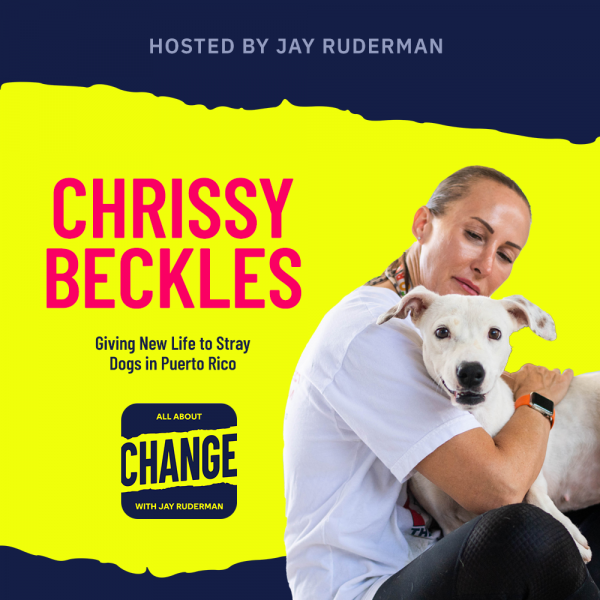
Chrissy Beckles:
I will never forget the first day I walked on that beach. It was a life-changing moment for me because I walked onto there and there were just dogs everywhere, like hundreds of them running in packs. We put them there, but we’re the ones that can help them because we’ve taken away a lot of their original instincts to hunt and to fend for themselves, to feed themselves.
Jay Ruderman:
Hi, I’m Jay Ruderman and welcome to All About Change, a podcast showcasing individuals who leverage the hardships that have been thrown at them to better other people’s lives.
Montage:
This is all wrong. I shouldn’t…I say put mental health first because if you don’t…This generation of Americans has already had enough.I stand before you, not as an expert, but as a concerned citizen.Yes, we can. Yes, we can.Louder.Yes, we can.Louder.Yes, we can. Yes, we can.
Jay Ruderman:
Chrissy Beckles never expected to be where she’s today, but after a fateful trip to Puerto Rico, she felt she had no choice.
Chrissy Beckles:
I flew back to New York and I just spent the entire plane ride thinking, “What am I going to do? I don’t know what I’m going to do, what it’s going to look like, but I know I need to do something. I can’t get back to Brooklyn and forget what I’ve seen.”
Jay Ruderman:
What she’d seen were packs of starving stray dogs, hundreds of them, roaming the beaches and streets in Puerto Rico. In the weeks following her visit, she was inspired to start The Sato Project.
Chrissy Beckles:
There are currently estimated to be in excess of half a million here on island, and to give you a metric and a visual, Puerto Rico is roughly the size of the state of Connecticut.
Jay Ruderman:
In the years since then, in the face of underfunding, a pandemic, and a category-five hurricane, Chrissy and The Sato Project have rescued more than 8,000 dogs. Chrissy Beckles, thank you so much for being my guest on All About Change. I really look forward to this discussion, as I am a dog lover, as many of us are, and I know you are. Maybe you could take a step back and talk about why there’s such a strong connection between humans and canines?
Chrissy Beckles:
From my personal perspective, I grew up with animals. So, I’ve always had an affinity and a connection. I think if I take a step back and look at the larger picture, it’s something that we, as a species, have started, and I think in some cases we’ve taken it a little bit too far, our reliance on other species and try to mold them to what we believe they should be, and I see that a lot with dogs. The canine and human connection started when dogs were trying to get warmth around a campfire. Then, hundreds of millions of years later, we’ve essentially positioned those animals to be reliant on us, and that’s something that I see in our day-to-day work that the stray and the abandoned dogs we’re dealing with are in that scenario because of us, because of humans. It’s a conflicting position to be in. We’ve put them there, but we’re the ones that can help them, because we’ve taken away a lot of their original instincts to hunt and to fend for themselves, to feed themselves.
Jay Ruderman:
Right. I happen to have been in South Africa on safari once and encountered some wild dogs, and they are a completely different species than our domesticated dogs.
Chrissy Beckles:
Yeah, absolutely. It’s not just we’ve made them reliant on us. It’s what we’ve done to them with differing breeds. If you look at what bulldogs look like even 100 years ago, they looked very different to what they look like. Now we have them to look cuter and to be more appealing to us as a species at a detriment to them and how they can survive.
Jay Ruderman:
What did you do professionally before you started this endeavor?
Chrissy Beckles:
My background was advertising and marketing, so I had my own consulting business, but I was also a champion amateur boxer that was competing in New York. I didn’t get paid for what I did, but I had a couple of titles. I boxed in Madison Square Garden three times. Won New York Golden Gloves, a couple of other titles. And crazily enough, there is a huge correlation in boxing and rescue, believe it or not. There’s a lot of things that I take from my training. My coaches would always instill in me that the fight should be the easiest part of what you do. The training has to be the hardest, and that’s what we do every day in rescue. It’s like we’re training for the big moments, and that’s where all of your effort has to go. You can’t be afraid to take a knee. It’s not a bad thing if in the ring you get hit and you’re seeing the birds playing around your head or whatever, stars, disco lights, whatever you want to call it, taking that knee is not a sign of weakness. It’s actually a sign of strength to give you a beat, to give you a moment, to gather yourself, to listen to your corner and then get up and continue with either a better plan or stronger. And then, the other thing is that boxing, you enter the ring on your own, but you have a team in your corner and you should always listen to your corner, because they can win a fight for you. And they can see things that you might not be able to see in that moment. And so, by listening to them, it can change the entire nature of a fight and the result of a fight. So, a lot of my boxing training has had a huge impact on what we do in rescue. And one of our taglines is that we fight for the dogs of Puerto Rico and we do. If I get in a ring now and I fight, it’s to raise money and to raise awareness of what’s going on on the island.
Jay Ruderman:
So, paint us a picture of your first visit to Puerto Rico. I understand you visited with your husband, who was a stunt man at the time.
Chrissy Beckles:
Correct. Yeah. So, he quickly transitioned from boxing into stunt work. He’s smart, and he soon realized that he could get a lot more money for pretending to get hit than actually being hit. So, yeah, he’s been working in the stunt industry for almost 25 years now, and he’s very successful. He does a tremendous job. And he was filming in Puerto Rico, it was 2007. He was filming a movie called Che with Benicio del Toro. And him and a group of other stunt guys were living in Puerto Rico. They were down here for a couple of months. He had never been to the island before. I had never visited before, and I was coming to spend a week with him. And he said to me before I arrived like, “You’re going to freak out when you see the dogs here.” And I was like, “Oh, that doesn’t sound good.”
Chrissy Beckles:
We had one dog at the time, a little Jack Russell named Basher. And so, I arrived on island and was completely immediately overwhelmed with what I saw. There were dogs everywhere. It’s something that in day-to-day life, depending on where you are in the US, you don’t ordinarily see. I know this is a situation that is not unique to Puerto Rico, and I’ve traveled Europe and I’ve seen stray situations in Greece and other areas, but it was different here. There was definitely kind another level to… There was a lot of indifference to the animals, to the dogs that we were seeing. And if I picked one up, I could literally see the looks of horror on people’s faces that are like, “Ugh, why are you touching that dog? It looks like a rat or it’s got a skin disease, and you’re going to get it.” There was a definitive lack of empathy.
Chrissy Beckles:
And again, not from everybody. It’s a certain amount of people. And if that happens often enough, it becomes the norm. If you’ve grown up and you’re used to seeing animals on the street, then it’s not shocking to you. If it goes from generation to generation, then it’s nothing new and it’s something that is the norm. To me, it was incredibly overwhelming and I spent a week wondering, “What the heck do I do here?” I flew back to New York and I just spent the entire plane ride thinking, “What am I going to do? I don’t know what I’m going to do, what it’s going to look like, but I know I need to do something. I can’t get back to Brooklyn and forget what I’ve seen.”
Chrissy Beckles:
And so, I did some research. I reached out to every organization I could find that had a website. And I think 100% of them, it was literally a static page with a general email address, some photographs, and that was it. And I wrote to everybody and two organizations got back to me and I started volunteering for them. I mean, it’s kind of the complete 360 is those are the emails, I get hundreds of them now every day. It’s like came, I saw, what can I do? I was in a position where I have my own consulting organization. I earn a very good amount of money, so I could donate a lot of money to these organizations. I got what I like to call my Harvard education in rescue over like an 18-month period of coming to Puerto Rico, volunteering, learning what went into rescuing dogs, transporting, vetting, et cetera.
Chrissy Beckles:
And about a year into that, we adopted our first Sato, who we named Boom-Boom, which is my ring name, my boxing name. She was a puppy that came from one of the five municipal shelters on island, and she was the only member of her family that survived. So, we gave her a fighter’s name, which was mine. And the minute she arrived in Brooklyn, it was like game over. I said to Bobby, “I can’t half-ass this anymore. I need to do more.” And I am incredibly lucky that I have a wonderfully supportive and understanding husband that I turned around to him and said, “I want to do this full time.” And he said to me, “Well… The Beckles’ family motto is, “If you’re going to do something, you don’t (beep) it up.”
Jay Ruderman:
So, I want to ask you about stray dogs. These are dogs that are just either abandoned or have been born as strays and are just scavenging. How do they live? How do these dogs survive? And the other thing that I would ask you is this problem more exacerbated in Puerto Rico as opposed to other countries in the Caribbean or other places around the world?
Chrissy Beckles:
I can’t think of another area that small that has a concentration of stray and abandoned animals this large. So, I would say, I think it’s really bad here. Satos, that’s the colloquial term for stray dog or street dog, as they’re known in Puerto Rico. There are currently estimated to be in excess of half a million here on island. And to give you a metric and a visual, Puerto Rico is roughly the size of the state of Connecticut. So if you think of it in those terms that if Connecticut had half-a-million stray dogs running around, it would be front page news in every newspaper. It would be the ticker on every news channel, but it’s not. It’s something that is widely ignored here in PR.
Chrissy Beckles:
Obviously, my organization is working incredibly hard to change the situation down here, as are many others, but it’s overwhelming. I always say with the island that can’t get a breakdown here, I started rescuing in 2007, so 10 years later, Hurricane Maria hits, it hits the island as a Category 5 hurricane. It makes landfall at Dead Dog Beach where we have always concentrated our work, so it was very, very personal to us. In that moment, I lost not only the 10 years of work that we had done as an organization, I lost my home. I lost everything I owned. We were set back over a decade in one day, and we had to pick ourselves up and keep moving forward.
Chrissy Beckles:
It’s that adage that this wasn’t a need. This was almost like a KO to us if you look at it in boxing terms. So when that happened, a lot of people, like 5% of the island’s population left and not everybody took their animals with them. So you have a large number of dogs and cats entering an already huge stray and abandoned population. Sadly, there is not a culture of spaying and neutering here in Puerto Rico. It’s something that, again, we as an organization are working very, very hard to change. So you’ve got all this new population entering into an already large population and there’s an explosion. I could see it from day one. I said, “In six weeks we’re going to be inundated with puppies and it’s going to be the same thing six weeks after that,” and that’s what happened. But it’s really hard to get ahead of it when it’s a very few amount of people that are fighting to make these changes, and we can’t get the government to get on board.
Jay Ruderman:
So with all of these challenges—the number of dogs, lack of funding, natural disasters—what keeps you going? What motivates you every day to continue this work?
Chrissy Beckles:
The dogs. It’s always the dogs. Once you see it, once you’ve experienced it, you can’t unsee it. You can’t walk away from it. For me, it’s a responsibility. It’s something that I feel I have to do.
Chrissy Beckles:
And it’s also the small wins. Every single dog that we rescue, every dog that we get off the streets, every dog that we get into a loving home, that’s a victory. You have to focus on those moments because if you focus on the bigger picture all the time, it can feel overwhelming.
Chrissy Beckles:
We’ve rescued over 8,000 dogs, and that number is incredible, but at the same time, you look at the scale of the problem and you realize how much more there is to do. So you take it one dog at a time.
Jay Ruderman:
What role do adoption and awareness play in solving this crisis?
Chrissy Beckles:
They’re critical. Adoption saves lives, obviously, but awareness is what drives adoption. People need to understand the problem. They need to see what’s happening.
Chrissy Beckles:
Social media has been a huge tool for us in that regard. It allows us to show the reality of what’s happening on the ground and to connect with people all over the world who want to help.
Chrissy Beckles:
We transport a lot of dogs to the mainland United States for adoption because there simply aren’t enough homes on the island. So building that network, building those partnerships, is essential.
Jay Ruderman:
What can listeners do if they want to help?
Chrissy Beckles:
There are a lot of ways to help. You can adopt, you can foster, you can donate, you can volunteer. Even just sharing our content helps because it raises awareness.
Chrissy Beckles:
And beyond that, people can look at what’s happening in their own communities. This isn’t just a Puerto Rico problem. There are animals in need everywhere. So get involved locally as well.
Jay Ruderman:
Chrissy, thank you so much for the incredible work that you do and for sharing your story. It’s truly inspiring.
Chrissy Beckles:
Thank you so much for having me. I really appreciate it.
Jay Ruderman:
Thank you so much for listening to All About Change. Today’s episode was produced by Tani Levitt and Mijon Zulu. Stay tuned for our next episode. Spread the word, tell a friend or family member, or leave us a review on your favorite podcasting app. We’d really appreciate it. That’s all for now. I’m Jay Ruderman, and we’ll see you soon with another episode of All About Change.
J.R. Martinez:
Better off had they just left me in the Humvee to die because what life am I truly going to have now? This is definitely not a life worth living. That’s the way I felt.
Jay Ruderman:
Hi, I am Jay Ruderman and welcome to All About Change, a podcast showcasing individuals who leverage the hardships that have been thrown at them to better other people’s lives.
Montage:
This is all wrong.I say, put mental health first, because if you don’t…Yes, we can!This generation of Americans has already had enough.I stand before you, not as an expert, but as a concerned citizen.Yes we can!Louder!Yes we can!Louder!
Jay Ruderman:
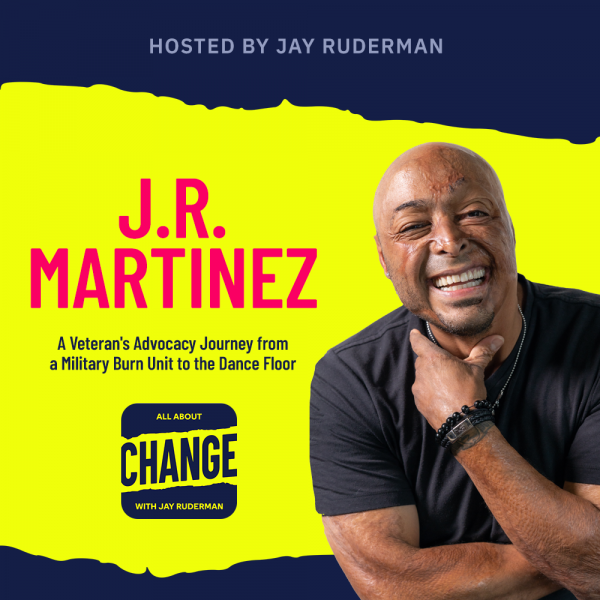
J.R. Martinez doesn’t like to think of himself as exceptional.
J.R. Martinez:
Sometimes I wake up and I’m stressed and I’m overwhelmed and I’m like, “I got to do this, this, this, that,” whatever it may be…
Jay Ruderman:
In spite of all of his accomplishments and will only get to some of them in our conversation, he still maintains that he’s just a regular guy. But to me, this is what makes him all the more impressive. In the face of hardship, trauma and adversity J.R. makes space for his humanity.
J.R. Martinez:
I believe in vulnerability and I believe in the sense of being completely transparent, and I’m not ashamed to showcase any of that.
Jay Ruderman:
After answering the call and enrolling to serve, J.R. was severely wounded in Iraq. Burned over 40% of his body, he had to spend years in the hospital. After struggling to move on and find new meaning in life, J.R. stumbled upon a new passion and a new purpose.
J.R. Martinez:
I can continue to serve in a very different way that I was accustomed to in the military. I can do it now through this, through talking and just putting myself in spaces and listening.
Jay Ruderman:
That realization opened Doors J.R. had never thought of and took him down a path no one could have predicted.So J.R., first of all, it’s a pleasure having you as my guest on All About Change, and I want to start off by thanking you for your service to our country.
J.R. Martinez:
I appreciate that. Thank you very much, Jay.
Jay Ruderman:
And I have to tell you from seeing all the videos that you’ve done and shows, you’re one of the most positive people that I’ve ever experienced in my life, I’ve seen. So, you had a big impact on me just learning about you for this podcast. I don’t know how you do it after everything that you’ve gone through in life, but you have an infectious positivity.
J.R. Martinez:
Well, come spend a day with me, come hang out on my house with me, and I guarantee you’ll probably see the human side of me. And what I mean by that is not that I’m this, a negative person or a pessimist and it’s all a front. What I mean is there’s this misconception that I just wake up and I’m like, “It’s going to be a great day.” And sometimes I wake up and I’m stressed and I’m overwhelmed and I’m like, “I got to do this, this, that,” whatever it may be, and I just got to find these moments to sit still, find gratitude in the space that I’m in. And when I do that, I find myself being able to show up as the best version of J.R. Martinez.
Jay Ruderman:
That’s beautiful. Can you tell us a little bit about your life before the military? What was it like growing up? And I know you’re particularly close to your mom. And can you just tell us about growing up as J.R. Martinez?
J.R. Martinez:
There’s this misconception that because of what I went through when I was 19 years old, that I immediately just became resilient. That it was a decision I made in amidst of my recovery and suddenly here I am 20 years later, successful, depending on what you define success. The first 19 years of my life were a lot of adversity, a lot of challenges, a lot of adaptability, a lot of change. But what I realized later in life, it was all conditioned in me for the major thing that was going to happen in my life and then prepare me for what ultimately was going to come of my life.But the reality is, I always tell people, in order to really understand how I survive that trauma, you have to go back to the previous 19 years of my life. You have to look at the fact that when I was nine months old, my father left. You have to look at the fact that my mother’s from Central America, El Salvador, and immigrated to this country and literally took me to El Salvador as a kid a lot. And I got a appreciation and a perspective and a reality check.I was born in Louisiana, lived there for the first nine years of my life. There was a lot of adversity there in a sense of my mother trying to find a partner and someone that can help raise this son. And unfortunately, fell into some really abusive relationships and I witnessed a lot of that. We moved around a lot within the Shreveport, Bossier City area. And then at nine years old, my mother decided to relocate to Hope, Arkansas because there was a better job opportunity.And that was challenging for me, Jay, because it was predominantly white and black at that time. I was one of the first Hispanic kids to arrive. And I later identified this when I was around 32 ish years old. I realized that what I have really been searching for my entire life was the sense of belonging community. And I didn’t really have that. It was tough for me because in Arkansas it was just my mother and I. I was kind of like the lone wolf, so kids would pick on me for various reasons. And I felt incredibly isolated and I didn’t feel like I had a community and I lived there until I was a junior in high school. And within those nine years of living there, we lived in six different homes. And so that should tell you that there was no stability, no structure.I believe in vulnerability and I believe in the sense of being completely transparent and I’m not ashamed to showcase any of that. And so I will be an open book in this conversation with you. And I will tell you that at 16 years old, I told my mother that I think about getting into a car accident because I wanted to see how many people would actually show up at the hospital.This is 2023. If somebody heard a 16-year-old echo those same words, I think all of us would respond a lot differently because the conversation has changed. But all my mother could do back then was just give me a hug, was to tell me she loved me and make me something to eat. Listen, that was awesome. That definitely helped a lot for her to be able to do that. But I was struggling. I was looking for something deep down that I felt like I didn’t have.But essentially my mother, I remember I asked her if we can move after my junior high school and she said no. She said, “No, this is home. I have a great job.” And you got to understand where she was coming from. I mean, my mother has a third grade education. She worked at Tyson Foods, a chicken plant in Hope, Arkansas. And for her to climb the ranks to be a supervisor on a third grade education, that was a huge accomplishment for her. And guess what? I went to Georgia a month later, I got a job, I was doing well, and my mother moved. And let me tell you something, that move to Georgia was everything. I found the community that I needed. I mean, people just embraced me immediately and just loved up on me. And that was awesome.
Jay Ruderman:
Well, your mother sounds like a very special person, but I wanted to ask you about joining the army. What made you decide to join the US Army?
J.R. Martinez:
I was looking for a way to sort of get away. I’ve always kind of felt sort of pulled and had this curiosity about this world that was out there that was bigger than these small towns that I was born and lived in. And I feel like the military was the opportunity where I felt like I could then go out into the world and experience something. It was an opportunity for me to get money for college. It was an opportunity for me to just get a skillset. And I thought I was going to do three years. That was it. I was like, I’ll do three years, I’ll do my time, I’ll serve and then I’ll get out and move on with my life. And as the saying goes, you make plans and God laughs.And sure enough, there was a plan in place and yet life, God, whatever you believe in, had a different belief and said not so fast. We’re going to take a little bit of a detour because you’re not really supposed to be in the military. You’re supposed to use the military as essentially a stepping stone to identify some things about yourself and things that you love and things that you want to carry with you. You’re going to get those things through the military, but you’re not going to stay there forever.
Jay Ruderman:
I guess a bigger question is, do you have any regrets that you went into the military? I mean, after everything that you’ve gone through?
J.R. Martinez:Listen, I mean just two months, just shy of two months of me arriving in my unit, I was on a plane with the rest of my unit heading over to war at the age of 19 years old. That’s six months after I signed the dotted line. I didn’t have the luxury to have extensive training. I didn’t have the luxury to, okay, understand what you’re getting into. I had to learn it while I was in it, and even though my military career was cut incredibly short, I learned so much.I was introduced to this concept of service. I was introduced to this concept of being a part of a team and embracing the role that you play on that team. As much as all of us strive to be the executive, to have the title, to have the parking spot, to have all the responsibilities, you have to understand at some point like, “Hey, listen, this is my role on this team right now. And it’s not that, I may be striving to get that, but right now it’s this.” And embracing that and owning that and understanding that there’s value you bring to the table. The military taught me that and taught me a lot about leadership, the things that I don’t like, the things that I should never do, the things that I do like, the things that worked for me.
Jay Ruderman:
Bring us back to that fateful day on April 5th in 2003, and just, can you tell us what happened?
J.R. Martinez:It’s a routine day. You’re patrolling through different parts of Iraq and you’re providing security for different jobs in the military. And there was one of our leaders, an officer said, this is the route we’re going to take. And then you had a couple of enlisted people, and if you know anything about the ranking system, there’s the officers and the enlisted and they tend to bump heads. The officers tend to come in, not always, but a lot of them are coming directly from college. And there’s very few officers that were once enlisted that were sort of boots on the ground, really kind of getting dirty and then they sort of transferred over, green to gold as they call it in the army and became officers. And they sort of understand how it works with people on the ground and they listen and they value those opinions and that perspective.But in this particular case, this officer was like, this is the route we’re taking and enlisted individuals said, “Sir, that route has not been cleared. We should not go that route. We should go this route.” That officer felt like he was being questioned and he said, “Nope.”
Jay Ruderman:
I see. Yeah.
J.R. Martinez:
“This is the route we’re going to take.” That’s the route we took. That’s where I get injured. That same officer not too long before the incident took place, literally smoked me. And what that means in the military means he made me do pushups, sit-ups, every exercise that he can think of while he was lecturing me because he overheard me talk about this concept of a brotherhood and I didn’t feel like it was a brotherhood. So he took me outside and he smoked me in the middle of the desert and he talked about this brotherhood. And at the conclusion I was like, “All right, sir, I get it. All right, my bad. I’m sorry, I didn’t understand.”Well, here we are. We’re on this routine day, routine mission. I’m driving a Humvee, three other troops in the Humvee. We’re laughing, we’re cutting up, and then all of a sudden, boom. And what happened was the front left tire of the Humvee that I was driving ran over a roadside bomb and the other three troops were thrown out of the vehicle. And they all walked away with minor physical injuries, but I was trapped inside.And the reason I say minor physical, because even though the injuries they sustained on a physical aspect were minor, I didn’t learn this until later, that mentally and emotionally, they were just as impacted and injured as I was. Because they remember the screams, the yells, they remember the chaos. They were essentially doing roll call and they were like, “Okay, we have this person. We have that person. We have this person. Wait, we’re missing one. Where’s Martinez? Where’s Martinez?” Only to learn, I was inside of the Humvee, literally fighting for my life for five minutes nonstop, just gasping and breathing and screaming and just hanging on as much as I possibly could, believing that somebody would come and pull me out of the Humvee and my life would be spared.And there were several instances over the course of those five minutes where I felt like, “No, it’s not going to happen. I’m going to lose my life. I’m going to die at this age and this way.” But then that’s where the previous 19 years of life comes into play because again, it conditioned me to be a fighter and not to give up and not to quit. And I would literally find myself continuing to fight and scream and yell and just hold on to hope, believing that somebody was going to pull me out. And sure enough, two of my sergeants pulled me out. It started the medevac process. The biggest thing that threatened whether I was going to survive or not, it was not just the physical injuries that I sustained. It was the internal damage. It was being inside of a Humvee for five minutes and the smoke and inhaling that. And I had a lacerated liver. I had broken ribs.The biggest thing that was threatening whether I was going to survive was everything internally was damaged, was affected. So that’s why they put me into a medical induced coma because they felt he’s one, consuming so much energy because his body’s going through this stage of shock. He needs that energy, and so let’s just put him at ease. Plus he’s not allowing us to do what we need to do to try to give him a chance. So let’s kind of knock him out.And from there, I went to Germany and I went into emergency surgery, and I have this huge scar that goes down, that divides my six-pack. I don’t have a six-pack. It just makes me, I just believe that if I had one, it would look so cool, but maybe one day. But once I was stable, they put me on a plane and brought me back to the United States, and I went to the burn center for the military in San Antonio, Texas.And three weeks later, that’s when I woke up and literally to a voice of a man, which was the head doctor. And he pretty much said, “Hey, this is your new norm. This is your new reality.” I couldn’t feed myself. I didn’t know how to walk. I couldn’t go to the restroom by myself. I couldn’t do anything by myself. I was literally, almost like a child, just dependent on the staff to do everything for me.I wake up from my medical induced coma only to learn about my new identities that I have and the identities that I lost. The first was my appearance, right? Every time I looked in a mirror for 19 years, I recognized that individual. Now I was looking and I had no idea who that person was.The second identity that I lost was this identity of being in the military, being of service, wearing a uniform. And so that was challenging. That was tough, man. And that definitely triggered a lot of those emotions of, I would’ve been better off had they just left me in the Humvee to die because what life am I truly going to have now? This is definitely not a life worth living. That’s the way I felt. And now I was told that I was no longer going to be allowed to stay in the army. I was going to be medically discharged and thrown into this society with no tools and no resources. And I put a lot of my focus into this concept of like, I’m never going to find anybody to love me. I’m never going to be able to have a family. I’m never going to have a job. I’m never going to be able to share space with “normal people.”And here I am 20 years later, I have a great career. I have a beautiful and amazing wife. I have beautiful children. I can share space with anybody. I look at my injury and I look at my journey and I perceive it as a blessing. I truly do. I see it as a blessing. I don’t know if I truly felt that way within that five-year period after I was injured, but that’s the way I feel about it now. And the only reason that I can say it’s a blessing now is because I’ve done a tremendous amount of work, Jay, to get to this space of where I can heal not just physically, but emotionally and mentally. And that takes effort, that takes commitment, that takes discipline, and I have made that commitment to myself over and over and over again.
Jay Ruderman:
So, J.R., you go through all of this horrific, I mean, the injuries, 34 months in rehab and 33 skin grafts and plastic surgeries, and yet while you’re going through this, while you’re in the hospital, you’re also supporting other injured soldiers. Where does that mental capacity to go beyond yourself and help someone at such a trying time? How’d you do it?
J.R. Martinez:
Well, I didn’t want to do it. And I think my life really exemplifies listening and paying attention and leaning in to things that you don’t clearly understand. So what I mean by that is six months after I was injured, I’m just going through the motions, just meeting my doctors, meeting my occupational therapist. Listen, my hands at one point were essentially like claws. I couldn’t straighten them out. I didn’t have a lot of range of motion. I would use this special tool to dress myself if I wore a shirt or even pants that required the button, I had this tool that went through the loop, hooked the button, pulled it back through the loop. That’s how I got dressed, at that point.Six months after I was injured, one of the nurses on the burn ward said, Hey, why don’t you go and talk to this patient who just arrived, is having a difficult time adjusting with this new norm, essentially where I was six months prior. And I said, “No.” And she said, “Why not?” I said, “Because I’m not a clinician, I’m not a therapist. What am I going to say?” And she said, “Just go in and talk to him and tell him how things have gotten better for you,” is what she said. And there’s a lot of back and forth. The medical team that took care of me, they were more like family and friends than doctors and nurses at that point.So, I am kind of bantering back and forth with this nurse as if she was my mom. I’m like, “Oh, no.” The typical teenager that doesn’t want to do something. And finally I was like, “Fine, I’ll do it.” That was my attitude going into this room. And I opened the door and it was completely dark and I felt the heaviness, the weight in this space, and all I wanted to do, Jay, was just close the door and get the hell out of there. But I just said to myself, “What message is that going to send to that patient?” And I decided I couldn’t do that. And I walked up and I literally just asked the person their name, where they were from, what unit they were in and what happened. That was it. And it literally turned into a 45 minute conversation. And at the conclusion I said to this person, I said, “Hey, I’m going to come back tomorrow and check on you. Do you need anything?” He says, “Nope. All I need is a visit.”And I remember as I was starting to exit the room, something caught my attention and when I turned around, he turned the light on above his bed and he was actually out of his bed and he was opening the curtain to the window. So there was natural light coming into the room and that said so much to me. So instead of ignoring that and just thinking if it’s a one-off experience, I literally asked the head of the burn ward, if I can visit patients every day, and I started doing that.There’s a couple things I want people to take away from that experience is one, my willingness to listen, but also two, listen, trauma lives in the body. Our minds will not always remember why we feel this way, why this triggers us, why we tend to sort of fall into this pattern of behavior, but our body retains all of that. Our body remembers all of that trauma. Remembers everything, it holds onto it. And it lives and it exposes itself in different ways. So a lot of us will sort of get that pit in our stomach. A lot of us will sort of get that sort of thumping of the heart.Let me tell you, when I opened that door to that patient, I felt that pit in my stomach. I was like, “I don’t want to lean into this.” And I did. I said, “No, I’m going to push through that feeling and lean in.” And because I did, I discovered, “Oh, I can continue to serve in a very different way that I was accustomed to in the military. I can do it now through this, through talking and just putting myself in spaces and listening.” And half the time we didn’t even talk about anything heavy. I’d come in there and watch movies and watch shows or watch sports and just talk life and just chitchat and cut it up and through all this work, that’s when I learned that service and that’s when I realized, “Oh, wait a minute. I need to pay attention to this because this is going to be essentially the template that I’m going to follow for the rest of my life.”
Jay Ruderman:
I think the human to human contact is so important. I just visited my mom in the hospital and she’s like, “The highlight of my day is when you guys come and visit me.” And I think that that’s so important. Let’s talk a little bit about when you left the Army. What was that like for you?
J.R. Martinez:
That was tough. I was 22 years old and I essentially got into the world again. I started reaching out to people that for those three years would give me their business card and say, “You call me if there’s anything I can ever do for you.” And it took a lot of pride for me to actually look at those cards and actually reach out to a few people and say, “Well, what I’d like is if you can give me an opportunity to come and speak to your group.” And you know what people did? They essentially said, “Hey, listen, we think you’d be better off just speaking to veterans. Why don’t you just stay in that space?”That sort of triggered a lot of underlying issue that again, at that point didn’t realize existed in me that I later identified through therapy. But essentially, I just this constant rejection and people not listening to me. Also that officer I talked about that suggested we go down one route and that smoked me and talked about well this is a brotherhood and we’re forever tied together. During those nearly three years in the hospital, he never reached out to me.
Jay Ruderman:
Wow.
J.R. Martinez:
He never came to visit me. Nobody from my unit ever came to visit me. Meanwhile, I would go into these hospital rooms and see people from their units coming to spend at least a couple of days and just hang out with them and just chitchat or whatever. Yet, this brotherhood was non-existent for me. So as you can imagine, I develop a lot of resentment towards this concept of this brotherhood. That’s not everybody’s reality and truth, of course, that’s mine.So, I’m getting a lot of this rejection as I get out of the military. As you can imagine, I’m carrying all this with me. I’m resentful and angry. I’m 22, Jay. I’m drinking and mixed with this emotion, that’s not a healthy recipe. I’m 22, 23, 24, essentially kind of navigating the world from this place that’s not great. It changes for me because I ended up, my best friend, one night with a group of veterans. We were traveling for this nonprofit. Somebody says something in the car. It triggers me. My best friend tells me to calm down because I’m kind of being a little nasty and I didn’t like him telling me to calm down. And so I wanted to fight him.And instead of him retaliating and literally rocking my world because he’s 6’4″, 280 pounds. I’m 5’9″, 200. He instead leaned in and told me to sit in the passenger seat of his car once we got back to the hotel and it was just he and I, and he told me to cry. And I said, “What do you mean I need to cry?” He says, “You need to cry. You’ve healed physically. You haven’t healed emotionally or mentally. Why don’t you cry? And I was like, “I don’t need to cry. I don’t need to cry.” And then all of a sudden, Jay, I started crying. I had no idea why I was crying, and it felt so good to cry.And I realized in that moment, I’ve been yearning to essentially allow this emotion to just kind of flow through me. But I didn’t know how to do it because vulnerability wasn’t something that was ever taught to me. My mom never taught me what vulnerability was. My mother experienced a lot of trauma. My mother never dealt with the trauma. She experienced it but never dealt with it. And those are two very different things. And so here I am crying in this car. After my best friend and I talk, he would always tell me he loved me. He would always say that to me. And I just felt it was odd. But of course after that conversation, I’m the first one that looks at him and says, “Man, I love you.”And it wasn’t because he gave me a book or told me to listen to a podcast about vulnerability and come back and do a report. He essentially presented this space for me to understand what it’s supposed to feel like. And I felt that I was in a safe space and I felt that I could be vulnerable. And through that, I allowed myself to go there. And that changed my life, Jay. It literally set me on this trajectory. I can tell you almost to the day, that was in Indianapolis, and it was around August, 2007 when that transpired. I was sort of operating from a different place. Now I wasn’t operating from this resentment place. Now I was operating from, I need to be the educator. I need to teach people and allow people to understand who I am and what I bring to the table, that I’m not just this person that you perceive. I’m so much more than that. So, operating from that place allowed me not to carry a lot of this weight. It was light, it was easy. It was conversational. Every time I talked to anybody, it was informative and ultimately it created opportunity.So, a few months after that interaction, I get an email because I’m selected as one of the five veterans they’re going to use to highlight, to represent the five-year anniversary of the war in Iraq. In 2008, it was going to be in People Magazine. And it ends up being a two-page spread that I get in People Magazine, and then people started reaching out to me to speak. All of a sudden now what I’ve been yearning for my entire, up until that moment, is now coming to fruition. I’m getting the opportunities to speak.Literally, almost a year to the day I get an email to audition to become an actor on a soap opera called All My Children. I’m like, “I’m not an actor. Don’t want to be an actor. I’m not doing that.” And I just kept listening to people saying, “You should try it. You should try it. You should try it.” And I went to the audition and it turned into an opportunity where I was supposed to be there for three months. I ended up being there for three years.
Jay Ruderman:
Wow. And no acting lessons?
J.R. Martinez:No acting lessons. I learned literally on set. I learned by watching the other actors and just picked up little things and incorporated into my scenes, and people embraced that. Now listen, there’s a great deal of criticism and scrutiny that comes online even back in 2008 on message boards where people are like, “Why would you allow somebody that looks like that on TV? Oh my God, it’s horrific to look at him on TV.” People would say those things. And I just kind of said, “Why am I going to give my energy to that stuff? I can’t control that.” And all it did was kind of fueled me more to just show up on TV and smile and just kind of be this character and tell that story.And that ultimately led to someone, again, suggesting that I should be on Dancing With the Stars. And I was like, “Ah, yeah, what are you talking about?” And then they were like, “No, you should.” And that turned into me being on that show. That turned into me ultimately winning that competition. That turned into a book deal, speaking opportunities. I mean, my life literally just completely took off because what I realized that I was not really operating from a place of vulnerability. I wanted connection with people. I wanted to impact people, but I was operating on the surface. I didn’t have depth, I had width. I didn’t have depth and I wanted depth. And once I realized you get that depth through vulnerability because you had to learn how to be intimate with yourself first, you have to learn first and foremost what you want from yourself and what you want out of the world first. Once I had clarity on that, then I can go out into the world and say, “This is who I am. This is how I operate. This is what I want from the world.”
Jay Ruderman:
And I have to tell you, you’re an amazing dancer. I know you won Dancing with the Stars.
Soundbite:
The winners and new champions of Dancing With the Stars are, J.R. and Karina.
Jay Ruderman:
But I watched a few episodes, and I don’t know if you’re a natural dancer or whatever, but you’re awesome.
Soundbite:
J.R., you are wild, exuberant with animal physicality. It was like a jungle, tribal, hypnotic…
Soundbite:
Yes.
Soundbite:
[inaudible 00:27:01].
Jay Ruderman:
And I know you talked at one point that your mother taught you how to dance when you were younger, but you have an athletic ability. That’s something special.
J.R. Martinez:
Yeah. Well, I appreciate that, man.
Jay Ruderman:
I wanted to ask you, now that you’ve become a celebrity, an actor, that you’ve had all this exposure, tell us the connection between that and being an activist.
J.R. Martinez:
It all started with activism for me, right? That’s how I found my voice. That’s how I found a lot of my purpose. As I mentioned earlier, me advocating for veterans and their family members and helping them in that transition and educating people to understand how difficult it was to transition out of the military. That is so important to me. So as much as I’ll find myself being busy and pulled in different directions, I’m always going to make time for different groups that I work with that speak to my heart, whether it’s an organization, Operation TRIAGE that helps veterans, to a burn survivor organization called the Phoenix Society for Burn Survivors, to No Barriers, which is an organization that takes people with different abilities and essentially puts them in the outdoors and connects them with people, and they develop their rope team. To A Call to Men, which is an organization that challenges men to live as Tony Porter says, “In the Man Box,” and tries to challenge these men to live outside of that man box and essentially end violence towards women and be advocates for women.And so that stuff fuels my soul, man. That’s the stuff where I feel like I get to connect with real people, people that are inspiring. I’m around individuals that listen, are still in the early stages of that journey. They’re still struggling, and it just humbles me to be in their presence and to feel like I have an opportunity to be an advocate for them because I found my voice, and they’re still in the early stages of finding their voice, and maybe I can be the one to speak up for them. And so advocacy is something that I will never compromise. I will never get away from that. I will always operate from that place because again, that’s all rooted in me wanting to serve, and that’s service to me.
Jay Ruderman:
But it sounds like your activism is really on a human level, that you’re working with, causes that you have personal experience, you understand where people are coming from. You can lend a voice, you can lend an ear. I mean, you’ve talked about listening as being so important, and those are the causes that you really truly devote your time to.
J.R. Martinez:
Yes, sir. Yeah, no, absolutely. What I always tell people is like, listen, just operate instead of overthinking it, just operate from what you know. Operate from the place of what you live, what you felt. That’s where you should operate from. Don’t overthink it and try to create this other tier of something that you haven’t lived or don’t quite understand. Operate from your core, from your truth.I put myself in a safe space of being around other veterans early on, other burn survivors early on, and I was essentially being vulnerable and open. And what that did is, that just allowed me to feel safe that I was in this space with people that wouldn’t judge me. Through that exercise, I kept finding more and more, my voice, my voice, my voice, my voice ultimately getting me to a place where I felt so empowered that I was just like, “I don’t care. I’m going to put myself out there.” As you alluded to, People Magazine even listed me as one of the sexiest men alive or being on the cover of People Magazine, and it was just like, “I’m just going to put myself out there. Who cares?” But it all came from me just operating from what I’ve lived, what I know. From that I learned about other things, that I can now advocate for those things as well. But it always comes from a human experience and what I’ve actually endured.
Jay Ruderman:Well, J.R., you have an extremely healthy outlook, and I wish you to go from strength to strength. I want to call on my listeners to check out your book Full of Heart: My Story of Survival, Strength and Spirit. Pick that up wherever you get a book and read that.J.R., thank you so much for being my guest on All About Change and again, thank you for your service to our country. You went above and beyond and we love you, man.
J.R. Martinez:
Just thank you again for the opportunity, man. This is what I love to do, and I love to share, and I believe I have a lot to share with people, but I also believe that other people have a lot to share with me, and I’m always paying attention and listening. So, I just encourage all your listeners to continue to listen, not only to your podcast, but also to every interaction that they have with the world, whether it be a human being or an experience. Pay attention. Listen, marinate on that. So thanks again, man, and look forward to us crossing again.
Jay Ruderman:
Thank you so much.J.R. Martinez’s story is made up of so much more than that one fateful day in Iraq. It’s the 19 years that came before it, and all the work, grit and generosity that’s come after J.R. has managed to transform what many would call a curse into, in his own words, a blessing. He’s taken his hardship and turned it into a helping hand. May we all strive to do the same.That’s it for today’s episode. Join us two weeks from today as I sit down with civil rights activists, Chelsea Miller, co-founder of Freedom March NYC. Today’s episode was produced by Kim Huang with story editing by Yochai Maital and Mijon Zulu. To check out more episodes or learn more about the show, you can visit our website allaboutchangepodcast.com. If you like our show, spread the word. Tell a friend or family member or leave us a review on your favorite podcasting app. We would really appreciate it. All About Change is produced by the Ruderman Family Foundation. A special thanks to our production team at Pod People, David Zwick, Grace Pina, Morgane Fouse, Bryan Rivers, and Aimee Machado. That’s all for now. I’m Jay Ruderman, and we’ll see you next time in all about Change All Reform.
Le Roy Torres:
I had made up my mind to serve in the military when I was in elementary school. My dad was drafted during the Korean War. He was my hero.
Jay Ruderman:
Hi, I am Jay Ruderman and welcome to All About Change, a podcast showcasing individuals who leverage the hardships that have been thrown at them to better other people’s lives.
Montage:
This is all wrong. I shouldn’t be-I say put mental health first because if you don’t-Yes, we can. Yes, we can.This generation of America has already had enough.I stand before you, not as an expert, but as a concerned citizen.Yes, we can.Louder.Yes, we can.Louder.Yes, we can.
Jay Ruderman:
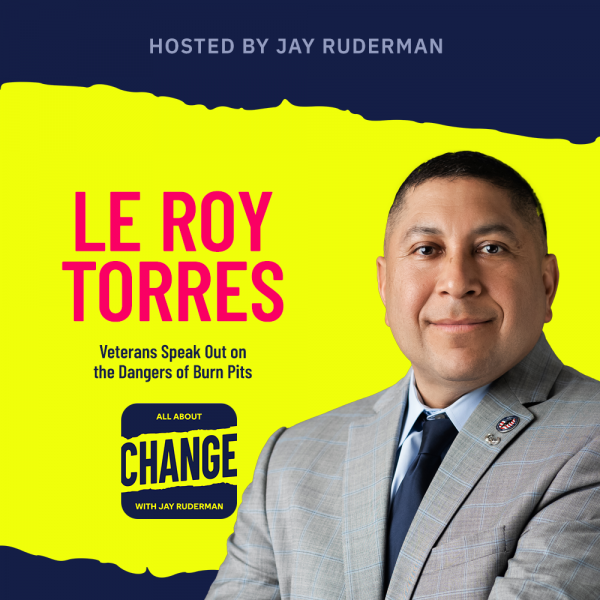
In 2007, US Army Captain Le Roy Torres was deployed to Balad, Iraq.
Le Roy Torres:
One of the first things that I remember was the smell of the air, the stench.
Jay Ruderman:
It was Leroy’s first encounter with a burn pit. Imagine a large open area, sometimes the size of multiple football fields, where every form of trash, electronics, plastics, medical waste, everything, is dumped and set on fire. And this fire? It burns all day every day.
Le Roy Torres:
They said, “Well, don’t worry about it. It’s being handled by the contractors.”
Jay Ruderman:
It wasn’t long before Le Roy started experiencing health problems, problems that would follow him home well after his deployment was over
Le Roy Torres:
My supervisor came in and said, “Hey, you can no longer come back to work. There’s something wrong with you. You may be contagious.”
Jay Ruderman:
After failing to get the help he needed, Le Roy and his wife set out on what would literally be the fight for his life. But it wasn’t only himself they were fighting for.
Le Roy Torres:
My wife, she told me, “No matter the outcome, no matter the results we get, I’m going to fight for you and I’m going to fight for others, because this is not going to be the ending.”
Jay Ruderman:
They were fighting for benefits and recognition for thousands of affected veterans, including Beau Biden, the son of President Biden, who died of a glioblastoma in 2015 at the age of 46.Just a heads up, Le Roy uses a ventilator and still has difficulty in his daily life due to his health. You’ll hear this in the audio.Captain Le Roy Torres, thank you so much for being my guest on All About Change. I want to start off by saying that I am extremely impressed with your activism. I’ve never met an individual who has both won a Supreme Court case and changed a major piece of federal legislation. So congratulations on your activism and I know that it’s affected thousands of lives in our country. First of all, let me ask you, how are you feeling these days?
Le Roy Torres:
Well, Jay, first off, thank you for having me and for this. Today has been a little challenging for me. It has. Aside from my respiratory issue, toxic brain injury, I now battle GI issues. Lately, I’ve had the intermittent bleeding episodes. Thankfully, it’s been resolving slowly, but I can say today has been somewhat a challenging day.
Jay Ruderman:
I’m sorry to hear that. Maybe I can take you back to the beginning of your career in the United States Army. Maybe you could tell us why you chose to enlist and when did that happen?
Le Roy Torres:
Actually, I had made up my mind to serve in the military when I was in elementary school. My dad was drafted during the Korean War. And he was drafted in 1950, so my dad was my hero growing up and I made a decision early life to join and at 17, as soon as I was able to enlist, I enlisted in the Army National Guard. Of course, it was challenging for my mother because she had to sign because I was considered under 18, a minor. It was very difficult for her, but my dad had no problem. Of course, he was proud. At the same time, knowing that I was choosing to go into the military that perhaps may come with challenges. But my dad was one who particularly inspired me to join the military and serve in the Army.When I first enlisted, my specialty was 11 Bravo, an Infantryman, so I was still a junior in high school. So upon my completion of my junior year, I traveled to Fort Benning, Georgia for basic training at the US Army Infantry Training Center and completed basic training. Then I returned back to Texas and completed my senior year. And a week after my graduation, many of my friends were headed to their senior trips and so forth and I was headed back to Fort Benning for infantry school.
Jay Ruderman:
So tell us, you were deployed in 2007. Can you talk us through that time, what happened, how you were deployed, and where you ended up?
Le Roy Torres:
I had just taken my dad to the VA clinic for one of his appointments and we’re sitting in the coffee shop having lunch after we were talking about a situation in Iraq, and he goes, “It’s a good thing you haven’t been deployed yet.” And I said, “I know that, but I’m pretty sure eventually my number will come up.” Not even 10 minutes went by, my phone rang. And it was my immediate supervisor, my Major. He goes, “Well,” he said, “your number’s been called. You’re going to Iraq.”November of ’07, I deployed to Iraq. And the challenging thing about it was that I was deployed with a totally different unit. I didn’t know anyone in the unit. I was an individual augmentee to a unit out of Rock Island, Illinois. The Army created this one unit and brought men and women from different parts of the US and put a unit together and deployed us to Iraq. Initially, I was supposed to go to Afghanistan as a Company Commander for a detachment. While I was at Rock Island, Illinois, my orders changed and said, “No, you’re going to Iraq to a logistics brigade, a combat support.” There was a Department of Defense personnel working as well as contractors and our mission was to lead the logistical effort there in Balad, Iraq and to others surrounding FOBS, pretty much handling battle damaged equipment that was coming back through Balad and sending it back to the United States.
Jay Ruderman:
Were you in barracks? Were you in tents? What was the situation like there?
Le Roy Torres:
The living situation in Balad was we were housed. They called them CHUs, containerized housing units, and there were these pretty much these metal boxes that we shared a latrine with another person. And it had a twin bed in there, and it was small but yet comfortable. And of course, one of the first things that I remember arriving in Balad and stepping off the shuttle was the smell of the air, the stench. And me having a law enforcement background, I asked a lot of questions. I started investigating. One of my first questions was, “What is that smell? Is this legal? Can they do this?” Said, “Oh, that’s the burn pit. That’s the burn pit. That’s where everybody throws all their waste and burn it.” And of course, eventually I was just told to kind of stay in my lane, that it was handled by contractors.
Jay Ruderman:
So let’s talk a little bit about what a burn pit is for listeners who may not know. What is it used for? How close were troops to the burn pits?
Le Roy Torres:A burn pit is pretty much just imagine a huge hole, or we can picture a landfill, for all your daily trash, from plastic to styrofoam, you name it. Everything that was thrown into the trash, plus tires, batteries, equipment was doused with JPA fuel and burned. Some people, “Well, it’s just a small hole.” But this pit was 10 acres in diameter.
Jay Ruderman:
Wow.
Le Roy Torres:
That’s how big it was there in Balad, Iraq.
Jay Ruderman:
What is the rationale behind a burn pit as opposed to carting off the garbage, or you’re in the desert, so even taking a tractor and burying it in the sand?
Le Roy Torres:
The thing about a purpose was an expedious way to rid of waste, and it was convenient. It was there on post. So it was one of those things where you didn’t have to spend all that time digging a massive hole and burying it, but just bringing it to the pit and burning it, getting rid of it as fast as they could. Burn pits, they were in operation 24/7. There were times where you could see just the smog just hovering over the area. At times I would walk out in the mornings outside my housing quarters, my living quarters, and I could just wipe the AC unit and the soot from debris from the pit.And that’s how serious this issue became. I remember going to the urgent care December 30th because I kept my sick call slip and I remember I had a really bad respiratory. I was having a horrible cough and I had a bad cold. Well, they said, “You have a bad upper respiratory infection.” And they said, Well, your body’s just adjusting to the Iraqi crud,” and it was going to take me a couple of weeks to acclimatize to the environment. So I was placed on quarters for 72 hours. I had a really bad upper respiratory infection, gave me antibiotics, and quarantined me for 72 hours. I was having really bad abdominal pain at the same time.
Jay Ruderman:
And what was it like for your fellow soldiers? I mean, was anyone raising an issue saying, “Hey, this might not be the healthiest environment.” And were there other soldiers that were experiencing symptoms that you saw?
Le Roy Torres:
Comments were made, and of course, just speaking within our unit, they’re developing this dry cough, some are having sinus issues, and of course when we’d go to the urgent care, they would just tell us, “Well, we were dealing with Iraqi crud.” So in other words, it was something that wasn’t really talked about at that time. They said, “Well, don’t worry about it.”
Le Roy Torres:
It’s being handled by the contractor.” We would at times comment on it, but it was something that we were trusting the government that it was okay what they were doing, that eventually it was just going to pass and that we would go back home and that things would resolve eventually.
Jay Ruderman:
So, I know you just described some symptoms and some upper respiratory issues that you were having at the time and GI issues. Were there other issues that developed over time that weren’t as immediate?
Le Roy Torres:
One for me was the headaches, waking up with headaches. I remember towards the end, maybe about midways, closer to the end of my deployment, I remember waking up with headaches. And I’m thinking, “Well, it’s just something I’ll deal with, I will just take some medication.” But I remember once I came home that they started to get worse, once I returned from deployment.And of course, the respiratory issue, that did become problematic. I actually went a couple of times to urgent care while I was there in Balad, and it was pretty much the same thing. Well, “Here’s a Z-Pak, take it for five days, stay hydrated and drive on.” And me growing up in that era of the army where it was, “Suck it up and drive on.” I wasn’t a complainer. So, I would just take my medicine and of course the headaches was something that I just dealt with until I came back home.Approximately three weeks after I returned from deployment, I ended up in the emergency room. And I remember, of course, explaining to the emergency room doctor, I had the horrible cough and that I had a really bad respiratory infection. And he was just started asking me questions if I was around any chemicals or had been exposed to anything. And when I mentioned that I was exposed to these burn pits that were in Iraq, he says, “I’ll be right back.” And then he came back with a mask and he goes, “Well,” he said, “maybe it’s eventually your body will just return back to normal from your exposure, whatever you were exposed to.”But it was the same thing, just put a bandaid on this. He just gave me medication for the respiratory infection, something for the cough. That’s when flags went up. And even talking to my wife, because she had already picked up on the issue that I had to dry cough and the hoarseness of my voice while I was at the end of my deployment. But I wouldn’t tell her the issues that I was having because I didn’t want to worry her and I didn’t want her to think that something was wrong. But when I came back home, that’s when I noticed the change.
Jay Ruderman:
I saw an interview that your wife gave where she said, “My husband went off to Iraq as a healthy person, and the person that returned and got off the plane was not the same person.”I’m sorry for everything that you’ve gone through, especially because you have served our country with distinction. What about your fellow soldiers or senior leadership, how did they react to your illness?
Le Roy Torres:
Before I left Iraq, I remember being handed a memo from Lieutenant Colonel Curtis, Air Force, Lieutenant Colonel. It explained the issue with the potential … The burn pits being hazardous to our health. And kind of, “Here, take this, you might need this later.” And that’s when I figured where eventually this issue was going to be a huge problem for us.
Jay Ruderman:
And maybe you can tell us a little bit about your experience with the Veterans Administration, with the VA. Did they offer support? Did they give you financial or medical? How did that work out for you?
Le Roy Torres:
At the start, it was a tremendous challenge. I remember traveling to Vanderbilt University Hospital to see Dr. Robert Miller about my respiratory issue. Right before that, I was admitted to the VA War Related Illness and Injury Study Center in DC. And this was after I had been dismissed from my civilian job. In August of 2010, my supervisor came in and said, “Hey, you can no longer come back to work. There’s something wrong with you. You may be contagious. You need to get checked.”Well, that’s what led us into this pressure of finding answers, but the dealing with the VA was very challenging for us and knowing that while I was there visiting Dr. Robert Miller and talking to some of the personnel working, that they were sending soldiers to see Dr. Robert Miller, but eventually it became an issue because of the diagnosis of the findings. So, he was advised, in other words, to change the diagnosis or they would stop sending soldiers, which eventually they did.Thankfully, as a reservist, I had my private insurance where this is how I was able to see Dr. Robert Miller. But knowing that I was trying to get support from the VA was very challenging. And even my wife asked there at the risk center in DC if they would do a lung biopsy, this is around October, 2010, and they said, “No, it’s not possible. We don’t have the resources to do a lung biopsy.” But at that time, my wife had already been in touch with Dr. Robert Miller, who, he wasn’t encouraging it, but because of my job, of wanting answers, that that’d be the only way to discover my lung injury was through a biopsy and which we move forward with that.
Jay Ruderman:
So, let me just understand, the VA, did they understand that your medical situation was caused by exposure to burn pits?
Le Roy Torres:
I had to prove my case. We started the process around the end of 2010, 2011, and finally in 2013, but not until the Army Reserve came up with their findings through the line of duty, that’s when the VA approved my case, approved my claim, because the Army discovered it and now it’s like, well, the evidence was there, the biopsy. So, in other words, they pretty much had no choice at that time already. There was a case by case basis for me, but I had to prove my case to receive treatment.
Jay Ruderman:
Going back to the initial interaction, when you’re exposed to hazardous materials, there may not be a direct immediate correlation. Sometimes diseases develop over a period of time. To put the impetus on you, as the soldier, to prove that this was caused by exposure to the burn pits seems to be onerous when you’re developing these conditions over a period of time.
Le Roy Torres:
It was very disheartening for that burden of proof to be on the soldier, the veteran, especially when the doors were closing and especially me serving as a reservist, which made it a huge challenge. I remember my wife taking me to Brooke Army Medical Center, and at that time there was a study, it’s called the STAMPEDE study, and they were actually doing research on soldiers returning back with toxic exposure issues, but I didn’t qualify because I wasn’t an active duty soldier.So, knowing that already that the Department of Defense was not supporting my issue and the obstacles that I was facing with the VA made it very challenging for me. And at the same time, I had a civilian employer who was also placing that burden on me as well. Like, “You can’t come back to work until you have answers.” But I couldn’t get an answer because of the delay and the denial issue at that time.
Jay Ruderman:
Can you tell our listeners about the extent of your medical condition? Because I know it’s not just the respiratory issues and the GI issues, but there was also some issues related to your brain.
Le Roy Torres:
In 2018, I was diagnosed with a toxic encephalopathy, it’s a toxic brain injury. For 10 years, I struggled with these horrific headaches, with horrific cluster headaches, waking up with these headaches. I remember one of the episodes that I had, I had this headache for eight days and it started affecting my short-term memory, my cognitive. Until 2018, so 10 years after I started having these cluster headaches, I was finally diagnosed and had answers.I actually went to a company, it was called [inaudible 00:20:16], and they did, it’s called a QSPECT. And it was a two-day evaluation, of course, a scan of my brain. And they discovered that there was certain areas in my brain that were compromised and areas in my brain that were not receiving adequate blood flow. And that’s what made it very challenging for me. So, I was prescribed supplemental oxygen to alleviate these headaches and to prevent the episodes of these cluster headaches.
Jay Ruderman:
So, let’s go back to, you come back from Iraq and you have several illnesses, you’re still a Texas state trooper. What happens at that time? I mean, you’re having discussions with your superiors about how you could continue to work for the state of Texas. And tell us what happened at that time.
Le Roy Torres:
Once I came back from seeing Dr. Miller and had received my results from the biopsy, of course, I’m thinking, “Well, now that I have the answer, I’ll be allowed to go back to work in a different capacity.” Because I already knew my limitations and what this permanent injury had done.So, when I presented the biopsy and I filed a request for accommodation, I was granted a temporary position, a modified position, but it was only for a short while. And as I requested a permanent modification, that’s when the challenge began with the state. Knowing that I had attempted to follow a process through ADA, and that I had done everything in my power to file the accommodation in a timely manner, it was something-
Le Roy Torres:
that kind of fell through. There was a job communication. They were not providing me that opportunity to remain employed. I remember that I was handed a memorandum for my supervisor. Say, you can, due to your medical conditions, you’re no longer able to serve as a state trooper. And when I received that memorandum, that was very disheartening. So not only having challenges on the VA, DOD side, but now my civilian employer, it became a very difficult season in my life.
Jay Ruderman:
My understanding is that the state of Texas is now telling you, “Okay, you have to leave your job in order to receive disability,” which is what you did. But then when you went and applied for disability, you were denied.
Le Roy Torres:
Right.
Jay Ruderman:
And that’s not clear to me. If they forced you through this process where they said, “Okay, you can no longer be a Texas State trooper, you have to go on disability and you have to lose your job to do that.” Why at that point deny your disability?
Le Roy Torres:
And that’s what didn’t make sense to me, that when I asked the question about why am I being forced to go this route where it seemed like it’s backwards, because then if my disability is not approved, then I’m out of a job. But it’s just the way that… I believe it was something with communication through my leadership and headquarters and eventually, which led to, well, we don’t know what else to do with you. So the option is to resign. And of course, at that time, I was receiving treatment in Utah. I was in Utah for 40 days going through a program where they were detoxing first responders due to the work they were doing around meth labs. And they had of course reached out, hey, for me to have an opportunity to see if it would help my ailments at that time in 2012. So throughout this time that I’m being forced to submit this resignation or this process, I was not even home.I was receiving treatment, but by that time, I was taken off the payroll. So it was the current situation at the time that put me under pressure because I was facing foreclosure. My credit was shot. I was already getting behind with all my payments. And that’s what made it a challenge for me where if I don’t submit this resignation, of course my response was, “Well, I’ll request medical retirement,” because I had over 10 years of service. So I said, “I should be given that opportunity to at least medically retire.”
Jay Ruderman:
You eventually go to court, you win your case. State of Texas appeals, and the case goes to the Supreme Court. And ultimately the Supreme Court held in your favor that you would do benefits.
Soundbite:
Significant ruling today from the Supreme Court involving a case that is centered right here in Texas. Justices saying that states can be sued by veterans who are alleging discrimination in the workplace
.Jay Ruderman:
That’s one part of your success in terms of advocating for yourself and others like you. But let’s talk about what made you decide to create Burn Pits 360.
Le Roy Torres:
Burn Pits 360, actually, we had no intention of starting a nonprofit. All this started from the delay in denial experience that I faced, that my wife faced. In 2010 as I was being wheeled into the operating room, my wife, she told me, “No matter the outcome, no matter the results we get, I’m going to fight for you and I’m going to fight for others because this is not going to be the end.” So Burn Pits 360 inception came about after our personal experience with delay and denial in seeking specialized healthcare. That’s just how it came about.It started on our kitchen table knowing that the challenges that we faced, that we were not the only ones, that there was going to be so many others that had already been affected and that were going to be affected in the future. And knowing that the challenges that I faced not only serving as a reservist, but also the challenges that were faced against with the VA and then a civilian employer, that’s what just put this… It lit this fire within us to not give up and to face the many challenges that we were facing at the time and the challenges that still continue to this day.
Jay Ruderman:
I’ve read that the President Biden has said that he believes that his son’s brain cancer and death was caused by exposure to burn pits. And now you enter this phase where you’re on Capitol Hill and you are lobbying for legislation that becomes known as PACT. What’s the connection between what you are lobbying for in terms of legislation and the compensation that was given to survivors of 9/11?
Le Roy Torres:
The PACT Act. Wow. It’s just monumental legislation.
Soundbite:
Veterans who were exposed to burn pits, Agent Orange and other toxic substances can now receive additional healthcare and benefits from the Veterans Affairs. The care is available through the PACT Act.
Le Roy Torres:
Just knowing that the challenges that how we got there throughout the years going to DC and the many walks that we did, those hallways sharing our story, our personal journey along other families, some who are no longer here, one in particular, staff Sergeant Thompson, rest in peace, walked the hallways. He passed on in December of 2021. But knowing the impact that this legislation would do was something that was beyond our imagination and that is still surreal to this day. And that honoring our PACT Act has been something that has been for many years. And my wife, we would talk about as many times as doors were closed or there’s no presumptive or we can’t do this because there was always a dollar sign behind issues about money. I was told by a member of Congress, I can’t sign a blank check. Well, sir, I signed two, I signed two blank checks, one for my state and one for this nation.
Jay Ruderman:
So what does PACT stand for?
Le Roy Torres:
PACT. Excuse my… Sorry.
Jay Ruderman:
No, no, take your time.
Le Roy Torres:
Yeah, so sorry. That’s one of the challenges that I still want… My cognitive is still a challenge.
Jay Ruderman:
I understand that the members of Congress were able to understand the correlation between the benefits that they gave to survivors of 9/11 and the exposure to toxic materials that they inhaled at the site of the 9/11 tragedy at ground zero and the toxins that you and other soldiers ingested at the burn pits. Who made that correlation? Which legislator was behind you in helping to push this forward?
Le Roy Torres:
At that time, I remember it was Congressman Joaquin Castro, Congressman [inaudible 00:30:09] in California who were very receptive and knowing that we were not receiving the support from our local member of Congress here in my region, Congressman [inaudible 00:30:22] was one in particular. And him being a medical doctor, he knew and he believed, especially knowing that he had a constituent who suffered and who he visited with before she passed away. He believed in the issue. And he knew that this was something that had to come to, for the PACT that to come forward and to give us that blanket of specialized healthcare for so many of us.And I think when some were allowed that they opened their hearts to know what really happened to us, like for example, just me of many stories sharing my personal journey is what really triggered some of these members of Congress to move forward and support us because this was real. And I think when they saw the impact that it made in their districts and when they went to visit these soldiers, these veterans who were struggling and who died, I believe that’s when the table started to turn and where they acknowledged, “Hey, we need to make this right. We need to correct this wrong because there’s so many of us that are going to be affected.”
Jay Ruderman:
And what was the role that Jon Stewart had? Because Jon Stewart’s been very outspoken about the fact that, as you said, we send men and women off to war who give up the ultimate sacrifice of their lives or come back with serious illness and injuries and then we don’t support them when they come back.
Soundbite:
America’s heroes who fought our wars outside sweating their [inaudible 00:32:00] off with oxygen, battling all kinds of ailments while these mother [inaudible 00:32:06] sit in the air conditioning walled off from any of it. They don’t have to hear it. They don’t have to see it. They don’t have to understand that these are human beings. Do you get it yet?Jay Ruderman:So how effective was Jon Stewart’s speaking out in his advocacy in terms of getting his legislation passed?
Le Roy Torres:
Knowing the work that he did with the 9/11 first responders, I remember in 2019, the fall of 2019, my wife had set up a meeting and actually talked to John Feel with the FeelGood Foundation and I reached out, “Hey, John, is it possible to maybe meet up or even just to have a conversation with Jon Stewart about the issue that we’re facing?” Because it was very similar. It goes to the 9/11 exposure. And sure enough, I was received a FaceTime call. I knew it was Jon Stewart on my wife’s phone. “Hey, it’s John.”
Le Roy Torres:
And he goes, “Hey, I heard about,” said, “I’m sorry about your job loss, first of all, and I’m sorry what you’re going through.” I said, “Hey, we did it for 9/11. First responders. We’re going to help veterans out and I’m going to be a voice.” And John kept his word throughout those years and he became a strong supporter of us pushing the PACT Act. And the PACT Act, what it stands for is the Promise to Address Comprehensive Toxics Act. And of course, it was named after Sergeant First Class Heath Robinson in his honor with his pact that it was named after.
Jay Ruderman:
After the legislation was passed. Did you have a chance to speak to President Biden?
Le Roy Torres:
Actually, we were standing next to President Biden at the signing of the bill, and I did have an opportunity to present him one of our challenge coins of Burn Pits 360, and that day I saw the commander-in-chief as a father who had lost a loved one to toxic exposure. And I remember I presented that coin to him and it was well accepted. And just knowing the effort that led to us to be there that day, it was just beyond imaginable. Knowing that going back 13 years along, that we had to push this issue, that it finally, all the work finally comes to fruition throughout the years, the challenges that we’ve faced.
Jay Ruderman:
Le Roy, you and your wife and countless others, I congratulate you on your success of everything that you’ve done for our country. I know it’s been a really long journey and I wish you good health going forward, what do you think is next for you?
Le Roy Torres:
Jay, now that the PACT Act has passed and now it’s the implementation, we thought things would slow down, but it’s like the work continues. Our organization is focused on the implementation phase. Of course, at the same time, my journey is still not over with my job loss case. It’s actually scheduled for trial later this month, so it’s been rather nerveracking for me these couple of weeks just getting ready for that, worst case scenario if we happen to go to trial at the end of this month.But the way ahead for us is that the work continues on the implementation phase and as well as seeking other health modalities. We’ve been networking with this company 4D Medical, who does four dimensional lung imaging. I actually had my lung scanned up in Miami back in January of this year. So it’s just now looking at non-invasive health technologies, where veterans don’t have to go through a lung biopsy like I did and have to go through a year recovery from the surgery. But knowing that there’s these technologies out there that will hopefully help veterans that are dealing with issues like myself, and there’s some that are still working but yet are having difficulty with their respiratory conditions because they’re afraid to say something because they don’t want to get fired or they don’t want to lose their job. So it’s the way ahead on how can we make those non-invasive technologies available to veterans. So that’s what we’re pushing for.
Jay Ruderman:
How can our listeners support the work you’re doing? What can they do to help Burn Pits 360?
Le Roy Torres:
They can actually go to our website. And just to add to that, there’s a documentary in the works. It’s called Thank You For Your Service: the Burn Pit Story. It’s in the making, but if they go to our burnpit360.org page through our blog page can of course you can support our efforts, also support our programs. One of our programs is the Warrior Hope Network, which we were able to provide, for example, concentrators like you see me wearing this concentrator. Thankfully I have Medicare, so I got mine through Medicare, but because veterans only have VA and it may be difficult for them to provide this type of equipment. But that’s one thing that we do that we are able to help veterans just to make their quality of life better.We’ve already also purchased several hyperbaric chambers to help those veterans receive treatment at home for their either traumatic brain injury or the toxic brain injuries and so forth. So it is some of the work that we are doing, alongside with networking with other stakeholders who are providing these non-invasive technologies like 4D Medical, and even looking at stem cell. Like myself, I had stem cell last year by [inaudible 00:37:53]. I had to travel out of the country to receive it, but I believe in it and I have faith that it’s made a difference. I’m hopeful that it will continue to work for me, but the worst going to continue for us at Burn Pits 360.
Jay Ruderman:
Well, Captain Le Roy Torres, I really want thank you for your service to our country, which came at a heavy cost for you and your family, and thank all those other veterans out there who’ve served our country and are suffering. And thank you for your service to the state of Texas. You’ve gone above and beyond for us, and thank you for being my guest on All About Change. I wish you good health, as I said, and I hope you go from success to success. You’ve had a tremendous amount of success in advocacy and I hope you continue to have more, so thank you.
Le Roy Torres:
Most welcome, Jay, and thank you for having me as well. Have a blessed afternoon, thank you.
Jay Ruderman:
Thank you. Breathing is something I take for granted. For Le Roy Torres, it’s a struggle he’ll faced for the rest of his life. His lungs permanently damaged from exposure to toxic fumes. Having him on the show, speaking with him about his journey, while witnessing the reality of his injuries firsthand was incredibly moving. But the idea of him using his breath and his voice, straining himself in order to advocate for thousands of other veterans like him, that is truly courageous and an example we can all learn from.That’s all for today’s episode. In two weeks, we’ll close out our conversation around veterans with actor, speaker, and author, JR Martinez, in a conversation that will span from harrowing encounters with IEDs to Dancing With the Stars, from struggling to help yourself to finding a calling and helping others.Today’s episode was produced by Rebecca Chaisson, story editing by Yochai Maital and Mijan Zulu. To check out more episodes or learn more about the show, you can visit our website all about change podcast.com, and follow me on Twitter at Jay Ruderman. If you like our show, spread the word, tell a friend or family member, or leave us a review on your favorite podcasting app. We would really appreciate it. All About Change is produced by the Ruderman Family Foundation. Special thanks to our production team at Pod People, David Zwick, Grace Pina, Morgan Fouse, Bryan Rivers and Aimee Machado. That’s all for now. I’m Jay Ruderman, and we’ll see you next time on All About Change.
Chelsea Miller:
One of the questions that we had asked the girls was, where was one of the first places that you learned how to love?
Jay Ruderman:
Hi, I am Jay Ruderman and welcome to All About Change, a podcast showcasing individuals who leverage the hardships that have been thrown at them to better other people’s lives.
Montage:
This is all wrong.I say put mental health first because if you don’t-This generation of America has already had enough.I stand before you, not as an expert but as a concerned citizen.
Jay Ruderman:
Chelsea Miller was born and raised in Brooklyn, New York. The neighborhood she grew up in was known as the Little Caribbean, a neighborhood filled with immigrant families like her own.
Chelsea Miller:
If you know anything about New York, yes, it is a melting pot, but it’s also one of the most segregated cities in the world because of wealth disparity. And so I spent a lot of time asking myself the questions of why does the world operate in the way that it does?
Jay Ruderman:
Those questions led Chelsea deeper into her activism. While studying at Columbia University, she and a college suite mate founded a program called We Believe. What started as a female leadership program for schools in Harlem evolved into a unique support group, a safe space for these girls to come together and process experiences they’ve been trying to handle alone, not always in the safest way.
Chelsea Miller:
If you grow up around a lot of trauma, if you grow up where you perhaps don’t receive that love from your parents or your family or siblings, then sometimes you go and find that somewhere else. And that somewhere else is not always a safe place.
Jay Ruderman:
But We believe was only the start for Chelsea. It gave her a taste of what it felt like to bring change. She went on to serve as an intern in the Obama White House and co-found Freedom March NYC.
Chelsea Miller:
We were like, we are ready to make it clear that this is what democracy looks like.
Jay Ruderman:
And I’m sure she’s only just getting started.
Chelsea Miller:
When things are good, right? When systems are working, when politicians are doing what they need to do, when everything seems to be fine, we are in a state of comfort. But what happens when those systems get disrupted?
Jay Ruderman:
Chelsea Miller, thank you so much for being my guest in All About Change. It’s a pleasure to meet you.
Chelsea Miller:
It’s a pleasure to meet you too.
Jay Ruderman:
Let me take you back to the beginning, growing up in Brooklyn. Can you tell us what impact your childhood had on you ultimately becoming an activist?
Chelsea Miller:
I was born and raised in Brooklyn, New York and Flatbush in the ’90s and early 2000s, which if you know anything about Flatbush in the ’90s and early 2000s, it was called Little Caribbean and really just exemplified the story of so many immigrants and the influx of immigrants that came to Flatbush. And so I am a child of immigrants. My family came here from Jamaica and for a very long time I think that I struggled with my identity of what it meant to be first generation American and also trying to grapple with this idea of the American dream and what does that look like and why does it feel so far removed? And if you know anything about New York, yes, it is a melting pot, but it’s also one of the most segregated cities in the world because of wealth disparity. And so I spent a lot of time asking myself the questions of why does the world operate in the way that it does?And so that really started my activism journey. And I also talk about a lot when I was around 12 years old, my mom turned the second floor of our two-story house into a group home for young girls. And so I grew up with foster sisters, and having that experience of growing up in a home where you see other kids come in who have so many different experiences than you and the trauma of navigating systems within our society and how do you reconcile with that? And so I think that definitely was the foundation of a lot of the work that I do now.
Jay Ruderman:
I’ve heard you talk about your mom and how she came to the country as an immigrant and sleeping at McDonald’s and doing odd jobs and just doing whatever she had to support her family. And yet also bringing in, as you said, foster sisters who opened up because of her. So how much of an impact did your mom have on shaping your outlook on life?
Chelsea Miller:
Oh my gosh. To this day she still has such a huge impact on how I just see myself, but then also how I understand my responsibility. I always say that it’s one thing to know who you are, it’s another thing to know who you are as it relates to this world and our responsibility in it. And I’ve just always felt a heavy sense of duty because of so many challenges that my mom experienced and the people who opened the doors for her. The people who gave her somewhere to sleep, the people who gave her the opportunity to work at least somewhere while she was here. And I think that even as a little girl, I always said that I want to be the person when I grow up that my mom needed.
Jay Ruderman:
That’s so beautiful. And you talked also about growing up in a predominantly Black neighborhood, but being sent to a predominantly white school. And what impact did that have on you about what you saw about the disparities that you experienced as a child?
Chelsea Miller:
It was difficult. I always questioned why it was that my friends, why a lot of my white classmates, their parents could just pick them up after school or could go on the field trips, attend the parent teacher meetings. And for me, that wasn’t necessarily my reality. My sisters would pick me up from school and if they couldn’t pick me up, then would take the bus home. And I think that because of that, I spent a lot of time trying to connect it to a lot of larger conversations. Because then I would look around and see that, oh, it’s not only me that has to take the bus home an hour away. It was mostly all the Black students who were taking the bus back almost an hour into a different part of the city.And so a lot of just questions in my neighborhood looks so different from where I went to school. There were parks where I went to school, there were houses. All these different things versus I go back home and it’s apartment buildings and there’s not really that many parks in the area. And the schools there are underfunded. That’s not to say that my community wasn’t vibrant, because it was vibrant in so many different ways. What I think it boiled down to is that my community did not have the resources. And I think that that was the most striking part.
Jay Ruderman:
And do you think that that was the birth of your activism, your interest in civil rights? I know you’ve been described by your family as trouble. Does that all tie in together? “I’m seeing disparity and I want to do something about it.”
Chelsea Miller:
Yeah, my family always thought that I was a troublemaker. And not even a troublemaker as it relates to school, ’cause I was always great in school, but just if there was some type of mischievous plan that was happening where we were trying to annoy my older sisters, I would be the mastermind behind it. And I think that in that way I just have always been the person that questioned a lot of things. And then in that also trying to figure out ways around it.
Jay Ruderman:
That’s very powerful. So you went to Columbia and then while at Columbia you started an organization called We Believe. Can you talk a little bit about that? Because it sounds like you had great success.
Chelsea Miller:
We Believe came about when I was at Columbia and I co-founded it with a suite mate of mine who became really good friends with Aquia [inaudible 00:08:17]. And we realized that we don’t see a lot of people who look like us where we’re from in these spaces. And we have a responsibility to make sure that we pour into the next generation of young women and girls who are coming behind us, so they know that a space like Columbia is their space too. A university like Columbia, they have every right to be there and to show up and to be present. And so we started with working with middle schools in Harlem to develop leadership programming for young girls. And I remember we did it for a semester and then so many other college students started messaging us and saying, “What is it that you guys are doing? How can we get involved?”And so we’re like, “Okay, well let’s launch chapters. Let’s train other young women on their campuses to be able to do these programs in schools near their campus universities.” And in doing that, we were at over 20 universities by the time I graduated. At one point, one of our conferences, there was about 500 women and girls and college students that had gone through the conference weekend. We had galas, we were honoring Toronto burg. We were doing so much incredible work. I think that one of the biggest things that I took away from that is that if you have the will and if you are able to, there’s so much that you can create. And also not allowing the budgets to stop you from doing things. ‘Cause we were savvy. We figured it out.
Jay Ruderman:
One of the most powerful things that I heard you say was that in a very short period of time that your organization was able to get young girls to really open up about trauma in a way that they were not able to open up to their social workers. You even made a statement that the social workers, their jaws dropped. They couldn’t believe that you and your organization had this impact. What do you attribute that to?
Chelsea Miller:
One of the questions that we had asked the girls was, “Where was one of the first places that you learned how to love?” And if you grow up around a lot of trauma, if you grow up where you perhaps don’t receive that love from your parents or your family or siblings, then sometimes you go and find that somewhere else. And that somewhere else is not always a safe place. And so, so many young girls who are in communities where there is so much trauma and hurt present, hurt people hurt people. And so we ask that question as a starting point to a larger discussion about relationships and self-esteem and love. And before you know it, there about I would say three out of four of the girls eventually came forward sharing that they had been survivors of sexual abuse in some way, shape or form. Whether that was they were boyfriend when they were 12. And then someone else saying, “That happened to me,” to stories of just having just so many different experiences in school.And the teachers looked at us and they were like, “Well…” Because we had opened a can of worms that they were not even prepared to deal with. And after that session, we had to have a touch base with the educators and the teachers and the school guidance counselors and everyone that was present and we had to unpack it. And what was the support that was going to be in place after today for all of the things that were shared? And that’s why when we did the programs, we made sure we brought educators into the space because we’re not in the school classroom all the time, but the teachers are. And so it also helps when students feel like there’s someone who is at my school who knows my story. And so that’s also important too, to building that relationship between adults and students.I think that there’s a lot for us to learn as adults about how we talk to kids about the spaces that we create for them, where they can feel seen and heard. And you’d be surprised all of the things that they have to say if we just give them the space to say it.
Jay Ruderman:
Yeah. I have to tell you a little story about how you inspired me in preparation for this interview. You’ve said time and again, we have to believe that we are enough, that you are enough. And I have a son who’s going through a hard time right now, and after I heard you say that, I texted him and I’m like, “You are enough. I’m proud of you. I love you.” And that really resonated with me. ‘Cause I don’t think we tell ourselves that enough, that we are enough. There’s all these expectations that we should be doing more or we should be living up to some standard that society sets for us. So thank you for that.
Chelsea Miller:
Absolutely. And that reminds me of something that I said a few weeks ago as well where I said, when we believe that, we also see ourselves as worthy of the world that we’re trying to create. We spend so much time trying to imagine a better world or trying to figure out how we can get there and all these things, but it’s like, okay, well when this world is created, do you see yourself there? And what version of yourself is going to exist there? Is it the best version of you? Do you see yourself as worthy of that best version? How do we get there?
Jay Ruderman:
That’s awesome. Tell us a little bit about your time in the Obama White House. I understand that you were the youngest intern at the time and you were working on domestic policy. What was that like and how did it inform what you do today?
Chelsea Miller:
I was one of the youngest, I don’t think I can take credit for being the youngest. But what I will say is that it was one of the most transformative experiences of my life. It was during the last months of the administration and it was also during the 2016 elections. And so there was a lot going on at that time that really had the nation divided and searching for hope.
Soundbite:
Right now, a historic moment. We can now project the winner of the presidential race, CNN projects Donald Trump wins the presidency. The business tycoon [inaudible 00:14:27]
Chelsea Miller:
I’ll never forget it was after the election results that came out and I went back to work and we all ended up on a call with Obama. And one of the things that he said was, the work still continues and we have a responsibility to the people, we have a responsibility to ourselves. And in this moment, we get to shape history. And the grace and the fortitude of how we pass on this administration, how we pass on this government, how we choose to leave that legacy.
Soundbite:
Regardless of which side you were on in the election, regardless of whether your candidate won or lost, the sun would come up in the morning. And that is one bit of prognosticating that actually came true.
Chelsea Miller:
And a lot of my time at the White House was then spent working with a lot of organizations, bringing folks who perhaps never would experience being able to go to the White House, into those White House doors. And being a part of the community aspect of the Obama legacy was incredible.
Soundbite:
I’m tired of my Black men and my Black women being shot. Being killed by the NYPD. I’m tired of it. I have three Black men in my home, I am tired. I am tired.
Jay Ruderman:
So Chelsea, let me take you to the days following the murder of George Floyd.
Soundbite:
Hands up, don’t shoot! Hands up, don’t shoot! Hands up, don’t shoot! We are a powerful people. And you know [inaudible 00:16:02] this is our time
.Jay Ruderman:
Tell me about that moment and what made you step out to the street in May of 2020.
Chelsea Miller:
So I think that there was a lot going through my head at the time. I was wrestling with the fact that we were in the middle of a global pandemic. And then I also think the reality that when I was a teenager, I remember Trayvon Martin completely shifting my universe and my understanding of what it meant to just be a young Black person in America. And when I saw the death of George Floyd, it felt like a shock to the system. And not a shock because it’s surprising, we know that this country has been lynching Black bodies since its inception. But I think that to see it on your phone at such a vulnerable time globally and understand that even in a global pandemic, we still are not safe. And I think that was by far one of the most frustrating and devastating realizations. And I went outside because I was tired of the narrative that was being developed, that rioters and hoodlums and thugs were outside taking to the streets, when we all have a right to exercise our first amendment. We all have a right to be outside.And there was such an emphasis on property and nobody was talking about why there were protests and disruption happening in the first place. And if we center that conversation, then we can actually push towards change. But if we don’t, then we fall into the same cycles that we have seen over and over again. And because we were in a pandemic where so many people were afraid to take to the streets because of health reasons, I felt the responsibility to take to the streets anyways and show that we would not be silent, especially at a time like this. And that this is the responsibility of our generation, the duty of our generation, to make sure that we do not allow these instances and these moments and these pivotal moments in our history to go without being reckoned with.And so that is why I went outside and I did not expect any of it. The first night I went outside, there was a lot of disorder. And the only reason why I went outside was because I wanted to protest. And there were agitators in the crowd and there was just a lot of confusion happening. And for me, I like some type of strategy. I’m a strategist. If there’s not a plan, I’ll help come up with it. So a friend of mine saw me outside the day before and was like, “Was there anything happening today? I’d love to come outside with you.” And I said, “There’s no organizing that’s happening. And so if there’s anything that we’re going to do, we probably have to do it ourselves.” And so we posted the flyer at 12:00 PM and by 8:00 PM that night on May 31st had organized one of the largest nonviolent protests in New York.
Jay Ruderman:
And so was this the founding of Freedom march NYC?
Chelsea Miller:
Yeah, it was the founding of Freedom March NYC. And it’s funny because the name of the actual march that day was Freedom March NYC, and that is how we got our name Freedom March NYC, was because that was the name of the first march that we ever did. And because it was an organized protest group, so many people were then asking, “When is the next one? What are we doing tomorrow? Can you guys talk about the state of what’s happening on the ground?” Because also, keep in mind, this was during the time where a lot of media was not present as well. So there were independent journalists who were contracted by media outlets, but a lot of media was afraid to send their people out because it could be a liability. If we sent you in the middle of a pandemic, you get sick, you get injured.There was so much what ifs at the time in the world that there were even media outlets reaching out to us like, “Can you send us videos? ‘Cause we don’t have anyone that can capture the content of what’s happening in real time.” So there was the one element of people were trying to figure out who is trusted leadership on the ground, who can we go to if we want to come outside tonight to make sure that we get home safely? And that you care about making sure we get home safely? And on the other front, there were folks who were like, “We need someone who is trusted to tell us what is happening and can relay that information to the world.” And so we felt the weight of all of those things happening at the same time, and that’s why Freedom March became what it became, because of that responsibility to community.
Jay Ruderman:
So I just want to take you back to the first protest. And from what I understand, you and your co-founder went to Washington Square, there were flyers, you stood on a bench. Tell me what you were seeing, feeling, hearing.
Chelsea Miller:
I was nervous, but I think I also just had so much conviction that it outweighed the nerves. We were fired up. And also keeping in mind, this was not a presidency that was aligned with what we were saying, with what we believed. Literally folks were telling us not to come outside because the KKK was coming into New York. The president at the time was saying that he’s going to send the National Guard into New York because of everything that’s going on. There were choppers in the air. And so for us, when we came out, we were like, we are ready to make it clear that this is what democracy looks like. This is what young people who are fighting for our rights, our freedom, for our communities, this is what that looks like. And so when we came out, we were like, okay, well this isn’t my first time organizing a protest, but this is my first time organizing a protest in the midst of a global pandemic with a hostile president, with a hostile local government, and with police choppers in there. This is a lot happening.But we definitely made sure that we relied on our values of we are just here to center the message. That is what we said. We were like, “We are here to center message. We will not engage with the police. We will not engage with anything that is going to distract from this message, because what’s happening in Minneapolis, the George Floyd family, the world needs to know that we are standing with them.” And there was this really critical moment on the first night. We were walking from Washington Square Park to go to One Police Plaza, because there were also some protesters that had been arrested the days before. There were videos of police vans that were mowing into protestors in New York. So there was a lot happening. And so our strategy was we are going to march from Washington Square Park to One Police Plaza, center the message of this movement, and demand that they release these protesters.And so as we were marching, there was a point where at first it was about a dozen people and then people saw us and heard what we were saying and started to gather. And before you know it, we start walking, we start chanting, we start doing all of these things, and there are hundreds of people. And then there gets to a point as we are halfway to One Police Plaza in the middle of the street where there is a group that is about to collide with us. And so the protest was going to merge, and this group were not looking to center her any message. They were going towards the stores, they were ready for a good time. And so it was intense. Because as an organizer, this is one of your worst nightmares for your group to now be merged with another group.And so we were like, “What are we going to do? Are we going to lose the crowd? Should we go with them? Should we figure out?” And we’re like, no, we’re going to go in the direction that we were going. And so there was a point where we merged with that group and then separated. And by the time we looked back, there were hundreds more people that had come to join Freedom March NYC and ,arch with us to One Police Plaza. And so that was one of the most defining points in my activism. Because if we had chosen to go with them, there would be no Freedom March NYC today.
Jay Ruderman:
Right. I remember I was in Boston at the time, massive peaceful protests about the death of George Floyd. But then there’s always stragglers on and there was some destruction of property, and as you said, a lot of people focused on the destruction of property and not the thousands and thousands of people that were protesting racial injustice and the murder of an innocent person. How do you deal with that? That there’s two different ways that society is looking at what’s going on.
Chelsea Miller:
We live in a capitalist society, and so there is no surprise that when property is destroyed, that is when people start to care or start to talk about it or it becomes the state of emergency. But Black folks have lived in a state of emergency in this country for hundreds of years. And so to me, it is not a question of whether or not the narrative will focus on what it focuses on. Because we know that America was built off of this idea of property. Black folks at one point were property. And so to me, I think it boils down to when we know the strategies and the tools of the oppressor, when we know the ways in which we are convinced of our own history, we have a responsibility to do the convincing. We have a responsibility to center the message. We have a responsibility to ensure that future generations know what happened. And there’s enough documentation of it, there’s enough fight, there’s enough energy, there’s enough everything.I think about the impact of history and the reason as to why I am as convicted of who I am and what I need to do is because of the understanding of my family history. But also I remember being in school and learning about Martin Luther King. I remember being in school and learning about Freedom Summer, learning about Emmett Till, learning about the civil rights movement. And I do not take it lightly when I say that we stand on the shoulders of giants. That’s why when folks are like, “I’m not voting because I don’t believe in the system,” and I think about all of the activists who have given their lives for that, it’s not even a question. That’s the bare minimum that we can do. No one is saying that that’s going to lead to freedom and crossing the line of all of the things that we need to get done in this generation, but it’s the least we can do. And so I think that for me, when you know your history, you have so much authority of how you can build a future.
Jay Ruderman:
I want to talk a little bit about allyship. You’ve talked about the difference between standing in solidarity and standing as a comrade. Can you talk about the distinction and what you mean by that?
Chelsea Miller:
Yeah. When things are good, when systems are working, when politicians are doing what they need to do, when everything seems to be fine, we are in a state of comfort. But what happens when those systems get disrupted? To me, the simple answer is community. Community happens. And that is fundamentally how we should see the world, based on community. Because if not for the comrades who stood with us, we would’ve been arrested so many times. If not for the comrades that stood with us, we would’ve been brutalized so many times. If not for the allies and some of our white comrades who literally walked in front of protesters, use their bodies as human shields to protect us from state sanctioned violence and police brutality. If not for the folks who were organizing bail bonds to get organizers out of jail. If not for the folks who were riding their bikes to make sure that protesters were safe. If not for them, the strength of this movement would not be what it is to this day. Because 2020 lives on and it continues, and the work doesn’t stop. It maybe takes new forms, but it doesn’t stop.And so I think about that. I think about the white folks who gave their lives to this movement, and not even just in 2020, but even if you look back into the civil rights movement. We talk about Freedom Summer in Mississippi Burning, we talk about Andrew [inaudible 00:28:55], and when we talk about the ways in which they organized and they believed in something greater than themselves. And I think that if there was more of that, we would be so much further. But as we know, this country is designed to do exactly what it’s doing. And so the divisiveness that we are seeing is not new. In politics and the two party system and the ways that there’s just either ors that we’re seeing is not new. But this work doesn’t stop and I push us in the direction of solidarity and comradeship. Instead of just simply, I’m on the sidelines, how are you participating?
Jay Ruderman:
What about sustainability, sustaining momentum? How do you do that personally and how do you do that for the movement?
Chelsea Miller:
Activists are not supposed to live long, according to the history books. And I denounce that. I believe that we have a right to live, we have a right to see the world that we are envisioning, that we are worthy of that world. I believe that we have a right to joy. I believe we have a right to freedom in all of the forms in which that looks like. Whether that be financial freedom, social freedoms, political freedoms.And so for me, when I think about sustainability, I think about being able to live my wildest dreams. Not just the wildest dreams of my ancestors, but my wildest dreams as well. I believe in using all of the parts of yourself and showing up in the world. And so whether that is wanting to launch an initiative or wanting to educate young people or being on the front lines or having talks globally about social change or taking a vacation, whatever that looks like, I think it’s so important to rest, to practice spending time with family and friends and the things that make you happy and traveling and seeing the world and just all of these different things.And so I think sustainability from an activism standpoint looks like taking care of yourself. Because if you are not here, then the work doesn’t happen. And we need to start talking about what it looks like to get to that point without assuming that burnout is a requirement and martyrdom is a requirement to how we create change in this world.
Jay Ruderman:
Right. When you speak, you cover a lot of issues. You talk about mental health advocacy, environmental racism, and many other issues. Why is it important to you to have such a breadth of topics in your activism?
Chelsea Miller:
Because the game oftentimes changes, but it is the same people who are playing it. And for me as an activist, it is my responsibility to always know who is playing the game. And so when we think about racial justice, it is connected to every single aspect of how we have created and formed American society and beyond. And so you can’t talk about climate change without talking about who’s going to be the most impacted. You can’t talk about women’s rights without talking about who was disproportionately impacted: Black and brown communities. You can’t talk about leadership without talking about who oftentimes is left out of these boardrooms and these opportunities.And so for me, because I grew up operating at so many different intersections, my identity is intersectionality. I have had no choice but to see the ways that these things connect, and in doing so use that to bring the worlds together. And so I’ve made it my life’s mission that there is no room that is too inaccessible, that I will not find my way into and center the message of what needs to be said and make sure that we hold people in power accountable.
Jay Ruderman:
So do you feel that when you talk about intersectionality and you’re dealing with groups that focus on, say, reproductive justice or climate change, that they understand the importance of intersectionality?
Chelsea Miller:
What I found is that a lot of folks are ignorant of how it connects. And I’m talking about specifically if we’re talking about folks who are interested in women’s rights and consider themselves activists as it relates to the women’s rights space, but may not necessarily feel like they understand fully racial justice issues. They may invite someone like me to come in and provide that understanding, that knowledge. And so I would say that it comes from not necessarily understanding, but what I have found in these spaces is that there is interest in trying to figure out how we get there.Not as much interest as there should be, but I also think that there’s something to be said when you have proven and you have a proven track record of how you are able to organize people. Sometimes we do have to go into the spaces where folks don’t think like us if we are going to build that solidarity and that comradeship and figure out ways to get our generation where we need to be. Because everyone’s operating in silos, but all the issues are connected.
Jay Ruderman:
Chelsea Miller, I want to thank you again for being my guest on All About Change. You have an important voice and I wish you to go from strength to strength. Thank you so much.
Chelsea Miller:
Thank you. Thank you for the platform.
Jay Ruderman:
Chelsea’s story of her activism stretches all the way back to her childhood roots in Flatbush, Brooklyn. I’ll be following her and I’m excited to see where she goes next.That’s it for today’s episode. Join us two weeks from today as I sit down with animal rights activists, Chrissy Beckles, founder of the Sato Project for a topic that’s close to my heart. Today’s episode was produced by Kim Huang, with story editing by Yochai Maital and Mijon Zulu. To check out more episodes or learn more about the show, you can visit our website allaboutchangepodcast.com. If you like our show, spread the word. Tell a friend or family member, or leave us a review on your favorite podcasting app. We would really appreciate it.All About Change is produced by the Ruderman Family Foundation. Special thanks to our production team at Pod People, David Zwick, Grace Pina, Morgane Fouse, Bryan Rivers and Aimee Machado. That’s all for now. I’m Jay Ruderman and we’ll see you next time on All About Change.
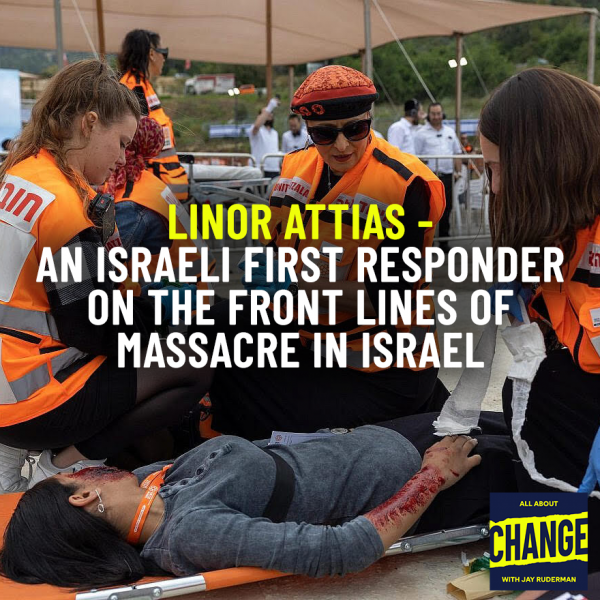
Jay Ruderman:
Welcome back to all about change. This is a special episode in Wake of the recent tragedy in Israel. We want to turn our focus to those working hard day in and out to save lives. We’ve taken pains turn this episode around more quickly than usual because of how fast things are developing on the ground. I spoke to Linor Attias, a first responder on the ground in the south of Israel. She was one of the first on the scene after the Hamas attacks on October 7th. She spoke to me via phone from inside a triage tent. You’ll be able to hear that in her background. I’m so grateful for her taking the time to speak with me and tell me about the situation on the ground. A heads up to our listeners, you’ll hear some graphic descriptions of the aftermath of the attack. If you’re listening with children nearby, you might want to use headphones. I want to tell you that I join you in all the pain that’s been inflicted on the Jewish people in the worst attack on Jews since the Holocaust. I’m sure you know people that have died in this attack, as do I. My wife and child are currently in Israel, so thank you for giving us the time. I see that you’re on the front lines. I know you’re going through a very difficult time, so thank you for your time right now.
Linor Attias:
Thank you. Thank you so much.
Jay Ruderman:
Linor is a member of the volunteer first responder organization, United Hatzalah. The organization’s day-to-day is changed over the last week, but it was founded to ensure rapid medical care to anyone in Israel,
Linor Attias:
United Hatzalah established to save lives. Our goal target is to be there to be every call within 90 seconds or less. For now, we are three all over the country and the major cities like Jerusalem and Tel Aviv. We’ll be there in 90 seconds or less only because we have enough volunteers. Whenever we don’t have enough volunteers, we just open more training. Course it doesn’t need to anything. Just need be able to speak two times a week during the evening to learn everything and that’s it. We’ll receive the medic bag, we’ll receive all the training all over the years, and of course the communication device, the communication device will the nearest one. We don’t have time when baby is choking 90 seconds. This is what we have. There are volunteers all over the country, also Orthodox Arab movement, Christian bedroom, women, everyone is part of the 7,000 volunteers of United.
Jay Ruderman:
I asked Linor about what inspired her to become a medic in the first place. Her answer had some familiar ties to what we’re talking about.
Linor Attias:
I lost my Uncle Emile in Jerusalem and if only back then he had first responders, maybe he wouldn’t. So many blood with a tour on probably could be saved. And at that moment that I didn’t know how I can help and assist my parents and a male doctor, I decided that I’m going to dedicate my life to save others. And then I heard about United Organization of Volunteers Medic. Everyone can become a medic and no matter what you’re doing, what your professional job skills, they’ll teach you everything. They give you the equipment, the communication devices, and if something happens and you are the nearest volunteer, you’ll be alert and that’s it. It’s done. You can save someone life because you have the equipment in your car or your end cycle. So I decided that I’m going to save life. That’s it.
Jay Ruderman:
She told me that as part of the training, volunteers go through something called MCI drills or mass casualty injury drills.
Linor Attias:
We have the drills MCI drills every branch in Israel receiving a bunch of M drills during the year. It could be or weapons earthquake. We are preparing the volunteers for any kind of emergency care scenarios. They know the logistic protocols, they know the medical protocols, they know the operational protocols.
Jay Ruderman:
But no training was sufficient for what volunteer medics would encounter throughout the day of October 7th,
Linor Attias:
I live in Jerusalem, 6 30, 6 40 am We had the first rocket and I was saying to myself, they got to say again, it’s mistake. It wasn’t mean to. It was mistake and that’s it. But then another and another, so going on. So I just ran over to our center in Jerusalem, volunteers around seven 30. We received phone calls shooting us, please, please help. Please rescue us. And it was devastating to hear those voices screaming and yelling for help and to hear the, it wasn’t like regular gun, it was rifles. This is, I heard, this is what I heard. And when I finished to establish all the distance center, I just went down to the south, all the courses that went down to the south. And I assist in help to open the medical field to make the first triage so we can demand if someone, the helicopter or just ambulance to take them to the hospital. It was a chaos. It was a chaos
Jay Ruderman:
For Linor. That chaos brought to mind why she joined United Hat in the first place.
Linor Attias:
Why I become a volunteer of the United because no one put tourniquet on my and lost so many, I cannot count the number of the tourniquet I put on soldiers and civilian who got started during this Shabbat and I know I stayed. Right.
Jay Ruderman:
So after checking with her Jerusalem dispatch office, Leno sped south with the siren on full blast. Within an hour she was onsite in an ambulance. The work couldn’t start yet though the United Hatzalah volunteers had to coordinate with the Israel Defense Force or I D F to figure out what was the safest way for volunteers to get to the victims.
Linor Attias:
For us to make the connection with the I D F to understand because safety, if we going to fill ourselves, no one will take the others. So let’s start protecting ourselves so we can be able to take someone else. So it took us 30 minutes to manage this assessment and then we start to get in and get out. We saw the bodies on the main road. I just drove big in between bodies, which I understood. They already did.
Jay Ruderman:
So can you tell us a little bit, I know it’s very emotional, but can you tell us what it was like to essentially show up in a war zone? What did you see? Can you describe for our listeners who don’t have a firsthand account of what you saw on the way down south?
Linor Attias:
I don’t have the right term, but warzone is not the right term for death. Warz zone is when military fighting against another military. It was town and cities with civilians, and they were in between missile terrorists and soldiers who also make, it wasn’t zone I how to very best decisions and the right decisions. I cannot think for my heart and I have a big huge arm. I needed to focus on all different aspects, information gathering to understand which information is true, which is just only like a guess or mistake. And to create the right operational picture. So we’ll know how to act and how to move the rescue inside and get them out. So we can take, sometimes we put seven or nine people on the ambulance, you couldn’t treat them, you just put them inside and escape outside and then you start to treat them.
And one emotional thing that happened to me in one town, it was in the village of Berry Kibbutz, we went down to take some injured civilian that was on the main road and it was near some houses and I heard a baby crying, but it was very low. I didn’t even understood if it’s baby or maybe it’s a kitty cat. I didn’t know what I’m hearing, but someone in my gut, in my heart tell me I need to check it out. So I went inside the house and I saw two beautiful twins, 10 months old, and their parents were murdered. They were over the babies. They protect the baby. The mother was one baby, the father was with the other. And this is how they say as a mother, I thought, I cannot just take them to the ambulance. What should I do with them on the triage on our hospital scene, I need formula babies, I need diapers.
I need to bring something with me because I don’t hold it in the ambulances. So I went to the kitchen and I saw the refrigerator, the magnets with the pictures of this beautiful family. And I start to think where the mar will put the baby formula. And I remember I said to myself, instead of her sending in her kitchen, referring the bottle for her babies, now no one going do it. Someone will do it eventually. This is what I told myself and another medic. I asked him to find the diapers and he did in the baby’s room. And then they just took them to the hospital, the hospital, the social workers of the hospital, them. And I don’t know what happened. What will be the next step for them. Another thing that was very hard for me is when I need to turn out the uniform for the soldiers, because we need to take over the clothes to see where the bleeding is so we can stop it. And just to turn over an I D F uniform for a soldier fighter, it’s a very hard moment for me as a soldier sense, this is crucial. This is not the right way to fight. This is not a, I don’t have even, don’t even have the word
Jay Ruderman:
For Linor. The horror was unimaginable. Something she’d only seen on a computer screen.
Linor Attias:
I think they took the video games and make them alive. I know that the reality I witnessed is something that obviously I’ll need to take care of myself with thema unit of United Atella and all the volunteers will take care by them. But to see so many blood, to see so many hundreds at the beginning, it was hundreds. Right at the beginning, hundreds of people that I saw that I count one road, I count 35, another road, I count 11, another house, another field. I count 25. It was hundred immediately. And the fairness to understand that there are still between us, that they’re hiding maybe in the cars on the road, maybe I have no way.
Jay Ruderman:
In the middle of all the devastation surrounded by tragedy, Linor kept going. She kept going. She told me because of the hope of saving, just one more
Linor Attias:
Hope. This is what hold me up over there. Just the hope that maybe I can save someone. Those who I couldn’t save, I couldn’t do nothing for them. And just I was hoping that maybe someone survived this barbarism, this brutal terror attack and maybe someone can be safe. Then when we found someone, it gave us the adrenaline and the power to go forward, to see more and more bodies, to smell the blood, to see the dogs hiding terrifying, to see everything that we saw. But looking for someone who still alive under the understanding that I can be shot immediately, that I can live my life here. But the adrenaline, the feeling that we received in every person we grab out from this battlefield, brutal battlefield, gave us the power to continue to continue. This Saturday, October 7th, we’ll never forget, we’ll never forget October 7th. And as you said, everyone to learn from this day, everyone to learn how they can protect their civilians because the civilians of the south of the Godde wasn’t protected. And I know that we is the right decision. This is our own life at risk. But still it was the right decision to serve so many people. So we established immediately the decision, the right decision, that every ambulance should have at least one volunteer with his gun and this is how we could make it. We didn’t know how many ISTs seen alive shooting the people. We didn’t know that. But when the army understood the situation, then they started to protect us. We worked shoulder by shoulder with the army.
Jay Ruderman:
But as time went on, more and more volunteers arrived as well. By 2:00 PM Linor told me there were 50 ambulances, three helicopters and 250 volunteers by 4:00 PM 150 more volunteers had arrived. But remember in the days to follow, United Hatzalah is still responsible for responding to emergencies nationwide.
Linor Attias:
So the mission wasn’t changed since last Saturday. What happened is that we brought more volunteers from all over Israel to assist in the south, but we still need to manage all Israel across. We have had accident, we have talking all over Israel every day, every day we receive 2000 calls, emergency call, 2000 calls. We grant for ambulances receiving every day, and now we need to do more service for the south. So we just bring the vehicle of the command center, the mobile district center, which establish a unique way to the situation in the south and in Jerusalem. They manage all over the country.
Jay Ruderman:
Well, God willing, there will be peace soon and this will come to an end. You talked about P T S D. How are your volunteers going to deal with what they’ve seen?
Linor Attias:
Thank you for asking about us. We have the cycle trauma unit. The cycle trauma unit. Open the hotline for the volunteers immediately when Shabbat went through during the night and think, then they are around the clock every shift that are opening, they have the circle that explain the operational side, but someone from the psycho trauma unit explain them what different things they’re going to see. Maybe they’ll see their bodies, maybe they’ll see attacks, maybe they’ll see a soldier. Soldier that just soldier physically is okay but mentally collapsed. And they preparing us for all different things that we might do and feel. And after the shift, they have the circles over here that someone that they can just speak. We can say whatever we want to say, we can. They bring the piano already during the night and of course the hotline still active. If you need a private call with someone, the unit is active 24 7. And if you need face to face, they’ll meet you wherever your home is, they will come to your home or a coffee shop or whatever. They’ll sit with you. And it’s very important for us to evangelize everything, to understand what we’ve been seeing and feeling and to bring their volunteers back normal to their own life, to the family, community, jobs. We need to bring them safe not only in their bodies, but also in their mining world.
Jay Ruderman:
Unfortunately, psychological safety isn’t the volunteer’s only concern.
Linor Attias:
We have already five volunteers who murdered in this director. Two of them was at the festival. One of them was in trying to assist the police station and we got shot at. We have wounded volunteers and we have meetings volunteers who maybe right now they’re sector in data, but we don’t have the information yet.
Jay Ruderman:
I’m so sorry for that. Well first of all, thank you so much for your service and for everyone else who is volunteering for United. Can you tell us how our listeners can get involved, how they can help, how they can support you and your colleagues who are out there on the front lines trying to save civilians and individuals who’ve been maimed and seriously hurt from terrorist attacks?
Linor Attias:
There are mainly two ways to support us right now, which are crucial for us. One is to donate whatever you can donate at United Atala website campaign. Please do, please help us because we need more, more and crucial for us to have more and helmet because right now we don’t have enough. And if someone will start at the north, we’re talking about the long run, then we need more and we already have the supplier that we can purchase. The second thing can help us just to be the ambassador, to tell the story of United about those responders who know how to save someone life so many during this week and just to support us, to tell about us to others. This is the two ways that I think we can help United Alah right now.
Jay Ruderman:
My heart goes out to you that you’re still there, that the volunteers of United Alah is still there helping people and knowing that your work will continue in the coming days and weeks. And all I can say is God bless you and thank you. And I urge all our listeners, anyone that wants to help people in Israel that have been the victims of the worst terrorist attacks since the Holocaust, to reach out to the of United Sah and give what you can to help this amazing organization. Leno, thank you so much for joining us. I appreciate you taking the time out of an emergency situation to talk to us and to let our listeners know what’s happening on the ground. So thank you so much. Thank you.
Linor Attias:
Thank you so much.
Jay Ruderman:
I wish you all the best going forward. Thank you so much.
Linor Attias:
Thank you. Thank you. Bye-bye Bye.
Jay Ruderman:
Thank you for joining us again on all about change for this difficult episode. We’ll be back on our regular schedule with our next episode.
Jas Boothe:
I am a young female officer going to lead troops into a combat zone. And as scary as that sounds, leadership positions are very far and few for women in the military so I was very excited that I was given this opportunity.
Jay Ruderman:
Hi, I am Jay Ruderman and welcome to All About Change, a podcast showcasing individuals who leveraged the hardships that have been thrown at them to better other people’s lives.
Montage:
This is all wrong. I shouldn’t-
Montage:
I say put mental health first because if you don’t-
Montage:
This generation of America has already had enough.
Montage:
I stand before you, not as an expert, but as a concerned citizen.
Jay Ruderman:
In 2005, US Army Major Jas Boothe was serving in the Army Reserves as a human resources officer and was busy preparing herself and her soldiers for deployment. For many of them, this would be their first.
Jas Boothe:
Their family members are all pulling me to the side and saying, “Please bring my son or daughter back safe. Please bring my mom or dad back safe.” And it just really hits you, the level of responsibility that you truly have.
Jay Ruderman:
There was another reason 2005 would make for an infamous year in Jas’s personal history. It was the year Hurricane Katrina, one of the deadliest storms on record, would slam into New Orleans, Jas’s hometown.
Soundbite:
Officials are telling us that a levy that holds back part of Lake Pontchartrain has been breached. They say it’s a two-block span along the 17th Street and Canal Streets area.
Jay Ruderman:
She and her son lost everything. But if losing her home wasn’t enough…
Jas Boothe:
I received a diagnosis of a very aggressive neck and throat cancer. The first thing I thought about was I wasn’t going to be able to keep my promise to those families.
Jay Ruderman:
Facing down illness and a medical discharge, homeless and jobless, Jas turned to the Veterans Administration, the VA, for assistance.
Jas Boothe:
And the lady looks at me and she says, “Yes, you’re a veteran but you’re a woman, so you need to go get on welfare and food stamps like other women that don’t have fathers that support their children.”
Jay Ruderman:
You couldn’t find a guest to better fit our show’s tagline than Jas. She turned her struggle into a path to help thousands of female veterans. Major Jas Boothe, thank you so much for being my guest on All About Change. I want to bring you back to sort of the beginning, and maybe you can tell us how you ended up enlisting in the armed services in the United States.
Jas Boothe:
So, I know some people think that everyone joins the military to escape something or they join to pay back college funds or something like that. I didn’t. I actually joined the military after college, and I didn’t have student loans. I played basketball during college and I went to college with a full basketball scholarship. So I actually joined the military for the challenge. I’ve always been a very team-oriented person. Obviously, the military is probably the toughest team sport you can play. So when I left college, I had already had my oldest son. So there are lots of stereotypes surrounding how successful you can be in life when you’re a single parent. And for me, I didn’t want my son to think that those stereotypes were true. And so I wanted to be in the toughest profession you could be and be successful to let him know that you can do anything that you put your mind to. And so for me, the military would be the toughest career that you can do, not only as a single parent, but as a woman.
Jay Ruderman:
And first of all, I understand that you served in active duty for many years. So first of all, I want to thank you for your service to our country, and maybe you can tell us a little bit about what you did in your service up until the point where you were about to be deployed to Iraq.
Jas Boothe:
So I actually started off enlisted. I started off as an 88 mike. So when I joined the military, they actually didn’t tell me about the officer training programs. And so while I was training as 88 mike, my drill sergeant said, “you have a degree, why are you enlisted?” I said, “Because my recruiter said that I can get E4.” And he was just like, “You are just on the wrong path.” And so I did two years of the Army ROTC program through the simultaneous membership program, and I commissioned as a human resources officer.
Jay Ruderman:
So 2005, you’re in New Orleans. What brought you to New Orleans?
Jas Boothe:
So after I commissioned as a human resources officer, I was looking for a civilian job at the same time because I had commissioned as part of simultaneous membership program out of a reserve unit. And so with that, I still needed a civilian job. And so the unit that I was in, the civilian job that I had applied for didn’t come open soon enough and so I was looking for other units that not only had a military position for me, but also had a civilian position in. And the only one that was available at that particular time was a transportation unit at the Naval Support Activity in New Orleans. That’s how I ended up in New Orleans. I went there towards the end of 2004, and in spring 2005 is when I got the call to Iraq.
Jay Ruderman:
What type of role did you have at this time? What were your duties before your deployment?
Jas Boothe:
So I’m a lieutenant at the time, I’m a young lieutenant, and I’m a human resources officer and postal falls under human resources. So I was called up to be a postal officer, which basically sounds like what it is. I was going to go run a post office. And the unique thing about my unit was that we were all transplants. Nobody knew each other. And so we were all just pulled from all different types of units. And so we are just green in every sense of the form. I was actually very excited to go into this deployment because I’m a young female officer going to lead troops into a combat zone, and as scary as that sounds, I was excited because leadership positions are very far and few for women in the military, especially going into a combat zone. So I was very excited that I was given this opportunity. Additionally, I was a single mom, and so that part didn’t really scare me because I rose my right hand in service like everyone else and I took it very seriously.
Jas Boothe:
So I just have all these young men and women, we have an event with their family of when they get to say their farewells and goodbyes. I’m not much older than most of them, but I’m responsible for them in every way, shape, and form. And their family members are all pulling me to the side and saying, “Please bring my son or daughter back safe. Please bring my mom or dad back safe.” And it just really hits you the level of responsibility that you truly have.
Jay Ruderman:
So I understand how important your service at the time was and the deep responsibility that you had for people who were not much older than you, but I understand that there were a few things that happened at that time that completely changed your life, and some very difficult things that happened to you. Can you tell us what happened at that time?
Jas Boothe:
We were in Fort McCoy, Wisconsin. It was very hot in the Midwest. I’m from Chicago, so I’m used to it and I know. But for some reason, it was taking a serious toll on me and I did not feel very well. I’m very in tune with my body and I’m like, “Something is not right.” We all know, they tell you in the army like to suck it up and drive home. As a woman, you didn’t get to have a bad day. And I would get belittled whenever I would try to go get checked out. I would get told things like, “This is why women shouldn’t be in leadership positions. You’re really showing why you’re the weaker sex. You are just the kind of leader that would get troops killed in combat.” And when they told me that, I never complained again.
Jas Boothe:
So fast-forward to August, we were at a training event and then a commander tells us we need to pause the training event and I need you all to come with me. Then he tells us that a hurricane hit New Orleans. And now, people that are from that area usually don’t evacuate, they just kind of hunker down because storm systems come through so very often. But this storm system was just not a fleeting storm or a category two hurricane. This hurricane was Katrina. And a lot of us are slowly realizing that we’ve just lost everything that we own.
Soundbite:
For the survivors of Hurricane Katrina here in New Orleans, there were pleas for help by any means available, from people perched on rooftops or wadding through the streets in search of higher ground. For a second day in a row now, there are still rescues going on as we come on the air tonight.
Jas Boothe:
Me and my son lost everything that we own. Luckily, my son was with my aunt in Missouri and so at least I knew that he was safe. I was fortunate, but a lot of my troops were not able to get in touch with their friends and family members. And so we had to do a two-week pause ex because obviously they couldn’t focus if they didn’t know if their families were safe. I don’t have anything to go salvage. My son is safe. So maybe this is the time for me to go check on my health. So I went and got that checkup. And I got a call two weeks later to come and get my results.
Jay Ruderman:
And I understand you were diagnosed with cancer at that time?
Jas Boothe:
Yes, I received a diagnosis of a very aggressive neck and throat cancer.
Jay Ruderman:
So at this time, obviously with Hurricane Katrina and the devastation of your property and your health and your life being in danger, I understand you had to leave the military at this time.
Jas Boothe:
You know what, that wasn’t the first thing I thought about. That did become an unfortunate reality. But the first thing I thought about was I wasn’t going to be able to keep my promise to those families.
Jay Ruderman:
That must’ve been devastating.
Jas Boothe:
It was just hard at that time because I knew that I had gotten them ready, that we were ready and we were going to go in and come out together. And then abruptly, I just had to leave them and not know what was going to happen, who was going to come back, and it was going to be my fault. And I basically have 48 hours to go tell them bye, get my stuff together, and go off to the hospital, make a call to my family, let them know I was going to go be in a hospital and just hope for the best. It just happened that quick.
Jay Ruderman:
And I understand you did not tell your son about your diagnosis or that you were even in the hospital?
Jas Boothe:
No. He was a happy little boy and I didn’t want him worried about me. And I also didn’t want him thinking about if he was going to go from one parent down to none. How do you even prepare a child for that?
Jay Ruderman:
And can you tell us a little bit… I saw some of the pictures of your treatment and it must have been just so difficult what you went through.
Jas Boothe:
It was horrible. I spent six months in the hospital. I had two surgeries, 30 cycles of radiation. And it was horrible. I lost my sense of taste. Radiation, it just burns you and all you feel is just physical pain and you just burn from the inside out. But I will tell you what gave me perspective in going through that treatment, because during that time, troops were getting devastated from IEDs.
Soundbite:
For these men, making the roads safer for others may often feel like an impossible mission, but they do manage to clear three out of four bombs that are found. And on every journey, never far from their thoughts, the memories of colleagues who haven’t returned.
Jas Boothe:
And I would see these, my brothers and sisters being wheeled in, burned, some with missing limbs, and I said, “You know, at least I can still look in the mirror and see myself.” And I would suck it up just for them. And I would see them come in, I would just smile and speak to them. And I said, “You know what? They got it way worse than I do.” It was hell going through it, but I just wanted to stand up tall for them.
Jay Ruderman:
And my understanding is that you did come through, you beat cancer, but you still had, and to this day, have complications from what you went through.
Jas Boothe:
Being that I had radiation so close to my brain, I developed lifelong mental health issues. I have cognitive decline. But I will tell you, through that whole experience, cancer probably was the easiest part of what I experienced during that time because I left the hospital homeless.
Jay Ruderman:
Can you talk about what that was like to be homeless at that time after everything that you’ve gone through and having served your country?
Jas Boothe:
By the grace of God, my cancer did get in remission. It did respond to the radiation after six months of treatment. Due to Katrina, I didn’t have a home or job to go back to. At that time, they had warrior transition units. I let the unit commander know that I don’t have a home or job to go back to, and it’s basically, “Hey, the military doesn’t have a place for you right now because you’re not fit to serve, and so here’s your Duty 214, you need to go to the VA and get services because you’re a veteran now. And so I had always thought that the VA was only for Vietnam era veterans. And so I had a glimmer of hope that I was going to go there and get services.
Jas Boothe:
And I go to the VA and I say, “Hey, I was sent here because I had to leave the military due to medical complications and the hurricane, and I need housing for me and my child because I’m a veteran.” And the lady looks at me and she says, “Yes, you’re a veteran but you’re a woman.” And I said, “Yeah, last time I checked, and I was also a soldier and a woman.” And she said, “Well, we have support services and housing for veterans, but not women veterans.” And she said, “Oh, but you mentioned you had an illegitimate child, so you need to go get on welfare and food stamps like other women that don’t have fathers that support their children.”
Jay Ruderman:
That must been completely devastating. Here you are, someone who’ve spent years in service to our country, and you need help and the VA is just not there for you.
Jas Boothe:
As I said, when I was in the hospital and when I would walk through the hospital corridors, there were men and women who had been injured and wounded by war. And so when I go to a system that looks at me differently because of my gender, I know, and I’m well aware that IEDs do not gender discriminate.
Jay Ruderman:
Right. So what did you do at that time? You’re essentially turned away by the VA. What ended up happening?
Jas Boothe:
I called my aunt, slept on her couch, and I went and got on welfare and food stamps because that’s all I qualified for. I went from being an army officer, having housing, having a job, having BA to take care of me and my son, to getting a couple of hundred dollars a month in food stamps to just basically feed my child and nothing more.
Jay Ruderman:
There were some statistics that I didn’t think about, but people should know that women veterans are two to three times more likely to be homeless than any other group in the United States adult population. That’s shocking to me. People that have served our country, that have given their time and possibly been injured, either physically or psychologically, that they’re two to three times more likely to be homeless?
Jas Boothe:
Yes. And most people also don’t know that over 70% of the homeless women veteran population have children in their care. They also don’t know that neither HUD or VA even tracked women veterans as a homeless population prior to 2011, when the government accountability office did an audit to ask them, “Hey, how many women veterans are you currently serving and tracking?” And everybody just looked around the room like, “Well, we don’t really track them.” They also didn’t know for the co-ed programs that actually had a woman veteran or two and a child that they were housing them with registered male sex offenders because they didn’t do background checks on them. So we were put in the worst possible situation. So you either put them in a bad situation, you don’t take them in, you don’t take in women with children, you have restrictions on the children, the ages of the children or the sex of the children. And for those that didn’t take in children, they asked them, “Well, why don’t you take in children?” And they said, “Well, the VA doesn’t pay us for the children. They only pay us for the veteran. So there’s no financial incentive on taking in children.” So you’re reducing supporting and keeping families together due to a financial incentive. These people have gone to war and already been separated from their families due to their service, and you are willing to separate them again for a price tag.
Jay Ruderman:
So I also read the statistic that 82% of women veterans do not use the VA for healthcare. It sounds like our country, well at least the VA, the government, is not set up to help women, especially women who have children.
Jas Boothe:
I would say it definitely takes time to make changes and I think the VA has started to get better, but I think women veterans just didn’t… When we initially went to the VA, when you went there, all the posters were male. Even the VA’s model is outdated and archaic. Some VAs don’t even have the same standard of care. Not all VAs have a women’s clinic. You can’t go to every VA and get mammograms. And so it’s just like we want to be served equally, but men and women are different in our biology. And so you can’t say we serve all veterans equally when I as a woman can’t go to every VA and get obstetric care if I’m pregnant. And so for me, it’s like I raised my right hand, I accepted all of the dangers, but I’m not seen as equal from a support service standpoint.
Jay Ruderman:
And so just to give a magnitude to this issue, there are 1,800,000 women veterans who are unscreened and unaccounted for. That’s a tremendous number that they’ve served our country, but they’re just not receiving services from the government.
Jas Boothe:
And not only that, when you look at homelessness, HUD has a point in time count where they say they go out and count all veterans who are homeless, one night a year on the coldest night of the year in January. So that system is severely flawed because they may say, “Hey, we went out and we counted that there were 40,000 homeless veterans on one night.” Well, the problem with that is you’re not going to find women veterans and their children in two degree below zero weather anywhere. If you do find a woman veteran on the street with her child, people are going to call child services, she’s going to lose her child.
Jas Boothe:
Also with that is you’re saying one night we counted everyone. You didn’t. So I tell people, I always put the unemployment numbers next to the homeless numbers. So the unemployment office may say, “We had 450,000 unemployed veterans.” And then the point in time count said, “Well, we had 45,000 unemployed veterans.” So you’re telling me that 400,000 unemployed people are able to maintain their household, but there are only 40,000 people who are homeless. It doesn’t match up, but obviously less looks better. But the problem is with those of us who are service providers who are telling you no, there are actually 55,000 women veterans who are homeless, but you’re only saying there are 40,000 total veterans. But if you look at the fine print at that number at the bottom of the page, it’ll say, “This is just a small number. We didn’t count everyone, but this is what we were able to capture.” They don’t put that upfront, but they will present that number as the gospel to make you think that the problem isn’t as big as it is.
Jay Ruderman:
How is it that so many people who’ve served in our military, so many women are homeless, are not receiving services, are unemployed? What’s going on in our country?
Jas Boothe:
I can’t recall how many times we would get emails from businesses, sports teams, “Hey, we have 50 free tickets to this, 50 free tickets to that. You guys can come sit in the front row. Hey, you want to come sit on the 50 yard line, do X, Y, and Z?” And we would meet all these people who would give us business cards and say, “Hey, when you got out of the military, if you need a job, you need anything, please reach out to us.” Our country gives us this false sense of security that once we leave the military, they will take care of us. And so once that uniform comes off and you reach out to these people, that email bounces back, “Oh, such and such is in a meeting,” or, “You know what? We’re actually not hiring right now.” “Do you mind if I come to a game?” “Oh, you know what, maybe next game, maybe next game.” Because you know what? You are no use to them anymore. That uniform gets them business. It’s a great optic for them. But a veteran struggling isn’t a good look for them.
Jay Ruderman:
Do you feel that people look at female veterans different than they do their male counterparts?
Jas Boothe:
100%. And I think part of that is what the media has portrayed for so long, not just local media, even in movies, men have always been the war fighters, they’ve always been the heroes. What they don’t show is we’ve been right there beside them. And it is not a competition. The thing is, whatever we raised our right hand in service from or for, we’ve accepted the same dangers. When you have insurgents that are bombing bases, those bombs don’t have a gender identifier. When you go to Arlington National Cemetery, yes, there are women there too.
Jay Ruderman:
What was the turning point that caused you to say, “I need to do something,” and led to the creation of Final Salute?
Jas Boothe:
So what I originally thought that, well, maybe the VA doesn’t have any supportive services for women because maybe I was a freak accident. Maybe women don’t go to the VA. Or maybe women veterans don’t end up homeless. Maybe it was just me. And so being that I am a Chicago native, I would watch the Oprah show every time I got the opportunity to watch the Oprah show. And so around 2009 or 2010, Oprah is getting ready to go off air. And so I’m home watching one of her last shows, and I happen to catch a combat veteran who is a female who is living on of her car
Soundbite:
Food, I like to call it my kitchen. Microwaves are very easily accessible all times night, anytime of night. So a lot of my food is microwaveable.
Soundbite:
Alicia is a retired Air Force staff sergeant. But for a year now, Alicia has been homeless.
Jas Boothe:
The similarities between me and this veteran I was watching were just crazy. And I just was like, “Wait a minute.” And so I went to look for resources for homeless women veterans, and not one single hit. And I said, “You have got to be kidding me. This is going to be my next mission.”
Katie Barnes:
This nationwide discussion that we’re having about transgender people is actually a conflation of so many different conversations at the same time. Some of which I think are in good faith and some of which I do not believe that is the case.
Jay Ruderman:
Hi, I’m Jay Ruderman and welcome to All About Change, a podcast showcasing individuals who leverage the hardships that have been thrown at them to better other people’s lives.
Montage:
This is all wrong.
Montage:
I say put mental health first because if you don’t.
Montage:
This generation of Americans has already had enough.
Montage:
I stand before you, not as an expert, but as a concerned citizen.
Jay Ruderman:
Today I’m speaking with award-winning sports journalists, Katie Barnes. Their extensive work has brought the conversation around transgender athletes, straight from school gymnasiums into people’s homes.
Katie Barnes:
I thought, “Oh, this is really interesting, I want to write about it.” And at the time I just didn’t foresee that it would be the political topic that it has become.
Jay Ruderman:
Katie is gendered nonconforming and uses they/them pronouns. In 2019, they were the executive producer of the documentary Mack Wrestles, which tells the story of transgender wrestler Mack Beggs.
Katie Barnes:
This was a story that blew up in a very short amount of time, and it burned white-hot. In that 2017 summer, he was kind of everywhere when it came to discussions of transgender athletes and transgender people.
Jay Ruderman:
At the time, Katie thought writing about the cross section of sports and gender would be a small part of their career in journalism. They now see it as the most important part of their job, serving communities on both sides of a critical issue with empathy.
Katie Barnes:
Everybody has a position on this issue, they have a bias on this issue. And I think that’s true in general when it comes to journalism that we’re all still humans, the most important thing is not to allow those biases that we have to unfairly guide us in our pursuit of a story.
Jay Ruderman:
So Katie, thank you so much for being my guest on All About Change. I want to tell you I really enjoyed your book and I learned a lot. Can you tell us a little bit about how you fell in love with sports?
Katie Barnes:
Sports was always a big part of my family culture. Whether it was playing sports as kids, basketball was my primary sport, and I played that competitively for most of my childhood. It was something that I don’t remember a life without.
Jay Ruderman:
I see. And I think you said that when you first wrote about transgender in sports, you thought it would be a one-off, and now you think it’s going to become something that you’ll continue to write about for the rest of your career. Why is that?
Katie Barnes:
So, I ended up pursuing a story about Mack Beggs, who was a subject of a chapter in the book, but also was one of the subjects of my very first stories. And at the time I didn’t think it was going to be… Not that the issue would go away, I didn’t really think that, but I didn’t foresee that it would be the just political topic that it has become. And so now there’s so much energy around having these discussions, some of which I think are in good faith and some of which I do not believe that is the case.
Soundbite:
Now let me ask you as someone who’s competed at the elite level, in your experience, is there a difference between women and men?
Katie Barnes:
And so because of that, I have a hard time believing that this is something that’s going to be resolved in the next few years. And I’ve spent so much time on the topic that even though I thought originally I’d probably just write about this once, maybe twice, it’s become something that has defined my professional career thus far.
Jay Ruderman:
Can you talk a little bit about Mack Beggs and his story? I found it fascinating.
Katie Barnes:
So, Mack Beggs is a wrestler in Texas. At the time of the film, it was 2018 was when we were filming, but he won a state high school championship in wrestling in the girls’ category. And Mack, as you can hear, we use he/him pronouns for him, he is a transgender boy. And Texas is one of the only states, there are a few, it’s about a handful that have separate categories for boys and girls wrestling. A lot of states have one unified wrestling category and then girls can compete, but there isn’t a separate girls’ wrestling sport that is sanctioned by the state.
Katie Barnes:
And so because of the existence of that category, and then also the Texas policy at the time was not yet law, that basically said that your gender eligibility was determined by your birth certificate that required Mack to wrestle in the girls’ category as that was how his family interpreted that policy. And then on top of that, Mack was also medically transitioning. And so that was a big part of the story where under the guidance of his doctor, he was taking testosterone as part of his medical transition and wrestling in the girls’ category. And a lot of people saw that as doping. And so the whole thing just really blew up and he became the subject of certainly one bill that was filed in Texas that did not pass, but in that 2017 summer, he was kind of everywhere.
Soundbite:
Anybody can wrestle. No matter who you put across the bat, it don’t matter, it just comes down to technique and who has the most heart. And I put too much tears, I put too much blood, sweat and tears, I put too much BS into this journey, that I wanted to come out on top of it.
Jay Ruderman:
And by interesting is that Mack actually wanted to wrestle on the boys team in the boys’ division in Texas, but was not allowed to.
Katie Barnes:
Yeah, he always said that he wanted to wrestle on the boys team. However, under Texas policy at the time, he was not eligible to wrestle on the boys’ category. That said, there was a period of time where he was wrestling boys, and that happened in the spring and early summer after his second championship. And he wrestled boys and he won and he qualified for nationals. He ended up not competing at nationals after being kicked off the team for not attending practices, which is chronicled in Mack Wrestles. And so I think for a lot of people who say, “Well, he should have been wrestling boys,” Mac would agree with that, he would’ve preferred that. And when he did do it, he was still quite a good athlete and successful in his own right.
Jay Ruderman:
So, can we talk a little bit about the opposition? Because one thing that stuck out in the film for me is after he would finish wrestling, his coach would take him and bring him into the hallway. That the abuse that was being leveled at him was so great that they wanted him just not to be there and be present and to have a little distance from that. And I know that’s something that you’ve covered, so can you talk a little bit about that?
Katie Barnes:
It’s unclear if the response from his coach was specifically around the abuse from the stands in terms of boos and things of that nature. I think it was actually more because of the intense amount of scrutiny. And it’s really hard to describe what Mack was experiencing during that time because this was a story that blew up in a very short amount of time and it burned white-hot. There were so many cameras and journalists camped out near his grandmother’s house, the Texas State Wrestling Championship had never seen a media response like this one before. And so it was incredibly intense. You see that in some of the footage of Mack stretching before he competed where there’s just a semicircle of cameras in his face. And so I always interpreted him being sort of whisked away between wrestling bouts as protecting him from that scrutiny, so that he could stay focused. Because otherwise, I don’t know how you who are 17 years old and you remained focused in that environment. It’s so much.
Jay Ruderman:
What is becoming very clear, and maybe we can get into this a little bit, is that the governing bodies that are determining when transgender athletes can compete and if they can compete is often state by state or maybe local community by local community. And even in terms of more elite Olympics NCAA on a national or international level, it just seems so confusing about how this issue is being approached by society.
Katie Barnes:
Yeah. So, we’re in a really clear period of just an incredible amount of policy upheaval. And so what I mean by that is from about 2010ish until 2020, I would say there was a general consensus for what policy sort of looked like. And there are exceptions to this of course, but there was an idea that in order to be eligible for the women’s category if you were a transgender woman, you needed to suppress your testosterone for a year and it needed to be under 10 nanomoles per liter, which is just your level of free floating testosterone. And that was kind of the status quo at the school level, meaning K12 sports. It varied depending on where you lived pretty clearly. But there has never been in the United States a national policy of sorts that dictates on this particular topic. There are different legal discussions about whether or not and how Title IX applies, but when it comes to this is how you handle transgender athletes in school sports, there is not a national law for that.
Jay Ruderman:
And is there any attempt by the federal government to provide some guidelines for states?
Katie Barnes:
So, I mentioned Title IX. I view a lot of the back and forth that we’re experiencing in the United States started with Title IX, honestly. And so in 2016, the Obama administration provided guidance essentially saying, “This is what we expect and we think Title IX protects transgender students in this particular way. Here is how you’ll be inclusive. And if you are not following this guidance, then you are perhaps not compliant with Title PX.” Title IX as a law is something that is often described as being the thing that gave us women’s sports and girls’ sports in schools. And that’s true, but the law actually has nothing to do with sports.
Katie Barnes:
It’s 37 words that just says that all students should be able to access education and shall not be discriminated against on the basis of sex, and that it includes education and activities, and the activities is where the sports thing kicks in. And so when that happened, about 23 states sued the Obama administration to say, “We think this is unfair. We think this is an overreach by the federal government.” And so that guidance never went into effect. Fast-forward, the Trump administration rescinded the guidance.
Speaker 9:
I will ask Congress to pass a bill establishing that the only genders recognized by the United States government are male and female, and they are assigned at birth.
Katie Barnes:
And then when the Biden administration took over, they didn’t release the same guidance again. Instead, they have proposed a regulatory change for the Title IX regulations as they stand that essentially says, “Blanket bans on transgender girls competing in girls sports are not appropriate under Title IX, but there are certain circumstances,” that they do not give them,” when some restrictions may be appropriate and in compliance with Title IX.” So, trying to thread a very specific needle. And in the midst of all of that, the US House of Representatives also passed a bill that looks very similar to a lot of the legislation that has passed in now 23 states across the country that restricts eligibility for girls and women’s sports.
Jay Ruderman:
Is this all about politics? Is this about discrimination? Is this about misunderstanding? It feels like the divide in our country and how we are sort of at war with ourselves on so many different issues that there are states and communities that believe in inclusion and acceptance, and then there are communities that do not believe in that.
Katie Barnes:
I think the hardest thing about this nationwide discussion that we’re having about transgender people broadly, but of course the area that I cover in terms of how that applies to sports is actually a conflation of so many different conversations at the same time. There are some people who have good faith questions about what policy should be when it comes to governing eligibility for sports. And ask the question, “Well, is it fair given everything that I know about the differences in biological sex, about the differences that I have been taught about these sexes, is it fair for someone who is assigned male at birth to compete in women’s sports? And under which circumstances would my answer be yes?” And I think that is a question that a lot of people are asking.
Katie Barnes:
And I also think there are people for whom the answer to that question is never. And when thinking about why in terms of how they characterize the conversation, it becomes clear that there’s also a desire to not validate who transgender people are. So, what I mean by that is the use of terminology that erases identity, so not saying transgender girls or transgender women and instead using alternative descriptions, not using an athlete’s pronouns and name that they use and instead using a name that they do not use anymore and using pronouns that they might have used in an earlier time. That isn’t a discussion about appropriate policy, that is a fundamental difference in worldview in certain regard. And so it can be really hard to sift through exactly what we’re talking about because they sound the same, and they’re not always the same.
Jay Ruderman:
Right. You start in your introduction with a quote from a lawmaker who you don’t identify, but it’s a very crude quote sort of saying, “Listen, if anyone wants to say that they’re a woman, it can be in women’s sports, what happens to women’s sports?”
Speaker 10:
I can tell you this, in Florida, girls are going to play girl sports and boys are going to play boys sports. That’s what we’re doing, and we’re going to make [inaudible 00:15:37].
Jay Ruderman:
How do you answer that question? So, how did that hit you when you were asked that and what did it make you think?
Katie Barnes:
At that time, I hadn’t considered that question or hadn’t considered the viewpoint of someone who might ask that question in such a way. And so I think I was at first a little taken aback because I was surprised, and then it was something that I considered a lot because it’s something that I hear a lot now. This feeling of, “Well, if we let trans women participate in women’s sports, then there will no longer be women’s sports.” And there are a lot of people who really believe that. And if that is what they believe and that is the question I’m being asked, then I felt like it was really important to seek to answer that question in a substantive and meaningful way.
Jay Ruderman:
Which is what your book is about, Fair Play, which is coming out next month. And I would urge all our listeners to pick up a copy because it’s a fascinating history and I think that it’s very readable and enjoyable. There’s something that you write in the book about being a journalist, which it really struck me. You say that, “In journalism we focus a lot on objectivity or the idea of being a neutral arbiter who is positionless. I don’t think of my role that way. Instead, I think it’s most important that my biases and positions are known and that fairness and truth be my guide, none of us are neutral.” I thought that was very powerful. Because usually you talk to a journalist, they’re like, “Listen, I just report.” But that’s a very unique position. I think it’s a very honest position. Maybe you can talk about how you approach your journalism.
Katie Barnes:
Yeah. I think that summed it up pretty well. I forgot I wrote that. That is very true to how I approach the journalism I do, especially on this topic. And I think folks are often surprised that I do talk to so many people, but I think it’s really important to do so. If something is “controversial”, it means that there’s multiple sides inherently in that description. And so I think it’s important to capture that. But I also think when it comes to this particular topic, folks have opinions and they often ask me mine. That was something that I have found in my reporting, both in my everyday professional job and also in reporting this book, everybody has a position on this issue, they have a bias on this issue. And I think that’s true in general when it comes to journalism, we’re all still humans, I think it’s important to acknowledge our humanity.
Katie Barnes:
And the most important thing is not to allow those biases that we have or those thoughts that we have to unfairly guide us in our pursuit of a story in terms of who we ask questions. The kinds of questions we ask, to what we include in our stories or not, all of those are decisions and those decisions are guided by our own perspectives and viewpoints. And so for me, I think it’s really important to know where my own perspective is and to allow that to be challenged, so that I can make the best decision when it comes to what I’m including and why, and feel good about whether or not this was fair and whether or not it was accurate. I think sometimes journalists can fall behind a veil of objectivity as a means of obfuscating the fact that perhaps they weren’t entirely fair. I don’t think that serves a reader or the communities that we’re reporting on.
Jay Ruderman:
Right. Well, that’s very profound. And do you feel that your employer is backing you up and says, “I get your point of view, and you’re adding something to the conversation. And you’re approaching it in the right way”?
Katie Barnes:
I’ve always felt really supported by ESPN, and that it’s a great place to work and I love doing the work that I get to do. And so I’ve never felt like I have not been supported.
Jay Ruderman:
You’re a journalist who’s reporting on a subject matter that’s controversial in our society. How do you deal with the blowback on social media, on, I don’t know, emails, general public, how they’re responding to your reporting?
Katie Barnes:
If it’s in good faith, I’m always willing to have a conversation. If you want to send me a message and ask me questions, I will answer those messages. If you want to comment on a photo of me and my wife saying nasty things, I will delete the comment and block you immediately. Like for me, it’s not that deep.
Jay Ruderman:
Well, that’s a good policy. What changes do you think need to be made in sports to allow more transgender inclusion?
Katie Barnes:
As I say in my book, I think that the restrictions currently are just too broad. So, there are a few things that I’m certainly in favor of, which is fewer restrictions in youth sports. I think that is absolutely appropriate. But also, I would love to see more co-ed sports. I’d love to see us sex separate later. I played soccer growing up, and in second grade we were already on girls and boys teams. And why? We don’t necessarily need to do that. And so I think it would be good if we did that less, for a number of reasons, most of them cultural. Right?
Katie Barnes:
I think it’s a really important lesson and gaining confidence if you are somebody who is a little girl and you beat a boy when you’re told that girls should never beat boys. And I think if you’re a boy, it’s important to learn to lose to somebody who just beat you. And that’s good. And if you are somebody who is more gender expansive and you’re figuring it out, I know that who I was as a kid, you are not put into a box so young. And so in general, I think that would be really good. And that’s not just about inclusion for young trans people, it’s also about a more healthy society from a gender relationships perspective in terms of what we think about sports, what we think about men and women, I think that would be really healthy.Ç
Jay Ruderman:
Right. What is your feeling towards… I don’t know what an elite athlete is, I don’t know if elite athlete is Division 1 in college or elite athlete is a professional athlete, but what are your feelings about restrictions at that level?
Katie Barnes:
I think from a restriction standpoint, I believe in a pathway to participation period. I think that trans women in particular should be allowed. If you want to have them jump through hoops, that’s fine, but they need to be able to actually jump through those hoops to then compete in the women’s category. There has yet to be a real example of just trans women dominating in women’s sports at the Olympic level. And I say this in Fair Play, my perspective is informed by where we are today, and if things were to occur that would have me change my perspective, I think it’s important that we can change our minds. But for where we are at right now today, I don’t think there really is a reason to have a blanket restriction that says, “No trans women after puberty ever.”
Katie Barnes:
When it comes to swimming and track and power lifting, we’re talking about speed and strength and power and explosion. I get it, I understand why people want restrictions. I think restrictions are appropriate. But three years of testosterone suppression, is that enough? Saying that you have to transition before Tanner stage 2 puberty, which is very early puberty or you’re never allowed to compete at the elite level, I don’t think the science supports that, frankly.
Jay Ruderman:
I just want to touch on the case of Lia Thomas at University of Pennsylvania, and that she was a trans woman who had gone, what my understanding is, over and above what the NCAA was requiring in terms of testosterone suppression, but yet there was a tremendous amount of controversy around her.
Soundbite:
They are putting ideology ahead of opportunity for women athletes.
Soundbite:
It’s happening all across the country to girls and women of all ages, all sports, all divisions, and it’s a travesty.
Soundbite:
The swimmer, I told you about the swimmer. And it really hurts women, it’s the opposite of dignity, it’s horrible.
Jay Ruderman:
What do you make of that controversy?
Katie Barnes:
So, you have a swimmer who spent three years swimming in the men’s category, and now was in the women’s category and had just put up the top times in the nation in her swimming distances. And oh, by the way, she’s six four. Right? So, when you look at it like that, especially if she’s being characterized as a mediocre men swimmer or below average male swimmer, if that is your characterization of what occurred previously, then I think a lot of folks were like, “Well, that’s not fair.” And so as that was occurring, I think it really just touched a nerve in our society. I remember I was in Atlanta and covering the national championships, and I was just kind of walking around talking to people, just chatting, it wasn’t a serious interview. And I remember having a conversation with someone, and she said to me, “Well, I just think that there should be a policy.”
Katie Barnes:
And I was like, “Well, did you know that the NCAA actually already does have a policy?” And she was like, “No, I didn’t know that.” And so we kind of talked about it, and I was like, “Did you know that Lia had actually met that policy and then some?” And she’s like, “No, I didn’t know that either.” And so I think when it comes to how Lia’s story was disseminated through the public, obfuscates the truth that, yes, for two years she swam on the men’s team. That is true. And after her sophomore year, she began testosterone suppression, so that third year she was swimming on the men’s team in a women’s bathing suit. That was happening, there’s photographic evidence of that. And then she had another year off because of COVID. And so by the time she got into the pool, she had undergone 29 months, I think, of testosterone suppression. And that was more than double what the NCAA required at the time. And folks, they just didn’t know that, that was not a core part of the original narrative.
Jay Ruderman:
Right. Usually in our society, the media focuses on loud people, people who are in opposition, people who are making a lot of noise. What can the parents of trans children or the athletes themselves do to amplify their voices?
Katie Barnes:
That’s a really tricky question. There’s a tremendous amount of risk right now being a family with a transgender athlete. Even in states where you are complying with the laws and policies and you’re eligible to compete, if you are a transgender athlete, you can still be outed publicly and then experience a tremendous amount of backlash. We have seen that happen over and over again in the last year with high school transgender athletes actually, usually transgender girls who are teenagers and who are not doing anything wrong. And it’s very scary for these families. And so I think for a number of families with trans kids and for transgender people in general, being quiet right now is what feels safe, and that’s very hard.
Jay Ruderman:
So, is there a way in today’s day and age when there’s harassment, restrictive laws, that transgender athletes, non-binary student athletes can thrive in sports?
Katie Barnes:
I think for me, when I think about in totality, how can we ensure that all of our students are able to thrive and have a high-quality education and athletic experience, it’s to be educated on the topics as much as we can be. And to provide support for all athletes, and that includes cisgender athletes and transgender athletes and non-binary athletes. And can you create an inclusive experience for all students and all kids where you are, I think really benefits a tremendous amount of kids outside of the scope of what I typically cover.
Jay Ruderman:
Yeah. Well, Katie, I want to thank you for being my guest on All About Change. Your book Fair Play is not to be missed. I would urge all my listeners to pick it up and read it and learn, and try to make our society a more equitable place. So, thank you so much.
Katie Barnes:
Thank you very much for having me. I really appreciate it. And thank you for taking the time to read Fair Play. That truly means a lot.
Jay Ruderman:
In so many of the stories Katie shared with me, the key component was context or lack thereof. Whatever the reason, people they spoke to weren’t getting the full story, just the bullet points. Knowledge is power and the narratives presented in the media we consume can turn the tide of public opinion in completely different directions. Our conversation helped me understand how crucial it is to avoid sacrificing context in the name of grabbing more headlines.
Jay Ruderman:
That’s it for today’s episode. In two weeks, we’ll be joined by Jas Boothe, a former military service member who turned her own heart-wrenching struggle into a new narrative of hope for female veterans in need.
Jay Ruderman:
Today’s episode was produced by Kim Huang, the story editing by Yochai Maital and Mijon Zulu. To check out more episodes or learn more about the show, you can visit our website allaboutchangepodcast.com. If you like our show, spread the word, tell a friend or family member, or leave us a review on your favorite podcasting app. We would really appreciate it. All About Change is produced by the Ruderman Family Foundation. Special thanks to our production team at Pod People, David Zwick, Grace Pina, Morgane Fouse, Bryan Rivers, and Aimee Machado. That’s all for now. I’m Jay Ruderman, and we’ll see you next time on All About Change.
Emily Penn:
So one morning we were in the middle of the Pacific. At that point, we were 800 miles from the nearest point of l and. The closest people to us were in the Space Station in orbit above our heads.
Jay Ruderman:
Hi, I am Jay Ruderman and welcome to All About Change, a podcast showcasing individuals who leverage the hardships that have been thrown at them to better other people’s lives.
Montage:
This is all wrong.I shouldn’t be happy.I say put mental health first because-Yes we can!… If you don’t-This generation of Americans-Yes we can!… Has already had enough.I stand before you, not as an expert, but as a concerned citizen.Yes we can!Louder!Yes we can!Louder!Yes we can!
Jay Ruderman:
This week we are visited by Emily Penn, an ocean advocate and founder of eXXpedition, a series of ocean voyages with an all female crew focusing on plastics, chemicals, and their effects on female health.
Emily Penn:We can also pass these chemicals on through the placenta and then also through breastfeeding. That’s when I thought, wow, this is quite a female-centered issue.
Jay Ruderman:
Emily’s work was inspired by a journey she took from Shanghai to Melbourne, Australia, a trip she made by land and sea.
Emily Penn:And when I came up to the surface of the water, I saw a toothbrush just floating just under the surface, and a cigarette lighter and a bottle top
.Jay Ruderman:
We’ve all heard about or seen trash in the ocean. It gathers in large amounts, sometimes covering miles, but equally troubling and far less the clear to the naked eye is chemical pollution. And as Emily would discover, she was just scratching the surface of another serious problem.
Emily Penn:We worked with the United Nations and we chose 35 chemicals that they had banned because of their toxicity, and we found 29 of those chemicals in my blood.
Jay Ruderman:
Okay. So Emily, thank you for being my guest on All About Change. I am looking forward to this conversation. I find that the work that you’ve done to be fascinating and extremely important and also a little bit scary. I understand you’re from Swansea in Wales and people say that you feel more at home in the water than on land. How did your love for the ocean begin?
Emily Penn:I did spend a lot of time on the sea. As a little girl, I learned to sail one holiday, but literally in a kind of bathtub size sailing boat. And then I just loved it and I’d go out in the wind, the rain, the tides on the muddy Bristol Channel. Not a very glamorous place to learn to sail, but there was just something about being out there that I found kind of freeing and just loved that sort of being right in the elements. And I think that’s probably where it began.
Jay Ruderman:
Tell us the story about how you decided to take a boat to Melbourne instead of jumping on an airplane to get there.
Emily Penn:Absolutely. So I had just finished my architecture degree and very much wanted to be an architect. I loved the degree. I loved the challenge of having a brief and having to solve a problem and create something. And I lined up this job in Melbourne, but the previous year I’d actually had an opportunity to write my dissertation on an eco city that was being built in Shanghai. And because I was studying this zero carbon city, I wanted to get there in a zero carbon way without taking an airplane.And I had the most incredible journey by land that time across Europe, Russia, Mongolia, and down through China to reach this city. And it was that journey where I just fell in love with this idea of traveling slowly around our planet and getting to experience all the subtle transitions, the change in culture and climate and landscape, and really the people who I met along the way. So the following year when I had this job lined up in Melbourne, I wanted to kind of see it all on the way and of course, reduce my carbon footprint as much as I could.And so I ended up looking for a way to hitchhike this time by boat and connecting back to my love for the ocean and got a place on board a boat that was heading to Australia.
Soundbite:
This is arguably the most efficient, environmentally friendly, not to mention sexy and futuristic powerboat ever imagined.
Jay Ruderman:
So tell us about this boat. I’ve seen pictures of it. It looks very strange, and I have so many questions about it. What was it like to travel in this boat? What kind of fuel did it use? Was it scary to be out at sea on a smallish vessel?
Emily Penn:Yeah. Well, take each one of those questions. There’s so much to talk about it. As you say, it looks completely crazy. It looks like it belongs in a James Bond film or it looks like it’s going to take you to outer space. It’s an amazing hull design that’s actually a wave piercer. So rather than going over the top of the waves, it’s designed to just go straight through the middle, which is what makes it more fuel efficient. It’s very, very narrow. You can sort of touch both sides with your hands at the same time when you’re in this little capsule, and it ran on biofuel.So fuel had come from all sorts of renewable sources, but also most importantly waste sources. And so that’s what we took on. And to your question about it scary, definitely some of my scariest moments I think I’ve ever had were on board that boat. It was a prototype vessel. No one would insure it. It was you’re sort of going out there kind of putting your faith that the designers knew what they were doing.
Jay Ruderman:
Tell us about your first encounter with plastics in the ocean.
Emily Penn:
So it was on that boat, and we didn’t actually have any running water on board. We just had three liters per person per day for all our drinking, washing, cooking that we needed to do. So if we did want to have a proper wash, we had to just stop the boat and then jump over the side. And so most mornings, if it was calm enough, we would do that. And so, one morning we were in the middle of the Pacific, it was gorgeous temperature, we’re all kind of excited to get in the water. We stopped the boat and jumped in.And when I came up to the surface of the water, I saw a toothbrush just floating just under the surface and a cigarette lighter and a bottle top. And at that point, we were 800 miles from the nearest point of land. So you literally can’t really get any further away anywhere on the planet from people. And in fact, the closest people to us were in the Space Station in orbit above our heads. That was the first moment. I don’t want to say that’s when it hit me, because I think it still took weeks more of seeing plastic again and again and again as we crossed the Pacific.We stopped at small islands, uninhabited ones that we found were shin deep with plastic as we came ashore. We stopped at inhabited ones that were having to burn all of this plastic. And so layer upon layer during that journey more became revealed that by the time I got to Australia, I thought, I’ve got to do something about this because there’s this issue there that no one’s really talking about.
Jay Ruderman:
It’s not like there are these islands of plastic that you’re encountering. Right?
Emily Penn:
Exactly. And that’s what we first thought, that we’d go out and find these islands. I mean, maybe even something that you could clear up. But the reality is when you do see a picture of a cluster of plastic, it’s usually something that might be a localized event like a monsoon that’s just recently brought a lot of plastic into a bay or something like that. But when you’re out in the middle of these gyres, which is what-
Emily Penn:
Bay or something like that. But when you’re out in the middle of these gyres, which is what we call the accumulation zones. Where due to the ocean currents, all the plastic leaving land eventually then ends up. And that’s when I really started to learn more about what was going on, and that it wasn’t just the plastic that I was seeing with my eyes. But when we built a trawl and dragged a fine mesh net across the surface of the ocean, we realized that actually that was full of hundreds of what we call microplastics. So pieces of plastic that are smaller than your little fingernail.
Jay Ruderman:
And what did you find was most alarming about these microplastics?
Emily Penn:
Really their size. They were hard to see, and then much harder to clean up. So I think that’s the first thing that struck me. Because when we were taking this net through the water, we’d bring up the microplastic, but we’d also bring up the plankton. And basically, the basis of our whole food chain that lives on the surface of the ocean as well. So that sort of struck me of, “If it’s that big, how do we clean it up?” Then I think, the next layer that struck me was also realizing that it was sinking, gets coated in algae. It then takes its way down to the seabed, maybe miles deep. And then started realizing that it was getting into the food chain. We caught fish, we dissected their stomachs, we found plastic in the stomach of fish. And that, I think is where it changed again for me. And it was no longer then just about cleaning up our mess, but also about, well, what impact is this having on animal life, and also human life?
Jay Ruderman:
You started to do this research and think about how the plastics move up the food chain in terms of consuming animals. And we obviously, as humans, are at the top of the food chain. What did you find there?
Emily Penn:
So I was obviously concerned about the plastic, but also a lot of the chemicals that are used in the production of plastic. So things like phthalates, that make plastic flexible. And flame retardants, that stop it combusting. And fluorinated compounds, that make things like our waterproof jackets have that lovely repellent texture. All of these chemicals that are very useful, they have all these fantastic properties, but we know that they are persistent chemicals. And many of them have actually been banned by the United Nations, because they are toxic to humans and wildlife. And so it was these chemicals that I was particularly interested in, because we know that they bioaccumulate in the food chain. So they’re not toxic to something at the bottom of the food chain, but by the time they get to the top, like to the human, then they can become toxic. Or the whale, or the eagle, whatever it might be at the top.And so I decided to do a blood test to find out, well, are any of these chemicals that we’re finding in the plastic, and in the fish, and in the water, I mean, are they getting into us? So did this blood test where we worked with the United Nations and we chose 35 chemicals that they had banned because of their toxicity. And we found 29 of those chemicals in my blood.
Jay Ruderman:
So, this is the part that’s scary, because probably most of us humans on the planet have plastics and toxins in our body. What does that mean? Are we all doomed to have cancer at some point in our lives?
Emily Penn:It’s a great question, and it’s one that there’s not a definite answer to. There’s a lot of science going on at the moment, the fact that we do have these chemicals in us… So those 29 chemicals I have inside me, I know that they’re either carcinogens or they’re endocrine disruptors. Meaning that they’re chemicals that disrupt our hormone known system, and stop those important chemical messages moving around our bodies. The levels that I have, it’s hard to know at what level does it become toxic. Or do you need a few different types of chemicals that work together to become toxic? One of the challenges is, there are so many different chemicals that we are exposed to in our lifetimes.We might have 600 or 700 toxic chemicals in our bodies at the moment, if we were to test for them all. And so it’s hard to know at what point does that then trigger cancer, or trigger some kind of hormone disruption. And then it’s also hard to know exactly the pathway they came into us. Because again, we’re exposed to so many things over such a long period of time in our lives.
Jay Ruderman:
Right. And in preparing for this discussion, I was just, the number of products that I was picking up over the day that were contained in plastics. And what happens to those plastics? And do we recycle them? And is recycling enough? And not every country recycles the same. So I guess what I’d like to ask you is, are we at the point of no return?
Emily Penn:
I suppose I have optimism in my nature. And maybe that’s what helps me get out of that every day, and keep on trying to change things as I’ve been doing for the last 15 years. And as I’m sure I’ll continue to do for the rest of my career and my lifetime. You sort of ask the question of, “Is it enough to recycle?” And my answer would be, “Absolutely not.” At the moment, like you say, different countries have different rules. Even different counties and towns here in the UK have different rules over what they recycle and what they don’t. But also, I think the main point is that, recycling at the moment is just this sort of afterthought. Which is why only 9% of the plastic that we use globally is actually recycled. And we design our product for its primary use, and then we think, “Oh, what are we going to do with this now?”And you have something that’s got three different types of plastic all stuck together. And that means it’s actually pretty much impossible to recycle, because you’ve got to try and strip the whole thing apart before you can recycle it. And then if it’s perfect quality of a certain type, then yes it will get reused. But even then, it’s often being used not to be turned back into what it was previously. Say a bottle back into a bottle, which would be an example of kind of a closed loop circular economy. It would probably get turned into a drain pipe, or a carpet. Once that’s got to its end-of-life, it then ends up in landfill. And so we really need to move into this way of living in circles, the same way that nature does. Where we can actually close these loops. Anything that we do make, and we put out into the world, we have to have a plan to recover it and take it back to a useful material that can be used for something again. Or we just have to avoid using materials completely.
Jay Ruderman:
So I’m wondering if you could tell the story of DDT. And how that might give us a glimmer of hope of how when action is taken, harmful chemicals can be done away with.
Emily Penn:
Absolutely. I mean, DDT, I think most of us are aware it’s a chemical used to control malaria, that was used widely in the middle of the 20th century.
Soundbite:
Anywhere and everywhere people want to make outdoor life around home more comfortable. It’s also good for use on swamps and pools of stagnant water. Campsites, and wherever else bugs like to breed and gather.
Emily Penn:
And then in the 70s it became known that it was actually impacting the bald eagle, and creating an inability to actually form and lay eggs. And that was due to this bioaccumulation of the DDT in the food chain. And so for that and other reasons, the chemical was banned. And it’s by all means, not perfect…
Emily Penn:
And it’s by all means not perfect. There’s still examples of DDT that kind of got dumped and is leaking in places around the world, which is an ongoing issue. But on the whole, there was a lot of action taken to try and remove the use of DDT. Now, interestingly, when we did our blood results for our team of women from all over the world and all different ages, we actually found that most of us didn’t have any DDT in us. But we had a few older women who were alive in that sort of fifties, sixties age who did have the presence of DDT in their bodies. But the fact that us younger generation didn’t, was really quite reassuring that when you do actually create a policy and that action is taken, we literally can see the results in our own blood.
Jay Ruderman:
Right. Emily, I wanted to ask you about the work that you’ve done on the effects of microplastics on female health and what have you found out there?
Emily Penn:
Absolutely. Yeah. So not actually so much microplastics, going back to what I mentioned earlier, it’s actually the chemicals that we’re looking at, these toxic chemicals, which we think could be carried into the body through microplastics, but they also probably enter our bodies through many other mechanisms as well, like the food and drink we eat, or even the pillow that you sleep on probably has some kind of flame retardant chemical in it that you are breathing in.When I discovered that I had 29 of these toxic chemicals in my blood when I actually learned what they were, most of them are endocrine disruptors that mimic our hormones. And when I started to understand, “Well, what impact might they have on me,” I realized that actually the biggest impact they would probably have would be during pregnancy because that’s when our hormones, of course, are essential with growing the fetus inside us. And any disruption to that could have really quite significant consequences. I then went on to learn that actually we can also pass these chemicals on through the placenta. It’s almost our body’s bizarre way of getting rid of them, and then also through breastfeeding, in the breast milk. And that’s when I thought, “Wow, this is quite a female centered issue,” which is why I set up my organization eXXpedition, which was to work with teams of women around the world to tackle the problem.
Jay Ruderman:
So let’s talk about eXXpedition and tell us what you do and what impact it has.
Emily Penn:
So we have been sailing to all parts of the world with teams of women, 10 at a time that leave their life, their job just for a few weeks and come and join us on one of these voyagers.
Soundbite:
This is how we tether ourselves down at nighttime so that we don’t fall overboard.
Soundbite:
Please, please, please, please, please, please do not puke in the trash can because we have to carry that around for the next three weeks.
Emily Penn:
And they are extraordinary women, but in a way, they’re also ordinary women. They are scientists, teachers, designers, storytellers, industry leaders. They have a whole variety of jobs and they come out and they join us and we do scientific research. So we collect samples that goes on to provide the data that I talked about earlier that we then supply to governments and industry to create change. But along the way, they also change. They have the most extraordinary journey where for one, they sail across an ocean, which for most of them being non-sailors is quite an extraordinary achievement. And seeing that transition in someone from arriving on this boat, this 70 foot yacht, which sort of seems big in harbor, but when you get out into the middle of the ocean, you feel like a little bath toy bobbing around out there and seeing them a week in at the helm steering this boat through waves is an incredible achievement.They’re also doing the science. They are really, really getting their hands dirty. And when you look closely, when you’re forced to do that science to count every piece of plastic that comes up in every single sample to characterize it, to put it under the FTIR to work out what polymer it is, it all starts to sink in just what the problem is, how vast the problem is, and how challenging it is to solve. And they take that experience back into their life. They can spread the word, they can incorporate into the job they do. We’ve had someone that works for a toy company, a plastics company. We’ve had someone who is a packaging designer, and they’re taking back home everything that they’ve seen into their industry.
Jay Ruderman:
I feel that a lot of what propels us forward as humans is greed, what is the easiest way to produce something that we can make some money on. At the same time, there’s no… I mean, I guess at some point governments or businesses can self-regulate and say, “We want to make money, but at the same time we’re destroying ourselves.” So tell me how you get involved in each aspect. How do you get involved speaking to governments? How do you get involved speaking to companies or speaking to individuals to try to effectuate change?
Emily Penn:
One of the things about the ocean is that it’s so far out of sight and out of mind, and if we can’t see what’s going on, then it’s very hard to actually feel like there’s a problem and that your behavior needs to change. So raising awareness of these issues and trying to bring them into the forefront of people’s minds has been a really important part of the last 15 years. But of course, however much consumer behavior and shifting we can get, it’s never going to be the answer if we haven’t got then businesses and governments really doing their piece. So with businesses, it’s about helping them sync right back to the drawing board about how we redesign our products, redesign our systems, and do things differently, and actually giving them the confidence that consumers want it, and that actually the only way that we’re going to succeed and going to be able to get through this is if they change their systems and change their ways and really get them believing in that enough that they’re able to commit to doing it.When it comes to governments, to them, I feel like it’s really about providing them with the data that they need. So a lot of the work we do is going around the world, actually trying to record what’s happening in the ocean and also in countries and on the shorelines, and do these circularity assessments so that we can actually understand the flow of plastic into a community, out of a community, where the leakage points are, so that then policies can be created that actually allow intervention to try and solve it, and also policies that help businesses make the right decisions and then allow them to survive as a business because of course, I’m sure many people want to do the right thing, but they are unable to be competitive if they do the right thing, and government can help with policies to level the playing field.
Jay Ruderman:
So Emily, when you’re taking on and challenging governments and challenging businesses, do you ever feel threatened that you’re out there as an activist saying, “Hey, you’re doing things the wrong way,” and you’re sort of causing even an issue that may help them in the longterm, does that ever enter into the situation for you as an activist?
Emily Penn:
To be honest, not so much. I’d say where I work is in more of a ground where someone sort of…
Emily Penn:
In more of a ground where someone sort of knows what the right thing is to do, but they just have no idea how to get there. That’s very much is this sort of 20/60/20 rule that I like to work with, where you sort of think, well, 20% of the population already know what’s going on, they’re doing the right thing, you don’t need to worry about them. Then you’ve got another 20% who just probably will never get it however hard you try. Actually at the moment, let’s park them.But there’s this 60% in the middle who aren’t thinking about it day-to-day or really putting it at the heart and center of what they’re doing but that actually, with a little bit of understanding that knowledge that they need, the tools, the belief that they can do something, that’s where really the opportunity is right now. Because they’re open to it, you just need to help find the way through. I think it’s just true of anything really.
Jay Ruderman:
Emily, maybe you can just leave us with how listeners to this podcast can get involved. How can they help you in what your organization is trying to do? We’ve talked a lot about what they can do in their lives, but maybe just a couple of tips of things that they could do immediately to try to improve our environment.
Emily Penn:
We actually, during lockdown, built a platform called Shift.how, which you can go to on your phone, online. It showcases hundreds of different solutions. It’s like a little signpost system to go and find other things that are going on.It uses filters that takes this overwhelming hundreds of solutions and it filters them down to just a handful depending on what it is that you are looking for. Whether you’re looking for something to do at home or in the supply chain, at work, or in your local government policy, it really helps you navigate.I think that’s one of the things that I find more and more when I talk to people about this is people want to do something. There’s a lot of people out there who genuinely care. They think it’s terrible what’s happening to our planet, but they just don’t know where to start.It’s completely fair enough because one of the hardest messages I think that I have to deliver is that there’s not a silver bullet solution. I think a lot of people are hoping that they’re going to open their news app one morning and it’s going to say, “Oh, problem solved. Someone’s come up with the answer. Everyone, you’ve just got to do this one thing and it’s all going to go away.”Unfortunately, that day is never going to come. You’re never going to open your news app and find that one solution. But then the good news is there are already hundreds of solutions. We all just need to start adopting as many of those small solutions as we can.I really believe that the only way we’re going to solve this problem is by a lot of people taking small actions because that’s also how we’ve created it. Every toothbrush out there, every bottle top out there, it’s a small action from one person that’s created that problem.We need everyone to believe that they will make a difference because I think it’s very easy to think, “Oh, but everyone else is drinking from a plastic bottle. What difference is it going to make if I drink from one more?”But of course, it’s like voting. you think, “My one vote is not going to change the outcome.” You’re right, one vote won’t. But if nobody voted, then you wouldn’t have a vote at all. It’s exactly the same with the plastic bag and the plastic bottle. We need everyone to believe that their one action will add up to make a difference.
Jay Ruderman:
Well, that is an optimistic note to end this discussion. Thank you so much, Emily, for being my guest on All About Change. I learned so much from you and a little bit of optimism to help save our planet, so thank you so much.
Emily Penn:
Thank you so much for having me.
Jay Ruderman:
It would be nice, wouldn’t it, for someone to just wave a magic wand and make all of the trash and chemicals in our oceans just go away? But if we can understand anything from Emily’s story, it’s that these problems aren’t a simple fix.To her point, we’ve made meaningful change before with DDT. We can do it again, but it’s going to take a massive effort and we all have a role to play. Consumers, companies, and governments too. Emily’s experience teaches us, while we may not arrive at a crisis together, together is the only way forward.That’s it for today’s episode. Come back in two weeks as I sit down with sports journalists, Katie Barnes, to hear the struggles transgender athletes face just to compete in the sports they love.Today’s episode was produced by Kim Huang with story editing by Yochai Maital and Mijon Zulu. To check out more episodes or learn more about the show, you can visit our website allaboutchangepodcast.com.If you like our show, spread the word, tell a friend or family member, or leave us a review on your favorite podcasting app. We would really appreciate it.All About Change is produced by the Ruderman Family Foundation. Special thanks to our production team at Pod People, David Zwick, Grace Pena, Morgan Fouse, Bryan Rivers, and Aimee Machado.That’s all for now. I’m Jay Ruderman and we’ll see you next time an all about change.
Jean Weiner:
We want the ocean to be able to rest. And every minute that there isn’t a fisherman in the water actively fishing is an added minute that the ocean can rest and produce fish and grow.
Jay Ruderman:
Hi, I’m Jay Ruderman, and welcome to All About Change, a podcast showcasing individuals who leverage the hardships that have been thrown at them to better other people’s lives.
Montage:
This is all wrong.I say put mental health first because if you don’t-This generation of America has already had enough.I stand before you, not as an expert, but as a concerned citizen.Louder.Yes we can!
Jay Ruderman:
This week on All About Change, Jean Weiner, the executive director at FoProBiM, the Foundation for the Protection of Marine Diodiversity.
Jean Weiner:
I don’t think you can go anywhere in Haiti now and not find some type of plastic somewhere, even on the furthest reaches of certain mountains where you think it would be pristine.
Jay Ruderman:
Jean was born and raised in Haiti. Over the years he saw his country transformed by conflict and also by pollution. But addressing the problem has been easier said than done.
Jean Weiner:
At first, we were really met with a lot of anger and disdain.
Jay Ruderman:
Despite gaining ground with local governments and establishing himself as the nation’s most acclaimed environmentalist, the fight to clean up Haiti is confronting Jean with some impossible dilemmas.
Jean Weiner:
I would never expect someone to come up to me and say, “Okay, you have to stop doing your job for just simply a month or two,” because it’ll be, how am I going to feed my family? How am I going to send kids to school? And all of that.
Jay Ruderman:
Thank you so much for joining us on All About Change. I’m very excited to speak to you. I’ve learned a lot about your work. First, let me start off by asking you, you grew up in Haiti. Can you tell us what that was like?
Jean Weiner:
In Haiti, we were not really one of the poorer families in the country to put it simply. I was able to grow up and go to private school, have a really good education. The situation while I was growing up was very different clearly than what it is now. For me growing up things were not bad. I mean, we had a good life with the family. We participated in community activities, growing up went to the beach a lot, and that’s where my love for the environment and for the coastal marine ecosystems came in.
Jay Ruderman:
Can you, Jean, talk a little bit about the natural beauty of Haiti for most of our listeners who probably have never been there, and perhaps go back to when you were a child and you visited the ocean and what the country looked like then and what is the situation ecologically now?
Jean Weiner:
Well, we’ll start when I was a kid. To me being a kid growing up in Haiti was just amazing. The treat of being able to go to the beach all the time with my parents practically every weekend was just something which really guided my future. That led me to talking to local fishermen, talking to sailors, talking to everyone working in the coastal and marine environment. Back then, at least I know that things had already begun to deteriorate, but beautiful nonpolluted beaches; incredible seafood, conch, lobster, snapper, and all things you can think of; beautiful mountain forests, and everything you can think of as an idyllic Caribbean country.But slowly over the years, even in the short timeframe of up until I was probably 17 or 18 years old, even in that timeframe, the realization that less fish were becoming available to the fishermen, seeing marine debris wash up on the shores, plastics, toothbrushes, and sandals, and plastic bags, and all of that type of trash starting to wash up on the beaches. I don’t think you can go anywhere in Haiti now and not find some type of plastic somewhere, even on the furthest reaches of certain mountains where you think it would be pristine. We’ve tried to do beach cleanups in certain areas where almost the entire beach is just plastic. We kept on digging down and removing trash, and the deeper we’d dig, the more trash we’d find. There are places where the beaches are just entirely made of plastic debris now.Don’t get me wrong, there are still a lot of places where beaches are beautiful, sandy, water is great, but we do have a lot of the normal problems which are developing now around the world which should not be normal with a lot of plastic waste everywhere.
Jay Ruderman:
I’ve heard you talk about the snapper, the fish that was caught when you grew up, and now seeing fish the size of your pinky. What is the situation of marine life in Haiti right now?
Jean Weiner:
Haiti, at least in the Caribbean, is probably the most overfished country in our region. That has a lot to do with the extreme poverty which Haiti is going through, which it is experiencing. People who may not normally have taken up fishing as a part of their normal work life have now entered the fishing community, if you will, and are using methods and fishing techniques which are unsustainable and are causing damage to the marine environment, and therefore reducing the fish.The biggest problem of course starting with the poverty issue is that as fish become more and more scarce, the methods for catching them become more and more extreme. So just a quick example, if you had a fishing, net for example, which had a five-inch mesh and there are less and less fish, your natural processing is going to be, “Well, if I can’t catch fish because the mesh is five inches, I’m going to make it smaller.” Then you make it smaller and you catch a little bit more fish. And then that becomes a little bit less, and that cycle repeats itself and repeats itself. And now people are fishing in many places with mesh sizes about a quarter of an inch to a point where it’s often joked about that they’re fishing with bedsheets because the mesh sizes have gotten so small.So that is causing serious issues in which fish that would normally be allowed to grow to a marketable size, depending on the species of course, but to a nice marketable size are now being harvested at, as you said, pinky size. You can’t even clean those fish to be able to put them, for example, on a plate with rice. What is primarily done is that they’re almost used just as seasoning. They’re putting a sauce in a gravy whole. It’s almost like flavor cubes or something. We’ve seen buckets and wheelbarrows full of this type of catch where if those fish were left to grow to adult size instead of selling for maybe the equivalent of 10 US dollars, you would have easily four or 5,000 US dollars worth of fish if those fish were allowed to be able to normalize.It becomes a question of, again, the poverty. How do you tell someone not to catch something that they’re going to eat for that day, or just going to be able to provide for their family for that day, or to send a kid to school, or to pay a medical bill?
Jay Ruderman:
I know that you’ve said in the past often when you approach people who are involved in fishing, you’re approaching with a full belly and they’re on an empty belly, and that’s a very difficult conversation. People have to survive, and I believe that the average income in Haiti is a dollar a day. How do you approach people who are overfishing and say, “If you hold back on the fishing for a while and let the fish grow, that will benefit you,” when at the same time, as you said, they have to feed their families?
Jean Weiner:
Yeah, that’s our biggest problem, of course. I would never expect someone to come up to me and say, “Okay, you have to stop doing your job for just simply a month or two,” because it’ll be, how am I going to feed my family? How am I going to send kids to school? And all of that. You’re dealing with a situation in which you can’t even ask for a delay of one day. So what we try to do is on one hand try to provide the fishers, the fishing communities, with alternative methods of fishing, which are more environmentally friendly and sustainable so that they can catch larger fish and hopefully less of them so that the fish can reach reproductive age and grow to a decent size, while also, on the other hand, providing them with other methods, what we call alternative income generating methods such as breadfruit flour, apiculture, beekeeping, and hopefully we’re going to be able to get into mariculture, which is seaweed farming soon as well.Being able to provide the alternatives is key. One of our biggest issues, even along those lines, is that we’re dealing almost entirely with peer pressure. Because of the weaknesses in the government, there’s no law enforcement available whatsoever, so it’s left to us to try to convince the fishers that this is a better way to do what they’re doing without relying on any type of penalties whatsoever from the government if they don’t abide and participate in this type of change. You really, really have to take a holistic approach to all of this, taking everything which is happening into consideration. Because if you just try to pick out one component here and there, it’s not going to work. The rest is going to fall apart.
Jay Ruderman:
So to the extent that you feel comfortable, Haiti’s going through potentially the worst time in its history right now, can you talk a little bit about that?
Jean Weiner:
Sure. For the past few years, we could say probably three, four, or five years even, the security situation in the country has continued to deteriorate. This culminated a couple of years ago, actually July 7, 2021, with the assassination of our president, and from then gangs have taken over large swaths of the capitol, Port-au-Prince, and have engaged in extortion, kidnapping, rapes.
Soundbite:
If the gangs come to invade us, we will defend ourselves. We have our own weapons, we have our machetes. We will take their weapons. We will not run away. Mothers who want to protect their children can send them elsewhere.
Jean Weiner:
We must remember also that 99.99% of the people who are in Haiti right now have nothing to do with this. They just want to get along, get on with their lives, take their kids to school in peace. It’s really a tough situation. I’m always extremely saddened whenever I think about it. When I’m doing my field work, it’s in my face all day long. We’re just hoping for some type of outcome in which peace can be reestablished.
Jay Ruderman:
When you’re in the field and your organization is working, does the political situation infringe upon your work at all?
Jean Weiner:
In a lot of what we do, the situation has begun to deteriorate in terms of our ability to interact and even to trust a lot of the local government officials. Again, we try to work with them as best as we can, but there is a lot of corruption at many different levels. It’s our ability, I think, to be able to determine when we’re being the target of a shakedown, if you will, because we are often in that position where local government officials will hedge and haw and ask us, “Can you help us out with this? Can you help me out with that? Can you provide a ‘participation’ from FoProBiM to undertake this or that activity?” For which they can get credit and gain brownie points with the local communities.So it’s a delicate dance in trying to not participate in the corruption and yet being able to undertake our work and keep everybody happy at the same time. It’s already an extremely difficult situation working in Haiti, and having this added to it is really making work very, very difficult. And on top of that, the logistics that we have to go through now to move things around the country to do our work, to move people from one location to another, to be able to undertake, for example, educational activities, is complicated by the gangs that block the roads, that kidnap people, and can be extremely violent and take your stuff, take your equipment out of your car, or even take your car if you’re in the wrong place at the wrong time.
Jay Ruderman:
It sounds extremely challenging for your staff, and I’m sorry for the situation that your country is going through and hope that things will get better. So Jean, can you talk about how you came up with the idea and founded your NGO FoProBiM? Was the focus of your work trying to influence legislation in Haiti, or trying to change facts on the ground through operations?
Jean Weiner:
FoProBiM started as a purely scientific research organization with the goal of working to try to protect and manage coastal and marine resources because, again, I was friend with fishers and they kept on telling me about how bad the fishing was becoming. It quickly became obvious that we were not going to be able to protect and manage the coastal and marine environment as we would like without beginning to engage those who were, for lack of a better word, exploiting the resources. So we began entering into more collaborative agreements with the fishermen, with the fishing associations, fishing cooperatives, trying to really engage these stakeholders, these fishermen in working on trying to better their livelihoods.At first, we were really met with a lot of anger and disdain even to a certain level, but we explained, we have the question for the fishermen. “What do you want?” They say, “We want better and more fish, and we want to have good and sustainable livelihoods and to make a good living for our families.” And we tell them, “What do we want at FoProBiM? We want better, bigger fish so that you can have more sustainable livelihood for your families.” So we’re actually coming at the issue from two different ends, perhaps, but the end goal is the same. We are not an organization that enters a community and tells them what their problem is. We enter the communities and we ask, “What do you need in terms of fisheries?” Since that is our domain in terms of protecting the coastal and environment, and work with them to provide income generating activities, gear swaps, educational activities, and things along those lines.
Jay Ruderman:
Jean, can you talk about a success story where you’ve gone into a community and the community has been able to change their situation? And as a juxtaposition, what NGOs do wrong, and how to effectively work in a country like Haiti and how not to effectively work there?
Jean Weiner:
So for us, let’s say our favorite success stories are the stories in which the local communities were provided with a certain amount of training and equipment, and took that and really ran with it. One of the communities which we work with, we had undertaken certain small mangrove restoration activities with them. We had provided them with training and beehives so that they can start a apicultural activities for the communities. We recently provided them with a couple of kayaks so that when they have their local annual village party, they could use them, and at other times, but they could use those kayaks to generate a little bit of income, renting them out to local tourists to generate a little bit more income for the community.That community actually doubled the amount of hives that we had provided with them initially, and are now one of the larger honey producers in the area where we work. They had taken some of the money that they made from helping us undertake some of the mangrove restoration and took a previously defunct fish pond and restarted the fish pond and were able to generate income from fish grown in that fish pond. They expanded their activity with the kayaks that we had provided them and included even other fishers’ boats because there was demand for some of the now ecotourism activities that they were undertaking and were generating more money from that.Just have to remember something which I had put in my mind from the very beginning, is that we want the ocean to be able to rest, and every minute that there isn’t a fisherman in the water actively fishing is an added minute that the ocean can rest and reproduce fish, and produce fish and grow. So being able to provide some of these coastal communities with alternatives, as you said before, the apiculture, the ecotourism, and other types of activities. What we really look for often is just that, the ability of the local communities to not depend on us 100% for new activities and for their survival.Whenever we undertake activities, we always ask local communities for a counterpart input. So if we provide them with beehives, for example, we ask that they provide the land where the hives can be installed, that they clear the land and manage the beehives for themselves, so that they have skin in the game. For the kayaking, for example, we ask that they develop a place and develop a method and a system where they can store the kayaks and generate enough income so that they can upkeep the kayaks so that they can continue to use them. Some other organizations, in many cases we know that they’re just there to check the box.We are 100% against just giving things away. There’s a saying in Haiti that if you don’t need it, I certainly don’t need it. So if you just give things away, it’s never appreciated. If you provide people with leg up and they have to provide some skin, they have to put some skin into the game as well, they will appreciate it more. They will work more to be able to grow it and expand it and use it versus if you just give things away.For the boats and the motors, for example, that activity, we warned that organization not to do it because that’s not the way things work in Haiti. Project lasted, I mean, they gave boats to organizations probably over the course of a year. This was probably 10 or 12 years ago maybe. So right now there are no boats left. There are no motors left. Either they broke down and/or were sold to people for a quick buck because the people again did not have any skin in the game.
Jay Ruderman:
Can you talk a little bit about why mangroves are important to the environment, and what is the threat to mangroves in Haiti right now?
Jean Weiner:
Sure. The mangroves in Haiti help protect the coastline, and the coastal communities importantly, from the frequent hurricanes that we have. They break the waves. It helps to keep houses from being blown away when you have that line of mangroves along the shoreline. And critically they serve as fish nurseries. A large majority of the fish that the fishermen are catching have at least part of their lifecycle within the mangrove forest and the mangrove roots. So they are, for coastal communities at least, incredibly important.The issues that we’re having in Haiti is that they unfortunately also make very good charcoal, and Haiti has a fuel issue. We’re still using pretty much just wood, either raw wood or wood transformed into charcoal in order to provide fuel for tinting primarily. We’re losing, I think estimates are anywhere from two and a half to 5%. We’re losing that amount of mangrove forest cover every year in Haiti as it’s being converted into charcoal. We are replanting mangrove forests. I think we’re probably up at about 2 million trees at this point over past couple of decades.But we don’t want either to be planting mangrove trees just to have them cut down and turned into charcoal, so we undertake educational activities, and again, provide with alternatives and really try to explain to the local communities the importance of the mangroves to protecting their lives when there’s an event such as a big hurricane.
Jay Ruderman:
Let’s talk about one of the successes that your organization has had in creating the first marine conservation area in Haiti, the Three Bays Protected Area. How did that become a reality, and what does that mean for the country?
Jean Weiner:
Well, as we’d like to say, we’re an overnight success. It only took us 30 years to succeed in doing that. Haiti has had protected areas on land for decades, I think back into the 1930s even. I had always found it weird that we were a tropical Caribbean island, and at that point, the only island in the Caribbean that did not have a marine protected area, and were not managing or trying to manage or protect our coastal and marine resources, which are an absolutely critical part of our country and always has been. We’re an island, so we have the ocean, we have beaches, we have coastline marine resources, which need to and should be protected.So a lot of lobbying, if you want to call it that, begging and pleading was more like it, to government officials over the years. And finally I think the stars aligned and we ended up with a government that was open to being able to develop marine protected areas, as well as at that time I think a lot of the international donors were also behind being able to develop Haiti’s first marine protected areas. So a lot of preparation, a lot of research, a lot of documents in terms of why they should be done, where they should be done, and just moving forward with that was really probably the capstone of what we’ve been able to do and the legacy that we’ll be able to leave behind.Our outlook on that was kind of the saying, “If you build it, they will come.” What we felt was that if we were able to establish the protected areas and show that there was not only government interest, but other local interests from NGOs and other stakeholders to develop a protected area, a marine protected area, that the support would follow, whether it be from local communities, whether it be from local organizations or the international organizations, and that has certainly been the case. We’ve been able to draw in support from a lot of different sectors to be able to engage with local communities inside the protected areas and to be able to move forward with a lot of the initiatives which we’ve been doing for the past decades.
Jay Ruderman:
How can people get involved with your organization, and what can our listeners do who are motivated to try to do something to improve the situation in Haiti?
Jean Weiner:
Well, for us, we do take donations at FoProBiM.org, F-O-P-R-O-B-I-M.org, and that does help us move forward with a lot of our activities. But there are so many people, and I’ve spoken to so many Haitians, both inside and outside of Haiti who want to help but don’t really know how, and others who are really moving forward with a lot of their initiatives and trying to get things going, whether it be businesses to help local people, education activities for schools, health activities and those types of things. Everyone has a skill, and if you could, tap into that skill and put it to work. If you can’t, on the other hand, join a group which is helping out. And you can pick which sector you’d like to help the most in. We know right now that the situation in Haiti is very difficult. A lot of people would like to go down and help, but are afraid to. And if you can’t, then again, all of these different organizations are there and have people on the ground and are doing really, really good stuff.
Jay Ruderman:
Jean, I want to thank you so much for being my guest on All About Change. Thank you for all the work that you’ve done over the course of your life to protect the marine environment in Haiti. Thank you so much, and I really appreciated our discussion.
Jean Weiner:
Thank you, Jay.
Jay Ruderman:
Jean’s work is unique, but he shares a lot in common with other activists I’ve spoken to. The strive for change often collides with basic human survival needs. The situation in Haiti is complicated. What do you think should be done? Tweet us at @JayRuderman and let us know what you think.That’s our show for today. Come back in two weeks. We’re going to stick with the oceans for another episode. Emily Penn, who’s an ocean activist, will teach us about the surprising link between microplastics, pollution, and female health.Today’s episode was produced by Kim Huang with story editing by Yochai Maital and Mijon Zulu. To check out more episodes or learn more about the show, you can visit our website AllAboutChangePodcast.com. If you like our show, spread the word, tell a friend or family member, or leave us a review on your favorite podcasting app. We would really appreciate it.All about Change is produced by the Ruderman Family Foundation. Special thanks to our production team at Pod People, David Zwick, Grace Piña, Morgan Fouse, Bryan Rivers, and Aimee Machado. That’s all for now. I’m Jay Ruderman, and we’ll see you next time on All About Change.
Lek Chailert:
In the tribe where I come from, I’m the hill tribe and I stay in a deep jungle. The area that we have, it bring many people, who bring the elephant into our area, and they cut the big giant tree to be the logging.
Jay Ruderman:
Hi, I am Jay Ruderman and welcome to all about change, a podcast showcasing individuals who leverage the hardships that have been thrown at them to better other people’s lives.
Mashup:
This is all wrong. I shouldn’t…I say put mental health first, because if you don’t…Yes we can! Yes we can!This generation of America has already had enough.I stand before you, not as an expert, but as a concerned citizen.Yes we can!Louder!Yes we can!
Jay Ruderman:
This week on All About Change, we welcome Lek Chailert, an animal rights activist who’s often been described as an elephant whisperer. For decades, Lek has worked with governments and local communities in her native Thailand, serving as a voice for this majestic animal. Throughout her life, Lek has seen these animals endure cruel, and often abusive conditions.
Lek Chailert:
I heard all the time the screaming of elephant in the jungle.
Jay Ruderman:
Her experiences shaped her love and compassion for elephants. I spoke with Lek about her work, and the challenges she’s faced along the way. Just a note, some of today’s episode contains graphic descriptions of animal cruelty.Okay, so Lek Chailert, thank you so much for being my guest on All About Change. I’m really excited to speak to you, and thank you for being with us today.
Lek Chailert:
Thank you Jay to have me here in your program.
Jay Ruderman:
And I understand right now you are on the border of Thailand and Cambodia.
Lek Chailert:
I am here in the eastern of Thailand, as along Thailand and Cambodia border, where it’s elephant and human conflict. We have, in this area, they have about 600 elephant in this area, every year the number of the elephant get killed in this area. So that’s why one of the reason I am here today.
Jay Ruderman:
And how many wild elephants are there in Southeast Asia?
Lek Chailert:
For Southeast Asia altogether? I mean all the Asian elephant, wild elephant, is about 50,000 left, and it’s really risky, and is critical on that, because of the Asian elephant population is, they turn decline every year because of the problem of the land, the lost habitat, the people take the land from them, especially for their homeland. And the area that is, I am here today, I do right now, now because I can’t do alone, I have to do that is to come to work with the local quality, local government, speak for the people and bring the government from the center of Thailand, to come and understand about what the people need here. Today is the people take the land from the elephant, and they start to use the land for the plantation. So what we do right now, that we have to bring the job to them, and we have to start to bring more income to them.
Jay Ruderman:
You know, Lek, I’ve heard you talk about the elephant as being the most majestic creature on the face of the planet. Can you talk about your first experience with an elephant, and how you got into the job of being an activist in saving elephants?
Lek Chailert:
Okay. Myself, in the tribe where I come from, I’m the hill tribe and I stay in a deep jungle, and where the area that is our village stay, we have many a big giant tree. So, when we stay among the jungle and the area that we have, they cut the big giant tree to be the logging. And that time, I heard all the time, the screaming of elephant in the jungle during the time, they work and we heard about the jet, we heard the angry of the man that is yelling, at show, but in the same time we heard an offense screaming, we are not allowed to go to the jungle to see what happening over there. I keep up my father, my grandfather, what going on in there, why elephant seem very angry. And then my grandfather just said, the people, false elephant took the pull the log, pull the timber.That is, I can’t imagine anything, until when I become a teammate I work as a volunteer. I followed the missionary into the jungle, and to visit the tribe, and also to help them to translate from the tribal language to the English.So when I was there, and I heard the screening exactly the same, that is the elephant work in the village, in our village. So I asked the headman if they could show me where is the noise come from. So the headman of the village take me up to the creek, and then suddenly I see the bull elephant, all really not looking well, all skinny. The size of the timber is almost the same size of elephant. So he moved me up to stay in front of elephant which is I can see that, every time when elephant start to pull the log, I heard the screaming, and he try very hard to try to pull that giant log to the steep hill, every five inch of to move the log, he get a painful because [inaudible 00:06:16] who control him, one on the top of that elephant, jab the knife into his head, the be high in the leg, the one of keeper start to jab with the spike in the back leg, and one in front sling shot his face over and over.So this elephant get very angry, and then he tried very hard to get out of the pain, but the more he pulled, the more they force him and abuse him. And when he stop he look at me and then he start to pull on his power again, and screaming. And when I saw the man jab the knife on his head, I screaming myself, because I wanted to stop it. During that time, I don’t know between me or the elephant was screaming the most because I’m really upset to see that and I keep screaming and then they remove me out from there.I remember that that eyes, that eyes and that noise crushed my heart. I can see the eyes of angry, the eye of painful, hopeless, confused, and everything come from that eye. I came home with that noise and that eye follow me like a shadow.So I decided to work and bring the money to buy the medicine, and I went back to the area again. I brought a full rucksack. The medicine is not enough for the boy. I can see that his eye, his loud and everything. Then the keeper said more elephant sick in that village, more sick to the other village. They gave me a location, and I walk deeper in the jungle. The more I walk into the jungle, the more I see the suffer. I witnessed all elephant, sick elephant and they told me when the elephant falling down die.
Jay Ruderman:
So, Lek, that’s a very traumatic story about your introduction to the suffering of elephants. I understand that your family was also involved with working with elephants. So when you took the position of wanting to save elephants, what did that do to your relationship with your family?
Lek Chailert:
When I leave for my home, I’m the first woman in the village who come to a university, because most the tribe and they don’t allow the woman [inaudible 00:08:47] to go to school. So my mother asked me to be like a government official, because the people in the village, they dream for the family to be the government official, because we get a lot of thing also like [inaudible 00:09:03] from the government.So I promised my mother, that is when I graduate I will work as maybe to be nurse, to be doctor. But I see in my mind, when I see the elephant, and I think that this is I want to work for them, and I want to voice for them, and I can’t turn my back to them. My sister, brother they do the elephant, because I try already. I want them to change, they not agree, and yes, they don’t want to talk to me.
Jay Ruderman:
So I’m so sorry for the loss of the connection that you have had with your family, but you’ve saved hundreds and hundreds of elephants in your country. Can you tell us, in addition to logging, how else are elephants abused in your country?
Lek Chailert:
Many people come to Thailand and they want to have experience to ride elephant, they want to buy the elephant painting, they want to see elephant circus, because it’s in many country, you may be can’t find that, but you still can see many in Thailand.But what is behind the scene? First of all they will take, they would separate the baby from the mother. This is the worst part. Elephants, they socialize like a family, they stay as the herd. So when they take the mother elephant separate from the baby, the baby fear and confused. Many of them during the training, they died during the training class, but no one speak about this. But before you order to train elephant to use for the logging, it might take a few command to lift the leg, to stop, to move forward. It’s just maximum [inaudible 00:11:02] command.But to train elephant to work, to serve it people, then they nonstop train. After they train the baby elephant, they make sure that the elephant afraid, and obey to people, because they have to come to serve it to people, to do whatever people want. And it’s a lot of thing that people have no idea about that. And as well, in the tourist industry, they bring so many baby elephant to come to serving people. Many people come southeast Asia, and sometime the people will tell to the tourists these elephant are the orphanage. But the fact is, they’re not orphanage. And some tourists not even get no idea and not even question, but they enjoy to like to take a picture or selfie with the baby elephant. And when they start to show in social media, more and more people want to do the same.
Jay Ruderman:
What type of torture does an elephant have to endure in order to get to that condition?
Lek Chailert:
So it’s not easy at all. And also, we talk about [inaudible 00:12:14]. When they start to train elephant, they have to not just leave [inaudible 00:12:19], they use knife, they use nail, they use spike, they use rope, they use plenty. For the first seven day they tie elephant everywhere, then the more the fight, the more the leg is cut deeper by the rope, and then the baby elephant have to learn. If they’re screaming for the mother they will poke with some spike, and also they will check the baby with the nail nail [inaudible 00:12:47] they make very sharp.This is very sad, and I witnessed so many times, and I have been below some area when they trade they don’t care because they outlaw, they allow me to see that, and we can’t do anything because we have no law. So I only take a picture, that I want the world to see about that. But when I start to show that, I can get punishment by the authority and also I get plenty, I get enough bully by my [inaudible 00:13:21] as well when I start to speak out.
Jay Ruderman:
So what have you endured, in terms of, because you’re challenging a large part of the economy, and a large part of society in Thailand, that’s using the elephant for different purposes. Have you been arrested, have you been threatened? As an advocate who’s standing up for the survival of the Asian elephant, what have you personally endured?
Lek Chailert:
One time I went through a transport [inaudible 00:13:57] for elephant, and I get chased by at the motorcycle, and first we drive fast as we can, because we didn’t know, and suddenly that man with on the motorcycle used a gun, and knock our window and tell us to stop.So when we stop, and we asked who are you? They said the police, but they have no uniform. So we can’t stop the car in the middle of jungle. So we decided to drop the car, and let them chase us until to the busy street. So after that, they stopped us and we allowed them to talk to us, and I asked what’s going on? And then he said we want to search your car. And of course they said get out the car, and then the police call or my driver out, and he said come here, I want to charge you for driving with no seat belt.And we said we put a seatbelt, and the police said we didn’t see you put a seatbelt now, isn’t it? And then they start to give us the bill. And then the police talk to my driver, tell to your boss, don’t try to be a big mouth to speak bad about country. And I know already, they get the order and I get a lot of trouble for life, for the animal right in the country, where we have very weak of animal law, and not have animal right issues. Sometime I feel that I speak, my language is like a alien language, and it’s difficult to stand up and challenge. But I won’t give up on that. I will speak until that is my voice can hear, on behalf of the animals here.
Jay Ruderman:
So what do you think the role of circuses, elephants and circuses, a lot of people attend circuses around the world, and they see elephants, and they’re performing tricks. What is your attitude towards the use of elephants in circuses, and what should people be doing in order to protect elephants?
Lek Chailert:
In my opinion, the circus in Century 21, they shouldn’t have anymore. This is very old fashioned. Our children shouldn’t see this anymore, and the circus is always behind the scene, they torture elephant. No not animal will have walk out of the case and suddenly stand up at dancing and performing. And especially you can see that stand up and let the people stand on the trunk, stand up with the leg, and this is unnatural for them.One elephant named Lucky, she was the elephant who did a circus since she one years old until she’s 20 years old, both eyes blind from the light, and now she stay with us, and they rescue her when she was 20. Now she 35, like 15 years already, she stay in the dark, and people doesn’t know, when the people come and see they may be enjoy but who knows? And people think that is normal. It’s not normal at all. Elephant shouldn’t be show anything like that. They should let them free, let them enjoy with the river, let them enjoy with the mud bath, and elephant, they are the social life. They stay as the herd, let them be herd, bring them to the family, they’re not belonging to us.
Jay Ruderman:
You are often called an elephant whisperer, and you can see the qualities of elephants. People often look at animals and they don’t think that they have feelings and emotions. Can you tell me what it’s like for you to connect with an elephant?
Lek Chailert:
Okay, Jay, anyone can be the elephant whisperer. The only thing that is in way you see elephant as alive. You see elephant as the people, everyone can understand them, if they stand on the rock and under their feet have the rock stuck in the feet. I know right away, because they walk to me and they start to use the trunk to point, and then I will tell them, okay, lift your feet. Then I see over there, and then to treat them, sometime I talk to the vet who stay at our work project, when they want to draw the blood, and elephant doesn’t want them, elephant afraid of the vet.I said to them, look, start to come and speak very nice to them. They’re like the children, so calm them down and let them know this is will go to help. And somehow when the vet start to draw the blood, I have to be between their leg, to comfort them like my baby, and to let them know that everything will be okay. Between human and animals, we have only one wall. If we broken that wall, then we will understand each other. It don’t need a special skill, but need heart to be that.And my husband, after he finished the work for me, from Canada and then he came stay with me now, and he spend a lot of time with elephant and now elephant totally in love with him, and they trust him, and they love him. So I think anyone can communicate with elephant, if we really open our heart.
Jay Ruderman:
So you started the Elephant Nature Park. Can you tell us a little bit about what it is, and how many elephants you’ve been able to bring to the park to date?
Lek Chailert:
The elephants park start from after I credited, and then I start to have a job, and save money. And then I know from the first impression I met that bull elephant, I not give up. So I saved the money, I went back, I want to rescue him, and at that time I didn’t have land, I just want to bring him to stay behind of my backyard of the house.So I went back to the village, and then I find that I went there too late, because the bull pass away. So I not come back with empty hand. So I start to walk more and to search for the other elephant, and I found one old elephant and they told me she is 90 years old. At that time I believed them, because she’s so skinny and look old, so I brought her, and then I take her to stay with my friend [inaudible 00:21:05], and which is I asked him if he could start elephant sanctuary.So this man, he invest the money to put elephant sanctuary, but when he start the project, and he can see that his sanctuary next to the elephant riding camp, and he said he want to cross the sanctuary, and he want to open elephant riding, and he want to make money too.So I beg him, I said, well what do you really want? He said he want to start elephant show in circus. I said, no, no, no don’t do it. So I asked the man, please allow me, I want to try. I said okay, we can make the show, but not really a full show. So I start to take Elephant to walk, and start to explain to people about Elephant, by talk about how happy of elephant, where this elephant come from, a biography of the elephant, and start to tell the story. But for his competition, for his business, and other camp, they start to get conflict.The man get gunshot after that, and after he get that injury, stay in the hospital and his family said, no, they don’t want to do anymore. So I have to find the land to stay. But the land that we stay, I stay in before, I lease the land from the global bank. But the land we have right now, we have donate money from [inaudible 00:22:35] from Austin, Texas who donate the money to me to buy land. And we start Elephant Nature Park with my elephant from start, in 2003, at we start to the place we are stay now.
Jay Ruderman:
So Lek, how many elephants do you have currently in the Elephant nature park?
Lek Chailert:
We have, at the moment, 119. Next week will be 123, because we rescue four more.
Jay Ruderman:
Wow. So you’re doing great work at saving elephants who have been injured, and elephants in need. I’ve seen a wonderful film that features you, called Love And Bananas, An Elephant Story, and there are many times when you’re sitting directly underneath a three ton elephant, how are you able to have that connection with an elephant, and not be afraid that the elephant is going to crush you?
Lek Chailert:
I tell to you, I feel safe to stay under the [inaudible 00:23:43] more than I walk along the street side, because it’s, when I sit there I feel peaceful, I feel protection. They will never do harm to me, because it’s, even they move their feet. They be careful every step. And sometime, during the midday, the lunchtime, I will spend my time to sit there, and they would have a trunk and to touch me all the time, and they go, okay mommy, you are there, are you still okay? And they would check me all the time, and sometime one elephant will come and grab me out from, pull me out from the other one, to there to be under them. And they have behavior like a human, that jealousy. See, sometime when I stay with this they will call me. They fight to help me under them, and I completely feel safe under them.
Jay Ruderman:
It’s amazing to see your connection to the elephants. Lek, how do you think that you’ve changed attitudes in your country towards elephants, based on your activism?
Lek Chailert:
If I talk like 15 years ago, it’s very difficult. When I start to invite many of the camp owner. We have about 300 camp before Covid, and many people that is there really enjoy to make money from elephant riding and circus, because we have a lot of Chinese tourists to come sometime like a million, million people a year to come to use elephants service. And when I start to talk to them, they laugh. And I invite so many people to change their way from riding and elephants circus to be the ethical program, or to do more humane business. And many of them just said no, they don’t care for that, because they can make money from riding and circus. They feel secure on that.So it’s very difficult when we start to talk to them and they don’t change. So we create the volunteer program, and we have the people who come from around the world to work with us, and I educate the people from that point, and from these people they become our elephant ambassador. When they know better, they do better.So the inspiration from what they have learned from Elephant Nature Park drive these people to go around the world, to go back to their home. They start to help us to educate. They start to campaign to the guidebook, they start to campaign the travel agency. So when the people start to get educated, and they start to show about the training class, so many travel agencies start to announcement that they don’t support the elephant show circus, and when the market outside start to say no, then the [inaudible 00:26:45] came in Thailand.And if you come to Thailand right now, compared to 15 years ago, you will see the poster everywhere. They call about elephant sanctuary, elephant retirement, elephant conservation, no [inaudible 00:27:01], no show, no riding. And most business start to advertising, because it’s follow the work we have educate for over decades, it have changed the market, and especially I have the hope of the young generation that who can help us to voice for the elephant, and the attitude of the people now start to change.
Jay Ruderman:
Well Lek, that’s a huge accomplishment. Just to end with for our listeners, what can they do to help? How can they get involved to save Asian elephants?
Lek Chailert:
I always tell people education is a big impact. We can’t win the people if they come to ride elephant or they have to come see the animal show, because the people didn’t know. But if the people know, they won’t do it. So I think we have to educate the other who didn’t know that. And now, every one that can help us to voice for the elephant, we have the most powerful tool in our hand, is the social media, and animals can’t have that. So we can create that to help to educate people, share to your Facebook, your Twitter, Instagram, and then educate the others. And for social media is a really can help us for a big chain and can speak a thousand words for the animals.And as well that so many people who doesn’t know, they lost the way, we cannot insult them, we have to gentle, and give them the point, and guide them to the right way. And I would like to also to talk to many animal right. So animal right people always talk that is they love animal, but they hate people. And I think that is maybe we have to change our way to work. We cannot use word hate, because if we love animal, we have to work with people as well. We have to care to people who doesn’t know, and we have to work with love and care, and bring them to understand us, and we cannot push them away. And this is the only way that we can help the animals, and speak to them when they don’t know that. I think this is the only best way we can do right now.
Jay Ruderman:
Well Lek, thank you so much for being my guest on all about change. I really admire your dedication, and the devotion that you’ve given your whole life to saving the Asian elephant, and improving our environment. So thank you so much, and I wish that you will go from strength to strength.
Lek Chailert:
Thank you so much.
Jay Ruderman:
When Lek speaks, you can hear so many things in her voice. She can be somber, but also hopeful and determined. Above all, you can sense how much respect and reverence she has for elephants.These animals have long been subjected to cruelty and exploitation, and not just in Thailand. How can we change that? Tweet us @JayRuderman and give us your take.Thank you for joining us today. Check back here in two weeks as I sit down with Jean Wiener, the environmental activist restoring coastlines in Haiti. Today’s episode was produced by Kim Huang, with story editing by Yochai Maital and Mijon Zulu.To check out more episodes or learn more about the show, you can visit our website allaboutchangepodcast.com. If you enjoy our show, please help us spread the word, tell a friend or family member, or leave us a review on your favorite podcasting app. We would really appreciate it all about Change is produced by the Ruderman Family Foundation. Special thanks to our production team at Pod People, David Zwick, Grace Piña, Morgan Fouse , Bryan Rivers and Aimee Machado.That’s all for now. I’m Jay Ruderman, and we’ll see you next time on All About Change.
Genesis Butler:
I think my generation is just so amazing with how we have been using our voices, and I think that a lot of us are realizing our plan is on the future. Everybody’s future is on the line, so we’re all becoming activists and we’re talking with world leaders because we realize the importance of it, and I think that it’s just really amazing that my generation is really stepping up to raise awareness about our planet.
Jay Ruderman:
Hi, I’m Jay Ruderman, and welcome to All About Change, a podcast showcasing individuals who leverage the hardships that have been thrown at them to better other people’s lives.
Montage:
This is all wrong.I say put mental health first because if you don’t…This generation of America has already had enough.I stand before you, not as an expert, but as a concerned citizen…Yes, we can. Yes, we can. Yes, we can.Louder.Yes, we can.Louder.Yes, we can. Yes, we can.
Jay Ruderman:
This week on All About Change, we welcome Genesis Butler. Genesis is an environmental activist focused on animal rights. At age six, when she discovered where her food came from, she became vegan. At age 10, she became one of the youngest people to give a TEDx Talk.
Genesis Butler:
I kind of just said it like, when I got older, I wanted to give a TED Talk, but I didn’t really know that it happen so soon. And then I got a message and they were saying for me to apply to the TED Talk near me, so then I did, but I did it just to see, “Maybe I’d be able to get in, because there’s so many people playing and I’m really young, so maybe they won’t pick me.” But then I realized after I did get chosen to give the Talk, people do want to hear my message.
Jay Ruderman:
Since then, Genesis has been featured in dozens of articles and interviews in various news outlets. She founded her own nonprofit organization, Genesis for Animals. Later on, at a time when the world was coming to grips with COVID-19, she started a global youth-led climate organization, Youth Climate Save.
Genesis Butler:
A lot of youth had so much time in quarantine to learn about more things and to educate themselves, and a lot of them were figuring out more about climate change, so then, after all these youth are figuring out about this, they want to get active and they want to use their voice and do something, but some people don’t have the platform for it, or they don’t know how to start.
Jay Ruderman:
Thank you. Genesis, welcome to All About Change. I’m really excited to have this conversation. In your honor, after we finish, I am having a vegan burger, so that’s been your initial influence on me. Let’s talk about your beginnings. You became a vegan at six years old. Where did that decision come from?
Genesis Butler:
Well, I’ve always loved animals. I didn’t have any pets or anything growing up, but I would always see them on TV, so I knew that I loved them just from looking at them. And then I started to wonder about where my food was coming from, so I started to ask a lot of questions, like where my food was coming from, and my mom finally told me how we had to eat animals and kill them for my food.That really devastated me, and I was like, “I don’t want to eat this again,” so then I went vegan. My whole family went vegan with me.
Jay Ruderman:
How did they accept the decision to join you in becoming vegan?
Genesis Butler:
It was just hard for my mom at first, because she always loved chocolate, so that was one of the things that she was really upset about, was that she wouldn’t be able to eat it anymore. But now there’s so many different vegan options of chocolate, but before, that was the only thing that was kind of hard.And with the meat products, because they would always eat meat before, so then they were like, “Oh, well, what are we going to eat now?” But once they figured out that there were substitutes, they were totally for it. And my siblings were the same, because they realized that vegan food was really good, so they were really all for it.
Jay Ruderman:
I think I remember you telling a story about how you found your mother in a closet eating chocolate when you first got into this, and then obviously she changed and became a vegan. What about your friends, relatives? How did they accept it? Did they join you? Or did they ridicule you for you making this decision?
Genesis Butler:
My friends were super supportive, and my grandparents, my whole family was all really supportive. My grandma is Mexican, she’s with my Mexican side, so at first it was kind of difficult with tamales or things like beans and rice, because then she didn’t know how to veganize them, but she learned how to veganize all of those recipes, so she has always been super for it.She’ll put vegetables in my tamale, she’ll make the masa with coconut oil instead of lard. She is always just been super supportive with my veganism.
Jay Ruderman:
You didn’t want to eat animals and you didn’t want to have milk, but you were able to see a much bigger picture out there and the impact in the world. How did that come about?
Genesis Butler:
That really started when I first gave my TED Talk, and I gave that on the environment, and that made me realize people aren’t really talking about animal agriculture, and a lot of people didn’t really know, so I wanted to start talking about it, and then I really started to realize I wanted to make that my main focus.Because at first, I was an animal rights activist. That was the only form of activism that I was doing. But then I started to think, “Well, I want to do more and I want to have a thriving planet to live on,” so then, I started becoming more of an environmental activist, and that has been my main focus, because I have a little sister and I want her to have a thriving planet.And I want to raise awareness about how animal agriculture is harming our environment, because sometimes people just don’t know, so I think it’s super important to get that message out there.
Jay Ruderman:
Do you think that your generation is much more hyper aware of climate change and the impact that it’s having on our lives right now, but it will have on your future lives as you guys get older?
Genesis Butler:
I think my generation is just so amazing with how we have been using our voices, and I think that a lot of us are realizing our plan is on the future. Everybody’s future is on the line, so we’re all becoming activists and we’re talking with world leaders, because we realize the importance of it. And I think that it’s just really amazing that my generation is really stepping up to raise awareness about our planet.
Jay Ruderman:
And I think you’ve said in the past that the impact of agriculture on our environment is not something that the environmental movement is really focusing on. When you started to interact with other environmentalists and bring this issue to them, how was that received?
Genesis Butler:
It was hard for me to get into these environmental spaces because I talk about animal agriculture, because most of the focuses in these climate spaces were fossil fuels. Yes, that’s harming the environment, but animal agriculture was left out, which is a big piece of the climate crisis.At first it was hard, not from the activist side, but more from the people that have these summits or have these conferences. At first, I wasn’t invited into these spaces, but now I’m starting to get invited more into the climate summits. I’ve been speaking at them. Now, I’m super nicely perceived by them, and they’re more open to hearing about it, but I would say at first, it was really hard for me to start to get into these environmental spaces.
Jay Ruderman:
Let’s talk about agriculture, and specifically the growing of animals. You look at it in two different ways. One is, “What are we doing to animals? Why are we treating animals the way we treat them when we process them from meat?” And two, the impact that so many animals and raising them on land and using space and water is really impacting the environment.Can you talk about both aspects of what motivates you to become an animal activist and its impact on the environment?
Genesis Butler:
Yeah. First, I became an activist for the animals, because I realized everything that they have to go through, how they’re in these tiny spaces. I have been to sanctuaries, and being around these animals made me realize animals are super smart and they have different personalities, and to know, because some people think before the animals are killed for food that they just don’t feel anything or they don’t know it, but I’ve been to events like pig vigils and you see the animals and you go bear witness before they go into the slaughterhouses, and you can really tell they know what’s going on and they’re scared and a lot of them are killed when they’re babies, so it’s just super sad.And that was originally why I became an activist. But then after that, then I realized about how much land and water was going into the meat products that we’re eating, and then it made me like, “This doesn’t really make sense. The food that I’m eating, I could eat other options that won’t harm my environment,” but people would rather choose the other options, so then I started to realize it’s super important to make the right choice and to eat a plant-based diet, because then I started to realize the meals that I’m eating isn’t worth my planet. I want to have a thriving planet to live on.
Jay Ruderman:
First of all, I have to give you a lot of credit, because at such a young age, to be witness at a slaughterhouse and see what most of us don’t see, because most of us, when we consume meat, we’ll pick it up at the supermarket or order it at a restaurant and we are not subjecting ourselves to the horrors of a slaughterhouse. How were you able to do that at such a young age and to see this real, very disturbing activity?
Genesis Butler:
At first, before I went to a pig vigil, it was really hard for me and something that I didn’t really want to do, because it was hard enough for me to see slaughterhouse footage online, let alone to be there in person. But I realized that it was really important to be with these animals in their last moments. And we give them water, you give them love.I feel like if everybody was to go to a pig vigil, everybody would be vegan. And you don’t really ever get used to going to vigils and seeing the animals, but I feel like it made me want to be a stronger activist, because you see them before they’re about to go into these places like the slaughterhouse is, and it’s just terrible.
Jay Ruderman:
Most of us, I would think, in America, people are very attached to their dogs and their cats, and if we were slaughtering wholesale dogs or cats, I think Americans would be in an uproar. How do we get Americans or citizens of the world to be in an uproar over the killing of domestic animals?
Genesis Butler:
I think just the more and more people that get exposed to this, because I feel like when a lot of people see either slaughterhouse footage, or sometimes on the freeway, you can see the trucks that are heading to the slaughterhouses, and you can see the faces of the animals in the little hole, so I feel like the more people that just start to really realize what’s happening to these animals before they’re killed.They’re not just killed and that’s it, there’s stuff that leads up to them. They’re kept in these super tiny cages their whole life before they’re killed. I think just really starting to make people get the connection. These animals don’t just go to the slaughterhouse and that’s it. Their whole life, they don’t know what love is. I think that when people really start to realize these animals really go through so much, then they’ll really realize this is terrible.I do hear that a lot. Whenever people figure out cats and dogs are being killed for meat, it makes people so sad, it makes them start crying. But I feel like people should have the same reaction for farmed animals, because farmed animals act the same way as their cats and dogs do.
Jay Ruderman:
So you did a TED Talk, which became very, very well received and viewed when you were 10 years old.
Genesis Butler:
When I was three years old, my favorite food was chicken nuggets. I loved chicken nuggets. I could eat them almost every day. One day, I was getting…
Jay Ruderman:
How did that come about at such a young age, that you were asked to do a TED Talk that got such great exposure?
Genesis Butler:
Well, first, when I told my mom that I wanted to give a TED Talk, I kind of just said it like when I got older, I wanted to give a TED Talk, but I didn’t really know that it would happen so soon. And then I got a message and they were saying for me to apply to the TED Talk near me, so then I did, but I did it just to see, maybe I’d be able to get in, because there’s so many people applying and I’m really young, so maybe they won’t pick me.But then I realized after I did get chosen to give the talk, people do want to hear my message, and that really helped me become more of an activist and start realizing the power of storytelling, because if I didn’t tell my story and if I didn’t use my voice when I gave that TED Talk, then people probably wouldn’t have known why I became an activist or why I am the way that I am.
Jay Ruderman:
Was the TED Talk the impetus for you to become a full-fledged activist?
Genesis Butler:
The TED Talk really helped me start to shift to more talking about the environment, because at first before I gave that talk, I was only an animal rights activist, and I wasn’t focusing on other causes. But then after I gave that talk, then that made me realize I should really continue speaking about this.I was a gymnast before then, so I was trying to choose between doing my activism or my gymnastics, because that was what I really loved. But then I started to realize I can’t do any of the things that I love on a dead planet, so I shifted to becoming an activist, and the TED Talk really pushed me to start to talk about the environment, because I realized how important it was.
Jay Ruderman:
Genesis, you’re taking on one of the largest industries in the United States and in the world, and you’re an active voice out there. Do you ever feel threatened that you’re threatening the livelihood of a huge industry?
Genesis Butler:
I think sometimes it can, because my mom always asks me if I feel threatened by it, but I just know that what I’m doing is right and that it’s important to use my voice and talk about this, so I’ll continue speaking about it for as long as I have to, because I know that somebody has to do it and somebody has to talk about this, no matter if it makes people feel uncomfortable, if it makes people feel threatened. We need to make sure that we’re putting our planet before our profits, so I think it’s super important for all companies to realize that.
Jay Ruderman:
Let’s talk to the listeners here who might be listening and saying, “Genesis is making a lot of sense. What I’m engaged in as a consumer and buying meat and consuming meat, and it’s not great for the planet, but you know something? I don’t know, I just love the taste of meat.” What do you tell people when they confront you and they ask you those questions?
Genesis Butler:
Well, I would say that vegan products are getting really, really good, and they’re starting to taste exactly like the real thing. My grandpa, I would give him vegan burgers, and he wouldn’t be able to tell the difference, and same for my grandma, and they have eaten meat their whole life and they weren’t able to tell a difference.But I think now that veganism is more popular, there’s better products like the vegan cheeses, for example. When I first went vegan, the vegan cheeses were super coconutty and weird, but now they’re really, really good, and they’re starting to get really accurate. And I think that right now, it’s one of the best times to go vegan because of how many vegan products are appearing and how they taste just the same thing.It’s also important to know taste is one thing, but the planet is another thing, and I think it’s really important to make a choice that isn’t just for right now. One cheeseburger isn’t worth everybody’s future on the planet, so I think that it’s super important to realize, “This one choice that I’m making right now can impact everybody’s future,” and now that there is being more options that tastes better, just to try those options and see if you like them.
Jay Ruderman:
You set up a nonprofit called Genesis for Animals to raise funds for rescued animals. What are some of the things that you’ve been able to achieve by establishing this nonprofit?
Genesis Butler:
I started that after I went vegan, because I started going to sanctuaries, and then I realized how many sanctuary owners needed help, or they put their animals before they put themselves, so some of them would go without eating so that they could have money to buy their animals food, and there are so many activists fighting for all these animals to be free, but once they’re free, they’re all going to need somewhere to go, so I realized it’s important to start donating to these animal sanctuaries.And I’ve been donating to them especially after the wildfires, because a lot of the sanctuaries, it was really hard for them to get habitats for their animals again, or their food, or their main concerned was to hurry up and get the animals to safety, so I helped them get back on their feet after that, and also with vet bills, or if there’s any sanctuaries that need help with food, then I’ll donate to them in some.I’ll also donate monthly to help their animals or sponsor the animals, because I realize these animals are living in peace on these sanctuaries and there’s so many animals that are starting to be freed, so once they’re free, they’re going to be at these sanctuaries, so I wanted to help out however I could.
Jay Ruderman:
You also started an organization called Youth Climate Save, which has chapters of young people all over the world. What do you think is so powerful about bringing together people from all over the world?
Genesis Butler:
I started Youth Climate Save during quarantine because I knew that there were so many youth that wanted to go out and do protests or speak to people, but we couldn’t do that since we were all quarantined, so then I wanted to figure out, “Well, what can youth do?” Because a lot of youth had so much time in quarantine to learn about more things and to educate themselves, and a lot of them were figuring out more about climate change.Then, after all these youth are figuring out about this, they want to get active and they want to use their voice and do something, but some people don’t have the platform for it or they don’t know how to start, so I want to have a space for youth to be able to talk about whatever issue that they’re passionate about, and we have some activists that talk about plastic pollution or fast fashion.We talk about all causes, but our main focus is animal agriculture, and I think that’s something that is so powerful about having all these youth from around the world, is all the different perspectives and all of the things that some of our members have never really thought about and how it can really change their mind. And now that COVID isn’t as bad, now we’re starting to table at big events.Recently, Youth Climate Save tabled at the Billie Eilish concert, and there was a lot of youth that came up and were asking questions, and it really showed me how many youth are really curious about this, and they want to figure out what they can do to make a change.
Jay Ruderman:
Do you ever feel, Genesis, that the issue is so large that what can you actually do to make things happen? And what’s holding you back from that big breakthrough?
Genesis Butler:
Sometimes, I feel like a lot of youth can feel like the climate crisis, it’s just a lot to carry, because it’s something that’s affecting everybody’s everyday life, because the planet is getting hotter or colder all the time, and we know we have to do something and we have to act quick. But I think that a lot of youth are realizing it’s super important user voice.And I think something that a lot of youth have realized and I have realized is that it’s super important to hold the world leaders accountable and to keep on putting pressure on them, because once people continue talking about a topic and world leaders really realize, “We have to do something,” then it’s starting to make a big change, but I think also, a lot of my generation are starting to become leaders, and there’s a lot of youth activists who talk to the UN or talk to these world leaders, or they’re just becoming the leaders themself.And either they’re doing things like how I’ve started Youth Climate Save, and they have organizations, or they’re public speaking, or just using their voice, and I think that’s why there’s so many activists. But I think something that has really given me hope for the future is seeing how many youth are fighting for our planet.
Jay Ruderman:
Yeah, that’s great. And you’ve talked to some really famous people, Paul McCartney, Moby, the Pope, but I want to talk about you. Are there ever times, as an activist, that you feel isolated? Or you feel like you get down, you’re like, “Oh, is this ever going to be successful?”
Genesis Butler:
Sometimes I do, I do get really sad about our future, but I think that I have a really great community of activists who are also fighting for the planet, and they always really help bring me up and motivate me, and I think that it’s just super important to see the climate crisis as an issue for all of us to solve together.And I think that something that is so powerful about people all coming together, because I have a lot of activist friends who talk about the climate crisis, and I think that they always really help build me up. Sometimes I do get really sad about it, but I just really think it’s super important to stay optimistic about the future, and I’ve always been super optimistic, but I think just using my voice has always helped me not be sad about the climate crisis, because I know that at least I’m doing something about it however I can.
Jay Ruderman:
I understand that you are related distantly to Cesar Chavez, who is a well-known activist. You seem to be very, very motivated, that this keeps you going. Can you talk about that, about your family history, and maybe how that might have affected your passion and your dedication as it is today?
Genesis Butler:
Cesar Chavez has really always helped me with my activism, especially since I’ve been an activist since I was so little. He really helped me continue with my activism through watching him through documentaries or seeing him on TV, because he would do these big, big events or protests, and there would be a lot of people, and something that would always scare me when I was younger, people would say, even though I was on property that was for everybody, they would say they were going to call the police. Since I was little, that would scare me.But I would watch documentaries of Caesar Chavez and I would see that they would always tell him that even though what he was doing was right and they would say that they were going to call the police, but he knew what he was doing was right and he stood his ground, and that really helped me become more of a powerful activist, was just knowing that it’s important to continue using your voice.And it also really helped me realize the power of unity, because he has so many people united, and he would talk about unity, so that really made me realize it’s important to be united with others and to look at these issues as a group issue, and to have everybody help out, because then you can get things done quicker when you have a lot of people supporting you.
Jay Ruderman:
You’ve made a comment in the past that people of color and marginalized groups are the most affected by climate change. Can you talk a little bit more about that and how you came to that conclusion?
Genesis Butler:
I think that some people think climate change isn’t happening, but it’s affecting people of color every single day, and I see this a lot through my Youth Climate Save members, because a lot of the people in these areas where climate change is affecting them every day are the people that are joining Youth Climate Save, and a lot of people of color are put in these areas where factory farms are.I think that it really made me realize they’re in these areas where it’s a lot hotter or colder, or Native Americans are getting their land chopped down to put animals there or to grow their food, so a lot of people of color are in these areas. But something that really made me realize it is so important to speak up for these people, because they’re being affected and they have no choice but to be affected by the climate crisis, but there’s some people that have a choice where they aren’t affected by the climate crisis quite yet.
Jay Ruderman:
And do you think as a young activist that your age is an advantage or a disadvantage?
Genesis Butler:
I would say that it’s sort of both, because I think that a lot of people are more motivated by me since I am so young, but I think that sometimes it can be a disadvantage because I’m younger, so then people sometimes will think like, “Oh, she doesn’t really know what she’s talking about.” Or that will be their main claim is like, “Oh, she’s so young, her parents taught her this,” or, “She’s just researching this. She doesn’t know anything about it.”But I think it doesn’t matter what my age is, but I think that it can be both an advantage and a disadvantage, because some people will think that I’m too young, or some people will be motivated by my age, so it’s kind of tricky.
Jay Ruderman:
Yeah, I’m sure. Tell me what you’re doing right now. I understand you’re in college or you just finished your first year in college?
Genesis Butler:
My first year.
Jay Ruderman:
Yeah. How did that go?
Genesis Butler:
That went really well. I’d been taking some online classes just so that I can get a really early start, but it’s been going really well.
Jay Ruderman:
That’s awesome, and I wish you the best of luck.
Genesis Butler:
Thank you.
Jay Ruderman:
In the next few years, what are your hopes and goals? What do you think you can accomplish?
Genesis Butler:
Some of my goals, I want to start traveling more to speak again, and I’m really picky with where I travel to speak, because I know of the emissions, but I know if there’s a place that it could really raise a lot of awareness or people don’t really know about this, I want to start to talk to them again and to start doing more speaking events.I also lobby, sometimes. I’ll go to Washington and I want to continue with that. Some of the things that I’ve done was to get plant-based foods in all prisons, nursing homes and hospitals in California.
Sound Bite:
California prisons have never been known for their cuisine, but they soon may be required to add vegan meals to the jailhouse menu.
Genesis Butler:
That was one of the ones that I’ve done, and that one got passed. And I also helped with the Cruelty Free Cosmetics Act in California, so I want to continue doing more bills like that, because I realize the importance of it and how much of a change it can make, and also just continuing to build up with Youth Climate Save, because I know that there’s a lot of chapters that want to get started, so just continuing to help them and to do more actions that are in person.
Jay Ruderman:
Awesome. Genesis, give me a couple of dishes that you would say, “Listen, you’re not a vegan, but try this and you’re going to be hooked.”
Genesis Butler:
I have been posting a lot of recipes on my Instagram, because I realize a lot of people need good vegan meals to make, and one of the meals that I always like to make people is lasagna, and I use tofu to make the ricotta, and people cannot tell the difference. They love it, and they say that it’s even better than the normal thing.I feel like with some people, it’s just super important to eat foods that you like and to veganize those dishes, because something that really stops people from continuing being vegan is they’ll try one meal and they hate it, and then they think all vegan foods are like that, but I think it’s super important to try things that you already like and veganize it.Some of the things that my family really likes is things like tacos and burritos or pasta, so we’ll those dishes. But I think one food that people really like is plant-based burgers, and those are really good.
Jay Ruderman:
Well, Genesis, it’s been a pleasure speaking to you. I really have a tremendous amount of respect for you because you really follow through and you do, and you conduct yourself in terms of your life in a way that you really believe will make a difference, not only on a personal level, but also as an activist. Thank you so much. It’s been such a pleasure having you as my guest on All About Change, and I wish you to go from strength to strength, and I hope your movement continues to catch on. You’re a great young leader and I’m sure will continue to become a very serious and impactful person in our society, so thank you so much.
Genesis Butler:
Thank you for having me.
Jay Ruderman:
Thank you. After speaking with Genesis, I feel more invested in animal rights and curious about the connections between what we eat and the world we live in. But what about you? How do you feel about the consumption of farming animals and how it affects the environment? Tweet us at Jay Ruderman and let us know what you think.All About Change is a production of the Ruderman Family Foundation. This episode was produced by Kim Huang, with story editing by Yochai Maital and Mijon Zulu. We hope to see you in two weeks as we hear from another activist, Lek Chailert, another voice for animals. She has dedicated her life to the plight of the Asian Elephant.To check out more episodes or to learn more about the show, you can visit our website, AllAboutChangePodcast.com. Lastly, if you enjoy our show, please help us spread the word. Tell a friend or family member, or consider writing a review on your favorite podcasting app. It helps us connect with more people and we really appreciate it.All About Change is produced by the Ruderman Family Foundation. Special thanks to our production team at Pod People: David Zwick, Grace Pena, Morgan Fouse, Bryan Rivers, and Aimee Machado. That’s all for now. I’m Jay Ruderman, and I’ll see you next time on All About Change.
Noa Tishby:
if you have a subconscious bias against the Jewish people, it’s going to affect your opinion about Israel,
Jay Ruderman:
Jay Ruderman: Hi, I’m Jay Ruderman and welcome to All About Change, a podcast showcasing individuals who leverage the hardships that have been thrown at them to better other people’s lives.
Jay Ruderman:
And today on our show, Noa Tishby.
Noa Tishby:
You grow up in Israel, you grow up with zero antisemitism. Like you just, you’re the majority. Like you’re not, you grow up with zero antisemitism, you learn all about the Holocaust, and you literally kind of like conclude, The humanity must have moved on from this insanity..
Jay Ruderman:
Noa Tishby is an actress, author, producer, and activist. Raised in a secular family in Israel she wasn’t really exposed to Anti-semitism. A chance encounter on a trip to Greece in her teens, offered her a rude awakening.
Noa Tishby:
that was the first time that I experienced holocaust denial and distortion, right? I didn’t know that there’s a term for that.
Jay Ruderman:
Inspired, Tishby decided to take action. She became an advocate and founded the first Israel-focused online advocacy and rapid response organization, Act For Israel, becoming a powerful voice for Israel and the Middle East.
Noa Tishby:
there’s a disproportionate obsession that people have with the state of Israel that is by far exceeding any obsession with any other country that is actually horrific,
Jay Ruderman:
After years of advocating for Israel, both publicly and privately. She decided to put her understanding and experience to pen in her first book – “Israel: a simple Guide to the Most Misunderstood Country on Earth.”
Noa Tishby:
the more open we are, the more inclusive we are, the more like, the more love that’s gonna be out there and the less room for hate there will be.
Jay Ruderman:
Noah Tishbi, thank you so much for being my guest in all about change.
Noa Tishby:
Thank you.
Jay Ruderman:
really looking forward to this discussion. Obviously it hits home for me and my family. Let me ask you first off about yourself. You were raised in a secular family, with a deep history to Israel and in including, family members who are founders of the state of Israel, and you ended up in entertainment. Can you tell us how that happened?
Noa Tishby:
So I talk about this extensively in, in my book. Um, and I apologize if, if some of your listeners have listened to the book already, so I don’t wanna repeat myself. But I grew up in Israel, in Tel Aviv, uh, in a very kind of like secular liberal. Super, super Zionist family, and it was one of those things that was in the backdrop of my life my entire time.But I didn’t actually give it that much attention. Honestly, it was kind of like the water I swam in. My, grandmother was one of the founders of the first kibbutz in Israel, and therefore the first. Kibbutz in the world, Ghana. My, uh, great grandfather moved to Jerusalem in 1922 to start the Indu, the ministry of industry and trade.So he brought into Jerusalem, into the oldies. Sh like a lot of the industry, who’s a huge proponent of. There’s never gonna be a Jewish state without Jewish industry. And my grandfather was Israel’s, not only Israel’s first ambassador to Ghana, Liberia, Nigeria, ivory Coast. He was, he was literally the first ambassador, the first representative that the state of Israel sent to the entire continent of Africa.Um, it was in 1956, um, before Ghana became, uh, Ghana, when it was still Gold Coast So it was one of those things that was just like, that was, these were the stories in the household. This is how I was raised, this is how I was, I, this, I was brought up and I didn’t see it as anything unique at all. And I went into the entertainment industry and did really well.I went in as a, as a child actor, basically in musicals as a teen and. Did really well and was like, to me, this was all about, this was who I am. I I was right. I was like a liberal person of the world, actor and singer and, and all of that. And it wasn’t until I moved to America and started experiencing antisemitism in anti-Israel and Zionist sentiments that I.Yeah, as my mom says, my DNA kicked in and I just couldn’t shut up. I just couldn’t shut up. So I, I knew that this is the most important thing that I can do. fighting against antisemitism, fighting for the Jewish people, and fighting for the state of Israel. Like everything that I’ve done up until now prepared me for this.And two years ago my book came out. It’s called Israel, A Simple Guide To the Most Misunderstood Country On Earth. It’s basically a simple explainer when people don’t know anything about Israel or know a lot about it and wanna kind of refresh themselves. It’s the first book of its kind to make the story of Israel easy to understand,
Jay Ruderman:
Why did you decide to go to LA and, and, and go to Hollywood?
Noa Tishby:
I had an urge to live in America since I was a young kid. Again, I didn’t know at the time why, to me it was I wanted to become a famous actress and singer, and I did well, right? And I did amazing as a producer. But this is not why I need to live in America and not in Israel. The reason I need to live in America and not in Israel is to do the work that I do now.
Jay Ruderman:
you’ve spoken about, that when you were living in Israel, you didn’t think that there was such a thing as antisemitism, that it was gone, that maybe it went out with the Holocaust. then you go to la you talk about some of the instances that you had? In the entertainment industry or just living in Los Angeles, where all of a sudden you said, whoa, this is a real thing out there, antisemitism is alive and well.
Noa Tishby:
You grow up in Israel, you grow up with zero antisemitism. Like you just, you’re the majority. Like you’re not, you grow up with zero antisemitism, you learn all about the Holocaust, and you literally kind of like conclude, The humanity must have moved on from this insanity, this mental illness called antisemitism. Um, The first incident that I. Had was I was 17 years old and I was in a boat on my way to, in Greece on my way from Athens to this island called eos.And I was, there was a, a, a very kind of like cute young guy who started chatting me up and, We were like talking and walking on the deck and midnight and this beautiful Mediterranean August moon, and we started talking and he says to me, he, we say, you know, he’s like, he asked me where am I from? I said, from Israel.I said, where are you from? He said, Germany. And I saw his face change and he kind of became, when he heard I’m from Israel, he kinda went quiet and went a little weird. And I’m trying to lighten things up and I’m like, oh, are you. Being weird about our nation’s past because it was like, you know, we’ve been through so much and we’ve learned so much from it.And like, look at how beautifully we’ve moved on and learned from what had happened to make sure that it doesn’t happen again. And the guy looks me straight in the eye and he goes, well, you know, it’s not a hundred percent certain that it actually happened. There are a lot of books that say that it didn’t, and even if it did, you guys took all the money that we gave you and you used it for your wars,
Jay Ruderman:
Wow.
Noa Tishby:
and that was the first time that I experienced holocaust denial and distortion, right? I didn’t know that there’s a term for that. I was blown away. And remember, I’m 17 years old. I’m like, just finished 11th grade. I have no idea how to respond, respond to this. I just look at him like kind of shocked and I just walked away, extract myself. I went to my girlfriend and I’m like, this is insane.What is he, what, what is that? Again? Not even knowing what this was. Um, so that was the first thing that I’ve experienced and the biggest thing that I’ve experienced. Experience in LA and specifically in Hollywood is anti-Israel or lack of understanding about Israel. So it wasn’t so much about anti-Semitism because honestly there are a lot of Jewish people that work in Hollywood, which is not to say that the Jews control Hollywood. Two very different things. a lot of Jewish people work in Hollywood. True Jewish control of Hollywood. I’m still looking for that. I would love for this to be true, but it, you know,
Jay Ruderman:
not,
Noa Tishby:
Sadly, listen, I would love to, I wish we’d have as much power as they give us. They credit us from so much power. It’s amazing. But the lack of understanding about Israel is the thing that shocked me the most in Hollywood, which actually propelled me eventually to write my book.
Jay Ruderman:
So sort of this benign, like, oh, uh, do you guys ride on camels and, and um, you know, live in tents or was it more like sinister, like, you know, oh, well, aren’t you guys oppressors and a colonial, uh, empire?
Noa Tishby:
of the above. All of the above. All of the above. Like, oh, how come you don’t have an accent? Oh, how come you’re modern and not wearing a headgear? Oh, you guys are so horrible to the blah, blah, blah. And like, you know, every single trope, misunderstanding. every single one when it comes to Israel, every single one.And the thing that shocked me the most, um, was again, the, the reason that I wanted to write this book is because the of the difference between like how little people knew about Israel and the strong opinions that they had about it. So I’m like, well, fun and game. You don’t have to know anything about like, I don’t know anything about the Bali Right.Or Denmark governance system. Right. But I’m not gonna be opinionated about it and tweet about it up a storm and pretend like I know what I’m talking about. And when it comes to Israel, people allow themselves to not know what they’re talking about, but for the sake of virtue signaling, they feel the need to talk about it.
Jay Ruderman:
So how, how did you, like you, you are trying to establish yourself in the industry in Los Angeles and how did you begin to respond to people when they were talking about the country you’re from, but talking in ways that you knew were, were blatantly false.
Noa Tishby:
Couldn’t shut up.
Jay Ruderman:
Yeah.
Noa Tishby:
It’s more than like a political calculation it’s where my family lives, know what I mean? So it’s like, I can’t shut up, I can’t just let it slide. Oh, people have this misconception about Israel and they’re saying these, you know, anti-Zionist tropes and I’m just gonna let it go. I can’t let it go. So I would find myself drawing maps. On napkins at restaurants and getting into, uh, heated arguments with like people who are just like blatant anti-Zionists. and say that they’re not anti-Semitic. And I would just find myself, my Israeli attitude would take over my American attitude and I’d be like, slightly, There was one situation with one specific friend who’s not a friend anymore, and when the book was coming out and I was giving interviews and I said, anti Zionism is anti-Semitism. He texted me and he said, if you’re gonna continue saying that, I’m not gonna be able, you’re not gonna be able to have me in your life anymore.
Noa Tishby:
And I was like, okay. I mean, I don’t know what to tell you. Like, I can’t change what I believe to make you comfortable. And this is not even about belief, it’s about facts.
Jay Ruderman:
That must have been a very difficult moment for you.
Noa Tishby:
It was. But it was also very clarifying. Because you realize who people are and what they stand for. And sometimes that’s painful, but it’s also necessary.
Noa Tishby:
Look, I think that if you have a subconscious bias against Jewish people, it’s going to affect your opinion about Israel. That’s just the reality. And a lot of people don’t even realize that they have that bias.
Jay Ruderman:
So how do you begin to address that? Because it sounds like a very deep-rooted issue.
Noa Tishby:
Education. It always comes down to education. That’s why I wrote my book. Because I realized that people have opinions, very strong opinions, about something they know very little about.
Noa Tishby:
And I’m not saying that everyone needs to become an expert on Israel, but if you’re going to have an opinion, at least make it an informed one.
Noa Tishby:
There’s so much misinformation out there. And social media just amplifies it. People read a headline, they see a tweet, and suddenly they think they understand a very complex situation.
Jay Ruderman:
And do you feel like your work is making a difference?
Noa Tishby:
Yes. I do. I get messages all the time from people who say, “I didn’t know this,” or “This changed my perspective.” And that’s all I can ask for.
Noa Tishby:
I’m not trying to convince everyone to agree with me. I’m trying to give people the tools to understand.
Jay Ruderman:
What do you think is the biggest misconception about Israel that you encounter?
Noa Tishby:
That it’s simple. That it’s a simple conflict with a simple solution. It’s not. It’s incredibly complex.
Noa Tishby:
And when people reduce it to slogans or talking points, they’re doing a disservice to everyone involved.
Jay Ruderman:
And what would you say to someone who wants to learn more but doesn’t know where to start?
Noa Tishby:
Start with curiosity. Be open to learning. Read different perspectives. Ask questions.
Noa Tishby:
And don’t be afraid to change your mind. That’s part of the process.
Jay Ruderman:
So looking back on your journey—from growing up in Israel to becoming an actress, producer, and now an activist—what does “change” mean to you?
Noa Tishby:
Change means using your voice. It means not staying silent when you see something that’s wrong.
Noa Tishby:
For me, it wasn’t a calculated decision. It was something that I felt I had to do. Once I saw what was happening, once I experienced it myself, I couldn’t ignore it.
Noa Tishby:
And I think that’s true for a lot of people. We all have moments where we’re faced with a choice: do we speak up or do we stay quiet? And that choice defines who we are.
Jay Ruderman:
What would you say to people who are afraid to speak up?
Noa Tishby:
I would say that it’s okay to be afraid. But don’t let that fear stop you.
Noa Tishby:
You don’t have to have all the answers. You don’t have to be perfect. But you do have to be willing to stand up for what you believe in.
Jay Ruderman:
And what gives you hope moving forward?
Noa Tishby:
People. The fact that there are so many אנשים out there who care, who want to learn, who want to make a difference.
Noa Tishby:
I believe that the more open we are, the more inclusive we are, the more like, the more love that’s gonna be out there and the less room for hate there will be.
Jay Ruderman:
Noa, thank you so much for sharing your story and your perspective. It’s been an honor having you on the podcast.
Noa Tishby:
Thank you so much for having me.
Jay Ruderman:
Thank you so much for listening to All About Change. Today’s episode was produced by Kim Huang, with story editing by Yochai Maital and Mijon Zulu. To check out more episodes or learn more about the show, you can visit our website allaboutchangepodcast.com. If you like our show, spread the word, tell a friend or family member, or leave us a review on your favorite podcasting app. We would really appreciate it. All About Change is produced by the Ruderman Family Foundation. Special thanks to our production team at Pod People, David Zwick, Grace Pina, Morgane Fouse, Bryan Rivers, and Aimee Machado. That’s all for now. I’m Jay Ruderman, and we’ll see you next time on All About Change.

Evon Benson-Idahosa:
the overwhelming majority of people who are involved or enslaved, in sex trafficking, over 90% are women and girls.
Jay Ruderman:
Hi, I’m Jay Ruderman and welcome to All About Change, a podcast showcasing individuals who leverage the hardships that have been thrown at them to better other people’s lives.
Jay Ruderman:
And today on our show, Evon Benson-Idahosa
Evon Benson-Idahosa:
I was always questioning and pushing and talking back. and I put that in air quotes, because I was really just trying to be the voice that, that I believe God had called me to be from a very, very young age.
Jay Ruderman:
Evon is a Nigerian native, a leading expert, and thought-leader on the subject of modern-day slavery. But before she was an activist, she had a ‘previous life’. Achieving tremendous success as a lawyer in NYC. But one day she woke up wondering – “what have I done with my life?”
Evon Benson-Idahosa:
I’m a partner at my, at my firm. I’m supervising, lots of associates. quote unquote to the external world, I was successful. Um, but what was more important to me at that point? Was it financial success or was it having a life of significance?
Jay Ruderman:
She turned to her boss and informed him that she would be leaving her job to become a full-time activist.
Evon Benson-Idahosa:
I’m not sure who was more, who was, whether I was more shocked in that moment or whether he, whether he was, because we both would’ve looked at each other like, are you really doing this?
Jay Ruderman:
Moved by the plight of Nigerian women all over the world, she decided to address gender-based violence and the sexual exploitation of women. She founded Pathfinders Justice Initiative (PJI), a leading international impact organization dedicated to the prevention of sex slavery, and the eradication of its root causes.
Evon Benson-Idahosa:
There’s about 50 million people who are currently enslaved. I think a lot of people tend to think, you know, slavery was something that happened, you know, in the 15th, 16th, century in the trans-Atlantic slave trade. But there are actually more people enslaved. In this day and age than at any other point in history.
Jay Ruderman:
So Yvonne, thank you so much for being my guest on all about change. I’m looking forward so much to this discussion. The work that you do is incredibly important, affecting so many people around the world. But maybe we could start the discussion by talking about your family. Your father was a very well known re religious leader, who had impact. Well beyond Nigeria, and I’m just wondering about your childhood and what impact your childhood had on you and your direction that you chose to go in life.
Evon Benson-Idahosa:
Well, Jay, it’s a pleasure, um, to be able to join you. I’m always honored when people start, start, start with my childhood. Cause I think it, it, it has a way of bringing. A lot of context Right. To, why I do what I do and the woman that I am.
Evon Benson-Idahosa:
But, uh, yeah, like you said, I grew up, you know, to parents who were, were ministers and who were pretty much larger than life right? In, in my, in my mind, even as a child. But I think one of the most, amazing aspects and one of the things that, I, I took away from that relationship was just the, the fact that we. I got to travel with them. so I was born in England. My parents are from Nigeria. but I, you know, I also schooled in the, in the US as well, but even in my childhood, we got to travel with my parents wherever they were going to speak, uh, to preach, uh, to, you know, to teach.
Evon Benson-Idahosa:
you know, my mom was in school when she was in England, so all of this really informed. My worldview. It really ch, it really informs the way that I move through the world cuz I’m able to see things from multiple perspectives. And I think even as a child growing up, I, one of the things I recognized was that even though I was born, into a family that valued education, I was born with, a certain extent of, of privilege.
Evon Benson-Idahosa:
What I, what I, what I knew. intuitively as as a child, was that there was some level of imbalance here. There was some level of injustice because I would go from, depending on where I was, I would go from country to country and recognize that people were treated differently, not just because of. Um, not just because of, of where they were born, but also to whom they were born.
Evon Benson-Idahosa:
And as a child, I, I recognized that distinction very at a very young age and started questioning it quite a bit. it came across, I mean, I, in some ways as, as quite rebellious. and I, I, cuz I never understood injustice. I always. Felt this sense of, when things were unjust, there needed to be an explanation for it.
Evon Benson-Idahosa:
And I was always questioning and pushing and talking back. and I put that in air quotes, because I was really just trying to be the voice that, that I believe God had called me to be from a very, very young age.
Jay Ruderman:
You know, I find your philosophy to be very, uh, first all resident. Resonates with me and it, and it’s very, inspirational and, and meaningful in that you look at the world as you believe God believes it should be and not as the way it is right now. And they’re able to see things in a more, just an equitable and godly way. And, and I assume that that comes from, Your family life and your education and, and, and how you were brought up.
Jay Ruderman:
So you. Are a born activist and you’re, you’re picking this up from your parents and they’re encouraging you. How do you maybe talk a little bit about how you decided to become a lawyer and be educated in the United Kingdom and then become a very successful attorney in New York and, and, and talk about that part of your life?
Evon Benson-Idahosa:
It’s interesting because I, I’m not sure I would’ve chosen law on my own. Right. Um, and you know, alluded to this earlier when my parents, gave us a choice and an option. You know, I put choice in, again, in air quotes because it was either law or medicine.
Evon Benson-Idahosa:
And you know, my brother, and this is from when than we were. Three, four years old. My brother, you know, said he wanted to be a doctor and I had no idea what a lawyer was. But again, I think as a reflection of my naturally quote unquote rebel self, I was like, I’m not doing whatever he’s doing. I’ll do the other thing and that was a lawyer.
Evon Benson-Idahosa:
And so from when I was young, my parents would always say, oh, you’re always arguing, you’re always, talking back, you’re always, questioning and, so yeah, maybe you should be a lawyer. And so I think in my mind I thought, oh, okay, this is exactly what I’m supposed to be doing.
Evon Benson-Idahosa:
So I went to, I ended up, finishing, after I got, asked to leave politely from my dorm when I was 15. Um, I then traveled, my parents then had some friends in Atlanta. I was in Nigeria at the time. And I moved, um, over to the us. I finished my high school, did my undergraduate degree, and then went to law school, in England.
Evon Benson-Idahosa:
And I got called to bar over there and decided, You know, I didn’t want to wear those ugly white wigs. Um, after the first time I put it on, I put them on, put one of them on my head, which is at my, at my graduation. And funny enough, I actually handed my law degree to my mother at my graduation. I had not seen it since that day, and that was over 20 years ago.
Evon Benson-Idahosa:
yeah, once I got called to, called to bar and became a barrister at law, I decided, you know, it looks. Like what, what they’re doing in the US looks a bit more exciting. You know, they talk back to judges, people are jumping over turns, style, not turns styles. you know, it would just seem like, um, it seemed more like my personality, the way that law was being practiced in the US and, and in England it was just a lot more stoic, a lot more quote unquote respectful and uh, so I decided, you know, I’m gonna come over to the US and I flipped a coin, literally flipped a coin.
Evon Benson-Idahosa:
because New York and, uh, California were the only two states that would allow me to use my law degree almost immediately without having to go back to some, it takes some other courses. And I flipped a coin, it landed, um, on New York and I packed up my bags and um, and I moved to New York.
Jay Ruderman:
And, uh, and you had the, you, you had a great career in New York. You had the corner office, you had. A nice car. You were in charge of many subordinates. were you happy as a lawyer in New York?
Evon Benson-Idahosa:
I actually, I was happy. I would say that I was, I, I, I say happy, but was I joyous? No. Was I fulfilled? No. Um, was I good at what I was doing? Absolutely. I, I was successful. in the general sense of, of how most people define success, you know, which is financially.
Evon Benson-Idahosa:
I was at a space where I was training other lawyers. Yeah. I was a lawyer’s lawyer. I was, teaching other lawyers how to avoid getting sued for malpractice. I was, Happy in the sense that I was, every day I was, I woke up with a sense of, Of a connection to the work that I was doing because I was good at it.
Evon Benson-Idahosa:
But there was an underlying sense of, of incongruity between what my life had been calling me to do and what I was currently doing and it got to a point though where, I refer to it as God giving me the gift of discomfort where so, Unaligned with your current life and current reality, that it gets uncomfortable for you to be yourself in that space.
Evon Benson-Idahosa:
And so every day it just became this growing sense of this is not what you’re supposed to be doing. This is not my life. I was in search of, of ensuring that that alignment, Um, within the work that I was doing and the life that I was living, was actualized.
Jay Ruderman:
So what was that moment? That moment where you said, “I can’t do this anymore. I need to change my life.”
Evon Benson-Idahosa:
It wasn’t one single moment. It was a buildup. But I do remember a particular day where I woke up and I just asked myself, “What have I done with my life?”
Evon Benson-Idahosa:
And it wasn’t because I hadn’t achieved anything. It was because I realized that I hadn’t aligned my life with my purpose.
Evon Benson-Idahosa:
I was living a life that looked successful on the outside, but on the inside, I felt empty. And that emptiness became too loud to ignore.
Jay Ruderman:
That’s a very powerful realization. So what did you do next?
Evon Benson-Idahosa:
I went to my boss and I told him I was leaving. And like I said earlier, I’m not sure who was more shocked in that moment, him or me.
Evon Benson-Idahosa:
Because from the outside, it didn’t make sense. Why would you leave a successful career, financial stability, everything that people work towards?
Evon Benson-Idahosa:
But for me, it was clear. I needed to do something that had meaning.
Jay Ruderman:
And that led you to founding Pathfinders Justice Initiative?
Evon Benson-Idahosa:
Yes. But it wasn’t immediate. There was a journey in between.
Evon Benson-Idahosa:
I started by trying to understand the issue more deeply. I went back to Nigeria. I started speaking to women. I started listening to their stories.
Evon Benson-Idahosa:
And what I found was heartbreaking. Women who had been trafficked, exploited, abused.
Evon Benson-Idahosa:
And I realized that this wasn’t just an isolated issue. This was systemic.
Jay Ruderman:
And what did that realization do for you?
Evon Benson-Idahosa:
It gave me clarity. It gave me direction.
Evon Benson-Idahosa:
I knew that this was the work I was meant to do.
Evon Benson-Idahosa:
And so I founded Pathfinders Justice Initiative to address not just the symptoms, but the root causes of trafficking and exploitation.
Jay Ruderman:
And what are those root causes?
Evon Benson-Idahosa:
Poverty, lack of education, gender inequality, systemic injustice.
Evon Benson-Idahosa:
These are not simple problems, and they don’t have simple solutions.
Evon Benson-Idahosa:
But if we’re serious about ending trafficking, we have to address these root causes.
Jay Ruderman:
So when you talk about scale, when you talk about 50 million people enslaved today, it’s almost hard to comprehend. How do you even begin to tackle something of that magnitude?
Evon Benson-Idahosa:
You start with one person.
Evon Benson-Idahosa:
I think when people hear numbers like that, it becomes overwhelming and they feel paralyzed. But the reality is, every single life matters.
Evon Benson-Idahosa:
And if you can impact one life, that matters. If you can impact ten lives, that matters. And that’s how change begins.
Evon Benson-Idahosa:
At the same time, we also have to think systemically. We have to think about policy, we have to think about prevention, we have to think about long-term solutions.
Jay Ruderman:
What role does education play in this work?
Evon Benson-Idahosa:
Education is critical.
Evon Benson-Idahosa:
Because a lot of the women that are trafficked are deceived. They are promised opportunities, jobs, a better life.
Evon Benson-Idahosa:
And if they had access to education, if they had access to information, many of them would not fall into those traps.
Evon Benson-Idahosa:
So prevention is just as important as rescue.
Jay Ruderman:
And what about the role of governments?
Evon Benson-Idahosa:
Governments have a huge role to play.
Evon Benson-Idahosa:
There needs to be stronger laws, better enforcement, and more accountability.
Evon Benson-Idahosa:
But we can’t rely solely on governments. This is a collective responsibility.
Jay Ruderman:
What keeps you going in this work? Because I imagine it can be emotionally very heavy.
Evon Benson-Idahosa:
It is heavy.
Evon Benson-Idahosa:
But what keeps me going is the impact. The stories of the women who have been rescued, who are rebuilding their lives.
Evon Benson-Idahosa:
That gives me hope.
Evon Benson-Idahosa:
And also the belief that change is possible.
Jay Ruderman:
What would you say to someone who wants to get involved or make a difference?
Evon Benson-Idahosa:
Start where you are.
Evon Benson-Idahosa:
You don’t have to have all the answers. You don’t have to start an organization.
Evon Benson-Idahosa:
But you can educate yourself, you can raise awareness, you can support organizations that are doing the work.
Evon Benson-Idahosa:
Everyone has a role to play.
Jay Ruderman:
Evon, thank you so much for sharing your story and for the incredible work that you do.
Evon Benson-Idahosa:
Thank you so much for having me.
Jay Ruderman:
Thank you so much for listening to All About Change. Today’s episode was produced by Tani Levitt and Mijon Zulu. Stay tuned for our next episode. Spread the word, tell a friend or family member, or leave us a review on your favorite podcasting app. We’d really appreciate it. That’s all for now. I’m Jay Ruderman, and we’ll see you soon with another episode of All About Change.
Benjamin Gilmer:
we’re kind of, wed to this notion of punishment, and we’re not wed yet to this notion of like actually healing people.
Jay Ruderman:
Hi, I’m Jay Ruderman and welcome to All About Change, a podcast showcasing individuals who leverage the hardships that have been thrown at them to better other people’s lives.
Mashup:
Jay Ruderman:
And today on our show, Dr. Benjamin Gilmer
Benjamin Gilmer:
unbeknownst to me. I inherited this practice that had been started by another Dr. Gilmer, and then I had started learning all about him because we shared patience.
Jay Ruderman:
Dr Gilmer is a physician, and I guess in a way all doctors are activists, they literally devote their lives to making people feel better. But his true foray into activism began completely by chance. Fresh out of Med school he took on a small rural practice in North Carolina only to find that its previous doctor shared his last name.
Benjamin Gilmer:
I learned that everybody was confused about it, as was I, and learned that my patient still believed in this man..
Jay Ruderman:
Curious to learn more, Dr Benjamin Gilmer started looking into the dark past of his predecessor – Dr. Vince Gilmer. And the deeper he dug the more troubled he became.
Benjamin Gilmer:
Of course, in, in my mind, I’d imagined all these images of who Vince Gilmer might be. But when I saw him, he was, he was none of those things. He, he looked like a decrepit old man who’s, he’s only a few years older than me. he was clearly sick, like he was clearly ill mentally or, and or neurologically.
Jay Ruderman:
Dr Gilmer went on to spend many years fighting for Vincent’s clemency and release.
Benjamin Gilmer:
I had never been to a prison before. I’d never witnessed suffering in in prison. And you know, as someone who grew up as, you know, in a privileged community, like most of us don’t see those things. and and, and for me it was, it was a, a, moment that changed my life.
Jay Ruderman:
Benjamin, thank you so much for joining me on my podcast all about change.
Jay Ruderman:
So, Dr. Gilmer, you were raised by parents who were called to service, both spiritually in the medical profession, mental health. Can you talk about how your parents, perhaps laid the foundation for you and your sense of activism and altruism?
Benjamin Gilmer:
Yeah, I, I have great memories of both. I have two sets of appearance. My stepfather ran a mental health center in the small community where I grew up. And so we were always inundated with, with him being on call and reaching out to people, especially who were suffering from mental illness and seeing his daily ritual of, of like being in, working in service.
Benjamin Gilmer:
Um, that was really informative. Like to my, my path is a, is a, is a child. My father was a, an amazing person who. Who was a little bit of everything. He was a union psychotherapist, an Episcopal priest, but his greatest work was serving in the hospital, so serving people, around the time of their death.
Benjamin Gilmer:
so I got to witness a lot of work that he did as, as someone who really committed himself to service both in, in the church and in the hospital. And, and that was, that was always really powerful for me to see as example,
Jay Ruderman:
And what, Part, do you think spirituality plays in the practice of medicine? Because sometimes, you know, there there’s seen as a separation between spirituality and modern medicine, but do you think there’s a connection.
Benjamin Gilmer:
Absolutely. I mean, this is something my father has spoken to me about is, you know, my whole life, Yeah, the the trilogy of, of mind, body, and spirit
Benjamin Gilmer:
is, you know is universal. you know I have, I’ve witnessed how if you, if you can’t connect with people’s hearts,
Benjamin Gilmer:
then you, you can’t connect with their overall wellness.
Benjamin Gilmer:
And oftentimes as physicians, were afraid to, to delve into the, the,
Benjamin Gilmer:
spiritual of, of a patient. But it’s so important.
Benjamin Gilmer:
and that’s spirituality could be.
Benjamin Gilmer:
You know, it could be Christianity, it could be Buddhism, doesn’t matter, like it’s delving into the spiritual heart of a, of a patient is, is supremely important to understanding how their belief systems are formed and how, how their sense of hope is instilled.
Benjamin Gilmer:
And that’s, that’s so critical to, to fighting illness. My wife is a yogi teacher, and so I’ve, I’ve witnessed her ability to heal through, Yoic practice and, and connecting with, with a deeper sp spirituality. my father always spoke about the collective on consciousness, which is a big part of Carl.
Benjamin Gilmer:
Carl Young’s philosophy.
Jay Ruderman:
Mm-hmm.
Benjamin Gilmer:
And that, that is very important, I think, to understanding the depths of where pathos, you know, comes
Benjamin Gilmer:
from, like from the
Benjamin Gilmer:
collective unconsciousness. And Jung himself believed
Benjamin Gilmer:
that the spirituality was, was part of the centerpiece of, of our collective unconsciousness.
Jay Ruderman:
So true, and I am a big believer in that but you seem to have embodied the fact that medicine is more than just seeing a patient for a few minutes and. And diagnosing them and, and, and moving on, which a lot of modern medicine has, has become, more of like a factory. And, and I think that what you have embodied, was really connecting very deeply with your patients and giving them the time to speak to you and to really understand what they, what they were going through.
Benjamin Gilmer:
What, this isn’t unique to me. This is, this is unique to, to family medicine and community medicine. And public health, and this is what we strive for in family medicine, family med medicine, and, primary care in general is about, is about relationships and about connecting relationships within families and understanding them more deeply and having a, a longitudinal relationship with them.
Benjamin Gilmer:
That’s, that’s, it’s so important to understanding someone’s, struggles. And helping them to heal and build trust with them. So yeah, this is something we take very seriously in family medicine is our, our ability to, to appreciate and really commit ourselves to, not only our, our patients, but to the overall health of our community.
Benjamin Gilmer:
And that’s sort of the essence of, of public health.
Jay Ruderman:
You know, I was intrigued by your practice and, did you make a conscious decision? I, I understand you grew up in the country. Did you make a conscious decision to want to work in medicine, the country serving people, you know, in that part of our commu, uh, our country,
Benjamin Gilmer:
You know, I, I’ll have to admit, no, I would, my plan originally was to do urban emergency medicine, and then I, I discovered what rural medicine was, but even, in practicing medicine in the developing world, which is really powerful, you taught me many powerful lessons along the way, but I. After graduating from residency, I really wanted to, uh, to be a teaching physician.
Benjamin Gilmer:
And the only job available at the time was this rural practice, so I kind of wanted to stay in the city. so it was, it was by, by a random chance that I ended up in that clinic, but it was so fortunate for me because I. Practicing rural medicine and teaching rural medicine and running a rural fellowship has, has been a big thread of my life in, in discovering the joys of rural medicine and discovering that, you know, this is what America needs right now.
Benjamin Gilmer:
But it wasn’t. It wasn’t because I intentionally chose it initially, it, it really sort of fell into my lap as did the crazy intersection of, with Vince Gilmore’s life. But I feel so grateful now that, that it did happen this way.
Jay Ruderman:
So I want to get a little bit into that, you know, which, is obviously.
Jay Ruderman:
You know, started out with a recording of this American Life and then in the book that you’ve written, the other Dr. Gilmer, two Men, a Murder and An Unlikely Fight For Justice. So you are Dr. Gilmer and you are interviewing to take over a practice of Dr.
Jay Ruderman:
Vincent Gilmer. Can you tell us a little bit about the story for those listeners who haven’t heard It and who are yet to read your book? Because it, it, it, it is truly a bizarre story.
Benjamin Gilmer:
It was, it was certainly bizarre for me starting my, my career, sort of following the footsteps of a presumed murderer. But that’s, that’s what, uh, the beginning of, of my, profession. Career was unbeknownst to me. I inherited this practice that had been started by another Dr. Gilmer, and then I had started learning all about him because we shared patience and I learned that he brutally killed his father and was, was to life in prison in Virginia.
Benjamin Gilmer:
And I, I learned that everybody was confused about it, as was I, and learned that my patient still believed in this man. And I, you know, it was a very dissonant time for me starting this career. I. Really just trying to learn how to be a doctor and then being, living in this kind of shadow world where everybody wanted to talk about, about the other Dr. Gilmer because no one made sense of, of the murder.
Benjamin Gilmer:
And so over time I started becoming more and more curious about what happened to him and, you know, started forming my own little theories about what happened. but I, I learned remarkably like. From his patients who wanted to tell his story. And then ultimately I learned that if I was going to continue in that practice that I needed, I needed to know what happened to him.
Benjamin Gilmer:
I needed to dig a little bit deeper and discovered, you know, why this good doctor by everyone’s account, why his brain went, excuse me, went awry, and why he killed his father. So that was, that was the baptism of my career, was trying to figure out this, this crazy mystery.
Jay Ruderman:
And at some point you decided that you were going to visit him in prison. That must have been a very difficult decision.
Benjamin Gilmer:
It was. I mean, I had never been to a prison before. I had never interacted with someone who had committed a violent crime like that.
Benjamin Gilmer:
But I also felt this deep sense of responsibility. Not just as a physician, but as someone who had stepped into his life in a very unusual way.
Benjamin Gilmer:
And so I decided that if I was going to understand what happened, I needed to meet him.
Jay Ruderman:
And what was that first meeting like?
Benjamin Gilmer:
It was surreal.
Benjamin Gilmer:
Of course, in my mind, I had imagined all these images of who Vince Gilmer might be. But when I saw him, he was none of those things.
Benjamin Gilmer:
He looked like a decrepit old man who’s, he’s only a few years older than me.
Benjamin Gilmer:
He was clearly sick, like he was clearly ill mentally or, and or neurologically.
Benjamin Gilmer:
And that was the moment where everything shifted for me.
Jay Ruderman:
Shifted in what way?
Benjamin Gilmer:
I realized that this wasn’t just a story about a crime.
Benjamin Gilmer:
This was a story about illness.
Benjamin Gilmer:
And if that was the case, then the question wasn’t just “What did he do?” but “What happened to him?”
Jay Ruderman:
And that’s a very different question.
Benjamin Gilmer:
Exactly.
Benjamin Gilmer:
And once I started asking that question, everything changed.
Benjamin Gilmer:
I started looking into his medical history, his behavior leading up to the crime, the symptoms that he was exhibiting.
Benjamin Gilmer:
And what I found was that there were clear signs that something was wrong.
Benjamin Gilmer:
But those signs had been missed or ignored.
Jay Ruderman:
And what did that realization lead you to do?
Benjamin Gilmer:
It led me to advocate for him.
Benjamin Gilmer:
Not to excuse what he did, but to understand it in the context of his illness.
Benjamin Gilmer:
And to fight for a system that recognizes the difference between criminality and disease.
Jay Ruderman:
So you took on this mission, not just as a doctor, but as an advocate. What did that journey look like?
Benjamin Gilmer:
It was long and incredibly challenging.
Benjamin Gilmer:
I had to navigate the legal system, the prison system, and the medical system all at the same time.
Benjamin Gilmer:
And what I quickly realized is that these systems don’t always talk to each other.
Benjamin Gilmer:
There’s a disconnect between how we understand illness and how we administer justice.
Jay Ruderman:
And what impact did that have on Vince Gilmer’s case?
Benjamin Gilmer:
It meant that his illness was never properly considered.
Benjamin Gilmer:
He was treated purely as a criminal, without a full understanding of the medical factors that contributed to his actions.
Benjamin Gilmer:
And that’s a problem.
Benjamin Gilmer:
Because if we don’t understand the root cause, we can’t provide the right solution.
Jay Ruderman:
So what does the right solution look like in a case like this?
Benjamin Gilmer:
It looks like treatment.
Benjamin Gilmer:
It looks like compassion.
Benjamin Gilmer:
And it looks like a justice system that is capable of recognizing when someone is sick rather than simply punishing them.
Benjamin Gilmer:
Right now, we’re kind of wed to this notion of punishment, and we’re not wed yet to this notion of actually healing people.
Jay Ruderman:
That’s a very powerful statement.
Benjamin Gilmer:
And I think it’s one that we need to grapple with as a society.
Benjamin Gilmer:
Because there are so many people in our prison system who are suffering from mental illness.
Benjamin Gilmer:
And instead of receiving care, they’re receiving punishment.
Jay Ruderman:
What do you hope people take away from your story and from your work?
Benjamin Gilmer:
I hope they take away a sense of empathy.
Benjamin Gilmer:
I hope they begin to ask deeper questions.
Benjamin Gilmer:
And I hope they start to see the humanity in people, even in those who have committed terrible acts.
Jay Ruderman:
Dr. Gilmer, thank you so much for sharing this incredible story and for the work that you do.
Benjamin Gilmer:
Thank you so much for having me.
Jay Ruderman:
Thank you so much for listening to All About Change. Today’s episode was produced by Tani Levitt and Mijon Zulu. Stay tuned for our next episode. Spread the word, tell a friend or family member, or leave us a review on your favorite podcasting app. We’d really appreciate it. That’s all for now. I’m Jay Ruderman, and we’ll see you soon with another episode of All About Change.

Kris Henning:
To enslave an entire group of people, one has to create a narrative to justify that.
Jay Ruderman:
Hi, I’m Jay Ruderman and welcome to All About Change, a podcast showcasing individuals who leverage the hardships that have been thrown at them to better other people’s lives.
Mashup:
Jay Ruderman:
Today on our show, Kris Henning.
Kris Henning:
why did he take off running? Well, the, people who are asking that question don’t live in neighborhoods where police officers are present 24 hours pretty much a day
Jay Ruderman:
Kris is a Professor of Law at Georgetown University and the Director of the Juvenile Justice Clinic. She has been representing children accused of crimes for over 25 years.
Kris Henning:
I saw a line of children being escorted down the hallway in chains, shackles on their arms, shackles on their feet, and so many of those children were black or brown.
Jay Ruderman:
In her long career as a Public Defender, the overwhelming majority out of the thousands of kids she represented have been Black and Latinx. But she got a start to her career on the other side of the bench, as a prosecutor:
Kris Henning:
We go into that courtroom and I’m sitting with the prosecutor I looked over across the room and I said to her, I’d really want to be over there, and I’m pointing at the defense table.
Jay Ruderman:
In our fascinating – and frankly – troubling conversation, Kris weaves together powerful narratives and persuasive data. She explores the criminalization of normal adolescent behavior and makes a compelling case that racial disparities in the juvenile justice systems are rooted in America’s unfounded, and sometimes intentionally manufactured, fears of youth of color.
Kris Henning:
One child, a white child is not only, not punished, but is viewed as creative as intellectually curious and is put into advanced science classes where my client, my black client in Washington, DC ends up in court for nine months.
Jay Ruderman:
So, professor Henning, welcome to all about Change. Maybe I could start out by asking you – how did you decide to become a defense attorney and focus on, juvenile law?
Kris Henning:
I grew up in a family of preachers and teachers, all of whom cared deeply about, young people, working with at-risk youth in the community, in churches. And so I think I just saw it in my house and in my community, and gravitated towards working with young people. And then second, when I was in, in college, I had in my. Freshman year, an opportunity to do an apprenticeship at a local prosecutor’s office. And I will never forget the very first day of that, apprenticeship. I walked into the juvenile courthouse. It was in Durham, North Carolina. I turned down the hallway to go find the prosecutor, and I saw a line of children being escorted down the hallway in chains, shackles on their arms, shackles on their feet, and so many of those children were black or brown. We go into that courtroom and I’m sitting with the prosecutor and I, I looked over across the room and I said to her, I’d really want to be over there, and I’m pointing at the defense table. and that was my aha moment when I knew this was the kind of work that I wanted to do to be a defense attorney and to be a defense attorney specifically for children.
Jay Ruderman:
can you tell me about the impact of a child, a juvenile being arrested or even stopped by the police and the impact that that has on, on that juvenile, whether it’s in school or outside of school, and also their family and friends?
Kris Henning:
There is a growing body of research on this very question, but there’s a growing body of research documenting the extraordinary psychological trauma that police encounters have on young people, and especially on black and Latina youth. Those have been the, the, the subjects of the, of this particular research. And the research shows that young people, teenagers who live in heavily surveilled neighborhoods, Who attend heavily surveilled schools or who are the frequent stops of, by the police stops frisks searches by the police report, high rates of fear, anxiety, hopelessness. They become hyper-vigilant, really, which just means that they become always on guard and not trusting police officers.
Kris Henning:
What’s so tragic is that that distrust of police officers very often carries over to other adult authority figures that they begin to see as sort of quasi law enforcement. So teachers, counselors, other people, all of whom might be an ally to that child. So that’s really, what we are seeing.
Kris Henning:
And, and the research shows that the trauma occurs not just by becoming a direct target of some, police youth encounter, but also by witnessing it. Right, or hearing about it among friends and family and watching it on television. And so a child today, a teenager today watching, the killing of George Floyd on television has an extraordinary impact. We know this as an adult, but think about what impact it has onto an adolescent and what impact it has on a black or Latino adolescent who believes that this could happen to me.
Kris Henning:
And I say all the time, this isn’t an anti-police conversation. This is just the reality of what we see and what young people are experiencing it. And so the psychological research bolsters that.
Kris Henning:
You also asked about family, the impact on family. And I love that you asked that question because people very rarely think about it. We think about the, the impact of parental incarceration on young people. We rarely think about the impact of youth incarceration on adults and siblings and all of it. And what we find is that the trauma is real. You think about, how much fear, for example, black parents have when their children walk out the door because they’re afraid, um, of their children going to school and just being criminalized for doing the things that we all did when we were kids, right?
Kris Henning:
So you worry about their ability to get an education, you worry about them, being singled out and targeted, and you worry about, Biased presumptions about their intellectual capacity and their, prone to violence. These are just stereotypes and myths about black children that black parents have to contend with. And then, black parents always, you know, sort of live with this fear. What am I, what’s gonna happen if I get that phone call? Either that my child has been arrested or that my child has been shot and killed, worst case scenario. And so all of it is very painful, and very difficult to navigate.
Kris Henning:
We talk about the black parents really having no choice but to give their kid the talk. Do whatever you have to do to get home safe. You know, if you encounter a police officer, be deferential, say, yes, sir, no sir, yes ma’am. No ma’am. Put your hands up. Don’t make any sudden movements. Those kinds of things.
Kris Henning:
And you know, when I talked to, many white parents, it’s not true for everyone. But when I talked to many white parents, they never even thought about, you it’s certainly not until recently thought about giving that talk.
Jay Ruderman:
Hmm.it’s very powerful what you’re talking about. It’s almost like we’re living in two different Americas where in, in white America, parents do not have to give children their talk. But in black America, they’re concerned if is their child gonna come home. Maybe you could talk about the juxtaposition, because I know that, that you opened the book about, talking about Eric and, and what Eric did and what happened to Eric as a result of what he did, and juxtapose that with a talk that you gave in Connecticut where a white mother relayed a similar story.
Kris Henning:
Absolutely. Eric was a 13 year old boy who on a Saturday night was watching a movie and he sees someone in that movie with a Molotov cocktail. And in his 13 year old brain, he thinks, oh, that looks cool. Let me see if I can make something that looks like that. To be clear, he does not research it. He doesn’t ask anybody what’s in a me Molotov cocktail. He just goes to the kitchen, he grabs a glass bottle and he begins to pour in whatever liquids he can find, bleach, pine, saw water, whatever he can find, mind you together, And some of them separately are not flammable, but he pours them into a bottle.
Kris Henning:
And my favorite part of the story is that he grabs a piece of toilet paper, right? And he runs the toilet paper from the inside of the bottle to the outside and he closes the bottle. And we know that that toilet paper, he wants it to be a wick, but it’s gonna burn out before it even gets to the top. Um, but he tapes up the bottle. So that it looks like a Molotov cocktail and he plays with it for a little while, right? he’s 13, it’s Saturday night. He plays with it for a while, but then he forgets all about it.
Kris Henning:
He puts the bottle in his book bag, right, so it will not spill out on his mother’s white carpet, and he goes on about his business. He does not think anything of that. think anything about that bottle again until Monday. Monday morning comes his mother takes him to school, he grabs his book bag and he puts his book bag through the metal detector and a school resource officer sees the bottle and says, what is this?
Kris Henning:
Eric immediately says, oh, that’s nothing. You can throw it away. Eric goes on to class. Little does he know, this is the beginning of a nine month ordeal in our local juvenile court. Police officers and a fire department show up. and pull him outta class. He gets arrested in the hallway in front of friends and held in detention overnight. He is prosecuted, formally prosecuted the next day for possession of a Molotov cocktail and for attempted arson. Right.
Kris Henning:
He told those officers at the school, told everybody, look, I wasn’t trying to blow up the school. This was nothing. No one believed him. No one gave him the benefit of the doubt.
Kris Henning:
You also asked about family, the impact on family. And I love that you asked that question because people very rarely think about it. We think about the, the impact of parental incarceration on young people. We rarely think about the impact of youth incarceration on adults and siblings and all of it. And what we find is that the trauma is real.
Kris Henning:
You think about, how much fear, for example, black parents have when their children walk out the door because they’re afraid, um, of their children going to school and just being criminalized for doing the things that we all did when we were kids, right?
Kris Henning:
So you worry about their ability to get an education, you worry about them, being singled out and targeted, and you worry about, Biased presumptions about their intellectual capacity and their, prone to violence. These are just stereotypes and myths about black children that black parents have to contend with.
Kris Henning:
And then, black parents always, you know, sort of live with this fear. What am I, what’s gonna happen if I get that phone call? Either that my child has been arrested or that my child has been shot and killed, worst case scenario. And so all of it is very painful, and very difficult to navigate.
Kris Henning:
We talk about the black parents really having no choice but to give their kid the talk. Do whatever you have to do to get home safe. You know, if you encounter a police officer, be deferential, say, yes, sir, no sir, yes ma’am. No ma’am. Put your hands up. Don’t make any sudden movements. Those kinds of things.
Kris Henning:
And you know, when I talked to, many white parents, it’s not true for everyone. But when I talked to many white parents, they never even thought about, you it’s certainly not until recently thought about giving that talk.
Jay Ruderman:
Hmm. it’s very powerful what you’re talking about. It’s almost like we’re living in two different Americas where in, in white America, parents do not have to give children their talk. But in black America, they’re concerned if is their child gonna come home. Maybe you could talk about the juxtaposition, because I know that, that you opened the book about, talking about Eric and, and what Eric did and what happened to Eric as a result of what he did, and juxtapose that with a talk that you gave in Connecticut where a white mother relayed a similar story.
Kris Henning:
Absolutely. Eric was a 13 year old boy who on a Saturday night was watching a movie and he sees someone in that movie with a Molotov cocktail. And in his 13 year old brain, he thinks, oh, that looks cool. Let me see if I can make something that looks like that.
Kris Henning:
To be clear, he does not research it. He doesn’t ask anybody what’s in a me Molotov cocktail. He just goes to the kitchen, he grabs a glass bottle and he begins to pour in whatever liquids he can find, bleach, pine, saw water, whatever he can find, mind you together, And some of them separately are not flammable, but he pours them into a bottle.
Kris Henning:
And my favorite part of the story is that he grabs a piece of toilet paper, right? And he runs the toilet paper from the inside of the bottle to the outside and he closes the bottle. And we know that that toilet paper, he wants it to be a wick, but it’s gonna burn out before it even gets to the top.
Kris Henning:
Um, but he tapes up the bottle. So that it looks like a Molotov cocktail and he plays with it for a little while, right? he’s 13, it’s Saturday night. He plays with it for a while, but then he forgets all about it.
Kris Henning:
He puts the bottle in his book bag, right, so it will not spill out on his mother’s white carpet, and he goes on about his business. He does not think anything of that. think anything about that bottle again until Monday.
Kris Henning:
Monday morning comes his mother takes him to school, he grabs his book bag and he puts his book bag through the metal detector and a school resource officer sees the bottle and says, what is this?
Kris Henning:
Eric immediately says, oh, that’s nothing. You can throw it away. Eric goes on to class. Little does he know, this is the beginning of a nine month ordeal in our local juvenile court.
Kris Henning:
Police officers and a fire department show up. and pull him outta class. He gets arrested in the hallway in front of friends and held in detention overnight. He is prosecuted, formally prosecuted the next day for possession of a Molotov cocktail and for attempted arson.
Kris Henning:
Right. He told those officers at the school, told everybody, look, I wasn’t trying to blow up the school. This was nothing. No one believed him. No one gave him the benefit of the doubt.
Kris Henning:
Fast forward several months later, I’m at a conference in New Haven, Connecticut, and I share this story, when I’m talking, at this conference. And, someone comes up after I talk, and it was a white woman and she says to me, my son did the exact same thing. He made a Molotov cocktail and he took it to school. And I asked her what happened and she said, my son was put in advanced science classes.
Jay Ruderman:
That’s a very, very powerful story. And I think, many of us are faced, with incidents in the news of, racial disparity in America and the impact that it can have. But, you go back to a basic element that once you’re targeted in the system, and, and as a, as a former prosecutor many years ago in Salem, Massachusetts, I experienced this, once a child was in the juvenile system and brought before the court and charged by the police, they were sort of on the radar, meaning the police were always looking for them, and it was very common to see the same child of color in and out of the court system.
Kris Henning:
Yes. once you get arrested, if any of your siblings get arrested, right? The whole family gets labeled or targeted, or if a parent has been in the system before, they are on sort of the watch list. And these are very informal watch lists though I will tell you that there are also formal watch lists, right where there are, created shadow gang databases. There are surveillance teams now in police departments all across the country that are following social media, Instagram accounts, Twitter accounts, Facebook accounts, TikTok accounts for certain children, And only for certain children in the community.
Kris Henning:
So you’re absolutely right. Once you get targeted, you get, followed. and what we see often too, that, accounts for what you saw in Salem is the allocation of resources throughout the city so that you’re allocating more police officers to certain neighborhoods.
Kris Henning:
And so I talk very often about the criminalization of normal adolescent behaviors. Well, we know, right, that the more police are Present, physically observing those behaviors that quote unquote, are really adolescent, but technically meet the elements of a char of a crime. You can always find a way to arrest a child.
Kris Henning:
Right? and so, to be clear, I think even when police officers mean well, right? They wanna keep a particular neighborhood safe, they wanna be responsive to, purported crime in a particular neighborhood, or they even want to take care of a group of kids, that it still state intervention, right? State intervention, that actually ultimately does more harm than good.
Jay Ruderman:
Right, Right, And, and I want to talk about, first of all, what do you mean by normal adolescent behaviors? And also what is it like to live in a neighborhood where the police are all over?
Kris Henning:
Yes. I think about, Close. Let’s think back to tie dye T-shirts, right and bell bottom pants in the hippie era commonly associated with hallucinogens, right? And other forms of drugs. We never outlawed the tie dye T-shirt.
Kris Henning:
think about all black attire and short straight black hair. The commonly associated with the goth era and also associated with mass shootings. Of course, we never outlawed all black attire.
Kris Henning:
Think even today about steel toed doc Martins with red shoelaces, which some white supremacist groups, young, white supremacist groups have claimed as their own fashion statement. We have never outlawed that, but the one thing that we have, Outlawed on the books is sagging pants.
Kris Henning:
and I always tell people I don’t wanna see anybody’s underwear either. But should it be a crime on the books, right, that allow for police youth contact, this is what I’m talking about, the ways in which we have stereotypes and assumptions about hip hop styles, for example, right? That is criminalizing normal, Adolescent creativity.
Kris Henning:
Another example. Think about music. I think this one’s even more profound. Think about country music, hard rock, heavy metal, pop music. Even. All of those genres of music have the same themes. Themes of, misogynistic lyrics, glorification of drugs, sex, alcohol, violence, all of that appears in all of the genres of music.
Kris Henning:
But without consequence. You think about hip hop music and rap music and immediately, children who are listening to that music, let’s say loudly in a park, are automatically assumed to be dangerous and violent.
Kris Henning:
That’s what we’re talking about, the criminalization of normal adolescents.
Kris Henning:
You think about kids who sit together in a cafeteria, and I hope all your listeners can envision what it was like. You remember to be a teenager sitting together in a cafeteria and sometimes guess what? You dress alike, and if you’re a black kid or a Latino kid and you dress alike and you have hand signals and like maybe tattoos, you’re presumed to be a violent gang member, as opposed to just being a group of friends that are in a sorority or a fraternity.
Olivier Bernier:
If we wanna look at this society we wanna live in, that really has to start in the classroom.
Jay Ruderman:
Hi, I’m Jay Ruderman and welcome to All About Change, a podcast showcasing individuals who leverage the hardships that have been thrown at them to better other people’s lives.
Jay Ruderman:
and Today on our show, Olivier Bernier.
Olivier Bernier:
The problem with most school districts, and especially New York, is that they use these evaluations to find reasons to segregate the children from an early age.
Jay Ruderman:
Olivier Bernier is an award winning director and documentary filmmaker who lives and breathes to tell stories that explore the human condition. When Olivier and his wife Hilda’s son was born with down syndrome they were entirely unprepared.
Olivier Bernier:
I think that if at a very young age you tell someone that you don’t belong, you start disenfranchising them and you don’t give a reason to live.
Jay Ruderman:
But though he was unprepared emotionally, he did have his camera on him, and was filming; From the very moment the doctor broke the news. Inspired, Olivier Bernier decided to document his family experience. Forget Me Not became a documentary about Olivier’s son, Emilio, but it also talks about a much broader issue. The film sheds light on families fighting to have their children included in one of the most segregated school systems in the country – the New York City public school system.
Olivier Bernier:
I think the most important thing is that Emilio’s story just happened to be the one I filmed, but Emilio’s story represents millions of other kids around the country and around the world that are going through the same thing. So you’re not alone.
Jay Ruderman:
Olivia, it’s a pleasure to welcome you as my guest on, all about change. I want to tell you, I really enjoyed your film. Forget Me. Not, it resonated with me on so many different levels. I’ve been involved in the work of inclusive education for most of my career. but I think film has a way of really drawing people in and making them feel and live. what the experience is really like. you start the film in an abandoned institution, and can you talk a little bit about, why you chose to start this film that way?
Olivier Bernier:
Yeah, well, when we started making the film, it was more of a cerebral look at what inclusive education was, and a part of that was just my discovery of inclusive education. As we got into making the film, I started to realize, Well, segregation is actually the norm. And where did it all start? It started in these institutions, so there’s a couple reasons why I think that institutions are really relevant.
Olivier Bernier:
One, because it’s the worst form of segregation, but also it shows to me a sense of optimism because just 50 years ago, if my son was born in a hospital, it would’ve been recommended that he’d go into an institution Today we’re past that and it shows that as a society we can change and we can move forward.
Jay Ruderman:
Right. And, and I think later on in the film you show some of the real horrors that were uncovered when cameras went into these institutions and showed, people with disabilities essentially being treated as animals. and I, and you know, I think we’ve come a long way from them from then, but, we still have a long way to go, which is what your film essentially, points out.
Jay Ruderman:
this is a very personal film. the birth of your son is prominent and, and his. Growing up in his,the trials that you and your wife go through in terms of his education. When you first started to look into or, or had the interest in making this film, did you intend it to be such a personal look into your own life?
Olivier Bernier:
Absolutely not. Uh, when we started the film, we started with the idea that we wanna see what an inclusive education system looks like. when my son was born, I was completely unprepared for him. I didn’t know what Down Syndrome was in a real way. And in some ways I thought that he would be stuck in a room for the rest of his life.
Olivier Bernier:
And part of that was my ignorance, but as I looked at it, You know, I went to a school of 3000 people, a high school, and I never met anyone with Down syndrome or a significant disability. And I started to realize that it wasn’t necessarily only my ignorance as the ignorance of society in general, that we keep people with disabilities hidden.
Olivier Bernier:
And then what we do is we create a river between us. When my son was born being unprepared for him, it really made me wanna look at how can I change that? How can I do something that makes this world a little better for him growing up and as he was turning to education was on our minds, what is education gonna look like?
Olivier Bernier:
And we decided that. Probably want him to be included just because we want him to be included everywhere. at the time we were taking him to swimming lessons to every kid’s group, music group. And why would school be any different?
Jay Ruderman:
So the filming of the birth, was that separate from the film? That was like a personal, like, I’m gonna film my son’s, uh, birth and, and then later was you decided to include that in the film. Is that, does that sound about right?
Olivier Bernier:
Yeah, I was, you know, I was a filmmaker before my son was born, so I was like any dad just filming everything. I just had fancier cameras to do it with. And, when my son was born, it was a pretty dramatic birth for a couple reasons. oxygen levels, all, all the reasons why births are never like they are in the movies and at the time I. Thought I had put my camera down. It was around my neck and I forgot to stop recording. And I caught the moment that, the doctor tells us that Emilio shows five markers of Down syndrome.
Jay Ruderman:
right.
Jay Ruderman:
because the, the scene where the doctor sort of says, you know, there are, indications that your son may have down syndrome. What did you think of the way he delivered that information at, at such a time? I mean, how did that hit you?
Olivier Bernier:
it took a moment that I thought would be one of the best in my life and made it one of the worst I thought. I don’t know that it was necessarily the way he delivered it. It could be, I don’t know if there’s any easy way to deliver it, but the fact that he kind of created some doubt, it wasn’t certain that he had Down Syndrome and he was very apologetic for it.
Olivier Bernier:
I wonder if that was maybe the best way to go about it. knowing what I know now. Down syndrome is not doom and gloom. Down syndrome is just another thing. It’s just another way, just another way of living. and I wish that perhaps I was better informed and that it was more.. presented a little differently. Let’s put it that way.
Jay Ruderman:
Right. So there were no indications during the pregnancy and all of the tests that, someone goes through, um, before the actual birth that you have, that your child may have had Down Syndrome.
Olivier Bernier:
No, there was absolutely no indication that we would have a so with down syndrome and, in fact, the statistically we were at very low risk of it. so it was a complete shock in the moment. I think had we had a little preparation for it, it might have been a little easier of a moment, but it was just the next 24 hours after his birth were very dramatic.
Jay Ruderman:
Right. your wife Hilda features prominently in the film. was that something that from the start, she wanted to be part of this film or was it a discussion between the two of you? How did that come about?
Olivier Bernier:
Yeah, so when we started making the film, like I was saying, it was more of a. Cerebral look at inclusive education. So I was filming with experts and just trying to understand what inclusive education is. Why is it not everywhere and how does it work?
Olivier Bernier:
But as I was making that film, we started to see our own son going down a path of segregation. And at that point I started filming it and I spoke with Ilda and we had a discussion and we both came to the conclusion that if we don’t at least try to capture this, Then what are we doing?
Olivier Bernier:
because I, I think that, as you said earlier, true change happens when people can see and believe. at that moment, we didn’t know what would be in store for Emilio, but we knew that it wasn’t looking good. So that’s why we decided to start filming Emilio so closely. And ultimately that became a large part of the film and we kind of pivoted, from the film we were making to the film you see today.
Olivier Bernier:
I definitely didn’t intend to ever appear in the film, let’s put it that way.
Jay Ruderman:
Had you ever made a film in the past where you were featured,
Olivier Bernier:
No, no, I’m not that kind of director. I much prefer to be behind the camera.
Jay Ruderman:
right.
Olivier Bernier:
you know, I think it happened even in the earlier cuts. I, I was very resistant to it. I thought that I had plenty of opportunity to speak just through the filmmaking and that I didn’t feel like I needed to be visible.
Olivier Bernier:
But then it became apparent. It looked like I was kind of an absent father to Emilio if I didn’t appear in the film. So we started to, the editor started to add more and more of me into the film, and that’s kind of how I ended up in the film.
Jay Ruderman:
Right, and, and your wife is obviously, extremely emotional through the whole process of, you His birth is growing up, his education before he enters into the official New York City school system. did she hold any reservations at any time about having such a prominent role in the film?
Olivier Bernier:
Ilda is a very strong woman, and I think she saw the vision pretty quickly about how important this was because she was a special educator, but she had never been on this side of the table and she had no idea what it was like to be on the other side of the table, so she felt like, It was an important and valuable resource to other parents and other teachers, to show what was happening.
Olivier Bernier:
So I don’t think she had reservations about being on camera, but she did at some point have reservations about inclusive education because being a professional in the field, she believed that we should listen to the other professionals, that they know what they’re doing.
Olivier Bernier:
That’s maybe where there was some resistance on her part. Because the, all the professionals are saying Emilia would do better in a small, segregated class where he’s separated from all the other children. And I just didn’t see it that way. And as soon as she visited the Henderson school, she didn’t see it that way either.
Jay Ruderman:
Right. the Henderson School is in, is in Boston and, part of the film you visit the Henderson school. What makes that school unique amongst other schools in, in the United States?
Olivier Bernier:
So the Henderson school’s a Boston Public School and. The only difference is that 40% of the people that attend this school have a disability and 20% of those people have a significant disability, and they’re all included in the same class.
Olivier Bernier:
There’s not a single segregated special class. When I first read about the school, I was like, oh, well that’s interesting. It seems like a place we should visit. And as soon as you open the doors to this school, it’s your whole world changes.
Olivier Bernier:
You see something that you’re like, this is, this is exactly what school should be like. This is the school I wish I went to, and we spent about two weeks. In the school of filming, and what I learned is that inclusive education is very possible. It just takes the right people to make it happen.
Jay Ruderman:
Right. And, and I think it’s striking that it is part of the, the Boston Public School system. and you juxtapose that to what happens throughout much of the film, of your experience with the New York City public School system, which is set up in a very different way.
Jay Ruderman:
there’s a quote in the film, which is a statistic from a conference at the UN that they said in 1985, the average life expectancy of a person with Down syndrome was 25. And at the time of the film it is 61.
Olivier Bernier:
I, I think there’s multiple things there. There’s definitely, the medical field has advanced and has been able to help people with Down syndrome. especially at birth. There’s a lot of hard defects. There’s a lot of issues that, that we dealt with with our own son, and those have been amazing advances.
Olivier Bernier:
I think what you really have to look at though, is how we value people in society and self-worth and what that does to a person.
Olivier Bernier:
I think that if at a very young age you tell someone that you don’t belong, you start disenfranchising them and you don’t give a person a reason to live.
Olivier Bernier:
how does anybody. Survive in a world where they’re not wanted. You know? And I, I think that’s the biggest leap we’ve taken, is starting to value people with disabilities and showing the world how much they’re worth to us.
Jay Ruderman:
So when you think about the message of the film, what do you hope people take away from it?
Olivier Bernier:
I think the most important takeaway is that inclusion is possible.
Olivier Bernier:
And not only is it possible, it’s beneficial for everyone. Not just for children with disabilities, but for all children.
Olivier Bernier:
When you create an environment where everyone belongs, you create a stronger, more compassionate society.
Jay Ruderman:
And what do you think are the biggest barriers to achieving that kind of inclusion?
Olivier Bernier:
Fear and lack of understanding.
Olivier Bernier:
People are afraid of what they don’t know. And when they don’t understand something, their instinct is often to separate from it rather than embrace it.
Olivier Bernier:
And the system reinforces that. The way schools are structured, the way resources are allocated, it all contributes to segregation.
Jay Ruderman:
So how do we begin to change that?
Olivier Bernier:
It starts with awareness.
Olivier Bernier:
It starts with conversations like this. It starts with people seeing stories like Emilio’s and realizing that these are not “other” children. These are just children.
Olivier Bernier:
And from there, it requires action. It requires parents advocating for their children, educators being willing to try new approaches, and policymakers being willing to rethink the system.
Jay Ruderman:
What role do you think storytelling plays in driving that change?
Olivier Bernier:
Storytelling is everything.
Olivier Bernier:
Data is important, but stories are what move people. Stories are what create empathy.
Olivier Bernier:
And when people feel something, they’re more likely to act.
Jay Ruderman:
Olivier, thank you so much for sharing your story and for creating such a powerful film.
Olivier Bernier:
Thank you so much for having me.
Jay Ruderman:
Thank you so much for listening to All About Change. Today’s episode was produced by Tani Levitt and Mijon Zulu. Stay tuned for our next episode. Spread the word, tell a friend or family member, or leave us a review on your favorite podcasting app. We’d really appreciate it. That’s all for now. I’m Jay Ruderman, and we’ll see you soon with another episode of All About Change.
Meggie Palmer:
on average, women are paid 15 to 20% less Than men.
Jay Ruderman:
[show intro]
Jay Ruderman:
And today on our show, Meggie Palmer.
Meggie Palmer:
for every entry level man who’s promoted into a manager role, Only 72 women are given that same opportunity,
Jay Ruderman:
While still finding success as an award-winning journalist, Meggie was surprised to find out that she was being paid much less than her male counterpart.
Meggie Palmer:
And so I just naively assumed that there’d been a mistake.
Jay Ruderman:
This personal experience opened her eyes to pay inequality and inspired her to take action not just for herself but for all women around the world.
Meggie Palmer:
I was very much raised, that if you see something, you should say something and there’s no harm in speaking up. And so that’s what I did.
Jay Ruderman:
So, Maggie Palmer, thank you so much for joining me as my guest on all About Change. Uh, I’m really excited about this conversation and it’s nice to meet you.
Meggie Palmer:
Yeah. I’m excited. Looking forward to chatting Jay.
Jay Ruderman:
So let’s start back on. Your background, your, your career, how you started your career and, and how you got to the point where you changed from a journalist to an activist.
Meggie Palmer:
Yeah. It’s funny. I feel like, honestly, Jay, I think maybe I’ve always been a bit of an activist. I don’t know. I’m not sure if it’s something that you’re born with or like For me it was really around inequality. Like, I still remember Jay being like a young kid in the backseat of Mum’s Light Blue Volvo, you know, one of those old school eighties cars, driving with my little brother and sister sometimes someone would cry.See, and I would get blamed because I’m the eldest child and I remember being maybe six or seven thinking that’s so unfair and it’s something little and stupid and it doesn’t matter. But it’s funny, like that feeling of like when something’s not right, when it’s not fair, whenIt’s not just, that’s really been a theme throughout my life, and I think that’s a big part of the reason why I became a journalist, because I, do believe, Jay, that you can use. And the press and the power of story to create change. Because if we didn’t have podcasts like this, if we didn’t have the nightly news, if we didn’t read memoirs, we wouldn’t understand and get that window into other folks’ world. And so that was really, the underpinning reason why I got into journalism.
Meggie Palmer:
And I loved being a journalist. I spent 15 years as a journalist in Australia as a foreign correspondent overseas in London with the BBC world, with CBC, and, then eventually moved over here to New York City.
Meggie Palmer:
And it was during that time as a journalist that I actually experienced. The gender pay gap myself. I was traveling into, into war zones, into national disasters, you know, like Zimbabwe, Philippines, Syria, all those sorts of countries, traveling, doing stories, filming, documentaries. And one day, Jay, I found out quite by accident actually, that my pain conditions.Were quite different to my male colleague, journalist, who I sat next to in the newsroom in terms of how they were being paid and how they were being compensated with their contracts. And so I just naively assumed that there’d been a a mistake. and I was very much raised, that if you see something, you should say something and there’s no harm in speaking up. And so that’s what I did.
Meggie Palmer:
It was actually one of my old bosses, who told me he left. and he was the one who told me, and he said to me, quote unquote, he’s like, you should have negotiated harder. was what he said to me.
Meggie Palmer:
on the one hand maybe there’s some truth in that. I think often you don’t get in life what you deserve, but you do get what you negotiate. But equally, as you know, in most Western countries, it is illegal to pay people different if they are doing the same job with the same qualifications and, the same experience.
Meggie Palmer:
But the problem with that is, is that it’s so hard to prove, and. Often to, to prove that you have to be willing to go to court or you have to be able to afford to get a lawyer.
Meggie Palmer:
And in fact, my employer at the time when I said, what’s going on? Like, probably, can’t I be treated equally please? They said to me, they were like, listen, if you don’t like it, why don’t you quit or we’ll see you in court. And so those were kind of the options, that they gave me.
Jay Ruderman:
And how did you respond to that conversation?
Meggie Palmer:
Honestly, I was a little shocked. Like I was kind, it sort of felt like I was living in an altern universe. I was like, what? Because I just thought like, if, if something was unfair, they’d be like, oh, whoop, sorry. We’ll fix it. and I now know I was pretty naive at the time and, and in fairness, this was, this was almost a decade.At a decade ago, right? And I would like, to think that, a lot has changed, but I’m not sure that it has. And certainly the statistics would tell us that the gender pay gap itself hasn’t really moved much.
Meggie Palmer:
but in that moment I thought, at the time I was single, I had savings. I backed myself and my ability to get another job As a journalist, I knew that I was very good at my job.I’d won a lot of awards like. And I kind of felt, Jay, I was like, if I don’t say something, what’s gonna happen to the next person? And what would happen to someone if they were pregnant or if they had a family to feed or if they had a mortgage and they had no savings and they couldn’t afford to take up the fight.
Meggie Palmer:
And so I, I very much felt like almost obliged to sort of go that next step because I just sort of thought like, if I don’t. Who will, and I’m gonna butcher the quote, but it’s that whole thing of like, bad things in this world happen when people walk by, see it happening and do nothing, you know? So I felt kind of a bludge
Jay Ruderman:
what action did you take as a result of that conversation?
Meggie Palmer:
it’s a long story, but essentially I had to engage a lawyer and it’s not something that I wanted to do, and it’s not something that was an enjoyable process. I found it incredibly stressful. for the first time I experienced anxiety, and I now know, that this is pretty common for folks who go through essentially a dispute with their employer, even though.Even if it’s illegal, even if they’ve been treated unfairly, there are often intimidation tactics. There is bullying that goes on because, ultimately employers don’t necessarily wanna have to pay you out. they would prefer that you just sort of left quietly or maybe just went away and, and didn’t bother to, to have that, conversation, those hard conversations.
Meggie Palmer:
But as I said, I felt, I did feel obliged to do that. And so anyway, at the end of the day, we. I walked away essentially at the, at the end of the day. I did. Eventually I walked away. I stayed in journalism for a little bit longer, but that whole experience stayed with me and Again, I was just so naive at the time.I didn’t realize that this is what happened, and I didn’t realize that whilst this was my experience for folks, people of color, their experience is so much worse.
Meggie Palmer:
And to have been at this point in my mid twenties when I first experienced this discrimination, in many ways, that’s a privilege, right?Because I know that many people experienced that discrimination and that bias a lot earlier in their lives and their careers.
Jay Ruderman:
so do you feel that because you took legal action to address an injustice that you may have been blackballed in the industry?
Meggie Palmer:
Well, certainly that was the, the threat that was given to me. You know, they would say things like, oh, you are never gonna work in this industry again. so-and-so boss hates you and you know, these people, you know, are really angry that you’re doing this, and how dare you? We’ve been so good to you.
Meggie Palmer:
I know now that they were tactics and of course it hurts at the time.And of course, you know, there were relationships that were damaged as a result of that But again, you know, like I really wanna have quality relationships with people who do the right thing. There were many people who, who could have stood up, who could have said something, who could have used their internal power to do something and they chose not to.
Meggie Palmer:
And of course that’s disappointing. but I also appreciate that, that people step up when they can and when they feel like they have that. strategic power, I suppose, or those offers, politics, relationships that they’re able to leverage.
Meggie Palmer:
And so again, like that’s a lesson that I’ve taken with me into my future careers and my future jobs of like when I have power within companies, within organizations.And when I see something, again, I have to do something because if I don’t, how’s that gonna affect the folks coming after me or the person who’s being impacted?
Meggie Palmer:
And I think, all of your listeners today, you have to be, an activist on your LinkedIn profile. You don’t have to be working for Green Peak or a charity to be an activist and to, to create those ripples of change.I think everyone truly has the capacity to support other people, to be an ally in the workplace, to speak up when something’s not right.
Jay Ruderman:
So how did you make the transition from journalism into building something that directly tackles inequality?
Meggie Palmer:
Yeah, it wasn’t overnight. I think for a while I was still kind of processing what had happened to me.
Meggie Palmer:
But I kept coming back to the same question: how can I make sure this doesn’t keep happening to other women?
Meggie Palmer:
And I realized that part of the problem was transparency. People don’t know what they’re worth. They don’t know what others are being paid.
Meggie Palmer:
And if you don’t have that information, it’s really hard to advocate for yourself.
Jay Ruderman:
So what did you do with that realization?
Meggie Palmer:
I started building tools and resources to help women understand their value and negotiate better.
Meggie Palmer:
I also started working with companies to help them close their pay gaps. Because it’s not just an individual issue, it’s a systemic issue.
Meggie Palmer:
And if companies are serious about equality, they need to take responsibility for fixing it.
Jay Ruderman:
Do you think companies are willing to do that?
Meggie Palmer:
Some are.
Meggie Palmer:
But it takes courage. It takes leadership.
Meggie Palmer:
Because when you start looking at your data, you might not like what you see.
Meggie Palmer:
And then you have to make difficult decisions.
Jay Ruderman:
What advice would you give to women who feel like they’re being underpaid or treated unfairly?
Meggie Palmer:
First, gather information.
Meggie Palmer:
Know your market value. Talk to people. Do your research.
Meggie Palmer:
Second, don’t be afraid to speak up.
Meggie Palmer:
I know it’s hard. I know it’s uncomfortable. But your voice matters.
Meggie Palmer:
And third, find allies.
Meggie Palmer:
You don’t have to do it alone.
Meggie Palmer:
There are people who will support you, who will advocate for you, who will stand with you.
Jay Ruderman:
Meggie, thank you so much for sharing your story and for the work that you’re doing to create change.
Meggie Palmer:
Thank you so much for having me.
Jay Ruderman:
Thank you so much for listening to All About Change. Today’s episode was produced by Tani Levitt and Mijon Zulu. Stay tuned for our next episode. Spread the word, tell a friend or family member, or leave us a review on your favorite podcasting app. We’d really appreciate it. That’s all for now. I’m Jay Ruderman, and we’ll see you soon with another episode of All About Change.
Meg Appelgate: It was scary to have no trust and it was scary to be treated like a criminal, you know, I felt like I had done something horribly wrong.
Jay Ruderman: Hi, I’m Jay Ruderman, and welcome to All About Change, a podcast showcasing individuals who leverage the hardships that have been thrown at them to better other people’s lives.[show intro]
Jay Ruderman: And today on our show, Meg Appelgate
Meg Appelgate:We’re talking about congregate care facilities that use behavior modification techniques to change children that is incentivized by profit.
Jay Ruderman: Meg is CEO of Unsilenced, a grassroots organization dedicated to speaking out against institutionalized child abuse in the troubled teen and youth mental health industry.
Meg Appelgate: I was 15 when I was woken up in the middle of the night by these two people by my bed telling me that I’m gonna come with them whether I like it or not, and we can do it the easy way or the hard way.
Jay Ruderman: After being sexually assaulted and expelled from school for drinking, Meg’s parents spoke to an educational consultant and forcibly sent her to a children’s facility and boarding school.
Meg Appelgate: They market themselves as being the solution to a long list of problems. Everything from, oh, does your child have autism? Okay, O C d eating disorder, we will help you. In reality, that’s not how things are treated. They need to be very individualized.Jay Rudeman: And while Meg and her family thought it had saved her life, eventually, Meg began to think differently.
Meg Appelgate: I went to her and I was like, “Did we, I’m kind of trying to think about Chrysalis. Were, were we abused?” and she responded, “God! Finally!
Jay Ruderman: And Meg realized that what she thought was therapy was actually having a negative impact on her.
Meg Appelgate: It was a way to break down every coping mechanism you have, every defense mechanism you have, so that you will follow Chrysalis rules so that you look to the people around you, to help build you back up again and, of course, when you get built back up again, it’s gonna be in the Chrysalis image.
Jay Ruderman: Meg eventually founded Unsilenced and has been working since then to transform the troubled teen industry
Meg Appelgate: It’s forcing transparency into an industry that not only is it not encouraged, but it literally doesn’t exist.
Jay Ruderman: Meg Applegate, thank you so much for being my guest today and all about change. This is such an important discussion, , about the trouble teen industry. And I, I’m really looking forward to, digging down with you on this.
Meg Appelgate: Thank you for having me.
Jay Ruderman: It’s my understanding that you went through a very traumatic event as a very young teen, and you entered into the troubled team industry. Could you tell us what happened?
Meg Appelgate: I had started to like not feel like I fit in anywhere and, and I was about 15 years old, probably 14 when it started. And. It started to just feel like I didn’t fit in any, in any groups. And so I started to try different behaviors to see if that fits my personality.So I started to try out drinking, started to smoke pot, started getting interested in boys and, and having sex. And I think that I was really just searching for who I was. And what ended up happening is I one day left school and I was in ninth. And I loved campus and I had this guy buy us some beer, my friend and I, and we ended up subsequently being drugged by this guy and, going through a sexual assault. And when the school found out that I had drank during school hours, they expelled me.And that was my last straw and they didn’t really know what to do and it was out of complete pure intentions that it happened. And you know, they researched what to do. They came across an education consultant and in conjunction with a neuropsychologist and a psychiatrist, they all decided that it was the best thing to send me away.But I wasn’t aware of any of that going on behind the scenes. And I was 15 when I was woken up in the middle of the night by these two people by my bed telling me that I’m gonna come with them whether I like it or not, and we can do it the easy way or the hard way. And I really just felt that sinking feeling.I actually thought I was being arrested, and I didn’t know what other scenario would I be told that I’m coming with them. And from movies, you just understand that it’s probably. Either a kidnapping or you’re going to jail. And they basically took me to the airport and I wasn’t allowed to know what was going, but they, I, I ended up in Idaho for the first six months at a lockdown, facility.It was like a psychiatric facility and. it was full of really, really troubled kids, like kids that legitimately needed help and I felt so outta place again, right? I was in the search to find out who I am and then I ended up just being more lost, and that’s how it all kind of started.
Jay Ruderman: When this all was happening, they were obviously talking to some professionals and the advice was to send you to this place called Intermountain Children’s Hospital in Idaho.I assume that they were listening to people that they thought were giving them the best advice.
Meg Appelgate: Well, first of all, the quote professional that they really listened to was, is someone called an education consultant, and it’s kind of a misnomer. They’re really not usually any kind of professional in that realm. Really, when you look at it, they are really big referral systems to these programs within the troubled teen industry and if you go and analyze their businesses, a lot of ’em are getting kickbacks from the programs that they refer to. And many of them are referring to programs they’ve never even visited. So you right away have deceptive marketing in the fact that they’re saying these are the best places to have kids and they’ve never even been there.Right. So the incentive from the very get go is, not great. And then you add in that when parents or caregivers are talking to these programs, they market themselves as being the solution to a long list of problems. Everything from, oh, does your child have autism? Okay, OCD? Eating disorder? We will help you.In reality, that’s not how things are treated. They need to be very individualized. Then we have, a lot of fear-mongering and pathologizing adolescence and saying, oh, wow. Your, your kid, uh, is smoking weed. Well, if you don’t act quick, they’re gonna end up dead.What I don’t think everyone realizes is that us survivors are not the only victims here.It’s the parents, it’s the caregivers, it’s the decision-makers and communities that are being duped into thinking they’re helping kids, and really they’re playing into the abuse.
Jay Ruderman: And how are the connections being made?,How do these, essentially, consultants come into these situations?
Meg Appelgate: You’d be so surprised at actual professionals like psychiatrists, neuropsychologists that just don’t know that this is going on.They know the base level that these places exist to help children and they have good results and things like that, but they, they don’t know the abuse that happens and you don’t really hear about it because up until recently, the media didn’t really pay attention to it either. So there’s a lot of miseducation out there and a lack of transparency and a lack of accountability and reporting that’s leading to all of those.
Jay Ruderman: Are there any facilities that are actually not bad facilities that, that actually help adolescents going through very difficult times?
Meg Appelgate: When we’re talking about facilities that are considered what we call the troubled teen industry, we’re talking about congregate care facilities that use behavior modification techniques to change children that is incentivized by profit. We understand that sometimes institutions are needed if a, if a kid is in a crisis, if they’re attempting suicide or things like that, that a short stay at a hospital is, might be needed for that, for the duration of that crisis. The programs that we’re against are going to be the ones that oh, are saying to kids, you know, you’re struggling from depression.Okay, we recommend you stay here from around one to two years. Right? That that’s not based in evidence at all. There are institutions or facilities that are targeted towards that crisis care that we think are okay because they are about helping versus keeping the kid there for as long as they can to get the moneyAnd I also think that there’s a lot of different community-based resources that are very underutilized and aren’t part of what we’re talking about either.
Jay Ruderman: So Meg, could you take me back – You’re 15 years old. You’re now in Idaho. What was it like when you arrived?
Meg Appelgate: I walked in, they took all my bags, they start searching for everything I own. looking for contraband.They took my pencils even because I can’t have pencils cuz they’re scared of self-harm. I had to write home my first letter in a crayon because it was the only writing utensil I was allowed. And then they, they even took my shoes and this is in the middle of Idaho and winter. It was scary to have no trust and it was scary to be treated..like a criminal, you know, I felt like I had done something horribly wrong and that first re letter that I wrote in crayon actually was begging to go home and saying, I’m so sorry for anything I ever did. I promise I’ll never do it again. I don’t think you understand what this place is like. They aren’t, these other kids aren’t like me.This I’m not supposed to be here. And you know, within the first couple days they misdiagnosed me as bipolar disorder and pumped me full of medications, like hardcore medications that adults get, and it was really just a lot of kids just super dosed up on medications.
Jay Ruderman: And in addition to the, the misdiagnosis and the medication , what type of professionals or what type of adults were you dealing with at the hospital.
Meg Appelgate: The staff, I remember just being really young. and like they were there. It was just a job like I don’t think many of them had any education in child development or abnormal psychology or anything that would help them with this position. It’s just a bunch of babysitters watching us. And there was a doctor. And he was weird. He was very strange. And I have letters that he sent my parents talking about my subset of bipolar disorder is really, really bad and I, they’ll have to watch me cuz I have a higher chance of ending up pregnant before I’m married and all this weird stuff that you would never hear a doctor saying.I saw him maybe, maybe three or four times the entire time I was there. you really don’t get a ton of therapy for being something that’s like supposed to be helping you. And I honestly spent most of my time in the hospital on desk space, which is where I had to sit at a desk all day long and do assignments, and I had to draw from a hat whether I was allowed to program with the rest of the kids or socialize or go outside or go to the cafeteria.So I spent so much time in isolation. How is that therapeutic?
Jay Ruderman: You left the. Intermountain Children’s Hospital and you ended up at a place called Chrysalis School
Meg Appelgate: Mm-hmm.
Jay Ruderman: And how did that transition happen?
Meg Appelgate: So I actually didn’t know that I would be going to Chrysalis until my parents like maybe three days before I was supposed to leave. and they said, by the way, you’re not going home. And I was like, what? And they’re like, yeah, you’re gonna be going to Northern Montana to a place called Chrysalis. And they just hyped it up to be what, you know, they were told by Chrysalis that they’ve got horses there and you get to go skiing in the winter and you get to, you know, go do all these fun things and hike and all this stuff.And I was devastated. I was just absolutely devastated.
Jay Ruderman: So I understand that when you were there, there was a practice called attack therapy. What does that?
Meg Appelgate: Yeah, so they called it circle. And Circle was their form of group therapy. And I say that in in quotes cuz all we really did was sit in a circle and someone would be in the hot seat. meaning they would get confronted by a peer, usually first a peer, and the owners, Kenny and Mary would kind of sit there and just watch all of the girls hold that girl, other girl accountable for some behavioral or like or mistake or something like that, that they’ve done.And you would just hear echoes around the group, and then someone else would say something you did wrong. And then you’d just hear it over and over and over and over again, and it was. It was so hard to continually hear something that you’ve done wrong, like you end up having no, like self worth left, and the way that you view yourself is just like this failure.You’re not allowed to talk back. You’re not allowed to cry. That’s seen as being defensive. Really, the only thing you can respond with is thank you for your feed back. It was a way to break down every coping mechanism you have, every defense mechanism you have, so that you will follow Chrysalis rules so that you look to the people around you, to help build you back up again and. Of course when you get built back up again, it’s gonna be in the Chrysalis image.It’s gonna be in the Chrysalis Spirit, and it’s gonna be with your Chrysalis sisters. looking back at that with my experiences, it was very much so a cult and even the way that we, that we talked about ourselves, we were a Chrysalis family.There’s nothing normal about that. It’s weird to look back because when I was in the moment, it didn’t seem weird. It didn’t seem weird because as a kid, you look to the adults in the room to say, is this weird? And if they’re cool with it, you’re like, oh, I guess this is it. This is life. You know? And you just accept it.
Jay Ruderman: It sounds like the, the lines of blur between parental figures and clinicians.
Meg Appelgate:That was something that I think they, they in my opinion, really purposefully drilled in because. They wanted it to feel like a family. I mean, we even called ourselves Chrysalis family. So when they would get upset or yell, well, your parents sometimes yell at you too, and you never really removed yourself and said, wait, whoa, whoa, whoa. Wait. Uh, their, therapists, they’re not our parents, they’re therapist. Is it okay for a therapist to yell you or to call you stupid or an idiot?No, it’s not. And that didn’t really occur to me until I was much older and had my own children and thought, Hmm, would I want this to happen to my kids? No, absolutely not. So it created this separation that allowed it to go on for so long without even realizing it.
Jay Ruderman: So what makes a facility like this? in the troubled teen industry seem like a cult. Just help us understand that.
Meg Appelgate: It’s a lot to do with control and coercive control and the amount of mechanisms they put in place to control the information out and control the information in. What happens is if you’re like in a silo of information, and so the only information you’re getting is ones that they, one that they created. And so they are creating your own reality based on the values and morals that they want you to have. And by controlling out outside information, they’re able to create a barrier between you and reality. And so then you, as you grow older, and a lot of people are there for a long time, I was there for three years, so it becomes part of who you are. And all of a sudden you’re down the road. You realize you’re doing things that are kind of against what you would normally do, and you don’t even realize it’s against your morals or values internally because it’s this bounded choice. Y y you know, you, you don’t have the choice that you don’t know about, right? Because you’re built within this little system of Chrysalis.
Jay Ruderman: Is there a religious aspect to it?
Meg Appelgate: So a lot of times there are, yes. Even, even when they aren’t specifically like a religious exemption school or state that they’re religious, a lot of times the program owners and a lot of the staff do have a particular religion and they hire because they have that religionEven in the ones that don’t specifically state that they are, Catholic or Baptist or Fundamental Baptist, whatever it may be. It’s still within the program, right? So a lot of the owners of these facilities are latter Day Saints and a lot of the morals and values that they have within, Mormonism gets put into the program and it certainly gets put into the way that they treat the kids and or handle issues within the facility, such as someone being LGBTQ plus, right? They’re gonna handle that situation based on their values and morals within their religion. So you’re going to see some of that abuse coming out in that way.
Jay Ruderman: Do you think that, , there’s a little bit more leeway when, when there’s a religious aspect to it saying, oh, well there’s freedom of religion, and they have their own beliefs and they can, you know, impose these beliefs within this system.
Meg Appelgate: 100%. It is one of the biggest frustrations of mine , it is so hard to shut down a program period, but it’s really hard to shut down an abusive program that is a religious exemption because there’s so many protections. I’ve, I’ve talked to survivors who have been beaten while they’re hearing bible verses.
Jay Ruderman: Hmm.
Meg Appelgate: it’s, there’s nothing they can do. I know people who have lost their sister in, in a facility, in a religious facility, and when they went to try to sue them, they couldn’t because there wasn’t like an agreement full of, in this agreement, I say agreement, but it really wasn’t, it was full of like bible verses a legal agreement to, you know, not sue.In all this was Bible verses, how is this even happening? There’s just so much leeway for any kind of religious exemption school because they can say, well, you know, we’ve practiced this within our religion for a hundred years, so it is in our religion that we’re able to beat someone while we’re saying Bible verses. That is part of it, and there’s really nothing like people can do.
Jay Ruderman: You know, you’ve talked about the connection between some cults and tough love mentality from the 1970s and this transition into the troubled teen industry. Can you talk a little bit about the connection or how you see it? Cult-like bike.
Meg Appelgate: Each type of troubled teen facility, whether it’s a bootcamp or if it’s a religious academy or wilderness or therapeutic boarding school, they all have their own ediologies and stuff. , if you dated all back, there was a cult in, in the 1960s, 19 late 1950s, that was an offshoot of Alcoholics Anonymous, and it was called Synanon and Synanon, back then was made because Alcoholics Anonymous was very tight.It was only alcoholics. There was no drug addicts allowed very, non-inclusive. So it was developed and it quickly turned into America’s Deadliest, one of the America’s deadliest cults. And they practiced something called the game. And the game was what now is called attack therapy. It eventually was disbanded, but not before many people who were inspired by sending on to start their own, spinoff programs, some of which are Straight Incorporated, which was a big one because it, it started really focusing on the youth, right? Not just, not just adults, but now we’re talking about youth. And then, that led to kids and the Seed, and then a really, really big one. CEDU and CEDU schools, really started the very beginnings of what we call the therapeutic boarding schools, And wilderness camps and wilderness therapy, they have a different etiology back to, uh, BYU and a wilderness course that was started. , and then we have, you know, religious academies that go back to like roll off homes and, and, uh, fundamental, um, Christian beliefs. It’s really thought of that Synanon and the tactics within Synanon became a very important aspect of the way that these troubled teen facilities work. Even if they didn’t come from Synanon and CEDU schools, it had elements of that, right. And it was a really good way to brainwash people is to break them down till they, they just feel like there’s nothing left. And so you see an aspect of that really incorporated into everything.
Jay Ruderman: So I understand that there was a turning point for you when you had a close friend at, Chrysalis who, died by suicide. What impact did that have on you?
Meg Appelgate: it was catastrophic. And you know, I had, so backstory, I have this really one of my best friends from chrysalis had been my friend ever since Chrysalis only. She woke up right away. She did not ever think that this was a great place, but we were best friends and I did.And finally when, when my Chrysalis sister committed suicide, I went to her and I. Did we, I’m kind of trying to think about Chrysalis. Were, were we abused and she responded, God, finally, you know. She had been waiting for me to wake up so that we could talk about it so that we could both like kind of go into what exactly had happened.And it really, it was, it was the suicide that caused me to turn around and understand this narrative in a much different way, and which subsequently caused me to absolutely trauma spiral out of control and all of a sudden, everything, you know, it’s tons of anxiety and panic attacks, and I even became agoraphobic.I could barely leave the house, and I didn’t know why yet, because that was just the first component of waking up. I hadn’t really understood that I was truly abused right at that point. It’s a slow, slow process that’s happened over the past several years.
Jay Ruderman: All right. I’m so sorry.
Meg Appelgate: Thank you.
Jay Ruderman: Who is funding these facilities? Cuz it’s not just parents who are paying to have their child go through these programs. There’s also government money coming into these programs.
Meg Appelgate: so we’ll never be able to get an accurate account of how much parents and caregivers are privately giving, cuz there’s zero reporting on that aspect. However, we have determined that approximately 23 billion of public funds are going into these facilities and , they’re coming from various pipelines, they’re coming from juvenile justice, they’re coming from child placing advocates, they’re coming from school systems and IEPs, parents, mental health professionals and insurance companies. I mean, you name it. We’re seeing a pipeline that exists , but like I said, it’s so hard to be able to tell. Because it’s virtually unregulated and, and the regulations are really up to the states and obviously regulations and laws between states very greatly.
Jay Ruderman: But there’s also federal money coming in as I understand. Why are these abuses allowed to take place without regulation from state government, from federal government, even local authorities?
Meg Appelgate: Right. I mean, you would think that federal funding would mean federal regulation and um, unfortunately there isn’t. And what is really atrocious is that if you look into laws regarding abuse within the home, it’s very, very clear cut. We know what’s gonna get us in trouble and what, what is gonna get a child removed from someone’s care.And if that happens, it’s clear cut repercussions and we know pretty much what’s gonna happen in court. But for some reason when we remove that child from the home and put them into an institution, all of a sudden there’s really a lack of accountability. And to be honest, as far as I know, there is no definition of institutional abuse that exists on a federal level. In fact, there’s no bill of rights for children on a federal level. There’s so little protections and, it’s mind boggling to me. I don’t understand how we can even see places like this existing without this really basic foundation of having children able to access a phone to be able to report abuse and, access to food and water and things like that. How, how is that not built into this at the very least? And if you take a look actually side by side, view of you’re rights when you’re in prison and the rights when you’re in the troubled teen industry and you have way more rights when you’re in prison, way more rights, way more protected.
Jay Ruderman: And is there any leadership in Congress, or in the administration that’s looking into this saying there are real abuses there and we’re not doing a good enough job to regulate this industry?
Meg Appelgate: More so now than ever, we’re actually being listened to and you know, we’re catching media’s attention, we’re catching Congress’s attention. There’s several senators who are really, really interested in this. And have really had it right with all of the abuse that they’ve seen for the past 50 years that’s been reported.So I mean, in August of last year, right after our trip to DC. We heard from Senator White and Senator Murray that they were launching a federal investigation into the four main TTI companies, because of allegations and long-established patterns of abuse. So we’re really starting to feel the movement shift, right?This is not a new movement. Um, as far as advocates are concerned. I know people who have been fighting this for over 30 years, but we’re finally feeling a difference in how much people are caring about it. And we’re also seeing a difference because of incredible advocates who have a platform and are speaking out that now more survivors feel like they can tell their story and wow, someone cares.And I’m, and I’m seeing programs react accordingly. I think that they’re scared.
Jay Ruderman: And I, I understand there were even celebrities like Paris Hilton who’ve become involved and spoken out against it.[Paris Hilton Qoute]
Meg Appelgate: Yep. Yep. Exactly. She’s amazing. She really helped pave the way for all of us survivors to come out and not only wake up, she caused a lot of survivors to wake up to the abuse. She certainly helped with mine and, uh, but also really feel like it’s okay to tell your story. and that was, that was definitely a significant part of my waking up. Further when I watched her documentary and when she said the words that her abductors said to her, we can do this the easy way, the hard way. And they were the exact same words as mine. That was powerful. Yeah.
Jay Ruderman: Sexuality and gender identity – is this also part of the trouble teen industry?
Meg Appelgate: They’re certainly trying to, , I’ve spoke to programs. We’ve had different people in within our movement who have called programs and actually like asked them, pretended to have a kid and all this stuff and, and honestly it they are claiming even in, even in states where conversion therapy is illegal, they are basically claiming that they can help change their kid and that they don’t have to be bisexual or they don’t have to have they them pronouns or fill in the blank.It’s pretty disgusting what’s going on. And I think with this now movement of people finally feeling comfortable in their own skin and being able to say, this is who I am, they’re seeing that as a new marketing technique because they’re, they are assuming that parents are gonna, may have an issue with that and many parents do. And so they seek out these facilities that could potentially change.
Jay Ruderman: So talk to us about your organization on UnSilenced. How did it start and, and what is the bulk of the work that you do?
Meg Appelgate: I really decided to start it because I had been in nonprofits my entire career. I’m the vice president and managing director of a foundation. I’ve sat on boards my entire career, and so I, I had this experience in non-profit. And I wanted to enmesh it with my newfound purpose, which was really just making sure child abuse stops within institutions. And so that’s when un Silence was born. And we’re really a nonprofit that serves past, present, and future victims of institutional child abuse.
Jay Ruderman: And I understand that the organization’s very active on TikTok and Instagram. What are you learning on these platforms from people who are probably still in the industry?
Meg Appelgate: I’m really learning. just how much these platforms work.
Jay Ruderman: Hmm.
Meg Appelgate: I’m seeing, you know, TikTok is really important. I’ve seen that be really important because you’re targeting kids that are like the ages that they would be sent away. So all of a sudden with TikTok coming out, we’re able to see kids start to be empowered with information.We have kids reaching out – Saying to us, my parents want to send me to Wilderness Camp, uh, they wanna send me to second nature. Can you send me information on Second Nature? And we’re doing that. So we’re actually empowering the kids before they get to this point of being able of being sent away. Right. And, that gives them a chance to have a.. sit down and have a conversation with their parents about these places and, you know, whether that, whether or not their parents listen is obviously out of our control, but how much social media can help these kids and get information and help us reach those decision makers. And honestly, just coming together and feeling that sense of community because for so long, so many of us didn’t have a community. For the longest time, I didn’t even know the troubled teen industry existed.So it allowed us to all find each other and there’s so much comfort in being able to find each other and hear other people’s stories and how similar they are to yours. It’s just so extremely validating to have that. And I think that, in turn it makes the programs very scared. We’re making our movement much bigger than they anticipated, and as big as they are, our stories put together are pretty, pretty big. So I think that they’re finally realizing like, oh, we’re up against a lot.
Jay Ruderman: So I understand that on silence has done a really good job at sort of documenting the long term negative effects of the troubled teen industry, the spread of these facilities, the reported causes of death. Why do you think all of this is important? What’s it doing?
Meg Appelgate: It’s forcing transparency into an industry that not only is it not encouraged, but it literally doesn’t exist. And that’s really what our website is. It’s a tool to force transparency. Our archive is absolutely incredible. We have over 3,500 different programs within that archive and over a hundred thousand different documents.And the really amazing thing about our website further is that we’re using OCR, optical character recognition to search all those PDFs, search every single word so that it gets incorporated into Google so that, for instance, if someone goes to Google and says Provo Canyon School, that we might show up first before Provo Canyon School, because we mentioned Provo Canyon School many more times than Provo Canyon School. So it’s a tool to put the information in the decision maker’s hands and it’s one that’s really, really effective. We are u our archive is used by disability rights, all over the country, used by organizations, attorneys, and all of that. So it’s, it’s really our way of making sure information is out there.
Jay Ruderman: How can people be effective in supporting or showing support for the unsilenced movement?
Meg Appelgate: With how many kids are being sent to these facilities, we’re talking 120,000 to 200,000 kids a year are housed in these facilities, chances are, you know, someone that has, so talk about it. Ask people, ask people to tell their stories.And furthermore, go and follow our socials and learn about the industry. Learn, learn what you can do on our website and even donate. We’re definitely looking for donations as well. And then connections. If you know someone that has a potential connection that could further our networking or allow us to connect to a new survivor, even if there’s survivors, you know, send ’em our way. We have amazing volunteers within our organization and an incredible group of people. So there’s really so many ways, but the number one thing is to just talk about what’s going on and have a conversation at dinner about the troubled teen industry and how we need to be careful and teach your kids about this. Tell your kids that this industry exists because then they’ll tell their friends and it could potentially keep kids from being sent.
Jay Ruderman: Yeah, so powerful. What advice would you have for people like me who are parents who may be having a hard time with their teenagers what do you tell teenagers who might be having a hard time with their parents that are, maybe doing some behaviors that might have caused you at one point to be sent away, but, how do you deal with these without getting involved in a worse situation?
Meg Appelgate: Yeah, it’s something that I’m going through as well, right? My oldest is 12 and very much so a mini me . So, I’m going through the exact same things and one thing that I think is really helpful is for you to find help. You and your partner to make sure that you have someone to talk to about these behaviors. And I think that something that is underrated and underutilized is parent coaches.
Jay Ruderman: Mm-hmm.
Meg Appelgate: Parent coaches can be incredible in these kinds of situations because it allows you to get. An understanding of a child’s point of view, of a teen’s point of view, cuz it’s been so long since we’ve been at that point.And every child learns differently. Every, every teenager functions differently. So for every child it’s different. And so getting a parent coach that you can work with, just you, your partner, and this coach can literally sit down and learn different mechanisms of being able to get them on the right path and the best way for that specific child and the way that they react or their temperament to be a good coach for your kid, right.That is something that I’ve found to be really, really helpful and obviously on their end, opening conversations up about this stuff, right, about the things that they’re going through and finding them help if they need, there’s even kid coaches, which I think are underutilized as well.People that are just advocates for this kid. They can call, they can text, and they are able to understand and kind of walk them through the hard times when they can’t talk to their parents, which we all know, we don’t always wanna talk to our parents.
Jay Ruderman: Right.
Meg Appelgate: I also think that pairing them up with someone else who has potentially been through that, and it might be older than them that have already been through something like that, is really powerful as well. I think lived experiences does a lot, right? It’s very powerful to be able to feel so validated in the things that you think no one else understands. Right? So I think that getting them around other people who have recovered from whatever they are dealing with is extremely powerful as well.
Jay Ruderman: For someone like me who’s a listener, who’s concerned about their child, and what are some of the safe and compassionate ways to provide support to your child who might be going through a really difficult time.
Meg Appelgate: To listen, just, you know, when I think back to that point in my life, like. , it would’ve been really cool to just have someone listen and to not have a repercussion of that listening too. Like to be able to say whatever I wanted, I could cuss, I could do whatever I needed to say, do whatever I needed to do in that moment, but to just feel like, wow, I’m listened to.And I think that we react as parents sometimes to what they’re saying. For instance, let’s say my daughter says, I hate. , I hate you. Right? We get offended, but what I really try hard to do is God, that must be really hard to feel towards your mom, you know, own that right now she does hate me , you know, and own that that’s not anything about me. But to validate that feeling because if I say, no, you don’t. Don’t say that. That means I’m instantly invalidating her instead of being like, yeah, I bet you do. But her, that must really feel like really crummy.
Jay Ruderman: Hmm.
Meg Appelgate: you know, and just trying to listen and validate whatever they’re saying because they’re still learning how to emotionally regulate.Right.
Jay Ruderman: Right, right. Well, Meg, this was very, very powerful. Such an important issue that you’re undertaking and, and you know, I wish you success and I wish you safety, you know, because I’m sure there are forces that are not happy with what you’re doing.
Meg Appelgate: Yes.
Jay Ruderman: And it was a pleasure to have you as my guest on all about change.So thank you so much for sharing your story with us.
Meg Appelgate: Absolutely. It was a pleasure to be here.
Jay Ruderman: Thank you.———————Jay VO: All About Change is a production of The Ruderman Family Foundation. Our show is produced by Yochai Maital and Mijon Zulu.As always – be sure to come back in two weeks for another inspiring story. In the meantime, you can go check out all of our previous content – live on our feed and linked on our website – allaboutchangepodcast.comLastly – If you enjoy our show, please help us spread the word. Tell a friend or family member, or consider writing a review on your favorite podcasting app. I’m Jay Ruderman and I’ll catch you next time on “All About Change”.
VO:
All Inclusive, a podcast on inclusion, innovation and social justice with Jay Ruderman.
Jay Ruderman:
Hi, I’m Jay Ruderman and this is All Inclusive, a podcast focused on inclusion, innovation and social justice. For decades, Deborah Lipstadt has been a leading figure in writing about and combating [00:00:30] anti-Semitism. She’s probably most well known for having been sued for libel by David Irving after calling him out as one of the most dangerous spokespersons for Holocaust denial in her 1993 book, Denying the Holocaust. Irving lost the case and was publicly denounced as a Holocaust denier. Lipstadt later wrote about the trial, which was made into the 2016 film Denial, starring Rachel [00:01:00] Weisz. However, Deborah’s accomplishments spent far beyond the trial that made her infamous. She’s currently the Dorot Professor of Modern Jewish History and Holocaust Studies at Emory University, and has written eight books on the topic of anti-Semitism. She spent the past 20 years in roles like historical consultant to the Holocaust Museum in DC and served two terms on the United States Holocaust Memorial Council as a [00:01:30] nomination for President Clinton. Her most recent achievement, a nomination by President Biden as US envoy to combat and monitor anti-Semitism. Deborah, welcome to All Inclusive.
Deborah Lipstadt:
Thank you, Jay. It’s a pleasure being with you.
Jay Ruderman:
So let me just jump right in and ask you the pertinent question of why is anti-Semitism different from other types of hate?
Deborah Lipstadt:
It’s a great question and I could go on [00:02:00] about that for an hour but let me give you a short answer. It’s similar in many respects, it’s a prejudice and prejudice, think about the etymology of the word prejudice, pre-judge. Don’t confuse me with the facts. I’ve made up my mind. I know what this person is when I see them coming down two blocks away, and it assumes everybody in the group is the same. So in that sense, it’s a prejudice and other characteristics of prejudice [00:02:30] as well, but it’s different. I always find that the best contrast can be done between, most direct though it applies to other prejudices too between racism and anti-Semitism. The racist does what I like to call punching down. The racist looks at the person of color black person, brown person, Asian person, Asian origin person and says if that [00:03:00] person if they, and I put they, if we were on camera I would put they with very big air quotes. If they move into air quotes, again, our neighborhood. If their kids go to our kids school, there goes the neighborhood, there goes the school. They’re going to drag us down. They’re lesser than us, they’re not as smart, they’re not as talented et cetera, et cetera. The anti-Semite looks at the Jew and sees someone, [00:03:30] they’re smarter than us but not smart in a good way. Smart in a malicious, a conniving way. They’re crafty. They’re small, but they’re all powerful. They’re rich, they’re all rich. In other words, the anti-Semite punches up, but at the same time punches down. In my very nice neighborhood in Atlanta, at the height of the pandemic, there’s a Catholic family, lovely family, terrific family who was in the neighborhood, [00:04:00] but their young kids were playing outside and some Jewish kids were [inaudible 00:04:04] with yarmulkes. I think it was Shabbat so maybe they had Shabbat clothes on or whatever and the young kids said, there are those who do stay away from them, they carry the pandemic. When the parents who were standing there, the Jewish parents heard this, they spoke to the Catholic parents. The Catholic parents were appalled, but somehow the kids had picked this up, and if you look at some of the untrue stuff about the [00:04:30] pandemic, it’s often infused with anti-Semitism. So the anti-Semite punches up, the Jew is more powerful and punches down, the Jew is disgusting, but that punching up is the main difference in that the Jew is not just to be loathed but for the anti-Semite, the Jew is to be feared for what they might do.
Jay Ruderman:
So do you think that Jews are seen in some sectors by anti-Semites as the white elite?
Deborah Lipstadt:
[00:05:00] It’s a great question. Some see them as the white elite. Some see them as non whites, it depends who the anti-Semite is. You have anti-Semites on the left. You have anti-Semites on the right. You have anti-Semites who don’t know where they stand politically. So I think it would really depend on the person who was the source of the anti-Semitism. Let me contrast anti-Semitism on right and left because I think I [00:05:30] know that’s of interest to you with all the other work you’ve done in this arena. For the person on the right, on the far right, for the murderer in Pittsburgh, or the murderer in San Diego, or the murderer in Halle, Germany, three of the recent incidents that we’ve had in Halle, but for a lock on the door, a door that had been reinforced with funds given to that community by the joint distribution [00:06:00] committee. There would have been the biggest massacre of Jews on German soil since World War II. For all those people, those were all far right wing extremists. For all those people the Jew was other, the Jew is not white. The Jew is other and not only is the Jew other, but the Jew is the one conspiring behind the scenes to hurt white people. That’s what you heard in Charlottesville, [00:06:30] in Charlottesville when they were chanting on Friday night with the tiki torches, Jews will not replace us. What did they mean by that? They meant that the white supremacist, and this goes back to a theory propounded already in the late 60s or early 70s as civil rights was began to change, as there seemed to be in a sensible change and there was a change not far enough as we well know, in the status and in the position of black people in the United States. [00:07:00] White supremacist looked around and said, remember my punching up punching down thing. These people they’re not smart enough. They’re not talented enough to be achieving this on their own. There’s got to be someone behind them, someone smarter than them and smarter than us, someone wealthier than them and possibly wealthier than us, who is conniving, who is making this happen. Who is the piper the puppets? Who [00:07:30] the puppeteer? The Jew is the puppeteer. So the Jew for those people are clearly not white people. I believe the murderer in Pittsburgh, as he was being brought down by the SWAT team was screaming at the people in the synagogue, many of whom he had just murder, you will not destroy the white race. In other words, you’re not white. You’re something other, you’re mud people, whatever. If you go to the left, and I’m not talking about everybody on the left, nor am I talking [00:08:00] about being on the right but I’m talking about the extremes. But if you go to the anti-Semite on the left the Jew is white. The Jew is white, the Jew is privileged. Now there are many Jews who can pass as white, who are white, however you to define it, and I’m one of them, which is one of the reasons why if we were on camera, you would see I’m wearing a Jewish star. I started to wear a Jewish star just about a year and a half, two years ago as anti-Semitism began to skyrocket and I didn’t want to a pass but for them, [00:08:30] the Jew is white. The Jew was wealthy. Remember my template of anti-Semitic charges. The Jew is powerful, and the Jew can’t be a victim because they’re white privilege powerful. So it really depends if you’re looking on how the Jew is seen you have to ask who is doing the seeing.
Jay Ruderman:
So let me ask you something about the left. Where does anti-Zionism fit into this? I mean, obviously, you [00:09:00] can be critical of Israel but sometimes those lines are blurred and anti-Zionism being against Israel, blurs the line and becomes anti-Semitic. Where do you see that happening?
Deborah Lipstadt:
It’s a great question and it’s a very, it’s a difficult question because there is so much nuance embedded in both the question and the answer and you asked it in a very nuanced fashion, I’m not surprised but more power to you for that. As [00:09:30] you say, you can criticize Israel, you can criticize Israel’s policies. Read Haaretz. Certainly before the current Israeli administration, Haaretz was a bedrock of criticism of Israeli policies and it still is to a certain extent, go to the Knesset, you sat in the Knesset and I’m sure you’ve been in there and they yell and scream at each other. They’re debating and criticizing Israeli policies. Go to the coffee shops of Tel Aviv of Jerusalem [inaudible 00:09:59] you’ll hear criticism. [00:10:00] That’s not anti-Semitism. I say that we have to be we, particularly we in the Jewish community, have to be very careful because if we call any criticism anti-Semitism, then when we confront real anti-Semitism, nobody’s going to pay attention to us. So it’s not criticism of Israeli policies. I would argue that someone who says I don’t believe in the right [00:10:30] of a Jewish state to exist that I’m going to do everything in my power to make sure there is no Jewish state. I would say to them, excuse me, there’s six million Jews living in, that strange number, but yes, that’s the approximate number. There’s six million Jews living in United States, many of them of course, people of color, or they would be considered people of color or non Ashkenazi at the very least, where should they go? What should happen to them? Now if they tell me they should live happily in a by national [00:11:00] state, I would say, give me an example of one Muslim state with possibly the exception of Morocco, where Jews and other religions live and prosper as minorities. A, you want to say the Jews as a people don’t have the right to a national identity in the national homeland and b, you’re glibly willing to do away with the State of Israel without thinking of the personal consequences. [00:11:30] I would say that’s not anti-Semitism, it’s pretty darn close to it.
Jay Ruderman:
So it seems to me in my 55 years that I’ve experienced more anti-Semitism in the past few years than I have in the rest of my life. Do you think that over the past few years, let’s say three to four years, that there’s been an uptick in violence both in America and Europe and why do you think that is because anti-Semitism has been with us for thousands of years?
Deborah Lipstadt:
Right. It’s rightfully [00:12:00] called the oldest or the longest patron. I’m not sure if the late Professor Robert Wood speech was the one who coined that term, but he wrote a book, calling it that. You’re absolutely right. It’s been around. I describe it as a herpes like disease. Someone who regrettably has a herpes like disease can be mild, it can be more severe but they know that at moments of stress, it often will surface. At moments [00:12:30] of stress it will often come out and there are certain kinds though, medicine has advanced now at certain times can be eradicated, can be gotten rid of. Some lay dormant in the body and I think in that respect, there’s a similarity to a virus that lies dormant in your body and can’t be gotten rid of. Why more in recent years? I certainly think that we’ve just had an administration here in the United States, with a president [00:13:00] who did some good things, the Abraham accords and things like that, but who also, his political strategy seem to be based in dividing amongst groups rather than uniting groups, and being what might be called in new edition, certain German [foreign language 00:13:20], a cooking spoon stirring up the pot. I’m not saying at all that he created it, not at all. It was there. It was there [00:13:30] long before, but it was given a certain legitimacy, open expressions of prejudice, open expressions of racism, of hatred, the anti-Asian sentiments were made okay by that. Conversely, as we began to get in the wake of the murder of George Floyd and even before George Floyd other murders and other tragic incidents like that, there began to be those [00:14:00] in the African American community, in the anti racist community, who as I said earlier, began to look at Jews and say, what are you talking about anti-Semitism? Anti-Semitism isn’t real anti-Semitism is made up. You’re just using anti-Semitism because you want to be thought of as victims. I have a friend who just experienced it in the high level conversation group in their major metropolitan city where a group of prominent people and [00:14:30] emerging leaders have been brought together to talk about practice of racism and in the course of talking about problems of race and someone engaged in pure anti-Semitic stereotypes and no one in the group of about 20 people there no one in the group said a word. She tried to intervene but by then the moment had passed. So that anti-Semitism, in part because Jews, we recovered quickly, it’s sometimes hard for people to remember. I know you have no trouble remembering it, that about [00:15:00] 70 years ago, one out of every three Jews on the face of the earth was murdered and we never replace those, that third of our population. But on the surface to the general population it looks like well, they had a tragedy and they pulled themselves up by the bootstraps, or they got others to pull them up by the bootstraps, and they’ve recovered. So people when we say, wait a minute, it’s still there, [00:15:30] there’s a failure to understand. I know of your interest on the campus and that’s one of the issues we see on the campus, that the administration’s, of different campuses and there’s a wide variety amongst them, fail to understand that though the Jewish student who comes into the Office of the Dean of Diversity or the provost for diversity, inclusion, and whenever the title might be, and [00:16:00] says I was a victim of anti-Semitism, they look at this student, this articulate nicely dressed students, not on scholarship comes from a solid home, et cetera, et cetera and they say, this is not the victim of discrimination that I see most of the time in my office. What is he, what is she complaining about? They don’t get it or the other thing that we see happening is when [00:16:30] students go into complain about this, they’re referred to the Office of Religious Life. Every campus has some Chaplains office or something because they say we don’t deal with religion. Go talk to them. This is a religious thing and the failure to understand that a kid, an adult, a person, a Jew, to be an atheist can be antagonistic to any form of religious belief but has a very strong Jewish identity. So it’s immediately boxed into the box of religion of [00:17:00] anti-religious sentiment. On top of that, we’ve gone through a period of upheavals, the pandemic, the massive migrations from Africa, from Middle East, from South America. If you remember my comparison of a few moments ago of anti-Semitism to a virus that is always present, when there is that tension in society. [00:17:30] When you have a proliferation of conspiracy theories it often ends up in anti-Semitism. I just mentioned a term which I probably should have mentioned earlier, when we’re talking about anti-Semitism is anti-Semitism is the only prejudice that’s a conspiracy theory. That’s what makes it different going back to your very first question. The conspiracy theorist, I think it was [inaudible 00:17:56] who wrote a very insightful little article or blog post, [00:18:00] I don’t remember what it was, and he was very correct. I’ve talked about this. I’ve written about this, but he really nailed it in his comment. He said the conspiracy theorist may not start out looking at or for Jews, but they’re going to end up looking at or for Jews. Many conspiracy theories start right away, who is conspiring? Who has evil in the society? Who’s poisoning the wells? Who’s bringing down the German mark, Reichsmark [00:18:30] in the interwar period? Who’s doing this? Who said this in the back of a Jew? But there are conspiracy theorists who don’t start there. But if you’re a conspiracy theorist, you’re looking for someone who is manipulating things, someone who works behind the scenes, someone who does the devil’s work, their evil handiwork inCognito. Someone who is crafty, who is powerful, [00:19:00] who is well connected, who knows how to manipulate the sources of power, and what am I describing to you? I’m describing to you the anti-Semitic template. If you go back to the Protocols of the Elders of Zion, which of course is a forgery produced in the late 19th century by the Czarist police, based on an earlier work that had nothing to do with Jews, was totally unconnected to anything Jewish but taken [00:19:30] by the Czarist police and the evil characters that the antagonist in it were made Jews and it’s supposedly the protocols of these groups of Jews, Sydney, I believe in Basel, if I remember correctly, I try not to read it too often, figuring out how to control the world. So if you’re looking for who is controlling, who is creating this pandemic, who is profiting from this pandemic. Maybe the Chinese created it, says the conspiracy [00:20:00] theorist, but who’s profiting? Who’s behind Big Pharma? Who’s doing this? They will often end up at the Jew.
Jay Ruderman:
So let me ask you, following on this discussion about conspiracy theories, and you’ve written about this, but let’s look at the insurrection the attack on the Capitol on January 6th. All sorts of people up there, they come, they attack the Capitol, they’re trying to stop the election. [00:20:30] A lot of anti-Semitic shirts, flags, so forth. What does that have to do, the issue at hand which was trying to de legitimize the election?
Deborah Lipstad:
For the first time in our conversation, I’m going to critique your question.
Jay Ruderman:
Okay.
Deborah Lipstad:
You make the same mistake that hordes of people make, lots of people make. You are looking for a rational explanation. [00:21:00] You’re a rational man, I know that. You’re looking for a rational explanation for an irrational sentiment. It goes back again to what I was saying earlier about prejudice. A prejudice, to pre-judge, to decide when I see a black person, when I see an Asian person, when I see a Jewish person, when I see someone who is ostensibly gay and I assume I know what they are. It’s ridiculous. I don’t know what their personal behavior and personal beliefs [00:21:30] and personal ethics are any more than I would know from a white, blond, blue eyed person. So prejudice is inherently irrational, and to try to find a rational explanation as to why these people might have turned to anti-Semitism is almost to legitimize it. I’m not saying that you’re legitimizing it but it’s the conundrum we [00:22:00] who study and I have spent my entire academic career, over 40 years, well over 40 years, studying anti-Semitism, teaching about anti-Semitism, pondering about anti-Semitism. It’s such a conundrum because you are trying to fight and expose an irrational sentiments and you’re trying to explain something that’s irrational using rational means. So going back to the insurrection on January [00:22:30] 6th, there’s no way of rationally explaining it. There were Nazi symbols all over that place and there were also Nazi symbols in Charlottesville, as you probably well know, there is a civil suit that’s beginning in less than three weeks against the organizers of Unite the Right. I looked at all the flags and all the paraphernalia, and listen to tapes, and read transcripts and emails of the organizers of the [00:23:00] Charlottesville, Unite the Right. It was the first rally that the Right tried to come together as a coalition, and the anti-Semitic Nazi ideology symbolism rhetoric was just overwhelmed. These are people who believe in a conspiracy, a conspiracy against white people, of which Jews are not in their view. Those people storming Capitol Hill believe there was a conspiracy and even though there was some Jews amongst them, [00:23:30] they were looking for someone who was manipulating this, who was controlling this, someone behind the scenes, and for many of them that was the Jew.
Jay Ruderman:
So let me jump to the left and the criticism of Israel that we touched on. There are so many conflicts around the world where people are being treated unjustly, being killed, being forced into camps. What is the fascination with Israel and why is Israel gets so much more attention on the left than other [00:24:00] injustices around the world? Not to say that you can’t criticize Israel, but it seems to me that there is an undue focus on what’s happening in a very small slice of the world.
Deborah Lipstad:
Right, You’re absolutely correct. I won’t critic that question because that’s a spot on question. There is a disproportionate attention. If you look at the UN Human Rights Council Commission, the number of combinations [00:24:30] they pass of Israel and none of China for the Uyghurs or Rohingyas in Myanmar, or other places in which they’ve been genocides. It’s just striking. That’s not to say, I’m not arguing that everybody does it therefore a prejudice or oppression or mistreatment is right. I’m not saying that at all, and I’m not saying that everything Israel has done is right. It hasn’t, no entity of people can claim [00:25:00] that they are as I said, in traditional Hebrew, in biblical [foreign language 00:25:05], free from sin. We’ve all done wrong. We’re human beings, and if any religious identity recognizes that certainly is Judaism. But this proportionate attention you just have to ask, why? What is it about? That doesn’t mean that someone who fights against what they consider mistreatment [00:25:30] of the Palestinians has to be also equally devoted to mistreatment of the Uyghurs in China or the Rohingya in Myanmar, or wherever other countries, whatever it might be. People have their particular niche. People are concerned about a certain disease that doesn’t mean they don’t think other diseases are dangerous, but do have your focus. But the disproportionate as I think you put it, the attention to this one issue, you got to wonder why. [00:26:00] I was once in a town, giving a lecture and I was free in the evening, and the big university in that town was having a lecture, something to do with the Middle East, with whatever. So I just picked myself up by myself. Nobody knew who I was and went and sat at the back and listened. Then it was, some things bothered me, some things I agreed with. Afterwards, people were standing around chatting and I was just listening because I really wasn’t there with anyone but one group had welcomed me in or whatever, and I [00:26:30] was just listening. One guy said, Israel doesn’t have a right to exist because it displaced some other people. Now, I thought about this and I wasn’t going to get into a debate, whether it displaced some other people, how many people were there, et cetera, et cetera but there were certainly were people who were displaced you know that and Israel acknowledges that. But I said that, you said because Israel misplaced, or in the process of the creation of the state people were displaced by [00:27:00] Israelis, that delegitimize it’s right to exist. The guy said, absolutely. I said, okay, I’m a historian. Let me put that in historical context and let’s think of all the countries that have displaced people in the course of their creation. Let’s start with the United States of America and certainly, Native Americans, some Native Americans prefer to be called Indians, whatever term you want to use, or even slaves. America being built on slaves, they weren’t displaced they were taken, [00:27:30] stolen from Africa. Or go to Canada and the First Nation as the indigenous tribes in Canada are called, and the terrible schools in which these were [inaudible 00:27:42], go to Australia and look at the Aborigines and New Zealand and the Maoris. In other words, I didn’t talk about China and I didn’t talk about me, I talked about countries that are held up as shining examples of Western democratic countries. Again, I said, [00:28:00] I wasn’t saying because it happened to United States, Canada, Australia, the British Empire, no better example than that, that makes it all right. I wasn’t saying that. He beats his wife but so does he so that makes it all right, of course not. But I was saying, you may say America mistreated its native population, which it did. No question about it and still does but you don’t say that that [00:28:30] questions its right to exist. Australia mistreated the Aborigines and many cases they still are suffering terrible, terrible, disproportionate status in society, but you don’t question the right to exist. So I’m just saying when you pick out, when you make the Israel the singular focus, I have to ask why, what’s behind it? What’s underlying it? Maybe not in all cases but I would say in many cases it’s [00:29:00] anti-Semitism, maybe unconscious anti-Semitism, but it’s anti-Semitism.
Jay Ruderman:
Right. It’s a great point. Let me ask you, you’ve written eight books on the topic of anti-Semitism. what initially drew you to this topic?
Deborah Lipstad:
That’s such a good question. A couple of things. I was a undergraduate in Israel in, I went over the year 1966, 67 and that makes me very old, [00:29:30] not so old. I was there during the Six Day War and I remember that fear. I remember that concern. I remember those graves being dug in the public parks in Tel Aviv, expecting deaths of hundreds and that was very, very telling for me and a powerful experience. I’d even had a powerful experience before the war in April of 1967 when no one knew a war was coming, including the [00:30:00] IDF and security services. I was in Greece, we had a break in school and I went to Greece and to Turkey and then from Turkey, from Istanbul instead of flying back to Tel Aviv I flew to Beirut and went by car. Beirut, Damascus, Amman across the Allenby Bridge into East Jerusalem and then through what was called the Mandelbaum, which was the way tourists crossed from one side of Jerusalem into the other. I had to hide my identity as a Jew and I heard people say horrible [00:30:30] things about Jews and that was also a striking moment. The third piece, it wasn’t one thing, the third piece of the puzzle so to speak, was a trip I took to the Soviet Union in 1972. I arrived there the day after the massacre at the Munich Olympics and that was already unsettling thing. I spent time meeting with people who were called as you well know, Refuseniks. [00:31:00] Jews who wanted to leave the Soviet Union but who couldn’t get visas to leave even though the Soviet said we allow reunification of family and we allow people to freely emigrate, but of course, that was all a lot of hooey. I met people who were suffering directly and experiencing direct anti-Semitism from the Soviet regime and then on the day, we were supposed to continue midway through our trip I was with one other person. Midway through our trip we were detained by the KGB, [00:31:30] separated, held for a day, questioned. We didn’t know what was going to happen and finally released and allowed to go to Romania. So I saw that, it was momentary. I’m not comparing it in any manner, shape or form to what a Refusenik experienced but I saw that hatred up close and personal and it was very, very striking to me. So I think when I put all those things together I began to think about the Holocaust. I [00:32:00] hadn’t really experienced or I thought I hadn’t experienced anti-Semitism in my life. I’ll tell you a funny not funny haha, but strange story. I was sitting around with a group of Israelis. It was after the Six Day War because I stayed on in Israel for another 12, 13 months. They were talking about, early on immigrating to Israel and anti-Semitism and things. I said, “Well, I’ve never really experienced anti-Semitism.” Now shortly before in the conversation I [00:32:30] had mentioned something about a Jewish kid, a kid from, certainly if they came from a major metropolitan area where there was a large Jewish population, but if they were Jewish, they had to be better than the non Jewish kid to get into the best schools, that it was clear that they had a quota. This is in the late 60s, it [inaudible 00:32:54] still was there. It was there, sometimes they’d make it a geographic quota. [00:33:00] We want to limit the number of kids from New York and from Chicago, Philadelphia and Miami or something like that and Los Angeles. Then I had said, but Jewish kids to get in has to do better on their exams and better in their grades, et cetera. So someone sitting there looked at me and said, “You just said you’ve never experienced anti-Semitism. What’s that?” I was taken aback, and I said,” Oh, my God, they’re absolutely right.” So all those things put together formed the puzzle [00:33:30] that shaped my professional life and intrigued me by this topic. Then as I began to study it, and to write about it and write about the [inaudible 00:33:42] and then the Holocaust Denial of course, I then had the unlucky experience of being sued by a Holocaust denier. In that courtroom, I saw anti-Semitism up close and personal sitting 10 feet away from me, sitting in the gallery with his supporters, being accosted [00:34:00] in the street by people who were his acolytes, his trainees, so to speak. I heard sneering remarks in a British courtroom about Jews and even little things like Elie Weisel. He would always say Elie Wiesel, or a description of Simon Wiesenthal at one point hook nose, beady eyes, it could have come out of the most classic anti-Semitic, work it could have been description of Shylock. [00:34:30] All those things together reminded me that though I have lived a very good life, blessed life and had many fabulous experiences and the chance to teach and to write, that it’s out there. That it’s out there and that, you see ultimately I also became convinced and I’m more convinced now than ever that certainly anti-Semitism is a threat to the Jew and to [00:35:00] the jewel whose ox is gored, they’re the ones who are directly going to experience it. But it’s not just a threat to the Jews. It’s a threat to the democratic society which we still treasure and which Jews and many others have so prospered in so many ways, and I don’t mean only financially but in terms of achievements and contributions. Other groups have not had that same experience but [00:35:30] let’s hope that that improves as well. But hatred, you see anti-Semitism, this goes back to my earlier comments about conspiracy theories. Anti-Semitism creates doubts about the government, who’s controlling the government? Who’s lobbying? Who’s behind it? The banks, who controls the banks? The media, who controls the media? Who’s controlling the judges? Who’s controlling even the protest movements of people [00:36:00] of color? Ex cetera. But it creates doubts about the fairness of society and once you’d succumb to, well we saw it going back to your question of January 6th. Once you succumb to this notion of a conspiracy, once you feel that the democratic society in which you live is being controlled by others, and things are being done unfairly. You either have reached that point [00:36:30] from a root of anti-Semitism, or you’re going to come back anti-Semitism. So if you value this democratic society, this fragile democratic society in which we live, you’ve got to fight against all forms of prejudice but anti-Semitism goes to the roots of the democratic society which we treasure.
Jay Ruderman:
Deborah, it’s an excellent point that I think more people need to internalize because most of us are against [00:37:00] different forms of discrimination, but as an academic, as someone who’s been a professor for a long time, why do you think it seems like younger generations of Jews have a very different view of Israel than their parents? I want to follow that up by asking about the growing BDS movement and what it’s about, which is boycott, divestment and sanctions against Israel, and has that contributed [00:37:30] to anti-Semitism?
Deborah Lipstad:
I think first of all, for the parents of many of the young people, they still remember an Israel at threat, an Israel in ’67 with people saying send us the children, why are you going to survive, the young people or war, [inaudible 00:37:48], words that are code words for so many Jews about a much more vulnerable Israel. Even those, many people today who say yes, Israel is stronger, [00:38:00] Israel is better are equipped to fight but they also know that there’s a certain vulnerability and the younger people don’t see that. They see a strong prosperous nation and in a very black and white, no nuance view of the situation. They see a wealthy prosperous nation to them and [00:38:30] borrowing from subjugating another people. Would I want to be a Palestinian living in the West Bank today? It’s [inaudible 00:38:39] occupied territory, it’s wherever you want to call this place, it’s the same geography, same place, Google Maps will lead you to the same place. No. But is it a genocide? Of course not and you hear that very much. So you hear these kinds of things and universities are inherently liberal places [00:39:00] and they challenge the status quo and that leads me to the BDS movement. I think that the BDS movement when it was founded, and those who founded it. If you go back to its originating documents, which are available online, you see a movement whose ultimate goal is the destruction of the State of Israel. There’s no question about it. Free unfreeable refugees and by the way, the only refugee problem in the world when you talk about Palestinian refugee and they’re [00:39:30] many refugee groups of refugees, where it goes from generation to grand generation is in this particular conflict, this particular area. So essentially called for, all intensive purposes in the destruction of the State of Israel. But that doesn’t mean that every young person or even adults who signs onto the BDS movement is an ipso facto to an anti-Semite and we do ourselves a disservice by immediately deciding, no, [00:40:00] you’re from BDS, you must be an anti-Semite. For some people and again, I’m differentiating between the originators and some of the adherence. It’s a way of trying to change a policy just like in previous generation tried to change and successfully helped change, they of course didn’t do it alone, the discriminatory apartheid policy in South Africa. we’re going to boycott you and this will force Israel. We’re going to divest [00:40:30] from you and this will force Israel to change its policies visa ve the Palestinians. So it becomes a code word and there is students as smart as they may be in and are in some of the best campuses, they also sometimes could be like Lemmings. I don’t know if you watch the Netflix series, The Chair but you see that there where a enact, white [00:41:00] professor does something silly in class, imitated a scene from the movie which he’s doing the Heil Hitler and immediately the students label him as a fascist. There’s a tendency, nuance gets lost. Nuance gets lost, and as you know, I’ve had the privilege of being nominated by the President for a special envoy in the State Department and should I be confirmed one of the things I hope to do is [00:41:30] to bring back an attention to nuance, to an understanding of the terrible practices and try to inject some nuance into understanding not only the threat that it is, but how we might fight it.
Jay Ruderman:
Deborah, you mentioned quickly in passing, which I think is very important that you were sued by a Holocaust denier, David Irving, and went on trial. I’m sure that was a very difficult part of your life. I would encourage [00:42:00] our listeners to watch the film Denial with Rachel Weisz, because I think it’s a very moving film and she portrays you in that film. I’m wondering what you would say to people if they want to take an active role in combating anti-Semitism. What can people do? What can your average person do?
Deborah Lipstad:
Yes, it’s a great question Jay. First of all, we have to become the unwelcome [00:42:30] guests at the dinner party. I often depict, you’ve come for Thanksgiving dinner, we’ve gotten through the Jewish holidays. The next thing on the calendar is Thanksgiving or Hanukkah, who knows what comes first anymore. But you arrive to Thanksgiving dinner and your host or hostess or whomever meet you at the door and says, listen, uncle XYZ is here and you know he’s a play mean homophobic, racist, anti-Semite, whatever it is. Please don’t get into a fight with him. We’ve worked so hard. We want it to be a really nice [00:43:00] afternoon and evening. You can’t do that anymore. You can’t sit silently by. You can’t sit silently by a because it’s wrong. What the person is saying is full of hate and venom and b, because you’re telegraphing a message to the other people around the table, particularly the young people that it’s okay to talk like that. I think the thing to remember and if anything, my studies of the Holocaust has taught [00:43:30] me this. It all begins with words. Now being the unwelcome guest at the dinner party won’t stop this pernicious hatred. We need action on state government levels, state levels, educational levels, we need our educators to recognize its pernicious nature, as I’ve said a number of times through our time together, but the little things, when you hear something, say something. [00:44:00] Now, that means you got to know what to say, and you got to educate yourself. So maybe start by educating yourself what it is. What’s wrong with it, why it’s dangerous. That’s why I wrote my book as you mentioned on anti-Semitism, my most recent book on anti-Semitism. I write it as a series of letters to a student then a colleague, because I wanted it to be accessible. I wanted to give people some of the tools for trying to fight it. It’s not easy. Too often you will think of the perfect thing to say at one [00:44:30] o’clock in the morning when you’ve had the incident the previous evening you’ll stay, woke up right in bed and said that’s what I should have said and the moment is past but one day you’ll get it right and we need that. We can’t, we won’t eradicate it with all this hatred, but we can try to control it and to make people sensitive to it’s dangerous.
Jay Ruderman:
I do want to encourage my listeners to read your latest book called Anti-Semitism Here and Now because I think it’s [00:45:00] a very powerful book and it is an important conversation to have, both with an imaginary colleague and student and I think it’s very powerful. Let me end by asking you, some European countries have considered Holocaust denial hate speech, and have made that illegal. Do you think the United States should be going in the same direction as these countries?
Deborah Lipstad:
I’m not a lawyer and I don’t play a lawyer on TV [00:45:30] but I don’t think we can because there’s freedom of speech and freedom of speech makes that very difficult but what I like to say is, people first of all have the right to their own, to say things. Holocaust denial is not an opinion, it’s a lie. I have a TED talk on that. Go look at my 15 minute TED Talk, where I explore exactly that. They have a right to speak, but we don’t have to give them a microphone. They have a right to speak but we don’t have to [00:46:00] provide a platform. I don’t debate deniers because they are haters and they are liars. I will talk to someone who has been influenced by denial and who I think I can show the lies, but I wouldn’t get into a debate. They’re not on either side and that’s something we have to recognize
Jay Ruderman:
Deborah it’s been a pleasure having you as my guest on All Inclusive. You’ve made such an impact on many of our lives and I know you’re going to [00:46:30] go on and continue to have a tremendous impact on our world and our country. So thank you so much. I wish you much luck and success going forward.
Deborah Lipstad:
Thank you, Jay and I appreciate this chance and you do a great job on this program. In preparation I listened to a lot of the podcasts and you’re good.
Jay Ruderman:
Thank you. Thank you so much.
Deborah Lipstad:
Take care. Bye, bye.
Jay Ruderman:
Take care. Bye
VO:
All Inclusive is a production of the Ruderman [00:47:00] Family Foundation. Our key mission is the full inclusion of people with disabilities in all aspects of society. You can find All Inclusive on Apple podcasts, Google Play, Spotify and Stitcher. To view the show notes, transcripts or to learn more go to rudermanfoundation.org/allinclusive. Have an idea for a podcast, be sure to tweet @jayruderman.

Jay Ruderman: Hi, Jay here. Before we dive in, I want to jump in and say this episode does discuss depression and suicide. If those topics are triggering for you, you might consider skipping this one. Please take care of yourself. Ok, now on to our show.Jason Docton: I go back to the guild and I’m like, Hey, I know this was just kind of a thing that we did, but like, we gotta help this kid. this isn’t right.Jay Ruderman: Hi, I’m Jay Ruderman and welcome to All About Change, a podcast showcasing individuals who leverage the hardships that have been thrown at them to better other people’s lives.[Show Intro]Jay Ruderman: and Today on our show, Jason Docton.Jason Docton: It was just the worst. everything was just declining.Jay Ruderman: Growing up, Jason was a serious gamer. He was a World of Warcraft guild leader – and if you have no idea what that means, don’t worry, you’re in good company. I had no idea either. We will get all into that. After graduating, Jason went on to med school. But the pressure he was experiencing drove him to dark places –Jason Docton: Uh, nobody explained it was a panic attack or, you know, that this can happen. you know, when you’re really stressed out, overworked, overwhelmed. It was just, you’re fine. Finals are fine. go home. Uh, you know, uh oh, okay.Jay Ruderman: Not realizing he was experiencing agoraphobia, Jason dropped out and became increasingly isolated. He sank in to a deep depression and began planning for his end. But he decided that before taking his own life he would do one last final act – save someone else’s life first.Jason Docton: I didn’t want to be in the world anymore, but I didn’t wanna leave a world that was like this. Maybe if I could convince someone who, like myself was thinking of leaving this world, you know, to not leave this world, to stay, Maybe that would somehow balance things out.Jay Ruderman: Jason, as you can hear, is still with us. And I am so glad he is. What started as a one off personal ‘good dead’ project, turned into his life mission. Today, Jason is the CEO and founder of RAD – Rise Above The Disorder, a nonprofit promoting mental health in the gaming world and beyond. Jason is a strong believer that mental healthcare is a basic human right. Jason and his organization have helped over 40,000 people from across 135 countries receive free mental health care. He is with us today to share his incredible personal journey and story of activism.————————————————–Jay Ruderman: Jason Docton, it’s a pleasure to meet you. Welcome, as my guest on all About Change, I’m excited to have this conversation.Jason Docton: Likewise, Jay. Pleasure to meet you.Jay Ruderman: So let’s start when you were, uh, in medical school. And maybe you can just take us back to what was going on in your life at that time and what changed, you know, while you were in medical school.Jason Docton: I was trying to grind out as many hours as I could. to get into medical school, you know, a lot of the schools required that you had some kind of medical background. You worked as a cna or you worked as an emt, medical records and billings, something in, in the field. And so, you know, I was working as an EMT for a long time. and, you know, when I got into medical school, given the already enormous bills, you know, I just kept working as an EMT. So I was doing maybe 12 hour shifts or so, on and off the ambulance and starting school in med school going, you know, nine or so hours a day, plus whatever was needed for studying.On a good day I probably slept four hours. So yeah, it just doesn’t work. Um, you can’t, can’t sacrifice all of that sleep. You know, over time it really started to get to me, uh, started to get pretty on edge, pretty keyed up. Think one night I was, I was coming home, from Chabes dinner with, some friends and, uh, I had a really bad panic attack.And, you know, with the, the medical knowledge I had, it was, it was just enough to realize that however I was feeling was not good. but not enough to realize that potentially, you know, this was just a panic attack. or, or even really what a panic attack was. It just seemed like, oh no, I might be having a heart attack.Heart was racing. My limbs started to really go numb. and then it’s just the sheer terror and like my mind was completely hijacked and focused on something is happening. I’m, I think I might be dying, what do I do? and it, it just didn’t, I didn’t pause to try and actually resolve or, or check in with myself or do vitals. You know, I end up calling 9 1 1 and, um, they, they take me to, the ER and it doesn’t seem like anything is going on, but nobody really explained either. Uh, nobody explained it was a panic attack or, you know, that this can happen. you know, when you’re really stressed out, overworked, overwhelmed. It was just, you’re fine. Finals are fine. go home. Uh, you know, uh oh, okay. Um,Jay Ruderman: didn’t really help.Jason Docton: no, you know, and this is something that would keep happening to me. and it just made sense in my head that, okay, so anytime I go to work, you know, I have these panic attacks.know, maybe, maybe I stopped going to work for a bit. Okay, now it’s happening when I go to school, maybe I stopped going to school for a bit, taking a few days off to a few weeks off, two months off to semester off, the year off. and then it made sense at the time, you know, anytime I left the house, now this was starting to happen, so maybe I just don’t leave the house.Jay Ruderman: So you were in medical school and at some point you said, that’s it. I’m, I’m taking a break. I’m, I’m, I can’t do this because of the panic attacks.Jason Docton: Sure. I mean, I couldn’t do anything in school or at work anyways. There was just that constant crippling fear. The anxiety, the, does anybody else notice this? Should I say anything? Do I do anything? You know, just made sense to keep going home. And in, you know, the way my brain, my body is translating this is okay, So this keeps happening. And whenever we go home, we feel a lot better. So maybe that’s, that’s the place that we need to be. That’s the safest spot. So let’s just keep going home.Jay Ruderman: right. So, okay. After you dropped out of school and you’re at home, what are you doing with your time?Jason Docton: playing video games. Uh, you know, there, there was really not much else to do. you know, I’d been playing this game, World of Warcraft for, yeah, I mean, most of my life by this point. you know, just off and on. But now it was the only thing to do, you know, it was a mix of taking my mind off of the anxiety to, you know, what else is there to do anymore.Now it’s just taking my mind off of life. you know, it’s, people would check in, people would ask where I was, you know, if I was coming back, but I just didn’t really know what to say, um, or how to approach that. It almost, it, it felt really embarrassing, you know, to be honest. It’s like I was this budding medical student, and now suddenly, you know, um, having these random attacks that I can’t explain or control, and I can’t even leave my house. I don’t even want to answer, you know, where I’ve been or what’s going on. So I just isolate and play more games.Jay Ruderman: Give me a, gimme a couple sentences about what World of Warcraft is and, and how many people are playing this game.Jason Docton: World of Warcraft is what we call an mmo, , a massive multiplayer online. It is a game where you exist in this fantasy world called Azeroth and you can be anything from night elves to humans, orks the undead. , but you pick a character and you pick a class like a rogue or a warrior or a mage and you go out into the world and fight other players.[World of Warcraft Audio]And, you know, the cycle of identifying with a character to gearing that character doing more advanced, more difficult things, that’s really strong social factors.It was definitely something that fell. Feels rewarding for the time invested, especially, you know, if I was struggling at the time to invest it elsewhere. yeah, I can’t really improve myself, but could improve in game and that felt good.Jay Ruderman: so millions of people are playing and just explain the social factor. How are people connecting through a game? Him?Jason Docton: you know, at least for me growing up, there was something so unique about the gaming community where, uh, it, it didn’t really matter what your background was. It didn’t matter what your identity was. People didn’t judge you for those things. They really just judged you based on how good you were at the game, you know, and it feels.much like I, I think how we often hope life would be real life would be where it’s, you’re just judged purely off the merits of your efforts. You know, if I put in a ton of time into this game, people acknowledge that, they see that it’s rewarded. Sometimes there’s just inherent parts of life that feel like penalties, feel like, you know, points of judgment that we have zero control over.And in a game you have control over all of it. You have people from all over the world who are acting out and, and playing as almost an ideal, uh, identity and ideal self.And. They’re being judged based off of, you know, what they choose to put into the world, what they choose to put into that virtual world. I wouldn’t even say it’s an escape as much as it’s, it just becomes a part of life.Jay Ruderman: So what was happening to you? I mean, you’re connecting to other people, you’re. There, there’s an escapism there. There’s, there’s, um, you’re getting caught up in, in the game, spending a lot of time playing, but what’s happened to you personally during this time?Jason Docton: I was just the worst. everything was just declining. you know, sleep schedule didn’t really exist. Goals, ambitions didn’t really exist. you know, to think of, I have to get my life back together as you just can’t even begin. that it’s just, it’s like a messy room, you know, where, where do you even start? You just keep displacing things and not wanting to think about it as it gets worse and worse.And because it’s getting worse and worse, you keep not wanting to think about it. And it, it’s just that vicious cycle. Yeah. Towards the end – In, in my mind, you know, about a year had gone by, it didn’t seem like I was gonna get better. It didn’t seem like things were improving. things are getting much, much worse. And you know, the second you log off the computer, that loneliness is just very apparent.Oh, nobody’s texted me in like a few months now. Haven’t heard from anybody, talked to anyone, seen anyone outside of the games. it just made sense to not be here anymore. And, and, you know, that was really the plan. Um, that’s really where so much of, you know, rad, the nonprofit begins is, know, I think I’m just going to end things here.at, at the time it was, it was kind of an odd time spiritually for me. cuz I had, you know, I had actually been, you know, habad for, for, you know, for some time by then. but, you know, not being able to go to shul, um, you know, the, the person that I was studying under, uh, was going through their own kind of spiritual dilemma and they just kind of started to fall apart with their, their own beliefs and, you know, the community I was in was kind of curious about where I stood.so I kind of lost touch there as well. you know, at least with, with what was in my mind at the time, it was, I think if I do choose to leave this world, know, my goal was really to, in, in life was to, to add to it, to, to really help people. this would be subtracting from the world, taking my life would be subtracting.So maybe, maybe if I could convince someone who, like myself was thinking of leaving this world, you know, to not leave this world to stay. Maybe that would somehow balance things out.Jay Ruderman: What would you, what would be your advice to, to someone who’s, who’s feeling that, who’s, who’s feeling like you know, it’s life is not worth living anymore?Jason Docton: I don’t think it’s, it’s the best idea to fight that feeling, to fight those thoughts. Um, those were thoughts and, and feelings that I was really ashamed to have. which means you don’t talk about them, right? you hide those thoughts, those feelings.I think everybody has those thoughts and feelings at times. And so, you know, to, to not fight that, to, to lean into, okay, so this is happening, uh, makes it a lot easier to talk to others, um, to share some of that, that pain. The, the people that are in our lives, if we do have people in our lives, You know, imagine what it might be like if, if they were having those thoughts, you’d, you’d want to be there for them, just in the same way they want to be there for you when you’re having those thoughts.So I definitely talk with people about them and, you know, really sit down and think from the perspective that this is all coming from, is it because I truly don’t want to be here and there is no other option? or are there other options? Is it, is life worth living, If things could change?Jay Ruderman: Mm-hmm.Jason Docton: if things could, could be, be, um, mended, you know, is is there a reality in which I would want to be here?Jay Ruderman: Mm-hmm.Jason Docton: And if I’m already feeling like I’m towards the end, why not try for those realities? Why not give that a chance?Jay Ruderman: So how did you go about doing that? Because at, at some point you took some action and maybe you can tell us like what that was.Jason Docton: Yeah. You know, I, I had kind of made this deal with myself that, okay, I’m gonna go through with this, but you know, again, I don’t wanna subtract from the world. I want to at least balance things out. So I’m gonna find somebody who is thinking of taking their life and I’m gonna try and convince ’em to stay.And if I were to do that successfully, then okay, I can go through with it. So I, I set out to do that, uh, and I set out to do that in World of Warcraft because it was the only place that I, you know, was still connected to people, could still talk to people. And, you know, sure enough, um, you know, just constantly posting about it in chat rooms, just.Hey, does anybody want to talk? Or if anybody’s feeling this way, you know, feel free to reach out, add me on Skype, or add me in game and, and we can talk. And, you know, people took me up on.. on that offer. and, you know, went from really spending all this time, you know, playing games to escape and, you know, trying to sleep as much as I could to, you know, okay, I’ve gotta talk with this person.You know, let me, let me research what I should say, um, how I should approach this. How can I help them? And between talking with people and trying to get better at talking with people, you know, life really started to, to become much more focused.Jay Ruderman: So you started to find your mission and, and at what point did you begin to form, well, first of all, let’s talk about guilds. What, what are, what are guilds within the gaming community?Jason Docton: Sure, sure. I mean, a guild is, you know, it’s kind of a classical community. It’s a classic group. Um, large, large group. So just like you might have a Facebook group, you might have had a guild in World of Warcraft. Um, and you know, this, this guild really formed out of purpose. It was, you know, I was talking with a lot of people now, um, and then there were people who would see these messages.I would send offering to help, offering to listen, talk with people, and they wanted to also listen and talk with people, you know, so we get the skill together where you’ve got a bunch of people listening to others, um, that are, are in need and people in need. Um, but the reality, you know, was, was very, very clear. Um, Quite quickly that, you know, listening and, and talking with people, uh, buddy was, was very, um, helpful, but, you know, people needed professional help. Uh, all of the people that were coming to you us, it was, it was kind of a, a, an additional thing to what they clearly needed, you know, therapy.So, you know, the, the guild started to really shape itself around that. How do we, you know, find people professionals to see, um, so people start joining the guilds and the people who were once listening to others share their difficulties now, you know, would listen and, and have that shared with them and use that to find a therapist local to that person to recommend.Jay Ruderman: So did you, did you, was this guild like, called anxiety gaming? Were you, did you form the organization within World of Warcraft?Jason Docton: Yeah, I, I mean, you know, we, we, we called it anxiety gaming, which, you know, a lot of these big gaming organizations that were starting to form, you know, always called themselves something gaming. There was like, complexity Gaming was a, a, a is still a very popular organization. and so we went with anxiety gaming and, you know, we were finding people, therapists, we started to get the hang of it. You know, sometimes people come to us and they say, well, I really prefer to talk with a woman. Um, I need somebody of a certain spirituality. You know, I tried CBT and, and that was helpful in the past. This type of therapy wasn’t helpful. Can you find me a different type?And, you know, we started to learn the ins and outs of what people were looking for in therapy and, and how to find them a good therapist. What really started to change things was people joining who, uh, had very clearly wanted to see a therapist, but didn’t have access to therapy, didn’t have insurance, didn’t have the ability to afford, you know, therapy without insurance.And that that was a big dilemma. You know, we could find somebody their perfect therapist, but if they couldn’t afford to see their therapist, didn’t have insurance to see a therapist, then it didn’t really matter. and so really the guilds started to shape itself around finding people therapists, and then crowdfunding people’s therapy within the guilds.Jay Ruderman: Do you think really, I mean, ultimately this is the job of the, of our medical establishment. This is the job of our government to, you know, provide the resources that, that will allow people to be healthy. I mean, it shouldn’t, it shouldn’t have to be a group of people, you know, within a game saying, listen, I’m gonna try to help you out. I mean, it’s admirable and, and, and you helped many, many people, but isn’t there a better way to do this?Jason Docton: Yeah. You know, I think about that a lot. you know, to really wrap the story. Uh, you know, we we’re crowdfunding people’s mental health. Um, I’m paying out of disability checks. Other people are coming together with their disability checks and paying for people’s therapy, things that shouldn’t be done. Right. we already don’t have money. I was getting 600 or so a month in Los Angeles and paying for people’s therapy with it. That this is just, it wasn’t livable for most of us, but we came together because we, we needed to, people needed. To help. Thankfully, we get, uh, the attention of some influencers within the gaming community who, by extension of their fan base, end up getting Imagine Dragons, the band to fundraise for us.[Imagine Dragons Audio]you know, this is the point where we decide, I guess we’re a non-profit now cuz that that was the terms we will fundraise for you if you become a non-profit. But what you’re doing is amazing, become a non-profit already. So we, we just snap everything together. Anxiety, gaming, you know, becomes the name of the charity because it was just the name of the guild.And a lot of this becomes forced together quickly so that we could help as many people as we could with Imagine Dragons fundraising for us. But you know, that, that just never stopped because the problem never goes away. Um, you know, and I, I’ve met so many amazing, innovative for-profits, nonprofits, foundations within the mental health space, all really focused on the future.I’ve seen people come up with ais that can talk with people. I’ve seen people come up with fancy billing, you know, for, for therapists to make their life easier. I’ve seen a concerning amount of people get into coaching and trying to get around the idea that there, you know, are limited number of therapists, but all of this is aiming towards a reality that could be decades, centuries in the making of a better social service system.Uh, a system that doesn’t exist. A system that. You know, the, the current, the actual system that we’re dealing with is failing. And all of these people who are struggling with their mental health, our generation, gen Z and, and every generation at this point, are all sitting here waiting for these groups to figure out how to solve the problem and then spend the next decade or or potentially century century implementing it.And we’re saying, okay, well, everybody figures out how to do that. We can just write a check to a therapist and this person gets to get better. Because therapy is proven process. It works. When you put somebody in therapy, they heal and it changes the outcome. This 23-year-old who is debating on dropping out of college because they’re having panic attacks every day and will possibly have a future where they’re also on disability and maybe don’t survive like I did. That person is waiting for somebody to solve the social service system and all of the problems that’s their life while everybody is taking the time to figure it out. And we have an immediate resolve to that.Jay Ruderman: At a certain point, anxiety gaming either runs out of money or it’s closed down. So, so talk about that and, and, and, and how did that happen and, and what happened after that?Jason Docton: Sure. Um, this, this is back with, all the, the Imagine Dragons fundraising, you know, that that went really well. you know, we have thousands of people apply. We, we put together a website real quick so that we can have a form for people to apply for therapy, and we’re just, we’re finding the therapists and trying to get through thousands of people as quickly as we can.And, eventually, we get through everybody and it’s great. And you know, we sit back and we’re like, we did the thing. We helped all the people. Uh, does anybody just want to go back to playing video games and, you know, not doing all this work? Um, you know, and, and that was, you know, and that was kind of it.It was a, it was a slow unwind. You know, we didn’t even continue to file paperwork for the nonprofit because there was no expectation to continue it. We didn’t ask people to fundraise for us. We stoped crowdfunding, we helped all the people. And now, you know, if you wanted to be a part of the guild, great, we can play games together and talk.But, you know, we helped all the people. Um, so we were done. Sometimes we’d get emails from people asking if we still paid for therapy and you know, we’d let them know, no, you know, we don’t do that anymore, but, feel free to come and hang out and join the guilds.Jay Ruderman: So at that point, where are you like personally,Jason Docton: Still struggling. Um, not in therapy myself, but, you know, we, the, the intention was never to be an organization, a nonprofit activist change. We just, you know, I tried to help one person and it just kind of turned into helping a few thousand people. we didn’t know how to fundraise. We didn’t know how to really do much beyond play games.And there was no, there was no staff. I wasn’t paid, nobody was paid. It was just, yeah, there was no structure. It was the only way we can fundraise with Imagine Dragons is if we become a non-profit, and why not? We could help a ton of people real quick and then go back to our lives. And so we did. you know, all of that kind of changed.Um, we, we got this email from this, uh, this 17-year-old you know, he’d reached out and he had said, you know, I, I, uh, heard about you through this, this person in the gaming community. And, you know, I live in the middle of nowhere in Georgia. you know, and I lived with my parents and my grandparents and, you know, one night my parents and my grandparents wanted to go out to dinner.and so they, they went to go out to dinner and I stayed home to play video games cuz 17, what else do you do? and, uh, they never come back, you know, and it turns out that they had gotten in a car accident, and none of them survived. And so, the sheriff shows up and, you know, lets this person know, and, and tells them, you know, social worker is gonna come by in the morning to help you understand, you know, what, what next?Um, nobody ever comes by. So, you know, the 17-year-olds, that, that’s just kind of it, you know, and time goes by and there’s no other family members. eventually the bank figures out, you know, no one’s paying the mortgage anymore, and, oh, there’s nobody alive to pay the mortgage. And they foreclose. And, and this kid becomes homeless.And he writes to us from a library computer. He tells us all of this and, you know, just says, look, I don’t want to be here anymore is there anything you can do? and, and I go back to the guild and I’m like, Hey, I know this was just kind of a thing that we did, but like, we gotta help this kid.this isn’t right. and everybody agreed like, yeah, let’s, okay, let’s, let’s do what we do. Um, and we start looking for therapists. And of course they’re in the middle of nowhere, there’s no local therapists. And we start calling therapists to see, you know, if they could do remote. And, you know, the therapists we’re talking to are like, this person lost their whole family and is homeless.they, you know, they need inpatient, they need to go someplace, you know, with much more, direct care and you start looking for inpatient care. And closest thing we find is one in Atlanta, like two hours away. Um, and had enough, you know, if you’ve ever looked for inpatient care without insurance, no. I mean, no, it was like buying a car with cash.It, it’s more expensive to go to inpatient than it’s to buy a car. a lot of these places wanted 10 grand a month. and we found one place that was, that was, know, willing to work with us. But you know, the second they asked if he had insurance, we’re like, he’s 17 and he has no family, doesn’t have, there’s no insurance.Jay Ruderman: Mm-hmm.Jason Docton: They were willing to do a thousand a month for the first few months if we could raise it. And that was the best. Best we could find. So, you know, we, we have this, um, cell phone of a friend of theirs that, you know, we used to communicate back and forth and, you know, this kid will stay at his friend’s house every, you know, other weekend or so, and, you know, we’ll talk over the phone and, you know, we let him know, you know, we found a place we need to fundraise, get you there.And it became very clear, very quickly how hard it is to raise money. I mean, we couldn’t raise anything, but we were posting on Facebook. We were, we were pitching in dollars, uh, at the time and we were just not getting close. you know, we were checking in, but by week three of trying to find this money, I think we managed to raise about $800.and we get a call from, from the friend, you know, this teenager that we’re trying to help. You know, letting us know that they took their life.Jay Ruderman: That’s incredibly sad. And I’m sorry for your loss and the loss of everyone involved. but let me ask you, I mean, you, you had with anxiety gaming success at raising. Significant money. Why was it so difficult this second time around after, you know, essentially anxiety gaming was closed down. Why couldn’t you go back to Imagine Dragons or some, you know, other funders and say, Hey, listen, we have an emergency situation. We need, we need some more money to help this kid out.Jason Docton: We tried, you know, momentum. Momentum is a, is a hell of a thing, and once you lose it sometimes thats it. imagine Dragons, you know, we never heard from them again. We couldn’t get ahold of them. It was this major band, you know, they had their own foundation as well that they had just started. Most of us were broke, you know, far, far, far broke, had gone into debt in the past to try and crowdfund and fundraise and, you know, tapped friends and family members so many times.It was just, that was it. And now it wasn’t you know, cool thing that was happening in the gaming community that had that momentum now it was just, it was a thing that happened in the past and people move on.Jay Ruderman: what happened after that? I mean, like, what, what was the result of, of that very traumatic experience for you and, and your community?Jason Docton: That was it. you know, I’d set out to help one person. and I helped thousands of people. maybe now it was time that the one person I couldn’t help what, what was the, the, the sign that it was time to go. you know, I remember planning out that last day and thinking to myself just how frustrated I was initially with myself, you know, why couldn’t we raise the money and why couldn’t I do better?Um, then frustrated with, you know, the, the people who said no, didn’t respond to any of our requests for funds, didn’t, didn’t care to help. and then I just was mad at the system. It was like, this is a 17 year old who did nothing, nothing wrong. Like, I could find so many reasons why I deserved anxiety deserved depression. but this was, this was a kid and this was an unfortunate series of events that happened in their life that led to this. And at no point did the people who were supposed to intervene intervene. I just couldn’t stand for that. I, I didn’t, I didn’t want to be in the world anymore, but I didn’t wanna leave a world that was like this. It, it had to change. You know? I went back to what was left of our guild. A lot of people left after this person passed away. just not wanting to think about it anymore,you know? And I had said like, look, this never happens again. It can’t, we have to figure out how to fundraise. We have to figure out how to do this. There’s no, there’s no other way.Jay Ruderman: So you guys are acting while, while the system is broken and not really, you know, figured out by the government or the medical community, you guys are, are jumping into action. How are you guys able to do this? I mean, you’re, you’re, you’re amateurs, you’re, you’re not professional medical, um, mental health professionals. How are you able to take someone in Pakistan or Los Angeles or New York or wherever they are in the world and find the right therapist for them? I mean, you, you’re, you’re not like tapped into a network. How does it, how does it happen?Jason Docton: Well, I mean, so there’s a few parts of this. You know, at first we weren’t professionals. Now, you know, we have about 17 full-time staff members. And, you know, they’re, they’re clinical social workers. you know, they have master’s degrees. This is what they do. they’re finding therapists based off of their wealth of knowledge and their experience.And so the, the program, you know, when, when you enter this program and you’re looking to find a therapist and have this therapist paid for, you’re working with a clinical social worker now. So you, you do have a professional with you along the process. finding a therapist in different countries, you know, initially takes some cultural, uh, you know, uh, adapting and, and you know, cultural competency that we build up.But it, it’s not too hard to. Say to a therapist, here is a check. You know, see this person . Um, that, that tends to go pretty, pretty well, you know, I think, you know, again, because we cut out so much of the, the bureaucracy when it comes to healthcare and, and mental healthcare, uh, it’s actually really, really easy what we do.I don’t think it’s, it’s too challenging. However, you know, because of the, the team being so focused and so professional and, and having, you know, degrees and, and, and, and being very well respected individually, we’re able to really pioneer a lot of science. You know, we, we work pretty closely with UCLA these days to pioneer the science of this client therapist relationship.What. That relationship’s successful? How do you find the right therapist? It’s, it’s great that there are for-profits that are trying to use an AI to, to do this or, you know, have turned it into Tinder or, you know, where you’re just swiping through therapists. But, you know, right now it just seems to make the most sense for us to hand match people and, you know, a mix of the science that we’re pioneering and sometimes gut feeling, to go through and find somebody their perfect therapist.And, and it’s quite a process on our end. But, you know, for the person who might be struggling to get out of bed each day, who’s really struggling to even take care of themself, to go through and call dozens of therapists to interview those therapists and figure out if they’re the right person. That’s a.A lot to expect, for us, for them to just talk with us once and for us to go out and use our understanding, our knowledge to go out and find somebody on their behalf makes things significantly easier. you know, nobody here, you know, we have a lot of clinical social workers now. Our business team, nobody has a business background. Nobody has that kind of experience. We’ve, we’ve been learning, we’ve been very aggressively growing and, and figuring everything out along the way.You know, 2019, we’re a team of two people. 2000, you know, 22. We’re wrapping up now. We’re a team of almost 20 people. We are very young people who are living through this epidemic, this mental health epidemic. And, you know, we, we’ve. for people to send help. We’ve waited for the next great idea, social revolution change.We’ve waited for people to fix the system. We’ve been told there are people lobbying for it, that there are new innovations and there’s just so many more people suffering while all of that is getting figured out. So we are here just making it as simple as possible. Here’s a therapist, here’s the money. That’s, that’s, that’s all there really needs to be.Jay Ruderman: So when do you form red? What does RAD stand for?Jason Docton: Yeah. Yeah. We formed rad, you know, probably after a year or so, you know, of re returning to this after, after the 17 year old, that’s name is Ben, uh, passed away. you know, and initially, you know, we had teamed up with this person who’d worked in the music industry who was connecting us to Demi Lovato and, and a couple of other people.And we were gonna do an event called Rock Against Depression, rad Rock Against Depression. And, you know, it, it didn’t work out. but we loved the acronym. We thought it was a really great positive thing. And so we kind of forced the name rise above the disorder into it. and it’s, it’s been that way ever since.You know, our website is, you are rad. Our emails are all, you are rad. Uh, we get to write rad all over stuff. And, you know, I think radical works in so many different ways, you know, using that term. And we’ve just kind of played with that ever since.Jason Docton: well, today we’ve, you know, we, we have raised almost $15 million, you know, not a, not a huge sum of money. You know, when you remove a lot of the, the red tape, the bureaucracy that’s involved in healthcare, when you take out the middleman services and things like that, it’s relatively cheap. Uh, you know, f for us, when we work with a therapist, . You know, we’ll usually try and work on a, on a discounted rate, but it’s guaranteed sessions.The person is going to go. we know because they’re highly motivated. They wouldn’t be in the program if they weren’t. it, it ends up costing us very little, you know, just a few thousand, sometimes just a thousand to get somebody through six months of therapy. And when we look at it on a universal level, right, we do this in 135 countries now, in a lot of places it’s even cheaper.You know, I can put somebody through therapy, in, you know, in Pakistan.Jay Ruderman: Mm-hmm.Jason Docton: you know, for, for 10 years, for a thousand dollars. I mean, there’s, there’s just so, so much impact that we’re able to have with such a small amount of money. Um, but the reality is that is a life-changing amount of money to somebody at the most critical time in their life.Jay Ruderman: and how were you able to raise the 15 million?Jason Docton: Gaming. you know, th this is a really unique time in gaming. You know, as we start to really grow, you start to see the rise of on online influencers. You had big YouTubers for long time, for decades, but now they were making seven, some even, you know, getting into eight figures these days. the same thing was starting to happen within the gaming community, not just on YouTube, but through live streaming. You know, some of these people are making, you know, 10 to 20, 30 million a month playing video games for an audience. They are cultural icons. They’re shown up in movies and music videos. And, you know, I’ve seen as the music industry and, you know, casino is now trying to get into the gaming world. And the gaming world is, is mainstream culture. And we were on the wave of that as it was going. Myself and so many of these other people that were involved, grew up around some of these creators, played games with a lot of these creators. And you know, we watched as friends got into content creation and online influence, you know, and, you know, became, you know, these modern day celebrities. And being able to team up with them to fundraise has made a huge difference. Um, you know, some of the big gaming companies also have joined and, and have been funding us and helping us, but, you know, the, the gaming part, you know, is still a huge part of our identity. But there’s just so much now that happens outside of gaming. You know, we, there, there have been times where we have closed applications. They, they’re currently closed now, you know, to give our social workers just a rest for the, the winter holidays. But you know, we’ll close down and, and people from Crisis Text Line will, email us and say, Hey, when are you, when are you opening back up? We send so many people to you, you know, and they’re telling us you’re close. You will get calls from NAMI and, and so many other nonprofits who now depend on us, we’ve become a core service. I think, you know, these days we can see upwards of 400 applications for our services in a week. That’s more than nonprofits, you know, that are bringing in, you know, a hundred plus million a year. And we just have 15 million in our 10 year lifespan. So we’re, we’re still figuring everything out.Jay Ruderman: is the gaming industry, pitching in and, and, and providing the resources that you need to, to help people that are, uh, that are, you know, the lifeblood of their industry.Jason Docton: Not as much as you’d hope. Um, you know, our, our big ones are electronic arts, um, which makes, you know, Madden, um, previously made FIFA was.Jay Ruderman: Mm-hmm.Jason Docton: you know, they have Apex Legends and some really popular, amazing games. Um, you know, EA has been doing this very subtly, you know, supporting us. There’s, there’s not a lot of promotion of it, but there’s, you know, a website that talks about this.Our, our relationship, uh, Ja X, the people who make ruin scape have been our biggest supporter. They ask literally nothing from us and fundraise for us all the time. it’s just been an incredible, incredibly supportive relationship. But, you know, we don’t have support, you know, from even the games that are our origin.You know, I think some of the gaming industry is still very worried, um, you know, about supporting nonprofits, especially ones that they see that are smaller. Um, some have even come back to us concerned about supporting mental health because there is that still that panic of mental health and gaming, Is there a relationship there? You know, we don’t want to, we don’t want to. Say that we care about mental health and then have people then say, okay, well then why do games cause these issues and get dragged into that argument. Um, and so there’s really not as much support as I think there really could be.Um, you know, at least at the level that we are working with, the amount of people that we’re seeing and helping, I mean, we, we need significantly more funding. And we could certainly get that from the gaming community, from the industry side if the gaming industry showed us support. but that’s just not happened as much.Jay Ruderman: Jason, I want to ask you, you, you, um, have a quote on your website, um, that says, therapy is one of the greatest acts of protests we can engage in. And I wanted to ask you as we sort of, you know, close out the interview, um, how are you doing? I mean, I mean, you’ve, you’ve dedicated your life to helping other people. You came through a really difficult time yourself. How are you doing these days?Jason Docton: Good. You know? better, better. I got help eventually and, I still remember some of those days. Never leaving home. And it, it’s, uh, kind of a tough reality that the pandemic would follow. So soon after I started to be able to travel. But I’ve been everywhere. I went to Spain for a convention on games to talk about the work we do.I’ve, I’ve been to so many different countries. Jag X has flown me out to, to Cambridge and, and England to learn how to be a better leader. I’ve been able to travel quite a bit and build relationships and, and meet, even meet some of the people that I’ve helped over the years. And, you know, every day I wake up and I, I choose to do this.I, I, I’m so excited to do this. it’s not, it doesn’t feel like a way to justify leaving the world. Instead, it feels like this, this is my life. This is. What I love doing, and I can’t imagine doing anything else. You know, I wake up with this level of excitement and anger, that I think fuels everything. And, you know, to some degree, I hold on to some of the depression and some of the anxiety to fuel me.So I never forget what that’s like, what it’s like to, to feel so alone, to feel so lost, so disconnected. I don’t wanna forget it. I, I need to remember what that’s like so that I can be the most effective, at my work.Jay Ruderman: Well, I wish you, um, continued good health, um, good mental health and, and I wish your organization will go from success to success. It’s obviously vital, in our world that we live today. Um, maybe you can tell the audience, uh, if they want to contribute to rad, um, how do they go about doing that?Jason Docton: You know, supporting RAD is, is, you know, a couple of different steps. It’s, it’s, if you want to donate, if you can’t afford to donate it’s rad.org/donate, that money goes directly to covering therapy sessions. That is, you know, a teenager just like Ben, who’s always wanted to see a therapist and their family’s just not been able to afford it, or maybe they are in a position like Ben, where they don’t have their family there to, be able to help them with that anymore. you can help cover those costs and make that possible. Uh, but we’re also, you know, actively, if you’re a professional, if you have skills that you’re looking to lend, we’re always looking for volunteers.You know, on the website youarerad.org/volunteer. We’re looking for mentors, people who know business, who know how to build these connections, maintain these relationships. Again, you, you have a bunch of young people in their twenties. I think I’m the oldest person in the organization and I’m 33. and all of us are still trying to learn how to build this nonprofit into what it needs to be.The, the demand is there, the demand is, is. is way, way, way beyond what we can fulfill. Um, but you know, anybody, you can help us learn how to get there, it would be greatly appreciated.Jay Ruderman: Jason Din, thank you so much. It’s been a pleasure to have you as my guest on all about change and, uh, look forward to hearing great things from your work, uh, and from you in the future. So thank you so much.Jason Docton: Oh, thanks for having me. It’s been an honor Jay.
Katy Sullivan: I really had to learn, at a very young age, how to adapt to a world that was not made for me.Jay Ruderman: Hi, I’m Jay Ruderman and welcome to All About Change, a podcast showcasing individuals who leverage the hardships that have been thrown at them to better other people’s lives.[show intro]Jay Ruderman: And today on our show, Katy Sullivan.Katy Sullivan: I always say I had the tremendous fortune to be born to a set of parents that looked at my circumstance as, okay, this is what is.Jay Ruderman: Katy Sullivan is an award-winning TV and stage actress, producer, writer and paralympian. She was born as a bilateral above-knee amputee. Her family welcomed her with open arms. In fact, they didn’t make a big deal of her condition.Katy Sullivan: “Let’s move on. Let’s move on with things like we got, we got places to go. We got stuff to do.”Jay Ruderman: While growing up, her parents encouraged her to try everything and, eventually, she fell in love with and pursued acting.Katy Sullivan: People who have the experience of being.. either becoming disabled at a young age or being born disabled, our level of adaptation is pretty next level.Jay Ruderman: Katy never considered herself an athlete, but after she got her first pair of running prosthetics at 25, she discovered that she loves to run. Almost by accident, she found herself on a path to becoming a four-time US Champion and was among the first bilateral above-the-knee amputee to compete in the Paralympics during the London 2012 Paralympic Games. But despite her successful sports career, she never lost sight of her dream to become an actor. Among her many acting accolades, Katy has recently made history again. She developed and starred as Annie in the hit show “The Cost of Living” – turning her into the first amputee to star on Broadway.Katy Sullivan: I’m humbled and it’s amazing. And we need more of this, please. But, on the other side, it’s like, it’s 2022. Like there’s never been an actress who’s an amputee on Broadway. Like why is that?Jay Ruderman: Katy, welcome to All About Change. I’m really excited to have you as, my guest today and we have so much to talk about.Katy Sullivan: Same. Likewise. This is exciting.Jay Ruderman: You were born without the bottom half of your legs. And can you just tell the story, as you know it, from your parents of how they reacted once you were born?Katy Sullivan: That’s from my perspective? No. I was there, but I wasn’t completely there, if you know, but, um, no, my mom had a normal pregnancy. It was, there was nothing to indicate that anything was different about me or what was going on with me. I have three older siblings and all of them were born totally normal, you know, physically normal.So there was no reason for her to be concerned or worried. And no one in our family, none of this had happened to anybody in our history. And it was a little bit before they did ultrasounds on every baby. So, it was when she was in labor and she was having a C-section because she had had previous C-sections, she heard one of the nurses go, “Oh my god.” And they were like, “We’re just gonna give you some oxygen.” Like, so they put “oxygen,” I’m using air quotes, and they basically like knocked her out. And it was when, she woke up in recovery that my dad was there and, I was not. And she was like, what’s going on? Where’s the baby? And my dad, um, who was a physician, he said She’s healthy. She’s, she’s okay. She was just born without the lower halves of her legs. And she just was sort of like, “Bring me my kid. Like, what is wrong with you? Like, where’s the baby? Where is she?” And so, I really, I always say I had the tremendous fortune to be born to a set of parents that looked at my circumstance as, okay, this is what is, and we have soccer practice to get to, or swim practice, or whatever it is that the family had going on. And the fact that I had a limb difference from birth, was part of our experience, but it wasn’t what made up everything that we had to focus on all the time. And I think their example of just sort of pick up and go is why I sort of developed an attitude of let’s move on. Let’s move on with things like we got, we got places to go. We got stuff to do. And so, we were busy. Like my sister was, a tremendous swimmer and she was constantly going to twin swim meets. And, my older brother was super into soccer and he wanted to, you know, I just wanted to do the kinds of stuff that they were doing. My sister was a cheerleader, so for a long time when I was a kid, I took gymnastics, which was fine to a point until to go up a level you had to get your back handspring. And I don’t know how anyone does the back handspring without calves. so sports really became frustrating to me and I started to kind of look for other outlets and other things to be a part of that I didn’t have to be a competitive athlete to be a part of.Jay Ruderman: But you were never discouraged by your parents or your siblings from being included. In fact, I think you’d said that you were also teased by your, by your siblings growing up that it was a normal childhood.Katy Sullivan: They never treated me like I was different or that I was made of glass. Like, we grew up in Alabama and where we lived had a lot of like, kind of wild area. And my brother would throw me on his back and we’d go trampling into the, you know, going into the like woods or whatever. And so, I really had to learn at a very young age, how to adapt to a world that was not made for me. And I think that that’s pretty true and pretty common of people who have the experience of being either becoming disabled at a young age or being born disabled, our level of adaptation is pretty next level because we’ve just had to do it since, the day we were born or the day that this onset of whatever it is.[Excerpt from 2012 Paralympic Trials]Jay Ruderman: You did not run until you were 25 years old. And then your running career sort of took off.Katy Sullivan: I mean, honestly at some point it was sort of, would this interest you? Would you wanna try this? And for me I was like, for sure I’m an actor. Like, it’s important to be fit and like feel strong and healthy that was my only intention, with getting the running blades. And, I had no muscle memory for running because I was born without them, without my legs. So I would sort of bounce on each foot twice and, I, like, my brain understood running, but like, my, the mechanics in my body were just like, we have no idea what you’re asking us to do. It took me a while to even just figure out how to put one foot in front of the other quickly. Like, that in itself was a big challenge. I went to a track meet for fun. Um, I had been running for about two months. And there was a track meet that my prosthetist was like, “The company will pay. Let’s go. You can just run a hundred meters.” And it was at that track meet that a Paralympic track coach, Joaquim Cruz, he’s still the ambulatory track coach for the Paralympic team. He saw me at that event and he was just how serious about this are you? And I was like, “Not at all. Like, not at all.” But he kind of planted this seed and it truly was at a point where there was not a lot going on for performers with disabilities.And it just sort of opened a space and made way for me to focus on fitness for a little while. And, uh, you know, being a kid born without legs, I didn’t know that I happened to be quick. But it really became a passion. And again, it was just sort of like the worst thing that can happen is that I don’t make a national team.And I landed, I, I was slated to go to the Beijing games in 2008 and I got hurt when I was, uh, a week away from the national trials for two, for the 2008 Beijing games, and you had to compete in the trials to make the team. And I fell and I hurt myself really badly. And , I always say, be careful what you wish for because, at my first track meet, I turned to my prosthetist and I was like, “Can I just sing the National Anthem? I would rather do that than run this race.” And I had already committed to singing the national anthem at those nationals. And, it might have been the slowest national anthem ever sung because I was on some pretty heavy painkillers, uh, and then I sat in the stands and I watched my hundred meters run past me with just tears rolling down my face because, I knew what I had put out in the world, and I saw it disappear right in front of me. And I, you know, I licked those wounds for a while. Like I couldn’t, I definitely couldn’t run for a while. I got strong again in the pool. I had to take all of the weight off of my back to be able to exercise. So, it was when Beijing was far enough in the rearview mirror and London was close enough in front of me for me to go, yeah, uh, this is something that I want, this is a, this is something I want to try to accomplish. It was, uh, 2012 that I was kind of like, this is sort of my last shot. And I trained and worked hard and, made it to the London Paralympic games and set an American record in the hundred meters, and ran a personal best. And, you know, it was just extraordinary.Jay Ruderman: That’s awesome. And, and I, I believe that the, the London Olympics were maybe the first time where the Paralympics were really sort of out in front and really got a lot of, uh, spectators and a lot of interest. That must have been amazing.Katy Sullivan: It was… it’s sensory overload. London was the first time that the Paralympics have ever sold out. And track is a marquee sport, so like everyone wants to go see track and field. And to stand in that place wearing a jersey that says United States of America. Like who gets to do that? Like not very, like you said, not very many people get to have, you know, especially in the entertainment business, the, the success I have. But I would deem to say that fewer people get to wear their countries Jersey and represent them at you know, at the Olympics or the Paralympics. It’s a, it’s a pretty small, band of humans,Jay Ruderman: Do you design your own prosthetics? I mean, in terms of like fashion?Katy Sullivan: I think this influx of like 3D printing has really come into the world and, and the world at large. I’ve started working with, a, uh, a company called UNYQ, and they do 3D printed prosthetic covers. In the past, I’ve just sort of taken the kind of robot vibe and then styled around it. But now, it’s gotten to the point where I get to make a choice about also not just, “What am I wearing? What are my shoes?” But like, ” What did the prosthetics actually look like?” Which is really exciting. And I feel like. it’s figuring out how to make them feel feminine because I feel like, for the most part, they’re, it’s metal and it’s hard. And it’s like, how do you take something like that and try to figure out how to make it look, feminine and sexy and soft in some way? It’s a cool time. Who knew that 3D printing would be the thing that’s like, “Oh, no, no. We can, you can do all sorts of crazy stuff and you just put it, you know, it’s a cover?”Jay Ruderman: So let’s talk about becoming an actor or your desire to become an actor, which started very, very young.Katy Sullivan: I always loved to sort of perform. I feel like I was born singing, song music really was my sort step into that world. I sang in, in the choir at church and things like that. And I just loved singing. I loved performing. And I went to see a children’s theater production of Charlie and the Chocolate Factory when I was in elementary school. The girl who played Violet, the little girl playing her went to my school. She was a couple years older than me, but she went, she went to my school and it was like seeing your best friend on Broadway. I mean, it was literally like, “Wait, this is possible. I know her. If she can do this, I can do this. Why can’t I do this?” And that really was kind of the beginning of me just sort of saying, “Yes, that, whatever that is, I want to do that.” And I, I went to my first theater audition at 12.Jay Ruderman: When you said, Hey, I wanna be an actor, what was their reaction?Katy Sullivan: I don’t think they really got it. And I think that they thought it, maybe just something to do for fun on the side or and even when I was like auditioning for colleges and went to a conservatory, my dad, even to that day was like, yeah, do this. Like, go. But he really wanted me to sort of have a backup plan. Like, he really wanted me to like perhaps get a teaching certificate while I’m in college. No, he was a sensible person. I was a 17/18 year old that was like,”No, my dreams are gonna come true. Hold my beer I’m doing this.” Whether that was sensible or not is up for debate.Jay Ruderman: Did you ever try to hide your disability?Katy Sullivan: For a long time I called it the art of blending in. If I have cosmetic coverings over my prosthetic legs and I wear, you know, a nice pair of like pants or loose, you know, loose jeans or something like that, you may notice that my gait is a little different. But, like, it will almost looks like I hurt my ankle or something. Like, it doesn’t, it’s not, it’s not so noticeable. But I always felt like I always felt like I was walking into an audition or into a situation where I felt like I had a secret, and it was like not a good secret to have because you’re terrified of what they’re gonna ask you to doIn college, I never played disabled in college. I only wore, you know, I played Hedda Gabler in college and I had a corset and a bustle, and like, it didn’t matter. And my earliest jobs out of college were, you know, my first like equity jobs and things like that. In Chicago, actually, where again, it was like Oscar Wilde, so it was bustles and corsets and long dresses and things like that. And it didn’t, it didn’t matter. But it was when I moved to LA that you really had to, sort of, find a box. There have been times that it’s been like long stretches where nothing was going on for performers with disabilities. And then there’d be like one show and you’d be like, Huzzah!, I’m on My Name is Earl. And then you, you know, pray that something else happens, but it takes another three years for else to happen.[Excerpt From Cost of Living]Jay Ruderman: I want to talk about Cost of Living and congratulations on the huge success and, and the Pulitzer. I understand that it was a very difficult role for you to play.Katy Sullivan: The first time I read the script was almost seven years ago now. It was six. When we started the Broadway run, it was six and a half. And it scared me to death. And part of that was her vulnerability, the fact that this woman has gone through so much. I knew it was going to be emotionally difficult to play this part. And myself as a performer, as an actor, when something shakes you that hard, to me that is an indication that it’s probably something you should try to do. To push yourself out of your comfort zone artistically. Because most of the time you’re getting to do like a guest star on this cute little sitcom or whatever. The times for you to really stretch and push yourself as an artist.Are those times where you are like, wow, I’m really intimidated by this. And, to me, that’s an indication that I should probably give it a try. Cost of Living itself is a four-person play, and it’s two storylines and it’s really kind of a person who needs care and a caregiver and a person who needs care and a caregiver.And you don’t know how the two stories relate until the very end. My side of the storyline it’s a couple who have separated and they’re getting divorced and, during their separation, she has a car accident. And she becomes, in our world, she became a quadriplegic, but also, uh, due to sepsis, she loses her legs.She’s in a wheelchair. I have very little mobility. Every single time, the scariest moment for me in the whole show was the moment before I wheel out on stage. because of that vulnerability.Annie is in a wheelchair. She doesn’t use prosthetics. So incredible amount of vulnerability coming from me to play that part. And then, there’s a scene in bathtub where the last of the play, I lay in a bathtub for about 20 minutes and we, the whole scene, basically all you see is my neck and my head. And, we had to figure out, sight lines and stuff. And so added bubbles to the bathtub, which also complicates everything because it’s not just water, then you’re dealing with bubbles, and like, but like, the bubbles did add a layer, I mean, a literally a layer of danger because of, my character, there’s kind of an accident, you know, in this bathtub. And, it is scary. It is scary and, and Martina, the brilliance of Martina and her writing and the brilliance of using a performer with a disability in that role.There is a moment where the audience genuinely does not know if the character is in trouble or if Katy is in trouble.There is a real moment in the theater of people being like so startled and uncertain if that is real, if it’s planned. And I don’t know if an able-bodied person was playing that role, I don’t know that people would’ve had that same visceral reaction which is a brilliant, brilliant, brilliant reason to kind of demand for more authenticity.Jay Ruderman: And how do you feel about inspiring others?Katy Sullivan: It’s challenging at times because it feels, actually it was Lena, Waithe who was talking about, she’s a, an Emmy-winning writer and actress and she’s LGBTQ. And no, African Am- or women of color, who’s also LGBTQ had ever won an Emmy before for writing. And she was saying that she was sort of this reluctant flag bearer of like, and saying that like she didn’t realize that she was who she was waiting for. And, I didn’t realize this going into rehearsals or anything like that. It was when I started doing press, actually, that my publicist made known to me that I was the first actress who was an amputee to ever be on Broadway, like, Ever.That’s unbelievable. I mean, I remember the first Broadway show I ever saw. I was 17, I was on a school trip and my school, we went to see three Broadway shows. And the first show I ever saw, curtains going down, like end of the show. And I just start sobbing, and, um, my teacher actually, I’m standing on the street, By the theater and I’m just crying. And my teacher came over and she was like, “What happened? Like, are you okay? What happened?” And I just was just like, “I just wanna do that so bad.” Like, I was crying because like, I was just like, I wanna be a part of this. And, every single day walking from my apartment to rehearsal, I passed that corner, that same exact corner where the 17-year-old in me was crying, saying that she just wanted to be a part of this world and community.And not, for not a single day did I not reflect on that and was grateful and excited and pinching myself to actually be like, holy crap, I did it.And that is twofold in that it’s incredible, from the perspective of, “Wow. I, I’m humbled and it’s amazing. And we need more of this, please.” But, on the other side it’s like, “It’s 2022. Like there’s never been an actress who’s an amputee on Broadway. Like, why is that?” And so, it’s amazing and humbling and all of those things, but it also comes with a bit of a, you know, you have to hold yourself to some respect to a higher standard in what you put out in the world, how you interact with people. And so, I’m really careful about how I present myself because I do feel a responsibility to a community of young girls who are looking to me to be the person to point to and say, “Well, she did it so I can. I can too.”Jay Ruderman: Let’s talk a little bit about your activism and when Dwayne Johnson played an amputee in Skyscraper. You put out an open letter, you did some press about it.Katy Sullivan: I picked that moment to, rattle the cage in a big way for two reasons. I was never going to be considered for that part. Like I didn’t want it to come across as like, oh, I wanna play that part. I would be more careful about coming across as an actress who’s like sour grapes. So it felt like, okay, this might be a, a decent time to point this out. And also, Dwayne Johnson seems like someone who’s sort of open and receptive. I’m sure it could have felt like I was attacking him, but I was honestly trying to start a conversation about, representation. If you look at individuals with disabilities are 20% of the population. The largest minority not only in our country, but globally. But we’re still the least represented, am I busier personally? A hundred percent. I’m way busier than I ever have been.And, I think that is, it, all, comes from, germinates, from that place of enough people have said, ” Hey, can we tell our own stories?” And /or,” This is not okay.” And, and the people who are making the money and putting their money down are starting to, that’s where you have to get to the people who are like, okay, this is gonna be a problem for us.That has to outweigh, at some point, casting Dwayne Johnson or saying, how do we rewrite this script in such a way that we can use a performer with a disability? And Dwayne is still the biggest star in the movie. Like, how do we marry these two? And I’ve, I mean, personally gone and had meetings with producers, and sat down with them.There was a film that came out, a number of years ago, and again, it was a, they used an able-bodied actor to play an amputee. And I asked the producer to have a meeting with me, and, to his credit, he did. And we talked about it and he was very candid about it. And he said, listen, it’s box office draw.Like, this is an independent film to begin with. And then if we don’t have, you know, X name attached to it, are people gonna come? And that’s where I feel like things are changing and starting to change because there are so many projects now where people are like, oh my gosh, have you seen, and it’s this tiny little thing that like, look at Crip Camp.It went all the way to the Oscars because people were so blown away by the story, not necessarily who was attached to it. So, I mean, I know that was a documentary, but, and I said to this producer, no one is going to. you know, Dwayne Johnson until someone’s given an opportunity to become Dwayne Johnson. So that’s the difference.Jay Ruderman: Exactly. Do you think we’re going in the entertainment business of more authentic representation that you’ll see people with disabilities playing parts that don’t have to do with their disability at all?Katy Sullivan: I certainly hope so. And I feel like how we get there is more writers from our community, being, having access to writers’ rooms or developing a project, developing a series. Because they will look at the mundane, which will always seem extraordinary to like the able-bodied population or the people who don’t necessarily, have someone, have personal life experience with somebody who lives their life this way.I’m excited about where we’re going in that direction too because more writers from our community or more writers that have life experience with somebody who lives this way is, are, we’re gonna get to the place where it’s, it’s less of I’m a hero from some recent war or a plane crash victim or a cabinet fell on me and I got squished. Like, that’s my early career that, you know, my early television career, a lot of veterans, really good at my military salute and, you know, some tragic accident. I’m interested in the woman who is a double amputee, going on a date or going to, you know, going to the D M V or, you know, what are those stories? And in my life, now, what excites me are those opportunities in those times to play a character that it’s not necessarily about disability like that cuz that’s where I came from.I came from this place of, well I can play Hedda, I can be in this Oscar Wilde play, I can do Shakespeare, I can do all these things. And it’s not about disability. I was a part of the new season of Dexter and, my character, was disabled, in a wheel- she was a wheelchair user and she identified as a person with a disability. But like, it wasn’t a plot point. It wasn’t emotional manipulation for the audience in some way. She was just a woman with a job and she was the town gossip and she was funny and whatever from a seated position, like, and it, I was like, “Yes, this. More of this: Playing roles where it’s like, well, why can’t that lawyer be in a wheelchair? Or why can’t that doctor have a prosthetic leg?” Like, I don’t understand why we can’t move in that direction.Jay Ruderman: Exactly, exactly. Katy, it was so exciting to have this conversation. So enlightening and, and I really appreciate you being our guest on All About Change. So thank you so much for your time. I wish you much success in the coming years.Katy Sullivan: Thank you so much. It was my pleasure. Thank you for asking me.—————————————————-Jay VO: All About Change is a production of The Ruderman Family Foundation. Our show is produced by Yochai Maital and Mijon Zulu.As always – be sure to come back in two weeks for another inspiring story. Jason Docton is going to take us into the gaming subculture. We will learn about how gaming impacts mental health and what can be done to help. In the meantime, you can go check out all of our previous content – live on our feed and linked on our website – allaboutchangepodcast.comLastly – If you enjoy our show, please help us spread the word. Tell a friend or family member, or consider writing a review on your favorite podcasting app. I’m Jay Ruderman and I’ll catch you next time on “All About Change”.