%201.avif)

Shining the light on activism
All About Change podcast is where I sit down with activists, artists, athletes, and advocates who keep showing up, even when it’s hard.
The archive

Princess Noor Pahlavi:I think there's this theme in my family of duty to their countrymen transcending any pain that one person might feel in the moment and a bigger picture they're all fighting for. It's such a unique privilege for us to be in a position to help others on this scale and to play an active role in bringing about change.Jay Ruderman:It's not every day that I get a chance to talk to a real-life princess. Today, I'll be talking to Princess Noor Pahlavi, a member of the exiled Iranian royal family. Born in the US, Noor could have opted to live a normal life, to remain in the shadows. Instead, she chose to leverage her unique heritage to give a voice to the oppressed people of her homeland, to continue her family's legacy of civic duty. We'll be talking about gender equality in an oppressive regime, about democracy, women's health, and hope for the Iranian people. It's an honor and absolute pleasure to welcome Noor to our show. Noor, welcome to All About Change.Princess Noor:Thank you for having me.Jay Ruderman:So Noor, your father as the Crown Prince has been a symbol and an advocate for democracy in Iran to Iranians who are living outside of Iran and those living inside Iran. When you were growing up, what type of stories, what did you learn about your grandfather, the Shah?Princess Noor:I mostly heard about who he was rather than what he did. So a person who was very kind of soft-spoken, loved his wife, loved his dogs, loved his kids, kind of had a sensitive stomach, was very low maintenance, and also kind of a suffer-on-the-inside type, but definitely sensitive to his people, their sentiment. And I'd heard a few things. I had a high school teacher who worked for the Carter administration, and I remember hearing some things in that class that I went and asked my grandmother about when I came home. And she is not a reactive person, and I've never actually seen her stirred apart from in this conversation where she was just... She sat me down and just laid it all out, all of the misconceptions in the United States that they have about what happened then, the US's role in the revolution, and what people who worked in the Carter administration have said to her since, expressing apologies and stuff like that for the way they really turned their backs on him when he needed them most.And I think that that was also the conversation where she talked a lot about what he did for Iran as a country for his people, for women, for families, for the environment, for the progress of the economy, the vision he had of a country that isn't solely reliant on oil for fossil fuels, but treats it as a precious resource, bringing people from the cities to the rural areas to expand access to education, sending people abroad to get access to other countries and bring back what they know and really trying to integrate Iran into the global landscape and build bridges.And I think it's such a shame now because if he could see what Iran's become, it's the complete antithesis of what he had in mind. It's now a passport you don't want to have, it's a country that's feared and a country that shuts its people off, even if it involves cutting off internet access from anything that doesn't align with its really rigid ideology. My grandfather wanted minorities to have a voice. He welcomed Jewish people, he welcomed people of all faiths. He was open to anyone having a voice in government, in leading educational institutions, in business. And I think, again, the laws that are in place now, everything that makes life for these people in Iran, for women, for religious minorities, for gay people, for everything, I think if he could see what's become of this country, he would die all over again.Jay Ruderman:Right. I want to switch and talk about your grandmother, the Empress Farah Pahlavi, and what influence she's had on you in terms of fashion, in terms of advocating for the Iranian people. What do you remember at a young age the messages that she gave you?Princess Noor:She's a really, really special person. I think what messages she gave me when I was growing up usually had to do with making sure I understood Iranian culture for what it was and the truth behind its people and the beauty, the openness, the art, the intelligence, the education, everything that was true about the people when she was there and that still is, and the warmth of this culture. And beyond that, it was a lot of messages about treating all other living things with kindness, with respect, trees, animals, and not to value material things at all. I think that really came from her leaving Iran with nothing but jean shorts and her photo albums. The way that she never talks about things she used to have, she's very in the moment and just very grateful for her family and for the love she still feels from the Iranian people who reach out to her all the time.And what I've learned most from watching her though is the grace with which she faced unbearable loss, first her country, then her husband, and more recently her two children to suicide. I think there's this theme in my family of duty to their countrymen transcending any pain that one person might feel in the moment and a bigger picture they're all fighting for. And I think being a mother to Iran has always pulled her through the trials that she's faced in her personal life. And I understand her. It's such a unique privilege for us to be in a position to help others on this scale and to play an active role in bringing about change, and I think that really has been something she's clung to to pull her through.Jay Ruderman:Well, she seems like a beautiful person. I want to talk about the current Islamic regime in Iran. How would you describe them, and in your opinion, what are their goals? I remember the revolution, and I remember that Iran was a fairly modern country with a modern outlook, with people who were happy. And now to see the repressive nature, not only of the Islamic Republic, but also the export of terrorism is problematic for the region and for the world. And I saw a post that you put up, and maybe you can talk about this, that when we say Iran, you don't want us to refer to Iran as Iran, but as the Islamic Republic.Princess Noor:Right.Jay Ruderman:Can you talk about that a little bit, about what that means to you?Princess Noor:Yeah. First, I feel it's really important to clarify for those who are less familiar with Iran that this government should only be referred to really in the context of it being Iran's occupiers. They're in no way representative at Iran's population. They represent their own pursuit of fundamentalist Islam, which they want to export and impose on the rest of the world, its proliferation both domestically and abroad, and they're constantly preaching to this effect. If you watch videos of clerics inside Iran and what they're saying, our Western values are the enemy that threaten that. When foreign countries address them or negotiate with them as Iran's representative, it legitimizes them, and this legitimacy is a slap in the face to all who are risking their lives and giving them every day inside Iran to fight this government.And secondly, there's a huge misconception here that this government has been democratically elected. Despite appearances of having elections, these are heavily controlled by the radical Islamic clerics and the supreme leader as holding the ultimate authority. Since 1979 through propaganda, through brutal force against its people, they maintained their grip on power, and the elections are not free or fair. Only candidates approved by the regime can participate to ensure that this ruling class remains in control. And make no mistake, the supreme leader pulls these strings, and the regime's priorities are not the welfare of its people, but in maintaining this ideological and political dominance. And all the proof is there. They're lining their own pockets, funding terrorism, and letting their own people starve. They're the enemy of any freedom-loving person. And so when I hear people apologizing for them or attributing their actions to a different source, I really ask that they educate themselves or listen to the speeches they give to galvanize people against the West.And they wreak havoc on all of us through their proxies every day. They're the head of an octopus, and organizations like Hamas are the legs. And I want to say to Americans that you're not untouchable. If you think you've not been affected by Iran, in some way you have. Think again. And if things continue down this track with nobody supporting the Iranian people to stop them, being stripped of freedoms won't just be an Iran problem, it'll come right to your doorstep, because they view America as the devil, and they'll do whatever they can to infiltrate it. It started in Israel, it's going to happen here. It's already started on university campuses here and election meddling, and it will only get worse as they get emboldened as they approach a nuclear weapon.Jay Ruderman:Noor, let's talk about life for Iranians in the Islamic Republic. I've seen many videos during protests, and there's a love, I remember during the hijab protest, women walking in the street without the hijab, giving each other gifts, hugging each other, smiling. There was a story of, you probably know this story, of a man who was dancing, it was a shopkeeper, and his dance went viral all over Iran. So can you talk about the Iranian people and what their lives look like?Princess Noor:Yeah. So because they live under a government that's more interested in holding on to power and spreading radical Islam than helping its own country and people thrive, they're facing severe economic challenges and oppressive social conditions. Basic necessities like bread and eggs have become luxuries for many Iranians because of rampant inflation, the devaluation of their currency, infrastructure, electricity, and water systems is severely outdated, dating back to when my grandfather was there. This has led to frequent power outages, water shortages, which I talked about a bit on my Instagram. And I frequently get videos from Iranians in sweltering heat struggling to keep their businesses running with no power in the middle of the day and no AC.And one thing the regime especially doesn't care about, which those who overthrew my grandfather pointed to as a sign that he was delusional when he attempted to prioritize it, is the environment. Iranians often joked that soon the regime would charge them for oxygen. And now after decades of severe neglect, pollution issues have made the air in so many cities dangerously toxic, and it breaks my heart to see the toll that this is taking physically on Iranian people. And beyond mismanagement of funds. The social conditions in Iran, as you know, are dire. They have the highest per-capita execution rate in the world, and there's been a significant increase in the executions following the 2022 protests that Mahsa Amini's death triggered.And the regime also routinely persecutes religious minorities and ethnic minorities where they're contributing to this atmosphere of fear of oppression. And there's also the highest child execution rate in the world, and you can be jailed or killed for leaving the Islamic faith and denied education. Unmarried men and women are banned from being together in public or showing affection. Dogs are considered illegal. They're rounded up and killed by the regime. Anyone who speaks out against this government is at risk of brutal repression. And Iran's prisons are now filled with intellectuals and some of Iran's bravest and brightest, because they have no basic protection. Even lawyers for political prisoners or families demanding answers for their loved ones are being thrown in jail. So this regime is doing this with impunity, and their policies are emboldened by Western weakness and appeasement in regards to this government.Jay Ruderman:It's a horrific situation. Maybe you can talk a little bit about what freedoms were present when your grandparents were ruling the country.Princess Noor:It'd be so much harder to even talk about what freedoms were not present, because my grandpa made my grandma the first female regent, which empowered her to stand in as a leader should anything happen to... until my father came of age, which was extremely progressive for the time. A good amount of family law had been passed that some Western countries don't even have today. We don't have that much help sometimes with family planning, child care, maternity leave, but that was a priority. My grandpa banned polygamy, unilateral male divorce. He allowed mothers custody of children, he raised the legal marriage age. The mandatory headscarf was removed by my great-grandfather. He gave women the right to choose if they want to be covered or not.And there were a bunch of other freedoms granted that I think we might take for granted over here in the US back then, but the Islamic Republic revoked every single one of these provisions in 1979. Women were the first casualties of the Iranian Revolution. And we talked a bit about it before, but my grandfather really wanted to open Iran up to the rest of the world and make sure that his people progressed with the rest of the world and played an active role in the global economy, and I think it's such a shame.Jay Ruderman:So we've all seen these horrific videos of women being taken off the street and pushed into vans. Can you talk a little bit about the state of affairs for women currently in the Islamic Republic?Princess Noor:Yeah. I've always been surprised that this wasn't talked about more before the Mahsa Amini protests kicked off. But Iran ranks near the bottom of the World Economic Forum's Global Gender Gap Index. They're 143rd out of 146 countries. Women in Iran have no laws to protect them against gender-based violence. Their testimony in court is worth half of the man's. They receive half of the inheritance of their male counterparts. The legal marriage age was lowered from I think between 15 and 18 to 9 after the revolution, and later raised to 13, but younger marriages are still allowed with a judge or father's permission, and I think that it probably it was only raised to 13 because they realized nine-year-olds can't produce children right away. But women need their husband or male guardians' permission to travel or get a passport. Men have the unilateral right to divorce while women can face significantly legal obstacles to do so.They're segregated from men in the workplace, classrooms, and public spaces like beaches. They're banned from certain fields of study and job roles that are deemed inappropriate by the regime, Banned from attending sports events and stadiums. They can't ride bikes or sing alone in public, which is super strange. They have no legal protections against honor killing, or if there is a punishment, it's minor. Gender-based violence pervades them, and the perpetrators often face minimal consequences. Sexual assault is used as a tool of repression against female protesters regularly, and they're constantly monitored by the morality police who enforce dress codes and other gender-specific laws.So the regime has engaged in a ton of campaigns of intimidation, including poisoning schoolgirls or actively shooting protesters in the eyes to blind them. And women in religious minorities face additional discrimination, including denial of education and employment opportunities. So the situation for women in Iran is dire, and the current protests have shown the world, I think, that Iranian women are not willing to be silenced. They're fighting back against a regime that seeks to erase our identity, their autonomy, and the world really needs to recognize the severity of their struggle and support this quest for women, life, freedom that you keep hearing chanted throughout this revolution.Jay Ruderman:Right.Crowd:[chanting in foreign language].Jay Ruderman:You've talked in the past about gender inequality in the Islamic Republic, including in healthcare, and yet you've been very open, your mother's been open about talking about her own health and her experience with breast cancer. Can you talk a little bit about health care and where you think things are right now?Princess Noor:Sure. So my mom's a pretty private person when it comes to her personal life. We're not really the people who speak comfortably in front of a camera feel natural sharing aspects of our day-to-day, so a lot went into her decision to share this journey at a time that was very scary for her. And she did a lot of research into the state of healthcare in Iran and women's access to it by speaking both to women inside and getting connected through various sources, as well as doctors who are trying to get care to these patients or trying to raise awareness in the region. And her reasoning for sharing her struggle was providing a lens into it might help combat some of the taboos associated with women's health discussions in Iran, and she hoped it would empower women to talk more about this and raise awareness. And so many people face this in their lives, and investment in proper healthcare, particularly in rural areas, isn't something that's been prioritized in Iran as we've discussed.What they prioritize is lining their own pockets and funding their interests of spreading radical Islam through terrorism. So in these areas, both the lack of access to the infrastructure as well as the culture, which is one where there are so many taboos surrounding talking about the female body, really, women are spoken about in the media by the government as tools to procreate and nothing more. And they started associating some kind of shame with anything to do with talking about something like their breasts or breast cancer, and that is something that my mother really wanted to change. She didn't want people to shy away from it because this is actually a preventable illness. And being educated about it and monitoring it is something that could save lives. So she wanted to combat that moratorium around the vocabulary that the Islamic Republic has.Jay Ruderman:So we've talked about what you see in videos about the beautiful nature of how people interact with each other, but talk a little bit about your dream for women in Iran.Princess Noor:Yeah. My dream is it's for them to have the freedom and autonomy over their lives that I have. I can't think of anyone who deserves that more after the hardship they have faced and the bravery they've shown. And to see someday free and their elections take place in Iran and for people to have a choice in who governs them or a government that actually represents them and works for them. And my dream is for the rest of the world to stand up to this bully and to set their differences aside and hear the cries of the Iranian people and acknowledge them. This dream started to come true when I saw actors, musicians, artists, and other people with platforms highlighting the plight of Iranian women on their platforms and reposting these videos that these women have risked their lives and very often sacrificed their lives to put out into the world.So I would love to see the US get behind them by easing sanctions or releasing frozen assets because those funds do not touch the Iranian people. They line the pockets of the few who are in charge and fund the terrorism that we're sending troops to fight. And I would love to see them stop negotiating with a government that the people say doesn't represent them, one who makes a mockery of us and the agreements openly and has been proven to ignore them, a case in point, the nuclear progress they've made. This legitimizes them, like I said, and it's a slap in the face to all who continue to give their lives in peaceful resistance. And we shouldn't be inviting them to speak at the United Nations. These are the number one human rights violators in the world, and assigning guards with our taxpayer dollars to protect them is ridiculous. And government shouldn't be able to do what the regime does with impunity. It simply can't continue. And my dream is to see that and to see Iranians freed.Jay Ruderman:Well, I think we stand at a pivotal time right now regarding the Islamic Republic and the world, and we'll see what the weeks and months ahead bring. I also want to touch on your advocacy for Iranian women abroad, and what are you doing to advocate for women who are not living in Iran.Princess Noor:Yeah. I think some of the work that I do, it's difficult to give too much detail on since the people I try to help, they take great personal risk to reach out to me and getting anything-Jay Ruderman:True.Princess Noor:... into Iran is so sensitive and so challenging, and it's been a lot of work trying to create the channels for that. One initiative, for example, was, when the internet was shut down, trying to get drones in to get people back online to make sure that people continue to hear their stories and that the government isn't able to cut Iran off from the rest of the world. But using my platform to shed light on their issues I think has helped somewhat to get their voices heard globally. I want to be a megaphone for them since they've been systematically silenced. And I think it's important, though, to go beyond that as well. And there are some people here in the States who are working for the Iranian people and trying to get their stories to the right people in government and trying to influence policy here so that our policy leaders actually understand the voice of Iranians and aren't just listening to the regime and its proxies.And those are groups like the National Union for Democracy in Iran. It's comprised of a mix of Iranians from all over, all ages and genders, many of whom have escaped Iran. They're very smart, they could have chosen any path here in the States, but they choose to dedicate their lives to this, and I found them very inspiring, and I think that they're making meaningful strides in policy in the States. And then I also work with a group called the Persian American Women's Conference, which does a lot of work to empower women who have suffered in Iran and refugees through mental health services, and also by giving them platforms to speak about what they went through when they were in the country, and for those who still are, trying to get them the resources that they can. And yeah, I often think of what my life would've been like growing under different circumstances, and I just feel really strong ties to these women, especially the ones my age, and I feel it's really important to magnify their struggle.Jay Ruderman:Well, thank you for everything that you've done in terms of your advocacy, but let's shift to your present-day life, and tell us about your work as a member of the global advisory board at Acumen. What about their mission draws you?Princess Noor:So I was initially drawn to Acumen when I heard that its founder, Jacqueline Novogratz speak. She has such a deep sense of empathy and her decision to dedicate her life to bettering this world reminded me, actually, a lot of my father. I read her book, The Blue Sweater, and heard her speak and was just deeply moved by her vision. If you ever find yourself losing faith in humanity, picking up one of Jacqueline's books will bring you home.Jacqueline Novogratz:On the one hand, people say the time for change is now. They want to be part of it. They talk about wanting lives of purpose and greater meaning. But on the other hand, I hear people talking about fear, a sense of risk aversion. They say, I really want to follow a life of purpose, but I don't know where to start.Jay Ruderman:That's good to know.Princess Noor:Yeah. It goes back to this sense of the circumstances to which we're all born are nowhere near equal, but working to create a world where all human beings have... [inaudible 00:26:19] opportunity, a more fair world is of paramount importance, and more importantly, it can be done. And when you hear Jacqueline speak and lay out Acumen's vision, you really feel like you can get behind it and that this business model might work if people cooperate and open up to these possibilities. And the world really needs people who are willing to redefine success through inclusion, fairness, and dignity, and it takes community, it takes courage in the face of conformity, and listening to voices unheard to redefine the rules of success.So Acumen isn't working on band-aid solutions to acute problems. Basically, they invest in entrepreneurs in developing countries who are tackling the most challenging issues, such as environment, healthcare, agriculture, women's issues, and it's helping lift these people from these communities out of poverty in a sustainable way and provides them with the tools to move their missions forward and lift up their communities. And I believe that it's creating a deeply meaningful impact. I wish we could do this in Iran. Unfortunately, the infrastructure isn't there yet, but hopefully one day, and part of Acumen's model involves connecting dots across government, civil society, and the private sector to build markets for greater impact. It's just been an incredible journey being on their advisory board, and I'm really proud of the work that they're doing.Jay Ruderman:It sounds like a very empowering organization, and very vital in our world, the work that they're doing. Finally, I want to ask you about how you conceptualize and leverage your platform, because you have a foot in two different worlds.Princess Noor:Yeah.Jay Ruderman:So what does your platform mean to you?Princess Noor:It's an odd situation because I'm not an influencer. I have a day job, and it's kind of been an accident in a way that it's garnered a following, and there was no strategy there. It's just kind of a place where I post things that I care about, and now that the situation in Iran has become so dire, what I care about is magnifying the voices of the people inside who are being oppressed. And I'm fortunate that it seems people see the stuff that I put out there, and I view it as a platform to broadcast the bravery of those still resisting a weapon against this regime that's done nothing but try to smother and silence its people. And yeah, it's just a place I talk about things I care about now.Jay Ruderman:Yeah. Well, Noor, I really want to thank you for being our guest in All About Change. I want to thank you for your activism and for your family's activism on behalf of democracy in Iran and the people of Iran. Your voice is vital, along with that of your father and your grandmother and the rest of your family. And I hope someday the situation will change in Iran, the work that you're doing will bring about change where you'll be able to be there and to visit and to be part of that society in person.Princess Noor:Thank you.Jay Ruderman:Thank you so much for being my guest in All About Change, and I wish you to go from strength to strength.Today's episode was produced by Yochai Maital and Mijon Zulu. To check out more episodes or to learn more about the show, you can visit our website, allaboutchangepodcast.com. If you like our show, spread the word, tell a friend or family member, or leave us a review on your favorite podcasting app. We'd really appreciate it. All About Change is produced by the Ruderman Family Foundation. That's all for now. I'm Jay Ruderman, and we'll see you next time on All About Change.
Announcer:
Ladies and gentlemen, there's no way anyone beats him. Your Fortnite world champion, Bugha.
Jay Ruderman:
Kyle, known by the Fortnite Gaming community as Bugha, rose to fame after winning the Fortnite World Cup in 2019. But his father, Glenn, describes the sweetness of that victory as short-lived.
Glenn:The day, Kyle won the World Cup, his phone was hacked and everything was... Like his ID and everything. They just went after him right away.
Jay Ruderman:While the hate online and trolling that Kyle received was frustrating, he tried to keep his attention on his supporters.All these people supporting you, these are the people that you really need to focus on and give your energy to. And me, being young, I wasn't able to shift my mentality that early.Kyle's family has been tremendously supportive of his unconventional career as a professional gamer, as his father, Glenn, tries to walk the line between being his fan and being his parent.
Glenn:My number one concern has always been his safety above and beyond anything else.
Jay Ruderman:Kyle and Glenn, thank you so much for being my guest in All About Change. I really look forward to this discussion and welcome.
Glenn:Thank you for having us.Bugha:Thank you.
Jay Ruderman:So Kyle, let me start with you and ask you how young were you when you got into gaming, and what were the first games that you remember playing?Bugha:I got into gaming really young. Literally, when I was a toddler, I was just playing any types of games that my dad would throw on there. Some of the earliest ones I remember though, I feel like you remember them better than I do, honestly. I remember the Call of Duty is growing up.
Glenn:Do you remember your first one?
Bugha:No, I don't.
Glenn:So it was Mario Kart, Balloon Battle.Bugha:See those are the ones... I forget about those types of things. The little ones.
Glenn:You were a little terror with those balloons.
Jay Ruderman:Glenn, you're also a gamer. What was your interest in getting Kyle involved so young in gaming? Was it your interest or did you think it would be something good for him?
Glenn:It was a little bit of both. I grew up, my father was the first one that had an IBM computer with the 15-foot floppy drives for work and Apple to see and everything else when we were growing up. So I was always into that as a child. It was always been my passion. I've always liked gaming. I thought that gaming is a good way to bring some people together. It gives you something in common that you can have to chat with about. So I always thought it was cool to play the little Mario cards or there's something little with him and that would give us a little bridge to talk to each other about things like break the ice maybe.
Jay Ruderman:Did you guys used to play together?
Glenn:All the time. We would just play, and then he got into the little bit of the first person shooters where we were playing the Call of Duty's. And then I do remember one of the biggest games that he used to play was the Grand Theft Auto. Now that's a game that everybody would say, "My God, why would you let your child play Grand Theft Auto? There's a lot of craziness in it." However, he wasn't in it to play any of the missions. He just basically wanted to ride. It was San Andreas and he wanted to ride the motorcycle around town and drive the cars around town, and I actually used it as a learning platform because I explained to him that, "You can't do this in real life. If you go out and you get hit by a car, you don't come back. You don't respawn." So I always have used gaming with him for me as an inroad to have conversations with him.
Jay Ruderman:I see. Kyle, when did you first get into Fortnite? When was that introduced to you?Bugha:So I got into Fortnite probably when I was early-fifteen, freshman year of high school. Actually, maybe even a little bit before that, I think, maybe even eighth grade. But I was 15, still playing now, about to be 22 in this year. So it's been a while.
Jay Ruderman:When did you know that you were good? When did you know that you had skills that were superior to maybe friends that you were playing with at that time?Bugha:Growing up, I would always play video games amongst my friend groups, and I usually was a lot better than them. I would also just play competitively online, just like multiplayer games. I was usually the youngest kid in the lobby and I was playing a bunch of playing against a bunch of older guys. Everyone would call me the young little prodigy in the lobby, this little kid just running around just being really good. So things like that made me understand that I was pretty decent at video games, but up until Fortnite, that's really when I started getting especially good at something and then just kept going up and up.
Jay Ruderman:Glenn, when did you realize that Kyle had sort of exceptional skills in gaming?
Glenn:He's still got to get up to my level. One of the things I realized is honestly, when you were talking, I was thinking about that is when he was younger, we always had rules that you had to be in some a sport. I wanted him to not just be in the house, sitting there playing video games, 24/7. I realized that there's a world out there, there's a lot of other stuff. So Kyle played soccer, he also played hockey and he played basketball, but he played these sports and I noticed, especially with the soccer and with the hockey, that he has an ability to see the field.But I started knowing he was pretty good, probably like five or six years old, to be honest with you. All kids when they're young have good hand eye coordination. You raise them on there, you can go to your neighbor right now, and that little kid is going to probably be much better than it is than we are. But it's like anything else in life, I just think if you have a passion for it and something that you want, you just got to basically tell yourself, "This is what I'm going to do and I'm going to make sacrifices to get there." And you're going to have to do that if you do anything half, but it's not going to work.
Jay Ruderman:So Kyle, can you describe... I know a lot of people, my kids play Fortnite, I know a lot about it, but describe Fortnite to listeners who don't even know what it is.Bugha:All right, so pretty much, Fortnite is what they would call a Battle Royale. There are a hundred players and you are all on an island, and the objective in the mission is to pretty much be the last one standing. So throughout the game, there is a storm or a zone that closes in all the way down to a very small point, and you just pretty much need to be the last one standing. The ways to do this, you can run around, you can fight other people, you can hide, you can use strategies, whatever you're more comfortable doing. That's pretty much just what Fortnite is.
Glenn:No game is ever the same. That's one of the benefits of that game.Bugha:It changes each game.
Glenn:It changes every game because there's of a hundred different people and different POIs and Fortnite itself is always changing. Every week, they add new content into it so it doesn't get stale.
Jay Ruderman:How did you choose the name, Bugha?Bugha:So the name Bugha, it's a nickname that my grandpa gave me. When I was a little baby, he would call me Bugha and I would laugh, and that sucked through and it was just like a family nickname for me.
Jay Ruderman:Let's talk about, in 2019, you entered the Fortnite World Cup. What was that like? Why did you decide to enter and what was your experience?Bugha:I was playing Fortnite beforehand. It was about a year leading up until they announced the World Cup. They announced it. The game was very fun. I was pretty good at it. There was a very large prize pool and all my friends, everyone around me was going to try to compete and try to qualify as well. So I was like, why not? I really enjoy the game. I'm pretty good at it, so let's just give it a shot, see what happens. It's just what I did. I just put my head down. I was playing pretty much every single day, playing a lot of the scrimmages, the practices leading up to it, and I eventually qualified and made it to the big stage.
Jay Ruderman:Was that a shock to you? Did you ever expect to go that far in the World Cup?Bugha:I had a lot of confidence in my own abilities early on in Fortnite. I was very confident as a player. I thought I was one of the best players in the game very early. I expected myself to qualify. I knew I was going to do good, but everyone understands that in order to win something, you need things to just fall into place and things to just happen. You need certain things to occur, and I think I had the perfect mix of all of it and ended up winning.
Jay Ruderman:First of all, congratulations. It was a nice prize that came with it. Glenn, how did you feel about Kyle entering the World Cup?Glenn:A little bit torn. I didn't mind him trying, but any other parent, we had discussions with this. If I'm being blatantly honest, I didn't have any expectations that he was going to win. He was a 16-year-old kid that just had gotten into it a couple of months prior to it, and he had been playing it. I knew he was good, but you're going against 40 million people, you're going worldwide. You're going against people that have been playing games for their entire life. You had some of the biggest names at that time, were even involved in this, and here you are, your first LAN event. We kept our expectations in check. I was happy for him. We were all excited about it, me and my wife, his best friend went with us to the World Cup and we had fun. We were running around the streets, but I honestly thought maybe top 15, that's where I realistically was thinking, and it's not a knock on him, it's just age, going against people, being in the lights and seeing how he would deal with all that.
Jay Ruderman:When you won, you're pretty young and all of a sudden, you have all this success and popularity. How did that hit you?Bugha:Being that young, it definitely came at me very quick. It wasn't really something that I had the choice to choose between. It happened and I had to just face it and deal with everything that was coming after that. So all the talk shows, hopping on interviews, doing those sorts of things, they were all very new to me and I was getting used to them. It was definitely very different at first, but over time, I've gotten used to them. I don't mind any of those things at all. Now, at the very beginning, it was just different because I wasn't prepared and I didn't really understand what people are going to ask me.
Jay Ruderman:Glenn, did you have to scramble to put things in place to protect Kyle at the time from this onslaught of attention?Glenn:We tried. The day Kyle won the World Cup, his phone was hacked and everything was like his ID and everything, they just went after him right away. So we tried to do what we could. We used the resources that we had available to us and we made some calls to people with police department, things of that nature and just say, "This just happened, just letting you know in case we call or you hear about it." Just tried to get out there with the authorities and see what options we had more. So a lot was worried about a lot of people just was worried about people actually trying to come here and break in and do things of that nature.
Jay Ruderman:So it must've been super exciting, but also a little bit scary at the same time.Glenn:It's exciting for him. We were really excited for him because it was an opportunity that we know, as a parents, that doesn't come around, doesn't happen very often to many people at all. It was an opportunity for him to get his name out there and get a career going and become something that we weren't able to do. But it's also scary because he has a sister, I have my wife, and all of a sudden everybody being targets.
Jay Ruderman:The cash prize was announced, I think it was $3 million. Whenever that stuff is announced publicly, everyone's going to come out of the woodwork.Glenn:You got to forget, there's taxes, there's management fees, there's ownership fees. He doesn't get $3 million, but still, it's more money than he'll need for a while.
Jay Ruderman:Have you decided how you're going to use the money yet or has it just been set aside for future education or something like that?Bugha:Pretty much, right away, when we got the money, we got an accounting, we got someone very good to handle the money, and we pretty much just put it straight to investments right away. I'm not a big money spender. I don't really use my money for anything unless I need to. So I just sit back, play the video games, invest my money, and just let it happen.
Jay Ruderman:What advice would you give your younger self now based on the experience that you've had all these years?Glenn:Listen to Dad more.
Jay Ruderman:That's always a good answer.Bugha:Honestly, I'm not really sure because I feel like I did a lot of things in my career the way I wanted to. I feel like I didn't change what I was doing based on what other people were saying or what they wanted. I was always just focusing on what I wanted in my career in gaming, and I'm happy I did that. I really don't know any advice I could give myself early on. I enjoyed everything that happened and went on, and I'm cool with it being that way.
Jay Ruderman:Glenn, what concerns did you have at this point in time where Kyle's going to become professional video gamer? How do you support him at this time? Your life has changed as well as his life.Glenn:To be honest with you, my number one concern has always been his safety above and beyond anything else. When Kyle started this out, he was 16 years old. We've all been 16 years old. He's 21 now. He's still growing. He's still changing. His mentality is still changing and learning. His brain is still growing. So the only thing that I can do as a parent is try to explain to him from my worldview of what has happened to me in my life, not necessarily a hundred percent the same for his life. I didn't have fame and all that, but I tried to explain to him things that I've seen in the world and try to impart that knowledge to him, and it's hard because he doesn't live in the same world that I did.One of the things I've always explained to him is, it is weird for him because most of his friends are in college right now, getting ready to graduate. They're juniors or seniors or whatever it is, and here he is, still playing video games. So to him, a lot of times he feels like he's missed out on a lot of things in life and he has to a degree. But if you take that flip side, I try to explain to him that everybody going to college right now is vying to get an education to try to make some money out there in the world.You, right now, have the opportunity to make the money more than you're going to ever have to do going from school, for the most part. So you're earning your money now, and I've always tried to say, "You've got to be professional, even though you're not mentally there. You're 16, you're 18, you're 20. But you've got to have this adult mentality about your career because those are the years where you're going to make the money and it's got to last you for the rest of your life." Do you know.So it's always been hard like that. But what I do is I was more heavily involved when Kyle was younger and almost all aspects of his career with his deals, his management, everything going on, I have scaled that back as Kyle has gotten older. I've put a little bit more responsibility on him and I have scaled back and I just pretty much handle a lot of his financial, his billings. If there's some coordination events that have to happen in the background, I do that. But I pushed that to him. He's 21 years old, he's got to start learning. He's been learning.This is a different world. It's challenging. He wants to have a normal life as well, but there's also the professional side.
Jay Ruderman:So there's a balance.Glenn:There's a balance, and he's going to make mistakes. What we made mistakes. The problem I'm trying to do is make sure that the ones he makes aren't life-changing.
Jay Ruderman:Kyle, were you a good student and do you have any interest in the future of pursuing an education?Bugha:I would say I was a good student when I tried leading up to high school. I was pretty good in my freshman year. Everything was good, As, Bs. Sophomore year, I mean I started focusing a lot more on Fortnite, I still was getting good grades, obviously just not all As anymore. In the future, I definitely could see myself having interest in something and whatever that is, I could see myself taking some classes on. Just anything. But right now, I'm not set on that. I'm not looking at that right now. But maybe in the future, I think I definitely would.Glenn:For Kyle and for anybody else that's watching this or hearing this video or podcast, I think especially, if you're going to be doing a career in eSports or anything like that, I think some level of education and finances is a must. You need to understand the world around you and not just, "Hey, I made a hundred dollars. I can just pocket that and go do what I want to do with it." You do need to save for the future, and that's a hard thing for most people. But you need to take a portion of that money and put it aside for taxes. You need to take a portion of that and set it aside for everything else because it isn't going to last forever.We would love to say, "Hey, Kyle's going to be in the limelight for the next 20 years." But the reality of that is it's not really there. If you do make it successful, where Kyle has, you need to understand where your money's going and who's doing what with it. So I think even if it's a finance class, just to understand the basics of it and investments and things of that nature, I think that's something that every kid should have.
Jay Ruderman:I think that that's very wise advice so that you know what's going on and you can hire the right people to help you through the process. I'd like to shift the conversation a little bit to mental health. Kyle, one of the unfortunate side effects of being visible and popular is the increased harassment and trolling that you've received. After 2019, you were swatted while you were playing. Can you tell us what swatting is and what that experience was like?Bugha:Swatting is pretty much when there's somebody just from a random place around the world, hops on the phone, will call the police, give them my address pretty much, and just say that I did a bunch of bad things, and the police will come, even SWAT team will come and they'll come out with guns. Their intention is to obviously have bad things happen to you, just some bad people out there that are trying to get you. Lucky for us, we have that all figured out, settled, and we had contact with the people around us.
Jay Ruderman:Did that happen to you? Did the police show up at your house? It must've been super scary.Bugha:Two or three times, that happened. Obviously, the first one was probably the most severe. They came in, they didn't really... It happened before. So they had to come in, they came up into my room while I was playing. They had machine guns out everything. I was like, hold on. I literally told them, I was like, "Hold on, can I finish this?" Because the police officer, the first one that I saw, he was actually, my school's police officer, he worked there as well. He would always be in the lunchroom just standing around, stuff like that. So when I first saw him, I thought he was just coming by to congratulate me or something. He was still in uniform, and I was just so shocked.I was confused, but he told me, "No, you need to get off now." It was serious, and then I realized what happened.Speaker 4:Shockwave, flint knocked in the safe zone. Doubling back another one. A valiant effort. He's got to find a bead, but he won't be able to do it. Ladies and gentlemen, game two goes to Sky.Bugha:It was definitely scary. Walking out to the front yard, all these people that have angles on you, there's people surrounding your house to make sure you don't leave. They have it down, they have it figured out. But it was definitely weird.
Jay Ruderman:It's a very dangerous situation actually. I'm so sorry for you and your family because that must've been horrific.Bugha:Everything with us is good. There's some people out there, bad things have happened to them when swats get called and those sorts of things, which are so terrible. But luckily for us, nothing bad happened.
Jay Ruderman:How do you deal with the trolling?Bugha:Definitely, early on, the trolling was a lot more massive. As soon as you win, there's going to be a lot of people that just instahate. There's so many people, they know nothing about you, but they're just jealous and they're just going to hate. But obviously, with all those haters comes a lot of supporters and you need to balance that out and just realize that these people hating, paying attention to it does nothing. All these people supporting you, these are the people that you really need to focus on and give your energy to. Me being young, I wasn't able to shift my mentality that early. So it was hard, but growing up, and just getting used to it, that helped me a lot as well.
Jay Ruderman:When you're playing Fortnight, are you seeing these negative comments come up? Is there a chat going on during the game?Bugha:If you decide to stream your gameplay, you don't have to stream your gameplay, but if I get on a service and stream and other people can watch me, they can write comments and I'll have the chat up on my side. Advice during tournaments, probably don't have your chat up on the side because it just takes your thoughts away and whatever you're thinking on the game.There were times when I'd have the chat up, I look over and there's people. They're just saying random things like, "You're bad." This and that. It's just a bunch of people just trolling. Early on, I really hated that. I wanted people to think that I was good at the game. I had this thing about me. I wanted people to think I was good and I hated when people didn't like me for no reason, but over time, I literally just understood that there's nothing that I can do for these people that are hating. They're just hating because it's just them.
Jay Ruderman:Nothing prepared you. You couldn't have been prepared for that stream of hate coming at you. How did you deal with it?Bugha:Definitely. Even if somebody is to tell me, "Hey, a bunch of these people are about to start hating on you, you need to ignore it." Some tips might help, but I truly think you just have to experience it and just let it settle with yourself. These are just comments on a screen. Try to separate those hate comments and try to look at them as just like bots or robots online. That's the way that I was doing it, and then all the real positive messages, I was connecting those with real people. So every message I saw that was just hate. I was like, just another bot spam message and just tried to ignore it.
Jay Ruderman:That's a very healthy way of looking at it. One of the things I always think with trolling is that people don't really know you. They don't know who you are. They don't know your family, they don't know you personally. They're just randomly attacking.Glenn:I wanted to jump on that because there was something that you guys were talking about. So social media has been a blessing and a curse, especially for a young person of Kyle's age. When we grew up, you might go to school, you might get picked on, somebody might say something stupid to you, but then you went home and you had the weekend, you had the nights, and then you went back to school and you had to deal with that again. With social media, that doesn't exist anymore. There's a lot of kids that go to school, have issues, get bullied, whatever it is, and then they go home and people are still doing it on social media. They do it to Kyle as well.People that play games heavily, especially competitive, don't go outside and see the world like me and you do necessarily. He wakes up, opens up TikTok, Twitter or X or whatever you want to be. Instagram, looks at the feeds and sees people making comments, and they're all just hate, and that's his world. That's what he sees. The reality is, if you turn that off and go outside, nobody even cares. Nobody knows who you are, and it's a different perspective. But when you're living in that bubble where everything is through social media, it can be very polarizing. It can be very demoralizing for younger children, it's very hard, and I think from a parent's perspective, you also need to have the kids understand that social media, what it is and what it can be positive, but there's also a lot of bad people, actors out there that just try bring you down.
Jay Ruderman:You can't really...Glenn:You can't turn it off.
Jay Ruderman:You can't turn it off. You can't really control it.Glenn:You just got to ignore it.
Jay Ruderman:Kyle, walk us through your daily routine, your training process, and what are you doing every day?Bugha:My daily routine, I wake up pretty early, like 9:00, 10:00 A.M. I'll make some breakfast, relax for a little, hop on the game, just mess around a little bit, build. I'll hop on, check out some YouTube, Twitter, just see what's going on in the community, those types of things. Throughout the day, I don't really have a set schedule, but sometimes, if there's something that I can stream, I'll hop on and stream it, play it. But around 5:00, 6:00 P.M. is when scrims, which are just scrimmages, like practice, those go live. So around that time, I dial in, sit down and just play, and I play those up until... They can run pretty late. Sometimes, they'll run until 1:00 A.M., 2:00 A.M. Those are the late night sessions, usually when summer is you in effect. But it is very simple.Now, it's a little bit different than when I first started playing. When I first started playing, every single moment that I had, I was spending on trying to improve and getting better. But now, I've definitely dialed it down a little bit, but I'm still very active when it comes around tournament time.
Jay Ruderman:Do you ever feel burnout when you're playing?Bugha:I think burnout really comes with you not enjoying what you're doing. That's what I've found. When I wasn't enjoying the game much and was forcing myself to play, I would find myself really burnout. I would just not like it at all. But when I can find myself in a friend group online and playing with them all day, having fun talking to people, I don't really feel burnout. It just feels like another day and doing something I enjoy. That's honestly the key to gaming. You really need to find enjoyment in it, and the people around you help a lot as well.Oh my God, bro. What?Speaker 5:It's fine. No.Oh my God, that was so sick.
Jay Ruderman:So what are your ambitions in terms of Fortnite? What's the next step for you? What's the next goal?Bugha:So the next goal step, we have grand finals, which are the finals of all the qualifiers we've been playing over the past few months. In this finals, you can make around 60, $70,000 each from my region. So I'm hoping to win, take that home, as well as qualify for the LAN event from this FNCS Grand Finals. If you get top 10 in this Grand Finals, you'll qualify to the actual in-person event. So I'm shooting for that and obviously to hopefully win.
Jay Ruderman:I wish you good luck. Glenn, do you ever give Kyle any advice in terms of mental health, how to get himself balanced and deal with stresses that someone his age may or may not have to deal with?Glenn:I'm probably not the best person to get mental advice.
Jay Ruderman:How do you deal with your own mental health?Glenn:We'll save that for the after dark podcast. These people, a majority of them that are the trolls are just jealous. There are a lot of people that support him, but the best thing that I can do, like I said, is just support them and be there for him.I've had this conversation with him even recently. I said... I'm going to call him out on things. I'm not his a hundred percent fanboy, where I'm just going to say yes to everything, but I'm his father and the deal is I'm not going to agree with everything he does in life. It doesn't mean, he can't do it, it's just I want him to understand everything that I do, and where I come from is from a loving perspective.It's from me wanting the best for my child and knowing that the world is not always a nice, fun, safe place. When you're 21, nothing will happen to me. Nothing bad will happen, and it's just something that you got to go through. But I support him. I do have some issues with certain things, but I'll support him. Anything he asks for, I leave him be. If he needs help, I jump in there and do everything I can for him.
Jay Ruderman:As a father of four, what you say resonates with me. Kyle, I think you're lucky to have Glenn as your dad. He sounds like he's a super dad and he's there for you. So I'm sure there's tension. Every family has tension, but you're lucky to have him in your corner.Glenn:My wife and his sister are just as a supportive, obviously. They just don't do the face this stuff as much as I do. He does have a huge family that's around him that loves him and supports him, and I think that matters more than anything else because at the end of the day, when this is all over, we're going to be the ones that are still there for him.
Jay Ruderman:Exactly. So Kyle, how do you balance your online life with your offline, your real life?Bugha:I don't know. I find a lot of enjoyment in my online life. I don't really do too much in my outside life. Like here and there, I'll go to the gym, I'll work out, do those things. I really treat this online thing like it's just my job, my everyday hobby as well. That's the one thing I find. It's a hobby, but it's also my job. So I find myself spending a lot of time doing it on both ends. I enjoy what I do, and the balance for me is just get out there a little bit, try to experience some things, but ultimately, just stay locked in on this, and that's just what I've been doing.
Jay Ruderman:You're a professional. What advice would you give to all those people out there playing who are not professionals, and maybe how would you recommend that they take care of their mental health?Bugha:As far as mental health, just try to find yourself surrounded by people that you like and you have good friendships with, and people that are supportive and not people that are just trying to tear you down. Just lock in on what you want, set goals for yourself and just try to focus on those things. Just try to ignore these outside gaming, just things that will throw you off and try to have a good time, set these goals for yourself and spend time with family and friends, online, offline, whatever that may be.
Jay Ruderman:That's good advice. I understand you have a dog, and I'm sure the dog helps with your mental health also.Bugha:I have a little pug. Her name's Zoe. She's getting old though. She's awesome.
Jay Ruderman:You've used your platform and popularity in terms of philanthropy. Can you tell us about some of the causes that you've supported and what the funds have gone to help people on?Bugha:We've done gamers outreach. We have done some things where we have donated money pretty much to these stations that go in hospitals for kids, and they are able to pretty much just play video games when they're sick or whatever they may be going through. That resonates with me because a gamer, and I love to be able to help these people that aren't as in a fortunate situation as I am, and let them experience these things and let them have fun as well.Glenn:I think one of the good things about being in Kyle's position is that he can use his platform to a degree for betterment. Gaming is a very powerful thing. I grew up with gaming. I've loved it my entire life. I think there's a lot of positives that are in it. There are negatives in it, but I think if you're already susceptible to some negative aspects in your life, if you've got anger issues, certain games are going to probably bring that out more. But from a gaming perspective, I love the fact that Kyle was able to work with Children's Outreach where, like he said, we work with kids that have cancer, kids that have other kind of sicknesses that bring a little joy into their life. They get to play video games. We were trying to go out and visit people, but the problem with COVID, all the hospitals were closed down during that time. Kyle did start a platform called... We worked with Five Below.It was getting to gaming, so it was affordable. One of the barriers for gaming is cost. To buy a nice high-end PC, to buy a nice high-end console or to buy anything. Obviously, there are hundreds of dollars. You got monitors, you got TVs, you've got peripherals, a hundred dollars for controllers, everything else. So one of the things that we did is we partnered with Five Below, and Kyle was spearheading, helping with the designs and the products that would bring low cost keyboards, mice. They aren't high end, they're not competitive, but they were $10 keyboards that would get kids into gaming. It was a great success, and I've always wanted him to... I feel like that's where he is good at.Bugha:Just adding onto what he was saying, the product line, it was great. The entry of products were very great. When I started out, I didn't have the most expensive gear ever. Those things were just good to be able to get back and help people, and that's truly what I try to use my platform as much as I can too, as well as play competitive.
Jay Ruderman:First of all, Kyle and Glenn, I want to thank you for being my guests on All About Change. You sound like you guys have a super family, very strong, there for each other, which is so important. Kyle, I wish you a lot of success in your career as you move forward, but I really want to thank you for speaking out about mental health and removing the stigma and bringing it forward and giving advice to people who are also into gaming and may not know how to deal with it. So thank you for your leadership. I think you're going to be a great role model of people.Bugha:Of course. Yeah. No, thank you.Glenn:Appreciate you having us on.
Jay Ruderman:Glenn's love and support for Kyle has given him the ability to pursue the career of his dreams and has shaped Kyle into becoming the positive role model that is a bright spot in the online gaming community. That's it for today's episode. Join us two weeks from today for my talk with Princess Noor Pahlavi. Today's episode was produced by Rebecca Chaisson with story editing by Yochai Maital and Mijon Zulu. To check out more episodes or to learn more about the show, you can visit our website, allaboutchangepodcast.com. If you like our show, spread the word, tell a friend or family member, or leave us a review on your favorite podcasting app. We'd really appreciate it. All About Change is produced by the Ruderman Family Foundation, in partnership with Pod people. That's all for now. I'm Jay Ruderman, and we'll see you next time on All About Change.
Octavia Spencer:
I don't think that there's ever a time in my life where I walk outside and the world is just homogenous in any way. There is always a variety of people, people from all walks of life, all religions, all body types. And this fantasy that everyone is 18 to 30 and fit and, you know, stunningly beautiful is ridiculous.So is Hollywood there? No, Hollywood is not there. Hollywood is not there. Yet, but we have definitely made strides.
Jay Ruderman: Hi, I'm Jay Ruderman and welcome to All About Change, a podcast showcasing individuals who leverage the hardships that have been thrown at them to better other people's lives. I say, um, put mental health first because if youdon't This generation of Americans has already had enough.
Jay Ruderman: I stand before you. Not as an expert, but as a concerned citizen.When Octavia Spencer lost her mom, she felt that she'd have to work extremely hard to accomplish all that her mother had dreamed she would.
Octavia Spencer: I realized after my mom passed away that I was responsible for my life path that there were always going to be no's. But if I wanted anything that I'd have to be tenacious, that I'd have to be persistent.
Jay Ruderman: Octavia followed her dream and decided to pursue a career in acting. As a black woman, that path required more work and grit than it might have.
Octavia Spencer: You're going to have to fight tooth and nail and that's just not for black women for sure for minority women But women in general we usually play that supporting character To a male lead for women of color black Latino Asian We usually facilitate the white narrative of.And what I would say to anyone who is good at writing, or if you're not good at writing, find your tribe of people who write, who have the same interests and, um, utilize each other's talents to further your careers.
Jay Ruderman: Through years of working in the industry, Octavia realized that she could affect more change behind the camera on the production side of Hollywood.
Octavia Spencer: Rather than wait for studios to think I'm worthy, small enough, thin enough, pretty enough, I am just banking on myself and creating the roles that I would like to play. The most important role that I play now is that of a producer. To provide those opportunities, not just for me, but for other people who are already going to have a hard time seeing their dreams realized.
Jay Ruderman: Octavia's persistence has not only allowed her to achieve her dreams, but to use her position to help open doors to other underrepresented groups in the industry.So Octavia Spencer, thank you so much for being my guest on All About Change. I'm really looking forward to our conversation.
Octavia Spencer: I'm excited to be talking to you, Jay. So thank you for having me.
Jay Ruderman: So let's start at the beginning. You grew up in Montgomery, Alabama. You attended Auburn University, which I know you're very proud of that.And initially, my understanding is that you considered a career in the law, but ultimately gravitated towards acting. Can you talk about that process and how you ended up focusing on acting?
Octavia Spencer: It's, it's funny. I, I think, I've always had an affinity for the law and I, I don't know why. It just seems very natural to me.Before I could afford attorneys, I would Read everything myself and, you know, as a, as an actor, but early on, I, I just felt that as much as an education was integral to one success, understanding the rule of law and understanding. The letter of the law was also important. And then I realized I was in the minority there.Not everybody had those interests. And I think also my mom died when I was 17, so it was likely. me wanting to fulfill her dreams for me and her desires for me. But I, at a young age, I, I can't remember. I want to say it was the Academy Awards, but I remember watching a, a clip on the evening news and, and the people were all dressed and, Sparkly and beautiful and poised and regal.And they were receiving awards. And I remember asking my mom a lot of questions about how, uh, how did they get the awards and what did they do for a living that prompted them to. Be at that award ceremony. And I was entranced. And so that was imprinted on my DNA just as much as procedurals. Even as a kid, I would stay up late at night watching, you know, law shows and cop shows and all of that.For me, the, the evolution happened after my mother passed away. When I enrolled at Auburn, I enrolled as a liberal arts English major because most lawyers do English because you're going to be writing so many briefs and then you go on to law school to get your JD. And so that was my plan to go to law school after Auburn.But while I was at Auburn, I was drawn to the theater because I had a double minor in theater arts. And journalism, and I just couldn't get the arts or theater out of my blood. And so I just decided that I needed to pursue my own dreams. And as futile as it might've seemed, you know, a young girl from Montgomery, Alabama going on to pursue acting in California, I knew that that's what I wanted to do.So I left that all behind and thought, well, one day maybe I'll play a lawyer.
Jay Ruderman: And my understanding is that you were very, very tenacious. And can you talk a little bit about breaking into the system as a young black woman who didn't have a lot of connections in Hollywood? Can you talk about some of the obstacles that you faced and how you overcame them?
Octavia Spencer: I will definitely tell you I recently received a lifetime achievement award from From Trinity rep at Brown. And I had to think about my life. And, you know, a few years ago I received a lifetime achievement award from Auburn. And it's so funny when you sit and, and reflect on. Where you are and how you got there, the journey for me, it was strange because I've never taken no for the final answer.I realized early on that I, after my mom passed away and that I was responsible for my, Life path that there were always going to be knows, but if I wanted anything that I'd have to be tenacious that I'd have to be persistent. And I think back now, I, I, I think this was a God wing. What I consider a God wing whoopie Goldberg and Sissy Spacek did a movie in my hometown called the long walk home.Um, And I had just graduated high school when the production office is set up. And when I, I called every single day to try to get to work there. And when I tell you every day, I mean, every day when I found that phone number, which they mistakenly, I think, printed in the paper. And then, I started looking to see where the offices were, and I, when I found the offices, I drove there every single day to get them to hire me.And I finally got a job as an intern in the extras casting office. And that's where my journey began. And it was the best way. It's like working in the mail room was the best way for me to learn. To get set skills and then utilize those because I use those now as an actor, as a producer to commune with my crew.My job as a, as a producer is not only to make sure the material is up to my standards, but once we're on the set, I produce the crew. I show up every day. I make sure that we don't keep them as long as, you know, you know what I mean? If I'm not prepared, then it impacts the day. And then I also reward our crew.So I produced the crew, I produced the people, and I learned how to do that by Starting in the film industry mailroom, basically, you know, working in extras casting, but there were no connections prior to that. I mean, whoopie Goldberg. And what she did was remind me of a promise that I made to my mom to graduate college.Because after that film was over, I was ready to move to Los Angeles. Like I was still 17. And, uh, she reminded me that. I had made a promise to get my degree, whether in law or film, and she reminded me that Hollywood would always be there. And so that was a huge God wink. I think that this movie came to my hometown and I didn't know they did that, that they filmed all over the place on location.And meeting Whoopi, she was one of my favorite actresses, and so was Sissy Spacek. And those, you know, the people that I got to meet working on the film, both in front of and behind the scenes, I feel really had an impact on my very impressionable 17 year old mind. But tenacity, definitely, because I, if I, if I listened, To the nose that I received every single day,
Octavia Spencer: I would not have embarked on that journey. I don't think.
Jay Ruderman: And your first film, A Time to Kill, you know, you were, you were tenacious in getting that role. Can you talk about how, how you landed that role?
Octavia Spencer: It's very funny. I, again, I was working in the extras casting office because now I had built a tiny little resume and most of the directors that I had worked with in helping do location casting, my, the, the casting director that I worked with, she sometimes did location casting and the extras.And when she did the location casting, I would help out. And, and the auditions and nearly all of the directors that, that she'd worked with, there would be a role of one or two lines and they'd say, I'd like someone with personality, you know, like, like Octavia. And then the light would come on, Oh, you should read for the role.And I would stick to no, no, no, I'm not an actor, but thank you. And somehow when I worked on a time to kill. It was one of those books that I loved and it was Sam Jackson, Sandy Bullock and Matthew McConaughey. I was hoping that Joel Schumacher would say, Octavia, you should read for a role. And he didn't.He did not. I pursued that and rather than it be given to me, you know, I had to audition and it was basically eight words, wait, innocent, innocent, innocent, innocent, we won, we won, six words. And it was Sandra Bullock's nurse. And I actually wanted to audition for this woman who had one line and I can't remember what that line was, but she started this riot and Joel Schumacher said, no, no, no, no.Your face is too sweet. You should be Sandy's nurse. So they brought the sides for me to read. And I had been Mally Finn was the casting director on that. And I had been working with Mally. And I auditioned and they gave me the role and we filmed it the last day of shooting.And they gave me like this great trailer, all of these things. It was really sweet, but I definitely pursued that because I was ready, I think, to take the leap. And I was, you know, counting on the fact that I would get that role. And thank you, Joel Schumacher. May you rest in peace for launching my career.
Jay Ruderman: Octavia, do you think that there are obstacles for women of color to not only become actors, but also to become directors and, and producers? Do you see that in today's Hollywood?
Octavia Spencer: I think in order to become an actor, you, you, you just do it now. Are there going to be roles? where one could have a varied career.No, there aren't. You're going to have to fight tooth and nail, and that's just not for Black women. For sure for minority women, but women in general, we usually play that supporting character to a male lead for women of color, Black, Latino, Asian. We usually facilitate the white narrative, the friend of, and What I would say to anyone who is good at writing, or if you're not good at writing, find your tribe of people who write, who have the same interests, and utilize each other's talents to further your careers.There are always going to be obstacles. There are still obstacles. Obstacles for me now having won an Academy Award and total of three nominations. I still have limitations and obstacles, but I decided that where I am now, I have the luxury, the privilege to develop things. And so rather than wait for studios to think I'm worthy, small enough, thin enough, pretty enough, I am just banking on myself and creating the roles that I want to play.Would like to play the most important role that I play now is that of a producer to provide those opportunities, not just for me, but for other people who are already going to have a hard time seeing their dreams realized. So yes, there were obstacles. There are still obstacles. There will be obstacles.If you want to act, you must first train and then you. Do it, whether it's in musical theater in your hometown, once you get your land legs, then you, you, you break out and you try Los Angeles or a bigger market because it does, you don't have to come to Los Angeles to be successful. If you live in Georgia, if you live in new Orleans, if you live in a place that, um, has a lot of filming done there.So, um, yes, I'm sorry. I'm very long winded.
Jay Ruderman: No, no, that's, that's good. Do you feel that. That there's more of an understanding in the industry of, of the need for authentic portrayal of roles, whether that be, you know, people of color or based on sexual orientation or, you know, disability, do you think that there's more of an appreciation that different types of actors can actually participate in the industry?
Octavia Spencer: I believe that should be a core belief that we should see society represented in film. What I don't believe is that we, we should compromise artistic integrity. One of the things that I love about you when I met you is that we met through Peter Farrelly. Because you believe in having the visibility of, of disa people who are disabled in the film industry.In film and television. I also believe that. And, I don't think that there's ever a time in my life where I walk outside and the world is just homogenous in any way. There is always a variety of people, people from all walks of life, all religions, all body types. And this fantasy that everyone is 18 to 30 and fit and, you know, stunningly beautiful is ridiculous.So, is Hollywood there? No. Hollywood is not there. Hollywood is not there yet. But we have definitely made strides. Why do I say that? Because I am where I am. And I know a lot of people who don't resemble that cookie cutter image have also been quite successful. But we have a long way to go.
Jay Ruderman: Right. So what do you think about The Help?The Help covers a pivotal time in American history. What drew you to the project and do you think it was important to play roles of characters who traditionally were silenced in our history?
Octavia Spencer: I became a part of the help because Katherine Stockett was Tate Taylor's best friend and Tate and I were roommates at the time and she wrote a character based on one interaction with me and it was, you know, basically many.had my appearance and she had my bum personality, you know, cause she met me when I was dieting and, and we were doing a walking tour in August in New Orleans and I was just not having it. And so my physical appearance and the bombastic personality that I possess at certain times.
Movie Clip:Miss Celia! Minnie, hey, stop!Minnie! Miss Celia! Minnie! Stay back! Stay back! I'm not here to hurt you! Girl! You gonna put the stick down? Uh uh. Listen, Celia finally told me about the babies. All of them. But I also know the minute you started working here, she started getting better. So you, you saved her life. You knew how it was going to be.
Octavia Spencer: Here the whole time,fried chicken and okra on the first night. I mean, y'all could have at least put some corn pone on the table. No,
Octavia Spencer: I can't let you eat no more corn. Mr. Johnny.Thanks to you. Now I've had to let out every pair of pants. I own.Just leave that
Octavia Spencer: is who many. It was the Genesis of many. And, uh, When she told me that, because I had met her and then like seven years later, I think she asked me to read the book. And when I read the book, I loved the fact that she Highlighted the people who were normally invisible. So I know that there are people in Hollywood who were fatigued by characters who were in subjugated roles, especially black women, black people.For me, though, these characters represent people who are still and they don't have to be black. They are still integral to our society. And to portray any person who, whose voice is silenced in any way was a dream for me. So I know it's controversial for people. But for me, I was honored to play Minnie. I was honored to play a woman who represented so many women who came before me.And so many women who still carry that role in our society. How many people still have, they may not be, you know, maids, but they're nannies. Right. Or they're cleaning ladies. And they facilitate all of that. All of our lives, and they have great value and importance. So that role definitely is how people came to know me, but I was working, you know, doing, you know, gig a day jobs in Hollywood for 15 years prior.
Jay Ruderman: So that movie sort of changed your life and you've gone on to win or be nominated for consecutive Academy Award nominations for Hidden Figures in the Shape of Water and these films are very, very different, but they both showcase women of strength and resilience. Can you talk about the preparation process for these roles and what drew you to them?
Octavia Spencer: It's, it's strange for Hidden Figures. I had, well, I can't say I had just done the help. It was a few years after the help, quite a few. And I thought because the help was historical fiction that these women, these black women who were part of the space program, who helped get our astronauts into space and who were integral to our, the space program, the space race, surely we would have.Learned about them in school. So I assumed it was historical fiction. And as I, when I met with Donna Gelati and. Realize that these women actually existed and that they were called computers because they computed the math. I was mesmerized and also again, honored to play women who basically had no agency in society because I think at that time, black women weren't even allowed to vote.Black people weren't even allowed to vote and that they, they had so much power in, in, in their own lives and, and agency in their own lives, but not society. And so I would prepare for any character from history because that time existed before me. I'm a product of the seventies and eighties. And I would always prepare by watching this documentary called Eyes on the Prize.And it's a civil rights era. Because it was a part of America that I didn't know. And I had to make sure that there were no anachronisms in my portrayal.
Jay Ruderman: Right.
Octavia Spencer: Of these women. So, the strength I think that you, you see, or that these characters exude, came from. The fact that they had no agency in society, many had no agency in society.Dorothy Vaughn had no agency within society, but they were pillars of strength within their communities, within the black community. So I, I found that fascinating. I also found it liberating and my prep work usually began. With a historical lesson.
Jay Ruderman: Yeah. And also portraying Madam C. J. Walker, who was the first self made Black female millionaire in America.It's a series on Netflix, and I really enjoyed it. But what did you find inspiring about that, and, and, and what challenges did you face bringing her story to life?
Octavia Spencer: We grew up knowing about Madam C. J. We were taught about her from our mom as a, she was a standard bearer. And it's so strange. I think Madam C.
- died maybe 70 years before, on the exact day that I was born. Wow. And I, I didn't realize that until doing research for the role. But again, I didn't know it. As a child, but we had very similar ideology. I think the tenacity, the work ethic, the idea or understanding that we are the masters of our fate, no one else can dictate your path in life.
And. It was one of the things that I love. It is one of the things that I love about Madam CJ and what she was able to accomplish at a time when Black women, she was basically the first generation to not be born a slave. And what she did during the reconstruction period is A marvel. And it's still a marvel.I, I'm still humbled by what she was able to achieve. I think it's one of the things, because we, we had no money. We were poor. And it was one of the tenants, I think, of, of, of how we were reared. My mom would always tell us we can, if we dream it, we can be it. And, and that was, what madam did, you know, she dreamed it for herself and she actualized it for herself.And, and that has always been a part of my upbringing and it's foundational for me. And so I was very honored to play madam CJ.
Jay Ruderman: Well, all of these roles that we've discussed, you know, have been, I mean, you bring a very personal element to the roles that, that, that just draws the audience in. And I think they take something, at least I take something away from it.I learned from these, these movies. They're not only enjoyable. But, you know, I take something away and I love watching them over and over again. Octavia, I want to talk to you about one of your passions, City Year in Los Angeles. I understand that approximately a million students drop out of school every year in our country.And you've been a long time board member. of City Year in Los Angeles. Why are you passionate about this organization and their mission?
Octavia Spencer: I am passionate about City Year. I'm a, I sit on the board of City Year Los Angeles. Education was the key out of poverty for me. and my siblings. And man, I wish that City Year had been around then, but I did okay.Their goal and their mission statement is to graduate as many children in the Los Angeles area who are in neighborhoods and communities that are underrepresented, that have a high volume of, of dropouts. And, I came to City Year via Stacey Snyder, Leslie Feldman, and Chip Sullivan. It's been 14 years now.I went to a City Year event. When we started promoting the help and it struck a chord because I knew that education has always been the key that unlocks all of life's doors. It has been for me. And so I wanted to make sure that I, since Los Angeles had become my home, that I was a part of, of furthering that goal.For children in the Los Angeles area. Now, I would like to get a chapter in my home state of Alabama where I grew up, because I think the work that our core members do to tutor these kids and how effective they are, has been beautiful to watch. And, and one of the things that I'm, I'm most proud of that I get to be a part of.
Jay Ruderman: I wanted to transition to you becoming a producer and what motivated you to, you're still an actress and you're very busy in, in what you do as an actress, but why did you want to open a production company?
Octavia Spencer: I actually wanted to be a producer. Before I wanted to be an actor. I wanted to be a producer more than an actor.I like the idea of the germ of an idea and then bringing it to a full script and full production. And I didn't know when I was. Actually learning about acting that that's what the job was called producer. You know, what do they do? They put the projects together, but I love acting. And I think I, I, what I learned, I was optioning books.You know, 25 years ago. And I, I think I, I always knew that this was a transition that I would make. But for me, it was born out of the lack of roles, the lack of roles that I felt that would challenge me to get out of my comfort zone. And the way to do that, I think, is to not allow other people. To give you a perspective of who you are, it's for you to declare who you are.And I think for me, finding those roles that are different from the, the, the archetypes that I've usually played, the only person who was interested in doing that was me. Because people would like to see you in a way. And so that was my, that was the genesis of it.
Jay Ruderman: Can you talk about how you named your company Orit?
Octavia Spencer: I named my company Orit. Uh, I was working as an intern, um, for one of the most talented and generous casting directors in the business, Francine Maesler. And upon meeting me, maybe five seconds, Octavia, Francine, Francine, Octavia, Octavia, you're going to sit here. And it was at the front of the office.You're, we open all of our submissions. So all the mail that comes in, you open everything and you pull out the headshot. Okay, and maybe 30 minutes in, and Francine also had, there were two other assistants in the, in the front office, and she had two associates, so that had their own offices, but in the main room, the room I was in, I was the first face you'd see when you walk through the door, and there were two assistant desks.Desks there and I didn't remember anybody's name about 30 minutes later. I hear or eat. Can you get such and such on the phone? And I'm just busy, you know, opening the packages. That was my job. Maybe 45 minutes after that, I hear, Orit, I'm gonna need you to make copies of this, uh, script and distribute it.I'm busy opening the mail. Maybe, and this, now, keep in mind, this is about half. The day before lunch and one of the assistants leaned in and she said, I think you're a week.My God, she thinks I'm ignoring her. And it's one of those things that we still laugh about. And I told her, or it's going to be my alter ego. And she told me Octavia, I'm sorry, I forgot your name, but one day. Everybody will know it and it was so sweet and I later learned that or read is, um, Hebrew for light.So it was kind of meant to be while I'm attracted to variety of stories, hope must be a common thread and I view hope as the light at the end of the tunnel. So, or read. Means light and that's what we hope that our projects will bring in the end.
Jay Ruderman: That's beautiful.
Octavia Spencer: Thank you
Jay Ruderman: Well, I'm impressed that it's not only sort of something that you do because you feel you have to do But but you feel passionate about it and you're thinking about the next step of where it could go and how it could help communities that you're intimately attached to and and and come from So, let me first, I guess that's my final question.Is there any particular role that you haven't played that you're like, I'd always liked, I've always wanted to play this role?
Octavia Spencer: There are so many roles that I haven't played. I think for me, as long as it's a character that I have never, the type of character, like, you know, everybody wants me to be the doting.Now these days, grandmother or mother or the sweet friend who does such and such. There's that archetype of the nurturer. I'm a nurturing person. I think I, the majority of the people I know are nurturers, but I like the idea of, you know, playing a narcissist one day or playing a sociopath one day or playing, playing things that are against type.So for me, it would be something against. type, continuing to play someone that I have to build a character that I have to get to know, you know, playing God was something really unique and beautiful and wonderful because it wasn't anything that I understood. At first, when I got the role, I thought, ah, this is going to be great.And then I spent months trying to figure out all of this religious doctrine And I was in the airport LAX, getting ready to go to Canada to film it. And I was just. Nervous because I thought I don't know how to play this character. I don't have a way in and I was in the bathroom and there was a line to get into the bathroom.And when I got into the stall because my brain had been working overtime, like, like just like a computer. You know how you Um, try to remember something and your brain in the background keeps trying to remember it. It never idles down. I was in the bathroom and I had the epiphany at I'm the father And I yelled it out and then I realized I was yelling as a woman In the bathroom that i'm the father and I you know, I Realized where I was and I said Stop myself and I waited and like, let a lot of flushes happen and people leave before I came out.But I realized that my way in was that as a father, I am the mother and that I had to approach everything as the mother, not the creator, but the mother. Of every of all of mankind. And that was my way in. But it was hilarious getting to that point.
Jay Ruderman: I will have to say that your your role as ma in the movie was was not the typical role that I envisioned you playing.So that that must have been somewhat of a stretch.
Octavia Spencer: It was a stretch and it was fun and it's, you, you want to keep challenging yourself because, um, if you don't use it, it atrophies. So I want to continue to stretch as an actress and as a human, because life is all about growing and evolving. And, um, I'm excited for those prospects.
Jay Ruderman: Well, Octavia Spencer, thank you so much again for being my guest on All About Change. You're a beautiful person who is changing the world. Your activism is changing the industry. So it's a pleasure having you as my guest, a pleasure having you as my friend. And I really want to thank you for your time.
Octavia Spencer: Thank you, Jay. And again, I'm grateful for the privilege of getting to sit down with you. What you're doing to change the world is beautiful and I wish more people would do it.
Jay Ruderman: Octavia's advocacy for underrepresented folks in film has gone a long way in manifesting her desire to see society represented on screen. Her commitment to that work will lead not only to better films, But a better world. That's it for today's episode. Join us two weeks from today for my talk with gamer and mental health advocate, Booga.Today's episode was produced by Rebecca Chaisson with story editing by Yochai Maital and Mijon Zulu. To check out more episodes or to learn more about the show, you can visit our website, allaboutchangepodcast. com. If you like our show, spread the word, tell a friend or family member, or leave us a review on your favorite podcasting app.We'd really appreciate it. All About Change is produced by the Ruderman Family Foundation in partnership with Pod. That's all for now. I'm Jay Ruderman, and we'll see you next time on All About Change.
Jay Ruderman:
After years of sharing stories of relentless activists and world shapers, All About Change is taking an intentional break. Even the most dedicated movements need a moment to recharge. And we’re doing exactly that. I want to step back to reflect, regroup, and prepare for our next chapter.
In the meantime, we didn’t wanna leave you without a meaningful story this month. May is Mental Health Awareness Month, a cause that the Ruderman Family Foundation and I care about very deeply. To honor that, we’re releasing the rerun of my conversation with Sophie Trudeau.
Sophie is a tireless advocate for emotional literacy and the perfect guest to rethink our awareness of how we care for ourselves and others.
I encourage you to stay in touch, stay engaged in your activism, and dive into our archives to revisit the stories that moved you most. Until then, take care of yourselves and keep pushing for progress.
Sophie Trudeau:
The more we deal with our emotions and our traumas, whether big or small, the better chances we’ll give ourselves of having this relationship with life and with others, and that’s liberation.
Jay Ruderman:
Interacting with the natural world is foundational to Sophie Trudeau’s mental health and sense of self.
Sophie Trudeau:
I kind of had this intimate relationship with nature. I felt safe with her. I felt listened to. I felt at ease in silence, which today is almost impossible with the chaotic lifestyles and very noisy lives that we lead when we pay attention to the noise more than the music.
Jay Ruderman:
Today, a childhood and a life free of technological distractions is simply not possible, and Sophie sees these distractions greatly impact our relationships to others and ourselves.
Sophie Trudeau:
We’re taught that slowing down is a sort of failure. We are impairing our brains, the development of our brains. We are impairing our relationships. And therefore, we are impairing our own capacity to understand ourselves better.
Jay Ruderman:
This is something that she addresses in her new book, Closer Together, which aims to inspire us to see that there are more things that bring us together than separate us.
Sophie Trudeau:
We need good people with a good heart, good values, and who believe in human goodness and who want the best for others without dividing or polarizing or hating. I think that is the core and the essential qualities of evolution and of peace.
Jay Ruderman:
Sophie Grégoire Trudeau, thank you so much for being my guest on All About Change. I’m really excited about this conversation.
Sophie Trudeau:
So am I. And change is everything. A fixed mindset is a dangerous one, so I just love that title. It’s a good way to start.
Jay Ruderman:
Oh, thank you. Thank you. So, Sophie, you’ve talked about our brain is a 200,000-year-old brain, but it’s impacted by our earliest childhood experiences. Can you talk a little bit about that? Talk about maybe growing up in a small town in Quebec and how your childhood, you think, affected your mental health.
Sophie Trudeau:
Mm-hmm. This is such a fascinating topic, because now I think we’re understanding more and more how, because our brains, from a structure perspective, are like a big, hard disk, like a computer hard disk. And the structure hasn’t changed in 200,000 years, but the programming has. And that programming on the hard drive is really how we were taken care of, how your parent or your caregiver, whether it was a mom or a dad, an uncle or a grandmother, held you, looked at you, the amount of time they looked at you, for example, when they fed you, when they played with you, the way they validated your reality and your sense of self.
That’s something called epistemic trust. It simply means that the person who took care of you from zero to three years old, did that person give you constant care, support, validation? And did they, for example, when you were sad or when you were angry, did they soothe your nervous system by holding you, by touching you, by reassuring you until your whole nervous system calmed down, or were there six siblings in the background, grabbing their attention, and then they had to turn their head away, and they had to go onto something else and say, “Okay. You’ll be fine, my love”?
The one thing we have to understand here, Jay, is that trauma is not just something really bad that happened to you. And unfortunately, this is true for a lot of people. But it’s also something that did not take place from an emotional perspective that should have taken place. So we all have, in some way or another, trauma in our brains, and therefore in how we carry the zero-to-three childhood bond of attachment that we call into all of our adult relationships, because if you think that your four-year-old is still not active, the way you react to conflict or criticism or in your own relationships, read Closer Together, because you’ll be able to learn more in a very accessible way about science and how we’re wired from early childhood, and that that wiring is carried throughout our whole lifetime.
Jay Ruderman:
So most of us don’t remember our early childhood. And I get what you’re saying. It’s vitally important. And you talk about that you were able to get in touch with little Sophie and love her. How did that happen? How were you able to connect with yourself as a very young girl?
Sophie Trudeau:
So I think I did part of that work naturally, because I grew up in a small town called Sainte-Adèle in Quebec. I’m an only child, and my parents really let me play out in nature, and they would spend time with me in nature as well. But I guess I developed the kind of trust in something greater than what my eye could see as a child. But because I was allowed to play outside by myself and to really form a sense of independence, I kind of had this intimate relationship with nature.
I felt safe with her. I felt listened to. I felt at ease in silence, which today is almost impossible with the chaotic lifestyles and very noisy lives that we lead when we pay attention to the noise more than the music. Right? So yeah, I think early, I caught on to a spiritual… It’s not religious, to a spiritual component of life, to something that is greater than what the human eye can see that I trusted. And I think that helped me on my path later when I had my own path of suffering like every other human being does.
Jay Ruderman:
You talk about the way that you grew up and being in nature, and without the distractions that we have today. And now you have your own children, and I have my own children, and I’ve heard you talk about cell phones and electronics and the impact it has on our kids and us. You also quote Esther Perel, and she said, “The quality of our relationships determines the quality of our lives.” And what are relationships like these days, and what is our mental health like these days when our interface and our children’s interface is mainly through the telephone?
Sophie Trudeau:
This gives me chills because, well, you must have heard of all the work that’s been coming out now and the research on the impact of social media and screens, and not a lot of time in nature and less human connection on the development of our brains, but also on the quality of our relationships. So I guess the biggest drug, the numbing drug that is free-flowing these days is lust, distraction, and rage.
And when you look at movements of populations or groups that ignite that fear, ignite those places where we are threatened by the difference of others, I think if we add to that or maybe include that and better understand it, it really stems from hate, for example, and I talk about this in Closer Together. Hate stems from a deep need for human connection that never took place. This does not excuse abusive behavior or condemnable behavior, or atrocities being committed throughout the planet, not at all.
But it does better explain how the human brain is aware of its own conscious and unconscious patterns or not. But when we live in a society where, yes, lust, rage, and distraction are the drugs of choice, and where we are not taught to reset, we are not taught that we are worthy of rest. We’re taught that slowing down is a sort of failure. You’re not the ultra-performer. You’re not the ultra-competitor. We are impairing our brains, the development of our brains. We are impairing our relationships. And therefore, we are impairing our own capacity to understand ourselves better.
So what’s happening right now in the child’s developmental brain is that when they’re always on screens and there’s less human connection and less time spent in nature, when they take low risk, low costs, risks, let’s say, and experiences in childhood, like fall off your bike, get back on, fall off the branch of the tree, get back, and you’ll know you’ll be fine, right? You’re taking those low risks, low costs, that tell you that you’re resilient. You can go through anything.
So when that is being impaired and that’s not being pushed in our own children, what happens when they get to the teenage years and the adult years when it’s high-risk, high-cost life? Because it’s real life. It’s not childhood anymore. And then criticism and big emotion and failure is felt like these waves that we can’t control, when, in fact, human emotions are not dangerous. Fear is not dangerous. Panic and lack of awareness, that can be dangerous, and suffering in silence, obviously.
Jay Ruderman:
So what about what our kids and what we are getting bombarded with all the time, which is… And you, more than most people in the world, and your family have been bombarded with hate. There’s so much hate out there, so much divisiveness. How do you deal with that? For your own mental health, for your family’s mental health. I mean, they’ve been subjected to some really terrible attacks, and how do you deal with that?
Sophie Trudeau:
So there’s a couple of things here. First of all, I’m very aware that politics is not being played the same way than it was five, 10, 15, 20 years ago, or more for that matter. But still, it changed a lot in the past, I would say, six, seven, eight years. And yes, there’s a lot of bullying online, intimidation. A lot of female MPs are being threatened. It’s a very toxic environment in which to grow daily. And this we have to discuss, because there is a mental health crisis in that industry as well.
And also, the other thing that, with time, I’ve studied as a mental health advocate, because I’m just a eternal student of life and I just want to deepen my knowledge of human behavior, what I’ve noticed are two things. First of all, and the experts are telling us this, and I really went deeper into it in Closer Together, in my book, is that hate stems from a deep need for human connection that didn’t happen.
It’s very often the same minority of people who are themselves in a very insecure mode, who feel threatened by the difference of others, and who need to blame or shame or bully in order to lift themselves. And that’s obviously not the right way to do it. But sometimes when people feel helpless and powerless, they will go there. And when they have very low self-awareness and capacity for self-regulation, fear can take over, and then panic can take over, and then you have to survive.
So you have to blame, because it’s almost impossible for you to continue on with your day, because you’re constantly in your alert mode, in your sympathetic nervous system, like bells are ringing, like there’s a saber-toothed tiger that’s going to attack you every minute of the day. So it’s understandable from a psychological, neurobiological point of view.
Is it acceptable? No. Is it real? It’s not that personal. It’s very sad. It breaks my heart, because it shows a very low level of emotional awareness and emotional leadership. And I think that our society, our peace, and our democracies, our institutions, our communities, and our schools depends on our capacity for self-awareness, self-regulation, and emotional leadership.
Jay Ruderman:
As a woman who’s a leader, and you mentioned other ministers, women in positions of power who are attacked on very personal ways, on their appearance, are you able to say, “This isn’t about me. This is hurtful, but this isn’t about me”?
Sophie Trudeau:
Absolutely. We can all take criticism to become better at our work, become better at our relationships, become better with our friends and at life in general. But the level of accusations of hatred and of blame lacks serious common sense, and it lacks serious self-awareness. So I think we have to look at the root causes of that, and that’s a mental health crisis.
We pathologize a lot of mental health things. Mental health is not just the absence of mental illness. And by the way, I think that the people who are insecure and threatened and bullying and intimidating, they’re not in a secure place. And therefore, they are threatened by the difference of others, because… I’ll always remember a great psychologist, 40 years of experience or so, telling me in the book, her name is Rose-Marie Charest, saying, “Sophie, the most unhappy human beings I’ve ever met in my life are the ones who cannot trust in others.” So think about the movements right now that are happening on planet Earth.
Jay Ruderman:
Yeah.
Sophie Trudeau:
A lot of people have become distrustful of institutions, of people, of governments, and this is dangerous. Not to say that there’s not bad people everywhere. There are bad people, like the bad apple that makes the whole group of apples look really bad, and that’s really unfortunate because it’s not the case. And Jay, what I can tell you is that 10 years on the whole political path, what I’ve noticed is that most humans and most people who are public servants are amazing human beings, who sacrifices their family life daily, yearly, for years in front of them in order to serve their citizens. So the fact that we are kind of painting a picture that is not the actual picture of what real service is about, I think that’s dangerous, because who’s going to want to do it in this toxic environment?
Jay Ruderman:
Right.
Sophie Trudeau:
We need good people with a good heart, good values, and who believe in human goodness and who want the best for others without dividing or polarizing or hating. I think that is the core and the essential qualities of evolution and of peace. We’re talking about the state of the world when we talk about mental health. It’s not just to call us here.
Jay Ruderman:
Sophie, you’ve been very transparent about your own mental health, and you’ve talked publicly years ago about struggling with bulimia as a teen and into your 20s. Can you talk about that, realizing when that was an issue, and how did you take the steps to get the help that you needed?
Sophie Trudeau:
When you ask me that, I still feel the sadness of what it means to be lonely, of what it means to suffer in silence, and to be ashamed or feel guilty, feeling never good enough, feeling, “Why am I suffering from this? I’m such a loser. Why can’t I stop this now?” Well, one, because it’s probably because you haven’t examined your trauma completely. Two, because an addiction always stems from a lack of connection that you needed and that you didn’t get. Three, we’re all one trauma away from each other.
It takes one traumatic life event to change your brain, to change your mind, to change the way you interact with yourself and with other people, or a series of traumas that are just there chronically that you don’t really notice, and that at some point, your body is like, “I can’t do this anymore.” And by the way, when your body is in your sympathetic mode, your fight, flight, freeze, for too long, what it does is that you can become chronically sick, physically or mentally.
But also, it can go into what we call vagal dorsal mode, which means it’s kind of like the fawn. Everything shuts down, which is depression, low energy, darkness, slow, feeling you can’t cope with anything. No way you can get out of bed. That’s when all other systems in your brain have been tried, and in your nervous system, and they didn’t feel safe enough, and you fall there.
So when we understand this, we understand better that in a fast-paced, stressful, competitive, success about recognition instead of contribution, not sleeping well enough, and that whole wheel of elements affecting our sleep, because insomnia and sleep disturbances are an epidemic in themselves, we understand how our stress mode, who’s actually there to protect us, because positive stress is important. It leads us to action. Stress can tell us that there’s a danger passing in front of you on the street, and you stop to protect yourself, and stress can be good. But when we overuse that system chronically, then we can really fall, and that’s when the system shuts down.
Jay Ruderman:
But you were able to reach out. You were able to ask for help. Before you go, I just want to say it’s very personal to me. I mean, I have a son who has ADHD. He needs help. We’re trying to get him the help that he needs, but he’s very resistant to getting help. So on a personal level, I’m very curious, how do you make that first step happen with someone that you love or for yourself?
Sophie Trudeau:
So first of all, thank you for your vulnerability. I think this is very useful. I think we need to talk more about our own vulnerabilities, because people are probably going, “Yes, me too. Yeah, my son. Oh, yes, my cousin,” or whatever. Right? It’s a universal story that we’re sharing here, and it’s hard. It’s hard as parents to be able to go towards our child and discuss this.
But a couple of things. First of all is, after having suffered for so many years from bulimia myself, and having suffered in silence, the moment I asked for help, now that I look back, it was a tiny leap that looked enormous, monstrous to me, to be able to say, “I’m hurting. I need help.” And the moment I did that, my whole life changed. It didn’t change in the moment, but it gave a new direction to my inner life and to my life out in the world.
So I would say that don’t be afraid of the awkward conversation. Don’t be afraid if sometimes it’s upsetting. It’s okay. It’s okay. Let’s not hold back because we are afraid to upset each other. Being upset is part of life. So I would say that. I would say as well, if, as a parent, you need support from a friend of the family or somebody that you know your child trusts, that you could bring in that voice as well.
So first of all, let’s not be ashamed of it. Second of all, let’s understand that it’s a reaction to the way we live, and it’s not just, “Oh, you inherited this, and this is how it’s going to be.” Okay? And I think that it is not as difficult to adapt with that to life with more awareness and more calm. Schools and communities are more and more inclined and open to giving support to teens and to children who are struggling.
And finally, I think that it can be a gift. It can be a gift. So I think that the more we read on these conditions and the more we actually know more about the source, root causes of these different learning differences, and neurodiversity, we understand that in there, there is a way of perceiving the world, a way of thinking that can actually be quite useful to solve problems, to think outside the box, and to actually have more discernment and realization of the actual society that we live in, and the culture and the values that are being shared that can be quite unhealthy.
I think it’s important for a child to realize that as well, that, “You are reacting, my love, to something that is not healthy for you.” And what we bring our attention to, we become. We become that. So no surprise. Look at how we live. It can be explained, but now we have to take it seriously and to think of new ways to adapt to knowledge and learning, because, as you know, I’m sure that maybe some of your kids are already doing their homework with ChatGPT.
Jay Ruderman:
Right. Right. It’s a different world.
Sophie Trudeau:
It is.
Jay Ruderman:
I want to ask you, in 2006, you came out publicly and talked about your struggles with bulimia. And I know that you’ve also talked about, “Well, is this going to affect my career, and people going to offer me contracts?” What made you come out at that time and talk about it?
Sophie Trudeau:
So a friend of mine who I studied with at college when I was about, I don’t know, 16, for some reason, I didn’t talk a lot about my eating disorder to other people, but she knew. And she came to me years later when we were at CEGEP, which is kind of like a pre-university, for Americans, and she said, “Listen, Soph, I’m starting a foundation.”
She had issues as well. She said, “I want to help people. There are too many people suffering from eating disorders. Nobody talks about this. We have to do something. I’m starting this foundation. Do you want to get involved?” I’m like, “Absolutely.” And then she said, “But you understand that if we do a press conference and you get involved…” I was a newcomer in the TV and radio industry, so it could have been disastrous. People could have gone just, “Oh my God, that’s the girl who vomits.” And boom, stigma, taboo. Absolutely no education or comprehension of what it is.
So I said yes, and I said, “Okay.” And then I had to think about, “How am I going to share this? This is insane. How are people going to react?” And I think that the sane voice that I had access to when I was a little girl surrounded by adults, who internalized all of her parents’ tensions, and who was in nature a lot, and who could go in to listen a little bit deeper, at some point, I felt, “Soph, it’s the right thing to do.” I said, “Go for it. Do the right thing, and the rest will come into place.”
And I think that’s been my mantra for many, many years. Sometimes it’s clear to me. Sometimes it’s not at all, and I mess it up, and I don’t have it figured out. But the more I try it, the more I see that it comes from a place of integrity, of congruence, and of connection, and of honesty. And human beings, we’re only thirsty for that.
Jay Ruderman:
Your transparency is very apparent and it’s very refreshing, because what you’re talking about, everyone is dealing with, either themselves or in their family, or someone has a connection to mental health. So you wrote Closer Together: Knowing Ourselves, Loving Each Other. Why at this time? What prompted you to write it at this time?
Sophie Trudeau:
You’re going to laugh, but my answer lies in a quote that I have heard from Michael J. Fox. Are you ready?
Jay Ruderman:
Sure.
Sophie Trudeau:
Okay. We are only as sick as our secrets.
Jay Ruderman:
Powerful.
Sophie Trudeau:
Okay. So if you’re listening right now, just think about this in your own life. You might react not so well to it at first. It’s fine. I was also like, “What? What does he mean?” The secrets that we keep from ourselves, from our own traumatic experiences, our own lack of self-knowledge, the secrets that we keep from our friends, our lovers, our parents come from an incapacity to really express our true desires and emotional needs.
So if we work on our capacity to dig deeper to know what we truly need, and how to express it without attacking, without criticizing, or dramatizing, the maturity that stems from all of this could serve us to, I would say, not save relationships, because we have to be very careful, because we’ve been brought up in a system where success is marriage, divorce is failure. But really, life happens in between, and then we give all this drama to the kids, and the parents don’t get along, and that is heartbreaking.
And it’s not emotionally mature, and it’s not relationally mature, because it’s not the truth. Right? We need more models of relationships that evolves through life. And Esther Perel, again, can be quoted here, because she told me… Last time I saw her, she said, “Longevity is not the direct sign of a successful relationship.” But we’ve been taught that, and kids have been taught that. Therefore, when parents restructure a relationship or change a love, love changes through time. It doesn’t have to stay the same.
And our feeling and our fear of being rejected, of growing old alone, of being non-validated and being left by the tribe really triggers us in ways that is… Actually, it’s in our primitive brain. It’s normal. Okay? We don’t want to be left alone. We don’t want to be rejected by the tribe, because that means death. Right? So we’re competing with a primal nervous system and brain that tells us, “Be careful of the cues of danger out there and seek comfort.”
What does this remind you of? It’s kind of like an addiction process, right? Don’t let the negative come to you because it hurts too much, so numb it and seek comfort. Incentive/reward kind of thing. Okay? It’s a big generalization, but you’ll understand where I’m going with this, is that if we don’t learn to sit with the pain without feeling overwhelmed by it, we’re not training our brains, our bodies, our minds, and our whole system to face adversity and conflict in our everyday life with less drama.
So here’s the thing: Stress is a dysfunctional relationship with the present moment. Stress is a dysfunctional relationship with the present moment, because we’re constantly projecting, constantly planning, constantly taking ourselves out of the present moment. But love, what is love to you? You tell me, Jay. What is love to you?
Jay Ruderman:
Acceptance, comfort, belonging.
Sophie Trudeau:
Acceptance, comfort, belonging. Can that happen if presence is not there?
Jay Ruderman:
No.
Sophie Trudeau:
So, again, I have chills because I think that as we talk about this man to woman, we’ve never met. There’s a home between us right there. There’s a home. That home is in your heart and it’s in my heart. That’s where we meet, because that’s what we need, and it makes us non-strangers on the path. So in this world where we divide, where we want to conquer, to succeed, and to possess, whether it’s in love or in business, we are making ourselves sick, and we are dramatizing our human existence. That’s taking away our capacity to examine our brains, our minds, and our hearts.
Jay Ruderman:
Yeah. I’m fascinated by something that you’ve talked about, that there are generational cycles to emotional health. And why do you think it’s important for ourselves to try to break those cycles, and not only for ourselves, but for people that will come after us?
Sophie Trudeau:
Right. The people who came after us maybe in our own lifetime, and sometimes that’s apparent, and that leaves scars, deep scars. In my book, Closer Together, I talk with one great psychologist named Terry Real, who was abused as a child by a very tall father. And when he’s in conflict with his wife, she says, “Sometimes it’s that four-year-old child or seven-year-old child that’s triggered, feeling that there’s a six-foot tall man towering over me who’s going to hurt me. My wife doesn’t want to hurt me, but it triggers that alarm system in my nervous system, in my brain.”
And we all have this in some ways or another. It doesn’t have to do with family abuse, obviously, and I hope not. But it means that it takes one person from one generation to wake up. And I could have put in a little swear word in between, because sometimes it’s not as difficult as we think. It’s possible. We have the capacity to wake up and say, “Enough. Enough is enough of people suffering like this. We don’t have to continue on this path.”
But in order to do that, you have to accept what you went through, and you have to understand that hurt people hurt people, and that you have the power to be able to stop it. So I think the hopeful message here, the most positive message that we can share today is that in that home that separates you and I right now in this interview where we want to be validated, where we want to feel compassion from other people, and we want to be loved, and we want each other’s presence, it’s possible to offer this to yourself, and to offer it to every relationship that you’ll sustain in your lifetime.
And if you’re a leader somewhere, if you’re an influencer somewhere, whether it’s your own household, as a teacher, as a leader, or corporate leader, or whatever, wherever you are in your life, you have the capacity to change your own environment. That’s how it works.
Jay Ruderman:
Right. What I love about your book is that it’s so open, and there’s so much stigma surrounding the issue of mental health, and people are afraid to talk about it. What is your advice in terms of how we should talk about our experiences and traumas?
Sophie Trudeau:
Always remember that once you tell your story, you will hear someone along the path say, “Same. Similar. My mom, my dad, my family member, my friend, my friend’s cousin.” It’s everywhere. Our stories are universal. Our need for connection is universal, and our need to comprehend our own suffering is universal as well. And it brings us closer together, and that’s no pun intended, because that’s why I chose the title to this book, and that’s why I daydreamed the cover where we’re all holding each other around the book, because there’s no way that we can face the crises that are facing us as humanity, and whether it’s in our homes or in the streets, without having more awareness of how we work and how we react to life.
So the message is quite hopeful in a very chaotic world. Sometimes we can feel overwhelmed by, “Yeah. Okay, fine. All this is plausible.” But there’s a sense of urgency. There’s a mental health emergency on this planet. But if we stop, if we reset as much as we can, sometimes it’s five minutes between two meetings, instead of trying to resolve those 10 emails, slowing down in our nervous system, there is a way. There really is a way. And presence is the way. Love is the way. Compassion is the way. And it doesn’t come from being a monk, which is great, or from being the perfect human, and for figuring it all out. That’s not what we’re talking about here. But it’s the willingness to start and begin again and again and again.
Jay Ruderman:
Sophie, I wanted, first of all, to thank you for your time. I want to thank you for writing this book, Closer Together: Knowing Ourselves, Loving Each Other. I want everyone who’s listening here to go out and buy a copy, because it’s a phenomenal book. And not only do you talk about your own experiences, but you bring in the expertise that is needed to really understand mental health. It’s so needed in our society. I’m so happy that you wrote this book, and I’m proud that you were my guest in All About Change. So thank you so much for being here.
Sophie Trudeau:
Thank you. You’re bringing tears to my eyes, because if I can be honest, when I wrote it, I put my whole heart and soul into it, and I was thinking at some point, “Who’s going to read this? Are they even ready? Are they going to think I’m right?” And in doubt, I think we choose to trust, and that’s the big lesson here. So thank you for shining light on it, and thank you for having an open heart and an open mind to this and for receiving it this way. I really appreciate it, Jay.
Jay Ruderman:
Thank you. It was a pleasure meeting you.
Sophie Trudeau:
Same here.
Jay Ruderman:
I hope you found Sophie’s insights as grounding and inspiring as I did. Her message about choosing trust and sitting with our pain is such a vital reminder, especially during Mental Health Awareness Month. As we head into our break, I want to remind you that all of us here at All About Change are so grateful for this community and your continued support of these stories of change. Keep an eye on our socials for updates. And please, take this time to check in on yourselves and those around you. For All About Change, I’m Jay Ruderman. Be well.
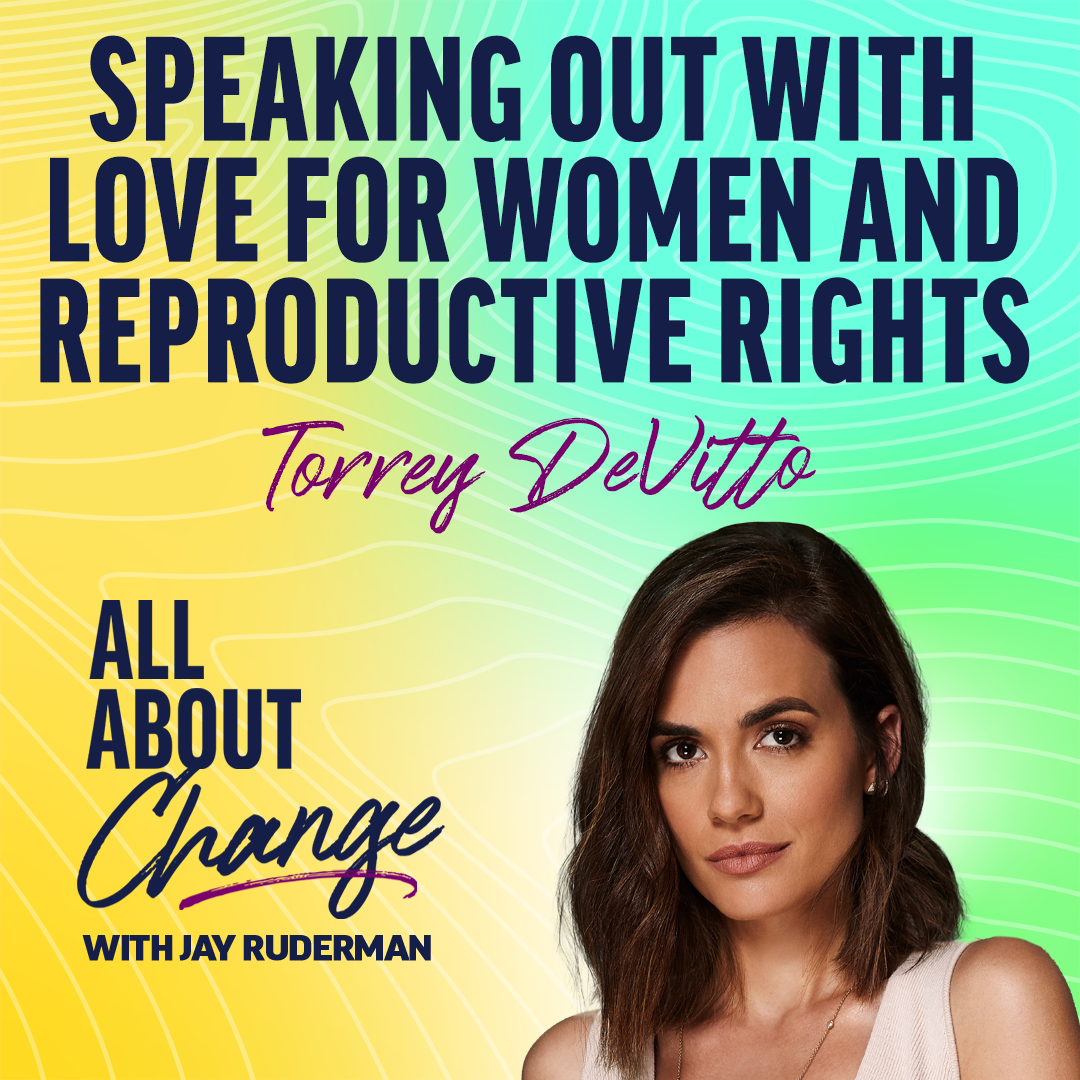
Torrey DeVitto:I have a lot of really lovely friends and some are very vocal and some are not, and there is a lot of fear that goes into speaking out. If there's a lot of fear involved, everybody has to go at their own pace.Jay Ruderman:Torrey DeVitto had something of an unconventional childhood. She grew up fast on the road with her mother and father, a touring musician.Torrey DeVitto:There was a level of growing up a little faster, and you're around these people and you see all these people that you call aunt and uncle who other people adore and think are icons. And that when you're little is kind of a mind trip, because you're like, "Wait, why?"Jay Ruderman:What Torrey DeVitto learned on the road helped her keep a level head and be her authentic self. Those were lessons that came in handy when she pursued a career in the entertainment industry.Torrey DeVitto:I'm around a lot of big egos all the time. It's very energy sucking. I realized, I was like, but this also gives me that platform to speak about the things I like. And so whenever I would get a little down being on set or something, I would remind myself of that. So, those shows definitely, especially with young females, gave me a really big voice to talk about the things that matter.Jay Ruderman:Torrey uses her platform for many important causes. She centers her activism around creating a better world for young women in particular.Torrey DeVitto:You want to create what you didn't have really, especially for me, for other young women, it's important to create for them what I didn't have.Jay Ruderman:Torrey has had a very successful career starring in shows like Pretty Little Liars, The Vampire Diaries and Chicago Med, and she's about to take on a new role being a mother.Torrey DeVitto, thank you so much for being my guest on All About Change. I'm really looking forward to this discussion.Torrey DeVitto:Yes, me as well. Thank you for having me. I'm very excited to be here.Jay Ruderman:First of all, I want to congratulate you on your pregnancy and engagement.Torrey DeVitto:Thank you.Jay Ruderman:And a happy belated birth. I understand that it was recently your birthday and it was a big one.Torrey DeVitto:Yes, it was. It was the big four-oh.Jay Ruderman:Well, you're a baby right now, but what does 40 mean, turning 40 mean to you right now?Torrey DeVitto:It's so funny. Even when I was in my young twenties, I used to always say to all my friends and everything, I felt like my life was going to really start at 40, and I didn't know why. I just always felt that way and I really struggled in my twenties with anxiety and really couldn't figure things out in my twenties. I still have things to work on every day, as does everyone, but there's just this settling in your body and your mind. I feel like you just don't care as much about your surroundings and what people think. So to me, 40 represented a comfort that I couldn't to get to. And now that I'm here, I can confirm from my point of view, it was literally everything I was hoping it would be.Jay Ruderman:So Torrey, you've been acting for many years and you said that in your twenties you dealt with anxiety. Since we talk a lot about mental health, how did you deal with that at the time?Torrey DeVitto:I actually would put it into my work. So, I felt like acting was very cathartic for me because especially if I had a very emotionally, a high emotional scene, I would use my anxiety to amp me up and I would use my fear that I was going to disappoint everybody around me almost as an emotional trigger. And it really worked for a long time until I finally woke up and was like, "This is exhausting. There has to be a bit of the easier way." And then realize that you can go even deeper without anxiety.But in my twenties I really leaned on it a lot in a weird way. And so as much as it's like anxiety is something we all fight against, in that moment, it did act as a gift and it was a huge learning experience for me, one that I wouldn't take back. But I definitely showed up on set very timid. I was always worried I wasn't going to be liked. I was worried I wasn't going to do a good job, that I get fired. So, that kind of stress is just such a waste of time and it's so mentally taxing. But luckily, like I said, I could put all those feelings into my work.Jay Ruderman:You've had such a successful career, but I want to talk a little bit about your childhood and you had sort of an unusual childhood growing up on the road a lot with your parents. And I'm wondering if you could talk about what it was like growing up and how those experiences shaped you? I understand your dad, Liberty, was a drummer with Billy Joel for many, many, many years. So, what was that like?Torrey DeVitto:It's so funny, because it's like you only know what you know, right? So it wasn't until I got a little older and people were like, "That's so cool," that I was like... Well, yeah, obviously, I was aware enough to know traveling with my parents and my family and stuff like that was so cool. But I didn't really know anything different. So I do feel like there was so much of my childhood that really put me in the position and helped me navigate, especially the career that I chose as an adult because it really kind of forced me to grow up a little bit. Because my mom always said, "If you weren't as well behaved as you were and on the planes and things like that," my mom probably would've chosen to stay home more rather than take me out on the road with them.And so there was a level of growing up a little faster and you're around these people and you see all these people that you call aunt and uncle who other people adored, think are icons. And that when you're little is such a kind of a mind trip, because you're like, "Wait, why? They're just people. I don't understand." And I'm so grateful for that piece because once I got into acting and I started working, it really helped me navigate egos that I was coming up against because I went into it like we're all people. And for people who didn't agree with that and maybe had a certain attitude that I didn't agree with, it's like, I grew up around people that a lot of the masses think are icons and they didn't throw this kind of attitude. What is actually going on here? So it really helped, I feel like keep my head on straight.Jay Ruderman:So you've had a very impressive career. You've been on Chicago Med, Vampire Diaries, One Tree Hill, Pretty Little Liars. How have these roles influenced the issues that you have chosen to focus on as an activist?Torrey DeVitto:I don't know that the roles per se really did, but each show put me in a different position and gave me a broader audience. And with that, I was very aware that there was more ears to speak to. And I've always had very strong opinions about things I felt passionate about, whether it be female rights, human rights, animal rights. And so when I was about 26 and the business was still not totally making sense to me, and I just felt like, "Gosh, I'm around a lot of big egos all the time. It's very energy sucking. I'm in a lot of reconditioned air. I'm not outside all the time. I'm not seeing when it turns from day to night and night to day, and I was getting a little depressed." I realized. I was like, "But this also gives me that platform to speak about the things I like." And so whenever I would get a little down being on set or something, I would remind myself of that. So those shows definitely, especially with young females, gave me a really big voice to talk about the things that matter.Jay Ruderman:So, why do you think some people who achieve a certain level of fame choose not to speak out, whereas you are very confident about speaking out and not afraid at all? And where does that come from?Torrey DeVitto:I've always had this need to speak out since I was little. If I saw something bothering me or an injustice happening, I just couldn't sit still or keep quiet. I know people come down so hard on celebrities who don't speak out. And yes, I think there are some people that don't speak out just because maybe they don't really care and that I fundamentally disagree with. I think you have to care about something in your life. But I have a lot of really lovely friends and some are very vocal and some are not, and there's a lot of fear that goes into speaking out.And I've talked to them and I've seen the fear of it's so scary, the safety issue, you just get attacked. People online can be so vicious. And so I never judge anyone for not speaking out on certain things. If there's a lot of fear involved, everybody has to go at their own pace. And for whatever reason, I don't have that fear in my body. I don't know why, but I definitely don't judge people that do because it's scary. People can be nasty.Jay Ruderman:Yeah. And how do you deal with that from a mental health perspective of the trolls and the people who are saying nasty things about you and that you're seeing these comments? How do you deal with it?Torrey DeVitto:I mean, I don't really look anymore to be honest with you. I don't look at the comments and luckily, I have it set up on my Instagram where the first comments are always people I follow. And then once I see it started to shift, I kind of shut it off, which I think is a little unfortunate because sometimes I think people can say some really interesting things, and I'm missing that because of the negative comments. But I have to put myself first in that way where I can't read everything. I just can't. It really does take a toll on you no matter how much you say you don't care when you read people saying the nastiest things about you because of an opinion you have on something.And especially for me, there's not a single opinion that I have that I put out there that is not completely grounded and rooted in love and love for people and just wanting unity. And so whenever I get such horrible backlash and I hear people call me a baby murderer and all these horrible things, I'm like, "Oh my God, how are you so misconstruing everything I say?" So it can make you really sad. But for that reason, I just don't look anymore because I just can't.Jay Ruderman:You mentioned the issue of fear and that you're not a person that's afraid. Where does that come from?Torrey DeVitto:I really don't know because, and I say this very lovingly, and I'm sure my mom would admit it too, my mom has a lot of fear. And so I think maybe that's where it comes from, because I saw my mom fearful. My mom is the most sparkly, gorgeous human being when she walks in the room, you're just so attracted to her energy. But I did always see a fear of maybe her wanting to be liked and really caring if people liked her or not. And also her fear with me and me speaking out all the time and like, "Oh God, what if somebody hurt you?" I don't know. All those things.So, I think growing up around that fear and realizing and trying to talk to my mom and being like, "Just don't care about it." So I almost think that my mom's fear like that and me seeing that and going, "Okay, if she could just get over this fear, life would be so much more joyful." And so I think that I made a promise to myself, I'm not going to carry that through. I'm not going to take on that fear. It's not mine, it's hers. She can keep it. I don't want it.Jay Ruderman:Yeah, we learn a lot from our parents, whether it's-Torrey DeVitto:We do.Jay Ruderman:... how to emulate them or how to change.Torrey DeVitto:A hundred percent.Jay Ruderman:Yeah. That's wonderful. I want to talk about an issue that you've been very vocal on, if you feel comfortable about reproductive rights. Can you talk about why this cause is so important to you?Torrey DeVitto:Yeah. Well, first and foremost, I feel like any person should have the right of complete autonomy over their own body. This is your vessel, and especially for women right now, for primarily men, women too, to be saying, "No, actually, this is how we are going to govern your body," is so mind blowing to me that it hurts. It hurts my soul. And so that to me is so important to always fight for, for the right for a woman to be able to choose what happens to her body. And then beyond that, what I've realized is so many people take abortion as so black and white. They're like, "You got yourself into this. You should have this baby." When I had an abortion, I chose that it wasn't the right time for me, and that was it. And I am so grateful to have had that choice.But that's just a small, small, small spec of people that need fundamental care like abortion. I mean, women who have miscarriage, it's health, it's their health, miscarriage, rape, incest, all these other issues of why women seek abortions. It's so frustrating to me that some people can't see that. It's like, why does an 11-year-old girl in Texas not have the right to an abortion when she was raped? That is so vile and revolting and heartbreaking to me that people are like, "No, no." I'm like, how? And that's why I stay on the comments section mostly because to me it's like, why would you make a child suffer for something that wasn't their choice?Jay Ruderman:Yeah. I have a daughter who's 18, and when I read your story about... and you were very open. Can you talk about that time and why that decision was right for you at the time?Torrey DeVitto:Yeah. I was young. It was my boyfriend that I had since high school. We'd been on and off and he was young. We were both starting off our careers, and I remember I was living in this crappy apartment with roommates and I found out I was pregnant. I remember we were sitting on the bed and we were both dumbstruck. We didn't even know. It was like earth shattering. I didn't know what to do. I just knew, we both knew instantly this was not the time. We were not capable human beings of bringing a child into this life.And we called my mom and I had so much support from my mom and my family, and luckily because of that support, my mom helped me make all the arrangements and I flew home, but it was just such a scary time. And then what was really interesting to me is that happened, I went like this and then I moved on. And then recently with all this stuff, the overturning of Roe v. Wade and all these things happening has triggered so much emotion in me. And I was talking to this friend of mine who's an energy healer, Janet Raftis, and she's so beautiful and amazing, and she was like, "Have you ever taken a moment to grieve the abortion?" And I was like, "No, because I always felt like grieving the abortion would mean that I don't stand for abortion." And she was like, "That is so not true. You can have all your beliefs, but you can still grieve that moment. It's a huge moment."And so almost 20 years later, I went through this beautiful grieving process and it just made my activism work even stronger because it's so complex. It's so complex. But yeah, luckily I had so much support and luckily there was nobody in the government system trying to tell me what I could do with my body. And it was easy for me. I can't imagine what it's like for young women in my position nowadays.Jay Ruderman:So, what led you years later to come out and give a personal example rather than just advocating for a cause, but just say, "No, I want to talk about what happened to me?"Torrey DeVitto:Talking about things surrounding reproductive rights and also even talking about things within... talking to kids and teens about consent and sexual assault and all that kind of stuff has always been very, very important to me because I felt like when I was younger, I didn't have anybody that showed me where my rights were, what my boundaries were, where my no was. So for the last seven years or so, I've been working with and on the board of directors of this organization called Safe Bay that talks to young kids in schools about sexual consent. And so I go there, I go to those schools and I talk to these kids.So when all this stuff was happening with the overturning of Roe v. Wade and all this stuff, I just felt like I wanted to share my story because I wanted people to know I'm not just standing there with you, I am you. I have gone through this. I know what you feel. I know the emotions. I know how complex it is. I'm not just talking out of my ears. This is very real to me. And it's the same like when I go to talk to these kids about sexual consent and stuff. It's like nobody told me where my no was when I was in high school and there was situations that happened that I wish I had a mentor or somebody older than me that I could have looked to. I grew up in a very boys will be boys type world, and I just didn't have that. And so I think what's important sometimes is you want to create what you didn't have really, especially for me, for other young women, it's important to create for them what I didn't have.Jay Ruderman:So Torrey, you talk about also later in your late twenties using the abortion aid process during a miscarriage. Can you talk about that and what happened and why that was important?Torrey DeVitto:Yeah. So, I had gotten pregnant and around, I think it was like eight weeks or something like that, I had gone in to hear the heartbeat and there wasn't a heartbeat. And the doctors told me, "You need to take the abortion pill so that you can expel of everything in your body because if you don't, you'll get very, very sick." So I had to go to another place and get the pill. Luckily, I had my sister who could stay with me through that 24 hours because it's very painful. And yeah, I can't imagine if that... I don't even know what that would've looked like if that wasn't available to me. And that's what I try to talk to people about. I'm like, "Take away then you being mad at somebody's just right to choose."There was just a woman I read in the news, she had a miscarriage and I think it was 14 weeks or something like that, and there was no heartbeat, and they refused to treat her and she died. That is crazy. That's so crazy. So I felt like that was really important for me to come out with too, because it was like, without that, I could have died. I would've gotten very, very sick and possibly died. And women are dying because they're having miscarriages. And that to me is so... It's like, what are we living in the stone age? This is crazy.Jay Ruderman:Right. It seems like it's such a medical necessity in a case like that to save the life of the mother. And why do you think that... First of all, what does it mean to you to have had access to reproductive healthcare at that time? Did you think about it, I'm happy that I have this ability to take this pill and it's going to help me? Or is that something that came to you later on?Torrey DeVitto:Later on. I'm realizing what a massive privilege it was to be able to have access to this and not even think about it. There was nothing in my mind that said, "Oh my God, what if I can't get this?" And I can't imagine right now the fear wherever you're having a miscarriage, if you're in one of the states right now that are very problematic for this, that fear of, "Oh my God, who's going to help me," has got to be so scary. I have girlfriends that are pregnant right now, and I had a girlfriend say to me, "I want to take this vacation, but God forbid I go into labor early. I have to be careful about where I am." And that is so crazy. We're living in this world in the United States in 2024, and women are worried about being in certain states because if they give birth and something happens, they might die because nobody cares in certain states.And it's just, that's horrifying. How are we going so backwards? And also the hypocrisy of, well, once the baby's out, the lack of care and help for a mother and the baby. It's like most of these politicians that are fighting for this, for the anti-abortion, they don't care about the actual baby when it comes out. They only care when it's like this fetus that they can't see. I think that's another big piece for me that I sit here and I read these comments and I just get so incensed because I'm like, the hypocrisy drives me wild. The lack of help for single mothers or low-income families that are struggling, especially when they have a kid and they can't afford it and they can't afford food and they can't afford this, they can't afford that. The lack of help is just mind blowing, but yet they have more care about the baby when it was inside the belly still rather than when it comes out. That to me is like, "Wait, what?" It's crazy.Jay Ruderman:You have so many young fans, and why do you think it's so important for you to be transparent on this subject? What do you want them to learn from you from speaking out?Torrey DeVitto:One thing I always try to do is I feel like a lot of love is missing in activism. And I think right now, and rightfully so, women especially are very, very pissed. But I always try to say, especially when I talk to young people, when you're banging doors down and you're screaming, you're losing a lot of your audience. And I learned that by watching. I watched that RBG documentary on Ruth Bader Ginsburg, and I listened to this podcast with Jane Goodall, and the way they speak is so effective because they don't yell. They're not hateful in their speech, which I understand where it's coming from. I understand the anger. I want to get hateful sometimes too, but you lose your audience. And so I always try to tell them, think about what you're saying and make sure it's rooted in love and your truth.I also feel like in this world of social media and all this other stuff, it's just everything is so filtered and sake and you just never know what to believe. And so taking that responsibility of knowing, there's a lot of young girls watching me and it's like, "Look, I'm being me. I'm telling you everything truthfully. I'm not slapping filters on how I feel or my face. We're here, we're here together. You can do this too. You can be your full authentic self and be accepted, and you don't have to do things because society tells you you should do them."Jay Ruderman:What do you think people who maybe not on one side or the other, but in the middle, what do you think that they may be missing about this issue of reproductive rights?Torrey DeVitto:I think people who lie in the middle are usually people who haven't been affected or haven't loved someone who's been affected. Once you have yourself or a sister or a mother or a daughter or a niece go through something and you see it, you're not going to be in the middle anymore.Jay Ruderman:That's great. I wanted to ask you about another area of your activism because I thought it was... when I was learning about you, it's so unusual, but so meaningful, your work in hospice care. Where does that come from and how did you get involved in that?Torrey DeVitto:That just kind of landed in my lap in a really weird way. I think I was 24 or 25 and I was on a show, and to me it was a very, very dark set with a lot of negative energy. And it was the first time I was on a big show that everybody was seeing in that way. And so I was so excited for it. But then when I got there, I was like, "This is awful. Showing up to work like this every day is awful. I'm scared. I want to go home. I don't like this." But I knew I wanted to still act because I loved it. And so I was thinking to myself, well, what can I do to combat these feelings? And I was like, "Okay, well, maybe I'll start volunteering somewhere, put my energy elsewhere when I'm not working."And I thought, "Oh, maybe I'll volunteer at children's hospital or something." I didn't really know. I had no direction. And I just typed in Children's Hospital and in my Google search, it popped up on hospice and I had no idea what it was. I'd never heard of hospice before. I clicked on it. I called them, they were like, "Oh, we're having a patient care training starting this weekend for the next three weeks. Come." And I was like, "Okay." I went to the training. It was all day Saturday and Sunday for two or three weeks. I just fell in love with it. I was like, "Oh my God, I don't know how this found me because I didn't even Google this." So I felt like it was very meant to be.And all my family and friends were like, "But you're a little depressed right now, isn't being around people who are dying going to be bad for you?" And honestly, it gave me such a light because whatever was going on in my life, I was sitting with these people. And I will tell you this, I went to people's houses who clearly had a ton of money. I went and saw people at nursing homes who had pretty much nothing. I saw everyone. And the one thing I will say is when all these people were dying, no matter what differences they had, what background differences they had, none of them brought up their career to me ever, career or money, none of them.They all just wanted to talk about while they were dying, who they loved, who they regretted not loving, where they traveled, and family. That was it. Everyone wanted to talk about that. And it put such a perspective in my life, and I always walked away from these patients feeling like, yes, we help babies come into the earth so it makes sense to help them then go out and to whatever is next. And so I always looked at it as a positive thing. And then whenever I got down, I was reminded myself of that. I was like, at the end of life, nobody sits there talking about their career and how much money they have.Jay Ruderman:Right. Right. It's such a beautiful thing because we all are excited when a baby is being born, which is such, having four children, it's such a beautiful experience. But it's also so beautiful to give back and to be with people, including some people who may be alone at the time that they're leaving this earth and there's nothing they can give back to you. So it's such a selfless act of helping someone.Torrey DeVitto:Yeah, I think there's so much beauty in death that unfortunately we miss, especially in America. I feel like some cultures still honor it that way, but it's really rare. It's such a scary taboo thing, and it really should be not happy. But I read this book and I wish I could remember what it was, but the woman was saying that her mother's one request, it was like her, her sister and her brother, and the mother was dying. And she said, "My one request is that when I die, I want you guys to laugh." And they said they were all surrounded her mother in her hospital room, and her mom died and they were devastated.And then they remembered what their mom said, and they were thinking, "How are we going to laugh? We're devastated." And then one started and then it trickled, and it became this beautiful... Oh my God, I have chills right now. It became this beautiful thing, and I was like, "Oh my God, I can't imagine laughing around one of my... I'd be devastated too." But to honor your mom's wish in that way and to make that a part of her death, that's so beautiful.Jay Ruderman:Yeah, that's a beautiful story. Well, Torrey, I really want to thank you for your authenticity. You're an extremely authentic person, and for your activism and your boldness in speaking out on issues that are really important to so many people in society and to all of us. So, thank you Torrey DeVitto for being my guest on All About Change. I've really enjoyed this discussion and I wish you success and I wish you a successful delivery. So, thank you so much.Torrey DeVitto:Thanks for having me.Jay Ruderman:Torrey's passion for activism and her career brings a refreshing authenticity to what can be an inauthentic industry. I think we can all take a page from her book and remember to root our activism in love. That's it for today's episode. Join us two weeks from today for my talk with former Canadian first lady, Sophie Grégoire Trudeau. Today's episode was produced by Rebecca Chaisson with story editing by Yochai Maital and Mijon Zulu. To check out more episodes or to learn more about the show, you can visit our website, allaboutchangepodcast.com. If you like our show, spread the word, tell a friend or family member, or leave us a review on your favorite podcasting app. We'd really appreciate it. All About Change is produced by the Ruderman Family Foundation in partnership with Pod people. That's all for now. I'm Jay Ruderman, and we'll see you next time on All About Change.

Jay Ruderman:So your point is stop waiting for a hero to show up.Erin Brockovich:You are the hero.Jay Ruderman:We can be our own heroes.Erin Brockovich:You already are. You just got to look at that person in the mirror and go, “I’m going to boss up today.”Jay Ruderman:In the year 2000, Erin Brockovich became a household name with the release of the film that highlighted her work on California water pollution. But her story didn’t start in Hinkley.Erin Brockovich:I have something they call dyslexia. I really didn’t know. We think every single mind is supposed to think, walk, talk, act, lookalike, do the same. It’s just it would be impossible. And dyslexics, we code differently. I can read, I’m plenty smart, but I’m a very visual learner.Jay Ruderman:Erin’s findings in Hinkley set the stage for the rest of her career.Erin Brockovich:And I just stood there, and I was like, what is a common denominator that all of these people are utilizing? And it dawned on me. I’m like, oh my gosh, it’s the water.Jay Ruderman:In the years since, Erin has used what she learned in Hinkley and her notoriety from the film to advocate for communities all around the country suffering from environmental pollution.Erin Brockovich:We think it’s going to trickle down from the top. It doesn’t. It actually changes at ground zero with you and organizing a community and showing up.Jay Ruderman:Erin’s wealth of experience has led her to one conclusion. We’ve got to be our own heroes. Thank you so much for being my guest on All About Change. I am really looking forward to this discussion. Let’s start with your childhood, growing up in Kansas. Who instilled in you your persistence and your sense of right and wrong?Erin Brockovich:So there was three really instrumental people. My mom was a huge inspiration to me. She was a journalist and a sociology major, very interesting combo. And then my dad was an engineer and he ran and built pipelines for industry. He was a mechanical, an industrial engineer. And both of them were instrumental in my life for a plethora of reasons, my mom in particular, because I’m a dyslexic, so school was very difficult for me. And my mom would always tell me, “You got to find your stick-to-itiveness. I had no idea what she was talking about. I thought it was a made up Kansas slang word. And she ended up reading me the definition, and its definition is noun, a propensity to follow through in a determined manner, dogged persistence born of obligation and stubbornness. Now see this, I understood. I am stubborn, I’m very dogged, but it helped me almost focus those feelings and those emotions.I was always playing outside. I was following the creeks, chasing the water, amazed at the environment. Everything about it was teaching me what I didn’t want to learn in school. And I understood it, but I just didn’t want to learn it in school. So my dad is the one that taught me about respect of the environment. He is the one, and I know he saw things about what would go wrong with the water and promised me, in my lifetime, I would see water as a scarcity, as a commodity. And those two were the main key characters. The other would be a school teacher.Jay Ruderman:So I just wanted to dig down on that a little bit more. I have a child with ADHD and school has been a complete disaster for him. So do you think when you were growing up, that dyslexia was understood?Erin Brockovich:Dyslexia, in my opinion, was terribly misunderstood. And I believe that it is still misunderstood today. I think we talk about it more, whether it’s ADD or ADHD or what we call learning disabilities, dyslexia. I worry if we don’t get out of this box of… How is it that we think every single mind is supposed to think, walk, talk, act, lookalike, do the same? It’s just it would be impossible. And dyslexics, we code differently. I can read, I’m plenty smart, but I’m a very visual learner and I recognize patterns. And so if I don’t see those, I feel like that cat that has tape on its paws and I’m like, where am I? But that wasn’t allowed. So it was a school teacher. Her name is Kathy [inaudible 00:04:59], and interestingly enough, she was my psychology teacher. And one day leaving class, she was passing out the exams. And I could see mine. I could see the big old F on there.And she said, “Well, Erin, I’m interested here. You know everything in class. You’re the one that always has your hand up. ‘Ooh, ooh, ooh, ooh, I know.’ But yet when we test, you fail.” And so Kathy [inaudible 00:05:25] says, said, “Well, if I gave you this test orally, do you think you could pass it?” I said, “Absolutely.” And she just randomly went through there and I knew everything. She goes, “You do know.” I go, “Yes, I do know, and it’s been stuck inside of me because nobody sees me, nobody hears me, nobody believes me.” To this day, I still get frustrated by that, and I get even more frustrated in my work when I see the same thing happening to communities. And so I can’t help myself. It almost becomes a calling of, how do you push out… If a door closes, how do we go through a window? Where do we go?Jay Ruderman:So I want to go back to what propelled you to fame, the case against PG&E, the company that had contaminated the groundwater in Hinkley, California and led to the movie that bears your name. Can you just give us a short recap for those listeners who may not be aware of the story of what happened?Erin Brockovich:So I ultimately graduated high school, graduated from college, went on to have a family and had three children, found myself being a single mom. And at the time, I was living in Reno, Nevada and I had a car accident. And during that, before a trial, I moved down here and met somebody, was actually the biker dude. And still had a lot of problems going on, and he introduced me to Jim Vititoe to help me in my car accident situation. And Jim Vititoe’s partner was Ed Masry, the man played in the film by Albert Finney. So we had a trial. I didn’t win. I needed a job. This firm told me it would be okay. It wasn’t okay. So Jimmy had introduced me to Ed Masry, and I needed a job. I didn’t come in with a law degree. I didn’t come in with some PhD. I came in as a single mom.I came in with a really good skillset, and I had a really good… I’m an empath in many ways and I can feel things. And I know that sounds weird, but it’s true. It becomes very vibrational for me, a connection. People will tell me their life stories. I want to hear it. I get it, I understand it. There’s no box. There’s no judgment. There’s full on acceptance. I get it. And so Ed decided to hire me and put me in the workers’ compensation department because I have that good skillset. And that’s where I started my work with Masry and Vititoe. And one afternoon, if people haven’t seen the film, he came into my office with a big archive box. See, I love my archive boxes. I still do. It’s a whole thought process that goes on here in my dyslexic mind. I have to touch it, feel it, see it.And there was a bunch of test results of children that piqued my curiosity. I was a young mom, 31 years old. I had a baby, Elizabeth, who was 12 months old that I was taking up to Hinkley with me when I eventually started going out there. So I was intrigued that it was children. And all the blood tests were done in a bar graph. Again, I’m visual. So see, I could clearly see, wow, this is out of range. So I went to this great box we had called Google, and I just started researching and learning myself. A lot of these test results were indicating disease, potential, cancer. And I was really curious, if I saw a blood test like this on my kids, I’d want to know what the heck’s going on. So I asked Mr. Masry if I could go out to Hinkley. And what happened for me there was the minute I honestly had my feet planted on that ground, it was a perfect storm that started to brew for me.Power of observation is great. I started noticing all the trees were dying, which I thought was weird. When I met neighbors, they would tell me about all the animals that were dying, or the dairy farmers and the cows covered in tumors. And they took me to see them. I could see that something was really wrong and I could feel it. All the trees were secreting this white stuff out of the little pine ends of them. And as I just stood there, I’m like, what is happening out here in this desert town where people come for fresh air and clean well water and freedom of living and enjoying riding their horses? Everything’s sick and dying. I couldn’t understand it. And I just stood there, and I was like, what is a common denominator that all of these people are utilizing? And it dawned on me. I’m like, oh my gosh, it’s the water. And that set me out on my journey and ultimately discovering that a large utility, Pacific Gas and electric, had knowingly been dumping hexavalent chromium into unlined ponds and all these people had been drinking it.And one thing that I did recognize quickly was the mothers in particular weren’t being heard. They weren’t being listened to. Here we go again. I’m back in the classroom. “You aren’t this. You aren’t that. You are being hysterical. You’re not a doctor. You’re not a lawyer. You’re not a scientist.” Well, let me tell you what. You don’t need to be any of that to be a mom and to know something’s wrong with your child. And for me, it became a moment where I didn’t have to be any of that to be a human and to tell you that I’m looking at two headed frogs and green water coming out of the tap, that something is wrong. And I, at that moment, thought of my dad about that respect, giving that respect to listening to these people, believing in these people. And it became a phenomenal response because I believed in them and they believed in me, and we began to work together collectively to really uncover what had happened to them and telling a true story.Jay Ruderman:It’s a very emotional film. I would recommend it to anyone who hasn’t seen it. I want to bring Aaron back to Hinkley. Is litigation a way to get people justice?Erin Brockovich:That’s an excellent question and one that over 30 years, I have a different perception of. Yes, the judicial system is part of something that we need to help find a form of justice. And there is no amount of money ever that could give them a child back or their health back or take away the fear that they’re going to die of a disease or cancer that is related to something that was hidden to them and poisoning them for years and years and years. So the judicial system isn’t the answer. I think we need to look at the upfront of infrastructures and safety first, and being honest with communities. I have learned that people, they handle the truth. They never handled a lie. None of us can make a choice if we don’t know what the truth is.Jay Ruderman:Right. You’ve devoted your life to this and you’ve written the book called Superman is Not Coming. Talk about what’s going on in this country and what the risks people are facing in terms of just drinking water.Erin Brockovich:I began my work in Hinkley in late 1991, and I was a single mother of two toddlers and an infant. Today, and I just want to kind of give that span upfront, again, I’m the visual one, so if I can help explain that, I’m going to be 64 this Friday and I’m now the grandmother of four.Jay Ruderman:Happy birthday.Erin Brockovich:Thank you. It’s been a long career, and I’ve been able to observe a lot in that time about the law, about agencies, about the government, about companies. It’s easier to kick the can down the line to the next CEO, to the next president, to the next governor. And all of this is just built up and built up and built up and built up and built up. And I think now, we’re seeing a huge impact of things that happen 30 years ago that we’re starting to… We’re up against a wall, and we got nowhere else to go.And for me, it’s astounding because that timeframe that I presented for you from 31 to 64, do the math, not much has changed. I’m gobsmacked by all of it. In my 30 year span, I think I’ve been through six administrations, both Democrat and Republican, and we still got the same result. We haven’t accomplished much. I don’t think the finger pointing of right or left is where we need to be when we are going to talk about our environment, and most specifically our water, the most necessary element to sustain all of life is in huge jeopardy. And I believe that climate change is going to be water issues. I’ve said this for a long time. We are watching that happening right now. We’re going to live it. Too much, too little, none at all. We see here in America. We see flooding going on right now in Florida, we’re seeing scarcity of water.Aquifers are going to run out of water. We see droughts. We’re going to see huge interruptions to the supply chain. We’ll see more vector diseases. We’ll see migratory pathway changes. We’ll see municipalities, when they get flooded, you can’t just turn these systems back on. You can’t get air in those lines. You’re going to have all kinds of bacterial outbreaks. We’re seeing it now. So I think the real issue that we need to be paying extraordinarily close attention to is going to be our water supplies or the lack of water supplies. And while we continue to argue about climate change, which is here, you don’t have to call it anything. I think if you would just educate yourself and take a look around, things are different. We need to stop the fighting and start having a legitimate plan, being realistic about the goals because we’re not going to switch these things tomorrow. This will be decades in the making, and start getting prepared for what is in front of us.Jay Ruderman:So Erin, I have to ask you, if the political system is not addressing this vital issue, and if industry is not policing itself by and large, and if the justice system can be helpful but is slow and limited, what is the way forward? How do people in communities across America make sure that their water is safe? What can they do?Erin Brockovich:Well, what I have seen from Hinkley through Flint, Michigan, through… Whenever there’s a big crisis like that, I’m usually the first one that they come to. And what I have learned is that the change comes from within you. The change will never happen with us sitting here and going, “It’s your fault and you fix it, and that’s supposed to be your job.” So I encourage communities. And the mothers, when they get organized, you got a group of moms, they’ve got stick-to-itiveness. It’s like nobody’s business.Jay Ruderman:Right.Erin Brockovich:And for them, they’ll stay in it as long as they have to, until there is a resolve. Oftentimes, we don’t go to our very own local city councils. That’s where actual changes about your local municipalities exist. We think it’s going to trickle down from the top. It doesn’t. It actually changes at ground zero with you and organizing a community and showing up. Doesn’t matter. You don’t have to know all the science in the world. Just show up. People always say, “What action can I take?” Just show up. Just ask a question at city Council. One of the stories, and I want to share it here real quick, is exactly what I’m talking about. I share in the book, and it happens to be in Hannibal, Missouri, home of Mark Twain. And they had lead levels in their system higher than what we were seeing in Flint. Now, that was bad.So the community came to us, and myself and Robert Bowcock, who’s a water expert and water master, and we worked with the community on what they could do. So first of all, they understood why, understand why you are having a water problem. In their situation, it was led. They had all this lead because the municipality was using chloramines. They started adding ammonia to the system, and that created a huge corrosive water system inside lead pipes. So all the lead was leaching out of those pipes into the distribution system and was being delivered to the tap. You can’t smell lead in the water. You can’t see lead in the water. So we educated the moms. And they got very organized about why they had lead in the water, and they started going door to door and informing their other neighbors.And what they started learning was they too had sick children, skin rashes. Their hair was falling out, they didn’t understand, their attention wasn’t there, they didn’t seem to be learning the same. The teachers were reporting it. So they became very informed, and they chose, you know what? I want to learn what’s going on. These mothers, I’m not kidding you, would have math on their drywall in the house because they could look at it and study it. Long story short, a couple of the ladies said, “We need to do more.” And they were having local city council elections. They ran for office, city council, and they won. They won.And now here they are, informed as community members, on city council, what was happening. And they created an initiative that they wanted to put to vote. Now that everyone understood, do you want to add ammonia to your system? Yes or no? Unanimously, community voted no. And it went all the way to the state and they won their referendum and their amendments and they stopped adding ammonia to the system.Jay Ruderman:Wow.Erin Brockovich:And I’m so thrilled to tell you, as of March, 2020, that community has led free water.Jay Ruderman:That’s awesome.Erin Brockovich:That’s the power to the people. That’s the power to you. That’s the power to the individual. And I think we’re finding ourselves now, and that is key. And when we do, I truly believe that we’ll look at ourselves again and see, I do have the courage and I do have the brain. I have the ability. I am a mom. I can see. I can feel. I can tell you something’s wrong. And that’s really the power of how and where it happens. And again, I’ve been doing this for 30 years, and I can assure you 100% of the time, that is what makes the greatest outcome of all, whether there’s a lawsuit or not. They can change their circumstances. They can begin to protect themselves, prepare themselves when they’re informed, when they know the truth, when they organize as their neighbors and have that respect for each other, their community, their environment. That, they make more change than the United States EPA.Jay Ruderman:So your point is that stop waiting for a hero to show up.Erin Brockovich:You are the hero.Jay Ruderman:We can be our own heroes.Erin Brockovich:You already are. You just don’t know it. You just got to look at that person in the mirror and go, I’m going to boss up today.Jay Ruderman:Right. That’s powerful. I want to talk about something much more recent. In 2023, there was a train wreck in East Palestine, Ohio, and it set off a chain of events that caused a lot of harm to people that were living miles around. You visited the crash site. You were there. What did you experience when you showed up there?Erin Brockovich:Exactly what I always experienced. They weren’t seen. They weren’t heard. They weren’t respected. They were lied to. And it’s very upsetting. I never want to say you’ve come to expect a big corporation to lie, but when they’re in trouble, they tend to possibly do that. But I don’t want to make a broad stroke about that because I do believe that there are well-intended companies that want to do the right thing. But with Norfolk, it was kind of a whitewash, a situation that never needed to have happen that quickly got covered up, that created a lot of chaos. Oh my gosh, we don’t believe and we don’t listen to, and we have no empathy for those that are living it, breathing it, drinking it, experiencing it. “That can’t possibly be. Oh, the science isn’t here. That has to be made up. You’re being hysterical.” I go nuts when I’m out there, and I can’t imagine how these people feel, but I don’t want to use words like gaslight because now I guess everything could be seen as that, but that’s exactly what happens to them.You’re trying to tell them what experienced, they didn’t really experience, and it’s maddening. So I was out there several times and I didn’t come back because I was being exposed myself.Jay Ruderman:You got sick.Erin Brockovich:I got sick. And so even the CDC had people getting sick. First of all, you could smell it. You could smell it. And everybody else was standing there that were reporters too. Their eyes were burning. And so there was multiple occasions, whether it was the people I was working with, whether it was the media, they would tell me they could smell it, their eyes were watering, but yet nobody was doing anything. I’m like, this is BS. And so I’d go home. I kept coming back. And around the fifth visit, I started having… My lacrimal and my goblet cell on my eyes were burnt away and I was sick. I always believed these people, but most people wouldn’t. And so I stopped going out there. I tried to work with people remotely, and I still do, and I’m still in touch with some. And I was very disturbed and very taken back that during many of my community meetings, one evening somebody sent to me a report from Yahoo that I had been returned into a fusion center, Homeland Security Fusion Center as a potential terror threat.Jay Ruderman:Wow. So you think you were getting blackballed?Erin Brockovich:Well, you want to talk about a good way to silence somebody, put them on a list like that.Jay Ruderman:Yeah.Erin Brockovich:It still upsets me. I have not often been able to talk about it. Homeland Security created these fusion centers after 9/11 for a good reason. And it makes me wonder that are we now utilizing that as a way to silence an activist or activism that a company or somebody may not like to silence a community’s voice? I would find that extremely concerning. I still haven’t got all the answers as to how it happened. I’m learning more and more about the fusion centers, but it would be terrifying that it could have been a situation where I would be on a list where I couldn’t fly or I couldn’t travel. So I see it as a way to silence people, and that’s disturbing.Jay Ruderman:And what about the Environmental Protection Agency? Isn’t this why this agency was created, to protect our environment? Are they doing anything to improve the situation?Erin Brockovich:No. So there was a lot of things that went wrong in East Palestine starting in the beginning. And listen, I’m not taking any accolades for this, but we watched, and I’m thinking day after day after day, did anybody not see the fireball that looked like an atomic bomb throwing up in the sky that people were reporting on? But nobody was talking about it. Talk about an elephant in a room and everybody’s just walking around. But locals were on their own cameras. They’re like, “Why is no one talking about this?” From the get go, this was a coverup, and we now learn that the railroad had days why it was burning. They’re the ones that decided. And how this got by the state or state agencies, I still don’t really know, but they dug a trench and they bled out the chemicals in the rail cars and lit it on fire.I think second grade science might tell you that’s not a really good idea. So for me, it’s like, whoa, what are you hiding that you just blew up and has now gone everywhere? The EPA was slow to respond. Agencies were slow to respond. There was lack of information, lack of communication. There was chaos, there was coverups. There was senators asking questions. And people were asking, actually, where was Department of Transportation? Where was the EPA? Who was out here? Where was FEMA? Where are you going to put these people? It was a shit show. I don’t know what else to say. I hope I can say that on your podcast.Jay Ruderman:Yeah.Erin Brockovich:I apologize. They were absent. And even stories are coming out today. And the media was there in the beginning, but once it settles down, these people are still left with the problem. We do know the CDC had sick people. They called them off. We do have several occasions where the United States EPA came out and said, “Well, there’s some levels. If it was my kids, yeah, I wouldn’t let you play around the creek.” Well, that would’ve been helpful information months beforehand. Even today, that they’re now admitting that they are finding pockets of vinyl chloride. So it’s like the whole situation’s happened. There’s a settlement. Now, they’re kind of coming back in to go, “Oh, wait a minute, maybe we’re wrong.” And that’s the problem. That’s the problem with the EPA. Well, you’re letting all of these chemicals into the stream of commerce first. And then when there’s an accident like this, they get studied through us.And it takes decades to do that, to finally come to a conclusion, “Oh yeah, oops, we made a mistake.” We’ve got to stop that. That’s what I was talking about earlier. We have got to put safety in people first.Jay Ruderman:Right.Erin Brockovich:You should know what these chemicals do before they ever enter the environment. And again, if we talk about the Norfolk Southern Railroad situation, they had infrastructure failures on the line that they knew about. But once again, we don’t want to fix those infrastructures. This is going to boil down to… Even when we really get to water, it’s going to all be about our infrastructures. They’re antiquated. They’re outdated. And if we don’t shore up those infrastructures, we will continue to have disasters like this. And that is what happened in Norfolk. These things don’t need to happen. We allow them to continue to happen because we put profits and money first, health and safety last. That’s not working out so well for any of us.So the $600 in a class action might not get spread too far. It’ll get spread, but the dollar value will be less and less and less to the families. And that will be up to the courts and the laws to figure out that structure. I’m definitely not a part of that like I was a part of knowing precisely, in Hinkley and Kettleman and these other pg e cases, what was going on. But I can assure you, at the end of the day, I talked to these communities and they would tell you, I do believe the law wants to help make it whole, but that the justice in a settlement isn’t a solution. I would like to see the law look at more legislative changes, look at more policies. I think at the EPA, we don’t necessarily need a bunch of new rules on the book. What we need is better oversight, better enforcement, better follow through so we can catch these things before they happen.Jay Ruderman:Yeah, the money is not solving the issue. But let me ask you, just to sort of leave this with the listeners who might be saying, “What’s going on with my own water?” how do they look into it? How do they ensure that they and their families are safe?Erin Brockovich:If we will accept that maybe not somebody else has got our back or is watching this, maybe I myself will take part in it, just your observations again and again and again and again… And this is another story I talk about in Superman is Not Coming in upstate New York where they were turning the ammonia feet on and the water keeper, the head of the municipality, made an observation. Every time he turned on the ammonia feed, his customer started calling him, “My skin is burning. I have a funny rash. My children’s eyes are burning.” And this water operator figured it out. He goes, “Wait a minute. Every time they call, I’m turning on an ammonia feed.” He ultimately shut it off. So use the power of your own observation. Don’t be afraid to call your own municipality. Show up to a city council. Talk to your neighbors. That’s funny we don’t do that anymore, yet we live right next door to somebody. “Hey, how are you? Are you experiencing this?”But we don’t want to do that because… And I see communities, the minute they do, somebody else is going to tell them, “You shouldn’t be saying anything,” or “You could drive our property values down,” or “What do you know?” Then we retract. Look, your gut is your second brain, and that’s science. It talks to us, but we ignore it. That’s why I say bring it home. And if you’re living it and breathing it and experiencing it, and you’re seeing it happen and you’re seeing it happen to your child, you can email me. Make a phone call to the municipality. If you’re not getting any answers, show up at city council. Go down to city council, voice your concern, sign a petition, take an action, and pay attention to what’s going on around you. I think we all see it. And we don’t have to demon a name or climate change. It is something’s wrong, and don’t assume that somebody else is taking care of it. And this is why I created my community health book, a place for people to report to.I wish I had it up, because it is daunting. And we’ve put up live images of bath water, bucket water, kitchen, sink, tap water, shower heads, in the buckets, Oklahoma, Texas, Boston, North Carolina, South Carolina, California. That is a representation of America’s water supply. It’s disgusting, and it’s shameful. And again, these municipalities, they’ve got budgetary problems. They spin it wrong. They don’t have the appropriate filtration system. And it costs $100 million dollars on some filtration systems just to keep one chemical out of the water, just one. And so we have a lot of problems. Every day, I get lead reports. Every day, we see more Legionnaire outbreaks. Every day, there’s a whole host of reasons why your water’s black, yellow, green, purple. I could tell you if it’s running green, I’m going to worry about a chemical called hexavalent chromium. If it’s orange, we can tell you that you’ve probably got chloramines in the system. You have an acidic water source that’s causing all the iron and the lead and the manganese that’s precipitating out of the pipes is being delivered to your tap.Oh my gosh, for heaven’s sakes, I was up the United States Capitol talking about lead. I went into the women’s washroom and there was a sign, “Don’t drink the water, contains lead.” Are you for real? Took a picture of it. It’s in the book. So either we’re normalizing this or there’s an elephant in the room we still don’t want to look at. And for me, the most important thing to say to everybody is, please don’t assume. And never assume and think that you can’t because you can. If you see it, if you smell it, if you’re experiencing it, if you’re sick, if a neighbor’s sick, your child, ask a question. Get on this great big brain thing we got called Google, make some phone calls, call the municipality, email me, go to communityhealthbook.com, take an action. Any action. And when I say show up, show up for yourself because I don’t think anyone else is going to do it for us.Jay Ruderman:I want to thank you for your leadership, your national leadership on this issue. You’ve done so much. You’re going to continue to do a lot. And thank you so much for being my guest on All About Change.Erin Brockovich:Thank you for having me. It’s so hard to explain everything a short time, but-Jay Ruderman:It’s a lot.Erin Brockovich:… you did a great job and-Jay Ruderman:Thank you.Erin Brockovich:You know what?Jay Ruderman:Thank you.Erin Brockovich:It’ll be up to us. But listen, I always end on a hopeful note, and I know it may sound corny, but I believe in us, and I think we can change. And we can see ourselves, and we can join together again. And it seems very daunting, I’m experiencing it too, but I’m going to forever be an optimist. And I will go down fighting, and I will go down with hope. The change isn’t over there and something magical. The change is going to happen within us. And when we find us, we prevail.Jay Ruderman:Thank you so much. This was such a great conversation and I really enjoyed it. I’m a big fan, so thank you so much.Erin Brockovich:It was nice to be here. Thanks for having me.Jay Ruderman:Erin Brockovich’s story has inspired countless individuals and communities to feel empowered, to ask questions and to advocate for themselves. To find or share information about your own water, you can head to communityhealthbook.com. That’s it for today’s episode. Join us two weeks from today for my conversation with actress and reproductive rights activist, Torrey DeVitto. Today’s episode was produced by Rebecca Chaisson with story editing by Yochai Maital and Mijon Zulu. To check out more episodes or to learn more about the show, you can visit our website allaboutchangepodcast.com. If you like our show, spread the word, tell a friend or family member, or leave us a review on your favorite podcasting app. We’d really appreciate it. All About Change is produced by the Ruderman Family Foundation in partnership with Pod People. That’s all for now. I’m Jay Ruderman, and we’ll see you next time on All About Change.
Bill Courtney:You don't have to be part of the media and you don't have to hold a public office, and you don't have to be the CEO of some multinational corporation to affect change in your world and your community. And I think the remedy is an army of normal folks.Jay Ruderman:Bill Courtney is perhaps best known for his work on the football field. Coaching the Manassas Tigers in Memphis, Tennessee earned him a claim in the Oscar winning documentary Undefeated. But for Bill, coaching is more about what happens off the field.Bill Courtney:We are all bruised in this life and it requires persistence, courage, and integrity to keep getting off the ground and keep facing the day, not only for yourself but the people around you. That is what is character to me. It is not about the numbers on a scoreboard at the end of the game.Jay Ruderman:Bill's own character was forged in the fire of a rough childhood.Bill Courtney:I experienced unconditional love for my mother, but I also experienced an enormous amount of trauma. And so I grew up and became a very young man with a whole lot of insecurities. And it took me a long time and the love of my wife and my four children to start understanding the value of fatherhood from being a father, having never experienced the value of fatherhood from having a father.Jay Ruderman:Understanding that value made Bill keen to pass it on to others.Bill Courtney:It is a blessing, Jay, because it also serves to help me really understand the plight of fatherless kids in the inner cities that I coached, broken men that come to me in my business looking for a job after having spent the first 30 years of their life screwing up.Jay Ruderman:All of Bill's lived experiences served to solidify his guiding philosophy that the only thing any of us normal folks need to do to affect change is to find the opportunity to do so.Bill Courtney:You do not have to be part of an NGO. You do not have to be part of a faith-based organization. You do not have to be part of some foundation or anything else. You have to look at yourself and say, "I'm blessed. I want to give back. This is what I'm good at. This is what I'm passionate about, and there's an opportunity," and stick your head in it like filling a hole in a. That is it.Jay Ruderman:Thank you, Bill, so much for being my guest on All About Change. I'm really looking forward to this conversation. Let me start off by asking you there's a through line in your life about helping people and where does that value come from?Bill Courtney:Jay, that's a fair question and I don't think any of us are exactly alike, but I think we are parts of a number of people that mentored us coming up, and those parts make up our own whole. Despite the fact that my dad left when I was young and mom was married and divorced five times, and I grew up with a lot of trauma, there were a lot of people along my life, my grandfathers, one of my grandmothers, coaches, teachers, people along the way who always showed me kindness and service that I think really impacted my life. And so bits and pieces of each of those experiences I think have culminated into what is my ethos regarding service.Jay Ruderman:Well, for those who have not seen Undefeated, I'd suggest that they see it, but there's something in it that really stuck with me, where you talk about your dad not being there when you were growing up, that you would leave the football games and you'd see all the other dads carrying their son's shoulder pads and helmets and helping them off the field and you were walking by yourself. And it's poignant because towards the end of the movie, you are carrying your son's pads and helmet. So what was it like growing up without your dad?Bill Courtney:I had a mother who worked hard and loved me unequivocally. She did her best. My father left when I was young and mom was married, divorced five times. My fourth dad took out a 38 caliber pistol one night after drinking a half gallon of usher scotch and shot the house up. I had to dive out a window that night to live.So what was it like growing up? I experienced unconditional love for my mother, but I also experienced an enormous amount of trauma, really. And what happens along the way after your dad doesn't have anything to do with you, and then more men come in your life and leave your life, what you start to do as a young strapping 14, 15, 16-year-old guy lettered in six sports in high school and tried to keep decent grades. And despite all of that, nobody stuck around. And so what you do is you develop this odd sense of something must be wrong with you.So how I grew up, I grew up with a loving mother who tried really hard and worked hard to keep me straight. I grew up with a lot of trauma and a revolving door of people in and out of my life. And so I grew up and became as a very young man with a whole lot of as a result of that stuff. And it took me a long time and the love of my wife and my four children to start understanding the value of fatherhood from being a father, having never experienced the value of fatherhood from having a father. But it is a blessing, Jay, because it also serves to help me really understand the plight of fatherless kids in the inner cities that I coached, broken men that come to me in my business looking for a job after having spent the first 30 years of their life screwing up.Jay Ruderman:You would think that growing up as you did and feeling, as you said, worthless, that you'd be angry, that you'd be angry at the world. But when you see you, when I see you on film, I've never seen someone so loving to kids from a very different background who are going through some really tough stuff in life and you're there for them, and to the extent that you're giving up time that you could have with your own family to be with them, not just for football, but to help them through their problems in life. How does someone who basically felt that they were worthless become such a loving person?Bill Courtney:First of all, that's really kind. Second of all, I was really angry for many, many, many years into my 40s. And that anger went away when I started to understand the value of grace and forgiveness. And the fact is, in my opinion, it's more important for the forgiver than the forgiven. But it took me four decades to figure that out. But I always had a sense that even though I did not have an earthly father, I had an heavenly father and I felt that love even in my most desperate times. And whether you're Jewish or Christian or Hindu or Muslim or whatever, and even agnostic, I am what I am and you are what you are, you plural.And I am not a person who says, believe like me or you're doomed. I think faith is a very personal thing and I have many friends of many different religions and some with no religion, and I respect them equally. So I don't want to evoke some type of moral superiority when I say what I say because there's nothing about me that is morally superior. But I will tell you my sense of love, I really do think comes from my belief that despite all of my transgressions and despite all of the problems I've had, I've always experienced love from a father even though I didn't have one on earth.Jay Ruderman:That's beautiful. I think spirituality plays a very strong role in many of our lives, and yet we live in a world where we're afraid to talk about that. In civil society, we don't want to talk about that, but it is a big part of many people's lives.Bill Courtney:I think not wanting to talk about is part of the problem. I mean, the truth is I don't care what you look like. I don't care who you love, Jay. I don't care who you worship. I don't care how you vote. None of that stuff ultimately matters. But the problem is we've become so polarized in our categories that seem to define groups of people as who they are based on those categories. And we've started villainizing and canceling one another if we didn't belong in the right groups or categories for particular conversation that now we've started to be afraid to actually have conversations about the stuff that matters. And I think it's high time that we drop our egos and sensibilities at the door and start having civil, non-threatening conversations about the stuff that matters. I think one of the things that's hurting us the most is the unwillingness to talk about it.And so I think when you operate in a vacuum, when you surround yourself with people that look like you think, like you vote, you love, you worship you, every conversation you have, it's just going to be circular and there's no growth. So I think we got to get out of that vacuum of thought. We've got to get out of that place and experience a little discomfort, but trust another human being's ability for discernment and have civil non-threatening conversations outside of that vacuum about the stuff that matters so that we can grow.Jay Ruderman:I really love the way you're approaching the world, but it seems like our world is so broken, our politics are broken, our civil discourse is broken, and yet I believe in the American people. I believe that people are good at heart. I know this is a big macro question, but why are we such a broken society made up of people who are basically good people? What the hell happened here?Bill Courtney:Jay, do we have a four-hour podcast? I read a ton. I mean, I read a lot. I read too much. It drives my wife nuts. And history is a very interesting indicator of the future. And I will share with you something I was just reading this morning. When our culture starts questioning one another's belief systems, that's a good thing because you start to learn why somebody believes and thinks the way they do, and nobody is 100% wrong and nobody is 100% right, absent a sociopath. So if you're willing to listen and hear another person's perspectives and thoughts on an idea and you're willing to be open to it and then the person that's speaking is willing to be that open to you, you're going to find going to find common ground, you're going to find conciliation.My son is the chief of staff in Washington DC for a sitting member of Congress. And I was with that member of Congress and my son at a dinner about a year ago, and he repeated something that we've all lamented on, which is 30 years ago, politics has always been a full contact sport, but 30 years ago, people would hammer it out till five o'clock. But those two, that Democrat and the Republican, at 5:30 would be at the pub having a beer together. And more importantly, their wives would have drinks and dinner together. And a Democrat and his wife, a Republican and his wife would go out to eat. And so what happened is even though you had different policy belief sets, you respected one another's people and you understood the decency behind one another.And then that dynamic started breaking down as a result of our political discourse because if I was running against you in a primary, I could use the fact that you'd have friended somebody across the aisle against you to try to beat you in a primary. So you started withdrawing from that. And so little by little we've disintegrated politically this willingness to reach across the aisle to save our own political lives. And then the media and social media get involved. We start polarizing and surrounding ourselves with only people that like us and only getting our information from the people that are like us. And little by little we start pulling more and more apart and then people's lives start getting destroyed. We start attacking people personally. We start attacking people about their children or about who they love or how they worship or whatever. And more and more we start beating them up.And so then, about 15 years ago, some really quality people started saying, "You know what? I would really like to do some good for my city on the school board or the county commission or be the mayor or work as the county trustee, or I would like to be a state representative or a state senator or a governor or a house... Pick any level of municipal, state or federal elections, I would like to do that and I think I could do a good job, but I'm not willing to drive my kids and wife through what it takes to get the job. And I don't want to play that gross game because it's gotten so divided." Well, all of this is to say that I don't think this is anything new.Plato said one of the major penalties for refusing to participate in politics is you end up being governed by your inferiors. Plato said that. So clearly this has been going on since the beginning of time, and the reason all is, in my belief set, is that human beings are clannish. We always have been.And I would like to think a progressive, developed, evolved society of people would have the temerity and the wisdom to break from their clan in order for the greater good. And I do think our country did that for many, many years. And I think the advent of social media, the advent of CNN and Fox and a altruistic attitude toward covering politics and society and social issues has started to revert us. And I think it's dangerous. And I think the remedy is an army of normal folks, people like you and me, regardless of... I think you're Jewish, aren't you?Jay Ruderman:Yes.Bill Courtney:So you're Jewish, I'm Christian. You're from up in Boston or the Northeast. I'm from Memphis in the Southeast. I mean our demographics are pretty different, but I absolutely love the work you've done for folks who are disabled or have challenges. I celebrate that. I think that is phenomenal.Jay Ruderman:Thank you.Bill Courtney:And so you obviously appreciate what I've done for coaching kids and some of the other stuff. Well, here we are, two guys from two completely different walks of life that can celebrate one another. That can't happen when the media is destroying one another and our politics' destroying one another. So fine. What we need is just an army of normal folks, hundreds of thousands of people in this country like you and me coming from different walks of life and different viewpoints coming together to celebrate one another and having civil non-threatening chats about the stuff that matters and we need to retake the narrative.Jay Ruderman:I want to dive into that a little bit more, but I'll tell you a quick story. First of all, when I was in high school, going way back into the '80s, I do remember the times of Republicans and Democrats sitting down together, socializing together. But fairly recently, I was on Capitol Hill meeting with a Democrat from Massachusetts on disability issues and a Republican literally across the hall from Mississippi also working on disability issues. Both great people both had done so much for the cause. And I asked each of them, "Hey, do you know your colleague across the hall?" And like, "No, I've never met him." And literally you could walk 12 feet across the hall and I just left there saying something is terribly wrong to have good people just because they're from different parties don't even say hello to each other. But how does this army of good people break through the ossified political system, the terrible social media that's like a garbage dump. How does that happen?Bill Courtney:I own a business I started in 2001. I started with $17,000. I now have 135 employees. I did business in 42 different countries. We'll do about 80 million in sales this year. Not saying that to brag. I'm saying to make a point. I am a very realistic, pragmatic human being, and I have to be. Any business you run, it is what it is, all right? Data, analytics, all of that. It really is an idealism that I have, but I don't want somebody to hear that and say, "Oh, he's just an idealistic idiot. He doesn't understand how the real world works." I know how the road works. I live in it and work in it every day.But in answer to your question, even though I do realize it's a little bit idealistic, I also think it's workable is so simple to me. We have got to have the courage to just have conversations and celebrate the things that we can all agree on because if you create a basis and a foundation of celebration and respect around the things we can agree on, that opens the door for us to discuss the things we don't agree on, but in a respectful, learning, understanding way.So when a Jewish gay father of two surrogated by a lady who lived in Washington who is a TV producer living in Beverly Hills and his partner and my wife and I, who are Christian southern people, you can't come from two different walks life than that. When those two couples come together around a simple philanthropic project that we both agree we see a place that needs help and then we become friends around that basis and that foundation, now we do talk about LGBTQ rights, we talk about my faith and we talk about those things. And all of a sudden, it's not threatening and scary, and it's not a place that you recoil and it doesn't turn into an argument. It turns into a discussion, an open, honest discussion to learn. And I've learned so much from them and they've learned so much from us.And one of them, when he heard the word Christian or Jesus would immediately run because he just thought it was the most horrible thing on the face of the planet. And now he embraces people from my faith because he understands a different viewpoint. He doesn't embrace the faith, but he embraces people from the faith, and that's all that really matters.So that's a microcosm of what I have seen over the last year of literally tens of thousands of people coming around rallying around a certain project or societal ill or issue that they can agree on and work together to fix that then creates a foundation of basis to have the conversations about other stuff and grow together. It seems simple and it seems idealistic, but in a very pragmatic sense. I've just watched it work for the last year and I believe with everything I am that it is just normal average. You don't don't have to be part of the media and you don't have to hold a public office and you don't have to be the CEO of some multinational corporation to affect change in your world and your community. And people that do that together, grow together, learn together, it breaks down barriers, these barriers that we've created for ourselves these last 30 or 40 years. And I've watched them crumble.Jay Ruderman:Yeah. Well, that's beautiful. Bill, I want to bring you back to football. Talk about your love for football and your love for coaching, and what do you think sets your coaching style apart?Bill Courtney:What I love about football is there's one guy that scores, but there's 10 others that are bleeding, sweating and beating themselves up, and their name will never be in the paper and nobody's celebrating them, but if they don't do their job, that one guy can't score. That is quintessentially teamwork. I also love football because it teaches you the difference of being hurt and being injured. If you're hurt, get your ass up. If you are injured, go to the hospital, but don't be a victim of a bruise. We are all bruised in this life and it requires persistence, courage, and integrity to keep getting off the ground and keep facing the day.People say tough times build character, football builds character. This stuff builds character. I think that's crap. I think the character is revealed during the tough times. I think the work you do in preparation of the tough times is what builds character. And then when the tough times hits you, it reveals whether or not you've done a good enough job giving yourself the proper foundation and principles to handle those tough times. And that's when your character's revealed. And I think football is just a game, is a microcosm of life in that regard and that you're always, no matter how well you coach, no matter how well you practice, no matter how well you plan, no matter how well you scheme, something's going to happen to test your resolve and you have the character to continue on in the face of all of those obstacles, not only for yourself but the people around you. That is what is character to me.The second part of your question about my coaching philosophy is this, players win games. I have never seen a coach score touchdown. I've never seen a coach make a tackle. It just doesn't happen. Players win games. Coaches win players. And I believe if you teach that fundamental ethos and the tenets of commitment, integrity, perseverance, the value of showing up on time, civility, dignity, forgiveness, grace, if you coach that is the paramount building blocks of your program. I think you win your kids because they understand they're playing for something bigger than themselves and they're growing for something bigger than the win on a Friday night.Jay Ruderman:That's great. Talk to us about how you became the coach of Manassas in Memphis. How did that come about?Bill Courtney:When I started my business in 2001 in a really dilapidated, crappy area of Memphis, because that was the only property I could afford, there was a school called Manassas that was about a mile from my property that had won four games in 10 years. They had 19 kids on the team and their equipment was dilapidated and their facility was crap, and they needed a coach. And they knew I coached, they knew who I was and they reached out to me. And I was really only going to go over there for a couple weeks during the spring practice to try to just get them started. And I fell in love because what I saw in those kids, even though they were from the hood and even though they were from a different part of the city that I grew up in, I saw me. I saw kids without dads, I saw brokenness. I saw a very, very tough, hard outer shell with an enormous amount of insecurity in the middle, and I could feel where a lot of it came from.So I fell in love with them. So I stayed. The reason I went there is because it was convenient. It was only a mile from work. I could make work and coaching happen because of the proximity. And then when I fell in the kids, I stayed. And that turned into a seven-year bit of work there at Manassas.Jay Ruderman:Let's talk about some of your challenges there. I'm thinking about a young man, Chavis, who had a tough background and you developed a very strong connection with him.Bill Courtney:Chavis was a freak athlete and was good-looking, big when he was young. So he was the in-crowd guy. And because he was an in-crowd guy coming up in an area of the city that in-crowd guys tend to get in a lot of trouble, he was in it. And he was angry at the world and a very good football player. And again, I saw me in him. I saw insecurity masked by aggression. I saw toughness manifest itself in a way that was meant to elicit fear among his peers. And I saw, when nobody was else around, a immature, self-conscious, hurt boy. That's what I saw. And I identified with it.And so I started having conversations with him about that and I called him on it. And he didn't like it at first, but he knew I was right. And we developed a relationship and eager to trust me because he trusted that I understood who he was. And he spent some time in jail, but little by little we started breaking some of that stuff down, held him accountable. I mean, every time he screwed up, he was not playing that week. And by the end of his junior year, he was not only a leader on the field, he was a leader inside because he grew to understand that he did have value. And his value was not in his street toughness and his willing to fight, but his value was in his ability to lead. His value was in his ability to make good grades. His value was in his ability to have a positive measure of change on the people around him. And he started to embrace that.And incidentally, he's a grown man now. Well, he's 29, but about five years ago he started a thing called the North Memphis Steelers Youth mentoring program where he had 80 or 90 boys and 80 or 90 girls playing on three or four football teams and three or four cheerleading squads, one of which won the national championship and on the back of all the uniforms with the word school first.So even in a youth thing, he made all the kids bring their report cards and if they didn't have Cs, Bs and As, he didn't kick them off the team and he made them practice, but they could not play in games or cheer on the sideline until their grades were Cs, Bs, and As. And this is in an area where an 18-year-old male is three times more likely to be dead or in jail by his 21st birthday than he is to have a job. And he took in 180 kids over four years and had them concentrate on school first, held them accountable and got their young lives head in the right direction. And that's the very guy that you were introduced to in a movie that you saw as a gang banging, fighting jackass. We as humans have the ability to change, to learn and to redeem ourselves. And Chavis Daniels is living embodiment of that.Jay Ruderman:How did you get these kids to understand the character and building character was central to their future success beyond football?Bill Courtney:The first year and a half, the character stuff wasn't sticking. I was just another dude with another program giving away more stuff and eventually I'd be gone. And so yes sir, no sir, I'll take what you got and we'll see you when we see you kind of thing. But over the course of time, being consistent on a daily basis, continuing to come back despite any difficulties or obstruction, talking the same stuff consistently over and over again and illustrating it in your own life, eventually, it starts to take hold, but it takes... It's very simple. It's just time. It's time, commitment, effort, consistency, and accountability.Jay Ruderman:I want to talk a little bit, Bill, about your podcast, An Army of Normal Folks. First of all, what are some ways that normal folks can get involved? How can they have a positive impact on their community? And what are some of the first steps they need to take?Bill Courtney:Shameless plug, listen to the people on my podcast. That's first. Every week, we highlight a story of someone who is really very normal, their beginnings, Jay. I'm talking about people who don't come from any wealth, anything. And the magic is this, when discipline and passion... And I don't mean discipline doing the right thing. I mean discipline is in your discipline. I think you're an attorney. That's your discipline. I'm a lumberman and a football coach. That's my discipline. When your discipline, when what you're good at and your passion meet at opportunity, amazing things can happen. And what I mean by that is I'm a football coach. So my opportunity, my discipline as a football coach and my passion about football met at an opportunity at Manassas and amazing things happened.I think the symphony is gorgeous. I love going to the symphony. Lisa dragged me the first time I thought I'd hate it, and I love it. I can't play a musical instrument and I can't carry a tune in a pale, okay? So I will never, ever teach anybody or mentor to young upcoming poverty kids that are interested in that stuff. I just will never do it because I may be passionate about it and I may see the opportunity, but I don't have that discipline. So the first thing we got to do is ask ourselves, what are we good at? What are we passionate about? And where's an opportunity in my corner of the world to use that passion and that discipline to affect some measure of change? That's it. You do not have to join something. You do not have to be part of an NGO. You do not have to be part of a faith-based organization. You do not have to be part of some foundation or anything else. You have to look at yourself and say, "I'm blessed. I want to give back. This is what I'm good at. This is what I'm passionate about. And there's an opportunity," and stick your head in it like filling a hole in a. That is it.I had a guest on the show probably four or five months ago, I guess. Her name is Stacey Horst. Her daughter was autistic, loving, loved to cook, loved animals, and her daughter's name was Erin. She was unmercifully, bullied and ostracized. She once had a birthday party that no kids came to, which means parents of fifth graders wouldn't take their children to another little girl's birthday party. When she was 17, she killed herself because of her disability, because of her bully, because of her being ostracized.And as Stacey and her husband, Darren, sat in Erin's bedroom bawling three days later, four days later, trying to figure out how are we going to summon the courage to clean our daughter's room out? What are we going to do? They decided that no other parent should feel the helplessness and the gut-wrenching loss, they felt. And so they just said, "There's other kids around the world like Aaron in our community, and there's other parents like us who are worried sick about their kids. If Erin had just had one friend, she would be alive today, just one." So they started Erin's Hope For Friends. That's what they called it. And the very first weekend, they found other parents of kids with autism and other disabilities and simply met in a room and let these eight kids that first showed up, hang out, video games, pizza, whatever. And the parents left the room, said, "Y'all be kids like all your friends are. All the things that you want to be doing with the people that are ostracizing, y'all do."And from their pain and from their passion from their daughter and their discipline gained by understanding what autism is by raising a 17-year-old girl and they saw a need, they now have e-clubs and Erin's Hope For Friends chapters all over the place, and there are thousands of kids every single week in our country with autism that get to go sit down with other kids and go bowling and play and have friends because their passion and discipline met an opportunity even in one of the most gut-wrenching times of their life. And through it, they're saving lives and changing both parents and children's lives. Nobody invited them to do that. Nobody asked them to go do that. They saw a need and they filled it with their discipline and passion.Every single week, we highlight a story like that. I only tell you that story because I know that disability in children is something near Dear your heart. So I'm just sharing it with you, but it's so simple. What am I good at? What am I passionate about? Where's my opportunity? I'm not going to wait to be invited. I'm going to have the temerity to go do something.And here's the thing, Jay, back to what we just first started talking about, in that situation, do you give a crap who I voted for president for?Jay Ruderman:Not really.Bill Courtney:Do you give two dodos about whether or not I'm gay or straight?Jay Ruderman:No.Bill Courtney:Do you care about any of that?Jay Ruderman:No.Bill Courtney:No. It's above it. It's greater than that. It is our humanity. And then, when in that world, we grow to love in one respect one another as a virtue of the work we're doing, now we can talk about that stuff and come together over it because we're joined by a much bigger thing.Jay Ruderman:That's beautiful. Bill, first of all, I appreciate you and what you're doing to make our world a better place. And I'm going to give you a blessing that comes from the Jewish religion that may you go from strength to strength. So thank you, Bill Courtney, so much for being my guest in All About Change. I really enjoyed this discussion. I think people get a lot out of listening to you.Bill Courtney:Jay, thank you for having me. I appreciate it. And one last shameless blog, I hope people keep listening to you because I know you do good work, but I hope some of your listeners will check out an Army Of Normal Folks and maybe get inspired to do something in their world.Jay Ruderman:Thank you. I hope so too.Many, many thanks to Bill Courtney for joining All About Change. His commitment to change at every level for everyone is admirable. That's it for today's episode. Join us two weeks from today for my conversation with environmental activists, Erin Brockovich. Today's episode was produced by Rebecca Chaisson with story editing by Yochai Maital and Mijon Zulu. To check out more episodes or to learn more about the show, you can visit our website allaboutchangepodcast.com. If you like our show, spread the word, tell a friend or family member or leave us a review on your favorite podcasting app. We'd really appreciate it. All About Change is produced by the Ruderman Family Foundation in partnership with Pod People. That's all for now. I'm Jay Ruderman, and we'll see you next time on All About Change.
Lee Asher:The reason why we love the hug so much, it’s the heart against the heart. We’re here and connected and living things, human beings, we’re all connected. When you go from just thinking that and saying it to believing it, then the animals believe it about you too, and that’s the biggest difference.Jay Ruderman:Hi, I’m Jay Ruderman and welcome to All About Change, a podcast showcasing individuals who leverage the hardships that have been thrown at them to better other people’s lives.Montage:I say put mental health first because if you don’t-Montage:This generation of America has already had enough.Montage:I stand before you, not as an expert, but as a concerned citizen.Montage:Yes we can.Montage:Louder.Montage:Yes we can.Montage:Louder.Jay Ruderman:If there’s one word to describe Lee Asher, it’s resilient.Lee Asher:But what I can tell you that I’m convinced of is the beauty of a dog that we share in common with is the resilience. People always mention, “Man, dogs are so resilient. They’ve been through this, they’ve been through that.” Yeah, but you have been through a lot of shit too, and you’re here.Jay Ruderman:Lee has been an avid animal lover since childhood. His history of rescuing and fostering dogs goes all the way back to high school. That singular purpose of finding animals safe and loving homes came out of a rough beginning.Lee Asher:Nothing ever felt like I fit. I always felt like a piece of a puzzle that was out of place. I had scoliosis, so I had to wear this huge back brace to school. Everyone was picking on me and throwing me into things and tripping me with it. And if it wasn’t for me feeling like such an outcast, I never would’ve started running away from school and going to the animal shelters and feeling like I found my purpose with animals. It never would’ve happened.Jay Ruderman:Lee’s single minded focus on saving animals has not only helped countless shelter pets find homes, it’s also kept him afloat during his own battles with mental health.Lee Asher:I get very depressed and it gets so dark and sometimes it comes for no reason. And what I have to do is I have to stop and I say, “Okay, let’s also think about the dogs that are on the way. Think about how happy those dogs are about to be when they touch grass for the first time.”Jay Ruderman:Today Lee runs Asher House, a sprawling animal sanctuary in Oregon. He’s been able to find hundreds of dogs, new homes with loving families and open the eyes of countless others to the beauty of rescuing a shelter pet. So welcome. As you can tell, I’m a dog lover. This is Teddy.Lee Asher:Hi, Teddy.Jay Ruderman:Teddy is with me all the time and loves me and I love him. I wanted to start by asking you a very basic question, something that I think you’re uniquely positioned to answer. What is the connection between dogs and humans? And I know you have many other animals in your sanctuary and animals that you’ve worked with, but the dogs seem to be a little bit different. They seem much more attached.Lee Asher:Yeah, I mean, it goes back to a long time ago with the wolves, and we depend on each other. We’re one of the few animals where we depend on each other to survive for more than just survival, it’s for love. It’s mental, it’s physical. I think the dog and the human bond is one of a kind. And you see it with other animals too. You see it with pigs and you see people have very special bonds with parrots, but with dogs, there’s just something very special there. Going back to the energy, 99.9% of the time, if you pass away, your dog is going to pass away too. Here’s a great example. I think it was six months ago, an awful story, this couple boyfriend, girlfriend, husband and wife were on a hike with their dog and they died. They died from dehydration.Jay Ruderman:I remember this story.Lee Asher:The dog died with them. Any other animal, a parrot, any other animal would’ve said, “I need to survive. I’m going to go find water.” And they probably would have, eventually. They would’ve found it. The dog definitely could have found water eventually, and he didn’t leave his parent’s side. He didn’t leave the humans side, and the dog died too. So it just shows you all animals are special. They really are. All animals have souls, and all animals, in my opinion, are the light of the world. The world can be very dark and animals naturally bring a light to it that makes any sane person, in my opinion, feel some sort of emotion, a better emotion. But dogs in particular, it’s like they were really sent here. Dogs are, it’s the only animal that’s not going to leave your side, but it’s just a very, very special, special soul.Jay Ruderman:Lee, I want to talk a little bit about growing up, and you’ve talked about this, about what your experience was growing up and being very uncomfortable interacting with other people, being bullied, having physical issues like scoliosis. Talk a little bit about your childhood and how that impacted you.Lee Asher:Everyone has a story and everyone has things that they wish went differently. For me personally, I grew up in a very narcissistic home and I was able, at a very young age, to figure out that I didn’t want to really be like my parents. And when you figure that out at a young age, it doesn’t mean you don’t want parents. You just don’t want to be like those parents. And at a young age, I really began trying to find my way because I could see how lost my parents were and their priorities were just so messed up. Their values were so messed up.So because of that, I became needy to belong. Nothing ever felt like I fit. I always felt like a piece of a puzzle that was out of place. And it was very depressing for me because there weren’t many things in my favor that were helping me achieve those goals. As you mentioned, I had scoliosis, I still have it, so I had to wear this huge back brace to school. Everyone was picking on me and throwing me into things and tripping me with it. And in addition to that, I was told that I had severe learning disabilities. I still have very bad ADHD. If anything wasn’t fascinating to me, I just couldn’t retain it. I really couldn’t. And I would try and it just wasn’t possible. I was always thinking about animals and nature.So I had to be in these special classes. I was in the classes with the kids with the severe learning disabilities. So at the time I really thought to myself, “Why is this happening to me? Why am I like this?” But my gosh, now going back, I wish I could hug that kid and tell him, “Hey, this is all part of what you’re going to do with your life. This is all preparing you for the future. And if it wasn’t for me feeling like such an outcast, I never would’ve started running away from school and going to the animal shelters and feeling like I found my purpose with animals. It never would’ve happened. And that’s what people really need to understand. All of it happened for me. It was all such a gift. And everything that happens to you is a part of the recipe for your purpose.And if you don’t believe that, the alternative makes you a victim. When you have the victim mentality, it’s “I’m not going to help others because nobody helped me.” It’s not the approach for a successful life. And when I say successful, I don’t just mean financially, I mean a life worth living. Because of what I do, people tend to ask me how to find their purpose. And a good question in response to that is, “Well, what are you doing to look it?” And if you’re not looking in service, you’re not looking at all. You have to know that, Jay, me and you, we have the same purpose. The people who helped facilitate this have the same purpose. Your neighbor, we all have the same purpose. It’s an act of service. It’s why we’re here to help each other.And if you’re doing anything other than that, you’re just pushing yourself backwards. No one is here to hate. No one is here to troll. We are all born to be creators. So you have to ask yourself every day, “Am I creating today or am I destroying?” And I learned at a young age that I wanted to create. I was never good at math. I was never really good in school. I always felt like I was stupid. I just knew what my calling was. I wanted to help people. I wanted to show love. I wanted to show people the same love that I would show animals like this unconditional, forgiving love.Jay Ruderman:So much of your background has resonated with me. I don’t talk about it, but I also had scoliosis growing up. I can tell you from looking at you and you’re very physically fit and you work out a lot, I could not tell unless you said that out loud. And I have a son with ADHD that we’re dealing with a lot of issues. He’s dealing with a lot of issues.Lee Asher:It’s not easy.Jay Ruderman:No, it’s not. And I tap into what you’re saying, but the way that you have been able to encapsulize the meaning of life, cut through all the crap and really see, hey, this is why I’m here, this gives me the most, meaning this gives me the biggest ability to contribute to the world. I think that the fact that you’ve been able to do that, I’m sure it didn’t happen right away, but in short time is very impressive. Most people can’t do that throughout their whole lives.Lee Asher:Can I add to that?Jay Ruderman:Sure.Lee Asher:When you say what you’re saying, for some reason, I’m not sure if it makes sense, but I have this inner dialogue that keeps saying the word resilience. And I was only able to get to this point, and by the way, as I say that, I have this uncomfortable feeling in my chest like, “Are you really at that point?” I just want to be clear, I wake up every day and the first thing that I tell myself is remember that you know nothing. I don’t know shit. I only know what I think I know. I don’t know shit. Nobody knows. We should never be convinced that we know or this is it.But what I can tell you that I’m convinced of is the beauty of a dog that we share in common with is the resilience. People always mention, “Man, dogs are so resilient. They’ve been through this, they’ve been through that.” Yeah, but you have been through a lot of shit too, and you’re here. It’s about, you go for your purpose, you don’t care what people think. That’s one of the hardest things with social media. Everyone, they’re so afraid of what people say about them, who they’ve never met, who they don’t know, have no effect on their life. If you really have a strong purpose, you would never allow the opinion of someone else to interfere with that. Nobody who has ever done something extraordinary, didn’t have tens of thousands or even millions of people who tried to stop them.I have to tell you, it’s about being resilient. It’s about being defeated, knocked down, hurt, wounded. I’ve really felt so many times so close to death emotionally. I can’t express it. I mean, I really like, “Maybe this is it for me.” But you have to not live in those feelings. When you feel this feeling of defeat, remember that you’re still in the shallow end of the water and it’s up to you which side of the pool you want to be. You can get out of the deep end. It’s about being resilient. You are no different.People want to feel unique with their problems, Jay. That’s a big thing. People want to feel like they’re unique, and I’m only using this as an example because you just mentioned it, but when people talk about ADHD and things like that, other learning disabilities or anything whatsoever, anger issues, none of us are alone with our problems. All the things that you feel, that I feel, that these listeners who are listening feel every day, millions of people deal with that too. Some worse, some less. But our problems do not make us unique. What makes us unique is the way we decide to deal with them. That’s what makes us unique because at the end of the day, they’re not problems. They’re our gifts. They’re the things knocking on the door saying, “Hey, this is what makes you unique.” I’m not a problem. I want you to figure out how to use me as a force for good. That’s the difference.Jay Ruderman:It does take a lot of determination.Lee Asher:100%.Jay Ruderman:For what you’ve done, changing your life, what you’re focused on, even physically, keeping yourself active, taking care of yourself. That takes a lot of dedication. A lot of people don’t realize that everything that you’re going to do, which is going to bring you to a better place, involves hard work. Nothing is simple. I know we live in a society where everyone says, “Oh, things are simple.” Even adopting a dog, people may be like, “Oh, I want to adopt a dog.” Having raised a dog and you’ve raised many dogs, it’s a lot of work. You have to put the work in. You have to pay attention. It’s a creature that is reliant on you and you have to put the work in. And that’s what I think is missing from a lot of people. It’s stopping them from moving forward.Lee Asher:The thing is that you mentioned how I exercise physically, and it’s what we do behind the scenes when you’re not filming that’s going to create the foundation for your success. If you’re going to fulfill a purpose, your life’s mission. Let’s say you say, “I want to focus on my life’s mission, even figuring out what my life’s mission is,” you’re not going to be able to do that if you’re exhausted.Jay Ruderman:Exactly.Lee Asher:You’re not going to be able to do that. The thing about life that so many people unfortunately figure out once they’re too old is that there is no easy direction. Not being disciplined is even harder than being disciplined. It’s hard no matter what. We have a pond behind us. It’s about 10 acres. The dogs go swimming in it. The sanctuary is on 240 acres. A week ago, I was overlooking the pond. It was around 8:00O PM. The sunset was starting to go down, and I see these two geese, and they have six ducklings with them, and they’re going across the lake. And I remember looking at them and it was so peaceful, and I said, “Gosh, what an easy life to be a goose. What an easy life.” Today, this happened this morning. I go out, I look at the pond, the same two geese were going, only two ducklings, only two.What does it mean? Just because something looks easy for a second, doesn’t mean that that is the easy life. In one week, those poor geese lost more than 50% of their children. It doesn’t matter what you are. If you are alive, if you are a duck, a goose, a worm, anything, if you are alive, you have to constantly work to survive. And if you don’t put that work into survive, when you’re in nature, you get eaten. If you don’t put that work to survive when you’re a human, you pretty much lose your will to exist. You become this person who never really actually lived. And if that’s the case, why not just decide to switch that? Why not just decide to start to commit? And I always tell people, if every day the grind of every day, which is what I do, sounds too unrealistic, then why didn’t you choose five days? Why didn’t you choose four or three or two? There’s no excuse.Jay Ruderman:Let’s talk about your journey. You took the path to work in corporate America. You did that for a while. You realized you hated it. Talk about that transformation, how you went from there to going on the road with your RV, with the dogs, to establishing Asher House.Lee Asher:As soon as I was able to, as soon as I was pretty much 18 and able to adopt a dog from a shelter, I was always getting dogs from shelters. In college, I was fostering dogs. In college, I fostered dogs, parrots, pigs. I mean, I was already building a small farm. I had the vision that I was going to work my ass off, make a lot of money and open up a sanctuary. That was my big thing. And that’s what everybody who loves animals pretty much says, “If I ever hit the lottery, I’m going to do this, do that.” None of that is actually true, unfortunately, because you’re either going to do it or you’re not. You’re not going to wait. And that was the epiphany that I had. I realized I was working as hard as I could. I hated my life. And I said to myself, “What are you doing with your life right now that makes you think you’re going to be able to fulfill your dreams? You’re not any closer today than you were 10 years ago.”I had a lot of dogs at the time, and I was around 27-28 years old when I realized I was looking around me, seeing what my coworkers were doing, seeing what past coworkers were dealing with their lives. And if you’re a part of a herd, unless you leave that herd, you’re most likely going in that direction. I knew in my heart, I could feel it, I needed to leave the herd. I needed to do something different. I needed to go the opposite direction that everyone was going.And the reason why I was able to make that decision, and I don’t mean to get too deep here, but the truth is, is I don’t think I wanted to live unless I was going to do it. I was over it, man. I was over the grind and the hustle without getting closer to the promises that I made dogs when I was younger, which was that I was going to save them all. And it was really that rock bottom that made me change my mind. I was like, “I’m either going to go all out and live my dream and fulfill my purpose and search for it along the way, or I just don’t know if I want to be here anymore. ”Jay Ruderman:How did you make that transition? Because I’m sure that it was a struggle at that time.Lee Asher:Yeah, it was beyond a struggle. My gosh. It was a very scary place for me, but I was going to do it regardless. So for people who don’t know, back in 2017, I had an idea because I was going to the shelters at the time and filming dogs that were available for adoption. And so many people on social media couldn’t believe that a dog that beautiful or a dog that calm or a dog that well behaved was at the shelter. And my own personal dogs, literally, people didn’t believe that I had adopted these amazing, beautiful dogs. A good way to find your purpose is the questions that people ask you a lot. The attention that you’re getting for something positive a lot, not all the times, but sometimes is a good foot in the door for finding your purpose and your mission.So I had the idea. I said, “Man, if all these people don’t think that these are the types of dogs inside of shelters, let’s get an RV, bring my dogs so I could show people the relationship and the bond that you can have with your rescue dogs. And let’s go visit all the shelters in the country, highlight them on social media, get dogs adopted while showing what kind of dogs are inside of shelters.” Because I remember being so disappointed with the marketing material from shelters. The very sad music showing the sick, sad dogs, the slow motion with the dog looking up, and it only has one eye, “Please donate today.” I’m like, “My God, you’re scaring people, for God’s sakes. You’re keeping people out of the shelters.” Show them the other side of the kennels, which is the puppies and the jumping and the happy dogs and this. It’s not just the two, three sick dogs that are there.So that’s what I wanted to do, and I sold all of my stuff. I sold everything. I started a Kickstarter where I needed to try to raise $40,000 to buy this RV. It was very difficult. If it wasn’t for a company called Best Bully Sticks, I never would’ve made it. We were about $20,000 away from our goal, and they gave me the rest of the money, and we got a lot of beautiful support from the supporters and followers, and we bought the RV and I hit the road.Jay Ruderman:So you’re trying to get people comfortable around the idea of considering adopting a dog.Lee Asher:Nailed it.Sound Bite: Host:You may know him for his six rescue dogs or maybe for his big RV in which he’s traveling the country in. But what most fans can’t get enough of is his sense of humor.Sound Bite: Lee Asher:Hey, welcome to the Asher House. Come on in.Sound Bite: Host:Lee Asher, along with his best friend and his six rescue dogs have been on a trip that will take them through 49 states in which their goal is to get as many dogs adopted from local shelters as possible. It was all made possible thanks to a Kickstarter-Jay Ruderman:And when did you realize that you’re starting to have success? That you’re able to influence getting people to adopt dogs?Lee Asher:My very first adoption event was in San Francisco. I really thought we’d have maybe 25-30 people and the event only had three people show up and they were related. And that was really scary to me because I’m like, “Oh man, I don’t know if this was the best idea, these three people.” And so it ended up just being me and these three people hanging out in my RV until the tour of the shelter. And we were talking and they said that they had a dog, but they got it from a breeder and the next dog they were going to get from the same breeder. So I was trying to talk to them about why they should consider adopting. And they had never been in a shelter before. They’d never even been in a shelter, and they lived right by it.On the tour, they couldn’t believe their eyes. They were like, “Oh my God.” And they see a dog, they fall in love with it, it’s this little poodle, and they adopted it. They adopted their first dog. I really had felt like I won the lottery. I felt a little bit defeated by the outcome of just the three people. But when they adopted a dog, I was like, “Wow, maybe I can really do this. Maybe this is going to work.” And then slowly but surely, we started adopting more and more dogs and more and more people started showing up to the events. And then it wasn’t just that, all around the world, not just the country, all around the world, people are telling me, “I adopted this dog because of you. I adopted that dog.” So I started seeing this and I was like, “This is it. This is why we’re doing this. This is why I’m doing this. This is it.”Jay Ruderman:How do you know when someone is the right fit to adopt a dog?Lee Asher:The most unfortunate thing about the animal rescue community, it is filled with mentally unstable people that, for their own ego, call themselves a rescuer. They rescue a dog from a shelter just to put it in their own personal shelter, to say that they saved the dog. It gives them this significance. And then they have this entitlement to decide, to make the decision who gets the dog. So when you ask what does it take to adopt a dog? It really takes someone who has the mindset that, “I’m not adopting a dog because I need a dog. I’m adopting a dog because that dog needs me.”And that’s the difference. Anybody can want a dog, but does that dog need a person? And what kind of person? And that’s something really important to pay attention to. It doesn’t matter how perfect a dog is, but a dog is going to test you just like a child will. It tests your patience, it’s going to make messes, it can bark, it can be very sick. You can find this perfect puppy from a breeder. I can’t tell you how many dogs we take because someone adopted a dog from a breeder. They end up having health issues that they can’t afford. You really want to be somewhat prepared for anything.One of the things that the rescue community needs to do is get better leaders in the community, better people that represent animal rescue. There’s some really crazy, crazy people out there that would rather dogs not get adopted and destroy rescues because they’re sick. There’s really crazy people that just say they rescued a dog because they want to get the likes and the comments. It makes them feel like they have purpose, but it’s the complete opposite. They rescued a dog for their own need, for their own ego, and that’s what you have to be the opposite of. That’s one of the terrible things about social media. One of the reasons why the rescue world is in this very dark place right now with hundreds of thousands of dogs being euthanized every day is because of social media. People are trying to get the boutique most cutest dog so that they could be Instagram famous and whatever, and they’re getting rid of their other dogs and any dog with any sort of issue.Jay Ruderman:So Lee, I want to get back to social media because you’ve been fabulously successful at projecting a really positive image of being with your animals, and it’s attracted a big following and had a hugely positive effect in the world. But when did you start doing the videos and when did you start realizing that these videos were meaningful to people and were catching on?Lee Asher:It was really 2017 when articles started to come out, a lot of these different articles were coming out about this guy who can’t stop fostering dogs. And so it was really then, it occurred to me this is going to be the best way to share this message. This is going to be the best way for me to influence people in a positive light.Jay Ruderman:And when did it start really taking off?Lee Asher:It really started taking off in 2018, and just hasn’t stopped.Jay Ruderman:I’m very curious about this. When you’re feeling down, you can’t tell from your videos. You’re still energetic. You’re out there doing your job. You’re showing the positive impacts of being with animals and how important it is. How do you take your emotions, your regular person, your feeling emotions, how do you set that aside and be able to show the best part of yourself and what you’re doing?Lee Asher:I don’t know if people know this about me. I have a Patreon community and they know this, but it’s important that people know my parents really suffered from depression, and I do as well. I get very depressed, and it gets so dark. Gosh, gosh, it gets so dark, Jay, and sometimes it comes for no reason. I could feel the cloud and I start to beg, “No, not right now.” And it comes and it starts searching for all those reasons to hate myself. It starts searching for regrets. It starts searching for failures. And what I have to do is I have to stop and I say, “Okay.” I have to say, “This is what we’re doing then, yeah?”I separate myself so that I now become a partner to me. I tell myself, “What is the outcome right now? Why are we doing this to ourselves?” I really start to be my own therapist. I said, “There’s always going to be time today, Lee, to think about the mistakes that you’ve made. For a second, let’s also think about what we’ve accomplished. Let’s also think about the dogs that are on the way.” Let’s say I’m about to make a rescue video, but I feel depression, I’ll tell myself, “Think about how happy those dogs are about to be when they touch grass for the first time. You are doing that, Lee, think about how good the people are going to feel when they see how excited you are about this rescue. You love these dogs. You’ve been wanting to save these dogs since you saw them. This is what we’re about to do. Maybe the dark cloud can go away for a little bit and come back later so that we could take care of this together.”Today is rescue day, and this is a big one. This will be our biggest intake yet. We are taking 20 dogs specifically from some of the highest kill shelters in California. Oh my God, look at these babies. Wee-wee-wee-wee, wee-wee-wee-wee. Look at that. Oh my God, look at the husky babies. Are you kidding?And that’s what happens. I don’t just say, “This is it now. Now I’m in a bad mood, everyone has to walk on eggshells around me.” You know what people don’t get about me and people like me is if someone can be that happy and that excited, we can also be the opposite. And we are. You’re never going to have one extreme without the other. This does not exist. It does not exist. So someone who feels love like I do and feels joy, oh my God, don’t think that that person doesn’t… It’s a gift for sure, but it’s an incredible curse because we feel the opposite just as much as we feel the love and the joy. It’s a dark place to be that extreme. The only way to figure it out is to figure out how to talk to yourself. You have to be able to have very important conversations with yourself that separate you from the situation at hand.Jay Ruderman:It’s a gift. Not everyone can do that. The mindset is really, really important. How did you move from the RV to the sanctuary?Lee Asher:It has to go back to the lesson of, this is happening for me and not to me. It’s happening for me and not to me. This is a habit that you have to believe in. It can’t just be motivation. This is happening for me. The car wreck, the accident, the breakup, the losing the job, it’s happening for me. I’m in the RV, the beginning of my career. The beginning of my career, I finally have 2, 3, 400 people showing up lines outside to come into the RV. We’ve adopted 2-300 dogs. I mean, we’re doing it. We’re doing it. Covid happens. They say, “You’re not doing it anymore. No more adoptions. The shelters are closing to the public. You’re done.” I had a choice. I said, “I’m going to camp out in the RV until I can hit the road again, or I’m going to know that this is happening for me. This is a sign that I’m ready for the next step.” And that next step was opening up a sanctuary. And that’s exactly what I did the same year.Jay Ruderman:And what type of animals do you have on the sanctuary?Lee Asher:Dogs, cats, parrots, pigs, alpacas, llamas, a lot of horses, donkeys, goats, mules, turkey, geese, quails, chickens. That’s pretty much it. Oh, peacocks. I forgot about the peacocks.Jay Ruderman:I just want to tell you that what I was most impressed by watching My Pack life on HBO Max is the way you’re able to get down on the ground and be close to an animal before you’re rescuing it. And there’s a video where the previous owner, I don’t know if it’s an alpaca or-Lee Asher:It’s an alpaca.Jay Ruderman:An alpaca, and the guy has him on a rope and he’s pulling him, and you’re like, “Can you take the rope off?”Lee Asher:It broke my heart, dude.Jay Ruderman:But then you pick up the alpaca, which I can tell, animals, I mean, not all animals, some animals love the touch, and this is an alpaca that probably weighs 140-150 pounds, and you’re carrying it and the animal’s heartbeat is coming down. You’re sitting with it. You have a very special way about being intuitive about how to be with these animals and then make them feel, even the ram, I don’t know how much the ram weighed, but picking up that ram and making the animal feel comfortable and not having someone drag into the trailer. Amazing. I would urge people to watch the show and to watch your videos because they’ll learn a lot about how to interact with animals, how they want to interact in their natural state and not just how we want to be with them.Lee Asher:Exactly. And it’s a thing to remember that, not to be so corny, but it’s because we’re all here to lift each other up. Whether it be an animal or a person, we’re here to lift each other up. And when you see someone struggling the way I saw that alpaca struggling, I’m there to lift them and to connect with them. The reason why we love the hug so much, it’s the heart against the heart. We’re here and connected and living things, human beings, we’re all connected. And when you go from just thinking that and saying it to believing it, then the animals believe it about you too. And that’s the biggest difference.Jay Ruderman:Just tell people how they can get involved in what you’re doing, how they can support your efforts, how they can make a difference in helping making the world a better place in terms of finding homes for animals.Lee Asher:I’ll start with the last question, which how to make a difference. If you really want to make a difference, you’re going to figure that out. You can volunteer, you can foster, you can donate, there’s so many things. You know how to make a difference. If you have the intention to make a difference, but you’re not going to take any action to figure out how, it’s going to be very short lived. It’s not going to do anything. I would say with all due respect, don’t think that although sharing videos and sharing things is important, it’s too easy to think that that’s part of your purpose. You have to take action and you have to go do something. There needs to be some struggle or else what’s the point? But spend some time to invest in making a difference. Don’t take the easy route, that A.B, remember that the art of living is giving. For you to actually enjoy your life, to live a good life, there has to be service. You have to give. You have to give the best of yourself and the worst of yourself. Give to the universe, give to people, give. Not just money. That’s not what I’m talking about. I’m talking about action. If you can’t give action, then give money. Speaking of donations, the only place to ever make a donation to the Asher House is on our website, theasherhouse.com. If you’d like to come to one of my speaking events or engagements, it’s theofficialleeasher.com, theofficialleeasher.com. I’m going on tour soon. I’m very excited about it, and hopefully I can meet some of you there.Jay Ruderman:Well, I’m sure you’re going to be very successful. I really appreciate the work you’re doing. I mean, just seeing the number of dogs and the connection that you have to each of your dogs and how you care about them and how they’re all different because they all have their own personality, but you’re doing God’s work, and I wish you to go from strength to strength, and I’m so happy that you’ve not only found your calling in life, but you’re able to influence so many people to make the world a better place. So Lee Asher, I really appreciate our time. I’ve respected you and thank you for being my guest and All About Change.Lee Asher:Thank you deeply, brother. The feeling is mutual. Thank you for hosting me. Thank you for being who you are and you are appreciated, and I hope we stay in touch. Thank you so much for this opportunity.Jay Ruderman:As a dog lover myself, it’s been a true pleasure to hear not only about the incredible work Lee is doing, but the joy he’s been able to bring so many people and animals along the way. That’s it for today’s episode. Join us two weeks from today for my talk with Coach Bill Courtney, football coach, activist, and host of an army of normal folks. Today’s episode was produced by Rebecca Chaisson with story editing by Yochai Maital and Mijan Zulu. To check out more episodes or to learn more about the show, you can visit our website allaboutchangepodcast.com. If you like our show, spread the word, tell a friend or family member, or leave us a review on your favorite podcasting app. We’d really appreciate it. All About Change is produced by the Ruderman Family Foundation in partnership with Pod People. That’s all for now. I’m Jay Ruderman, and we’ll see you next time on All About Change.(singing)
Jason Collins: That was the last nail in the coffin of, I’m doing this, I’m adding my voice to all the other athletes who are speaking up on behalf of the LGBTQ+ community. But there were those family members that I had who said, Jason, do you need to come out publicly? Can you just live your life but know that we know we love you, but you don’t necessarily need to talk about it? And I said to them, that’s not who you raised me to be.
Jay Ruderman:Hi, I’m Jay Ruderman and welcome to All About Change, a podcast showcasing individuals who leverage the hardships that have been thrown at them to better other people’s lives.Montage:I say put mental health first because if you don’t…Montage:This generation of America has already had enough.Montage:I stand before you, not as an expert, but as a concerned citizen.Jay Ruderman:Jason Collins spent 13 years playing in the NBA. During his career on the court, he earned a reputation for being a team player who knew when to step out of the spotlight for the good of his team. But that reputation came at a price.Jason Collins:I tried to be the good son, tried to be the people pleaser. What I eventually became was one of those people who was a glue guy, someone on the team who did whatever it took to make sure the team was going in the right direction. And also in real life, sacrificing my own, I’ll call it happiness.Jay Ruderman:From a young age, Jason knew he was different, and he knew that to achieve his goals, he’d have to hide his true self.Jason Collins:That summer, that was when my Uncle Mark came out and then it was like, oh, that’s what I am. And then also to hear the reaction of some of the family members with his coming out and thinking to myself, is this how they’re going to talk about me?Jay Ruderman:Jason publicly came out as gay in 2013, the first active male player in any major American team sport to do so. He realized that to be a truly great leader, he had to be the change he wanted to see on and off the court.Jason Collins:How can I help make the path easier for someone else or a family member for their next generation so that they don’t have to struggle?Jay Ruderman:Jason took a risk and did something that could have tarnished his reputation on the court, but by speaking out, he learned that what set him apart was actually one of his biggest strengths. So Jason Collins, thank you so much for joining me as my guest on All About Change. I really look forward to our conversation today.Jason Collins:Thank you for having me.Jay Ruderman:Your childhood growing up, when did you start playing basketball and who introduced you to the sport?Jason Collins:My parents grew up in Los Angeles, California suburb the Valley, San Fernando Valley, and I have a twin brother. Our parents were only expecting one child. We were born in the seventies where this could still happen, and I was born first and the nurse said to the doctor, there’s one more in there to my parents. So they go into full panic mode and our parents raising two giant twin babies, were trying to keep us active and out of the house so that we wouldn’t eat up all the food and just go play sports. So we played every single sport growing up and we were first introduced to basketball through one of our neighbors up the street who had a hoop in his driveway. We would go play basketball at his house and then eventually the three of us joined the Granada Hills Recreation Park Basketball League, and that was the first time that we played the sport.Jay Ruderman:You both went to a very prestigious high school and a prestigious college. Where did you learn your skills? Where did you hone your skills?Jason Collins:Throughout Los Angeles. Everywhere. We wouldn’t be where we are without the support of our family, in particular, our parents driving us all over southern California to play against. And then also as we got older nationally against the best competition. I’ll never forget being 12 years old and going and playing pickup basketball with my dad and against grown men and getting beat up. And it’s one of those life lessons that if you want to improve, you have to play against people who are better than you, who are going to be stronger than you. I tell this to my nieces and nephews all the time. Yes, you’re going to get beat up in that moment, but when you go back to normal playing competition, it’s going to be so much easier because you’re already used to playing against people who are bigger, faster, stronger. With regards to challenging ourselves, it wasn’t just about the athletics. And as you said, we did go to some pretty prestigious schools. Went to Harvard Westlake High School, one of the best high schools in Los Angeles area, and then obviously Stanford University.I remember being in eighth grade and going to a summer basketball camp and the speaker talked about how because of basketball he was able to travel the world, he was able to get free education. And as I mentioned, we played every single sport up until that point and we went to our parents and said, we want to get a Division one scholarship. That’s our goal. Now, our parents said, that’s great because it was going to be very difficult for them to put us financially through college on their own. But they said, okay, that’s great that you want to earn a Division one scholarship, but put yourself in a position where you can pick and choose what school you want to go to, which means you have to have the talent on the court, but then also you have to have the grades in the classroom and you have to work extremely hard, challenge yourself and know that people are going to use your talent and then you use this sport to put yourself in a position that’ll benefit you for the rest of your life. And that’s what we did.Jay Ruderman:So it sounds like your parents were pretty special in raising you guys as well-rounded people and not just focusing on 100% basketball.Jason Collins:Definitely.Jay Ruderman:When did you decide that you wanted to be professional? Who were you looking up to at the time? Who were your sports heroes?Jason Collins:Growing up in Los Angeles with the Showtime Lakers, it’s Magic Johnson Cream, Kareem Abdul-Jabbar, it’s Michael Cooper, it’s that team, Pat Riley, the coach, the whole Showtime era. And our parents were able to get season tickets along with another family. So you see AC Green and Byron Scott. So yeah, I grew up around that and seeing those players being able as a 12-year-old to interact with NBA players and yeah, that’s what I want to do. And also our family is big into having goals and long-term goals, short-term goals. So I was just always looking up to Magic Johnson in particular because I was a center, a guy named Hakeem Olajuwon who used to play for the Houston Rocket.Jay Ruderman:Sure.Jason Collins:And then there was someone else, a professional athlete that I did idolize and look up to, but I never publicly talked about that until after I came out. And that was Martina Navratilova. I was a huge fan of tennis. I have always been, you can see even right now at these wooden tennis rackets here on the wall. But I was looking for someone who was out and still able to kick butt athletically, and that for me was Martina Navratilova.Soundbite: Interviewer:Martina Navratilova is a tennis icon and won a record 59 Grand Slam titles. She came out more than 30 years ago in a very different time. Martina, let me start with you. We’ve been long asking the question, when would a man playing a major professional US sport come out and say, I’m gay. We now know the answer to that. So the next question is, what’s the impact?Soundbite: Martina Navratilova:Well, I think the impact is immediate because we’re talking about it. It’s an everyday word now. We don’t have to hide. And for Jason, I think it’s going to make a big difference in his life. Of course, it already has, but most of all, he will sleep better at night.Jay Ruderman:Jason, at what age did you think that you may be gay?Jason Collins:Oh, definitely junior high school, definitely. That was when I started having crushes and feelings that were different than my teammates, especially when you’re around your teammates in the locker room or just you hear your friends talking about the different crushes that they have. And I’m thinking to myself, I have different feelings. And that was in junior high school, so that’s 13, 14, 15. At age 16, I realized what it was because my uncle came out. And for a month out of every summer we would spend time in upstate New York with my dad’s family. And I remember that summer, that was when my Uncle Mark came out, and then it was like, oh, that’s what I am.And then also to hear the reaction of some of the family members with his coming out and thinking to myself, is this how they’re going to talk about me? I just did not want to accept it. And I know I describe it as telling myself a lie over and over again that yes, I know that the sky is blue, but I just tell myself the sky’s red and just trying to believe a lie, even though I know it’s a lie kind of thing.Jay Ruderman:You were a teenager, which is difficult enough.Jason Collins:Yes.Jay Ruderman:But you’re keeping all of this internal, you’re not sharing your feelings with anyone, even family members. That must have been tough.Jason Collins:It was very difficult. And then also in the back of my mind, I’m praying, hoping that it’ll change, that I’ll start developing feelings and like the rest of my friends and teammates have, and I keep trying to date women and see, and that opening up and actually saying the words to another human being, that didn’t happen for me until I was around 32 years old, 32, 33 years old. So it was a very long process of coming to terms and accepting who I am. For me, basketball was always my outlet. It was always the elephant in the room as far as I’ll deal with that later. I’ll deal with that later. I’ll come to terms with that later. Right now I’m just going to focus on my job, focus on my sport, and do everything I can to just, that’s the focus, that’s the priority. And that’s obviously not a healthy way to process what’s going on with my life, but at the same time, it’s how I dealt with it.Jay Ruderman:But at the same time, you had a very close family.Jason Collins:Yes.Jay Ruderman:I’m curious as to the values that you were raised with and what were the perceptions of the LBGTQ+ community when you were growing up?Jason Collins:Well, I’ll say thank God for my Uncle Mark because he really took a lot of hits with certain family members. And there are times when members of the community will step forward and it takes some family members some time to adjust, some time to get over their own fear, get over their own prejudices. And also in my family, we grew up very religious as most African American families. The matriarch of our family, my mom’s mom, she came from upstate Louisiana, very rural, met her husband almost out of high school. He served in World War II after the war came back and got his bride and was like, let’s get out of Louisiana and move the family to California. Growing up in the deep South under Jim Crow laws and blatant racial discrimination, they always saw education as a way to climb the social ladder. So that was a part of the reason why through religion and then also through education we were very disciplined, we were very focused.And then obviously I tried to be the good son, tried to be the people pleaser, try to be the person who I really didn’t set boundaries with my family members. I would always try to be a glue. And I guess that was in basketball. What I eventually became was one of those people who was a glue guy, someone on the team who did whatever it took to make sure the team was going in the right direction and oftentimes sacrificing my game, my whatever. And also in real life, sacrificing my own, I’ll call it happiness.Jay Ruderman:I want to bring you back to basketball when you were at Stanford, talk about your time there. What was some of the highlights both on and off the court?Jason Collins:The highlights definitely, obviously going to a final four, my freshman year, achieving the number one overall ranking, playing against Duke. So that final four, my freshman year, I had two knee surgeries and I wasn’t able to play, so I had to learn how can I still support the team without playing. Learning how to deal with adversity, overcome injuries, the challenge of am I still going to achieve my goal playing in the NBA after dealing with these, but then also meeting new people. And my roommate just happened to get a perfect score on the SAT, and actually he’s from Boston, Jeff Cooper, but he was one of those people who would go on, of course, to get a PhD, meeting new people who were going to go on and do incredible things. Chelsea Clinton, a classmate, and I remember the first time I met her at a party, I go up and introduce myself and she was just down to earth and I just remember introducing, hi, I’m Jason Collins, and she’s like, oh, hi, I’m Chelsea Clinton. In the back of my mind I’m like, yeah, I know everyone, but just down to earth.And then becoming friends with her and becoming friends with her parents. And so it wasn’t just about basketball, it was about the friendships that you meet. And then also the classes. The class that I got the most out of was a class called group communication. This class has helped me throughout my life. You walk into a room with about 40 people, you put your books on the side, you sit in a circle and then you say, okay, we’re going to talk in the group setting, but then also have little breakout groups. And in these conversations we’re going to talk about issues that usually divide us as people and see how can we find common threads, whether it’s race, religion, socioeconomic, gender, sexual orientation.And I learned so much about so many different, and people that might not look like me, might not have the same background as me, but always there’s something that connects us in our humanity, finding those common threads. And throughout my life, throughout my travels, I always try to find common threads, even with some people that I might not get along with our [inaudible 00:15:12]. There has to be something that connects us. When you truly have that understanding and that communication, it just strengthens our bonds in our communities.Jay Ruderman:Despite these injuries, you were able to have a 13-year career in the NBA, which is impressive since most of your teammates probably did not go on to the NBA and you played for different teams. But what are you most proud of during your career in the NBA? What stands out as a highlight?Jason Collins:Most proud of is definitely coming out publicly and being able to play and make history. But besides that, I think it’s being a good teammate because there are some very talented basketball players. Not everybody is going to be able to shoot the ball, but you have to find a way to help your team win games. And that was my role was, okay, I’m going to set screens, I’m going to dive on the floor, I’m going to hustle, communicate, I’m going to know the game plan, the strategy. I’m going to use my voice out there on the court. I played against so many players who were a far superior athletically, but this is how I beat them. It’s just preparation and using my brain and being in position to take away their strengths and make them beat me.I didn’t want attention. Obviously attention would come, but especially when I was in the closet, reporters and the casual NBA fan will always flock to whoever the leading scorer is, so I never wanted that media attention, especially when you’re a professional athlete and you’re over age 30 and you’re not married, people are like, what’s going on there? I didn’t want those questions. I was like, okay, how can I help my team win, but without scoring the basketball or not scoring too much? I try not to have regrets, but I wish I didn’t have to do that, but I didn’t feel that I had to do that.Jay Ruderman:Yeah. So I wanted to ask you, during those 13 years before the end, what was the culture like in the NBA regarding attitudes towards the LBGTQ+ community?Jason Collins:So when I first entered the NBA, it was 2001, our society was different. Then I remember watching an interview, big name player, and he used a homophobic slur in his interview. That was from 2001 to 2007. That was acceptable. Now, the changing point, I think was in around 2008 or 2007, 2008, there was an NBA player, John Amaechi, who came out, and this was the game plan for male athletes, was that you wait a couple years after you retired and then you come out publicly. But I remember when he came out that I started to notice a shift because there was another former NBA player who made some very homophobic comments about John, and he was met with a lot of backlash for making those homophobic comments. So I was like, yes, that’s… And then also the NBA League Office under our former commissioner, David Stern, they started fining people for using homophobic comment. And the minimum fine at that time was 50,000 dollars.Soundbite: Sports Broadcaster:Kobe Bryant was recently fined $100,000 for using a gay slur after a referee called a technical foul on him.Jason Collins:But when Kobe Bryant was fined for using homophobic language, the message that that sent was that if Kobe can get fined, anybody can get fined. And to Kobe’s credit, he apologized for his comments and what he said, accepted the penalty. And then there were a few other players over time who you have to be consistent with the fine. You have to be consistent with holding people accountable when they mess up, people are going to make mistakes, but there has to be that accountability in the League Office. So when I noticed that, I was like, okay, things are changing kind of thing.And then also obviously in male sports, even from elementary school to junior high school, high school, you’re taught, okay, especially in contact sports, how can I attack this other male athlete? And a lot of ways that you attack them verbally is by using sexist language and homophobic language. And a lot of times the guys aren’t understanding the impact of those words because some of the people who I heard using homophobic language were some of my biggest supporters. And it’s because there’s a disconnect. A lot of education needs to continue to happen.Jay Ruderman:I want to take you to 2013, before you publicly came out, talk about your conversations privately with family and friends, and how did they react to your desire to come out publicly?Jason Collins:The private coming out started in 2011, November 2011, Thanksgiving. And the holidays were always the toughest for me because I was surrounded by people who I love, but I didn’t know will they truly love me if I stepped out and said this is who I am. And we also were dealing with the NBA lockout, so I didn’t have my outlet, I didn’t have basketball. So I came out in November, the Saturday after Thanksgiving 2011 to my friend and then came out to family members and then lockout ends. I’m playing for the Atlanta Hawks. After that season is over, so in April, May, I’m starting to come out to other family members, close friends that I have to the point where I signed that off season with the Boston Celtics, 2012. I’m living in Boston, having a great time. I have a lot of friends, especially from Stanford who are now living in the Boston area. I have a great support system.I got traded in February 2013 to the Washington Wizards and then going to Washington Wizards, to a new city. I got tired of telling the, it’s like going to a new job. Your coworkers ask you, oh, where are you from? Are you married? Are you single? Are you dating anyone? And I just got tired of telling the lie. And at that point, I’d already come out to so many of my, I guess my inner network, my support system. And I never had a doubt or a worry that my secret would get out because that’s the kind of people that I keep in my life is people who truly have my back. Now we’re getting to where, okay, I’m going to come out publicly. I call my agent, Arn Tellem, and I said, Hey, Arn, we got to talk. And I said, ARN, I’m gay. My family and close friends already know, but I am tired of telling this lie and I want to come out publicly. How do we do this?Do we do this right now? Because at that point, there’s about another month and a half to go in the season playing for a new team, Washington Wizards, or do we wait until the season’s over and then we come out publicly? And Arn, I couldn’t have done this without Arn. He truly was the quarterback of my coming out process. He said, let me think about this. Let me come up with a plan, but I want you to know that I love you and I support you, and we’re going to do this and we’re going to do this right. So that happened in February 2013. And the beginning of March was when DOMA and Prop eight were being argued at the Supreme Court.And here I was playing for the Washington Wizards. I actually lived in Judiciary Square in DC area, and it killed me to stay quiet. But at that point, we’d already agreed, we reached that I was going to wait until the season was over to come out publicly. But that was the last nail in the coffin of I’m doing this, I’m adding my voice to Billy Jean King, Martina Navratilova, to all the other athletes who were speaking up on behalf of the LGBTQ+ community. But there were those family members that I had who said, Jason, do you need to come out publicly? Do you need to disclose this? Can you just live your life but know that we know we love you, but you don’t necessarily need to talk about it? And I said to them, that’s not who you raised me to be. You raised me to be proud of who I am, to celebrate everything that makes me who I am. And I reminded them of an opportunity that was missed when I was in high school.When I went to high school at Harvard Westlake, one of our famous alums was Sally Ride, the first female American astronaut. And I was on the welcoming committee because I took women’s studies. We didn’t have LGBTQ studies back then, but I took women’s studies and I was one of the few men in the class. And so I got to be on the welcoming committee for her, and I got to meet her and interact. And she gave a great speech about reaching the stars. And it was just… But especially when I was in that time of looking for heroes, LGBTQ people who were out, and I understand that choice of non-disclosure, but there was an opportunity that was missed for me meeting her. And I didn’t want that to repeat that cycle to repeat where I’m interacting with someone and they don’t know that you too can reach your goals and dreams and be out in public because I didn’t find out that she was a lesbian until her obituary.And a lot of the people didn’t find out until that she was a lesbian until her obituary. And I said, and I reminded my family members, that is not going to be me. So that’s why I’m coming out publicly.SoundBite: NBA Announcer:Jason Collins, getting ready to check into this game for Brooklyn at the scorers table.Soundbite: NBA Broadcaster:Two shots.SoundBite: NBA Announcer:Can begin to hear a little bit of a buzz in the crowd as Collins gets ready. Here it is. You hear the applause. A historic moment at Staple Center as Jason Collins becomes the first openly gay athlete to play in any of this country’s four major professional sports.Jay Ruderman:When you came out, it was on the front cover of Sports Illustrated. You were the first athlete in one of the major sports, NBA, NFL, NHL, MLB. When did you realize that that was the right thing to do? I know you worked with your agent, but you knew that you were going to be making history.Jason Collins:Watching those Supreme Court case. I knew that this was what I was going to do. This was, to those other family members, I was like, this is happening. Get on the bus. We’re doing this. I knew that it was going to be a big story because there was a rumor the summer before that four NFL players were going to come out publicly. And then that never happened. And I knew that I was going to be the first male athlete. Mind you, women have been doing this for… Billy Jean King, Martina Navratilova, and I couldn’t have done what I did without them. So I have to give them their flowers for making the path easier for me. But at the same time, I also remember watching the movie Moneyball with Brad Pitt, and there’s that famous scene where he’s like, the first person through the wall usually gets bloodied.And I was mentally preparing myself for whatever. I didn’t know obviously what was going to happen, but I had a lot of people who I had those conversations with, who I wanted them to hear it from me first before seeing it on Sports Illustrated. And one of those people to give me some great advice was President Clinton and also Secretary Clinton. Bill, and particularly said to me, and he knows obviously a little bit about being in the eye of the public [inaudible 00:27:48]. He gave me a great piece of advice. He said, Jason, if it ever gets to feel like it’s too much, like it’s too much, what I want you to do is close your eyes, take a deep breath, open your eyes and keep moving forward. It’s a great calming centering thing. But it definitely helped me because on the day that the story came out that Monday, I got back to back calls from Oprah Winfrey and President Barack Obama, just to name a few.Yeah, it was pretty cool. And there were a lot of things that were offered to me and asked the game plan was, we’re going to keep it in the realm of basketball, sports entertainment. We did our interviews, we were very strategic about who we granted interviews to. Obviously Oprah was with the family, so you don’t say no to Oprah, but as far as everything else, it was usually with ESPN, Disney, somewhere ABC because that’s who the NBA had their contract with. But as far as everything else, I wasn’t going to have a documentary crew following me around or anything like that. It was me training, working hard, being the best possible shape of my life. I was a free agent, and if I got an opportunity to get back into the NBA, whether it be a workout or just an interview, I had to be ready.And I was training so hard, but in July 2013, when free agency started, and for a veteran big man, someone like me would usually get signed in late August, beginning of September. And to see people who were being signed to teams who I knew that I was better than, that hurt, but also it was like, okay, we’re going to use this as fuel. All of this is out of my control. What I can control is how hard I work, how hard I train, so that when I do and have the faith that I will get one opportunity, I just have to be ready for it. I only got one opportunity, and that was with the Net. And that didn’t happen until February of 2014 where I had a workout with them during All-Star break of 2014.Jay Ruderman:So I wanted to ask you, when you came out and the story was published, how did your former teammates respond to you?Jason Collins:My former teammates, it was great. One was with Jerry Stackhouse and the other was with Darren Williams, who was a teammate of my brother’s, but great guys who I’ve got to know nothing but words of support. And I thought to myself, again, I didn’t know what to think. But also hearing those two guys and their words of support and their words of, I know how hard you work, how hard you train, I know that you’re a good teammate, and wishing me best of luck with what was about to happen. And then seeing more and more of my former teammates, whether it’s Paul Pierce with the Celtics to Jason Kidd to, and then some of my playing competitors, Steve Nash and Kobe Bryant putting out tweets of support. And it was really cool to see my NBA and WNBA family all step up and be there. Not to say that everybody was on board because there’s always going to be those people who “are the haters.”When I was playing playing for the Celtics at that point, I had come out privately to some family members and to some friends, and I had to pick a jersey number, a new jersey number. I couldn’t pick my normal 34 because I was Paul Pierce. And a lot of the other jersey numbers that I was thinking of there were all retired because there had been so many great Celtic legends. So I started thinking to myself, is there a jersey number where I could hide in plain sight? Is there a number that is significant to the LGBTQ+ community, to me as a gay Black man playing in the NBA? And it was like, okay, the year 1998, I was a sophomore in college, and that was the year that Matthew Shepherd was killed. And then also the year that the Trevor Project was founded. So a year that is significant for our community.So I chose jersey number 98. So when I got back into the NBA playing for the Brooklyn Nets in 2014, after the game, I was able to meet with Dennis and Judy and Logan Shepherd, Matthew’s parents and his brother just in a small little locker room after the game, I gave them the jersey that I was wearing-Jay Ruderman:That’s so cool.Jason Collins:… for that game, just getting to know them over the years. And she had some great pieces of… She’s like, Jason, let the haters hate you. Just keep living your life. You thrive. If you feel like you have to respond to every single hater, it can turn into a game of whack-a-mole where you respond to this one over here. Here’s another one popping up over here. And that’s just wasting energy. And especially as you get older, you only have so much energy. And the best revenge honestly, for those haters is youth thriving in life. So with regards to some of the people in the NBA who maybe weren’t supportive, it didn’t matter like that, I have the love and support of my friends and family. I have the acceptance of, hell, Kobe Bryant, you see now, like I just said, Paul Pierce, Jay, the list goes on, my former teammates. And then getting back in the NBA, played for the Brooklyn Nets, flying from one city to another.I remember I was sitting across from Kevin Garnet, who was the team leader and one of the most outspoken players in the NBA. And I remember him tapping on my shoulder and I took off my headphones and I said, Hey, what’s going on, Ticket? And his nickname was Ticket. And he’s like, Hey, I just want you to know how proud I am of you, and I’m just so happy that this is big, and just I’m glad you’re back in the NBA, I’m glad you’re my teammate. And so for him to go out of his way to say that to me completely put me at ease, because I know that if Kevin Garnet says, I’m cool, nobody can tell me, I dare anyone. You’re not challenging me if I got Kevin Garnet on my side, it’s just not happening.To those allies out there who might be listening, use your words, create that environment, because you never know. It’s not that I needed that, but it put me totally at ease like, okay, I’m fine now. This is good. So please be verbal with your support, be vocal with your support, with your words and your allyship.Jay Ruderman:And I understand that your jersey is now hanging in the Smithsonian.Jason Collins:It is.Jay Ruderman:Which is so neat.Jason Collins:That was cool.Jay Ruderman:So Jason, I just have a few more questions for you. First of all, do you think the conversation in sports about LBGTQ+ players has changed in the time since you’ve been out of the NBA?Jason Collins:I think it continues to change for more and more female athletes in particular. I remember Elena Delle Donne, a former MVP of the WNBA. I remember she came out right before the 2016 Rio Olympics, and everyone was like, okay, cool. Go win a gold medal. So that’s the response that we’re still working towards because I guarantee you, if a major league baseball player came out tomorrow, there would be a big media thing. But then eventually, I hope that athlete would realize, and also the media that okay, it’ll go back to, which is what it always should be when you’re in professional sports, okay, how’s the team doing? How’s your performance doing? And that’s always going to be there for professional athletes.And I also say to those male athletes who are thinking about this, obviously you have to have a support system, strong team, but then also the feeling of after your game is over and you’ve just gone out there and bled for your team and going to the family room where everybody else’s significant other is, and seeing your boyfriend there alongside everybody else’s and not feeling like you have to hide that, you just scoop them up, get in the car and go complain about the coach or the refs or something on the way back home. But just that’s how normal that and the energy that it takes to hide and walk around with a filter and feel like that is just you’re wasting energy. It’s negative energy and not having that, especially in that last year, playing with the Brooklyn Nets in 2014 and obviously history making, but I had closer relationships with my coaches, with my teammates to the point where we’re playing against the Miami Heat and on one of the days off, an assistant coach and one of my teammates, we’re going to do a hot yoga session together. We’re doing yoga.That would never have happen when I was in the closet. But you’re forming more authentic connections with your teammates, with your coaches, with your coworkers, and life is just so much better when you’re having those real connections with people.Jay Ruderman:Yeah, that’s great advice. What’s your take on all this wave of anti LGBTQ legislation that’s been in different states coming about?Jason Collins:Well, I think it’s not just anti-LGBTQ, it’s almost anti-women, anti-immigrant. And it really is about civil rights. And I remember having a conversation, I got to meet the late great congressman, John Lewis, and he said that the path for civil rights, it’s a marathon. It’s not like when you achieve something and you think, okay, case closed, we’ve achieved this and we can go on to the next thing. And it’s like, no, because just as hard as you’re working to achieve something, there is someone on the other side who is thinking, how can I get that repealed? How can I get that taken away from them? I don’t know what’s in someone’s soul that makes them think that, how can I take away someone else’s civil rights? But there are people like that that exist, let’s not be naive or blind to this, but it’s constant, which is why you need the energy of the youth. But you need those people who have the experience who’ve been there before to also guide them.And those great leaders like John Lewis who have been there and just having those conversations about how can I help make the path easier for someone else or a family member for their next generation so that they don’t have to struggle or work. And unfortunately, obviously in our country and around the world, we’re seeing a lot of steps going backwards. It is frustrating to see, but also you can’t let it discourage you. You have to know, okay, we’re on the right side of history here, fighting for civil rights. I know, and deep in my soul, me fighting for civil rights, expanding and finding community of like-minded individuals that we’re doing the right thing. So how do we continue to build on this? How we not get discouraged? How do we also organize game plan, goes back to sports, coming up with a plan.How do we… And the most important thing also, and I’ll say this to the listeners out there, is voting. You have to vote. You have to vote your values and what kind of world you want to live in, what kind of world you see, and I remember when I was campaigning, going around being a surrogate in 2016 for the Hillary Clinton campaign and trying to talk to college students, trying to get them to register to vote. And a lot of them, oh, it doesn’t matter. And it was like there could be as it was, was it three Supreme Court seats that were opened up? So you have to vote. Even if you’re frustrated with one candidate or one party. In which candidate’s world do you want to operate under?Jay Ruderman:I think like John Lewis said, it is a marathon and it doesn’t end. Jason, thank you so much for your leadership. I’ve really enjoyed talking to you, and thank you for being my guest on All About Change.Jason Collins:Thank you. Appreciate it.Jay Ruderman:Jason Collins’ journey highlights the importance of both visibility and representation. Throughout his life he’s worked to find common threads to connect with others. It turns out that our differences as well as what we have in common is what gives our communities their strength. That’s it for today’s episode. Join us two weeks from today for my talk with Animal Advocate, Lee Asher. Today’s episode was produced by Rebecca Chaisson with story editing by Yochai Maital and Mijon Zulu. To check out more episodes or to learn more about the show, visit our website allaboutchangepodcast.com. If you like our show, spread the word, tell a friend or family member, or leave us a review on your favorite podcasting app. We’d really appreciate it. All About Change is produced by the Ruderman Family Foundation in partnership with Pod People. That’s all for now. I’m Jay Ruderman, and we’ll see you next time on All About Change.
Ronald E. Richter:Unless we really focus on addressing the needs of young people, then we’re going to end up having fewer resources as a society.Jay Ruderman:Hi, I’m Jay Ruderman, and welcome to All About Change, a podcast showcasing individuals who leverage the hardships that have been thrown at them to better other people’s lives.Montage:I say put mental health first, because if you don’t-This generation of America has already had enough.I stand before you, not as an expert, but as a concerned citizen.Louder.Louder.Jay Ruderman:Ronald E. Richter is the CEO and executive director of JCCA, an organization that provides child welfare and mental health services to the most vulnerable of New York’s children and families. Before that, he spent years working as commissioner of New York City’s Administration for Children’s Services, as well as serving on the bench as a judge in the New York City family court system. Suffice it to say the passion Ron has for helping children in need runs deep.Ronald E. Richter:From a relatively young age, I was very drawn to the challenges that kids have in our world, in life. Just a feeling that the voices of children, including my own, were not always heard.Jay Ruderman:Ron drew inspiration from his father’s harrowing childhood.Ronald E. Richter:As a young man, or young boy, really, during the Holocaust, and his very traumatic experience as an adolescent.Jay Ruderman:As well as coming to terms with his gay identity as a child.Ronald E. Richter:In my eyes, I was an effeminate, littleish kid, and people were not sensitive to the impact of bullying and mistreating. I think that it’s something that gets imprinted on your brain and it’s very, very hard to overcome.Jay Ruderman:Ron is particularly passionate about mental health care as a critical facet of child welfare, an issue for which too few resources exist for kids, let alone kids with greater needs.Ronald E. Richter:Without treating children’s behavioral health challenges, their depression, their anxiety, their PTSD, we’re creating people who don’t have the ability to function, who don’t have the capacity to show up at work.Jay Ruderman:And he brings his experience implementing evidence-based social services for young people to his current work at JCCA.Ronald E. Richter:There are so many examples of amazingly resilient young people who have persevered and succeeded. We don’t like talk about those, we like to talk about the kids who have struggled so much and been so traumatized that they end up in jail or worse. But the fact of the matter is that there are amazing, inspiring stories everywhere you look in our child welfare world.Jay Ruderman:Ron Richter, thank you so much for being my guest on All About Change. I really look forward to this discussion about something that is really important in our society, so welcome.Ronald E. Richter:Thank you.Jay Ruderman:Let me start off by asking you a little bit about yourself. Why did you decide to go into law, and tell me how you became a judge?Ronald E. Richter:From a relatively young age, I was very drawn to the challenges that kids have in our world, in life. I think later on, I discovered that my interest in issues affecting children were very much related to my father’s experience as a young man or young boy, really, during the Holocaust, and his very traumatic experiences in adolescence. Just a feeling that the voices of children, including my own, were not always heard. I’ll add that I didn’t know at the time that I was gay, because this goes back to very young, but ultimately think that that also has something to do with it, that I was a kid in the ’70s struggling with my identity, and I’m sure wanted to be heard more than maybe I was.Jay Ruderman:So you bring up a couple of interesting points: First of all, did your dad ever share with you his experiences as a child in the Holocaust?Ronald E. Richter:He did. So my father was born in 1928 in Antwerp, Belgium. In 1939, the Germans invaded Belgium. They were among the first to be invaded, and my grandmother decided that she was going to pack everything up that they had and leave their home, and that’s what they did, and they hit the road, and tried to get out of Belgium. And it took about six months ultimately of them living hand to mouth, until my grandmother was able to take everything that she had of any value and purchase two, sort of, what he described as fake passports, but passage to relatives in the Vichy part of France. And they just lived a very frightening life, with my father experiencing hunger, and just a really horrifying, traumatizing experience. But ultimately, they survived, and my dad, and his sister, and my grandmother returned to Belgium. And I will say that they survived when most of my dad’s family did not.Jay Ruderman:Well, thank God for that, and because of that, you’re here with us today.Ronald E. Richter:That is true. That’s probably why I became a judge and why I feel so strongly about justice for children.Jay Ruderman:And you talked about growing up in the ’70s-Ronald E. Richter:Yes.Jay Ruderman:… as someone who realized that they were gay. So did that have an impact on how you felt, in terms of an identity, and valuing a child, and how a child sees him or herself?Ronald E. Richter:I think it still affects me today. As much as all of us try to be self-reflective and reconcile our prior experiences, I think that it’s something that gets imprinted on your brain, and it’s very, very hard to overcome. Yeah, I grew up in suburban New Jersey in the ’70s, a very progressive town called Teaneck, but struggled with sort of being bullied, because I was, in my eyes, I was an effeminate, little-ish kid, and people were not sensitive to the impact of bullying and mistreating. And I was fortunate, I had some teachers that I think were amazing role models, including I think a fourth grade teacher who was a gay Black man in Teaneck, New Jersey, and that would’ve been probably in 1974-ish. So I was lucky, but I definitely felt different, and I guess somewhat odd.Jay Ruderman:You also served as the Commissioner of New York City’s Administration for Children’s Services. Talk about how that position shaped your view of child welfare.Ronald E. Richter:It’s a position of tremendous power, where you really have an opportunity to develop policies that, in my estimation, can really impact children and families who are primarily poor and of color, in this case, in New York City. And I felt the greatest impact that I had was around juvenile justice reforms to prevent children from being placed outside of their communities, outside of their homes on delinquency cases, and also spending a lot of energy trying to modernize the preventive services system in New York, so that we in New York to this day rely on evidence-based models of prevention, so models of prevention that have been shown to actually work when studied, and social workers follow protocols in order to ensure that the desired outcomes are achieved, programs that are designed to reduce the level of risk so that families can actually remain together safely and thrive.Jay Ruderman:See, I find this fascinating. I used to be a prosecutor, and I handled juvenile justice for many years, and I saw many, many children go into the juvenile justice system, into locked facilities. I do not remember at the time, and this is going back decades, of the type of interventions that you’re talking about. So can you talk a little bit about that? Because I think it’s so important, the shift in how we deal with children who are in crisis, and instead of treating them as criminals, we try to treat them as children, and help them, and help their families.Ronald E. Richter:So I am proud to say that I think New York is a leader in doing exactly what you just said. I think that we have made investments, including when I was a deputy commissioner at ACS, New York City’s child welfare agency, in 2006, the Bloomberg administration invested $9 million, which is a lot of money when you’re talking about prevention, in order to purchase these evidence-based models. When I was the commissioner, we did it in child welfare or child protection. When I was a deputy commissioner, we did it in juvenile justice, where we actually purchased models of care that were demonstrated to work in order to reduce recidivism. And we met with prosecutors, we met with defense attorneys, we met with judges.We brought the model developers to New York at significant cost, to essentially demonstrate to all of the players in the system that what we were doing, placing 15- and 16-year-olds eight hours from their home, at a tremendous expense to the taxpayer, wasn’t netting very good outcomes. We had huge recidivism, and part of the reason for the recidivism was that children who are 15, 16, 17, they need to be with their families. They obviously need the support of people who actually love them. And so it worked, and we pretty quickly saw that judges and prosecutors were willing to entertain it. As you know, for the most part, these are people who go into this work because they actually care about, yes, public safety and good outcomes. I think that there was a recognition that these are pretty young kids, and yes, they sometimes act badly and do stuff that’s stupid, but that shouldn’t change the trajectory of their life so much that they’re separated from the people who love them.Jay Ruderman:Let’s talk about the relationship between the children and their parents, because my guess is that sometimes it’s a good relationship and sometimes it’s not a good relationship. And how would you deal with each of those situations?Ronald E. Richter:Right, so this is why these models work. This is why functional family therapy and multi-systemic therapy work, because this is not about the young person necessarily being subjected to some sort of course of treatment. This is about the family being assessed, and the family having a social worker involved in their lives in a pretty intensive way, for a relatively short period of time, three to six months.But the way that I used to describe it is that it’s a social worker at the kitchen table, someone who is ultimately trying to ensure that a parent actually has established authority in the family structure. And many of the kids that got involved in the kinds of behaviors that I just described were kids where they were running amok, and their parent could not control their behavior. So kids who had chronic absenteeism, kids who were hanging out and doing stuff, even if it wasn’t criminal, that was just plain stupid, and parents who were tremendously frustrated, but often a single parent, often a single parent that had a couple of younger children that were much more time-consuming than an adolescent.And these models are designed to address the dysfunction and create more functionality, not perfect, but really empowering the parent to manage their child. But I can’t say that, from my experience at JCCA, where I work, I can’t say that families are all good in three to six months, because there are institutional, systemic challenges that remain if you still have a deficient education system, a deficient healthcare system, struggles with housing, economic deprivation that include parents really having a hard time getting a job that helps them support their families.For those families that have complex needs, an evidence-based model for three to six months is not going to solve everything. It’s going to help. It’s going to give agency to the parent, which is so important, but we have a lot of work to do that is well outside of juvenile justice and child welfare. One of the challenges we as a society have is that child welfare is supposed to be a panacea, when in fact, and in law, child welfare is the 911 when things have really gone awry. We are not designed to be a quote/unquote “primary preventive system”.Jay Ruderman:So you mentioned JCCA. First of all, why did you decide to leave the courtroom and get involved in the nonprofit side of child welfare, and why did you decide to join JCCA, and what do they do?Ronald E. Richter:Jewish Child Care Association was founded in 1822, to provide cash transfers, basically, to poor Jewish immigrant folks in New York. There were children that were being identified by local authorities living on the streets with their Jewish mothers, and there were other religions too, but Jewish mothers who needed to be removed, because the children were failing to thrive. And JCCA’s forebears built orphanages in New York to care for these children.They’re sort of called single-parent orphans. And JCCA, since that time, has developed preventive services to support parents to take care of their children at home. We have developed significant mental health services, so that children and families that are struggling with mental health issues are able to live safely with each other. And we’ve continued to provide out-of-home care for an increasingly small number of kids, and we’re a big agency, but right now, we probably have about 450 to 500 kids living in out-of-home care.Jay Ruderman:So when does that happen, the rare case where a child needs to be removed from the home and placed in foster care? What does that look like?Ronald E. Richter:It’s devastating. It’s a very unfortunate occurrence. I will say in New York City, in 1990, we had close to 50,000 children in foster care. Today, we have less than 7,000 children in foster care, and that is a strong public policy against removing children. Having said that, I do think that there are kids who can’t live at least temporarily with parents who are not able to provide what we say in the law is a minimum degree of care. So children who are left alone, even though they’re two and three years old, children who are not fed, children who have exceptional special needs that are just not being met, parents who are engaged in serious violence in the presence of their children for a range of reasons.So it is in those cases where the Child Protective Service investigates and determines that they think a child is at risk, and then presents their evidence to a judge, who actually has to make a legal finding that the child’s life or health is in imminent danger, and then, there can be a removal. A lot of children coming into care have very complex needs, and that can be the result of significant trauma, even if a parent doesn’t intend to cause trauma.I’ve seen less of kids who are coming into care because of their own particular needs and a competent parent who can’t meet them. I mean, usually, if you have a parent that you can work with, a parent who is engaged and wants their kid to succeed at home, those kids are generally not being removed, and they shouldn’t be. It is usually a case where a parent has, let’s say, a child who has a developmental disability, a physical disability, and even though that parent wants that child to succeed because of their own limitations and because of a lack of strong community-based services, coupled with strong special education services, which we lack, those kids sometimes come into care.Jay Ruderman:And when you talk about foster care, is foster care placing them with another family or is it placing them in a group housing?Ronald E. Richter:The overwhelming majority of children who are in foster care are in a foster family, living in community, and in probably about half of those cases, the foster family is kin. The foster family is either biologically related to the parents and the child, or someone that the child knows well, a teacher, a counselor, a friend’s parent. So there’s been a tremendous effort and success, I think, in our child welfare system to really maximize the likelihood that a kid is not in what we call stranger foster care.Jay Ruderman:Can you talk about budget cuts in New York and what impact that those budget cuts have had on child welfare?Ronald E. Richter:There’s a huge impact on children, and I think that there’s an ease with which we as advocates are always going back to restore what we had last year that’s been cut again, as opposed to being able to build on our successes. Having said that, it’s also the way in which we have structured the receipt, in particular for young people in foster care, of behavioral health services. So children who come into care obviously have experienced something traumatic, in addition to the removal from their family, and they have a much higher occurrence of anxiety, depression, other behavioral health challenges.And in New York, we have moved to what we call managed care for children in out-of-home care. And that means insurance companies are now either paying us or not paying us for the services we provide to children in out-of-home care. And of course, their business model is to deny claims. And so what is even more damaging than budget cuts is a structure in which children that the government has removed, those children are dependent on profit-making, managed care organizations for the delivery of their range of physical and behavioral health services.Jay Ruderman:I want to talk a little bit about some of the myths of the welfare system and foster care. Can you talk about some of the stereotypes that you want to push back on that the society may have about foster care and the welfare system?Ronald E. Richter:Most importantly, for a range of reasons, there’s lack of understanding that kids who are in foster care are just like any other kids. Somehow, we want to think that they are damaged. We want to think that they are unlikely to succeed. We love data, no matter how many decades old it is, that says, “Well, kids in foster care are more likely to be teen parents. Kids in foster care are more likely to go to jail.” We drive home the data without understanding, I think, that it takes something to get into foster care. Something has happened in your life that is pretty meaningful, and often quite deleterious to your success. Of course, the data remains concerning, but we can’t overlook adverse childhood experiences and the impact that that has on a child’s likelihood of success. We also, as we just talked about, do not appear to want to invest as much as these foster youth need to succeed.I think we’re making progress, but there remains generally a lack of recognition of the incredible resilience of children who are in foster care, the amazing folks who are trying to support them. We like to emphasize the tragedies. We like to emphasize what’s gone wrong, as opposed to looking at how amazing it is that we have kids who are successful in school, who go to college, who have relationships with their families, even though they’re not living with their families. So I think a big myth is this whole stigma that we associate with kids in foster care, that’s simply not fair. A lot of that has to do with the fact that a lot of kids in foster care are Black and Brown children, and so we deliver upon them all of our associated racism and biases. And it’s a neat little package that is completely folderol.Jay Ruderman:Have you run into examples where the communities where these children are living in foster care situations have been unhelpful, in terms of how they react to children in foster care being in their communities?Ronald E. Richter:So I think that, first of all, it’s very hard to generalize about these communities. Right now, in child welfare, we’re confronting what’s been characterized as sort of abolitionism. We want to abolish the child welfare system. And there are those advocates who will say, “We’re just representing the views of our community.” And at the end of the day, “No, you’re not. You’re representing the views of you and I’m representing the views of me, having had the experience I’ve had, and you having the experience you’ve had.” But there’s no question in my mind that communities that are struggling with economic deprivation, et cetera, are also communities that want their children to be safe, that they want to be safe.And if you look at the way those communities vote when they go to the polls, it would suggest that this is an important government function in their minds. Now, that’s not to say that there are fears in communities about patching a case and having your child removed, and those fears are well-founded, because the data would suggest that there’s a lot more of that going on in communities where there’s economic deprivation. But that doesn’t mean that the people who live there don’t think that there’s a role for protecting children in government, or frankly that those communities don’t want good-quality law enforcement, because generally they do.Jay Ruderman:Is there one particular example of a success story where a child was placed in foster care and thrived in that situation?Ronald E. Richter:Oh my gosh, so many. We happened to be having our gala, our annual gala tonight, and I just asked someone whether a kid named Anthony is going to be there. Anthony grew up in foster care, then he lived on our residential campus. He now is the director of a program at JCCA supporting at-risk youth. And Anthony is not alone. There are many Anthonys. Whatever you may think of her, Tiffany Haddish grew up in foster care, and during the pandemic, actually did a Zoom with our young people who live on our campus, and talked about what that was like.There are so many examples of amazingly resilient young people who have persevered and succeeded. We don’t like to talk about those. We like to talk about the kids who have struggled so much and been so traumatized that they end up in jail or worse. But the fact of the matter is that there are amazing, inspiring stories everywhere you look in our child welfare world.Jay Ruderman:Ron, I want to talk a little bit about mental health, because sometimes traditionally we think of child welfare is making sure that children have a place to sleep and a place to eat. But mental health, especially post-COVID, is so vital. And I heard you speak and say that you wouldn’t walk around with a broken arm and not treat it, or with a fever and not treat it. But mental health regularly is not treated in our society. So can you talk a little bit about mental health and the importance of mental health in the system?Ronald E. Richter:Mental health is not treated in our society, even though we have laws that create parity, which is really astounding, right? We’ve passed laws to say it is equal, yet we do not support it. So as you pointed out, because of the pandemic, in 2021, more than four in 10 students, so young people, 42% felt persistently sad or hopeless, and almost a third experienced what we consider poor mental health. In the same year, 2021, more than one in five, 22% of students seriously considered attempting suicide, and one in 10 attempted suicide. If you are in foster care or if you are in a child welfare program, then something has happened.So the occurrence of depression, PTSD anxiety, far exceeds in our population of young people, the general population, in terms of occurrence. And it is tremendously frustrating that we, across the United States today, cannot even find a psychiatrist for our kid if we can afford to pay hundreds of dollars an hour. Without treating children’s behavioral health challenges, their depression, their anxiety, their PTSD, we’re creating people who don’t have the ability to function, who don’t have the capacity to show up at work, who are distracted by their illness. And for some reason, we have not as a society decided that that warrants our urgent attention. Instead, we have empowered insurance companies to decline claims.Jay Ruderman:You mentioned the lack of clinicians. Has JCCA been able to provide the mental health counseling to children and their families that is needed?Ronald E. Richter:We have wait lists. The answer is no, and we prioritize the children who have the most urgent needs, so those would be children who are living in residential care. But I don’t think there’s a provider in the United States that does what JCCA does, that currently has adequate behavioral health staffing. There aren’t enough providers, and you don’t see us rushing to incentivize young people to go to social work school. No one is saying, “Oh, we’ll give you a free ride.” And I think that we have to get over that, because yes, if you have, God forbid, cancer, you’re going to get an insurance company to pay for your treatment.They’re going to pay for your broken arm to be X-rayed, and put in a sling, and have a doctor check it out. But we don’t feel the same way about people who are walking around suffering. We lament the use of cannabis. “Oh, my gosh, terrible, horrible. Look at what’s going on. I smell it everywhere.” That’s like the big complaint. Okay, why are people using cannabis? They are self-medicating. And again, we don’t want to acknowledge, we don’t want to acknowledge that we probably should be addressing this self-medication issue here in the United States.Jay Ruderman:When you are able to provide to children mental health services, my understanding is that it’s important that the family is also involved, the family also receives these services at the same time?Ronald E. Richter:100%, and very important, especially for children in out-of-home care, that whatever we’re working on with a young person, within the bounds of confidentiality, obviously, that their parent is well aware. I don’t think there are many people who have 14- and 15-year-olds who they just send off to a behavioral health specialist, a mental health professional, without knowing what’s going on behind the door.We also use models where we will work the model with the young person on our campus, at the same time as we are working the model with the family in community, so that the parent is able to sort of assume a kind of leadership position in ensuring that the impact we’ve had on the campus continues in the community, and it works. We are able to shorten the lengths of stay for young people on our campus, and we’re able to get them home sooner to a parent that understands kind of what we’ve been trying to accomplish and has been part of that work.Jay Ruderman:Can you think of an example where mental health care have kept families together?Ronald E. Richter:Oh, my gosh. Tonight, we’re having a gala, and the speakers are a mother-daughter combination. They’re dynamic and fabulous, and the daughter was extremely ill, so much so that she was headed to Bellevue, which in New York is one of our children’s services in psychiatric care. And they actually worked intensively with a social worker, a licensed social worker at JCCA, who was in their home with them.And they’re speaking tonight at our gala, because their relationship has improved tremendously. They understand each other better, they’re more sensitive to what each brings to the table, and it’s all because of effective behavioral healthcare, it’s because of functional family therapy, it’s because of an amazing team of staff at JCCA. So there is no question that it works. The question is why are we so reluctant to pay for it?Jay Ruderman:Do you think that JCCA and maybe New York State in general have led the way in a formula or a method that has had a positive impact on child welfare, on keeping families together? And if that’s true, is there a way to export that to other states around the country?Ronald E. Richter:So I think that in the area of prevention and in the area of integrating evidence-based practice, New York is the leader, and I’m proud to say I think New York City led New York State. This work was started during the Bloomberg administration. And why is that important? It’s important because Mayor Bloomberg is not known as someone who throws money away. He’s really prudent financially, and gave his administration the opportunity to make investments carefully, in order to ultimately reduce costs, because fewer kids come into foster care, fewer kids get placed on delinquency cases.That’s meaningful, because number one, you’re helping a family stabilize and feel valued, and you’re saving the taxpayer millions and millions of dollars to accomplish relatively poor outcomes. So it is really a tribute to the city for going the direction that they went in. And frankly, I think the proof is in the pudding, because every administration since then has continued the same public policy.Jay Ruderman:So Ron, you’ve picked a challenging, although vitally important field, you’ve been doing this for a long time, and talking to you today, I know how passionate you are about this. What keeps you going?Ronald E. Richter:Okay, it’s the kids. I mean, there’s no question about it. It’s young people. I spent the first 13 years of my life representing kids as a lawyer in family court, and you can’t help but see how amazing they are. And I’m generalizing, but my message is always like every single kid is different, right? You are different from your sibling, you’re certainly different than your neighbor, and you’re definitely different than your neighbors’ kids, meaning your kids are different than your neighbors’ kids.All that to say that unless we really focus on addressing the needs of young people, then we’re going to end up having fewer resources as a society. So I do it because of that, because I’m inspired by young people. In my career, have rarely met a parent that didn’t want what’s best for their child. They may not be able to support that child the way they need to be temporarily, but every parent, almost to a parent, loves their kid. And that is really inspiring to me, even in circumstances that I can’t imagine. And I do like the community that I work with. I’m inspired by the people that are doing this work. And that doesn’t just mean child welfare, it means human services and giving of themselves.Jay Ruderman:If someone listening to this show wants to get involved in JCCA of New York, how do they do that?Ronald E. Richter:They go to JCCANY.org and they look for how to become a volunteer or for the jobs that we have available, and they reach out to us.Jay Ruderman:Ron, first of all, I want to wish you much success on the gala tonight, and it was a pleasure having you as my guest on All About Change, and I wish you to go from strength to strength. Thank you so much.Ronald E. Richter:Many thanks, it was really a pleasure. Thank you for considering me and inviting me.Jay Ruderman:Ron’s deep-rooted values and dedication to the welfare of children has undoubtedly impacted lives of thousands of children and their families. And his work for JCCA has ensured that thousands more will be impacted by his efforts for years to come. Today’s episode was produced by Rebecca Chaisson, with story editing by Yochai Maital and Mijon Zulu.To check out more episodes or to learn more about the show, you can visit our website AllAboutChangePodcast.com. If you like our show, spread the word, tell a friend or family member, or leave us a review on your favorite podcasting app. We’d really appreciate it. All About Change is produced by the Ruderman Family Foundation, in partnership with Pod People. That’s all for now. I’m Jay Ruderman, and we’ll see you next time on All About Change.
Shane Burcaw:
If I’m going to die by 30, then I’m going to live the crap out of life until then to make it worth it, and that idea ultimately carried through the rest of my life.
Jay Ruderman:
Hi, I am Jay Ruderman and welcome to All About Change, a podcast showcasing individuals who leverage the hardships that have been thrown at them to better other people’s lives.
Montage:
I say put mental health first because if you don’t-
Montage:
This generation of America has already had enough.
Montage:
I stand before you, not as an expert, but as a concerned citizen.
Jay Ruderman:
Shane Burcaw never set out to have a massive following. When he started making content about living with spinal muscular atrophy, known as SMA, he rapidly gained online attention.
Shane Burcaw:
As my blog was getting bigger, I began to meet more and more much older disabled people both living with my condition and others, and I began to learn from them that a life with a disability may not be a negative or a shameful experience.
Jay Ruderman:
He’s since written multiple books, founded a landmark nonprofit and built a YouTube channel with more than one and a half million followers.
Shane Burcaw:
It’s a double-edged sword, not to use a cliche, but it’s really effective in showing people the reality of disability. On the other hand, yeah, it’s a very vulnerable thing to let people into that part of your life, and it opens the door for people to make horrible comments and say, “Why do you look so weird in your bed?” And, “How does a woman like that ever want to take care of a man like him?”
Jay Ruderman:
I sat down with Shane to talk about what his journey looked like to get to where he is now.
Shane Burcaw:
I was diagnosed at 11 months old, so my whole life I’ve been disabled, and that’s just been the reality of my existence. My parents found out about my diagnosis, found out that I would be a wheelchair user for my entire life, that I would need significant physical assistance throughout my life, they obviously were not expecting that, but they made a decision in that moment that disability would not have a negative impact on my life. They acknowledged it. Yeah, life is going to be different than we imagined, but we were going to work together and figure out ways to have me live as regular of a life as possible using adaptations and advocating for myself.
Shane Burcaw:
I got my first electric wheelchair at the age of two, so that’s an infant basically. Being handed this 300 pound piece of machinery sounds like a horrible idea, but as I was learning how to navigate this newfound freedom I had at my fingertips, I could now get myself anywhere I wanted to be.
Shane Burcaw:
But as I was growing up as a child, they really encouraged me to go out in the neighborhood like all the other non-disabled kids and play and make friends and get dirty and get in trouble, although they didn’t love that, but they gave me that freedom to figure out for myself how to navigate the world in a wheelchair rather than something that I see all too often, which is a complete opposite of that where a parent of a disabled child feels that they need to overly protect, overly monitor, the classic helicopter parent that you hear about. And I think that that ultimately is a disservice to a child because they feel so separate and differentiated from the kids around them.
Shane Burcaw:
My parents were really good at allowing me to go out and explore the world, make friends, make mistakes, and learn from them. And as I got older, they shifted that into helping me advocate for myself. When I was going to school and I needed maybe a newer different accommodation, it would make sense for my parents to hop on the phone and call the administration and say, “Hey, Shane needs more time on tests because his arms are getting tired.” But instead, they encouraged me to get on the phone and call and say, “Hey, this is what I’m dealing with, and here’s why I need to change my accommodation.”
Shane Burcaw:
So they instilled in me ideas of responsibility and self-awareness, communication skills to be able to explain to the people around me like, “Hey, this is my disability, and this is why I use a wheelchair, and here’s why you should interact with me just as you do anyone else.”
Jay Ruderman:
A phrase prominent in Shane’s work, his blog, his nonprofit is, “Laughing at my nightmare.”
Shane Burcaw:
That came from learning that humor was a way to disarm people’s discomfort with my disability. At a very young age, I began to perceive that other kids and the people around me made assumptions about me based solely on the way that I looked, the fact that I used the wheelchair, and I had to overcome those initial assumptions and judgments by people every day it seemed. And I found that by making a joke, by having open communication, I could get people over their own preconceived notions about disability a lot faster.
Jay Ruderman:
That humor isn’t just for other people’s benefit. Shane told me that laughter is a vital part of his own mental health, something else he attributes to his parents.
Shane Burcaw:
When you live with a disability, even when you don’t live with a disability, life is inevitably difficult. We all face daily and year-long lifelong challenges, and humor does not solve any of them. I think that’s the most important headline is laughing about a problem that you’re experiencing isn’t going to fix the problem. And that’s not the point of it, I don’t think, but rather to help you and maybe those around you be in a better head space to deal with whatever problem you’re experiencing in more practical ways.
Shane Burcaw:
I believe that this mindset of mine came from our family dinner table growing up. My mom and my dad and my brother, we would relentlessly make fun of each other each night at dinner, and we would make fun of the problems we were experiencing all in a loving, lighthearted way. But it taught me and my brother that it was okay to laugh about the more vulnerable parts of life. Nothing was off limits at the family dinner table, so if you couldn’t laugh about it, you were the odd one out.
Shane Burcaw:
And I do think that if you’re able to step back from a problem that you’re facing and laugh about it with a friend, you should move forward in a more productive way.
Jay Ruderman:
But even with all the love, laughter, and support, Shane said there were still difficult times growing up.
Shane Burcaw:
So my disease is progressive, meaning that I get weaker as I get older, and I’ve always known that. But it wasn’t until eighth grade when I really looked that in the eye and realized what it means. I was having trouble chewing my food in eighth grade, which is something that I’d never experienced before. And so I did some doodling of my disability, and it was really the first time I read scientific descriptions of my disability. And they said that people with my condition generally did not make it to 30 years old.
Shane Burcaw:
I entered into this I’ll call it a dark stage of my life. I don’t want to give the idea that I was depressed or anything like that, but there was always this voice and this idea in the back of my mind that I was going to live a short life and that I was always going to be getting worse and that having a disability was awful.
Shane Burcaw:
And I began to resent my disability and really hate it. And I did everything in my power to minimize and distance myself from my disability. It was such a negative thing in my head, and there was just a lot of self-hatred almost that wasn’t properly expressed. It was more it came out in sarcasm and judgments of other disabled people, and it was just a messy mental time for me.
Shane Burcaw:
And then I got a little bit older as I was in college, and as my blog was getting bigger, I began to meet more and more much older disabled people, both living with my condition and others. And I began to learn from them that a life with a disability need not be a negative or a shameful experience, but rather there are hundreds of thousands of disabled people out here in the world living amazing, successful, happy, adventurous lives who embraced and loved their disability.
Shane Burcaw:
And this was a brand new idea for me that you could be happy and proud to be disabled in those years ahead that I began to examine a lot of my own stigmas and misperceptions about disability and questioning them, identifying all of the ableism that I had internalized throughout the years. Today, I’m 31 years old, and I love my life living with a disability. I wouldn’t have it any other way.
Jay Ruderman:
Shane’s done a lot of work to rid himself of those internalized stigmas against disability, but old misconceptions still stick around. I asked him what some of the more common ones about SMA are.
Shane Burcaw:
I think they’re similar to the misconceptions that people have about disability in general, and they are that living a disabled life is inherently negative and sad, less worthy, less valuable than a non-disabled life. And that unfortunately leads to a variety of systemic barriers that we have as institutions in our world today because for so long we excluded and minimized the value of disabled people.
Jay Ruderman:
For many people with disabilities, one of those systematic barriers can keep them from something absolutely vital. Medical care. Shane said he was one of the lucky ones.
Shane Burcaw:
I was fortunate to grow up in an area where I had access to all the medical care that I needed. All the best hospitals were right there in Philadelphia, all the doctors I needed to see. I had case workers that made sure I always had the equipment I need and fought with insurance when they denied the equipment I needed. With that being said, I think I’m an outlier in that way. I’m very fortunate and privileged to have grown up that way because as I got older and met more and more disabled people, I’ve found that that’s often not the case.
Jay Ruderman:
Another important part of Shane’s activism is highlighting the normalcy of his life. One example, his love life.
Shane Burcaw:
Hannah was going to college at Carleton in Minnesota, and I had just graduated from college in Pennsylvania, and my first book had just come out, my non-profit was beginning to grow and help more and more people. And Rainn Wilson, the actor who plays Dwight on the office, had a production company at the time that was making documentaries about disabled people doing interesting things. And they featured me in one of their episodes. And that episode got pretty big on YouTube. It got a couple million views.
Shane Burcaw:
And one night while Hannah was studying, she opened up YouTube to distract herself, found this video about me and felt like we had very similar senses of humor, similar hobbies and passions. And she sent me an email out of the blue just saying, “Hi, I saw your video. We have a lot in common. What’s up?” I read her email, and was instantly captivated by her voice and her interests and her worldview. And I replied, and I was like, “Hey, let’s talk and be friends.”
Shane Burcaw:
So we began to text, and then we began to FaceTime. And very quickly within a few weeks we were like, “Oh, no, we have feelings for one another.” And that’s super inconvenient because we were a thousand miles apart. Thankfully, a few months later, Hannah flew out to Pennsylvania so that we could meet in person. That kicked off two years of long distance dating. Thankfully, we had many visits in between to keep us sane. At the end of two years, Hannah was going into her senior year of college, and I was established as a writer, and I made the move out to Minnesota so that we could get an apartment together, and that began our life. And today we’re married and we live in LA.
Jay Ruderman:
Wow. And so you guys have written a book together called Strangers Assume My Girlfriend is My Nurse. What are some of the misconceptions that you and Hannah deal with on a daily basis about your relationship?
Shane Burcaw:
There’s two main types of misconceptions, and they’re the ones that we get online from people that want to share videos and then ones that we face out in the real world. The real world ones are often not as severe. They’re usually silly when people out in public say to Hannah, “Oh, is this your son?” Because they see me, and they can’t fathom that a non-disabled woman like Hannah would date a disabled man like me.
Shane Burcaw:
But then online it goes a lot further because people are able to hide behind an anonymity. They double down on the idea that I should never be married to a woman like Hannah because it’s not something that people often experience. Our media has done a pretty bad job so far of portraying disability in a positive and enviable way. You never see the disabled character be the hero or be the one that falls in love and wins the girl or anything like that.
Shane Burcaw:
So we have all these ideas in our society that disability is bad, it’s ugly, it’s something that should be avoided at all costs. And people just say that out loud on the internet to us. They say that we’re lying, that I’m paying Hannah to pretend to be my wife because obviously it could never be real love. People say that I am ruining Hannah’s life, that by being with me, I’m holding her back and that she’ll never be able to live a full life. It’s all wrong, and it’s all based in inexperience and even a meaningful or purposeful ignorance and an unwillingness to open up a worldview that maybe you haven’t considered before.
Shane Burcaw:
So, yeah, it’s a lot. There are a lot of misconceptions about disability and dating and romance and all of that. We’ve been doing this together now for six years, making videos that is, and we’ve gotten good at separating our advocacy in our online work from our life. In the beginning we had the camera on almost all the time. We were filming as much as we could because it was reaching people, and we wanted to share our lives and combat those negative ideas that are out there. As we’ve gotten older, as our channel has matured and come into its own, we’ve realized that we don’t need to share every minute of our life in order to affect the same change. So we’re a lot more mindful and purposeful now about having a private life outside of our work.
Jay Ruderman:
Shane, you’ve built this platform, this community, and you’ve turned something very personal into something that helps a lot of people. When you think about your work today, what drives you to keep doing it?
Shane Burcaw:
I think what drives me is the realization that representation matters. Growing up, I didn’t have examples of people like me living the kind of life that I wanted to live. I didn’t see disabled people in relationships, in careers, living independently, being happy and fulfilled. And so if I can be that representation for someone else, if I can help someone see that their life can be full and meaningful, then that’s worth it to me.
Shane Burcaw:
Also, I think there’s still so much work to be done in terms of accessibility, inclusion, and changing societal attitudes. We’ve made progress, but there’s still a long way to go. And I feel like I have a responsibility, given the platform that I have, to keep pushing that forward.
Jay Ruderman:
For people who might be listening and who are dealing with their own challenges—whether it’s a disability, a health issue, or something else—what would you say to them?
Shane Burcaw:
I would say that your life is not defined by your challenges. They are a part of your life, but they don’t have to define your worth or your potential. It’s okay to struggle. It’s okay to have bad days. But it’s also important to recognize the things that bring you joy, the things that give your life meaning, and to focus on those.
Shane Burcaw:
And don’t be afraid to reach out for support. Whether it’s friends, family, online communities—there are people out there who understand what you’re going through and who want to help. You’re not alone in this.
Jay Ruderman:
That’s really powerful. Shane, thank you so much for sharing your story and your perspective. It’s been a pleasure having you on the podcast.
Shane Burcaw:
Thank you for having me. I really appreciate it.
Jay Ruderman:
Thank you so much for listening to All About Change. Today’s episode was produced by Tani Levitt and Mijon Zulu. Stay tuned for our next episode. Spread the word, tell a friend or family member, or leave us a review on your favorite podcasting app. We’d really appreciate it. That’s all for now. I’m Jay Ruderman, and we’ll see you soon with another episode of All About Change.
Brett Gelman:
Speaking out for our people, for my own people, I was like, well, if I’m going to speak out for other groups and I don’t speak out for mine, that’s all too Jewish in the wrong way.
Jay Ruderman:
Hi, I am Jay Ruderman and welcome to All About Change, a podcast showcasing individuals who leverage the hardships that have been thrown at them to better other people’s lives.
Montage:
I say put mental health first because if you don’t-This generation of America has already had enough.I stand before you, not as an expert, but as a concerned citizen.
Jay Ruderman:
Brett Gelman’s been part of some of the most popular series over the past few years, with prominent roles in both Fleabag and Stranger Things, but he’s also a dogged advocate for Israel in the wake of the October 7th attacks.
Brett Gelman:
I’ve always spoken out for causes that I believe in. I think that that’s just a part of who I am.
Jay Ruderman:
In the days following the attack, Brett visited hospitals in Israel and spoke to victims.
Brett Gelman:
We felt like this deep need very early on just to go there and to help, to show our support in the physical body. We knew that we were going to be talking about it, and so some of it was putting your money where your mouth is, and to be like, “I’m here. I’m seeing it.”
Jay Ruderman:
In the time since, Brett’s received pushback for his stance. Several stops along the press tour for his upcoming book, the Terrifying Realm of the Possible Nearly True Stories have been canceled due to safety concerns.
Brett Gelman:
If you’re trying to defame my character in that way, you’re further trying to dox me. So I wonder, even if it is a security issue, you folding to that is folding to antisemitic pressure, and where does that end?
Jay Ruderman:
In spite of all this, Brett stands firm in his beliefs advocating for more Jewish inclusion in Hollywood.
Brett Gelman:
When I’m trying to get a role in somebody’s like, “Oh, well, they don’t want any more white people.” That’s antisemitic. I don’t think people know that it is, but when I get framed as white, that is because I’m not white. White people hate me too. White people hate us too. So there’s a lot of subtle things that’s playing into this really disgusting aspect of progressive thought that has completely removed the Jew as a marginalized person.
Jay Ruderman:
So Brett Gelman, thank you so much for being my guest on All About Change.
Brett Gelman:
Thank you, Jay. Thank you for having me.
Jay Ruderman:
If I could start off in the beginning. Tell us a little bit about your childhood in Illinois. You’ve spoken about how formative your Jewish faith has been to you. What was it like growing up in Highland Park?
Brett Gelman:
I wouldn’t say that my faith was formative as much as the culture of being a Jew. Obviously there’s ways in which going to temple, and celebrating the holidays, and learning about our customs, and traditions definitely shaped me. But I was a very reformed Jew. I didn’t grow up very religious at all. My family was not very religious.But Hammond Park Illinois is a predominantly Jewish suburb on the North Shore of Chicago. So it’s just, being Jewish was really mostly what I knew in terms of my day to day, in terms of the people that I was absorbing, the culture that I was a part of, am a part of.
Jay Ruderman:
And how did you eventually move into comedy?
Brett Gelman:
How did I eventually move into comedy? I watched a Night at The Opera when I was six years old, which is a Marx Brothers movie, and that made me obsessed, and formed the rest of my life and its decisions. So I took the normal routes that a kid who wants to be a comedian and actor take. I went to theater camp, took childhood acting classes, got very involved in the high school theater department, went to a classical training conservatory for college, and then once I graduated there and moved to New York, I joined an improv sketch comedy theater called the Upright Citizens Brigade. And I pretty much have that theater to thank for my career. It gave me a constant place to showcase myself and to perform.
Jay Ruderman:
So Brett, I want to ask you, you worked for years in entertainment and then Stranger Things and Fleabag come along, and you’ve really taken off, and you have a fan base and an audience. What does that transition, how did that feel to you?
Brett Gelman:
So I had steady work leading up to those jobs, but with both of these shows, I certainly, it’s different. It was different. In terms of Fleabag’s reception, especially season two, doing that awards tour, winning all of the awards, feeling like you were in the show that was everybody’s favorite show. It felt like at the Emmys, and the Globes, and the Critics Choice Awards, SAG Awards, that not only did people think that we were the best show, but they wanted us to win. I remember when Maisel got the best ensemble award at the SAG Awards, and they were like, “Why isn’t this not being given a Fleabag?”. Because that was the one, the only big award that we didn’t win. And I’m not talking smack about Maisel here. I’m just saying that’s what they said. I think that that’s an ingenious cast and an incredible show.And then with Stranger Things, which is also justifiably considered one of the best shows of all time, but it’s a very different show and a very different… It’s crazy. It’s crazy when you take a breath and you realize, oh my God, I’m in the equivalent of what Star Wars was to me when I was growing up.And to feel that, yeah, it’s the biggest level of fame I’ve ever felt. No matter where I go in the world, I have fans and that’s wild.
Jay Ruderman:
So I wanted to ask you, because you are very outspoken and you are an activist. Once you have that audience, once you have that platform, how do you use it?
Brett Gelman:
I’ve always spoken out for causes that I believe in. I think that’s just a part of who I am. I’m somebody who is really inspired by artists who engaged in political discourse growing up and social discourse. I’ve always had that counterculture aspect to me. My parents were hippies, so I remember very much idolizing what they did, even though my parents were more on the rock and roll side of it and less the activism side.But yeah, I remember just people who I looked up to and got really into when I was in high school, just people like fellow Jewish sages like Abby Hoffman, and Jerry Rubin, to Lenny Bruce, to Bob Dylan. And so that just always felt like it was a part of me. So yeah, I have always spoken out against injustices, towards marginalized people and have tried to educate myself in where those unconscious biases have lived in me.And so when this happened on the seventh, I was just… And even prior to the seventh, I started speaking out for our people, for my own people. I was like, well, if I’m going to speak out for other groups and I don’t speak out for mine, that’s all too Jewish in the wrong way. That is the essence of the self-hating Jew.
Jay Ruderman:
So I want to get into that a little bit deeper, but first I want to talk about you have a book that’s coming out or came out called The Terrifying Realm of the Possible Nearly True Stories.
Brett Gelman:
Yes.
Jay Ruderman:
What’s the book about and why are some of your appearances being canceled?
Brett Gelman:
It is a book of short stories. They revolve around five characters, a child, a teenager, an adult, an older woman, and a person in the afterlife. It’s very darkly comedic. And it’s very culturally Jewish. It’s very influenced by a lot of my heroes and a sort of literature that I didn’t feel like we were really seeing anymore, which was just very hard-hitting urban Jewish neurosis. And it’s kind of a very hilarious, in my opinion, purge of my self-hatred and all of my issues that are flowing around in my head.And since I’ve been outspoken, I’ve gotten attacked constantly by pro, or I should say anti-Jewish, anti-Israel protesters. I don’t like to call them pro-Palestinian because I don’t think that they’re helping the Palestinians either. But yeah, they started calling to… I’m doing a book tour, which is custom that you go around, when you have a book coming out, you go to certain cities, you go to bookstores to do appearances, maybe read something, do some meet and greets, sign some books. And some of these protesters called some of these bookstores and intimidated them and got them to pull out of hosting me.
Jay Ruderman:
So do you think it’s a security issue or do you think it’s more antisemitic?
Brett Gelman:
On the bookstores part you mean, their motivation for pulling out?
Jay Ruderman:
Exactly.
Brett Gelman:
I have no idea. They said it’s a security issue. I can’t call them a liar. Well, one store, the Book Passage after… They thought that I was calling them antisemitic when I did an article with the New York Post. I was not. I was calling the protesters antisemitic, so me thinks she protests too much because I wasn’t calling the bookstores that. So I wonder… Even if it is a security issue, you folding to that is folding to antisemitic pressure, and where does that end? So there is some antisemitism wrapped up in their cancellation. And some of the stores I think have Jewish owners, but hey, plenty of Jews, as we saw last night at the Oscars fully have the ability to be antisemitic.
Jay Ruderman:
Right.
Jonathan Glazer:
All our choices were made to reflect and confront us in the present, not to say, “Look what they did then. Rather, look what we do now.” Our film shows where dehumanization leads at its worst. It shaped all of our past and present right now. We stand here as men who refute their Jewishness and the Holocaust being hijacked by an occupation, which has led to conflict for so many innocent people, whether the victims of October… Whether the victims of October the seventh in Israel, or the ongoing attack on Gaza, all the victims of this dehumanization. How do we resist?
Jay Ruderman:
And how do you take that? A guy wins an award for a movie about the Holocaust and then says, “I want to apologize for my Jewishness and using the Holocaust for a genocide of a people.” How did you take that?
Brett Gelman:
It was really… It made me very angry and it was heartbreaking. And it’s just at best so incredibly irresponsible of him to do that. I’m not saying that people don’t have a right to criticize the Israeli government. I certainly have and do. But in terms of this conflict, the fact that the people who started it and have designed this conflict in order for so many innocent Palestinians to die, the fact that they’re not called out anymore, it just shows that this is at least unconscious antisemitism.And in the case of Mr. Glazer, I mean that is a filmmaker who I really admire artistically. It’s somebody who was on the top of my list of directors I would want to work with. That name has obviously been removed. It’s a completely disgusting, self-hating, really insensitive act. And to refute your Jewishness to completely remove the pain, it’s an erasure. It’s such a profound erasure of Jewish pain. It’s a profound denial of how many Holocaust survivors live in Israel, or lived in Israel, or only found peace after the atrocities of what his movie was made about, live in Israel. It shows that you’re making that movie as an intellectual exercise, not at all from a true place of empathy. It’s his narcissism playing out to the most extreme degree, not only in that speech, but showing the whole making of that film. The whole making of that film is wrong if that is his perspective.To top it all off, you had those pins everywhere. Somebody who was, even one of the actors, I don’t remember his name from Zone of Interest, was wearing the Palestinian flag, a French actor. If any of these people were Palestinian by the way, I would’ve been like, okay, I get it. But the complete erasure of us by these people. And them thinking that they’re standing up for social justice while they’re completely dehumanizing us and thus creating an even bigger divide in the midst of this conflict, culturally.
Jay Ruderman:
Right.
Brett Gelman:
And yeah. Anyway, I could go on and on, but it upset me. It upset me.
Jay Ruderman:
I want to ask you about your industry, about the entertainment industry, because it seems to me that there are few, like yourself, Deborah Messing, Jerry Seinfeld who made a visit to Israel, and others, but there are many that are silent. What makes someone like you speak out and say, “This is wrong. This is an attack. This is the worst attack on my people since the Holocaust,” and others, just to just stay silent?
Brett Gelman:
What do I think of the silence? That was the other thing that was incredibly disappointing last night. The fact that nobody got up and said anything to speak the truth. And I know that there are people in that room who agree with you and I, who see it in the way that we do. I was at Oscar parties all weekend. And I had people come up and thank me, but then I had a lot of those same people who were coming up and thanking me, asking me, “Should I wear the yellow ribbon? I have clients who don’t agree with me. What do I do?”. And I’m like, “That’s your choice. If your clients are so against you that you supporting your people would jeopardize your business with them, I don’t see how you can be in business with them. I honestly don’t.”And so yeah, there is a cowardice happening in Hollywood right now. I think that part of the Jewish identity unfortunately in Hollywood is based on assimilation. We built this industry, but then we built it in the way to serve American culture, tried to assimilate into American culture and give people what we thought would sell. They had life experience of seeing that nobody except the Jewish people had interest in the Jewish people. So it makes sense that from that traumatized place, they assimilated, but we’re in a different world now and it needs to be different.I think also it was this total giving over to identity politics that a lot of Jews in Hollywood began to believe that the things that they were being told that people who were brainwashed by this propaganda started to tell them, was that we were white oppressors who benefited from white privilege, who ran Hollywood. And so a lot of people took off that identity. And even if they didn’t agree with it, became very afraid because liberal culture runs Hollywood. And I agree with that. I agree with lots of aspects of identity politics. I just don’t agree with the fact that we are not included. And I also don’t agree with if you call a terrorist a terrorist, you’re being Islamophobic. Those are the two things I don’t agree with.
Jay Ruderman:
The thing that I don’t understand… I understand calling for a ceasefire. Listen, there’s atrocities all over the world. There’s wars being fought all over the world that are barely talked about, but I understand calling for a ceasefire. What I don’t understand is no one is saying, “But Hamas needs to be eradicated. They’re committed to the destruction of Israel, to the Jewish people. That needs to be part of it.” And that part is not being said. And that I find to be very disturbing.
Brett Gelman:
Yeah, I want a ceasefire. Absolutely. I don’t want innocent Palestinians to die anymore at all. But we need to have our hostages back. And yeah, Hamas needs to be eradicated for the state of Israel and the Jewish people. And also the Palestinian people who are completely oppressed by that iron fist, who are abused. They’re living under a completely oppressive regime. So when these people talk about Palestinian self-determination, and they’re not talking against the very entity that is oppressing them. They’re not even including them in the conversation along with Israel. Sure. Talk about Israel, Netanyahu regime’s injustices towards Palestinians, and towards Israelis and Jews, but if you’re not including Hamas in that, it’s not a fully conceived perspective.
Jay Ruderman:
I want to bring you back to October 7th and just if you can talk about your experience that day. What went through your mind? What were you thinking when you learned about it?
Brett Gelman:
I woke up and a friend of mine was like, “Hey, I think something’s going on in Israel right now.” And it was not the first time I got that text from somebody. And my fiance is Israeli American, so all of her best friends are in Israel. A lot of her family’s in Israel, and they’ve become my family and a lot of my best friends. So immediately we thought of them and are they safe? And started reaching out to them, and thankfully they were.It’s wild because my birthday’s on the sixth and hers is on the eighth. So we were like, “Oh, just for fun let’s go to Vegas on the seventh.” And as we were driving to Vegas, it was unfolding. We were listening to the news the whole way. We could hardly process it on the seventh. It was so surreal. We just sort of felt like this giant tidal wave of tragedy was smashing into you to where it was almost numbing. And then we got to Vegas and we’re like, “What the hell are we doing here?”. And we did our best we could to sort of go through the motions a little bit and got out of there the next day as early as possible. It just was like, it felt like we were spinning and didn’t really totally know what to do.And so yeah, and what happened was a deep, dark depression and fear. And then you saw the footage and the accounts, and it’s the worst thing that I’ve ever experienced.
Jay Ruderman:
I always wonder, the film that has been put out, which clearly shows, which Hamas film themselves of beheading people and raping, gang raping women, and burning babies alive. If Israel had released that to the general public, and just said, “Okay, you want to see what they did here? Everyone in the world see what they did.” I wonder if that would’ve changed opinions or if people would’ve just found a way to say, “You know something, I still hold Israel responsible.”
Brett Gelman:
I wonder too. I wonder too, because I wish that we would’ve been able to, because at least we would’ve seen what that would’ve done, seen the reaction. I do think that there are people we still wouldn’t have cared. I think really, people are not really taking responsibility in total account for how much antisemitism is just baked into culture of the world. If you are not a Jew, how much you have the possibility of hating us, how much that possibility is in your brain is in your DNA.Yeah. And you saw these many reactions of when I saw the screenings being put together in LA, for instance, and then the protests that people in the industry saying, a specific person in the industry saying that it was propaganda and fake. It’s just, yeah. But I do think that maybe if we were able to release that more fully across social media in the way that footage of the bombing has been released, there would’ve been more of a pause in the rhetoric people were using and the narratives they were painting.
Jay Ruderman:
Do you feel in your industry, in entertainment that, do you experience antisemitism?
Brett Gelman:
Yeah, I think to some degree I do. Yeah, absolutely. I think it’s again, it’s that, “Oh, you’re white,” thing. Michael Rappaport has said it, there’s not a lot of Jewish movie stars. And there’s not Jewish stories being told unless it’s about the Holocaust.I also think that in a slow way, like Jewish culture, even in the ways that we love it, that classic misanthropic archetype of Larry David, and Jerry Seinfeld, and Albert Brooks, and Woody Allen has been demonized as well or sort of just condescended to. And that’s a very important aspect of American Jewish culture. That’s something that I very much value.I do think, yeah I see how people describe my characters sometimes, and it feels a little more critical than… I wonder if a non-Jewish actor was playing them, they would be criticized in the way and talked about in the way that mine are by some people when they call them disgusting. Yet Travis Bickle is very complicated.When we’re talking about roles, when I’m trying to get a role and somebody’s like, “oh, well, they don’t want any more white people.” That’s antisemitic. I don’t think people know that it is, but It’s not antisemitic to say they want a black or brown person, or a person of color to play this role. That’s not antisemitic. But when I get framed as white, that is because I’m not white. White people hate me too. White people hate us too.Yeah. And I think that we were removed in Hollywood from the cultural conversation and from the marginalized table, and we were recognized as part of the white oppressive body, where we saw it at the Academy Museum. There’s no mention of the founders of Hollywood in the history of Hollywood at the Academy Museum. They left us out. They left out-
Jay Ruderman:
And they had to remedy that.
Brett Gelman:
So there’s a lot of subtle things that’s playing into this really disgusting aspect of progressive thought that has completely removed the Jew as a marginalized person.
Jay Ruderman:
Are you concerned about your career, that because you’re outspoken that you may receive fewer roles in the future, or are you concerned about your safety because you’re outspoken on social media, and social media tends to be a very vile place where anyone can lash back at you?
Brett Gelman:
Absolutely. Absolutely. I’m lucky that my collaborators who I work with now are very supportive, whether it’s who I’m working on projects with or my team, are all very supportive. So I don’t know if it’s lessened my opportunities or not in that way.I don’t know what’s being said to me. Hollywood’s a very fake place a lot of the time. People telling you one thing to your face and then saying something behind your back. You’re not usually going to get called out at a Hollywood party for having a different perspective. You’re just going to get ignored, and snubbed, and be left to wonder if the reason you’re being ignored is because of who you are and what you think.And then my safety yeah, I get death threats every day. I get death threats every day. However, I also think that it’s important to realize that social media is very much, for the most part, just this fever dream that we’ve all bought into it as reality, which isn’t actual reality at all a lot of the time, whether it’s the bots who are coming at us or the echo chambers we find ourselves in. So I take it seriously, and at the same time I try not to take it too seriously.
Jay Ruderman:
I wanted to ask you about visiting Israel after October 7th. Why was that important to you, and what did you gain from visiting victims in the hospital and hearing from people who suffered directly because of October 7th?
Brett Gelman:
Well, it was important. We really wanted to see our friends and family, and offer them comfort, and get comfort from them too. They live in a much clearer world than we do. And we felt like this deep need very early on just to go there and to help, to show our support in the physical body. We knew that we were going to be talking about it. And so some of it was putting your money where your mouth is and just be like, “I’m here. I’m seeing it. I’m seeing how people are actually affected by this.” It was to serve, to offer our support to hostage families, Nova survivors, displaced peoples, and give them a voice, and try to amplify Israel’s humanity. And it was also to be healed by that clarity that Israel has, and be healed by being in a place where you didn’t have to explain your thoughts or feelings to anyone. Everybody is experiencing that with you. And that was really essential. When you talk about my mental health, that definitely helps with that.
Jay Ruderman:
So I want to ask you about a couple of letters that you’ve signed. One, we talked about this briefly about Jewish representation in Hollywood, and talking, including Jews as a distinct minority that deserve to be represented. And the other letter to TikTok saying, “Hey, you’re overly antisemitic.” Are you receiving answers to these letters? Is it moving the needle?
Brett Gelman:
No. No, I don’t think it is at all. No. I think that we have to change our tactics more here. I think we still are wanting to frame this in some way that we think it’s going to elicit empathy from people who just don’t have it, and that we have to get a little more forceful with our message, and stand up to this bullying, and stand up to this one-sided, miseducated misinformed messaging that’s coming at us so frequently.And we need to get louder. I really would love more people who agree to us, Jews and allies alike, to get louder for our side, for the side of truth, because it’s not only for Jews, it’s for democracy, it’s for analytic thinking, it’s for freedom of speech, it’s for all of these things. It’s for the whole, to bring us back to a culture of conversation move.So anyway, I just think these letters and these events, they’re great. And maybe they’re effective. I hope they are. I certainly will continue to sign them and support them, but I think that we definitely need to do more. This needs to be more of a movement. I heard Naftali Bennett, former Prime Minister of Israel. I was next to him. And he was speaking, and he was saying, “I don’t know how much we can change minds, but we need to have strength and solidarity in ourselves,” not only in how we fight this messaging, but what is our culture? What are all the different aspects of our culture? Let’s put that out there. Let’s wear that with pride. Let’s be that. Let’s be more forceful and less afraid.You can’t control your fear. I’m certainly afraid, but I mean at a certain point, when do we start protesting the protesters and start showing these bullies that they’re bullies? So many of these people are bullies. So I’m not talking about violence, but in a non-violent way, let’s march. And you bring that up, and I have people in our own community being like, “Well, we don’t have the numbers.” I’m like, “I don’t know. I was in Washington and I saw a pretty hefty number.”
Jay Ruderman:
So Brett, I want to just finally ask you, where’s the line between being critical of a policy of the Israeli government and being antisemitic?
Brett Gelman:
First of all, I do question this obsession with Israel. The fact that people who have no skin in the game talk about this conflict and don’t talk about the many other injustices that are going on in the world right now is very suspect to me. So I think there’s something antisemitic in that. And making Israel the only international situation that you have any interest in, and it always being about criticizing Israel, I think that there’s wrapped up in that.But I certainly believe that Israel’s government deserves a lot of criticism. I’m no fan of its current regime. I don’t think that they’ve been good for anybody. Criticizing that is not inherently antisemitic, but it so quickly rolls into the whole country. It so quickly rolls into a conversation leading to the eradication of Israel’s existence. And so that’s deeply antisemitic, that Israel’s the only country that no matter what its government is, people call for its end. And that’s just a deeply, deeply, cartoonishly antisemitic.If you’re going to go so far as to call Hamas resistance, well then you shouldn’t be able to understand the popularization of a right-wing regime, and that maybe that is somewhat of a result of Israel being attacked, and the horror and terror that Israelis experience. Some of them being brainwashed into voting for a right-wing regime like that, that’s a reaction to something too. So that you’re not analyzing this whole thing. And you have no knowledge of Israeli culture. You demonize the whole culture. You demonize the whole people. You question and criticize Israel’s conception. This is all antisemitic.We used to be able to look at the conflict and go, “Oh my God, this is horrible.” That’s how we used to define it. And now it’s this complete attack on the one Jewish state, which is not all Jewish. There’s lots of other people living there. So it’s not only attack on Jews, it’s an attack on all Israelis, no matter what their culture and faith.
Jay Ruderman:
Well, Brett, I want to thank you for being articulate, for your strong stand against antisemitism in support of the Jewish people, especially when there are many people in your industry who are not willing to take that stand. So I don’t take that, and I don’t think many people take that for granted. I wish you much success in your career, and I hope that you go from strength to strength. And I know you’re a comedian, and this was not a very funny conversation, but I think it was an important conversation. But thank you so much for being my guest on All About Change and keep on keeping up the good fight.
Brett Gelman:
Thank you. You too Jay. Thank you so much for having me,
Jay Ruderman:
Brett Gelman’s dedication to speaking out, particularly in the face of such backlash is admirable, and I wish him all the best as he goes forward. That’s it for today’s episode.Join us two weeks from today for my talk with disability advocate and author Shane Burcaw.Today’s episode was produced with story editing by Yochai Maital and Mijon Zulu.To check out more episodes or to learn more about the show, you can visit our website allaboutchangepodcast.com. If you like our show, spread the word, tell a friend or family member, or leave us a review on your favorite podcasting app. We’d really appreciate it.All About Change is produced by the Ruderman Family Foundation in partnership with Pod People.That’s all for now. I’m Jay Ruderman, and we’ll see you next time on All About Change.
Ed Begley Jr:
When everybody thought I was out of my mind, nobody thought, “Wow. Let me join Ed in this quest to save the environment.”
Jay Ruderman:
Hi, I am Jay Ruderman and welcome to All About Change, a podcast showcasing individuals who leverage the hardships that have been thrown at them to better other people’s lives.Montage:I say put mental health first because if you don’t-This generation of America has already had enough.I stand before you, not as an expert, but as a concerned citizen.Louder. Yes we can. Louder. Yes we can.
Jay Ruderman:
Ed Begley Jr. has been around Hollywood for years. He got his start on TV shows in the 1960s and has had more recent acclaim from features in Young Sheldon, Better Call Saul and the movie Amsterdam. Though he’s played a wide range of roles, there’s one thing he’s been committed to throughout his career, his environmentalism. That hasn’t always been in his favor.
Ed Begley Jr:
I did pay a price for that. A lot of people thought I was pretty wacky. They thought I was out of my mind talking about things like climate change and ozone depletion. That was heresy back in the late ’70s and early ’80s and what have you, the Reagan era.
Jay Ruderman:
That environmentalism got its start in an unlikely place, Ed’s alcoholism.
Ed Begley Jr:
I always cared about the environment, but I didn’t see what I was doing to my own ecosystem.
Jay Ruderman:
Getting sober allowed Ed to get his career back on track and begin to truly live out his values. He credits his father with a big part of that shift.
Ed Begley Jr:
He said, “Eddie, I know you’re against the smog. I don’t like smog either, but what are you doing to make a difference? Do something positive. Don’t just curse the darkness. Light a candle and do something.”
Jay Ruderman:
Ed Begley Jr., thank you so much for being my guest on All About Change today.
Ed Begley Jr:
My pleasure, Jay. It’s great to talk to you.
Jay Ruderman:
So I figured we’d start at the very beginning. I know that your father was a huge role model in your life in a number of formative ways. Can you talk a little bit about him?
Ed Begley Jr:
Many people ask me what was it like having an Academy Award-winning father, and I always think, “Compared to what?” I just thought that was normal to be hanging out with these other actors and things like that, and it was an impediment in a way. It was ultimately a great, great gift and helped me get into the business, but I saw it as an impediment because my dad made it look so easy. I thought, “I can do that. Wake me when I’m famous. Get me a series dad. I want to be on Wagon Train. I want to be on Perry Mason. I want to be on Gunsmoke. Give me a part for God’s sake. You can pick up the phone and just get me a job, right?”I had no idea how the business worked. I didn’t know that you had to train. I didn’t really understand, though he told me many times. I didn’t understand that my father trained as a voice actor in radio and then trained in other ways or on stage at a movies and TV shows, and he worked hard to get there. I didn’t see that part of it. I, of course, never got any work. I went on interviews and didn’t know what I was doing. So finally, when I started to train, then I began to work.
Jay Ruderman:
So did your dad encourage you take acting classes and what role did he play in your decision to become an actor?
Ed Begley Jr:
He did encourage me, but I tuned that out. I thought, “He just wants to make it harder for me. He didn’t have to work. Why should I work?” And though he made it clear what was involved, I thought I was special and different, and so I didn’t need to do that. So finally, just to shut him up or something to prove he was wrong, he signed me up for some classes and right away, most importantly, I loved the classes. Doing some form of acting, albeit for free in a class, was very exciting for me. And then, by no small coincidence, I quickly started to work. I got my first job in 1967 in a show called My Three Sons and I had just one episode, but my day job was a paper route at that point. I left my makeup on and did my paper route hoping that somebody would recognize me, Jay. That’s how tragic my thinking was. I wanted all the trappings of it and didn’t have much belly for putting in the work for quite a while.
Jay Ruderman:
So how did that develop? How did you develop the work ethic that you needed to become an actor?
Ed Begley Jr:
The way I developed most of my ethical standards, through pain and not having any success by doing it wrong. I got that first job on My three Sons, I’m sitting by the phone like this, “Okay, here we go. Sardom’s coming my way.” Cobwebs, crickets, the phone didn’t ring. And so I fought hard to do different parts in some college theater in LA Valley College and I got a bit of training doing that in spite of myself, but I didn’t work much as an actor at all.And so I started doing more camera work. I was trained as a camera technician. For some reason, I knew you had to put work in to do that. You had to learn all the equipment, the Mitchell BNC camera, the Eclair NPR, the Arriflex 2C, the Arriflex S, all these different cameras. I could still work on them to this day because I put a lot of time, that 10,000 hours thing they talk about. I surely put in that amount of time in a few years on learning all about cameras and film and lights and sound and all of it, and I loved it. I worked in that way.Then somehow, tap, tap on the shoulder. “What?” “Oh, there’s an episode of something called Room 222 and there’s a part you might be good for.” And I did that. And that was my acting class on camera. My acting class on stage was in these workshops that I did that my dad recommended. Then at Valley College, my training was on stage at the college in different plays, but on film, it was on the show Room 222 and I finally got relaxed in front of the camera, which presented a new problem.
Jay Ruderman:
And do you think that your father’s star power helped you get jobs in the beginning?
Ed Begley Jr:
Unquestionably. No question but that it helped me. I didn’t see it that way at all for years. I thought, “I’m not him. I’m Ed Begley Jr. There’s no mistaking it.” I thought there was something negative about it. I don’t know why I really thought that, but I did. It’s just, I think, a young man wanted to be separate from his father, a very common theme. But I quickly realized somewhere in my late 20s or 30s, wait a minute, wait a minute, wait a minute. I’m the son of Ed Begley. I go into a job interview the same way you get any kind of a job. You go into a job interview called a casting session. You go in there, number one, they’re going to remember your name. So when I finally opened my mind to it, my heart to it, it was clear that it was a big plus to be Ed Begley’s son in every way you could imagine.Soundbite:And the winner is Ed Begley in Sweet Bird of Youth.
Jay Ruderman:
Well, you’ve had quite a career yourself spanning many, many decades. But I wanted to talk a little bit about something that you’ve talked about very openly about your struggle with alcoholism, especially in the ’70s. Do you think that your journey through alcoholism influenced your environmental activism?
Ed Begley Jr:
It influenced everything and certainly the toxic chemicals that I was trying to get us to stop using starting in 1970, the first Earth Day, I started to fight against toxicity. And the irony doesn’t escape me that the toxicity was not at some distant hazardous waste site, it was right in my body. I was drinking toxic amount of liquor and pills and everything else you can imagine that I did back in those years. And I didn’t see the connection, but it was a challenge. I always cared about the environment, but I didn’t see what I was doing to my own ecosystem. And finally, I woke up to that and got better finally at the end of the ’70s, in 1979.
Jay Ruderman:
And how did that happen? I know you tell a famous story about John Belushi pulling you out of a bar in Mexico.
Ed Begley Jr:
Totally. He and Judy, his wife Judy, dragged me out of the El Presidente bar there in the lobby of the hotel. We were doing Goin’ South, and I was too far gone for John. John was like, “Dude, dude. I like a drink or two myself, but you’ve gone crazy, man. You’re going to kill yourself.” He dragged me out of the hotel and he and Judy took me around the town. I’d been holed up in the bar. I hadn’t seen any of Durango. We’re down in beautiful Mexico and I hadn’t seen any of the sites. It was gorgeous. So John was a great influence on me in so many ways. He was a great comic. I know he had some difficult times there near the end, but I remember him as a great, great actor, a great comic, a great friend who made a lot of people laugh and I was sure one of them.
Jay Ruderman:
Right. So how did you finally get through the alcoholism? How’d you finally become sober?
Ed Begley Jr:
You got to, as they say, bottom out. You don’t want to deprive somebody of the bottom. You want them to… There are many people in my life who catch me before I fell and hit my head in different ways, metaphorically, I’m speaking, of course, they would save me in different ways and bail me out and do this and do that. That was all fine and I’m very grateful for them. But the people who were fed up with me certainly get a lot of points for me getting sober, perhaps to my majority share. This one guy in particular, his name was Billy Boyle. I first started going to meetings, twelve-step group meetings back in 1976, and I came in and out, in and out. Each time it was something new, injured some part of the body, injured or some sort of damage. I’d be coming in crutches, come in with an arm in a sling each time.And finally the fourth time, this guy, Billy Boyle saw me coming. He said, “Hey, Slim, how are you doing? What is this? Fifth time you come through these doors?” I said, “Yeah, Billy, I’m back. I thought you’d be happy.” He said, “Yeah, that’s great. You know you’re never going to get sober, right?” I went, “What did you just say?” He said, “You’re never going to get sober.” I said, “What a terrible thing to say, Billy. You’re supposed to help me.” He said, “No, you’re definitely not going to get sober. You know why? Aren’t you working now?” I said, “Yeah, I got a job in Battlestar Galactica. Got a nice apartment out here.” He said, “Yeah, a nice place in Hancock Park. You’re still married to Gretchen?” “Her name’s Ingrid, but yeah, we’re married. Got a kid. I got two kids, Billy.” He said, “Oh, you’re screwed.” “What are you talking about? That all sounds like good stuff to me.”He said, “No, you haven’t lost anything. You still have a wife and a kid and a place to sleep and a job. Once you lose everything and you will, then you’ll get sober. But apparently you’re one of those guys who won’t.” And that really stuck with me. He said, “Here’s a new deal, mister.” And he’s about a foot shorter than me. He weighed about maybe 110 pounds. He said, “You’re going to call me before you drink, not after next time. You’re not going to come into this room and say you drank again. You’re going to call me beforehand. You understand? I’ve got to come over there to that nice little apartment in Hancock Park and I’m going to kick your ass. You’re going to call me before, right mister?” “Sure, Billy, okay. Don’t kick my ass, Billy. Yeah, I’ll call you before.”So time goes by and something very negative can trigger an alcoholic to drink again. But sometimes it’s something positive. And there I was, about to embark on this wonderful project. I was in a movie with Peter Falk and Alan Arkin, about to do The In-Laws, but I’m there at the LAX Airport bar. It’s 8:00 in the morning, but they’ve opened up the bar. They’re starting to get set up, and I go and I order Bloody Mary because I can’t take the pressure of this very good thing that’s happening. I need to relax, so I order Bloody Mary. I’m just about to drink it. Oh yeah, Billy Boyle. Promised I’d call him before. Okay, so it’s 1978, go to payphone just about 20 feet away from the bar. “Hello, Billy?” “Yeah. Who the hell’s calling me this hour?” “It’s Ed Begley.” “Hey, Ed.” “You told me to call you before I drank, so I’m about to drink. So here I am. This is me calling you.”“Oh, okay. Sounds like you’re at the airport.” “I am.” “Where you headed?” “I’m going to Cuernavaca.” He said, “Oh, I heard it’s nice there this time of year.” Again, he’s just like, nothing’s up, like I’m calling him about a travel plan. “Okay. And Billy, by the way,” I look at my boarding pass, “Yeah, I’m in first class because the Screen Actors Guild rules, they had to put me in first. So I’ll have all the drinks they can serve me on the plane too. I’m going to get good and sloshed.” “No, you give me a call when you get there, buddy.” I said, “Billy, I’m going to drink.” He said, “You’re not going to drink.” “I am going to drink.” “You’re not going to drink.” I said, “Billy, why am I not going to drink?” And he said, “Because you called me.”And it hit me like a ton of bricks. He was right. He said, “If you didn’t want to drink, you wouldn’t have called me. If you didn’t want to drink, you wouldn’t have come into that first meeting I saw you back in 1976. You don’t want to drink is what you haven’t figured out yet, jerk. So once you land, like I said, give me a call. Have a nice time in Coronavacca.” He hung up on me. I did not have that drink in the bar. I did not have that drink in the plane. And Billy is the guy that did that.
Jay Ruderman:
And that was it.
Ed Begley Jr:
Yeah.
Jay Ruderman:
And that was it. So I want to talk about your environmentalism. You’ve been involved for decades and decades. Tell me how it impacted your career early on. I can’t imagine that it was always popular for you to be so out front as an environmentalist to ride your bike to a premiere.
Ed Begley Jr:
It was definitely crazy when I started in 1970, Jay. I had a little Taylor-Dunn electric car. When I say car, I’m being quite grand. We’re talking about a golf cart with a windshield wiper and a horn. It had a top speed of about 22 miles per hour, maybe 25 if it was flat ground, a range of maybe 20 miles. And I drove that around LA with little leather World War I pilot’s helmet. I had this leather helmet on and I just drove around and everybody thought I was out of my mind. Nobody thought, “Wow, let me join Ed in this quest to save the environment.” There was some people, some hippie friends, what have you, that cared about it as much as I. A good many people, I shouldn’t categorize. There’s many people who cared about the environment in 1970, many scholars and people and PhDs and lots of people did.But I did it because I knew there was a problem because I’d grown up in LA in that horrible smog. So I knew there’s a problem and I knew we had to fix it. So I set about fixing it, and here’s the good news, Jay. Even though we have four times the cars in 1970, millions more people, we have a fraction of the smog because everything we hoped would work, did work. But as you suggested a moment ago, I did pay a price for that. A lot of people thought I was pretty wacky. They thought I was out of my mind talking about things like climate change or ozone depletion. That was heresy back in the late ’70s and early ’80s and what have you, the Reagan era. People just abandoned it for a while.Soundbite: Interviewer:You bike everywhere?
Ed Begley Jr:
I ride my bike. I take my electric car around town and I have nine kilowatts of solar on the roof of the house. So that’s enough to run the house.Soundbite: Interviewer:Did you bike here?
Ed Begley Jr:
I did not. I walked over here.
Jay Ruderman:
And there’s a lot of actors, celebrities, people who are famous who take on causes, but they don’t live the causes the way that you’ve lived them. What caused you early on to internalize it and in your own life become a very active environmentalist?
Ed Begley Jr:
I saw that there’s a link between my actions and the very smog that I’m complaining about, and I credit my dad with that. He was a conservative that liked to conserve, even though I’m in the other side of the aisle, I love my dad and I really respected his opinions and I’d be complaining again about the smog. He said, “Eddie, I know you’re against the smog. I don’t like smog either. But what are you doing to make a difference? Get on your bike and ride your bike if you don’t want to make smog. Take the bus if you don’t want to make smog. Go get a friend that’s handy and make an electric car or do something like that. Do something positive. Don’t just curse the darkness, light a candle and do something.”So in 1970, my dad died within a few days of the first Earth Day, and I loved him so much, I did whatever I could afford and I couldn’t afford much. I was a broken, struggling actor. My dad had supported me and he was gone. So I did everything I could to honor him, if you will. I started recycling. I started composting. I became a vegetarian, rode my bike if weather and fitness permitted and it did in Southern California a lot, took public transportation, but I even bought that 1970 electric car for $950 and it got me around LA. So everything I did, I did to honor him as much as anything.
Jay Ruderman:
Right. Well that’s beautiful, your commitment that you had to him. But what do you think about your environmentalism made people nervous at the time?
Ed Begley Jr:
First of all, back in the ’70s and early ’80s, I think people thought it was just wacky. They didn’t quite get it, but also a lot of people felt threatened. They thought I was going to get in their face going, “You shouldn’t drive that SUV. What are you doing getting in a limo to go these awards? You’re a bad person.” I never have ever once done that. I encourage people to join me, but you don’t accomplish a lot by making people feel guilty and bad, I don’t think. It’s more like, “This is what I’m doing. You want to join me? Here’s what I’ve figured out, see if it works for you.”And so I had a lot of success with that, but I did give people the creeps, I know, because back in that time period, my agent and manager both said, “It’s costing you work. People are afraid you’re going to make trouble on the set because they don’t have a recycling bin,” which I’d asked that they get one, that if they don’t get one, I’m not going to storm off the set. People were afraid of that kind of accusation or that kind of behavior.
Jay Ruderman:
So in light of the fact that your agent was telling you this might be costing you work, what made you stick to your guns?
Ed Begley Jr:
Well, it was again, because of all the environmental things I had done. Not only were they good for the environment, they’re good for another green thing, that thing in my pocket, my right hand pocket with a little money clip around it called cash. It was much cheaper to live the way I was living. No electric bill to speak of because of the solar, no hot water bill to speak of because of the solar hot water. I grew a lot of my food. I made my own compost. I had a bunch of fruit trees on the property, small little property, a small house. This was not a homestead somewhere in the country. This is right in the city of LA in Studio City, a little lot, 8,000 square foot lot with a 1,700 square foot house on it.So it was a modest house, but I did everything I could. I captured my rain water coming off the roof. Everything that I did was good for the environment, but also good for my pocketbook. So if they’d cool my heels for a while, I could make it through to the next job or the next spokesperson event I could get, whatever I could get.
Jay Ruderman:
So Ed, how do you think public perception has evolved regarding environmentalism over the years?
Ed Begley Jr:
People have started to see that A, it should not be and it must not be a partisan issue. It’s something we need together. People on both sides of the aisle want to breathe clean air and they want their kids and grandkids to breathe clean air. I talk about my personal action making a change, that’s one of three things that made the change. The other important thing is good legislation and corporate responsibility. Good legislation would include the Clean Air Act, the Clean Water Act. Both of them signed by an environmental radical by the name of Richard Nixon. Bipartisan thing. He knew that we needed to have clean air. He vetoed the clean water bill at first, but he, the second time, signed it.So that’s the kind of thing we need today, something we have to do together. So it’s good legislation and corporate responsibility. Finally, people started to build cleaner cars with catalytic converters. Then truly different cars that ran on electricity and what have you, hybrid cars and finally fully electric cars. So those are the three pillars that support any good change. Personal action, which I was doing for years, corporate responsibility and good legislation. That’s how we clean up the air in LA, not by me riding my bike. We clean up because of that cudgel that we use, that weapon that we use, that tool that we use called the Clean Air Act, again, signed by Richard Nixon.
Jay Ruderman:
So you, no matter your financial situation at the time, were committed to being an environmentalist. Do you think that class plays a role in the environmental movement today?
Ed Begley Jr:
Yes. I think it was very much a problem back in the day. There was an ivory tower mentality. People didn’t know they were doing it. They were being very paternalistic with people in different parts of different neighborhoods in LA and different parts of the country and different parts of the world coming in and trying to be the white knight to fix things for people who are having challenges in Asia and Africa. And so finally after some bad missteps over the years, people figured out you have to work with people and give them help that they want if they want it, and give them a menu of choices to what might work for them and their culture and what have you and their history and not dictate anything. Go in there and put the shoulder to the wheel after they’ve decided which wheel they want to move in which direction.So for a while we had it wrong. We’re going to go and show people how to do things right. We stopped doing that back in the ’90s, thank God, and started to do things right. Here we are standing, if you want a bucket brigade, we’ll start passing you buckets. You tell me where you want to get the water and where you want it to go to. And all the environmental groups I work with now, that’s what we’ve done for years. We don’t get in there and meddle in things that people don’t necessarily want that kind of help.
Jay Ruderman:
Sure, sure. Can you talk about the balance between advocating for systematic change and somewhat altering their own living habits to live a more environmentally conscious life?
Ed Begley Jr:
It comes back to those three columns that have to be balanced. If you’ve got one of the three columns that’s half the size of the others, it’s not going to be a proper arch and structure. It’s going to be lopsided and you go, “Who did that?” It’s got to be those three things of equal support and equal weight. Corporate responsibility, people making the car. Now that there’s a demand of people like me getting that first car EV1 that GM had, they go, “Okay.” Other car companies eventually went into that business and started making electric cars. Now every brand has three models of pure electric vehicles. People wanted those light bulbs. First, it was compact fluorescent bulbs that we used, they were more efficient. And finally, it got to be LEDs that are really efficient, last a lot longer, don’t have mercury in them.So we found our way with companies trying to do the right thing in many cases, eventually getting the point where they actually did it and that good legislation and that personal action. For years, people thought, “It’s all personal action. We can change it all the way Gandhi did. We’ll stop eating sugar and we’ll stop doing this and that. We’ll overthrow the British Empire.” Didn’t quite work like that. There were many things at play, and it’s the same with the environmental movement. Has to be corporate responsibility, good legislation and personal action altogether because otherwise you lose one of the three, nobody did any personal action, you go, “Why should I do that? You talk about electric cars, nobody’s driving them. I never met anybody that drove one. Why should we build electric cars?”You had people that are making, like my first electric car in recent memory, and the more recent part of my life was a ’73 Subaru converted to electric that I drove around LA. And there were many other people that had them, many being a few 100 back then in the state of California if that. But that built to the GM EV1 because then they figured there’d be a few 1,000 people who would want that car. And they were correct. They did. And that car, they finally crushed them all. There’s a line in Shakespeare, “To condemn with faint praise,” I think that’s basically what they did. They talked about their new electric car, but nobody knew where to buy it. Nobody knew it was at a Saturn dealer.Moreover, when you go to try to get an EV1 electric car in the years that they offered them, the guy at the dealership would say, “You don’t want one of those cars. I heard they don’t go so far. Come over here and look at this car.” They would actually try to sell them another car when they went into the showroom. This happened to people that I know. So there was that, and also I think GM resented being forced to do it. They were forced to do it by the ZEV mandate. That’s the Zero Emission Vehicle, Z-E-V mandate. So when you have to dictate by law to somebody do something, they can really dig in their heels and not want to do it. That’s why they leased the cars only and never sold them to me or Jay Leno or anybody. Bill Nye, none of us were allowed to keep our car because we didn’t own it. It was lease only because they knew all along they’re going to pull them back at some point.And when they asked Wagoner, that guy who was top guy at GM for years, “What’s your biggest failure?” He said, “Crushing the electric car. We had a good car. We shouldn’t have done that. We should have stuck with it and got it just right. Made a four-door so more people, families could buy them. We had the better mousetrap with the engine and the controller. We shouldn’t have crushed the electric car.” That’s what he said was his biggest mistake.
Jay Ruderman:
So what advice would you give to a listener who can’t afford to put solar panels on their home or can’t afford an expensive electric vehicle?
Ed Begley Jr:
I would advise them to do it exactly the way I did it. My dad died in 1970. I didn’t have a meal ticket anymore. I was waiting for the next acting job or camera assistant job to come my way. I was broke, so I had to do all the cheap stuff. Broke guy, cheap and easy stuff that I can afford. Eating lower in the food chain. Even if you don’t want to become a vegetarian, just eating more plant food will be cheaper for you. Using vinegar and water to clean glass and baking soda is definitely cheap. Taking public transportation if it’s available near you is definitely cheap. Riding a bike when weather and fitness permit, cheap. Home gardening, home composting, grow a little fruit or vegetable patch in your front or backyard. If you live in an apartment, don’t have a front or backyard, get part of a community garden. You don’t have a community garden in your area, start one.There’s always something to say “Yes” to. I know I myself got hung up on, “No, I don’t like smog,” I’d say to my dad. He said, “I know what you’re saying no to, but what do you say yes to?” Maybe there’s no public transportation near you, but can you ride a bike some of the year? Can you eat more plant food? Can you put an energy saving thermostat on? Can you afford that? Can you put up an energy efficient light bulb or two? I would advise people who have few resources to do exactly that stuff that’s cheap because you get a payback, in some cases, in the first month with your electric bill. But many utilities give away these LED lights now and they have for years, since they were a CFL, the compact fluorescent bulbs, they’ve been giving them away because that’s cheaper to give them the light bulbs than it’s to build a new power plant.So do that stuff. That’s going to lower your bills, that’s cheap and easy and pretty soon you’ll have extra money in the pocket. Then you can move up to the medium ticket items like a solar oven or a rain barrel to put under your downspout to collect rainwater. Pretty soon, one day you can do other things too.
Jay Ruderman:
So save money and at the same time help the environment.
Ed Begley Jr:
Exactly. That’s what I did for years before I had any success. I did exactly that.
Jay Ruderman:
So I want to talk a little bit about a recent endeavor that you’ve been pursuing about producing environmentally conscious cleaning products. Why are cleaning products a place where you’re putting your focus?
Ed Begley Jr:
Because back in 1970 when I wanted to use cleaner products in the home to keep everything tidy, all that was available to me at first was vinegar and water and baking soda. And that can clean some things, but not everything. There’s sometimes we need something more aggressive, cleaner to clean tile or to clean your pet, to clean your different things, hand soaps and what have you. So I, for a while, bought these very clean products and green products and they’re still out there. Again, I’m not that competitive with my competitors. By that I mean I support Seventh Generation totally. I support ECOS. These other people are making wonderful products. Anybody that’s out there, the hazardous waste site near their house and the worst hazardous waste site is not near your house, it’s in your house under your sink. Get rid of that stuff and start buying somebody’s green products. It could be mine, it could be theirs.They have great products at Seventh Generation and ECOS does it well and so does my line of products called Begley’s Earth Responsible Products. We have them in Costco stores now, and they have them on Amazon too. If you want to look up where to get them, just type in your search engine Begley cleaning, it’ll come right up and you’ll see where the easiest place is to get it. I think they’re in Target too. I’m pretty sure they are.
Jay Ruderman:
And what makes a product better or worse for the environment?
Ed Begley Jr:
Well, the chemical makeup is what’s important, but it also has got a clean good. I pitched the vinegar and water and baking soda thing for a while, and that’s not going to do it for a lot of people. They want a different level of clean and that can supply. So you’ve got to get a good formula that’s not going to harm your pets or harm your kids because kids and pets are always crawling around on the floor, putting their fingers and their toes in their mouth, and you can get sick from that if you’re using something toxic with a lot of ammonia or some other chemical that’s not healthy. So I set out having something that would be clean and green but has to clean aggressively and clean very well, and ours cleans very well and it’s got a clean, clean formula made from plant-based materials and it really works good. I’ve been very impressed with it for years.
Jay Ruderman:
So how do you stay current on the best techniques to lead a low environmental impact life?
Ed Begley Jr:
I rely on my friends, people who have good resources to really study things. The NRDC is a great group and they have a lot of great information about different things we can do environmentally, as does the Union of Concerned Scientists. More than half the living Nobel laureates are part of that great group and so, often when I’ve had a question about electric vehicle battery disposal, I thought, “That didn’t sound right, where it’s going to be more toxic when the batteries thrown in the landfill.” Very few of those batteries are going into a landfill, very, very few, if any, because there’s a way to recondition them and use them again and again and again. And ultimately those different elements can be recycled in some facilities. There’s a facility in Arkansas, I believe. No, I’m sorry, in Alabama, that’s recycling lithium ion batteries, but there’s no toxic heap the way people are trying to represent it in landfills across the country where these old batteries are going. Very few of them wind up in a place like that. Most of them are recycled because these are very precious metals and they can be recovered.
Jay Ruderman:
So Ed, I have to ask you, are you hopeful or are you pessimistic about where we are in the world?
Ed Begley Jr:
I’m hopeful because I know we have accomplished a lot. An area as big as the LA Air Basin, four times the cars, millions more people, but a fraction of the smog, that’s a big win. The Cuyahoga River used to catch fire it’s so covered in toxic and sometimes flammable chemicals. That doesn’t happen anymore. Ozone depletion, the ozone hole is not bigger, it’s not the same, it’s smaller. These are global things that we’ve done. But again, having said all that good news, I’m not living in the dream world. We’re going to lose a lot of plant and animal species. We have already, and will it be enough for us to continue to survive ourselves in the way we have for many, many years? That’s the question. You lose that much of the coral reefs that we all depend on, that’s nature’s nursery. It’s not just something that’s pretty to look at when you’re scuba diving or snorkeling. It’s part of the ecosystem that we need.Paul Ehrlich said years ago, “How many rivets can you lose from an airplane before it ceases to fly?” How many rivets in nature can you lose before the airplane that we’re all on ceases to fly? Before we’re successful as a species and have the web of life that we really need to require to keep things going? We need a lot of trees standing. Trees don’t begin to have value when you make something out of them, trees have value when you leave them alone, let them stand. Collecting rainwater, providing shade, providing recreational activities, taking in CO2, putting out oxygen. Trees do a lot for us, and so we have to stop seeing a hillside that has no structures on it as nothing. There’s something going on there. There’s a factory that we all get our check from, that beautiful hillside. So preserve as much of nature as we can. We’ve lost a lot, minimize our losses and save what we can and try to survive.
Jay Ruderman:
Well, Ed, I really want to thank you not only for the years of entertainment that you’ve given us, and not only for being committed as an environmentalist, but for living the life and setting the example of how to live an environmentally conscious life. So thank you so much for being my guest on All About Change. I really enjoyed our discussion and may you go from strength to strength.
Ed Begley Jr:
You too, Jay. Thank you. You’re wonderful to talk to. I hope to see you again.
Jay Ruderman:
Thanks, Ed. Appreciate it.Ed’s commitment to living out his values is an inspiration at every turn. No matter his phase in life, his dedication to building a better world shines through. That’s it for today’s episode. Join us two weeks from today for my talk with actor Brett Gelman. Today’s episode was produced by Rebecca Chaisson with story editing by Yochai Maital and Mijon Zulu. To check out more episodes or to learn more about the show, you can visit our website allaboutchangepodcast.com. If you like our show, spread the word, tell a friend or family member or leave us a review on your favorite podcasting app. We’d really appreciate it. All About Change is produced by the Ruderman Family Foundation in partnership with PodPeople. That’s all for now. I’m Jay Ruderman and we’ll see you next time on All About Change.
Jane Velez-Mitchell:
I decided I’m just going to be who I want to be and that was a sober, lesbian, vegan. Take it or leave it.
Jay Ruderman:
Hi, I am Jay Ruderman and welcome to All About Change, a podcast showcasing individuals who leveraged the hardships that have been thrown at them to better other people’s lives.
Montage:
I say put mental health first, because if you don’t, then…
Montage:
This generation of America has already had enough.
Montage:
I stand before you not as an expert, but as a concerned citizen.
Montage:
Yes, we can. Yes, we can.
Montage:
Louder.
Montage:
Yes, we can.
Montage:
Louder.
Montage:
Yes, we can.
Montage:
Louder.
Montage:
Yes, we can.
Jay Ruderman:
Before becoming a radio and TV journalist, Jane Velez-Mitchell was raised in Manhattan by a showgirl mom and an ad exec dad who exposed her to alcohol at a very young age.
Jane Velez-Mitchell:
My parents had these big cocktail parties and people were drinking martinis and leaving their glasses around and I would drink some of the alcohol in the glasses.
Jay Ruderman:
After graduating NYU, Jane Velez-Mitchell quickly rose through the broadcast ranks, working in Fort Myers, Minneapolis, Philadelphia, and New York before anchoring in Los Angeles. It was there at a Hollywood party that she was confronted by her own battle with alcohol addiction.
Jane Velez-Mitchell:
Everybody I knew was there. The next day, I woke up feeling incomprehensible demoralization, and I asked a friend who had recently gotten sober for help. Thank God, one day at a time since that moment, I have not had a drink.
Jay Ruderman:
In facing her addiction, Jane realized that it came from not being her authentic self. From then on, her commitment to being authentic helped make some changes like coming out on live radio in 2007.
Jane Velez-Mitchell:
The funny part was that it really wasn’t that big a deal. As my ex-boyfriend, we’re still good friends, and he had a great sense of humor. He said, “It’s worse than that, Jane. Nobody’s thinking about you at all.”
Jay Ruderman:
Confronted with the moral dilemma of industrial animal agriculture, she realized she wanted to be of service to both humans and animals. So she became a vegan and founded UnchainedTV, a free network advocating for the health, ethical, and environmental benefits of plant-based living.
Jane Velez-Mitchell:
You can’t solve the climate crisis without looking at animal agriculture. People are just talking about electric cars. The United Nations itself did a report back in 2006. It said animal agriculture is responsible for more greenhouse gas emissions than all transportation combined.
Jay Ruderman:
Jane Velez-Mitchell, thank you so much for being my guest on All About Change. Let me just jump right into it. You’ve had a very storied career, but what I found inspiring about your story is the incredible change in mindset that you were able to accomplish first with your choice to get sober in 1995. For those of our listeners who are not familiar with your story, let’s start at the beginning. Can you tell us what happened growing up in Manhattan?
Jane Velez-Mitchell:
Well, I grew up in Midtown Manhattan directly across from Carnegie Hall, so you can’t get more Midtown than that, 57th and 7th. I had a very fascinating childhood. My dad was a Madison Avenue advertising executive, straight out of Mad Men. Never knew a pair of jeans, drank the martinis, and smoked the Pall Mall and had a pipe as well. My mom was from Puerto Rico. She was a showgirl, a dancer, and she had her own dance troupe, Anita Velez dancers. My parents met because my father was a great ballroom dancer. He was Irish-American and my mom was a professional dancer and they liked to stop traffic. They liked to go to these parties back when there were live bands and everybody did ballroom dancing and people would watch them because they were so good at it. I was exposed to a lot of cocktail parties as a child. My parents had these big cocktail parties and people were drinking martinis and leaving their glasses around and I would drink some of the alcohol in the glasses.
Jay Ruderman:
When you were finishing off the ends of the drinks of your father and people at the parties, did people understand at that time what addiction was? Were you aware that you could be developing an addiction to alcohol?
Jane Velez-Mitchell:
Well, my father was a high-functioning alcoholic. I mean, it’s a self-diagnosed disease. He’s no longer with us. Sorry, Dad, but, yeah, he was a high-functioning alcoholic. Yeah, I was very lucky. I never got a DUI. I didn’t lose the house, the car, the job, but I also followed my father’s, I would say, method of alcoholism, which was I never drank before work, I never drank on the job. It was always after work. I was sometimes hungover. I went to a party in Hollywood. All my friends were there, my agent was there, and her husband and my ex-husband and my current boyfriend. I started drinking tequila, which was always like the worst thing. I could keep it together if I had chardonnay, but with tequila, all bets were off and I got wasted and went into a blackout. The next thing you know, I was being taken out of the party and I was like, “Why are we leaving? Why are we leaving?” And it was embarrassing because everybody I knew and cared about was there, but that was really good because it was like, “This is your life.” They were all there at once. There was no making it look good. The next day I got help and that was the last day I ever had a drink. Right now, it’s 28 years. By April Fools’ Day it’ll be 29 years. I’ve often said my worst day sober is better than my best day drunk.
Jay Ruderman:
Well, first of all, congratulations on that. That’s a huge accomplishment. Did someone say something to you like, “Jane, you need to get some help,” or was this something that you just came to and you said, “I need to make a change in my life”?
Jane Velez-Mitchell:
No, I think only your good friends, your true friends will tell you you have a problem. A lot of my fair weather friends were like, “Oh, you were fine. Don’t worry about it. It was fun.” But there were a few true friends, like this friend of mine that I went to college with, who had gotten sober himself, who told me, “You’ve got to stop drinking.” First, I said, “You’re not my mother.” But after that experience, I called him up and I said, “You’re right. I’m turning myself in.” That’s literally what I said. I find that in situations like this, only your true friends will tell you, but you know that you can’t drag anybody into sobriety who’s not ready. It’s literally only the person who has the issue can declare that bottom hit.
Jane Velez-Mitchell:
That’s the nature of addiction. The nature of addiction is there’s a substance or a behavior you can never successfully negotiate with, and the only power you have is the power to not negotiate at all, to walk the other way, and so it’s a dichotomy. The power is in admitting you’re powerless. I was very blessed that after I had some clarity and I was able to see, “Wow. Okay, this is life on life’s terms.” Sure, there will be dark moods, but you don’t have to drown them out. You can just sit through the feelings. They don’t last forever.
Jane Velez-Mitchell:
After having some clarity, I make some big changes in my life. I realized that one of the reasons that I was drinking was to suppress my sexuality and I came out as gay. That was another miracle, getting sober, coming out as gay, and then what I did afterwards is realized that I have certain values. I like to consider myself a compassionate, kind person, and I decided to align my behavior more with those values. I became a vegan and I started to do work to wake people up to the horrors of industrialized animal agriculture.
Jane Velez-Mitchell:
All of that would not have happened, none of that would’ve happened had I still been drinking. I was really able to restart my life on a much better footing and be present and figure out who I am. I have this as a refrigerator magnet. Oscar Wilde says, “Be yourself. Everybody else is already taken.” I think that’s one of the best statements, because, well, I’ll speak for myself, I was trying to be whatever my father wanted me to be, my mother wanted me to be, and society wanted me to be. I decided I’m just going to be who I want to be and that was a sober, lesbian, vegan. Take it or leave it.
Jay Ruderman:
Okay. Can you talk about coming out and why you came out? You came out at a time where it wasn’t like it is today. It wasn’t as accepted. What was the fallout from coming out?
Jane Velez-Mitchell:
I was one of the first on-camera TV journalists to come out. Now, I didn’t do a deep dive undercover investigation into this, but there may be people before me, but I don’t know too many as far as especially lesbians. What happened was I fell in love with somebody, a woman, and I was living with her. I was also doing some freelance work at KABC Radio and I was co-hosting with this what they call a log cabin Republican, which is a gay Republican. We were talking about Senator Larry Craig, the toe-tapping senator who was caught in the Minneapolis-Saint Paul Airport bathroom, and who hotly denied that he was doing anything but going to the bathroom. But it was the topic du jour. A lot of people were talking about it and so we were talking about that.
Jane Velez-Mitchell:
You know how radio is, it goes on for hours. TV, you’d have a two-minute or three-minute segment. We were talking about this for an hour and 45 minutes and my co-host was talking about how he came out to his mother and blah, blah, blah. I was just starting to get this horrible feeling of hypocrisy. Here I am, talking about this other person’s alleged hypocrisy, and I’m living with a woman and I haven’t told anybody publicly about it. At that moment, I had a crisis of conscience and I felt icky. I called my girlfriend at the time and I said, “Turn on KABC Radio. I’m going to come out.” After the commercial, I did, I came out. I said, “Well, I live with a woman…” And I don’t even remember what I said after that.
Jane Velez-Mitchell:
The funny part was that it really wasn’t that big a deal. As my ex-boyfriend who we’re still good friends and he had a great sense of humor, he said, “It’s worse than that, Jane. Nobody’s thinking about you at all.” I think a lot of the fear that I had, a huge fear, first of all, to tell myself that I was gay. I gave it the old college try heterosexuality. I was married. I dated men and I am not saying I had bad relationships and I can say that, however, despite all that, I’m gay. It took a lot of basically, well, therapy and getting sober.
Jane Velez-Mitchell:
Once I didn’t have the alcohol to hide behind, it became harder for me to lie to myself. Once that was taken away and I had to live life on life’s terms, I literally started realizing, “Why do I want to go through my life like lying about such a key aspect of my personality?” I don’t think it’s about sex as much as it is about being true to who you are. Again, as Oscar Wilde said, “Be yourself. Everybody else is already taken.” I think that the courage to be myself resulted in me coming out and I’m very happy I did. Sure, there was some gossip, but then when I actually came out, I was just freelance. I’ll be honest, it helped me come out that I was freelance. If I had been under contract somewhere, it might’ve been trickier, but I was freelance and so I took the opportunity.
Jay Ruderman:
So you’ve had this personal transformation—sobriety, coming out, becoming vegan—and you mentioned aligning your behavior with your values. Can you talk a little bit about that moment when you realized that your lifestyle and your values were not aligned, especially when it came to animals?
Jane Velez-Mitchell:
Yeah, absolutely. I think that’s something that happens to a lot of people. We all consider ourselves good people. We don’t want to cause harm. But then when you start to look more closely at certain industries, certain behaviors, you realize, “Wait a second, I’m participating in something that is causing harm.” For me, that moment came when I started to learn about factory farming, about what happens to animals behind closed doors.
Jane Velez-Mitchell:
And I remember thinking, “If this is true, I don’t want to be part of it.” But at the same time, like a lot of people, I didn’t want to know. I think there’s a part of us that resists that information because it’s uncomfortable. But once you see it, once you really understand it, you can’t unsee it. And that was my experience.
Jane Velez-Mitchell:
So I made the decision to become vegan, and it wasn’t just about diet. It was about aligning my life with my values of compassion and nonviolence. And once I did that, I felt a sense of integrity that I hadn’t felt before. It was like, “Okay, now I’m walking the talk.”
Jay Ruderman:
And then you took it a step further by becoming an activist and starting UnchainedTV. What was the motivation behind that?
Jane Velez-Mitchell:
Well, once you see something that you believe is an injustice, it’s very hard to just stay silent. I felt like I had a platform, I had experience in media, and I wanted to use that to make a difference. So I started UnchainedTV as a way to give a voice to this movement, to share information, to inspire people.
Jane Velez-Mitchell:
We’re living in a time where media is so powerful. It shapes how people think, how they feel, what they believe. And I wanted to create a space where people could learn about plant-based living, about the environmental impact, the health benefits, the ethical considerations.
Jane Velez-Mitchell:
It’s not about judging people. It’s about giving them information and letting them make their own choices. But I do believe that once people have the information, many of them will choose compassion.
Jay Ruderman:
You’ve been very outspoken about the connection between animal agriculture and climate change. Why do you think that message hasn’t fully broken through to the mainstream yet?
Jane Velez-Mitchell:
I think there are a lot of powerful interests that don’t want that message to get out. The animal agriculture industry is huge, and there’s a lot of money involved. And when there’s a lot of money involved, there’s often a lot of influence.
Jane Velez-Mitchell:
But I also think it’s a difficult message because it asks people to change their habits, their traditions, their comfort zones. And that’s never easy. People are more comfortable talking about things like electric cars because it doesn’t require as much personal change.
Jane Velez-Mitchell:
But the reality is, if we’re serious about addressing climate change, we have to look at all the factors, including what we eat. And that’s why I continue to speak out about it.
Jay Ruderman:
What advice would you give to someone who is going through their own transformation right now, whether it’s related to addiction, identity, or values?
Jane Velez-Mitchell:
I would say be patient with yourself and be honest with yourself. Change doesn’t happen overnight. It’s a process. And it can be scary because you’re letting go of old identities, old habits, old ways of being.
Jane Velez-Mitchell:
But on the other side of that fear is freedom. When you start living authentically, when you align your actions with your values, there’s a sense of peace that comes with that.
Jane Velez-Mitchell:
And also, don’t be afraid to ask for help. Whether it’s friends, support groups, therapy—whatever it is. We’re not meant to do this alone.
Jay Ruderman:
Jane, as you look back on your journey—from addiction to sobriety, from hiding your identity to living authentically, and from being a journalist to becoming an activist—what does “change” mean to you today?
Jane Velez-Mitchell:
Change means evolution. It means growth. It means being willing to look at yourself honestly and say, “Where can I do better?” And not from a place of shame, but from a place of curiosity and compassion.
Jane Velez-Mitchell:
I think a lot of people resist change because they think it means they were wrong before. But I don’t see it that way. I see it as, “I learned something new, and now I’m going to do better.” That’s a beautiful thing.
Jane Velez-Mitchell:
And I also think change is contagious. When you change, when you live authentically, when you stand up for what you believe in, you inspire other people to do the same. You don’t even have to tell them what to do. Just by being who you are, you give them permission to be who they are.
Jay Ruderman:
That’s powerful. And for people who are listening and maybe feel overwhelmed by the state of the world—there are so many issues, so many problems—what would you say to them? Where do they start?
Jane Velez-Mitchell:
Start where you are. You don’t have to solve everything. You don’t have to save the world overnight. Just pick something that matters to you and take one step.
Jane Velez-Mitchell:
Maybe it’s changing what you eat. Maybe it’s having a conversation with a friend. Maybe it’s volunteering. Maybe it’s just learning more about an issue. Every step counts.
Jane Velez-Mitchell:
And don’t underestimate the power of small actions. Small actions, when multiplied by many people, can create massive change.
Jay Ruderman:
Jane, thank you so much for sharing your story and your insights. It’s been truly inspiring.
Jane Velez-Mitchell:
Thank you so much for having me. I really appreciate it.
Jay Ruderman:
Thank you so much for listening to All About Change. Today’s episode was produced by Tani Levitt and Mijon Zulu. Stay tuned for our next episode. Spread the word, tell a friend or family member, or leave us a review on your favorite podcasting app. We’d really appreciate it. That’s all for now. I’m Jay Ruderman, and we’ll see you soon with another episode of All About Change.

Jay Ruderman:
Hey all my listeners, this episode is a very special one. We are honored to have the academy award winning actor – Troy Kotsur with us as a guest. I spoke with Troy through his ASL interpreter, Justin Mauer, so the voice you will be hearing throughout this episode will be his, but the words and thoughts are all Troy’s of course. If you want to get a better sense of how this happened – maybe you know ASL and would like to see Troy sign directly, or you’d like to share it with a friend or relative who is deaf – just head over to YouTube.com forward slash @therudermanfamilyfoundation. Ok, and on to the show.
Troy Kotsur:
I remember my dad’s last sentence before he passed, and I asked my dad, “Hey, what do you want me to do?” And he said, “Just do what’s best for your children.” That was his last sentence before he passed actually. It was unforgettable. “Just do what’s best for your child.” And so I do my best for my child. I’ve tried my best as a dad.
Jay Ruderman:
Troy Kotsur is an Academy Award-winning actor. He’s acted on Broadway, in hit shows like Criminal Minds, and the award-winning film CODA. But that’s not his voice you’re hearing. It’s his interpreter. Troy is a proud member of the deaf community. He had the support he needed as a child, but he said that’s not the case for all deaf children.
Troy Kotsur:
Most hearing parents of deaf children are not willing to learn sign language to communicate with their children. Instead, they try and “fix” them. And so I think it’s an important message for families out there to hear. It’s not just about deafness, but it just it’s about love and communication and caring about what’s best for your children.
Jay Ruderman:
In spite of his solid family foundation, Troy’s success didn’t come easily.
Troy Kotsur:
I really wanted to show that we have diversity and that we are talented deaf actors. We’re actors who just happened to be deaf. I just happened to be a deaf man. And I really had to keep the faith through the years. It was really tough. There was a lot of struggle.
Jay Ruderman:
That lack of representation impacts not only deaf artists, but the authenticity of the stories themselves.
Troy Kotsur:
Really, it’s almost impossible to match our authentic performance, if you know what I mean, because we have that entire lifetime of that lived experience. We know all the nuance of that lived experience.
Jay Ruderman:
And it’s not just having deaf actors in front of the cameras. That diversity of experience is vital in all aspects of production. Troy has made it part of his work to ensure that other deaf artists have more access than he did.
Troy Kotsur:
I want more deaf professionals so I can die with a smile on my face and see that Hollywood’s finally improved and there’s more room for us deaf professionals to be creative.
Jay Ruderman:
Welcome Academy Award winner, Troy Kotsur, to All About Change. And we are also joined by ASL interpreter, Justin Mauer. Good to see you.
Troy Kotsur:
Nice to see you too, Jay. Hello everyone. Thank you for having me.
Jay Ruderman:
Troy, you’ve mentioned in previous interviews that you’ve suffered from language deprivation as a child due to lack of ASL. And you say that learning ASL saved your life. What is language deprivation?
Troy Kotsur:
I’m extremely fortunate. When I was younger, I did not have language deprivation, but I had so many friends that I grew up with who were deaf who happened to have experienced language deprivation. Most hearing parents of deaf children are not willing to learn sign language to communicate with their children. Instead, they try and “fix” them. And so if you don’t have access to language before you enter elementary school, these children can really be left behind. It’s so important to have that language exposure at a young age. And the reason why I say ASL saved my life is because I was able to learn how to read and write math and all of the subjects in school basically through ASL. And so ASL is the language that taught me. ASL is not a written language, but teachers using ASL were able to communicate with me visually. And that’s why it was extremely important for me as a child. And it’s important for folks to be aware of that. Over 30 states have recently passed a law saying that children from zero to five must be learning a language before entering kindergarten. I’m very pleased to hear that and hope that it expands to all 50 states.
Jay Ruderman:
That’s wonderful. And I wanted to ask you, why do you feel that it is important that hearing people have access and learn ASL?
Troy Kotsur:
Well, it’s a very friendly way to communicate in your environment wherever you happen to go. I’ve noticed that ASL is becoming more and more popular at the high school level as well as colleges and universities. It’s being considered as a foreign language in foreign language departments. Or when I go to a restaurant or to Starbucks or the airport, it’s so nice to bump into someone who happens to learn sign language in any situation. And so there’s less and less emphasis on using a pen and paper or texting on a phone to communicate. So it’s wonderful to be bilingual, to have English and sign language together and be able to go seamlessly through life that way. ASL is really a gift that folks are able to learn a different perspective. And as deaf people, we have our own culture and we have our own language. And so it’s wonderful to increase awareness and for hearing folks to learn our language.
Jay Ruderman:
And just to be clear, ASL is for Americans, that if I go to another country, let’s say Mexico or Canada, well, I don’t know about Canada, but if you go to Mexico, their sign language is going to be different than American sign language.
Troy Kotsur:
Yes, you’re correct. It’s a myth that sign language is universal and there’s one universal language. There’s over 300 different types of sign languages worldwide, including Japan, China, Russia, all over the African and European continents. And it’s fascinating. It’s truly amazing. But just like spoken languages, every country has its own sign language as well as dialects. There is one type of international sign language that does exist for international conferences that we’ve developed so we can understand each other. And that is amazing that we’re able to communicate worldwide, but folks aren’t quite completely fluent in this international sign yet. And American sign language isn’t standardized either. We have dialects in different states and even different signs in different regional areas. And so it’s similar to your spoken dialects and accents. You can hear if someone’s from the south or from the east coast or you have a New York accent, we have something similar in sign language. And so we can see that a deaf person from New York would use a different type of sign than someone from California. So it’s nice to have that diversity in America too.
Jay Ruderman:
That’s so fascinating. I did want to tell you that my daughter, who is hearing, did learn ASL in high school. I don’t know if she became fluent, but I’m so proud that she took that course and saw it as something important to study.
Troy Kotsur:
Absolutely. It’s extremely important. I’m so proud that ASL is becoming more and more popular all over the country. And as you mentioned, your daughter is learning sign language. My daughter’s a real life CODA. She’s hearing. She’s a child of deaf adults. Her first language was sign language before she could speak. And so she was bilingual growing up. And my interpreter Justin is a CODA too. His parents were deaf and he grew up with sign language as his first language.
Jay Ruderman:
So I wanted to ask you about entertainment. You’ve said that in interviews that when you grew up, that captioning was not common. What type of entertainment were you interested in as a child and how did you consume that entertainment?
Troy Kotsur:
When I was younger, TV became my best friend because everyone in my family were hearing, they were busy. Sometimes they didn’t really have their skills and sign language quite developed yet. So when I was young, I remember watching Tom and Jerry cartoons because it was visual communication and had a lot of action. Imagine watching something like Godzilla as a kid. I was like, “Oh, that’s cool. There’s so much action in Godzilla.” I was looking for something that was fun to watch visually and that would influence my imagination as a storyteller. My friends and I told stories to each other recounting what we had watched. There was no close captioning, but there were silent films, Charlie Chaplin for example.
Troy Kotsur:
In silent films, they’d have these captions pop up so that hearing and deaf audiences could enjoy them. And then when the talkies came out, the deaf community became segregated, a segregated audience that didn’t have any access to TV or film and we had to wait until the ’80s and ’90s really before access was improved. And now we’re able to see all films just like hearing people can. With our film CODA that was released, it was a perfect example of bringing these two worlds together. And so we were able to share our cultures and our languages in the same place at the same time. And so we were able to gain this mutual understanding. And that’s what you saw on screen and that’s what you saw an audience’s reaction to our film.
Jay Ruderman:
That’s so great. We’ve made so many advances that are positive for all communities. I also wanted to ask you, what inspired your interest in performing?
Troy Kotsur:
Well, when I was younger as I mentioned earlier, from watching Tom and Jerry. Imagine reading a book and getting that knowledge and spreading that knowledge. I was spreading that storytelling to my friends on the school bus on the way to the school for the death and all of my friends would laugh and feel good. It was just fun to tell these stories, recounting these Tom and Jerry episodes. So my inspiration began from there and continued through the years. I was really looking for a place where I’d have the opportunity to be an artist or work in TV or film, and I realized that 99.9% of folks working in TV and film were hearing including the folks at the studio level. So it was nearly impossible for a deaf actor to get these opportunities, and it was really hard for me to find work. So the right place for me to work was the theater stage. And then when Marlee won the Oscar in the late ’80s, it was a huge step for Hollywood. And then after our film CODA, I’m seeing more and more opportunities and awareness in ASL beginning to grow and folks popping up in different TV shows. Alaqua Cox, who’s indigenous and deaf just appeared in Marvel’s Echo on Disney Plus. And so I’m seeing more and more opportunities beginning to grow.
Jay Ruderman:
That’s awesome. Troy, you’re from Arizona. There’s been a lot of back and forth about the Arizona School for the Deaf and Blind. Why do you think that school has been under attack?
Troy Kotsur:
So I grew up attending the Phoenix Day School for the Deaf and Blind. It’s under ASDB, the Arizona School for the Deaf and Blind, and that’s where I had my first exposure to sign language, and just like I mentioned, learning all of these subjects through education in ASL. I can’t imagine these schools shutting down. As we mentioned, language deprivation and young deaf folks struggling to find their, there are so many schools all over the country and all over the state, and so I’m wondering why they’ve targeted a school that has focused in specific education for the deaf. I’m concerned about the future of our deaf children. I want them to have access to education in their natural language.
Troy Kotsur:
I remember meeting these parents that had two young deaf children and who were quite nervous about the threat to Arizona School for the Deaf and Blind. And their parents had learned sign language, they were in tears and so worried about where their daughter could go because these deaf kids need a social environment and the best place for that for deaf kids is at the School for the Deaf. So my heart goes out to them so I needed to make my voice heard and I went to the state capitol in Arizona to help them fight for continued funding for their school. And I’m grateful that the senators there appeared to listen to our voices. It was an interesting experience. I never thought that we’d have issues like that exist and those types of budget cuts for schools for the deaf. Because I’m data, I know what’s best for deaf kids being deaf myself.
Troy Kotsur:
Regarding why they are trying to threaten the funding for that school, is because they’re trying to put everyone with disabilities into the same category and put all disabled kids into some type of statewide special ed program. And so disabled people are not a monolith. We’re not all the same. We have different needs. My wife is an ASL teacher. She noticed that they sent quite a few special ed kids into her class thinking that ASL would be a great fit for all disabled kids, which it isn’t. It’s just another language, right? And so there needs to be that new type of consideration, a way of thinking and improvements, that we’re not a monolith and we have specific needs that schools for the deaf are currently fitting. And I hope that the school will not be under threat again. This happens to be in my hometown when I grew up and it would be heartbreaking to see that school close. So I think it’s important that it is their right to have education in their language of ASL, and no one should take that right away.
Jay Ruderman:
Well, I want to commend you on your activism. And I hope that the school remains successful and opened and a resource for children who need it. I wanted to ask you, what do you think you gained from your time there?
Troy Kotsur:
The social aspect obviously because we were able to communicate in our own language, so we have that mutual understanding. 24 hours a day we were able to communicate in ASL. Many kids live in the dorms just because kids live all over the state, and so they tend to stay at the school during the week and on weekends go back to their families. And so we had that socialization, we had sport., our coaches were fluent in sign language. Our teachers were fluent in sign language. And so really that’s the best atmosphere. That was the best benefit for me, to develop my own identity, my own language, and my skill as a storyteller. That came from socialization with other deaf kids and storytelling on the bus and storytelling on campus rather than having to wait sometimes days or weeks to even see another deaf person. And so that social aspect I think is invaluable.
Jay Ruderman:
Troy, I want to ask you about CODA. That film had such an enormous impact, not just in terms of storytelling, but in terms of representation. What did that experience mean to you?
Troy Kotsur:
CODA was a life-changing experience for me. It was the first time that I was able to be part of a project where deaf culture, deaf language, and deaf actors were truly centered and respected. It wasn’t just about including a deaf character, it was about telling a story from our perspective, authentically.
Troy Kotsur:
Working with the cast and crew, we were able to collaborate in a way that honored both ASL and spoken English. It brought two worlds together. And I think audiences felt that authenticity. They connected with the story on a deeper level because it was real.
Jay Ruderman:
And you won an Academy Award for your performance. What went through your mind in that moment?
Troy Kotsur:
It was overwhelming. I was thinking about my journey, all the struggles, all the years of trying to find opportunities as a deaf actor. I was thinking about my community, the deaf community, and what this moment meant for all of us.
Troy Kotsur:
I also thought about my family, my father, my daughter. It was a moment of pride, but also a moment of responsibility. I knew that this wasn’t just about me. It was about opening doors for others.
Jay Ruderman:
And do you feel like things have changed since CODA? Are there more opportunities now?
Troy Kotsur:
Yes, I do see change happening. There is more awareness, more interest in telling diverse stories, including stories from the deaf community. I’m seeing more deaf actors getting opportunities, more projects incorporating ASL.
Troy Kotsur:
But we still have a long way to go. Change doesn’t happen overnight. We need to continue advocating, continue pushing for inclusion, for accessibility, for authentic representation.
Jay Ruderman:
What would you say to young deaf individuals who dream of becoming actors or pursuing creative careers?
Troy Kotsur:
I would say, believe in yourself. Don’t let anyone tell you that you can’t do something because of your deafness. Your experience, your language, your culture—these are strengths, not weaknesses.
Troy Kotsur:
Find your community, find mentors, keep learning, keep practicing. And most importantly, don’t give up. It may be difficult, but your voice—your story—matters.
Jay Ruderman:
Troy, thank you so much for being here and for sharing your story. It’s been an honor.
Troy Kotsur:
Thank you. It’s been my pleasure.
Jay Ruderman:
Thank you so much for listening to All About Change. Today’s episode was produced by Tani Levitt and Mijon Zulu. Stay tuned for our next episode. Spread the word, tell a friend or family member, or leave us a review on your favorite podcasting app. We’d really appreciate it. That’s all for now. I’m Jay Ruderman, and we’ll see you soon with another episode of All About Change.
Tsakane Nxumalo:
The Black Mambas is the first to change that perspective in the communities, in the societies, in the minds of the men that have been doing this job for that long, that also women can be in this industry and they can do their job.
Jay Ruderman:
Hi, I am Jay Ruderman and welcome to All About Change, a podcast showcasing individuals who leverage the hardships that have been thrown at them to better other people’s lives.
Montage:
I say put mental health first because if you don’t…
Montage:
This generation of America has already had enough.
Montage:
I stand before you, not as an expert, but as a concerned citizen.
Jay Ruderman:
On the western side of the Greater Kruger National Park sits the elephant’s West Nature Reserve. It’s the home of what’s known as the Big Five, the African elephant, lion, leopard, Cape buffalo, and the rhino. It’s also home to a group dedicated to keeping those animals safe. They’re known as the Black Mambas. One thing that sets the mambas apart, there are force formed entirely of women.
Tsakane Nxumalo:
For us, it’s every animal, whether it’s a rabbit, whether it’s an elephant, big or small, we are protecting all the animals. Gender doesn’t define what we can do. Our gender is just a gender. I’m just a female. A person is a male. But then when it comes to the job, it depends on how determined I am to do the job. Then I can get it done.
Jay Ruderman:
That’s Tsakane Nxumalo, a ranger with the Black Mambas. The group’s primary goal is to keep rhinos safe from poachers, many of whom are the Ranger’s neighbors. While that could make dynamics tense between the two groups, Tsakane has an incredible depth of empathy for the situation the poachers are in.
Tsakane Nxumalo:
Value the lives of the animals that we’re protecting, that is how we value the lives of the poachers that are coming in here. Some are there because they just want that little meat to feed their families. Some are there because they want that meat to sell so they can take their children to schools. If I can come to you, you are not working. You need the money, and I tell you that, “Okay, go into a reserve, get me a rhino horn and I’ll give you 10,000.” Some people have never touched 10,000, so they’ll just go because they need the money.
Jay Ruderman:
That dedication to the communities they’re part of extends past the Rangers patrols. The Black Mambas also run an education initiative to bring the love of wildlife into local classrooms.
Tsakane Nxumalo:
For me, it’s a long-term investment because they’re going to go home and tell their fathers or their uncles who are poachers. “People should stop poaching because the animals are going instinct and when I grow up, I want to be a ranger.” I think that gives parents the platform to start sitting down and thinking that, “Okay, if I kill all the animals, where’s my child going to work?”
Jay Ruderman:
Underlying all their work is a commitment to the wildlife and ecosystems that have been there longer than we have. So Tsakane, welcome to All About Change. It’s my honor to have you as a guest today and thank you for being with us.
Tsakane Nxumalo:
Thank you for having me.
Jay Ruderman:
So for those listeners who are not familiar with your organization or hearing about it for the first time, in your words, can you tell us who the Black Mambas are?
Tsakane Nxumalo:
Okay, so the Black Mambas is an organization like the first organization, which is an all female, that was started in 2013, which is really working on uplifting women in the rural communities. Like women, we are not working and mostly women because we’ve grown in a society where it was all about men in this industry. Women couldn’t do this job. Women were not even seen anyway doing this job. But then the Black Mambas is the first to change that perspective in the communities, in the societies, in the minds of the men that have been doing this job for that long that also women can be in this industry and they can do their job.
Jay Ruderman:
What is the significance of an all-women force?
Tsakane Nxumalo:
For me, I think that with women, we do everything wholeheartedly. Whatever that we put our mind to, we make sure that we get it done and we have all those qualities that we can nurture from the children that we have from home. We know how to be mothers to those children, and then it goes to like every child in the community, it goes to the animals that we are busy taking care of and it goes to every person in the community because when we go back home, we don’t stay with the information that we have. We make sure that if it’s a child, I teach that child. I make sure that the child, when they’re with their friends, they talk about it. If I’m talking to an elder, we do talk about preserving nature. We do talk about taking care of natural resources, taking care of the animals. So I think with women we are just gifted in that.
Jay Ruderman:
And Tsakane you mentioned that traditionally the field of conservation is a male-dominated field and that the Black Mambas are challenging gender stereotypes. Have you experienced any pushback because you are a group of all women?
Tsakane Nxumalo:
We have. With the group that I came after, they got remarks such as, “What are those women thinking?” Because we trained at Protrack, which is okay before us, it had never trained women ever. So we are the first group of women trained by men, trained by Protrack, which is a training facility that men are running away from. So women we’re still going there, whereas men were running away from that place, but we’re still going there. And even now from people who are just, I can say narrow-minded because it’s not really about gender, our gender doesn’t define what we can do. Our gender is just a gender. I’m just a female. A person is a male. But then when it comes to the job, it depends on how determined I am to do the job then I can get it done.
Jay Ruderman:
So tell me about the training that you receive before you go into the park. What type of education do you go through in order to do this job?
Tsakane Nxumalo:
Our job requires us to be physically fit. That is the first thing first. We have to be physically fit. And the training that we went to, if I had to go again or if I had to save somebody, I’d never go there again. We did a semi military training where we were taught how to track. We’re taught how to identify tracks of animals, how to report the tracks of animals, how to report tracks of human beings, how to back track if we find tracks of human beings inside the reserve. We’re also taught how to read the bush because immediately you are inside the bush. You have to know, since we are not using any firearms, you have to know if I find an elephant, what do I have to do? Do you run? Because there’s no running in the bush. So they were teaching all that and then they were also making sure that we’re physically fit, would run for 12 kilometers a day with just a little bottle of water, would exercise so bad. But then it was good because it took the we can’t from our mindset. It took the doubts that we came with from the society, the doubts that people were talking that we are not going to make it. We will run away. Even men ran away from that training. But then it took away those thoughts and we had that mindset of we can do it. If others that were members before us did this training and succeeded, then that means that we can do it also.
Jay Ruderman:
Tell me, what is an average day look like? What do you do day to day?
Tsakane Nxumalo:
We kind of do different things depending on where we are needed. But then the fence line is our top priority because it’s where we have to put our boots on the ground. And most of the time it’s where the poachers are coming in from. So we are making sure that every time they try coming in, they will see that okay, this place is being looked after. The women are already here. So we put our boot in the fence line, which is the first line of detection for us. And some days we do nest sweeping. We go into the bushes because the poachers, whether it’s bush meat, whether it’s the other poachers, they go into the bush, they put nests, and most of our animals are getting killed by those nests because most of them are there to kill. They’re not just there to just trap the animal and they come take the animal away. We just find some animals killed. And some of the days we do roadblocks. We do stay at the gate making sure that most of the time we have contractors that are working inside the reserve that we’re working in. So we are making sure that they don’t come in with anything that should not be inside the reserve. And also making sure that when they go out, they’re going with nothing that belongs to the reserve. So in the morning we walk the fence line checking if the fence is not cut, no animals are going under the fence, making sure that there are no tracks coming in or going out. And then at night we are going in vehicle with our spotlights, making sure that we shining. Also store checking the fence line.
Jay Ruderman:
And which animals are you trying to protect? I know that there’s a focus on rhinos. Are you trying to protect other animals in the park?
Tsakane Nxumalo:
I think for us it’s all the animals. We just have that priority of saying the rhino is the most endangered. We have pangolins, we have elephants, which they’re targeting the tusk or the ivory. So depending on what the people that are coming to poach are looking for, because we also have bush meat poachers. So they can’t be coming for an elephant. It’s too big for them if they’re just going to feed their family. So they’ll be coming for also the small antelopes. So for us, it’s every animal, whether it’s a rabbit, whether it’s an elephant, big or small, we are protecting all the animals.
Jay Ruderman:
I see. Tell me about a poacher. What is a poacher doing in the park? What is their target?
Tsakane Nxumalo:
Some are there because after we just came out from the COVID-19 pandemic, a lot of people lost their jobs and some are there because they just want that little meat to feed their families. Some are there because they want that meat to sell so they can take their children to schools, but then some are just there because they’re greedy. If I can come to you, you’re not working, you need the money. And I tell you that, “Okay, go into a reserve, get me a rhino horn and I’ll you 10,000.” Some people have never touched 10,000, so they’ll just go because they need the money. So I think the motive behind it for every poacher is different. Whoever is being sent to get the rhino horn is not really the person who’s going to sell the rhino horn. They’re just being the scapegoat for whatever happens in the reserve, I’ll just get another person to replace that person so that we can get what we want.
Jay Ruderman:
So have you on your patrols, have you seen animals caught in snares?
Tsakane Nxumalo:
I’ve seen one, but then we found it dead. I’ve seen a buffalo that was trapped in a snare. Luckily it was able to pull the snare in the tree that it was tied in and it was able to move from where it was trapped to a different place. So we’re able to just track it down by the branches of the trees that were being dragged on the ground and how the legs were moving because we could see from how the legs were moving that one leg is injured and then the other legs are still fine. So we found it dead, unfortunately.
Jay Ruderman:
So Tsakane, tell us your personal story. How did you grow up and what made you decide to become a member of the Black Mambas?
Tsakane Nxumalo:
I come from a very big family in a village called Hlamalani in Bushbuckridge, which is in Mpumalanga. I grew up with my dad since he separated with my mother. And my mother was in Limpopo, in Phalaborwa. I’ve always had a desire to serve. For me it was not really about nature, I just wanted to find myself somewhere where I’ll be serving. I became a Black Mamba in 2019. I heard about it and I was not doing anything. It was after I was done with my diploma in public management and then I got the opportunity. I heard about it like, “Okay, there are ladies who are working inside a reserve called the Black Mambas. They’re doing a very good job.” So for me it was that thing that, I want to be part of that change, the change that they’re making out there, the role models they are in the community to children and to other women that are there in the community. And I applied and when I got to the interview, I didn’t even know what to say the Black Mambas are. I remember I was asked, “Do you know anything about the Black Mambas?” And I told them that, “Yeah, I know a Black Mamba, a Black Mamba is a very dangerous snake.” That is all I knew. But with being here, I’ve learned a lot from the training, from working with the people that were here before and from everybody else. I’ve learned a lot and I’m still learning.
Jay Ruderman:
How did you first hear about the group?
Tsakane Nxumalo:
They took it to the community. So our reserve is near the community of Phalaborwa. So every time they want people, they take the post to the community in a way of trying to uplift from that community or from that rural area. So when they took the post to Phalaborwa, luckily I had visited my mom and then I heard about the post, I was doing nothing. So I just had to give it a try and here I am.
Jay Ruderman:
So with this difficult job, what motivates you to keep going?
Tsakane Nxumalo:
I’ve never loved failing at anything I do, irregardless of if it’s something that I’m sure that I’m going to do and do it well or if it’s something that I’m just trying out. But also I have a very supportive family, super, super supportive. So it’s more of the thing that they didn’t believe that I would do it. But then at the end I managed to change how they looked at everything because TV shows a whole different scenario from real life and they would just see a lion on TV are taking a person, but then it’s not really that case. So I managed to change how they looked at it and now they’re very supportive. So I have that thing in me that before letting myself down, I don’t want to let them down.
Jay Ruderman:
That’s wonderful. Let’s talk about going into the park. You’re going into the park on foot, in pairs. You do not have a weapon with you. There are poachers in the park that do have weapons and you’re facing some of the strongest animals in the world, elephants, lions, buffalo, leopards. How do you feel safe walking into a park with all of those threats all around you?
Tsakane Nxumalo:
For me, being inside the park, I’ve learned to live my quaint in my room. The minute I go into the park, I know that all the animals are there. It’s more of remembering what to do when you are inside the bush because it starts with listening, like using our senses. If I go inside the bush, I don’t listen to anything. I don’t check the animal tracks. You can just pass tracks and then a lion just passed there. Or you can just be walking and you’re not listening and a lion is roaring. And if you can hear it in time or detect it in time, you’d be able to get saved or turn back or do something. But then if you’re not using all those senses, like if you’re not using the education that you were taught at training, the teaching that you were taught, how to read the bush, how to read the animal’s behavior, then it becomes hard. And with poachers, I’ve never had an encounter, but every track that we find, we make sure we report. Even if it’s a boot as long as it doesn’t look like my boot, then it’s not supposed to be there. I report. And the team that is supporting when we report every time is always, always, always, always on point because every time we report, they’re there. So it makes it very simple that even if I come across something, they’ll be here in a minute.
Jay Ruderman:
And what is the reason that you do not carry a weapon?
Tsakane Nxumalo:
For us, the reason why we don’t carry weapons is that as much as we value the lives of the animals that we’re protecting, that is how we value the lives of the poachers that are coming in here. And with us also, the reserve is much nearer to the village that we are coming from. So it’s very much possible that the poacher that is coming into the reserve is my neighbor or it’s someone that I know. And we are avoiding that thing of going back to a very angry revengeful community of kids that want to revenge rangers who have killed their father was maybe trying to feed them or maybe trying to take them to school.
Jay Ruderman:
Why is it better that you patrol without guns than having a weapon?
Tsakane Nxumalo:
I think it goes back to us remembering everything that we were taught. Because if we were to check the statistics, I think a lot of rangers are getting killed out there with guns a lot because every time I come across a situation, I’m not going to stand and think or read the bush or check the animal’s behavior because yes, I’m going to find an elephant that is angry already and that doesn’t mean that I have to shoot it. Maybe if I see it from a distance, I just turn back and just leave it there. So it goes back to us having to remember that, okay, if an elephant is doing this and that I have to do this or I just have to go back, if I see tracks of a lion, I report and I have to go back. That decreases the number of animals that were shot by rangers because maybe they were in close range or the animals were trying to attack or anything. So it goes back to us remembering, it’s more of us learning every day. Because if you learn today and then you don’t practice what you have learned in time, you forget. With us, every time we are refreshing what we have learned in training, we are refreshing what from experience we’ve come across and had upon that situation or had to do something. So we are remembering and refreshing the teachings that we were taught that if an animal is doing this, you do that. If you see a track of a human being, you report fast and then backup will be there. They don’t have to be any shootings because obviously the backup does have firearms, so they know what to do. They were trained for that. But for us, we have to remember and then just report everything.
Jay Ruderman:
I see. Have you ever while you’re on patrol, I know you say you’ve never encountered a poacher, but have you encountered the big five while you were in the park?
Tsakane Nxumalo:
Countlessly. So I remember this one time we came across lions. I couldn’t even count how many lions there were and we were just two. So what happened is we walked the fence twice, we go the other way and come back. And when we passed, we didn’t see anything. So the reserve is near the R40, which is a national road, which sometimes gets very busy, so you can get disrupted easily. But then we do look and listen and everything and observe. But that day we came across two buffalos and they were on the way that we had to pass on and we reported immediately that, there are two buffalos, we are not sure if we are going to make it past them. And they told us to go back and fetch the car. We turned back and as we were turning back, when we got to where the lions were, I don’t know, something told me to look on my right-hand side. And when I looked, they were just sitting there looking at us, a lot of lion, a lot, in a ditch somewhere. And I told the one that I was with, I just held her hand and said, “Stop. Let’s go back a bit.” And then we went back. I told her like, “Okay, don’t be alarmed. Look on my right-hand side.”
Jay Ruderman:
So let me just understand, the fence is electrified.
Tsakane Nxumalo:
Yes.
Jay Ruderman:
And you have a pride of lions. There’s a large group of lions and you see some buffalo which are also dangerous.
Tsakane Nxumalo:
Yes.
Jay Ruderman:
Were you fearful that you could be attacked either by the lions or the buffalo?
Tsakane Nxumalo:
At the time I wasn’t. What’s funny is that we are there to protect those animals, but then they’re also attacking us who are protecting them. For me, it was more of an adventure. The way they were so chilled. I got that confirmation that, okay, they are not even going to come here. They looked like they just ate. So they were full.
Jay Ruderman:
I see. Let’s talk about community engagement. You work closely with the communities that are adjacent to protected areas and you work to build trust and educate them about the importance of protecting the wildlife. How does that work? How do you work with the communities and do you experience any pushback from the communities?
Tsakane Nxumalo:
We have a program called the Bush Babies Environmental Education, which is working with 11 schools in Phalaborwa. We have seven environmental monitors or teachers that are going to the schools every day teaching about environmental education. And we also have Bush Grannies, which are the grannies in the communities, they also have a lot of information about what has been happening long ago before we even knew about all this. So they’re also helping with teaching the kids what they know, teaching us also what they know. And we have camps for the kids and the grannies. And sometimes we do take them to the Kruger National Park because it gets really hard if we have to teach the kids how to protect animals they have never seen. Or if we have to teach the grannies how they have to protect a rhino, if they’ve never seen one, they just know a cow and a goat because it’s domestic animals.
Jay Ruderman:
So you’re telling me that people who live close to the fence, close to the border of the parks, many of them have never seen the wildlife in the parks. Many of the children or the adults have never been in the parks or seen this wildlife.
Tsakane Nxumalo:
For them, they just know that this is a park, they’ve never went there. So it’s very much important that they are taken into the park so they can see all those animals. But then for most them, for of their kids, most of their parents don’t have the money to take their kids because it’s transport. Sometimes they have to pay to go into the Kruger National Park.
Jay Ruderman:
So now that you’ve had a chance through your work to bring children into the parks to educate, do they then feel like they’ve become stakeholders in the conservation efforts?
Tsakane Nxumalo:
I think they do. They feel involved in what we are doing. They feel included.
Jay Ruderman:
And do you see a difference between let’s say 2013 and now in terms of rhino poaching and the difference that since the Black Mambas have been in existence, do you see a difference in what’s happening in terms of poaching?
Tsakane Nxumalo:
I can say I see a very huge difference because when we were starting out in 2013, a day would come back with 70 to 80 snares a day. But then now it has gone back to maybe two or three and we were able to remove 1,471 snares.
Jay Ruderman:
So when you’re on patrol, I understand a big part of your job is to take the snares and to remove them and take them out of the park.
Tsakane Nxumalo:
Yes.
Jay Ruderman:
In terms of the economics, and you talked about people being paid $10,000 for a rhino horn or providing bush meat to their family so they can eat. There’s a lot of money at stake. How do you think the Black Mambas have been able to combat this problem in terms of economics and in terms of helping that dynamic?
Tsakane Nxumalo:
So when the pandemic started, we had a program, a food parcel program, where we’re going into the community. We are asking for donations through our donors so we can get the food parcels to take to the people in the community. Mostly people that are not working and mostly people that have lost their jobs during the pandemic. So I think that has lessened the number. It has decreased because they don’t have to go out into the reserve trying to feed their families since they’re getting the food parcels.
Jay Ruderman:
Tsakane, can you tell us a story of maybe your favorite moment on the job?
Tsakane Nxumalo:
I think having to go back to the community and teaching the kids. One thing about teaching the kids is that they never forget. It’s always there. Even if they’re playing, they play with what you taught them. For me it’s a long-term investment because they’re going to go home and tell their fathers or their uncles who are poachers also that, “Today soldiers came to our school,” because we are called soldiers because of our uniform. “And yes, when I grow up one day I want to be like her. People should stop poaching because the animals are going instinct and when I grow up, I want to be a ranger.” I think that gives parents the platform to start sitting down and thinking that, “Okay, if I kill all the animals, where’s my child going to work?” So that is one phenomenal moment. I can say I’ll do it every day if I had to. I would teach the kids every day. I would be talking to the kids every day about preserving nature. I would teach the kids every day about if you cut a tree, you plant another one because those are natural resources.
Jay Ruderman:
So this is sort of a larger macro question, but what are your thoughts on the global fight against wildlife trafficking and what are your hopes for the future of rhinos and other threatened wildlife in Africa and abroad?
Tsakane Nxumalo:
I’d really, really, really plead with people to really stop the poaching because as much as I am protecting the rhino, I don’t want tomorrow or next year or after five years to have a child and tell the child stories of animals they can’t see because the animal is gone instinct. So I want to show my grandchildren of that animal that I once protected, that animal that once chased me, although I was there because of it and there for the good of protecting it.
Jay Ruderman:
So do you see more wildlife now when you’re in the park than you did maybe a few years ago?
Tsakane Nxumalo:
Yes. Now I see a lot more of wildlife. When we are at work, it has become our little safari because when we are moving around, we come across elephants, we come across lions, we come across rhinos. So I see a lot because while I was still at home, it was not every day that I’ll just wake up and decide to go into the Kruger National Park to see the animals. It’ll be maybe when I was in primary school, it’ll be maybe once or twice a year on a school trip. And then you’d hear them screaming, “Oh, lion.” And then that time the lion has gone already. You can’t even see it.
Jay Ruderman:
And what do you think that you’re capable right now in your life of doing that you could not have done before you became a Black Mamba?
Tsakane Nxumalo:
I’d never go into a reserve unarmed, that is one, and I’d never just walk there knowing very well that I might come across one of the big fives. That is one thing I’d never do. But then now I do it and I’m super comfortable when I’m inside the bush because I know that is the work I chose. I know that is something that I’m doing and I’m passionate about. So nobody has to wake up in the morning, motivate me, like, “Okay, get up and go to work.” I wake up for myself, I wake up knowing that I’m going to make a change out there. So yes, I’m going.
Jay Ruderman:
I see. And what is the impact of what you do or the fact that the Black Mambas exist at all? What’s the impact on the lives of women and girls in the communities that you come from?
Tsakane Nxumalo:
I think we’ve given them their voice back mostly with this industry and other industries that were male dominant. We’ve given them a voice back. We’ve given them that desire of saying that if they can do it, that means we can do it also. And we’ve given children a path to see, because while we were growing up, we didn’t know that there are a lot of opportunities in tourism, which includes this one that we are doing. But now we know that and we are taking the word back home to tell them that even if you don’t want to be a Black Mamba, then you can be a guide, you can be something in tourism, in conservation, you can be someone.
Jay Ruderman:
So where do you see the conservation efforts, let’s say five years from now? You think things will be better?
Tsakane Nxumalo:
Yes, I think things will be very much better because we, as rangers and everybody in conservation, we are building that awareness and people are getting more and more aware, more and more involved in wanting to save the nature and wanting to protect the environment. So in five years time, I think people will be there working together to combat poaching.
Jay Ruderman:
And what changes do you hope to see maybe on an international level in terms of the conservation effort?
Tsakane Nxumalo:
Well, first of all, I can say that I’m actually hoping and waiting to see more female rangers, whether they are armed or unarmed, but then more female rangers. That is one thing that I can say I’m hoping that I can see or they can be a change like that women are represented in this area.
Jay Ruderman:
That’s beautiful. If our listeners want to support the work of the Black Mambas or to be involved in the cause of rhino conservation, what do you suggest they do?
Tsakane Nxumalo:
They can follow our pages on Instagram, on Facebook, on the Black Mambas APU, or they can follow Transfrontier Africa.
Jay Ruderman:
So Tsakane, thank you so much. First of all, I want to thank you for all the hard work that you do, for your motivation, and for trying to make our world a better place and conserve the animals that are so beautiful and part of our world, so they’re around for generations to come. So thank you so much. It’s been such a pleasure talking to you. I appreciate your time and thank you for being my guest on All About Change.
Tsakane Nxumalo:
Thank you. Thank you. Thank you for having me.
Jay Ruderman:
The Black Mambas are as innovative as they are impressive. Slowing the rate of poaching at Kruger is a tall order, but when the women of the Mambas are equipped to handle. That’s it for today’s episode. Join us two weeks from today for my talk with Academy Award-winning actor and tireless advocate for the deaf community, Troy Kotsur. Today’s episode was produced by Rebecca Chaisson with story editing by Yochai Maital and Mijon Zulu. To check out more episodes or to learn more about the show, you can visit our website allaboutchangepodcast.com. If you like our show, spread the word, tell a friend or family member, or leave us a review on your favorite podcasting app. We’d really appreciate it. All About Change is produced by the Ruderman Family Foundation in partnership with Pod People. That’s all for now. I’m Jay Ruderman and we’ll see you next time on All About Change.
Bobby Farrelly, Guest:
Our style of comedy is sort of pushing the envelope, and I guess in this instance, we’re pushing the envelope about who’s included in the story.
Jay Ruderman, Host:
Hi, I am Jay Ruderman and welcome to All About Change, a podcast showcasing individuals who leverage the hardships that have been thrown at them to better other people’s lives.
Montage:
I say, put mental health first because if you don’t…This generation of America has already had enough.I stand before you, not as an expert, but as a concerned citizen.
Jay Ruderman:
Bobby Farrelly is a director of movies like Dumb and Dumber, and There’s Something About Mary. He’s of course known for his comedy, but his work has another through line as well.
Bobby Farrelly:
And even if the script doesn’t say, oh, this guy’s a guy in a wheelchair or on crutches, or a guy missing a leg or blind or whatever, someone like that can play that part. So we just opened up our mind like, where can we fill it out so that you see a little bit of everyone?
Jay Ruderman:
I spoke to Bobby and his brother Pete Farrelly back in 2020 about their film careers and how they got into the movie business. You can go back into the All About Change archives and listen to those interviews. But for this episode, I wanted to hear from Bobby about what’s changed in Hollywood since then.
Bobby Farrelly:
The days are gone when you’d get a able-bodied actor to play a disabled part. Not going to do that anymore. That’s not accepted, and that’s a good thing.
Jay Ruderman:
Bobby has been a pioneer in disability inclusion from the onset of his film career, and that’s still true today. That ethos is clear in his newest movie, Champions.
Bobby Farrelly:
They were all great. They could act just, it was no harder for me as a director getting a performance out of them as it is with able-bodied actors.
Jay Ruderman:
Bobby, thank you so much for joining me on All About Change. I know you’ve been with me before, but it’s been a few years and I think it’s a great time to catch up about what you’ve been doing, and you’ve had some great stuff since we spoke, so it’s a good time to get into it. So let’s start at the beginning. How did you get into entertainment and what were your goals when you first started down the road to say, I want to make movies?
Bobby Farrelly:
Yeah. Well, my brother, Pete and I, neither of us studied film or ever thought we’d have anything to do with film. Growing up, Pete went to Providence College and studied accounting. I went to Rensselaer Polytechnic Institute and studied geology, and neither of us used our, whatever it is, we studied for even a day after college. And Pete, who’s a year older than me, thought to himself, you know what? I want to try something different. And he really, out of the blue said, I want to be a writer. So he quit his job and he started writing and went to grad school to study creative writing and all that, and he wanted to write a book, and he did write a book. It took about a year and it got published and it did great. As far as books go, it’s hard to have a huge hit right out of the gate, but it got published and it got good reviews and all that.So it was very encouraging. Pete said to himself, I’m going to move out to California. He had met a guy at a writing school who lived out there, and he thought, I’m going to move out there and try my hand at screenwriting. So he moved out, and meanwhile I moved out to California because I didn’t have much going on back home either back in Providence where I was working, and I moved out with a friend. And so while I was out there, Pete and his writing partner Bennett were writing screenplays, and when they get a screenplay ready to turn in, they’d send it to me and say, hey, take a look at this and tell us what you think. And so I sort of became their first line of defense, the first eyeballs who saw it, and then I’d give them some notes and they’d think, oh, that was good. Those are good notes.And so eventually they said, you want to come in and write with us? And I was like, oh my God, this sounds great. Because the other thing, we were having fun doing it, but we weren’t making a living. So I hopped on board with Pete and Bennett, and we wrote. We wrote screenplays, and we would get so close to getting it made into a movie, but it just wouldn’t quite work. So we wrote maybe a half dozen screenplays. We’d sell them, sell them to the studio, they’d option them or they’d pay us for them or it wouldn’t quite get made. And one of the ones we had written was the script of Dumb and Dumber. And the studios, they all saw it and they laughed, and people had, that’s great, and we’d get hired to write other things because we had written this screenplay that was making everyone laugh, but they would oddly, they wouldn’t make Dumb and Dumber. Just, oh, okay, it’s funny, but it’s really dumb. That’s the idea. They’re so dumb, it’s funny, right?And so eventually we got frustrated that we didn’t get anything made. And so we thought, why don’t we try to take one of these screenplays that we’ve written and we’ll try to figure out how to make a very low budget movie ourselves. We’ll make an independent movie, and that was going to be Dumb and Dumber.And as we started that process, things just kind of took off. We got this guy in it named Jim Carrey that everyone knows now, but he was on a TV show. He wasn’t a big star and nobody thought he was going to be a movie star. And we got him at the right time and things were just taking off. And finally we’re in the right place at the right time, and it was number one at the box office when it came out. And so we went from a standing start to off and running, and we’ve been making movies ever since and just having a really good time doing it. We both enjoy it, and it’s just been a tremendous experience.
Jay Ruderman:
It’s unusual, and it’s not unusual, for brothers to work together. It sounds like you guys had a really good relationship, that you live near each other and you were able to work together for a long time.
Bobby Farrelly:
Yeah. Well, Pete and I are, we’re only a year and a half apart, actually a year and a half to the day apart, 18 months apart, a little bit of what you’d call Irish twins, I guess, or close to that. And so when we grew up, we were very close. We had the same group of friends basically. We always did the same things.
Jay Ruderman:
So Bobby, can you tell me the story of Danny Murphy? Danny, I guess, is someone that you and Pete grew up with, and just tell me his story and how he ended up impacting you guys.
Bobby Farrelly:
Yeah, Danny Murphy was a childhood friend. He was from Boston. We were from Rhode Island, but we’d both go to the Cape during the summertime. We ended up meeting him and he became a good friend. He was a young guy who just had the world by the tail. Tremendous athlete, came from a really nice family, big Irish family, I think eight or nine kids and great hockey player and golfer and all that. And then one day during the summer, he was out, I wasn’t there that day, but Pete was there on a boat and Danny dove off the boat into the water, and it was way more shallow than he thought, and he hit his head and broke his neck and became a quadriplegic at age, I think it was 16 or 17. And he was just that guy. He spent the rest of his life in a wheelchair.He was just such a great inspiration because he just never wallowed in pity at all. He just said, all right, I’m going to make the best of this. And he did. And he had a full life afterwards doing all sorts of things. He became a great advocate in the community of people with those sort of disabilities. He was in a wheelchair his whole life and was basically a quadriplegic where his arms nor legs worked properly, but he did have a little movement in his arms. But anyway, stayed our friend, just a great guy. And after he saw Dumb and Dumber, we showed the movie to all of our friends, and he said, that’s really great, so proud of you guys, but I didn’t see anyone with a disability in that movie. And we were like, oh God.He just called us out on it and we were like, oh, okay, it is just one of those things. We didn’t think to do it. We didn’t write a character that had a disability in it. And so we realized, okay, okay, you got us. I remember Pete said, tell you what, you want to be in the next movie? We’ll put you in. He’s like, what am I going to do? I don’t know. We’ll figure out a place for you.And so we actually put him in our next movie, Kingpin, and he kind of said to us at the time, he said, I’ll do it. He wasn’t an actor or anything, but kind of leapt at the opportunity. But he said to us, he goes, I don’t want to just be that guy that everyone loves, and he is the sweetest guy, and I’m an earth angel, and I never do any wrong. I want a real role. And so we basically turned him into one of the bad guys that Woody Harrelson comes up against when, Woody’s in the movie, he’s a bowling hustler. And so he comes across these other guys and they catch him hustling them, and they end up roughing him up. And Danny was one of those guys.
Clip From “Kingpin”:
What are you doing? I’ll play you back, I swear to God. I swear. No, no, no…
Bobby Farrelly:
So he ended up being in all of our movies after that. But because we put him in and we thought he did such a good job, we just opened up the doors to thinking about people who’d have some form of disability and putting them in our movies. And actually, people from that world came to us because they saw that we had done that, and they lobbied us for other roles. And so we’ve just always had basically an affinity for finding places for people with disabilities because they’re often overlooked in other movies, just like we did in the first movie. We just didn’t think about it. But after we started thinking about it, we put them in.My feeling about actors is that a lot of what makes a memorable actor or a good actor is having a really good look or a distinct look. It’s not the whole thing, but it’s a big part of it. If you stand out in some way, you’re going a long way towards building a memorable character. And so Danny in his wheelchair, it becomes a memorable character. And oddly, in movies, they were very seldom, “they” being people like him with disabilities, were very seldom cast in movies. And it was usually like he said, only to play, oh, the guy who’s someone’s brother and is a sympathetic character and all that, but never really full-bodied human roles where they could be a good guy or a bad guy or anything in between. It was always a certain stereotype. And so he told us, don’t do that to me, I don’t want to do that.And that’s what opened up our mind to think is like, okay, well, we have all these roles in a script. And even if the script doesn’t say, oh, this guy’s a guy in a wheelchair or on crutches or a guy missing a leg or blind or whatever, someone like that can play that part. It doesn’t just have to be, oh, then they come across, like I say, a guy with a certain disability. So we just opened up our mind like, where can we fill it out so that you see a little bit of everyone?
Jay Ruderman:
And one of my favorite movies that you guys made is Something About Mary, and there are several roles with people with disabilities in that movie. So it wasn’t just Danny. You had many people in there. And did that become something that was now a focus? You’re like, okay, let’s fill several of these roles.
Bobby Farrelly:
Well, in There’s Something About Mary, trying to write this Mary character we were drawing on, we always draw on our own experiences of what we had growing up or what we have in our life or people that we know and all that… And we had a kid who was in our neighborhood growing up who was intellectually disabled. In those days, we’d say he was mentally retarded, but he had intellectual disabilities and everyone loved him. He hung out with us, he had a couple of brothers that we hung out with, and he was just one of the guys. He was one of the gang. So we thought he can be Mary’s brother in the movie. And so we wrote this character a lot like, and his name’s Warren and the one that I know, Warren Tashin, so we named the character Warren, and he’s a little bit different, but there’s a lot of similarities.And we just wrote this character in, and he just became part of this story. Now it’s a big, broad, goofy go-for-it comedy. And so the studio that was looking at said, hey, you can’t put this character in here. It doesn’t feel right. We’re like, why doesn’t it feel right? It’s like, well, it feels like you’re making fun of him. They’re going to come after you. You’re making fun of this guy. And our feeling was, we’re not making fun of him at all. He’s just one of the guys, everyone in the whole story is a little flawed and does funny things and all that. He’s just part of the troop. And they were like, I don’t know…And so they kind of put the squeeze on us to take this character out. And we gave it a moment’s thought, thinking, well, these guys are smart. They run a studio, they know what they’re doing. But then we thought to ourselves, well then we’re just pretending that he doesn’t exist. That’s not what we want to do. There’s something inherently wrong about it. We’re pretending that our friend Warren doesn’t exists because all the other characters are loosely based on people that we know, so how come we can’t base one on him? And that was the beauty of being a brother team is that we talked to each other. Then we just stood our ground. We said, no, no, we’re not taking him out. We’re leaving him in. And he stays.
Clip From “There’s Something About Mary”:
Have you seen my baseball?Hey, buddy, come here. I think I know where your ball is.You seen my baseball?Yeah. Yeah, I seen it.
Jay Ruderman:
And that must’ve been hard, going up against the studios footing all the bills and saying to them, no, I think he’s the right person.
Bobby Farrelly:
Jay, making a movie, it’s always hard because you’re always up against the studio and all that, and God bless them. They give you the money. And like I say, they’re experts. They know a lot. They know what they think the audience will want and all that sort of thing, and there’s a certain wisdom to what they’re saying, but they have a tendency to try to water everything down, just to play it all safe. And that was one of the things that Pete and I didn’t do.When we made Dumb and Dumber. It kind of broke the mold. It wasn’t like other comedies that were coming out, that we were putting in jokes and things that we thought were funny, and the studio would’ve told us to take all those things out too. It’s just that because we were making a smaller movie and it kind of took off on us, they didn’t have time to tell us all that. And so we just made the movie that we wanted. And then we’ve pretty much done that ever since and just followed our own instincts. Otherwise, it just becomes a sort of a very watered down vanilla story. It’s safer to tell those stories, but there’s something missing. But I guess in this instance, we’re pushing the envelope about who’s included in the story.
Jay Ruderman:
So let me ask you, I’m curious, have you seen a shift in the industry in a recently, and do you see any changes for the better regarding authentic representation?
Bobby Farrelly:
There’s definitely been a shift. The eyes have been opened, and I think that there’s a lot more representation now. I still think we have a long way to go, but yeah, I don’t think that the studios and all that would object as quickly as they did before. It was easier to just, I don’t know, like I said, sort of pretend that everyone’s healthy, everyone’s normal. But no, nowadays you see, of course, in almost all stories, you see much more representation of not just people with disabilities, but all sorts of ethnicities and religions and everything else. They’re all way more represented than they used to be. Our thing is, it still is people with disabilities, because as you know, all too well, they’re underrepresented. They’re a lot more in real life than there are what you see in the movies and the TVs and all that.But I think we’re coming, look, last year we made the movie Champions, and in the movie Champions, there’s 10 people with varying degrees of intellectual disabilities. So I had to find actors who could play that. The days are gone when you’d get a able-bodied actor to play a disabled part. Not going to do that anymore. That’s not accepted, and that’s a good thing.
Jay Ruderman:
So talk about that shift. How did that happen? Because it used to be, at least from my advocacy, when I would sit down with the studios and talk about more authentic representation, disability, the pushback that I would get is, hey, we need a big name, and I don’t have a big name who has a disability. So therefore, that’s what good acting is. How do you push back against that?
Bobby Farrelly:
Look, you can build a case for either side. Would Rain Man if they said, oh, Dustin Hoffman can’t play that part, he’s just acting, he doesn’t have that degree of autism or whatever that character had. But it’s like, well, that was a great movie though. So I can see where someone would say, they’re an actor. They can play that part. I can understand that. But here’s the rub the other way is that, people with actual disabilities and different abilities, they don’t get cast for regular, what they would call ‘normal roles’. They just don’t. And so if there’s a part like that in a movie nowadays, a part where somebody has something that makes them stand out in the world of disabilities, it’s like, well find an actor with disabilities that can do it.And that’s what I was getting at with Champions, is that when I cast the 10 actors that were in that who were to have intellectual disabilities, they all did. The actors did have disabilities, they were all great. They could act just, it was no harder for me as a director getting a performance out of them as it is with able-bodied actors. So I mean, that’s the thing is, given the chance, you’ll see that, and I hope everyone sees it, they can perform, they really can. They can act as well as an able-bodied actor.
Jay Ruderman:
So let’s talk about Champions. I saw it and I loved it. It’s funny, and it’s moving. And tell us about the casting process. I mean, Woody Harrelson is the lead actor in the movie, but maybe just give us a quick synopsis of what the movie’s about and how you went about casting actors with disabilities for the movie.
Bobby Farrelly:
Yeah. Well, Woody is a good friend. He said, I found this movie/ Champions is a remake from a Spanish movie called Campeones, which is the same word in Spanish. And he showed me this Spanish movie that had been made and he said, I love this movie and I want to remake it for an American audience. And when I saw it, I said, okay, I see it. It’s about a down and out basketball coach. He’s a pro basketball coach. He’s off the rails. He’s drinking too much, he’s making a lot of mistakes in his life, and he gets court ordered to coach a team. He either has to go to jail or his sentence is that he has to coach this one team who has intellectual disabilities, and he has to do it for a certain amount of time. So anyways, he coaches this team. It’s one of those stories where they teach him more than he teaches them, and it becomes this kind of a love fest where they just fall for each other.So what we had to do was find this team. I had to find 10 actors who could play basketball. They’re not kids, they’re adults. They’re mostly young adults in their twenties or thirties and they play rec league basketball. It was a little bit of a to do because there’s just a lot of things involved. They had to play basketball. They couldn’t get an actor who really, they had to at least want to play basketball, and we were shooting it up in Canada. And so we opened up the casting process. We went out to all these different basketball leagues all over Canada and the US and said, do you have any young adults with some form of intellectual disability who love to play basketball and want to try their hands at acting? This was all happening during the pandemic and all that.] So it was very difficult to get in front of all these people, but I had them all put themselves on tape and send it into us, and we were just bombarded with people sending in their tapes, and there were so many, so many good choices about who to pick.It was really surprising, I think. So we whittled it down. We whittled it down to what we thought were the 10 best. We wanted to have a little bit of this, a little bit of that, a little height, someone small, someone tall, male female, different forms of disabilities and all that. And so it was a little bit of a chess game, and we ended up with these 10 people, and I got to believe we got it right because they were all just terrific. Also, authentic. And it was a tremendous experience. It was a great experience for me as a filmmaker. It was really, I think the highlight of my career directing that particular story with all those particular actors. Most of them had never done any acting at all. So it was just a lot of fun. We went up to Winnipeg, Canada in the middle of the winter.It was very cold, but we had a blast. We really did. We just had a blast making the movie. And so it’s just something that we’re very proud of and it did great. And particularly when it got to streamers, it’s on Amazon Prime and all that. And when people found it, it really got an audience. So right now we’re looking into making a sequel with these 10 characters, but my feeling is, I don’t want to make another basketball movie because it’s going to feel like you’re doing the same thing twice, and I don’t want to do that. We’ve already told that basketball story. So ideally we get these 10 same actors, and something else happens in someone’s life where they all have to band together and involves Woody and all that. So right now, we’re piecing together some different storylines, but Woody and myself and certainly all the actors are very excited about redoing it. And so making something resembling what we’d call a Champion Stew.
Jay Ruderman:
I’m so happy to hear that because I love the movie and I didn’t know until I’m talking to you now how it did, but I’m happy it did well, and I’m happy that the studio’s happy about it because more movies like this will get made. And that’s great. Congratulations on your success. I think that’s great.
Bobby Farrelly:
Well, thank you. Jay, I had this woman come to me last week, and she said to me, are you the guy who made Champions? I said, yes. And she said, okay, I just want to tell you, I saw the movie… And I didn’t know where she was going with this. I don’t know if I was in trouble or not. And she said, I have worked with special needs people my whole life in schools and growing up and everything… And I’m like, okay, okay, okay… I absolutely loved it. And I was like, oh, well thank you very much. It’s so great to hear. She said, I almost didn’t see it because of the reviews. And I said, really? What was it about the reviews? She said, I read a review and they said it was very condescending towards people in that world. And I was like, really?And I remember reading some of these reviews, and I honestly said to myself, I don’t know if that reviewer saw the movie or if they just think they know what it’s about because it’s a comedy and there’s people with intellectual disabilities in it. I must be making fun of them. And of course, we’re not making fun of them. We’re making fun with them. They’re part of the fun. Yeah, there was jokes on certain people in it, but most of the joke was on Woody and how he needed to learn more. They needed to learn a little basketball, but he needed to open up his eyes and see the world in a different light. And he did in the movie. So it’s just one of those things. You can’t please everyone.
Jay Ruderman:
You cannot please everyone. No.
Clip From “Champions”:
Who the hell are you?I’m Marcus, coach… Welcome to the team, Cosentino.Look, don’t flirt with me, okay? Let’s keep this professional. I’m Miss Cosentino to you.I beg your pardon… Miss Cosentino.
Bobby Farrelly:
Critics are tough. They scared away a lot of people, but when it finally got to Amazon Prime and all that, they give you the critic score and it’s like, not good. 55% or something. But then they give you the audience score and it’s like 96%. And I’m like, what’s this disparity between the audience, the people at home watching it, the whole world, and these critics? It’s a bizarre thing. They’re very tough on this genre, I think.
Jay Ruderman:
Well, I think we could have a long discussion about the community and looking for perfection, but I thought it was done very well. And audiences want to…
Bobby Farrelly:
We make all of our movies for the audience. They
Jay Ruderman:
They want to have a good time. They want to see something that makes them laugh, that they maybe have a tear in their eye that they remember. And this is a memorable movie. I want to ask you, Bobby, talk a little bit about the writing process. How do you go about, I mean, I know this is a remake, but who’s in the room? Who makes sure that this is told correctly?
Bobby Farrelly:
Okay, well, I just want to get it out on Champions, when Woody brought it to me, there already was a script written, and it was written by this really great screenwriter named Mark Rizzo. He had adapted the Spanish movie that said, when we have the screenplay, I have to make sure before I go out there that we’re not doing something that is going to offend the people that they care about, namely the people in that world. So I found a lot of people that I know who have some connection, either have a sibling or someone they know, who’s in that world, and I wanted them to read it and say, Hey, is there anything in here that’s jumping out at you? Is there anything that’s not true? Is there anything that you don’t agree with? And we would get a couple of small notes, but like I said, the original screenplay was so well done that there really weren’t a lot.But I take to heart anything that anyone says just because above all, I want the people in that world to appreciate this movie. If that world was mad at me for making that movie, I would be heartbroken and devastated. So I want to get it right by them. And along the same lines, we’ll send the script to the people that we know at the Special Olympics and Best Buddies, Tim Shriver, those kind of guys. We have them look at the script and we say, is there anything in here that we have to change? And again, small notes, this, that, the other thing.The vernacular changes. It changes over time. What used to say you wouldn’t say anymore. Those kind of things, I want to make sure there’s nothing in here that’s outdated or in any way insulting or anything. So that was the key thing, is I wanted to make sure that we’re starting from a good place. And then in the making of the movie stuff happens where it’s not always what was on the page, it might be a little ad libbing on the set and all that sort of thing. So then when the movie’s put together, you also have to show it to everyone to make sure that there’s nothing that went wrong along the way, or even tonally or like that. So, look, I listen. I listen to the audience and all that. I want to make sure that if we do something like this, that we get it right.
Jay Ruderman:
Well, I had the privilege of watching Peter direct a movie, and it was intense. I mean, the amount of people on the set, the amount of preparation that went into it, how exacting he was in terms of what he wanted from the actors. So I’d love the opportunity one day to see you in action because it’s fascinating. It’s a world that most people don’t know. They see the final product, they’re like, oh yeah, they’re just going through it. And it’s not that at all. It’s bits and pieces and it’s done over and over again.
Bobby Farrelly:
Did you go to see Peter, Green Book or was it one of his other movies?
Jay Ruderman:
No, it was Greatest Beer Run.
Bobby Farrelly:
The Greatest Beer Run. Yeah.
Jay Ruderman:
And it was interesting, and I learned a lot. I learned a tremendous amount. So I wanted to ask you, you have a large body of comedic work, Stuck on You, Something About Mary, Champions. What role do you think comedy plays in furthering social issues?
Bobby Farrelly:
I’m one of those guys who thinks that comedy’s really important. It doesn’t seem like it is, but it is because life is hard. It’s difficult for everyone. Nobody gets through this life unscathed. Comedy helps us just laugh at it all. You laugh or cry. I’d rather laugh than cry. And so when you’re joking about things, it has a collective way of making it all make sense, or at least making it not so serious and it eases the pain. I think you should laugh at stuff, not in a disrespectful way, but when the time’s right, tragedy + time = comedy. I think that’s a formula someone smarter than me made up, and I think that’s true. So without the comedy, it’s just tragedy, period. Tragedy plus time. It’s like no, sooner or later you got to laugh at things. You got to laugh at it. It eases it and it connects us all.When we had made our movie, There’s Something About Mary, it was a big hit of course at the time, and I remember at the time, Pete and I, some doctor reached out and he said, I just want you guys to know that we have these people that are in the hospital and they’re on their deathbed and we don’t know what to do with them. We’re showing them your movie, and they’re laughing their butts off and it’s helping them. It was prolonging them, he’s saying, it’s recharging them. They went on to beat all their ailments, but it prolonged it, and it brought a certain quality of life to their last days. And I think comedy does do that. Laughing does do that. It’s therapeutic.
Jay Ruderman:
It is. It is.
Bobby Farrelly:
So you don’t want to go through a life not laughing at all. And so you have to leave for a little comedy in your world.
Jay Ruderman:
Well, you have had a major impact. What’s next? What do you see coming down the road? What are some of the things that you’d like to do?
Bobby Farrelly:
I’m looking forward to doing Champions 2. Mark Rizzo, again, is going to write the screenplay because he did such a good job the first time, so I’m dying to see what he comes up with. Woody told me it’s his favorite movie he ever made, and I don’t doubt him because like I said, it was my favorite too, I think. It’s just, how much fun we had, and overcoming challenges and all that. But it was just a blast. So definitely looking forward to that. But also, I got one that I think about to do now, and it’s kind of a throwback comedy where it’s a big goofy comedy that, like I was saying, they haven’t really made in the last few years. So I’m hoping to make one of those too, just to energize the comedy world, hopefully, and just to make a good old school, laugh out loud comedy.
Jay Ruderman:
Bobby, I really thank you for being my guest and all about change. I know you don’t think of yourself as an activist, but you have changed our world. You’ve made our world better. You’ve taken some moral stands and acted on it, and you made us laugh at the same time. So thank you so much for being my guest today. I really appreciate the conversation.
Bobby Farrelly:
Jay, thank you. Thanks for the kind word. I never thought of myself that way, but I appreciate it and it’s great talking to you. I appreciate the work you guys do, and I don’t know who else is doing it. Certainly no one better than you, so I appreciate you. Okay, thank you very much.
Jay Ruderman:
Thank you. It’s been a pleasure.Bobby Farrelly’s movies never cease to amaze me. They can make you laugh, open your eyes and warm your heart all at once. Hollywood may be moving toward a more inclusive view of our world, but there’s a lot of work left to do, and I’m glad Bobby is there to do it. That’s it for today’s episode. Join us two weeks from today as I sit down with a member of the Trailblazing Conservation Group, the Black Mambas.Today’s episode was produced by Rebecca Chaisson, with story editing by Yochai Maital and Mijon Zulu. To check out more episodes or to learn more about the show, you can visit our website allaboutchange.com. If you like our show, spread the word, tell a friend or family member, or leave us a review on your favorite podcasting app. We’d really appreciate it. All About Change is produced by the Ruderman Family Foundation in partnership with Pod People. That’s all for now. I’m Jay Ruderman, and we’ll see you next time on All About Change.
Michael Maren:
People generally make logical decisions, and if you think they’re acting illogically and trying to change them, it’s because you don’t understand the system that they’re working in.
Jay Ruderman:
Hi, I am Jay Ruderman, and welcome to All About Change, a podcast showcasing individuals who leverage the hardships that have been thrown at them to better other people’s lives.
Montage:
This is all wrong.I say put mental health first because if you don’t-This generation of America has already had enough.
Jay Ruderman:
I stand before you, not as an expert, but as a concerned citizen.Food relief, humanitarian aid, development work, these are phrases we’re all familiar with. At face value, these are things that seem to be fundamentally good. But if you look below the surface, they can sometimes be anything but.
Michael Maren:
Development is not an evolution. It’s not a revolution. It’s something that needs to evolve over time. You can’t just plunk something down. Whether it’s a well or electricity or anything unexpected, it’s instantly going to change the lives of people.
Jay Ruderman:
That’s Michael Marin. He spent years in the Peace Corps and as an aid worker in countries in East Africa distributing US surplus food. But after seeing the system operate up close, its flaws became more clear.
Michael Maren:
In a famine situation, nobody with money ever goes hungry. I’ve seen horrible famines and gone and had a meal at the local parish house or the local government officials house or something like that. They’re not hurting for food. It’s often a money situation.
Jay Ruderman:
Michael left aid work, but continued to observe development as a journalist covering conflict and famine in the region. He chronicled his observations in his book, The Road to Hell: The Ravaging Effects of Foreign Aid and International Charity.
Michael Maren:
When there’s food shortages brought about by conflict, which is what we’re dealing with more often than not, the guys with the guns always eat first.
Jay Ruderman:
While Michael’s career took him beyond aid work in journalism, his ability to step back and see the bigger picture has helped raise important and sobering questions about the effectiveness and ethics of international aid.So Michael, it is nice to meet you, and thank you for being my guest on All About Change. You’ve had a very exciting life, and looking forward to this discussion very much.
Michael Maren:
Yeah. Sometimes I don’t know how I got here, but maybe you’ll help ferret it out for me.
Jay Ruderman:
Well, like most of us, I think we take twists and turns in our lives and our careers. Let’s start with your early life. What do you think shaped you in terms of your passion for helping others and your sense of adventure, because I think that that’s a current running through your life?
Michael Maren:
I mean, I go back to my childhood, really. I grew up as one of the very few Jewish kids in a very waspy town, and I grew up feeling very, very much as an outsider. And I really remember not feeling bad for myself ever, but feeling empathy and identification. I think I was never a cool kid growing up, and I kind of identified with, I think a lot of the other kids in school who were not the cool kids. I think it helps create a kind of empathy in that way, a sense of like, yeah, I know what you’re going through. Also, I think there was a little bit in my life where I always wanted to get away. I was always curious about what was outside. I remember as a child, studying maps on a coffee table in our living room. There was an atlas that was always there when I was a kid, and I would spend hours thumbing through the Atlas, looking at places and picking up some little island in far northern Canada and thinking, wow, I wonder what things are like there.So I think that all came together with a desire to go out in the world and see what I could do. I grew up in the 1960s. I remember JFK starting the Peace Corps. I was a child. I was in third grade when he was assassinated, but that was always kind of in my consciousness as a thing to do. I was in school, in college in the 1970s. And I don’t know that young people today understand how different things were in those days. IBM would come to campus to recruit and nobody would show up. In the mid 1970s when I graduated from college, nobody was interested in taking a corporate job or doing anything like that. But to dial it back a little bit, I was lucky enough to spend the fall of my junior year of college in India. It was a semester abroad program that my college had. And I was a political science major, and I wanted to come up with a subject to study. And the subject I came up with was US Foreign Aid to India.So I started traveling around and looking at famine relief projects. When I was a kid, the catchphrase for parents was, “Finish your dinner, people, kids are starving in India,” which is not something people say or think anymore. But at the time, I was extremely interested in that, and I started to become fairly skeptical. At the time, it was a very unformed opinion of a 19-year-old, but I think I started to see foreign aid as being an instrument of imperialism, to put it into that terminology, and started digging and going around and asking people and going to aid projects. So it got me interested in all of that, in the idea that we can be trying to help people overseas, but maybe we’re not really helping. And so that paradox interested me, and it’s something that I pursued into the Peace Corps. So I went into the Peace Corps largely as an experience of looking at it as kind of going to grad school, which it was for me.Interestingly, I was originally supposed to go to Malaysia, and I believe it was in the summer of 1977 before I was about to leave, there was a military coup there, and we pulled the Peace Corps out. And I very distinctly remember calling the Peace Corps office in Washington and saying to them, “Look, I sold my car. I canceled my lease. I’m not moving back in with my parents.” So where do you have a program? I will go absolutely anywhere. And they called me up later and said, “We have a program in Kenya.” I arrived in Kenya, I was 21 years old. I’m teaching English in a rural secondary school, and got a very, very close look at US foreign policy as it played out and in a village and foreign aid programs. I’ll just give you one example of part of my education, which was being in this village, I’m thinking, how arrogant is it for the US to send a 21-year-old kid who studied political science and English literature to this village in rural Kenya and expect that I have anything to offer anybody?And I think what happened over the two years there was I developed a tremendous amount of respect for the idea that things were screwed up here to a large extent, but people have reasons for doing things, and a lot of our aid programs only support the status quo. My point being, people generally make logical decisions. And if you think they’re acting illogically and trying to change them, it’s because you don’t understand the system that they’re working in. So my respect for the way people were doing things and the way they were living their lives and the decisions that they were making for their own lives, something that grew over two years there as I became very integrated in this little village for two years, and then learned to speak the language and made friends, people I’m still friends with.
Jay Ruderman:
But you talk about seeing yourself as a political pawn arriving in rural Kenya, a white person teaching in a school, supplies showing up at the school, and then immediately being absconded by the headmaster to build a shop in town. So was that your impression throughout the Peace Corps, that you were sort of being used?
Michael Maren:
What I understood was that I was a gift from the Ministry of Education to the village chief and headmaster of this school. There was a certain status that having a white teacher gave to these schools. And one of the things you need to understand is these were not public schools. The kids who go to these schools pay school fees, pay them very heavily, their parents do. I learned very quickly also that it wasn’t money that these parents ever saw. The school fees were paid by the coffee co-op. They were coffee growers. They had one place to sell their coffee. They had to sell it to the local co-op at whatever price the local co-op was paying. It’s not like it was an open market for the coffee, which is why I’m an advocate of the Fair Trade Coffee Movement right now. And the money went in there, and before they ever saw money, the Coffee co-op would pay the school fees of their kids.So I was already kind of involved in a political system in the village on the local scene, and as well as something that reached into the Ministry of Education, which decided which schools could get Peace Corps volunteers. I probably wasn’t even the best teacher they could have gotten at the time. I didn’t know that much about teaching, and it certainly took me a while to learn how to talk to these kids and reached them. So I was teaching The Merchant of Venice my first year there to a bunch of kids who didn’t even have shoes. We staged the play under a tree in front of the school. But I became part of this machinery that was very much giving most of these kids unrealistic expectations for their lives, not teaching them what it was they really needed to know and putting them into a world that did not have the infrastructure to absorb them.And so, yeah, I did feel like a pawn to that extent, and I did what I thought was the best thing I could possibly do for two years in that village, was just integrate myself into that community to make friends, to come to an understanding. That understanding resulted, many, many years later, in the book, The Road to Hell, that I wrote. But I think being there and having tremendous respect for the decisions people were making really helped shape my worldview at this time.
Jay Ruderman:
So you are there as a young person in the Peace Corps, you go through this experience of really internalizing the fact that the people that you are there to help pretty much know how to help themselves. At that point, why do you decide to go from the Peace Corps into-
Jay Ruderman:
Decide to go from the Peace Corps into humanitarian aid, and food relief in Africa?
Michael Maren:
Part of it is, I wasn’t ready to leave Africa. I did want to stay. I didn’t have anything back in the US to go home to at that time.And so this job possibility came up, and I got it through the Peace Corps director at Catholic Relief Services. And it was administering a Food for Work program, which is the worst thing you can do with food, to my mind. But I also saw that as an opportunity to continue to learn, and to learn it at a higher level.Because at that time, I found myself directly interacting with USAID and the State Department. I think most people today may or may not know, it’s called Food for Peace. It was a US government program that started in the 1950s, that brought us surplus food to Africa, to India, to other poor countries.
Dwight D. Eisenhower:
Early this year, I set in motion a new program. It is, quoting, “To explore anew with other surplus producing nations, all practical means of utilizing the various agricultural surpluses of each, in the interest of reinforcing peace and wellbeing of free peoples throughout the world. In short, using food for peace.”
Michael Maren:
What people don’t tend to know is that the Food for Peace program originally started out as something called, and I’m not going to get it exactly right, but it was the US Agricultural Assistance Act of 1948, or something like that. In other words, the entire program of sending food overseas was built to dump surplus food, to keep prices here high for farmers.And it was very clear to me that, as tons of food were going into villages, that it was reducing the price of what farmers in those villages could sell their own food for. So it was undermining agriculture. And this is where it gets particularly sinister, in my view.From Kenya, we buy coffee and tea. And from West Africa, it’s coffee, and cocoa, and palm oil and stuff like that. So what you’re doing by undermining subsistence agriculture, and agriculture for food, and driving prices down there, is having more and more farmers who can turn their land over to cocoa, and coffee, and, tea. And things that we import from them.So not only does the food program keep food prices high for farmers here, and reduce it for farmers in Africa, it also increases the supply of coffee and tea. Which keeps the prices of coffee and tea much more reasonable for consumers here, meaning us.
Jay Ruderman:
So do you think that this whole system was designed to, one, benefit big ag in the United States, and number two, to hold down agriculture in the countries where our food from America is going into?
Michael Maren:It’s probably a little conspiratorial to say, “Yes, we want to suppress food prices there so we can get cheaper coffee.” But it is the inevitable result of it.And we can see it happening today, if you look at all of the wrangling over trying to get an immigration bill on this country. That everybody’s thinking, well, what’s in it for me? How can I use this either financially or politically, or something like that? Everybody wants to get their peace.So the Food for Peace Act, or the Agricultural Assistance Act, had tremendous support along party lines. From, a Democrat in Minnesota here at Humphrey was actually the person who was behind it. And Republicans in Kansas and all that, they could all agree on it. Those Heartland agricultural states could absolutely agree on it.The maritime states could also agree on it, because the rule said you had to ship it on US carriers. So all that food got shipped on US carriers who were considerably more expensive than international market rate shipping. And yes, behind it was private agriculture, Archer-Daniels-Midland-Cargill, and companies like that who wanted that food all shipped out so we didn’t drown in our surplus food here.And we still create a huge surplus in food here, and it’s still largely subsidized by the government.
Jay Ruderman:
I’m Wondering if you could take us back to the time that you’re working for Catholic Relief. And describe a day of what your job was like.
Michael Maren:What would happen was, these parish priests would send a proposal in to Catholic Relief Services saying, “We want to build a road from this village to that village.” And they would do it by hand. “And we want food for a hundred workers for five weeks.” And you would do the math.And so I would get in my truck, and I would drive up and I would talk to the parish priest, or the school headmaster, or whoever was applying for the food. And ask them questions, actually ask them … Trying to do my best in terms of not doing any damage with the food, I would ask them questions about the projects.And, how do you think this can be done, and what are your other plans? You can’t do it all with food, do you have financial backing to something else that would need to be done to make this school work? So you can pay workers to build a school building, but you also need the money to buy the roofing material, and the lumber, and all of that. So I tried to find projects that I thought would be helpful.I did get in trouble a couple of times for not approving projects that my bosses wanted approved. And part of that reason was, they needed to keep moving the food along. If you’re an [inaudible 00:16:48] organization and you’re getting grant money or food as money, rule number one of anybody who gets a grant is spend it. Be sure you spend all of it, don’t have anything left over. Because if you don’t spend it, the next time you want money, they’re going to say, “Well, you asked for too much last time.”So I was under tremendous amount of pressure to keep the food moving out of there. I mean, I understood at the time what was going on, but I did my best to make sure that I did as good a job as I could with it all, in terms of not doing any damage to people.But ultimately, that’s what my book was about. And I think it changed. It changed a few things. Later on down the line, I think people started to understand that there is less food aid being used now than there was then, although I still think it’s abused.The flip side of that is relief food. When I went on the road, I did a lot of lectures about this, and I did it at universities and whatnot. And people would say, “Well, what are we supposed to do? Let people starve?”And I said, “You have to make a differentiation between food that is put into a famine situation and food that is just simply being dumped into places with all of these other programs.” Eight organizations were cooking up programs to use food, that’s where Food for Work came from.Relief is different and it’s sticky in its own way. And whether you’re talking about what’s going on in Somalia and Sudan right now, or Gaza, or any place like that, I don’t think we do a lot of deep thinking when it comes to any of those situations.But I’ve got two principles when I’m talking about this that I always bring up. One is, in a famine situation, nobody with money ever goes hungry. I’ve seen horrible famines, and gone and had a meal at the local parish house, or the local government official’s house, or something like that. They’re not hurting for food. So it’s not always a food shortage situation, it’s often a money situation.And the second part of it is, when there’s food shortages brought about by conflict, which is what we’re dealing with more often than not, the guys with the guns always eat first. And I saw this in Goma during the Randan genocide and all of that. That feeding the hungry, feeding the refugee, is also always, and every time I’ve ever seen it, feeding the problem by supplying food and resources that get used, first and foremost, by the militant groups that are usually behind the famine to begin with.
Jay Ruderman:
So I want to talk about relief organizations; Catholic Relief Care, Save the Children, any of these organizations. And you make the point that they’re not really charities. Can you talk a little bit about what you mean by that?
Michael Maren:
Let me make one thing clear first, and that is I haven’t been face-to-face with this in a very long time. And there have been changes since then. But my overall point at the time, and it still stands today, is that these groups are largely US government contractors or UN contractors.That is, the money that you donate, or that kids donate from dropping coins into boxes or whatever that goes to any of these organizations, only accounts for a fraction of their budgets. And where their budgets come from, for the most part, is aid and development contracts.So as subcontractors doing a project for the US government, you are essentially doing something that’s in furtherance of US government foreign policy. The US is not going to support a project that undermines an oppressive government that we’re backing. And it’s not just the US, it’s the EU and other groups as well.And the point I tried to make is that most of the problems in these poor countries come from bad leadership, from corrupt leadership, from self-serving political interests in other countries whose main goal is, they may have altruistic motives, but job number one for them is take care of themselves and keep themselves in power.And so you are always feeding the status quo. Aid work that comes through US governments is not feeding a revolution, it’s not feeding any kind of subversive activity that might really be what is needed in a certain country. And in my experience in Africa, that has always been that the poverty and the corruption comes from the top down.And so the government in any one of these countries is not going to allow you to operate there as a charity, if you’re doing things like really educating kids about the reasons for poverty. Really educating kids in anything that the government finds is undermining their basic stability.So you’re supporting the status quo. There’s no way that aid organizations can get around that.
Jay Ruderman:
How is famine used, and you’ve seen famine in your time in Africa as a journalist and as an aid worker. How is that used for political purposes? And what I’m trying to wrap my head around is, you see pictures. And obviously some of these organizations…
Jay Ruderman:
… around is you see pictures, and obviously some of these organizations will show pictures of the starving babies who are starving. But then you say, look at the wider view of the camera and not everyone in that area is starving. Can you just walk me through that and help me understand what that looks like and how it’s used?
Michael Maren:
Famine causes movements of people. It causes refugee movements. It causes people to pick up their belongings and head to a place where there’s food. That mass movement of people becomes political and it’s used in different ways. Those of us who are old enough, remember we are the world in sending all of that money to Ethiopia and all the money that was raised by Bob Geldof and everybody, Michael Jackson, everybody singing that song.What the government of Ethiopia was doing at that time was relocating massive numbers of people and they were relocating massive numbers of people for their own political benefit. They wanted to move people out of certain areas and have them in other areas because their ethnic groups that were backing the government versus ethnic groups that were opposing to government.In Somalia, which I know more intimately because I was there longer, USAID was used to move people from an area that was dominated by the Siad Barre, the dictator’s clan, into an area that was dominated by another clan in order to increase his political power in that area. That is ultimately what led to the Civil War in Somalia. You had one ethnic group in an area north of the capital Mogadishu. He started what Civil War in Ethiopia that brought all of these refugees over. Food aid was set up and refugee camps were started for the refugees who were part of the dictator’s clan.Those refugee camps became towns and small cities. So I remember I wrote that when I looked over the amount of relief supplies and goodies that the refugees were receiving, the local people who worked there could not earn that much money working a full-time job so that the refugees were getting the food in their refugee camps and then selling it in the markets and making more money than the local people were. So it established one ethnic group in an area held by another ethnic group.Same thing had happened in Ethiopia, and that’s how it’s used. That’s one political usage of famine. I mean, Sudan today, the fighting that’s going on there, I mean, one of the fastest ways to break down your enemy is to block food supplies going in. The world tries to respond by sending food, but to go back to the other principle of food in a situation is that the guys with the guns always eat first, right?
Jay Ruderman:
So you can have a situation where you have babies who are starving and right next to them, people who are doing okay.
Michael Maren:
Yes, because if you have some money, if you have resources, if you have something to sell, if you’re a foreigner walking in there with money in your pocket, you can buy food. These two things. One, I think with climate change today, we’re running more and more into actual climate famines, but if we gave people money instead of food during a famine time, people who had food would be find a way to get it into them, to sell it to them. I’m not a raging capitalist in that way, but it’s a situation where I think capitalism and trust that people make logical decisions about what to do with their resources, I think that comes into play in that situation.
Jay Ruderman:
Your book, The Road to Hell is a seminal volume that really looks at the damage that NGOs do in Africa. And one story that you wrote about, it struck me about laying down pipes, building pipes, and with the intention of bringing clean water and helping the area where the pipes are being laid and how 10 years later, it has the exact opposite effect and people are back drinking dirty water out of the river. Can you talk a little bit about that example and how good intentions are used in a way that ultimately don’t help people?Michael Maren:Doing things for people as opposed to supplying them the resources to come around to doing them for themselves is the difference of what I’m talking about here. That’s kind of a case study that’s been done over and over in terms of the water in the wells. And one is if you start putting in pumps and wells, if you don’t train people to repair them and have the resources to continue to repair them, then suddenly after 10 years, you have a bunch of people who aren’t used to walking to the river. There’s broken windmills all over the place that people put in windmills from pumping water, and then those people go away and the local people in the village, the windmill came from some company in Oklahoma or something, then it breaks and they have no access to the resources to fix it.I think one of the examples I gave in my book though was a situation where actually giving somebody water can destroy their lives. And the story I told, and it’s a real story and I saw it happen, is that there was a group that started putting wells into the desert so people could get clean water. And what happened was, yes, people did that, but they also brought their cattle to the wells to feed their cattle. And what I get into is cows need to drink every day and goats can drink every three days, and a camel can drink every eight days or something like that. But as the circumference around the well increased, cattle started to die because when they had access to the water, it gave them more the ability to have more cattle because more of them lived.So that resources and development, I really believe need to come incrementally. I’ll give you one other quick example. Northwestern Kenya, there’s a big lake called Lake Turkana that was when I was there, it was full of fish and there were local fishermen around there and someone decided they were going to make it easier for the local fishermen to sell their fish and maybe make some money and build up an economy.So they started creating roads that went down to the south. And what happened was not that the fishermen around the lake were able to then take all their fish south to market; it’s that the people in the southern part who had cars and refrigeration cars and were much more sophisticated, used those roads to go north and get the fish from them there and they fished out the lake. Development is not an evolution, it’s not a revolution. It’s something that needs to evolve over time. You can’t just plunk something down there, whether it’s a well or electricity or anything, and expect that it’s instantly going to change the lives of people. I think people need to come around to certain things. Pushing roads through things has been one of the most destructive things that have happened in Africa, not because it hasn’t helped the poor people in certain areas. It’s allowed the people from wealthier areas to come and exploit them.
Jay Ruderman:
So 25 years after The Road to Hell was released, what do you think is the lasting impact of the book?
Michael Maren:
Well, a couple of things have happened from it. One is CARE announced some years ago, and they were one of the biggest, if not the biggest private distributor of US Food Aid, that they would stop doing that. That they would stop subsidizing their work with food. And I think that has been a huge step forward.The other thing I criticize in my book that also no longer exists is child sponsorship through Save the Children and stuff like that, where you would pay $20 a month and you would have your child and your child would write you letters and all of that. And I talked about the cost of actually administering a program like that and the fact that it actually was a money-loser for these organizations. And I think the way I described it was a good way to do public relations and raise money. It was not a good way to do development. Save the Children does not do that anymore. And I don’t know if I can take credit for that in any way, but I came down pretty hard on them based both on their practices, their money-raising practices, and what I saw them doing on the ground in Somalia, in Coma for the Rwandan refugees. I mean, they literally would send groups of young Americans in there who would start taking control over people’s lives. And I just found that just utterly abhorrent.
Jay Ruderman:
What I take away from what you’re saying is that providing food doesn’t work. People are smarter than we give them credit for In developing countries, what would really help them is to provide them the resources, financial resources, to let them improve their lives in the best way that they know how to do it.
Michael Maren:
Yes. And that almost all of these countries have a serious government corruption problem. And I think that it’s leftover from colonialism, it’s leftover from … There’s a lot of factors I could get into about why that is the case, but any young African or in some, not just African other places understands is that one of the fastest ways to get wealth is to go into politics, to get into the government, to get into a position where people are then going to pay you for stuff. By dumping resources into a country, you’re simply supporting that. I think what needs to happen. Yes, if a famine situation starts to break out, I think people need to be given money. People with the money never starve to death. There are situations where I believe that we’re seeing incredible environmental, we haven’t gotten into the environmental stuff. I first got to Africa in 1977, so long time ago, and the environmental decay that I saw over the years that I was going there, which was ’77, it’s almost 20 through ’97, pretty much was absolutely palpable.And I think the world, we wanted to do something for Africa too. I mean, it would be to fight climate change because not in a position to do it. And I think climate change is behind a lot of the destruction we’re seeing in poor countries today that’s going to make it harder and harder for them to kind of catch up. And what you see economically in most of these places is a tremendous concentration of wealth at the top. It’s what’s happening here, it’s what’s happening in the US. I mean, there’s more billionaires now than there were five years ago, I think in Africa as well, and developing countries as well, there are extremely wealthy people there, and most of them are in some way are taking advantage of aid programs and foreign investment and stuff like that for their own enrichment.
Jay Ruderman:
So talk about your transition from an aid worker to a foreign correspondent, and what caused you to move into journalism.
Michael Maren:
I always consider myself a writer. I always wanted to write. I took mostly English literature and creative writing classes in college, kept journals, published a few things when I was still in college. One of the reasons I went into the Peace Corps was I just wanted to live, I wanted to learn things. I wanted to have experiences …
Michael Maren:
I wanted to live, I wanted to learn things. I wanted to have experiences that I could write about. So I think pretty early on I had some notion of moving from what I was doing there into journalism. It wasn’t a plan. I never had a plan to do anything. And so when I finished working with USAID in Somalia, which was at the end of 1981, I came back and applied to graduate schools. I spent a couple of years at Columbia. I have a Masters of International Affairs from the School of International Public Affairs at Columbia. And I had job offers when I was done there. That would’ve brought me back to Africa. And instead I took a job at a little tiny magazine called Africa Report, and that’s how I started to cut my teeth in journalism. I should also say that when I was still in Somalia, still working for USAID and planning, deciding that this was not really the way to live.A journalist showed up in Somalia, a guy named Richard Ben Cramer. Richard died some years ago, but Richard was a Pulitzer Prize winning reporter for The Philadelphia Inquirer. And he was starting to do the Starving Baby Story. And I said, “Ah, screw it. I’ll show you the real story.” And I took him all over the place and he wrote a big multipart piece about Somalia for The Philadelphia Inquirer. And there was an article about me in there, and Richard sort of became my mentor in journalism in terms of helping me get started. And I started writing. I sold pieces to the Nation and Harper’s magazine and a few other things, usually about that subject matter. I read a bunch of op-eds for the New York Times and I loved it. I love being a journalist.
Jay Ruderman:
So I want to ask you about being a journalist in a foreign country where there is war in human suffering, and how do you cover that in terms of objectively telling people what’s going on, but also shaping whatever activism you may have about what you think of the conflict.
Michael Maren:
If you believe something strongly enough, I think you’ll find that… And this works on both sides, whatever you believe, and I think it’s very human. I think you’ll find that the facts will adhere to your own preconceptions about what’s going on. There were times certainly when I had my mind changed by things I saw, and I think I’ve written about some of that. I mean, I did learn a lot in Somalia during those years I was there. I was there on and off between ’89 and ’96 when the Civil War started. And I came to certain understandings, but I don’t think I saw anything that ever undermined what I really felt. And the stories I found and the people I talked to, I always felt I could be very objective as a journalist in terms of what I saw. I mean, I’ve always been able to keep my eyes open. And listen my own views politically, I got a somewhat horrifying moment.I don’t remember when this happened. I think it was the late ’90s. I was asked to testify in front of Senate Foreign Relations Committee about our aid work in Africa and stuff like that. And I started talking and there was a guy named Jesse Helms who older people will remember, who was a major right-wing kind of dude up there. And he was on the committee. And I found myself agreeing with Jesse, not for the same reasons. He was from the America shouldn’t be helping these countries that don’t get behind us politically and all that, which I always thought was ridiculous. I thought we shouldn’t be helping them for other reasons. And so I think I’ve always kind of been able to just be very open-minded and I’ve tried to do this. I don’t know that you always succeed as a journalist, but to try to let the facts inform your sense of activism and ideology as opposed to starting off with that and then finding the facts that fit it.We live in the age of MAGA here in this country where there’s a huge number of people who are utterly impervious to facts. And that’s not only on the right, by the way, I think there are certainly people on the left or who consider themselves to be on the left, whose views are impervious to any kind of factual disruption. But I think it’s a battle as a journalist that you try very hard to think about it. And the one piece of advice I got from Richard Ben Cramer when I was just starting out as a journalist, he said, “Every five minutes, stop and ask yourself what’s the story? Just keep an eye on where the story is and allow the story to change.”
Jay Ruderman:
So let’s talk about journalism a little bit because journalism has changed drastically since the time you were a foreign correspondent. How do you see journalism today? I mean, people are getting their facts all over the place. Everyone has their own set of facts, let’s say. What is the role of journalism today and how does journalism adapt to the world that we live in?
Michael Maren:
I hardly know how to define journalism today when you have no consensus on the facts out there, and journalists or people who call themselves journalists seem extremely willing to utterly lie and to create the facts or the idea of alternative facts, to me is absolutely horrifying. And honestly, I’m very glad that I’m not working as a journalist right now. And one of the things about foreign journalism that has changed a lot, when I was based in East Africa, there was a building, and you could walk down the corridor and there was a Los Angeles Times in the Chicago Tribune and the Boston Globe and the New York Times, and CNN and Agence France-Presse and The Guardian and The Times of London and in various offices, all these people were there, Time and Newsweek had their own correspondents in these places. And so you got all of this information. Right now, people are generally relying on local people at the scene.Things that come across to them on Twitter, press releases from parties in the wars because they don’t have enough people on the ground actually observing and writing what’s going on. And I think that’s a shame. Nationals in these countries aren’t bad journalists, but one of the reasons you want an American or British or French correspondent in some other place is that if I’m a local correspondent with my family and my kids over there, you’ve got to be very careful about what you say. You can’t afford to tell the truth all the time, and some of the people I know who did that or no longer live in the countries where they’re from. So there really was a role for foreign correspondents for a long time, and you don’t see it as much anymore. And it’s budgets on these newspapers and the datelines are from 500 miles away from where the action is very often.
Jay Ruderman:
Michael, I do want to thank you, not only for being my guest on All About Change, but also for documenting so many stories throughout your career. They’re important and have changed the world, so thank you so much for your time and I’m looking forward to seeing where you go from here.
Michael Maren:
Thanks, Jay. I think there’s a couple of more steps I have left in life. We’ll see.
Jay Ruderman:
I’m sure. Thank you so much.
Michael Maren:
Appreciate it. Thank you. Thanks for the opportunity.
Jay Ruderman:
Michael’s career is one that’s taken plenty of twists and turns, but his journey reminds me of the power of storytelling. We can affect change through books and journalism by drawing attention to injustices and hypocrisy, and we can use storytelling to help us understand the bigger picture and choose what role we’d actually like to play. That’s it for today’s episode. Join us two weeks from today for another fascinating conversation with an activist. Today’s episode was produced by Rebecca Chason with story editing by Yochai Maital and Mijon Zulu. To check out more episodes or to learn more about the show, you can visit our website allaboutchangepodcast.com. If you like our show, spread the word, tell a friend or family member, or leave us a review on your favorite podcasting app. We’d really appreciate it. All About Change is produced by the Ruderman Family Foundation in partnership with Pod People. That’s all for now. I’m Jay Ruderman, and we’ll see you next time on All About Change.
Julianna Margulies:
I didn’t want to shame anyone or put anyone on the defensive. I wanted to just explain something that I realized that night when I got home and looked at my husband and I was like, “No one is hurtful. None of my friends are.” They have no idea why their silence is so hurtful.
Jay Ruderman:
Hi, I am Jay Ruderman and welcome to All About Change, a podcast showcasing individuals who leverage the hardships that have been thrown at them to better other people’s lives.
Montage:
This is all wrong.
Montage:
I say put mental health first because if you don’t…
Montage:
This generation of America has already had enough.
Montage:
I stand before you, not as an expert, but as a concerned citizen.
Jay Ruderman:
Julianna Margulies often plays powerful characters on screen, women who don’t back down from a challenge and speak their minds. The woman behind the scenes is no different.
Julianna Margulies:
I think of myself as someone who wants the world to be a better place, and someone who grew up with a family saying, “When you see something, you say something and you always fight for the little guy.”
Jay Ruderman:
That dedication to speaking up is one that’s never wavered, even in the face of horror.
Julianna Margulies:
I was horrified, devastated, scared. It felt surreal. Just hearing about it made me… I just was weeping. It was a nightmare, a nightmare that I feel like we’re all still in.
Jay Ruderman:
Even before the October 7th attacks, Julianna had committed herself to broadening Holocaust education in the United States, her own means of combating the rise in antisemitism.
Julianna Margulies:
It’s still shocking to me to know that I can say something and it makes a difference in someone’s life that severely, and I’m grateful for that. I will use it to the good as best I can and to teach.
Jay Ruderman:
Julianna, thank you so much for being my guest on All About Change. I am really excited to speak to you. Let’s start with your childhood. You had a very diverse and interesting childhood growing up in New York, Sussex, England, Paris, and then New Hampshire. Can you tell us what it was like with your upbringing?
Julianna Margulies:
If I were to sum it up, I would say that had my parents been married and I had been going to all these countries with my parents together and not torn apart away from my father, I think it would’ve been exciting and a little bit exotic and interesting. But because my mother and father were divorced, to be in different countries all the time, I felt a little bit like a gypsy, a little nomad, no belonging, and it felt a little lonely because I always had to reinvent myself. I never fit in anywhere. I was the American girl in England. I was the English girl in America. I never had the right clothing for the school uniform. My mother was just a sort of a free spirited hippie woman who felt like we’d figure it out. In a strange way, as an adult now I actually see some of it and think, oh, I had to fend for myself and I had to learn. Those are good tools to give to children.
Jay Ruderman:
What I was going to ask you is do you think that your upbringing helped shaped you into entering into a career as an actress?
Julianna Margulies:
Absolutely. I mean, when I really started writing about it, I realized writing is very therapeutic and it really helps you uncover things about yourself that you always knew were lurking there, but didn’t quite have the wherewithal to see it. As I was writing about always putting on someone else’s shoes in someone else’s country, in someone else’s school, I kind of was trained at a very young age to be an actress because I was always being someone else. When it came time to do it as a profession, honestly in the beginning I felt like it wasn’t a noble enough profession because my grandmother was such a trailblazer and had been one of the first women to ever graduate NYU Law School in 1924, and started so many things. She was a suffragette without having to march in the streets. She just lived it. She never took no for an answer. She just found a different way to do her life. “Okay, you’re not going to accept women. I’ll start the Women’s Bar Association of the Bronx.” I wanted to follow in her footsteps. But when I got to college and took acting classes, it was the first time, my first play my freshman year, this curtain went up and for the first time in my life felt like I belonged somewhere. I was home.
Jay Ruderman:
It was natural.
Julianna Margulies:
It was that strong, yeah.
Jay Ruderman:
Being from Boston, I just want to ask you about New Hampshire. I saw an interview that I think you did with Seth Meyers when you came from England and you’re in New Hampshire and you had a teacher saying, “Ya tardy.”
Julianna Margulies:
Mrs. Lombardi.
Jay Ruderman:
Right.
Julianna Margulies:
Yeah.
Jay Ruderman:
And you’re like, “What?” Tell me about why New Hampshire. That must’ve been a real culture shock.
Julianna Margulies:
It was such a culture shock. Well, my middle sister and I had been living in England with my mother. My eldest sister was in New York, she was a ballerina, so she was studying at the School of American Ballet, living with my father on 89th Street on the East Side. We just kept begging my mother, “Please, we have to move back to America. We have to move back to America.” I missed my sister, I missed my father. My mother was a teacher and she got a job in Wilton, New Hampshire, and so we ended up in Wilton, New Hampshire, which was not really what we were hoping for. We were hoping to move back to New York. So it was a culture shock to me, not only because of it being so far away from New York City, although I would try to get to New York City on weekends if I could, but also because it was just a different world. It was flannel shirts and blue jeans. I remember my girlfriend, Shauna, the first time we were talking and she said, “Jeez and crow.” I said, “What? Jeez and crow?” And she explained to me, that’s how they say Jesus Christ, “jeez and crow,” but to me it was a different language. Mrs. Lombardi, who was my Latin teacher, and she was from Boston, she told me I was “tady.” I didn’t know what that meant. I really didn’t know what “tady” meant. And she said, “You’re tady, T-A-I-D-Y.” And I remember going home that day and looking at my mother going, “We might’ve left England, but I have no idea what anyone’s saying in this part of the world.” It took a while. Within a year I too was wearing flannel shirts and blue jeans and Timberland boots. Kids are resilient and they learn to fit in, and I ended up loving that school.
Jay Ruderman:
I want to get back to your grandmother because your grandmother from what I’ve read, was a very special person, and as you said, a trailblazer. What impact do you think she had on you?
Julianna Margulies:
Because I’m the youngest, I’m the youngest of three, you have to sort of fight for your place in the family when you’re the youngest. The advantage of being the youngest is that no one’s really paying attention, and the disadvantage is that no one’s really paying attention. My eldest sister was so much like my Great Aunt Marley and my middle sister was sort of a cross between my grandfathers, and I got… My grandma Henrietta Margulies, her family descended from Austria. They were Austrian Jews and I got her green eyes and her wide cheekbones. Not that I liked that as a kid. I wanted to… My Aunt Marley was very tall and she had blue eyes like my eldest sister. But I took after my grandmother and she was also very athletic. My eldest sister was already a ballerina, and my middle sister was already a musician, so I was the athlete. I had to find my own path that wasn’t related to them. I realized at a very young age that my grandmother Henrietta, her path was much more the path I wanted to walk in that she was a feminist before feminism was a word, and she was also incredibly smart. I truly don’t believe I had the brain to be a lawyer. I’m so grateful I got to play one on TV for as many years as I did. But when I got to college and really thought I was going to be a lawyer and started taking pre-law, I didn’t care about the small print in all the contracts. It just bored me. I realized I just didn’t have that. I think what I do have of my grandmother’s is that incredible sense of responsibility. I feel a tremendous sense of responsibility, which I think she carried on her shoulders her whole life.
Jay Ruderman:
Wow. Well, I was also very close to my grandmother who had a tremendous impact on my life, so I really identify with that. As a lawyer, I want to tell you just abuse you of any notion, it’s not that difficult. Let’s talk a little bit about your acting career and how you got started in ER. I heard you tell a story about George Clooney and how he convinced you to stick around and give ER a chance because you might become a regular.
Julianna Margulies:
Yeah, I mean talk about fate. That was an unbelievable time in my life because I was broke and living in a five floor walkup, and I’d done this pilot with the original cast of ER and had such a good time, but I was a guest star in the pilot and my character died. I got on a plane and I went home back to New York. At the time, I had done a couple of episodes of a show called Homicide Life on the Street with Tom Fontana and Barry Levinson, and I had played opposite Ned Beatty. I got home from doing the pilot and Tom Fontana called and said, “We want to make you a series regular on the show.” And it shot in Baltimore, which meant I could basically stay in New York. I said, “Amazing, thank you.” Homicide Life on the Street was a great show. So I said, “Yes, please.” I needed to pay my rent. Right after I said yes, I came home and there was a voice message from George Clooney saying, “Listen, I’m hearing from producers that your character tested really high and none of the audiences like that you died. So don’t take another job.” I remember thinking like, well, that’s a big if. I died in the pilot, how are they going to… And so I called Tom and I said, “I don’t know what to do.” Tom Fontana. I said, “I can’t look a gift horse in the mouth and say no to you, but at the same time, I just don’t know what to do.” He said, “There’ll always be a part here for you. Take the chance.” And I did. A week later, they called and said, “Come on out.”
Jay Ruderman:
Wow. That’s an incredible story. And obviously ER became one of the most successful shows in television history. How did that level of success impact you personally?
Julianna Margulies:
It was overwhelming at first. I mean, nothing really prepares you for that kind of visibility and attention. One day you’re struggling to pay rent and the next day you’re on billboards and people recognize you on the street. It was exciting, but it was also a little disorienting.
Julianna Margulies:
I was very lucky because I had a strong foundation. My family kept me grounded. I also had mentors and colleagues who reminded me to focus on the work and not get caught up in the fame. At the end of the day, it’s about the craft, about telling stories, about connecting with people.
Jay Ruderman:
You’ve spoken out recently about antisemitism and about the importance of using your voice. What prompted you to speak out more publicly?
Julianna Margulies:
I think there comes a moment where silence feels complicit. After October 7th, I was horrified, devastated, scared. It felt surreal. Just hearing about it made me… I just was weeping. It was a nightmare, a nightmare that I feel like we’re all still in.
Julianna Margulies:
And what really struck me was the silence from people I considered friends, from communities that I felt aligned with. It wasn’t that they were saying anything hateful, it was that they weren’t saying anything at all. And that silence was incredibly painful.
Julianna Margulies:
I didn’t want to shame anyone or put anyone on the defensive. I wanted to just explain something that I realized that night when I got home and looked at my husband and I was like, “No one is hurtful. None of my friends are.” They have no idea why their silence is so hurtful.
Jay Ruderman:
What do you hope people understand when you speak about that silence?
Julianna Margulies:
I hope people understand that speaking up matters. Even if you don’t have all the answers, even if you’re afraid of saying the wrong thing, acknowledging pain and standing in solidarity can make a huge difference.
Julianna Margulies:
It’s about empathy. It’s about recognizing that when something terrible happens to a community, silence can feel like indifference. And I think we can all do better in that regard.
Jay Ruderman:
You’ve also been involved in Holocaust education. Why is that so important to you?
Julianna Margulies:
Because history has a way of repeating itself if we don’t learn from it. And I think we’re at a moment where misinformation is rampant, where people are questioning facts that should never be questioned.
Julianna Margulies:
Holocaust education is not just about the past, it’s about understanding the consequences of hate, of dehumanization, of silence. It’s about making sure that future generations understand what can happen when we don’t stand up for each other.
Julianna Margulies:
For me, it’s also personal. It’s part of my identity, part of my family history. And I feel a responsibility to carry that forward, to educate, to speak, to make sure those stories are never forgotten.
Jay Ruderman:
For people who are listening right now and feel overwhelmed by everything happening in the world, what would you say to them?
Julianna Margulies:
I would say start small. You don’t have to fix everything. You don’t have to have all the answers. But you can show up. You can listen. You can support.
Julianna Margulies:
And most importantly, you can speak. When you see something that feels wrong, say something. That’s something that was instilled in me from a very young age. You don’t stay quiet in the face of injustice.
Julianna Margulies:
It doesn’t mean you have to be perfect. It just means you have to be present and willing to engage. I think that’s where change begins.
Jay Ruderman:
Looking back on your journey—from your childhood, to your acting career, to the work you’re doing now—what does “change” mean to you?
Julianna Margulies:
Change means growth. It means being open to learning, to evolving, to seeing things from different perspectives. It’s not always comfortable, but it’s necessary.
Julianna Margulies:
I think the most important thing is to remain curious and compassionate. When you approach the world that way, you’re more likely to create positive change, both in your own life and in the lives of others.
Jay Ruderman:
Julianna, thank you so much for sharing your story and your perspective. It’s been an honor having you on the podcast.
Julianna Margulies:
Thank you so much for having me. I really appreciate it.
Jay Ruderman:
Thank you so much for listening to All About Change. Today’s episode was produced by Tani Levitt and Mijon Zulu. Stay tuned for our next episode. Spread the word, tell a friend or family member, or leave us a review on your favorite podcasting app. We’d really appreciate it. That’s all for now. I’m Jay Ruderman, and we’ll see you soon with another episode of All About Change.
Jay Ruderman:
Was there ever a point where you’re like, oh my God, this is just too much. I can’t do this anymore. This is too much work.
Montage:
Roughly 600 times.
Montage:
This is all wrong.
Montage:
I’d say put mental health first because if you don’t…
Montage:
Generation of America has already had enough.
Montage:
I stand before you, not as an expert, but as a concerned citizen.
Jay Ruderman:
Nuseir Yassin, better known as Nas Daily, is famous for his highly produced one-minute videos Nas produced and astounding 1,000 of these videos in 1,000 days.
Nuseir Yassin:
It was a thousand days of torture, but it was the best 1,000 days of my life.
Jay Ruderman:
Those videos were more than a chance for Nuseir to practice his production skills and travel the globe. They were a chance for him to spread the word about all the good there is in the world.
Nuseir Yassin:
No one is there that’s ready to tell you what goes well in the world, what is happening that’s inspiring, that’s positive. I wanted Nas Daily to be that. It’s almost like the antidote to what exists today.
Jay Ruderman:
Nuseir Yassin, thank you so much for being my guest on All About Change. I’m so excited to speak to you and thank you for joining us.
Nuseir Yassin:
Likewise. Thank you for having me.
Jay Ruderman:
So I’d like to start off in the beginning. You did a TED talk where you talked about growing up in Northern Israel in the Galilee, in your village of Arraba, and you said it was a good life. Can you talk a little bit about growing up in your family and what it was like?
Nuseir Yassin:
Yeah, I guess I was lucky. My parents were educated, so we were not poor, we were not rich, we were middle class. I’m lucky in the sense that I got everything I needed, but even from an early age, you could still see that you’re unlucky because you’re born and raised in the Middle East, in general. You’re unlucky because you’re in the Middle East, not in America. You’re unlucky because you’re not Jewish in Israel. You’re unlucky because you’re a middle child. There was some unluckiness happening. But overall, doing better than 95% of the world.
Jay Ruderman:
You spent a lot of time educating yourself, teaching yourself to speak English, teaching yourself the piano, really improving upon your skills. Tell us what led you to decide to apply to Harvard.
Nuseir Yassin:
The issue is that I could see there’s a ceiling back home in Israel. There was a ceiling for me as an Arab-Israeli. I wanted to be where the future was and I wanted to be where there is theoretically no ceiling. That was in America.
Nuseir Yassin:
The reason I wanted to go to Harvard, honestly, is I had a Jewish-American friend in Ohio, and their brother went to Harvard. They suggested I apply there. I never thought I would ever get in. So really, I owe them a lot for putting that idea in my brain. But I applied to Harvard and for me it was like a shot in the dark really. I didn’t know there was anything special about my application. Luckily Harvard saw something and they said yes.
Nuseir Yassin:
So that was really probably the best thing that happened to me. But the big idea here is that I think a lot of people want that mobility. I wanted to be surrounded by smart people. I wanted to be at a place where my nationality, my religion, my origin doesn’t hurt me or doesn’t affect my progress. That I found at Harvard.
Jay Ruderman:
And so Harvard was, I remember this clearly, this TED talk where you talk about going from good to better and you’re always trying to improve your life. Was it better for you at Harvard?
Nuseir Yassin:
Was it better at Harvard than at a 30,000 or 20,000 person village in Israel in the Middle East? 100%. 100% it was better to be surrounded by the world’s smartest people. Now Harvard has a bad rep for anti-antisemitism. But at Harvard I made my first ever Jewish friend. At Harvard, I made my first ever Israeli friend, not in Israel. It was at Harvard. So Harvard really opened my eyes to what diversity looks like, what different opinions look like.
Nuseir Yassin:
I think for the majority of us, we are lost in a way. We don’t know what we want to do or where we want to go, especially as a college person. So for me, education wasn’t what’s important. It was the community. It’s the community of people around you that was important. I knew whatever I learned at Harvard, I was going to forget. What I really wanted to do though is build something of my own and create a company, create something out of nothing. I think that desire has been with me since I was a Harvard student and it’s been like that for the last 13 years.
Jay Ruderman:
So then what led you to take a job at a company? I understand you were working at Venmo. First of all, why take that type of job and what led you to leave that job?
Nuseir Yassin:
I took that job because, one, it was the only job that I could find, and two, it’s the thing that will give you the visa. Also, I wasn’t quite ready to go on my own. I felt I needed a little bit of a shelter, something to lean on. So that’s why I took that job. But after a year and a half in corporate America, I realized this is not for me. It just didn’t make sense to trade your time for money, especially when your life is so valuable, your time is so valuable. It didn’t make sense to trade it for money.
Nuseir Yassin:
I thought the world is much bigger than the office. Funny, I’m talking to you right now from the office, but the world is much bigger than the office, and I wanted really to see the world and that’s why I decided to start Nas Daily.
Jay Ruderman:
Your decision was to make 1,000 videos for 1,000 days, one minute videos. How did you get to that decision?
Nuseir Yassin:
It’s hard answering this question because there is no clear answer. 1,000 is a number that made sense. But what I really wanted, I felt for the majority of my life, for the first 25 years of my life, I didn’t really have a voice. I didn’t have a voice in Israel. I didn’t have a voice at Harvard. I didn’t have a voice at my job. I wanted a voice. I wanted an opinion to be heard. I thought that video making, telling your opinion in video is the best way to be heard.
Nuseir Yassin:
So I thought, I’ll just make those videos. I don’t know how to make videos. So if I don’t know how to make videos, I should practice every day. If I don’t have a job, then I shouldn’t be taking any time off. No weekends for me because I don’t have a job. So it made sense to do it every day, and it made sense to make it as a video, and it made sense to go around the world and do it.
Nuseir Yassin:
Is this your working? I don’t know. I have no clue why I’m doing this, but I think it will be fun. Here’s the idea. Once a day, I’m going to make one video that’s one minute long. That’s it. In New York City. Off to Egypt today.
Nuseir Yassin:
And that’s how Nas Daily was born.
Jay Ruderman:
So Nas Daily, I’ve watched many, many of your videos, but they’re very positive. Was that something that you were purposely trying to do to make positive videos?
Nuseir Yassin:
Yeah, I wanted Nas Daily to be the opposite of what I saw growing up. I think that’s really important for me. What I saw growing up is wars between Israel and Lebanon, between Israel and Hamas, and Israel and Palestine. I saw people labeling themselves, I’m Jewish, I’m Muslim. No, this is this, I’m black, I’m white, I’m Bedouin, I’m a farmer. I saw a lot of casting, I saw a lot of turmoil, and I saw a lot of negativity in the news every single day.
Nuseir Yassin:
I just thought that it seems like if something bad happens in the world, there are at least 10,000 organizations that are ready to talk about it. They are ready to make it bigger, a bigger deal. They’re ready to publicize it, which is the news, the media. But no one is there that’s ready to tell you what goes well in the world, what is happening that’s inspiring, that’s positive.
Nuseir Yassin:
I wanted Nas Daily to be that. It’s almost like the antidote to what exists today. I think that’s why there’s a lot of interest in Nas Daily because it’s not just kumbaya positivity, like let’s all be friends, this is great. It’s more like actionable, real, positive impact that’s happening today and is amplified through Nas Daily that smart people like you and kids that are 10 years old can enjoy watching. That’s what Nas Daily is.
Nuseir Yassin:
This is a condom. It’s cheap, it’s effective, it’s nice, and it can save your life. Meet the Condom King.
Jay Ruderman:
Hi, Nas Daily.
Nuseir Yassin:
This scientist can catch cancer just by smelling your breath.
Jay Ruderman:
So the videos are fascinating and I did learn a lot, but let’s talk about making the videos because they’re a minute long and I guess that was the algorithm at the time in terms of getting views. But what went into making a one minute video?
Nuseir Yassin:
15 hours of torture, that’s what went into it. It’s making a one minute video that’s highly produced is five hours of thinking about the video idea, five hours shooting the video, five hours editing it.
Nuseir Yassin:
… five hours shooting the video, five hours editing it, and one hour uploading it. There’s a significant amount of time that goes into each video, and also each video must have an idea that’s new, that’s unique, that excites you to make it. It wasn’t an easy process. It was 1000 days of torture, but it was the best 1000 days of my life because it really took Nas Daily to the next level, and it allowed me to come here on your podcast, so I’m forever grateful for it.
Jay Ruderman:
Was there ever a point where you’re like, “Oh my God, this is just too much. I can’t do this anymore. This is too much work.”
Nuseir Yassin:
Roughly 600 times, maybe 500 times, roughly half the time I was thinking, “This is too much. I’m tired.” But when you commit, I think that’s really the thing that I have that I think many people may not have is discipline. When I commit to something I never cheat. I’m incredibly disciplined and I learned discipline from this 1000 experience, and now I’m trying to sort of be the same discipline with health, with relationships, with work, with building a business. Discipline is key.
Jay Ruderman:
When you started this challenge with the 1000 videos and Nas Daily, how did your family react? How did your friends react? I mean, you were giving up a good job. You were making, I think you said more money than your parents and your siblings were making, so how did they take this news?
Nuseir Yassin:
Well, look, when I called my parents and I said, “I’m quitting my 120K a year job to go to Kenya, Africa to make one-minute videos on Facebook that make no money,” clearly that was not a good thing for them. I think I learned that parents want their kids to live the most risk-free life possible. Parents want to de-risk their children while children want to risk it. And so that’s the primary difference between me and my parents is that at age 24, I want to take risks for the next six years. For them, they don’t want me to take risks until you have enough money in the bank, and that’s why they were not happy. But again, this is why I’m so lucky because they were able to trust me with this. They said, “Just go for it.” And the fact that they watched the videos, liked, commented, subscribed and all that stuff is all I needed.
Jay Ruderman:
Nuseir, every time I see you, you’re wearing a black T-shirt that has life and a percentage of life that you believe that you have consumed. Can you explain that T-shirt?
Nuseir Yassin:
So my T-shirt says 41% of life. So when I was 24, I asked myself, “When am I going to die?” That’s a weird question. I know. It turns out there’s two people in the world that know when you’re going to die, God and Google, and you type on Google life expectancy, and it says 76 years. And so 24 out of 76 was 32%. That’s when I realized I was 32% done with life, and that was a big realization to be one third dead.
Nuseir Yassin:
And so I decided to just put that on my T-shirt and just only wear the same thing for the last six years. And every eight months I become 1% older. So now I am 41% done with life. And it’s just a nice way to track how precious time is, and it’s a reminder to do something important every single day. And it also makes my life much, much, much easier traveling wise and everything else. So that’s what I wear.
Jay Ruderman:
So it’s not a way that a lot of people look at life because a lot of people say, “Oh, I have time.” I think it’s a very unique way of looking at things, and obviously it keeps you motivated to live the best life possible. Are you suggesting that all of us sort of look at life that way?
Nuseir Yassin:
I mean, definitely 100%. It also, it just doesn’t make sense where we say, “You graduated at age 21, then you retire at age 65, and then you do what you want to do.” It’s like, wait, what? So I just think when you think of time in terms of percentages, time becomes a lot more precious.
Nuseir Yassin:
And that’s really what I want people to understand is we think of our money in terms of percentages, our salary or bonuses in terms of percentages. We think of inflation in terms of percentages. We think of discounts in terms of percentages, but we never think of life in terms of percentages. So would you give 10% of your life to a relationship that you do not like to a wife or a husband that you do not love? That’s the question.
Jay Ruderman:
So looking back on your journey—from growing up in Arraba, to Harvard, to leaving your job, to building Nas Daily—what does “change” mean to you?
Nuseir Yassin:
Change means doing something different even when it doesn’t make sense to other people. It means trusting your instincts and being willing to take risks.
Nuseir Yassin:
For me, change was leaving a stable job to pursue something uncertain. It was traveling the world without a clear plan. It was committing to something that most people thought was crazy. But that’s where growth happens.
Nuseir Yassin:
I think a lot of people wait for the perfect moment to make a change, but that moment never comes. You just have to start. You have to take that first step and figure things out along the way.
Jay Ruderman:
What would you say to someone who wants to create something of their own but feels afraid to take that leap?
Nuseir Yassin:
I would say start small. You don’t have to quit your job tomorrow. You don’t have to make 1,000 videos. Just start with one.
Nuseir Yassin:
The biggest mistake people make is overthinking. They plan and plan and plan, but they never actually do anything. Execution is everything.
Nuseir Yassin:
Also, don’t be afraid to fail. Failure is part of the process. I failed so many times during those 1,000 days. There were videos that didn’t perform well, ideas that didn’t work. But each failure teaches you something.
Jay Ruderman:
And now you’ve expanded beyond Nas Daily. You’ve built a business, a platform, an entire ecosystem. What’s next for you?
Nuseir Yassin:
What’s next is scaling impact. I want to help more people tell their stories. I want to build tools and platforms that allow creators from all over the world to share their voices.
Nuseir Yassin:
I believe everyone has a story worth telling, but not everyone has the resources or the knowledge to tell it effectively. So my goal is to democratize storytelling.
Jay Ruderman:
That’s really powerful. Nuseir, thank you so much for sharing your story and your insights. It’s been a pleasure having you on the podcast.
Nuseir Yassin:
Thank you so much for having me.
Jay Ruderman:
Thank you so much for listening to All About Change. Today’s episode was produced by Tani Levitt and Mijon Zulu. Stay tuned for our next episode. Spread the word, tell a friend or family member, or leave us a review on your favorite podcasting app. We’d really appreciate it. That’s all for now. I’m Jay Ruderman, and we’ll see you soon with another episode of All About Change.
Jay Ruderman, Host:
Hey, this is Jay. I’m so excited to share that we’ve recently doubled our audience. This is an incredible milestone, and I’m so grateful to all of you for listening and sharing the show. We’re a growing community of people who are passionate about activism, and this growth has us trending at the top of the Apple Podcast charts. I feel incredibly proud of this achievement, especially considering we’re a small, independent production. If you’re one of the many listeners to our show, first of all, welcome. I encourage you to check out our back catalog. Here are a few of my favorite episodes.Episode 24. Filmmaker Olivier Bernier fights for his son’s enrollment in the regular school system and shows us how everyone, especially the “regular students” stands to gain from such inclusion.Episode 20. Lise Deguire, a psychologist and burn survivor, shares her inspiring resilience journey and commitment to helping others to find their own strength.Episode 27. Evon Benson-Idahosa, a leading expert on modern day slavery, discusses her efforts to heal survivors and advocate for change.And lastly, Episode 19. Jason Docton is a gamer who’s on a mission to increase awareness and provide aid to a mental health pandemic that’s hitting the gaming community especially hard.I love hearing from listeners and I’m always looking for new ideas and topics to cover on the show. I’m curious to hear about what activism you’re involved in. Are you working on any projects or campaigns that you’re passionate about? Please feel free to reach out to me with your thoughts and suggestions by filling out our listener feedback form linked in our show notes.Lastly, as the old podcasting trope goes, if you’re enjoying the show, please leave us a review on Apple Podcasts. It’s one of the most effective ways to help new people find our show and learn about activism. Thank you for being part of the All About Change community. Your support means the world to us. May we all grow together from strength to strength. And now, onto our show.
Montage:
This is all wrong.I say put mental health first because if you don’t-This generation of America has already had enough.
Fran Drescher, Guest:
I stand before you not as an expert, but as a concerned citizen.
Jay Ruderman:
Hi, it’s Jay here. Today we’re re-releasing one of the most memorable conversations I’ve had from the All About Change catalog. A few years back I had the privilege of talking to Fran Drescher, an icon known for her transformative role in The Nanny. At the time, Fran was deeply immersed in her campaign for the presidency of SAG-AFTRA, the Guild representing actors, broadcasters, and media professionals. Revisiting our talk, I’m struck by Fran’s passion for advocacy, her unwavering commitment to fair compensation, equitable rights, and inclusive representation is a testament to her unwavering spirit. Recently, Fran played a crucial role in leading her fellow industry members to a landmark agreement.
Fran Drescher:
We are fortunate enough to be in a country right now that happens to be labor-friendly, and yet we were facing opposition that was so labor-unfriendly, so tone deaf to what we are saying. You cannot change the business model as much as it has changed and not expect the contract to change, too. We’re not going to keep doing incremental changes on a contract that no longer honors what is happening right now with this business model that was foisted upon us. What are we doing? Moving around furniture on the Titanic? It’s crazy. So the jig is up, AMPTP, we stand tall. You have to wake up and smell the coffee. We are labor and we stand tall and we demand respect and to be honored for our contribution. You share the wealth because you cannot exist without us. Thank you.
Jay Ruderman:
As we bid farewell to this year, let Fran’s words be our guiding light for what is to come. We’ll be back in the new year with fresh episodes featuring inspiring guests who I’m sure will ignite your imagination and fuel your passion for change. Stay safe, cherish your loved ones, and embrace the spirit of the season.Fran, let’s begin by talking about the cultural moment that The Nanny is having right now on HBO Max. Why do you think 28 years after the first airing that it’s resonating with new generations?
Fran Drescher:
Well, timing is everything, and I think that The Nanny happened at a particular time when the internet was just beginning to happen and the kids that grew up watching it who are now the millennials were the ones that kind of drove the beginnings of social media. They had a lot of nostalgia in lots of the show. So as they got older, they began to appreciate some of the jokes that went over their heads. They began to appreciate the costumes that I’m sure they enjoyed seeing, but didn’t really grasp what a truly stylish show it was. And they probably didn’t grasp the sexual tension between The Nanny and her boss, Mr. Sheffield. I think the millennials and their addiction to social media and the fact that the show has never been off the air since 1993, and now that it’s finally streaming on HBO Max so they could binge it, watch it whenever they want commercial free, they’re sharing it with their kids now, and it’s just an incredible phenomenon that I’m extremely grateful for and very proud to have been the creator and producer of. So it’s wonderful.
Jay Ruderman:
Well, it’s a really funny show and you are wonderful in it. I want to talk about when you co-created it with your then husband, Peter Marc Jacobson. How did the idea come about for the show?
Fran Drescher:
I was on a trip to Europe, and on the flight over was the president of CBS and I kind of started chewing his ear off about how he should listen to ideas for shows for me that Peter and I had, because I have a very unique brand of comedy and I don’t think just waiting for the right script or audition is quite going to do it. And nine and a half hours later, he threw up his arms and said, “Okay, when we all get back to LA, you’ll call my office and I’ll set you up a meeting with the head of comedy development.” And then I ended up walking around the streets of London with my girlfriend Twiggy’s daughter, who was just a proper little British school girl at the time, maybe 11 or 12. At some point she said, “Fran, my new shoes are hurting me.”And I thought, “What the hell was she telling me for?” And then I thought, I didn’t feel like going back yet. So I told her, “Just step on the backs of them.” And she says innocently, “Won’t that break them?” And I said, “Break them in.” And I thought, this is a very funny relationship because I’m not being the typical caregiver. I’m not telling her what’s good for her. I’m telling her what’s good for me. And I couldn’t get that idea out of my head. And in the middle of the night, I called Peter because it was like nine hours earlier in LA and I said, “I think I got the idea for us to pitch to CBS when I return.” And I said, “What do you think about a spin on The Sound of Music, only instead of Julie Andrews, I come to the door?” And he thought for a moment and said, “That’s it. That’s the show we’ll develop as soon as you get back, and then we’ll pitch it to CBS.” And the rest is TV history.
Jay Ruderman:
I remember you saying about seizing the day. Can you talk a little bit about your philosophy about going for it in life?
Fran Drescher:
From a very young age, I started to appreciate the life lessons that experience was teaching me. When I was still a teenager living at home with my parents, I had a commercial audition to go up on. And from where we lived in Queens, I had to take two buses and a train to get to this audition. I spent a great deal of time putting on my makeup perfectly and blowing my hair out like Farrah Fawcett and all this. But when I got there, I didn’t feel confident. They wanted me to sing and dance with a paper bag over my head because I think it was for a Jack in the Box commercial.So I kind of got in my own way and I didn’t really give 100 percent because I was embarrassed a little bit. On the train ride and two buses to get back home, I was beating myself up. Why did I do that? Why did I go to all this trouble just to end up getting in my way? When I was finally at the audition and I said, “This feeling of regret is profoundly worse, and if I had just dived in and did it,” and I said, “I’m never going to do that again.” So I recall that 17 or 18-year-old girl still living at home with my parents when I saw the president of CBS walk on the plane. I thought to myself, “Carpe diem. Seize the day.” Because this is divine intervention, and if I don’t take advantage of this moment now, I will have profound regrets. I already know I hate feeling regretful, so I’m just going to dive in the deep end and convince this man that I know my brand of comedy better than any writer he’s going to be working with.
Jay Ruderman:
There’s a lot of talk about The Nanny being ahead of its time. In fact, there have been several articles that have written that have lauded The Nanny about being sexually liberated. Was your intention when creating character of Fran Fine to have her as a sexually liberated woman, as a feminist?
Fran Drescher:
We write what we know. I happen to come from a family of mostly women, and they’re all very comfortable with their sexuality and sensuality starting with my great grandmother, my grandmother, my mother. I have a sister. My mother has a sister. We’re a bunch of women that are comfortable in our own skin and comfortable being women. We don’t take no shit, but on the other-
Fran Drescher:
We don’t take no shit. But on the other hand, we’re comfortable with our sensuality. So when we wrote it, both Sylvia and Yada were very comfortable in their own skin, in their womanliness. It was what it was. So I don’t think we were particularly thinking in terms of, “Oh, we’re going to create a character who’s a feminist or who’s sexually liberated.” We just wrote what we knew and what was truthful to us.
Jay Ruderman:
You also mentioned about Fran’s wardrobe, and what were you trying to convey about the iconic wardrobe that Fran Fine wore on the show?
Fran Drescher:
Well, Peter and I understood very clearly that this was a star vehicle for me, and that I’m a woman with a great deal of style, that wears clothes really well, and that television is a visual media. So we wanted the character to put on a fashion show in every episode. We knew that going in. We even designed that circular staircase to accommodate her entrances. And so this was by design, but I had just finished a CBS series that was very short-lived with Twiggy and Julie Hagerty, which was where I met Twiggy and how we became friends. That was called Princesses.And on that show, there was a woman second in command to the lead designer who I found to be extremely impressive. Her name was Brenda Cooper. I said to Peter, “She really understands how to dress a woman from the undergarments out, so she looks her best.” And if we ever do get a TV show up and running, because I had already put that out to the universe and I was manifesting it, I knew that I really needed to be in charge. I was more talented than some of the people I was working for, and it wasn’t that satisfying. I really needed to manifest getting on the inside in a big way. And so I was already collecting people in my head anticipating it happening, and she was one of them. As was Ann Hampton Callaway, who wrote the famous theme song.
Jay Ruderman:
Yeah, I was going to ask you about the theme song because it’s one of the most famous in the history of sitcoms.
Fran Drescher:
I went to a cabaret in the theater district of Manhattan, and she was performing. It was a friend of mine, Todd Graff, who’s a writer and director, who took me to this cabaret show that she was headlining. And I was blown away by her. I thought she’s singing songs that she wrote, and I’m not used to hearing original music in cabarets that I really think are great. She’s writing songs for Barbara Streisand. So I thought, “Wow, if ever we need someone to write music, I’m going to get her.” And I started to just collect people that impressed me, including the company that animated a commercial that ended up being the company that did the animated opening titles.
Jay Ruderman:
It’s like a very holistic view to life. Everything adds on itself.
Fran Drescher:
Yes, exactly. And when you want to manifest something, you start living it, and eventually the pieces come together to create a whole picture. But you can’t get in your way ever. Opportunity is constantly knocking at your door. You have to have the tenacity to not only recognize it, but then carpe diem, seize the day.
Jay Ruderman:
One of the great things about The Nanny is how unapologetically Jewish you are in the show. And in light of antisemitism on the rise today, can you talk about your efforts to keep Fran Fine as Jewish on the show?
Fran Drescher:
The character was always written as Jewish because it was created for me. And then CBS called when we were writing the pilot script and said that they have an opportunity to pre-sell the entire series to Proctor & Gamble. The only thing is they want the character to be Italian, not Jewish. Now again, here’s this concern about feeling regret because I know myself, and although this was my big break, I knew it was going to be my big break, if I didn’t stand firm on how this character must be written and the show failed, I would have a very difficult time living with the fact that I didn’t do it my way. Whereas if I do it my way and I fail, I think that would be easier for me to live with because I did my vision and I felt in my heart it was right. But to do it for no good reason, just to get it on the air and not stand firm to the vision was not an option.And I really dug in my heels and said, “I’m sorry, but the character of Fran Fine must be Jewish. It’s an extremely fast medium. Writing, performing, it’s all very fast, and there’s no time for us to do it with an Italian character because I’m not Italian and we can’t write Italian with the richness of specificity that is our brand of comedy.”
Jay Ruderman:
Well, Fran, you’re a very strong person. I want to talk a little bit about your activism and your journey in founding Cancer Schmancer. I understand it took eight doctors in two years to finally determine that you had uterine cancer. Can you talk about that journey?
Fran Drescher:
This kind of plays into the set that I challenge the status quo constantly. I am a visionary. I like to be in the leadership role. I’m not afraid to reinvent the wheel. I’m not afraid to walk away from something that does not feel right to me. So that personality within me saved my life, frankly, because we are living in a time where doctors are bludgeoned by big business health insurance to go the least expensive route of diagnostic testing. So many doctors, and certainly the eight that I saw, subscribe to the philosophy, if you hear hooves galloping, don’t look for zebra. It’s probably a horse. But if you happen to be a zebra, you’re going to be screwed.And I slipped through the cracks every step of the way because I was too young and too thin to be a candidate for uterine cancer. Even though one in four women or 25% of the women who get uterine cancer are young and thin, that to me warrants ruling it out before you start treating them for the more benign possibility, which for me was perimenopause is what they assumed it must be.And doctor number one said, “Oh, well, you’re too young for an endometrial biopsy.” And at the time I didn’t say, “Why? What would that prove or disprove?” I was just thrilled to be too young for anything. I was 40 at the time, and by the time I was 42, doctor number eight gave me one because after trying over the course of those two years, four different hormone replacement therapies for a condition that I did not have, the last one gave me a hormone that had estrogen in it, which is literally like taking poison if you have uterine cancer. And I started immediately bleeding 24/7.And when I called her up, I said, “This cannot be right for me.” She said, “Well, I’ll give you an endometrial biopsy, but it’s probably just not the right hormone combination.” While she’s giving me this endometrial biopsy, which is a very uncomfortable but very brief test, she was saying to me, still convinced I was perimenopausal and I had like five minutes of fertility left, that I should definitely free some embryos if I ever want to have a biologic child.And three days later, she called me and said, “I’m very surprised, but you have adenocarcinoma.” And I said, “What’s that?” And she said, “Uterine cancer.” And I literally dropped to my knees and wept. I knew something was wrong with me. I hoped it wasn’t cancer. But I’ve had this a long time and I may be at an advanced stage, but you have to be lucky with even the kind of cancer you get. And I was because unlike ovarian cancer, which is very aggressive and spreads its seeds, uterine cancer grows very slowly and keeps building on itself. The tumor gets bigger and bigger until it starts to penetrate the endometrial wall and eventually reaching a lymph node where it might spread, but that wasn’t the case with me even after two years and eight doctors, I was still in stage one, which means the tumor was just resting on the uterus and not penetrating the endometrial wall.
Jay Ruderman:
So I know that you have a statement that I’ve heard you say a few times, “Get it on arrival…”
Fran Drescher:
95% survival.
Jay Ruderman:
“95% survival.” The women who are listening to this show, what should they look out for? Why do you think people ignore early warning signs of cancer?
Fran Drescher:
Women tend to put their families before their own needs. This is classic of certainly my generation. Many women work and still, they are the principal caregiver to the spouse, the elder and the children in every home nationwide. So at the earliest and most curable stage, which I call the whisper stage, you may feel something seems unusual, irregular, abnormal…
Fran Drescher:
… seems unusual, irregular, abnormal, but you can dismiss it because it’s not that bad, and you have a lot on your plate already, and maybe it’ll just correct itself and go away. Unfortunately, in most cases, that is not what happens. And so we at Cancer Schmancer have been trying to pivot women’s thinking to realize that they have to put their health and wellbeing first, because they’re useless to their family if they’re six feet under. So you can say to yourself, “Oh, it’s probably nothing, and I got to get the kids off to school and I got to get to work,” and everything like that.You could say that to yourself and keep your head in the sand, but really what you have to say is, “This may be nothing, but God forbid it’s something. I have to catch it at the whisper stage, so I’m going to make a doctor’s appointment. I am going to go and check this out. And I’m also going to be my own patient advocate. I’m going to transform from being a patient,” which already the word implies passivity, “to a medical consumer. I’m going to go online and do a little research and see what this might be and what tests that are available because all too often they’re not even on the menu at the doctor’s office.” There are things that we encourage women to ask for when they go for their gynecologic exam that is not part of a normal gynecologic exam, and that is completely predicated on big business health insurance and has nothing to do with what the actual patients’ needs are for a thorough exam.
Jay Ruderman:
And what would be your advice to doctors or health professionals in terms of how can they better listen to their patients?
Fran Drescher:
First of all, you need time. You need to know that the patient actually knows more than you’re giving them credit for. You need to ask more questions, and you need to look at the whole body as a complete system, and not just the end symptom. You must pivot towards causation, which is rare to find a doctor that does that, and why I tend to go to functional medical doctors because they have that extra layer of training where they know if, for example, you have chronic acne or seborrhea psoriasis or any kind of skin condition, it behooves them to look at your liver because skin is liver. It behooves them to look at your hormones, particularly in women, because a hormone imbalance will show up on your face. So that didn’t happen with me, and this is all stuff that I’ve learned the hard way, but the body is a system.If you’re having emotional problems, mental issues, anything that has to do with your brain, it behooves you to look at your gut and see what kind of microbiome you have in your gut, because gut is brain. Likewise, if you’re getting sick a lot, even two colds a year would be considered too much, you need to check out your gut because gut is also immune system. And at Cancer Schmancer, we have a very progressive radical program called Detox Your Home. Most people don’t know that the home is the most toxic place you spend the most time in, more toxic than living across the street from an oil refinery. And ironically, the place we have the most control of, but we’re so brainwashed by advertising and big business manufacturers that compromise our health and the health of the planet for the almighty dollar, that we have to become more mindful consumers because what we buy is our vote and what we don’t buy becomes our protest. And we have the capability to clean up everybody’s acts because money talks, and the only language big business understands is the bottom line.
Jay Ruderman:
So what would be your advice to the consumer? What are they looking for and how do they educate themselves to rid more toxic items from their home?
Fran Drescher:
I would only eat organic food, number one, because otherwise you are what you eat. And if you’re eating an animal or a plant that has tons of chemicals or antibiotics in it, if the animal is living a Dickensian life of misery and enslavement and being fed GMO grain, when that’s not even natural to the animal’s diet, or they’re full antibiotics or growth hormones, you’re eating that. That’s what’s going into your body. Don’t do it. We have to have an end to industrial farming. We need the Farm Bill to pivot towards encouraging these farmers that drank the Kool-Aid in the 20th century to get out of the agrochemical industry and to start learning regenerative farming. That’s what our tax paying dollars should go to because everything else is a downward spiral towards destroying our health and the health of the planet and the water beneath the soil.
Jay Ruderman:
Very powerful and really important, and I hope people take that. In 2002, you wrote your bestselling book, Cancer Schmancer. How did it come from being a bestselling book to being a movement and then a foundation?
Fran Drescher:
I started the book because I in earnest didn’t want what happened to me to happen to other people, and it was a very cathartic process for me. I actually wrote four versions of it longhand until I finally struck a chord where it was useful information delivered in the more familial voice that my audience has become accustomed to. And it did become a New York Times bestseller and helped more people than I can count. People said to me that they made Cancer Schmancer of their mantra when they were going through their own bouts with cancer. And it was a fast read and an informative and empowering one that made a big difference in a lot of people’s lives. So when you’re a celebrity and a cancer survivor who has a New York Times bestselling book, you’re invited to go speak publicly at many major events, and I did that.And in my speaking and on my book tours, I realized that I was not unique. I was one of millions of Americans who are misdiagnosed and mistreated. And as an unfortunate consequence for many, though thank God not me, late-stage cancer diagnosis is the price they pay for a medical community that does not delve deep enough, that does not give the patient enough time, that does not look for causation. So I realized that the book was not the end, but just the beginning of what has become a life mission. And I said, “I’m going to start a movement, a nonprofit called the Cancer Schmancer Movement.” But we’re a three-prong organization. It’s, we’re advocates, activists, it’s prevention, it’s early detection, and it’s advocacy. The organization divided into what’s a 501(c)(3) and (c)(4) which means that we can go to Washington, we can lobby, we can make laws, and then also we can get donations for our programs that are tax-deductible dollars, so that’s the just subtle difference between the movement and the foundation.But I always refer to us as the Cancer Schmancer Movement because we’re all about waking, shaking, and educating you to change the way you are. And let’s shift this paradigm from a sick care system to a truly healthcare system. And that’s one of the very sad, unfortunate, missed opportunities with this whole pandemic, that no one on the national broadcasts or in the high levels of government is really trying to use this as an opportunity to educate the public on how to not compromise your immune system by living an unhealthy life and buying unhealthy cleaning products, personal care items, and gardening products that are constantly eroding our immune system and making us more vulnerable to all kinds of disease.But you see, because that would cut into someone’s profit margin and because big business really pulls the strings on many of our elected officials, it’s nearly impossible to break this cycle, this unhealthy paradigm. And it’s only organizations slide Cancer Schmancer Movement and the partners that we align with, who are mostly, frankly, environmental groups, because if you are in an unhealthy environment, you will eventually be unhealthy. And so there’s no wiggle room with how you live equals how you feel.
Jay Ruderman:
What’s the best way for people to get in touch with Cancer Schmancer? To go onto the website if they’re interested in getting involved?
Fran Drescher:
Yes, info@cancerschmancer.org. Everything gets looked at. Everything gets read. It’s an excellent way to reach us, and we’re always interested in anything that are fighting the good fight, because it’s really about grassroots movements and reaching people, and waking them up to realize that-
Fran Drescher:
… Breaking them up to realize that they wield a lot of power. And it can be very overwhelming when you think about how many things are wrong in this world. And I would say every single thing at its core is driven by greed. So that is a very deep rabbit hole. But who’s fueling that fire? Who’s fanning that flame? Mindless consumerism. Who’s supporting big business, who’s ruining so many things from our health and the health of our families to the planet, the water, the air, everything.Listen, I’m not against making money, but making money at the expense of all things of true value is a [inaudible 00:37:02]. It’s completely maniacal. What kind of a fool ruins the microbiome in the soil, where the food comes from or the water below that because they’re using glyphosate that is water-soluble and pollutes everything all the way down to the very watershed in our urn or ruins the ocean. We have to stop using single use plastic and we have to do it now. Everybody can start altering their lives by reading labels. And if you don’t understand something on the ingredients list, don’t buy it because we should dial it back to a time when it’s whatever we eat or buy should have nothing more than what might’ve grown in your grandma’s garden period, end.
Jay Ruderman:
Fran, you’re very passionate and you’ve had a tremendous amount of success as an activist. You’ve talked in the past about the fact that you’ve identified or you have always identified with marginalized communities, how have these experiences shaped you as an actor and an activist? I mean, was this from a very young age? Did you always feel this way?
Fran Drescher:
I do think that I have a gift to articulate on behalf of those who are marginalized, to fight on the side of what’s correct and good. I have the tools to do it. That was a gift from God and I don’t want to waste them. By the same token, I feel like I got famous, I got cancer and I lived to talk about it. So I’m talking.
Jay Ruderman:
I want to talk about briefly your activism through Art. The Nanny is cherished by the LBGTQ community. There’s talk about the show being ahead of its time. How did you use the show to uplift that community?
Fran Drescher:
In the 90s I think that many of the humor was at the expense of people, we never did that on The Nanny. We celebrated people over and over and over again. We were always very accepting, or the characters were very accepting of the diversity within the human experience. That was unusual for that decade, quite frankly. But Peter and I always wanted to do… I like being self-deprecating. I don’t like humor that puts other people down. And so we never did that. It’s an easy potshot and we had to always corral our writers to not go there, and we really never did, even in the regard that I thought that the show was actually too white. And so we gave Grandma Yetta a boyfriend, and that boyfriend was Ray Charles.
Jay Ruderman:
I remember that.
Fran Drescher:
And he had a whole family that was Bryant Gumbel and Coolio and Whoopi Goldberg, and nobody was doing that either in the 90s. You had casts that were predominantly black, and then you had casts that were white, but you very rarely saw interracial relationships. I don’t think you ever did actually, except on our show. And he, even though it was an 8:00 show, much like Mr. Rogers, we in a very kind and unchallenging way, normalized what was really not being normalized in that decade.
Jay Ruderman:
There was an episode of The Nanny where Mr. Sheffield hires a PR person. Everyone thinks the two of them are going to get together, but it turns out that she’s gay. And this episode was truly ahead of its time. Do you remember the response that you got to that episode?
Fran Drescher:
Well, I remember the scene when she’s hugging me and she doesn’t let go and she’s stroking my hair. And I said, “I’m letting go, but you are not. Why?” I mean, look, we were very aware that very early on in the series, the gay bars were having Nanny viewing parties on the night that we aired and the bars were making big business just by putting that on their TVs. And everybody was enjoying watching the show together. And then in the Pride Parades and Wigstock and Halloween, the character of the Nanny was constantly being copied by drag queens. That made us extremely happy because Peter and I always know, I mean have always known that where the gays go, the rest follow in style, in attitude and enlightened thinking, I mean everything. And so when they embraced the show, we thought, oh my God, we’ve hit the bullseye.
Jay Ruderman:
Do you feel that you and Peter, when you wrote the shows, that there was a deeper message, even though it was comedy, there was a deeper message behind your shows, like when you-
Fran Drescher:
Definitely, definitely. Every single show that I do has what I call a global message. The global message of The Nanny that we pounded, not only to every episode, but in our writer’s room, was it doesn’t matter what you look like or what you sound like, it’s what’s in your heart that counts. Now, when Peter and I did Happily Divorced, the global message for that show was everybody has a right to live an authentic life. And that was exemplified episode after episode because we remained in love as Peter and I continue to be, even though he’s gay and I’m not.
Jay Ruderman:
It’s a great life lesson. And Fran, I just want to say this past June, you celebrated 21 years being cancer free. What are some of the most important lessons that you learned through that journey that you could leave with our audience?
Fran Drescher:
Certainly to honor your body. Never dishonor your body because it’s going to come back to buy you on the ass. So just honor your body. If you’re tired, lay down, if you’re stressed, meditate, or take a brisk walk or start looking in the moment to notice leaves on a tree or a bird or cloud floating through the sky. And that’ll take you out of your stress faster than anything because the most important thing is understand how to bolster your immune system and understand what compromises it.Your immune system is the most perfect operation. It’s a system in your body designed to keep you healthy, to kill cancer cells, to attack viruses, to clean up bad bacteria, overload, all of it, but you have to help it. We live in very toxic times, so please go to cancerschmancer.org. Sign up, it’s free, you’ll get my emails, and they’re all informative and motivating, and it’s a very optimistic, empowering organization that’s going to open your eyes up to how you can live more healthfully for you, for your family, for your pets, for the very planet on which we live that feeds and supports all life.
Jay Ruderman:
Today’s episode was produced by Rebecca Chassen, with story editing by Yochai Maital and Mijon Zulu. To check out more episodes, to learn more about the show, you can visit our website Allaboutchangepodcast.com. If you like our show, spread the word, tell a friend or family member, or leave us a review on your favorite podcasting app. We would really appreciate it. All About Change is produced by the Ruderman Family Foundation. Special thanks to our production team at Pod people, Lindsey Ploussard, Grace Pina, Morgane Fouse, Bryan Rivers and Aimee Machado. That’s all for now. I’m Jay Ruderman and we’ll see you next time on All About Change.