%201.avif)
Shining the light on activism
All About Change podcast is where I sit down with activists, artists, athletes, and advocates who keep showing up, even when it’s hard.
The archive
Jay Ruderman:
Welcome to All About Change. Now is a great time to check out my new book about activism, Find Your Fight. You can find Find Your Fight wherever you buy books and you can learn more about it at JRuderman.com.
Jay Ruderman:
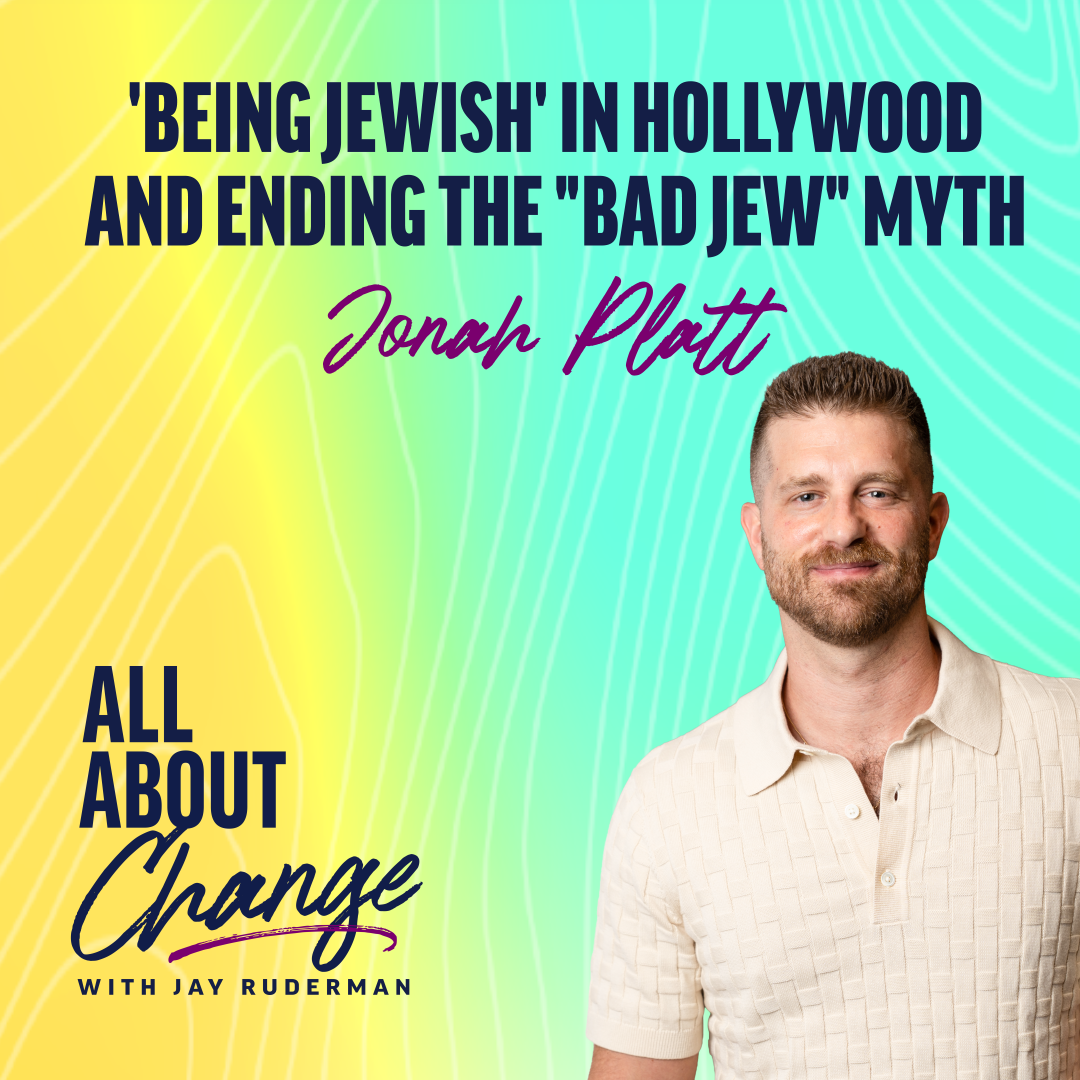
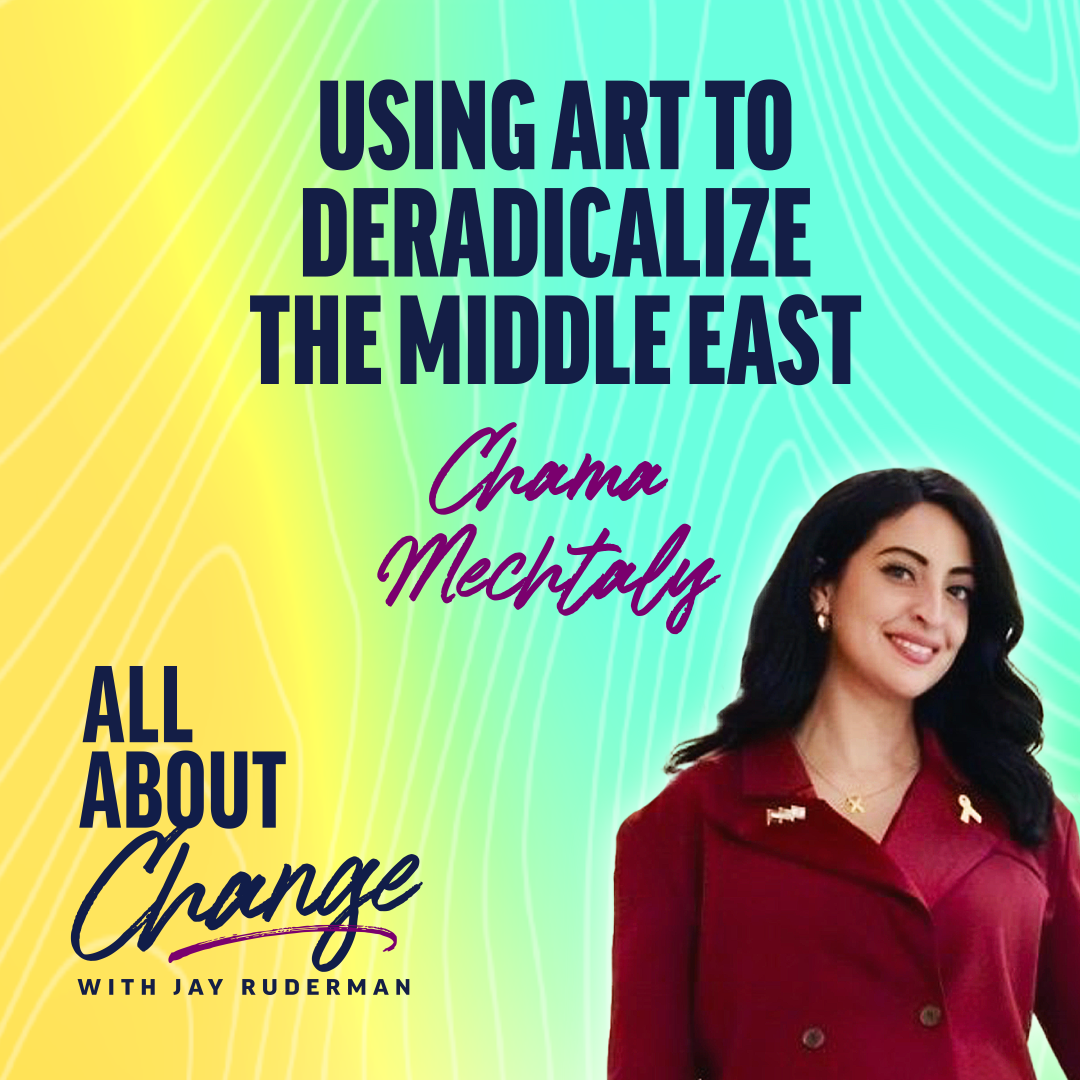
Today my guest is Chama Mechtaly. Chama is a Moroccan Jew from a mixed Jewish-Muslim family. An artist from a young age, she has spent her professional life combining that passion with an interest in international affairs, particularly those related to Israel and the Middle East. She's now the founder of the Emma Lazarus Institute for Liberty and Tolerance, an action tank, bridging media and policy gaps between the Middle East and the Democratic West. As a visual artist, she has exhibited her work in four continents, including twice at the Jerusalem Biennale. Chama, welcome to All About Change. Chama Mechtaly, thank you so much for being my guest on All About Change.
Chama Mechtaly:
Thank you for having me.
Jay Ruderman:
Chama, I want to talk about growing up for you in Morocco. You come from a mixed family of Muslim and Jewish, and I wanted to ask you about the role that religion played in your life growing up and how that impacted your views as you got older.
Chama Mechtaly:
That's a great question. So I was born on July 4th in Casablanca, Morocco, 1992. So I grew up in the 90s, early 2000s, until I was 17 years old, really in Casablanca, Morocco. My mother's from the north of Morocco, my father's from the south. My mother is Muslim, my father is ethnically Jewish, though grew up very secular and really influenced by French secularism, which we call laïcité. And, for me, religion from an early age was really complicated, obviously. And not so much because of the interfaith story, but because of how I experienced religion in a public space. I grew up at a time when there was an Islamist insurgency that was sweeping through North Africa in the Middle East. And so my experience as a woman in public spaces, especially in a big city like Casablanca, meant constantly facing religious extremism and repression and being told that I am not allowed in certain spaces, I am not supposed to show up in certain spaces.
Chama Mechtaly:
And it just created this stark difference from my experience in public spaces and my experience at home with my family, with my parents, with my father, who was not setting any boundaries around how I should show up in public spaces or how I should dress up. And, if anything, my parents both really pushed me to do a lot more than sort of the average boy around me. And so my experience with religion was both getting to see the kind of cultural beautiful aspects, the pluralistic aspects to religion, the diversity of religion in the Middle East and North Africa, and the repression of religion when it's used as an ideology.
Jay Ruderman:
So where did you see or experience the diversity in Morocco?
Chama Mechtaly:
So it was clear from sort of a young age, I would hear stories of Muslim Jewish coexistence and I would hear also stories of longing to the Jewish community. I would hear it specifically from my father's generation, my mother's generations. When it comes to mind already, you had decades of essentially anti-Israel, anti-Semitic sentiment that was brewing the background. You had an erasure of Jewish and other Indigenous and Native communities to the region. And so my generation grew up with this idea that they're only supposed to be Muslim and Arab, and it was a lot harder to actually speak to them about that diversity.
Chama Mechtaly:
But the generation that was older was really shaped by that coexistence and diversity. And you'd really see it everywhere. I mean, Morocco in particular has a massive Jewish history, and while it might not be so apparent, the moment you start doing a little bit of digging, you see it sort of unravel. And one of my favorite proverbs that specifically Amazigh communities in Morocco say, so the Amazigh communities are the Berbers or the Native communities of North Africa, and they say that if you scratch Moroccan once, you find an Amazigh. If you scratch twice, you find the Jew.
Chama Mechtaly:
So there's this recognition that the Indigenous history of the region is very, very deeply Jewish, but it has been essentially erased or lost, that Jewish story has been lost through hundreds of years of essentially Islamist conquest and erasure that was coming in from different invading cultures that were imposing a system of dominance over the Native communities. And so you really see it everywhere, and the more you go venture into the Atlas Mountains, you venture into Amazigh heartland. You see there's a museum in the south of Morocco that is entirely Jewish and has these artifacts from two thousands of years of Jewish history. My hope after the of peace deals that were taking shape in 2020 and onwards was that we would have a revival in not just the search, but the curiosity, sort of the social cultural curiosity around this beautiful heritage that had been pushed to decide. And hopefully we'll get back to that place again.
Jay Ruderman:
So you're growing up in a culture where for a long time there's been Islamic influence and you, as I understand, went to a public high school and experienced discrimination. How did you learn about the diversity and the history of the country you grew up in?
Chama Mechtaly:
I think I just inherently internalized my difference, and it was affirmed by the reaction of the public, my peers, my teachers, classmates. People would make fun of my last name and know that it doesn't sound Arabic, doesn't sound Muslim. So that made me sort of question my identity more. But also I realized that I really felt othered everywhere and in every space that I go to and so much that the first time I actually felt belonging in my life was when I went to college. I went to Brandeis University.
Jay Ruderman:
Like me.
Chama Mechtaly:
No way. That's amazing.
Jay Ruderman:
There you go.
Chama Mechtaly:
It was really the first time that I felt deep belonging in my life. And I think it was because as a patrilineal Jew, it's very hard to find belonging in Sephardi Mizrahi spaces, it's very centralized, also these are communities was very recent traumas, recent experiences of exclusion, exile, and persecution. And so they tend to be more insular. It wasn't until I got to Brandeis University with that sort of tradition of the American Jewish reform legacy and the deeply embedded values of inclusion where I looked around and I realized, "Oh my God, being a Jew is actually an ethnicity. That's why I feel how I feel. That's why I've been fighting for Jewish inclusion since I was a kid. That's why I've been fighting for peace in the Middle East since I was a kid." Right? And so I came to really understand what Jewish identity means through really going on these adventures and experiences and allowing my identity to meet the world and sort of meet the world where it is and kind of negotiating my identity as a result.
Chama Mechtaly:
But I didn't feel full integration of my identities until I went to Israel. So when I went to Israel for the first time, that was the second time in my life I felt deep belonging, very, very deep belonging. In Israel you land and you see Hebrew and Arabic in all this public signs. For me, as someone who had fought for the inclusion of Jewish history and Jewish narratives and stories, to see the Magen Davids in public spaces for the first time and not see them be threatened or defaced or damaged in public spaces was so healing for me that I literally broke down when I saw the first Magen David in the pharmacy sign.
Chama Mechtaly:
And so, in Israel, I really experienced this holistic integration of my identities. And I think if people of the region were able to go and experience Israel and sort of park the stereotypes, the preconceived notions to the side and really experience it for themselves, they would realize that it has become sort of the last stronghold of diversity in the region and actually exposes the beautiful pluralism that has shaped the Middle East and North Africa for thousands of years. Somehow, by a miracle, this very small plot of land was able to actually preserve all of that diversity. And so what happens for a Kurdish person, an Amazigh person, a Druze person going to Israel for the first time and seeing that inclusion and that integration of the diversity of the region, it's just something calms down in their hearts, a piece of the puzzle integrates into their hearts and they realize, "Oh my goodness, we have been lied to because there are extremist ideologies that are really going after that diversity."
Jay Ruderman:
You have incorporated intersectionality and interdisciplinarity approach to peace building Jewish inclusion, Arab-Israeli integration. Talk about that work and why it's important. But also I wanted to ask you, is it possible with what is built up in the region with Islamic fundamentalism, which opposes all of that, how does your work face reality and do you face discrimination threats to you? How do you do your work in the face of reality in the region?
Chama Mechtaly:
Sure. So that's a great question. I think, first of all, you asked how I integrate intersectionality into this work. I think there's no other way, and I think part of it is as someone who went to Brandeis, you understand, I carry that sort of legacy, but there's a reason I went to Brandeis in the first place. I painted a series of Amazigh Jewish women when I was a teenager and took them everywhere for exhibitions and acts of essentially resistance and resilience and really showcasing those stories that were pushed to the side.
Chama Mechtaly:
And I called them the triple minority status woman. I didn't have that language of intersectionality, but I just knew that they navigated three times those levels of oppression and marginalization. And so of course their stories are not to be found anywhere. When it comes to sort of the realistic, pragmatic applicability of this in this backdrop of fundamentalist, jihadist ideology that really seeks to wipe out all of this difference. What I truly, fundamentally, believe and work for is setting a foundation for regional integration through de-radicalization, through countering extremism and specifically the de-radicalization of culture. And that's why I founded the Emma Lazarus Institute.
Jay Ruderman:
So I want to bring you back to 2015 and you did a piece of artwork that was very controversial. And in the end you decide to remove the piece of artwork from the exhibition. Can you talk about that story, what happened and how that shaped your view of where you were and what was happening in the region?
Chama Mechtaly:
Yes. So I didn't remove it. It was not according to my free will, but it was actually removed by the Ministry of Interior and then by the police. But to explain to you what happened, it was June, 2015, I had an exhibition at the heart of Casablanca, Morocco. And this was after I had done many exhibitions abroad, especially in the United States, and this was going to be my solo exhibition in Morocco. So I'm getting a lot of commentary and feedback and attention. And I was actually on my way to a radio show around 12:00 P.M., where everyone's driving back home, so everyone's tuning in, and it was a live radio show and they asked why it was the first time I was doing the solo exhibition after doing many exhibitions abroad. And I said, "It's not the lack of trying. I keep trying and I keep getting censored. In fact, on my way to you, I received a call from the Ministry of Interior who threatened to shut it down, who said that they're going to take me to jail for what they call the defamation of a national symbol because my work had Magen Davids in it."
Chama Mechtaly:
And essentially they threatened to find me and take me to jail and said that if I put back even an image of the painting on the wall, that I would face those serious repercussions. And there were undercover cops outside of the exhibition, inside the exhibition, and actual cops outside of the exhibition. And so it was this very, very tense environment, and this is why I needed to explain to the audience sort of the political complexity of the country. Now, after the Arab Spring 2011, the Muslim Brotherhood affiliate political party in Morocco was able to consolidate power, was voted on by popular votes.
Chama Mechtaly:
So they headed the government at the time, and they won two times after the first time. So they were in power over a long period of time, and that enabled them to really deepen their grip on the politics and the social and cultural dynamics of the country. So all of a sudden you look around and most women are wearing the hijab. When you walk into parliament, all women are wearing the hijab. And so they started really shifting the culture of the country and repressing all civil liberties, coming after the artists, the journalists, et cetera. Now that exhibition really kind of put me on the map of all the sort of radicals and fundamentalists.
Chama Mechtaly:
I was receiving death threats on a regular basis. And at the same time as this was happening, and when I started to realize, "My goodness, they have become really powerful in North Africa and Morocco in particular." I started seeing this breath of fresh air coming from the east, from the Gulf in particular. And I became really curious about what was going to happen in the Gulf because I started seeing them implementing more inclusive practices, using more inclusive rhetoric, and looking towards the Jewish community in Israel. And that's why I moved to the UAE in 2016.
Jay Ruderman:
So just for the audience's benefit, and hopefully we'll throw a picture in there, the art in question was a Moroccan flag with instead of the traditional star, a Jewish star in the middle with some other images of Native culture. That was what was offensive to the authorities.
Chama Mechtaly:
Yeah, so initially they said that it was all offensive because there were Magen Davids in my portraits of women and some of my more abstract work that was informed and inspired by Amazigh rugs and Amazigh Jewish artistry and craftsmanship. But I essentially negotiated with the authorities and I said, "There's no way I'm going to bring down the other works." But they basically sort of doubled down on the pressure and said if I were to leave the Moroccan flag, I would immediately go to jail. And it became actually a really powerful symbol because when you walked into the exhibition, you saw the name of the artwork, but no artwork. Which is essentially where we find ourselves in the Middle East and North Africa, that question around identity as a whole, but specifically Indigenous identities and Jewish identities as part of the Indigenous landscape of the region is totally erased, totally absent.
Chama Mechtaly:
And the artwork was actually a nod to how the Moroccan flag used to look like. So it was a red flag, red banner with a green Magen David, and it used to have this Magen David up until 1927. And the story says the flag was changed by this French general, Marshal Lyautey, to reflect a five pillar star instead of a six pillar star. And the artwork, if you look a little bit deeper, if you get a little bit closer, you see that it has a three languages that have really defined our culture as North Africans and as Moroccans. One is Tifinagh, which is the language of the Amazigh people, and it is now recognized part of the constitution.
Chama Mechtaly:
The second language is obviously Arabic, which is part of the culture of Middle East and North Africa. And the third language is most definitely Hebrew. And so the artwork had Hebrew, Arabic, Tifinagh scripts woven together with the Magen David in the center, and the Magen David itself is really kind of showcasing all of these beautiful Amazigh symbolism that also tell a story of deep indigenous legacy. And that puts forward the centrality of Jewish indigeneity when we talk about Indigenous communities of North Africa and the Middle East. So that was the artwork that threatened so many.
Jay Ruderman:
Can you talk about some of your successes in terms of the work that you've done in terms of integration and acceptance of Jewish culture? What have you been able to do to move the needle forward?
Chama Mechtaly:
So even when I was in Morocco, I worked briefly at the Parliament in the Division of International Affairs. I put up events interpreting the reforms of the constitution in 2011, which declared for the first time that Jewish identity is a core component of Moroccan identity, and that's actually really major and something I wish that the west would see a little bit more and understand that model a little bit more. So I put up events interpreting that part of the constitution, what it means to teach Hebrew in national schools and national curricula. I hosted many, many, many summits and events and discussions and panels on the Israeli, Moroccan, Israeli UAE, Israeli Bahraini relationships. I put up the first exhibition between the UAE and Israel in Jerusalem in 2021, shortly after the Abraham Accords. And it was incredible. It reverberated across the region. We had diplomats from every embassy representing the Middle East in Jerusalem, attending many ambassadors.
Chama Mechtaly:
The UK Minister of State had tweeted about it, celebrating this exhibition and telling people, "This is what we need to see more of," because fundamentally it's really about shifting cultures as well and creating this sort of cultural framework through which people understand the political shift because you can't just all of a sudden show up and say, "Now we have peace." Other wins were basically setting up summits and spaces of dialogue where we totally witnessed the complete transformation of people.
Chama Mechtaly:
One of these initiatives that I do now as part of the Emma Lazarus, in partnership with the Abraham Accords Institute is we put up these deradicalization summits and we bring media personalities, people who woke up to extremism in the region recently and are trying to develop ideas, we put them together with deradicalization and counter extremism, experts who have been in the field on the ground looking at the ideology, looking at the philosophies that underlay the ideology for decades. And sort of allowing them to share knowledge, share best practices so that whatever the intellectuals develop is not just read by one or two people but is actually scaled and whatever that is developed by the media personalities and the social media influencers and the activists is informed by decades of research and best practices. And so that's really where I thrive, is this convergence of policy and culture towards deeper deradicalization in the region because, again, this is the only way to pragmatically set the stage for sustainable peace.
Jay Ruderman:
So I want to focus on your art and how you weave your art into activism. And recently on the show, Eli Beer runs United Hatzalah in Israel. Talk to me about the volunteerism of Muslims and Jews together for the common good. Your jewelry line, Moors & Saints is meant to promote religious tolerance. Tell me about art jewelry and how that helps you promote your activism.
Chama Mechtaly:
So it's twofold. One, when you have ideologies that take away the right to sing in public, that take away really beauty that repress women's freedoms, it's all because they're actually going after culture. So if they can completely essentialize, reduce culture to what they see fit, which is very clearly stated, a return to sort of a purest version of Islam, which really is not a purest version, it's a fundamentalist interpretation that has constantly been challenged throughout the Muslim world and throughout hundreds of years. But by stripping away these avenues of culture, you are stifling, obstructing innovation, the ability to imagine. Because really what is radicalism and extremism? It is an attack on the imagination. When someone tells you you can only be this or that, nothing in between, they are suppressing your very ability to imagine a different reality.
Chama Mechtaly:
First, it is a kind of a reclaiming of the culture and the diversity of the region. And second, I was pushed into it because even though I think I've always been an artist and I've always as a child always painted and drew and created things, but I was pushed into it in the sense that when I started with political activism in my schools growing up, I was clearly told that I had no right to speak. And so my automatic reaction was, "I'm going to create a very safe space for people to actually understand that they've been lied to in school, that they've been manipulated, that they have not been told the full story." And when I created an artwork or a jewelry collection that is so beautiful, you can't actually look away. It commands you to look and it creates this immediate intimacy because it also tells your story and you are able to see yourself in the product or in the painting. And so you'll have no choice but to actually face that history and that diversity that we just didn't have spaces for before.
Jay Ruderman:
So your art is very beautiful, and when you're in the UAE, when you're in Bahrain, is your art able to be seen? Do you feel that you have more ability to show a diverse piece of art there than in Morocco or in other places in North Africa and the Middle East?
Chama Mechtaly:
That's a brilliant question.
Chama Mechtaly:
Hi, my name is Chama Mechtaly and I'm the founder and creative director of Moors & Saints, which is a startup incubated here at IN5 Design. So Moors & Saints is a fine jewelry company that offers products inspired by Moorish architecture and Moorish design. And what we do is we map where Moorish architecture kind of started, so in Andalusia and the Maghreb region and how it traveled across the world, so reaching as far as Mexico in the west or India in the east. And we really try to source out places that have this kind of architecture across different religions. So IN5 believed in me from day one, and I had a lot of fun pitching Moors & Saints for the committee and had a lot of fun with the application process, which to be fair was very much hassle free and pretty straightforward. And IN5 also offers the cheapest rated incubate and to start a business in Dubai. So that was a no-brainer for me, and I'm sure for any young aspiring entrepreneur.
Chama Mechtaly:
So the reason why I started Moors & Saints was because when I showed up in UAE in 2016, I looked everywhere, I asked everyone and I said, "Is it okay if I show these paintings that showcase Jewish minority communities from Mizrah, from the east?" And I was told that the community's still not ready for it, and as long as there is no sort of green light from the top that it would be very difficult to do that kind of thing. The green lights came with first the UAE's Year of Tolerance in 2019, and that's what allowed me to launch Moors & Saints at a really massive design fair called the Dubai Design Fair that happens in the fall.
Chama Mechtaly:
And that draws in people from all over the globe with the best design innovation. And I would have people kind of coming into the pop-ups and the activations and they would see collection covered in Magen Davids in jewelry, sacred architectural jewelry inspired by Moorish design, but embedded with Magen Davids. And they would say, "What's this doing here? Why do you have the Israeli flag on the jewelry?" And I would say, "Well, I'm so glad you asked. This is a Magen David. This piece is actually inspired by a mosque where you find the Magen David ingrained it on stone in the courtyard of the mosque in Egypt, and the mosque was built a thousand years ago by a Jewish architect from Iraq."
Chama Mechtaly:
And so it just totally destroys all of their ideas about the Jew or about the other. And now all of a sudden, "What do you mean Jews were here thousands of years ago and were instrumental in building Muslim civilization?" It's not always easy, of course, and I tend to sort of market segments as much as I can because ultimately I want that message to resonate, to land. And I want culture to be deradicalized, and I want Jews to be understood as Indigenous to the region and Israel as a core part of the region that is never going to go anywhere. It's really because of that that I kind of tweak my approach and it becomes really hard and difficult to answer the basic question of, "What do you do for a job?"
Chama Mechtaly:
Because given my experiences in the spaces in which I was born and grew up and had formed my formative years, I've had to kind of carve out these different professional identities. And so I thought, "Okay, well, we're just going to have to be entrepreneurial and create a small business with deep social impact." And so these are the things that are really lost on the West in particular when they think of the Middle East, because there's a lot of media manipulation and there's just a lot of glossing over the specificities of the Middle East, and it tends to create these gaps in consciousness.
Chama Mechtaly:
And those gaps only further the goals of the extremist organizations because it hinders the very ability to actually engage with the Middle East and with the different countries of the Middle East, not just normal countries, essentially normalizing not just Israel, but all of the other countries that make up the region. And so this is why I'm also very, very, very firmly against any organization that claims to work for peace, but is actually calling for the boycotts of not just Israel, but other countries in the region that they see normalizing with Israel, the Abraham Accord countries, because they don't want those avenues of dialogue. And so that rupture and communication really helps them create even more and fertilize more extremism in Western society.
Jay Ruderman:
I like what you're doing as shifting and approaching different things in order to try to get the word out there and show people the reality, and come up against a really, really strong and dangerous philosophy that's in the region. So I give you a lot of credit. I hope that you are keeping safe because I think the threats out there are real. I've learned a lot from you, and I appreciate you being my guest today on All About Change.
Chama Mechtaly:
Thank you so much. Really pleasure to meet you.
Jay Ruderman:
Thank you for being part of the All About Change community. We aim to spark ideas for personal activism, helping you find your pathway to action beyond awareness. So thank you for investing your time with us, learning and thinking about how just one person can make the choice to build a community and improve our world. I believe in the power of informed people like you to drive real change, and I know that what we explore today will be a tool for you in that effort. All right, I'll see you in two weeks for our next conversation, but just one small ask, please hit subscribe and leave us a comment below. It lets us know that you value this content and it supports our mission to widely share these perspectives. If you're looking for more inspiration, check out this next video. I chose it for you and I know you're going to enjoy it. I'm Jay Ruderman. Let's continue working towards meaningful change together.
Jay Ruderman:
Today's episode was produced by Tani Levitt and Mijon Zulu. To check out more episodes or to learn more about the show, you can visit our website Allaboutchangepodcast.com. If you like our show, spread the word, tell a friend or family member, or leave us a review on your favorite podcasting app. We really appreciate it. All About Change is produced by the Ruderman Family Foundation.

Jay Ruderman:
Welcome to All About Change. Now is a great time to check out my new book about activism, Find Your Fight. You can find your fight wherever you buy books and you can learn more about it at JayRuderman.com.
Jay Ruderman:
Today my guest is Tiffany Yu. Tiffany began her career in investment banking, but chose to pivot and dedicate her life to advocating for people with disabilities. At nine years old, Tiffany was in a car crash that left her disabled and led to the death of her father. Now she's the CEO and founder of Diversability, an award-winning social enterprise to elevate disability pride, the founder of the Awesome Foundation Disability Chapter, a monthly micro grant that has awarded $92,500 to 93 disability projects in 11 countries, and the author of The Anti-Ableist Manifesto: Smashing Stereotypes, Forging Change, and Building a Disability-Inclusive World. As you and the audience know, the Ruderman Family Foundation has long been active in disability advocacy and it brings me enormous strength to meet and learn from Tiffany, a young leader in the space.
Jay Ruderman:
Tiffany Yu, thank you so much for being my guest on All About Change.
Tiffany Yu:
Thank you so much for having me.
Jay Ruderman:
Tiffany, I want to start off with something you've talked about, PTSD, and telling a whole version of your story long after it actually happened. Why did it take so long for you to tell it? What was going on there?
Tiffany Yu:
So I'm the daughter of Asian immigrants. My dad is from Taiwan and my mom is a refugee from the Vietnam War. And one of the things that I'm learning as a result of that cultural background and growing up in that cultural upbringing is that shame is viewed in the entirety of the household. So I did some research and when a death happens in the immediate family, part of that is leaning into, oh, somewhere along the lineage there was some bad luck and this is why this needed to happen in the family. The same with the car accident and me acquiring disabilities as a result of the accident. And in some ways I feel like it was amplified within this Asian cultural upbringing, but I also think that in 1997 there was still a lot of shame and unknown around disabilities. I think about how things I think are changing from my parents' generation to my generation where now I'm seeing a lot more grasp around disability pride, a lot more disabled people coming onto social media, or authentic casting that's happening in Hollywood around disabled people and disability narratives as well.
Tiffany Yu:
And to be honest, now that I think about it, the car accident was 28 years ago, so it was a long time ago. And around November 29th, which is the anniversary day of the car accident, I'll usually share something on social media. And over the past couple of years, there was one year where someone I went to elementary school with said, "Hey Tiffany, I knew about the car accident but I didn't know about your dad." Which also signaled to me that the people that I grew up with, because this car accident happened when I was in fourth grade, they knew something happened, but they didn't know all the details.
Tiffany Yu:
And then recently I reconnected with someone I went to high school with and he said, "Oh, Tiffany, I knew about your arm, but I just assumed it was from birth." And I'm kind of putting these puzzle pieces together for my own adolescence that is reinforcing to me that I just didn't share a lot of it. So it wasn't until I was in college where I was meeting so many new people for the first time that I had realized, oh, I am kind of rusty here. I actually haven't told anyone about these details. And at that point in time, because it had already been so long of me not sharing, I had essentially been habituated into not sharing any parts of it.
Jay Ruderman:
So I'm going to tell you now why that struck a chord with me. When I was learning about your advocacy and who you are, and I've never told anyone about this. When I was younger, a teenager, maybe 14, I was diagnosed with scoliosis and I had to wear a brace, but I wore it in such a way and wore clothing to hide it. So I was in school in middle school I guess at the time, and people didn't know. And I wouldn't let anyone touch me. And I think that there was sort of an embarrassment that I had. And I just wrote a book called Find Your Fight, which is about advocacy. And I talk about certain disabilities that I've had, depression, anxiety, but I didn't touch on this, I didn't write about it.
Jay Ruderman:
And I'm thinking after I learned about you and what you went through, why I didn't talk about it. And I'm still sort of thinking about that over the last few days. What is it? Because now this was maybe, I don't know, 40 years ago that this happened and why is it still something that I choose not to talk to people about? I don't know. I mean, I think we all have stories, some of them we tell and some of them we don't tell. And I don't know why I haven't told that story in the past.
Tiffany Yu:
Yeah, thank you so much for sharing that.
Jay Ruderman:
Thank you.
Tiffany Yu:
And I will say that has been one of my favorite parts of being on this journey is people who realize there are parts of their stories they haven't shared and maybe doing some of that reflection of better understanding why or why not.
Jay Ruderman:
I don't know. I mean I think it's a part of who I am. It's a part of what I think about, but I think that I was approaching it as an embarrassment, and maybe this is what I was integrated with growing up society I grew up in, that I would be seen as the other. Look, I grew up a long time ago and the other was not something you wanted to be. And maybe now we're at a place where the other is something you should be proud of. I don't know, I'm just going off the back of the envelope here.
Tiffany Yu:
I mean something I'm thinking about when you talk about the embarrassment, I think about the ways that shame festers in secrecy, silence and judgment. And when I learned that, I actually took a critical look at myself and I said, "Where are the areas that I feel a little embarrassed or a little bit of shame?" And I think I still am unlearning some shame, but I feel very empowered in my disability story. But for a long time I didn't like the way my hand looked. It looks different. And I think similar to what you said, this desire to not be the other or not have something look so different.
Tiffany Yu:
And so I thought about that. I said, "Okay, I have shame about the way my hand looks." And in 2020, many of us were turning onto short form video and all of these different platforms. I said, "One of the ways I think I'm going to tackle shame around the way my hand looks," because I would even look at past photos of myself and I'd be hiding my hand behind my hip or behind someone else or behind a table or under a table, is I said, "Secrecy, silence and judgment. Which one of those can I tackle that will help me unlearn some of the shame around how my hand looks?"
Tiffany Yu:
And so I started putting my hand onto social media and I said, "Hey, my arm's paralyzed. This is how I do X, Y, Z thing." And I will say, the deluge of comments really, I think touched on this adolescent Tiffany who felt so much shame and embarrassment around my body and the way it worked and didn't work. And I had to remind myself, "My whole life doesn't exist in social media. Let me make sure I have community that if I'm feeling a little bit insecure, I can turn to these other places as well." So yeah, I don't want to give shame its power. And part of how I am tackling, not giving shame, that power is by bringing more light on the things that people might have shame about.
Jay Ruderman:
I want to talk about something that you've touched on and it's something that I wonder about in the disability space, that some disabilities are seen and some disabilities are not seen. Can you talk about people who have disabilities that are not seen? Does the community in general accept them as part of the disability community, or do you see any divisions within the community?
Tiffany Yu:
Ooh, so much to unpack there. Well first I'll start by sharing that the majority of disabilities are not apparent, right? This can include Tiffany, who lives with PTSD. It's anxiety, depression, like you mentioned. It's ADHD, OCD, hearing related disabilities. And part of what I feel excited about is to have more people who have non-apparent disabilities be transparent about them because it also helps interrupt the narrative that disability has a certain look.
Tiffany Yu:
But I think to your question around whether people who have non-apparent disabilities are embraced within the disability community, I hope that's changing. I will say there was a period of time where, even as we're recording this call, unless I showed you my hand or told you, you may not know that I have disabilities. And so I guess I want to share two things. And one is that people who have non-apparent disabilities, sometimes you have a choice and a strange privilege in a way of how much you want to share. And sometimes you may see someone who has a non-apparent disability decide not to share because they see the way that people who have more apparent disabilities are treated. And if we are getting stares or people are questioning our capabilities simply because we have visible disabilities, then why would someone who has a disability that is not apparent most times? Because disabilities can become apparent at any time, it deters them from wanting to share.
Tiffany Yu:
So again, I think we're starting to see a change within the community that is embracing that disability doesn't have a look. We are welcoming many people who have long haul COVID, which depending on how it manifests, can be considered a disability. We're welcoming many of them into the community. And they have their own long haul COVID support groups, which is really great. But I also think a lot about cross disability solidarity. How can we show up with each other? Because even though our disability experiences may be drastically different, I think there are two things that unite those of us who have disabilities, whether they are seen or unseen. And the first is that we have all experienced this system of oppression that is called ableism, which is the devaluing of disabled bodies and minds. And then the second is that we've had to learn how to adapt in a world that wasn't built for us.
Tiffany Yu:
And I think about the ways that the term Asian-American came into consciousness in the sixties, again, with a bunch of people from different countries who don't have shared history or shared language. We just happened to all have black hair. And part of why they came together in solidarity with each other was because they had more power and influence together as a collective. And I see that within the disability community as well.
Tiffany Yu:
So me personally, I welcome anyone who believes that they have a disability. Whenever I share about my work, I'll always get someone come to me who says, "I have asthma or I have diabetes. Does that count?" Or they'll say, "Hey, when I was in university, I did use my disability resource center to get some accommodations, but I don't consider myself having a disability." I'm not here to police whether someone identifies or not. It's just to say we all have this shared experience. I think the more of us who understand that so many more of us are disabled than we realize, I think the more that we can start to tackle and dismantle ableism and this devaluing that we are seeing.
Jay Ruderman:
That's very powerful. And so much agree with what you've said. And it's a perfect transition to my next question. The website of the organization that you run, Diversability, has a section dedicated to allies. So what does an ally to the disability community look like?
Tiffany Yu:
I come back to this definition of ableism that I use, which is a system of oppression where we devalue someone based on the way their body and/or mind works. So when I think about allyship, it's what are the actions that we can take where we are not devaluing someone based on their disability status?
Tiffany Yu:
I will share that. I also wrote a book recently, I think it came out last fall, so congratulations on yours. The book is called The Anti-Ableist Manifesto. And right now for those who can see the video, I'm holding up a piece of art that says The Anti-Ableist Manifesto at the top. And there are about 30 statements on the manifesto that range from disability is not a bad word or a bad thing, don't erase history, diversify your feed, halt microaggressions. And each of these statements actually correspond with different chapters in the book, which is great if you... So you can start out with the art, figure out which statements on the piece of art resonate with you and then dive more deeply into it. But for me, an ally is really someone who thinks about the experiences of communities they might not be a part of. An intentional decision to show up with a willingness to learn and figure out ways to advocate alongside us.
Jay Ruderman:
And the community needs allies because, I don't know what the figure you use, but historically the disabilities community has been about 25% of the population, which is a very large percentage. But to get to the majority, we need allies. And I think that's something very important.
Tiffany Yu:
I will say that part of allyship or even thinking about how to become an advocate or activism is where are my spheres of influence? Where can I shake things up a little bit? One of my own personal wins, when I was living in San Francisco, I got appointed to the San Francisco Mayor's Disability Council. One of the things I thought about when I was in that role was again thinking about, "Okay, what are the different levers that we have?" So we now have direct communication with a lot of different departments and can ask them about what they're doing around disability inclusive disaster response or hiring programs that they're doing. And we also have a line into the mayor. So we have an opportunity to write letters that are signed onto by the San Francisco Mayor's Disability Council to really share, "Okay, this is what we're hearing from the community," and we can trickle this up.
Tiffany Yu:
So then even if I take that a layer down and I think about people who might be listening to this who say, "Oh, well, I'm not on a council or a commission." All of those councils and commissions have public meetings that you can then go and attend as a member of the public and make a public comment to. And if that's not something you want to do, there's an email address or a phone number that you can use to share more about how you can make your city or wherever your local area is more inclusive.
Jay Ruderman:
Tiffany, I wanted to ask you, you and I had organizations and we have people that work with us. I remember a case where an employee, Ellie Wolf, who has since passed away, brought to me an issue. Major League Baseball used to call people who were injured the disability list for over a hundred years. And he's like, "That really has to be changed. They're not permanently disabled, they're injured." And I contacted Major League Baseball and they changed it to the injured list. Have you had an employee who has come to you with a significant story that has led your advocacy forward?
Tiffany Yu:
I don't know if you know this, Jay, but the Ruderman Foundation is actually mentioned in my book a couple times-
Jay Ruderman:
Oh, thank you.
Tiffany Yu:
... because I also remember there was an initiative of the Ruderman Foundation called Link20. And I actually do remember this major League Baseball was one of the advocacy actions.
Tiffany Yu:
One of the ones that is mentioned in the book is around the Paralympic medal pay, which was an initiative that was driven by Jenny Sichel, who was part of this group called Link20, which was this initiative of the Ruderman Foundation to bring together young disability advocates to figure out how they could band together again in solidarity with each other and in community with each other to make change.
Tiffany Yu:
But one of the ones that does come to mind was right around the beginning of the pandemic there was a campaign called NoBodyIsDisposable. And this was during a time where many hospitals were experiencing a lot of people coming in with severe symptoms related to COVID and doing something called hospital triage, which is they were deciding who got a hospital bed and who didn't. And on paper as disabled people, simply because of our disability status, many of us are viewed as having a lower quality of life. So if it just so happened that I had severe symptoms and needed to go to the hospital and there weren't any beds, there may have been a chance that a doctor or the hospital would've decided that I wasn't worthy of a bed, determining who deserved a bed and who didn't. So this was, again, in partnership with a lot of organizations to send letters to not only raise awareness that this was happening, but also send letters to different insurance companies and hospitals that this is something that we didn't want to support.
Tiffany Yu:
And then I think one big one that I think a lot about is the fact that it's still legal in over 30 states to pay disabled people below minimum wage. The organizations that have something called 14(c) certificates. So you can literally just go online and search for who has a 14(c) certificate and see who is legally paying disabled people below minimum wage. And I fundamentally believe that every single human being, at least in the United States, all of us, there is some job that we can do where we can be paid at least minimum wage.
Elizabeth Warren (Clip):
My staff came across a few reports about working conditions of individuals with intellectual and developmental disabilities. In Rhode Island, Pedro, a 25-year-old man with an intellectual disability, spent three years sorting and packing buttons. Pedro's boss described him as an excellent worker. He was paid 48 cents an hour. In New York, workers with disabilities package pharmaceuticals at a nonprofit organization. They were paid 33 cents an hour. The CEO, by the way, was paid more than $400,000. In Iowa, dozens of adult men with intellectual disabilities worked at a turkey processing plant. They began work every day at 3:00 in the morning, and they were housed in a crowded schoolhouse together. They were paid $2 a day. Now, Dr. Mank, you're an expert on the labor market for individuals with intellectual and developmental disabilities. Congress has passed labor laws, civil rights laws, and other laws protecting Americans with disabilities. It's 2017. Can you explain why wages this low are not illegal?
Dr. Mank:
The original legislation was passed in 1938 that allowed payment of subminimum wage. This was somewhat updated in 1966, but because of the section of the Fair Labor Standards Act called 14(c), it's perfectly legal.
Tiffany Yu:
I will say that the Link20 initiative and a lot of the work that the Ruderman Family Foundation has done has really inspired and created a lot of ripple effects within the disability community too.
Jay Ruderman:
Right. I'm thinking about my background and I come from the world of politics, so communication was important to me when I transitioned into advocacy. But you got your start in investment banking at Goldman Sachs and had a lot of success with the issue of your micro grant. I'm wondering how that background shaped your advocacy?
Tiffany Yu:
Well, I'll share two stories first. I was a summer intern at Goldman in 2009. And while I was there, I got introduced to a lot of the different employee resource groups that they had. So they had one for Asian employees, for women, for queer employees, and they also had one for disabled employees. And here I was literally the most junior person at this bank getting introduced to vice presidents and managing directors, those are the most senior people within the firm who were now, I felt like sponsoring and mentoring me to be successful in my internship, to then get that full-time offer to come back. And it actually wasn't until I got there that I realized how powerful a disability centered community could be, which has inspired literally all of my work. With Diversability, we're a big community around building cross disability solidarity or across disability movement.
Tiffany Yu:
So it actually wasn't until my experience in investment banking at Goldman that I started to find my own voice as a disability advocate. And I share some of these stories throughout the book. But one other thing that happened was every single new hire had an ergonomic assessment done of their workstation. So many of my colleagues and I got a second monitor or a keyboard wrist pad. I got a left-handed mouse. And then the ergonomic specialist asked me if I could use a headset so that I could use speech to text technology to help me type. And here I was 21 years old, becoming disabled at nine. And that was actually the first time I'd ever heard of speech to text technology. And there were so many things about that experience that I appreciated was that every new hire had different ways to adjust to their workstation so they could work best. This is how I think about accessibility and accommodations. They aren't special. Everybody got an assessment. And then I also appreciated how the ergonomic specialist was proactive in offering a variety of different ways that might assist me in doing my work best.
Tiffany Yu:
I just wanted to share those two stories because I think they not only inspired who I've become as a disability advocate now. I don't want to be the exception. But as I fast-forward, I guess one of the things I think about a lot in my own advocacy is what I call disability-centered economic justice, which is looking at the ways that we create more financial literacy within the disability community. But then I recently started angel investing, which means putting small amounts of money into startups that are growing. And I currently have two disability-owned startups in my portfolio, and that makes me really excited is that we're seeing disabled people starting to be represented everywhere. We don't just exist on the philanthropic or charitable side, which is important as well. We need funding for different disability advocacy initiatives. But we're starting to see real companies with solid business models start to emerge that are run and led by disabled people.
Tiffany Yu:
So I come back and I think, like you said, I run The Awesome Foundation Disability Chapter, and every single month we award $1,000 to a disability project around the world. And in a couple of months we will surpass $100,000 of grants globally. And keep in mind, depending on who you are, $1,000 is a lot or a little. But when I started Diversability in 2009, we had gotten a $500 grant, which was the most amount of money I had seen for a project that I was working on. So sometimes the money matters, yes, but it's also the vote of confidence in an idea from your peers, that they want to help you succeed or take your project to the next level.
Tiffany Yu:
I remember grabbing dinner with a friend and I was thinking about my own advocacy. And it's interesting being in this space because you want to think about how do I avoid advocacy, burnout, or compassion fatigue? And I remember I was at this dinner and I was thinking about how I feel like I haven't made that much of an impact. And the friend I was having dinner with actually I think had gotten hired as a speaker, and she was like, "Tiffany, this fund that you created at Georgetown went directly to supporting my livelihood." This is what she said. So I'm actually getting to see the impact of that fund, even if it's small amounts in the beginning, happen right away.
Tiffany Yu:
So yeah, I think it's just remembering that we're all part of a bigger movement and also thinking about how can we create more sustainability in this space? And I'll just share a very small example of this, which is my book, The Anti-Ableist Manifesto, it came out last fall. And I did receive an advance from my publisher, so I was paid. And I used part of that advance to hire a disabled designer who is the designer behind The Anti-Ableist Manifesto art. And then I also used that money to hire a disabled editor. And we hosted our first launch event in Los Angeles at a disability-owned bookstore called The Last Bookstore. And so these are all ways where I was like, "Okay, here are ways that I can invest in disability-owned businesses, even if it's disabled solopreneurs, all throughout the supply chain of even just this one project of launching a book."
Jay Ruderman:
Awesome. Well, Tiffany, thank you for being my guest on All About Change. I've learned so much from you. It was a pleasure talking to you. And thank you.
Tiffany Yu:
Thanks so much for having me.
Jay Ruderman:
Thank you for being part of the All About Change community. We aim to spark ideas for personal activism, helping you find your pathway to action beyond awareness. So thank you for investing your time with us, learning and thinking about how just one person can make the choice to build a community and improve our world. I believe in the power of informed people like you to drive real change, and I know that what we explore today will be a tool for you in that effort.
Jay Ruderman:
All right, I'll see you in two weeks for our next conversation, but just one small ask. Please hit subscribe and leave us a comment below. It lets us know that you value this content and it supports our mission to widely share these perspectives. If you're looking for more inspiration, check out this next video. I chose it for you and I know you're going to enjoy it. I'm Jay Ruderman. Let's continue working towards meaningful change together.
Jay Ruderman:
Today's episode was produced by Tani Levitt and Mijon Zulu. To check out more episodes or to learn more about the show, you can visit our website Allaboutchangepodcast.com. If you like our show, spread the word, tell a friend or family member, or leave us a review on your favorite podcasting app. We really appreciate it. All About Change is produced by the Ruderman Family Foundation.

Princess Noor Pahlavi:
I think there's this theme in my family of duty to their countrymen transcending any pain that one person might feel in the moment and a bigger picture they're all fighting for. It's such a unique privilege for us to be in a position to help others on this scale and to play an active role in bringing about change.
Jay Ruderman:
It's not every day that I get a chance to talk to a real-life princess. Today, I'll be talking to Princess Noor Pahlavi, a member of the exiled Iranian royal family. Born in the US, Noor could have opted to live a normal life, to remain in the shadows. Instead, she chose to leverage her unique heritage to give a voice to the oppressed people of her homeland, to continue her family's legacy of civic duty. We'll be talking about gender equality in an oppressive regime, about democracy, women's health, and hope for the Iranian people. It's an honor and absolute pleasure to welcome Noor to our show. Noor, welcome to All About Change.
Princess Noor:
Thank you for having me.
Jay Ruderman:
So Noor, your father as the Crown Prince has been a symbol and an advocate for democracy in Iran to Iranians who are living outside of Iran and those living inside Iran. When you were growing up, what type of stories, what did you learn about your grandfather, the Shah?
Princess Noor:
I mostly heard about who he was rather than what he did. So a person who was very kind of soft-spoken, loved his wife, loved his dogs, loved his kids, kind of had a sensitive stomach, was very low maintenance, and also kind of a suffer-on-the-inside type, but definitely sensitive to his people, their sentiment. And I'd heard a few things. I had a high school teacher who worked for the Carter administration, and I remember hearing some things in that class that I went and asked my grandmother about when I came home. And she is not a reactive person, and I've never actually seen her stirred apart from in this conversation where she was just... She sat me down and just laid it all out, all of the misconceptions in the United States that they have about what happened then, the US's role in the revolution, and what people who worked in the Carter administration have said to her since, expressing apologies and stuff like that for the way they really turned their backs on him when he needed them most.
Princess Noor:
And I think that that was also the conversation where she talked a lot about what he did for Iran as a country for his people, for women, for families, for the environment, for the progress of the economy, the vision he had of a country that isn't solely reliant on oil for fossil fuels, but treats it as a precious resource, bringing people from the cities to the rural areas to expand access to education, sending people abroad to get access to other countries and bring back what they know and really trying to integrate Iran into the global landscape and build bridges.
Princess Noor:
And I think it's such a shame now because if he could see what Iran's become, it's the complete antithesis of what he had in mind. It's now a passport you don't want to have, it's a country that's feared and a country that shuts its people off, even if it involves cutting off internet access from anything that doesn't align with its really rigid ideology. My grandfather wanted minorities to have a voice. He welcomed Jewish people, he welcomed people of all faiths. He was open to anyone having a voice in government, in leading educational institutions, in business. And I think, again, the laws that are in place now, everything that makes life for these people in Iran, for women, for religious minorities, for gay people, for everything, I think if he could see what's become of this country, he would die all over again.
Jay Ruderman:
Right. I want to switch and talk about your grandmother, the Empress Farah Pahlavi, and what influence she's had on you in terms of fashion, in terms of advocating for the Iranian people. What do you remember at a young age the messages that she gave you?
Princess Noor:
She's a really, really special person. I think what messages she gave me when I was growing up usually had to do with making sure I understood Iranian culture for what it was and the truth behind its people and the beauty, the openness, the art, the intelligence, the education, everything that was true about the people when she was there and that still is, and the warmth of this culture. And beyond that, it was a lot of messages about treating all other living things with kindness, with respect, trees, animals, and not to value material things at all. I think that really came from her leaving Iran with nothing but jean shorts and her photo albums. The way that she never talks about things she used to have, she's very in the moment and just very grateful for her family and for the love she still feels from the Iranian people who reach out to her all the time.
Princess Noor:
And what I've learned most from watching her though is the grace with which she faced unbearable loss, first her country, then her husband, and more recently her two children to suicide. I think there's this theme in my family of duty to their countrymen transcending any pain that one person might feel in the moment and a bigger picture they're all fighting for. And I think being a mother to Iran has always pulled her through the trials that she's faced in her personal life. And I understand her. It's such a unique privilege for us to be in a position to help others on this scale and to play an active role in bringing about change, and I think that really has been something she's clung to to pull her through.
Jay Ruderman:
Well, she seems like a beautiful person. I want to talk about the current Islamic regime in Iran. How would you describe them, and in your opinion, what are their goals? I remember the revolution, and I remember that Iran was a fairly modern country with a modern outlook, with people who were happy. And now to see the repressive nature, not only of the Islamic Republic, but also the export of terrorism is problematic for the region and for the world. And I saw a post that you put up, and maybe you can talk about this, that when we say Iran, you don't want us to refer to Iran as Iran, but as the Islamic Republic.
Princess Noor:
Right.
Jay Ruderman:
Can you talk about that a little bit, about what that means to you?
Princess Noor:
Yeah. First, I feel it's really important to clarify for those who are less familiar with Iran that this government should only be referred to really in the context of it being Iran's occupiers. They're in no way representative at Iran's population. They represent their own pursuit of fundamentalist Islam, which they want to export and impose on the rest of the world, its proliferation both domestically and abroad, and they're constantly preaching to this effect. If you watch videos of clerics inside Iran and what they're saying, our Western values are the enemy that threaten that. When foreign countries address them or negotiate with them as Iran's representative, it legitimizes them, and this legitimacy is a slap in the face to all who are risking their lives and giving them every day inside Iran to fight this government.
Princess Noor:
And secondly, there's a huge misconception here that this government has been democratically elected. Despite appearances of having elections, these are heavily controlled by the radical Islamic clerics and the supreme leader as holding the ultimate authority. Since 1979 through propaganda, through brutal force against its people, they maintained their grip on power, and the elections are not free or fair. Only candidates approved by the regime can participate to ensure that this ruling class remains in control. And make no mistake, the supreme leader pulls these strings, and the regime's priorities are not the welfare of its people, but in maintaining this ideological and political dominance. And all the proof is there. They're lining their own pockets, funding terrorism, and letting their own people starve. They're the enemy of any freedom-loving person. And so when I hear people apologizing for them or attributing their actions to a different source, I really ask that they educate themselves or listen to the speeches they give to galvanize people against the West.
Princess Noor:
And they wreak havoc on all of us through their proxies every day. They're the head of an octopus, and organizations like Hamas are the legs. And I want to say to Americans that you're not untouchable. If you think you've not been affected by Iran, in some way you have. Think again. And if things continue down this track with nobody supporting the Iranian people to stop them, being stripped of freedoms won't just be an Iran problem, it'll come right to your doorstep, because they view America as the devil, and they'll do whatever they can to infiltrate it. It started in Israel, it's going to happen here. It's already started on university campuses here and election meddling, and it will only get worse as they get emboldened as they approach a nuclear weapon.
Jay Ruderman:
Noor, let's talk about life for Iranians in the Islamic Republic. I've seen many videos during protests, and there's a love, I remember during the hijab protest, women walking in the street without the hijab, giving each other gifts, hugging each other, smiling. There was a story of, you probably know this story, of a man who was dancing, it was a shopkeeper, and his dance went viral all over Iran. So can you talk about the Iranian people and what their lives look like?
Princess Noor:
Yeah. So because they live under a government that's more interested in holding on to power and spreading radical Islam than helping its own country and people thrive, they're facing severe economic challenges and oppressive social conditions. Basic necessities like bread and eggs have become luxuries for many Iranians because of rampant inflation, the devaluation of their currency, infrastructure, electricity, and water systems is severely outdated, dating back to when my grandfather was there. This has led to frequent power outages, water shortages, which I talked about a bit on my Instagram. And I frequently get videos from Iranians in sweltering heat struggling to keep their businesses running with no power in the middle of the day and no AC.
Princess Noor:
And one thing the regime especially doesn't care about, which those who overthrew my grandfather pointed to as a sign that he was delusional when he attempted to prioritize it, is the environment. Iranians often joked that soon the regime would charge them for oxygen. And now after decades of severe neglect, pollution issues have made the air in so many cities dangerously toxic, and it breaks my heart to see the toll that this is taking physically on Iranian people. And beyond mismanagement of funds. The social conditions in Iran, as you know, are dire. They have the highest per-capita execution rate in the world, and there's been a significant increase in the executions following the 2022 protests that Mahsa Amini's death triggered.
Princess Noor:
And the regime also routinely persecutes religious minorities and ethnic minorities where they're contributing to this atmosphere of fear of oppression. And there's also the highest child execution rate in the world, and you can be jailed or killed for leaving the Islamic faith and denied education. Unmarried men and women are banned from being together in public or showing affection. Dogs are considered illegal. They're rounded up and killed by the regime. Anyone who speaks out against this government is at risk of brutal repression. And Iran's prisons are now filled with intellectuals and some of Iran's bravest and brightest, because they have no basic protection. Even lawyers for political prisoners or families demanding answers for their loved ones are being thrown in jail. So this regime is doing this with impunity, and their policies are emboldened by Western weakness and appeasement in regards to this government.
Jay Ruderman:
It's a horrific situation. Maybe you can talk a little bit about what freedoms were present when your grandparents were ruling the country.
Princess Noor:
It'd be so much harder to even talk about what freedoms were not present, because my grandpa made my grandma the first female regent, which empowered her to stand in as a leader should anything happen to... until my father came of age, which was extremely progressive for the time. A good amount of family law had been passed that some Western countries don't even have today. We don't have that much help sometimes with family planning, child care, maternity leave, but that was a priority. My grandpa banned polygamy, unilateral male divorce. He allowed mothers custody of children, he raised the legal marriage age. The mandatory headscarf was removed by my great-grandfather. He gave women the right to choose if they want to be covered or not.
Princess Noor:
And there were a bunch of other freedoms granted that I think we might take for granted over here in the US back then, but the Islamic Republic revoked every single one of these provisions in 1979. Women were the first casualties of the Iranian Revolution. And we talked a bit about it before, but my grandfather really wanted to open Iran up to the rest of the world and make sure that his people progressed with the rest of the world and played an active role in the global economy, and I think it's such a shame.
Jay Ruderman:
So we've all seen these horrific videos of women being taken off the street and pushed into vans. Can you talk a little bit about the state of affairs for women currently in the Islamic Republic?
Princess Noor:
Yeah. I've always been surprised that this wasn't talked about more before the Mahsa Amini protests kicked off. But Iran ranks near the bottom of the World Economic Forum's Global Gender Gap Index. They're 143rd out of 146 countries. Women in Iran have no laws to protect them against gender-based violence. Their testimony in court is worth half of the man's. They receive half of the inheritance of their male counterparts. The legal marriage age was lowered from I think between 15 and 18 to 9 after the revolution, and later raised to 13, but younger marriages are still allowed with a judge or father's permission, and I think that it probably it was only raised to 13 because they realized nine-year-olds can't produce children right away. But women need their husband or male guardians' permission to travel or get a passport. Men have the unilateral right to divorce while women can face significantly legal obstacles to do so.
Princess Noor:
They're segregated from men in the workplace, classrooms, and public spaces like beaches. They're banned from certain fields of study and job roles that are deemed inappropriate by the regime, banned from attending sports events and stadiums. They can't ride bikes or sing alone in public, which is super strange. They have no legal protections against honor killing, or if there is a punishment, it's minor. Gender-based violence pervades them, and the perpetrators often face minimal consequences. Sexual assault is used as a tool of repression against female protesters regularly, and they're constantly monitored by the morality police who enforce dress codes and other gender-specific laws.
Princess Noor:
So the regime has engaged in a ton of campaigns of intimidation, including poisoning schoolgirls or actively shooting protesters in the eyes to blind them. And women in religious minorities face additional discrimination, including denial of education and employment opportunities. So the situation for women in Iran is dire, and the current protests have shown the world, I think, that Iranian women are not willing to be silenced. They're fighting back against a regime that seeks to erase our identity, their autonomy, and the world really needs to recognize the severity of their struggle and support this quest for women, life, freedom that you keep hearing chanted throughout this revolution.
Jay Ruderman:
Right.
Jay Ruderman:
You've talked in the past about gender inequality in the Islamic Republic, including in healthcare, and yet you've been very open, your mother's been open about talking about her own health and her experience with breast cancer. Can you talk a little bit about health care and where you think things are right now?
Princess Noor:
Sure. So my mom's a pretty private person when it comes to her personal life. We're not really the people who speak comfortably in front of a camera feel natural sharing aspects of our day-to-day, so a lot went into her decision to share this journey at a time that was very scary for her. And she did a lot of research into the state of healthcare in Iran and women's access to it by speaking both to women inside and getting connected through various sources, as well as doctors who are trying to get care to these patients or trying to raise awareness in the region. And her reasoning for sharing her struggle was providing a lens into it might help combat some of the taboos associated with women's health discussions in Iran, and she hoped it would empower women to talk more about this and raise awareness.
Princess Noor:
And so many people face this in their lives, and investment in proper healthcare, particularly in rural areas, isn't something that's been prioritized in Iran as we've discussed. What they prioritize is lining their own pockets and funding their interests of spreading radical Islam through terrorism. So in these areas, both the lack of access to the infrastructure as well as the culture, which is one where there are so many taboos surrounding talking about the female body, really, women are spoken about in the media by the government as tools to procreate and nothing more. And they started associating some kind of shame with anything to do with talking about something like their breasts or breast cancer, and that is something that my mother really wanted to change. She didn't want people to shy away from it because this is actually a preventable illness. And being educated about it and monitoring it is something that could save lives. So she wanted to combat that moratorium around the vocabulary that the Islamic Republic has.
Jay Ruderman:
So we've talked about what you see in videos about the beautiful nature of how people interact with each other, but talk a little bit about your dream for women in Iran.
Princess Noor:
Yeah. My dream is it's for them to have the freedom and autonomy over their lives that I have. I can't think of anyone who deserves that more after the hardship they have faced and the bravery they've shown. And to see someday free and their elections take place in Iran and for people to have a choice in who governs them or a government that actually represents them and works for them. And my dream is for the rest of the world to stand up to this bully and to set their differences aside and hear the cries of the Iranian people and acknowledge them. This dream started to come true when I saw actors, musicians, artists, and other people with platforms highlighting the plight of Iranian women on their platforms and reposting these videos that these women have risked their lives and very often sacrificed their lives to put out into the world.
Princess Noor:
So I would love to see the US get behind them by easing sanctions or releasing frozen assets because those funds do not touch the Iranian people. They line the pockets of the few who are in charge and fund the terrorism that we're sending troops to fight. And I would love to see them stop negotiating with a government that the people say doesn't represent them, one who makes a mockery of us and the agreements openly and has been proven to ignore them, a case in point, the nuclear progress they've made. This legitimizes them, like I said, and it's a slap in the face to all who continue to give their lives in peaceful resistance. And we shouldn't be inviting them to speak at the United Nations. These are the number one human rights violators in the world, and assigning guards with our taxpayer dollars to protect them is ridiculous. And government shouldn't be able to do what the regime does with impunity. It simply can't continue. And my dream is to see that and to see Iranians freed.
Jay Ruderman:
Well, I think we stand at a pivotal time right now regarding the Islamic Republic and the world, and we'll see what the weeks and months ahead bring. I also want to touch on your advocacy for Iranian women abroad, and what are you doing to advocate for women who are not living in Iran.
Princess Noor:
Yeah. I think some of the work that I do, it's difficult to give too much detail on since the people I try to help, they take great personal risk to reach out to me and getting anything into Iran is so sensitive and so challenging, and it's been a lot of work trying to create the channels for that. One initiative, for example, was, when the internet was shut down, trying to get drones in to get people back online to make sure that people continue to hear their stories and that the government isn't able to cut Iran off from the rest of the world. But using my platform to shed light on their issues I think has helped somewhat to get their voices heard globally.
Princess Noor:
I want to be a megaphone for them since they've been systematically silenced. And I think it's important, though, to go beyond that as well. And there are some people here in the States who are working for the Iranian people and trying to get their stories to the right people in government and trying to influence policy here so that our policy leaders actually understand the voice of Iranians and aren't just listening to the regime and its proxies.
Princess Noor:
And those are groups like the National Union for Democracy in Iran. It's comprised of a mix of Iranians from all over, all ages and genders, many of whom have escaped Iran. They're very smart, they could have chosen any path here in the States, but they choose to dedicate their lives to this, and I found them very inspiring, and I think that they're making meaningful strides in policy in the States.
Princess Noor:
And then I also work with a group called the Persian American Women's Conference, which does a lot of work to empower women who have suffered in Iran and refugees through mental health services, and also by giving them platforms to speak about what they went through when they were in the country, and for those who still are, trying to get them the resources that they can. And yeah, I often think of what my life would've been like growing under different circumstances, and I just feel really strong ties to these women, especially the ones my age, and I feel it's really important to magnify their struggle.
Jay Ruderman:
Well, thank you for everything that you've done in terms of your advocacy, but let's shift to your present-day life, and tell us about your work as a member of the global advisory board at Acumen. What about their mission draws you?
Princess Noor:
So I was initially drawn to Acumen when I heard that its founder, Jacqueline Novogratz speak. She has such a deep sense of empathy and her decision to dedicate her life to bettering this world reminded me, actually, a lot of my father. I read her book, The Blue Sweater, and heard her speak and was just deeply moved by her vision. If you ever find yourself losing faith in humanity, picking up one of Jacqueline's books will bring you home.
Princess Noor:
Yeah. It goes back to this sense of the circumstances to which we're all born are nowhere near equal, but working to create a world where all human beings have opportunity, a more fair world is of paramount importance, and more importantly, it can be done. And when you hear Jacqueline speak and lay out Acumen's vision, you really feel like you can get behind it and that this business model might work if people cooperate and open up to these possibilities.
Princess Noor:
And the world really needs people who are willing to redefine success through inclusion, fairness, and dignity, and it takes community, it takes courage in the face of conformity, and listening to voices unheard to redefine the rules of success. So Acumen isn't working on band-aid solutions to acute problems. Basically, they invest in entrepreneurs in developing countries who are tackling the most challenging issues, such as environment, healthcare, agriculture, women's issues, and it's helping lift these people from these communities out of poverty in a sustainable way and provides them with the tools to move their missions forward and lift up their communities. And I believe that it's creating a deeply meaningful impact.
Jay Ruderman:
It sounds like a very empowering organization, and very vital in our world, the work that they're doing. Finally, I want to ask you about how you conceptualize and leverage your platform, because you have a foot in two different worlds.
Princess Noor:
Yeah. It's an odd situation because I'm not an influencer. I have a day job, and it's kind of been an accident in a way that it's garnered a following, and there was no strategy there. It's just kind of a place where I post things that I care about, and now that the situation in Iran has become so dire, what I care about is magnifying the voices of the people inside who are being oppressed. And I'm fortunate that it seems people see the stuff that I put out there, and I view it as a platform to broadcast the bravery of those still resisting a weapon against this regime that's done nothing but try to smother and silence its people.
Jay Ruderman:
Yeah. Well, Noor, I really want to thank you for being our guest in All About Change. I want to thank you for your activism and for your family's activism on behalf of democracy in Iran and the people of Iran. Your voice is vital, along with that of your father and your grandmother and the rest of your family. And I hope someday the situation will change in Iran, the work that you're doing will bring about change where you'll be able to be there and to visit and to be part of that society in person.
Princess Noor:
Thank you.
Jay Ruderman:
Thank you so much for being my guest in All About Change, and I wish you to go from strength to strength.
Jay Ruderman:
Today's episode was produced by Yochai Maital and Mijon Zulu. To check out more episodes or to learn more about the show, you can visit our website, allaboutchangepodcast.com. If you like our show, spread the word, tell a friend or family member, or leave us a review on your favorite podcasting app. We'd really appreciate it. All About Change is produced by the Ruderman Family Foundation. That's all for now. I'm Jay Ruderman, and we'll see you next time on All About Change.
Jay Ruderman:
Welcome to All About Change. Now is a great time to check out my new book about activism, Find Your Fight. You can Find Your Fight wherever you buy books, and you can learn more about it at jayruderman.com. Today, my guest is Steve Preston, the CEO of Goodwill Industries. When I think of Goodwill, I think about the big stores where you could donate clothes, and buy them secondhand. But those stores are just the first level of what Goodwill Industries is about. Those stores fund an international organization that provides job training, employment placement services, and other community-based programs for people who face barriers to their employment. They support veterans and individuals who lack job experience in education, or face employment challenges, such as those people who are formerly incarcerated, which is what Steve and I will be discussing today. Steve Preston, welcome to All About Change. Thank you for being my guest today.
Steve Preston:
Yeah, thank you for having me.
Jay Ruderman:
When you think of Goodwill, we think of stores where people can sell clothes, and buy clothes, but the organization, as I understand, has one of the best rates of employing people in the country.
Clip :
People line up early to attend Goodwill's Second-Chance job fair event.
Clip :
Well, here at Goodwill, that's what we do. We help people find jobs, and we improve people through the power of work. And so that way, it's always good to help and give someone that second chance that's down on their luck. We have several programs that we offer to help people be job-ready, but it's important that we, Goodwill, be that resource for someone that's looking for a hand up, and not a handout.
Jay Ruderman:
And I think that that's something that's not fully known by the public. Can you talk a little bit about that, about how that became a major role for Goodwill?
Steve Preston:
Yeah, interestingly, it's always been a major role for Goodwill, and as the economy changes, and grows, and job requirements change, we adapted that to make sure that we can support people in that competitive economy. Almost 125 years ago, we were founded by a minister who was working with the poorest of the poor in Boston. Much of what he was doing in that particular effort was just supporting human needs, helping people with food, helping people get decent housing, helping their children go away to camp, and things like that. And what he realized in the process of giving away clothing to people in need, and this was used clothing that he connected from the people of Boston, was that if they could repair, and clean, and resell that clothing, they would've a business, and people could get jobs, and training, and have a different kind of future by being able to support themselves.
Steve Preston:
So over the last, once again, almost 125 years, that has morphed into a massive social enterprise, with over 3,300 stores. But in addition to employment in those stores, we have over 600 job centers, where nearly two million people a year, not in the stores, but outside the stores, come to us for job training, for coaching, for placement, for other types of human services. We also have business contracts that we have either with the federal government or with other employers, where we provide support activities. We may be doing fulfillment for a website, or we may be packing boxes for a shipper, or a manufacturer. In those cases, we are able to provide employment for people with many challenges, and in many cases, for people with disabilities. One of the things about people with disabilities is, people often see the disability, they don't see the ability.
Jay Ruderman:
Right. Right.
Steve Preston:
And so many people have unique abilities, and in some cases, when we think of people who are disabled, many of them have outsized abilities that may be greater than other people, the population. Many people on the spectrum, for example, have cognitive abilities that make them very adept at certain tasks or functions that are really outsized. So we provide that support through in-store employment development, through these business contracts, but also through job centers that are very specifically focused on training, development, job placement, and other kinds of support to help people move forward in their lives.
Jay Ruderman:
I want to focus right now on the unique challenges of people who were formerly incarcerated and looking for work. Can you talk about the data and the success in finding work for them?
Steve Preston:
Let me just start out by saying, this is a really important question, because work is enormously important for people coming out of incarceration. We see people who are unable to maintain employment experience a recidivism rate of over 50% over the first three years, whereas their peers who maintain employment, even for one year post-release, have a recidivism rate of just 16%, and that came out of a Chamber of Commerce report late last year. So it's such an important thing for people to be able to embed in work, because it provides stability, obviously it provides some level of financial security, and so it's just essential. So we know that people who are previously incarcerated are twice as likely to experience unemployment than the rest of the population. And there are many reasons for that, but that number is significant. And then if you look at relative wage rates, obviously you see a very significant gap there as well.
Jay Ruderman:
I can imagine that people who are coming out of incarceration, they want to work, they want to reenter society, but one thing that I've always wondered about is businesses, and their, either desire or reluctance, to hire people who are formerly incarcerated. What's been your experience on that?
Steve Preston:
Well, the experience is pretty clear, and that is, people coming out of incarceration had a very difficult time even getting their foot in the door. We had time and again, in fact I was just, this past couple of weeks, have had a number of opportunities to speak with people who've gone through our programs, and they consistently talk about the fact that they just can't get in the door. And in many cases, their journey forward ended up with their coming to Goodwill for a job to get that stability, get that employment. In many cases, they stay with us and move up the ladder, which is exciting. In many cases, after a time with us, they move into other roles. So that's a big issue.
Steve Preston:
The irony is, SHRM did a study last year that basically indicated that well over 80% of both business leaders and specifically HR leaders felt that people who'd been incarcerated performed as well as the rest of their employees. In many cases, we hear employers saying things like, "Gosh, these people are great employees, because they integrate well into the organization." The job is so important to them, they are so committed, they really want to succeed. And so you find this different kind of ethos among a lot of people who've had this challenge getting employment, because they see the job as something that's just so essential to their future, and for a different kind of life than they've had historically.
Steve Preston:
But even as many employers say those people make very good employers, it doesn't always translate into their hiring people who've had a history of incarceration. And unfortunately, because we don't do a great job at helping people move from incarceration into society, and into a place where they can take care of themselves, a lot of those negative narratives, I think, become a self-fulfilling prophecy, because we don't believe in what's possible, we don't look at the evidence, and we don't have systems, or structures to support them.
Steve Preston:
And so at a national level, I think one of the most important things we could be doing is changing the narrative on what is possible, number one. And once we believe in what's possible, looking at evidence, and doing what it takes to help people move forward. If somebody is coming out of incarceration, they are more likely to have a lower level of education, other kinds of challenges in life. Many women, if you look at people in women's prisons, have a history of abuse. In many cases, that led to drug addiction. And we also see people with a higher level of learning disabilities, and some of those other challenges.
Steve Preston:
And when you have a preponderance of those kinds of issues, when somebody is trying to reenter society and move forward, we have to make sure that we support them in addressing those issues, and moving beyond them. So those are the personal issues.
Steve Preston:
They also come up with no housing, no cash, many kinds... No networks, no transportation, all of these other impediments, which are just things that we all take for granted, which makes it very difficult for people just to have a normal life. And then layer on top of that, basic job skills.
Steve Preston:
So if we can help people stabilize, and we can help them get those foundational supports early on, and get training in a job, that stability, and that support completely changes the game for those people as they're looking to walk that road to a better life, and move beyond the need for all of those supports. Because once somebody gets a decent job, and they can take care of themselves, and they're moving to a different place, a lot of that stuff moves into the rearview mirror. But we need to give them the support and the time to move to that better place, and that support has to be relevant to the needs that they have.
Jay Ruderman:
So you've had vast experience in the private sector running companies. Talk about some of the successes with companies that you've been able to pick up the phone and talk to, and say, "You should give this a shot. This will work for your company."
Steve Preston:
So there are a number of companies out there that have made it part of their mission to do this, and increasingly... There's a book called Untapped Talent that came out a couple of years ago by Jeffrey Korzenik that actually goes in and begins to interview a number of these companies to share those experiences. So we see that validated in many places. The other thing we see is, in many cases, people are saying that it changes their culture, because by having a more inclusive culture in the workplace, and sort of demystifying what it looks like to work with somebody who's had these challenges in the background, it really brings a different kind of wholeness to the organization. The other thing is, many employers have reported that during a time when people are having hard time getting the talent they need, those companies report fewer challenges with respect to staffing. And when you're in the middle of a competitive talent war, that's really critical to a company's ability to be able to move forward and compete effectively in the marketplace.
Jay Ruderman:
Let's talk about these employment centers. Someone's coming out of prison, how do they know where to go?
Steve Preston:
Yeah, it comes about through a number of ways, and in some cases, it has to do with what's happening locally, or in that state. People come to us, in many cases, through established referral mechanisms, when people are leaving incarceration, if people are working with a parole officer, if they're getting some other type of support service locally, those people know who we are, and they refer them to us. We also do a fair amount of marketing, so people understand the very specific supports we provide in communities.
Steve Preston:
The other really interesting thing about people who have been incarcerated is, if you look at the types of training they're looking for, and the places that they are most comfortable getting that training, they're significantly more likely to look for non-profits, and other community organizations like Goodwill. That is a place that they find comfortable. Going into other institutions, or community colleges even, or colleges, those may be less comfortable to them.
Steve Preston:
The other thing that's really important to understand is that this group of people generally do much better with in-person support, and it's not surprising. If somebody hasn't worked for 10 years, or doesn't have the skills they need for a job, or maybe doesn't even have a high school degree, having somebody sit with them to say, "Let's talk about what you can do. Let's talk about what your aspirations are. Let's talk about what that pathway would look like. And yes, you can do it. I know you can do it, because I understand this pathway, and I will coach you through this process." That is an incredibly important element for many people who've never seen these pathways before-
Jay Ruderman:
Right.
Steve Preston:
... who don't know people in their lives that can coach them, who don't know why taking a class would lead to something. And I think for those of us who have had the opportunity to understand what those pathways look like, it almost seems like common sense, or natural. But there's a significant portion of our population, whether it is people who've been justice-involved, or other people from difficult backgrounds, who just don't know how to do this, or where to go, or who to talk to.
Steve Preston:
And by opening up those pathways to people, and coaching them along the way, you're walking into an entirely different world of opportunity, that many cases, just didn't even know existed before. So it's really important for us when we're talking about people who've been impacted by the justice system to understand what that human being needs specifically to be able to move forward in their lives, and believe in the fact that change is possible, and with the right kind of support, people can have really a completely transformed experience in life.
Jay Ruderman:
That's so important. Let me ask you, is working in the Goodwill stores, is that the soft landing? Do a lot of people start there, and then from there, go up the ladder, and find other types of employment?
Steve Preston:
Absolutely. Goodwill is an organization that welcomes people with open arms. Somebody comes into one of our career centers for help, people don't get turned away. We support people who come to us as they are, with the needs that they have, and we try to work with them in a way that supports them. For many of those people, the first step is a job in a Goodwill store, and in many cases, managers, they know the drill. They know that people need a little bit more support, they know that they need coaching, they know that this may be a first step forward for them that looks very differently than for other people.
Steve Preston:
In many cases, we actually have career navigators that work with our own employees to help them navigate their life challenges, help them get the development they need, and in many cases, when they look for roles outside of the store, help them get those roles as well. It is, in many cases, a soft landing, it's an essential landing for many of the people we're talking about. But in many cases, also those people end up becoming leaders at Goodwill, managing stores, managing districts, in some cases, managing entire facilities. And I've met people in all of those roles, and listened to their stories, and it's incredibly gratifying to hear those stories.
Jay Ruderman:
Right. That's a very important message. Now, Steve, I understand that there are local chapters of Goodwill all over the country, and that your job is to run an umbrella organization, and I want to talk about how that interaction happens, what impact the national organization has on the local chapters.
Steve Preston:
This national-local interaction is really important. So first of all, you mentioned, we have 153 local organizations. Those are independent 501(c)(3)'s in those local communities, with local CEOs, local boards of directors, local supporters. And that's very important, because so many of the opportunities that we face require significant local knowledge, local commitment. Jobs are local, so for training people for a job, they need to be able to find a job locally, and that is really an important part of the strength of our model.
Steve Preston:
In addition, many of those local organizations run programs that are unique to those communities, that we don't get directly involved with, other than supporting them with technology, and curriculum, and other types of things like that. And as a result, we have remarkable programs that are conducted locally. For example, in Texas, we have five fully-accredited high schools that are run inside of local prisons, where people are getting a regular college degree, with all the requirements. They're getting an industry credential as well, so that when they get out, they may be trained in a trade or something else. And then once they get out, then the local Goodwill organization will then help them find the job, and get other support they need.
Steve Preston:
At the national level, we also do run programs that are designed to support a number of locations that we administer centrally. Those programs, one of them, for example, is a program that we run for the Department of Labor. And in that program, we designed the overall structure of what does the entire process of helping an individual look like to ensure that support.
Steve Preston:
So on a high level, our program design looks like this, number one, you've got to do a really great job when somebody comes in the door in evaluating their need, their opportunity, their skills, their personal challenges. And then take that evaluation, and turn it into a program for support. Do they need digital skills? Do they need housing support? Do they really even know the fundamentals of what it takes to be successful in a job? And once they move through that process, moving them into employment, which is something hopefully that they've told us upfront they aspire to. And so in that evaluation, it's not only what they need, but it's also what they hope for, and making sure in the process to support them with the things they need, and put them on a path to their dreams, and hopefully be able to ultimately place them in that.
Jay Ruderman:
Steve, how do you keep yourself connected to the ground? You're running an international organization, how do you connect with people that are actually benefiting from the work that the organization is doing?
Steve Preston:
That is a very important question for me, because I am in this job, because what we do moves my heart. I visit our local organizations, and when I visit those organizations, I ask to go to the mission activities, and if I have an opportunity to talk to people who are getting services. I actually just finished, and I'm continuing this process right now, of reaching out to a number of people that we've served who have been previously incarcerated, and gotten support, and I'm doing an interview series with a number of them, and I'm going to be launching that this spring.
Steve Preston:
And I have to tell you, those little pockets of time where I can talk to people, and hear their stories, and ask them questions that I have about what it was like moving through those processes, and what it felt like to them, and what were the things that helped them change their future, for me, those are such rich moments. I hold those stories with me, and it's just amazing to see people who've not been able to realize that potential for so many years, and had so many challenges that have built up over the years, some seemingly insurmountable, be able to take a step back, and say, "No, I'm going to move past those challenges, and I'm going to go back to what's possible, and invest in what's possible, and change my life because of it."
Steve Preston:
And I just have to say, I learn from our local leaders every day. We have people on the front lines across the country, we have CEOs in different territories across the country, and those are the people that I learn from every day, and I just hope I can take whatever I learned from them, and have an impact at my level.
Jay Ruderman:
Right. And you could not do what you do without them?
Steve Preston:
No, because they're the ones that do it.
Jay Ruderman:
Right. Right.
Steve Preston:
They're the ones that make it happen every day. And I said a little early how important it is for people to have in-person support, frequently, I get to go to the local organizations, and maybe go to a dinner where they have participants speaking, or people telling their stories. And a lot of times, they'll talk about the fact that they may have gotten digital skills, or they got a trade skill, which is very relevant.
Clip:
Many people who have recently been released from prison have a difficult time restarting their lives, with life on the outside changing drastically from when they first went in.
Clip:
As a part of Goodwill's new Aspire program, 400 incarcerated individuals across the state of Kentucky are receiving professional development training from career coaches while still in prison, preparing them for their next step after release.
Clip:
Upon release, that same career development facilitator is going to meet them at a career center, like you're in today, and work with them on those post-release barrier removal model that we have here at Goodwill.
Clip:
Trainings include financial and digital literacy, communication skills, behavioral health, and any other education opportunities necessary for a successful start to a career after release.
Steve Preston:
But what they always talked about is the fact that, "Jay was my career navigator. He was there when I needed him, and when I didn't think I could do it, he's the one that showed me how to do it, and told me to get back in the ring." Right?
Jay Ruderman:
Right.
Steve Preston:
And that's where, at Goodwill, we just have an army of people that are out there serving others every day, and helping those people do what's possible for themselves.
Jay Ruderman:
That's really inspiring. Steve, I want to thank you for being my guest on All About Change. I want to thank you for the work that you do, and the work that Goodwill does across the country, and internationally, and for giving people second chances, and third chances, and fourth chances, because I think that's what people need in order to succeed.
Steve Preston:
Well, thank you. I appreciate the opportunity to talk with you, and share a little bit about what we do.
Jay Ruderman:
Thank you for being part of the All About Change community. We aim to spark ideas for personal activism, helping you find your pathway to action beyond awareness. So thank you for investing your time with us, learning and thinking about how just one person can make the choice to build a community and improve our world. I believe in the power of informed people like you to drive real change, and I know that what we explore today will be a tool for you in that effort.
Jay Ruderman:
All right, I'll see you in two weeks for our next conversation, but just one small ask. Please hit subscribe and leave us a comment below. It lets us know that you value this content and it supports our mission to widely share these perspectives. If you're looking for more inspiration, check out this next video. I chose it for you and I know you're going to enjoy it. I'm Jay Ruderman. Let's continue working towards meaningful change together.
Jay Ruderman:
Today's episode was produced by Tani Levitt and Mijon Zulu. To check out more episodes or to learn more about the show, you can visit our website Allaboutchangepodcast.com. If you like our show, spread the word, tell a friend or family member, or leave us a review on your favorite podcasting app. We really appreciate it. All About Change is produced by the Ruderman Family Foundation.
Jay Ruderman:
Welcome to All About Change. Now is a great time to check out my new book about activism, Find Your Fight. You can find Find Your Fight wherever you buy books, and you can learn more about it at jayrudermancom. Today my guest is Gary Sinise. Gary is an award-winning actor on stage, TV, and the big screen. He's best known for playing Lieutenant Dan in Forrest Gump. Alongside his acting career, Gary has been an advocate for American service members and their families for the past 40 years, an effort that only grew stronger after his iconic portrayal of Lieutenant Dan. Gary is now the head of the Gary Sinise Foundation, which offers support for service members who need help with mental wellness, trauma, physical recovery, and loss. He also plays concerts worldwide for our nation's defenders and their families, boosting morale and offering gratitude for their services as part of the Lt. Dan Band. Gary Sinise, welcome to All About Change. I'm so excited to have you as my guest today.
Gary Sinise:
Well, thanks for having me. Good to be with you.
Jay Ruderman:
So Gary, you started standing out for American military members a long time ago, and as America's military is engaged in widely different conflicts across the world, when you zoom out, can you paint a picture of the American service members and their families changing needs during the many decades of your activism?
Gary Sinise:
Getting active with supporting veterans started really with the Vietnam veterans in my family back in the '80s. My wife has two brothers who both served in Vietnam. So in the '80s, I got involved with supporting local Vietnam veterans in the Chicago area and supporting them through my theater company. Because of my brothers-in-law, I wanted to do a piece of theater that would speak to the Vietnam veteran experience, and I found one that was written by a group of Vietnam veterans. I did that play in 1984 leading to getting involved with local Vietnam veterans groups in the '80s, supporting them and having them come to the play over and over and over, raising money for them and getting involved. It was from there that I really started to... That created a foundation for which I jumped off, eventually playing Lieutenant Dan in Forrest Gump, who was a Vietnam veteran as you recall. He was a disabled, wounded Vietnam veteran.
Gary Sinise:
So I started working with our wounded at that time. And then September 11, seven years later after Forrest Gump and working with our wounded, I felt like the Vietnam days of the 1980s and getting involved with Vietnam veterans and then playing the wounded veteran, getting involved with supporting our wounded in the '90s, those were just teeing me up for a very active service life supporting the men and women who served our country. And that's what happened after September 11th, 2001. I didn't want the men and women who were deploying to Iraq and Afghanistan to come home to the same kind of reception that our Vietnam veterans had when they came home. So I jumped in and I got very, very active, and all of that led to the creation of my own foundation.
Jay Ruderman:
And you've done so much. You've donated hundreds of millions. I think I heard the figure $500 million.
Gary Sinise:
We've raised that much. I haven't donated that, but we've raised over 500 million in the 15 years.
Jay Ruderman:
How do you see the change over time of how we as Americans see people who have given the ultimate sacrifice to protect us?
Gary Sinise:
That's where I was trying to get to with that long-winded answer, bringing it up to speed there because you asked me that initially, because I wanted to go back to the Vietnam days, because things are significantly different now for folks that are serving in the military versus the way it was then. And of course, World War II veterans in my family, my two uncles, my World War I grandfather, my dad served in the Navy during Korea.
Gary Sinise:
World War II, they came home. It was a difficult time for people coming home from war in World War II because of the severity of what happened there. You could be deployed for four years just seeing all kinds of bad stuff every single day, and then you had to come home from that. But they came home to a grateful nation, a nation that was really behind them and supportive of them for what they had done to keep us all free from tyranny.
Gary Sinise:
Coming home from Vietnam was a very different thing, getting spit on, falling into the shadows, pretending you didn't serve your country just to get by the day. Because if somebody knew you did, they'd call you a baby killer or whatever. I mean, it was just a terrible time to be a service member. It was a difficult time for the Army. I remember learning quite a lot from my Vietnam veteran brother-in-law about what it was like to serve there and then come home.
Gary Sinise:
Very, very difficult time. And I think in some ways, Jay, we've tried to make amends for that. During this period of time after September 11th when we were attacked brutally by Al-Qaeda, we've seen tens of thousands of nonprofits popping up all over the place to give back to the people that are serving our country. That is significantly different from the days of Vietnam when there weren't those kinds of services being provided.
Gary Sinise:
To have served in Vietnam was a thing that our veterans were supposed to be ashamed of. And so they disappeared into the shadows. Now you have multiple services all over the place. And I've supported many, many nonprofits that are trying to give back to our active duty folks and our veterans and our first responders today that are there to ensure and to take up the charge to make sure that what happens to our Vietnam veterans, what happened then does not happen today.
Gary Sinise:
And so there is a significant difference. Is it enough? No, it's never enough because there's too many veterans out there, and there's too many veterans that continue to fall through the cracks because they may not know where these nonprofits are that are there to serve them.
Clip 1:
John believes the burden of helping him cope shouldn't fall on his wife. He says when he turns to his nearest VA location in McAllen, it's understaffed and he cannot get help.
Clip 2:
The only thing that I ask is people come to work. You go to check in, and there's no one. You come to try and walk in and they're full. They don't have enough doctors.
Gary Sinise:
And there are plenty of services out there to provide our veterans beyond the VA system. The VA can do what it does, the government does what it does, but it's not going to be enough because there's just too many veterans. We're building homes for very, very badly wounded service members. And while the VA provides housing grants, it's a small amount. It's not going to build an entire house for millions of veterans.
Gary Sinise:
So thankfully, there are many, many nonprofits that are stepping up to provide specially adapted smart technology housing for very, very severely wounded service members. That's just something that wasn't really done back in the Vietnam days. And you find a lot of services being provided now that you wouldn't have seen then. So things are different, but I always say we can never do enough for the men and women who serve our country. We can always just find ways to do more, and that's what we're doing at the Gary Sinise Foundation.
Jay Ruderman:
After you played Lieutenant Dan in Forrest Gump, the Disabled Veterans Association of America invited you to speak and gave you a standing ovation. How did that feel like to you to be in a room with hundreds, I don't know, maybe thousands of veterans and they're applauding you for the way you portrayed a veteran on screen?
Gary Sinise:
Thank you for asking, Jay. This was a significant moment. It was an impactful moment. No question. It was 1994. It was just weeks after Forrest Gump had come out. In Forrest Gump, of course, I play a wounded Vietnam veteran, a double amputee. The Disabled American Veterans Organization invited me to come to their national convention to receive an award that they wanted to give me for playing what they considered to be a positive portrayal of a wounded veteran.
Gary Sinise:
And it is a positive portrayal because even though Lieutenant Dan goes through a lot of tough stuff in the movie, it's a happy ending at the end of the movie. And we had never seen that before, a Vietnam veteran portrayed in a film as someone who could move on and be very, very successful. It's a hopeful ending. And that was very, very positive to the members of the DAV.
Gary Sinise:
Many of them, of course, real life Lieutenant Dan's. There were a couple of thousand wounded veterans in that ballroom. So it was significantly impactful to me to walk out and see all these folks, everyone who wasn't in a wheelchair who could stand up or standing up and giving me a standing ovation. People with no arms, no legs, really going all the way back to World War II. And up until that point, this was 1994, so it would have been through the Gulf War.
Gary Sinise:
So you had wounded veterans from World War II through the Gulf War all in that ballroom cheering me on. It was a profound moment for me. And from that point on, I stayed very actively involved with supporting the DAV and wanting to do more for our wounded. It was a big moment. I write about it in my book, Grateful American. In fact, the first page of the book begins with that moment that you asked me about walking out on the stage of the DAV Convention.
Jay Ruderman:
One thing that you've talked about that really resonated with me and I think is such an important message is by helping others, we step out of ourselves. We can be very self-absorbed and thinking about what's going on in everyday life, but by helping others, you can step out of that and you can achieve in some ways a higher meaning. I think that is such an important message, and I think that's a message that's lost on many people in society.
Gary Sinise:
Well, it's absolutely true, and I've found it through our own challenges at home when I'm out there helping somebody with a new house or visiting a hospital and seeing somebody who's maybe wounded or challenged in a big way physically and emotionally. Somebody like me walks in and you bring some light in with you. And when you leave, it's a little lighter in there, and I could see that that was happening.
Gary Sinise:
And so you see the impact that just showing up has when you just simply show up to do something for somebody. And it doesn't have to be money. It doesn't have to be providing money. Money is absolutely necessary to get the big job done, the big job, but there's no comparison to the personalized message of support that wrapping your arms around somebody can do when they're going through a difficult thing.
Jay Ruderman:
Growing up, you played in bands. Some have suggested that it was at the expense of your schooling. But all these years later, you get to use that rebellion to help people. You founded the Lt. Dan Band and you play for the country's service members.
Gary Sinise:
I've met a lot of incredible people serving our country. I want to help. I want to be a part of supporting them. I know where my freedom comes from and I don't take it for granted. So we're producing this show today with the generosity of the American people who support my foundation. We can make sure everybody has a good time and knows they're appreciated.
Jay Ruderman:
Do you ever think about how many of your passions that you've had growing up you've been able to incorporate into your activism?
Gary Sinise:
I played music as a kid. I struggled in high school, as you mentioned. Thank you for mentioning that.
Jay Ruderman:
Sorry about that.
Gary Sinise:
No, it's okay. It's in the book. I did. I struggled through academics from an early, early age all the way through high school and everything. But I did find that the arts were something that I kind of fell into and was kind of good at music. I got my first guitar in fourth grade, started to learn how to play it and had bands from sixth grade all the way through my early 20s until I got so busy with acting that I put it away for a while.
Gary Sinise:
And then I stumbled into acting kind of by accident in high school as well. And I found, okay, I'm good at playing music and I'm good at acting. I might not be good at math and science and history and English and everything else in between, but I am pretty good at getting on stage and performing. When I graduated from high school, I just kept doing the acting thing.
Gary Sinise:
But because I got so busy with the acting, I put the guitar away for a long time and didn't play until the late '90s. I just started picking it up again and doing it. And then as I said, September 11th happened, and I started going on USO tours. And Kid Rock was on the first tour that I was on, and he was rocking out. And I was Lieutenant Dan shaking hands and taking pictures. And Kid Rock and others were putting on the show.
Gary Sinise:
And then I'd go out on stage and say hi to the troops and they'd yell, "Lieutenant Dan." And I thought, I have some people that I play with. I'd love to take them on a tour. And then the USO set up a tour, and then another one, and then another one. I've done 100 USO tours since then and many, many more with the Gary Sinise Foundation all over the country and overseas. And I could see what showing up and playing some music on military bases could do for folks.
Gary Sinise:
And I enjoy playing music. I never thought all those years ago that music would be a thing that I would be doing so much. I'm 70 years old. I just turned 70 a couple of weeks ago and I'm still rocking for the troops here. I've been doing it for over 20 years. I do it all for free. It's all part of the mission. So could I have predicted all the way back then that I would be playing music in this way and it would be part of the mission? I could not have. No.
Jay Ruderman:
Gary, I want to thank you for being my guest on All About Change. I want to thank you for your decades of service to our country and your commitment to helping others. You've inspired so many people, and it's really an honor to have you on the show.
Gary Sinise:
Well, thank you, Jay. I appreciate it very much. Thank you for what you're doing as well.
Jay Ruderman:
Thank you for being part of the All About Change community. We aim to spark ideas for personal activism, helping you find your pathway to action beyond awareness. So thank you for investing your time with us, learning and thinking about how just one person can make the choice to build a community and improve our world. I believe in the power of informed people like you to drive real change, and I know that what we explore today will be a tool for you in that effort.
Jay Ruderman:
All right, I'll see you in two weeks for our next conversation, but just one small ask. Please hit subscribe and leave us a comment below. It lets us know that you value this content and it supports our mission to widely share these perspectives. If you're looking for more inspiration, check out this next video. I chose it for you and I know you're going to enjoy it. I'm Jay Ruderman. Let's continue working towards meaningful change together.
Jay Ruderman:
Today's episode was produced by Tani Levitt and Mijon Zulu. To check out more episodes or to learn more about the show, you can visit our website Allaboutchangepodcast.com. If you like our show, spread the word, tell a friend or family member, or leave us a review on your favorite podcasting app. We really appreciate it. All About Change is produced by the Ruderman Family Foundation.
Jay Ruderman:
Welcome to All About Change. Today my guest is Ashlyn So. Ashlyn is a rising star in the design world. At 16, she's already shown collections at New York Fashion Week and Paris Fashion Week, but she's so much more than that. Ashlyn combines her fashion with activism and believes that fashion gives people an identity and a voice. She's spoken out against bullying and AAPI hate, and has used her sewing skills to make over a thousand masks for frontline workers at the outset of the COVID-19 pandemic. It brings me great joy to learn from the next generation of activists. So Ashlyn, welcome to All About Change.
Ashlyn So:
Thank you so much for having me.
Jay Ruderman:
So back in 2021, you called yourself an accidental activist. Do you think that someone is born to be an activist, or does a person simply step into that role when injustice is in front of them?
Ashlyn So:
I definitely think that being an activist is not something that I ever intended to, or anyone ever says, oh, I want to be an activist. I feel like it's definitely something you step into. For me personally, it was back in 2021. I saw a lot of hate and just a lot of injustice happening in my own community, in my own city, and it felt like the first time I've ever seen anything like it, the first time I've ever seen people getting hurt, there's people that I knew that I looked like. So this was very shocking to me because my parents had never shown me anything like this. So seeing that for the first time, I was like, there's no way I'm going to let this happen in my community. I have to do something about it. And whether it's something super small or something like a rally, I wanted to just get people together in my community and almost just a very small like, raise awareness to the situation because I didn't think many people knew about it at the time.
Ashlyn So:
So I organized my first rally then, and that was the first time I ever did any public speaking because I was very shy. I was very young. Stepping into a space like that was very different for me, especially because I've never done anything really putting myself out there like that. But I didn't feel like that at the time because I felt like it was for something else. Even though I was super shy, I felt like I had the power to speak about this issue. I was given a voice and I have to use it. And I feel like that's something so important to other people as well and lots of other activists, I think they feel similar ways, just being able to use what you have and really empower other people with it.
Jay Ruderman:
So let's talk about Asian hate. You come from the San Francisco area?
Ashlyn So:
Yes, I do.
Jay Ruderman:
And there was an explosion of hate against Asian Americans, specifically against older people.
Ashlyn So:
Yes.
Jay Ruderman:
Can you talk about what happened and maybe some of your personal connections to some of the people that were injured?
Ashlyn So:
Yeah, so the first I think incident I ever saw was Amy Ratanapakdee's dad who got shoved on the street. And that was completely shocking to me because first of all, in my culture, honoring elders, respecting elders is a huge thing and they are the pillars of our community and we have so much respect for them. And the fact that seeing anyone hurt like that for just no reason was completely shocking. And I think it hurt and shocked everyone in the community, and especially I think Asian Americans, they don't like to speak up or they don't like to do anything about situations.
Ashlyn So:
But with this specifically, I saw people that never used to speak up or never used to want to do anything come up into the community. Personally, I knew that if I ever saw my grandma or my grandpa ever getting hurt like that, I would literally be shattered. When I first organized the rally, that was the first time I ever saw my old classmates, their parents, who said, "Oh, we can't come out." Especially because it was during Covid. "It's unsafe, we don't really want to, but we really do support your cause." They ended up coming to the rally with their family and what I saw was lots of kids too. I think creating that family safe space and being able to just bring your kids to that was almost very, very touching to me because I saw that everybody really wanted to help. And it wasn't just about rallies or anything, it was about just being a community of change.
Clip:
Recently there have been many attacks against Asians and Asian elders. So today we're going to raise awareness for this cause and stand up for Asians. I started looking into this and I found out that many of these cases are not reported as hate crimes and this wasn't okay.
Ashlyn So:
I met this self-defense teacher who begins teaching self-defense classes to elders and everyone was doing everything they could, and I think that's what was really special about it, and it gave everyone a chance to rise up together and create a space to really fight back against all the hate that was happening.
Jay Ruderman:
And wasn't there an issue where the authorities were not prosecuting-
Ashlyn So:
Yes.
Jay Ruderman:
Or starting the prosecution process and looking at this as a hate crime?
Ashlyn So:
Yeah. After the rally, I was very close with Amy Ratanapakdee who had... And I still think she's continuing to try to get the prosecution as a hate crime. It's such a long process and everyone keeps denying it or just not acknowledging the fact that it is a hate crime. Even with all the movements that she's done, she's protested in front of City Hall, really reached out to London Breed and tried to get a specific crime prosecuted, it was still very hard to, and I think it is still a process that she's going through.
Jay Ruderman:
So I want to talk a little bit about you and fashion. You're sort of a prodigy. You started at a Montessori school learning how to sew. At a very early age, you were very creative. You were at New York Fashion Week and Paris Fashion Week. Where did that come from? Because I've heard interviews with your mother and father and they're like, "It's not from us," but they backed you. Where did that love of fashion come from?
Ashlyn So:
So I think for me it was just a very small thing in Montessori school, but I used to make these little ornaments and we would hand sew them for Christmas and stuff, or just little stuffed animals that we made and just being able to hand sew, it was super special to me. So I asked my mom from when I was like six to eight to take me to sewing class and just to learn how to sew. And when she finally let me, I literally just fell in love with fashion and I did one class and ever since then I've fell in love with it and I did it at home and I started creating my own things and just designing. And I feel like it's such an amazing space to be in because I love being creative and I love bringing something new into this world. Yeah, it was just an amazing process in general that I fell in love.
Jay Ruderman:
And your fashion is so unique. I mean, I've never seen anything like it with the top design, like a sail of a Chinese ship. There's a meaning in your fashion. You're trying to get a message out, so you're integrating your activism in your fashion. Can you talk a little bit about that, about how you combine the two?
Ashlyn So:
After 2020, I started my new collection for New York Fashion Week, and I felt that I wanted to combine my fashion and my activism together. I took inspiration from the community that I saw that was being built and I was like, I want to make a collection inspired by this because it's such a beautiful movement. Yeah, so I kind of got inspiration from Bruce Lee's quote, "Be like water," and I wanted to make it a collection that was about going against stereotypes and really kind of how everyone is fluid and everyone is water and everyone's different and we should be celebrating that in each of our own ways.
Ashlyn So:
So I created a very couture, sculptural kind of collection that was representing water. Ever since then, yeah, I've wanted to make all my collections have a certain meaning to it because fashion to me is something that everyone wears. It's a pillar of our everyday lives and being able to express yourself through fashion is a huge thing and I wanted to use my pieces as conversation starters, so when people would wear my clothing, I would want them to talk about the meaning behind it and be able to spark a new conversation with a new person.
Jay Ruderman:
You're making all of these dresses by yourself in your own studio.
Ashlyn So:
Yes.
Jay Ruderman:
Which are very unique. I know I remember you talking about using your culture, the bowls that are blue and white and using those colors.
Ashlyn So:
Yeah.
Jay Ruderman:
Can you talk about a little bit about how your culture is woven into your design?
Ashlyn So:
Yeah. So I really wanted to take what I knew about my culture and I really wanted to put it into my designs and I really wanted to get inspired by that. So I would remember when I was at my grandma's house, she would always make us fried rice and it would always be in these porcelain bowls. So I made my entire collection blue and white to represent porcelain. And then yeah, there's different elements in the collection. Like you said earlier, the Chinese sails. I created a top inspired by that and I see a lot of everyday kind of objects and things and I really am able to create it into a design and that's kind of what inspires me.
Jay Ruderman:
Your designs have grown from your early line for children enchanted winter forest to your more mature recent collections, and we've seen you grow in maturity in terms of your fashion, but it seemed like in terms of activism, you were almost fully formed as soon as you became an activist and you took on race-based hate and public health. Do you think your activism will grow in the same way that your fashion has grown?
Ashlyn So:
Yeah, I definitely think so. I think the spaces that I've gotten into through activism has definitely grew and changed. I think in the beginning it was literally just me and then my family helping me plan the rally in one week because it was such an urgent situation that I just felt like, yes, we need to do it now, now, now, as soon as possible. But then throughout time I've been able to meet so many other fellow activists and organizations and just leaders in the community who have inspired me so much in so many different ways. And I think just like the way my fashion has grew, I feel like my activism has as well. I've been getting into more of the mental health space especially with my most recent collection. Yeah, I don't know. I think I'm very inspired by the people around me and how they've been able to make change.
Jay Ruderman:
Right. How do you deal with the mental health issue because you're a younger person and you're on social media and you're outspoken and there's so much hate out there. And I remember listening to your mother who said, "Listen, I take a lot of that stuff away so she doesn't see that." I don't know if she's still doing that, but how do you deal with that pressure?
Ashlyn So:
I definitely think that there's lots of pressure, especially being a teenager and then kind of putting myself out there. Yeah, I'm very grateful to her because she has shielded me from a lot of hate, especially when I was younger. But I think now that I'm older, it's easier to get in that hate, especially from my peers and stuff. And I think dealing with that is definitely hard. It's something that I'm still working on. And same with mental health, it's something that I'm still working on and still on a journey of, but I think just being able to be surrounded by loving and positive people and just being able to remember or practicing self-worth and self affirmations has been very helpful. Being able to just make sure that who you're with and who you're surrounded with is very intentional.
Jay Ruderman:
Yeah, I think getting back to what we talked about about being shy. There's this feeling like activists have a tough skin, but they don't all have a tough skin. The bullying does get to you, but I do feel like when you think of the cause as much higher than you and you were put into a situation, given the platform and you're using it, maybe it can give you a little bit... Like, well, it's not about me. People might be attacking me, but it's really not about me know they're mad at some other reason of what I'm saying or what I represent. I mean, at least for me, I think that that helps me a little bit.
Ashlyn So:
Yeah, definitely.
Jay Ruderman:
And what about being in school? Because you're still in school. I mean, you have success beyond your peers. Do you deal with bullying at all and how have you been able to deal with that?
Ashlyn So:
Yeah, definitely. I think not just from my school but from people around me. Yeah, there's definitely a lot of hate coming at me. It's still an issue that I'm dealing with, but I think with every day it gets better because like you said, it isn't about me. It's about a bigger cause and it's about something that I want to change. And if people are mad about that, they're not mad at me and I have to remind myself of that. And I think dealing with it is definitely hard. You have to keep your circle so small. Just being able to remind yourself that you love yourself and you have loving people around you, yeah, it makes everything easier, I guess.
Jay Ruderman:
I saw a video of you when you were really young and you were doing an interview and it was very emotional for you.
Ashlyn So:
Yeah.
Jay Ruderman:
Is it better now?
Ashlyn So:
Definitely not. I feel like I am such an emotional person for some reason, especially talking about vulnerable things, but I think I've grown to accept it more. Talking about real things makes me emotional, but that's okay. I kind of learned to accept that. I definitely think that I've grown a lot though and I've healed a lot and in those ways it's gotten a lot better.
Jay Ruderman:
So Ashlyn, I want to take you back to what happened during Covid with the Asian hate and organizing the rally. How were you able to organize a rally so quickly, get so many people involved, but more importantly, we see a lot of rallies that are very violent and very hateful. And from what I saw, the rally that you did was very peaceful. People came together, there was sort of a message of love, that we have something to say, but we're not going to be violent and lash out. Was that something that was done intentionally? How did you organize a large rally and keep it safe at the same time?
Ashlyn So:
That was something that was very intentional. From the beginning, we wanted it to be all about love and unity and something that was very community based, something that was very family oriented. So yeah, the first rally I ever organized was super, super fast. It was just in one week because of the urgent situation and the urgent need. I think from the start, it was important to set that intention of what is the rally about? The rally was about standing for Asians and standing up. So that's what I wanted to do. I set that clear intention.
Ashlyn So:
And then afterwards, it's all about logistics and stuff, making sure to get the permits, finding location, and I wanted to do it in my community park because it is a very family area and it is a perfect place to just spread that message along with a big street on the side to really spread the message to people driving around and stuff. After that, we wanted to make sure that people in the community knew about it. So we reached out to lots of speakers and people who are already in the space and to get them to come out and to talk about their different perspectives because I think it's also important to have different people speak.
Ashlyn So:
And then afterwards we wanted to make sure the media knew about it because it was important to spread that message. And so I posted it on Nextdoor and I had a lot of people come out as families, news people coming as well. And I think I wanted to keep it very loving and very peaceful. So I wanted to make sure that everyone who was coming was families or just a very community oriented rally.
Jay Ruderman:
It sounds like a lot of work.
Ashlyn So:
Yeah.
Jay Ruderman:
And it came together very quickly. I've always believed that most people are fair and just and they react to injustice.
Ashlyn So:
Yes.
Jay Ruderman:
Did you find that the rally had an impact?
Ashlyn So:
I definitely think it had an impact. I think after that, I noticed just lots more rallies happening and lots of people coming out to speak who would never speak before, and I had a lot of younger kids come up to me and they felt so inspired and they wanted to speak up as well. And I think change comes from many different places and I think different self changes and different realizations and just being able to grow is super important.
Ashlyn So:
And yeah, I did notice that from the rally. Afterwards, I noticed people who would never do these things before were able to adapt and change and they wanted to do something. And I noticed how just afterwards, there was just so many more. Weekend after weekend, there was protests and rallies and they were all very much more peaceful than I had seen before and I hope to have a little bit of impact and change in the community in that way.
Jay Ruderman:
Did you notice a difference as a result of these rallies that the level of attacks on Asian Americans went down after these rallies?
Ashlyn So:
I think after a while it definitely did because people were finally speaking up about it, about this issue. But I think also the long-term solutions were much more impactful as well. We were able to get the Asian-American studies kind of implemented, and I'll notice people talking about the railroad workers and I'll be literally so happy because you knew about that, you learned about that in school. That's a change that we were able to be a part of. Just knowing about that, it makes me super happy to know that we've made a little bit of impact.
Jay Ruderman:
So you're saying that before this activism, what you were learning in school, what others were learning in school about the history of Asian Americans in America was not widely known, and then after that you were able to influence the curriculum at least in your school and maybe other schools to learn about the history of Asian Americans in America?
Ashlyn So:
Yeah, I definitely think so. And it was not just me, it was the whole community being able to do everything they could to implement these studies. When I was in middle school and elementary school, I had learned nothing about Asian Americans, and I had only known about the railroad workers because of a substitute teacher who saw the curriculum, and he was like, there's nothing about us in here. So he decided to go against the book and teach us about it. And I immediately came home and told my parents, did you know about this?
Jay Ruderman:
Did they?
Ashlyn So:
They did know about it, but I didn't know about it. And they're like, "Oh, you didn't learn about this? That's weird. They should be teaching you this." Especially because at the time, I was going to a school that taught two languages and it was Chinese and then also English, but we still didn't learn about Asian American studies. So then now even I'm hearing people talk about it and I get so proud and I'm so happy that they know about this situation.
Jay Ruderman:
So Ashlyn, let's talk a little bit about your projects that you're working on now. How have they changed and what's your direction in terms of fashion? Because now you're going to be going from high school to college. What are your dreams?
Ashlyn So:
Well, I hope to build an amazing fashion brand and I hope to create a couture luxury brand. And I think, yeah, definitely I have to go to college, but I think throughout, I still want to be able to continue to build my business and I want to build it in a very intentional way. I still want to have my messages of love and unity implemented into my fashion and still have fashion as a conversation starter.
Jay Ruderman:
What's the future of your activism?
Ashlyn So:
I think it's going to take me in many different ways, but I think right now mental health is something that I think I want to continue to pursue and keep going in, especially because it's such an impactful situation in my generation, and I really hope to be able to create some change about that.
Jay Ruderman:
A couple months ago, because we're talking about combining art and activism, I interviewed a Ukrainian ballet dancer, Alexis Tutunek, who shared with me his perspective of how art can shift culture and actually create change. And I saw this as really, really powerful because it's not just the message being directly thrown at you, but it's coming in through art. Is that something that you're always going to be committed to? That as you progress and become a more successful designer, that activism will always be part of what you do?
Ashlyn So:
I definitely think so. I think activism is now a part of me. Even at a young age, I still wanted everything to be full of love and full of good intention and positivity, and I still think now I want to continue to build my brand on that and on that message and being able to continue to intertwine art and activism together throughout my career.
Jay Ruderman:
Well, Ashlyn, I hope you go from success to success.
Ashlyn So:
Thank you.
Jay Ruderman:
And you've had an amazing career so far, and I'm sure you will be successful. Can you tell us a little bit about your website and how people can learn more about the work you're doing or your social media and how they can watch what you're doing?
Ashlyn So:
Yeah, so my social media on Instagram is Ashlynso_ and you can visit my work and my brand at ashlynso.com.
Jay Ruderman:
Thank you so much. Thank you so much for listening to All About Change. Today's episode was produced by Tani Levitt and Mijan Zulu. Stay tuned for our next episode featuring Gary Sinise. Spread the word or leave us a review on your favorite podcasting app. We'd really appreciate it. That's all for now. I'm Jay Ruderman, and we'll see you soon with another episode of All About Change.
Jay Ruderman:
Welcome to All About Change. Now is a great time to check out my new book about activism, Find Your Fight. You can Find Your Fight wherever you buy books and you can learn more about it at jayruderman.com. Today, my guest is Eli Beer. Eli is the CEO of United Hatzalah, an international organization of volunteer medical emergency response teams. Hatzalah is Hebrew for saving and for Eli, that is the goal, to save as many people from medical emergencies as possible. Under Eli's watch, many local Hatzalah groups organized under the umbrella of United Hatzalah and the organization has flourished and expanded since. United Hatzalah has worked around the world, providing assistance from Haiti to Nepal, the United States, Ukraine, and Israel, where it is based. Eli Beer, welcome to All About Change.
Eli Beer:
Thank you so much for having me.
Jay Ruderman:
Thank you for being here. Eli, let me jump right into it. When people think of Hatzalah, they think of speed, they think of responding to patients as quickly as possible, and that's an absolute must for you for whenever emergency happens. How have you managed to set and exceed such an aggressive standard?
Eli Beer:
Well, I used to be an EMT in the back of an ambulance when I was a young kid, and I used to see how we would go out to emergency calls to save someone who was choking and we would get stuck in traffic. And ambulances were invented to save people's lives, but I realized that average response time of an ambulance in Jerusalem where I was a volunteer, was 17 minutes. And I knew that 17 minutes is impossible to save someone, and I said something has to be done. So, I focused my life really, to change that and make sure that immediate response by paramedics or EMTs will arrive in seconds. 90 seconds.
Jay Ruderman:
Okay. Let's walk back. You have an experienced from when you're very young. Maybe you can tell us about that.
Eli Beer:
When I was a little boy, I saw a bus blow up in front of my eyes, a number 12 bus coming back from school, and I saw people killed. I saw people were injured. I didn't know what to do. I was too young, and when I grew up, I said, "I'm going to go save people's lives and go volunteer in an ambulance." That bad, terrible incident changed my life.
Jay Ruderman:
So where did the idea come from to change from an ambulance to essentially, what is a motorcycle with life-saving equipment on the back of it?
Eli Beer:
So, I used to see motorcycles passing us to deliver pizza, and I was stuck in traffic and I said, "Why are these guys delivering pizza arriving immediately when the pizza is still hot and we come with lights and sirens, we can't go through traffic?" Because there're narrow roads and when we get there, the patients are cold. And I said, "What if we turn an ambulance on a motorcycle, call it an ambucycle," and put everything an ambulance has besides for a stretcher in the back of that ambucycle? We could get there in 90 seconds. And that was the game changer when I came up with this and all my friends said, "This is a brilliant idea." [foreign language 00:03:39]. But we need to ask for permission from the police and from the government. I said, "No, no, no. In Israel, you never ask for permission. You first of all, do it, and then if you get caught, you ask for forgiveness."
Eli Beer:
The biggest obstacle we actually had was the ambulance services in Israel did not want to share calls with us, and we were stuck with ambucycles. These motorcycles with volunteers ready to go, but we had no medical emergency knowledge about what's going on. If someone would call the ambulance, we would not know. So I decided to use some Israeli chutzpah and I went ahead and I bought police scanners in New York by Radio Shack and I used these scanners to listen in to the police and fire and ambulances. That's how we knew emergencies happening and that's what we used to save lives, and that was 1989.
Jay Ruderman:
Let's back up a little bit. Your service Hatzalah depends on volunteers. How do you get the volunteers and how do you train the volunteers?
Eli Beer:
Well, it's amazing to see how many people want to do good and we get requests from everywhere. When I started, I used to go from neighborhood to neighborhood in Jerusalem, tell people about it, and people my age more or less, and everyone said, "I want to join and how do we do the courses?" We used to then pay for people to train us and slowly, slowly we got our own trainers. Now, we train people every day. It's a long process. Everyone has a job. This is volunteeringly, so we have to find a time where to train them. It's usually twice a week. It takes about 200 hours over a few months, and once they finish that, they get fully licensed to be an EMT and they could go ahead and start saving lives.
Jay Ruderman:
One of the things that I'm impressed about you is your entrepreneurism, that you see a problem, you find a solution, and not only do you train people and give them these ambucycles, but they take them home with them. So wherever they're living in the country, they can just walk out their door, get onto the ambucycle and get to the closest emergency. Usually, organizations are very bureaucratic and they want to keep everything in one place and the volunteer or the employee has to get to their place of work in order to access the ambulance or whatever and then get to the emergency. Tell me the thought process where you said "No, it makes more sense to keep it at their home."
Eli Beer:
That's exactly the idea of United Hatzalah. It's actually using volunteers within their communities and creating an emergency response within communities, which it's really the grassroots of life-saving, taking random people from everywhere. And the beauty about this is, I believe in order to get to 90 seconds, we need to take people who are Jewish and non-Jewish in Israel, religious and secular. So these people come from all backgrounds and we have a network.
Eli Beer:
If you think about Uber, it's very much like Uber. Any volunteer who goes home is on call, they go to work, they're on call, they go to vacation, they're on call. We actually locate every single volunteer by a special app that we have on their special rugged phones that we give them so we could know where they are and within three seconds they get an alert, something nearby them is happening. So they jump out of work or home or synagogue and they run to save people's lives. And the idea of having that ambucycle with them, that's the brilliant idea because many organizations have volunteers, but they tell the volunteers when they have a fire, you come to the station, we'll all leave together in a fire truck. We say no when you have a fire or someone is choking, run straight to the fire or to that person choking. So save that person.
Jay Ruderman:
First of all, that's amazing. And I want to talk to you a little bit more about how you've shared this technology because this is a volunteer service. You're not making money off of this. How have you shared this technology with other countries about how they can respond quicker to emergencies in their communities?
Eli Beer:
Well, I speak all around the world about this and I get many people who stop me and say, "How do we do this in my country? In my city?" I'll give you an example. I was in Miami speaking in a synagogue at Bell Harbor, a person comes over to me, he says, "I live in Panama City." Panama City, you could stand in traffic for three hours and not move. It's like normal. And he said, "When you call for an ambulance, you're dead." So, he says, "Can we do it there?" I said, "Yes. Do you have people who have some chutzpah?" Because we're doing this from the grassroots, we're not coming from the government, we're coming from the people. So, he said, "Yes, we have some people chutzpah." I said, "Okay, so let's get them together and I'll come to Panama."
Eli Beer:
I was never there and I met incredible people. Over 100 people registered right away to join in, and they started there. Many countries around the world who started this, they found out that this is changing their communities. The first layer of response before Hatzalah exists, people would wait for an ambulance sometimes 30, 40, 50 minutes, an hour, and it was impossible to save them if they were in a life-threatening emergency. Today, your next door neighbor or some random person will jump into your home and do that initiative work, the first important stabilization, and then when an ambulance arrives, they could take them to the hospital.
Eli Beer:
But the most important thing is actually to save someone, to stabilize them, to prevent brain damage. How many people get saved and die months later or years later and their family suffers so much? If someone would've arrived 30 seconds earlier, that could have been different. The problem is, when someone calls for help and they see their child not breathing, God forbid, it takes them two minutes to explain where they are and what the story is. Sometimes you call 911 and they could ask you for three, four or five minutes a lot of questions, and we see that such bureaucratic and a waste of time.
Eli Beer:
Who cares how old, if the boy is four years old or seven years old, if the kid is not breathing, just send someone to save that kid. Or if someone's having a heart attack, what does it matter their medical history? Now, we need to send people to them. The first thing we do in Israel, in United Hatzalah, we actually ask for the address. Now, if they don't know the address, if we have a question mark about their location, we send them a link within a second, they could press it and we see their address, we see their exact address, we see their phone opens up and the camera opens up, and now, we see what's going on.
Eli Beer:
We see the location, the volunteers get the exact location and we see an image. So we could tell that mother what to do. We could tell that person who's seeing the accident, how to stop the bleeding until we arrive. So this is a revolution in life-saving.
Jay Ruderman:
You talked about a term, chutzpah. That we have, chutzpah that we just... And I'm trying, I'm racking my brain and saying, what is the definition of chutzpah? How would you define that to an English-speaking audience?
Eli Beer:
It's an incredible Israeli word. It's a Jewish word. When you hear and know, you say, "I don't accept that and I want to do it anyways and I'll find a way how to do it." And I think chutzpah is what really defines us as Israelis, as Jews. That's how we create so many companies and organizations in Israel. And when I heard a no from the ambulance, when I went to see the head of the union of the ambulance service in Jerusalem, and I told him my idea and I was 16 and a half years old, he threw me out of the building.
Eli Beer:
He said, "Never come back." He said, "When someone calls for help, they're going to get an ambulance. No one's just coming there randomly coming to save people." And I said, "But how many people die waiting for us? I was there, I saw it. I had a login of all the calls we went out to. Average response time was 17 minutes." He threw me out of the building. So I was stuck and I said, "I'm going to make this happen no matter what." And thank God we had an undercover place. It was unbelievable how we started. I said to people, "We just come, we arrive. We're just going to come as regular Israelis."
Jay Ruderman:
So how does it work? Like okay, you guys are working on a patient and another ambulance, whether it's your ambulance or whether it's another company's ambulance, shows up. By now, people are expecting you guys to be the first ones on the scene. So how does it work together now?
Eli Beer:
It took us time, but we actually are aligned with over 100 ambulance companies in Israel. Now, we are the only ones who come for free. We're volunteers, totally 100% volunteers on the road. So we're not there to compete with them about the transport. We're there to get there for the first seconds until they arrive. So, it could be they have so many different ambulances, big ones and the national one and small ones, when they get a call, they actually share the calls with us and we could get there faster by just knowing the location.
Eli Beer:
When we arrive, we work together with them. Sometimes, they would arrive first and we would show up and we would work with them. And if they don't need our help, we'll go back to work. It's like we're there just to fill in the gap and help out. And if we can't help out, if they don't need us, we will just go back because our job is not really the transport, although we do that sometimes because we need to. We actually prefer to just come and do the first initiative work and then ambulances show up and take them to the hospital.
Jay Ruderman:
Not only is Hatzalah dependent on support that it's free, that people are supporting the organization, but you also have this amazing group of thousands and thousands of volunteers. Can you talk about the network? Who is the type of person that works with Hatzalah that will leave their job or their family and rush into a situation of need?
Eli Beer:
I could say it's a variety of people, and I love the fact that we have Arabs and Jews working together in Israel, which is fascinating to see, but even more, to see the Jews working together. We have ultra-Orthodox and secular and Christians and Druze working all around the country in one organization all wearing this orange vest. And these volunteers, some of them are plumbers, some of them are electricians, lawyers, business people. Most of these people are either independent or their jobs allow them to leave anytime of the day or night.
Eli Beer:
We would interview people and say, "So what happens if you get a call at two o'clock in the afternoon? Could you respond?" And if they say, "Yes, I have to ask my boss." And so we say, "Okay, first thing is get permission from your employee." You must have a job. We're not going to take people who doesn't have a job. We want people who are stable, who know what they're doing. We want usually people over 21. So they finish their army service and once they join us and they have the training, they're on call 24/7.
Eli Beer:
So, I find itself fascinating. Sometimes I go out to calls and meet people. I say, "What do you do for a living?" Oh, I'm a garbage truck driver. And he say, "How did he get here?" And he says, "Oh, look, here's my garbage truck. It's right here. I responded with the garbage truck." And the city allows him to have a defibrillator and a trauma kit in the back of his truck. This guy, he was telling me, he just saved the baby's life because he was right around the corner and he arrived with his garbage truck. These are the heroes that I see and I love.
Jay Ruderman:
I think at a time where Israel gets so much negative press in the world, I don't think people understand Israeli society. And maybe you can talk about the story about your father. When your father was in trouble and who responded to save your father.
Eli Beer:
My father was a great man and he loved Israel. I had six brothers and sisters, and I was the youngest in the family. I gave my father the most trouble and ended up that he was in the back of an ambulance. My father actually owned a cemetery in Israel. He was a partner in a cemetery. So my father told me as a joke all the years, he meant it as if... He was a [inaudible 00:17:11]. And he said, "Oh, Eli, you're going to kill my business with Hatzalah." He was joking, of course.
Eli Beer:
And one day my father's neighbors runs over to my house on Shabbat afternoon and he says, "Your father's not feeling well." I run over to his house, I find my father collapsing in front of my eyes and I froze. I forgot everything I knew about saving lives. I couldn't do anything. I loved my father. And all of a sudden, out of the nowhere, one of the neighbors who's a rabbi who volunteers for United Hatzalah Rabbi Rosenberg runs in and he says, "Eli, move aside. I'll take over." And he starts CPR on my father, but we needed a defibrillator.
Eli Beer:
And a few minutes later, like two minutes later, a taxi driver stops by. It was an Arab volunteer of United Hatzalah, a taxi driver. He got the call. He didn't know it was my father, of course, just showed up with a defibrillator. And they started working on my father. And within nine minutes after he got three shocks with his defibrillator, he got his life back. His heartbeat came back to him. And in the hospital, my father was told by the doctor that your son saved your life. And my father looks at me and he was so proud. He said, "I'm sorry for all these years for joking around with you."
Eli Beer:
I said, "It's fine." He could continue joking. And my father lived for a few more years and it was wonderful years.
Jay Ruderman:
I hear these stories of Arabs saving Jews, Jews saving Arabs. I'm sure you know so many of these stories. Maybe you can talk a little bit about how integrated your group of volunteers is.
Eli Beer:
The thing I'm so proud of is the fact that we are united, and the reason I added the name to Hatzalah, I added United Hatzalah is because of the fact that I have volunteers who come from all sectors. I remember I getting a phone call before we had any Arab volunteers from a person called Mohammed, and he said to me, "Why don't I join the United Hatzalah?" He told me that his father died waiting for help for over an hour. His father was waiting for an ambulance, and he said, "I want to join you and I want to save lives." And when I met him, I saw he was really sincere.
Eli Beer:
He said, "I live in Jerusalem, East Jerusalem. By us, we wait for a very long time for help, but Hatzalah is in West Jerusalem and you come immediately, how could you do the same by us?" So I said, "Join, but you have to bring 25 friends with you." And he actually joined with 25 friends, and today, we have 750 Arab volunteers. And to see the Hasidim and the secular Jews and the men and women and the Arabs all together, it brings me a lot of joy. And the reason we succeed is because this is Israel. The truth is, this is the real story of Israel.
Jay Ruderman:
Is there a particular story of a volunteer that stuck with you? Someone that just stands out?
Eli Beer:
This Mohammed volunteer of ours is very active. And we gave him an ambucycle. A friend of mine, Mark Gerson, donated that ambucycle in honor of his rabbi, and we gave it to this Mohammed, and he was driving this ambucycle. And one day, he gets a call about a woman giving birth in a gas station. And he got there in like 40 seconds and he saw this rabbi with a long beard and his big [foreign language 00:20:22], he's yelling for help. His wife is in the car giving birth, and he runs over.
Eli Beer:
This is on Ramadan, the end of Ramadan. He has to be home that time. His wife is waiting for him to take care of the kids. And he sees the situation, he sees the baby is choking from the umbilical cord around the neck, so he helps release the baby and he saved the baby's life. The husband, he fainted when he saw that happen, he thought the baby died. And when he woke up, another volunteer of United Hatzalah was treating him. And he says to him, "What happened to my baby? Is the baby okay?" And he said, "No, your baby's fine. You have a baby boy."
Eli Beer:
And he runs over to Muhammad, not knowing who he is and what's his name and nothing, not his background starts hugging and kissing him. And he says, "I want you to be the sandek next week and the bris, you should be the Godfather in the ceremony, in the Jewish ceremony, the bris." So he says, "No, no, no, no. We don't allow in United Hatzalah to pay for the service." And this is like a big payout. We don't take tips, so you can't give me any Bris. He says, "No, please, please come."
Eli Beer:
And they're fighting and he says, "You know what? In this case, because you want to give me something, I'm not going to accept the sandek, but send my wife flowers, a little bouquet of flowers. That would be enough." And he's fighting with him. And he said, "No, no, no, I want you to come. No bouquet. I want you to come." And he said, "No, just a small bouquet. Write a little note that I saved your baby's life. That would be enough for me."
Eli Beer:
And then he says, "No, I want you to come. I'm insisting." He says, "I'm not taking it." So he says, "You know what?" The rabbi says to Muhammad, "I see you're such a humble person and I see you're a good person. You don't want to come. It's fine. Just give me a name. I want name my son after you." And now, Muhammad's thinking to myself, "How do I get out of this one?" And he says, "Listen, I'll tell you the truth. A little bouquet of flowers is enough for me."
Eli Beer:
He says, "No, no, what's your name?" So he says, "I'll tell you, not everyone in United Hatzalah is Jewish. I'm not Jewish, I'm Muslim and my name is Muhammad. I'm not sure this name Muhammad will do too well in Yeshiva." So, the rabbi looks at him and he says, "What's your address? I want to send you a huge bouquet of flowers." And I heard that story from Muhammad and he told me that story and I said, "This is the essence of this organization."
Eli Beer:
We do good. We don't want anything in return. And that guy, Muhammad and the rabbi, became very close friends and he used to hang out with them. And it was just a nice thing to see that we building bridges in Israel by saving lives.
Jay Ruderman:
Let me turn to you in your own experience, because you got COVID, it was pretty bad and you turned from the helper to the helpee, and thank God you're recovered and you're healthy. But how did that experience, maybe you could talk a little bit about it, but how did it shape your work in terms of how you think about helping others?
Eli Beer:
It's weird. You're putting this up, this question to me now because it's five years since the day I was intubated when I got sick with COVID. Five days today, I was actually in the hospital, it was a Friday afternoon actually when the doctor said, "We have no choice but to induce you into coma." This is the beginning of COVID. And people actually did not know a lot of people in a coma, on a ventilator. And I was one of the first.
Eli Beer:
When I woke up, it was a month later and I had a 5% chance recovery. The doctor said I had a 5% chance to be saved. And when I woke up, I realized that I should do more. And one of the things I learned from there is to be humble when we treat people. Very, very humble, meaning, I always told my people, our volunteers of United Hatzalah is, "When you treat someone, you should sit or lay down on their floor to be in their level of their eyes."
Eli Beer:
Because when someone's laying on the floor or laying on a bed, when you're standing up above them, they feel intimidated. And I learned by being in the hospital, dying and then waking up and for a month, wearing a diaper, and I couldn't even move. I lost my muscles. I couldn't really go to bathroom, so I was wearing a diaper. I realized that when a nurse came to me and she was standing all the way up there, I felt so embarrassed.
Eli Beer:
And then a doctor in the hospital, Maria, she actually wore Star of David. So I connected to her and she was holding my hand and she went down to look at my eyes and I felt I needed to make sure when I come back to life and go back to saving lives, not only that we go down, we actually go one inch lower and make the patient feel like the most important person in the room.
Eli Beer:
And that's what we do now. And that's what I learned from COVID. We arrive quickly, we treat everyone equally and in the most respectful way. And I love that.
Jay Ruderman:
First of all, I did not know this was five years from the day that you got COVID and that you went into the hospital. I'm overjoyed that you're healthy and you're with us and you survived.
Eli Beer:
Thank you.
Jay Ruderman:
That is an important lesson because I think it is intimidating to be in a hospital or be in a medical emergency and have all these people around you and you're scared. Eli, you have so many lessons that you have imparted to the world. We can learn from your success and from your entrepreneurism. Let me just ask you as a final question, Hatzalah, at the heart of it is a Jewish and Israeli organization and it shaped the identities of the organization. But now, in a reality where there's so much anti-Semitism around the world, how has that impacted your organization?
Eli Beer:
Well, I actually speak to people about the lies that people implant in the world about Jews and about Israel. And I show them United Hatzalah as an example. And I always said, if you want to fight anti-Semitism, you have to tell them the truth. We go with these vests, with the Israeli flag and the United Hatzalah symbol. We travel around the world. I've been to Morocco for the last earthquake they had there. We've been to Turkey almost two years ago. Turkey had a big earthquake with thousands of victims, tens of thousands of victims. Our teams were the first teams to arrive.
Speaker 1:
For more, let's speak with Linor Attias, director of communications for United Hatzalah Emergency Services, and she also is there in Gaziantep. And Linor, give us a sense of the situation you're confronting there in Turkey.
Linor Attias:
We just landed a few hours ago from Israel with United Hatzalah delegation, our rescue mission here with medical of doctors, paramedics, medics and rescue people, engineers who wish to assist wherever is necessary.
Eli Beer:
We came there and we were helping and we saved lives there wearing our Hatzalah vest. And Israeli army was there too. So we did a tremendous say, [foreign language 00:27:48], which is our way of respecting God. And we came there and we were showing the goodness of Israel. We just have to show who we are and hope people understand to be different, but we're not going to be able to fix it. It's going to be very, very hard because it's 5,000 years old or 3,000 years old.
Jay Ruderman:
Eli, I just want to thank you for being my guest on All About Change and may you go from strength to strength.
Eli Beer:
It's great to be by you, and I hope to... We should do this once in a while. So many updates in the future.
Jay Ruderman:
God willing. Thank you. Thank you so much for listening to All About Change. Today's episode was produced by Tani Levitt and Mijon Zulu. Stay tuned for our next episode featuring Ashlyn So. Spread the word or leave us a review on your favorite podcasting app. We'd really appreciate it. That's all for now. I'm Jay Ruderman, and we'll see you soon with another episode of All About Change.
Jay Ruderman:
Welcome to All About Change. Now is a great time to check out my new book about activism, Find Your Fight. You can find Find Your Fight wherever you buy books, and you can learn more about it at jayruderman.com.
Jay Ruderman:
Today my guest is Jonathan Jones. Jonathan, an NFL cornerback, who rose from the undrafted ranks to become a two-time Super Bowl champion with the New England Patriots, is a businessman, philanthropist, and a licensed pilot. In 2019, Jonathan founded the Jonathan Jones Next Step Foundation, a platform dedicated to empowering youth through education, professional development, and mentorship. The foundation works to alleviate food insecurity, promote women in STEM and sports, and to promote professional development in communities where he lives.
Jay Ruderman:
In 2023, Jones received the Ron Burton Community Service Award, became the first male ambassador for Play Like a Girl, and was a finalist for the NFL's Walter Payton Man of the Year Award. In 2024. He also won the Ed Block Courage Award, an NFL award for players who are role models of inspiration, sportsmanship, and courage. SJonathan, thank you so much for being my guest on All About Change. I'm really excited to have this conversation.
Jonathan Jones:
Thank you for having me. It's an honor to be here.
Jay Ruderman:
It seems like everywhere you go, you leave your mark. Your foundation is active in Carrollton, Georgia, where you grew up; in Auburn University, where you went to college and where my cousin is a history professor. And certainly as a Bostonian I can say with certainty that you've had a massive impact on our community since you joined the Patriots. How do you build the connections in the places where you've lived?
Jonathan Jones:
It's reciprocal energy, honestly. It comes off a relationship, and I could say I genuinely have a relationship with those places. For my hometown, obviously you grow up there, you spend so much time. And the people there I'd say raised me. It's a small town. To start there, you kind of know everyone and you build so many relationships and you get the opportunity to excel based off the help from other people.
Jonathan Jones:
And then you get to college and it's the same thing. You're still on your journey and I'm ... have these dreams. I wanted to be in the NFL and graduate from Auburn, and the people there helped me along that journey and to get to New England and leave an imprint here and be here for nine years. And as I begin to look back on, it's all reciprocated energy and trying to make sure that I give back to places that gave to me.
Jay Ruderman:
And the thing is, it's not just you embedding yourself in the community. Your wife, Andressa, just opened Joyville, which is an indoor playground near the Patriots' stadium. I listened to some of her interviews saying, these places are available all over South, but here not so much. And I know your parents were a huge influence on you. This instinct to give back, who instilled that in you?
Jonathan Jones:
As you alluded to, it starts at home with my parents. I come from people who didn't have much but still gave. And so when you grow up in that environment and you become fortunate and blessed as I'd become, you don't forget those principles that I've seen, whether it's my grandmother or everyone around me, just want to help. If you were in a bad space, there was no time you couldn't go to my mother, to my grandmother, to my father or anybody in my community to ask for help.
Jonathan Jones:
My grandmother, well, my great-grandmother, when she cooked ... she was the matriarch of the family. And when she cooked, everyone came into town. Everyone came to her house and had a meal every Sunday. That was kind of the thing and it started there. But just even my father, I grew up ... My dad's very hands-on and good with his hands. And so people would call him, "Hey, can you fix this? Can you do this for me?" And it wasn't his full-time job, but just any moment that he could go to help someone.
Jonathan Jones:
And he did it with no expectations of being paid or anything in return, it was just to help. And I grew up watching my father be that individual for so many people that he'd ... Hey, throw some brakes on someone's car or go fix something that they just needed help with. And it was genuine. It wasn't expecting anything in return, it was genuine.
Jay Ruderman:
You have talked a lot in the past about mentorship and how you learned from different people. And you talked about a guy who was a little bit older than you in high school and he was running track and you wanted to learn from him. And I'm sure there were other people who are mentors when you were growing up. How'd you come to that, to say, "Listen, mentorship is important. That's important. I can learn from these people." That's not something that most young people are thinking about.
Jonathan Jones:
I don't know where I got that from. And I try to give that to other young kids as you come across because it is important, mentorship. And I always say, I can look back at every accomplishment that I've made and who was leading that, who was leading that and who I was trying to follow in their footsteps to become.
Jonathan Jones:
And so as you alluded to DeLandis, one of my good friends, he grew up in Carrollton. And seeing him go to college, just simply go to college and run track, I was taken away because I hadn't seen that be done before and I just wanted to fall in his footsteps. I had been that way as a young kid and that kind of goes from sports. My mom would put me in front of the TV on Sundays to watch football, and the next Saturday I was out there trying to emulate something that I saw on TV. And so I think that just stuck with me in a lot of other areas. And so I understood how big mentorship was of just watching something be done and trying to replicate it.
Jay Ruderman:
One of the key elements in my new book about activism, which I'm going to give you a copy, is finding your issue. And you're such a good example from people to learn from. NFL players have a massive opportunity to give to their community, but you took it to the next level.
Jay Ruderman:
First I would say you weren't drafted, so you didn't come in with a high contract worth millions to begin your activism. And second, you chose multiple ways to give back to the community. How did you approach community work in the beginning of your career and how did that change once you became more established in the NFL?
Jonathan Jones:
As with most athletes, one of the first things I did was the camp, was a football camp. And that's just a direct correlation of what brought me here, what got me here. And as I built out my NFL career, there was more to me as a person than just the football aspect.
Jonathan Jones:
As mentorship, I always say the greatest thing that I can be is an example, more so than giving money and time, just being an example. And I've tried to be that actively in the things that I do to be an example to kids. And I try to be multifaceted, so there's so many things that I'm trying to be involved in so that I can turn around and give that back to someone else. And so that's why I even named my foundation Next Step Foundation because it wasn't specific to any one cause, it was wherever you're at in your journey, I can meet you there and help you take your next step. And that was deliberate.
Jay Ruderman:
But you started that in the beginning. Where do you think that came from, the fact that you knew from the beginning, "I want to give back."
Jonathan Jones:
I think it comes down to stability. I was fortunate enough to have that stability from support. A lot of guys don't have that. And so when you're in a stable place, it's a much easier process to help people and to realize that there are other people that need help. And it's easy to get caught in the journey of yourself, of, "I'm trying to make it, I'm trying to become this superstar. Me, me, me." That's easy to get caught up in.
Jonathan Jones:
But when you have stability around you and support, you can breathe a little bit and look around and say, "I am blessed. I'm fortunate to be where I am." If I'm not the highest paid player on the team and I'm just here barely, I'm a free agent, there's so many other people that would love to be in my shoes and my cup is full and I can pour into other people.
Jay Ruderman:
Right. And you've been recognized with the Ron Burton Award and you were a finalist for the Walton Payton Award. So I think the League and ownership, Patriots, really realized what you were doing for the community and wanted to recognize you for that.
Jay Ruderman:
My dad used to always say that no one gets to where they are without some help from someone else. And you've talked a lot about even going back to running track, and you guys I guess traveled to different meets and you didn't have the money to do it. And one of your coaches had a friend who backed you up. That meant so much to you. And I don't know if he knew it at the time, but what do you think about that concept of no one really gets to where they are without someone helping them out?
Jonathan Jones:
It's the truth. No one is self-made. That doesn't exist. Everyone has some help along the way. And Dave, Dave Knight, was a good friend of my track coach Larry Turner. And we couldn't afford to go to a national track meet, which was usually either California, Oregon, or somewhere far where you're paying airfare and hotel.
Jonathan Jones:
Coach Turner reached out to Dave Knight and he asked him, "Hey, I need some help trying to get these athletes to their national meet." And Dave was like, "Hey, sure, I'll help you." They were good friends. "I'll do what I can." At the time, as a young guy, you're not realizing his career, his profession was selling insurance by profession. And he helped and we were able to go on national trips expense-free. And he did that the first year and he thought, "Hey, I'm done. I did my deed." And it began a relationship that he was doing it year after year.
Jay Ruderman:
Wow.
Jonathan Jones:
And so many kids, not just me, have [inaudible 00:10:03] from that track program that are maybe not professional athletes, but a good father, is a good husband, good businessmen and women because of Dave Knight. And I've had the opportunity recently to rekindle a friendship with him and to just let him know how much his small donations at the time impacted me and my life and so many others.
Jay Ruderman:
And what was his reaction when you rekindled that friendship and you told him how much impact he had on you?
Jonathan Jones:
He was excited. I think more so to see things come full circle. A lot of times when we give and we give out, we don't really always get to see the end result. We don't get to see the benefits of it. And I think him being able to see tangible benefits of his time, his effort, and his money, if anyone gets to see that in their lifetime, it's a feeling that you don't forget.
Jay Ruderman:
I want to talk to you a little bit about that because as we've talked right now about you being a product of people who invested in you, do you see people who you've benefited through the foundation? Are you seeing others that you've helped begin to pay that forward or is it too early in the process?
Jonathan Jones:
No, I have, and it's a beautiful thing to see. It's a beautiful thing to see that once you hand a baton to someone and they hand it to someone else in the relay, to loop back to track, it's a beautiful thing to see. The guys who've looked up to me, whether it was from business things off the field or being here in the community, just them being able to look up to me and do things, it's beautiful to see.
Jay Ruderman:
And what's that feeling like? Because I think a lot of people who might be listening, who maybe they're athletes or maybe they're just everyday people and they're giving back, and they're wondering, "What's in this for me?" Not that they're looking for any sort of maybe ego or recognition, but talk about the feeling of helping people who you know need the help. You know they need that little bit of extra help. And what does that do to you?
Jonathan Jones:
It's a good selfish feeling, in a good way of, "Hey, I did that. I helped that person." And you feel embedded to their journey. When you give a mom and her kids some clothes back to school and you see the confident and the smile and that she comes back and say, "Hey, my son has this confidence now that he's going to school." And you might not ever see him out at school with the confidence, but there's a selfish part of you that celebrates, of like, "God, I was able to do that. I was able to impact someone's life."
Jonathan Jones:
And so working for those moments, because they don't always come. They don't always come. You don't get the accolades or the acknowledgement. You talk about the Walter Payton and the Ron Burton, those are nice, but to feel it from the individuals that you directly impact. And it's usually always the parents. In what I do, it's always the parents who acknowledge it before the kids, who they say, "My kids don't realize what you're doing for them, but in the future they will. And right now I just want to thank you."
Jay Ruderman:
Jonathan, I have to ask you, the needs in our world, in our society, are so overwhelming. How do you choose in Carrollton, in Auburn, in Boston, how do you choose what to do?
Jonathan Jones:
It's hard to become anything when your basic necessities aren't taken care of. And so anytime I get the opportunity. With Auburn, we work with the substance program there to feed kids while they're out of school. Anytime you can help someone with their basic necessities, I start there. And then after that, give them direction. And that's things we do with the STEM program, because you need your basic necessities to be able to flourish. It's hard to tell a kid to focus in school when they're hungry or when they're worried about other things. They don't have clothes to fit in.
Jonathan Jones:
And so as their basic necessities are taken care of, I like to give direction. And that's where the STEM and things like that come into play because you have to give someone a target to hit. A lot of these kids and youth don't know what they can be. They don't realize the talents that they have within themselves. And so exposing them to as many things as they can so that they can build on their next steps.
Jay Ruderman:
You were the first male ambassador for Play Like a Girl. Reading through what you've done, I love to see the through line through your passions and your work opening up to people who then share your passions. Talk about girls in STEM and girls in football in particular, and how do you see the connection between your passion and accessibility and how does that shape the work of your foundation?
Jonathan Jones:
Relatability, to see a group of people trying to make their way into a space that isn't for them is something that I can relate to. And so those girls are so passionate about being in sports and representation, that at first I didn't know how I could help. I would go into the room and I say, "Hey, I'm not like you." At the time I thought that, that, "Hey, we're not much alike. I'm a male." You don't feel comfortable speaking up for you. And they said, "We need allies. We need allies in our space to get where we want to go." And when I heard that, it gave me the confidence to go out and petition on their behalf for them to be accepted in sports and to grow their platform and the things that they're doing.
Jonathan Jones:
It's been a wonderful journey to see those girls develop, to see them get their league started and expand flag football. I think it's going to be a force here in the next few years that I don't think people are ready for because they've just been so limited, limited in options that they could do. And so now that they're getting that opportunity and they're getting exposure, it's beautiful to see.
Jay Ruderman:
Before we started the podcast, we talked a little bit about your daughter and competing in gymnastics. Tell me the impact that your daughter has had on you, her interest in sports, and you wanting to get involved in supporting her and the example that she's been for you.
Jonathan Jones:
Yeah, that was the foundation of it honestly, was just having a daughter, having something that related me to the cause. And so watching her grow up in her journey and seeing all these ideas and dreams and aspirations that she has, and if I could use my platform to lay down a foundation before she even gets there and to help her on her journey, I'm helping so many other young girls as well along the process. So she was definitely my tie to the cause and it's helped so many others along the way.
Jay Ruderman:
I mean, we think of STEM, sciences and technology, as being something that is focused on boys. Why is it so important for girls?
Jonathan Jones:
When we talk about inclusion, this country, this world, everything that we have is built off of a collection of people's ideas. And the more people we can get in the rooms when decisions are being made, it does nothing but brings us further along.
Jonathan Jones:
And so getting women in sport, or getting women in STEM and sports and so many other areas, it brings other ideas that we wouldn't have on our own as males. We wouldn't have the insight. And so being able to get next to them and bring them into this conversations is going to do nothing but advance us.
Jay Ruderman:
I'm really impressed with your outlook on life. You're a football player, you've been here for many years. You've had a longer career than most people in football, and I hope that continues. You are looking at life beyond football. I know that you've began to fly planes and you have other passions. And where does that wisdom come from?
Jonathan Jones:
With football, it's one thing that we know, it's a inevitable end. At some point, whether it's three years, four years, 10, I don't know, longest maybe 20, 22 as a quarterback or something, but inevitably it's going to end. And so being prepared for something that you know is going to end is always a easier solution.
Jonathan Jones:
I enjoy challenging myself to see what else I can do. Making it to the NFL was my way of telling myself that, "Hey, you do belong in this area. You do belong in this space." And you check that off. And aviation, philanthropy, other things allow me to realize that I belong in that space as well. And so those are things that I can build out for a lifetime and I'm looking forward to it.
Jay Ruderman:
And you've talked about when you're involved in, for example, in aviation and different things that you're involved in in philanthropy, of having people see people like you that are not extremely represented in those areas. So what does that mean for you?
Jonathan Jones:
A lot. And I can see it in people's faces. When I land somewhere ... To be a fact, piloting is a old, white male-dominated field. And so as a young male, young Black male, when I land places, I can see the looks on a lot of the line workers' faces who has aspirations of becoming a pilot, of a motivation. They may not have to ever say it, but I could see it in representation. I always say the easiest thing to do is to do something you've seen done before, and the hardest things to do is to do something that's never been done before.
Jonathan Jones:
And so to give people an opportunity to see me in these spaces, I can't tell you the countless emails and messages on social media that I've got that, "Hey, I'm starting my pilot's license." Or, "Hey, I didn't even know that that was a thing, that I could be a pilot or you could fly your own plane." And it's just exposure-
Jay Ruderman:
Wow.
Jonathan Jones:
... and exposure breeds expansion. And I've been fortunate enough to be the exposure to a lot of people.
Jay Ruderman:
Talk about the Next Step Foundation. How do people find out about it? What should people know? Is there any way that they can be involved in it?
Jonathan Jones:
We're on social media. We have a website, nextstepfoundation.org. But my biggest cry is to help me help. Help me help people. That's all I'm trying to do is help people and help people take their next step. And anytime you go out and help someone, I promise you, you don't regret it. Been fortunate, I'm not as old as you, as wise, as you [inaudible 00:20:10]-
Jay Ruderman:
You will be.
Jonathan Jones:
Well, I hope so.
Jay Ruderman:
Not wise. You'll be as old. You'll be wiser.
Jonathan Jones:
But I haven't heard too many people say, "I'm mad that I went and helped these people. Oh, I'm frustrated that I spent time helping." I just haven't heard that statement. And so anytime we get the opportunity to go out and help, we should.
Jay Ruderman:
That's awesome. Jonathan, I want to thank you for being my guest at All About Change. I want to wish you the best of luck in your career. May you go from strength to strength.
Jonathan Jones:
Thank you so much. I appreciate that.
Jay Ruderman:
Thank you.
Jonathan Jones:
And we'll continue to heal the world.
Jay Ruderman:
Pleasure meeting you.
Jonathan Jones:
Thank you.
Jay Ruderman:
Thank you so much for listening to All About Change. Today's episode was produced by Tani Levitt and Mijon Zulu. Stay tuned in our next episode featuring Eli Beer.
Jay Ruderman:
Spread the word, tell a friend or family member, or leave us a review on your favorite podcasting app. We'd really appreciate it. That's all for now. I'm Jay Ruderman, and we'll see you soon with another episode of All About Change.
Jay Ruderman:
Welcome to All About Change.
Mijon Zulu:
Today we're doing things a little bit differently. As you might hear from my voice, I'm clearly not Jay Ruderman. I'm Mijon Zulu, managing producer of All About Change, and today I have the privilege of speaking to Jay about his brand new book, Find Your Fight. Find Your Fight teaches the next generation of activists and advocates how to step up and bring about lasting change. Over the past 145 episodes of All About Change, Jay has talked with activists who have each found their fight. Their work inspires us at the Ruderman Family Foundation and we certainly hope it inspires you all. Of course, Jay is not just a podcast host, so we're doing things a little differently today. Jay is going to be in the guest seat and we're going to talk about his book. So without further ado, Jay, welcome to your podcast to talk about your book.
Jay Ruderman:
Thank you, Mijon. It feels weird to be on the other side.
Mijon Zulu:
Well, I mean, I love this idea because I feel like there are people who may have been listening to this podcast for years, or maybe they're new listeners, but they might not know as much about you. They might not know as much about your own beliefs about activism, why that's inspired, why it's important for you to share a book like this. And I really feel like this is kind of like, you know, are all about Jay and passing on some of the observations that you've learned as an activist and really just showing that there's a through line in what people are doing, whether or not they're doing the same type of activism that you've been involved in.
Jay Ruderman:
Well, the book, Find Your Fight, is really 20 years in the making. I've been involved as an activist for a long time on the issues that were important to me and to my family, but I've also been a podcaster for a while and I've met many, many activists who are doing various types of activism. And I've learned so much from them, including others who I've just read about. I think activism is the core to changing our society, and so I wrote the book as sort of a how to guide, how to become a more effective activist and I weave in my own stories, but the stories of others, people I've interviewed, people that I've learned about, and I hope that people will find it helpful.
Mijon Zulu:
I really felt that while I was reading the book because it's not a memoir, as you like to say, but you get to hear your own journey in terms of starting out, working in politics, also being inspired by your own family, and then choosing to really go after something. How does one choose a cause to go after and feel comfortable doing that?
Jay Ruderman:
It's very personal and I think it requires a deep dive. First of all, most of us care about many different issues. We're humans, we're members of the world's community and we care about each other and we care about the world, and we have different things that we care very deeply about. But you have to look into yourself and say, what is the most important? Or what are the few things that I care the most about that when I wake up in the morning, when I wake up in the middle of the night, what am I thinking about? And that's really what you have to make your focus on as an activist. It doesn't mean you don't have to care about other things, but you really have to do that deep dive and think about it.
Mijon Zulu:
You know, most people listening to this who've experienced the podcast might not really understand how you decided that activism was important and then decided to go after that. What was that journey like for you?
Jay Ruderman:
I write about this in the book and it's going to sound a little bit corny, and I hesitated to put this in the book because it's very vulnerable, but when I was very, very young, maybe 11 years old in summer camp, and I was on a swing set and having this, why am I here, what is life about? And I was like, it was almost like a spiritual moment. And I'm like, well, life is about helping other people and I'm going to try to devote my life to helping other people. My 11-year-old mind until my 20-something-year-old mind said, "Oh, well that means getting involved in politics." And you know I grew up in Massachusetts where the Kennedy family was our ideal. And-
Mijon Zulu:
That's so funny that the Kennedys were like, you're like, oh, this is who we are.
Jay Ruderman:
Right. I built my life towards going to law school, getting involved in politics, and then at some point I'm like, "Well, politics seems pretty crappy." Becoming a professional fundraiser essentially, and playing the game. I think that that just sort of evolved over time to saying, no, why don't I just get out there and talk about the issues that I really care about. And I think that that was sort of my evolution. I still want to help people and give back, and I think that's sort of where it all comes from for me. But most people, their lives take twists and turns like mine has.
Mijon Zulu:
Yeah.
Jay Ruderman:
My activism started very, very young.
Mijon Zulu:
That's so funny.
Jay Ruderman:
But it took me a while to figure out how to do it, which is one reason why I think the book is important because I think you can read it or listen to it and be like, "Oh, this can help me figure out how to start doing something and making a difference about something I really care about."
Mijon Zulu:
Working in politics, you do do a lot of networking with strangers and one day you might say it's community organizing. Did you feel like that skill set translated into your later work?
Jay Ruderman:
I do think that politicians know how to grab attention. Now, they're grabbing attention for themselves. It's not often issue-based, and I think that activism, someone has to stand up and do it, someone has to do it, and human nature, we are attracted to personalities. I'm not saying put an issue out there and don't be identified with it, but activism is more about promoting the issue. This issue affects me. I want to make a difference about it. So I think the politics taught me how to grab attention. I think law taught me how to organize my thoughts, which is another thing because we also see people out there yelling and screaming and they're not organized.
Mijon Zulu:
And they can't present their ideas if they're yelling and screaming.
Jay Ruderman:
Right. I think most people are good, okay, and I think activism is really about getting to the hearts and minds of people. People react negatively to injustice and when you can talk about injustice and how society can be better without that injustice, people inherently get that. We may go through periods of time where hate rises up. I don't think hate changes our society for the better.
Mijon Zulu:
No.
Jay Ruderman:
I fundamentally don't believe that. I know we're living in a very hateful time right now, but any activism that is built on hate and violence, ultimately will not be successful
Mijon Zulu:
In the book, there are a bunch of steps that people can take and really finding that cause, just to use an example of Chrissy Beckles, who was also a guest on the podcast. She went to Puerto Rico and she saw these stray dogs at Dead Dog Beach as it used to be called. She left the island and she's like, "I have to do something." She really felt the cause. So she really was able to sort of say, there's something that I will lose sleep over and that I really want to make change in, and then I'm going to focus on it.
Jay Ruderman:
I think that it's about injustice and I think we all experience injustice in different ways. It could be like Chrissy, you know, walking across a beach and seeing hundreds of dogs and saying, "Why are these dogs here starving to death and why aren't I doing something about it?" It could be someone like Nicole Hockley who lost a son at the Sandy Hook School shooting. There's so many different examples of how you find what means the most to you, but we all care about things deeply and we all have the time to do something about it. And sometimes people think, "Oh, well, the issue is so big I can't really do anything about it." Well, number one, you're not in it alone. You always have to work with others. And the book talks about how to build allyship, how to find people to work with on things that you're not good at.
Mijon Zulu:
One of the steps that's talked about in the book is not just being able to know your facts, but also being able to confront people in a productive way. So how do you find the balance between confronting people in a productive way but not being a troll?
Jay Ruderman:
I think that when you come out and you talk about an issue and it's controversial, you have to know what you're talking about. You can't just go out in the street and march around and shout about slogans or write a press release, or put something on social media, that you don't really know. You have to spend the time to know your facts. If that's not your thing to do research, then find a buddy or find someone that you can work with that really can do the research. And then you have to gain attention. For any activist, you have to gain attention. Whether it's traditional media that you want them to cover your issue or whether it's social media.
Mijon Zulu:
Both you and one of our guests both called out Dwayne the Rock Johnson for the movie Skyscraper, and even when she talked about it on the podcast, but also when you were talking on the podcast, it was about drawing attention to an issue and not doing it in a hundred percent negative way, but really drawing attention to the importance of inclusivity in film. How did you come from politics into addressing inclusivity around disability in the world?
Jay Ruderman:
When I got involved seriously full-time in activism, disability was an issue that was already something that was there that my family had experienced. My father developed a disease called alpha-1 antitrypsin, where his lung capacity was reduced over time. He passed away in 2011. My nephew was born with autism. I have some with ADHD. I myself have dealt with depression, so disability was all around us. Like everyone deals with disability, but society saw disability as segregation. And I think when we got involved, my background in politics and rights, and I was educated by many people about disability rights, and our added value was sort of to provide the research to do programs that impacted millions of people. But I think as an activist, when I really sort of jumped from creating programs to getting attention, was to call out people who were saying derogatory things about disability, were treating disability in a way that was not productive for society, and I think that's how we created controversy. Creating controversy by calling people on the carpet, people in positions of power. Now, I don't think we did it in a way that was hateful or mean, but we did it in a strong way. And by the way, I am against activism that is based on hate, that is based on creating fear in people, but public figures, whether they be political figures or celebrities or whatever, I think that they are fair game, as long as you do it and you talk about an issue, and you don't go after them based on personal characteristics or lifestyle or anything like that.
Mijon Zulu:
You're attacking the issue, not the person.
Jay Ruderman:
Exactly.
Mijon Zulu:
I loved seeing the through line of how you can use drawing attention to actually make some lasting change. Just the example of starting a conversation around whether people can take a pledge to create some change behavior, whether it be how you're referring to injured players in the major league baseball team, or whether or not you're committing to actually have parity. We've been talking about disability inclusion, but also like Geena Davis for example, really pushing to make sure that we actually have women in films who are not just the girlfriend, the wife, or the maid. Actually saying with some of these extra characters, some of them can be women.
Jay Ruderman:
So Geena is a great activist, she's a great actor, but in Hollywood, she is seen as the gold standard in terms of activism. And she knew that both in children's programming and in adult programming, women were not being portrayed on an equal level on screen as men, and she was able to have conversations with studios and change that, and bring parity in film. That's a great example of how someone through their diligence and persistence was able to really effectuate change. So I think Geena and I have, first of all, we're friends, we're allies, and we do work together. We had a different tactic of how to gain attention. First of all, Geena Davis is an Oscar award-winning actor, and immediately could open doors in Hollywood. When we got into, or when I got involved in entertainment, I'm from Boston, I don't live in LA. I don't have an office in LA. I knew very few people in LA. So we sort of got involved in the issue by accident. We started to criticize film for the inauthentic portrayal of disability, and we would criticize films and people portraying characters inauthentically, and get a lot of media attention. That was key for us to get that media attention in order so that when I knocked on the door of, let's say CBS or whatever, they knew who I was. And that's very important, whether you do it through traditional media or social media or whatever, when you want to have that discussion and turn from a gadfly who's saying, "You're wrong, you're wrong, you're wrong." To saying, "Let's see how we can fix this." You have to be known. And so where we made the switch was we started to meet with studios, Tiffany Smith-Annoyé, when we met with CBS, when I said, "I'd like your studio to pledge to open all your editions to actors with disabilities." She's like, "Yeah, I'll sign." But then we go on to other studios, Sony, NBCUniversal, Paramount, a little bit trickier. They would meet with us, they knew who we were, but that's when allyship comes into play. And to meet people who believe what you believe, and can open the door. And that's where someone like Peter Farrelly or Bobby Farrelly come into play. Where they were able to pick up the phone and talk to the studio and say, "Yeah, I'm with Jay on this." And that really-
Mijon Zulu:
Jay, the outsider from Boston.
Jay Ruderman:
Right, exactly.
Mijon Zulu:
Yeah.
Jay Ruderman:
So that's another part of the book, allyship. You have to find those allies and they were out there, and you got to do your work and find them. And that's how we were able to, I think, come from way outside of really not being in the entertainment world to really creating real change within the entertainment society.
Mijon Zulu:
Obviously, long-time listeners of the podcast know that there are certain issues that really do matter to you, like animal rights, Israel representation in Hollywood, but we've had such a wide range of guests on the show. How do you learn from people whose causes, they might not overlap with you, but there may be things that you can take away from their journey?
Jay Ruderman:
So first of all, I learn something from every person I speak to or every person I've read about. You have to listen, listen to what they're saying. Listen to how they've gone about it. It may not be, there's no blueprint in activism. There's no like, oh, this is the way you should do it. Just follow this blueprint and you'll be successful. I would say that the one thing that's important for every activist is to be persistent, and that's what I find in every activist. They are persistent. And by the way, there are drawbacks. There are setbacks. Look at the issue of reproductive rights. I grew up Roe v. Wade was the law of the land. Reproductive rights was taken for granted, and then recently, last few years, Dobbs decision comes down and that is taken away and sent back to the states.
Speaker 1:
Terry Moran, who has covered the Supreme Court for years, and he's at the court tonight.
Speaker 2:
At the Supreme Court today, an historic upheaval. In a sweeping ruling that overturned a half a century of precedents, five justices ended the right of American women to choose abortion under the Constitution.
Jay Ruderman:
You can't rest on your laurels. It's a lifelong pursuit.
Mijon Zulu:
Both you and Gloria Feldt, when she was on the podcast, talked about the importance of resilience and knowing that some fights are very long and you will get tired, but you pick yourself back up and you keep going. Obviously, we've talked about a bunch of the steps, but I really appreciated in the book how the last two were also about celebration and joy and self-care, because it is a long fight depending on what the fight is. So what role has resilience played in your journey as an activist, and what role do you think it should play for other activists?
Jay Ruderman:
I think for me, friends, people that I'm very close to, people I work with, are very important, because you will have setbacks. And it helps me to talk through them to figure out a way forward. And I think that that's, first of all, it's important to celebrate victories. Sometimes as activists we're like, "Oh, okay, great. We accomplished this. So what's the next thing?" You have to step back and say, this was a big deal. We helped effectuate change, and then you have to also take care of yourself. People that we know as successful activists, we may not know everything about them, but believe me, they are celebrating their victories and they are taking the time to take care of themselves.
Mijon Zulu:
Otherwise, it's not going to be sustainable. Obviously, there was this, not only is self-care important, but also knowing your no. Can you explain what that means? Because I feel like that's something that not everyone thinks about. They're like, if I'm dedicated to a cause, I just have to keep going no matter what.
Jay Ruderman:
Right.
Mijon Zulu:
But being able to say no, it's actually very powerful as well.
Jay Ruderman:
A strong piece of advice that I could give to someone is, in your gut, if you feel that this connection is not the right connection, I'm all in favor of allyship and working with other people, but when you meet that person when you're like, "This doesn't feel right." Trust your gut and say, "No, I can't work with you." Also, as you have more success as an activist, you're going to be approached on all different causes. Can you get involved in my cause, which has to do with this? And you may say, "Gee, I'm an activist on the environment and someone's approaching me about reproductive rights, and yeah, I really care about that." But if your brand is, you know, I'm focusing on the environment, you have to stick to that. That has to be what you're known for. It doesn't mean that out of your pocket, you can't help someone and give them some money, or you can't go help them one afternoon or whatever, but you've built a brand as an activist known for one thing. Once you start spreading out and taking on a million different causes, you're going to lose your effectiveness as an activist.
Mijon Zulu:
This book is coming out now. You've had the podcast. It's kind of like a love letter in both ways, but why do you think this book, why now, and what sort of change do you hope that it affects?
Jay Ruderman:
I hope it's useful to people. I think it will be useful to people. I think this book is good for anyone who cares about the world. You can be finishing high school and say, "I really care about the future of my world. I'm concerned. There's a particular issue I really want to focus on. How do I do it?" It's sort of a how-to book. How to get started, how to continue, how to have success. It's not a blueprint. I mean, you don't have to follow my example, and by the way, it's not just my example, it's many other stories.
Mijon Zulu:
Yeah, like Genesis Butler, who was a little kid when she got started.
Jay Ruderman:
Right. It's very important because some people will look at me as the author and say, "Oh, well, you're a philanthropist, of course. You have money. You're able to invest in things. You're able to create change." But if you look at the examples, Genesis Butler started her activism when she was 10 years old. She gave a TED Talk. She became known by celebrities like Paul McCartney, the Pope, as someone who was promoting veganism, the protection of animals, and didn't start with any money. She was just talented at getting her voice out there. By the way, social media is the great equalizer. If you're talented, if you're well-spoken, if you can get your message across to people who think like you, you're going to gain a following. You don't have to put any money into social media. Open an account and start talking, and if you are talented at it, you're going to gather a following. That's what Genesis Butler did. I think this book, anyone can pick it up and they can go through it and say, "Yeah, that part makes sense to me." Or, "This story resonates with me. Yeah, I should be doing that better." And I think it will help make people more effective at changing the world.
Mijon Zulu:
And it's incredible to really think about just you paralleling your own use of social media in the same way that like Genesis Butler might be doing it, and that we are living in this digital world where we can affect change from any vantage point of society. You're a grown man with kids giving young activists social media advice, which is great.
Jay Ruderman:
Well, but I'm not, you know, I mean, social media is not my strength. Okay. I do it because I think I need to do it, but I see others who are much better at it than I am. I enjoy podcasting because I like having conversations. I like meeting people. I like hearing their stories about activism. And social media, by the way, 2025, right now, we're talking about social media. Social media can change. The platforms we're talking about now can disappear. There could be another platform. But people caring about the world, that's not going to change. And so it may have been, you had to know someone who was a columnist for a newspaper or reporter for TV or someone reporting on the radio, and now you don't need to know that. You can get on Instagram or TikTok, or Facebook, or X, or whatever it might be, or YouTube. But those platforms will change, and you have to be able to adapt and use what's right for you, and you'll know. People will know what's the right medium for them to use.
Mijon Zulu:
What inspires you to continue to be a proponent for activism in the world?
Jay Ruderman:
I think activism is the most important thing that any of us can be involved in to change the world. I mean, we can be involved in material pursuits, and I have nothing against capitalism. I have nothing against making money or adding to society through building wealth, but at the end of the day, people that I know who've built wealth want, usually if they're good people, and I think most people are good people, want to contribute to society. And they don't always know how. And sometimes it's as simple as, well, I'll write a check to an organization. And that could be okay, but often there's not that personal involvement, and this is a great book for someone who's at that stage who might pick it up and say, "How do I personally get involved?" I mean, one of the reasons we ended up focusing on the entertainment world is because the stories that we consume shape our opinions. When I grew up, if you were gay, you hid it, or the stories that were portrayed in TV, in the movies, were hidden. And now it's a non-issue, and that affects how we see others. Octavia Spencer, who wrote the foreword to the book, and his friend did a PSA for us where she said the first time she saw someone like herself on TV was when she watched The Jeffersons, which was a TV show in the seventies.
Mijon Zulu:
Yeah, yeah, yeah. Love The Jeffersons.
Jay Ruderman:
And we have to see ourselves, we have to see others, and I think that entertainment really impacts the way we see others.
Mijon Zulu:
Well, I have to say that I enjoyed reading the book. I've enjoyed working on this podcast, and it's really awesome to have conversations around how people are taking it upon themselves to just affect change.
Jay Ruderman:
It's not a long book. It's 170 pages long. It's very digestible, and it's going to come out on audio and it's on Kindle. I think that every single person that picks up this book is going to take something away from it that's going to better their lives.
Mijon Zulu:
I've started reading it, and then I stopped again, and then I read the whole thing in one night, and it gave me a little bit of hope for our ability to change some of the things that are going on in this world.
Jay Ruderman:
Yeah, that's nice. Thanks for saying that.
Mijon Zulu:
Thank you.
Jay Ruderman:
Because I think we can all get depressed and be like, "Oh, the world is so crappy right now, and there's so much going on that's awful." There are some good things going on and there's a lot of people trying to make things better.
Mijon Zulu:
And you can still be working on them right now, not in 10 years.
Jay Ruderman:
And don't expect someone else to do it. You have to take some responsibility in our world to do something, or else, I think at the end of your life, you're going to kick yourself and be like, "Why didn't I do that?"
Mijon Zulu:
Thank you so much for the book. Thank you for the podcast.
Jay Ruderman:
Thank you.
Mijon Zulu:
And it's such a pleasure to work with you on this podcast. Thank you.
Jay Ruderman:
Thank you so much for listening to All About Change. Today's episode was produced by Tani Levitt and Mijon Zulu. To check out more episodes or learn more about the show, you can visit our website allaboutchangepodcast.com. If you like our show, spread the word, tell a friend or family member, or leave us a review on your favorite podcasting app. We'd really appreciate it. All About Change is produced by the Ruderman Family Foundation. That's all for now. I'm Jay Ruderman, and we'll see you soon with another episode of All About Change.
Jay Ruderman:
Welcome to All About Change.
Jay Ruderman:
Today, my guest is Alexis Tutunnique. Alexis is a ballet dancer, a graduate of the Kyiv National Ballet School, and a first soloist for a number of dance companies. After dancing in Ukraine, Russia, and Ukraine again through the 2010s, Alexis found himself in exile, living in the Netherlands after Russia invaded his home country. There, Alexis joined up with other Ukrainian ballet dancers as the United Ukrainian Ballet Company. They've danced across Europe and North America, raising funds and awareness for Ukraine's war effort. They're also the subject of a brand new documentary called Front Row, in which Alexis befriends and invites Sasha, a former Ukrainian soldier who lost his legs in a bombing, to join the dance troupe to perform in LA. Alexis Tutunnique, thank you so much for being my guest on All About Change.
Alexis Tutunnique:
Thank you. Thank you for the invitation.
Jay Ruderman:
There are scenes in the documentary, Front Row, where various members of the dance troupe work through the idea that dance is a crucial part of the war effort. What was it like for you when you realized that dancing was not just dancing but is also an activist statement?
Alexis Tutunnique:
Russia has long been engaged in cultural warfare, and alongside with other instruments and other channels of influence to spread their narratives and propaganda. And especially with ballet, many people see ballet as a pure art or something beyond politics. But the truth and reality we live in, that the Kremlin has long weaponized cultural institutions like the Bolshoi and Mariinsky theaters to shape their global perceptions, manipulate narratives, and even protect their political interests. And for Russia, ballet, it's a cultural trademark. And Kremlin actively promote them to create a positive global image of Russia, distract the world from its human rights violation and military aggression. And while Russian forces invade sovereign countries, not only Ukraine, actually, Russian ballet companies continue to tour internationally, softening the country's reputation. These performance serve as a subtle diplomatic missions, reinforce the idea that Russia remains a respected cultural power despite it war crimes.
Jay Ruderman:
Front Row, which is a documentary on the company that you're part of touring around the world as a Ukrainian ballet company-
Video:
[Foreign language 00:02:43].
Jay Ruderman:
It's clear throughout the movie that not only are you performing around the world and proudly as a Ukrainian ballet company, but you all have ties to family members who are on the front lines fighting the war against Russia. So were you and your company members aware that you were representing your country, that you were in somehow opposition to the prominence of Russian art and Russian ballet out in the world?
Alexis Tutunnique:
Yeah, because with United Ukrainian Ballet, the company's more than just a ballet company. It's a cultural force that spreads awareness about Ukraine's struggle. And with United Ukrainian Ballet [inaudible 00:04:02] Foundation, we're keeping Ukrainian culture alive and raising awareness and support, at the same time, countering Russian cultural propaganda. And performing internationally with UUB, we ensure that Ukrainian ballet and artistic tradition remained visible and vibrant country, because it's one of the main target of Russia to raise Ukrainian identity, cultural identity.
Alexis Tutunnique:
And with our performance, as we raise awareness and support for the communities around the world ... With our project, we don't see some push-backs, but I know some situations and stories from my colleagues, not only in the ballet, but also in acting, in opera, in orchestra, when their performances were canceled because of the Russian influence. Because Russian oligarchs, which is close to the Kremlin, they use ballet as a shield, donating for the ballet institutions, some festivals, cultural foundations, some performances. They legitimize themselves in the Western countries, getting social and political connections that help them avoid sanctions.
Alexis Tutunnique:
And what I understand also from the stories of my colleague that there was situations when these oligarchs or some businessmen providing funds for some Western institutions or festivals or venues, there was influence on these Western companies to block the possibility for Ukrainian artists to perform there and to promote Ukrainian art and culture.
Jay Ruderman:
What was it like before the war? I mean, you've been to Russia, you've had connections to Russia. How has that been since the war? Have those connections just ceased? Do you no longer speak to Russian friends?
Alexis Tutunnique:
So I was working in Russia most of my career. In the beginning I spent there seven years, and five of these years I spent with Mariinsky Theater. I was young and stupid. I was not paying attention to the politic, actually. And for me, it was only ballet and career, and I was concentrate on my career in the ballet world. So I was really not into any issues, situations, war, conflict, nothing. And actually, I came to Petersburg, it was few months before the Revolution of Dignity in Ukraine. And then, yeah, we all know what's happened.
Alexis Tutunnique:
Then our former president, which was Ukrainian President Yanukovych, was a puppet of Putin. He ran away. And then it was a reason for Russia to invade Ukraine to occupy this part of Ukraine and ex-Crimea. And even during that time, I remember I was very concerned about that because of course it's my country, and also the Revolution of Dignity, it's a place where all my family been.
Alexis Tutunnique:
And I remember my colleagues in Mariinsky, they was asking me, questioning me, "What is going on, what's happened?" Because I remember at that time, I was also watching Russian news. And it was crazy huge propaganda because they say, for example, that revolution which we had, it's sponsored by United States, which was completely untrue, because as I say, all of my family have been [inaudible 00:07:24].
Alexis Tutunnique:
And they go [inaudible 00:07:25] in this Revolution to protest against the corruption against dictatorial regimes, which has started to spread all around Ukraine because of Putin's puppet. And nobody was paid. My parents was not paid to stay there.
Alexis Tutunnique:
And yeah, I remember I was explaining that to my colleagues. And after that, even some people from the company management started to come to me and tried to sneaky, picky, get information from me about my position, about the situation. It was not very scary, but it was a bit scary and dangerous because I understanding that I can have some problems.
Alexis Tutunnique:
In Russia, there is no freedom of speech. You are very loyal to the regime or you are in prison. So I was quite careful because also, as I say, at that time I was being more into my career, dance and performances, and in Mariinsky, it was quite tough because we was working 24/7 every day. So most of the time, you even don't have time to think about something else.
Alexis Tutunnique:
I don't have so much friends in Russia after working there. Most of my friends there was all Ukrainians, or I have friends from Great Britain, Xander Parish, who actually left Russia after Russia invade Ukraine, after full scale invasion.
Alexis Tutunnique:
And actually, most of my friends, people like my colleagues who I can call friends, they left Russia when Russia invade Ukraine, 2022. And some of my colleagues who still work in Russia, we all block each other, because they was completely brainwashed. Some of them even wrote me some messages like, "We come to save yourself from yourself," some bullshit like that.
Alexis Tutunnique:
And there was even one message from one dancer from Michalowski Theater, he write me that ... I don't remember the correct word he said, but it was something about when Russian soldiers will kill me, to put me down or to make me free, or something like that.
Alexis Tutunnique:
Unfortunately, they're brainwashed, or they're just following this propaganda of this regime because they have some business ties with government with this regime. So that is unfortunately the truth.
Jay Ruderman:
First of all, I would urge everyone to watch Front Row, but there is a very powerful element where a soldier who has lost both of his legs, he's a double amputee, and decides that he wants to become part of the ballet troop. There's some tension within the troop about whether he can perform or whether he can't perform. And you develop such a close relationship with him. What did that add to the performance of the troop, having a soldier who's a double amputee become part of the show?
Alexis Tutunnique:
I mean, first of all, of course for me, he's a hero. He's a person who sacrificed his life, his health, to defend our country, our freedom, our identity. When we first time met each other, I felt as a family. He became for me as a brother. We find a connection very fast. And as I say, for me, he's a huge inspiration because his very positive way of thinking, and he's very active and very [inaudible 00:10:56].
Alexis Tutunnique:
And he's after performance, because I invite him on performance, so we watch together Giselle of Alexei Ratmansky. And after this performance, he tells me, "I'm so inspired by your performance," because it was his first time in a ballet.
Alexis Tutunnique:
And at the same time, he came on the stage to see our dancers and say thanks for them. And at the same time, he inspired them. So it was a very huge and deep synergy between dancers and Oleksandr.
Alexis Tutunnique:
And it was the beginning of the close relation, not only between me and Sasha, but also between him and the ballet company, because after that, he tell me, "[inaudible 00:11:40] I want to go on a stage to perform." I was like, "Okay, let's think about that," because I mean, it's very brave, but we need to think how we can create which kind of choreography, how can adapt it that it will be comfortable for him, because he never danced before.
Alexis Tutunnique:
Then it's like just starting like step by step, layer by layer. And first, we did together with a production of the Front Row. We did this incredible photo shoot with Zahrir Asfani, together with dancers.
Alexis Tutunnique:
And after we made this ... Oh actually, when we did with Zahrir this photo shoot, actually, it was the idea that we will combine this photo shoot with some video recording where Sasha will dance.
Video:
There you go. Wow.
[Foreign language 00:12:32].
Oh, you have a really good hand, really ballet hand.
Geez.
Yeah, so classical.
Alexis Tutunnique:
And he was dance, actually. I don't know if this recording, we still have. But after that, he come to me and he said, "[inaudible 00:13:06] but it's not what I want to do. I want to really go on a stage and dance full ballet."
Alexis Tutunnique:
And I was like, "Okay, okay, let's do that. Let's think about that." And then we invite Emma Evelein, this incredible, beautiful girl choreographer from [inaudible 00:13:23] and she created a beautiful piece, which was shown for the first time ... we shown in Orange County, in the Segerstrom Center, after the main performance of Giselle, Alexei Ratmansky.
Alexis Tutunnique:
It was incredible. There was 3,000 seats in audience, and all of the people was deeply touched by this performance by this heroic entrance on a stage of a wounded soldier. It's just this situation and the story, and the war in Ukraine is became closer to the people, to the audience in the United States who visit our performance.
Jay Ruderman:
I think it's a very powerful scene in California. I mean, not only are people showing up to watch a wonderful performance and to support a troop from Ukraine, but also at the end, you have this scene with a soldier who was severely wounded fighting for his country. And the emotion in the room, I mean, you can feel it through the screen, was so powerful.
Jay Ruderman:
And I just have to give credit to the choreographer and to the troop and to the acceptance of pulling him in. And I think it leads, especially as the war continues on, a very powerful impression of the impact of cultural activism on a situation that's affecting millions and millions of people.
Jay Ruderman:
I want to just say congratulations on that and for being part of that.
Jay Ruderman:
Let me ask you about the limits of cultural activism: is there a point when you say to yourself that you need to do more? And what do you think would be the next step for you?
Alexis Tutunnique:
The experience which I had, I think there are no limits in general, but there is boundaries, because we need to be selective and careful about where and how we promote the truth about the war in Ukraine through the soft power, through the ballet art, because not everyone is willing to get involved in this.
Alexis Tutunnique:
And I'm talking about the ballet producers and venue representatives, because someone, as I mentioned previously, is influenced by Russia propaganda or because they have some commercial ties with Russia or because they just have their own personal beliefs.
Alexis Tutunnique:
So we must be conscious in our activism so we don't lose potential platforms for connecting with the public. So sometimes it shouldn't be just, "Oh, here we are, Ukrainian dancers promoting Ukraine, Ukraine, Ukraine, Ukraine."
Alexis Tutunnique:
I mean, I see with time, people around the world, they're tired from that. And I mean, of course it's very sad, but I understand these people. So we need to find another way to bring attention to the problematic of the war in Ukraine.
Alexis Tutunnique:
Not with screaming louder, but through some smart ways, creating some high-end gala concerts where we'll perform not only dancers from Ukraine but worldwide, but connecting it, but not so loudly with money-raising to support humanitarian aids in Ukraine, but also combined with some other humanitarian aids in other countries, because there is many destruction in the world.
Alexis Tutunnique:
That's the situation what we have now. And about my next steps, I just try to not give into emotions and move forward in my career, so that through success in my work field, I can influence the opinion of people involved in the ballet art, or in art in general.
Alexis Tutunnique:
Because quite often, I've been invited on some performances as a guest principal or on some gala concerts, or even just as a guest to the audience, to some artistic performances, not only ballet.
Alexis Tutunnique:
And it's good to meet with people, very important people, quite often, including politicians, on a backstage in [inaudible 00:17:54], as we say, and to talk to them personally about the situation and the problematic of the war in Ukraine.
Jay Ruderman:
What about the tension? Were there any members of the troop that felt like, "Okay, I'm serving my country, I'm representing my country, I'm dancing and I'm around the world performing, but maybe I should be fighting?"
Alexis Tutunnique:
Most of the time, I think not only me, but most of the Ukrainian boys, especially in our company, that's what I know, feel very concerned and like, "Am I doing right to be not in Ukraine on the front line with my friends and my colleagues who is there now? Is it right to be here in a safe place in comfortable conditions and doing what we do?"
Alexis Tutunnique:
And you always question yourself about that. This moment, it's quite heavy. And I remember, when you question yourself about that, there is always an answer sent by God.
Alexis Tutunnique:
And for example, there was an answer with Sasha [inaudible 00:19:04] and when he tells to all of the dancers, including me, that the work we did and do, it is very important and it's very influential and very impactful.
Alexis Tutunnique:
Yeah, because as I say, ballet is a soft power, which not only Russia used, but we also use it to bring attention and awareness about the war in Ukraine, and at the same time raising the money for humanitarian aids.
Alexis Tutunnique:
And at the same time, I know many dancers, including me, we personally also donate for our friends who is in the military, to help them to buy all the necessary equipments.
Alexis Tutunnique:
So in that case, I understand that while we are useful for Ukraine and as a support line for the frontline for the soldiers there, I think there is a reason to be here. When we don't have an opportunity to help our country abroad, then there is a time to go back.
Jay Ruderman:
Over two years ago, you said Ukraine had already won the war on account of its strengthened national identity. And when the fighting eventually is over, how do you think you'll describe your contribution to the Ukrainian war effort?
Alexis Tutunnique:
At that moment, when I say that, like many Ukrainians, I felt a sense of victory, both national and international, because of the unity that Russian invasion, military aggression has provoked.
Alexis Tutunnique:
Now honestly, it's quite difficult for me to speak about any sense of victory, considering how many lives have been lost in this war and how much blood has been spilled and how many people and their families has been suffered and their lives been destroyed by Russia.
Alexis Tutunnique:
It's very hard to even use the word of victory after all of that. I'm sorry to say that, but also, especially when I see and now with new government in United States, United States for us is a country we relied on and whose values we shared and continue to share.
Alexis Tutunnique:
And so much blood has been shed in Ukraine, and now a new government in US trying to take the side of the aggressor, forgiving all of the war crimes committed on pro-American territory. So yeah, I mean, I'm quite concerned about the term of victory.
Jay Ruderman:
But Alexis, I want to tell you that what impresses me about your activism is, yes, you're fully aware and your colleagues in the troop are fully aware of the sacrifices of their families and the fighting that's going on.
Jay Ruderman:
But you have the opportunity to travel the world and you have the opportunity to represent your country. And at every performance at the end, the Ukrainian flag is held up.
Jay Ruderman:
And you're influencing so many people, and you don't know who those people are. You don't know what type of political connections they have, what type of financial resources they have, what impact your performance is going to have on inspiring them to get involved in helping your people.
Jay Ruderman:
So it's not that one part is more important than the other. One part may carry more danger, but your cultural activism is a form of diplomacy.
Jay Ruderman:
And so I want to applaud you for everything that you've done and for what you've gone through in your life, I mean, as someone who spent a lot of time in Russia and really had those ties severed and came out as a strong advocate for his country at a time of real need. And I don't want to diminish what you've done.
Alexis Tutunnique:
Yeah, thank you so much. Thank you. I just want to say thanks to you and to bring light and keep talking about war in Ukraine, because it's very important.
Alexis Tutunnique:
It's very important to keep people aware, and I mean, people in the Western countries aware about this horrific situation which we have. I mean, like always, I just want to thanks to our defenders and to God that he defend our defenders.
Jay Ruderman:
Well, Alexis, I really thank you for being my guest on All About Change, for telling your story, for doing what you've done for your country. And I wish you to go from strength to strength. So thank you so much.
Alexis Tutunnique:
Thank you. Thank you so much for invitation and for highlighting Ukrainian war.
Jay Ruderman:
Thank you so much for listening to All About Change. Today's episode was produced by Tani Levitt and Mijon Zulu. To check out more episodes or learn more about the show, you can visit our website, allaboutchangepodcast.com. If you like our show, spread the word, tell a friend or family member, or leave us a review on your favorite podcasting app. We'd really appreciate it. All About Change is produced by the Ruderman Family Foundation. That's all for now. I'm Jay Ruderman, and we'll see you soon with another episode of All About Change.
Jay Ruderman:
Welcome to All About Change. Today, my guest is Chris Nowinski. Chris is a former football player at Harvard University and a professional wrestler with WWE, World Wrestling Entertainment, where the matches are scripted, but the injuries are very real.After enduring a career-ending head injury, Chris has dedicated his professional life to serving patients and families affected by brain trauma, particularly chronic traumatic encephalopathy or CTE, a progressive neurodegenerative disease that develops after repeated head injuries. Chris advises youth and professional sports leagues on concussion protocols and makes his voice heard on social media when those leagues don't meet safety standards.Chris, welcome to All About Change. Thank you so much. It's an honor to have this discussion with you.
Chris Nowinski:
It's my pleasure. Thanks for having me.
Jay Ruderman:
So Chris, so much has changed in public sentiment regarding concussion since you left the WWE. ESPN doesn't have jacked-up segments anymore.
Announcer:
A little in-move, come back outside and Shawn Taylor from the U is going to finish him off, we'll take another look at him and then I want you to give a listen to this hit.Terry Glenn jumps up and says, "Shawn, I didn't get jacked up!"Shawn says, "Yes, you did!"Alex Smith to Terry Jones. Oh! Cheryl sends the ball with the hit. You got to pick that ball up a little bit.
Jay Ruderman:
NFL players can wear padded helmets and much more. What do you think the most important changes are either technical or cultural that have increased concussion safety over the past two decades?
Chris Nowinski:
I think the most important thing is that we've changed how we talk about it in the culture. So, when I got hurt in '03, there was no education about it and no one took it seriously and we treated athletes as heroes when they were knocked unconscious and went back into the sport.Drawing attention to the dangers of concussions and calling out the professional sports leagues, we changed the culture around it, which then allowed for changes to be made throughout most of sports, not all of sports, but most of sports, especially at the high school level, to ensure that athletes were cleared by doctors before they returned and not being asked to be put in games anymore.
Jay Ruderman:
The NFL is now allowing padded helmets, which I saw for the first time when I attended a game this year. Do they really work and are they an improvement?
Chris Nowinski:
The jury is out on those, so there's no evidence to date that they work outside of the lab. The way they test these things is you put a helmet and a pad on a head form and you jam a missile into it and you see if the padding reduces the acceleration felt by the brain, and of course, it does because you put a pad on anything, it's going to work.But when they've put accelerometers in people's mouths and mouth guards, put the pad on their helmet and had the pad on some people and not on other people, the head experience doesn't change. And so that tells us that they're probably not as good as we thought or we would like it to be or if it works at all. Then the other thing that's sort of come up is that the NFL has been bragging now for probably a year and a half, almost two years, that they had this massive reduction in concussions when they have used these in preseason, but they announced it and said a paper was forthcoming and having published over 50 papers myself, when it takes a year and a half, there's something potentially questionable in their methods that is preventing this, preventing the most powerful league in the world from getting a relatively modest paper published.So, every day that paper's not published, I get more skeptical of the NFL's claims.
Jay Ruderman:
So, what you're saying that everything trickles down from the NFL and the NFL is one of the biggest sports enterprises in our country or in the world, and we talk about the concussions that they're documenting, but then there's all these concussions that they may not be documenting.Do you think that in the NFL that they're under reporting the number of concussions that happen during games?
Chris Nowinski:
There's no question that concussion under reporting is happening, obviously driven by the players. The evidence is that you'll see tons of players when they retire within a year or two, talk about the fact that they actually had symptoms every week. If you're not a great player, you will get a reputation as being not tough and probably lose your job.Basically, when you talk about concussion numbers in the NFL, you're talking about the concussions that players weren't able to hide or that players were secure enough in their job, they could report them. But there's so many dynamics going on here, so we're not missing the knockouts anymore. We used to. We're not missing the egregious acute symptoms, but acute symptoms don't always correlate to the severity of the injury. It can also be certain that 99% of those who wake up the next day feeling like they have, like, "Oh, I must've been concussed last night," are not coming into the building and saying, "I was," because we only hear about a handful of those a year.But most concussions have delayed symptoms. They do now have informed consent, they know the risks of playing through them and most of them will still play through them at that age for that amount of money. And so it's complex in terms of the messaging it sends to the rest of the public.
Jay Ruderman:
And it's amazing because in preparation for this interview, I looked at Wikipedia and CTE, it's obviously an epidemic in the National Football League, yet it's still the most popular sport. How do you put that together?
Chris Nowinski:
The way I look at it is somebody who played, I played eight years, I played through my senior year at Harvard. I had success. I was nearly an NFL prospect. You don't understand the risks when you sign up. And the problem that football has ethically is that everybody who plays signs up as a child, every single one, and so they don't understand the risk. And then by the time they're old enough to become aware of the risk, their identity is wrapped up in the game, the rewards are too high and the culture is one that you quit, you're ostracized forever. So you can choose to walk away from your life, your friends and your job or continue to take those risks knowing that frankly the risks are incremental at that point because you've already... By the time you're an NFL player, you've already put in 10, 15 years.I sometimes feel like they're sort of victims in that sense that once you have that chance to make money playing football and now that chance to make money has moved up a few years with NIL. But once you have that chance to make money, it's so hard to walk away. I get these calls from one or two NFL players a year who are in their early twenties who wake up to the idea of like, "Hey, do I probably have CTE already?" And we have that conversation and even at that point almost nobody walks away.
Jay Ruderman:
How do you feel about that? I mean, the layman can see it on the field that the guy is going through something awful, but yet he's back in the game.
Chris Nowinski:
It's a good question that sort of digs into the confusion. We've been learning all this stuff in real-time and in the early days when we started diagnosing CTE, we realized that one in five people we were diagnosing with CTE did not have a diagnosed concussion in their career. And we also started seeing that in our other brain banks of regular people, even those who had had car accident, traumatic brain injuries, other concussions, they didn't have CTE.And so we started trying to push this narrative that it's not the concussions that are causing CTE, it's the repetitive hits. The problem is the concussions are the only thing you can see with signs and symptoms like Tua Tagovailoa's hand, becoming conscious of his hand cramping up because he's having a severe brain injury. I still find today in 2025 when I talk to some NFL players, especially younger ones, they think that concussions is was what causes CTE and they will tell me, "I've only had one concussion," and therefore they're not worried about it.And so that is a problem that we are still are not educating the football community around what is causing concussions. And then it's a dose response relationship. The more years you play, the greater your risk. NFL players, most of them don't understand this and don't believe they're at risk. And then the other ones who do, most of them think they've been involved so long that we might as well make their money and leave more money for their family because they probably already have it, which is sort of a sad state of affairs. And then with Tua specifically-
Announcer:
Penalty flag comes in and Tua Tagovailoa was roughed at the end of the release. The pass rusher came on top of him there and Tagovailoa suffered some type of an injury on this play. We have Teddy Bridgewater in the game right now. Tagovailoa, oh boy, getting up. Oh my goodness, that's an awful, awful sight to see. They will take him to the sideline immediately.
Chris Nowinski:
... I would argue that if he didn't want to have CTE, he should retire. But CTE is the reason you retire, not necessarily concussions that you have recovered from symptomatically.
Jay Ruderman:
But you can't tell if you're going to get CTE.
Chris Nowinski:
You can't tell if you're going to get CTE right now. So that's the big problem. So, one of the reasons I created the Concussion Legacy Foundation and partnered with Boston University is because I realized that the only way we're going to figure this disease out is by looking at brains postmortem because the entire world had basically ignored this disease ever since, in 1928, a medical examiner named Harrison Martland wrote this sort of famous index article called Punch Drunk in the Journal of the American Medical Association. I think the world culturally just had no sympathy for boxers. Boxers didn't have advocates.And so once we proved boxers get punch drunk, we forgot about the disease. And so when we started the CTE Center at Boston University in 2008 and our brain bank, there were no active research programs worldwide on this issue. So then it became, all right, we've got to figure out what this is. And so that led to me calling families and reading... I've been reading obituaries for 20 years when calling families to try to build this brain bank and we're now at 1,650 brains in the brain bank. And so we've learned dramatic amounts, but what we haven't yet figured out is how to diagnose in living people.
Chris Nowinski:
And that is really what the goal is because once we can diagnose in living people, it gives us a chance to actually run clinical trials and figure out how to treat this disease and stop it as well as figure out how many people have it which will inspire more changes. And so it's slower than you want it to be and we have to do the work, but we are making great progress.
Jay Ruderman:
You've always been an athlete, you were recruited to play football at Harvard, you went into the WWE as a wrestler. At one point, you received such a severe concussion that you tell a story about sleepwalking and getting up at the night and diving into a wall and breaking a cabinet and a lamp, and your girlfriend at the time was freaked out. And I think at that time you said, "That's it, I'm out."From that situation, what propelled you to found your center, to get your PhD, to take this on as your life cause?
Chris Nowinski:
So, it was a slow process to get here. So, at the beginning it was, I've got a headache every day, I can't get back to work. And so I started traveling around the country to find a doctor that would fix me. So three months in, I go see Dr. Robert Cantu in Concord, Mass. He's the guy who changed my life by just starting to educate me along with the evaluation and helping me appreciate that I'd had a lot of concussions I wasn't calling concussions throughout my life and had I rested any of them instead of continued to play, I probably wouldn't be in this situation because my brain would've recovered. That was just a moment in that first meeting with him where I was like, "God, I can't believe that after 19 years of bashing my head that I never knew what a concussion was, what it meant for me, and that I could have just rested and I'd still be fine."And so it was that sort of idea that I feel like athletes should know this and I couldn't go back to work and I had time. So I said, "All right, maybe I'll try to tell them." And he encouraged me to do that because he said, "As doctors, we don't have the platform to create this sort of change in the sports world and maybe you do." So I wrote a book that nobody read called Head Games: Football's Concussion Crisis in '06, where not only did I outline the science that was there that we should be handling this different, but I also got very motivated by the fact that the NFL was playing the role of big tobacco and covering it up.I remember in the early days of doing the research, people would say: "Oh, the NFL's on top of this. They're publishing this great research." I could even tell with virtually no training that the NFL's research was garbage, that they were designing studies that could not find problems long-term because, for example, if an NFL player fell out of the study because they had to quit football due to brain injury, they could not be followed up on. The life-changing concussion would disappear from the study because they couldn't be at the facility to be tested again. And it was stuff like that that just blew my mind. And so I realized that there was a cover-up going on.And so in 2006 when Andre Waters took his life, who was a player I grew up watching, great safety for the Eagles. I had learned that CTE was just been found in two NFL players and I ended up coordinating his brain donation because I realized that again, concussions are invisible and that's why it's able to be covered up. But CTE is something you can see and that will change people's mind about this. And so started getting brains basically, and I realized that nobody was as passionate about it as I was, that it would've died if I stopped doing it because all the doctors had doctor jobs and they had their own lives to worry about. And it was a very risky proposition going up against the NFL and not the NHL and now FIFA and World Rugby.But at that point I had nothing to lose. I figured if you're going to be 6'5", 260, and a big tough football player and wrestler, you should be willing to use that strength to take some hits. We got the New York Times to write about it in the front page. We started changing the conversation back in '07. Then it was if we have brains, we need a nonprofit. So I learned how to incorporate a nonprofit, again, assuming I would never lead it. And then it was, okay, now we need a medical school because the NFL can fight with us all day long, but they can't... A university's not going to take this. They have credibility. So that was BU and even then it wasn't like this is going to be my life's work. I just kept getting them brains and thought I'd hand it off.And then they suggested as long as... They gave me an office in the building and said, "As long as you're here, go get a PhD." And so I did that and I was like: "All right, you know what? For this to keep going, I've got to keep doing it." We have almost 90% of the world's CTE cases. It's cool, but it's also disappointing because we need a lot of people working on this to figure this out.
Jay Ruderman:
So much of what you've done is personal. You were an athlete with brain injuries yourself in your past. You played football, you wrestled. Your early campaigns were really connected to people that you knew professionally.How do you now take this deeply personal connection and work with other activists who might share your point of view but don't have the immediate connection like you do?
Chris Nowinski:
Concussions matter to those of us who have not recovered. And so there's easily 4 million more concussions each year in sports, but the number of people that have long-term symptoms is relatively small and no one's ever counted it. And so there's not a huge community with chronic symptoms. And once they do get better, they forget about this. If you have a bad experience with concussions, once you're over it, you never want to think about it again.It's not a big activist community in the post-concussion space because it is a painful personal experience. Those who really struggled with it can often destroy... The teenagers end up on a different academic trajectory and people lose jobs and lose families. So that's one part of it. The other part of it is with CTE still only being post-mortem, there's only a thousand families worldwide who've ever been told you loved one had CTE. And almost everyone who's living doesn't want to think about it because who wants to have this dark cloud hanging over them? And so one of the ways that every spring that we try to make this real to people and connect them to the issue is we have something called the Race to End CTE.When someone gets CTE, just their family knows and maybe there's a memorial or maybe they'll share it on social media, but that's the end of it. And so we try to speak everybody's name that we've lost and we also try to lean in on existing networks to get people to remember who these people were and what it cost them. And one of the most effective ways has been getting college football alumni teams together. And so we start to group these names together so that people realize, if I cared about that college, I now know of five to 20 people who played there who I watched, who now have it. You have to cluster these things and you have to say it every year because the other sad part is that no one's going to say it for us, right? Notre Dame has lost more than 20 people to CTE. They will never tell anybody that. We have to try to find ways to do it ourselves.
Jay Ruderman:
You recently published research about shake, a new sign that can be used to identify concussion in real-time, and I want to know how you present this new research and modify it, your approach when you talk to different levels of the sport or different sports.
Chris Nowinski:
Thanks for noticing that. Just this blind spot we've all had, it was actually the 2022 first Tua Tagovailoa concussion that inspired me to do this research and write this paper, which was the idea that there was a Sunday game and then a Thursday game and the Thursday game, everyone saw him get knocked out and it was all very sad. But the Sunday game, he, in my and a lot of people's opinion, he definitely had a concussion, but he was put back in the game and they tried to claim the reason he stumbled and fell is he had a back injury.
Jay Ruderman:
Right.
Chris Nowinski:
And so if he was diagnosed with a concussion, he never would've played in that Thursday game. The reason I felt that the back injury story was obviously not true is because he got up and twice he went like this...And that's a familiar visual for anybody who's watched movies or cartoons or experienced a lot of concussions that when you take a hit and something's off, you'll often voluntarily make that motion to try to either fix your double vision or get rid of the ringing in your ears or jumpstart your brain because you can't hold a thought in your head. I used to complain about this on social media that he did the head shake, but they didn't hold him out. And then I realized that the head shake wasn't in anyone's concussion signs list. So basically when 2007, 2009 when concussion protocols were being slowly created, they asked experts to come up with a list of signs of why you should be held out. Being unconscious is one, getting up and falling over is another one, these obvious signs, but this one just never made a list.Then I looked in the literature and realized it's not on the list because no one's ever studied it, no one's named it, no one's studied it. There's no data on whether or not it actually correlates with concussion. But I think we all sort of knew intuitively. And when we rolled it out, we put together a bunch of videos from Roger Rabbit and National Lampoon's Christmas Vacation, they're doing it, all these old movies. So it was in the culture, but not in the medical literature. So we ended up doing a survey for athletes who had retired within the last 10 years. We showed them videos of athletes doing it. We said, "Did you ever do this after a hit to the head?" And they said... It was about ninety-some percent said yes. And we said, "Okay, well, what were you feeling?" And we gave them lists that were both concussion-related and non-concussion related.Like, did you have head pain or did you really have an emotional reaction to what had just happened to you? And it turned out that almost three out of four times that they did this after they were hit in the head, it was because they were experiencing what we would consider to be a symptom of a concussion. Part of the reason we did it as a survey is we wanted to get out there as quickly as possible. And we also knew that most concussion research is done using video. Like the NFL has video of concussions that happen in the field, and then they try to mark what happened afterwards. But those of us who've done this know you don't always shake your head right away. You might go to the sideline, you might do it there, you might do it in the locker room. So survey was the right way to do it, and we were successful.And so I worked with collaborators like Dr. Dan Daneshvar at Harvard University and a great team, and we published it and now we're fighting to get it out there. And we're realizing that partially because of all the fights we've had over CTE, people aren't necessarily wanting to do us a favor of adding it, but that's only going to hurt kids. And so we're trying to remind them that next time you have a player do that, you leave them in and something bad happens, you're now going to be legally liable because you should have had this in your protocol because you have things in your protocol that have less research than our one study.
Jay Ruderman:
NFL players have begun to advocate for their right to decrease hits in practice. Are there other areas, be it youth sports in the military where the athletes or the individuals are advocating for themselves in that way?
Chris Nowinski:
The sad reality is no. I remember very vividly a 2010 meeting with the NFL PA after I helped convince them to bring in their own experts and realize they were being lied to by the NFL. They asked us, what should we do? And we said, the number one thing you can do to reduce CTE risk right now as an NFL player is stop hitting in practice. Because at that point, they were hitting three, four days a week, and that was more than they were hitting in games. And so the doctors hadn't really thought about it, but the players got it because no one likes to get hit in practice and they understand the math. And so they fought for it. And remarkably, the NFL is so dramatically safer than it used to be, and it's because the players have been fighting for themselves because they have a union and they have a union that has a committee of experts that I'm on that keeps them up to date.Nobody else has matched that. And so we just worked with Marty Walsh at the NHL Players Association to have them create their first ever CTE committee internally. This summer, we're having meetings around getting their players up to speed so they can advocate for themselves. The unions outside the US aren't as strong, so internationally this is not really happening. And then the problem is below the professional level, there are no unions. If college players had a union, college football would be dramatically different.But right now, college football practices like the NFL used to, and there's nothing the players can do about it, and the players are even being lied to by the NCAA to tell them that CTE is not a consequence of playing football or hockey or anything else. And so they don't have a reason to advocate for themselves. And so it's a shame that the safest place to play is for the adults and the kids have very few protections and no informed consent and no concept of what CTE is. We're actually working with a state rep to actually mandate CTE education for the first time in the Northeast state because I just can't believe that people are still hiding from this so many years later.
Jay Ruderman:
Chris, I want to leave you with this. I'm a lifelong Patriots fan and I watched a film called '85: The Greatest Team In Football History about the Chicago Bears and Chicago Bears creamed the Patriots in '85. But that team, as they documented it, almost everyone on that team has something that they're dealing with or is no longer seen in public.And I remember a quote from the documentary with Mike Ditka who was the coach. They asked him, "Would you let your kids play football?" He said, "No."To me, I look at that and been like, "Well, you can be the greatest in history and have this great football team, but is it worth the price?" To me, the answer is no. But it seems like this is still all about money, and it's money for young people who are making a lot of money that they probably would not have been able to make if they weren't in football, but also the league itself making tons and tons of money and the advertisers and so forth. I commend you because I think that you're being listened to, but you're up against a monster.
Chris Nowinski:
No, you're right. I appreciate you saying that. And yeah, I mean, I'm from Chicago, so that '85 Bears team, I've gotten very close to a lot of those people. Gary Fencik is one of our biggest advocates, who was the free safety on that team? Dave Duerson, I shook his hand when I got a National Football Foundation award that's over in the corner there in high school, and then we studied his brain after he took his life. Steve McMichael is now dying of ALS, which is probably caused by CTE, which is very sad to watch. And not everybody's doing well. I saw Jim Covert at the Super Bowl, he's still doing great, and God bless him, but it's hard to watch. Jim McMahon has been a great advocate for us on this, but he's struggled.It is hard, so thank you for that comment. It is an unfortunate uphill battle against a big machine, but luckily we have gotten... Those people who have supported us have allowed us to do so much, and we do have a lot to show for it, and we have changed how we do things. We can still do so much better, and we have an entire disease to cure still, and so a lot of work ahead.
Jay Ruderman:
Right. Chris, thank you. It's been my honor to have as my guest on All About Change, and thank you for all your work and the work that you're going to continue to do to make our sports safer.
Chris Nowinski:
Thank you very much, Jay. Pleasure to talk to you and thank you.
Jay Ruderman:
Thank you so much for listening to All About Change. Today's episode was produced by Tani Levitt and Mijan Zulu. To check out more episodes or learn more about the show, you can visit our website AllAboutChangePodcast.com.If you like our show, spread the word, tell a friend or family member or leave us a review on your favorite podcasting app. We'd really appreciate it. All About Change is produced by the Ruderman Family Foundation. That's all for now. I'm Jay Ruderman, and we'll see you soon with another episode of All About Change.
Jay Ruderman:
Welcome to All About Change. Today, my guest is Tyler Merritt. Tyler is a Nashville-based actor, comedian, vocalist, and is the creator of the Tyler Merritt Project, and activist. As he says on his website as a six-two, dreadlocked black man living in the South, Merritt is well aware of the stereotypes and their potentially dangerous consequences. To combat this, Tyler began the Tyler Merritt Project, which brings his ethos of love, learn, create, to life through his words and videos. Tyler's 2018 video, Before you Call the Cops went viral two years after it was released, during the summer of protests following George Floyd's murder. Since then, his reach has grown wide and he has shared his message of coexistence on the podcast and book circuits and on national and local TV nationwide. Recently, Tyler's third book, This Changes Everything, hit bookstores across the country. When Tyler was diagnosed with cancer, everything he thought he knew about what mattered in life changed. This Changes Everything is a humorous and optimistic love letter to this beautiful life. Tyler, welcome to All about Change. So Tyler, I want to tell you that we've never met, but listening to your words, listening to your videos, reading your words, your idea of proximity and getting to know you, and after I get to know you, I'll love you and I feel like I love you. Your message really resonated with me.
Tyler Merritt:
I appreciate that, bro. Also, I know it's not easy, especially nowadays where proximity can oftentimes not even really feel safe. You know what I mean? It can literally not feel safe nowadays. It doesn't feel like when I was in elementary school, you just kind of were like, I'm going to get to know the kid next door and their family. Nowadays, it can be tricky. So I appreciate that, man. It means a lot, for real.
Jay Ruderman:
I want to talk about your new book, This Changes Everything, and there's so much brave vulnerability in the book. I was really impressed about what you were able to share. Now, the book focuses on your cancer diagnosis and recovery, and it could seem like a departure from the other work that you've done over your career. But African-Americans have the highest rate of mortality of any racial or ethnic group for all cancers combined. So, can you talk a little bit about how you see this book as part of your activist project that you've been working on for the past decade?
Tyler Merritt:
To be clear, I did not want to write a book about cancer. I don't ever want anybody to have to write a book about cancer again. It just so happens, people ask me all the time, in I Take My Coffee Black, I never talked about cancer, my first book. And I said well, it's because I didn't know I had it until I turned I Take My Coffee Black in. Almost a week after I turned it in, suddenly I found out that I had a 28 pound cancerous tumor in my abdomen.
Tyler Merritt:
I do okay financially. I am single with no kids, so I've had insurance for quite some time. I have a doctor who I see regularly, but that percentage of black people in America is not really that high. People who are continually checking in on their health, people who are invested in making sure that all parts of their body are taken care of, and it's not because there's not a desire to want to make sure that we are well, but it's all tied into systematic racism, in not trusting doctors feeling as if you have to go to somebody, it can be a sign of weakness. Being looked at like, okay, well your health isn't okay. We really don't care. There's a lot of things that are associated with that.
Tyler Merritt:
Of course, on top of financial costs, the same way that the entirety of America is affected. When I really dug into talking about cancer, it was almost impossible for me not to be able to look at kind of the causes of death, especially amongst people that look like me and why. And I talk about this in my new book. I'm a black man in America, everything is not fine.0
Tyler Merritt:
I walk through a million different things every single day and I don't have the privilege to not have hope as a black man in America. If I wake up and decide I'm just going to leave hope behind, I would never get out of bed. And for me, that funnels into things having to do with my health where I find myself saying it might be a bad day today, but if it's a bad day where I'm getting to spend it with my nieces and my nephews or I'm getting to spend it with someone that I love. Or hell, if I'm just getting to sit and watch a television show that I think is wildly amusing or touching to me, that to me, the still being here. Man, it's that thing that is beyond just good. It's a miracle, and not just if you're sick. If you're healthy, it's a miracle that we are still here and there's a joy in that.
Jay Ruderman:
That's a beautiful message. Is that the same when you wear a mask for health reasons, you're compromised and you're wearing a mask and people are turning to you and saying, "Hey buddy, what do you got the mask on for?" I mean, is that part of it also?
Tyler Merritt:
100%. And I mean this in a literal sense, not in the trying to be a punk sense. People that still question anybody for still wearing a mask to me are just ignorant. And again, and I don't mean that in this negative sense. I mean it literally. I feel like they need to educate themselves. I think they need to think about science. I think that there needs to be a little bit of empathy involved, and know that I don't like wearing a mask. I don't, but I just came back from a six city tour back to back to back to back to back, and in every airport, in every signing I had a mask on. And because a lot of these people were my people, they didn't question me, but I found myself going, you don't know what my story is.
Jay Ruderman:
Exactly.
Tyler Merritt:
And when I see somebody else who has a mask on, I don't know what their story is either, and honestly, how much does my wearing a mask affect you? Which also, bro, goes into the entirety of the concept of empathy and proximity to anyone. Us not being able to understand what other people are doing unless we allow ourselves to take the time to get to know those things. I would argue to say 99.9% of people, if they were to come to me and like, "Bro, come on man. Why you still got a mask on?" If I were to say, "Thanks for asking, I actually have cancer." Right after the word cancer, the whole mood would probably shift.
Jay Ruderman:
But I think we don't understand each other. I mean, I think that's the point that you're trying to get at. We make these assumptions in America and maybe other parts of the world, that you're in this camp, I'm in this camp. This is who you are. This is who I am. I don't like this thing about you, you don't like this thing about me. And what I get from your message is like, hey, just back up and try to understand who I am. I might look different, I might be acting different, whatever, but you don't really know me.
Tyler Merritt:
For me, it goes even deeper. I wish that we had the natural-born empathy to not only want to be curious about another person, but to actually care. If I see somebody who's wearing a mask, my initial thought doesn't go into, why are they wearing a mask? And maybe my initial thought goes into, okay, I don't know who this person is, but I care about them. I care about their wellbeing. And look, I know that that sounds like a whole thing. I know that sounds like make believe of me just going, so what you're saying Tyler, is you want just the world to be better as humans. And kind of in some way I'm saying, no, man, I just want you to see me and I want to be able to see you the way I do about any singular person that I care about.
Jay Ruderman:
And I know you're a religious person, and I also consider myself a religious person. How much does that come into it? Your teachings, what you've learned, your life experience, there's God in here and it changes your appreciation, it changes your perspective. And I know you've talked about different experiences that you've had over your life at a Christian camp and other times when you're like, my perspective has changed. This is a show about activism, not about religion, but I think religion shapes who we are and shapes our activism.
Tyler Merritt:
At a very, very young age, when I was in middle school, high school age, I went to a church camp and I won't get all into that story. It's highly documented in my first book, I Take My Coffee Black, but in that church camp experience, I ended up becoming a Christian and having a spiritual experience with Jesus. Now as a grown person, as an adult in a time period where Christian nationalism is rampant throughout the United States. I'll tell you and I talk about this in my new book, I don't even like saying I'm a Christian. I don't like using that word. And to be really honest with you, I'm not really comfortable really saying the name of Jesus anymore, because I feel like that Jesus that I fell in love with at this quiet summer camp as a young, young child, has been wildly vandalized.
Jay Ruderman:
Really?
Tyler Merritt:
Wildly vandalized. This thing that I care about, this thing to me that is the default of everything having to do with it is love. The idea of this Christianity, which is grace and understanding, accepting all people and loving those who need help and compassion, all of those things has become wildly vandalized into something that it is hard for me to recognize so much that it's hard for me to even say that I am that thing. Now, why that matters in activism, and I know that there are millions of people who feel the same way. When I'm on tour and I talk about this, it's when the audience probably comes the most alive, whether they're Christian or not, they understand what I'm trying to say. That my Jesus isn't an American flag.
Tyler Merritt:
My Jesus isn’t nationalism. My Jesus isn’t hate. My Jesus isn’t exclusion. And when I see people weaponize something that I believe is supposed to be rooted in love, it breaks my heart.
Tyler Merritt:
And so for me, when it comes to activism, it’s not about preaching, it’s not about telling people what to believe, it’s about showing up in love. It’s about showing up in empathy. It’s about saying, “Hey, I see you. I may not understand you fully, but I’m willing to try.”
Jay Ruderman:
That’s incredibly powerful. And I think it ties directly into your idea of proximity, which you’ve spoken about so often. Can you explain that concept a bit more?
Tyler Merritt:
Yeah, proximity is everything to me. Because I think fear lives in distance. When you don’t know someone, it’s easy to make assumptions. It’s easy to believe stereotypes. It’s easy to dehumanize.
Tyler Merritt:
But when you get close to someone, when you hear their story, when you sit across from them and share a meal or a conversation, it becomes really hard to hate them.
Tyler Merritt:
That’s why I always say, get close enough to someone and you’ll find a reason to love them.
Jay Ruderman:
Do you think people are willing to do that today?
Tyler Merritt:
I think some are.
Tyler Merritt:
But I also think we’ve built systems and habits that keep us apart. Social media, news cycles, political divides, they all benefit from keeping us in our own corners.
Tyler Merritt:
And it takes intentional effort to break out of that.
Tyler Merritt:
It takes courage to say, “I’m going to step into a space that’s uncomfortable and try to understand someone different from me.”
Jay Ruderman:
And what role does storytelling play in that? Because clearly, that’s a big part of your work.
Tyler Merritt:
Storytelling is the bridge.
Tyler Merritt:
Stories allow us to step into someone else’s life, even if just for a moment.
Tyler Merritt:
And when we do that, we start to see the world differently.
Tyler Merritt:
We start to realize that people aren’t just headlines or stereotypes. They’re human beings with experiences, fears, hopes, and dreams.
Jay Ruderman:
So when you think about everything you’ve gone through, your diagnosis, your activism, your storytelling, what do you hope people take away from your work?
Tyler Merritt:
I hope people realize that life is fragile and beautiful at the same time.
Tyler Merritt:
I hope they understand that every single day matters.
Tyler Merritt:
And I hope they choose love. Not the easy kind of love, but the kind of love that requires effort, that requires empathy, that requires seeing people as they are and not as we assume them to be.
Jay Ruderman:
That’s a powerful message.
Tyler Merritt:
And I think if we can do that, even just a little bit more each day, the world changes.
Tyler Merritt:
Not overnight, not in some dramatic way, but in small, meaningful ways that add up over time.
Jay Ruderman:
Tyler, thank you so much for sharing your story and for the work that you’re doing.
Tyler Merritt:
Thank you for having me, man. I appreciate you.
Jay Ruderman:
Thank you so much for listening to All About Change. Today’s episode was produced by Tani Levitt and Mijon Zulu. Stay tuned for our next episode. Spread the word, tell a friend or family member, or leave us a review on your favorite podcasting app. We’d really appreciate it. That’s all for now. I’m Jay Ruderman, and we’ll see you soon with another episode of All About Change.
Jay Ruderman:
Welcome to All About Change. Today my guest is Joe Bates. Joe is an environmentalist, a community leader and a native rights activist. He's a member of The Bad River Band, which is located along Lake Superior in Wisconsin. In 2013, Enbridge, a Canadian energy company was told to shut down oil pipes under the Bad River Reservation. Five years later, they had not shut anything down and the tribe raised concerns that an imminent oil spill might threaten their namesake river. Come 2024 Enbridge and the Bad River were still locked in a legal battle and the pipes had not yet been shut down. Joe Bates and many others in the Bad River Band have fought tooth and nail to protect their river, Lake Superior and their tribal lands. They're the subject of Bad River, a documentary released in early 2024. This fight is ongoing and as recently as last week, Bad River activists occupied the Department of Natural Resources Office in Madison, Wisconsin in opposition to permits granted to Enbridge. Joe Bates, welcome to All About Change. It's my pleasure to have you as my guest today.
Joe Bates:
Morning, Jay, and thank you for the invite. It's a pleasure being here.
Jay Ruderman:
So Joe, before we jump into what is currently going on, how did you personally get started as an activist?
Joe Bates:
Back in 1995 at The Bad River, we had a freight train that was scheduled to go across the southern section of our reservation and across two rickety old railroad tracks. Our trestles actually one over the Bad River, one over the Wong creek. We had Ogichida that said, "We are not going to allow this train to cross these bridges." This train was filled with sulfuric acid. They intended to take it to the White Pine mine in Michigan and dump it into the mine shafts so that they could extract the remaining copper out of the mine shafts. We had a group of men and women involved that built the fire. They stood on the railroad tracks with this train bearing down on them and they did not budge.
Jay Ruderman:
Wow.
Joe Bates:
So that ended up being a standoff for a number of days, and at that time I was operating a small mom and pop store. Even though I didn't get down there and stand with them, I made sure that we had supplies, food and water that we donated from our store to maintain our Ogichida that was holding up this freight train filled with tankers of sulfuric acid. We weren't going to allow it and they didn't. The mine ended up closing down.
Jay Ruderman:
That sounds like quite an activist story. Someone who's running a mom-and-pop who is faced with an existential threat to his way of life and takes action and then develops that action becomes more involved. What was it inside you that caused you to become an activist, even though that wasn't your plan initially in life to be an activist?
Joe Bates:
I have a lineal descendancy to one of the original signatories of a treaty of 1854, Chief Oniquot or Chief Cloud. He is my hereditary chief and he was part of the delegation that had gone on to Washington with Chief Buffett. They met in Washington and they struck out a deal taking down the Removal Act of 1837 where we were actually being forcibly removed from our homelands, and it's ingrained in me to want to help do better. I want to help make our place a better place to live. I want people that are unborn that have yet to come. I want them to be able to experience and live some of what we've been able to do. Granted, our lives were very hard, very tough, and we had to survive and we did it off the land. That's the big thing. We have to take care of the land, take care of the water, and that's what's really important so that we can continue to survive as people.
Jay Ruderman:
So I want to talk about the land, but I think you make an interesting point about activism in general because we go about our daily lives, whatever we do in our lives, but for an activist, I think there's something inside of them that says, "I want to help. I want to correct a social injustice." And I think you had that inside of you. For those listeners who are not familiar with the Bad River Band, you came back there, you got married, you raised children, you have grandchildren. Talk about what this piece of land is, what it means, not only physically, but what it is and why it's so special and why the people are connected deeply to the land.
Joe Bates:
It's rooted in our migration story, a story that was given to us many years ago by a creed, and we were told to travel along the waterway, which is now known as the St. Lawrence Seaway, until we got to the place where the food grows on water, that would be our beloved Cacoggan Sluse in the Cacoggan Sluse is a vast area of wild rice or manuman as we call it. It's this land that we have that was promised to us. It became fur trading place back in the early days when we had the settlers coming over during the fur trade. This property that we're on was set aside for us after this treaty of 1854 because we had our own death march, what we call the Sandy Lake March, where during the Removal Act we were forced off our reservation. The men, they were forced to go to a place called Sandy Lake, Minnesota to get their supplies, clothing, blankets.
Joe Bates:
So we had several hundreds of men and young men that went and tripped to Sandy Lake for this. When they arrived, there were no supplies, there were no annuities. They had to make do with what they had. In the meantime, we have the women, the grandmothers, and the children that were left back in Odena, back on the reservation. They had to survive the best they could. What ended up happening was on the trek back, our people that had gone to Sandy Lake said, "This is it. We're not getting our stuff." So they trekked back to the reservation and in doing so, hundreds of people died along the trail. They died in Sandy Lake from starvation and the element at that time, Chief Flo, he decided he was going to travel to Washington to try to work out a deed to give us our reservations and cancel the Removal Act of 1837 for us. And in that treaty, it outlines that river Redcliffe Plac de Flambeau, and the Couturet has forever permanent homelands for as long as we shall live without fear of forced removal.
Joe Bates:
Right now, we are in fear of forced removal due to this pipeline that we have running through the heart of our reservation called Enbridge.
Clip:
A Canadian company, later known as Enbridge constructs an oil pipeline that will move oil from Western to Eastern Canada. The cheapest and easiest route for this pipeline was to dip down to the United States and the Great Lakes before heading back to Canada.
Clip:
In 1953, Line Five is installed on the reservation courtesy of the Bureau of Indian Affairs without the consent of the Bad River band. The line is 12 miles long, which includes about three miles of tribal land and six miles of allotted parcels owned by different Bad River members. The BIA signs a pipeline easement agreement allowing the company to operate on bad river land for 20 years, all for a payment of less than $3,800.
Jay Ruderman:
I've heard the phrase that water for the seventh generation. Can you explain the importance of fresh water for your people, but not only for your people, but also for the American people?
Joe Bates:
That is correct. Lake Superior, my good friend and cousin Mike Wiggins Jr. calls it the stronghold of fresh water for the world. We have great lakes here, not only Lake Superior, but also the other great lakes that lie in danger of foreign pipeline company. We want to get it out of here. We want our families to be able to live the way they choose here at home, whether it be working, whether you live off the land, whether you harvest, oh, what we have here is very, very precious and we got to protect the water. Everything from the Bad River flows out in Lake Superior and from there we have millions of people that could be impacted by an oil spill right here on our reservation as well as of the many river crossings that we have in northern Wisconsin and the UP of Michigan.
Jay Ruderman:
You are living on a very precious piece of land. You're living on a natural piece of land that you gather wild rice that the band or the tribe is living there are stewards of the land. There's a pipeline that's coming from a Canadian oil company called Enbridge. The pipeline is crossing your reservation. The Bad River Band is a small group of people standing up to a company that has a $96 billion market cap. How did this process start? Because I understand that this pipeline is some seventy-some odd years old. How did it happen and how does it continue despite the opposition of the Band?
Joe Bates:
This pipeline was installed back in the early 1950s, Lakehead Pipeline company and the federal government, the BIA, the Bureau of Indian Affairs, actually felt that this would be a good idea. We'll go ahead and put this pipeline across the reservation. Our tribe had no say in this pipeline that went across our homelands and the BIA felt that it was in the best interest of a foreign oil company that they go ahead and put this pipeline in to make it the shortest route from Alberta, Canada to a Sarnia, Ontario and without any kind of regard to safety. At that time, we've seen some black and white videos of them wrapping cloth around a steel pipe and then pouring tar over, and that's what lies in the ground. We don't know how many leaks, slow, minute leaks that might be in this pipe. We have over 100 confirmed anomalies by the Enbridge Corporation just in 12 miles of pipe going across here, across our reservation.
Joe Bates:
That leads me to question how many anomalies are in 645 miles of pipe that was built in an early 1950? So we spring ahead in the early nineties, so we had a number of leases that came. I remember going to council meetings where they were talking about these renewals, and finally it was they went ahead and pushed it through. Our tribe received $800,000 one-time payment for a pipeline that will run across our land for another 50 years, so when we move ahead, the tribe bought up various parcels of land along within the reservation, and in doing so, they acquired property along the pipeline.
Joe Bates:
Those easements expired, so what we did was the tribe, through various talks, the BIA finally said, "Look, we're going to let the tribe have input in this pipeline." I remember being at the meeting in January 2017 when we finally said, "No, we're not going to renew your leases." And right in the bottom of the lease, black and white, it says, "At the conclusion of this business contract, you are to remove. You are shut down, remove and remediate the pipeline corridor." Black and white. That's that's what they agreed to, and as it turns out, they ended up being bad renters because they continue to stay there like squatting, the way I look at it. They continue to run 540,000 barrels of oil through their pipeline today in trespass. Federal court has issued that yes, they are in trespass, but they did stop short of shutting the pipeline down immediately, so therefore, we have to live with it forced threat of removal until July of 2026.
Jay Ruderman:
There's the issue of the United States deciding without the agreement of The Band to go ahead and give this right to a Canadian oil company to run oil through your reservation into Canada without your consent, and then the lease is run up and you want to protect the environment. Can you talk about some of the real threats to the environment where this pipeline at points has been exposed, is hanging in the air, is encroaching on getting closer and closer to the river and the water source that's emptying into Lake Superior?
Joe Bates:
We had an incident happen here on the reservation several years ago. A helicopter was flying along Line Five and that helicopter, unfortunately, they crashed. To crash between two ravines in an area that we call Slope 18. Slope 18 is a tributary that empties into Denime Creek. Denime Creek travels just 200 yards from my home through our community out to Lakes Superior. Then after that helicopter crash, our natural resources department went out there to survey damage that had taken place in the woods. There was a fire, there was jet fuel, so they went out to assess the damage and in doing so they backtracked to the east and came upon Slope 18 and they were shocked to find an over 40-foot section, 30 inch pipe suspended in air with no support where it had completely washed all of bedding and what have you from the pipeline out just washed it.
Joe Bates:
Currently, Enbridge is on their fourth fit to remediate what's going on. I've seen pictures of the Slope 18 and currently we have all of that, the riprap that they put in there to protect that top pipeline and once again, that's going to fail. That's just one.
Joe Bates:
We've got 186 river crossings in northern Wisconsin and the UP of Michigan. Each and every one of those crossings are susceptible to erosion, susceptible to failure, susceptible to that pipeline being exposed, being compromised. And it's not a matter of if it's going to rupture, it's when it's going to rupture.
Joe Bates:
And when that happens, we are looking at a catastrophic event that will not only impact our reservation, our river, our wild rice beds, but also Lake Superior. And Lake Superior, like I said before, is one of the largest sources of fresh water in the world.
Joe Bates:
So this is not just a tribal issue. This is a global issue.
Jay Ruderman:
What is the current status of the legal battle and what are you and others doing now to continue this fight?
Joe Bates:
Right now, we are still in court. We have a deadline of July 2026 for Enbridge to shut down and remove that pipeline from our reservation.
Joe Bates:
But at the same time, Enbridge is trying to push for a reroute around our reservation, which would still cross numerous waterways and still pose a significant risk to the environment.
Joe Bates:
So we are continuing to fight that. We are continuing to raise awareness. We are continuing to stand up and say no.
Joe Bates:
Just recently, as you mentioned, we were at the Department of Natural Resources office in Madison, Wisconsin, making our voices heard, letting them know that this is not acceptable.
Joe Bates:
We are not going to stand by and allow our land and our water to be put at risk.
Jay Ruderman:
For people listening who may not be familiar with this issue, what can they do to support your cause?
Joe Bates:
First and foremost, educate yourself.
Joe Bates:
Understand what is at stake.
Joe Bates:
This is about clean water. This is about protecting the environment. This is about respecting tribal sovereignty.
Joe Bates:
And once you understand that, speak up.
Joe Bates:
Contact your representatives. Support organizations that are fighting for environmental justice.
Joe Bates:
And most importantly, stand with us.
Jay Ruderman:
Joe, thank you so much for sharing your story and for the work that you and your community are doing.
Joe Bates:
Thank you for having me, Jay. I appreciate the opportunity to share our story.
Jay Ruderman:
Thank you so much for listening to All About Change. Today’s episode was produced by Tani Levitt and Mijon Zulu. Stay tuned for our next episode. Spread the word, tell a friend or family member, or leave us a review on your favorite podcasting app. We’d really appreciate it. That’s all for now. I’m Jay Ruderman, and we’ll see you soon with another episode of All About Change.

Jay Ruderman:
Welcome to All About Change.
Jay Ruderman:
Today my guess is Yuriy Boyechko. Yuriy is a Ukrainian expat. He came to America to get a degree and he brought with him memories of Russia's impact on Ukrainian life. He remembered his father imprisoned for working as a priest. He also remembered president after president living in Putin's pocket. And in 2016, after Russia annexed Crimea and invaded the Donbass region of Ukraine, Yuriy decided to leave behind a career in reality television and founded Hope For Ukraine.
Jay Ruderman:
Hope For Ukraine provides humanitarian aid to families in need, supports communities, and fosters education in Ukraine. Since Russia's 2022 invasion of Ukraine, the organization has been hard at work. They have partnered with local organizations to host summer camps for Ukrainian refugee children in cities across Ukraine, the US and Italy. In May, Hope For Ukraine achieved accreditation by the BBB Wise Giving Alliance. At the time, Boyechko's organization had marked 82 million meals served, 825 individuals were rescued from the war zone, 52 hospitals, clinics were provided with essential medical supplies, 1,875 tons of humanitarian aid delivered, 1,544 refugees sheltered, and 600 children weekly attend after-school programs. Wherever there are Ukrainians impacted by Russian aggression, Yuriy and Hope For Ukraine are there providing the support these people need.
Jay Ruderman:
Yuriy Boyechko, welcome to All About Change and thank you for being my guest today.
Yuriy Boyechko:
Thanks for having me, Jay. Thank you.
Jay Ruderman:
So I've seen many of your media appearances, and when you talk about Hope For Ukraine, you talk about it being by and for Ukrainians, and you emphasize that your organization is on the ground in Ukraine. In addition, you applaud other organizations who are on the ground in Ukraine. Why do you think it's so important that the organizations that are working in Ukraine have a direct connection to the country?
Yuriy Boyechko:
Yeah, because I think the situation on the ground right now is so dire, and unless you have serious boots-on-the-ground operation you cannot be really effective as organization. And I pride ourself in having one of the largest volunteering network on the ground in Ukraine. So basically we are able to purchase the truck full of food somewhere in Europe and get it to our warehouse in Lviv, Ukraine and get it to the front-line towns in a matter of 10 days and distribute that. And that's thanks because of the network we have on the ground. And that's very important, because right now the difficulties and the horror that civilians are facing on the ground, it's a matter of couple days for them to have food on a table or have nothing to eat. Because some of the areas we go to, there's no supermarkets, there's no regular deliveries of groceries, so they solely rely on food distribution and humanitarian aid deliveries. So that's why it's very vital to have quick response.
Yuriy Boyechko:
For example, there is a bombing in certain part of Ukraine. We trying to activate our resources as soon as possible to get aid there within 24 to 48 hours to assist those that's affected. So that's why it's very important for nonprofits who are working in the crisis areas to have a serious presence on the ground to make sure we are effective. Because at the end of the day, our goal as a nonprofit is to solve the issues. Not to do conferences, not to do things that planning strategy meetings, but actually deliver aid. So that's why I think that's very important.
Jay Ruderman:
As I studied your organization, I was shocked to learn about a major issue of children impacted by HIV-AIDS. Talk about this issue. I guess it's a major issue, but I didn't even know that there was a problem in Ukraine.
Clip:
In Moldova and Ukraine alone, it is estimated that thousands of children live on the street to escape the problems at home where violence, alcohol, and drugs prevail.
Clip:
Because they share needles or sell their bodies for sex, these children run a high risk of being infected with HIV.
Clip:
Worldwide, the number of HIV infections is decreasing, and fewer and fewer people are dying of AIDS. But here in Europe, closer than you think, the number of HIV infections is on the rise.
Yuriy Boyechko:
So that was one of our first programs when we started Hope For Ukraine. Because Ukraine was number two country in Europe after Russia for HIV-AIDS epidemic before the war. And there was a lot of kids who were born to HIV positive parents with a virus in their young bodies, and the government was giving them some sort of medical treatment to help for the disease not to progress, but it was not enough. So then we would step in and we would work with these families to provide supplemental medical treatment and resources to these kids to make sure that disease does not progress. Healthcare in Ukraine, you have to pay money for it. Even though they say it's a socialized medicine, but in order to get the proper medical treatment, you need to pay money. And a lot of these kids, they come from very poor families. Some of them live in foster homes. That's how we started it, to help these kids to make sure that they get proper medical attention, to make sure that the virus does not progress in their bodies.
Jay Ruderman:
How do you talk to people, your peers and friends who are in the world of making money? And when you tell them, "Listen, I think I'm happier helping people," does it fall on deaf ears or do people understand what you're doing?
Yuriy Boyechko:
Once they try it and they see the results of the good deeds, they get hooked on it. And that's one of my foundations of everything we do is to have very clear communication with every donor. So I want to make sure everyone who follows us, they know exactly what we're doing. That's why we are updating our social media every two hours with the reports of what's going on on the ground. So once you partner with us, you will know exactly. And once the people see the power of their $1 or the power of their $10,000, it changes them, because something about activism and something about volunteering is that I believe it's good for your heart, for your health. Physical health. And it just gives people a different look on life once they get involved. It doesn't matter what kind of cause you are involved, but get involved in something. Just don't do nine to five, make money and just go on vacation, get yourself involved in something that's not a material thing and then you would definitely be satisfied.
Jay Ruderman:
Let me talk about the flexibility of Hope For Ukraine. You said that food support is the key to the work that your organization does. How do you meet the needs when they're constantly shifting and impacted by where Russia is operating?
Yuriy Boyechko:
Hello everyone. I just would like to take this time to say thank you to all our donors because of your generosity. We started purchasing food for Ukraine for 2023. In this container, there's almost 20 tons of food that's going to Ukraine to feed thousands of families. We got instant noodles here, we got canned meat, we got soup, we got rice, we got cereal. Thank you so much for generosity. This year we plan to feed over a million families in Ukraine. Last year we provided groceries to over half a million, and this year we plan to double this. So thank you so much for standing with Ukraine, thank you for your support of Hope For Ukraine, and we wish you happy 2023. Thank you.
Yuriy Boyechko:
We have the areas where we always serve. We have the communities that we know that these people cannot survive unless they get food supplies, hygiene products from us. So we have the permanent towns where we send out humanitarian vans once a week, once in two weeks, depends on. And just to give you an idea, our food kit can sustain a family of four up to 10 days as far as the supply. So what they getting will last them for at least 10 days, seven days at least. And then for example, when the big attacks, remember when there was a big attack on the hospital in Kiev on Children's Hospital during the summer. So when you have instances like that, then we activate our resources in that particular region extra. Go overdrive, and then we trying to respond there. But basically our main area of operations is frontline towns. I'm talking about Sumer region all the way across, and then also we do a lot of work with internal displaced.
Yuriy Boyechko:
In Ukraine, I think last time I checked, we have about three million internal displaced people. So these are the people ... Because we have a center that we run in Lviv, Ukraine that right now I think we have 58 people who live there. Some of the folks that live there been there for two years because we cannot find them permanent place to stay. So there's millions of these people. They still live in a school gyms, in community centers and all they have to their name is the mattress or bed and the suitcase. We do also events in towns where we operate from Lviv, where we do events for internal displaced people, where we give them food, everything else they need.
Yuriy Boyechko:
And we also involved a lot in children's programs for these internal displaced families because most of them, they're single mothers and they have kids that they're raising. They have no money, no means to provide any type of activity for these kids outside of school. And just so you understand, most of the kids in Ukraine, very small percentage do in person studying. A lot of it is virtual, and virtual right now because of the energy crisis ... So just to understand, right now in Ukraine, as we speak, blackouts all across Ukraine, it's about 10 to 15 hours daily. No matter where you are. I'm not even talking about crazy areas in the front line. Talking about big cities like Kiev, Kharkiv, Lviv, Odessa. You have hours upon hours that people have no electricity. So you can understand the damage that is done to children in their educational process, in their everyday life where they cannot do nothing. Because if you live in an apartment building, and that's the reason why we're trying to bring as many of these solar generators as possible, because they can be used on the ninth floor. The mother can put this solar panel on a balcony, they can plug in. There's so many different needs there that sometimes I get overwhelmed because I don't know what to respond to. We are trying to do what we can with resources we got.
Jay Ruderman:
The needs seem overwhelming, and with Hope For Ukraine, do you work with other organizations? For example, I used to sit on the board of the joint distribution committee, which works in Ukraine. There's so many different organizations that are there. Do you coordinate so that, for example, when you're delivering meals, that the needs are met for the town that you're going into so that there aren't people that are left hungry there?
Yuriy Boyechko:
So we work with many different organizations. For example, for about two years we partnered with World Central Kitchen. They actually provided meals to all the people stayed in our refugee center. So it was a great partnership. They would cook meals and then they would deliver to our center and we would feed these people twice a day with the meals that they would cook. But as far as on the ground, we have, like I said, over 100 different organizations that are community-based organizations. And that's what I like because they know the area very well.
Yuriy Boyechko:
We get a lot of requests from people in the west. "Yeah, I want to go volunteer, I want to go deliver aid to frontline." But it's very dangerous unless you are local, unless you know what are you doing, and unless you know these basements where people live, you cannot be really effective.
Yuriy Boyechko:
So in every town we have ... The people who actually live there, these organizations, they're part of the community. So when we're targeting that and we give them let's say 500 food kits, I know that these guys will go and scavenge in the basements and they will find these families that live in the basements. And I know that these 500 kids will hit households that need it the most. And that's why we've been so effective in having very small percent. We don't have a lot of waste. So basically everything that comes in, just to give you an idea right now, every container we sent to Ukraine with humanitarian aid, Ukrainian law, we have 90 days to distribute that aid. So there's no such thing as things sitting on the warehouse going nowhere. So as soon as it comes to Ukraine, we already line up the volunteers, and we know we have to clear those 20 tons and give ... And everyone who receives, they have to sign off on what they got, because in the end of each month we have to report to Ukrainian authorities that everything has to be distributed.
Jay Ruderman:
I think that when you talk about knowing the region, or knowing the village that you're going into, I had the opportunity to visit Ukraine twice a long time ago, but I remember visiting an older woman outside of Zhytomyr, and she was living in a house with a dirt floor, with no indoor plumbing, with an outhouse, no source of heat other than the organization I was involved with was bringing her gas, a cylinder to heat her hot water. I think unless you're from a particular place and the place and the people and you know how they live, I think that you're not going to be as effective. I understand what you're saying, that you're working with people that they know exactly where people are living and exactly what they're going through.
Yuriy Boyechko:
And that's the key. Just to give you one example, that story is sticking my head all the time. Last week I get this video from one of our partners there. So they basically take the food kit and they take two loaves of bread, and they go to this village and from the video I see that they cannot even drive the car because it's up the hill and the snow. So they walk in with this food and two loaves of bread.
Yuriy Boyechko:
So this 85-year-old lady meets them at the front of the gate, she takes them inside of her home, she takes them into this kitchen and the house looks exactly like what you described before. And when they put these two loaves of bread and the food kit on her table, when she looks at these two loaves of bread, she just start crying uncontrollably. Because she probably haven't received any aid for a long time. And for her to understand that no matter where she lives, how far is from a real world, somebody went there and found her, this is what's making a difference, and this what's energizing these volunteers. I get asked this question, "Why these guys keep doing this?" It's because events like this, I spoke to this team, they're like, "Listen, we want to find more of these ladies like this, because when we did something small like that, it's priceless."
Jay Ruderman:
You've obviously experienced it, but I also have seen the volunteers on the ground in these very difficult areas really know that they're changing lives and they see it every day.
Jay Ruderman:
But I want to get back to a point that you made previously about overhead and how when you built Hope For Ukraine, you wanted people to know that when they donate to the organization that the money was going to go to help people and not to go for too much overhead. And where did you get that? Because that's something that I've also experienced, and sometimes you get pushed back from organizations. So talk a little bit about that. About what you were trying to accomplish and why you thought that was important.
Yuriy Boyechko:
Everything that nonprofit get as far as monetary donations from public, it's intended for recipients. It's not intended for ... You do have to run the organization, but the percentage has to be under 10%. The admin cost. And what I'm talking about is you can have a food kit ... And I've seen this firsthand. There's two ways you can distribute the food kit. You can have the food kit, put it in your hand and say, "Hey, go deliver the food kit." Boom, it's done. This is most effective way.
Yuriy Boyechko:
But there's other way. You can get the food kit, you can bring in all the volunteers and you can put them through three day training. How do you deliver food kit? How do you do this? You spend all that money on this training. Sometimes there are certain areas we don't have time to have our printed bags with our logos. On the other hand, you can have the red tape around your operation say, "Hey, you cannot deliver anything unless everybody have your logos, have your vests, have your tents set up." So these type of things, which is good, but it's at the cost of that food kit, because in order to get the badges for everybody, set up the tent, you got to spend money on that.
Yuriy Boyechko:
So I feel like especially in the crisis areas, when it comes to rebuilding and stuff, yeah, I believe you need all the conferences, meetings and stuff like that to plan for big project. But when you're talking about emergency relief, it has to be quick. It has to be very efficient, where everything that people give to you, you put it right back into the hands of those who need it. And I think working with the organizations that are part of that community, because they see the pain that the members of the community go through, that's why they want to respond as efficient as quick as possible.
Yuriy Boyechko:
Sometimes you get the report of 120 pictures. I was like, "Guys, if you don't have to send me 120 pictures. I believe you. Just send me a few." But that's the kind of attitude, because these people are living through that pain and they want to make sure that we know that they did the right thing to report it back. So that's why keeping the cost down is very important for the sake of the donors, and for the sake of the mission. Because unless you are good stewards of the money people entrusted you with, you cannot really grow and you cannot really call yourself a real nonprofit if 50% of that go to admin cost.
Jay Ruderman:
Let me ask you another question about the context of the war. In 2022 there was worldwide focus on Ukraine and a lot of people were giving money and trying to really focus on helping the Ukrainian people, but the war has gone through ebbs and flows. How do you sustain the momentum when Ukraine is not the first thing in the news, and not the first thing that people are paying attention to?
Yuriy Boyechko:
We have to work seven times harder now than what we did in 2022 as far as sustaining the same level of support for people in Ukraine. Just to give you an idea, when the war started full-scale war in 2022, we could have collect one container, 20 tons of humanitarian aid within a week. So back then we would send about four containers each month out of New Jersey here to Ukraine. And it was all coming from the local area. People donating here and stuff like that. Now we're sending about one container a month of aid, but we have to collect stuff all over United States.
Yuriy Boyechko:
So basically, for example, last week we had a family up in Connecticut. They say, "Hey, we have a bunch of clothes here that we want to donate to people in Ukraine," so we had to send someone there to pick it up to bring it here. Then we had one business person in Washington state say, "Hey, I want to donate some food." So we actually had to get a truck to bring it here. So right now, for us to keep supply going and aid going is we have to find aid anywhere around United States. There's still a lot of people who are passionate who want to help Ukraine. It's just for us as an organization, we need to spend more time and resources to find these folks and put all together in order to keep aid going and keep conversation about Ukraine alive, because I feel like right now, as far as the situation on the ground for civilians, they're in much worse shape than it was 2022.
Jay Ruderman:
Let's talk about that a little bit, because in 2020 it seemed like everyone was flying the Ukrainian flag, supporting the Ukrainian people and now Ukraine has become a little bit of a divisive issue. What happened?
Yuriy Boyechko:
Politics got involved. I think politicians took Ukraine and they start using it for their own benefits. So whatever party is becoming more ... Like in 2022, it was a humanitarian issue. Everybody was supporting this no matter what party you're on or what you support. Now, a lot of people, they took it and they're trying to use for their political gains. But it's not good. I think people not studying the history, and that's why they're making this mistake. Because what's happening right now is exactly what happened in previous century during World War Two. It's exactly the same. We have a crazy man who thinks he has some crazy ideas and he's not going to stop until somebody stop him with force.
Jay Ruderman:
When you talk about Ukrainian people, there's two distinct populations. There are those who are living in Ukraine and those that are living abroad. How do you look at those two populations, and how would you suggest that each of them be served?
Yuriy Boyechko:
My heart goes out to people who are in Ukraine. I do understand people who left and I wish them all the best, but I think the countries that they left to, whether it's United States or Europe, I think they have enough social programs to sustain them. My heart goes out to people who are still in the country. And we still have almost 30 million people who are still there, and in my mind, these are the bravest people on the planet earth.
Yuriy Boyechko:
Because everybody could leave the country in 2022. If you could, you need to have a passport, you just show up at the border, say, "My name is Joe Black," or whatever, and they let you into Europe. But these people who stayed back are the people who actually holding Ukraine together still. Those guys who went in and start fighting and didn't chicken out and didn't run out, that's why I have so much respect to them.
Yuriy Boyechko:
We have one of these ... He's a dentist. He does a lot of charitable dental work for internal displaced people, but the guy donates 50% of his monthly salary, which is not big, to Ukrainian army. Just to understand. Every day, every week, thousands of weapons and FPV drones are bought through donations of Ukrainians who live inside of the country to the local organizations because they rather eat less, they rather have less clothes, but they don't want to leave Ukraine. They want to stay in a homeland. They want to stay in the country and rebuild this country.
Yuriy Boyechko:
And that's why these are my heroes, these guys, those 30 million people. Because to live through the hell that they live in, every day ... You got to understand, if you have air rates every day, you go to bed, three o'clock, you got to get up, you got to go hide. You stay in the basement five o'clock and then you have to wake up and you have to go to work at 9:00 A.M. And it's daily. Imagine yourself if you could not have a proper rest each and every night for almost three years, and they're still standing. So that's why I have so much respect for them.
Jay Ruderman:
Where do you want to see Hope Ukraine in the next five to 10 years?
Yuriy Boyechko:
I want to see Hope For Ukraine to really become an agent of change and innovation as far as nonprofits go in Ukraine. I want us to grow. I'm not even talking about financial, as far as the processes. I want to make sure that we utilize all of the tech achievements that we have as a humanity to bring aid faster and quicker to people, to use less human resources, but use all the tech tools that we have and help rebuild Ukraine.
Yuriy Boyechko:
Because I do believe in the end of the day, Ukraine is going to be one of the most prosperous countries in Europe. I do believe as far as the democracy-wise, I hope that Ukraine is going to be next United States, as long as United States stays in democratic country.
Yuriy Boyechko:
And as far as development goes, economically-wise, I would like to see Ukraine to be like Singapore, where the infrastructure and everything is ... We have no more nuclear power plants, that we have solar plants, that we diversify everything, and all the people who been suffering all this time, how long this war is going to take that they would be rewarded by living in much better society and their kids live in prosperous country. I want to play, as an organization, a big part in that helping rebuild Ukraine.
Jay Ruderman:
Thank you Yuriy, for being my guest on All About Change, and I'd like to end with saying Slava Ukraini.
Yuriy Boyechko:
[Foreign language 00:28:46].
Jay Ruderman:
Today's episode was produced by Tani Levitt and Mijon Zulu. To check out more episodes or to learn more about the show, you can visit our website allaboutchangepodcast.com.
Jay Ruderman:
If you like our show, spread the word, tell a friend or family member, or leave us a review on your favorite podcasting app. We really appreciate it.
Jay Ruderman:
All About Change is produced by the Ruderman Family Foundation.
Jay Ruderman:
That's it for now. I'm Jay Ruderman and we'll see you next time on All About Change.
Jay Ruderman:
Welcome to All About Change. Today my guest is Vicki Sokolik.Almost two decades ago, Vicki became aware of the plight of unaccompanied youth. Homeless minors who have left abusive and troubled homes, who are not in foster care and who've taken care of all their basic needs themselves.1.7 million young people fall into this category. A number of Vicki believes is actually an underestimate. In 2007, Vicki founded the nonprofit, Starting Right, Now, an organization that takes a holistic approach to intervening and getting these young people care by housing them, helping them secure resources like food and counseling, and supporting them in graduating high school and going on to higher education and careers.Vicki has also written about her advocacy around this issue in her recently released book, If You See Them: Young, Unhoused, and Alone in America.So Vicki Sokolik, thank you so much for being my guest on All About Change.
Vicki Sokolik:
Thank you so much for having me. I am so honored. You have no idea.
Jay Ruderman:
Let me ask you, a number of our guests have shared origin stories. Peter Egan, Torrey DeVitto come to mind as previous guests and they found their causes by chance.For you, your son brought to your attention a classmate who was unhoused. And this was a chance encounter and you jumped in immediately and helped. But then, it went beyond that and you took this on as a cause.So why do you think you took that path rather than just this being a one-off? Why did you make this your mission?
Vicki Sokolik:
I feel like it wasn't ever my mission. Once my son made me realize that there were these youth that were alone. You can be like an ostrich, you can stick your head in the sand and you can say, "Okay, I saw it, but I'm not going to do anything about it."I couldn't imagine a child that age, 17 years old, navigating life alone and knowing that there were more kids in that same predicament. I couldn't be an ostrich anymore. My daughter had epilepsy and because of that, had an invisible disability. And it seemed to me that these kids had an invisible disability but had no advocate, and I wanted to be their advocate.
Jay Ruderman:
First of all, what does it mean for a youth to be unhoused and how does that happen? Because at one point these children have parents, they were brought into this world. How did they become homeless?
Vicki Sokolik:
We help a very niche population of kids that are classified as unaccompanied homeless youth, which is a federal term, meaning that the student is not living with their parent or guardian. And they're not eligible for foster care because they left home versus being taken from their home.
Narrator:
McKinney-Vento Act is a federal law that protects students experiencing homelessness and their families. The relationship between school and home is integral to student success. If the student loses their home or lives in a place that is dangerous to the people living there, they may qualify for protection under the McKinney-Vento Act.This may look like a student staying in a shelter, hotel, motel, or sharing the housing of others. Or even living in their own home that lacks utilities or is infested with vermin. The McKinney-Vento Act ensures that students receive support in obtaining anything needed for their education, including hygiene items, clothing and educational and medical resources.In addition to support, students have certain rights pertaining to enrollment, attendance, and transportation. Students that qualify for McKinney-Vento are permitted to stay at their home school if it's in their best interest, even if they move to another district during the school year.If this happens, schools are required to provide transportation. If students do have to enroll elsewhere, they are allowed to start the enrollment process even if they don't immediately have the necessary documents. And schools can help them obtain those documents after enrollment.
Vicki Sokolik:
Which doesn't mean that the Department of Children's and Families hasn't gone in and done investigations in the home, but they never felt that the child was in danger to pull them out.Almost 100% of the girls that enter my program have been raped in their home by family members or friends of family members when they have been trafficked by them. And at one point the child just says, "Forget it. I'm not going to stay here and let this happen anymore."And they start what we call couch hopping where they're asking a friend, "Can I sleep at your house?" And then, "Can I sleep at your house?" Until really they run out of options and they end up either too far away from school so they can't get there, or they're sleeping in park benches. Or they do what's called survival sex, where they will have sex just to have a bed and then the next night go do the same thing.And a child ever wants to be away from their parents. The kids that we have still actually really love their parents. It's just a matter of is it safe to be at home? The other main themes that we see are lots of drugs or alcohol in the home and the kids says, "Forget it. If I don't get out of here, I'll never get out of it."It could be their sexual orientation that the parent says, "Nope, if you're going to be gay or trans or whatever, you cannot live here anymore." And it could just be literally, economics where the family really cannot support all the kids. And they just all start disbanding and going different directions.When I first started doing this, if somebody would've said to me, "There's a kid on the street that the mom kicked out of the house." I would've immediately said, "Something's wrong with the kid, bad kid." And I do not think that anymore at all. I think that there's a lot of circumstances that go around that, and until you really understand the story, it's not bad kid and it may not even be bad parent.
Jay Ruderman:
I want you to give some advice to our listeners. What are the signs that people may see in youth? They're coming across a child, they may have some concerns. What should they look for and what should they do once there's concern?
Vicki Sokolik:
Well, I would say a student who constantly gets referrals for bad behavior at school, someone needs to ask, "Hey, what's going on at home? Do you have a home? Is there something I can do to help you?"A student who walks in a classroom immediately puts their head down and is not interested at all. I would guess is probably tired, hungry, emotionally drained. A student who's constantly skipping classes, possibly because they can't do the assignments. Maybe they don't have access to technology or whatever else the teacher wants them to be able to put it on. Those are immediate signs.Other things are kids that are constantly walking in the same clothes. They have a repeat of two or three clothes that you see them constantly wearing. Kids that are loners because a lot of kids do not want anyone to know, so they will isolate themselves and be all alone.I would say those are the main signs. And I think the biggest thing is changing the question. We're so quick to say, "What's wrong with you?" Instead of, "Is something going on that I can help you with? You can trust me, you can tell me I'm going to help you." We're punitive.
Jay Ruderman:
Right. That's wise. That's very wise.You're months into promoting your new book. It came out two decades after your work supporting unhoused youth began. Do you think that the conversations around unhoused youth has changed markedly from the time when you first got started?
Vicki Sokolik:
No, sadly. I still do not think people understand that these kids exist with no safety net. And that was one of the biggest impetuses of the book was that there's 1.9 million of these kids around the country. I can tell you that that number is so inaccurate because when we go in and we're interviewing kids, they have not been coded. And so there's probably double that number.
Jay Ruderman:
What do you mean by coded?
Vicki Sokolik:
Okay, that's a great point.So when you are an unaccompanied homeless youth, if you let someone at the school know, they will literally give you that distinction in the system so you get coded. And the reason that that's important is that in the state of Florida, that allows you to actually get public services that you may not have otherwise been eligible for. It's not true in other states, but in Florida we've changed 10 laws.One of the goals of the book was that I want to change laws on a national level. And the reason for that is we have a student right now who was born in Louisiana. And we can't get his birth certificate or his social security card because that state does not recognize unaccompanied homeless youth as being eligible to have their own personal documents.When you can't get those documents, you can't work. You can't apply it to go to your next goals. You're really dead ended, and that really should be a national law, which we're working on. I'm so happy to say, we're actually working on that. So that was one of the goals of the book.But the other thing is in the state of Florida now, the kids can have access to healthcare. That's not true in other states. It's just horrible. I can't imagine that there's all these kids out there that are literally surviving alone and that we as a country aren't saying, "How did this happen?"
Jay Ruderman:
Do you think the public is aware? I didn't know that figure until I prepared for this conversation. But how can we let more people know that that is such a problem in our country?
Vicki Sokolik:
If we want to have strong communities, we're only as strong as our most vulnerable population.
Jay Ruderman:
Right.
Vicki Sokolik:
This is the most vulnerable population. And usually school, for a short period of time, will be the kids' one thing that they will try to maintain until they can't anymore. Because maybe they have to go to work or maybe they have to go sell drugs or do whatever.We're not identifying them in the schools and catching them before they drop out. And like I said, once you drop out of school, you are limited on what you're doing for the rest of your life and your community won't be as safe.
Jay Ruderman:
So your work is not only about helping individuals, but also about strengthening communities as a whole.
Vicki Sokolik:
Absolutely. When you help one child, you're not just changing that child's life, you're impacting generations to come.
Vicki Sokolik:
These kids are incredibly resilient. They’ve been through things that most adults couldn’t even imagine surviving.
Vicki Sokolik:
And yet, when given the opportunity, the support, and the stability, they thrive.
Jay Ruderman:
Can you share a story that really illustrates that transformation?
Vicki Sokolik:
There are so many, but one that always stays with me is a young woman who came into our program after living on the streets.
Vicki Sokolik:
She had been through unimaginable trauma, but she was determined to finish school.
Vicki Sokolik:
We were able to provide her with housing, counseling, and educational support.
Vicki Sokolik:
And today, she’s not only graduated, but she’s in college and mentoring other young people who are going through similar experiences.
Jay Ruderman:
That’s incredible.
Vicki Sokolik:
It is. And it shows what’s possible when we invest in these kids instead of ignoring them.
Jay Ruderman:
What are the biggest barriers you face in your work?
Vicki Sokolik:
Awareness is a huge one.
Vicki Sokolik:
People don’t see these kids, so they assume they don’t exist.
Vicki Sokolik:
And then there’s funding.
Vicki Sokolik:
It’s always a challenge to secure the resources needed to provide comprehensive support.
Vicki Sokolik:
But honestly, one of the biggest barriers is changing the narrative.
Vicki Sokolik:
We need to stop blaming these kids and start understanding their circumstances.
Jay Ruderman:
What gives you hope as you continue this work?
Vicki Sokolik:
The kids.
Vicki Sokolik:
They give me hope every single day.
Vicki Sokolik:
Seeing their strength, their determination, their ability to overcome so much adversity… it’s inspiring.
Vicki Sokolik:
And it reminds me why this work is so important.
Jay Ruderman:
If someone listening right now wants to help, what can they do?
Vicki Sokolik:
The first thing is to become aware.
Vicki Sokolik:
Learn about this issue, talk about it, share it.
Vicki Sokolik:
If you see a young person who might be struggling, don’t ignore it.
Vicki Sokolik:
Ask questions. Offer support.
Vicki Sokolik:
And if you’re in a position to do so, support organizations that are doing this work.
Jay Ruderman:
Vicki, thank you so much for being my guest on All About Change and for the incredible work that you’re doing.
Vicki Sokolik:
Thank you so much for having me. It truly means a lot.
Jay Ruderman:
Thank you so much for listening to All About Change. Today’s episode was produced by Tani Levitt and Mijon Zulu.
Jay Ruderman:
To check out more episodes or learn more about the show, you can visit our website allaboutchangepodcast.com.
Jay Ruderman:
If you like our show, spread the word, tell a friend or family member, or leave us a review on your favorite podcasting app.
Jay Ruderman:
We’d really appreciate it.
Jay Ruderman:
That’s all for now. I’m Jay Ruderman, and we’ll see you soon with another episode of All About Change.
Jay Ruderman:
Welcome to All About Change. The holidays are upon us, and with the holidays comes the spirit of giving. We know that for Hanukkah or Christmas, many people are looking to add a furry friend to their families. Here at the show, we talk a lot about affecting change and empowering everyday people in their activism. And one way you can make a difference in the life of an animal in need is by adopting your next dog, cat, or other pet from a shelter or a rescue. That's why today we're re-airing one of the team's favorite episodes, my conversation with Lee Asher. Lee is the founder of The Asher House, a nonprofit animal sanctuary that rescues and cares for animals with nowhere else to call home. As Lee explains, coming to run a successful rescue not only has saved countless animals' lives, but in a way, it also saved him. We hope you enjoy this episode. Thank you, Lee Asher, for being my guest on All About Change today. As you can tell, I'm a dog lover. This is Teddy.
Lee Asher:
Hi, Teddy.
Jay Ruderman:
Teddy is with me all the time and loves me and I love him. I wanted to start by asking you a very basic question, something that I think you're uniquely positioned to answer. What is the connection between dogs and humans? And I know you have many other animals in your sanctuary and animals that you've worked with, but the dogs seem to be a little bit different. They seem much more attached.
Lee Asher:
Yeah, it goes back to a long time ago with the wolves and we depend on each other. We're one of the few animals where we depend on each other to survive. For more than just survival, it's for love. It's mental, it's physical. I think the dog and the human bond is one of a kind, and you see it with other animals too. You see it with pigs and you see people have very special bonds with parrots, but with dogs, there's just something very special there, going back to the energy. 99.9% of the time, if you pass away, your dog is going to pass away too. Here's a great example. I think it was six months ago, an awful story, this couple, boyfriend, girlfriend, husband and wife were on a hike with their dog and they died. They died from dehydration.
Jay Ruderman:
I remember this story. I remember this story.
Lee Asher:
The dog died with them.
Jay Ruderman:
Right.
Lee Asher:
Any other animal, a parrot, any other animal would've said, "I need to survive. I'm going to go find water," and they probably would have eventually. They would've found it. The dog definitely could have found water eventually, and he didn't leave his parents' side. He didn't leave the human side, and the dog died too. So it just shows you all animals are special. They really are. All animals have souls and all animals and my opinion are the light of the world. The world can be very dark and animals naturally bring a light to it that makes any sane person, in my opinion, feel some emotion, a better emotion. But dogs in particular, it's like they were really sent here. Dogs are, it's the only animal. It's not going to leave your side. It's just a very, very special, special soul.
Jay Ruderman:
Lee, I want to talk a little bit about growing up, and you've talked about this, about what your experience was growing up and being very uncomfortable interacting with other people, being bullied, having physical issues like scoliosis. Talk a little bit about your childhood and how that impacted you.
Lee Asher:
Everyone has a story and everyone has things that they wish went differently. For me personally, I grew up in a very narcissistic home, and I was able at a very young age to figure out that I didn't want to really be like my parents. And when you figure that out at a young age, it doesn't mean you don't want parents. You just don't want to be like those parents. At a young age, I really began trying to find my way because I could see how lost my parents were and their priorities were just so messed up. Their values were so messed up. So because of that, I became kind of needy to belong. Nothing ever felt like I fit. I always felt like a piece of a puzzle that was out of place, and it was very depressing for me because there weren't many things in my favor that were helping me achieve those goals.
Lee Asher:
As you mentioned, I had scoliosis. I still have it, so I had to wear this huge back brace to school. Everyone was picking on me and throwing me into things and tripping me with it. And in addition to that, I was told that I had severe learning disabilities. I still have very bad ADHD. If anything wasn't fascinating to me, I just couldn't retain it. I really couldn't. And I would try and it just wasn't possible. I was always thinking about animals and nature. So I had to be in these special classes. I was in the classes with the kids with the severe learning disabilities. So at the time I really thought to myself, "Why is this happening to me? Why am I like this?"
Lee Asher:
But my gosh, now going back, I wish I could hug that kid because... and tell him, "Hey, this is all part of what you're going to do with your life. This is all preparing you for the future." And if it wasn't for me feeling like such an outcast, I never would've started running away from school and going to the animal shelters and feeling like I found my purpose with animals. It never would've happened, and that's what people really need to understand. All of it happened for me. It was all such a gift, and everything that happens to you is a part of the recipe for your purpose. And if you don't believe that the alternative makes you a victim. When you have the victim mentality, "I'm not going to help others because nobody helped me."
Jay Ruderman:
Right.
Lee Asher:
It's not the approach for a successful life. And when I say successful, I don't just mean financially, I mean a life worth living. Because of what I do, people tend to ask me how to find their purpose. And a good question in response to that is, well, what are you doing to look for it? And if you're not looking in service, you're not looking at all. You have to know that, Jay, me and you, we have the same purpose. The people who helped facilitate this have the same purpose. Your neighbor, we all have the same purpose. It's an act of service. It's why we're here, to help each other. And if you're doing anything other than that, you're just pushing yourself backwards.
Jay Ruderman:
Right.
Lee Asher:
No one is here to hate. No one is here to troll. We are all born to be creators. So you have to ask yourself every day, "Am I creating today or am I destroying?" And it's really that simple. I learned at a young age that I wanted to create. I was never good at math. I was never really good in school. I always felt like I was stupid, and I just knew what my calling was. I wanted to help people. I wanted to show people the same love that I would show animals, like this unconditional, forgiving love.
Jay Ruderman:
Right. So much of your background has resonated with me. I don't talk about it, but I also had scoliosis growing up. I can tell from looking at you and you're very physically fit and you work out a lot, I could not tell unless you said that out loud. And I have a son with ADHD that he's dealing with a lot of issues.
Lee Asher:
Yeah, it's not easy.
Jay Ruderman:
No, it's not. And I tap into what you're saying, but the way that you have been able to encapsulize the meaning of life, I think that you've been able to cut through all the crap and really see like, "Hey, this is why I'm here. This gives me the most meaning. This gives me the biggest ability to contribute to the world."
Lee Asher:
Right.
Jay Ruderman:
I think that the fact that you've been able to do that, I'm sure it didn't happen right away, but in short time is very impressive 'cause most people can't do that throughout their whole lives.
Lee Asher:
When you say what you're saying, for some reason, I'm not sure if it makes sense, but I have this inner dialogue that keeps saying the word resilience, and I was only able to get to this point. And by the way, as I say that, I have this uncomfortable feeling in my chest, like, "Are you really at that point?" I just want to be clear. I wake up every day and the first thing that I tell myself is, "Remember that you know nothing." I don't know shit. I only know what I think I know. I don't know shit. Nobody knows, and we should never be convinced that we know or this is it. But what I can tell you that I'm convinced of is the beauty of a dog that we share in common with is the resilience. People always mention, "Man, dogs are so resilient. They've been through this, they've been through that." Yeah, but you have been through a lot of shit too, and you're here.
Jay Ruderman:
Right.
Lee Asher:
It's about trying to find... you go for your purpose. You don't care what people think. That's one of the hardest things with social media. Everyone, they're so afraid of what people say about them, who they've never met, who they don't know, have no effect on their life. If you really have a strong purpose, you would never allow the opinion of someone else to interfere with that. Nobody who has ever done something extraordinary didn't have tens of thousands or even millions of people tried to stop them. I have to tell you, it's about being resilient. It's about being defeated, knocked down, hurt, wounded. I've really felt so many times so close to death emotionally I can't express it... I'm really like, "Maybe this is it for me." But you have to not live in those feelings. When you feel this feeling of defeat, remember that you're still in the shallow end of the water and it's up to you which side of the pool you want to be.
Jay Ruderman:
Right.
Lee Asher:
You can stay there or you can get up and start swimming. And it's hard. I'm not going to sit here and pretend like it's easy. It's the hardest thing you'll ever do. But that's where growth happens.
Jay Ruderman:
Let’s talk about The Asher House. You’ve built something that has touched millions of people. How did that start?
Lee Asher:
It started with a van.
Lee Asher:
I literally sold everything that I had, bought a van, and set out to travel across the country rescuing dogs.
Lee Asher:
At the time, I didn’t know what it was going to become. I just knew that I wanted to help animals and share that journey with people.
Lee Asher:
And something magical happened.
Lee Asher:
People connected with it.
Lee Asher:
They saw the love, the authenticity, and they wanted to be a part of it.
Jay Ruderman:
And now you have this sanctuary.
Lee Asher:
Yeah, now we have The Asher House sanctuary where we take in animals that have nowhere else to go.
Lee Asher:
Dogs that are older, that are sick, that have been overlooked their entire lives.
Lee Asher:
And we give them a home.
Lee Asher:
We give them love.
Lee Asher:
We give them a chance to finally experience what it means to be safe.
Jay Ruderman:
What do you say to people who are thinking about adopting a pet?
Lee Asher:
Adopt, don’t shop.
Lee Asher:
There are so many animals out there that need homes.
Lee Asher:
When you adopt, you’re not just changing that animal’s life, you’re changing your own.
Lee Asher:
It’s a relationship that will teach you more about love, patience, and loyalty than anything else.
Jay Ruderman:
And for people who may not be able to adopt, what can they do?
Lee Asher:
There are so many ways to help.
Lee Asher:
You can volunteer.
Lee Asher:
You can donate.
Lee Asher:
You can foster.
Lee Asher:
Even just sharing posts on social media can make a huge difference.
Jay Ruderman:
Lee, when people look at what you’ve built, they see success. But what do you see?
Lee Asher:
I see responsibility.
Lee Asher:
I see a platform that I have to use for good every single day.
Lee Asher:
Because these animals depend on me.
Lee Asher:
And the people who support us, they trust me.
Lee Asher:
So I don’t take that lightly.
Jay Ruderman:
What has this journey taught you about yourself?
Lee Asher:
That I’m capable of more than I ever thought.
Lee Asher:
And that purpose is everything.
Lee Asher:
When you’re living in your purpose, even the hardest days feel meaningful.
Lee Asher:
And when you’re not, even the easiest days feel empty.
Jay Ruderman:
That’s powerful.
Lee Asher:
And I think that’s what I want people to understand.
Lee Asher:
You don’t have to do what I do.
Lee Asher:
But you do have to find something that matters to you.
Lee Asher:
Something bigger than yourself.
Jay Ruderman:
Lee, thank you so much for being my guest on All About Change and for the incredible work that you’re doing.
Lee Asher:
Thank you for having me. It means a lot.
Jay Ruderman:
Thank you so much for listening to All About Change. Today’s episode was produced by Tani Levitt and Mijon Zulu.
Jay Ruderman:
To check out more episodes or learn more about the show, you can visit our website allaboutchangepodcast.com.
Jay Ruderman:
If you like our show, spread the word, tell a friend or family member, or leave us a review on your favorite podcasting app.
Jay Ruderman:
We’d really appreciate it.
Jay Ruderman:
That’s all for now. I’m Jay Ruderman, and we’ll see you soon with another episode of All About Change.
Jay Ruderman:
Welcome to All About Change. Today my guest is Peter Egan, a British actor known mainly for his television roles, including his role in the hit historical drama, Downton Abbey. Like many activists, Egan found his cause by chance. When a laboratory named Custard collapsed outside his house, Egan's wife jumped into action, taking the animal to a vet, and eventually the family adopted the dog. For Egan, this moment opened his eyes to the crisis of surplus pets in the UK, and it served as his invitation into advocating for animal rights. Egan now supports a great number of organizations and animal rights causes, from Saving Suffering Strays, to Animals Asia, to Animal Equality UK. He's also been a vegan since 2016, and like me, he's a dog lover. Peter is currently involved in a campaign to protect stray animals in Turkey, and we talk about this timely work at length. We recorded this conversation in late November and things have certainly continued to develop since then, but the conversation remains timely and vibrant. Peter Egan, welcome to All About Change. Thank you for being with us today.
Peter Egan:
It's a great pleasure. Thanks for inviting me.
Jay Ruderman:
I'm going to jump in directly to the horrendous situation in Turkey. The law that Turkey passed to go after stray animals that are being slaughtered by the government.
Peter Egan:This as an urgent appeal for the whole world. The Turkish government is going to try and pass a law that will exterminate millions of cats and dogs in their country. We cannot allow this to happen.
Jay Ruderman:
I know that Turkey is reviewing the law, but this law calls for euthanasia of stray cats and dogs isolation in confined spaces. What I've heard is that there are around 4 million cats and dogs at risk. Where does the campaign to oppose this stand today?
Peter Egan:
Well, there's been a huge amount of support throughout Europe against this dreadful bill that is put in place basically to make the streets tidier for the FIFA World Cup in 2030. And as far as I know, certainly throughout the UK where I live, there has been an enormous response against that, and a lot of lobbying of FIFA to look at this dreadful piece of cruelty that is going to kill, I think, potentially 5 million dogs between now and 2030. It's absolutely shocking. And I think that anyone who loves what we call the beautiful game, cannot possibly condone such ugly cruelty to just tidy up the streets of a country that is quite a beautiful country with their dogs.
Jay Ruderman:
And Peter, how do you feel as someone who's living in the UK, working to oppose a law in Turkey? I know from my own activism that we've worked with the country of Indonesia to improve the way that they portray religion in their textbooks. How do you feel about working on an issue that's distant from where you actually live?
Peter Egan:
I think compassion is universal. I think care for our planet and care for all the species that contribute and inhabit our planet is a universal theme, and anyone in any country should feel free to campaign for those issues because anything that we are doing is not to influence the political status of the country or to inform people how they should vote, it's really about how they should consider the lives of the creatures that we share our planet with, and those, of course, that have no voice.
Jay Ruderman:
Exactly, and you're doing great work. I feel that there are issues that are pulling at us because we are citizens of the world and we should speak out, but I also feel from my own experience as an activist, that countries do care about their image and how they're portrayed around the world, and when people organize outside their countries in conjunction with people inside the countries, it does have an impact that these countries are paying attention to opposition to these policies.
Peter Egan:
Yeah, I think that's absolutely true. A lot of these countries, and without wishing to use an insulting phrase, but developing countries, for want of a better image, are very concerned about their image in the world, plus the fact that a lot of them depend very much on tourism as part of their commercial industry. Yes, they're going to be very concerned about that.
Jay Ruderman:
Having said that, it makes me think of your work against a horrendous policy of trying to extract bile from moon bears.
Peter Egan:
That's horrible.
Jay Ruderman:
And I believe that's in China. Can you talk about what it is and why it's important to the people that are doing it, but also the effectiveness of going there and talking about it. And this is a country that maybe fall into the category that you talked about that may be harder to influence.
Peter Egan:
Yeah. My first introduction to bile farming came through my favorite charity on the planet, which is Animals Asia, which was founded I think in 1996 by a remarkable woman called Jill Robinson. It's based in Hong Kong and has worked in China for 30 years. And she understands very clearly the importance of how to deal sensitively and politically with the Chinese system. Bile farming was introduced in China, I think in the early eighties because moon bears are the big, black Asiatic bears that have a golden crescent on their chest. That's why they're called moon bears. And there are probably 18,000 bears in captivity in China at the moment. The bears are caught in what they call crush cages. A moon bear can live up to 30 years, and indeed they do live for 30 years in cages. They live and they die in the cage, and then their body is disposed of in various ways where every single element of their body is used in one way or another for sale.Bears are extraordinarily stoic and can put up with great pain, and the farmers who extract the bile sometimes think the bear isn't in pain. So they're not being intentionally cruel, they're just being ignorant and indifferent. So it's an absolutely dismal and appalling condition for a wild animal to live in. It's absolutely heartbreaking.
Jay Ruderman:
It's a horrific condition. And I think one of the themes that we're going to get to, which I've heard you speak about in the past, is we treat animals differently than we would treat humans, and we look at them differently. We look at them as creatures that should serve us, which is not the way we should look at them. But at this point I just want to ask you, since the work that you're doing in Animal Asia is effective, if there are audience members who want to get involved with them, how can they reach out to them?
Peter Egan:
Well, they can Google www.animalsasia.org or just Google Animal Asia, and all of the outlets will come up and all of the support sites will appear with a Google search very, very simply. It's Animals Asia, and they have sanctuaries in Chengdu in China and in Tam Dao and [inaudible 00:08:31] in Vietnam. And that's the simplest way to get through to them.
Jay Ruderman:
Peter, what I love about you is that when you experience something, you act on it, which is a very important lesson for activists because people can see horrendous things, conditions in society, think that that's awful, but you take an action and you dedicate a significant portion of your life to these organizations because you've also come out against zoos in the UK. I'd like you to talk a little bit about why zoos are problematic and how sanctuaries can remedy the problems that zoos present.
Peter Egan:
A sanctuary exists for the animals, and a zoo exists for people. Zoos are a very Victorian concept introduced into the UK and in America, I think, about 150 years ago, then when we knew so little about animals and animal sentience. They just were kind of crowd pleases and they were freak shows, really. Yes, it was understandable in those days because people didn't travel, that we had no television, we had no hidden cameras, we couldn't see different species in the wild, so to have zoos was a remarkable experience, and it introduced these wonderful creatures to the public in general. But as we have grown as a society and as we now understand that it's entirely wrong to have a wild animal in a confined space, it's entirely wrong to have an elephant in a zoo. An elephant needs to be in the wild. It's the same with a lion or a tiger or a giraffe. I think any wild species needs to be in the wild.Zoos are constructed to try and show animals as closely as possible. So you have these big glass screens in generally a concrete enclosure, say, for an elephant or a silverback gorilla, and here they are in a prison, and all they see are faces pressed up against the glass, and it must be so confusing for them. I've often thought sometimes children scream when adults get too close with their faces. They don't know what is this huge face coming towards me. Then I wonder what an elephant or a tiger or a gorilla feels when 20 or 30 or 40 people press their faces against the glass and go, "Oh, look at that," And start waving and trying to make the animal do something. It's a total intrusion on the soul and the being of an animal. It's only there to make money. I just find the whole concept now of zoos outdated, restrictive and destructive in terms of my sensibility and my understanding of the needs of wild creatures.
Jay Ruderman:
Well, I think you've educated the audience about the problems of zoos. I want to transition to, you've been involved in so many different unique animal causes from stray dogs in Turkey and Sarajevo to donkeys working in kilns, making bricks in Egypt, and all of these fall under the range of animal rights. What's the connection? You're all over the world, you're involved in different cases. How do these issues come to you and what do you see the common connection between them?
Peter Egan:
The common connection between all of them is quite simply that I believe that every species on this planet has the right to have what we as the ace predator have, and that is the right to live as happily as we can, as freely as we can, and as much without fear as we can. I watched a film called Earthlings, and up until that point, I was caring a lot about animals and I had lots of rescues in my life, and I believed that I was a compassionate person. I watched the film Earthlings and saw the devastation and cruelty imposed on animals in intensive animal agriculture. And I thought, wow, I don't care about animals enough because if I cared about animals, I wouldn't eat them and I wouldn't support the industries that treat them in such a disgusting manner in order to have a piece of meat or a piece of animal product on my plate.I was in my early sixties then I couldn't believe that I'd spent all of my life not actually focusing on this cognitive dissonance, for want of a better word or image, that I've been experiencing all of my life. And I think that opened the door as far as I'm concerned and why I now am engaged with so many different species throughout the world. And because I am quite vocal about it, I then get approached by different organizations to say, will you give a voice to this? Like for instance, the donkeys in the brick kilns just outside Cairo in Egypt. I knew of course about donkeys for quite a long time, but a wonderful charity called Safe Haven for the Donkeys approached me a couple of years ago and said, "Look, we really like the work that you do in other areas for animal rights. Would you come and visit Egypt and come and visit the kilns and just learn about donkeys?"And I said of course I would. So while I was there, I was asked if I would go and visit a woman called Mira who had a house in the suburbs of Cairo, a double-fronted, old Victorian house, a wonderful house on three stories. It was a house that's owned by her father who was a judge, and her mother who was a doctor and now retired. Someone said, "Would you go and have a look and see Mira Dogs?" I said, "Yeah, sure, of course I will," So I went along. I could hear the house before I saw it because I just heard barking, and this is in a residential area. And then when we parked and opened the car door, I could smell it because all you could smell were feces and urine. We then went into the house and in the house there were 600 abandoned dogs that this woman had taken in, and they were all pets. They weren't street dogs, they were abandoned pets.And she is a woman who has taken on, now she has a thousand dogs. Mira has taken on a huge thing here. We've just come from her family house in Cairo, in the suburbs of Cairo. Just imagine 600 dogs together. Huge, huge commitment there. And what Mira wants to do is to develop this piece of land so that all of the dogs can move from that accommodation to here. They're not in the house, thank goodness anymore, because I helped her raise the money to build a sanctuary just outside of Cairo where 80% of the dogs have now moved, and eventually all the dogs will be there. Another kind of serendipity, I am now engaged with Mira Dogs in Cairo and trying to help the stray and also the abandoned pets in Cairo as well. The activity that I'm doing, I also do work on rhinos in KwaZulu-Natal in South Africa. It's like dominoes. They hit one after the other and they all come in my direction and I find myself irresistibly connected.And I have to say, having said that, I'm not in any way trying to imply what a good human being I am. I just feel that I have had an extremely lucky life. I've been an actor for 58 years, and during the 58 years that I've been an actor, I've never been an international or even a star, but I've always been a very successful actor. And so the acting God has been very kind to me, and I've been very, very lucky. And so I also feel that it is right for me, now that I have a platform, to give something back. I feel blessed that I have... I'm 78 years old and I have an overriding passion in my life that will be there until I die, and I feel lucky to have that passion.
Jay Ruderman:
Well, Peter, I think that the important message that I, as a fellow activist, am taking from you is, one, you're going out. You're going to the field, you're going to places, you're observing the situation of donkeys pulling bricks, of moon bears having their bile extracted, of dogs being culled in different countries. You're also not afraid to speak out.
Peter Egan:
Yes.
Jay Ruderman:
So you're taking a leadership position and getting other people involved and expanding the influence that you can have. I want to just turn back to something that you said, which is very important, because I think you've internalized the whole issue of how we treat animals. Is there an incrementalism in becoming a better human being, a better activist, or does it just happen right away?
Peter Egan:
I don't think it happens right away. A thing that I remember remarking to myself about 10 or 15 years ago when I was talking to someone about commitment and activism, is it is easy to get someone to notice, it's hard to get them committed, and it's hard to get them to carry on that commitment. It is never going to be a head judgment, it has to be a heart judgment, and you have to win hearts and minds, and you have to give people the opportunity to view something that is going to touch them so deeply without forcing them to turn away. So I have always tried to find a means of sharing the most appalling things in a way that will enable people to have the courage to sit, listen, and watch, and not say, "I have to turn away. I can't bear to look at this."So I have, in many cases, tried to not show the worst of what I've seen, but to try and explain it vocally rather than visually. So that's been a choice that I have made a lot of the time. I rescued a dog, he was a border collie spaniel, and he was a tiny dog. I found him with my late wife, Myra, in a rescue in North London in 1999. I was visiting this rescue center. I was in the cattery and a bucket started moving around the room on its own like a bit of magic, and I said to one of the carers, "What's that?" And they said, "Oh, that's a little dog that we just rescued." And so I tilted the bucket and looked under it, and my beard was much longer at the time, and this little dog attached itself to my beard and came out attached to my beard, and I said to Myra, "I think I've just been chosen." And this little dog could just fit in my hand. It was so small. It had been chucked away from a puppy farm in Wales.So the dog was about six weeks old. It had a little white bib and a black coat. I think in America, you call them tuxedos. In the UK, we call them dinner jackets. So I called him DJ for short. DJ became my gatekeeper in many ways. During that journey, I did find myself asking myself the question, could I eat this animal? And I say that in relation to when I visited the extreme markets in Indonesia when I was working on the dog meat free Indonesia campaign, and going into those markets where you see everything that moves is brutally killed in the most horrific manner. And the thing that really upset me was that you could see, in the dog meat area of this market, dogs in cages who had adopted learned helplessness, which meant that they had abdicated all response. They were there vacant, didn't look at you, looked straight ahead. And what broke my heart was that I could see young children eating candy floss with their parents pointing at the dogs.And they weren't pointing at the dogs to say, "Oh, isn't that a beautiful dog?" But they were pointing at the dogs to say, "Yes, that's the dog I'd like to eat tonight." They couldn't look at this beautiful creature and say I could love that creature and that creature can give me something extraordinary other than a meal. That's why I am so active. I want people to keep getting a message. I don't want to bludgeon them. I don't want to say to them, "I've had the most awful experience. My heart is broken. I feel bloodied and bruised. Help me. "I want to say to them, "Look, every single creature on this planet needs a life, and we have no right to take it away, and I'd love you to help me show other people how important and what a great contribution every species makes to our wonderful planet."
Jay Ruderman:
It's a great message. It's about building allyship.
Peter Egan:
Yes.
Jay Ruderman:
It's about working with people to explain how the world can be better rather than telling them how awful they are. Because I think the instinctive approach of people when you tell them how awful they are is a, "All right, leave me alone. I don't want to hear you preaching to me." My experiences as an activism is it takes stages. We focused on disability rights, and it went from local to nationally United States to international, and I understand that journey and how long it can take. You saw a movie, you became a vegetarian, then over the time you changed your diet and you became a vegan. And there is something called Veganuary, which is a month long vegan challenge. You said that you were disingenuous in not facing the horrors of the dairy industry, and it took Kate Fowler asking you at the right moment to push you over the edge to commit to eating vegan. How has being a vegan changed your life?
Peter Egan:
We used to joke about the fact that if you can pronounce it, you can be it. So it's Veganuary.
Jay Ruderman:
I'm still having some problems there.
Peter Egan:
Well, don't worry about it, Jay, because I had problems as well for a long time. I kept saying, "Is this Veganuary? How do you pronounce this word?" So it's Veganuary. Like January, Veganuary. So yes, it was Kate Fowler. It was also Jill Robinson as well, because I think we kind of transitioned together through taking meat and fish out of our lives, and then cheese and dairy and chocolate remaining in it as the last kind of hurdle to jump. And it was when certainly Kate and Jill took me through the dairy industry. In many ways, the dairy industry is the cruelest because it's an enduring horror where these poor cows are, and I know people hate the term being used when it's to do with an animal, but they are basically raped in order to keep them pregnant and to keep them producing milk. Again, once I saw that, and I had it described to me, and then I watched it. And in watching it, I thought, is this worth a piece of chocolate? A piece of cheese? Just horrendous.So there was no question in my mind, again, once I was faced with the reality that I could never, ever, ever support that. And now, in fact, I was having lunch, I was invited to a lunch the day before yesterday. I had some very good friends of mine. There were two vegans out of 10, and they very kindly cooked a vegan meal for everyone. And everyone at the table said, "Is this how you eat all the time?" I said, "Well, not actually maybe to this kind of high standard," Because this food was being cooked for us, and it was lovely. It was delicious. I said, "But yes, I don't have any..." I use the term, and it's not an original term. I said, "The thing I love about being a vegan is that I never have death on my plate." What appears on my plate is constructive and compassionate and life-giving. I'm not turning my body into a coffin. I'm not taking in dead material.And I asked the people around the table, I said, "What do you think of this?" And all the responses were very, very positive. A lot of people apologize. They said, "Well, I don't eat much meat anyway. I eat fish. I eat white meat. I don't eat red meat." As if that's any better. And I don't mean this in any patronizing way because I spent 62 years doing it myself so I can't throw stones. So I always deal with the conversation as openly and as warmly and compassionately as possible and with very little judgment.
Jay Ruderman:
I want to transition to an important thing about how... First of all, I'm so sorry for the loss of your wife, Myra.
Peter Egan:
Thank you.
Jay Ruderman:
But you've talked about how animals can help you through grief. How do animals provide you or how have they provided you, your dogs have provided you solace at a time when you lost someone so close to you?
Peter Egan:
I think animals have amazing intuition and amazing instinct, I think. When my wife, who was the most important and influential person in my life for 49 years, when she was dying and she wanted to die at home... Sorry, I just need a minute to kind of cross that territory.
Jay Ruderman:
No, take your time. I'm so sorry. I know how painful it is.
Peter Egan:
It's surprisingly painful in the most extraordinary times. And of course, I embrace grief completely because it's so important to me to make grief my friend. I hold grief by the hand now. It's an important part of my life. Not in an indulgent way, but in a defining way. It defines my love and it defines what I learnt from being in the most fantastic relationship for 49 years. So there was a situation of three weeks where Myra was in extreme pain every two hours, 24 hours a day, and myself and my daughter, our daughter, we were with her all the time, as indeed was a staffie called Megan, who was my wife's shadow. And Megan was a sixteen-year-old Staffordshire Bull Terrier, a beautiful, wonderful rescue that we'd had who was in love with Myra. Now, she only left the room where Myra was in bed to go into the garden to relieve herself, and then would come straight back and we put a bed in there for her, and she would go in the bed and she would just lie there.Now, five or 10 minutes before this drug was wearing off, she would get up and walk around the bed every single time.
Jay Ruderman:
That's beautiful.
Peter Egan:
Before we knew, Megan was saying Myra's in pain, and that happened every two hours for three weeks. And then when Myra died, we had four other dogs as well at the same time that were not experiencing that as closely as Megan was because Megan's relationship was phenomenal with Myra. Megan went quiet and went into a depression. I didn't think she was going to last very long after that. I thought that she would go very, very quickly, but she didn't. She lasted a year and a half. And I spoke to a friend of mine who was a healer, and I said, I'm amazed that Megan lasted that long, and he said she was looking after you.
Jay Ruderman:
That's beautiful. And I think people don't get that about dogs.
Peter Egan:
Yeah. They don't get it. They don't get it at all.
Jay Ruderman:
They don't get how strong a role they can play in our lives, that they watch out for us.
Peter Egan:
Absolutely. Absolutely.
Jay Ruderman:
Peter, I want to thank you for being so vulnerable and open because I know this has been difficult. I appreciate you sharing with us. People who are animal lovers, who understand dogs, how can they get involved? There's so many stray animals in the world. What would be your advice?
Peter Egan:
Well, I think the first thing I would say to anyone anywhere in the world, and they are all over the world, every community will have a shelter within their community somewhere. And as you would know, they're all over America. There's loads of amazing shelters. If they are interested, visit their local shelter. And they don't have to commit to a lifetime, they can just say, "Can I walk a dog for you? For an hour a day or an hour a week, or, "Do you have a dog that needs fostering?" I don't have to keep the dog all of my life. I can have it for six weeks or six months or two weeks or whatever. Just open the door to compassion and caring. What is very important about that, as far as I'm concerned, is that it stops us all just caring for ourselves and going inward and introduces opening that door helps us go outward, in my opinion.So visit a local shelter or go on the internet and just Google shelters, cats or dogs or whatever you like, and there will be an outlet there that you can quite easily... Because one of the great things about the internet is that it offers the most appalling things on the one hand, but it also offers the most creative things on the other. The best of the internet is its creativity. And you will see that there are people doing remarkable work close to you in any community, and every one of them needs help. And if you have the inclination and the interest, just put your toe in the door. And once you've opened that door, look in. Have the courage to look in if you can. And I promise you that if you look in, you'll step in and you will find remarkable riches.
Jay Ruderman:
That's great advice. Peter, thank you so much for being my guest on All About Change. You've given us so much treasure in how to become a more impactful and effective activist. Thank you for what you do, and thank you for your time. Today's episode was produced by Tani Levitt and Mijon Zulu. To check out more episodes or to learn more about the show, you can visit our website, allaboutchangepodcast.com. If you like our show, spread the word, tell a friend or family member, or leave us a review on your favorite podcasting app. We really appreciate it. All About Change is produced by the Ruderman Family Foundation. That's all for now. I'm Jay Ruderman, and we'll see you in the new year on All About Change. Happy Holidays.
Jay Ruderman:
Welcome to All About Change. Food allergies, for anyone who's experienced them, they can be frustrating, inconvenient, and even frightening. That's certainly true for today's guest, Mia Silverman. Mia's been dealing with over 50 food allergies, some of which are life-threatening, for the entirety of her life. Now, she uses her social media pages to show the world what it looks like to move through the world with so many allergies, building a community of those navigating similar struggles. Welcome to All About Change, I'm so happy you're my guest today.
Mia Silverman:
Thank you so much for having me, Jay, and not only am I super excited to be here, but also, super honored, so thank you so much for having me.
Jay Ruderman:
Thank you, so let's start at the beginning, with your childhood. Tell me a little bit about your childhood and when you first noticed that you had food allergies.
Mia Silverman:
I've had allergies my whole life, including my childhood, and that started from when I was born. So when I was about, I'd say, two years old, is when my parents noticed that my allergies were very serious, because throughout my infancy to being a two-year-old, I was very colicky. I'd cry a lot, I couldn't tolerate breast milk or any sort of milk, I had to use formula. And it wasn't until one day when I was about two, when my dad came home from work and brought home these cookies that had pistachios in them, or cashews, one of those nuts, I kind of forget, but I had the cookie, and immediately, my throat closed up, I was experiencing hives and rashes all over my body, I was vomiting, and I was experiencing something called anaphylaxis, which is a life-threatening reaction.And my parents called 911, and I got an EpiPen in the ambulance, and the doctors ran lots of tests on me and found I had all these allergies. So it wasn't until that point that my parents realized, oh, this is serious, because their daughter could've died. And throughout my whole childhood, allergies were a very big part of that. When I wanted to go to birthday parties, I wasn't always invited to those, either, as a kid. I experienced lots of bullying in my childhood. So my childhood throughout it all was really just around my allergies.
Jay Ruderman:
Wow. Well, first of all, I'm so sorry for your experiences, because they sound terrifying, not only for you, but also for your parents. And when you were a baby, did they have any idea of the extent of your allergies, or it wasn't until your father brought home those cookies?
Mia Silverman:
It wasn't until that moment. My parents didn't really know what allergies were, because it's not something that's talked about a lot in the media, online, in the news. They kind of knew that they were a thing, but they didn't know to the extent of how life-threatening and severe they can be until they watched their daughter almost die. And that was really when they noticed, oh, gosh, this is a serious thing, and we have to do a better job of parenting and making sure we make sure our daughter has safe foods and things like that. It was a very big adjustment for my parents.
Jay Ruderman:
So tell me about being in the hospital and what they told your parents at the time of the extent of your allergies.
Mia Silverman:
Yeah, so when they came back with these test results, they said, your daughter has all these allergies, have fun, go figure it out. They didn't really offer any resources, any sort of guidance, any support groups or mental health support for my parents, they kind of just said, your daughter has these severe allergies that could potentially kill her, and we'll give you an allergist to see, and that's about it. Because there's not really a cure, there still isn't a cure to this day, so imagine 20 years ago, or 19 years ago, where there was not really much on that, so my parents were kind of on their own.
Jay Ruderman:
So what happened? How did they determine what you are allergic to?
Mia Silverman:
So it can be done through a few ways, the first is a skin test where they will actually prick your allergens into your skin, and wait a while to see if you have a reaction, like if you have a little hive. And then, they'll measure the hive to see if it's a big hive or a small one, which will show kind of how severe the allergy could be. That being said, skin allergies aren't always accurate, you can have a reaction or you may not have a reaction, but it doesn't determine if you actually have an allergy or not.So then you would do a blood test, as well, and that would see, as well, how does your blood or your blood cells react to these certain allergens? Those aren't always accurate, either. So there's a very flawed way with testing allergies, so the best possible test is a food challenge, and that's only if your numbers are low on the skin and the blood test combined, where they would actually have you in the hospital and feed you little doses of the allergen every 15 minutes. And as each 15 minutes goes by, they'll add more and more, and if you do react, they will stop, they will monitor you. So that's kind of how they really test for my allergies.
Jay Ruderman:
So tell us, what are you allergic to? Because it's a long list.
Mia Silverman:
Yeah, it's a very long list. So I'm allergic to all nuts, including peanuts, because they're actually a legume, but I count them as nuts, and their oils, so peanut oil, almond oil, I can't have. I'm allergic to sesame seeds and sesame oil, I'm allergic to majority of seeds out there, including poppy seeds, flax seeds, safflower seeds, sunflower seeds. I can have sunflower oil, but that's the only seed oil I can have. I'm allergic to dairy if it's uncooked, which is a very weird allergy. But with my dairy allergy, I'm allergic to certain proteins in dairy, and when you cook it, like if you use cheese and put it on a pizza and it's heated up, it kills those proteins I'm allergic to. So I'm allergic to dairy if it's uncooked, so I can't have it in a glass of milk or ice cream or yogurt, it has to be cooked at a high temperature for a while.And same with eggs, I can have eggs only if it's in a baked dish, because it dilutes it and it kills certain proteins, as well. I'm allergic to all fish and shellfish, except for tuna and cod if it's cooked. I'm allergic to a bunch of different spices, like tarragon, sumac, za'atar, a lot of Middle Eastern spices I'm allergic to. I'm allergic to different food dyes, typically yellow and orange, and this can be also categorized as annatto, which is a more organic or natural food coloring, and then, carotene and beta-carotene. And these dyes can be found in Cheez-Its, like, any sort of yellow or orange food, you'll find it in that. I'm allergic to sulfates, I'm allergic to lots of fruits, so I can't have watermelon, peaches, pears, apple, cherries, kiwi. And then, I'm allergic to zucchini and eggplant, and then, a bunch of random other allergies to random natural flavorings, artificial flavorings, and things like that.
Jay Ruderman:
So you have a long list of allergies-
Mia Silverman:
Yes.
Jay Ruderman:
... how common are food allergies in the United States and the world in general?
Mia Silverman:
So 33 million people in America suffer from food allergies, so I'd say it's fairly common. Now, I believe the statistic is, 1 in 10 children have a food allergy in America.
Jay Ruderman:
So let's talk about growing up, when you're in grade school. What was that like? Did the school accommodate you in terms of your allergies? Did they understand the extent of food allergies? And how did your peers, your fellow kids that were going to school with you, how did they react to your situation?
Mia Silverman:
Yeah, so it wasn't a very positive experience. From elementary school, all they really had was a peanut-free table at the cafeteria, so you would probably see me sitting there by myself. I also experienced a lot of bullying throughout those years of school, where kids would threaten to sneak my allergens into my food to see what would happen, they would read my allergy list out loud in front of my whole class and laugh at it in front of me, and say that my allergies are a burden or they're not real, and that I'm stupid and I'm making all this up, and that's in my head.
Jay Ruderman:
So let's talk about the bullying, because bullying is a huge thing in our society. How did it affect your mental health growing up?
Mia Silverman:
Yeah, well, one in three children with allergies are bullied in the United States, so it's a serious issue in the food allergy community that's constantly being talked about and addressed. It really affected my mental health a lot, so I experienced a lot of depression, anxiety, I had to take medication for it, went to therapy a lot for it. I went to even a few support groups at times, which didn't really help that much, because one thing about me is that I have a very rare case of allergies. Typically, people only have a handful, but I have over 50.And so, I'm already seen as a medically complex patient, so I'm already categorized as something else. And so, even with people in the allergy community, sometimes, like when I was younger, in these support groups and settings, they only had one or two allergies, and they still were able to maintain a social life, and I couldn't, because I had it so much worse. So I always felt really alone and isolated, so the bullying really took a toll. And I never really looked forward to going to school because kids were always mean to me in class, and teachers wouldn't really stop them from bullying me, either, because it would happen in front of the teachers, and they wouldn't stop it.
Jay Ruderman:
Wow, I'm sorry for that.
Mia Silverman:
Thank you. I honestly think, though, everything happens for a reason, and even though I got bullied a lot, I kind of view it in a more positive way now, where it helped me build the confidence to actually speak up and now be an advocate so other people don't have to go through what I went through.
Jay Ruderman:
Right, how did you transfer from someone who was extremely anxious and being bullied to someone who became an advocate and very proud of who you are and what your life is?
Mia Silverman:
So it was around COVID, when people were quarantined in their homes, doing school on Zoom, it was around March 2020, and I was obviously in my room a lot along with my thoughts, really reflecting on my life, and specifically, my allergies, and how it's affected my life. And I kind of realized, I feel lonely, I feel frustrated, and I want to use some outlet to express my frustration and share how I feel, because maybe someone else relates. Because I just feel super lonely, and no one gets me except for my parents and my brother, and that's really it. So I had a TikTok account, and I was posting TikToks just for fun, like silly little meme videos, nothing serious. I had a couple thousand followers.And I posted one video where I listed my most severe allergies, kind of in a funny, quirky ... I was dancing, and I was listing my allergies, and I didn't think much of it, but I wanted to post it just to use it as outlet to express myself and get it out there. Just, it's out of my system, I posted it, maybe one person can relate to it, great. So I posted it, and the next day, the video went very viral, it got, I believe, over a million views. And I was like, mom, dad, my brother, Maximo, my video went viral, this is insane. And they said, Mia, this could be a chance for you to find your people, to create awareness about allergies, and make a difference, and you can use your platform to help others, uplift others. And I was like, you know what? You're totally right. And so, that's kind of where it started.
Jay Ruderman:
And so, what do you attribute that to? Why did it go viral?
Mia Silverman:
I think it's the shock factor, that someone could have so many allergies, because I listed at least 10 of my most severe, which was like, nuts, eggs, dairy, fish, all these ones. They're like, what can you eat? But also, lots of comments were saying, oh my gosh, I have these allergies, too, I feel seen. So I think it was a combination of people who were shocked, but also, people who relate to it. There wasn't really many advocates in my ... When I was young, I couldn't really find anyone to look up to, so I think probably people maybe saw that, that maybe there was someone that they could relate to, and not feel as alone.
Jay Ruderman:
Right, and after that first video that went viral, how did you then keep up your advocacy? How did you build on that?
Mia Silverman:
Yeah, so I started posting multiple parts of that video, where I listed other allergies that I had. And people kept commenting, saying, oh my gosh, I relate, keep posting more content. So then I started seeing different TikTok trends, and I would take them and make them more about allergies and relate them to allergies. I would kind of show relatable situations that I've gone through, like going to a party, dating, being rejected by men because of my allergies, or traveling and having to bring a whole suitcase full of snacks. And people started to resonate with that a lot, and that's where my advocacy really began, was posting relatable, funny allergy content.
Jay Ruderman:Right, I talk to a lot of guests who have social media reach, and there's a lot of trolls out there, and there are people who just want to comment negatively on what you're posting. And you're posting something positive, you're trying to help people, through your advocacy-
Mia Silverman:
Exactly, yeah.
Jay Ruderman:
... learn more about food allergies and how to handle it. How do you handle these trolls? What's your policy?
Mia Silverman:
Initially, in the very beginning, I'd say the first two years of my allergy advocacy career, it took a very big toll on me. I kept even thinking, should I stop doing this? What's the point in doing this? Because I'm just getting tons and tons of hate. But I learned that, also, people who are activists get hate all the time, people who have created social change and have changed the world have gotten hate, but they still made a difference and did positive things, so why can't I?
Jay Ruderman:
Right, let's talk about someone who has a food allergy, what you go through in your daily life. What's it like to try to go out to a restaurant?[VIDEO CLIP]
Mia Silverman:
So I was thinking about ordering the sugar butter and whipped cream mini pancakes with some strawberries, but I do have a nut allergy-Speaker 3:Yeah, no worries.
Mia Silverman:
... and a sesame allergy-Speaker 3:Yeah, no worries.
Mia Silverman:
... and all seafood, including shellfish. If you could just let the kitchen know to use clean gloves and clean-Speaker 3:Yeah, no worries, [inaudible 00:13:35].
Mia Silverman:
... when they make ... Okay, thank you.
Mia Silverman:
Oh my gosh, yeah, so you can't just go to any restaurant and eat whatever you want. That's something I wish I could experience, and that's a luxury, and that's a privilege. So for me personally, I have to first Google best allergy-friendly restaurants in New York City, for example. And from there, I would see restaurants, but that doesn't always tell me anything, so I'll stick to cuisines I know I can eat. So I can easily eat Italian food or American food, and from there, I'll call the restaurant that has the best reviews, like a five or four-star restaurant. I'm like, you know what? This seems promising.So I'll call them, I'll ask to speak to the manager, and say, hey, I have a lot of allergies, what's your allergy protocol? How do you handle something called cross-contact? And cross-contact basically means the risk of allergens touching your food, coming in contact with it, not on purpose, but by accident, because it happens in kitchens all the time. It's something that people in the allergy community fear a lot, including myself.And then, I'd ask, if anything, can you make me something safe? Do you think you could even accommodate me? Because it's a lot to ask for, because you guys are really busy, if this restaurant is a popular restaurant. And from there, if they say, yes, I'll go forward and I'll go to the restaurant, and I will, again, ask for the manager, talk to the chef, as well, make sure, hey, are you sure you can accommodate me? And they say, yes, they'll make me my food, they'll bring it over. And I usually will ask again to double, triple check, saying, hey, can you confirm that this is safe? So I've had times where I would be brought food that is supposed to be safe, and it's sent me to the hospital.
Jay Ruderman:
Wow, what is that like? You're at the restaurant, you're served something, you take a bite, and then, immediately, you know something's wrong.
Mia Silverman:
Yeah, so for example, over the summer, I went to one of my restaurants that I really love to go to, and this is no shade to the restaurant, because they handled it very well after, and I really appreciate it. So this is not me bashing them in any way, it was a mistake, but I ordered a burrito bowl kind of dish, and they brought it to me. And it looked like what I ordered, but inside, there was rice, corn, all these things, but the rice and corn that I thought it was, was actually scrambled eggs, and I couldn't tell. And also, it had everything bagel seasoning sauce, which has sesame and all the other seeds I'm allergic to, but you couldn't tell, because it was a sauce, not like with the actual seeds.I took a bite of it, and I'm like, this does not taste like rice and corn, this tastes like eggs, which I've had eggs before for a food challenge or something before. I was like, this is bad, so I run to the manager and I say, hey, what happened? This is the wrong order. Was there a mistake? And the manager's like, oh, shoot, yes, there was. And I realized, oh my gosh, this is bad, because I'm severely allergic to eggs and sesame, so it was a double allergy, double whammy. And my throat began to close up immediately, and my friend was there, and I was like, please call 911 right now, I'm having an anaphylactic reaction. I administered an EpiPen right then and there, and then was sent away.And so, it feels very scary and empowering at the same time, because I was able to save my own life, but in that moment, I felt like I was being watched, I was very vulnerable, like a wounded animal, and it felt very, very traumatizing, and it did not feel real. It was like an out-of-body experience, which is what, usually, anaphylaxis does.
Jay Ruderman:
And tell me about taking on companies, because I know that you've gone after some companies that have not done the right thing, and can you give us a couple of examples of that?
Mia Silverman:
Yeah, so I called out Starbucks two years ago, and I think The Independent did an article on me, and I think a few others did. And did they respond or make any sort of statement? No.
Jay Ruderman:
I think the important thing with taking on a company is that, even if they don't respond, they see it-
Mia Silverman:
Yes.
Jay Ruderman:
... and they internalize it.
Mia Silverman:
Yes.
Jay Ruderman:
So your impact might not be validated by them, but they're seeing it. I remember something that I had done, where there was a man who was in a mechanical wheelchair, and he called the airline and said, I'm coming, I have a ticket, I'm coming on my honeymoon. And they said, yep, okay, we'll accommodate you. He came, they're like, we can't accommodate you, we cannot fly you, they wouldn't fly him and his fiance to the honeymoon. I actually came out and spoke out against it.
Mia Silverman:
Wow.
Jay Ruderman:
The airline didn't respond, but they did make it up to him, and they were able to fly him-
Mia Silverman:
That's amazing, good.
Jay Ruderman:
... on a different plane. And he actually is someone that passed away, but he wrote me a letter, and he said that your advocacy on my behalf actually changed my life. So you might not hear it from the company right away, but believe me, people are internalizing what you're saying, and they're thinking, how can we do a better job?
Mia Silverman:
Absolutely, I think allyship is super important, because people like me, people that have ... Because allergies, I think, are a disability, and so, for example, with this person you were just talking about, we need to have people that aren't disabled, that are able-bodied, to also speak up for us and stand up for us, because that's also what really helps create change, and to also lift us up and give us space to also share how we feel to make those changes happen. So thank you for doing that for him, because that's what it takes, we need allies for all disabilities to really help uplift us so we can succeed and actually enjoy our lives and do what normal people do.
Jay Ruderman:
Right. Well, I think most people want the world to be a more equitable place.
Mia Silverman:
Absolutely.
Jay Ruderman:
They want people to be welcomed and to enjoy the world, and to enjoy the ability to see the world. And I want to talk to you a little bit about travel, because travel is extremely complex for you.[VIDEO CLIP]
Mia Silverman:
Hi, how are you?
Speaker 4:
Hi, how are you?
Mia Silverman:
Good, thank you. I'm sitting in 16B, and I have a severe nut allergy.Speaker 4:Yeah, we'll [inaudible 00:19:32].
Mia Silverman:
Okay, thank you so much, I really appreciate it.Speaker 4:Okay, thank you.
Jay Ruderman:
So I know you recently traveled to Europe, and can you talk about the process of what you had to do to go to Europe, and what was it like getting on the plane?
Mia Silverman:
Anything in my life, anything that the normal person does that thinks it's easy, for me, it's a process. That also includes traveling. So with boarding an airplane, for starters, I have to board early with the people that have disabilities, because they don't always wipe down the seats, and there could be someone that sat on my seat prior and ate nuts or an allergen of mine, and they didn't wipe down the seat, which is what happens, and I want to first prevent that and prevent that risk. So I usually board first, wipe down my seat and everything, and I talked to the flight attendants and tell them, hey, I have a severe nut allergy, because that's my most severe, that's my most airborne allergy. Everything else isn't airborne, but they still are severe enough.I tell the flight attendants that, and I say, I'm sitting in this seat, can you please tell the row in front of me and the row behind me to not eat nuts? If they're going to eat nuts, to go to the back of the plane, or the front, and eat them, then come back. And they usually will do that, and also make an announcement saying, there's someone on the plane that has a nut allergy, we're either not going to serve nuts, or if you want to eat nuts, you have to go up front to eat them. That's the first thing that has to happen with traveling. In terms of having to find hotels and locations, we always stay in locations that have good healthcare, because in case something were to happen, I at least want to be in a place that has good healthcare and can make sure I don't die, because that can happen.And in addition to that, I also tend to bring a little carry-on with tons of allergy-safe snacks, because when we're out touristing and there's no safe restaurants, I want to be able to eat something, because we're going to be out all day walking around, I'm going to get tired. And it's hard to find snacks that are safe, or foods that are safe, so I usually will bring some with me when on the go. In addition to that, being able to have allergy cards in different languages, so I have allergy cards that list all my allergies in Spanish, Italian, and Portuguese, for example, and so, when we were traveling to Italy, for example, years ago, I used that. But now, because of modern technology, you have ChatGPT, and I can just use that, and it makes life so much easier, and it actually accurately translates everything compared to my previous cards.In addition to that, we have to make sure that we're staying at a hotel that ... Usually, when we stay at hotels, we'll call and ask them if they can make me meals that are safe for me, which is really important, and that we'll look for safe restaurants. I'll look at them usually ahead of time a little bit, and sometimes we'll just kind of walk around and I'll talk to different managers at different restaurants to see if it's safe. And we did one night, and I posted a video about this, and it got a lot of hate, where we took my family eight or nine attempts to find a safe restaurant-
Jay Ruderman:
Right, I remember that.
Mia Silverman:
And it was very, very frustrating, and people were saying, I should plan ahead better. But everyone handles allergies differently, and usually, I do call in advance, but sometimes plans do change when you travel a lot, and so, you have to just be really flexible. So I'd say overall, having to plan ahead, packing lots of safe foods, also having to pack tons of medication with you. I usually bring between three to four EpiPens with me, and Zyrtec and Benadryl, as well, and other medications that could be lifesaving, just bringing a lot of things with you that the average person would not bring with them and lug around. So it's definitely a lot more challenging, but my family has a lot of patience because it's what they're used to, and what I'm used to. So it's not like it's ... It is difficult, but I'm just used to it and don't see it any other way, and same with my family.
Jay Ruderman:
So your social media has become so popular that you've been able to monetize your social media. I mean, I know you're a student in school, you're working, does that help you in terms of your own life? Are you able to put that back into your advocacy?
Mia Silverman:
Yeah, so I'd say my social media page really helps. First of all, it does pay my bills, which I'm very grateful for, and I'm able to save money, invest in money, which I'm really, really grateful for. And it's opened many doors for me, in terms of monetization, if other brands reach out to me to collaborate with me, and large nonprofits and large companies. So it hasn't necessarily ... The money itself has benefited my career, but people have noticed that my account does get a lot of reach and views, and so, more people want to work with me, such as being on this podcast. So I think that's kind of what has helped with my career, not the money part, but ...
Jay Ruderman:
So what organizations and companies have reached out to you that you've decided to work with?
Mia Silverman:
... I've done work with FAACT, which stands for Food Allergy & Anaphylaxis Connection Team, and they're an amazing nonprofit that offers resources such as mental health support and relationship support, and schools and IEPs. Anything that's important in any person's life, they have, any aspect of life that you can think of, like going to college, what are the best colleges for people that have allergies? All these different things, FAACT has. I'm actually speaking in their conference in Chicago next week, which I'm super excited about.
Jay Ruderman:
Oh, awesome.
Mia Silverman:
Yeah. I've had brands like GoodRX do work with me twice, CVS has done work with me. I've done work with a mental health app called Finch, where I create content for them on the side, as well, but I also like to integrate food allergies into that. So lots of really diverse brands have reached out. Oh, and Tide, Tide.
Jay Ruderman:
That's awesome, that's awesome, it shows that you really have had a very strong reach. As a college student, what are your social interactions like? You go to parties, that must be really difficult.
Mia Silverman:
It's very difficult, but thankfully, college is the actual time where I was able to make really nice friends, and people who are open-minded and mature and are willing to be accommodating and let me be in control. So what I mean by this is, when we go out to get dinner, my friends say, hey, Mia, you pick the restaurant, you pick where you want to eat that's safe for you, and we'll go there, and we'll do that, instead of them picking a restaurant.And then, with parties, my friends sometimes will make sure to have a sign that says ... They'll have a table with a bowl of popcorn and some fruit, other goodies, and it'll say, please use a spoon that's in these bowls, don't cross-contact anything, because of allergies. And with other aspects of my social life, like dating, for example, was always really hard. I have a boyfriend who's very amazing and very accommodating, but before that, men would say that it's a burden, that they don't want to deal with it, it's an inconvenience. But for the most part, social life-wise, it's been actually very positive in college compared to high school, middle school, and elementary school.
Jay Ruderman:
So it sounds like you've really made some good friends who understand what you're going through, which is really important as you go through life. What do you want people to know about what it's like to live with a severe food allergy that they may not know?
Mia Silverman:
I would say, the first thing to know is that, people that have a severe food allergy or multiple of them, they tend to suffer ... Or at least, they can live in fear, they often have anxiety, and so, when you want to be what's called an allergy ally, you have to, first of all, be open-minded and be empathetic and be patient, and listen to them. So the first step is to be open-minded, because you don't have to know everything, that's not expected. So if anything, ask questions to that person, if you're friends with them. Say, hey, I don't really know much about allergies, but I want to know. What are the things that I should know about? What are your allergies? How severe are they? How can I use EpiPen, so in case we're in a situation that's life-threatening, I can save your life and help you?And just, I think, being empathetic and patient, because people that have food allergies that are really severe, people often live in fear and are anxious, because they're always worried that the food that they can eat could potentially kill them or put them in a very life-threatening situation. So I think just being kind, patient, empathetic, the basics of being a human being, a normal, empathetic, kind human being, I would say.
Jay Ruderman:
So where do you want to see your advocacy go? I mean, you have your social media, your social media is strong, you have a reach of hundreds of thousands, millions of people. What do you want to do in the future as an advocate?
Mia Silverman:
Yeah, so I noticed that in order to make actual change, you have to work with the system, because the system, that's where change has to be done to actually make it so people like me can feel safe and feel included. So I'm now doing a research study with NYU Langone, which is our hospital, working with their allergy department to improve the physician-patient experience. Because one of our issues that we have in food allergies in general is the lack of mental health support and care and acknowledgement, so patients that undergo a certain treatment, which is called oral immunotherapy, where they're microdosing peanuts, oftentimes, they experience anxiety and fear, and the physicians don't know how to address or how to best support them.So I'm trying to create intervention to bridge that gap, because that's what will actually make a difference, is working with the system, working with the medical system, especially, because we don't always feel like we're seen or heard or validated with our mental health concerns. Because as I said earlier, I've experienced depression and anxiety because of my allergies and from bullying, and all these different things, so I want to constantly work with the system to improve it so people like me feel safe. So I'm applying to grad school to become a food allergy psychologist, to, one, do research to figure out other interventions to help people like me, and also, physicians, so they can also feel like they're doing the right thing and helping their patients the best that they possibly could.Also, offer mental health support to patients, because I also feel like there's a lot of mental health that comes into play with food allergies, like anxiety, where people can experience allergy-like symptoms, but it's actually just anxiety, not anaphylaxis. I want my future patients to feel like they can be empowered with their allergies, and so they think they can live a good life, and not let it stop from doing what they want to do, and what they love. And so, yeah, overall, I want to fix the system and help people on a personal level, because I saw a food allergy psychologist years ago, and she changed my life ...
Jay Ruderman:
Wow.
Mia Silverman:
... and that's why I want to do what she does, but also get really involved.
Jay Ruderman:
How did she do that?
Mia Silverman:
She changed my life in a lot of ways, especially with my reactions. So I would experience hives and think, oh my gosh, I'm going to have a reaction, but it's just anxiety. So she taught me really helpful coping strategies, breathing strategies, and to really notice, hey, how can I tell whether this is actually going to get worse and be a reaction or it's just anxiety? So instead of jumping to taking Benadryl like I used to do, she said, how about you wait 10, 20 minutes, drink lots of water, listen to some music, distract yourself, and see how you feel in 10 minutes? If you still feel bad, take a Benadryl or a Zyrtec, but if not, then wait it out. And I noticed, huh, my hive went away, it was just anxiety.And so, I kind of was able to realize, okay, I'm having a real reaction, I'm able to now stay calm and know what to do so it doesn't escalate anymore. Because the more anxious you are, the more adrenaline you have, the more [inaudible 00:30:45] you have, and it makes it worse, it exacerbates it, so why can't you just learn to kind of stay calm and know that you're going to be okay and safe? And that's what she really taught me throughout the years, and it really helped a lot.
Jay Ruderman:
That's great.
Mia Silverman:
And I feel like I want to help people that are in my shoes, because having food allergies are really hard and really scary, but you can also live a really great life. You can still travel, you can still date, you can make friends. It should not stop you from doing what you want to do and living a good life.
Jay Ruderman:
Well, Mia, I think you're mature beyond your years, and-
Mia Silverman:
Thank you.
Jay Ruderman:
... you're really going to make a difference in this world. I think what you said is something that's really smart, because a lot of times, people see advocacy as shouting and complaining and pointing out what's wrong, but if you really want to make change, I think you have to work with people in positions of power and convince them how they can become better-
Mia Silverman:
Exactly.
Jay Ruderman:
... which is a really wise insight.
Mia Silverman:
Thank you, absolutely.
Jay Ruderman:
So I know you have so much on your plate, you're at school, you have other jobs, you have your social media, your advocacy. I really am in awe and inspired by what you do, and thank you so much for being my guest on All About Change.
Mia Silverman:
Thank you, Jay.
Jay Ruderman:
I really enjoyed our conversation, and I'm proud of you. Today's episode was produced by Yochai Maital and Mijon Zulu. To check out more episodes or to learn more about the show, you can visit our website, allaboutchangepodcast.com. If you like our show, spread the word, tell a friend or family member, or leave us a review on your favorite podcasting app. We'd really appreciate it. All About Change is produced by the Ruderman Family Foundation. That's all for now, I'm Jay Ruderman, and we'll see you next time on All About Change.
Jay Ruderman:
Welcome to All About Change.
Montana Tucker:
Once October 7th happened, this instinct in me and this feeling inside of me, it was instant that I knew that I had to do something. And this is my time to step up to combat anti-Semitism, to combat all forms of hate, and to share the truth of what's going on and the reality, and really try to make a difference.
Jay Ruderman:
Today I'm thrilled to talk to Montana Tucker. She's a talented musician, dancer, actor, and social media star. Montana is also a passionate advocate for Israel. She uses a platform to raise awareness about the situation there and to fight against anti-Semitism. Her grandparents survived the Holocaust, which deeply influences her views. Montana, welcome to All About Change.
Montana Tucker:
Thank you so much for having me.
Jay Ruderman:
So I want to start off with your family because I know you have a very close relationship with your mother.
Montana Tucker:
Yes.
Jay Ruderman:
And I saw a video series that you did on visiting Auschwitz and visiting Poland and the camps, and how impactful that is. Can you tell us the story of your personal connection to the Holocaust?
Montana Tucker:
Yes, absolutely. So growing up, I was extremely close to both my grandparents, but growing up I was obsessed with my grandparents, always heard their stories about the Holocaust. They would speak at... I'm from Boca Raton, Florida, and they would speak at all the schools around Florida. And my zadie specifically always wore pins that said, "I'm a survivor. Never forget, and never again." And he would speak to anybody that would listen about his experience in the Holocaust to make sure truly that no one would ever forget, and that nothing like that would ever happen again. And when my zadie passed away, I was obviously so destroyed and devastated, and I rewatched his and my grandma's testimonies from the Shoah Foundation. And even though I saw them as a kid, I rewatched them as an adult. And especially after him passing, I felt it on such a deep level, and I knew that I had to do something with their stories.I wasn't quite sure what, but I knew I had to do something. And my mom and I never went to Auschwitz and we've never visited the camps. And my grandma's a survivor of Auschwitz and we decided, hey, let's go to Poland and let's do it. But then we also said, hey, I have the opportunity to impact millions of people, and my followers at the time were literally only Gen Z. And a lot of them aren't being taught about the Holocaust in schools. Obviously we know about the Holocaust, but it's crazy to me the amount of people around the world that really don't know, and especially the younger generation, it's getting less and less.So I knew I had an opportunity to do something, so we decided to film it and make it a docu-series solely for social media. It was a 10 part series called How to Never Forget. You can watch it on my YouTube, but we made it solely for Instagram and TikTok at the time. And my followers at the time didn't even know I was Jewish, really. Not on purpose, but because I grew my platforms from singing and dancing, and my goal was always to make people smile and happy with my videos. And so this was the first time that I was really going to introduce them to my family, my heritage, and make it very different than the content they're used to.And I was a little nervous about posting it because I wasn't sure the reaction or how they were going to like it, but I said, you know what? If I had the opportunity to impact even one person from this series, I got to do it. Sorry that I'm crying right now. Usually you guys see me posting really fun dance videos where I'm always smiling and dancing, and today I am going to do something very, very, very different.It took off in a way that I don't think any of us would've ever expected, and I'm so grateful for it because it really did make an impact. And I started traveling around to different schools to talk about it. I got invited to the White House to have a sit-down conversation with Doug Emhoff about both of our experiences at Auschwitz, because he went right after me actually. And I hosted Israel's 75th anniversary with Kamala Harris and Doug Emhoff and Michael Herzog. So this was all before October 7th, and it's still very important to me to talk about the Holocaust for Holocaust education, and I think it's more relevant than ever now.
Jay Ruderman:
So just an FYI for our listeners, the Shoah Foundation, what they have done is interview Holocaust survivors and to get their stories on tape and video to save them for perpetuity, to have personal stories about what people went through in the Holocaust. So I appreciate what your grandparents did to tell their stories. What do you know of their stories? What do you know of what they went through in the Holocaust?
Montana Tucker:
You can't even imagine, even when I knew the stories and even when I actually went to the camps, you still can't even really fully understand and imagine what they went through. And even after hearing their stories and the fact that they came to America with absolutely nothing, and they built such incredible lives for themselves, for my family, and also the fact that they had so much love inside of them, I still to this day don't understand, because they dealt with so much hate.And my grandma specifically, a story about her is she literally saw her mother get beaten up and dragged to the gas chambers right in front of her, saw other family members get killed right in front of her. Thankfully, she survived with her sister in the camps. They were the only two from her family that survived. And my zadie, he worked as an electrician in a labor camp and he had blonde hair and blue eyes, so he would kind of get away with a lot, and he made friends with one of the guards, and the guard would always tell him if the guard wasn't going to be there, or the guard would give my zadie extra food. And one day the guard got sick and couldn't tell my zadie he wasn't going to be there. So my zadie came back a little late, and for punishment, they made my zadie sleep in a coffin with nails on both sides. So if he moved forward or back, he would get stabbed.Those are just two stories of many, many, many crazy heartbreaking stories that they had to go through. But my grandparents are the main reason why I'm doing what I'm doing today, and they inspire everything that I do, and it's crazy how similar are these stories that I'm hearing from today, especially in Israel, how similar they are to things that my grandparents experienced, especially before going into the camps.
Jay Ruderman:
Your last visit, I believe, is with your mother in Auschwitz. And that's where your great-grandparents were killed, were murdered. What was that experience like?
Montana Tucker:
I thought I was prepared. We did it on the last day of our trip, so we already had a lot of really tough, hard days. It was extremely difficult to see the gas chambers. We stood, my mom and I actually stood by one of the cattle cars that it's very likely that my grandmother was on that cattle car because it came from Hungary, and it came from the exact time that she got there. And we stood literally in the same spot that pretty much my grandma probably stood to see her mother get dragged and taken to the gas chamber. And I was there arm in arm with my mother sitting there, standing there in the exact spot my grandma had to last see her mother. So I think that was a really powerful moment to be Jewish women, descendants of Holocaust survivors coming there, and standing there, honoring our family and being proud Jewish women. That's Hitler and the Nazis' worst nightmare.[VIDEO CLIP]
Speaker 4:
I want you to tell Montana what happened. I want you to tell standing here what took place on this spot.
Speaker 3:
I think that your great-grandma knew she was going to be marched to her death.
Jay Ruderman:
Very powerful. But I want to talk about your grandparents and what message did they give you regarding what they went through in the Holocaust, and the importance of having a state of Israel right now?
Montana Tucker:
Oh, my grandparents, they're not from Israel, they're from Hungary and Romania, but they would talk about how important the state of Israel is for every single Jew around the world. And they would always say they believe the Holocaust would've never happened if there was an Israel. And that's why it drives me crazy when there are Jews around the world that aren't supporting or not standing for Israel.Again, this has nothing to do with the government or politics, but Israel is so important for Jews around the world because God forbid there was another Holocaust, which there is not going to be, but God forbid, Israel is the place that we would need. And I went to Israel for the first time on birthright when both of my grandparents were still alive, and they were so happy that I went, and so thankful that I went. And again, I think that's why once October 7th happened, this instinct in me and this feeling inside of me, it was instant that I knew that I had to do something, and this is my time to step up. And I almost felt my grandparents' energy and voices inside of me being like, this is it. This is why you've built the platform of almost 14 million followers. This is your moment. This is your moment to step up and do everything that you can to combat anti-Semitism, to combat all forms of hate, and to share the truth of what's going on and the reality, and really try to make a difference.
Jay Ruderman:
So, I have a lot of respect that you have taken your platform and spoken out about Israel, the atrocities of October 7th, but did you ever feel that you were taking a professional risk by talking so publicly about your support to Israel to your huge following?
Montana Tucker:
No. Honestly, I think that right when the 7th happened, I didn't even think it was going to be a risk. I knew it was something that I had to do, but when I did start posting, I immediately lost hundreds of thousands of followers. And the hate I started receiving was insane. I received some hate when I did my Holocaust series, for sure. But the hate that I received, of course, for talking about Israel was on just a whole other level.And still to this day, I get death threats every day. Still to this day, the comments people say, I mean, I just came back from Israel filming a documentary about the children of October 7th. Now these kids are not talking about the conflict whatsoever. They're not involved in politics or anything, and they're just sharing their personal stories about what happened to them and their family that day.[VIDEO CLIP]
Speaker 7:
My dad screamed that he lost his arm. I did see my dad fall over, but my mom, I knew she was dead immediately. I just stayed still. I didn't make a single sound.
Montana Tucker:
And literally people were commenting on my video, "Oh, how much are you getting paid for posting this? You're such a liar. You propagandist." How is this propaganda? These are these innocent kids sharing their personal stories. So did I know that this was going to happen? No, but do I regret it? No. And I will never stop posting, and I will never stop sharing. And I think the more hate that I receive, the more it shows me why I'm doing this, and why I need to keep doing this, because these people are so either misinformed or so ignorant to watch a video of a kid crying and sharing their story, and to be able to comment that and say that, that just shows their character and again, shows why I need to keep doing this.
Jay Ruderman:
So first of all, thank you for doing it. And how do you deal with the trolls? I mean, it's coming at you all the time. How do you deal with it, and how do you deal with your own mental health?
Montana Tucker:
Social media can be such a negative crazy place, but I also believe it can be such a positive, amazing place. It has really the opportunity to impact millions of people around the world from watching a one-minute to two-minute video.For my mental health personally, I think what keeps me going is just I see how strong Israelis are in general. I see how strong these families of hostages that still have their family members in Gaza. I see how strong these kids, especially for my documentary, that lost both of their parents, Hamas murdered both of their parents, yet these kids still have so much love inside of them and the will to live and thrive. And so when I see that and I'm like, you know what? If they can handle this, I can handle these trolls on social media. So all of that is what keeps me going.
Jay Ruderman:
How does that stay with you? When you talk to people who are... People who've been kidnapped and come back, or families who have family members that are kidnapped or have lost loved ones who've been murdered, how does that affect you personally?
Montana Tucker:
Yeah, I mean it is been really difficult. I mean, over the past year I've met with so many different family members of hostages. I've met with many released hostages. I've now built friendships with these people that they really do feel like family to me now.Again, it's same thing with my grandparents. You can't imagine what they went through. You can't imagine what they're still going through. But again, the fact that they are so strong and resilient, and never gave up, and are still not giving up is so powerful. And really in every interview that I did on my past trip I wanted to break down and cry, and a few of them I did. But I would look them in the eyes and see how strong they're being and I said, you know what? I need to be strong for them. They're being strong, I need to be strong. But again, the stories will stay with me forever. Their faces will stay with me forever, but their strength and resilience I hope is what really stays with me forever.
Jay Ruderman:
I want to ask you about what do you think the media and others get so wrong about October 7th and the coverage of the war?
Montana Tucker:
Listen, this conflict, I think... I'm not a historian by any means, and I will never try to make it like I am. Every day I learn so much, and I'm continuing to learn. And I think that's what's most important is that everyone needs to be educated and continue to educate themselves, because I think that's what the issue is. There's such a lack of knowledge and lack of education, and people just make these assumptions, and all the propaganda that is on social media and in the news is so crazy to me, but people who genuinely don't know better, they see a video get 20 million views and say, "Okay, this must be true." Or they see their favorite news station reporting something and they say, "This must be true." And that's why for me specifically, it was so important to go to Israel and be on the grounds.And I've been there three or four times since the 7th, and I'm going back again at the end of the month, and I'm going again in January, and I'm not stopping going there, because it's important to be there on the grounds, interview these survivors. I've been to the [inaudible 00:14:52], I've been to the Nova site, I've been all over. So that way, okay, all this denial that you're having, well, I'm here. I'm actually physically here and I'm seeing it with my own eyes. And I've talked to people of all religions, all races, all walks of life in Israel. And so there's so many misconceptions about it, and most of the people that are spreading this stuff have never been. I'm like, please come. Come to Israel and see with your own eyes. Come, go visit. Go talk to these people. See it, hear it. Again, everyone has their own individual experiences of course, but when I go there, that's what I see and that's what I hear, and I hope that the rest of the world can visit and just see it with their own eyes.
Jay Ruderman:
So thank you for coming to Israel, and thank you for being here. I want to talk about one thing that you did since the attack on October 7th, that you got some survivors of the Nova Festival together, and you did a dance at the Nova Musical Festival site. Why'd you decide to do this, and what were you hoping to get across from this performance?
Montana Tucker:
Yeah, so for me, I was having a little bit of a struggle with combining all my worlds. I felt like I had my activism on one side and then I had my dancing, my singing, my acting over here. And it was really hard for me to combine them because my dancing and my singing and acting is very happy, and I do it to make people smile, and it's very bright, and colorful, and upbeat, and what was going on in the world was not that at all, and it was the complete opposite of that.But then I thought to myself, everyone went to that Nova Music Festival to sing, to dance, to hear music. And once I had that realization, I was like, okay, I can do something and I can combine my worlds. And I found a dance group actually, Lilach Friedman Dance Center in Israel who lost three of their members at Nova Festival, and they actually won a dance competition for dedicating this amazing dance number to Nova. And I saw it and I contacted them. I actually was brought out to Israel by Combat Anti-Semitism, CAM. They're an amazing organization, and they helped me contact this dance group, and they were excited to do this video.And then we reached out to Nova Survivors seeing if they were comfortable with this, if they'd want to do this, and we ended up doing it. And we went to Re'im and we filmed it, and we had a bunch of Nova survivors, and we had actually Moran Stella Yanai, who was a release hostage. She was at the Nova Festival and was in captivity for 54 days. Her and I actually have become great friends now. I love her so much, and it was just a really powerful moment to see these people standing there strong saying, "we can dance again. We will dance again," and be there. It was a lot of, some of their first times going back. It was very difficult because a lot of them have so much trauma. It was a very surreal experience, and I'm really happy because I feel that video made a big impact in a really special way.
Jay Ruderman:
First of all, I would urge everyone to watch the video because I think it's really powerful. I want to ask you about, again, about social media. You often approach people and try to have conversations with them. How do you handle people that disagree with you, whether that's online or whether you're meeting them on the street? I remember there was something, I think it was on the Santa Monica Pier where you had an artist that did a rendition of the sweatpants that were worn by one of-
Montana Tucker:
Namalevi.
Jay Ruderman:
... them that was taken hostage, and they were all bloody in Naama Levy. People were approaching you and you were explaining to them what this was about, but how do you handle those type of conversations? Because it's got to be really difficult. I remember one person walking by you and saying, "Hitler didn't do his job." How do you do that and put yourself out there?
Montana Tucker:
It's interesting because we always go into these videos that I do in public and I always think, okay, we're going to be met with so much hate, it's going to get crazy. There's actually just people who really don't know about it, which is pretty wild to me that every time I do these videos in public, people genuinely don't know. And they're shocked by what we share with them and what we show them, especially the ones with the sweatpants. No one knew about these girls, and these people couldn't believe what they were watching and what they were hearing. And they told us, "Thank you for educating me and thank you for sharing." And now they're going to go home and talk to their friends and their family about it. But then of course it does come with hate. And I did a video with a Muslim peace activist who's incredible. His name's Loay Al Shareef.[VIDEO CLIP]Loay Al Shareef:We're here to convey the message that Muslims and Jews, Arabs and Israelis can unite together for peace and understanding.
Montana Tucker:
If anyone listening doesn't follow him, you should follow him because he's been an incredible ally, he's incredibly educated. He went out with me in public in Santa Monica Pier, and he held up a sign that says something along the lines of, "I'm a Muslim Arab who supports the only Jewish state, Israel." And then I said something like, "I'm a Jewish American who supports peace with the Middle East," and we invited people to come and talk to us. And the amount of dirty stares that he got, specifically, like people could not believe that he was supporting Jews in Israel.People would walk by saying, "Disgusting," blah, blah, blah. A man from Ireland was there with his wife and two kids, and he had no ties to this conflict whatsoever, he walks by and said, "Hitler had the right idea. Jews are responsible for all the problems in the world." And was saying this openly loud in front of his kids, like had no shame in talking like this, and now his kids are going to learn from him, and that's going to be a spiral effect of what they think and feel. But then there was a lady who was from Palestine, and I asked her where she's from, she said, "Palestine," and she said, "I support you." And I said, "What?" And she goes, "I support the peace." And I could not believe that she said that. I asked, can I please have a hug? I was so grateful for that moment.And we hugged, and there was another group of kids that were Muslim that were probably in college, and they came up and actually just had an educated conversation. They were asking questions. They didn't necessarily agree with Loay, but Loay was sharing very specific stories and facts. And even though they didn't necessarily agree at first, they appreciated the conversation, and it ended up with them being like, "I'm going to go do more research, thank you." And we all hugged goodbye. So, conversations are so important. I think people are so scared to have them because of how polarizing they could be, or how, I feel like just how much separation and how much hatred there is, and you feel like you have to choose a side or whatever, but it's not really about that. We all have to listen to each other and understand each other. And I think if there was more of that, I think the world would be a way better place, that's for sure.
Jay Ruderman:
I want to talk about a video that you did that was very emotional. And it hits home with me because I have a daughter who just started at Columbia, but you were at UCLA and there was an encampment, and you wanted to have a conversation with the pro-Palestinian activists that set up this encampment and they would not talk to you, and it brought tears to your eyes.[VIDEO CLIP]
Montana Tucker:
I'm just trying to understand what you're protesting. For some reason, no one from your guys' team will let you guys speak, and I don't know why you guys can't speak to me. And this is so intimidating and scary for you guys to be standing here. I literally have walked around for the past two hours just asking peaceful questions like, "What's going on here today? Why are you guys here?" No one can speak to me, and you guys are laughing. I don't understand how this is funny.
Jay Ruderman:
It was extremely powerful to me. But can you talk about what that was like and why you decided to do that, and what brought out the emotion in you?
Montana Tucker:
Yeah, so I went to UCLA maybe like maybe a day or two before it started getting very violent and crazy, but the encampments were already up for a little while. And you hear everything online and you hear, okay, some of them don't even know why they're there. Some of them are getting paid, or some of them, just whatever it is.So I said, okay, I want to go there and I want to have conversations. I want to actually know why they're there. I want to speak to each other, I want to see if we can come to some kind of understanding with each other. I specifically went there and I didn't have any of my jewelry on, I wasn't holding an Israeli flag, or I wasn't saying anything about Israel or anything at all whatsoever. I was literally just there to say, "Hey, what are you guys doing here today?" And no one would speak to me.And they were sitting there spray-painting things, and I was like, "Well, you guys are clearly trying to get a message out there. What do you want the world to know?" And they said, "Sorry you have to speak to our media liaison." And I said, "Okay, I'm just wondering." I literally would just be like, "I'm just wondering what you guys are doing here. That's it." Okay. Then I'm like, okay, fine. I have no problem going to the mediate liaison. I think that's crazy, that it was like robotic the way that they were all answering me. But fine, I don't have a problem. I don't think I'm doing anything wrong.So I go over to them and I said, "Hi. I would love to interview them, whatever." The lady knew who I was and said, "We don't speak to agitators. You're an agitator. We don't speak to agitators." And then she started watching me walk around the whole thing on the outside. I wasn't allowed inside. I wasn't allowed inside the encampment, which it makes no sense. It's public property, okay, but I wasn't allowed inside.Then every time I'd walk anywhere, they were following me from the inside while I was walking on the outside to make sure I wouldn't speak to anybody. And then when I did try to walk in because I said, this is public property, I should be able to walk wherever I want to walk, they started blocking me. And so it started with two people, and then it got to 20 people blocking me from walking. And I would never, ever touch anybody or ever get physical, but if I were to walk, they would've physically pushed me if I would've kept walking.And I think what was the hardest moment for me is I was looking them in the eyes like, what are you guys doing? And the amount of it was just this hatred in their eyes. And then they started laughing at me. They were literally laughing. This was a joke. And I just couldn't believe it. It made me so sad to know that this younger generation, these college students who either their parents have worked so hard their whole lives to send them to college, or they're working so hard to be in college, and this is what they're doing with their education? And this is how they're spending the best years of their lives, having this much hate inside of them?And it also made me think of my grandparents too. They would tell me stories about friends they were friends with their whole lives, or even... I mean, they weren't in college yet when they were sent to the camps, but just how everything changed for them, and it was just wild to me. So I think it just really finally hit me that this is the reality of what is going on in the world, and then it only progressively got worse. Thank gosh, it's better now. But at the time it was terrible.
Jay Ruderman:
Well, I should say there's a recent Harvard Harris poll that came out that said 81% of Americans support Israel. So you're encountering students who are very anti-Israel, but I don't think they represent the majority of the American people.
Montana Tucker:
No. And also at the end of the day, I think especially with the younger generation, everyone wants to be popular and cool, and for whatever reason, it's popular and cool with the younger generation to be hateful, or to be anti-Israel, or anti-Semitic. But I don't even know if all of them actually feel that way. They're just following the trend and wanting to be cool, and I think a lot of these people finally feel like they have a community and they belong somewhere, and if it was popular to be pro-Israel, they would do it too. They just want to follow the trends and be cool.
Jay Ruderman:And Montana, what do you say to people that say, "Well, I'm not anti-Semitic. I have nothing against the Jews, but I'm anti-Zionist."
Montana Tucker:I personally don't agree with that, and I don't understand that concept. I don't know if that's controversial, but I don't... Because again, like my grandparents said, the state of Israel is important to every single Jew around the world. And again, you don't have to agree with someone's government. It's like saying, if someone doesn't agree with our president, are you going to hate all Americans, and are you going to hate America? That's just not how it works, and that's not how it should work for Israel as well. And that's why I always talk about how this is not political. It has nothing to do with politics whatsoever, but I just genuinely don't understand the concept of Jews not supporting Israel. It boggles my mind personally.
Jay Ruderman:So Montana people who are listening who want to get involved and speak up about Israeli and anti-Semitism, but they don't know where to go. Where would you tell them to go to start?
Montana Tucker:There are so many things you can do. I think people look at me and they're like, "Oh, well you have 14 million followers, of course you can do this." But you do not have to have 14 million followers to make a difference, and make an impact, and to stand up. There's so many organizations you can get involved with and you can help out. If you're on campus, I know there are so many clubs and organizations on campus that can really help, and feel it, and bring you to a community that supports you.I think having conversations with friends, even if they don't agree with you, don't be scared to have them. Try to open the door for conversation whether it's your friends, your colleagues, even your family. Some people have family members that are disagreeing with each other. I think try to have conversations and try to come to an understanding. This is a very complicated, hard time that we're all in right now, but this is the time that we all need to step up, and we all need to do something. We all have the power to make a difference. And I think whatever way you can do it, whether it's if you have the funds to donate, if you have the voice to speak, if you have the network to gather communities, to do rallies, not protest, not even protests, to do rallies, to support. All of these things make a difference.
Jay Ruderman:That is great advice. Israel's been fighting terrorism in the south against Hamas, in the north against Hezbollah, against Iran that's supporting Hezbollah and Hamas, and the Houthis in Yemen, and the pro-Iranian groups in Iraq. What hope do you have for the region?
Montana Tucker:It sounds, I feel like so cliche and so beauty pageant, but peace. I mean, I think that if you are discussing this conflict and your goal isn't peace at the end of the day, you're on the wrong side. I think every person should want peace.And again, there are a lot of people who don't want that, unfortunately. And so I think majority of us need to come together and really just want peace for everybody. And we all need to be united against terrorism at the end of the day. And we know who the terrorists are, we know who the bad guys are, and there are innocent civilians, there are innocent people on all sides, and we all need to come together against this terrorism and really strive and hope for peace.
Jay Ruderman:Well said. Well, Montana, thank you for everything that you do. You're amazing, you're talented, and I wish you to go from strength to strength. I really appreciate you.
Montana Tucker:Thank you so much. Thank you for having me on, and-
Jay Ruderman:Thank you.
Montana Tucker:... enjoy Israel, and thank you for being there, and thank you for everything you do as well.
Jay Ruderman:Today's episode was produced by Yochai Maital and Mijon Zulu. To check out more episodes or to learn more about the show, you can visit our website, allaboutchangepodcast.com. If you like our show, spread the word, tell a friend or family member, or leave us a review on your favorite podcasting app. We'd really appreciate it. All About Change is produced by the Ruderman Family Foundation. That's all for now. I'm Jay Ruderman, and we'll see you next time on All About Change.
Jay Ruderman:Welcome to All About Change. Today I'm speaking with Dr. Michelle Oakley, a veterinarian specializing in treating all species of remote wildlife in Alaska and Yukon. As the only vet in the region, she's a critical lifeline for local animals. Her work is featured on Nat Geo Wild, on the show Dr. Oakley, Yukon Vet. Her lifelong love of animals is evident in everything she does. Dr. Oakley, welcome to All About Change.
Dr. Michelle Oakley:Thank you so much for having me.
Jay Ruderman:So, Michelle, let me ask you, how did you decide to become a veterinarian?
Dr. Michelle Oakley:I think that was in my DNA somewhere. I don't ever don't really remember. Suddenly a light went on. It's like I just always wanted to help animals. I always wanted to be around them. I wanted to be watching them. I spent a lot of time growing up ... We lived on a creek. It was just like a suburban neighborhood, not too far, hour out of Chicago. And all I wanted to do was go down the creek, climb up on the trees, bait the raccoons into the house, just crazy stuff. My uncle had a dairy farm. I always wanted to be out there. So, I'm not sure.And then, it was like I started watching a lot of the Nat Geo shows. They had the National Geographic Explorer series. When I was growing up they had Wild World of Animals. I mean, Jane Goodall was on there doing her thing, and that was just fascinating.
Jay Ruderman:That's amazing. And did you have any pets growing up?
Dr. Michelle Oakley:Yeah. I had everything just about, growing up. Everything from snakes to hamsters, dogs and cats, of course, horses. Even people in the neighborhood knew that if an animal was injured, found a baby rabbit, they'd bring it over. Baby raccoons, baby dog, anything that they thought needed help, they would bring to me, even as a little kid, which was pretty cool.Yeah. So, I had a little bit of everything, but I really think, again, it was like watching the TV series that showed the wilds, not where I was growing up, but showed these wild places. I mean, that was the big allure for me. That's where I wanted to go. Early on, that's what I wanted to do.Jay Ruderman:Well, that's awesome. And how old were you when people started bringing you injured animals and seeing if you could help fix them?
Dr. Michelle Oakley:I think, nine or 10. And my mom would be like, "Okay." And she was always supporting me and she was probably helping do a lot of the work. But I remember raising baby ducklings when I was seven or eight years old, then we released them. That was pretty exciting too. It was hard to let them go, but then to watch them go away as a larger duck, and we took them to another place where it was sort of a soft release and they were feeding the ducks. And it was like, that was a good lesson too, I think, is I loved my pets, my dogs and cats that I wanted to keep. But then seeing the animals that I could help and put them back where they should go and watching them continue with their life, that was a lesson that hit me hard and early.
Jay Ruderman:Wow. And so, you had this calling from a very young age. You mentioned that you were at your uncle's farm. Were the adults in your life encouraging you at this point in time?Dr. Michelle Oakley:Oh yeah, totally. My grandma was always feeding all the stray cats in the neighborhood, so I'd help with that. But the dairy farm, my uncle said I was the only kid ... Because there's lots of cousins and stuff that would show up and want to help milk, and none of them want to get up at four o'clock in the morning. But he said I was the only one that would wake him up. He'd wake up and I'd be standing there like, "Is it time to go?" Yeah. And lots of encouragement.Jay Ruderman:That's great.Dr. Michelle Oakley:And when I was around 10 years old, I guess, I heard I was watching something and Nat Geo was talking about how Jane Goodall was going around, and I heard that she was going to be at Brookfield Zoo giving a talk. I was like, "Mom. Mom, we have to go." And she pulled me out of school and took me, we went to listen to Jane Goodall in person. It was my equivalent of the biggest rock concert ever, to just sit there, listen to her talk about the things she was doing in person.Couldn't wait to get in line afterwards, go up, and she was releasing her new book at the time, Chimpanzees of Gombe, and get her to sign it. And I still remember to this day telling her, "I want to do what you're doing." I couldn't wait to tell her that. I stood in line and I got up to her and I'm like, "I want to do what you're doing." She just looked at me and said, "And you shall."Jay Ruderman:Wow. That's amazing.Dr. Michelle Oakley:And I'll never forget that. Yeah. I'll never forget ... Anyone who's seen Jane Goodall on TV, her just kind of angelic looks and voice and the confidence with what she spoke. It was just like, "Yeah. Okay, that's what I'm going to do."Jay Ruderman:Yeah. And that changed your life?Dr. Michelle Oakley:I really think so. I think that moment and the encouragement I've had, it just, "That's what I'm going to do." "And you shall." And I feel that pretty lucky now with this show, we've had a TV show and I have a lot of kids that write to me and they want to be a vet and they want to do these things, and I try to say the same thing to them. We say, "Yukon do it." Super corny, but I'm a cornball. It's just something to say to them is, "You can do it. You want to do it, why not? You will."Jay Ruderman:I think it's so important that we encourage people, especially younger people, to pursue their dreams, and that's awesome. That's an awesome story. Thank you so much for sharing that.So, I want to ask you, when you decided to go into a career in veterinary medicine, how did you decide to become an all species vet instead of focusing on farm animals and house pets?Dr. Michelle Oakley:In a way it's a little decided for you. Every veterinarian that goes into vet school, it's usually four years of undergrad and four years of the veterinary medical school. You have to study everything. And they encourage you not to pick a track of small animal, horses, large animal, wildlife, until you stay open to it until more like your second of four years. But all the way through, I wanted to do everything. I mean, I wanted to be a vet that helped with spay/neuter clinics in places where there wasn't anyone to do that. I wanted to do the farm animal work, having grown up doing dairy work. I definitely wanted to go help wildlife, and really didn't even realize or just wasn't practical enough, I think at the time, to think about how would I get a job as a wildlife vet or a zoo vet? Because that was, I graduated in 2000 and there really weren't that many wildlife vet positions. I think there was a couple in Canada, a few in the US.I had went from Indiana to University of Michigan to the Yukon to do a wildlife study and then ended up staying there in the Yukon. So, then I wanted to go back there after vet school. So, there was no wild vet or any job like that, but luckily, I was too impractical to care. It's just what I wanted to do. And so, as I got through vet school, it just kept coming back, "I want to do all of these things." And really, I have to admit that the wildlife was what had my interest the most. But when you first graduate, you have to work at a small animal or a large animal clinic to get your basic skills down. But right away, the first job, second job, I guess, technically, I had was six months in. I started working for Yukon Fish and Wildlife on a wolf project, and I thought I was in heaven. It was a pretty lucky and amazing job to have.[SHOW CLIP]Dr. Michelle Oakley:Sierra and I are going to be vaccinating brown bears. Woo, that boy is big. That boy is big. Winter is coming, so we want to get them now before they get into hibernation.Jay Ruderman:Let me ask you, when you're in Alaska and Yukon and you have to treat an animal in the wild, most of these animals are large and dangerous.Dr. Michelle Oakley:Yes.Jay Ruderman:Just tell me how it happens. How do you get to the animal? How do you keep yourself safe? How do you keep your assistants, your crew safe, since you're filming some of this, and help the animal at the same time?Dr. Michelle Oakley:Right. Because a big part of it is keeping them safe.Jay Ruderman:Right.Dr. Michelle Oakley:Yeah. I think the situation can be so different. Everything from an orphaned moose calf or bear cub and making sure there's nothing else around it and it is actually orphaned when you're going to get it. Anesthesia, like darting animals, is really the main way that I can get my hands on them and safely work on them, because even a bear cub can really cause damage and hurt you, just because they don't know you're trying to help.So, I'd say, half the time I'm working out of helicopters when we're doing the wildlife work, because you're flying in, having to find them in super remote areas where there's no roads. And some of those are more like wildlife conservation studies where we're getting information from that individual that helps us understand what the population needs. We're putting radio and sat collars on that tell us where they're traveling, what's their most important habitat, is it okay that there is a proposal for a mine to go into this area? Then we have a better idea of where those animals need to be and all those important things.But then other times, I've worked with some sea lion disentanglements and they've got plastic wrapped around their throat and they need help right now. And again, the sea lion we worked on this summer was a big bull. He's probably 2,000, 2,200 pounds. There's no way to just walk up to him. We couldn't get up there and try to cut it or anything. He would just disappear. He would dive off the dock and disappear. But he was miserable. So, we had to dart him and hope that he didn't go dive in and get trapped under a boat.So, it's a lot of figuring out your best anesthesia, the best way to dart them and sedate them so you can get your hands on them. And yeah, you mentioned keeping everybody safe. That's a whole other layer.Dr. Michelle Oakley:You mentioned keeping everybody safe. That's a whole other layer.Jay Ruderman:Right. I think a lot of people listening to this show, they really care about wildlife, they care about our planet. And you're doing the work on the front line, but you're also putting yourself, you, your family and your crew at risk and you really have to, at some point, take a chance. Have you ever thought about that, that your personality is such that you are a risk-taker?Dr. Michelle Oakley:Yeah, and I feel like a few people have said that to me. Like, "Oh, well, you like all the adrenaline." I'm like, No, I don't. It's required to get this job done." And, "Oh, you fly around in helicopters." A lot of times when I'm darting, I'm wearing a harness and the door's off and I'm hanging out and darting and they're like, "Oh, you must really like skydiving." And it's like, "No, I really don't. I get enough of that in my life." And it's what's required to get the job done. I am afraid of flying, so I don't like getting in jets. I don't like getting in small planes, but that's what you need to do to help animals to get the job done.So early on, I had a mentor who was just like, "You just need to get over it." And it's like, I know that. And pull up your pants and get in there kind of thing. And then I find I'm not afraid at all when I'm doing the darting at all. The helicopters dive in and bomb and going up and down. And if you're so focused on your goal and what you're trying to do, you just do it. And I think there's a bit of a lesson there for a lot of things. I remember talking to my girls about this. There's a lot of fears that can hold you back from all kinds of things. It may not be just a fear of flying and you're in a helicopter that's diving, but getting over it and doing it and focusing on your long-term goal, it'll get you through it.Jay Ruderman:Can you talk a little bit about your family? Because I know your girls are involved in the show and they help you out.Dr. Michelle Oakley:Yep.Jay Ruderman:Talk about them and the different personalities and how they fit into your work.Dr. Michelle Oakley:Yeah, they're each their own beast, which is awesome. And early on, Sierra was always helping me, and Maya too. Sierra is my oldest. She's 27 now, Maya's 25, and Willow is 20. So they're a lot older than we first started when they were seven, 14, and 15. So it's neat to see how a lot of people who've seen the show over the years, for 10 years, they've watched the girls grow up. And they all help in their own way, and it's really become more apparent I think in the last couple of years of what their best skills are.Sierra, my oldest, has always been helping me set up the clinics, helping me put in IVs. I remember when she was 14, 15, she was putting in the IVs successfully, doing a great job helping me stabilize patients. During COVID, we were separated. She was on one side of the world and I was on the other, and we had a dog choking. And I got on FaceTime and talked her through how to put an IV in, sedate the dog and clear the obstruction. And there was just no other way to do it. That's not something you should be doing with a kid who was 20 years old and is not a veterinarian, but there was just no other way to do it. And so early on, you could see she had what it took and the interest in becoming a vet. And so now she's in vet school in her second year, so that's pretty cool to see her follow that path.Jay Ruderman:That's awesome.Dr. Michelle Oakley:Yeah, and Maya, she such a cool kid. She really has the most empathy, I think, of all of us. She feels the animal's pain. She's been so valuable in the clinic because she's just been always making sure that the animal is comfortable when they're waking up from anesthesia, always making sure that we're following up and how are they doing? Sierra and I are in there. Sierra's often scrubbed in helping me with the surgery. And Maya's monitoring, checking, making sure she's there for the entire recovery at the animal, making sure that all its needs are met. And that's such a wonderful skill. And now she's working as a vet assistant as well part-time when she's not working with me, so it's cool to see her following that.And then there's Willow, who's always been the most feral, and she's one of the wild creatures, I'd say. She'd be along, but she'd be out in the mountains chasing things around or running around the farm or whatever. But she's really come around to be just really into helping a lot of the feral animals. We started going to communities and she didn't seem to have an assigned job. And next thing I know, she showed up with feral kittens that she found, someone told her about, she went in and dug them out of some hole and their mom had died and they were just a wreck. We go to a lot of remote communities to do clinics in Alaska. And they said, "Oh, there's a bunch more."And by the end of the day, we had 22 feral kittens that were just on death's door. Really, a lot of these Rhino infectious influenza virus, all kinds of problems like that. They were emaciated, so she took care of them really for the next few days. She talked our boat captain, which is how we got there, because we were going out to different ocean communities. Talked him into letting us take them back, worked with the local shelter, and then we had homes for 21 kittens when we got back already. So it's just like, "Wow." And at that point, she was I think 17 or something, and it was like, "Wow." She had found her own way to help animals, so that was pretty cool to see.Jay Ruderman:And tell us how you first started getting into TV. How were you approached and what were your first thoughts on having yourself filmed as you're working?Dr. Michelle Oakley:It literally was just a random email that came through. They were looking for someone who was doing a lot of wildlife work. I honestly ignored at the time because I had less government. I had been the wildlife veterinarian for UConn Fish and Wildlife, but by that time I had three daughters. I'm divorced now, but my husband at the time was a firefighter, so he was gone all the time. So it was really getting hard to work full-time, have kids do all this stuff. And then the email came through again, this is the second time the email crossed. This time, it was sent from my best friends from vet school who was across the country in Newfoundland sent it to me. She's like, "You should do this. They're looking for a vet to be on TV." And I was like, "Okay."They came out, but it was fun to share it. And they're like, "Yeah, we just want to follow you." They followed me in a little bit of the bison helicopter darting we were doing on the conservation project and a little bit of horse work. I thought it would just be a one-off thing. And then they said, "Oh, we'd like to do three more episodes and we'll pay you." And I was like, "Oh, what?" I had no idea. That was really, again, before much reality TV. I certainly wasn't watching any reality TV. And I think Dr. Polo just started the year before, and so I just didn't know much about it. And then it was like, okay, we'll film for food, because this setup I have is not practical. I'm trying to travel all over the place. People can't afford to pay me. I want to do the work.I think the only thing that's maybe not really true is the financial aspect of it. You can't live as a vet. That traveling all over, that's really expensive and there's a lot of overhead, but with the show, I can go help all these people. And that was just amazing. It just suddenly opened my eyes. And I could work with equipment companies and get portable, and the type of medicine and the amount of animals and people that I could reach just blew up. That was super exciting. That was the best part about the filming, really.Jay Ruderman:You're covering a large area, Yukon, Alaska. You're traveling around the world to help exotic species. Is there a typical day for you and what does that look like?Dr. Michelle Oakley:Not really. There's typical projects, I guess, that are seasonal. Right now, I go monthly to the Alaska Wildlife Conservation Center. That's my only real steady job. I'm the head vet there. I go there once a month. I'm on the phone and FaceTime almost every day doing telemedicine with my tech there to, "Okay, do this, do that," kind of thing. But then I have to go there if there's an emergency, and that's 1200 miles away. Those are the distances you're working with in Alaska. It's not like I drive two hours. I have to drive 12 hours, or I have to do an hour and a half flight. So that's my typical monthly thing. I go there. We work on all kinds. It's a sanctuary, so we have orphaned muskox calves or moose or bears, whatever is needed. But then I also have other projects going. I hopefully plan to go to Madagascar later in the year or early next year to work with endangered lemurs.Jay Ruderman:That's cool.Dr. Michelle Oakley:Yeah. And then I'm going to Costa Rica. I work with a sanctuary there who gets in a lot of sloths that get electrocuted, electric shock on power lines or a lot of trafficked animals in Costa Rica. Tons. So trying to get that out. And when I went there last time, I organized someone who is an ultrasound specialist, a zoo ultrasound specialist, and then she helped us all learn ultrasound, which has become a really portable, handy tool, great for emergency medicine. And the vets in Costa Rica had never had that training. And we were able to get them both the ultrasound and the training. With a lot of these international trips, I feel a new goal or a new understanding of what's really needed and what I can do. I can only help so many animals. I'm me. That's all I can do. But if I can help train a lot of vets or get the right equipment in their hand... A lot of them know how to... They don't need the training. They just need the equipment or the notoriety or the supplies. That becomes more-Dr. Michelle Oakley:... Or the notoriety of the supplies, that becomes more exponential of what I can do. So I feel like that's really my new goal and what a lot of my projects are reflecting now. [SHOW CLIP]Speaker 1:Let's see how he does. Good boy, it's okay. Oops, sorry buddy.Jay Ruderman:I'm a dog lover and we've talked about dogs on many of our shows. There's a story that I'd like you to talk about, of a dog that you found that was brought to you with severe burns and that there was a unique ... Someone taught you or told you to apply fish skin to the burns of the dogs. And can you tell me about that story and how it helped the dog?Dr. Michelle Oakley:Yeah. There was a dog here in Haines that was tied to his chain. Went from the house and the people were away for the day, and then the house was caught on fire. When the firefighters came, the dog was actually on fire and they cut them loose and he took off running and it was a snowy day. He was rolling in the snow and then he took off. They couldn't get their hands on him. He ran down a couple miles to the ocean and was in the ocean when they found him. And these people lost everything in the fire. And what they worried most about was losing their dog. It was incredible. They did not want to put the dog down. That was honestly my first thing was like, "Okay, this is horrible. You need to put this down." And then actually a tech who I'd been working with at the time, she was the one who said, "Wasn't there something about fish skin?"I was like, "Oh, right." I just read an article a few months before, about a vet at UC Davis. Her name's Jamie Peyton. Wonderful, wonderful woman. She had been doing research on putting fish skin on wildlife that was burned in the California wildfires. So bears that burn their paws, they'll put fish skin on their feet like slippers and they could be released so much faster. It was like it took away the pain, it covered up the sores. It decreased infection, which is a big problem with burns. So we reached out to Jamie, Dr. Peyton, and said, "We have this dog." She works ... She has this fish skin technique. She's doing research on it and learned so much. Like she was saying, "Oh yeah, fish skin has been used in South America and Central America for years. It's really an old technique, but we're doing new research on it and I can show you how, and I'm trying to get the word out to other vets."And so she came and helped us and we were putting tilapia skin on this dog. He had 40% of his body, all across his back and his face were burned. And it's like as soon as we cleaned that up and put the fish skin on, it's like the amount of pain meds we had to give the dog went down more than half. We hardly had to give him any pain meds. His risk of infection went way down. He didn't have any issues with infection, so we cut down a lot of the meds we had to give him. And within about two or three weeks, he was able to move around and do a lot of things where normally that severity of burns, it would be months, probably more like four months before he'd be to that point. So it was incredible to see how fast he healed and to learn that technique from an expert.And then started looking into it more. I mean, now there's recipes you can get where you can use the fish skin, how to take it right from the grocery store and treat it, for veterinarians, and use it. And then the bushfires happened in California right after that, sorry, in Australia. And so I reached out to Dr. Peyton. I'm like "Other vets, this is the perfect opportunity. Other vets really need to learn about this. Do you want to go?" And she said, yeah. So we did a GoFundMe, got all our airfare covered, got supplies covered for a bunch of probably five different organizations there that we helped fund. And then we trained a bunch of other vets in how to use fish skin and used it to treat some of the animals. It was so cool. It was such a cool experience to go there.And both Willow and Sierra, my oldest and youngest came and worked out there for months and we did a lot of good work. And I feel like more than just treating the individual animals, we got this new technique out to a lot of vets, and it all started with Archer. We call Archer the Dragon Slayer. That was the dog that we had treated when he was covered in fish skin, he looked like a dragon.Jay Ruderman:But he survived.Dr. Michelle Oakley:He survived. Oh yeah, thrived. He's still alive. He's still doing great.Jay Ruderman:You're in a very stressful job. You're encountering stressful situations. How do you handle your own mental health?Dr. Michelle Oakley:I run and I exercise. That's definitely a big part of it.Jay Ruderman:I love it.Dr. Michelle Oakley:If I can't get out and get exercise, I feel like a death light. Everything starts closing in. It's also the way when I have ... I haven't had to deal with a lot of sick pets lately. I haven't done a lot of clinics lately. When I was doing a lot more of the clinical work that is getting out trail running, getting out into the mountains, hiking up somewhere. I think not only the exercise is important, but the perspective of you've done what you can, the perspective of seeing everything below you, of seeing how you're not that important in this world. Get back in there and do what you can, but it's not all about you and what you're feeling. Let it go and then move on so you can help more animals, I guess.Jay Ruderman:Good advice. Let's talk about climate change because you are working in remote parts of Alaska and Canada and you've seen the effects of climate change on habitats, on animal behavior. How has these changes, maybe you can describe the changes, but how have they affected your work?Dr. Michelle Oakley:It's just you can't predict the climate, I think is the biggest thing we see in Alaska and the Yukon. So many more animals doing things they wouldn't normally do because they should have been hibernating but they weren't. So they don't go in hibernation. They're hungry and they're skinny and they're doing ... They're getting in trouble. Way more problems with rain when there should be snow, and snow when there should be warmth. And so that causes all of those issues, just these strange weather patterns. We need the cold. A lot of these animals are specifically adapted to 20 below they're great, but then when you start getting 20 above or 30 above in the winter and everything melts and then freezes, that snow solidifies and it's no longer insulating, it's no longer all the things that they're depending on to happen, they can't catch prey or they can't get away from it.So yeah, I see it and everything from animals that are too thin. We see a lot of issues with lynx and wolves and bears that just, either bears don't make it through hibernation or they're too thin or they're getting in trouble. Or we see lots of things with a lot of the lynx and wild felids that they can't survive and make it because of the lack of snow.It's a mess for sure, but it's like these stories and we share the stories on the show of what happened. People hear about and they see. It's like, I might be dealing with this one individual, that we had a bear that was severely emaciated that showed up, and we think it was probably to do with it could not hibernate appropriately. Came out in the middle of winter, and we were dealing with that and got it into a sanctuary. It's like, well, that happened for a reason. And being able to share that story, people cared. When you talk about the individual animal and share that story, they care. They want to get the root cause and then they want to make a difference and they want to ... So I think that really helps to have the show, get that message out.Jay Ruderman:Things are changing rapidly. I just read a case about a polar bear that came onto a beach in Iceland and was put down because they thought it was a danger to the population, but the animals are looking for new sources of food and new habitats, and it seems like our world is just changing in ways that we didn't expect it to.Dr. Michelle Oakley:Yeah, it's definitely extreme weather.Jay Ruderman:I want to talk about how you strive to lead a sustainable lifestyle with a low impact lifestyle on the area that you live in. Can you talk about how you do that?Dr. Michelle Oakley:The biggest thing we do is to ... Well, I mean, what are the ways? I mean, everyone tries to do recycling and all the kind basic things, but how you live within an area, even just the food, like the hundred-mile diet, it's kind of an old concept, but we definitely try to eat and use food from around our area. We're out berry picking just all spring, catching salmon from here, halibut. That's really what we eat through most of the year. It's really expensive and difficult to get food in to the remote areas where we live. So you try to adapt to where you live and how can it feed you and support you? I think that's a big one.Yeah, it's tough in remote areas because ... I like avocados. They don't grow anywhere around here. So those kinds of things. There's those things that are tough. And even things that seem really straight up, like recycling, it is really expensive to recycle from here and to get things out. But reusing is a much better way. So instead of buying everything new, we get so many things used, just keep reusing that item. Or if we need parts, you go and take it from somewhere else, or you do the things yourself. So a lot of that reusing and using things secondhand so there's not so much demand out there. That's a big part for me.Jay Ruderman:I wanted to ask you, for those people listening to the show, who care deeply about wild ...Those people listening to the show who cared deeply about wildlife, our environment. Are there organizations that you've become connected to that people can turn to, to give money or get involved and help the environment and help wildlife in these areas?Dr. Michelle Oakley:There's a lot. I think that's part of what I'm trying to do, is to go out and ground truth them a little bit and get their notoriety out, get them out there so that people can look towards them, support them, go volunteer.The main one that I work for and volunteer for is the Alaska Wildlife Conservation Center. That one, we do so much work all over Alaska, Yukon. It's a sanctuary and animals that can't leave are given home but we're also building now to do a rehab and release center, so that's a great one.I'm also working with the group Toucan Rescue Ranch in Costa Rica. They're fantastic. They see so many critically endangered species and they're just constantly... Sloths are coming in, ocelots, spider monkeys, the tayra, which is a really endangered, almost like a type of badger wolverine, in Central America. So there's some fantastic groups out there, and we're actually starting a YouTube channel to go into that a bit more. I can give you the link. My daughter knows all these details. So that's the other great part about Maya, my daughter, she's really good at social media and she's my IT department. I can't even remember the YouTube channel.Jay Ruderman:We'll turn to her.Dr. Michelle Oakley:But anyway, we're going to... Please do. We'll be working on that, it's to go. We want to look at, not as part of the show, but just to go cover in a little bit more detail some of these different wildlife rescue organizations, and also the aspects of animals being trafficked, to try to bring that to light more. You have to be really careful. It's quite dangerous because it goes way down into the depths of some of the crime that's going on in those countries. But I think the more you bring out how wrong it is for the animals the less it becomes cool to have these animals just on your property running around, which is why a lot of them are trafficked by a lot of the drug cartels.Jay Ruderman:We touched on this but I wanted to ask you, since your show's been out for 10 years, how has the exposure helped you with the work that you do?Dr. Michelle Oakley:Getting companies on board, been able to work with some great radiology companies, some of the companies even that do the blood work testing, like Antech, Sound, all these companies are willing to give me equipment, not give, but let me use equipment for the work that's life-changing. That gives them exposure and that helps me do a much better job. I can do much better medicine with that. Then I can work with a lot of these other different wildlife projects and people all over the world to help them get that exposure or get that equipment. So that notoriety is really what... That's what I see it being about, is being able to get the stuff in the hands.These great veterinarians and these really important biodiversity hotspots and great projects, they're the ones that should be in there doing the work. They just need some tools. They need some help. They need some help with fundraising or they need just the equipment. So that's really been amazing to be able to be a part of that. And sometimes they need training too, and I have a lot of experience in different types of anesthesia in different species, so I go to a lot of the places first to work with some of the people if they need training. But 9 times out of 10 I come out of there learning way more than I feel like I delivered. But that's cool too. It helps the next one I work with.We've worked on some products where the notoriety also has helped where maybe I'm getting some business opportunities to work on products. That's been kind of touch and go. That's a tough world and a tough business. But I think my ideal model is something like the Patagonia model of where you can get a product or going that's good for somebody and then you can get this percent of sales back that then helps support the wildlife work. That's the model I'm putting out there now and hoping to get going.But otherwise, it's more just trying to use a notoriety to get the word out to inspire people. I think that's helped so much with the show. I get all these awesome letters, like these cool letters from kids especially, that they want to do what I'm doing, that they want to help animals, that they're going to do it. It's like, yes, if I do nothing else, that's going to inspire change and people to get stuff done and help animals and go out into the world and make a difference. That's so awesome and exciting that maybe Nat Geo helped me get that out.Jay Ruderman:That is so cool, because the impact that Jane Goodall had on you, you're now having on the next generation.Dr. Michelle Oakley:Exactly.Jay Ruderman:That's really important. Yeah. Michelle, I really want to thank you for what you've dedicated your life towards, helping animals in the most remote parts of the world and Yukon, Alaska, and other parts of the world, helping our world and helping those in need. And I want to thank you for who you are and what you do and the inspiration that you're providing to others. And I want to thank you for being my guest on All About Change. It was a delight speaking to you.Dr. Michelle Oakley:Thank you so much. Thanks for the interest and I'm so happy to share these stories.Jay Ruderman:Today's episode was produced by Yochai Maital and Mijon Zulu. To check out more episodes or to learn more about the show, you can visit our website, allaboutchangepodcast.com. If you like our show, spread the word, tell a friend or family member, or leave us a review on your favorite podcasting app. We'd really appreciate it. All About Change is produced by the Ruderman Family Foundation. That's all for now. I'm Jay Ruderman and we'll see you next time on All About Change.
Jay Ruderman:Welcome to All About Change. So folks, today we're going to talk about an issue that's sweeping the country, the banning of books, and we have an expert, a librarian who has become an activist, Amanda Jones. Amanda, welcome to All About Change.Amanda Jones:Hi, it's an honor to be here with you today.Jay Ruderman:Thank you. So let me just jump in and get your take on what you believe the purpose of a library as a community institution is.Amanda Jones:All right, so a school library, though the purpose for a school library would be to provide all of our students with access to resources for research, but also free independent reading as well as for providing everyone on faculty and staff resources to help teach their content standards and to help shape little minds into becoming more empathetic human beings and more knowledgeable about the world around them. Librarians are experts at connecting books to the right students or patrons. We are experts at helping them find those books. We're experts at helping them navigate resources and research and we can provide them with valid resources that aren't just a random Google search that they perform on the internet. We're the experts to help them, but also if we're speaking about a school library, school libraries, we provide a safe place for the kids to enjoy and hang out before school recess. The Human Rights Coalition just recently put out a report last year that nine out of 10 kids feel safe in school libraries.Jay Ruderman:Well, you're talking to someone who loves libraries and grew up in libraries, so I get it. But what are some of the misconceptions that you think people have about the way content is curated for libraries, particularly school libraries?Amanda Jones:So there are a lot of misconceptions right now. If we're talking school libraries, school librarians, we all have collection development policies, and in those collection development policies, it guides us on what type of materials to acquire for the library. So for instance, I'm a school librarian at a fifth and sixth grade school. My students are 9, 10, and 11 approximately. So I only have materials that are professionally reviewed for students in my age range. So you're not going to find a high school level book, a book that is targeted for 17, 16, 18 year olds in a 9, 10, 11, 12 library in a school. Same for the public library, except for a public library is for birth to death, it's for everyone in the community, but public libraries also have different sections. You have your children's, generally your children area, your teen, young adult section and adult section. And the librarians, the professional librarians at those, also file their collection development policies and place the materials in the appropriate section.Jay Ruderman:Let's talk about you a little bit. My understanding is that you live in the same town in which you grew up.Amanda Jones:So yes, I live in the same small two-red-light town that I have pretty much my entire life. And I was a reader. My mom is a former kindergarten teacher, she's retired and she would read to me every week. She's also a Sunday school teacher, so she would read to me Bible stories as well. And she took us to the library every week and she just instilled that love of reading and knowledge into me and both of my sisters. And as I got older, I wanted to take after her and become an educator and do the same thing.Jay Ruderman:Okay. So let's talk about the moment that you became famous. Talk about what happened, why you decided to speak up and fight back against book bans in your community in a public way.Amanda Jones:I've always been a library lover and I have had a library card since I was five years old in our public library. And although I am a school librarian, I made headlines for speaking out at a public library board meeting. So I went as a resident, not as an employee because it had nothing to do with where I work. I went as a resident of my community to speak at the public library because our libraries were being targeted by an outside extremist group, people that did not live and work in our parish. And I felt it was important to speak out. And part of the reasoning for that is because in 2020 I was named the Louisiana School Librarian of the Year, and in 2021 I was named the National Librarian of the Year by School Library Journal. And I think that when you are given a platform and a position and awards and accolades like that, you should use them for good.And so I wanted to use my expertise as a librarian, but go and speak as a resident who was concerned about what I was seeing happening in our local public library. There's an outside extremist group that I don't like to name on air to give them airspace, but they have been very significant in costing a neighboring parish, Lafayette Parish, funding, causing chaos. I was watching from my area, watching their library ward be replaced with extremists from rational levelheaded people banning displays, banning books, relocating books. And when I saw a member of that dark money nonprofit organization outside extremist group posting about our library and our local community Facebook page saying everyone needed to get to the library board meeting, I looked at the library board agenda and all that the agenda said was content and signage. But it was in July and it came right after Pride month, so I figured based on my expertise in following censorship attempts across the United States over the past few years and after following Lafayette, that there was going to be an attempt.Jay Ruderman:So for the listeners and for my own edification, because when you hear about book banning, you think of going back to the time of the Nazis and burning books and that books are dangerous. To me, education and the ability to access different viewpoints seems to be what education is about. But maybe you could just set the setting that you were in. What are people afraid of?Amanda Jones:Well, there are lies being pushed in our community and communities all across the United States that there are sexually explicit materials or pornography, if you may, if you will, in children's sections of libraries. And it's just not true. There are no sexually explicit materials in children's sections of libraries or in school libraries, what people are calling pornography and sexually explicit are any topics that have to do with the LGBTQIA+ community and anything having to do with sexual health. So for instance, a book that was challenged in our parish that someone said they wanted banned and removed from our library is a book called Pride Puppy, and it's a book written for little children about a puppy in a pride parade. And there's nothing remotely sexual in that book, but they wanted it removed because it had the word pride and the puppy went to an LGBTQIA+ themed parade. So it's that kind of nonsense. But you'll see people, politicians pick up the mantra of sexually explicit in the library and they run with it and people share false information online and it just snowballs until eventually everyone in the town is like the town in Beauty and the Beast and everyone, it's time to go attack the castle and kill the beast.Jay Ruderman:So it sounds like a lot of this is anti-gay in nature.Amanda Jones:Absolutely. Yeah.Jay Ruderman:Why did you feel it was important that these books be available in the library?Amanda Jones:Libraries are for everyone and everyone in the community pays taxes, including the families with two moms and two dads or whatever. Everyone, every member in our community deserves to see themselves and their families reflected in the books on the shelves. It's very important to me because as an educator, a 24-year educator, unfortunately I have seen a lot of my students once they graduate, move out of our area because they don't want to be ostracized and hated upon for being a member of the LGBTQ community. But I've also had a lot of students that have taken their own lives because of it, because they're othered and hated on. I just refuse to be a party to that. I think if you have a position of power and privilege like I do, you should speak out about it because if you don't, your silence is compliance and I refuse to be complicit in the othering or removing or ostracizing any members of our society.Jay Ruderman:So I've heard you say that people should see themselves in literature, but it sounds like you're facing an opposition that believes that the community is heterogeneous and everyone is the same, and you're trying to influence people to become different than they are and that's not the reality that you're living in.Amanda Jones:No. The thing about libraries is that librarians provide resources, but you don't have to check those resources out. If you're a parent and you don't want your child to look or check those books out, then don't, but you don't have a right to tell other people that they can't. And that's what we're seeing. We're seeing people that they don't want to accept other people are different from them in our community, and it's not just the gay community. I'll say we're seeing Black and Asian authors and indigenous authors and characters being challenged and banned across the United States as well, and nobody has the right to tell anyone else what they can and cannot read. But just because something's on the shelf, it's not a lesson anyone's teaching, we're not teaching any of these books. We're just providing access to information. And all libraries have policies for unaccompanied minors, usually around the age of 12 and 13. So if a parent doesn't want their kid to get it, don't get it. Go with your child to the library. It's not a daycare.Jay Ruderman:Right. So Amanda, what happened to you personally after you spoke out at that meeting?Amanda Jones:So four days after the meeting, I woke up to a targeted hate campaign against me by two different men. One man posted a meme that had my picture that said I advocate the teaching of anal sex to eleven-year-olds, that had nothing to do with my speech whatsoever that I gave at the library. He was a man, a local man in my community. And then the outside, a man from the outside extremist group, posted a picture of me with what looks like a target around my face and insinuated that I was giving pornography and erotica to six-year-olds, which again, had nothing to do with my speech at the public library, I don't even have six-year-olds at my school, but they brought my school into it. They started name-calling, people in the comments were calling me a pedophile groomer saying I needed to be slapped and purged and taken out and if they saw me in the street, I'd get what was coming to me.And these are not just strangers. Some were strangers, but some were people I've grown up with and known my entire life. It was heartbreaking. I mean, I'm an award-winning educator, not to toot my own horn, but I have won tons of awards. I have earned over a hundred thousand dollars for grants for my school. I've had near perfect observations for all of my career, so to wake up to see this was absolutely devastating, and to see it from people I know and love was even worse. And I'll be clear, these attacks are still happening to me. It's been two years, it's still happening, I've just grown more accustomed to it, sadly. I mean, they've ruined my reputation in my community. I do not go out in my community unless I absolutely have to. I don't go to restaurants in my community, I go outside of my community, but I have to because I live there.My child attends the high school, so she's in the band, she has events. So when she plays, I have to go. I mean, I don't have to, but I love her so I do. And I have to face people that give me dirty looks and call me names. And I also still show up at every single library board of control meeting to speak because they're not going to silence me. But when I do, I have to face people that record me, people that take pictures of me, people that wear T-shirts to mock me. They tell me I need to read the Bible. I was told at the legislature when I went to go speak on it, that God was going to put a millstone around my neck and drown me, all for the crime of reading a speech about censorship at the public library.Jay Ruderman:I'm so sorry for that. Did you ever go to the authorities about the threats that you were receiving?Amanda Jones:Yes. I lodged two formal complaints with the sheriff's department and they basically said, "Oh, that's a civil matter. We can't do anything about it." I received a very explicit death threat that I also went again for the third time to the sheriff's department and they said, "Oh, we can't trace it. We've tried and we can't," even though I handed them, I traced it myself and handed them all the information they needed. So no, the sheriff's department was not very helpful. And I don't know if it's because their hands are tied or what. It is very disheartening to not get any help from authorities. And so I ended up filing a lawsuit in civil court and it's still ongoing. The court case was dismissed by a local elected judge in my community who said, "It's their opinion," even though I can provide all four facets of defamation, it's their opinion that I teach children how to perform sex acts and give children pornography and erotica, even though it's provably false.It was sent to Louisiana First Circuit Court of Appeals. Two judges ruled that they couldn't even listen to it because of a technicality. And one judge ruled that, "Yes, we can and we need to," but because it was two to one, I am now appealing to Louisiana Supreme Court. So I'm still fighting for the right to have a trial to bring these men in front of a jury of my peers. That's what I'm fighting for right now. And it's all technical legal jargon right now, but all I'm asking for, I'm not asking for a lot, I'm asking for a dollar and an apology. That's all I want.Jay Ruderman:So Amanda, at what point did you turn from being a librarian who was being attacked and dealing with the emotional aspect of that to becoming an activist, to standing up and saying, "Okay, I'm not going to take this. I'm going to stand up and I'm going to fight"?Amanda Jones:It only took me about a week to decide. I am very stubborn, but my parents always raised me and I teach my students that if they're being bullied or if they see injustice, they need to speak out. So I'm doing what I was raised to do. I'm doing what I teach our students to do. Speak out if something's bothering you, you're being harassed or bullied. I didn't set out to become an activist, but they tried to silence me. And so I figured I was going to do the exact opposite of what these people who are trying to ruin my life want me to do. They want me to be silent, so I'm going to do the opposite. So maybe I went a little overkill with the opposite. I founded the Livingston Parish Library Alliance to help my local community, our local library. I joined with friends and we founded the Louisiana Citizens Against Censorship to help libraries all across Louisiana to stop anti-library legislation. And now I have a book out. I wrote a book about it, which is my ode to libraries and tells my story, but also shows the roadmap of why this is happening because it's important for people to know why this is happening not just in Louisiana, but all across the United States, and also what people that are not librarians can do in their communities to help educators and librarians.Jay Ruderman:So how do you deal with mental health issues while this is going on? Does your activism help you in terms of your mental health?Amanda Jones:Yes, it helps me in that. It gives me something positive I can do that I'm not just sitting at home going, "Oh, woe is me." There's actionable items that I can take and I can do. But I've been very honest with people about how I had to take medication for a while, anxiety medication. I have been in intensive therapy for almost two years, but I have a very, very strong support system. I have a very supportive family. My parents live next door to me, my sister lives behind me, a supportive husband and child, and I have the power of school librarians and librarians across the United States that have my back. And I have the support of all my former students that are in their twenties and thirties who contact me to tell me that.Jay Ruderman:That's great. And you're blessed to have such a strong family and friends. Has your activism, I know we've talked about in your community that people have turned against you, has your activism brought some people in the community towards you?Amanda Jones:Yes. I lost a lot of friends along the way, but I've made new ones. I found people that are willing to speak out for me and for the library on issues that are important. I'm in the coalition building business right now. I'm building personal learning networks and family networks and friend networks, coalitions of people from all walks of life. And so it has drawn people to me and I've made a lot of new friends that I'm very, very thankful for. I get a lot of messages of support and letters in the mail. There was a veteran named Bill who sent me a letter and Bill has served in the armed forces and he sent me a letter saying that there are going to be people that desert you when you fight for a cause, but to hold my head up high because there are more out there than I realize that are standing with me and that it's important to stick up for what you believe in. And so I get letters like that from former students that keep me going.Jay Ruderman:Amanda, I want to talk about your memoir, That Librarian. Why did you write it and what did you hope to accomplish in writing it?Amanda Jones:Well, I didn't set out to write a book just like I didn't set out to become an activist. I was offered the book, I was emailed by a senior editor from Bloomsbury that heard me on the New York Times First-Person podcast and said, "Have you ever thought about writing a book?" And I, through my therapist, my therapist asked me to journal and write down my feelings, and I thought, "Well, that's not much different than what I'm already doing." And I had broached the topic. A friend had suggested it like, "You ought to write a book," and I'm like, "Oh yeah, who are you kidding?" But I had notes on like, "If I did ever have a book, what would the chapter titles be?" But when you're offered a book deal, you don't pass that up. You're offered a chance to tell your story.Jay Ruderman:And has the book achieved success? Are other librarians around the country reading it? Have they contacted you with any feedback on it?Amanda Jones:Yes, hundreds. Hundreds of librarians, not even just librarians, just fans of libraries and readers from all across the country have contacted me about it. I was just excited to have a book in print and it's actually become a bestseller. It's been on the Washington Post and the IndyNext and all the regional bestselling lists. So now it's considered a Bestseller.Jay Ruderman:Wow. Congratulations.Amanda Jones:It sold a lot of copies so I'm really excited about that. It's more than I had hoped for myself. I just wanted people to know my story.Jay Ruderman:Well, that's awesome. So I would urge all of listeners to check out the book and consider buying it. Talk about what's happening in the rest of the country. I mean, we've heard about the awful experience that you've had, but what other examples have you heard in different parts of the United States?Amanda Jones:So the things that are happening to me, villainizing school and public librarians are happening all across. We're seeing mass challenges. People that don't even have kids at a school will challenge three to 400 books. We're seeing anti-library legislation. So we're seeing states like Missouri passed a bill that can criminalize and imprison librarians for literature. But we're also seeing the opposite of that because I know in Minnesota there was an anti-book banning law and there was Governor Tim Walz signed in a bill that librarians with their professional expertise should be trusted and that people should follow collection development policies. So we're seeing that as well. All of the lawsuits that are happening, most of them are in Florida and Texas and the people that are challenging books are not winning.Jay Ruderman:Right. Well, that's a good thing. I want to go a little bit deeper into why you think it's important, and I just covered this issue in my last episode regarding film with Octavia Spencer, about the importance of authentic representation, the importance of seeing a book or film and seeing yourself in it, and why is that so important?Amanda Jones:It's very important for authentic representation. I always use the quote by Dr. Rudy and Sims Bishop that, "Books should be windows mirrors and sliding glass doors." And we should have books where we do see ourselves in them and we can learn and grow from people like us. But we also need to learn about people that are different from us, people of other races or religions or orientations or different people in different socioeconomic status than us. Because when you read about others, you learn empathy. And my child is a white child, I want her to learn about other races and I want her to learn about them from authentic voices. I want her to read books on Indian Americans or indigenous people or Black Americans from those authors themselves. So it's very important to have representation, it matters. Because if they're missing from the shelves, that sends the message that they need to be missing from the community as well.Jay Ruderman:So I always thought, I agree with you, I think that that's something that I enjoy when I read or I'd want my kids to read about other people, to learn about their cultures, to learn about their stories. Why do people, do you think, see that as a threat?Amanda Jones:Well, the people that are seeing it as a threat, the majority of the people that are seeing it as a threat are white, straight males, if I'm being blunt. And those are the people that have historically been in a position of power in our country, and it's a threat to them to see other people learn and grow that are not white straight males, or even I'll say white, straight females too. It's people that have been historically in positions of power are scared to lose that power. And so what you're seeing is politicians helping stoke this flame of these falsehoods about libraries in order to pander for votes so they can swoop in for solutions to problems that don't exist so that they can get elected to maintain their power and in turn, they file other legislation to maintain that power and it's usually tied to money.Jay Ruderman:Is there a way, in your opinion, to keep politics out of our libraries?Amanda Jones:For this issue? No, because it's... I would love it. To me, it should be a nonpartisan issue. The first amendment, we should all be for free speech. We should all be for equal rights. But if we're being honest with ourselves and what's happening, it is the far-right Republicans who are pushing book banning and censorship, and as a registered Republican, of which I am, I tired of people, extremists from within my party pushing these extremist views and ruining things for the rest of us. And I'll say, they've about pushed me out of the party. I haven't voted Republican in a few years because of these extremist views. But no, politics, we should all be for the same things. Freedom. This is America.Jay Ruderman:Exactly. So Amanda, I want to ask you about your interaction with other librarians because what you have experienced, other librarians have experienced in other parts of the country, but not everyone is as strong as you are or has the support network that you do have. You come across librarians who've just said, "That's it. I can't deal with this. I want to leave. I don't want to do this anymore"?Amanda Jones:Yeah, they're leaving in droves. We're not going to have librarians or public educators for that matter left if our country doesn't stop attacking them. I have a good friend of mine who is a leader in our field, who for a solid decade was the lead presenter at all the librarian conferences. She was at the forefront of everything. She blogged, she had a website, she spoke out. She was attacked so much, she's disappeared. I mean, I still talk to her, but she's disappeared from the public eye, doesn't advocate for library. I mean, she can't because she's so attacked and it's heartbreaking.Jay Ruderman:And what can you say to someone like that? You can't force them to come back if it's emotionally... If their mental health is not there.Amanda Jones:I say, you have to make the best decision you have for you and your family because I am in a position of privilege and I have a lot of my librarian friends who are single moms, they can't afford to lose their job. They can't afford to lose family support. Not everybody's in that position and I understand completely. If they need to leave the field, that's what they have to do. It's just sad to me that they've been forced into no other choice but to do that because we love our jobs, librarians love our jobs. We go into our jobs not for the money, because that's certainly not it, not for fame and fortune. We go in it to help our communities. And these librarians and educators are being driven out of the profession that are our calling because of mean, hateful extremists pushing these horrible lies and anti-library rhetoric.Jay Ruderman:That's awful. Amanda, talk a little bit about the nonprofit that you helped start along with some fellow librarians, Librarians Building Libraries. What are the goals of this organization?Amanda Jones:Yes, we just launched that nonprofit and we have a website, buildinglibraries.org. And it was two friends of mine. We got together and we decided we wanted to help libraries. So it came out of an idea. A good friend of mine, Dr. Andrea Trudeau, spent a summer in Tanzania and she met Dr. Wasanga of the Jane and Demi School for Girls. And Dr. Wasanga said she really needed librarians help to help build her library at her school and help get it organized. It's a self-sustaining school for girls, and she wanted someone to come in and teach the girls at the school, the older girls at the school, on how to set up a library, run it, and so that they could in turn teach the younger girls who would grow up and do the same thing and pay it forward. So that's our first project, is we're going to help organize and build a library at the Jane and Demi School for Girls in Kenya.But we started a nonprofit because we didn't want that to be our only project. So we hope to have a project every year. It just so happens this project is in Kenya. The next one, the next year might be in one of our own communities somewhere, it might be somewhere else in the United States, but it's going to be helping people who need help build and grow their own libraries and information systems to empower, whether it's students or members of their community, into growing their own self-sustaining library systems. Really proud of it.Jay Ruderman:Well, congratulations. And how would people get involved in this organization?Amanda Jones:We have a website, buildinglibraries.org. Right now it's very new, very brand new website, so it will get better. But we are taking donations for our first project and once... We are going to be fundraising soon but once we get the details of our first major project, we're going to set up outlines for how other people can replicate these projects in their own communities. And so whether they want to donate to help us or they want to look at our model of what we're doing and do it within their own communities, they just need to follow our website and see what we're doing.Jay Ruderman:Awesome. That's great. So what advice would you give to fellow educators, librarians, even everyday citizens who don't know where to begin to stand up in their own communities against book bans?Amanda Jones:To start, you have to pay attention. You need to, pretty much every library board of control, city governance, county governance, state governance, public library system, post agendas. It's like in the bylaws, you have to post your agendas for open meetings, read those agendas, contact the people in power, whether it's a school board member or a library board member or whomever, and watch those meetings. And maybe you're scared at first to go to those meetings yourself, but usually they're streamed online. So watch them online and learn and pay attention. But paying attention is the most important part. The next part would be speaking out once you understand what's happening. You can email your legislators, you can join in. Pretty much every state at this point has a grassroots alliance that you can help and volunteer with. Louisiana has Louisiana Citizens Against Censorship. Texas would have the Texas Freedom to Read Foundation.Florida has the Florida Freedom to Read. So they're in all these states. Join and ask them what you can do. The power of the people in Louisiana, Louisiana Citizens Against Censorship, we built a coalition last year that sent 44,000 emails to the Louisiana legislature and we defeated seven anti-library bills, which was a huge success considering the extremist super majority in the Senate and the House and a dictator governor. So it's the power of the people. You have to use your voice. Send those emails if you're afraid, or you can attend meetings and you can fill out cards saying you're in opposition of things that you don't wish to speak, but show up and support.Jay Ruderman:Right. Well, that's powerful advice, especially because a lot of us tend to look at federal elections and we don't pay attention to local elections and local town meetings, and I think it's important. That's good advice to pay attention to what's happening locally because sometimes that can have a great impact on your own community.Amanda Jones:And they're counting on us not to pay attention. And that's what's happened, and that's how this has all taken root. It's all taken root in local communities across the state. It's all local, and so your local elections really matter, so you got to get out there and vote.Jay Ruderman:Well, Amanda, it's been an absolute pleasure talking to you. I'm very inspired by your activism, especially because you didn't start out to become an activist. You became an activist and you've grabbed a hold and you've become a national leader. And I thank you for your strength and to stand up. I know it's not easy, but I appreciate you and I really want to thank you for being my guest on All About Change.Amanda Jones:Thank you for having me. And I'll say, I'm ready for this part of history to be over so I don't have to continue to be an activist. I just want to go back to my normal, regular life. But until it does, until that happens, I will be speaking out. And I thank you for allowing me to share my story today. So thank you.Jay Ruderman:Thank you so much. Today's episode was produced by Yochai Maital and Mijon Zulu. To check out more episodes or to learn more about the show, you can visit our website allaboutchangepodcast.com. If you like our show, spread the word, tell a friend or family member or leave us a review on your favorite podcasting app. We'd really appreciate it. All About Change is produced by the Ruderman Family Foundation. That's all for now. I'm Jay Ruderman, and we'll see you next time on All About Change.