%201.avif)
Shining the light on activism
All About Change podcast is where I sit down with activists, artists, athletes, and advocates who keep showing up, even when it’s hard.
The archive
Jay Ruderman:
Welcome to All About Change. Hey, All About Change listeners, it’s Jay here, and I wanted to tell you my book, Find Your Fight is now available in 800 Walmart stores.
In the book, I talk about my biggest successes and those of others and also failures as an activist, and my personal philosophy on how to make a difference. It’s the perfect gift for friends and family who care about making a positive change in our society.
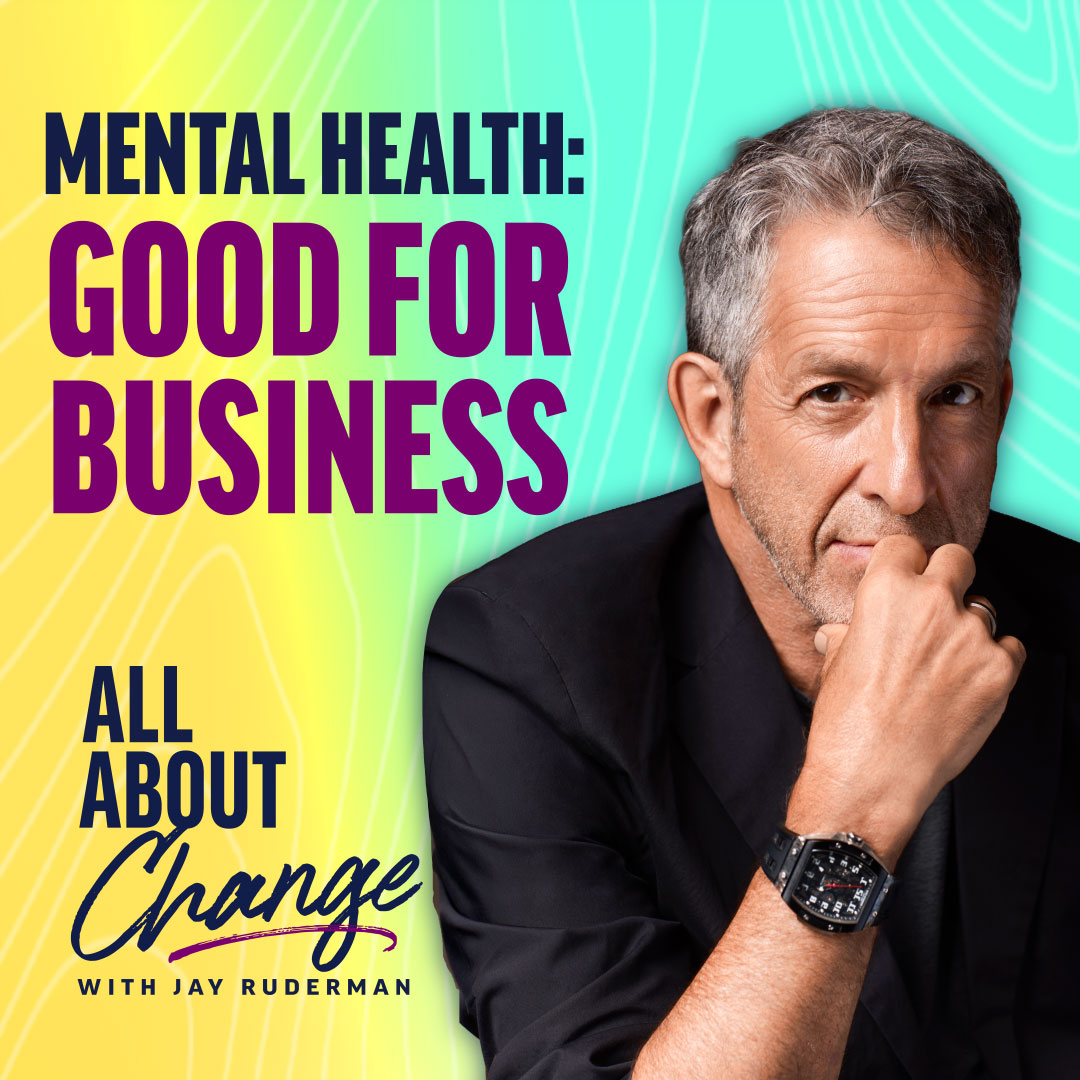
Today, I have a special interview for you that’s been a long time in the making. My guest, Kenneth Cole, has been a fashion icon for decades, innovating a unique and lasting style for which he is known. But he’s joining me today to talk about another of his great passions, mental health awareness.
Kenneth won the 2025 Morton E. Ruderman Award in Inclusion, an award my foundation presents to an individual who’s made an extraordinary contribution to the inclusion of people with disabilities.
The award recognized Kenneth’s transformative leadership in confronting mental health stigma and building a national movement for inclusion through storytelling, awareness, and action as the founder of the Mental Health Coalition.
Now, I’m lucky to be sitting in Kenneth’s showroom and talk with him about some of the crucial work he and his team at the Mental Health Coalition are up to. Kenneth Cole, welcome to All About Change.
Kenneth Cole:
Thank you, Jay.
Jay Ruderman:
It’s my pleasure having you, and I’m really looking forward to our discussion about mental health. For the guests listening, we’re recording this interview in December, but you’re hearing it in May, which is Mental Health Awareness Month. Kenneth, how do you think about Mental Health Awareness Month as part of the effort to de-stigmatize mental health struggles and the process of them seeking and receiving mental health support?
Kenneth Cole:
So those are a few different questions in one. So first of all, what do I think of Mental Health Awareness Month? As a concept I like it a lot. I think it’s a social media event, but it’s a mechanism to aggregate thoughts to large audiences because the whole process on social media and the hashtags and the conversations that ensue bring together large amounts of points of view and perspectives, and you have a chance to connect meaningfully at that singular moment in time. And I always encourage people to participate if they can.
Jay Ruderman:
It’s akin to when celebrities come out and they talk about their own mental health struggles. We’ve, as a foundation, have awarded Kevin Love, Selena Gomez and Michael Phelps. And when they speak out about their own mental health issues, I think it gets a lot of people to say, one, it’s okay to talk about it, and two, maybe I should look into my own mental health.
Kenneth Cole:
The idea of normalizing the conversation around mental health is crucial. Ultimately, that is the single and most important way to address the pervasive and destructive stigma that is making it so hard for people to address their struggles. We say at the Mental Health Coalition, they say one in four will have a mental health condition in their lifetime. We say it’s four out of four because if it isn’t you, it’s somebody you love, somebody in your family, in the community, the workplace, but everybody’s going to live with it and going to confront it in a profound way.
The problem is not that in and of itself. It’s more so that two out of three of those people do so in the proverbial shadows because of the pervasive stigma. They’re reluctant to want to talk about it and they’re reluctant… They feel they’re likely to be judged or to be diminished socially and because of the choices that they’ll use to describe their struggles and the circumstances there.
And there isn’t really today a safe narrative that people can default to. And that’s what we’re trying to work on at the coalition.
Jay Ruderman:
But you can remember back to a time when social issues were hidden, especially by celebrities. I mean, I’m thinking about the example of Rock Hudson in AIDS, and until the end, did not want to come out and speak about it because he thought it would affect his status as someone in the movie industry. But you’ve always been out in front speaking out and you own a business and you have shareholders. So as a longtime activist, how as a business leader, you were able to also become an activist and how did you balance that between running a business and being out there and speaking out about social issues?
Kenneth Cole:
It was a little easier for me than it is for other people because HIV, AIDS, clearly there was an at-risk group that were severely stigmatized and they were gay men, they were intravenous drug users, and to a degree they were Haitians. I mean, that’s where the largest population groups in the earlier stages of the most likely to be… Likely infected or infectors or infected, that’s where it was emanating.
And I wasn’t in one of those at-risk groups. So it was a little easier for me, I think, I wasn’t as concerned about being stigmatized. And maybe it was also for that reason, there weren’t many people that were willing to do what I wasn’t concerned about doing. And it was on everybody’s minds, but nobody’s lips in those days because people were petrified that they were going to be diminished as a result. To your point right now, it wasn’t just in the early days.
Even to this day, there was countless people in parts of Africa and other parts of the world where they still would rather live with AIDS than get diagnosed and get treated, than be open about their status and avail themselves of all the therapies and treatments that are available. They would rather be quiet and live with the consequences, which is what’s so frightening.
Jay Ruderman:
So stigma is a huge part of what we deal with.
Kenneth Cole:
Yeah. As I used to say then and believed, and it’s probably still today, more people are dying from the stigma of AIDS than from AIDS itself. And that’s certainly the case with mental health related issues.
Jay Ruderman:
A lot of your colleagues or competitors, they don’t do that. They talk about their products. They have nice pictures that are attracting people with models and so forth, celebrities, you’re an activist and why do you think you’re an activist and others don’t join you in that?
Kenneth Cole:
I made a decision early on in my career that fashion is a relative expression. What’s fashionable to you may not be to me. And what’s fashionable today may not be tomorrow. And heel heights and hem lengths change every 15 minutes. But if I can make our relationship more about what you stand for rather than what you stand in and not just of what you wear, what’s on your body, but what’s on your mind, then I can have such a… Then our relationship is likely to be so much more sustainable and meaningful over time. And frankly, it’s what’s on your mind that will eventually influence what’s on your body and what you stand for will eventually influence what you stand in.
So that’s just a decision I made early on. And I came to realize that everything felt so much more fulfilling and meaningful once we started doing that.
Jay Ruderman:
Because you’re speaking out about social issues and because you’re addressing things that people are dealing with, the people who have worked for you, do they feel like they’re not just involved in selling clothing and shoes, but they’re involved in a bigger cause?
Kenneth Cole:
I think they do. I mean, I’m sure there’s cases where they don’t, but I believe in my heart most do. And social impact isn’t something we do here. It’s part of, as I say, who we are, and it’s embedded in the business model. It doesn’t exist in a corner office, it exists in every office. And everybody here hopefully touches it in one way or another in their ordinary course, and that’s the goal.
And then we have in here in the business as well, we have a mental health 501C3 not for-profit, and we have a handful of people that work only for it, and they have very clear business goals and deliverables, and transparent, objective, and attainable goals.
And they have an ROI, return on investment needs, as does the business people. And I do think everybody kind of inherently supports each other, works together, but has their own clear goals and objectives.
And I think we’ve created something, I think, bigger than some of its parts by doing it the way we do it.
Jay Ruderman:
Can you talk about the Mental Health Coalition and why it was important to you to try to pull together all of these different organizations that are working on mental health to try to create a larger impact?
Kenneth Cole:
So initially, actually, my daughter was working here at the time. She was working with the HR and she wanted to institute a program, a stigma-free workplace. It was a program that was created and administered by NAMI, National Institute for Mental Illness, the largest mental service program in this country to my knowledge. And I said, fine, we did it and everybody felt good about it. And I had a conversation with the people at NAMI, and they said, “Well, why don’t you carry the torch and do something bigger with this like you did with HIV and help de-stigmatize mental illness?” And upon reflection and conversation, we determined that this is so much bigger than NAMI and it’s so much bigger than us.
And it’s almost culture changing because it requires, if you’re going to address this debilitating stigma, it needs to be such a bigger collaboration and coordination and cooperation unlike anything I think that we’ve seen.
And I said to them, “If we’re going to do this, it needs to be bigger and this tent needs to be wide open and we need to bring in other people because…” And they said, “Bring in anyone you want.” That was basically the feedback and we’re on board, we’ll support it, spoke to the board, they’re on board, loved the idea.
So we started doing that. We reached out to about, at the end, 50 different organizations, all representing disproportionately impacted communities and asked them if they’d want to be part of this coalition. And they basically all said, yes. So the mental health coalition was formed. And with the goal ultimately of circling the wagons and addressing first and foremost, stigma, the debilitating stigma and anything else that nobody else could do individually that felt that maybe we could do collectively. I use the adage often that, alone you can go fast, together you can go far.
And there’s so much strength in numbers and viability and capacity building that you can’t create otherwise. So everybody said they’re in and I spoke to people at Pentagram and they donated generously a lot of the creative branding stuff and then we had a lot here and branding is very much… Messaging is what I’ve always done in my career, but it became apparent very quickly that it isn’t what was appropriate necessarily here for the mental health effort because everybody was doing their own and my goal was to amplify everybody else’s work, not to compete with it. So we’ve created a platform that does that.
Speaker 3:
We all feel like a square peg in a round hole sometimes. One in four of us will have a diagnosable mental health condition at some point in our lives. Four in four of us aren’t okay all the time. The Mental Health Coalition exists to de-stigmatize mental health so people can get the care and support they need.
Spearheaded by fashion designer and social justice advocate, Kenneth Cole, we are the world’s most influential alliance of mental health providers. We work with nonprofits, corporations, and everyday people to change the conversation through campaigns that meet people where they are in bite-sized info that’s easy to apply. Offer fresh resources developed by experts for anyone and everyone to access and understand. Build community, to scale awareness and support online and offline. MHC’s approach is working. Since 2019, MHC’s programs have reached an estimated one billion people. So while there is no normal, there is care, there is support, and there is a role for all of us to play. Join us.
Jay Ruderman:
In my book, Find Your Fight, I talk a lot about allyship, and I agree with you. When you can have like-minded organizations or people who are trying to work on the same thing, it makes sense to bring them together, unless you can’t trust them. But let’s say you can trust people. Organizations can be very territorial. Did you deal with that at all where organizations were saying, “Well, listen, we do this and I don’t want to work with them because…”
Kenneth Cole:
Everybody is territorial. By nature, they need to be. They need to justify their existence and everybody is proprietary. Everybody has to serve the hand that feeds them. And if it’s through a funder or if it’s through some sort of an enabler, and as long as you understand that and you can figure out how to align interests, then you can overcome it. And branding was one of the first things that became clear. And fundraising was a, everybody kind of is going to the same place.
So with the biggest of hearts and best of intentions, everybody’s often tripping all over each other. So how do you create that efficiency? And one of the ways is, first of all, is put them all around the same table. Most of these people had never even spoken to each other, but yet they’re competing with each other with the same goals and objectives.
And I think a lot of that just democratizes itself. I find the opportunities, if there’s redundancy, you become clear on that too. Nobody wants to put more resources behind efforts that are already being addressed. And as long as you also just create that awareness and that access to that knowledge, then people will find their opportunities to have the impact they uniquely can make.
Jay Ruderman:
But does it take someone like you, an outsider who has had success in advocacy to be able to… And has some celebrity to take these organizations together and to say, “I want to do this. It’s important.”
Kenneth Cole:
I think it’s easier for me because I make very clear, I’m not a doctor, I’m not a mental health expert, I’m not a public health expert, I’m not a psychiatrist. I am the least qualified person around almost every table I sit when we’re talking about MHC, Mental Health Coalition, and I make that very clear.
But what I am good at is convening people who are qualified, and that’s what that conference was that we had yesterday. It was bringing experts to the table, empowering them, giving them a pedestal. And I’m good at… I’m a good convener and enabler in that regard. And I make very clear, I’m not here to compete with anybody. I’m here to help you be the best version of yourself.
Jay Ruderman:
One idea in the Jewish tradition is that if you do a mitzvah, if you do a good deed, that it will bring another mitzvah. And the story of the Mental Health Coalition’s founding, like we talked about, you wanted to create a healthy workspace. And as part of that process, you learned about prevalence of mental health issues in the country, in the workspace. Can you talk about some of the positive outcomes and good deeds that have come as a result of the mental health coalition coming together?
Kenneth Cole:
We’re all about transparent, quantitative outcomes, and everything we do is with clear goals and deliverables. And otherwise, we wonder, is this the best use of… Is there a reason for us to even exist in this space?
So the first initiative that we undertook, or one of the earliest ones was actually spearheaded by my daughter, Katie. And it was, “How are you really?” Which is arguably the most asked question everywhere in the world in every language and the one most rarely ever answered, and howareyoureally.org, and we set that up and challenged people to answer that question and allow others to engage in conversation.
And I think we had 300 million people engaged with that content the first weekend. So the ability to reach a lot of people, trigger, initiate conversation that might not happen otherwise, positive conversation, encourage people, show people how to be, myself included, how to be there for each other, how to show up for each other, how to be empathetic, how to be vulnerable.
Vulnerability is a hard thing, especially for a guy and we’re bred not to be vulnerable, and men of color more than Caucasian, and Asian men even more than that. It’s just culturally, it’s just not something that’s encouraged and promoted. So how do you be that? And it’s okay to be that. And we’ve done that. We’ve brought together these one-to-ones. We had this massive conversations with Instagram, and now we’ve launched this tech platform that I think is going to change people’s lives everywhere.
Jay Ruderman:
So yesterday, you had a convening of the Mental Health Coalition, and Jay Glazer got up and spoke, and he has a history in the NFL and professional wrestling, and he talked about getting hurt, and that when you’re hurt, you don’t show it. You can break an… He gave an example of breaking an arm and you don’t show your opponent that you broke your arm. But then he also talked about how he was in a really dark place, and he came to the point where he was able to speak about depression, anxiety, being bipolar.
I thought that was really moving. I thought that was moving for someone to speak about their vulnerability and use it as a power. That goes to your point of the fact that sometimes men don’t want to show that they’re vulnerable, but as part of what you’re trying to get at with the coalition is we have to be more open and honest and not worry about what the consequences are going to be.
Kenneth Cole:
Well, hopefully there are no consequences. I mean, hopefully it enables you to address your consequences in a positive way because if you’re not open about them, you can’t address them and they’re going to fester and they’re only going to arguably get worse. And our goal is to normalize it, to formalize it, to institutionalize it, and to be okay to talk about your struggles. I mean, if you have a broken foot, you wear a cast and you tell the world, and it’s okay. So if I have a broken heart, I have a broken soul, I need to be able to share that.
And what about it is encumbering me and making it hard for me to get out of bed in the morning? And I think that needs to be an open discussion. And if you’re not well emotionally, you’re not well. If your heart isn’t working, your mind isn’t working, your body isn’t working, you’re not working, you’re not whole.
Jay Ruderman:
Kenneth, I’ve heard you talk about the impact that mental health and not addressing mental health has on the business community and the amount of money that’s lost as a result of that. Can you elaborate on that a little bit?
Kenneth Cole:
Yeah. So look, I try to make this an easier conversation because the compassionate case for mental health breaks down almost consistently, I have found. And you try to have that conversation with people and it doesn’t go very far because we all have this empathy, so called empathy quotient I read years ago.
And it is exhausted before you get out of bed in the morning, if you check your social media and if you look at your algorithms, and there’s only so much empathy you can have for so many people, but the world is divided and the world is in pain. And you go to work and you walk past people who are homeless and people who are needy, and you’ve become hardened. It’s the only way you get through your days and only way you get to where you’re going. But the business case works almost consistently, oddly.
And because, A, nobody has money that they can throw at anything, but if you can make a rational case that any sort of allocation of resources is not in fact an expense, but it’s an investment that will pay itself back over time, that’s all of our jobs. And I run a big business, relatively large business, and I’ve been doing it for a lot of years, and I do think and understand the impact of resource allocation. And I do think that, and it has become very clear that, and I have learned that there is unequivocal evidence that an allocation of resources towards mental health initiatives realizes an improvement in retention, recruitment, morale, and ultimate productivity. And that’s my job, that’s every CEO’s job. And it’s an easy decision to make if you can put it contextually in that regard and not making it.
So you can say why it’s a good thing to do, but you can also say why it’s an awful thing not to make it because it’s such a huge drain on our economy.
$1.3 trillion is spent annually by corporate America, which by the way, more Americans get their healthcare from their employer than from Medicaid and Medicare put together. And it’s a drain on your balance sheet, it’s a drain on your income statement and your operating statement.
And not to reapportion it is, A it’s irresponsible and it’s ineffective and it’s inappropriate in your capacity as a CEO and even more so as a human being.
Jay Ruderman:
When I was coming in here this morning, I was reading a news story about a major corporation where the CEO came out and said, “All employees have to come back five days a week.” And I was sort of taken aback and I’m like, “That sounds like going backwards a little bit.” I can’t remember who, I don’t want to name the person because I can’t really remember it, but I think that that is sort of a thing of the past. I think the way I run my organization is, if you can get your work done, I don’t care where you are, I don’t care what you’re doing, I can tell if you’re producing or if you’re not producing, but this whole thing of like, no, everyone has to come back. We have to go back to what we had pre-COVID seems a little outdated.
Kenneth Cole:
Yeah. Look, I think some industries it’s more important than others and in certain areas and responsibilities within certain businesses is more… I mean, if you’re involved with product, it’s hard to do that remotely. But I think the world will never be the way it was pre-COVID. And I think people will work remote and they’ll find jobs where they can be remote because they’re going to look to balance their personal and professional lives uniquely and they’ll make those decisions uniquely.
But I do think there’s a hybrid formula that people will settle on and companies will settle on and individuals will settle on it, and they’ll find something that works for them.
Jay Ruderman:
Kenneth, I want to end by saying, we talked about this a little bit, you’re an incredibly ambitious person and you’re really trying to make a change in this world. What are your hopes for the mental health coalition’s next steps?
Kenneth Cole:
I think we can be a bridge and create something greater, as I often say than the sum of its parts, because there’s so much capacity out there for good and there’s so many people who are well-intended and if we somehow create a mechanism to leverage all of that, and now with AI, you have the capacity to do that much exponentially more than we could have ever imagined before.
I think you can connect with people everywhere and all the time, and you can do it meaningfully if you’re programmed to do so. I think healthcare has changed profoundly because of AI and the ability diagnostically, it’s thousands percent more capable. Healthcare and access to psychological support is 24/7 now, and it’s everywhere. It didn’t used to be. But it can also be, if not used in a good way, it can also be destructive. But I do think everybody’s intentions, way more people’s intentions are to do this thing the right way.
And I do think, and I do believe that we can help encourage that and support that.
Jay Ruderman:
So Kenneth, thank you so much for being my guest on All About Change.
Kenneth Cole:
Thank you, Jay. Congratulations for your book.
Jay Ruderman:
Thank you.
Kenneth Cole:
Congratulations on what you guys are doing and-
Jay Ruderman:
Thank you.
Kenneth Cole:
And encouraging and promoting, and happy to be a part of it.
Jay Ruderman:
And I just want to say that you are one of my heroes because not only have you built a successful company, but you’ve become an outstanding activist who really knew how to use marketing to get the message out there. And you’ve changed our country and our world in terms of reducing stigma on AIDS and now focusing on mental health, which is the biggest issue I think people are facing right now. So it’s my distinct honor to have spent some time with you, and I wish that you will go from strength to strength. Thank you so much.
Kenneth Cole:
Thank you very much, Jay, to you and your family. And thank you for what you guys do for so many.
Jay Ruderman:
Thank you for being part of the All About Change community. We aim to spark ideas for personal activism, helping you find your pathway to action beyond awareness. So thank you for investing your time with us, learning and thinking about how just one person can make the choice to build a community and improve our world. I believe in the empower of informed people like you to drive real change, and I know that what we explore today will be a tool for you in that effort.
All right, I’ll see you in two weeks for our next conversation, but just one small ask, please hit subscribe and leave us a comment below. It lets us know that you value this content and it supports our mission to widely share these perspectives. If you’re looking for more inspiration, check out this next video. I chose it for you and I know you’re going to enjoy it.
I’m Jay Ruderman. Let’s continue working towards meaningful change together.
Today’s episode was produced by Tani Levitt and Mijon Zulu. To check out more episodes or to learn more about the show, you can visit our website Allaboutchangepodcast.com. If you like our show, spread the word, tell a friend or family member, or leave us a review on your favorite podcasting app. We really appreciate it. All About Change is produced by the Ruderman Family Foundation.

Jay Ruderman:
Welcome to All About Change.
Hey, All About Change listeners. It's Jay here, and I wanted to tell you my book, Find Your Fight, is now available in 800 Walmart stores. In the book, I talk about my biggest successes and those of others, and also failures as an activist and my personal philosophy on how to make a difference. It's the perfect gift for friends and family who care about making a positive change in our society.
Few things bring me joy and hope quite like young people who are already involved in making the world a better place. Today, I have the pleasure of speaking with celebrity chef, Eitan Bernath, the youngest individual ever to be named to the Forbes 30 Under 30 list in food and drink. Eitan found success cooking on TikTok and quickly moved to TV, where he served as the principal culinary contributor on the Drew Barrymore Show on CBS since 2020.
Eitan is barely of drinking age and he's already involved in a wide range of activist causes. He's involved in local animal rescue and food rescue in New York City, Jewish representation and serves as a high level supporter of the United Nations World Food Program. Eitan wasted no time parlaying his success into a platform for activism. And I'm so excited to hear about his story. Eitan Bernath, thank you so much for being my guest on All About Change. I really look forward to this discussion.
Eitan Bernath:
Thank you for having me.
Jay Ruderman:
So Eitan, over the past five years, you've managed to get involved with so many wonderful causes and as an activist with a wide appetite for helping, how do you decide which causes you want to support and how do you get involved in them?
Eitan Bernath:
Yeah, so I have been working in food media now for 12 years, which is pretty crazy considering I'm 23 because that's more of my life than I haven't been. And so I've been surrounded by food so much in my life, both in a personal capacity, but also professionally. And so for me, it was a no-brainer in wanting to use my platform to support food insecurity efforts to combat food insecurity. And whether it's from just, it's something that interests me, something I genuinely care about, and also it's something that is adjacent to what my audience is already interested in. So it's very easy to incorporate that into content and to get people interested in paying attention.
Jay Ruderman:
So I've watched many of your videos and you create wonderfully delicious and beautiful food that's photographed so well, and you are just very creative. How did you learn about the fact... I mean, you live in New York City, there's an abundance in New York City, but there's also people who they don't have enough to eat. And how did you find out about that problem? And then what led you from finding out about it to taking action?
Eitan Bernath:
Yeah. So I mean, when you walk around New York City, whether or not most people realize, one in four children do not have stable food at home. It's a staggering number. And after the pandemic and with inflation, it has only worsened. And so I work with an incredible organization here in the city called City Harvest, which is the city's first and largest food distribution organization. Essentially what they do is they find excess food that's super high quality, just like you or I would be happy and excited to eat, from farmers, from grocery stores, from food suppliers, from supermarket chains, from everywhere, and are able to bring it into their facility and then get it distributed to soup kitchen, food pantries and alike here in New York City. And their work really, really inspires me. And I've been one of the chefs on their food council now for definitely over four years, maybe close to five. And I try to be as involved as possible.
Jay Ruderman:
So let's talk about Western society. And I just got back from three weeks in Japan and there's an obsession with fresh food in Japan, and everything tastes wonderful and it's prepared fresh. But I was thinking to myself, how much of this goes to waste? And I think it's the same thing in the United States and New York. I mean, what is happening? Does most of that food that's not being collected and redistributed, how much food goes to waste in our society?
Eitan Bernath:
Yeah. I mean, it's crazy. The problem of hunger here in the US is entirely a decision on our government and both in the public sector and frankly, also the private sector. We have more than enough food. A staggering amount of food goes to waste, and much of it is food that is perfectly still good to eat. Just actually this past weekend, I volunteered separate from the media stuff that I do with City Harvest. I try to actually use my hands and volunteer whenever I can. And so I was at a food distribution center in Staten Island. We distributed almost 10,000 pounds of fresh produce to New Yorkers in need. And this produce we're distributing is excess produce. Maybe they're apples that were a little too small to sell in grocery stores that are less desirable. We had green peppers that frankly just must have been in excess because they looked fantastic.
We distributed pears, we distributed potatoes, and this is all perfectly great produce that luckily thanks to City Harvest, has been rescued and has then been distributed. There's so much more. We have the food. It's not like the US doesn't have enough food to feed everyone.
Jay Ruderman:
So you'd almost think that... I mean, I know there are organizations and you talked about them that get involved in doing this, but you'd almost think that our government as responsible for its people would get more involved in addressing this problem and addressing hunger in a way that's more systematic.
Eitan Bernath:
Yeah. I mean, it's like the amount of the food that's wasted is by many estimates as much as 30%, and that's from the government. That is a ridiculous percent of our food that's wasted. And now, of course, that accounts for many things. If you at home, let's say, cook yourself dinner and there's some food left in the pan or you're cutting onions and then you throw out the peels, that's part of food waste. And we could all do our own things to limit the food that we waste, but on a much larger industrial scale, there is so much food. And this isn't only a problem in the US. There's many countries on earth, India being one of them that produces incredible amounts of food, but still has a huge percent of the population who suffer from hunger. This is an issue that happens across the world.
And so it's really up to, I think, governments and ideally NGOs and the private sector as well to step up and really find homes and mouths for this food because it's there. It's not like we need to figure out how to grow more food. We don't.
Jay Ruderman:
I'm thinking of an interesting clip that you just posted a while back about your trip to India and how there was a Sikh organization that had a kitchen in the religious center and they were producing food so that anyone who wanted to eat could come in there and eat, which was such an amazing moving thing because you don't think about that of people just welcoming anyone into their facility and saying, "Hey, there's extra food here. Come eat." What was that experience like for you?
Eitan Bernath:
Yeah, it was incredible. So I was in a Sikh gurdwara, and gurdwara is the word they used to call their house of worship. And there's an incredible part of their tradition called Lengar, I might be mispronouncing it, I think that's how it's pronounced, where people donate, farmers donate produce and the food is donated, and then people also donate their time to come cook the food, and then anyone who needs food can come in and eat the food. And I think what was so incredible about it is it truly is anyone. You don't need to be a Sikh, you don't need to be someone who's coming there to worship. Just if you're hungry, literally every single day you could go there. And it's all about everyone being treated equally. You all sit on the floor, you're given the banana leaf and the food's put in front of you. There's no hierarchy.
There's someone who's worshiping there is treated any differently than any person that walks in. And this is something that's not just done in India, this is done from, as far as I know, across the world in Sikh gurdwara. And it just was such a striking, beautiful tradition... Not even tradition, but something that's actively done that they really... It's one thing to say, I believe we need to do our part to feed the hungry, but this actual every single day in and out execution of that is really impressive and really beautiful.
Jay Ruderman:
There is something beautiful about that because instead of in our country, we're like, okay, well, if you want to eat, there's a soup kitchen and you can go and there's food there in some cases, but this is actively going out and saying, "You're welcome into our house of worship. We're actively going out and providing food for you." Do you think something like that could work here in the United States?
Eitan Bernath:
I think on a national scale... I mean, I do know there are in the US, because especially a lot of members of the Sikh community in the US had responded and messaged me when I had posted that. In the US, there definitely are gurdwara that do that. And maybe so if the Sikh community opens one up everywhere, that'd be amazing. But I think in a practical sense, I think it really can show the power of volunteer work and because it's not just a financial thing, people show up and what the person who was giving us a tour of the place really spoke about is a lot of the people volunteering. There were women and men everywhere cutting vegetables. Me and my family joined them in one of the rooms where you're rolling out roti, the flatbread. Many of the people who are volunteering there also come there to eat regularly and need to do so.
And so I think what can be learned from that and scaled more is more encouragement of actively doing your volunteering. It's like my grandma, my grandma Bobby, throughout my life when she was able to more physically would volunteer when she lived in Austin in Westchester, would volunteer at soup kitchens and food pantries. And for her, it was maybe checking people in or whatever kind of things they needed. And it's something that really inspired me. I do a lot with City Harvest. I also work with the World Food Program on a more international scale. I do a lot in media, whether it's going on television to talk about them, posting on my social media, but something that's really important for me, and I try to do as much as I can, is actually physically using my own two hands to help like I did this weekend. And I think that's something that we could really encourage across the board more.
Jay Ruderman:
You reminded me of my bubby and how she did not drive, but she loved cook, and she would cook meals for her friends who were maybe less fortunate than her and she would take those meals, put them in a paper bag and walk them to their homes to make sure that they had a nice meal for lunch or for dinner or something like that. And what role does fun play? Because when I see you in a video, first of all, you have a magnetic personality and people are drawn to you, I mean, not just for your delicious food and your creativity, but also you have a smile on, you're laughing, you're having fun. Talk about the importance of that because I think a lot of us maybe discount that and say, "Oh, this is work and this is tough." And it seems like people aren't having enough fun going through life.
Eitan Bernath:
I definitely am a big fun person, I would say or hope to say. I think for me at the end of the day, my goal with the videos I produce is to get people excited to cook. And at the end of the day, my job is a job. There are days where I am not in the mood to film a cooking video, but I need to. And maybe I'm a little less excited in my heart than my face is projecting, which is not frequently, but I'm a human and at the end of the day, me posting videos is my business, but I think there's a balance, especially working in the field that is my passion of, it's my passion, but and at the same time as a business. And so I'm really in a unique situation where I get to really have this creative control and have a lot of fun with what I'm doing, even talking about food insecurity.
I think something that I really make an effort is I'm not going to be posting videos guilting, "Oh, this many people are hungry. You should donate money, blah, blah, blah," in a sad way. I try to approach things even from that sense from this problem exists and here's what we can do about it. And whether it's just showing me volunteering or highlighting City Harvest's work, I think that for me, I know how I speak with my audience and the relationship I have with them. And so even when I'm speaking about philanthropic work or volunteering work, obviously if you need to stand outside in Staten Island and hand 500 New Yorkers produce for free that they can't afford, that's a tragic, upsetting thing, but that doesn't mean that's how you need to present it. You could talk about it as...
And because here's the thing, I had a good time doing it. People had great attitudes. The people I was volunteering with, we had fun just kind of schmoozing while doing so, wishing everyone who came in, "Oh, good morning. How are you?" There were some adults brought their children with them, saying hi to the kids. It's of course a upsetting thing that this need is out there, but being active and doing it doesn't need to be upsetting. I was not upset at any time when I was volunteering. I was having a nice time. It was fun to get to meet 500 people, ask them how their day is, smile, they smile back. And I think that's what I try to highlight.
Jay Ruderman:
And I think you truly love the human interaction, which is really important.
Eitan Bernath:
Yes. I would say I'm a big extrovert.
Jay Ruderman:
Do you ever find yourself as a mentor in talking to other influencers and trying to encourage them to give back more?
Eitan Bernath:
There's a lot of great opportunities to support organizations and causes that are important to you in your heart through your work that also can end up being quite reciprocal. And I think that's something I always try to tell a lot of friends of mine who do this is through my work with City Harvest, the reason I'm passionate about City Harvest or the World Food Program or any of these organizations I support is because it's something I care about and I believe in their work. And there's many incredible organizations and City Harvest is one of them, when they partner with media figures, also have really cool opportunities they could bring you. I'll give you an example. I think this was about two years ago in honor of an event that City Harvest was doing, I got to light up the Empire State Building that night, which was super cool. It was an incredible media moment.
Whether it's been that or I've gone to meet incredible other chefs that work with City Harvest, I have materially from a brand sense have benefited immensely from my partnership with City Harvest. It's not the base reason why I work with them and support the work at all, but something I tell people a lot is a lot of organizations are eager for your support. And if you find one that really resonates with you and you're passionate about, oftentimes if what they're doing is really cool, they have cool opportunities to bring you as well. And so it's really a 360 type of relationship. And it's something that I try to tell people, is everyone has limited bandwidths. You can only do so much in a day, but the reality is if you're passionate about it, a lot of times beyond doing what feels right and what you know is right, it actually can also benefit you in a cool way.
Jay Ruderman:
You've been in the spotlight since I think age 11, before your bar mitzvah.
Eitan Bernath:
Yes. Yes.
Jay Ruderman:
And I loved you on Chopped and your 11-year-old Eitan with the kippah. And I'm just wondering how much has your Jewish identity changed as you've gotten older and moved along your journey and how has your Jewish identity shaped your journey?
Eitan Bernath:
Yeah. I mean, so when I competed on Chopped when I was 11 and started an Instagram page and started creating content online, I would say probably 90%, if not more, of who was supporting me and excited about me was the Jewish community. I grew up in Teaneck, New Jersey and in a very strong supportive Jewish community. The first media pieces written about me were in the local Jewish papers. Nowadays, 12 years later, the overall majority of my following, I would guess probably 95%, if not 99% of my audience, just like because of the population of the world, is not Jewish. I still have a super strong, very loud, very supportive Jewish following. And yeah, I think I absolutely have the Jewish community to thank for A, the beginning of my career and being so supportive and just continuing to be super supportive.
And I think in terms of being on the internet as a Jew, that definitely comes with its set of challenges, have absolutely faced immense antisemitism, awful death threats, very, very unsavory messages. It's something that at this point I'm quite used to, but I've volunteered with different Jewish organizations and have spoken up about combating antisemitism. And it's a very integral part of who I am. The food I cook is not generally Jewish food. My account's not about being Jewish, but it comes up all the time because being Jewish is a ginormous part of my life.
Jay Ruderman:
And you don't hide from it.
Eitan Bernath:
No, not at all. Even despite obviously the last years or so as a Jew on the internet has been exceptionally challenging. And I think for me, just staying strong to my beliefs and my pride as a Jew. And it's definitely, there were some times in the last two years where there were some super, not very specific death threats. There were times I've been, unfortunately, had to be in touch with the FBI about specific things, which is not fun, but it's part of the job. An unfortunate part, I guess.
Jay Ruderman:
But I also say, that you have a very mature view. Some people would have a very difficult time dealing with what you have to deal with online, and you seem to have developed a very thick skin, or at least a way of dealing with it.
Eitan Bernath:
I think I've kind of always had a thick skin. I know when I was on Chopped when I was in middle school, I got made... Well, first off, at 11 years old, I got Chopped in the appetizer round on national television with my whole school and everyone I knew watching. So I think that definitely got me started with having a thick skin and being able to take some punches. But I think beyond that, I definitely got made fun of when I was younger for cooking. Now people think it's cool. It definitely was not cool when I was nine, 10, 11, and I think that's definitely how it started.
And beyond that, I think just being in the public eye, whether it was when I was younger and had acne and getting comments, "Oh, you have pimples, blah, blah, blah." Or I even had braces when I was on Chopped and was starting, out about a year on the internet or even less will probably build you with thick skin. If someone on the internet has the thought about you, they'll let you know. And so I think I've just gotten quite used to it and I think it's helped me become a super confident person. And I was actually just talking to someone about this the other day about how it's funny when you've done this for so long, you have a very thick skin and then randomly, once in a while, someone will send you a hate message about some very specific thing you didn't even know you're insecure about, and then it hits you like, "Oh my God, are they right?"
But I would say in general, specifically with antisemitism, I mean, obviously someone telling me, "I hope all Jews die." It doesn't upset me. It's upsetting that people feel that way, but nothing I did to deserve that other than be born into the religion and heritage I was born and choosing to be proud of it. And beyond that, I think antisemitism has so many forms, whether it's... I sometimes get messages that Jews aren't the real Jews, and that whether it's a Black Hebrew Israelite telling you that Jews are not actual Jews and they're the actual Jews and that we're imposters, or whether it's people, antisemitism or blaming Jews for the actions of the Israeli government, there's so many forms of it and it's unfortunately saying that there's new forms being figured out and invented, it feels like every day.
Jay Ruderman:
Well, I think that being famous is not always easy and it's not always natural. So I'm wondering how important a role does your family and your close network of friends play in giving you that stability that allows you to do something that puts you in a very vulnerable situation?
Eitan Bernath:
Yeah. I mean, I think a lot of times when people, sometimes find me kids or teens and they're like, "Oh, when I grew up, I want to be a social media influencer. I want to be famous." I think something that I've learned as basically spending now more of my life than not in the public eye is it is absolutely not for everyone. I think I have a pretty perfect set of self-confidence and thick skin that it works for me, but there are many, many, many, many, many, many, many, many, many challenges with it and things that I think most people would strongly dislike, and frankly, many parts of it that I dislike. I think for me in my life, the pros of my job severely outweigh the cons. But whether it's just opening yourself up to everyone's opinions, and not only that, is I can post something and off someone who then knows my parents and could say something to them about it.
And so things that I do in my actions don't only affect me, they affect people that are maybe close friends of mine or family members. And so for me, it makes me really value. I'm super close with my family. I live here in Manhattan, my family's in Jersey. I see them at least once or twice a week. I talk to my mom and dad every single day and my brother Yoni as well. And so it's super important for me, whether it's my family, my friends, it's important to keep a good close-knit inner circle and just have people to talk to, because there's definitely very unique challenges that come with this job that can be hard to talk about or hard to relate to with normal people who... Not normal people, sorry, people who don't experience having millions of strangers on the internet tell you what they think about you every day.
Jay Ruderman:
Hey, Eitan, I want to talk in my book, one of the biggest steps that I talk about as an activist that you can make is to find your fight, to really find what's important to you and to go after it. And I feel like you're just getting started. So I'm wondering, what sort of impact would you like to have in the next five to 10 years? How do you envision yourself as an activist and how does that work itself into your career?
Eitan Bernath:
I think in the food insecurity space, something that I've enjoyed doing that I would love to do more is be able to do more storytelling of unique solutions that are put in place throughout the world, kind of like what I did in that content series that you referred to in India. I'd also highlighted some incredible initiatives in this northern state in India called Behar, where they're helping women farmers optimize. One of them was out raising goats, another was more focused on agriculture. And so I think being able to highlight those solutions and raise awareness on them or sign that, I frankly really enjoyed the process of and hope to do more of. And then beyond that, just continuing to find ways to creatively incorporate the messaging into content in kind of fun and engaging ways, increasingly with the algorithmic content distribution on all the platforms, just posting a video of me talking straight to camera plainly about food insecurity is going to get 100 views.
And so you really have to be creative and make content entertaining, even if it's about something like that. And I hope to continue doing that and continue to encourage people to get out there and donate and donate their time, frankly. I think there's a lot of organizations that have a lot of money. Donating money's great, but I think a lot of times people may say, "Oh, I don't have the money to donate. There's nothing I can do." If you have a free Sunday morning, you could go to your local soup kitchen, your local food pantry. And I think that's something I like to encourage people to do is because truly, whether it's me handing out food, Grandma Bobby, checking people in while sitting in a chair, I think that's a good example of how we really all can do our part no matter how small it feels. And I think that that's something I really want to continue to encourage people and find creative ways to do that.
Jay Ruderman:
It's such good advice because I get approached by a lot of people and they say, "I want to get involved as an activist. I don't know what to do. I don't know how to start." And I once interviewed not too long ago, Jonah Platt, and his advice was, "Just do it. Just go out and do it. Just start doing something and it'll lead to something." Eitan, I want to leave you with a compliment because I know you travel all over the world, you're all over the place and you're busy and you meet people and you learn so much, but the way you do it is so respectful of other people and that's rare. I don't see that all the time. I see things as being very transactional, but I don't feel that your interactions are transactional at all. I think that you're really treating people with respect. You want to learn and you want to do it in the right way. So thank you for doing that.
And I really appreciate what you've done both as a young person and really having a fabulous career, but also giving back to our society and really having an impact. So Eitan Bernath, thank you so much for being my guest on All About Change. I've really enjoyed this conversation and I wish that you will go from strength to strength.
Eitan Bernath:
Thank you. Thank you. That was very kind of you and thank you for having me. This was a lot of fun.
Jay Ruderman:
Thank you for being part of the All About Change community. We aim to spark ideas for personal activism, helping you find your pathway to action beyond awareness. So thank you for investing your time with us, learning and thinking about how just one person can make the choice to build a community and improve our world. I believe in the power of informed people like you to drive real change, and I know that what we explore today will be a tool for you in that effort. All right, I'll see you in two weeks for our next conversation, but just one small ask, please hit subscribe and leave us a comment below. It lets us know that you value this content and it supports our mission to widely share these perspectives. If you're looking for more inspiration, check out this next video. I chose it for you and I know you're going to enjoy it.
I'm Jay Ruderman. Let's continue working towards meaningful change together.
Today's episode was produced by Tani Levitt and Mijon Zulu. To check out more episodes or to learn more about the show, you can visit our website Allaboutchangepodcast.com. If you like our show, spread the word, tell a friend or family member, or leave us a review on your favorite podcasting app. We really appreciate it. All About Change is produced by the Ruderman Family Foundation.
Jay Ruderman:
It is Jay here. I want to share that "Find Your Fight" is now available wherever you get your books. It is my personal guide on how to make a difference, a perfect gift for the change makers in your life.
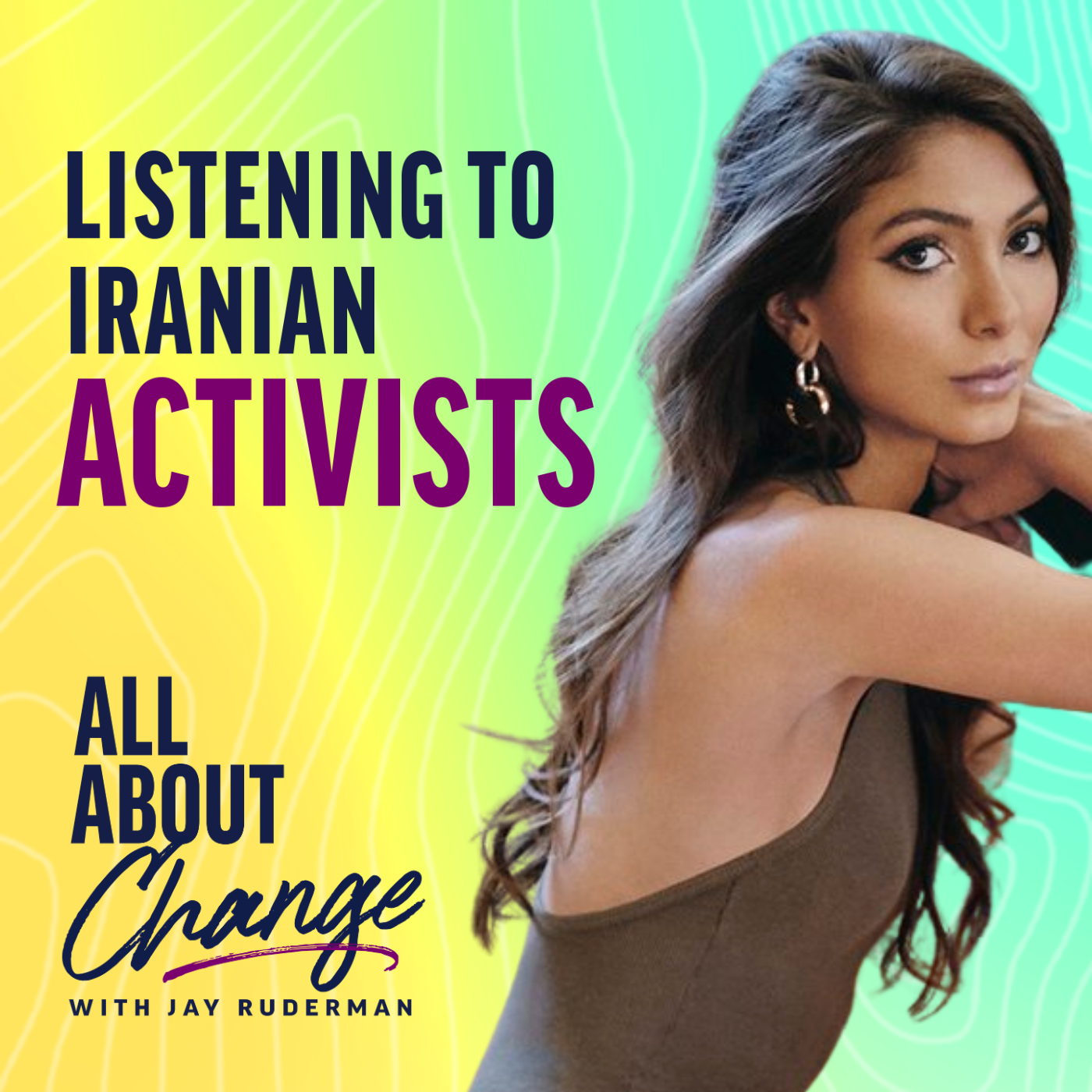
We’ve been committed to covering the human rights crisis in Iran for a long time. During the height of the “Women, Life, Freedom protests, we spoke with Hadi Ghaemi, the Executive Director for the Center of Human Rights in Iran, about the brutal reality on the ground and the resilience of those fighting for change as the situation remains as urgent as ever.
We wanted to revisit a more recent and vital conversation with another powerful voice for the Iranian people. Noor Pahlavi is a member of the exiled Iranian royal family, but she’s carved out her own path as a modern advocate born in the United States, she could have opted for a life in the shadows.
Instead, she chose to leverage her unique heritage and platform. To amplify the voices of our homeland. We’re returning to this discussion to talk about gender equality under an oppressive regime, the critical state of women’s health, and why it’s essential to remember the hope and courage of the Iranian people.
Noor it’s an honor to have you back on the show. Welcome to all about change.
Princess Noor:
Thank you for having me.
Jay Ruderman:
So Noor, your father as the Crown Prince has been a symbol and an advocate for democracy in Iran to Iranians who are living outside of Iran and those living inside Iran. When you were growing up, what type of stories, what did you learn about your grandfather, the Shah?
Princess Noor:
I mostly heard about who he was rather than what he did. So a person who was very kind of soft-spoken, loved his wife, loved his dogs, loved his kids, kind of had a sensitive stomach, was very low maintenance, and also kind of a suffer-on-the-inside type, but definitely sensitive to his people, their sentiment. And I’d heard a few things. I had a high school teacher who worked for the Carter administration, and I remember hearing some things in that class that I went and asked my grandmother about when I came home. And she is not a reactive person, and I’ve never actually seen her stirred apart from in this conversation where she was just… She sat me down and just laid it all out, all of the misconceptions in the United States that they have about what happened then, the US’s role in the revolution, and what people who worked in the Carter administration have said to her since, expressing apologies and stuff like that for the way they really turned their backs on him when he needed them most.
And I think that that was also the conversation where she talked a lot about what he did for Iran as a country for his people, for women, for families, for the environment, for the progress of the economy, the vision he had of a country that isn’t solely reliant on oil for fossil fuels, but treats it as a precious resource, bringing people from the cities to the rural areas to expand access to education, sending people abroad to get access to other countries and bring back what they know and really trying to integrate Iran into the global landscape and build bridges.
And I think it’s such a shame now because if he could see what Iran’s become, it’s the complete antithesis of what he had in mind. It’s now a passport you don’t want to have, it’s a country that’s feared and a country that shuts its people off, even if it involves cutting off internet access from anything that doesn’t align with its really rigid ideology. My grandfather wanted minorities to have a voice. He welcomed Jewish people, he welcomed people of all faiths. He was open to anyone having a voice in government, in leading educational institutions, in business. And I think, again, the laws that are in place now, everything that makes life for these people in Iran, for women, for religious minorities, for gay people, for everything, I think if he could see what’s become of this country, he would die all over again.
Jay Ruderman:
Right. I want to switch and talk about your grandmother, the Empress Farah Pahlavi, and what influence she’s had on you in terms of fashion, in terms of advocating for the Iranian people. What do you remember at a young age the messages that she gave you?
Princess Noor:
She’s a really, really special person. I think what messages she gave me when I was growing up usually had to do with making sure I understood Iranian culture for what it was and the truth behind its people and the beauty, the openness, the art, the intelligence, the education, everything that was true about the people when she was there and that still is, and the warmth of this culture. And beyond that, it was a lot of messages about treating all other living things with kindness, with respect, trees, animals, and not to value material things at all. I think that really came from her leaving Iran with nothing but jean shorts and her photo albums. The way that she never talks about things she used to have, she’s very in the moment and just very grateful for her family and for the love she still feels from the Iranian people who reach out to her all the time.
And what I’ve learned most from watching her though is the grace with which she faced unbearable loss, first her country, then her husband, and more recently her two children to suicide. I think there’s this theme in my family of duty to their countrymen transcending any pain that one person might feel in the moment and a bigger picture they’re all fighting for. And I think being a mother to Iran has always pulled her through the trials that she’s faced in her personal life. And I understand her. It’s such a unique privilege for us to be in a position to help others on this scale and to play an active role in bringing about change, and I think that really has been something she’s clung to to pull her through.
Jay Ruderman:
Well, she seems like a beautiful person. I want to talk about the current Islamic regime in Iran. How would you describe them, and in your opinion, what are their goals? I remember the revolution, and I remember that Iran was a fairly modern country with a modern outlook, with people who were happy. And now to see the repressive nature, not only of the Islamic Republic, but also the export of terrorism is problematic for the region and for the world. And I saw a post that you put up, and maybe you can talk about this, that when we say Iran, you don’t want us to refer to Iran as Iran, but as the Islamic Republic.
Princess Noor:
Right.
Jay Ruderman:
Can you talk about that a little bit, about what that means to you?
Princess Noor:
Yeah. First, I feel it’s really important to clarify for those who are less familiar with Iran that this government should only be referred to really in the context of it being Iran’s occupiers. They’re in no way representative at Iran’s population. They represent their own pursuit of fundamentalist Islam, which they want to export and impose on the rest of the world, its proliferation both domestically and abroad, and they’re constantly preaching to this effect. If you watch videos of clerics inside Iran and what they’re saying, our Western values are the enemy that threaten that. When foreign countries address them or negotiate with them as Iran’s representative, it legitimizes them, and this legitimacy is a slap in the face to all who are risking their lives and giving them every day inside Iran to fight this government.
And secondly, there’s a huge misconception here that this government has been democratically elected. Despite appearances of having elections, these are heavily controlled by the radical Islamic clerics and the supreme leader as holding the ultimate authority. Since 1979 through propaganda, through brutal force against its people, they maintained their grip on power, and the elections are not free or fair. Only candidates approved by the regime can participate to ensure that this ruling class remains in control. And make no mistake, the supreme leader pulls these strings, and the regime’s priorities are not the welfare of its people, but in maintaining this ideological and political dominance. And all the proof is there. They’re lining their own pockets, funding terrorism, and letting their own people starve. They’re the enemy of any freedom-loving person. And so when I hear people apologizing for them or attributing their actions to a different source, I really ask that they educate themselves or listen to the speeches they give to galvanize people against the West.
And they wreak havoc on all of us through their proxies every day. They’re the head of an octopus, and organizations like Hamas are the legs. And I want to say to Americans that you’re not untouchable. If you think you’ve not been affected by Iran, in some way you have. Think again. And if things continue down this track with nobody supporting the Iranian people to stop them, being stripped of freedoms won’t just be an Iran problem, it’ll come right to your doorstep, because they view America as the devil, and they’ll do whatever they can to infiltrate it. It started in Israel, it’s going to happen here. It’s already started on university campuses here and election meddling, and it will only get worse as they get emboldened as they approach a nuclear weapon.
Jay Ruderman:
Noor, let’s talk about life for Iranians in the Islamic Republic. I’ve seen many videos during protests, and there’s a love, I remember during the hijab protest, women walking in the street without the hijab, giving each other gifts, hugging each other, smiling. There was a story of, you probably know this story, of a man who was dancing, it was a shopkeeper, and his dance went viral all over Iran. So can you talk about the Iranian people and what their lives look like?
Princess Noor:
Yeah. So because they live under a government that’s more interested in holding on to power and spreading radical Islam than helping its own country and people thrive, they’re facing severe economic challenges and oppressive social conditions. Basic necessities like bread and eggs have become luxuries for many Iranians because of rampant inflation, the devaluation of their currency, infrastructure, electricity, and water systems is severely outdated, dating back to when my grandfather was there. This has led to frequent power outages, water shortages, which I talked about a bit on my Instagram. And I frequently get videos from Iranians in sweltering heat struggling to keep their businesses running with no power in the middle of the day and no AC.
And one thing the regime especially doesn’t care about, which those who overthrew my grandfather pointed to as a sign that he was delusional when he attempted to prioritize it, is the environment. Iranians often joked that soon the regime would charge them for oxygen. And now after decades of severe neglect, pollution issues have made the air in so many cities dangerously toxic, and it breaks my heart to see the toll that this is taking physically on Iranian people. And beyond mismanagement of funds. The social conditions in Iran, as you know, are dire. They have the highest per-capita execution rate in the world, and there’s been a significant increase in the executions following the 2022 protests that Mahsa Amini’s death triggered.
And the regime also routinely persecutes religious minorities and ethnic minorities where they’re contributing to this atmosphere of fear of oppression. And there’s also the highest child execution rate in the world, and you can be jailed or killed for leaving the Islamic faith and denied education. Unmarried men and women are banned from being together in public or showing affection. Dogs are considered illegal. They’re rounded up and killed by the regime. Anyone who speaks out against this government is at risk of brutal repression. And Iran’s prisons are now filled with intellectuals and some of Iran’s bravest and brightest, because they have no basic protection. Even lawyers for political prisoners or families demanding answers for their loved ones are being thrown in jail. So this regime is doing this with impunity, and their policies are emboldened by Western weakness and appeasement in regards to this government.
Jay Ruderman:
It’s a horrific situation. Maybe you can talk a little bit about what freedoms were present when your grandparents were ruling the country.
Princess Noor:
It’d be so much harder to even talk about what freedoms were not present, because my grandpa made my grandma the first female regent, which empowered her to stand in as a leader should anything happen to… until my father came of age, which was extremely progressive for the time. A good amount of family law had been passed that some Western countries don’t even have today. We don’t have that much help sometimes with family planning, child care, maternity leave, but that was a priority. My grandpa banned polygamy, unilateral male divorce. He allowed mothers custody of children, he raised the legal marriage age. The mandatory headscarf was removed by my great-grandfather. He gave women the right to choose if they want to be covered or not.
And there were a bunch of other freedoms granted that I think we might take for granted over here in the US back then, but the Islamic Republic revoked every single one of these provisions in 1979. Women were the first casualties of the Iranian Revolution. And we talked a bit about it before, but my grandfather really wanted to open Iran up to the rest of the world and make sure that his people progressed with the rest of the world and played an active role in the global economy, and I think it’s such a shame.
Jay Ruderman:
So we’ve all seen these horrific videos of women being taken off the street and pushed into vans. Can you talk a little bit about the state of affairs for women currently in the Islamic Republic?
Princess Noor:
Yeah. I’ve always been surprised that this wasn’t talked about more before the Mahsa Amini protests kicked off. But Iran ranks near the bottom of the World Economic Forum’s Global Gender Gap Index. They’re 143rd out of 146 countries. Women in Iran have no laws to protect them against gender-based violence. Their testimony in court is worth half of the man’s. They receive half of the inheritance of their male counterparts. The legal marriage age was lowered from I think between 15 and 18 to 9 after the revolution, and later raised to 13, but younger marriages are still allowed with a judge or father’s permission, and I think that it probably it was only raised to 13 because they realized nine-year-olds can’t produce children right away. But women need their husband or male guardians’ permission to travel or get a passport. Men have the unilateral right to divorce while women can face significantly legal obstacles to do so.
They’re segregated from men in the workplace, classrooms, and public spaces like beaches. They’re banned from certain fields of study and job roles that are deemed inappropriate by the regime, Banned from attending sports events and stadiums. They can’t ride bikes or sing alone in public, which is super strange. They have no legal protections against honor killing, or if there is a punishment, it’s minor. Gender-based violence pervades them, and the perpetrators often face minimal consequences. Sexual assault is used as a tool of repression against female protesters regularly, and they’re constantly monitored by the morality police who enforce dress codes and other gender-specific laws.
So the regime has engaged in a ton of campaigns of intimidation, including poisoning schoolgirls or actively shooting protesters in the eyes to blind them. And women in religious minorities face additional discrimination, including denial of education and employment opportunities. So the situation for women in Iran is dire, and the current protests have shown the world, I think, that Iranian women are not willing to be silenced. They’re fighting back against a regime that seeks to erase our identity, their autonomy, and the world really needs to recognize the severity of their struggle and support this quest for women, life, freedom that you keep hearing chanted throughout this revolution.
Jay Ruderman:
Right.
Crowd:
[chanting in foreign language].
Jay Ruderman:
You’ve talked in the past about gender inequality in the Islamic Republic, including in healthcare, and yet you’ve been very open, your mother’s been open about talking about her own health and her experience with breast cancer. Can you talk a little bit about health care and where you think things are right now?
Princess Noor:
Sure. So my mom’s a pretty private person when it comes to her personal life. We’re not really the people who speak comfortably in front of a camera feel natural sharing aspects of our day-to-day, so a lot went into her decision to share this journey at a time that was very scary for her. And she did a lot of research into the state of healthcare in Iran and women’s access to it by speaking both to women inside and getting connected through various sources, as well as doctors who are trying to get care to these patients or trying to raise awareness in the region. And her reasoning for sharing her struggle was providing a lens into it might help combat some of the taboos associated with women’s health discussions in Iran, and she hoped it would empower women to talk more about this and raise awareness. And so many people face this in their lives, and investment in proper healthcare, particularly in rural areas, isn’t something that’s been prioritized in Iran as we’ve discussed.
What they prioritize is lining their own pockets and funding their interests of spreading radical Islam through terrorism. So in these areas, both the lack of access to the infrastructure as well as the culture, which is one where there are so many taboos surrounding talking about the female body, really, women are spoken about in the media by the government as tools to procreate and nothing more. And they started associating some kind of shame with anything to do with talking about something like their breasts or breast cancer, and that is something that my mother really wanted to change. She didn’t want people to shy away from it because this is actually a preventable illness. And being educated about it and monitoring it is something that could save lives. So she wanted to combat that moratorium around the vocabulary that the Islamic Republic has.
Jay Ruderman:
So we’ve talked about what you see in videos about the beautiful nature of how people interact with each other, but talk a little bit about your dream for women in Iran.
Princess Noor:
Yeah. My dream is it’s for them to have the freedom and autonomy over their lives that I have. I can’t think of anyone who deserves that more after the hardship they have faced and the bravery they’ve shown. And to see someday free and their elections take place in Iran and for people to have a choice in who governs them or a government that actually represents them and works for them. And my dream is for the rest of the world to stand up to this bully and to set their differences aside and hear the cries of the Iranian people and acknowledge them. This dream started to come true when I saw actors, musicians, artists, and other people with platforms highlighting the plight of Iranian women on their platforms and reposting these videos that these women have risked their lives and very often sacrificed their lives to put out into the world.
So I would love to see the US get behind them by easing sanctions or releasing frozen assets because those funds do not touch the Iranian people. They line the pockets of the few who are in charge and fund the terrorism that we’re sending troops to fight. And I would love to see them stop negotiating with a government that the people say doesn’t represent them, one who makes a mockery of us and the agreements openly and has been proven to ignore them, a case in point, the nuclear progress they’ve made. This legitimizes them, like I said, and it’s a slap in the face to all who continue to give their lives in peaceful resistance. And we shouldn’t be inviting them to speak at the United Nations. These are the number one human rights violators in the world, and assigning guards with our taxpayer dollars to protect them is ridiculous. And government shouldn’t be able to do what the regime does with impunity. It simply can’t continue. And my dream is to see that and to see Iranians freed.
Jay Ruderman:
Well, I think we stand at a pivotal time right now regarding the Islamic Republic and the world, and we’ll see what the weeks and months ahead bring. I also want to touch on your advocacy for Iranian women abroad, and what are you doing to advocate for women who are not living in Iran.
Princess Noor:
Yeah. I think some of the work that I do, it’s difficult to give too much detail on since the people I try to help, they take great personal risk to reach out to me and getting anything-
Jay Ruderman:
True.
Princess Noor:
… into Iran is so sensitive and so challenging, and it’s been a lot of work trying to create the channels for that. One initiative, for example, was, when the internet was shut down, trying to get drones in to get people back online to make sure that people continue to hear their stories and that the government isn’t able to cut Iran off from the rest of the world. But using my platform to shed light on their issues I think has helped somewhat to get their voices heard globally. I want to be a megaphone for them since they’ve been systematically silenced. And I think it’s important, though, to go beyond that as well. And there are some people here in the States who are working for the Iranian people and trying to get their stories to the right people in government and trying to influence policy here so that our policy leaders actually understand the voice of Iranians and aren’t just listening to the regime and its proxies.
And those are groups like the National Union for Democracy in Iran. It’s comprised of a mix of Iranians from all over, all ages and genders, many of whom have escaped Iran. They’re very smart, they could have chosen any path here in the States, but they choose to dedicate their lives to this, and I found them very inspiring, and I think that they’re making meaningful strides in policy in the States. And then I also work with a group called the Persian American Women’s Conference, which does a lot of work to empower women who have suffered in Iran and refugees through mental health services, and also by giving them platforms to speak about what they went through when they were in the country, and for those who still are, trying to get them the resources that they can. And yeah, I often think of what my life would’ve been like growing under different circumstances, and I just feel really strong ties to these women, especially the ones my age, and I feel it’s really important to magnify their struggle.
Jay Ruderman:
Well, thank you for everything that you’ve done in terms of your advocacy, but let’s shift to your present-day life, and tell us about your work as a member of the global advisory board at Acumen. What about their mission draws you?
Princess Noor:
So I was initially drawn to Acumen when I heard that its founder, Jacqueline Novogratz speak. She has such a deep sense of empathy and her decision to dedicate her life to bettering this world reminded me, actually, a lot of my father. I read her book, The Blue Sweater, and heard her speak and was just deeply moved by her vision. If you ever find yourself losing faith in humanity, picking up one of Jacqueline’s books will bring you home.
Jacqueline Novogratz:
On the one hand, people say the time for change is now. They want to be part of it. They talk about wanting lives of purpose and greater meaning. But on the other hand, I hear people talking about fear, a sense of risk aversion. They say, I really want to follow a life of purpose, but I don’t know where to start.
Jay Ruderman:
That’s good to know.
Princess Noor:
Yeah. It goes back to this sense of the circumstances to which we’re all born are nowhere near equal, but working to create a world where all human beings have… [inaudible 00:26:19] opportunity, a more fair world is of paramount importance, and more importantly, it can be done. And when you hear Jacqueline speak and lay out Acumen’s vision, you really feel like you can get behind it and that this business model might work if people cooperate and open up to these possibilities. And the world really needs people who are willing to redefine success through inclusion, fairness, and dignity, and it takes community, it takes courage in the face of conformity, and listening to voices unheard to redefine the rules of success.
So Acumen isn’t working on band-aid solutions to acute problems. Basically, they invest in entrepreneurs in developing countries who are tackling the most challenging issues, such as environment, healthcare, agriculture, women’s issues, and it’s helping lift these people from these communities out of poverty in a sustainable way and provides them with the tools to move their missions forward and lift up their communities. And I believe that it’s creating a deeply meaningful impact. I wish we could do this in Iran. Unfortunately, the infrastructure isn’t there yet, but hopefully one day, and part of Acumen’s model involves connecting dots across government, civil society, and the private sector to build markets for greater impact. It’s just been an incredible journey being on their advisory board, and I’m really proud of the work that they’re doing.
Jay Ruderman:
It sounds like a very empowering organization, and very vital in our world, the work that they’re doing. Finally, I want to ask you about how you conceptualize and leverage your platform, because you have a foot in two different worlds.
Princess Noor:
Yeah.
Jay Ruderman:
So what does your platform mean to you?
Princess Noor:
It’s an odd situation because I’m not an influencer. I have a day job, and it’s kind of been an accident in a way that it’s garnered a following, and there was no strategy there. It’s just kind of a place where I post things that I care about, and now that the situation in Iran has become so dire, what I care about is magnifying the voices of the people inside who are being oppressed. And I’m fortunate that it seems people see the stuff that I put out there, and I view it as a platform to broadcast the bravery of those still resisting a weapon against this regime that’s done nothing but try to smother and silence its people. And yeah, it’s just a place I talk about things I care about now.
Jay Ruderman:
Yeah. Well, Noor, I really want to thank you for being our guest in All About Change. I want to thank you for your activism and for your family’s activism on behalf of democracy in Iran and the people of Iran. Your voice is vital, along with that of your father and your grandmother and the rest of your family. And I hope someday the situation will change in Iran, the work that you’re doing will bring about change where you’ll be able to be there and to visit and to be part of that society in person.
Princess Noor:
Thank you.
Jay Ruderman:
Thank you so much for being my guest in All About Change, and I wish you to go from strength to strength.
Jay Ruderman:
Welcome to All About Change.
Hey, All About Change listeners, it’s Jay here, and I wanted to tell you my book, Find Your Fight, is now available in 800 Walmart stores. In the book, I talk about my biggest successes and those of others and also failures as an activist and my personal philosophy on how to make a difference. It’s the perfect gift for friends and family who care about making a positive change in our society.
Sometimes the hardest type of activism is the activism that happens inside ourselves. It’s easier for us to give others support and grace when they need it than it is for us to look in the mirror and do the same for ourselves.
For recent guests, Jeffrey Marsh and Jackie Goldschneider, this internal activism became a platform from which they were able to support others. And today’s guess, Ari’el Stachel, is doing that same work.
Ari’el is an award-winning actor of Ashkenazi and Yemenite Jewish descent, and he has long struggled with his mixed identity. After 9/11, he was called slurs for his Middle Eastern heritage, which caused an internal crisis. He pretended he was anything but Middle Eastern to avoid scrutiny, and even pretend his Yemenite father was not his actual father.
But after realizing he could embrace his Middle Eastern identity in a professional capacity, his eyes were opened. Ari’el is now challenging his fear of himself in a brave one-man show called Other. In it, he tackles family history, his mental health challenges, and his profuse sweating, all of which are things that make him him. Ari’el, welcome to All About Change.
Ari’el, I wanted to start at the end of your show, Other. And it’s been playing for some time, to much acclaim. And one of the favorite parts that you talk about is your ability at the end to speak to audience members. And for me as an activist, these intimate discussions really hit home. I’m wondering, what moments have you taken away from speaking to audience members that have really had an impact on you and had an impact on others who’ve seen the show?
Ari’el Stachel:
One of the things that was really scary about creating my show Other, which was centering my anxiety as opposed to my ethnicity. And that was at the urging of my director, Tony Taccone, who thought that there was something realer underneath.
In framing the show as a story of a person who’s on a journey to overcome or try to overcome their mental health struggles, of course, the conclusion is that one doesn’t overcome it, they hold hands with it. The portal that it opened up for audience members was pretty sensational. Going back as early as the first production in Berkeley Repertory Theatre where people would come to me from a myriad of backgrounds, whether it was people who were in their 70s, who were of Japanese descent and who said, “I remember when my parents were in internment camps, and I had so much shame about being Japanese and I wanted to hide my ethnicity, and I see myself in your story.” There were people who came who were in wheelchairs, and because the focus of my show was on OCD, they felt like it was a show about disabilities. And so everyone had a different moment of entry.
I mean, for me personally, what was most impactful is when there were other Mizrahi American young people, who had been grappling with finding a place in the world, who felt like there was nowhere for them to feel accepted, and that watching me just share my story meant something, made them feel seen, made them feel visible.
It’s a pretty amazing thing to share your story and have it impact people’s lives. But I would say that, and you were just sharing the story about your son who’s dealing with something similar as I am, those are the kinds of things that really mean something to me. And I end up staying in contact with a lot of them on social media and just checking up on them and making sure that they’re good.
Jay Ruderman:
That’s amazing. So you make yourself available at the end of your show and keeping in touch with people. I know many artists and a lot of times they have many buffers and they’re not as accessible. What I love about what you’ve done in your career and in Other is that you’ve made yourself really vulnerable. You’ve talked about things that most people in your industry and other industries don’t want to talk about. They want to keep it silent. They deal with it internally or maybe they talk to someone like a therapist, but you’re dealing with this in the open.
I’m just wondering, how you decided to just bring up what happened in the past and deal with it instead of just saying, “Well, I don’t want to talk about that. I don’t want to tell you anything that could be vulnerable to me.”
Ari’el Stachel:
You may have watched Bad Bunny’s Super Bowl show, and that’s something that a lot of people have been talking about like, what is the responsibility for somebody who comes from a culture that is maybe underappreciated, marginalized? What is that person’s responsibility? And I think for me as an actor, I have two strands of my life. I have the part of myself that set out to become an actor. And then there’s a part of me that is from a very small, misunderstood community at a really, really tense cultural moment for our people as Jews. And for me, it feels like it is a responsibility to tell the story of my people and share it openly.
So I think that when I went to school, when I studied at NYU, the mission for everyone was to be a star. And when I entered into the industry, the mission was to be a star. It was like, how can you get the most high-profile job around the most famous people? So that was the metric that the industry was looking at everything from. And that felt very antithetical to the reason why I got into the arts and the reason why art exists.
And I feel like a lot of people say, “You really expose yourself, you talk about your mental health struggles, you talk about your struggles with your identity. Why do you do that?” For me, I see it as it’s no other option. It is the responsibility to my culture, to what I’m going through. And I think that we all have our responsibilities in society. And I think if you listen very acutely to that voice, which I try to listen to very acutely, that voice says, “The way you make an impact is through your art. And through your art, you try to deal with these things that we’re all hiding, we’re all dealing with in real time, but we’re not talking about.”
And I just think of that as the responsibility of the artist. And I also think of it as maybe the tikkun olam of my Judaism, which is to say that what I am after as an artist isn’t necessarily just self-serving. I mean, of course, there are wonderful moments, and it’s great to win awards and all these things, but more importantly, how can I use my God-given talents and what I used, what I sharpened for years and years in training to try to make the world a slightly better place? And for me, it was to be out in the open, proud about my community and my culture, and also about the struggles that I go through that I think a lot of young people are going through.
Jay Ruderman:
I want to get into that a little bit more about the time we’re living in. And you talked about, in the aftermath of 9/11, that victims of an act of terrorism, a worldwide act of terrorism, that out of their fear, they start inflicting their negative feelings on others. And you talked about being on a basketball court and people calling you a terrorist, and so many people of Arab descent were picked on and accosted post-9/11. And now we’re living at a time where it feels like every week, almost every day, there’s something on the world stage, on domestic stage that is creating a new set of people who, out of fear, could be inflicting their pain onto others. And I’m wondering what advice you would have to people who all of a sudden both are victimizing other people maybe because out of fear and those that are being victimized, and how would you recommend they handle the situation?
Ari’el Stachel:
I just to harken back to what you said, I was 10 years old when 9/11 happened, and my dad, as a Yemeni man, resembled the Osama bin Laden, and so he was called the Osama bin Laden. And so I did everything I could to avoid being associated with that because I wanted to just be a kid and be cool.
And so it took me about 8 to 10 years to feel comfortable saying that I was Middle Eastern and that I was of Yemenite heritage. It took 10 years. And in those 10 years, a lot of hiding, a lot of concealing.
And I felt after that, coming out 10 years after that, that that would be the last time that I would wrestle as intensely with my own identity. I was mistaken because our identities are always in conversation with the world.
And of course, in the aftermath of October 7th, living in a Yemenite Israeli Jewish body has become far more complicated even than what it was when I was a kid, but I’m an adult now, and so you deal with it in a different way.
I hope this doesn’t sound pessimistic, but I think for some people of some backgrounds, there takes a bit of audacity to be who you are in the world. And so to those who feel victimized, I mean, I think the sooner that we wrap our heads around the fact that we can’t please everyone and we can’t be liked by everyone, the better.
But I’ve also noticed that the negative atmosphere has led a lot of people to behaving in a way that’s very antagonistic and the energy is very, very negative. I’ve seen a lot of Jewish activists feel very negative and angry. I choose to just celebrate what I am. I choose to lean into the elements of my culture that I feel very proud of.
Though there is a lot of ignorance and hatred in the world, I find that for me, the way that I can live and enjoy every day is to simply celebrate what I am, which is audacious.
In my show, I opened my show Other prior to October 7th. And in the show, it was just the fact that I was Israeli. It wasn’t really a political statement. And there was a moment that I dramatized earlier in my life where I was at a Jewish day school and I start using an Israeli accent to make other kids laugh.
Well, after October 7th, when I made that joke, I would have a little quiver in my soul because I wondered what kind of judgment am I getting from the audience by simply stating that I was a fourth grader imitating my Israeli father’s accent.
And so after I felt that little bit of tension, I went home, and then I thought about it, and I was like, “Well, you have to be audacious.” And it’s also audacious to not lean into hatred. It’s audacious to celebrate what you are because in spite of all the hatred, my sense, and I’m speaking specifically of my background, when I think of Israel, I don’t think of war. I think of my beautiful family who arrived from Yemen, I think about wonderful summers, I think about my father growing up on the beach. And I think about my grandfather who arrived from Yemen, who was so happy just to be able to pray in peace and who felt like he was following his holy mission. And so there’s real beauty in those memories. There’s real beauty in my grandfather’s story.
And so this is a very roundabout way of answering your question, but our history, in many ways, is beautiful, our cultures are beautiful. And I think that the way that those who feel victimized celebrate with love.
Jay Ruderman:
I want to talk about something that’s very beautiful about you and your ability to adapt and change. Post-October 7th, you made some updates to Other and you decided to leave The Visitor in 2021. You’re constantly making choices that reflect the changing reality in the world. And I see that you have a resolve that reflects your values and that meet you as you move, and that your ability to take your philosophy and art and have it to adapt to the time of what you’re feeling and what you’re experiencing then.
Can you talk about how you came to that? Because there’s so many people that says, “Well, I’ve always believed in this, and this is my position. I never change my position.” But you’re like the opposite, saying, “Well, yeah, things are different, and I’m now going to change and talk about how it’s impacting me.” How’d you come to that beautiful sort of way of adapting to the world?
Ari’el Stachel:
First of all, that’s an honor to hear you frame it in that way. Thank you for that.
Jay Ruderman:
Thanks.
Ari’el Stachel:
One of the reasons why I’ve adapted so much is because I left school … Well, I had a dream of being an actor, start there. I was 15 years old when I wanted to be an actor. I got into NYU, and you look around your class and you decide, “Well, three of us might make it to Broadway out of 50.” That’s the odds. And I ended up not only making it to Broadway, but winning a Tony Award my first outing on Broadway. And it is a great blessing and a great curse. And the curse is that it happened at such an early age that you kind of … the goalposts had to change. And I would say that for me, it really, really quickly, and I think a lot of people who experienced these pinnacles of success come to this conclusion, I think I’m one of many who realizes, “Oh, this hasn’t solved anything. Shit.” And so your body, if you’re listening to your body and your instinct, leads you in different directions.
And so when I won that award, that’s a rare moment for an actor. And my agents and my managers wanted to cash in on it, just try to get a Marvel film or make money. And I wanted to sit in a corner and write a little play. And that’s not the most lucrative path to go on.
I can’t seem to live inauthentically. The cost is too great to move against my instincts. And so the answer to your question is that not only have I changed and adapted, I’ve also adapted mediums. And I’ve found that as I get older and as the world changes, there are new mediums that speak more to where I am in a particular moment. So one is interpreting as an actor, and then the next stage for me was writing and performing. Now I’m in the process of writing a book. I have interest in doing podcasts.
And I think that the question that I ask myself is, how can I be additive? How can I be additive? And when I ask that question, the medium reveals itself naturally.
I’m an artist, I’m not a neurosurgeon. The only way that I can change the world is by articulating something in a way that is not heavy-handed, but that is through expression and through vulnerability. And so I just, without sounding really precious about what it means to be an artist, I do think that that is what the artist’s role is in society.
Jay Ruderman:
Ari’el, I want to talk to you about and ask you if you’ve had any reaction about your show in Israel. As recently as 2023, there was a Sephardic member of Knesset who was talking about Ashkenazim, saying, “They’ll give us some things, but they won’t let us rule.” And reflecting the sentiment that Sephardim have a less-than status in Israeli culture and politics. And obviously their experience is not the same as yours, but with many prominent Sephardim in Israel, have they connected to your show and your message and what you’ve talked about?
Ari’el Stachel:
This is a great question and it’s very loaded, and I’m going to answer it as truthfully as I can. As far as Israel is concerned, it hasn’t necessarily penetrated in Israel yet. I mean, there has been conversations about bringing it into Israel, and I likely will, and so that will probably make it more of a conversation.
But as far as the Sephardic community in the United States is concerned, my desire to not fight and be unifying, I think to many members in Sephardic community, is seen as maybe weak. And I think that, and I’m just being honest, I think that I started to call myself an Arab Jew on Instagram, which really incensed people, but it mostly incensed Mizrahi Americans and Mizrahi people who felt like we had lived for centuries in these lands and we’re always second-class citizens. How dare you connect yourself in name to communities that abused us?
So how that relates to my show is like, it was very interesting to do my show because, to be frank with you, I mean, the theater-going audience is New York and Ashkenazi. So that was my biggest demographic in the audience. And it was really, really interesting to share a Mizrahi American story because it seemed like there were a lot, more often than not, a lot of people who were really receptive and really got it, but then there were a lot of other people who didn’t get it. And they didn’t get it because there was an element of my story that is about what it means to try to belong as a person of color in this country.
There were people who just couldn’t empathize with that experience of what it meant to try on new identities over and over. And so some people said, “Oh, it was a little cyclical. You’re doing the same thing.” But I also found a lot of people of color, African Americans would say, “Oh, I really get your story.” So that’s almost why it’s called Other, because it really is about not exactly fitting into any specific community.
But specifically when it comes to what it means for Jews of the Arab world to feel like second-class citizens, I’m still fighting that fight. And as successful as the show was, it still didn’t fit in a palatable way into the way that we see Jews. And so it was still almost a fight to make it clear that this was a Jewish story.
Jay Ruderman:
Right. It’s interesting, what you said resonates with me as someone who’s married to a Sephardic woman and spends most of my time in Israel in the Sephardic community. I’ve heard this sentiment: “No, we’re Jews, we’re not Arabs.” But when I look at the culture and the music and the food, it’s exactly the same as the Arab community. There’s a lot of connections there. And I think for political reasons, because of what’s happened since the establishment of the state of Israel and before, I understand where someone like your father may say, “What do you mean? I’m Yemenite and I’m Jewish.” But the connections, the foods, it’s just, there’s too many overlaps there.
Ari’el Stachel:
The overlap is unbelievable. And I do a lot of my writing at a cafe called Qahwah House, which is this new chain of Yemeni cafes that is actually now almost all over the country, but it started in Williamsburg in Brooklyn. I go there almost every day, and all of the guys who work there are Yemeni Muslims, and there’s a feeling in our eyes of connection.
And there’s one particular guy, actually two of them came to the show, and they learned that I was Jewish during the show. And I was a little bit nervous about their reaction, and nothing changed, nothing changed.
Nation states and politics make things really, really complicated, but people, on smaller interactions, are able to overcome and bridge these differences. But I have always felt, particularly my life was so affected by the perception of my being Arab, which was also a complication because I go home and I say, “Ab, they’re calling me a terrorist.” He’s like, “What do you mean? We’re Jewish, we’re Israeli.” So he’s completely disconnected from the reality of his son who’s experiencing the world as an Arab American kid.
I mean, so I do have good news. I am going to start a social media series that’s being sponsored, and I’m going to work with a researcher to uncover the DNA and get to the bottom of this. And so I’ll have more answers soon.
Jay Ruderman:
That’s awesome.
Ari’el Stachel:
I wish that we could look at our similarities more because I see things how you see things.
Jay Ruderman:
Yeah. I want to transition a little bit and talk about anxiety. I had Kevin Love on the show a while back, and I think you know his story about having a panic attack in the middle of a game and coming out and talking about his anxiety and being very forthright. And you’ve also talked about it. What I’m very curious about is how does having anxiety go along with being a performer and getting up on stage, which is, to me, would be the most anxious situation? How do you marry the two together?
Ari’el Stachel:
First of all, I want to say that Kevin Love, each time somebody who I admire comes out, it makes my shoulders drop a little bit. So that really meant a lot to me when he came out. And so I stand on his shoulders in some way.
The way that I’ll answer it is not the way that you might expect the answer to be, which is that there are so many different ways that anxiety is an incredible asset to a performer and other ways in which it’s in hindrance.
Living with OCD, as far as it lives in my body, means that you are attuned to a level of detail that is abnormal. And so when I was a kid, I would observe things about how people would speak or an accent or the way my dad would speak, and I would get obsessed with it, and I would repeat the dialect and the accent over and over until I learned how to play these characters.
Then, of course, in the aftermath of 9/11 and trying to conceal my Middle Eastern identity, that also required a level of character-playing. And so I survived by having to be really, really aware of how I was coming across, how I was speaking, and how other people were speaking. And so on that level, when you have that level of ability to focus, it is a great asset towards being an actor because you have to pick up on things that other people aren’t picking up on.
And then here’s the other side of it that people don’t understand. People say, “How can you go on stage in front of thousands of people but be anxious?” I say that when you have anxiety like I do, you’re living at a time signature that is very, very intense. I don’t know if you know anything about music, but if it’s like one person at 4/4, this is like 12/9. It’s the beat is moving more quickly than the average person. I’ve come to understand that later in life.
And so when you go on stage or, in my case, a solo show for 90 minutes, that level of intensity is where I feel calm because it’s matching my tempo. So it’s actually in more normal settings where I’m uncomfortable. It’s dinners, it’s cafe, it’s places where I don’t get to live at the depth of my soul. And so I live and look for places where I can be my full, unbridled self. One of those places is on stage.
Jay Ruderman:
Right. It’s interesting.
Ari’el Stachel:
And so that’s kind of the kind of weird answer that I would have for you, that it’s normal life that feels uncomfortable.
Jay Ruderman:
So that makes sense because I guess when you won the Tony, you were up on stage, that felt really exhilarating. And then in the aftermath of, “Well, I won it and now people are approaching me,” that feels uncomfortable for you.
Ari’el Stachel:
It’s so funny, and I’m writing this book now, so I’m starting to explain it with greater depth and explore it with greater depth. But people will ask, “How can you give a speech like that? You look so confident.” But here’s the thing about a speech: a speech, anything can happen and it’s acceptable. You can cry, you can snot. We love it, we love it. And so that’s one of the spaces where you can be anything that you want to be and it’s acceptable. And so for someone like me, that’s give me a lot of freedom.
On stage, there’s a lot of freedom, especially when I’m talking about my mental health, because for the first two years of development of my play was all about ethnicity. And my director said, “Focus on your anxiety.” And when I talk about it in the first three minutes of my play, now I’m free. And so you look for places where you feel free.
And yeah, it’s where you’re wanting to be something that you’re not where the anxiety hits. It’s like, “God, I wish I was actually as smooth and as confident and as cool. I wish I was all these things.” And when you feel like there’s a gap between those, that’s when it hits. And so it’s an ongoing process of self-acceptance.
And yeah, the only thing that I’ve come to through the exploration of my play is that I’ll be dealing with it for the rest of my life, and that that level of acceptance has been a huge step towards healing.
Jay Ruderman:
But you’re also pushing yourself, which, as an artist, you’re constantly putting yourself out there. I remember Michael Douglas saying that before he used to perform, he would throw up, and then he would go on stage. So it’s like you’re experiencing things, but you’re also … it’s not stopping you, it’s pushing you forward, which is a lot of people wouldn’t react that way. A lot of people would say … In terms of activism, people say to me, “Well, I don’t know how to start.” And I remember when I was interviewing Jonah Platt, he’s just like, what he tells people is, “Just do it. Just start something, do something, and it’ll turn into something.”
Ari’el Stachel:
Totally. I mean, yeah, pushing oneself to … I mean, it takes audacity, it takes audacity. You’re taking up space in the world, and it’s vulnerable to do it. And I always say that, I think we spoke about it when we first spoke and when we first started this podcast and now, there’s the fear and then there’s the mission. And if the mission and your belief is stronger than the fear, then you’re going to push forward.
And I think for me, it’s these missions that I feel are in my DNA. This mission to say, “Hey, I’ve been dealing with this thing, OCD, my whole life. I’ve been ashamed of it, I’ve been embarrassed by it. It’s been haunting me, it’s controlled so many elements of my life. The one thing I’ve never done is talked about it with people and been open about it.” And so on some level, that’s another battle for it. But my God, I think there’s nothing more freeing than truth and revealing yourself and just that everlasting journey of self-acceptance.
Jay Ruderman:
Well, Ari’el Stachel, thank you so much for being my guest in All About Change. I really enjoyed this conversation, and I wish you to go from strength to strength.
Ari’el Stachel:
Me too. Thank you so, so much for having me.
Jay Ruderman:
Thank you.
Thank you for being part of the All About Change community. We aim to spark ideas for personal activism, helping you find your pathway to action beyond awareness. So thank you for investing your time with us, learning and thinking about how just one person can make the choice to build a community and improve our world. I believe in the power of informed people like you to drive real change, and I know that what we explored today will be a tool for you in that effort.
All right, I’ll see you in two weeks for our next conversation, but just one small ask, please hit subscribe and leave us a comment below. It lets us know that you value this content and it supports our mission to widely share these perspectives.
If you’re looking for more inspiration, check out this next video. I chose it for you and I know you’re going to enjoy it. I’m Jay Ruderman. Let’s continue working towards meaningful change together.
Today’s episode was produced by Tani Levitt and Mijon Zulu. To check out more episodes or to learn more about the show, you can visit our website Allaboutchangepodcast.com. If you like our show, spread the word, tell a friend or family member, or leave us a review on your favorite podcasting app. We really appreciate it. All About Change is produced by the Ruderman Family Foundation.

Jay Ruderman:
Welcome to ALL ABOUT CHANGE. Hey, ALL ABOUT CHANGE listeners. It’s Jay here, and I wanted to tell you my book, Find Your Fight, is now available in 800 Walmart stores. In the book, I talk about my biggest successes and those of others, and also failures as an activist, and my personal philosophy on how to make a difference. It’s the perfect gift for friends and family who care about making a positive change in our society.
Some of the biggest challenges we face follow us through generations. And when Jackie Goldschneider sat down to write her memoir, she found two of her activist causes dated back multiple generations in her family. Jackie, a writer, lawyer, and cast member on Real Housewives of New Jersey, dealt all her life with anorexia that nearly killed her.
She traced this unhealthy relationship to food back to her ancestors, who survived the Holocaust, and she’s only now, decades later, unraveling that trauma. Jackie now raises awareness for eating disorder recovery and combats antisemitism using her public platform as a reality television star, author, and podcaster to share her personal story and advocacy. And I’m so glad to have her here on ALL ABOUT CHANGE. Jackie Goldschneider, thank you so much for being my guest on ALL ABOUT CHANGE.
Jackie Goldschneider:
Thank you for having me.
Jay Ruderman:
So I want to start with your advocacy on antisemitism and over the past two years, which have been a difficult two years, and where it continues to be a difficult time for the Jewish people with the rise of antisemitism.
And you really leaned into your Jewish identity, especially during the hostage crisis. And now thank God the hostages, except for one who at this point in time has not been returned, but most of them are home. Do you plan on continuing after this crisis to lean into your Jewish identity and advocate on behalf of antisemitism and other issues facing the community?
Jackie Goldschneider:
Yeah, I mean, in fact, I feel like now that the hostages are back, with the exception of one, that I can really concentrate on antisemitism, and I have no intention of stopping. I feel like I have a really loud, powerful platform in this space, and I can use that to try my best.
I mean, listen, I have four kids who are all teenagers who are going off to college and just every time I think about do I want to take part in this event or that event, I think about the fact that when I’m looking at schools for them, I have to see which ones are protecting them against people informing human swastikas on the football field, right. So the fact that we live in that world right now and that I have a platform to try to affect change, how could I not?
Jay Ruderman:
So I was not surprised to see the intersection in your book between your Jewish identity and eating disorder, and you write about a kid when you were young, calling you Zaftik, which is a Yiddish term for meaning large or fat, that it had a largely negative impact on you and your relationship with your body.
And for people who are not familiar with the way Jews interact with food, we all… all of us Americans see posts around Thanksgiving and the holidays, and around food, and how triggering those times can be.
But for those of us in the Jewish community, we face this once every seven days with Shabbat, and you have Friday night dinners, and you have a Kiddush or reception after a synagogue, and food during the weekend. So could you talk a little bit about this interplay between your Jewishness and eating disorder and how that’s worked out for you over time?
Jackie Goldschneider:
Yeah. Well, I was very surprised to know that there’s something called generational food trauma, which is passed down disordered eating habits from generation to generation. And I always had assumed that my very Jewish mother, my mother’s from Israel, and she would always plough me with food, like always wanted me to eat everything in sight. And I always felt like, and I have a great relationship with her, but she sort of sabotaged me.
And then while I was running… writing my book, I asked her about it, and she explained to me that these ideas about overeating were so ingrained in her because her parents were Holocaust survivors. They met on a train to Russia, they had no food, they lived in a refugee camp in Siberia. And she was raised with this idea of when you have food, you eat all of it because you don’t know the next time you’re getting it. And she was never able to get rid of that mentality, and that’s how she raised me.
So I learned to let go of a lot of these ideas of her sabotaging me or her trying to make me fat. And I understood that her trauma became my trauma. Her parents’ trauma became my trauma. And I know that other cultures are similar to the Jewish culture when it comes to eating, but I think it’s a distinctly Jewish mother thing to really want to feed your kids to capacity and to not take no for an answer around food.
Like, “Try this, try that, try this, try that,” a lot of my life was very difficult because when I was younger, I said yes to everything because I wanted to make everyone happy, and I thought that’s how you were supposed to eat. And then when I got older, and I developed a really horrific eating disorder, I said no to everything. And that was my way of rebelling, and I wouldn’t eat anything that anybody wanted me to eat. And it drove my mother crazy, but Jewishness has always played a part in my eating disorder.
Jay Ruderman:
Tell us about your story, about how you go from being a loved child whose mother’s taking care of you and feeding you to developing an eating disorder.
Jackie Goldschneider:
I never really felt that special as a kid. And my parents made me feel special. They were very loving, but I sort of felt pretty ordinary throughout my life, and I was always looking for something to make me feel prettier and special. And I felt like I’ve always lived in a bigger body, and I just couldn’t seem to lose weight. And I was on every diet, and when I was… and I didn’t have many boyfriends. I’d never felt like I looked good.
And then in my… when I was about 26 years old, I decided to try to cut as much as possible out of my diet, just one of the many diets I would go on, and it stuck, and it spiraled so quickly. But what happened during that spiral was that I got more positive reinforcement than you can imagine. I mean, every… with every pound that I lost, people were just lavishing me with attention.
I was going on dates. I had people asking me how I was doing it, and I got very scared to stop. And before I knew it, I was terrified of food, and I was terrified of not exercising. And in order to keep it going, I created this whole system of rules that I had to stick by. And eventually, there were more and more rules. And then I met my husband.
I met my husband about six months into my anorexia, and he was the most beautiful man who ever wanted to date me. And I was terrified of losing him, which obviously I wouldn’t have, but I was terrified of gaining weight. I felt like it would be a bait and switch to finally date him and then to start gaining weight back. So I convinced myself that I would stick it out for just a little longer, and a little longer turned into 18 years.
Jay Ruderman:
So did your husband know at this point? I mean, did he know what was going on, and did you talk to him about it?
Jackie Goldschneider:
He knew what was happening. I don’t think that he really understood eating disorders. His mom and his sister have a very normal relationship with food, and no one in his family is terribly thin and I think he’s never had exposure to it. So he knew something very unhealthy was going on, but he really had no idea how to stop it. The very few times that he tried to intervene, I bit his head off. So I mean, eventually you’re going to stop, right. I mean, you want to protect your marriage, and you have to…
At some point, when your wife is telling you, “I’m just not a hungry person, I’m fine.” And all around you are different diets. There’s people doing paleo and keto, and at what point do you say that what I’m doing is less healthy than what they’re doing? So I think he got confused, overwhelmed. I don’t think he knew how to help me. And you get yelled at enough times, you give up. So he always knew, and it always bothered him, but there wasn’t really much he could do.
Jay Ruderman:
But we all… those of us who deal with addiction, sometimes people have to hit rock bottom until they’re like, “Oh my God, this is… I can’t. I’m going to die if I don’t take care of myself.” What was that point like for you?
Jackie Goldschneider:
I think I hit about three rock bottoms throughout the course of this, and two of them scared the hell out of me, but didn’t make me change. Those were terrifying. And one of them was after that trip, I came home and got on my scale, and the number was so low, I said, “I think I’m going to die. I know I’m going to die if I don’t stop.” And the second rock bottom was a doctor’s appointment where the doctor didn’t even flag anything, but my heart rate was so low that I remember thinking, “This can’t be normal, and this can’t be good for me.”
But the third rock bottom I had, it wasn’t the worst rock bottom. It was a body pain that I insisted on running through because I had a rule among my hundreds of rules that kept me going with my eating disorder. One of them had to do with calories in, calories out. So if I didn’t exercise that day, I really couldn’t eat that day. So I was running through an injury, and I was just in so much pain, and I found myself on the floor. But the thing is, I was already 45 years old, and I have a little bit different perspective on life.
I could see the 18th hole. I know that life is not forever. I’ve known people who died young, and I didn’t want that for myself. I had four young children, and I sort of, in that moment, said, “Am I still going to be doing this when I’m 65?” And then I realized I might not even make it to 65 if I keep doing this. So that was the moment, the first time where I really said, “You know what? I got to stop.”
Jay Ruderman:
How do you make that change? Because so many people can’t make that change. They get to the point where they’re sick, or they die, or whatever. And I do believe about addiction, no matter how many people tell you or can have that discussion with you, like, “Hey, you got to make a change. Something’s wrong.”
It’s not until you decide that, “I’m going to make that change,” that it happens. So how did that happen to you? And I know there’s going to be people listening to this who are going through the same thing, and they’re going to want to know the answer to this question.
Jackie Goldschneider:
Okay, so the first thing I would say is do not try to do it alone. Open up to a loved one because once you open that door, you can’t close it. Went upstairs, asked my husband if I could speak to him, and for the first time ever, I said, “I’m really sick.” And I tear up thinking you matter, because it was such a pivotal moment in my life and a conversation that he had been waiting for so long, and I said, “I’m really sick. I need to get help. I need to stop.” And he was so happy. And he said, we’ll do it together, and whatever help you need.
And then I actually called the producers of my show, and I said, “I know what I want to do next season on the show, and I need your help. I need you to help me find a treatment center.” And together we found a treatment center, and I would tell anybody who wants to make a change but is scared and doesn’t know how, the first thing you should do is ask people you love to just be in your corner and to help you, not to push you and not to overwhelm you, but to be there to help you because the support system goes a really long way. And then really try to move fast before you change your mind.
There’s lots of resources out there. I work with the National Eating Disorder Association, and they’re nationaleatingdisorders.org, and I think that’s the correct website, but if you put in NEDA into Google, you’ll find it. And they have tons of resources for people you can call, places you can go. And Renfrew set me up with a… Renfrew Center was where I went, and they set me up with a specialized eating disorder therapist, and she set me up with a specialized dietitian. And together the three of us were a team. And I still speak to them weekly to this day, four years later.
Jay Ruderman:
First of all, I’m so happy that you had that support network in your family. Not everyone has that. And you were lucky to have that, and it helped you take the step. How important is therapy to move through this?
Jackie Goldschneider:
It’s so important. I mean, I think actually a dietician is also very important because I started with just the therapist, and she was amazing. The reason why therapy is so crucial to this is because anorexia is a mental illness. It’s not about food. I mean, in part, of course, it’s a little bit about food, but this fear of eating comes from somewhere. You’re trying to fix something, and if you don’t figure out what you are trying to fix by starving yourself, you’re never going to get over it, right.
You’re just going to revert to that because it worked for you. So once she helped me start eating, she gave the job of actually eating food to a dietician to help me figure out what my body needed, how to start feeding myself in ways that didn’t feel too scary, and my therapist and I really got to work trying to figure out what this eating disorder was doing for me, why I was hanging onto it, why I needed it. And once we started to really unravel that, I really didn’t need it anymore.
Jay Ruderman:
So you’re on a television show where your fellow castmates are also thin, and how do you deal with that? I mean, how do you deal with changing your view of your body and also being on a show that highlights people who are fit?
Jackie Goldschneider:
Yeah. Not easy, especially because my recovery started in 2021 and all of the diet drugs started… I mean, they’ve been around, but really started going into mainstream culture in 2022, I think. So the overlap of me gaining weight and everyone else losing weight was really hard for me. My castmates were not always super thin, and now everyone is. And at first, that really threw me. It really did.
It made me feel like, “Well, wait a second. I don’t want to be the only one, and I don’t want to gain weight while everyone’s losing weight, and I don’t want them getting all the praise while I get all the people looking at me with pity.” But I had to make a rule for myself that nothing was getting in the way of this and that there was going to be curveballs along the way, and I would really just have to… I would have to deal with them. And it hasn’t been so bad. I mean, my dad is open about it. He’s on Ozempic, and he’s got diabetes, and he’s also 82 years old, so it’s different.
But I’ll go to dinner with my dad, and he’ll order an empty plate and say, “I’m not hungry. I’ll just take a little bit of what the kids are getting.” And for me, that’s really difficult to watch someone give themselves permission to not eat. And I have these little moments where I’m like, “I don’t want to eat either.” And then I talk myself out of it. I mean, it’s a constant. It’s not easy all the time, but it’s worth it.
Jay Ruderman:
And what’s your body image right now? I know you’ve talked about you don’t weigh yourself any longer.
Jackie Goldschneider:
Right. And I think that that is so important to anybody listening. If you are on a recovery journey, I advise you to not put numbers on it.
Jay Ruderman:
So, how do you look at yourself?
Jackie Goldschneider:
I have good days and bad days, but I have a few things, a few tricks. First of all, I don’t weigh myself, so that’s the first thing, because you can’t hate a number that you don’t know. And number two is if I find myself criticizing my body in the mirror, I walk away from the mirror. I don’t let myself get lost in that moment. I feel good because most of my friends in real life, not show people, but my real close friends, and none of them are really on diet drugs. We’re all normal-looking 50-year-old women. So my body fits in perfectly among them, but I also still exercise.
I know that I’m fit and I know that I’m healthy, so I have to love my body because it’s a fit, healthy body. And I know a lot of 50-year-old women whose bodies are not super healthy. And when I say healthy, I don’t mean exercise healthy. I mean, I’m lucky enough to have good health, and so I can’t take that for granted. So I feel good. I feel like I look good and I’m happy. And I’m sure that if I was weighing myself, I would be giving myself anxiety every day over what the numbers were. So ignorance is bliss, and I feel okay. As long as my pants button, I’m not worrying about it.
Jay Ruderman:
It’s nice that the producers who you contacted supported you.
Jackie Goldschneider:
Yes, it was really important for me. I did find, and I know like you said, not everybody has a husband that they can run to, and who’s going to say, “Okay, I got you. We’ll do this together.”
But finding people to be a support system, including the producers who were, yeah, they were making a show, and this was a good show, but they also… I had known them for many years, and they were very interested in helping me, but I think that anybody could be that support system for you. For me, I had stopped and started a lot of times.
I was one of those people who said, “Monday morning I’m going to start eating more,” and then come Monday morning, I would not know where to begin. So having all of the audience of the show hold me accountable was really helpful to me.
Jay Ruderman:
What message do you have to younger people, or maybe not young people, who are listening to the show, who are… they’re listening to you, and they’re like, “Yes, I’m going through an eating disorder, or there’s something wrong about the way I’m eating.” What’s your message to them about what they should do early on?
Jackie Goldschneider:
First, I would let them know that social media and the diet companies who are very invested in you being on diets, they feed you a lot of lies. Your body is very efficient. It can handle food. You don’t need to go on extreme diets. You don’t need to do the fad diets. I think I’ve learned, and one of the reasons why I don’t go on diet drugs for many reasons, but the main reason is because I want, for the first time in my life, I want to have a healthy relationship with food, which means I want to be able to recognize my hunger to eat what I’m in the mood for when I’m hungry, and to stop when I’m not hungry anymore or when I’m full.
And I think I would tell people that if they really lean into that and they learn the right way to feed their bodies, that they don’t need to do anything extreme. I would also tell them that it’s normal to fluctuate, which is not something that I ever allowed myself to do. I had to stay within one pound always. But it’s normal to fluctuate. It’s normal to go up and down, and you deserve to eat. And also, really, to keep in mind that if you don’t feed your body properly, your health will suffer. Your health will suffer. And my health certainly suffered.
Jay Ruderman:
And how do you talk to your kids about eating?
Jackie Goldschneider:
That’s really hard because they’re all teenagers and they all have hang-ups about food. I completely own the fact that by the time I stopped, they were old enough to have seen a lot of terrible habits around food. And so I did talk to them about what I’ve done and how I’ve changed. And I try to model good behavior about eating anytime I am with them. But I get caught up sometimes. I don’t know how to answer. I have… My three boys are athletes, and they have… they certainly eat me out of house and home, so I’m not so worried about them.
Sometimes they go on healthy kicks, but they never do anything. I’m always watching, and it’s never anything alarming. When my daughter asks me, “Is this healthy? Can I eat this? Should I stop?” I get very nervous. I don’t want to say the right… the wrong thing. And sometimes if she’ll skip a meal, I’ll say, “You have to eat. You have to eat.” Because I get so scared that she’s modeling me and she’ll say, “Mom, I had the biggest lunch. I’m not doing anything bad. I’m just really not hungry,” and I have to trust her. And that’s hard for me because I know the things that I used to do.
So I think I’m always extra vigilant, but talking to my kids about healthy versus non-healthy and what’s good and what’s bad, I try to take a very middle-of-the-line approach. I try to not label foods as all… at all. I tell them that they can have anything they want in moderation, and to really just get… I try to use dietitian verbiage of, “Get in a good mix of protein and fiber, and then stop when you’re not hungry anymore.” And I leave it there. “Get some physical exercise too.”
Jay Ruderman:
Jackie, I want to end by talking about your TV show, and fans look at it, and it’s popular and they see the sass and the drama and the fights. But when you step out as an activist, whether it’s about eating disorders or whether it’s about Jewish representation and safety, what is the reception that… among your fellow cast members to your activism?
Jackie Goldschneider:
Everybody on my cast has their own charities and philanthropies that they work with and their own causes that they work with. And so I think everybody just kind of stays in their lane. But there’s only one other Jewish person on my cast, and for many years, I was the only Jewish person on my cast. So I don’t think it’s something that they really feel like they relate to at all.
I did co-chair a Holocaust events last year, and one of my cast mates came to it, which I thought… And she’s not Jewish. It was Teresa, and she’s not Jewish. And it brought a lot of visibility to the charity and I thought it was so incredible to be an ally like that, and it really meant a lot to me. But in general, it’s not something that I ever hear about from my cast mates, but I mean, I don’t talk to half of them anyway, as is the nature of the Housewives.
Jay Ruderman:
And your producers, they’re okay with you talking and talking about causes that are important to you?
Jackie Goldschneider:
Yeah, I mean, my show is not currently filming. We’ve been on hiatus for two years, so technically, they can’t say anything. But Bravo, no, Bravo is super supportive of anything and everything that I’ve been doing for the Jewish community.
Jay Ruderman:
I want to wish you all the success in the world, and I wish that you’ll go from strength to strength.
Jackie Goldschneider:
Thank you so much. This was really great.
Jay Ruderman:
Thank you. It’s been a pleasure. Thank you for being part of the ALL ABOUT CHANGE community. We aim to spark ideas for personal activism, helping you find your pathway to action beyond awareness. So thank you for investing your time with us, learning and thinking about how just one person can make the choice to build a community and improve our world. I believe in the empower of inform people like you to drive real change, and I know that what we explore today will be a tool for you in that effort.
All right, I’ll see you in two weeks for our next conversation, but just one small ask. Please hit subscribe and leave us a comment below. It lets us know that you value this content, and it supports our mission to widely share these perspectives. If you’re looking for more inspiration, check out this next video. I chose it for you, and I know you’re going to enjoy it. I’m Jay Ruderman. Let’s continue working towards meaningful change together.
Today’s episode was produced by Tani Levitt and Mijon Zulu. To check out more episodes or to learn more about the show, you can visit our website Allaboutchangepodcast.com. If you like our show, spread the word, tell a friend or family member, or leave us a review on your favorite podcasting app. We really appreciate it. All About Change is produced by the Ruderman Family Foundation.
Jay Ruderman:
Welcome to All About Change. Hey, All About Change listeners. It’s Jay here, and I wanted to tell you my book, Find Your Fight, is now available in 800 Walmart stores. In the book, I talk about my biggest successes and those of others, and also failures as an activist, and my personal philosophy on how to make a difference. It’s the perfect gift for friends and family who care about making a positive change in our society.
For some people, activism is an accident. They come into this work by the way of a core issue and either become experts on the matter, or they expand becoming experts in activism. For some, activism is an ethos, a lifelong calling to give and care for others. Angela Williams is one of those activists. Angela is now the president and CEO of United Way Worldwide, one of America’s oldest and most visible charities. And this position is a culmination of a lifetime of service. The child of civil rights activists, Angela is an ordained minister, attorney, and civil society executive. She has served in government and led private efforts at the YMCA, Easterseals, and Season Roebuck. It’s so great to speak with such a seasoned activist.
So Angela Williams, welcome to All About Change. I wanted to jump in because we haven’t met, this is our first time meeting, but my research into you shows me that you are one of the most positive people I’ve ever seen in this field. And as you know, advocacy can be quite heavy. There’s a lot of problems of the world, especially you as president and CEO of United Way Worldwide are dealing with issues every single day. How do you keep smiling and laughing and positive through everything?
Angela Williams:
You know what, Jay? I am a person of faith, and I also recognize that in the valley and between the valley are mountains. And that’s my grounding and my mindset to know that there’s this scripture that says all things work together for the good of those that love the Lord and are called according to his purpose. And as a Christian and as an ordained minister, I am constantly preaching hope. As a lawyer, I have always been that advocate for people. And now sitting in this seat as president and CEO of United Way Worldwide, I still believe in the human heart and the fact that neighbors are always willing to reach out and lend a helping hand to their neighbor that’s in crisis.
Jay Ruderman:
So do you feel that your background, and you’ve had a very diverse background, you’re a minister, you’ve served in the military, you’ve served in the nonprofit world, you worked in the political world, do you feel that your background in many different fields prepared you for tough conversations, for meeting people in the middle, for understanding people maybe a little bit better than people that who take the straight and narrow path?
Angela Williams:
Yes. Let me start, for example, in the military. And when I was on active duty, I was a lawyer in the United States Air Force, and so I was known as a judge advocate general. And in that scenario, and at the time that I was in active duty, there were very few women lawyers on active duty. And so being in the environment that I found myself in, you have to be tough. You have to be able to articulate positions or weigh in or give advice and ensure that people would listen to you.
The same working in a law firm or working in Capitol Hill for example, working for Senator Edward M. Kennedy, Teddy Kennedy, was an awesome life lesson in how do you navigate politics with people that are so divergent from you, but yet remain that friendship and relationship. And that was the secret sauce of Senator Kennedy. And that’s why I will always say that he is one of the greatest statesmen in human history, in the U.S. history, because he could be radically different in terms of his politics. Yet, they would come off the Senate floor, break bread together, have those warm relationships, and that’s what’s key. Never lose sight of humanity.
Jay Ruderman:
So I did, I’m from Massachusetts, and I did have a chance a couple of times to meet Senator Kennedy. I served as a congressional page on Capitol Hill, so I got to spend a little bit of time with him. And I do agree with you, he was a remarkable leader in the Senate. But when he was in the Senate or in Congress, people spoke to each other. He had relationships with Orrin Hatch or people on the other side of the aisle. This is not a show about politics, but there’s an analogy to advocacy. And now it seems that we do not speak to people who do not believe the same as us. Even in our political world, how do we get beyond that? How do we convince people that that’s really the way to go forward? Because I believe that most Americans are in the middle someplace. They’re not on the fringes, and yet our politics, our advocacy is pulling us to the fringes. And how do we get beyond that?
Angela Williams:
That’s a great question. I’m not sure that I have all of the answers, and I think that’s where the dialogue for bringing people together to think through, again, how do we have these conversations and get past extremes? I honestly think it starts in the home. It starts in local communities. It starts with small groups of people coming together just to talk.
I think it’s also about turning off the noise. I will tell you, so this is the insight into my marriage, right? Now, I stay glued to the TV, always look at the news, go through all of the different news channels, and he said, and his thing is, “Angela, turn off the news. It’s just a bunch of noise that’s going on. And that’s all you hear about this extreme or that extreme perspective.” And I said, “I know, but I just like to listen.” And his thing is, he’s a pastor, “Let’s just go out and talk to people. Let’s relate to people.” And so I really do think that’s what we do. We tune out all of the extremes and begin to humanize each other, the other person, understanding that you may not look like me, your socioeconomic status may be different than mine, but let’s talk.
And I’m going to give you, if you don’t mind, just one real example. So as I said, my husband’s a pastor. He’s been doing ministry in Chicago in one of the low-income housing projects in Chicago, and he wanted to make a difference. So he thought, let me go and talk to the drug dealers, the young kids that are on the street corners and say, “Hey, there’s another way for you. You can get your GED. You can graduate from high school. You can go to college. Let me paint a picture and a vision for a future different than your current trajectory.” And at that time, the young kids were like, “Hey, Pastor Rod, thanks. But you know what? People come and go. We need to know that you’re serious. So we’re fine with what we’re doing on the street corners, but if you’re really serious about changing lives, then we want you to spend time with our younger brothers and sisters.”
And so that’s what he did. So he would still walk the streets. He would grab guys on Sundays with, he would get trash bags and he would just clean the streets and talk to the guys on Sunday mornings. And that created this notion of trust. And hey, this guy’s really serious about being in relationship with us and so we want to now start talking to him. And fast-forward four years later, the gangs and everybody else, they protect my husband. It’s like, “Hey, Pastor Rob, we don’t want anything to happen to you. If there’s some shooting going on down the block, they’re making sure he’s okay.”
But it’s about relationships. And we can judge about people’s lifestyles, their backgrounds and experiences. But at the end of the day, when you show them that you care about them as a person and an individual, that opens up all kinds of doors and dialogue.
Jay Ruderman:
That is beautiful. I had recently interviewed an actor or singer, Jonah Platt, and he said people come up to him all the time and say, “How do I do this? How do I get started?” And he said, “Just start. Just do something. Just get out there and do something.” And I know with the United Way, there’s so many different volunteers out there doing so many different things and they’re doing. They’re actually going out into the community and doing things, whether there’s an emergency or whether as part of what’s going on in their community. And doing is a very important part of actually accomplishing things, but also making yourself feel like you’re contributing.
Angela Williams:
As you were talking, I had a flashback with one of my colleagues in the rural part, Mountains of North Carolina. And when Hurricane Helene and Milton hit, and as you recall the news and Asheville, North Carolina was hit unexpectedly, and of all of these towns in North Carolina, some of them were washed away, she talked about how she hopped into her car afterwards, was trying to cross over downed power lines and would go in the mountains to those volunteer fire stations.
And in that part of North Carolina, Appalachia, there’s a culture that says, “We don’t really want to engage with outsiders. We’re okay. We’re just going to handle it ourselves.” And she would go and said, “Hey, I’m here. How can I help? I’m with United Way.” And then she would say, “I’m part of you all.” And then when they realized she’s the one that owned the diner down the mountain, they would invite her in and she would always leave, she said, “With a plate of food.” But she always would say, “I’m here to connect you to resources.” And then she would go another couple of miles to the next volunteer fire station to check on people and say, “Hey, United Way is here.”
And that’s that fortitude, that’s that I’m going to understand that I have my own issues that I’ve got to deal with from the aftermath of the hurricane, but United Way is here. We are here to support you. We’re here to help you. We’re here to bring resources to you. Just let us in and we want to make sure that you’re okay. And that’s how United Way has been for 138 years. And we have been in communities before things happen, during things as they’re happening, and we’re there always long after because we live and work and play in the communities that we serve.
Jay Ruderman:
Excuse me. So I wanted to ask you, Angela, sitting atop the United Way, you really have a brilliant vantage point to assess the needs of people across America and the people that are rising to meet them. What’s your bird’s eye view of American charity, American philanthropy heading into 2026?
Angela Williams:
I truly believe that no other country can surpass American generosity. We have seen it time and time again for decades, how philanthropy has played an important role in the American economy, in local communities, and across the globe. What we’ve seen is that from small acts of charity, whether it’s the child that opens up a lemonade stand to say, “I’m going to sell lemonade so I can raise funds to buy things for people in need,” or what I saw on TV last week, this young girl who looked to be about 10 years old that told her parents, “I’m taking over the garage in our house and I’m going to ask our neighbors to donate clothing so I can give it to people that need clothing and warm coats to organizations like United Way that are 138 years old”, where we work and cover 95% of communities in the United States and operate in 35 countries where our staff are millions of volunteers and employees of corporations that give of their time, talent, and treasure, working alongside us and have done so for over a century, continue day in and day out to focus on their local communities.” And so going back to acts of charity or acts of generosity, we see it on a very small scale, but we also see it on a global scale as well and in a very connected way.
I also want to just mention that there is the 211 Health and Human Services Hotline that has been in existence for 40 years, both in the United States and Canada. People need to know about this resource. If you dial 211, you’re connected to a caring kind operator that will help you with whatever the need is, whether you’re suicidal, whether you’re in a mental health crisis, whether you’re a caregiver that needs resources. Whether you don’t have food, whether you can’t pay your utility bill or you are about to be evicted, whatever the need is, 211 is set up to be able to help people. We take in almost 50,000 calls a day, seven days a week from people that are in need. And it’s not for people that are lower income or whatever. It’s not about your social status, it’s all about what your need is at that moment.
And so again, we show up in communities in all kinds of ways and we are there for people.
Jay Ruderman:
So I did not know about that, and thank you for putting that out there, and I wish more people would know about that. I think what you’re talking about is how the American people are good people and they care about their neighbors and they care about their communities. And you mentioned that United Way has been around for 138 years, and I wanted to ask you about that because as a country, since the past 138 years, we’ve gone through depressions, we’ve gone through some very difficult times, some natural tragedies, how do the first responders without uniforms keep going in moments of crisis when we go through very, very difficult times periodically?
Angela Williams:
Thank you. I love that phrase, first responders without uniforms, because that’s really and truly who we are. As I said, we’re there before, during, and after crises that happen, and have always done that for more than a century.
I think it’s important to recognize that we in the nonprofit sector really recognize, and if you don’t mind, I’m going to bring in a little bit about the framework for my recent release book because I talk about systems are very brittle. We see where we think we can rely on the educational system and something happens, or we can rely on our financial institutions and then something happens, or we can rely on healthcare systems and then something happens. And so we recognize that they’re brittle. But what we see is when systems break and don’t meet needs, or the government, when it’s on shutdown for the longest time in American history and people are on the brink of losing SNAP benefits, meaning their benefits to buy food or whatever the system is, when it’s brittle, we know that systems like nonprofits are looking at ways to be creative and helping to be bendable and not being rigid. And that’s what we have to continue to do.
Or I will talk about, when I talk about we become anxious about what’s happening and people freeze and don’t know what to do, here comes the nonprofit sector. Here comes United Way, because we become really attentive. I mentioned our 211 call center operators or you can go online. There are people that are willing to listen and understand what the trends are and then bring in other people to make sure that we can be creative.
For example, in 12 hours what United Way did when people were losing their food benefits after the government shut down, we created 211.org, a food resource navigation system where people could log onto our website, put in their zip code, and they could see immediately where they could go find food in their community. And that resource now is still available on our website. But that’s where you’re talking about being bendable, where a system breaks down that you constantly relied on, consistently relied on, and is letting you down.
And so I could go on and on about where things just don’t make sense, and yet when things don’t make sense, that’s when you have to be innovative. That’s when you have to think about partnering with unusual partners and do things differently. That’s the moment that we find ourselves in, and that is what is required of all of us. And leadership, and I use that word, you don’t have to have a title of CEO or president. You don’t have to have a title of executive vice president. What you have to be as a leader is one who sees a need and decides to step up and say, “I’m going to come up with a solution for this moment.”
Jay Ruderman:
Well, thank you. Thank you for that. I’m impressed. I’m impressed by how quickly the organization can adapt to the real needs that are out there.
Angela, I want to talk a little bit more about your book. So about a couple of months ago, your book, Navigating The Age of Chaos, was released, and you talked about being brittle, and the book hinges on the term BANI, B-A-N-I. And I wanted you to talk a little bit about that and how that gives us a way to understand a chaotic world at this time.
Angela Williams:
So I will give you one example. So we say the BANI, B stands for systems being brittle, A, anxiety or anxiousness, N is nonlinearity and I is incomprehensible.
And so B, where we see systems are brittle during COVID, and this is going to be a story from Australia, during COVID, Australia was on lockdown and then access to food became hard for some people. And so what did our United Way Glen [inaudible 00:20:26] do? They said, “You know what? In neighborhoods, there are these little boxes where people drop off books and they go in, reach out and grab a book for free, and they do book exchanges.” And in fact, here in Alexandria, Virginia, where our United Way worldwide headquarters are, we have one of those same little book things on our front lawn. And they said, “You know what? Why don’t people who have canned food, instead of putting books in, put food?” And so people that have needed food, they can go to that little box and pull out some food.
That’s where we talk about a system that’s brittle, breaking. And then the positive of the B is being bendable. You take an existing system and reuse it to meet the moment. Isn’t that different? So that where we talk about in the book, where systems are brittle, then we can make them bendable and use other systems to meet that moment and come up with a solution.
The A is anxiety or anxiousness. And in that, we talk about where people become paralyzed. So the positive to the anxiety is attentiveness and being attentive meaning that there are people that are unlike you or partners that could be unique and different that you want to lean in with and partner with.
Nonlinearity is the N that we talk about in the book where systems are so complex and then we can’t see a straight line between cause and effect. And when you can’t see how one plus two equals three, then that’s when you need to become neuroflexible. And by that means what we talk about positively, be agile. Be agile. Don’t get stuck. Well, this is the way we’ve always done it. Well, guess what? The way that you’ve always done it isn’t working, isn’t meeting the moment, that’s when agility is required as a leader, as a human being.
And then finally in the book, we talk about the I, which is incomprehensible. And that’s when you say, “I can’t understand what the heck is going on. We’ve never seen anything like this.” And that’s when you have to have the positive to the incomprehensibility and the positive is inclusion. When you have everybody come to your kitchen table, you include all kinds of different perspectives, backgrounds, and experiences and say, “You know what? None of us have seen this before. Why don’t we sit down and let’s talk about it?”
Jay Ruderman:
It’s so helpful, because I think a lot of us are looking and we’re like, “Wow, this is so different. I don’t understand our politics. I don’t understand the way society’s interacting with each other. I don’t understand the leaps and bounds that we’re making in technology and how that’s going to impact us.” And I was just sitting in a conference on mental health and they were talking about AI and both the positive and negative aspects that that can have on us. So there are so many things that are being thrown at us and I think people are scared.
And the book that you wrote, I think really helps us reframe it and think about it a little bit differently and approach things without being overwhelmed, but actually take today’s life and try to make the best of it and adapt to it. So thank you. And I know that your co-authors are futurists, so they’re thinking about how we can live a better life going into the future.
Angela, thank you so much for being my guest on All About Change. I loved your story. I love your background. I myself have a diverse background and I’m a lawyer and have done many different things in my life, but I think activism is the way to change the world. And I think what’s been so important about your example is coming from the spiritual world, being a minister, being a lawyer, serving in our military, being in the political world, in the corporate world, there’s so many different aspects. And I think that people do not have to pigeonhole themselves. They can have a diverse background and that makes us stronger leaders. It makes us stronger people that contribute to society.
So I really want to thank you for your example. I want to thank you for your service and your dedication because you’ve dedicated your whole life to trying to help our world and you’ve done a fantastic job at that. So I want to thank you and I feel a real kinship with you, even though we haven’t met and we’re doing this over the internet, but thank you so much for being my guest. I really appreciate our conversation.
Angela Williams:
Well, Jay, thank you for your graciousness and I appreciate your kind words. And this is just a wonderful conversation and you continue to be the advocate that you have been and using your platform to encourage others.
Jay Ruderman:
Thank you so much.
Thank you for being part of the All About Change community. We aim to spark ideas for personal activism, helping you find your pathway to action beyond awareness. So thank you for investing your time with us, learning and thinking about how just one person can make the choice to build a community and improve our world. I believe in the empower of informed people like you to drive real change, and I know that what we explore today will be a tool for you in that effort.
All right, I’ll see you in two weeks for our next conversation, but just one small ask, please hit subscribe and leave us a comment below. It lets us know that you value this content and it supports our mission to widely share these perspectives. If you’re looking for more inspiration, check out this next video. I chose it for you and I know you’re going to enjoy it.
I’m Jay Ruderman. Let’s continue working towards meaningful change together.
Today’s episode was produced by Tani Levitt and Mijon Zulu. To check out more episodes or to learn more about the show, you can visit our website Allaboutchangepodcast.com. If you like our show, spread the word, tell a friend or family member, or leave us a review on your favorite podcasting app. We really appreciate it. All About Change is produced by the Ruderman Family Foundation.
Jay Ruderman:
Welcome to All About Change. Hey, All About Change listeners. It's Jay here, and I wanted to tell you my book, Find Your Fight, is now available in 800 Walmart stores. In the book, I talk about my biggest successes and those of others and also failures as an activist, and my personal philosophy on how to make a difference. It's the perfect gift for friends and family who care about making a positive change in our society. There are not enough therapists in America. And even when you can find one, it's hard to schedule an appointment. This is the case despite the fact that America also has a rising mental health crisis. More people are aware of their mental health needs and more people are coming to need mental health support. At the Ruderman Family Foundation, this is one of our main issues and we strive to facilitate changes in our communities that will provide better and healthier futures for those struggling with mental health. That's why I'm so excited to be joined today by Philip Schermer. Philip is the founder of Project Healthy Minds, a nonprofit startup building the world's first digital mental health marketplace to democratize access to life-changing services, partnering with public figures to de-stigmatize mental health and creating the first national standards for businesses to support better employee mental health. Philip Schermer, welcome to All About Change.
Philip Schermer:
Thrilled to be here, thanks for having me.
Jay Ruderman:
You must be coming off a high right now because just two months ago, you had your World Mental Health Day Festival. What are some of the standout moments that you had from that day?
Philip Schermer:
Yeah. Well, maybe I should wind it back first and give a little bit of the origin, because I think it'll give texture for some of the highlights. Project Healthy Minds really began inspired by music. Six years ago, I was at a breakfast with two friends of mine who managed a bunch of well-known musicians, and they told me a story over breakfast that eventually inspired the creation of Project Healthy Minds, which was this. The artist that they became well known for is a hip hop artist by the name of Logic. And he released a song in April of 2017. The title of the song is the phone number of the Suicide Hotline, the 1-800 number, what's now 988, but forever, and at the time was the 1-800 number. And the song was about Logic's own struggle with depression, which is rooted in the fact that he's biracial. And so growing up, he always struggled with a sense of identity and belonging. And so the song was him coming out and talking about the issue. He didn't think that the song would necessarily be a chart topper. Why would a hip hop artist rapping about depression be a number one hit? Well, that song ended up going seven times platinum. It was nominated for two Grammys, Song of the Year, and Music Video of the Year. But perhaps more important than the commercial success and what really inspired me was the day that song was released, the suicide hotline saw the second highest call volume in its history, behind the death of Robin Williams. A few months later, he performs that song at the MTV Video Music Awards. There's a 50% spike in call volume to the hotline. A few months after that, he performs it as the closing set at the 2018 Grammys, there's a 300% spike in call volume. And then when we hit the one-year mark of the song release, April of 2018, the hotline published a report showing that call volume was up 30% year-over-year since the day the song had been released. And years later, there were studies about the impact and the number of people whose lives were saved by it. And so Chris and Harry told me this story and I was inspired by it. And I thought to myself, "It's very unusual."
Philip Schermer:
And the short version of where we landed on all of it was you have two enormous issues in mental health. I mean, you have many, as you know, in mental health, but you've got 65 million Americans with a mental health condition, 60% don't get any form of care. And the first two barriers in the journey to accessing care are, one, people don't feel comfortable talking about mental health, they feel a sense of shame. Even if things are improving, people still feel a sense of shame so they put off seeking help. And then two, when they finally decide, they gen up the courage to go find mental healthcare, discovery is very difficult. Even if you are well-educated and well off and well networked, it's hard to find the right care. And if you're not those three things, it's overwhelming. And so we realized that Logic Song was an amazing public health case study for how you expand the number of Americans accessing care because the song addressed both barriers. A role model was coming out, talking about his own mental health journey. It was creating the permission structure for others to do the same, de-stigmatizing the issue. And by making the title of the song the phone number of the hotline, it solved discovery, gave people somewhere to go to access care. And so out of all of that, we basically realized, okay, well, if you could replicate those two core elements, partnering with culture makers to de-stigmatize mental health and making it easier to actually find care, you could help a lot more people access mental health services. In that framework, that's the origin of the organization. In the context of looking at how you change public attitudes around mental health, one of the things that became very clear to us was that, you know how you have Pride Parade for LGBTQ+ rights and Broadway Cares for HIV AIDS and Race for the Cure for breast cancer? There was no equivalent for World Mental Health Day on October 10th every year. The day's been around for decades and yet, there was no signature community event convening, focused on the day. And our view was that should change and we should lean into role models. You asked the question, what were some of the highlights, who are the most interested people? The first person that comes to mind is Jonathan Haidt, author of The Anxious Generation. I think that anyone who is either under 35 or has kids is extremely interested right now in the role that technology is having on our own mental health. He was a standout, Katie Couric moderated that conversation, but there was a whole set of folks. There was someone named Rich Kleiman, for sports fans, who is Kevin Durant's manager, that most people don't necessarily think of male personalities in sports as the most vulnerable personalities. And Rich did an amazing job talking about his own journey, so there was a lot.
Jay Ruderman:
Let's talk about Project Healthy Minds and as an aggregator. How you differentiate your organization from a for-profit like Talkspace or Better Health?
Philip Schermer:
The first is what you have across the mental health services space, is you have what people would call point solutions, a platform that has therapists on it, a platform that has psychiatrists on it, a platform that is about peer-to-peer support. It's one category of mental health service, but a lot of Americans at the beginning of their journey, don't know if they need a PhD, a PsyD, a licensed social worker. They don't even know if they need therapy. Do they need to see a psychiatrist for medication? Should they be thinking about meditating, should they be journaling? Do they need an eating disorder service? And so the idea is there is a broad set of services that exist within this category of mental health. And it would be the equivalent of if you only had an open table, but it only had restaurants that offered Thai food. If you love Thai, if you want Thai, that's a great place to go. But if you actually might want to see all the options that exist, if you don't even know what all the options are, then you need a broader view on it, so you need something that sits a layer above any one of these point solutions. And we're set up as a nonprofit because a lot of people will ask me, "Well, you worked at BlackRock for eight and a half years. Why not set this up as a for profit? This could be a marketplace play?" And the first question that I was grappling with when we were working on Project Healthy Minds was, if you believe that we are living in an era of rising populism around the world, if you believe that we're living through a time where we're on a 70 year decline of trust in all institutions, if we've been on a five or 10 year decline of trust in technology companies, started with big tech, I'd argue, sort of spilled over more broadly, if we're living in an era of rising social consciousness around data privacy and data rights, then when you take an issue like mental health where there's a stigma, people are so sensitive about how their data's being used. And so the question we had to answer was how the bar to earn and maintain trust, not just at the beginning, but over long periods of time, is incredibly high, how do we do that? How do you earn trust in a low trust environment? And it seemed to me there was no more profound thing you could do than to set up the corporation as a 501(c)(3) not-for-profit so that you would align the incentives of the platform to the people that you're supposed to serve, so that it's not organized around profit maximization, it's organized around improving social outcomes. That's how we came to start the organization.
Jay Ruderman:
I'm sure you have examples of people who come to Project Healthy Minds and they have the resources and they're looking for the best resources. What happens when someone comes and they have a mental health issue, maybe a mental health crisis, but they don't have the resources? What happens in that case?
Philip Schermer:
A few things. One is, it's one of the reasons why, and this is what makes it a little bit different from the straight analogy to OpenTable or Resy, which is that there are also a number of mental health services that are offered by nonprofits in the platform. There's also many services that accept Medicaid and Medicare. There's a number of services that are, for example, there's one that I'm thinking about that allows for Black men, a certain number of therapy visits for free before you have to pay. And so the idea is that you want to be a one stop shop that has all the different types of support. And I think there's a couple of use cases that you might think about. One is the more straightforward use case, which is someone's on Medicaid and so there's a number of services that they can't access. And so, how do you make sure that you have services in the platform? And that's exactly why that's part of when we think about the sourcing of what services go on, we think about it that way. But the second is you can think about another example, which is somebody in rural Idaho who really wants to see a therapist in person and they want a PhD and they have a very narrow set of criteria that to them, don't feel narrow. They feel like it's what they need, right? And they want to see this person in person. Well, the wait might be three months, it might be six months. And in the current environment that we operate in, the way that things are structured, it's basically like if it's a binary. It's either you find that person or you have bupkis. And in my view, the answer should be, okay, well, if the person we're trying to serve wants a PhD that they can go see in person, the wait might be a certain amount of time, but the answer shouldn't be that they get no help in the meantime. It should be, "What's the next best category of care that they could access now until they can visit?" And so that's sort of how we think about it.
Jay Ruderman:
I want to get back to the issue that you mentioned about the cutback in services and how it's becoming more difficult for people to access mental health, but there's another issue I want to talk to you about. The need is so overwhelming. Do we have enough therapists, professionals who can deal and work with people with mental health issues in this country?
Philip Schermer:
No. Any sober analysis of the situation is that you basically have a pretty significant supply side issue, you don't have enough providers in the country. So then you try to get into the details of, "Well, why don't we have enough providers in the country?" There are a number of reasons, but one of them most fundamentally is that the way in which we compensate people who work in this space, the interesting thing is that for the vast majority of Americans who can't afford to pay out of pocket for therapy, they don't even experience exactly, they may not even know exactly what the insurer is paying the therapist for. They might know what they're paying out of pocket or what their copay is, but they may not know exactly what their therapist is getting paid. And so this isn't an issue that necessarily every American interacts with every single day, but they have, I think, a broad understanding that it's way too expensive to find care. That's because we have the shortage of supply, and at the root of that is the reimbursement challenge.
Jay Ruderman:
I want to talk about an important issue that's coming up in the issue of treating mental health, and that's AI. There are tools out there right now where people are turning to AI to address mental health. And a recent Stanford study warned that AI-driven mental health tools can't meet the standards set by human practitioners. And it doesn't even consider people who use AI chatbots as therapists, which has led to a number of people dying by suicide. In fact, I was at a conference this morning and I heard some terrible stories about how, I don't want to name the company, but a person was talking to an AI model. In one case, the model taught the young person how to build a noose. In another case, the person who was considering suicide was advised by the bot not to speak to their parents, and the person subsequently died by suicide. AI is not going to stop. It's here and it's going forward and it's not regulated. What do you think about that? You have these non-human sources and people are turning to them and talking to them and getting advice from them. And sometimes that advice is dangerous, they're not human beings that they're talking to.
Philip Schermer:
Yeah. I mean, the stories are heartbreaking. I feel like you can't open the New York Times and not see another opinion piece from a parent who has lost a kid to suicide. I think that there's a few things. One is, I mean, right now we're living in this era of the Wild West on all of this. And it's one of the reasons we have this clinical and scientific advisory committee that advises Project Healthy Minds and that determines, shapes the criteria, the screening criteria for which services we allow into the marketplace. We don't have any of the AI chatbots that are trying to deliver therapy or whatnot in the platform today because we feel like it is way too early and it is the Wild West and there's too many cases. I mean, these stories are heartbreaking. And by the way, I can't imagine that the people who work at the AI companies intended for that to be the use case for it.
Jay Ruderman:
I don't think it was thought about.
Philip Schermer:
Exactly.
Jay Ruderman:
I think they thought, "Well, this is a great..." I mean, maybe akin to social media.
Philip Schermer:
Totally.
Jay Ruderman:
"This is a great asset for society, it'll help society." And they didn't think of the downside of the problems it could cause society.
Philip Schermer:
Totally. And I think that we are in the bottom of the first inning, or maybe even the top of the first inning, of figuring out what should that look like.
Philip Schermer:
Now, what's interesting is there is the beginnings of work around regulating this stuff. Maybe three months ago, Illinois passed the law banning the use of AI in provisioning therapy services. And I think there's a really interesting question around, first of all, what should the rules be, and then how should they be implemented? Should they be implemented state by state or should they be implemented at a federal level? And I think the reality is that no one really knows. And anyone who is out there saying definitively that it should be this way or it should be that way, I think that it is a little bit too early to be declarative. I think that it's important for the country that there's lots of different policy approaches that we try until we figure out what works. And I don't know today, but as we think about Project Healthy Minds, we've taken a very cautious approach to basically say, "Look, could there be some use case long term where machine learning is helpful for a category of people and a category of use cases with a certain set of safeguards?" Maybe, maybe. We don't feel like the space is mature enough yet to be something that we add to the platform, but we think it's something worth tracking. And I think that there need to be more safeguards, but I think that if you asked most people with specificity, "What do the safeguards need to be," they'd be light on the details because the whole space is too new.
Jay Ruderman:
I don't think government has figured out how to regulate it. And with your organization, obviously it's something that you're going to have to start to think about because it's there and we'll have to wait and see how it all works out.
Philip Schermer:
Totally.
Jay Ruderman:
One of the most interesting insights of Project Healthy Minds' 2024 State of Mental Health survey was that just over half of the people surveyed reported that extreme weather events negatively impacted their mental health that year, even more reported that mass shootings negatively impacted them. These rates imply that lots of people who aren't immediately impacted by these extreme events still suffer some mental health consequences from the shootings and negative effects from climate change. I remember the Boston Marathon bombing and my office was 20 miles away, and someone who was working for me said, "I've been affected by that and I need to seek therapy." At that time, I don't think I really understood, but now so many years later, I get it. Can you talk about how our collective mental health is under siege by these events that hang over our country like a gray cloud?
Philip Schermer:
Yeah. Well, what you're saying is resonant, because do you remember the Tree of Life mass shooting in 2018 in Pittsburgh?
Jay Ruderman:
Sure.
Philip Schermer:
That was my childhood synagogue. I got Bar Mitzvahed there, my younger brother got Bar Mitzvahed there. My childhood home is maybe five blocks away, knew a number of the victims. I wasn't there that day, but I remember where I was. I was in Philadelphia, visiting a friend who was going to grad school. And even today, when I go back to Pittsburgh and I see the, they still have up, or at least as of a couple of months ago when I was last there, they still have the fence up around the synagogue. And I wasn't there that day. I had moved out of Pittsburgh 15, 16 years ago, yeah, that was hugely traumatizing, I mean, even to me, but surely even more to people in the community, even people who weren't there that day. And I think that if you broaden the lens on this and you say, "Okay, well, why do people feel a heightened sense of anxiety even from, whether it's a mass shooting or a climate disaster or things that they're not directly part of," I think one of the through lines that connects it all is that we are living in this era of information overload. The 24/7 news cycle combined with the advent of the mobile phone and social media, the democratization of cameras onto everyone's... Suddenly we're all photographers. And the frictionless ability to share all of that content, not just with one person, but with everyone on the internet at any time of day, during any part of the year. And I think what that means, and the amount of time that we spend consuming this content, I think is more than what human beings are capable of ingesting. And so I think if you open up your phone 50 times a day and you see entire towns on the Eastern Seaboard destroyed because of a hurricane or wildfires out west, destroying neighborhoods, or you see a mass shooting or you're 13 years old and you hear a clip, you see a clip of a 10 year old in Connecticut during a mass shooting, those are extraordinarily traumatizing experiences even if you yourself were not there for any of them. And I think it's part of the reason why I think we live in this era of anxiety, it is overwhelming for people and perhaps not the healthiest.
Jay Ruderman:
I want to get back to something that you talked about before. The current administration canceled $1 billion in grants that were aimed at improving mental health services in schools and their proposed 2026 budget aims to cut another $1 billion from substance abuse and mental health services administration. Does Project Healthy Minds have any projects that address these top down attacks on mental health services?
Philip Schermer:
Yeah. Project Healthy Minds does not have any federal contracts, is not the beneficiary of any of this stuff, so there's no public funding that we are reliant on. But I think sort of my broader view on this issue is, I go back to the time in my life when I was spending every day working on economic policy. And in the root of economic policy, there's a set of economic data about the country that is the lifeblood for how policymakers craft better policy to improve the country, how business leaders, CEOs decide where they're going to place bets for running their own business, how the media knows how to report on what's going on in the economy, how researchers and think tanks do original research that uncovers the economic impacts of different policy approaches, the lifeblood of all of that is data. And it's funny that we're having this conversation now because in the news right now, there's a lot of conversation around how even the inflation data is going to be delayed two weeks. But I go back to, in the first Friday of every month at 8:30 in the morning, you have the jobs report. And I remember during the height of COVID, there was a lot of conversation that even once a month wasn't frequent enough for this unemployment data because the economy was changing so rapidly, and that we should perhaps be releasing data even more frequently than once a month. Well, if you analogize that to mental health, we should be so lucky to get data on a once a month cadence. We get data on a one year lag, over a year lag. Once a year, it's more than a year out of date and it's focused around suicide related data. Now, there are 50,000 suicides a year in the United States, there are 65 million Americans with a mental health condition. If the focus of the data that's being released by the federal government is around less than 1% of the population, it's not the full picture of what we need. And it would be like releasing an unemployment report that is only about the agricultural sector and just saying, "Jay, you should just extrapolate that it's the same in manufacturing and in technology services and in all these other areas." And I think that there's a sort of simple idea that you can't manage what you don't measure and this country does not measure mental health well enough. And so I think one of the important areas, one of the areas that we're focused on is, if you have a lot of people using a platform to find the right mental health services, you can aggregate and anonymize that data and then try to help public health officials and policy makers and researchers accelerate their own work based on a better understanding of what's actually happening in the community. And I will give you a good example of this. If I think back to Tree of Life, if we had existed then, we would be able to see both in the days, weeks, months prior to the mass shooting in the zip codes that make up the Jewish community, Squirrel Hill around Tree of Life, on a daily, weekly, monthly basis, how many people are searching for mental health services? What are the most common challenges people are facing, which services are they using? What's actually helping improve their health outcomes over time? And then you'd be able to see in real time, a day later, a week later, a month later or seven years later, how does all of that change? And it may change differently for single parent households versus two parent households. It may have a different impact on kids at the time who were 10 versus kids who were 16 years old. It may have a different impact on women versus men. It may have a different impact on folks who were in their 60s than folks who were in their 40s. Today, we do not have the national infrastructure to do that. If you were going to do that today, you would have to field a study, you'd have to know where there's going to be a traumatic incident, you'd have to create a baseline beforehand, and then you'd have to fund it for a long time thereafter. And that's just not scalable and not practical and it doesn't happen that way. And so if we're serious about better policy, then I think we also need better data and more data more often. And so in this moment when there's a lot of changes happening from a policy perspective, that's one of the reasons why we're grateful that we're not reliant on public funding to do the work that we're doing, because I think it becomes more important that other people are able to help fill in the gaps.
Jay Ruderman:
Phil, I want to thank you so much. As someone who deals with anxiety, has dealt with depression, has children who are dealing with different mental health issues, I mean, it's just so prevalent out there, I know how important this issue is. I really want to thank you. I think this is an important thing. I appreciate that you have dedicated your life to creating a nonprofit that's trying to tackle a really large issue and help so many people. I really enjoy the conversation, so important. Thank you. And I wish you go from strength to strength.
Philip Schermer:
Well, thank you.
Jay Ruderman:
Thank you for being part of the All About Change community. We aim to spark ideas for personal activism, helping you find your pathway to action beyond awareness. So thank you for investing your time with us, learning and thinking about how just one person can make the choice to build a community and improve our world. I believe in the empower of informed people like you to drive real change, and I know that what we explore today will be a tool for you in that effort. All right, I'll see you in two weeks for our next conversation, but just one small ask. Please hit subscribe and leave us a comment below. It lets us know that you value this content and it supports our mission to widely share these perspectives. If you're looking for more inspiration, check out this next video. I chose it for you and I know you're going to enjoy it. I'm Jay Ruderman. Let's continue working towards meaningful change together. Today's episode was produced by Tani Levitt and Mijon Zulu. To check out more episodes or to learn more about the show, you can visit our website Allaboutchangepodcast.com. If you like our show, spread the word, tell a friend or family member, or leave us a review on your favorite podcasting app. We really appreciate it. All About Change is produced by the Ruderman Family Foundation.

Jay Ruderman:
Welcome to All About Change. Hey, All About Change listeners. It's Jay here, and I wanted to tell you my book, Find Your Fight, is now available in 800 Walmart stores. In the book, I talk about my biggest successes, and those of others, and also failures as an activist, and my personal philosophy on how to make a difference. It's the perfect gift for friends, and family who care about making a positive change in our society. Tom Vozzo came to Homeboy Industries in a moment when they needed his skills. Homeboy Industries provides hope, training, and support to formerly gang involved, and previously incarcerated people, allowing them to redirect their lives, and become contributing members to our community. As an organization, they strive for five key outcomes, reduce recidivism, reduce substance abuse, improve social connectedness, improve housing safety, and stability, and reunify families. But around 2012, the organization was facing a financial crunch. Tom joined Homeboy Industries as CEO steering the company to financial stability, but working at Homeboy changed Tom as well. In writing his book, The Homeboy Way, Tom said that after years of working with the poor, forgotten, and demonized people of our society, he came to learn that he really didn't know as much about life as he thought. Thank God the gang crisis is not as prominent as it was in the late '80s, and '90s when Homeboy Industries was first founded, but Tom, and the rest of the Homeboy team continue to support formerly gang involved, and previously incarcerated people, helping them redirect their lives, and become contributing members of our community. In doing so, they make a bold, and critical statement. No life is disposable. No person is beneath society. No person cannot be better, and no person will not benefit from helping another person reach the potential of who they can be. Tom recently retired as CEO, transitioning to a senior advisor position. He's still heavily involved with Homeboy Industries, and now hosts a podcast called The Homeboy Way, where he shares stories of growth, and healing. Tom Vozzo, welcome to All About Change.
Tom Vozzo:
Thank you, Jay. Appreciate you having me.
Jay Ruderman:
I am really looking forward to this discussion. I learned a lot about you, and about Homeboy Industries, and it's an important conversation, so thank you.
Tom Vozzo:
You're welcome.
Jay Ruderman:
I've already given an introduction about the Homeboy way in the intro, but can you briefly tell listeners about the process, and why has it been such a success, and the key role that healing plays in the Homeboy way?
Tom Vozzo:
Homeboy Industries, we're based here in Los Angeles, and we're a nonprofit organization. And in short, we help gang members leave gang life behind, and not recidivate back into prison. Now, we work with over 10,000 people every year, 500 people part of our paid program, which we can talk more about in a minute. But essentially, when people come out of prison, and jail, they really don't want to go back to that lifestyle. But most times they have no other option. I mean, they got to survive on the streets. They got to get enough money for food, and shelter. But when they walk through our doors at Homeboy Industries, we help them. We give them a tangible help. And now every one of our folks are victims of complex trauma.
Tom Vozzo:
They're second, third generation gang members. They were told your life is about the only way to survive is join a gang. And that's what they did. And they joined a gang was a false hope. They did something bad, go to prison, and they're coming out, they want something different. And so really, because of their trauma, they perpetuated trauma, what we're all about is helping people heal, stabilize their life situation, help them develop positive relationships for the first time, and healing's a key ingredient to all of that.
Jay Ruderman:
I listened to a recording of your podcast that you did with Father Greg Boyle, and you guys talked about that. So, maybe you can talk a little bit about that, about how someone gets to the point where they're like, "I don't want that life anymore. I don't want to hang out with these people. I want to make a change. I'm seeking healing in my life." How does that come about? How does someone make that decision?
Tom Vozzo:
Yeah. No, I definitely understand your question. And what's interesting is people don't use those words as they're walking through our doors looking to change life. They're just tired of that lifestyle. They're tired of being always hustling on the street for money. They know what they're doing is illegal, but they don't find another way around it. They're tired of the family telling them they're not going to amount to anything. And mostly they don't want their children to be in that same situation as they were in. And so what Homeboy has been around for now 38 years, and what we represent is really hope that someone can walk through our doors, and change their life going forward. So, many people come into Homeboy, and say, "I just need help." Now, they're not really exactly sure. They can't put words to the type of help they're looking for, but they're tired of that lifestyle. They're tired of what it does to them, and their family. And they don't even know they use the words of they're broken, or they've been traumatized. I mean, really, they come out of the prison system angry, and frustrated. All their life, they've been told they're not going to amount to anything. The educational system has failed them. The criminal justice system is always pointing their finger at them. Society sort of demonizes them, and so they're tired of being on that side of it. And as you walk through the door as a homeboy, and anybody listening, we definitely invite you all to come to Homeboy, and visit. You feel an energy. You see how people want to be their best selves when they're at homeboy, because in a safe environment, there are over 200 different gangs in the county of Los Angeles, but we work with a gang member.
Tom Vozzo:
And so as I said, we have an 18-month program, but not many people go through from beginning to end in straight 18 months. People fall backwards. There's a lot of challenges in their life. The poll of their gang, trying to bring them back into the fold there, whether it's drugs, or alcohol, or situation with a parole officer. So, we give people multiple chances. One few rules we have is that you can't be running with the gang, and that's the banging hanger, or slanging, no selling drugs, no hanging around with your gang members, no doing gang activity. Because if you're not willing to leave that gang behind, then you're not really doing our program, you're not working on yourself. But the draw is tough because it's the only relationships they've had in their life. And so oftentimes, as we're asking them not to hang around with the gang, that means we're telling them, "Don't hang around with your siblings." "Don't hang around with your uncle." And the people that you thought were there all your life we're saying, "Stay away." And so it's the loyalty pull more so than anything else. And a lot of people think there's violence involved, and threats that that's not as much in place, but it's the loyalty that they hadn't developed at a young person's age to the gang, that we're trying to show there's a better way. You don't have to be loyal to that type of lifestyle.
Jay Ruderman:
I'm really fascinated by the way Homeboy Industries has shaped you personally. As you said, you had a whole career as a CEO at several different major organizations. And now that you've moved out of the position of CEO of Homeboy Industries, and you're touring, and you're lecturing on the value of Homeboy Industries, how did this become a defining mission for you?
Tom Vozzo:
That's a good question. No, I mean, I'm probably going to give you a little bit of a long answer to this. I show up at Homeboy. Father Greg, I show up as a volunteer. A couple months in, the organization was going through some financial stresses. Father Greg asked me to come on board as CEO. I already retired. I thought I was just going to volunteer, and do that type of thing for the rest of my life. Didn't want to work again, but the opportunity to be in Father Greg's orbit was too good of an opportunity to pass up. But what I loved about Homeboy from those first days is the authenticity of our people, of how, again, how they view how God's helping them on their path, that they're realizing that God's not judging them. And as Greg would say, "God is too busy loving us to be judging us." And I sat there, and thought, "Oh, my gosh, if someone who has been in prison for 25 years, if someone who's been in solitary confinement can sort of sit there, and just feel God's love, I'm thinking to myself, 'Tom, what are you missing? Pay more attention." And so that has pushed me onto my spiritual journey. While I see Father Greg often, we are best exchanges really when we write emails to each other. It's like pen pals type of thing. And I remember being stressed. And one year I was so focused on raising money, and we were coming up short, and even everything in my life got colored by. I thought about my friends. "Hey, I know how much money they have. They should give us more money." I started having a negative view of people who weren't donating enough, which is an awful attitude to have. But then I was doing some spiritual reading at the end of the year, and my faith, and I've learned from Father Greg on Ignatian spirituality, this concept, Call the King. But it's really about the faith is about understanding, praying for God, but also putting those values to action, and to show up every day for someone who needs you. And so I've been chatting with Greg, and he talks about that's where we look for joy, and see our efforts. That it's not about me saving somebody, but it's about me finding joy through others. And when he explained that to me, a switch happened in my brain that, oh, every day my job is to show up priority is to show up, and find joy through others, seek joy through others. And then all the other stuff, I eventually work on it, and get it done, but it's that attitude change that made a big difference that really has then propelled me deeper into my spiritual path.
Jay Ruderman:
So, someone comes into Homeboy Industries, and they're former gang member, they've been incarcerated, what are they ultimately receiving? What type of benefits do they get? And sometimes being in a gang, the money comes very quickly, and there's a lot of money. And how do you work against that? Where do they see the benefit from moving away from that sort of easy life? Not easy life, I shouldn't say that, the easy money.
Tom Vozzo:
Easy money. But it sounds cliche for me to give you this answer, but what they get is love, and they get a sense of family, get a sense of people that care about them. Early in my time at Homeboy, I'm the CEO now. I'm management by walking around, and I'm walking to the bakery one day, and I hear one of our guys, George, talking to the manager asking for the weekend off. And George was one of our best farmer's market guys. And he was asking for the weekend off, which is a big deal in the farmer's market world. And so the manager said yes. And then I went up to George, and more glibly say, "Hey, what are you doing?" I was just trying to create small talk. And George says to me, "I'm reporting in." I said, "Reporting in? What's that mean?" He said, "Well, I'm going to county jail this weekend." And he can see the expression on my face. And so he explains, well, he was reporting into county jail because he owed money. And at that time, you can go into jail, you can report into county jail for three days, and earn off what you owe. Now, as an aside, it is just nutty in our society that when people leave the prison system, they have thousands of dollars of debt, not just restitution costs, but court costs, parole officer costs. And then to think that once they got out of prison that first month, they're going to be able to get a job that pays enough money for food shelter, and to pay off the debt. It's just the nuttiest, nuttiest thing.
Tom Vozzo:
But George owed money, and he wanted to do it the legal way. And I went on that night thinking about it, "Wow, how great." "It's tough that he's going to jail, but he chose not to borrow money from his homies because he didn't want to be indebted with them. He chose not to go to a loan shark. He chose not to sell drugs on the street to get the money. He was going to report into county jail, and earn off half the money he owed, trying to do it the right way because he felt like that's what we're asking of him." Thought about it all weekend. And then on Tuesday, I made a beeline in, I wanted to see how it went. And I go into the bakery, I see George, and I say, "George, how did go?" And I could see the stress on his face, stress still on his face. And what makes George's story different is that he was with us about six months, came out of prison six months prior, and he got custody of his two kids, a 10-year-old, and eight-year-old. It's not often that the father gets custody of the kids. Now, he's leaving gang life behind, so he has no family support to help with the kids. And what happened on that weekend, the person who was going to watch his kids couldn't make it. And so he reported into the county jail, left his 10-year-old, and eight-year-old in their apartment, in his apartment by themselves for the three-day weekend. Now just think about that as a parent. Oh, my gosh, how stressful would that be? Now, the kids end up fine, so that part of the story worked out. But what that taught me was people want to do the right thing, want to earn honest day's wage. It also taught me not to judge that our folks face enormous impossible circumstances. And so our instinct is sometimes judge, well, maybe you shouldn't have sort of reported into jail. And our other instinct is to try to problem solve. And really at that point, what George needed was just sort of support, and caring, and a hug, because he kind of knew the tough situation he's in. So, it is an interesting dynamic about... It's not about the mind. These folks just want to move their life forward in a positive, loving, caring way.
Jay Ruderman:
Tom, the Homeboy Network has expanded worldwide under your leadership. When you launched the Global Homeboy Network in 2014, you took local lessons from Homeboy's decades of operating in LA, but how did you expand it across the world?
Tom Vozzo:
Our network is something that... A lot of things that Homeboy just kind of grew organically. It's not something we planned, and there's no strategic plan in place, or business development plan in place to grow the network. But over the years, even today, there'll be over 8,000 visitors to Homeboy every year coming in, seeing what we're about, taking a tour. We freely share our experiences, and our programs, and how we do our work. Many colleges, universities, high schools come visit us. And then along the way, other organizations who are starting up come the Homeboy, and say, "Hey, our city needs what you all do. Can you come to our city?" And we say, "No, no, we're not going to go, but we'll teach you. We'll tell you, we'll share it with you." So, over the years it has developed. So, now there are over 1150 organizations that have modeled themselves after us, and those organizations are in 42 states, and seven countries. And it really is about sharing best practices. We're really clear early on that we don't want to be in other cities with our own teams that to really do gang rehabilitation, and reentry, it's got to be born from the local flavor there. And so find leaders there, and we'll teach them how we do it.
Jay Ruderman:
How do you deal with stigma? Obviously, you've reduced the stigma within Homeboy Industries, but when you're dealing with the outside world, and it hits you, or it hits the clients, or the employees, how is that dealt with? Because it's obviously prevalent in our society that people, once they have served time in prison, once they've been involved in a gang, there's a stigma that they face when they go out into the world.
Tom Vozzo:
Yeah. I want to give two answers to that question. Obviously, it's one of our goals is to shine a light on the goodness of people, all people. There's no such thing as bad people. Everybody's got goodness in them. And while Father Greg goes out, and gives speeches, and I give speeches, and we invite people to visit, it's really, again, it's this philosophy of getting relationship with people on the margins. You can see that there's a whole bunch of reasons why they've had this tough lifestyle. And if you can take away those hurdles, then they're actually going to have a lifestyle that everybody else wants to have. If I'm talking to a business community, I'll sit there, and say, "Listen, we have a Homegirl Cafe. It's a [inaudible 00:17:30] rated cafe. There's only seven other restaurants in downtown Los Angeles where that's high as a rating, and it's fully run by gang members, and felons." So, if your organization doesn't want to hire felons, or gang members, well, you're missing out on a workforce. Every one of our businesses is run by a former gang member, and felon. And so that's way of showing it.
Tom Vozzo:
The other part of the answer I want to give is that we're realistic, and our team's realistic. We're not changing everybody's mind. And over, and over again, our folks face the stigma, face the quiet rejections, whether they're trying to rent an apartment, and they may get a Section Eight voucher, but they're not allowed to rent the apartment, or whether they're going to another county agency getting mental health services. Somehow our folks are put at the end of the line. So, I don't say our folks are used to it, and they're okay by it, but they understand that's kind of like the score, and they're just going to keep putting their head down, and kind of marching forward, and we help them through that. But sometimes it's heartbreaking, the stigma that's out there that people still hold on. But we're trying to get the message out that it's a group that's worth investing in. And we are living proof that if you just love somebody, trust them, and invest in them, they change their life around.
Jay Ruderman:
It sounds like because of what some of the people at Homeboy Industries have gone through in their lives, in some ways they're better employees, because they're not taking for granted what many of us who are getting a job may take for granted. They're like, "Okay, well, this is another job, and I want what's in it for me." But they may be saying, "Listen, this is a second chance at life." And maybe that makes sense.
Tom Vozzo:
And they become very loyal employees. They really do.
Jay Ruderman:
So, maybe that's something that we miss out as a society, that we're judging people, and we're not realizing what we're missing.
Tom Vozzo:
Yeah, amen to that. Absolutely true.
Jay Ruderman:
Earlier this year, I talked to Steve Preston of Goodwill on the podcast. We talked about Goodwill's work of reintroducing formerly incarcerated people into the workforce. And I'd like to ask you a question that I presented to Steve as well. Can you make the case for why minimizing recidivism needs to be a bipartisan cause?
Tom Vozzo:
And we're a living example of that. Because of Homeboy's reputation, and the work we've done, we've had people on both sides of the aisle come visit us, and we sit down, and we talk to them. And I can kind of go on the stereotypical side. It's the healing part, it's the mental health crisis that's out there. All our people are victims of mental health, and complex trauma, so how do you heal so they don't recidivate? If you want to talk from the business community side investing in jobs, if people don't have meaningful employment, they're going to be running in the streets, and running with gangs to make money. And so without a doubt, it's like any angle you take, it makes sense to invest in this community with healing, education, and jobs because we have shown they don't recidivate. And so let me give you our statistics. Now, we don't like talking about numbers that much. It wouldn't be what Father Greg would do, but I talked to enough foundations that I have to give out my numbers. But a number of years ago, a study was conducted about Homeboy Industries, and it showed independently funded study that two years later, someone who was part of Homeboy Industries only had a 30% recidivism rate. So, in other words, 70% did not go back into the jail system under new charges. And if you take the statewide average, that's two, and a half times better. So, statewide average was the opposite. It was 70% recidivated back in. So, look what that's costing society of all that reincarceration. And yet we have serious violent offenders, and we're able to, just by sheer caring for them, and loving them, and trusting them, they change the life around. And that's a story that resonates on both sides of the aisle.
Jay Ruderman:
You think that you'd have the state of California banging down your door saying, "How do we replicate this all across the state?"
Tom Vozzo:
Right. Now there, now you've teed me up this sort of rant for a little bit, but I think what I've seen though is elected officials, whatever, but there's a big bureaucracy in state government, and there's a ... Look, the county of Los Angeles has a $50 billion budget, $50 billion budget, and it's hard for us to get a million dollar grant to do what we're doing because they got to keep the jails going, and the sheriff department going, and all that going. So, it's a tougher story to talk through, and it's... But what I've seen is community-based organization with private investment with a little bit of money, that's a good confluence, and it works.
Jay Ruderman:
I want to get back to you for a second. And some of the folks who come onto my show, they talk about that their activism happens outside of the nine to five. But for you, for the past 15 years, your activism has been at work. Have you made a conscious effort to keep the activist spirit in you now that you're no longer CEO of Homeboy Industries?
Tom Vozzo:
Oh, very much so. And I appreciate how you frame up that question because one of the ideas I want to communicate to people is helping out a nonprofit, whether that's called activism, volunteering, donating money doesn't have to happen on your off hours. I mean, you can adopt those same philosophies in your life all day long. So, if you're waking up every day, and your mantra is to seek joy through others, well, you can do that no matter any workplace along the way. If you're waking up in your life, and you're doing what we ask people at Homeboy is to move ourselves to be on relationship with people in the margins of our society, and just be in a relationship with them. Don't wag your finger, just be in a relationship. Well, that doesn't have to happen only on off hours. There's always marginal... Wherever you are, any situation, so someone who's marginalized there, and you can kind of be in that relationship. And so to me, it's more of a life philosophy. And so now I'm always six plus months into my senior advisor role, but I still get to come down to Homeboy, and live that out. And so I don't see it being different, no.
Jay Ruderman:
I want you to talk a little bit about your book, and why'd you write it, and how's been the process of marketing, and getting it out there, getting the message out there?
Tom Vozzo:
Called the Homeboy Way. It's been out for a couple years now. The context is, again, I'm this corporate CEO of 26 years for profit sector. I saw up a Homeboy, and I really just want to help. I want to see if my business skills can be used in a different way. And the way I approached Homeboy was, I already have a successful career. I don't need to find success, or find my platform, or reputation at Homeboy. I'm just here to help. It was easy for me to be that servant leader in that sense. But every day, from early on, it's like, boy, Homeboy approaches people in a way I didn't learn in the corporate world. Homeboy approaches topics I never learned in my life in the corporate world, almost like a 180 degree difference. In the corporate world, you're taught to... You have to set precedent. If you do one thing for one person, you got to do for the other. Not at Homeboy. If you come to me today, if you come to the staff today, and you need money for electricity, or else they're going to shut your power off, we'll give you the money. And some ultimately come to us tomorrow with the same almost request, but we know more of their story. And so we're going to say, "Nope, we're not going to give you the money. We may loan you the money, or we may do something else for you." And there's not this worry about setting precedent. It's more about helping the individual. So, anyway, so there's lots of examples like that. And the more extreme example is one of the scourgers are still around in the world, and our Homeboy world is domestic violence, right? And it's a terrible thing in that community. And at Homeboy, we have the victim, and we have the abuser. In the corporate world, you would just drum that abuser out. You're just not having them part of your organization. But we know that we're not helping that guy, and woman sometimes, no one else is going to help them. They're going to keep on abusing people. So, we lean in to help. Now, it's those types of things that I think, "Wow, Homeboy has a different approach." And so I always thought, "Oh, if I was to go back into the for profit world, what would I take with me from Homeboy to bring it back?" And so that's why I started writing the book. And then along the way is I have a bunch of those lessons in there. And then along the way, I wanted to highlight the struggles of the poor in our society, that there are two Americas, the America of you, and I, and the America of the poor, not a great insight, but I was on the front lines with people who are poor, and see the struggles of it. And I see that, look, poverty rate in America has been the same for the last 60 years, has same narrow band, 12 to 13%. And I take a step back at Homeboy. We take people out of the prison system who are poor, dirt poor, and we're able to help them, and help really not just help them heal, but help lift them out of poverty, and get a job outside of Homeboy that moves them up the line. So, I try to sort of shine the light of how to help the working poor in America. And the third reason that I went into the book is my own spiritual path. And if a hard charging type A personality corporate executive can find his spiritual path, I think others can as well, and it's made my life much more fulfilling. So, I try to tell those stories as well.
Jay Ruderman:
You touch on some things that really resonated with me. First of all, I was a former prosecutor many years ago, and I prosecuted domestic violence, and what you say is true. We focus on the victim, and helping the victim, and the defendant, or the person that's charged often gets punished, and pushed out, and ostracized, and it doesn't help society, and I don't think we've yet figured out how to deal with that. So, I think that's a really important point that you made. Also, poverty in America, we don't seem to be solving that problem. It's an underclass that is always there, and is from generation to generation continuing. And I think as Americans, we have to learn how to fix that problem.
Tom Vozzo:
Yeah. And me, I call it as a business guy, look, what's the definition of poverty? Not earning enough money. So, let's create more jobs. And again, my workforce is a great workforce. Let's create more jobs that gives them a decent pay, and lift them out of poverty. And that's how you lower poverty is getting people up the economic ladder.
Jay Ruderman:
Tom, thank you so much for being my guest in All About Change.
Tom Vozzo:
Jay, I appreciate you having me.
Jay Ruderman:
I learned so much, and I really appreciate everything that you've done, and what you've devoted your life to. So, thank you so much.
Tom Vozzo:
Well, thank you.
Jay Ruderman:
Thank you for being part of the All About Change community. We aim to spark ideas for personal activism, helping you find your pathway to action beyond awareness. So thank you for investing your time with us, learning and thinking about how just one person can make the choice to build a community and improve our world. I believe in the empower of informed people like you to drive real change, and I know that what we explored today will be a tool for you in that effort. All right, I'll see you in two weeks for our next conversation, but just one small ask, please hit subscribe and leave us a comment below. It lets us know that you value this content and it supports our mission to widely share these perspectives. If you're looking for more inspiration, check out this next video. I chose it for you and I know you're going to enjoy it. I'm Jay Ruderman. Let's continue working towards meaningful change together. Today's episode was produced by Tani Levitt and Mijon Zulu. To check out more episodes or to learn more about the show, you can visit our website Allaboutchangepodcast.com. If you like our show, spread the word, tell a friend or family member, or leave us a review on your favorite podcasting app. We really appreciate it. All About Change is produced by the Ruderman Family Foundation.
Jay Ruderman:
Welcome to All About Change. Hey, All About Change listeners. It's Jay here, and I wanted to tell you about my book, Find Your Fight, is now available in 800 Walmart stores. In the book, I talk about my biggest successes and those of others and also failures as an activist and my personal philosophy on how to make a difference. It's the perfect gift for friends and family who care about making a positive change in our society. Kaila Yu lived many lives before she decided to write a memoir. As an actress, musician and import model, Kaila learned firsthand about the ways it is challenging to be Asian-American, particularly as a woman. But she didn't write about that experience until seeing her fellow Asian-Americans attacked and vilified in 2020. Now a travel food and culture writer, she's released a memoir titled Fetishized, a Reckoning with Yellow Fever, Feminism and Beauty. In this book of essays, Kaila challenges the pressures Asian American women face to perform for the white male gaze and details some of the history surrounding that social pressure. With Fetishized, Kaila is shining a bright light on a specific prejudice in our country, and I'm excited to amplify that light with our conversation today. Kaila Yu, nice to meet you. And thank you for being my guest on All About Change.
Kaila Yu:
Yeah, thank you so much for having me.
Jay Ruderman:
So first, I want to offer you a huge congratulations. I know you've been working on your book for three years, and it's a huge accomplishment to publish. I also just published a book on activism and how to be a more effective activist, and that took me years, and I know what the process is like. And so anyway, congratulations. On a personal level, I know it must be very gratifying to release your memoir, but I was wondering what the reception was like within the Asian American community at large, and have people responded in the ways that you had hoped that they would respond?
Kaila Yu:
Yeah. Well, the book's about the fetishization of Asian women, so I always knew it would resonate with Asian women because pretty much every Asian woman in America has experienced fetishization in some form. But what surprised me is that, also, Asian white and black men have been reading the book and just being so surprised that they know a little bit about the concept, but not deeply. And just being able to see it from a female point of view was very eye-opening, they said. Yeah, it's surprising to me that men are enjoying it because they weren't exactly the target audience.
Jay Ruderman:
So I know that you talk a little bit about the history and American soldier servicemen serving abroad in Asia and being exposed to what was called comfort women or people that were serving in the sex industry. What developed from there? How did it come to America? And how did this, in your opinion, or what you write about, how did this become a thing in our culture where Asian American women, in particular are fetishized?
Kaila Yu:
Yeah, that's a hard word to pronounce. I'm finding nobody can pronounce it. And I had to learn how to pronounce it for the audiobook. But one of the aspects of why I believe the fetishization of Asian women exist is because of military conquest and imperialism, just basically because the bulk of American men encountering Asian women, say back in the early 1900s was through prostitution because basically after the Philippines war, after World War II, after the Vietnam War, soldiers would be basically rewarded by what was called rest and recreation, and they would be sent to a nice location, say Thailand, Bangkok, where they could rest and relax, and basically prostitutes were a part of the package. So just the idea that the Asian women they were meeting were prostitutes and they weren't really meeting any real women as much. So yeah, that's part of the reason.
Jay Ruderman:
And so that is what brought it over to America. Is that why you think that there's a huge... Well, it's probably not an overwhelming part of the culture, but it's a significant enough part of our culture where it's a thing.
Kaila Yu:
Yeah. So I think the soldiers bringing back that idea, but really it was media. So movies like Full Metal Jacket, everybody's heard, "Me so horny." But not everybody knows that it's from that movie. And I think most people, now, haven't even watched the movie. And then that's one phrase, me so horny, was taken into the 2 Live Crew song and made viral basically. And everybody knows that they associate it with Asian women. And it's a common thing to just be walking along the street, maybe not so much these days, but when I was growing up and have someone yell, "Me so horny" at you. And not even really know the history behind it. But another aspect is that the first Asian women who came to America were, I don't want to call them prostitutes because they were more like sexual slaves. Basically, when the Chinese first came over to basically do indentured servitude for our railroads and to build other projects, they were not allowed to bring any women with them. So they couldn't bring their wives, their sisters, their moms, or anything. And it's natural for men to want female company, and they were not allowed to date white women or any other women, that wasn't allowed at that time. So the gangs would import captured women or sold women as prostitutes in horrible conditions where they had to live in these little box rooms. And when they got too sick or got a STD, they were just thrown onto the street to die. But then the community just thought of the Chinese and Asians as dirty and diseased and these slave women were an example of it, even though they are no representation of what an average Asian woman is like. So it was written about in health journals, how Asian prostitutes are spreading these horrible diseases and working with minors and just being a scourge on society that we had to get rid of. So that was another contributor.
Jay Ruderman:
So I'm just very curious as to why we didn't progress as a society from that period in history, which was a terrible period in American history to, let's look at you personally. I mean, you grew up in a small town in California, pretty sheltered, a good family. And how did you fall into this sort of mindset of, well, I need to present myself in a certain way in order for society to find me attractive. And why did you think that was important?
Kaila Yu:
Yeah, so it's progressed so much now. It's unbelievable how much Asian representation we have now. But when I was growing up, say in the late '90s and 2000s, there weren't barely any Asians on TV. What the hell is an import model? That is a question I get asked all the time. I mean, simply put, it's just pin up models, mostly Asian that post in front of JDM cars Japanese domestic market. They're not so big anymore, but they were big in the early 2000s. Pretty much every Asian American knows what an import model, but nobody outside of the Asian community knows what one is. So we weren't like real models like high fashion girls or anything. There's a hierarchy in modeling. Still, import models were significant in Asian American culture. I would argue that they defined golden era of the import scene in the 2000s. Back then, we had almost zero representation on film and TV. Social media hadn't even really started yet. Our shows like [inaudible 00:08:52] became these huge phenomenons because Asian Americans didn't have anywhere else to gather. The import models became mini celebrities within the Asian American community. And the import racing scene eventually inspired the Fast and Furious franchise. Did you know any of this?
Jay Ruderman:
The few ones you would see was, oh, there's a prostitute or a massage girl in some movie or a karate fighter. And I felt very invisible when I was growing up. I was very nerdy and shy and I was naturally looking for role models on film and TV and didn't find any. I liked boys, but they didn't like me at all. So I just felt very, very invisible. And then somewhere around that time, the movie Memoirs of a Geisha came out and the book. The book first. I read the book and I was absolutely in love with it. I probably read that book a dozen times growing up at least because it was the first time ever seeing Asian women presented in an attractive light because I had never. I mean, I'd seen them prostitutes, but that's like not... I don't know the word, but it's not ideal.
Kaila Yu:
It's not something you aspire to be.
Jay Ruderman:
Yes. And then Memoirs of Geisha, they are still essentially in this telling of it, they're still prostitutes, just very high class ones. But then it was like, oh, at least it's aspirational because they are living these glamorous lives. And then the movie came out, both the movie and the book were mega-million dollar selling sensations that were huge influences on the culture. And then the author, Arthur Golden, was a man who was white, which is totally fine, except that he presented very orientalized views of Asian women, very stereotypical views. And the funny thing is that the book is presented as a memoir. So a lot of people don't even know it was written by a white guy. They just thought an Asian woman wrote it, even though his name's clearly on the book cover, but the way it was presented was as that. It's a beautifully written book and it's a gorgeous movie, but he presented... The crux of the movie is that this young underage Geisha is selling her virginity, and that's the major theme of the movie.
Kaila Yu:
When you speak to any legitimate Geisha, they say this is categorically not something we do. But this was presented like every Geisha does this when she comes of age. So then it's not surprising that Western men who may not have encountered Asian women too much in their lives have this gorgeous presentation and kind of associate it with Asian women generally. It's not surprising to me.
Jay Ruderman:
Who is the intended audience for this memoir? People who have lived similar experiences to you, who need to feel seen or the people who are doing the fetishizing, who need teaching to act like decent people?
Kaila Yu:
Yeah, that wasn't the intention. It was for the women because my story's a very extreme example of playing into fetishization. The average Asian woman has not done the things I've done, but every Asian woman I've spoken to at least has experienced fetishization, like some comment by a creepy guy. What I found kind of surprising was that there wasn't a single book written about this topic, was part of the reason I wrote it. And yes, for men that have the fetish, I don't know if I've spoken to any of them that have read the book. I've spoken to men who perhaps have a preference for Asian women. And that's the big argument. Is it a preference or a fetish? And in the book, I explained very clearly that a preference is one thing, but a fetish, to my definition, is that when a man dehumanizes a woman and treats her as a sexual object and a caricature and disposable. And I don't think that's most men that are dating Asian women. It's a small portion of the population, but they're very vocal.
Jay Ruderman:
Right. And what role do you think pornography plays into that?
Kaila Yu:
Oh my God, pornography plays such a huge role. I think pornography is very damaging. Maybe not so much of the pornography I grew up with because it was still big movie production porns with studio systems, right? But the style of pornography that's popular now is so violent and degrading to women. There's been studies written that the percentage of r*pe shown for Asian women in pornography's higher than other ethnicities and Asian women are very, very typically or commonly stereotyped into specific roles in pornography. So I think it's a huge factor these days.
Jay Ruderman:
So when you say that you talk... that your book is mainly geared towards other Asian women, when they talk to you about your book, what is the takeaway? Because you said most Asian American women have experienced some sort of fetishizing. So what is your takeaway? How are they internalizing the message that you're putting out there?
Kaila Yu:
I don't know if there's a specific message to Asian women except that it was giving voice to what they've all experienced. So it's like a collective being seen. I think the message, I guess, more is for a wider audience is that fetishization isn't harmless because I think a lot of the times when Asian women get angry at being fetishized, the fetishizers say, "But it's a compliment. We like you. Why are you so mad about that?" But in the book, I kind of draw the line between where it originates in war and r*pe and ends in real life violence, not a rare portion of the time. And I also say, the books also for all women generally, because even if they haven't specifically been fetishized, I think pretty much all women have been objectified and there's a lot of themes that are very similar to general objectification.
Jay Ruderman:
So you've had a really interesting life and career. I mean, from a model to doing some acting to being in a band solo and then with a group, a journalist and a travel writer, and you've done so many different things with your life. And then you wrote this book. Did you feel that you were becoming an activist? When you wrote the book, was that something behind it? Or when did you realize that you were talking about something that society needed to know about and that you were becoming a leader in this field?
Kaila Yu:
Yeah, I would say that that's totally accidental. I became a travel journalist after all the entertainment career stuff. And basically what happened was the pandemic happened and the president basically called it the Chinese virus. And I grew up in a mostly white neighborhood and I didn't experience outright racism really, and definitely not on a daily basis or anything like that. And suddenly it was like what was disturbing I think for Asians to see was like, this was what people were thinking, some people were thinking this whole time, but now they have permission to say it out loud because basically the president said, "Go ahead." We're all stuck at home watching these viral videos of people shouting, "Go back to your country," to people who were born here or beating elderly people to the ground and pushing them into subways. So I think even though I was a travel and food journalist, there was no way as an Asian American I couldn't be also writing about these issues. So yeah, I started covering these issues on social media and in media writing during the pandemic, and then a year later, the Atlanta spa shootings happened. So that's when the young man went into three different, I think, massage parlors and shot eight people dead and six of them were Asian women. And of course, I think when Asian women heard these details, they knew exactly that it was fetishized and sexual violence. And the media has never recognized that to be the case. I don't think he was charged with sexual or racial motivation or whatever that is or hate crime. Later was revealed that he had a sex addiction he was trying to get rid of. So yeah, the book was kind of born out of that. I never planned to write a memoir about my life. It kind of just came out of writing about these topics.
Jay Ruderman:
I think about that also because with activists, they're opening themselves up and they're all getting, especially when people can hide in social media, they're getting terrible hate. But I always think, and I tell people, they don't really know you. They don't know your family. They don't know your friends. They really don't know who you are as a person. You become sort of like a figure out there that they can say something about. But when it happens to me, I look at it and I'm like, well, they don't know me. They don't know me. It's not like my best friend is saying this to me.
Kaila Yu:
They'll never say it to your face. I mean, say it to my face and then we'll have things to talk about. But yes, it's so easy to just hide in your room anonymously and say the most horrible things.
Jay Ruderman:
So I want to take into account of all that you've experienced in your career, the healthy, the otherwise not healthy, changing your name, modeling, performing with Nylon Pink and writing the memoir. Do you think you have a positive vision for what healthy Asian American representation in American culture should look like?
Kaila Yu:
Yeah, I feel like we're seeing a lot of it now. There's been so many. Okay, I always say it's so shocking to me to turn on the radio and hear Korean and see young kids learning Korean just so they can understand Korean dramas and K-pop and sing K-pop. That has been so huge. And then so many movies that present multifaceted Asian people who are not perfect. Like Beef. I absolutely loved Beef because the characters were messy and real. They weren't model minorities or they weren't highly sexualized. And nowadays, there's countless Asian musicians and actors. I don't even know them all. Literally when I was growing up, I can name you every single well-known. I was basically Lucy Liu.
Jay Ruderman:
Do you think that she was transformative in our culture in terms of representation?
Kaila Yu:
Absolutely. I mean, there's a chapter in my book titled Lucy Liu, and the thing is, some of the Asian American population believes, I guess including me, because I wrote it, that she did play into some Asian stereotypes like The Dragon Lady. Lucy Liu does not agree, just to state that. So I don't know if she'll like that chapter. But what I say is that I was an actress too. I would've taken any of the parts she played in one second without question, as would any Asian actress at the time, because that's all that was available. And also, as actresses, we don't generally, not we, because I'm not an actress, but actresses don't generally get to write their roles, right? They're just working on what's available to them. What she's done is transcended that. She took that and now she is playing parts that are not at all stereotypical and are far beyond, and she broke the door wide open for all Asian actors, period, I think, with her career.
Jay Ruderman:
Do you now see yourself as an activist on this issue? Are you going to continue to speak out on this issue?
Kaila Yu:
Yeah, I feel like I've, not just specifically on fetishization, but just on women's rights. And I think it is important to speak on that right now, especially. I'm definitely aligning with and speaking to some sexual violence or survivors companies and maybe speaking and aligning with speaking with them at different events next year. So yeah, it's definitely... I think everyone needs to speak about these things. Everyone needs to be an activist right now.
Jay Ruderman:
And now that you have a platform, you have the ability to really speak out when it's called for. I mean, I read an article recently that you'd written about reality TV show in which one of the characters was using derogatory language, and you wrote an article about that and explained why it was an issue when some people were saying it wasn't an issue. Do you want to talk a little bit about why you wrote that article and what that was about?
Kaila Yu:
Yes, that was definitely an online viral controversy, but it was about the dating show, Love Island, which is probably one of the biggest shows right now. And there was a contestant on there named Cierra Ortega. And I actually don't think that she was trying to be insulting, but basically she was saying, she used the C word that refers to Chinese people's eyes and she kind of did the gesture, I believe, with the eyes and said, oh, my eyes are looking too C-word. I need to get Botox or something. She said something to that effect, I'm totally paraphrasing. What was illuminating about that is that a lot of people don't realize that's a slur. People genuinely didn't know, and I think she genuinely didn't know. So it's unfortunate that I guess she said those words in relation to her eyes because she was basically saying, my eyes look too Asian, I need to fix them. And she's apologized for it. And to me, it seemed very genuine, but I think it brought awareness to the fact that it is a slur.
Jay Ruderman:
I want to ask you about... because one of the things I talk about in activism is taking care of yourself and you talk about getting into the competitive diving sport and then letting go of the competitive elements and enjoying the benefits of diving and being in the ocean. First of all, I found that really interesting because I think physical activity is so important and you did challenge yourself and it sounds completely scary, the sport, to go down so deep. But I guess what I'm asking you is, this freedom that you've been able to experience and has helped you, did you also experience that freedom during the writing process?
Kaila Yu:
Absolutely. I do say that writing about these experiences has been one of the most healing experiences of my life, which was not the intention. Also, my editor, Amy Lee, was an Asian American woman and she stood by me. My book is a book of essays and I turned in four essays to her and we edited those. But then after that, I would write one essay at a time, go over it with her, then write the next ones. She had a lot of input at that point, and I think that also helped the healing, to have a woman just witness all these stories and have her feedback on them and have her be able to relate. So I think having her as editor was a big healing part of the process.
Jay Ruderman:
Kaila Yu, thank you so much for being my guest on All About Change. I think you wrote a very important book and I hope people read it. Your journey is fascinating and how you've turned that into activism and your own personal experience and to teach others, I think is so important. So thank you so much for your time.
Kaila Yu:
Yeah, thank you so much for your time.
Jay Ruderman:
Thank you for being part of the All About Change community. We aim to spark ideas for personal activism, helping you find your pathway to action beyond awareness. So thank you for investing your time with us, learning and thinking about how just one person can make the choice to build a community and improve our world. I believe in the empower of informed people like you to drive real change, and I know that what we explored today will be a tool for you in that effort. All right, I'll see you in two weeks for our next conversation, but just one small ask, please hit subscribe and leave us a comment below. It lets us know that you value this content and it supports our mission to widely share these perspectives. If you're looking for more inspiration, check out this next video. I chose it for you and I know you're going to enjoy it. I'm Jay Ruderman. Let's continue working towards meaningful change together. Today's episode was produced by Tani Levitt and Mijon Zulu. To check out more episodes or to learn more about the show, you can visit our website Allaboutchangepodcast.com. If you like our show, spread the word, tell a friend or family member, or leave us a review on your favorite podcasting app. We really appreciate it. All About Change is produced by the Ruderman Family Foundation.
Jay Ruderman:
Welcome to All About Change. Hey, All About Change listeners. It's Jay here, and I wanted to tell you about my book, Find Your Fight, is now available in 800 Walmart stores. In the book, I talk about my biggest successes and those of others, and also failures as an activist, and my personal philosophy on how to make a difference. It's the perfect gift for friends and family who care about making a positive change in our society. My guest today is Jeffrey Marsh. For nearly two decades, Jeffrey has been a representative and advocate for LGBTQ people of all stripes, whether on Vine, TikTok, or Instagram. Jeffrey has built success on simple videos helping straight and LGBTQ people attain a lasting sense of peace and self-compassion. Jeffrey is the first non-binary person to sign a book deal with any Big Five publisher worldwide, and they have since written two books, How to Be You, and Take Your Own Advice. Jeffrey Marsh, welcome to All About Change.
Jeffrey Marsh:
Hi, how are you doing?
Jay Ruderman:
I am good. I'm good. As I told you before we got onto camera, I'm a little bit nervous because I don't want to make a mistake. I am a bit older than you and I'm learning a lot of new things about gender and respect and how to correctly address people. So if I make a mistake, call me out on it. But if you have any words of wisdom, I would love to learn from you.
Jeffrey Marsh:
Let's start breaking it down spiritually. So what does nervous feel like?
Jay Ruderman:
That I don't want to be disrespectful, that I'm a little bit tense because I'm all about respect, I believe that that is core to advocacy. That if you're going to be effective, you have to respect people that you're speaking to.
Jeffrey Marsh:
So you told me what you're thinking. What does it feel like? Where is nervous in your body? What's the muscles? What's the quality of the physical aspect?
Jay Ruderman:
Oh, I think shortness of breath, mind racing. Actually, before we came on camera, before you came on, I was practicing some of your breathing techniques. Breathing in, holding it, holding the breath in, letting the breath out, holding it as a way of doing a little mini meditation before we began.
Jeffrey Marsh:
So you were already beautifully mentoring yourself.
Jay Ruderman:
I was following your advice.
Jeffrey Marsh:
Well, hey, a tiny story. I went on Newsmax and that was a little ... There were some physical body sensations going on while I was sitting there. And before the camera was about to turn on, I'm saying to myself inside my head, "I love you. I'm glad you're here. Thanks for doing this." So you had a chance to have a mini meditation for yourself.
Jay Ruderman:
I did. I did, yes.
Jeffrey Marsh:
My teacher at the monastery would always say, "Feelings make things real." So I wanted to talk about the feelings first because me having anything going about whether you call me the right pronouns or whatever, that's a completely separate issue, and I don't have anything going about that. And what happens afterwards is very different than a story about what might happen. And we should be very kind to ourselves when we recognize that there's a story about what might happen and what we might do wrong and how we might prove that we're a bad person. All of that stuff is stuff we don't have to live with.
Jay Ruderman:
Yes. And I think that I ... Not to make this all about me because we're going to talk about you. But I can attempt to be a perfectionist and I think that sometimes gets in the way.
Jeffrey Marsh:
Yes. There's a sequence that I'm working with in the people, I do workshops and coaching and that sort of thing. And there's just this paradigm that I've seen very differently now. I want to be safe, so I try to do what's perfect so that people will be pleased and so that I won't be abandoned. A four-part process that stacks all the way up on itself, and I'm not sure any of it's true. I can answer that one. None of it's true. Isn't that interesting? It guides a lot of our lives sometimes. Can I say thanks for being a good dad?
Jay Ruderman:
Well, I hope I am. I hope I am. I have four children. And I do want to talk to you about this because you've talked about your parents and a separation and the reason for the separation. And that really, really scared me because I love my children and I want to have a relationship with them.
Jeffrey Marsh:
And that's what scares you most. I don't know what's going on for you internally, but you had made a few comments throughout as you were talking about something so frightening, so painful, the loss of perhaps your relationship with your child, if not their safety. Which is so scary. And then a kind of running commentary that, well, things are going to be how they're going to be, which is fundamentally true and, my goodness, can we just sit with a frightening pain for a little bit? Because philosophically, yeah, things will turn out how they turn out. True. And it's okay to have a lot of complicated feelings about that dynamic and that relationship.
Jay Ruderman:
Don't I know it? Been living that for a while.
Jeffrey Marsh:
Yeah. And so you asked me about my biography and some of the reasons why I made the decision I made. It's been years since I've spoken to anyone in the family. I haven't spoken to a cousin, a family friend, or anybody connected with the family for years now. And the reason that I, on TikTok, we say, "Go no contact." The reason I went no contact is that it wasn't healthy and it wasn't healthy for me. I actually would be open to it changing in the future. I think currently it's still not healthy or wouldn't be. But one thing I realized recently is that I was attempting to set boundaries with my parents, for example. But as far as I could tell, they had already set a boundary with me, and that was that they weren't willing to go certain places that I needed to go to talk about to heal for myself.
Jay Ruderman:
I get that. I'm wondering if I could ask you something about your activism, because from the outside, you've been remarkably consistent in your message for decades now.
Jeffrey Marsh:
Yes. Correct. Go on.
Jay Ruderman:
And how would you say that your work advocating for LGBTQ people has changed over the duration of your activism?
Jeffrey Marsh:
Generally as an arc. So did you Google around and look at any of my old Vines? Speaking-
Jay Ruderman:
I didn't see the Vines, but the Instagram, yes.
Jeffrey Marsh:
Yes. There was a time when people didn't know what non-binary was, for example. And so there was a lot of educational, there was an educational aspect to it, and that still happens actually to a certain extent. But there's ... How do I phrase this? Demonizing us for power and votes is very different than I don't know what I'm looking at, neither of which are very cute to deal with, but one is sure a lot more devious and immoral and hard to be around.
Jay Ruderman:
I quite don't understand the demonizing others who are different. I remember, this is going to sound very corny, but when I grew up, there was a song which you may know of, and I don't know who sings it, but I am who I am and with no excuses. Do you know who sings that song?
Jeffrey Marsh:
It is from the lyrics are Harvey Fierstein and the music is ... It'll come to me. It's from La Cage aux Folles.
Jay Ruderman:
Yes. And I remember listening to that and being like, "Yeah, that's right." Why should someone be anything but who they are? And I think that, I don't know, maybe I'm naive, but I think that we live in a society where we should accept people for who they are and not try to change them or demean them or treat them as lesser than. And so when I see people that are being attacked, and particularly political leaders that are attacking a group, whether it's immigrants or LGBTQ, I don't understand it because I think that that is a weakness in our society, not a strength.
Jeffrey Marsh:
Well, I think that the answer is very simple. And you just said it, which is that they're not secure in themselves. So if you are secure in yourself, it doesn't matter what anyone else is doing. And if you are insecure in yourself, then you need to control others. And that shows up in a variety of ways. And for people who are in power, it shows up in trying to control whole groups of people.
Jay Ruderman:
And how do you deal with that? How do you deal with the negativity that is directed at you? Because you're out there, you're visible, you're outspoken. How do you deal with the negativity?
Jeffrey Marsh:
I don't read it. I don't engage with it. And I think that that's one of the most important lessons that I can give anyone is that you do not have to engage with everything that comes your way. And I think that social media has created this expectation that we have to respond to everything, and we don't. We can choose what we engage with and what we don't. And for me, I choose not to engage with negativity because it doesn't serve me.
Jay Ruderman:
That sounds like a healthy approach.
Jeffrey Marsh:
It is. And it takes practice. It's not something that you just wake up one day and you're able to do. It's something that you have to practice over time. And I think that that's true for a lot of things in life.
Jay Ruderman:
I want to talk about your books. You mentioned earlier that you've written two books. What inspired you to write them and what do you hope people take away from them?
Jeffrey Marsh:
The first book, How to Be You, was really about helping people find a sense of self-acceptance and self-love. And the second book, Take Your Own Advice, is about helping people listen to their own inner voice and trust themselves. I think that we often look outside of ourselves for answers, and we forget that we have a lot of wisdom within us.
Jay Ruderman:
And do you feel that writing those books was also part of your own journey of self-discovery and healing?
Jeffrey Marsh:
Absolutely. I think writing is one of the most powerful tools that we have for self-reflection. When you put your thoughts on paper, you start to see patterns and understand yourself in a deeper way. So yes, it was very much part of my own healing process.
Jay Ruderman:
I want to ask you something that I ask many of my guests. What advice would you give to someone who wants to be an activist but doesn't know where to start?
Jeffrey Marsh:
Start with yourself. I know that might sound counterintuitive, but activism begins with self-awareness. If you don't understand your own beliefs, your own biases, your own emotions, it's very hard to effectively advocate for others. So start by getting to know yourself better, and then take small actions in your community. You don't have to change the world overnight.
Jay Ruderman:
That's really powerful.
Jeffrey Marsh:
And also, be kind to yourself in the process. Activism can be exhausting, and if you're not taking care of yourself, you won't be able to sustain it.
Jay Ruderman:
Jeffrey Marsh, thank you so much for being my guest on All About Change. I really appreciate your insights and your willingness to share your story.
Jeffrey Marsh:
Thank you so much for having me.
Jay Ruderman:
Thank you for being part of the All About Change community. We aim to spark ideas for personal activism, helping you find your pathway to action beyond awareness. So thank you for investing your time with us, learning and thinking about how just one person can make the choice to build a community and improve our world. I believe in the empower of informed people like you to drive real change, and I know that what we explored today will be a tool for you in that effort. All right, I'll see you in two weeks for our next conversation, but just one small ask, please hit subscribe and leave us a comment below. It lets us know that you value this content and it supports our mission to widely share these perspectives. If you're looking for more inspiration, check out this next video. I chose it for you and I know you're going to enjoy it. I'm Jay Ruderman. Let's continue working towards meaningful change together. Today's episode was produced by Tani Levitt and Mijon Zulu. To check out more episodes or to learn more about the show, you can visit our website Allaboutchangepodcast.com. If you like our show, spread the word, tell a friend or family member, or leave us a review on your favorite podcasting app. We really appreciate it. All About Change is produced by the Ruderman Family Foundation.
Jay Ruderman:
Welcome to All About Change. Now is a great time to check out my new book about activism, Find Your Fight. You can find Find Your Fight wherever you buy books, and you can learn more about it at jayruderman.com. My guest today is Alex Ryvchin. Alex is co-chief executive officer of the Executive Council of Australian Jewry, the author of internationally acclaimed books on history and politics and a bestselling children's author. Over the past 12 years, he's been a fierce advocate for the Australian Jewish community in Israel. His advocacy in writing has seen him recognized as Australian of the Year for 2024 by the Australian newspaper as one of 25 global Jewish visionaries by the Jerusalem Post and ranked 38th in the Daily Telegraph's Power 100 for 2024. He's the recipient of the 2025 B'nai B'rith Human Rights Award, and I'm so excited to have him on the show today. Alex Ryvchin, welcome to All About Change, and thank you for being my guest.
Alex Ryvchin:
Thank you so much, Jay.
Jay Ruderman:
So, Alex, let's start talking about the Jewish community in Australia. For most of our listeners who are probably in America, what are the needs of the Australian Jewish community, and how could they be different from those Jewish communities in America or in England?
Alex Ryvchin:
Look, I think the last two years have been a great equalizer for Jewish communities throughout the world. And to be honest, our needs were probably minimal before October 7, and now they're much like the rest of the world. And in many regards, I would say, "They're more urgent and more serious." I would say, "That we have had the sharpest decline of physical security of any Jewish community anywhere in the world." And in my role, I engage frequently with Jewish community leaders from all over the world, from Europe and the Americas, very small communities in Asia, and everyone is baffled by what has occurred in Australia in the last two years. We've had this surge in vulgar street antisemitism of Jewish school kids being abused and harassed. We've had organized boycotts, particularly against Jewish creatives and artists. It's been a really challenging time for the last couple of years. And in terms of what we need, we need a more productive, a more forceful response from the federal government, predominantly. That hasn't been there. But also we need all Australians to realize that when one community, when one group of the Australian society is targeted, when their rights to freely walk down the street and display their identity, their rights to worship in their temples, when these are attacked, it's an attack on Australian values and democracy. So I think that's something that the wider public hasn't fully grasped, the fact that this isn't our battle alone. It's really a national issue. Just in the last couple of days, there was a demonstration outside my state's parliament of neo-Nazis, proper neo-Nazi thugs, chanting, "Blood and honor", the Hitler youth slogan. Holding up a huge banner saying, "Abolish the Jewish lobby." Now, this was condemned from left to right, from all political actors, all quarters of society. There's no one supporting these people. But for the last two years, we've had particularly those on the far left inciting against the Jewish lobby, accusing the Jewish community when we speak for ourselves and try to assert our rights as Australians of controlling the media and controlling government. The same notion is about this insidious Jewish lobby. So when it comes in the framework of a conversation about Israel, it's legitimized or it's placed in the two hard baskets. So I think that's really the major problem. The source of the antisemitism determines what the response is, when that shouldn't be the case. The response should be determined objectively by the act and by the victim of that act. But too often, when there's an out for political reasons, people are willing to take it.
Jay Ruderman:
It's my understanding that there is a large percentage of Holocaust survivors in Australia. And I'm wondering if you know from your personal experience interacting with them, how this is hitting them, having escaped the Holocaust, moved almost as far away as you can move, and then being faced with this upsurge in antisemitism.
Alex Ryvchin:
It's hit them really hard, Jay, really hard. And in the early months since October 7, after October 7, when even in the immediate aftermath, in the couple of days after October 7, there was this deplorable scene, which was then beamed throughout the world of a group of thugs masked, gathering outside the Sydney Opera House, which is our most iconic landmark and chanting, "Where's the Jews," and, "F the Jews," and burning Israeli and Australian flags. And at that time, I was having survivors of the Holocaust and their children saying things to me like, firstly that they never imagined this could happen in Australia because like you said, they fled to what they thought was the most peaceful Western country in the world and the one that's furthest away from the horrors of Europe. And I had children and grandchildren of survivors saying to me, "I'm in some way glad that my survivor descendants aren't alive to witness this, to see what our country has become." It's really been shocking. And these are people who know antisemitism better than anyone, who have that deep experience, who have that trauma, who see that process of dehumanization, of demonization, who see the resurgence of the same conspiracy theories, the blood libels, the accusations of domination. It's all back. And for a country like Australia with no record of institutional antisemitism, a place where the Jews have lived since literally the very first day of European settlement, Jews have been here. There were about 14 Jews on the first fleet of convict ships that came in the late 18th century. So our roots here are as deep as any non-indigenous peoples. We've contributed to every aspect of Australian life immensely, whether it be the military or culture, politics, the sciences. And now to see this organized campaign to intimidate us, to push us out, it's been really confronting and really shocking.
Jay Ruderman:
For those listeners who are not as well aware of what's gone on in Australia, maybe you can talk about some of the physical attacks. And I know that, for example, your former home was attacked. Maybe you can just talk about the intensity of the attacks in Australia against the Jewish community.
Alex Ryvchin:
Yeah. Well, look, as I mentioned, it really began even as October 7 was still unfolding and those horrific pictures were coming in, and we were in our grief and mourning and shock, still processing and coming to terms with the full scale of the horrors. And you had in cities around Australia, including in my home city of Sydney, half an hour from where I'm sitting now speaking with you, there were Islamic clerics on the street, inciting mobs, calling this a day of joy and a day of pride, expressing elation at what had been done to our people. And a couple of days later on October the 9th, there was a gathering, as I said, at the steps of the Opera House, which is really the most important and iconic of all our landmarks, where this violent mob was chanting medieval battle cries to kill the Jews and so forth and burning flags and really menacing the community. And that set a tone. And then in the months that followed, it was a daily barrage, whether it be individuals walking down busy beaches in Sydney and abusing Jews and threatening to rape Jewish women. Jewish schools were being denied service. One school wanted to hire a jumping castle for a school event and the proprietor of the business that they approached refused to hire to them because they were Jewish. These things were becoming absolutely routine on a daily basis, physical intimidation, harassment, and it was getting worse and worse and worse. And we know in our bones through Jewish history where these things go. We know when you deal with fanatics, they don't stop. They go as far as they're allowed to go. And we were crying out for action because we knew that this would end with violence. And sure enough, a spade of firebombings began in December last year with the virtual complete destruction of a synagogue, which was built by Holocaust survivors in Melbourne. The Adass Israel synagogue was scorched virtually to the ground, which was just a horrific thing for the community. And you mentioned before, the large number of survivors in our community for them to have to witness a burning synagogue. And then following that in the days and weeks afterwards, there were fire bombings of vehicles in Jewish neighborhoods with slogans like F the Jews and F Israel adorbed on them. There was an attack on another synagogue, an attempt to burn another synagogue. And then there was the attack on my former home, and police have since revealed that they believe that my family still lived in that house and that I was deliberately targeted. They sprayed red paint on the facade of the house and burned three cars that were in front of the house, and again dorbed F Israel and F the Jews on the vehicles. You then had a couple of days later a childcare center being burned. So these things are so foreign to our community in Australia, but also to the country. You don't have racially motivated attacks of this sort against anybody. And this was becoming staggeringly, alarmingly routine, a daily basis. I would wake up every morning just waiting to see what was hit, what the target was. And it was a horrific way to live, and people became very apprehensive about their physical security. But I feel like the Jewish community has been tested immensely, but has come through that test. It shows our pride in being Jewish, our pride in being Zionist and our determination to remain Australians. That's a core part of who we are, and we love this country.
Jay Ruderman:
Who have been the greatest allies of the Australian Jewish community, and how have you been able to work with them together to support your community?
Alex Ryvchin:
Look, I would say, "The greatest allies have been, particularly in the media, the more kind of conservative leaning media." So the daily newspapers, the Australian, and the Daily Telegraph have been incredibly supportive of the Jewish community, have elevated our voices and our concerns, not just us here domestically, but also the hostages, their plight, what Israel's been going through. They've been unbelievably good and unbelievably supportive. Sky News, which is very different to Sky News in the United Kingdom has been exemplary as well. But beyond that, there hasn't been a great amount of organized support. So a lot of the people that we thought would be there, a lot of the interfaith relationships that we'd invested in over many years because we believed in that sort of work probably hasn't been there. The support has been tepid and sometimes non-existent entirely. Again, I think it comes down to what we discussed at the outset about this kind of political taint that anything to do with the Jews seems to have. It's too controversial, best to leave it alone. So there hasn't been like this mass kind of solidarity campaign with the Jewish community, as I believe there would be with virtually any other community facing anything approximating what we've gone through. But I think that the greatest support has come from what I would call everyday Australians. And I hear from them, they write to me literally every single day. I get stopped in the street in little country towns, in the regions, in cities, in restaurants by ordinary Australians who say, "We support you. We're with you. We aphore what's been done to the Jewish community." I think the fair-minded Australian looks at the fact that we are proud and patriotic Australians. We have contributed disproportionately to the greatness and the wealth and the success of this country. We're a peaceful community, we're law-abiding, and they support that, and they don't like what's being done to us. Australians, I think, are marked by fair-mindedness. I think that's a defining quality of being an Australian, a sense of fairness. And they know what's being done to us is horribly unfair. And to feel that support every day, it's meant an enormous amount, it truly has.
Jay Ruderman:
Do you think that people are aware that when there's intense Jew hatred, it doesn't end with the Jews. It may start with the Jews, but it just infects the entire society and other groups are also singled out and attacked.
Alex Ryvchin:
I'm not sure they do, to be honest. I mean, you and I know this so well, Jay. It runs through our history. We know that a society that submits to anti-Semitic conspiracy theories is not a healthy, not a rational society. Society that blames the Jews for all its ills is not going to be doing well. It's not going to be embarking on scientific discoveries and entrepreneurship. It's a society on the decline. And we know this, we know the process, we know the warning signs, but I feel like most Australians still view attacks on the Jews. They don't like them, but they view it as being, again, something political, something linked to a foreign conflict, and they don't realize that it's a warning of something deeply, deeply wrong with a society, of some rot that is beginning to set in. When people start to believe these things, it's a sign that we need to really repair the course that we're on. And when people start abusing school children on the streets because of what they identify them with or their national origin, it's not going to end with the abuse of those children. The fact that that kind of level of bullying and disrespect and inhumanity is able to be expressed, often with impunity, of course that's not going to remain with the Jews. It'll be the next group that will be targeted afterwards. But I feel like people are inherently kind of selfish and until their direct interests are affected, I think they think this is someone else's problem.
Jay Ruderman:
I was in Berlin not so long ago, and one of the major universities there had the greatest Jewish minds in history who were forced out of the country, and these universities have never recovered since then in terms of their greatness. And I'm wondering if people realize that if it gets very, very uncomfortable for the Jewish community, it's not going to bode well for overall Australian society.
Alex Ryvchin:
It's so ingrained in our story that understanding of the contribution of Jews to wider society. It's a story that we tried to tell so much. The greatest general that ever served in Australia is Sir John Monash, who was a Jew and the founder of the Zionist Federation in this country. The first Australian-born governor general who is the Queen's representative as head of state in Australia, Sir Isaac Isaacs was a Jew. The people that contributed so much to the arts and to the wealth, the business, scientific discoveries, so many of them are Jewish, but I feel like people don't truly appreciate the Jewish contribution until it's gone. So it's difficult for them to make that connection between the oppression and persecution of the Jews, them potentially taking flight, and then some personal impact, which they might suffer down the line because of that lack of Jewish contribution and ingenuity. But there have been a couple of incidents which I feel really cut through. And there was an incident which I think made international news a few months ago where you had two nurses at a public hospital online-
Jay Ruderman:
Oh, yes, I remember this.
Alex Ryvchin:
And they engaged with an Israeli, and when they found out the person they were speaking to was Israeli, they started talking about how they've poisoned and murdered Jewish Israeli patients in the past and how they're going to do it again. And it wasn't even what they said as horrific as it was. It was that calm calculating tone, that madness which was presented in such a kind of offhand, almost rational way. And I think that really shook Australians because the healthcare system is sacred. We expect that whoever we are when we turn up for urgent medical care will be taken care of. And that showed people that actually maybe not all is well. Maybe this antisemitism has infected society to such an extent that it's going to affect how everyone is treated. So there've been several instances like that, which I think served as major wake up calls to the nation. But as I said, people stop me every day and say, "They're seeing what's happening to us specifically, and that's enough for them." The fact that one community is being targeted, to them that's wholly un-Australian and unacceptable, and that's really fantastic they feel that way.
Jay Ruderman:
So unfortunately, a lot of your work is debunking myths and combating misinformation, but I want to give you an opportunity to talk about the positive. What have you and your fellow Jewish leaders been able to achieve for the Jewish community in Australia, and what do you hope yet to achieve?
Alex Ryvchin:
I think the greatest thing that's come from all this, there've been several positives. And firstly, the strength and the resilience and character that the Jewish community has shown. The fact that they've stood up to everything that I've cataloged in this discussion, they've come through it, they haven't submitted, they haven't withdrawn from society, they haven't stopped wearing kippah, they haven't stopped going to Hanukkah events, which we'll have again in a few weeks and will have record attendance as I'm sure. They haven't stopped walking to shul on the High Holidays or Shabbat or sending their kids to Jewish school. So I think we've shown the character of the Jewish people, that strength, that resilience, that eternal nature. And a lot of people, I think, and this comes out in polling and research that we do from time to time, they don't know who we are. They don't know. They know that an Italian Australian comes from Italy, speaks a certain language, is associated with certain foods and pastimes. With Jews, they don't know who we are. And so even though that the exposure and scrutiny and interest has come from some pretty nasty things, it's given us an opportunity to tell our story, to show who we are, what we look like, what we believe, what we sound like. And I think shadows some stereotypes and myths. And I feel like it's going to lead to a better long-term engagement between Jews and non-Jews in this country. But in the short term, it's pretty fraught. And I think some Jews do feel uncomfortable disclosing their identities. I think they've started to shelter more in Jewish institutions, Jewish law firms, art galleries, rather than seek being maligned or boycotted or pushed out or rejected in wider society. And I think that's a real problem.
Jay Ruderman:
Right. I see that here also, that there are those who have a typical, what I would say, "Diaspora mentality," where they want to fit in and fitting in is sort of like giving in. But yet also you find those who are standing up and proud of their heritage and saying, "Okay, this is the time to stand with my people." I want to ask you, Alex, about your career specifically. You're a very prominent leader at a very young age. What is it like for you to walk into meetings and sit at tables when the people that you're surrounded with may be significantly older than you?
Alex Ryvchin:
Look, it doesn't phase me. The people in the Jewish communal leadership who came before me and many of whom are still active in Jewish communal life in this country, they are overwhelmingly devoted and wonderful people from whom I've learned so much. They've mentored me through the years, and they respect my opinions and my contribution and I respect theirs. And so I don't feel intimidated by that. I don't feel out of place in any way whatsoever. And I feel like I'm part of a story, of a continuum. When I look at the fact that in the '70s and '80s, my organization, the Executive Council of Australian Jewry, led a national campaign to understand the plight of Soviet Jewry and the persecution that Jewish families in the Soviet Union were facing the exclusion, the discrimination, the street abuse, much like what we're facing here now. They raised the campaign, it went to the national parliament, and then it was raised by Australia, the United Nations. It was the first country to raise that particular issue. And then of course, it became a huge global campaign culminating in families like mine, being able to leave that place and live in freedom in the West. So I'm very conscious of that history, and I know that I'm now a part of that history and I'm building on what was done. So we're a very harmonious community. Our leadership is very unified and very motivated. And a time like this, any petty differences of country of origin or level of religious observance or age or gender, it's kind of obliterated because we know that we're fighting for something that is so fundamental and is so important to our future as Australians and as Jews that everything else gets shoved aside.
Jay Ruderman:
There's the age-old debate, and you're a very brave and strong leader. Do leaders respond to the times, or do the times make the leaders? And I'm wondering which category? Do you think that since October 7th, you have changed as a leader?
Alex Ryvchin:
That's a really good question. I mean, I haven't had time to really even pause and reflect on that. I guess the work that I've been doing the last two years, I've been doing for many years before that, writing books and representing the Jewish community in the media and in the political realm as well. All of that, giving speeches, Holocaust remembrance, all that sort of stuff that's always been important to me. But since October 7, firstly, the volume of work, the stakes, the scrutiny, the number of people who now oppose us, it's all sword and no doubt that has changed me. So in some ways, I'm exactly the same, and I'm doing what I was placed here to do, what I prepared to do for many years, developing the ideas that allowed me to step up on October 7 and to fight for the community, I hope in an effective way that has given strength to the Jewish community. But also, when you go through a period like this of endless work for two years of such scrutiny and stakes, it's surely got to change you in some way, but I feel like I'm still fundamentally the same person, surely. But I have fewer friends and more friends in some ways because a lot of my personal friendships, I haven't been able to sustain, which kind of saddens me a little bit. I just haven't had the time to do that. I have a wife and three kids and a community to look after, but then I've gained a lot of friends when I walk down the street, people who know me better than I know them, but I feel this immense kinship and love for them. So that's meant a great deal to me. It's really meant everything. It's felt like an immense privilege to be able to do something for your people in a time like this. It's been very beautiful.
Jay Ruderman:
I want to address something that you brought up, your family history of being Refusenik. How has that shaped you, and how has that come up in your work?
Alex Ryvchin:
I feel like it's always been a huge part of who I am. And even though my personal experience of it is extremely limited, I was three years old when we left the Soviet Union, and it's sometimes difficult to really fathom being born in Kiev and being from that place for generation after generation. But I was raised very much on the stories of my parents and grandparents. Stories of cruelty and injustice, stories of killing fields in every town and village, stories of having a dream shattered, of working in a certain profession or studying a certain university solely because you're a Jew, of taking beatings in the school yard or the football field on a daily basis. I feel so grateful to my parents and my grandparents for not sheltering me from that. They could have taken the view, we're now in Australia, we're thousands of miles away from that. What do we need to burden this kid with that for? But I'm so glad they did because they shaped my consciousness, my awareness of what it means to be a Jew, my pride in being Jewish and my determination to fight. And when you come to a country like this, that is free and fair and wonderful, and you have that historical awareness, you're going to stand up and fight. And when you see the same repetition of events, the same slurs, the same snickering hatred, the same desire to humiliate us or drive us out of view, you're going to recognize and you're going to do something about it. So it's really been the core component of who I am and my sense of self and sense of being a Jew.
Jay Ruderman:
We talked a lot about the dire state of affairs in Australia. What brings you hope at this time for the country and for the community?
Alex Ryvchin:
I'd say there's two things. One is the community itself. And if we coward through this time, if we split apart and turned on each other, if we fled on mass, then all would be lost. But the fact that two years on and we've come through all this, and we still don't know what lies ahead. I think some dark days do still lie ahead, but the fact that we're together, we're strong, we're proud of being Jewish, it shows me that whatever comes our way, we will get through it and we'll stand out for ourselves. So that gives me great hope, but also seeing this, there's a term that's used here about the quiet Australians, the people who don't march in the streets, who don't hold placards, who don't make themselves known and heard on social media on a daily basis, but who go about their lives and a good, fair-minded, decent, patriotic people. I believe firmly that these people are with us, partly because I hear from so many of them so often, but also I feel like I know the character of this country and the character of the people, and they can't help but feel solidarity with us given the injustice of what we're going through and how patriotic and loyal to this country we are. So it's that combination of feeling like the masses are with us and that those who are tormenting us, as bad as it's been, it's still a small group of people, but also fundamentally our courage and our strength and our ability to band together, to fight day in, day out and do what needs to be done. Those are the two things that really give me confidence.
Jay Ruderman:
Listen, I want to wish you safety and peace. I wish that you'll go from strength to strength. You're a remarkable leader. I want to thank you on behalf of the Jewish community in the United States for representing a Jewish community very far away, but being an extremely effective leader. We need more people like you. So thank you so much, Alex Ryvchin, for being my guest on ALL ABOUT CHANGE.
Alex Ryvchin:
Thank you.
Jay Ruderman:
Really appreciated our conversation.
Alex Ryvchin:
Thank you so much, Jay. Thank you for your kind words. Thank you for the work that you do, that the foundation has done for so many years for building that sense of affinity and connection between Jews throughout the world. And I hope to see you in person, maybe in the United States in the coming times, but thank you so much and thank you for your solidarity and support.
Jay Ruderman:
Thank you for being part of the All About Change community. We aim to spark ideas for personal activism, helping you find your pathway to action beyond awareness. So thank you for investing your time with us, learning and thinking about how just one person can make the choice to build a community and improve our world. I believe in the empower of informed people like you to drive real change, and I know that what we explore today will be a tool for you in that effort. All right, I'll see you in two weeks for our next conversation, but just one small ask, please hit subscribe and leave us a comment below. It lets us know that you value this content, and it supports our mission to widely share these perspectives. If you're looking for more inspiration, check out this next video. I chose it for you, and I know you're going to enjoy it. I'm Jay Ruderman. Let's continue working towards meaningful change together. Today's episode was produced by Tani Levitt and Mijon Zulu. To check out more episodes or to learn more about the show, you can visit our website Allaboutchangepodcast.com. If you like our show, spread the word, tell a friend or family member, or leave us a review on your favorite podcasting app. We really appreciate it. All About Change is produced by the Ruderman Family Foundation.

Jay Ruderman:
Welcome to All About Change. Now is a great time to check out my new book about activism, Find Your Fight. You can find Find Your Fight wherever you buy books, and you can learn more about it at jayaruderman.com. These days, young Jews look around, and they have so many Jewish institutions to tap into, federations, youth groups, synagogues, and advocacy groups define our community. And without proper knowledge, a person could take it all for granted. But that community was built by visionaries who knew what a strong Jewish community could be. Now decades into Jewish-American prominence, the institutions these Jews built are being maintained and expanded by a new generation of Jewish leaders, leaders like Jonah Platt. The son of an award-winning producer, Jonah has taken the opportunities granted to him and run. Alongside a widely successful career in acting and singing, Jonah has spent his career advocating for the Jewish people, sitting on the boards of Jewish organizations, participating widely in Jewish leadership programs, and speaking to Jews across the country. Just last week, as he launched the second season of the podcast, Jonah was awarded gold in the W3 Awards for best Indie podcast host. It's so great to see unabashedly Jewish content getting recognized, and I'm excited to continue that recognition on the podcast today. Jonah Platt, welcome to All About Change. It's my pleasure to have you as my guest.
Jonah Platt:
Thank you. I'm happy to be here as your guest.
Jay Ruderman:
Congratulations.
Jonah Platt:
Thank you.
Jay Ruderman:
Because as you have launched your second season, you've won a couple of awards in the W3 Awards. You have paired this with Webby Award nominations and the Religious Communications Council Award, and I would say that your first season was a huge hit, so mazal tov on that.
Jonah Platt:
Thank you.
Jay Ruderman:
Could you share some of the takeaways from your first season and what it meant to you?
Jonah Platt:
Oh, boy. Where to begin? In terms of what it meant to me, the feedback that I have gotten from this show has just been unbelievable. Not in terms of personal praise, but in terms of the way that it's doing what it was so intended to do, which is to help people and to help people feel seen, to give people things to think about, to help encourage people to lean into their own sense of Jewish identity, or if they're a non-Jew, to lean into their responsibility as an ally or to understand Jews better or feel more comfortable in their own skin. And the feedback that I get is just so encouraging and really is what keeps me going doing this work is just seeing the effect it has on people and how useful of a place and a tool and a community it has been for so many different kinds of people all over the world.
Jay Ruderman:
So I want to talk a little bit about Hollywood.
Jonah Platt:
Sure.
Jay Ruderman:
Because it's a field that I've been a little bit active in as a producer and executive producer and have known or do know some great people in the industry. What has been your experience with other people in the industry either willing to come out and talk about their Jewishness or unwillingness to do so?
Jonah Platt:
Yeah, I mean, as you might expect, there is a range, and I have interacted with people on all parts of that spectrum. There are, as you say, many Jews who have engaged more deeply than they ever have, have not shied away from this moment, are using their voices and their influence and their relationships to really stand up for Jews in meaningful ways and to work on camera, behind the scenes, all the ways that matter. And I love those people, and I'm inspired by them and encouraged by their energy and urgency. Then there are, of course, there are people who are not that. There are people who are not that in a couple of ways. They're not that in they were never going to be that, they're not engaged, this didn't wake them up. It's business kind of as usual, I'm going to keep my head down. I don't want to get involved. I'm a Jew sort of in name, but not really in heart, and I'm not going to bat here. And then there are people who are actively afraid and people in Hollywood who I've asked, "Do you want to come on the show?" And who have said no, not out of scheduling or whatever, but out of sort of a reluctance to talk about being Jewish publicly.
Jay Ruderman:
Right. And my wife, Shira, is on the Board of the Academy Museum, and the Academy Museum left off the story of the Jewish beginnings of Hollywood and then did an exhibit, which is interesting, called Hollywood Land in which the major studios that began out in Los Angeles were started by Jews mainly in the garment industry who came out west and started their own industry. And they themselves hid their Jewishness. They were not outwardly Jewish. Their movies, which are some of the classic movies, did not feature Jewish characters. It was something that they almost wanted to fit in so much that Judaism was something that they wanted to leave behind. And I'm wondering if there's a remnant of that going on right now.
Jonah Platt:
Yeah, I think that's exactly what you have said is 100% accurate. It's something I speak about a lot. The beginnings of Hollywood were built, as you say, on the notion of hiding your Jewishness, but they had a lot better reason than we do now when we don't examine it. I mean, these are European immigrants coming to a new country and wanting to establish themselves as Americans and be successful and be part of this amazing country, their new adopted home. So I get it a little bit. I'm not going to judge. I wasn't there in the 30s. I don't know what it was like trying to make a name for yourself when you're Schmuel Gelbfisz and you need to become Samuel Goldwyn and make a stamp in the American commerce world, especially in an industry that was so looked down upon by the moneyed class at the time in America. But again, as you say that it was about sort of infusing it with their own Jewishness, the values you see in a lot of early Hollywood, sort of that American pop culture of what stories are being told and the way they're being told and the romance, and they hear all this stuff that comes from these Jewish cultural touch points, but never actually about Jews or called anything Jewish and disavowing. And I think that's the legacy. And I think that's sort of always been in the water in Hollywood. I don't think that's brand new today. I think we're just examining it more carefully today because of where we are as a society and everyone's sort of looking to Hollywood in this moment of crisis, but we should have been looking at it for the last 30 years being like, "How come the Jews are still keeping their heads down and hiding and distancing? And the only Jewish characters I'm seeing on TV are either Jewish in sort of name and American culture only, but not really affiliated or distancing themselves, self-deprecating Judaism, or just black hat Orthodox Jews that the typical person feels very removed from?" We've been having issues for a long time, and I think one of the big changes we need to make as a Jewish community outside of Hollywood and definitely within Hollywood is flipping that switch from keeping your head down, disassociating, hiding, because maybe they'll leave us alone, to, well, they're not going to leave us alone even when we're hiding, so we might as well be loud and proud and looking out for ourselves and celebrating what makes us great.
Jay Ruderman:
Exactly. And it brings a couple of thoughts to my mind. First of all, how do you feel about people who hide their Judaism or are not speaking out? And second of all, with you, as someone who's very outspoken on Israel, on Jewishness, do you think that it's had a positive impact on you in the industry or a negative impact on you?
Jonah Platt:
In terms of how I feel about folks, it sort of depends on which camp you fall into. If you're somebody, as I mentioned earlier, who is simply not engaged as a Jew, I think it's not really rational to expect that person to speak out and lift their head up and be a proud Jew if they don't really care about being Jewish. It's sort of they're Jewish by birth, by an accident of birth, and they don't do anything else to live Jewishly or practice Jewishly. And I think that's one of the mistakes we make as a wider Jewish community with anybody who can claim the title of Jew. We're like, "Why aren't they standing up for us?" That's not someone I'm trying to necessarily reach. The people who I want to reach. And what I do have feelings about are the people who do identify as and do feel connected and are needing encouragement and needing a challenge to sort of wake them out of their current status quo and say, "Hey, we need you. This is an all hands on deck moment. If you care about being Jewish, if that is an important piece of your identity, if this isn't the moment that you're going to pick your head up and say, 'I'm here, I'm proud, I'm not going anywhere,' what could it possibly take?" I think this is the time for those people. So I feel a duty to those people to help them understand the stakes and to not be afraid. And to that end, in my career personally, it's harder to answer because I've shifted so wholeheartedly into advocacy and into my show. It's not like I'm in an audition room every single week anymore. All I can say is I haven't felt or heard anything negative. Obviously, if there's conversations I'm not privy to about me, I wouldn't know because I'm not privy to them. But what I will say and what I've observed and heard firsthand from basically everybody in the industry is even if you get burned by being loud, proud, and Jewish, once those negative, toxic people fall away, people you don't want to be involved with anyway, if someone doesn't want to be involved with you because you're a Jew, that's not someone you want to be involved with, once they go away, all the other people who are so encouraged and excited and energized by you and see you like, "Oh my God, I didn't know you were one of us too," they flock to you like a magnet and you get all these new opportunities and new relationships and that I'm seeing over and over again. I mean the people who find each other in the dark are all doing projects together and all new friendships and only positive things come out the other side. So I would certainly encourage folks to put away that fear and choose to live as their authentic selves.
Jay Ruderman:
Well, very well said. And you're an example for many, and in an article about telling positive Jewish stories, about celebrating Jewish life, and you talk about Adam Sandler's recent movie about his daughter's bat mitzvah, I was thinking about Happy Gilmore 2, and it's not overtly Jewish, but he's in his house in, I don't know if it's in Boston or whatever, but there's a mezuzah on the door and the kids are talking about grandma's brisket, and throughout his movies there's this sprinkling of, "Hey, I'm Jewish. I'm not embarrassed about it. I'm going to talk about it." And too often you don't see that. Do you see more of that coming along or do you see an issue with it?
Jonah Platt:
There's only one Adam Sandler. He has probably done more to put real Jewishness into pop culture than kind of almost anybody. I'm sure there are others I'm not thinking of, but the fact that he's got a million people singing a song about Hanukkah, not a lot of people doing that. And I have the same reaction, Jay, when I watched Happy Gilmore 2, I couldn't believe it. I was like, "He is planting a flag." He's like, "Guess what, guys? Happy Gilmore's Jewish." And to me it was sort of his message to the people, Jewish people being like, "I'm with you. Everybody knows I'm Jewish and it's important to me and this is who I am." And I love that. I don't see a lot of people doing that. More commonly, you'll get people doing that off-screen, but a lot of it comes from he's in a position to write his own ticket, and he gets to make the decisions and say, "Here's what we're doing. This is my thing." I know there are a lot of engaged Jews in Hollywood who are now trying to come together and do projects together and empower each other from the writer to the director to the studio to the actors. So I would hope within the next one to two years, you're going to start seeing even more of that stuff, but there's only so many people who really have the ability to say, "This is what we're doing. I don't need anyone else's permission. I'm the one who gives the permission and it's going to be Jewish."
Jay Ruderman:
And do you think it's weird when you juxtapose it to the movement for authenticity in Hollywood? So many different groups are very much vocal and there has been many more examples of authentic representation. I myself was very involved for many, many years in Hollywood in promoting the authentic portrayal of people with disabilities in film. And we've made great strides, and there's more and more films where people with disabilities are representing themselves on screen. And that's been a big success. And I can think of dozens of other groups who are out there strong and proud and saying, "If you're going to have a role about us, we should be playing it and there should be authenticity." Why is it not happening so much with the Jews?
Jonah Platt:
I would push back on that a little bit. I think it is happening to a degree with the Jews. I think it's a case by case thing, and I've talked about this a lot, as you might imagine. To me personally, it is a case by case thing. There are certain cases where I get it when they don't cast a Jew, for example, in the Golda Meir film, when they cast Helen Mirren, I get that one. The entire, the director, writer, crew, those were all Israelis, Jews. She had the full sign-off of the family. And honestly, that movie doesn't get made unless it's somebody like a Helen Mirren playing that role. She spent time in Israel on a kibbutz in her youth. She was coming into it with respect and bringing her star power to bear to get that story told. I don't think it happens at that scale with a non-Oscar caliber leading lady of a certain age, and there's just not that many of them. When it comes to things like, for example, this is the one sort of egregious one that pops to mind for me is the Funny Girl, the musical, the national tour famously cast a non-Jew in the role of Fanny Bryce. That is a totally different story to me. That, there's a million actresses who could have played that role, and a lot of Jewish ones could have done it. And it's a show about a famous Jewish performer whose Jewishness was so intrinsic to her personality, and to give that one away when you really didn't have to, to a non-Jew, that felt egregious to me. That was like, that's like an easy layup. You're talking about musical theater, I could name off the top of my head 30 amazing young Jewish female actresses who could have done that. So that bothers me. But I do see generally an awareness that this is a thing.
Jay Ruderman:
Okay.
Jonah Platt:
I'd like to see, I think part of it's the nature of the stories that are getting told, again it comes back to, are the narratives Jewish stories or are they stories where we're writing the lead character as the non-Jewish savior like you get in a lot of Holocaust narratives or Inglorious Bastards, amazing film. We're sticking it to Hitler.
Jay Ruderman:
Yeah, I love it.
Jonah Platt:
Incredible, but the main guy is Brad Pitt. It's always this non-Jewish dude who gets to be the kind of hero. So that's more of an issue, I think. And I think if we correct that, if that character becomes a super-Jewish dude, then we're going to have more naturally Jews in those roles.
Jay Ruderman:
I want to ask you about the second season of your podcast. What can listeners expect, and how are you thinking about evolving the show?
Jonah Platt:
Yeah, so the second season is really about expanding the conversation. In the first season, I was very focused on Jewish identity and giving people a place to feel seen and heard and understood. And in the second season, I'm still doing that, but I'm also bringing in more diverse voices, more perspectives, more conversations that maybe aren't strictly Jewish but are adjacent, that speak to identity and belonging and allyship and understanding one another. And I think that's really important because if we're only talking to ourselves, we're not going to move the needle. We need to be in conversation with others.
Jay Ruderman:
That makes a lot of sense.
Jonah Platt:
And also just continuing to create a space where people feel safe to have these conversations, to ask questions, to be curious without fear of being attacked or shut down. I think that's something that's really lacking in today's discourse.
Jay Ruderman:
Absolutely. I agree with that. Before we wrap up, I want to ask you one final question. What gives you hope right now?
Jonah Platt:
What gives me hope is the people. It's the people who are showing up, who are engaging, who are willing to learn, who are willing to listen, who are willing to stand up and say, "This matters to me." And I see that every day, whether it's through the podcast or through my work in the community. And that gives me a lot of hope that we're moving in the right direction.
Jay Ruderman:
Jonah Platt, thank you so much for being my guest on All About Change. I really appreciate your insights and everything that you're doing.
Jonah Platt:
Thank you so much for having me. I really appreciate it.
Jay Ruderman:
Thank you for being part of the All About Change community. We aim to spark ideas for personal activism, helping you find your pathway to action beyond awareness. So thank you for investing your time with us, learning and thinking about how just one person can make the choice to build a community and improve our world. I believe in the empower of informed people like you to drive real change, and I know that what we explored today will be a tool for you in that effort. All right, I'll see you in two weeks for our next conversation, but just one small ask, please hit subscribe and leave us a comment below. It lets us know that you value this content, and it supports our mission to widely share these perspectives. If you're looking for more inspiration, check out this next video. I chose it for you, and I know you're going to enjoy it. I'm Jay Ruderman. Let's continue working towards meaningful change together. Today's episode was produced by Tani Levitt and Mijon Zulu. To check out more episodes or to learn more about the show, you can visit our website Allaboutchangepodcast.com. If you like our show, spread the word, tell a friend or family member, or leave us a review on your favorite podcasting app. We really appreciate it. All About Change is produced by the Ruderman Family Foundation.
Jay Ruderman:
Welcome to All About Change. Before we get started, I want to offer congratulations to Kenneth Cole for winning the Morton E. Ruderman Award in Inclusion. Each year, the foundation presents the Morton E. Ruderman Award in Inclusion to an individual who has made an extraordinary contribution to the inclusion of people with disabilities. The award was named after my father, Mort Ruderman, the founder of the Ruderman Family Foundation. He was a successful entrepreneur, mentor, and proud family man who saw success as the result of help he received from others, and was therefore passionate about providing opportunities for others. The award recognizes Kenneth's transformative leadership in confronting mental health stigma and building a national movement for inclusion through storytelling, awareness, and action as the founder of the Mental Health Coalition. Mazeltov Kenneth Cole, for receiving the Morton E. Ruderman Award in Inclusion. There's a notion that observant Jews don't have a chance to be professional athletes. There are so many stories in our community of kids cut from elite travel teams because they won't play on Friday night or Saturday, missing out on the chance to show their skills in front of talent evaluators and recruiters. The few athletes who managed to push beyond these scheduling limitations have to think outside the box. One basketball player would stay in hotels near his Shabbat games and walk to the stadium by himself while his teammates took the bus from the team hotel. AJ Edelman is one of these trailblazing athletes. Without any support offered by the classic Winter Olympic pipeline, he taught himself the dangerous art of skeleton from watching YouTube videos and went on to compete for Israel in the 2018 Winter Olympics in Pyeongchang, South Korea. Since then, he's built out the Israeli bobsledding program recruiting athletes and sponsors and pushing his team to reach the 2026 Winter Olympics in Milan. AJ's success as Israel's first bobsled Olympian has given him a platform to campaign against bullying as an advocate for LGBTQ representation in sport for Israel and for Jews to get involved in high-level athletics without having to face as many roadblocks as he did. AJ, welcome to All About Change.
AJ Edelman:
It's a pleasure to be here, thank you for having me.
Jay Ruderman:
So we were just talking before we started recording that you are in Whistler, British Columbia.
AJ Edelman:
I am indeed. Whistler is one of three places in North America with eight bobsled tracks.
Jay Ruderman:
So I wanted, let me ask you a couple questions about sports because I'm really interested in that and we're going to get into the activism in a second, but you started in skeleton and I've always wondered, first of all, you'll tell us what skeleton is, but I've always wondered why skeleton and not luge?
AJ Edelman:
Most generally ask why the one. Skeleton and luge differ in terms of the directionality that you're facing. So skeleton, you're head first on the equivalent of a lunch tray and on luge, your feet first. The luge event, many people start when they're real young. They start eight years old, nine years old. There's a lot of development that's based around after-school programs in winter sport, locations like Park City, Utah, Lake Placid, New York, Whistler here, of course. Luge has its game really well put together for the development of youth sliding. Skeleton and bobsled are known as skill transfer sports, which means if you come from an athletic background and have skills in another sport, you'll generally be able to apply those to the best of your ability in bobsled or skeleton. So that often means what that translates into is luge doesn't have a starting component to it, and so more developed track athletes, football athlete, powerful athlete generally comes to bobsled and skeleton and that's why it's more attractive to an adult athlete, and I transferred over from my sport of hockey when I was 23 years old.
Jay Ruderman:
Talk about what you went through in order to become good in skeleton. How did you push yourself through some pretty difficult injuries?
AJ Edelman:
So I did skeleton for the audience members who don't know me. From 2014 to 2018, I did skeleton. I retired from sport for a couple of years to develop the next generation of Israeli sliding athletes. I went to business school and then I started the current iteration of the bobsled team in 2020. When I came into the sport of skeleton, I was essentially trying to see if the next phase of my life was going to be dedicated to sport or was going to jump into my career. And what motivated the question was a desire to see Jewish sport change for the better. Jewish sport doesn't really have an infrastructure in the same way that many other communities make. And for some reason, a lot of people peg that on the sound of issue, but if you actually take a look at the majority of Jews, majority of Jews don't keep that sort of degree. And so that when the Israeli hockey team have need to play for them in 2014 onward, I took a broader view of the Israeli and Jewish sport landscape and thought, "What would be the value add that I would contribute by playing for Israel as opposed to doing the rest of my career?" And I realized that there were very few individuals who were even facing this choice from our community, and there had to be a reason for that. And the reason that I pegged was it was just a vicious cycle of people who didn't see Jewish sports role models, so they didn't pursue sport and because they didn't pursue sport, it further depressed things.
AJ Edelman:
And I always draw the comparison of if a kid goes to their parents in the Jewish community and says, "I would really like to become a proficient pianist or a violinist or a teller." One of those sorts of endeavors, a parent might immediately jump at the opportunity to spend oodles of money and resources and time and effort to get them to even a moderate level of proficiency because they find value in that.
Jay Ruderman:
Yeah.
AJ Edelman:
In sport, the response might be, I think more often than not, what do you see? A future in this? What do you see? You're going to make this a job? It's going to be a parnasa like an income? That had to change, and in order to change things. You got to be the change. So I was looking for a sport in which to be the change to affect some change, to be able to go out into the world and say, "I accomplished something in this area. I know what it means, what value it can bring to the community." If you go do skeleton, at least if you do it, you do it on your own and you fail on your own. And when I went to try skeleton, I got the worst scouting report in the history of the training camp that they had put on in Lake Placid and the scouting report was they related it back to Israel and they relate it to me on my 23rd birthday in 2014. And they said, "You're not what we would call athletic. You will never achieve any degree of success in the sport. You might get down the track, but that'll be the most of it and you'll certainly never make the Olympics." And for me, that was kind of, I thought about I think as just a young 20 something that sort of like you can't do something as a real, I'll show you. By 2018, I had become one of the better drivers in the world, even though I had a lackluster start a pushing aspect of this sport, which is why they said I would never be competitive. I had watched over 10,000 hours of footage alone to become the best driver that was in many of the fields. So that's how I developed in skeleton.
Jay Ruderman:
So the next Olympics, the Winter Olympics are coming up next year in Milan. Is the team going to go or what's your chances?
AJ Edelman:
So it's TVD because everyone, it's kind of like if you're Jewish in the audience, it's like Yom Kippur every October the new season rolls around and the points are reset to zero. So you could have won the World Championships back in March and it has no bearing on the Olympics. So the points are presently at zero. I peg our chance is very good. We're a very good team. I'm a very decent driver, very good driver, thank God. And my mom would be sitting, she's going to be watching if it's sitting at home and going, "Don't stay." We're a good team and in sport you really have to believe that you're going to accomplish what you can't accomplish, but I actually do. We're a very good team. We should have been there in 2022, We were six spots ahead in the final two weeks in the quota, but there was a variant of the COVID virus called Omicron. It wiped out six people from the World's Cup competition on that other circuit. Three other pilots tore their hamstrings and pulled out and allowed the sled from the Netherlands to jump us in the final day. So I believe we'll be there in February.
Jay Ruderman:
Well, I wish you the best of luck and my producer is probably a little bit upset that I talked so long about sports, but I want to get into your activism. So you once wrote that ambassadorship is the responsibility and role of a national athlete as much as competing, but it's clear from your story that you've always seen yourself as an avatar for the every Jew. Your recent work lifting up Jewish athletes, advocating for and representing Israel seems to be part of a larger project. Did this attitude come from family, from school, or did you develop that goal on your own?
AJ Edelman:
I think the sense of responsibility towards your community is one that at least I received from a very loving home that had a certain set of values. My parents were always ones to give back silently. They instilled in us a great set of responsibility or sense of responsibility towards our community and towards our family and friends. And that carried over into the broader, as we find our places in the world, as we find our places in the Jewish community, we all seek out, or at least I do, what was my role in my place in the Jewish community? How can I contribute there? Eventually I came to see myself more even as an Israeli than as Jew because I chose Israel in a sense, whereas I was born into Judaism, Israel chose me I feel like as well, Israel has contributed a lot to life. The sense of responsibility of a national athlete I think came from, in particular the national athlete, came from the years of, it was really truly blood, sweat, and tears of what was taking place in no man's land, parts of Europe. As I was slaving away at this project of carrying Israel's sliding to the Olympic game. I woke up every day with a sense of purpose that this was my responsibility, that Israel had given me the responsibility of West life and therefore I needed to give back in not equal but better than equal part. That was my responsibility towards, because the only relevance a national athlete has is the flag that they wear otherwise, and especially in a sport like bobsledding or skeleton, you're just a guy going down a hill, right? And that's for most people, crazy thing to do. The only relevance that has, the only thing that gives it value is the flag that she ran is Israel's blessing to allow me to represent it. It removes your individual sense of self-esteem.
Jay Ruderman:
I did hear you speak about how you connect with younger people and how they see you and the impact that that has. So can you tell one of those stories and tell us how that motivates you?
AJ Edelman:
I think the most impactful interaction I ever had with a young person that solidified what it meant or solidified the importance of, at least it was a validation of what I preach so to speak, was after the 2018 games. I went to the, there's like a national Jewish Sports Hall of Fame in Commack, New York. It's in a JCC over there, and I went to donate some of my equipment from the Olympics to the Jewish Sport Hall of Fame. And in the JCC, they were having a theater after school program for kids. And the person who was taking me around who was the head of the complex named Avi, he said, "Why don't you tell the kids in five minutes or less your story?" And I did. And this kid came up after he came running up to after we were leaving the complex, and he said, "I tell my friends in school always that I'm going to work on Broadway, and they're always laughing at me and saying that I'll never work on Broadway, but I'm going to tell them that I met this guy who they said, never make the Olympics and you made the Olympics and you just tried really hard and I'm going to go in and tell them tomorrow in school." And it was the most, it was warming. It still always makes me incredibly emotional to recall it. Kids have very vivid and vibrant imaginations and they're able to put themselves in scenarios for which they can kind of just co-opt it into their own sense of self and their own lives. And sports is one of those very powerful images that even if they're not pursuing sport, they know enough about sports to be able to put themselves or to apply it for their own situation. And so I think that the biggest value that my journey has ever had is being impacting younger people to say, "I did this with really the biggest support was always my parents. They've always loved and supported and we speak every day." But when it comes to Olympic athletes, I'd say I'm probably I'm sure in the bottom one percentile of infrastructure and work of anyone who's ever done this sort of thing. So I'm really excited when I get to talk to young people because I know that there's lot they translate.
Jay Ruderman:
That's beautiful. I've spoken to several professional athletes who are activists and devote a significant amount of their time about talking about things that are important to them. Could be the environment, could be helping people from the community that they came from. You're out there. When things happen in the world, you're talking to people, you are raising your voice, you are using your social media platform to talk about issues that are important to you in support of the Jewish people, in support of Israel. Not all athletes do that. Some people said, "Okay, I'm an athlete and I'm going to focus on my day job, but I'm not going to say anything about what's going on in the world."
AJ Edelman:
For many athletes, I think the responsibility of the athlete is to shut up and dribble, right? It's to borrow the phrase from a number of years ago when all the protests were breaking out on the national anthem and things like that. When it comes to the role of the national, my country, my people, they're under attack. I don't get involved in domestic US politics in issues like that. I don't get involved in, if it was 2012, I wouldn't be involved in the gay marriage issue. And if it was around the time of Roe being overturned, I wouldn't be involved in that. It's not the responsibility of a national athlete certainly to come down on a political side. I think that that's the opposite. It's very polarizing, and your responsibility is to be an ambassador of the people in the state. So if there's ever an election in the drill, I won't be stumbling for some in my role as an athlete. Where I do insert myself and I find a responsibility, not just an option, but a responsibility is being a representative of Israel, is being a representative of not just all those in Israel, but it's the Jewish state and of the Jewish people. Where am I active and that's come out very strongly is in the post-1007 timeframe, both Israel and Jews are under attack. So my responsibility as an Israeli is to be the ambassador that Israel needs and as a Jew, to be the ambassador that Jews, because I've always our motto or my motto back in skeleton and it's still sifted from my back here, that's me, see if you can see it, it means for myself, for my people and for my country. So I represent myself in sport, but I represent my people. That would be the people of Israel, that'd be Jewish people. And I represent my country and it's all of the Jews, the Christians, the Muslims in Israel, but the state of Israel, that's my job, that's my role. I could think of nothing else more important in this time period than to do that, and there was a lot of cost to it. The team became politically very toxic. We lost every sponsor that was lined up. We've never really had many sponsors, but we were becoming quite good around when October 7th came about and a quick October 7th rolled around and I started to really raise a voice and the team just became, we got multiple emails, I got multiple emails that it is not the right time to be doing this, to be associating with the team. So of course, there's a cost to it, but that's the responsibility of the athlete that I am, that I've been allowed to represent the country. I have no other choice in my view.
Jay Ruderman:
So AJ, I want to ask you that since October 7th, two years ago, the world has been focused on Israel, and since you've been representing Israel as an athlete, sometimes public figures who are on social media get turned into fake people by the masses, by social media. How is that different? Your public persona and how you're treated than when you're in the Olympic Village with other Olympic athletes? What's it been like for you interacting with other Olympians?
AJ Edelman:
It's a great question because I found myself wearing this shirt in the start house yesterday, Zionist I am. It was the kind of thing that I just came right after 10-7, I just started splashing it on a bunch of our stuff because I really think that we need to explain exactly what Zionism is. It's really not well understood by people and crazy. And so the interactions with other athletes, I really try to lean the Israel stuff because Jewish people have, I think it's the Israeli condition, but certainly the Jewish condition as well. We do believe that because we are white, other people know we are white and because we have the that on our side that other people should just get it. But the reality is, and we oftentimes forget, it's like many other social issues that just don't impact us. We don't care, and they don't care. They don't have the time and the day to care, nor should they. I really don't think that a normal person should be caring about Jewish issues, it's Jews who care about Jewish issues. In the same way that while I empathize and sympathize with any single issue from any other minority community, I don't sit around my dinner table wondering what's affecting their community today. What I have taken is just being the most normal, decent, good human, and we've always had a thing on the team where every single person who comes into this land who sits in my land, we have a conversation and the conversation generally goes something like, "You're now a representative of the state of Israel. If we move slowly back, we are off the king no matter how good you." And so I expect a certain level of knowledge, professionalism, but even if people try to screw us, even if people try to deal with us in bad faith, which is very common in Bobsled, we don't play stereotypes. We deal with people honestly, we help them out every single time we can because I have been personally in situations where I have had a very negative interaction with an athlete from a country, and I have never met anyone else from that particular country. But when I see that country on the news or that flag, I do have a negative perception of the country and I can't help it, but all, and I'm thinking of one athlete in particular who, he's the only person I've ever met from that country, but he's been horribly anti-Semitic. He's just said terrible things about Jews. He's just been a terrible person and human being. And so when I see things about that country, I don't think, "Oh, that must be a great country. I don't think it must be a terrible country." But it's not like I go, "Oh, that must be a great country." At best, I'm ambivalent. I do know that there are countries that the athletes are wonderful towards us, and so when I see the flag, I'm like, "I love that country. That country must be great." So that's my experience in the start house. That's the experience in being with other athletes is you just have to be a real good member and that's all you can be, and you don't force Israel issues, we never talk politics. We never talk the war unless they ask and if they ask, you just be honest about the issues. But we never go in and go, "Did you see what happened? Or whatever."
Jay Ruderman:
So when you went out to talk to people, you went to Washington Square Park and you were hosting these change my mind and talking about Israel. What was one of your takeaways from that event or one of the conversations that really struck with you and when you put your uniform on, because I know that sometimes you did these conversations with your uniform. How did that change the conversation?
AJ Edelman:
The uniform was important for me in two respects. It was important that people see that I was trying to embody Israel. It would just immediately associated it with Israel or not just with Jews. So I think that it became very important that Israel be the centerpiece, at least as well when people were arguing, the focus of the argument was as much as they could on Israel self because Israel has become a real proxy for Jew hate, that was one. The second was, it was for me, this was my role as an Israeli athlete. I had been very conscious to stay away from being very vocal on sensitive issues because I think that that's still the role of an athlete or of a national athlete to steer clear of issues that can polarize internally. Your role is not to create divisions, to create positivity. Politics themselves are inherently divisive. So the subject of Israel as it relates to debating in the world is not a political issue, that's our identity issue. I don't think that the uniform changed too much in terms of the overall, I think people felt comfortable being vocal against someone who is visibly Israeli versus visibly Jewish. Shouting at someone who's visibly Jewish might make you a little self-conscious that you'll be tagged and anti-Semite off the back. Of course, you probably aren't an anti-Semite, but visibly. Visibly, if you're screaming at an Israeli flag, it's more socially acceptable than screaming at a Jew, that was important.
Jay Ruderman:
There have been campaigns to bar Israel from different competitions and the IOC and FIFA barred Russian athletes from participating as Russians. What would you say to people if they said you have to compete as an individual neutral athlete in the Olympics?
AJ Edelman:
Great question. The issue of athlete expulsion from athletic competitions is one that I've been exposed to every year now because Russia doped on a state-sponsored program in Sochi when I started an Olympic sport. And so the question is followed, "How do you deal with that? And then following that, the war." There's always been questions in my time in sport of what you do with Russians for one reason or another. Of course, it's been co-opted now on the Israeli side. In the sports for which you receive money and they're the major sports, just sporting leagues, not a single person of any nationality or ethnicity should be held out of those competitions. So that would be the NBA, the major leagues, cricket or whatever it is. When it comes to state-level actors, state-level competitions, I support the banning of certain countries from state-level competitions for certain various things because sport, I believe in the embodiment that sport is a promotion of your country, not of yourself, sport at a national level. So it's very difficult to separate out athletes who just want to go to the Olympics, but the Olympics are gathering of country, they are. At the end of the day, that's what the Olympics are about. For a country like Russia, the athletes are supported in their sporting endeavors almost always at that level through military service, through a connection to the state. So one of the reasons why we have such a problem on the bobsledding and even recruiting people, recruiting athletes is when the athletes come over, they have no income. You're just asking them to come and sacrifice a full-time job. Even if they were to commit four years to this, [inaudible 00:26:45], they can't have a full-time job for four years. They can have that most of part-time job for five, six months, and they often, and then whether they going to spend all that money and season on their food and their protein and sleeping arrangements, it's incredibly challenging to put together about something because I have to pay for everything. There's no other way to get them here, and at most they'll sign up for one season, and that's too because they can't, as a 23-year-old out of the military with no savings and haven't yet gone to college, or even if they just haven't gone to college, they got nothing of my, I can't say I'm going to sign up for this for five years, six years. Israel doesn't function the same way that a country like Germany does or a country like Russia does, where you essentially just get paid as a member of the military, but you go off and do sport. So the German, all the German bobsled athletes, they just go right traffic tickets in the off season, they're members of the pilot patrol or the national police. In that sense, yes, those athletes only thrive, only survive because of a state-sponsored infrastructure. And if you're going to punish the state, then you're going to end up punishing the athletes they bought into the state program. If you were to set up a system in which athletes were to say, "Okay, you know what, I'm totally renouncing anything to do with Russia for now and forever more. I'll take a limited amount of resources from the IOC 10 grand a year, let's say, and I have to fund the rest of myself." Individual sponsorships, A, no one's going to do it. B, if they did, I support them, they can do it. Otherwise, you're still getting paid by Russia. You're still going as a Russian, the Russian bobsled team, their training camp is an occupied Crimea. They're the beneficiaries of the exact issues that the IOC is trying to penalize them for. It's explicitly against the IOC rule to do that, to hold it in occupied territory, but our sport wants a lot of money from Gazprom and other Russian sponsors. So our sport is probably the only sport that has really gone the back for the Russians or at least the top level.
Jay Ruderman:
So let me finally ask you, you narrowly missed the 2022 Winter Olympics. What is it going to mean to you to compete with the Israeli flag emblazoned on your sled in 2026?
AJ Edelman:
It's like a great question. How you look at things in hindsight and what different things mean to you, as with the passage of time. In 2018, when I retired from skeleton, I retired from skeleton in 80% percent of that retirement was due to an exceedingly anti-Semitic, it was an anti-Semitic episode at the games from a member of our sports, not an athlete, but from a jury member that was still anti-Semitic, it destroyed my sense of purity in sport. He said he was going to make up a reason to disqualify a piece of equipment because Jews made all the rules. He said it to me two more things. The other athlete who was out the games who I've mentioned before, was also anti-Semitic, and he said that he was going to make up stories that I was prejudiced and that knew was going to believe people, him or the Jews, and it played into the depression, and it was awful. After 2022, I think I was very numb to it. What happened in the last few weeks was the only one could have missed those games is if this cascading series of insane events took place that no one would have ever predicted, including this violent explosion of Omicron virus. If it didn't happen, a two-week later period, a week later, that explosion of Omicron, we would've been began, that would be competing for that. I just look back on that. I continued to do sport, I continued to do this journey because I fell into the trap of 0.1 seconds out is like, how could you walk away from that in 2026? I'd be sitting on a couch and going, gone. How could you give up on yourself? I think the passage of time makes us all realize that things are just not as important as we make it out to be at the beginning, or there are certain things that are just more important. The boss of the team is supposed to have a generational impact because it has Druze on the team, it's always had Druze on the team, Arab, Druze. It's supposed to be a story for which many people, not just me then can go out in the world and impact on kids, and there should be a documentary about the team eventually could have just held wild, it's been since 10-7 to fly in new people every week and pull these together. In that sense, I think it's going to be something I'm very proud of an accomplishment. So I think it's probably what I would be thinking about when walking in is look what happens when you just try your best good things can happen. I'll probably just take that forward as a life lesson for the next thing. When it hits hard and life is hard, I'll be able to say, "You've had this before in a more extreme version."
Jay Ruderman:
Well, AJ, I want to wish you to go from strength to strength. Thank you so much for being my guest and all about change. I really enjoyed this conversation and I'll be following you.
AJ Edelman:
It was a pleasure. Thank you so much for having me.
Jay Ruderman:
Now is a great time to check out my new book about activism, Find Your Fight. You can Find Your Fight wherever you buy books and you can learn more about it at jruderman.com. Thank you for being part of the All About change community. We aim to spark ideas for personal activism, helping you find your to action beyond awareness. So thank you for investing your time with us, learning and thinking about how just one person can make the choice to build a community and improve our world. I believe in the empower of informed people like you to drive real change, and I know that what we explore today will be a tool for you in that effort. All right, I'll see you in two weeks for our next conversation, but just one small ask, please hit subscribe and leave us a comment below. It lets us know that you value this content and it supports our mission to widely share these perspectives. If you're looking for more inspiration, check out this next video. I chose it for you and I know you're going to enjoy it. I'm Jay Ruderman. Let's continue working towards meaningful change together. Today's episode was produced by Tani Levitt and Mijon Zulu. To check out more episodes or to learn more about the show, you can visit our website Allaboutchangepodcast.com. If you like our show, spread the word, tell a friend or family member, or leave us a review on your favorite podcasting app. We really appreciate it. All About Change is produced by the Ruderman Family Foundation.
Jay Ruderman:
Welcome to All About change. Now is a great time to check out my new book about activism, Find Your Fight. You can Find Your Fight wherever you buy books, and you can learn more about it at JRuderman.com. Abraham Hamra knows the historic plight of the Jewish diaspora better than most. At six years old, he was separated from much of his family, unsure if he'd ever see his grandparents again. He was among the last Jews left in Syria. And just a year after announcing Jews could leave Syria for the US, the Assad regime reversed course and said the remaining Jews were stuck. Abraham and his family were trapped. Eventually, the policy was reversed and Abraham was able to reconnect with his family in the US, and eventually with the rest of his extended family living in Israel. Now, alongside a successful career as a lawyer, Abraham advocates for Israel on social media and on the streets of New York. He speaks wildly about not letting Jews get bullied anymore, and he lives what he preaches. It's time to hear some motivation from one of the strongest and loudest Jewish voices in America. Abraham Hamra, thank you so much for being my guest on All About Change. I'm really looking forward to this conversation today.
Abraham Hamra:
Thank you for having me, and I'm looking forward for the conversation as well. I love your podcast.
Jay Ruderman:
Thank you so much. Abraham, I think a lot of my guests worry about how their activism might impact their social and professional lives. How do your colleagues at your law firm feel about your social media presence and activism?
Abraham Hamra:
At my firm, I've received nothing but love and support. And I actually had that fear, because I started speaking out four or five years ago, but after October 7th, everything got just heightened extremely. And within the first month after I started speaking out, after October 7th, I started losing a ton of business from my immigration base, which is a diverse base of clientele, so you can understand. And I predicted a loss in business, I didn't predict it to be that much. I went to my partner's office. I wanted to have this conversation with her and just apologize. I knew it was because of me and because of my activism and that now it's affecting her, it's going to affect my associates, it's going to affect my paralegals, and I was honestly starting to panic. I went to my partner to apologize to her and she's like, "Are you crazy? You're standing up for what you believe is right. You're defending yourself and you're defending us. Our western values matter. Although I'm not Jewish, it matters to me to have the freedoms that we have in America. Keep fighting, keep doing what you're doing." And as a matter of fact, look what our senior associate did. She created a, in a response to a loss of business, this is how my office rallied around me. She created a post that says, "We stand with Israel against anti-Semitism," and it sat on the cover page of our website in response. I didn't ask for it, I would've never asked them to do that. And honestly, it was just so moving to know, we do have allies, we do have friends. Now, I know this story isn't the same for everybody. I'm lucky, thank God, that I own my own business, but I can tell you, my office receives dozens of emails, people calling for me to be fired. But thank God I'm privileged to be one of the owners, so they really can't do that to me.
Jay Ruderman:
So first of all, congratulations, and I think that you're working with some special people because maybe not everyone would have that experience. But Abraham, I want to bring up an issue that you are sort of in a unique position in the Jewish community. I mean, there's this narrative out there that's all pervasive about Jews being white. And I think there's this narrative like Jews came, they were kicked out of Europe, we were exterminated in the Holocaust, we came to the land of Israel. I mean, I think there's a lot of misunderstanding about Jewish connection to land of Israel, but you are someone who was born and grew up in Syria, in the Arab world. You speak Arabic, you understand that culture. What does that do for you in terms of your ability to speak out and challenge the narrative of who Jews are?
Abraham Hamra:
It gives me two advantages. One, I just want to be very clear. I don't personally believe in white Jews, right? This racial construct may work in America and may work in different cultures, it doesn't work for us. Me and you are both the same, we both originate from Judea. We both have different diasporic experiences. So, I'm not going to identify myself and my identity with the experience I received as a result of my persecution, right? So, this construct of white Jew is very convenient to fit in the language of the American dictionary, but there is no such thing. To have this darker complexion, I don't need to have this debate. So my ability as a Jew, I say no, absolutely not. As a Jew from a Syria, as a Jew from an Arab country, an Arabized country, I must say, I say absolutely not. We existed in this region, this entire region, whether it's Syria, Iraq, Jordan, they did not exist until the 1920s, until after the Ottoman Empire fel. A million of us became refugees. We always lived as dhimmis in this area, we've always existed here since beginning of Islam. Palestinians accepted us. The entire notion of the Palestinian ideology came from the Hajj Amin al-Husayni in the 1930s. In the 1930s, he was kicked out of Jerusalem by the British, went and collaborated with the Nazis, went over to Iraq, started a coup, replaced the new prime minister with a man named Rashid Ali, it led to The Farhud and the expulsion of 150,000 Iraqi Jews, most of which went to Israel in 1941. So, as somebody from an Arab country, as a Jew from an Arab country that lived, that I didn't live, my ancestors lived before 1948 as dhimmis, as third-class citizens subjected to paying jizyas and taxes and having all these restrictions, even though this land we occupied prior to the Arab colonization of it, I say, fine, you believe Palestinians deserve a state. Everybody deserves a state. Syria deserves a state, Lebanon. What about the Jewish minority population of the Arab world? Did we not deserve a state?
Jay Ruderman:
Yeah, I think that there's so much to unpack of what you're saying. Your lives as a lawyer and social media activist seemed to have collided recently, with you filing a lawsuit against Al Jazeera for libel.
Clip:
Well, in New York, a Jewish refugee from Syria is taking on Al Jazeera in federal court, accusing the Qatar-backed network of libel and anti-Semitism.
Jay Ruderman:
You've spoken a lot about, Jews need to stand up for ourselves, and here you're doing just that. How's the past month been for you since filing the lawsuit?
Abraham Hamra:
Absolutely. My mother watches Al Jazeera and other Arabic news channels, right? At home, we speak Arabic, we have Arabic TV. And so my mother was much older, obviously when she came to this country. So ever since I started talking about, there's this innate fear that exists within her heart about, okay, what's going to happen to you? Because if you would do this in Syria, this would happen. A news article would be published, like my great uncle was imprisoned in Syria for protesting the Assad regime in Syria, and they had to ship him out. So, she always had this fear.
Abraham Hamra:
And so I went to Israel, I went to Italy. I promised my daughter a grand bat mitzvah, and she turned 12 before I was able to gather enough money to throw her this grand bat mitzvah. So instead of doing that, I told her, "Let's take a family trip. We'll go to Italy for a few days and then we'll go to Israel for two weeks, so we'll see all these sites. We'll really visit our country at our homeland, Israel." And she was with it, we took the trip. We went to the Amalfi Coast for a couple days, we went to Israel. We're vacationing, really, and I'm just showing my kids the sites. I took them to [inaudible 00:08:40], they took them to Nova, all on my dime. I paid through the nose for this stuff between El Al and hotels.
Abraham Hamra:
And all of a sudden, I had a meetup, I called for a meetup in Israel with all the content creators that I knew. They came through, we hung out by the Tayelets, we're enjoying life, drinking, having fun. One of my friends said, "Would you like to get into Gaza?" I said, "Absolutely. What kind of question is that? I'm an activist, I'm speaking about this subject, and given the opportunity, I would love to get into Gaza." He said, "Let me see if I can try and help facilitate that." I said, "Thank you." Texted me, "I can get you into Gaza. You need to get to this area and you're going to get in." I said, "Amazing." I took a cab, man, literally, I took a cab to the location that took us to the border, and we went in into Gaza.
Abraham Hamra:
I filmed, I showed truthfully what was going on, and then me and Marwan, who is an Arab Druze influencer, did a Arabic post from the food distribution site, from the food site, the storage site, showing the people, the Arab people at least, there is no starvation. There's so much food here. This is a lack of management, this is a failure of bureaucracy, if anything. There's thousands of boxes filled to the rim with food, just sitting there under 110 degrees sun. It was August in Israel in the south.
Abraham Hamra:
And so we did this video, before I know it, Al Jazeera is running a story. Paid propagandists. "Israel paid this individual, paid these people to..." If I'm remembering it correctly, I don't remember the exact quotes, but basically alluding to that, Israel paid us to go into Gaza and push Israeli Zionist propaganda. When I saw that, I knew my mother's reaction, what it was going to be when she saw that, right? The fear in her heart as well is like, oh my God, is this real? I see this Arab news channel just came back, now they're attacking you here in America. I saw that and I was flabbergasted. I'm like, no, nobody paid me anything. I had to work my butt off to make this money, and it cost me a lot. It wasn't a, oh, just let's go take a vacation. It was something I had to work up for, I had to save. I didn't come from wealth, everything I build, everything I do, I have to work very hard for.
Abraham Hamra:
And to see this article about me as this propaganda-ist, as this person that gets paid by a foreign government to go and push their propaganda, it pushed me over the edge. I said, look, I could ignore, I could say, "Screw them, they're lying," and make a video and ha-ha, nice... But I'm like, absolutely not. I want to send a message that you cannot come back here and think you're going to run the same type of things you did to us back in those countries where they run a story and say, "This businessman is doing this," and a mob comes and lynches this businessman or discriminates against that community or more danger exists.
Abraham Hamra:
I said, in those countries, you're right, we didn't have right, we couldn't fight back. The government had your side, we were dhimmis, we were [foreign language 00:11:51], which was the insult we received on the street, a piece of Jew. But not here, not in America. It's not what my father and my mother came here with four children, restarted their entire life to give us an opportunity in a country that promises you equality, protections, and gets you the right to fight back. And so we're sitting in this curious time, and I have this opportunity to not stay silent at the face of libel and slander against me. So of course, I wasn't going to stay silent. I filed the lawsuit telling El Jazeera, "You really think I'm a paid propagandist? You're a liar. I'm going to prove that you're a liar, and you're going to have to pay those damages." And so, that's really the inspiration to file the suit.
Jay Ruderman:
I hope you're successful, because I think that this is happening to us over and over again. There are lies that are perpetrated, there's no one's stopping it. [foreign language 00:12:49], and congratulations for taking this step because I think a lot of people may be afraid to take that step.
Abraham Hamra:
No, and I get it. And honestly, and I spoke to an organization about this. I said, "Look, I'm funding this litigation. But forget, a lot of people may not want to take this step. What if they can't afford it?" Right? Like litigation is expensive, it's not cheap. And I don't think we have built enough avenues in which people can come to a fund and say, "Hey, I had an anti-Semitic incident to happen to me. Whether you want to assign it to your lawyers or not to handle, I want to file a lawsuit. Is there a fund available that can cover costs of the attorneys?" Right? This is a practical step in actual fighting antisemitism and actually led me to shift a little bit of my focus from fighting the outside to trying to fix what's wrong with us on the inside, which is the new initiative I've actually just launched last week.
Jay Ruderman:
Can you talk a little bit about it?
Abraham Hamra:
Yeah. I called it BEIT DEBATE, and what I realized is we are never going to, we're playing this game of whack-a-mole with antisemites. One anti-Semitic comes out, 10 Jewish influencers make a video, organizations send a statement. It used to work five, six years ago, it used to work when the ADL called you an anti-Semitic. Oh my God. You made the donation, you went to the Holocaust Museum. It affected people. Today, it doesn't work. They don't care. You're seeing, they do not care.
Abraham Hamra:
So it led me, over Shabbat last week I was just praying. I was in shul and I was thinking, and I'm like, we keep saying a unified nation, a unity, unity. Our unity is our strength, that's how we're going to fight back against antisemites. But I looked around, I said, what organization is focusing on the inside? What organization is truly focusing on fostering and creating a strong and connected army of Zion in a nation of Israel? How do we share this agreement so we can learn from one another? Right? I'm not Reform, and somebody may not be Orthodox, but how am I going to know your perspective and how are you going to know my full perspective if we never have this dialogue?
Abraham Hamra:
And so, the whole idea of BEIT DEBATE is really based after debate midrash. It's a space for all types of Jews, Zionists, anti-Zion, whatever they want to be. If you're Jewish, you're welcome at BEIT DEBATE. And we have debates. We have debates structured on a way of the ancient rules of the Gemara, where there's two debaters, one person, each person gives five minutes, whatever, there's a whole debate structure. After the debate ends, it's a very Jewish structure of the debate.
Abraham Hamra:
But after the debate end, you move on to breaking bread portion of the event where you cannot speak about the debate topic, but instead, you're going to have to start learning about each other's humanity. Right? Like, what's your name? What's your favorite color? Because I bet you, even the one that believes in their anti-Zionist cause, if they come to these events enough and they develop that human connection with a Zionist enough, they're going to think four times before they come up on a screen and misrepresent what Jews in totality or a majority actually believe. Because now they have personal contacts that's going to call them out.
Abraham Hamra:
Right now, they live in their silo, they live in their bubble. They've been to their synagogues that tell them, Tikkun olam is the way we fix the world, and that is our commandment of being Jewish. Nobody has challenged that notion for them. They haven't heard of a different perspective on that, right? And so all of a sudden the rabbi is like, Tikkun olam means pushing DEI, we need to push inclusion. They're so worried about including Islamists that they're offending and hurting and whatever other word they want to use, the Jewish refugees of Arab countries. Are we not the same? Do you not have consideration for us? Do you not include us?
Abraham Hamra:
And I've challenged many Reform synagogues on this. I'm like, where is your annual day of commemoration for the Jewish refugees of Arab countries? That's on November 1st. None of them have it, then you can't expect this poor whatever person who grew up from a young age in the synagogue learning Tikkun olam in a wrong way, and then being applied in the wrong way, not knowing our existence and saying, "You know what? I'm with the Palestinians." It's logical that she's going to go to that decision. If she has a heart, she'd go to that area. But we're not having these conversations. And I believe in having those conversations with people.
Abraham Hamra:
So, that's really my new initiative. And after I announced it, hundreds of people stepped up and wanted to volunteer for the organization all over the world. Marnie Perlstein in Sydney wants to, we're discussing opening a chapter over there. I have people in the UK, in Ireland, and this is all grassroots. That's the initiative, because I believe we need to put more focus, not saying abandon the fight outside. We should continue pushing back on antisemites, but we need to start bringing it back in and seeing, what does our community need? How do we help foster strong united and growing Jewish community in America?
Jay Ruderman:
Well, Abraham, first of all, I want to thank you for your insights and thank you for your activism. I think you play an important role in our country, in our community, and I'm going to wish you to go from strength to strength.
Abraham Hamra:
Amen. Thank you. Thank you so much, and thank you for this podcast and for the interview. I really do appreciate it.
Jay Ruderman:
Thank you for being part of the All About Change community. We aim to spark ideas for personal activism, helping you find your pathway to action beyond awareness. So, thank you for investing your time with us, learning and thinking about how just one person can make the choice to build a community and improve our world. I believe in the empower of informed people like you to drive real change, and I know that what we explore today will be a tool for you in that effort. All right, I'll see you in two weeks for our next conversation, but just one small ask, please hit subscribe and leave us a comment below. It lets us know that you value this content and it supports our mission to widely share these perspectives. If you're looking for more inspiration, check out this next video. I chose it for you and I know you're going to enjoy it. I'm Jay Ruderman. Let's continue working towards meaningful change together. Today's episode was produced by Tani Levitt and Mijon Zulu. To check out more episodes or to learn more about the show, you can visit our website Allaboutchangepodcast.com. If you like our show, spread the word, tell a friend or family member, or leave us a review on your favorite podcasting app. We really appreciate it. All About Change is produced by the Ruderman Family Foundation.

Jay Ruderman:
Welcome to All About Change. Now is a great time to check out my new book about activism, Find Your Fight. You can Find Your Fight wherever you buy books, and you can learn more about it at jayruderman.com. Nearly two years after October 7th, the Jewish world is still reeling. Hamas still holds nearly 50 hostages and tunnels beneath Gaza, of whom 20 are thought to be alive. As long as those people, whether from Israel or not, and dead or alive are in tunnels, Jews across the world cannot feel stable or at ease, even as years pass and other issues take center stage. In this time, many have demonized Jews in Israel, ignoring the pain that comes with knowing your community members are hostages. Today's guest, Lizzy Savetsky, is a long-time activist and social media influencer who turned her activism and social media presence towards Israel after October 7th and has been a staple of pro-Israel media since. At first, this change in content cost Lizzy tens of thousands of followers and management, only for her following to balloon with her strong commitment to her values. I wrote in my book Find Your Fight that every activist has to find your no, and Lizzy's no was letting go of her connection to Israel. Today, Lizzy and I will talk about her Israel activism and the costs and unseen benefits of finding your no. Lizzy Savetsky, thank you so much for being my guest in All About Change.
Lizzy Savetsky:
Thank you so much for having me, it's great to be here.
Jay Ruderman:
I have followed your work for a long time and this is a podcast about activism, so I want to talk about you as a person and how you got your start in activism and why activism is important to you. In the intro, I talked to our listeners about how your activism predates October 7th and is not only about anti-Semitism. You've spoken widely about living sober, you've supported Jewish women who've suffered miscarriages with Nechama Comfort. Have you always had an activist heart, or do you think that you were driven to activism as you moved on through life?
Lizzy Savetsky:
I think that I was definitely born to be an activist. It's not something that I really could see until I looked at hindsight. I have always been obsessed with justice and obsessed with speaking up for what was right. I think part of it was I grew up in Fort Worth, Texas as a Jewish girl, and I knew that that made me different, growing up in the Bible Belt, but I felt empowered by that and I felt like, in a weird way, an ambassador for the Jewish people. It gave me this sense of responsibility to speak up, not necessarily in defense of my people. I give a lot of credit to my parents, because I think a lot of parents probably would've looked at their high school freshman child and said, "Okay, very nice. You're passionate about something, let's get back to business as usual," but my parents really nurtured and cultivated that fire that I had, and it's been such a huge, huge part of my driving force in life. I think understanding that I could make a difference with my voice at such a young age, from my teenage years, is something that very much paved the way for the work I do today. Obviously, the lens through which I do my activism has changed, but the heart and the passion has always been there.
Jay Ruderman:
You've become a celebrity for a few years now, and you get a lot of attention, especially post October 7th. Can you talk about the tangible changes in your personal life and in your social media life and how that's impacted you and your family? Especially, as we're recording this, a very prominent activist was just assassinated. How does all of this affect you personally and how do you deal with it?
Lizzy Savetsky:
Thank you so much for asking that. I think, a lot of times... I'm not complaining at all about my position, I feel very unbelievably grateful to get to do this work, this is such a gift, but I do think, a lot of times, people forget that I am a human being like anyone else, deeply flawed and somebody who feels very deeply, deeply sensitive by nature. It's definitely been a journey for me to learn how to put the mission and the message above my feelings and my fears, because when I focus on the mission and the message, I don't really care if you don't like me or if you have something negative to say to me. I've been able to really develop a thicker skin. Things still penetrate it, but emotionally, you have to really be strong, but it helps to know that you're focused on something that's so much bigger than you.
Lizzy Savetsky:
In terms of the reality of my daily life, when I started on social media, I never thought that I would be going in this direction or that I would be on the receiving end of death threats on a daily basis. That is my reality. It never occurred to me to not post my children. I didn't have a huge, huge following, and I was always posting them, I was always forthcoming about my life, so there's had to be a lot of things that I've had to rethink and be more cautious about in the recent years. Up until this really awful murder of this activist that just happened, I've been really, really good at compartmentalizing my fear mechanism, because I think if I start to think about all the threats and all the people who hate me and all the people who want to silence me, then I wouldn't be able to wake up every day and do what I do and get out there. I'm not only very unapologetic online, but I'm out there in the streets. I lead rallies, I am at events all the time. I like to be with people, I like to be with my community, and I would never want to have to give that up, sacrifice that, because of safety concerns. Unfortunately, that's something I'm now having to think about, and it really sucks, for lack of a better word, to feel like your life could be in danger simply for speaking up for what you believe in. We've really started to take, over the past couple of years, really, the most intense precautions that we can in terms of what we do when we receive the threats. We go through all the processes, we've reported everything to the NYPD that's local, and we have an entire file with the FBI. It's something that I'm always thinking about, and one of the most common questions I get is if I have personal security full-time. I can't believe I'm in that situation, that that is something people are constantly asking me about. It's heartbreaking, but if we want to keep making change in a real way, we have to think about how to do it safely.
Jay Ruderman:
One of the things I talk about in my book is finding your no, and you made a decision in your activism that giving up on Israel was not going to be an option for you. Instead, you doubled down on your support for Israel. By the way, there are a lot of people who are Jews or non-Jews who may support Israel, who would be like, "This is too intense for me. I can't deal with this. My friends, my colleagues, world leaders are turning against Israel. In a diaspora mentality, I want to protect myself. I want to put my head down. I'll even criticize Israel, because I think it'll help me fit in."
Lizzy Savetsky:
See way too much of that.
Jay Ruderman:
You took the opposite approach. You doubled down, you're like, "No, this is not the right way." That took a lot of moral fortitude. What would be your advice to others about when to say, "Screw it, this is what I believe in. I'm not giving up on what I believe in"?
Lizzy Savetsky:
When I talk about Israel, I'm talking about my poor identity. Israel isn't a place to me, it is a part of me. I cannot, as a Jewish person, be separated from the land of Israel, so I think anytime that your core identity is up for question, how can you not do everything that you can to fight for it? As a Jewish person, when I talk about Israel... So much of my fight comes from the fact that I am an observant Jew, it's my north star, and I need that in order to keep me on the path that I believe I was put here to do this work. When I think about Israel, God said to Abraham, at the beginning of our story of the Jewish people, of actually of all of Judeo-Christian... All of us in the world, all Christians, all Jews. God said to Abraham, "Go forth to the land that I will show you where I will make you a great nation and you shall be a blessing," so we have in one breath from God telling Abraham that, "You'll go to the land of Israel where I will make you, the Jewish people, a great nation, and you will be a blessing to the world." Meaning that the people, the place, and the purpose are all one. All one, all in the same moment. When I think about fighting for Israel, I'm fighting for my very existence as a Jewish person in this world, for my ancestors, for my children, for everything that I am. If you're going to question that, I'm going to fight until the very end to spread the truth about it. This is who I am, it was never even a decision for me. It was just, "This is me and I'm going to fight for myself and for my family." I think you have to have that level of passion, especially in a case like this, because we are so small in number, and I wish that every Jewish person really understood intrinsically how critical Israel is to our identity. That's why I do what I do, because it's less about convincing the world and more about empowering my own people to see the truth, to see how critical this is, and to mobilize them and activate them, at least to a small degree of what I feel.
Jay Ruderman:
Because you moved into a new lane of Israel advocacy recently, winning a spot in the World Zionist Congress with Aish Ha'am, and this should give you a great opportunity to advocate for Israel from America. What are you excited to do at the World Zionist Congress that you haven't yet been able to do?
Lizzy Savetsky:
The World Zionist Congress is... I knew a lot about the history of it before I ever thought that I would be on a slate and running, and now I am very honored and humbled to have a seat in the congress, but it was founded before we had the modern state of Israel, by Theodore Herzl, in the 1890s. It was founded to be the body for the Jewish people, because we did not have a state, and we were, across the globe, experiencing a lot of the same things that we needed to address, and also establish a state, which we ultimately, thank God, did. The World Zionist Congress still exists, even though we have the state of Israel, because there are still so many things that we need to address as the Jewish people, and it goes beyond the state of Israel. We're talking about fighting anti-Semitism, Jewish unity, Jewish education in the diaspora. That, to me, is one of my number one causes that I care about, that I was passionate about getting involved with this, because of Jewish education. Particularly for secular Jews outside of Israel, to have some sense of understanding and identity, because my fear is, although anti-Semitism and the recent surge of it has activated a lot of Jews, has helped us in a very, very unfortunate way to understand who we are and has made us want to get more involved in our community, there is a huge education piece that is lacking, and I think, as important as it is to fight anti-Semitism, it's more important to know who we are, so that we can know what we're fighting for. That was the piece that I was most passionate about in getting involved with the Aish Ha'am [inaudible 00:14:35], because that is their number one cause. This congress is such an amazing institution, because it's Jewish voices from across the globe addressing the most pressing issues, and we all have different points of view. We're one great big dysfunctional family, so for us to be meeting for the first time this October in Jerusalem all together in one room and getting down to business has never been more important in our modern history as the Jewish people to collaborate and to form coalitions and to actually start. We have a lot of power, there's $1 billion a year that world Zionist Congress has to allocate. That's a huge amount of money that we have to do good work with, and to be a part of that, I pinch myself. I can't believe little Lizzy from Fort Worth, Texas has a seat at Theodore Herzl's table. It's pretty special and I don't take the responsibility lightly.
Jay Ruderman:
Looking back on your career as an activist, not just the past few years, which has been horrific, but what do you think your impact is? Are you satisfied with your impact, and where do you think you're going from here? What are your dreams going forward as an activist?
Lizzy Savetsky:
I never even really considered myself to be an activist, I guess it's just a label that I now have used about the work I do. I just am a person with a passionate heart who feels a responsibility to speak up. I guess that makes me an activist. When I think about my impact, I think about doing my part with the gifts that God gave me to spread a message of truth, of love, and to fight hate anywhere I see it. But more than that, what I've realized is the most fulfilling is seeing how my activism activates others. I think that that has been my greatest success, because it shouldn't just be about my voice or what I could do, but it should be about the mission itself, and the best way to accomplish a mission is with an army. When I see other people get activated and empowered by the work that I'm doing, there's no greater feeling in the world. When people tell me these small actions that they do, small or big, arranging rallies in their own cities or campaigns at their schools in the spiritual sense, organizing [foreign language 00:17:24], people that have never really had any organized connection to their religion, to Judaism. All of these things to me, if I had any role in that, then what more could I ask for with the work that I do? That, to me, is the biggest success. Where do I hope to go? I don't really sit around and think about a five-year plan or a 10-year plan, and unfortunately, the world is in a very bleak place. My city, New York City, I think we have a long road ahead of us and a great fight ahead of us. My goal is to just keep going and to keep building this army of people who feel like I do, who are not willing to sit back and accept the status quo, to accept hate and violence becoming normalized, and to forge ahead. That's really my goal. I don't have any specific frame that I see that in. People ask me all the time if I would go into politics, it's not off the table for me. If I felt like I could make a bigger difference than what I'm making now by subjecting myself to that and my family, then I would, but it's not something I dreamt about or sit around thinking about, because it's never to me been about power, it's always been about change. I don't need to have fame or power or money. Those things don't define success for me in the real way at all, but seeing change, seeing my work make change within other people, within the world, that is success.
Jay Ruderman:
Lizzy, this is the first time we met and I want to thank you. I really have a lot of admiration for how you go about fearlessly your advocacy.
Lizzy Savetsky:
Thank you.
Jay Ruderman:
I want you to take care of yourself. Seriously, really, be careful.
Lizzy Savetsky:
Thank you.
Jay Ruderman:
I wish you to go from strength to strength, I really appreciate this conversation.
Lizzy Savetsky:
Thank you so much. I really appreciate it, I appreciate this work and this platform.
Jay Ruderman:
Thank you for being part of the All About Change community. We aim to spark ideas for personal activism, helping you find your pathway to action beyond awareness, so thank you for investing your time with us, learning and thinking about how just one person can make the choice to build a community and improve our world. I believe in the empower of informed people like you to drive real change, and I know that what we explore today will be a tool for you in that effort. All right, I'll see you in two weeks for our next conversation, but just one small ask, please hit subscribe and leave us a comment below. It lets us know that you value this content and it supports our mission to widely share these perspectives. If you're looking for more inspiration, check out this next video. I chose it for you and I know you're going to enjoy it. I'm Jay Ruderman, let's continue working towards meaningful change together. Today's episode was produced by Tani Levitt and Mijon Zulu. To check out more episodes or to learn more about the show, you can visit our website Allaboutchangepodcast.com. If you like our show, spread the word, tell a friend or family member, or leave us a review on your favorite podcasting app. We really appreciate it. All About Change is produced by the Ruderman Family Foundation.
Jay Ruderman:
Welcome to All About Change. Now is a great time to check out my new book about activism. Find Your Fight. You can find Find Your Fight wherever you buy books, and you can learn more about it at jayruderman.com. Welcome to All About Change. I'm Jay Ruderman. Many years ago, I was involved in opening a program in Boston that trained people with disabilities in food service. The program was a huge success, and they've gone on to work in restaurants across the Boston area. But I remember folks outside our program asking if people in our program could be good employees. This is the same question that my former guest, Steve Preston of Goodwill, is asked when his organization helps folks who are returning to society from prison find work. And it's the same question that today's guest, Kerry Brodie, is asked about her suit employees at Emma's Torch as well. In all three cases, the question is founded on stigma, not facts. People with disabilities, people returning to the workforce, and in Kerry's case, refugees, are all fantastic workers, key parts of our national economy. Kerry Brodie is the founder and executive director of Emma's Torch. Emma's Torch is a non-profit social enterprise that provides refugees with an in-depth culinary training, as well as employability, equity, and empowerment training. Kerry came up with the idea of Emma's Torch while volunteering at a DC homeless shelter. She met refugees looking for jobs, and connected this to report she was reading of understaffing in restaurants. She named her organization after Emma Lazarus, who wrote a poem now emblazoned on the Statue of Liberty that says, "Give me your poor and huddled masses." In a moment where refugees are demonized in our society and others, Kerry is living Emma Lazarus' words, and I'm so excited to have her on the show to talk a bit about community activism and welcoming refugees. So Kerry Brodie, welcome to All About Change. I'm so excited to have you as my guest today.
Kerry Brodie:
Thank you so much for having me. I'm really looking forward to this conversation.
Jay Ruderman:
So let me talk to you about Emma's Torch, which has been recognized this year as part of a growing movement of mission-driven restaurants. And even earlier this summer, Emma's Torch was a finalist for the Rammy Awards, which, Washington DC's recognition of honors for restaurants and bars. Why do you think that food activism has become more of a thing now than when you first had the idea for Emma's Torch?
Kerry Brodie:
I love this question, because I think it speaks to something that's so central to our humanity. I think that people connect over food in ways that can transcend language barriers, backgrounds, trauma, all of these other pieces. But I think to the point about why does it feel so prevalent right now, is I think people are looking for ways in their day-to-day lives, we all eat every single day, hopefully, to live their values. And so I remember during, I was at a protest in the first Trump administration, and somebody said, "Protest is the new brunch." Joking that we don't go to brunch anymore, we go to protest. And I actually think that for many people, brunch is a new protest. If I'm going to buy a cup of coffee, if I'm going to go out on a date, if I'm going to pick up lunch from the workplace, how can that live into my values? Which I think is really a wonderful movement.
Jay Ruderman:
I myself started my career a long time ago in politics, and my feeling back then was, well, politics was really the way to change society. And then I evolved over the years and said, "Well, listen, as an activist who's focused, you can actually have a tremendous impact." So when did you make that switch from saying, "I'm working a public policy and I'm having an impact, but I can have a different kind of impact by being out there in the community and actually starting a business?"
Kerry Brodie:
I think it's important that we all take stock of what our skills are and where we are best suited to serve. I think that everybody in their everyday lives has something to contribute. For me, I thought I was going to be in public policy forever. I grew up watching the West Wing. I wanted to be Sam Seaborn. That was my goal. And I studied for that, and I worked at the Israeli embassy and then the Human Rights Campaign.
Kerry Brodie:
But I learned a lot about myself. One of those things was that I'm not very patient, and I think that that impatience is a challenge when you're working on changing these huge policies. I had the honor of getting to be on the steps of the Supreme Court when marriage equality was announced, and I looked around me and I saw people who had spent decades doing this type of world-changing. And I so deeply admire them, and so many of my colleagues from that period are still very close friends. But it made me realize that that wasn't my skill set. My skill set was how do we do some of those nitty-gritty, on the ground changes that opens up people's hearts and minds, and gives space for those bigger policy changes? And so I think that there's so much space if we think about any of the big challenges facing us, in my case, it was the refugee crisis is really a driving force. There's space along that continuum. There's public policy changes that need to be made, there's local policy changes that need to be made, and then there's that grassroots work. And I think impatience and a real, perhaps sometimes misguided belief that there is always something we can do is why I think I have been so comfortable and been able to find a space in that more grassroots work.
Jay Ruderman:
You make an important point. People think a lot of times that activism has to be on a national level or international level, but sometimes the most effective activism comes on the local level. How did you actually make that change? Because a lot of people can't make that change. And where did you get the idea and also the impetus to really say, "Okay, I'm going to make this change?" Which is a big step.
Kerry Brodie:
I'm very fortunate that I've had amazing mentors at every stage, including in my family. And I think something that I've always appreciated is when we think about activism or just think about, in a very simplistic way, making the world a better place, it requires the humility of recognizing that the world's a very big place and that these are very big problems. And I think sometimes when we get sidetracked, we get into this headspace where it's all or nothing. We must be changing everything at the federal level, otherwise it doesn't count. And for me, it was a very important learning to have a little bit of humility in that, that actually it's good enough if it is changing the story for one person, it's good enough if you're changing the story for one person for one day. Because if everybody focused on changing the story for one person for one day, we'd be in a much better place than we are now.
Jay Ruderman:
Exactly.
Kerry Brodie:
And that's not to say that there's not space on that other end, but you asked about how I made that shift. I think it was a couple of factors. One of them was definitely recognizing my own limitations. I really enjoyed the work that I was doing, but the part that was filling me up and giving me a lot more hope and really motivating me throughout the day was volunteering at a homeless shelter in the mornings on my way to work. And I was just handing out muffins. That, for me, felt world-changing, and really catalyzed a lot of my understanding of interacting with people across barriers. But it's not the most exciting thing to ever happen to somebody at 7:30 in the morning. And so those conversations I was having at that shelter while I was volunteering helped me come to the realization that this jump might be worthwhile. And then very fortunate, I had a crazy idea that I told my husband, and in the naive way of 25-year-olds, he was like, "Well, I don't know. Why don't you give it a shot? What's stopping you?" And I do sometimes think that we don't ask ourselves that question of what's stopping us, because the answer is scary sometimes. The answer is our own insecurities, or our own beliefs, or our own unwillingness to recognize some of that humility. So that was my story, at least, and I'm very grateful that I've had my husband as well as so many great friends and mentors who helped me go from that to starting Emma's Torch.
Jay Ruderman:
So can you talk a little bit about, way back when Kerry's volunteering and handing out muffins. And what were the interactions like? What did you learn from that experience?
Kerry Brodie:
I learned a lot about how similar we all are. I think it's very easy when you're not interacting with people who have different life experiences than you to create distance, and to think, "Oh, that could never be me," or "We're so different." And I think one of the most powerful things about those mornings was realizing that the conversations I was having were conversations that I could have with my friends, with my family, with my coworkers. It was about hopes and dreams and frustrations and fears. And I think that was really powerful.
Kerry Brodie:
I also learned a lot about dignity. I think sometimes when we think about service or volunteering, we can unintentionally strip people of their dignity, because we come in thinking we are the helpers and they are the ones being helped. And I think one of the most important lessons I learned was that it's about mutual respect and mutual dignity. And that really informed how we built Emma's Torch, because we didn't want it to be a charity model where people are coming in and receiving something. We wanted it to be a place where people are gaining skills, building community, and moving forward in their lives with agency and empowerment.
Jay Ruderman:
That's really powerful. And I think that speaks to something that is often missing in conversations about refugees and immigrants, which is that sense of dignity and respect. Can you talk a little bit about the people who come through Emma's Torch? Who are they, and what are some of their stories?
Kerry Brodie:
Absolutely. Our students come from all over the world. We've had students from over 60 countries at this point, and each of them brings such a unique story and set of experiences. Some of our students were chefs in their home countries and are looking to continue that career here. Others have never worked in a kitchen before and are starting completely fresh.
Kerry Brodie:
What unites them is that they are all navigating a new life in a new country, often after experiencing significant trauma or displacement. And they are incredibly resilient. I think resilience is the word that comes to mind over and over again when I think about our students. They show up every day ready to learn, ready to work, ready to build something new for themselves and their families.
Jay Ruderman:
And what does the program actually look like? What do they go through when they come to Emma's Torch?
Kerry Brodie:
Our program is about 11 weeks long, and it's a full-time culinary training program. Students are in the kitchen learning knife skills, cooking techniques, food safety, all of the things that you would expect from a culinary program. But in addition to that, we also focus heavily on what we call wraparound services. So that's English language support, job readiness training, things like resume building, interview skills, workplace culture.
Kerry Brodie:
We also provide things like legal support, case management, and really try to meet students where they are. Because again, it's not just about the technical skills, it's about everything else that goes into being able to succeed in a new environment.
Jay Ruderman:
What have you seen in terms of outcomes? What happens to people after they complete the program?
Kerry Brodie:
We have seen incredible outcomes. The vast majority of our graduates go on to secure employment within a few months of completing the program, often in restaurants, catering companies, or other food service roles. But beyond that, we see people gaining confidence, building networks, and really starting to feel a sense of belonging in their new communities.
Kerry Brodie:
I think one of the most meaningful outcomes is when we see alumni coming back to mentor current students, or when they refer friends or family members to the program. That sense of community and paying it forward is really powerful.
Jay Ruderman:
That’s amazing. And I imagine that there are also challenges. What are some of the biggest challenges that you face in running Emma’s Torch?
Kerry Brodie:
There are definitely challenges. Funding is always a challenge for nonprofits, especially when you're trying to provide comprehensive services. There's also the broader political and social climate around refugees and immigrants, which can impact both our students and our ability to do our work.
Kerry Brodie:
But I think the biggest challenge is making sure that we are always evolving to meet the needs of our students. The world is constantly changing, and the needs of refugees are not static. So we have to be constantly listening, learning, and adapting.
Jay Ruderman:
Before we wrap up, what gives you hope?
Kerry Brodie:
What gives me hope is our students. Every single day, I get to see people who have gone through incredibly difficult experiences show up with courage, determination, and a desire to build a better future. That is incredibly inspiring.
Kerry Brodie:
And beyond that, what gives me hope is the community that surrounds Emma’s Torch. The volunteers, the staff, the partners, the employers who are willing to take a chance on someone and see their potential. It reminds me that there is so much good in the world.
Jay Ruderman:
Kerry, thank you so much for being my guest on All About Change. This has been an incredibly inspiring conversation.
Kerry Brodie:
Thank you so much for having me. I really appreciate it.
Jay Ruderman:
Thank you for being part of the All About Change community. We aim to spark ideas for personal activism, helping you find your pathway to action beyond awareness. So thank you for investing your time with us, learning and thinking about how just one person can make the choice to build a community and improve our world. I believe in the empower of informed people like you to drive real change, and I know that what we explore today will be a tool for you in that effort. All right, I'll see you in two weeks for our next conversation, but just one small ask, please hit subscribe and leave us a comment below. It lets us know that you value this content and it supports our mission to widely share these perspectives. If you're looking for more inspiration, check out this next video. I chose it for you and I know you're going to enjoy it. I'm Jay Ruderman. Let's continue working towards meaningful change together. Today's episode was produced by Tani Levitt and Mijon Zulu. To check out more episodes or to learn more about the show, you can visit our website Allaboutchangepodcast.com. If you like our show, spread the word, tell a friend or family member, or leave us a review on your favorite podcasting app. We really appreciate it. All About Change is produced by the Ruderman Family Foundation.
Jay Ruderman:
Welcome to All About Change. Now is a great time to check out my new book about activism, Find Your Fight. You can find your fight wherever you buy books and you can learn more about it at jruderman.com. Today, my guest is Kalina Silverman. Kalina is a documentary journalist, entrepreneur, speaker, and creator of Big Talk, an award-winning viral media project that highlights meaningful conversations to foster empathy and human connection. Over the years, people worldwide have shared how Big Talk transformed their lives, from reconnecting with estranged family members and finding love to opening up at work, overcoming depression, finding hope after experiencing loss, and discovering their true purpose. Inspired by this impact, Big Talk evolved into a global initiative to help people connect more openly and meaningfully. Part of the Ruderman Family Foundation's mission statement is we work to end the stigma surrounding mental health and promote emotional wellbeing for all, and Kalina is an ally in that project working on her own towards that same end. Kalina Silverman, I'm so glad to have you as my guest on All About Change. I think that what you've done is so impactful in a world where we live in a lot of superficiality. You've been able to connect with people in a real way and that's resonated, so I commend you for that. I'm really looking forward to this conversation.
Kalina Silverman:
Thanks so much. It's an honor to be on your podcast. I've heard you speak to so many inspiring people, so it's fun to just be here with you today.
Jay Ruderman:
Thank you. Thank you so much.
Jay Ruderman:
Kalina, we're now four years out from the first COVID vaccine, and we lived in a time where we were particularly isolated. There was a tremendous amount of loneliness. What would you say about the state of loneliness right now in 2025?
Kalina Silverman:
I don't think it's changed too much. It seems like every year there's another factor contributing to loneliness. I have received the most messages from people who were suffering with loneliness before COVID. During COVID, I think people actually, if they were lucky, were able to shelter in place with people and actually have that face-to-face contact more often than not. I think now the new factor is AI, technology. It's easier to ask the internet a question than call up someone and ask them a question. I try to stop myself from Googling the answer to everything so I can make sure I have a real conversation about it.
Jay Ruderman:
Yeah, so let's talk about Big Talk because it's become this worldwide phenomena. People really, really connected with it, and it's expanded much beyond yourself. How do you explain that? How do you explain that this is an idea that you had to really cut through the small talk and really get to really what humanity is going through? What resonated with people?
Kalina Silverman:
I call Big Talk a grassroots global movement because it started off with a simple video of me walking up to strangers and skipping small talk. And then people would start messaging me and they'd say, "Hey Kalina, I want to join your Big Talk movement." I never even thought of it that way. I thought it was just a YouTube video that I made in college. And then people started reaching out and sharing examples of how they made big talk in their lives. I received a postcard from Thailand from a group of models who held a pizza party where they wrote down big talk questions and talked about it because they said the modeling industry is superficial. I had soldiers in Korea and Israel reaching out to me saying how the military is super rigid, and it's hard to open up. And so they did big talk in the military. People in prison have written to me talking about how big talk was their solution to opening up about mental health struggles they were going through when they were in the psychiatric ward. I think the reason it's taken off as a movement is because it's such a simple universally resonant idea. It doesn't matter who you are, where you live, what you do, the idea of asking meaningful questions of yourself and others to connect and feel less alone is universal.
Jay Ruderman:
How did you do that breakthrough? How did you take yourself and say, "I'm going to talk to a stranger and I'm going to have a real conversation with that stranger," when maybe that wasn't so comfortable to do?
Kalina Silverman:
It was definitely nerve-racking at first. I remember I was in Germany doing a project about the Holocaust, and I saw a question written on the Berlin Wall. It said, what do you want to do before you die, and that question immediately stirred something emotionally in me. I connected it to this name Big Talk, and that's when I decided to try this experiment. I called it an experiment. I didn't know what would happen. I would approach strangers and skip the small talk to ask them, what do you want to do before you die? The first one was really awkward and I was super nervous, and then I kept walking up to people from all walks of life. It didn't matter if it was a 90-year-old woman, an eight-year-old boy, a businessman in Beverly Hills, a homeless man in Venice Beach. I would ask them all this question and people would break down in tears. People would open up, and their faces would be glowing talking about their dreams in life. I saw how impactful a simple question and approach to conversation could be. That's led me on this journey of 12 years to where I am today.
Jay Ruderman:
One of the brilliant insights that you've had is that people can become lonely in an instant, which I think that we don't think. We think loneliness is something that builds up over time. People are locked away, and they've shut themselves away from the world for whatever reason. Can you talk about an example of how you've talked to these people who are experiencing loneliness and loss and how that went and why that became such a viral moment?
Kalina Silverman:
I think I've learned over time that when you're talking to people about seemingly difficult, taboo, dark, heavy subjects like grief and loss, depression, approach it like you're their friend and don't approach it like it's something heavy. I talk to them with the same tone, something that's optimistic and hopeful and friendly and conversational, and just hear them out. Just listen to them like you're sitting with a friend over drinks chatting about anything, right? And then that way people feel comfortable opening up as well. I think it leads to such profound effects of someone feeling truly heard, comfortable, seen. And then when other people witness these conversations, they too feel like they're just sitting with a friend and hearing about it.
Hazel:
People, they don't realize how blessed they are that they're still here.
Kalina Silverman:
What was the most difficult time of your life, and how did you get through it?
Hazel:
Well, the difficult thing was having my young son... Well, he wasn't all that young, but he was my baby still. He started getting sick. He was going to go into surgery. I said, "Jeffery, I will go downstairs and get something to eat, and I'll be back up." I got back up an hour and a half later, my son had died. It was really hard for me to understand because he had been such a sweet person. He had never been in trouble. He was always trying to help other people, but I wanted to share this with you guys. Be kind. If you are not really out there really touching other people's lives, it doesn't make any difference. I get out here and dance every sunset, and God knows I make a lot of people happy, laugh, and whatever. I just do it. This is me. This is Hazel.
Jay Ruderman:
Do you keep in touch with the people that you've had these conversations with?
Kalina Silverman:
Oh, totally. Not every single one, but a lot of them. I interviewed a woman who recently lost her husband just a few months after they were married. When they got married, they knew he was going to pass away of cancer. And then a few weeks later we met up to play music and jam in the park. I love how a big talk conversation can lead to a real meaningful connection. That was the whole point of Big Talk. Sometimes it's just about a one-off encounter that'll change your perspective or maybe your life. Other times it can lead to a long-lasting friendship, or something else unexpected can come out of it, like an activity or a job opportunity. You never know. Hazel, she's 89 years old now, and she dances at sunset to remember her son. Whenever I go on beach walks, I still see her there every night and she sees me and she goes, "Hey, baby girl." We sit and we talk for a while.
Jay Ruderman:
Wow, that's beautiful. Do you ever feel like when you're interviewing people that you open up yourself and you talk about yourself and what you're going through? Are people able to give you insights and how to maybe see things from a different perspective?
Kalina Silverman:
That's a great question. I find when I'm doing these interviews, I don't really talk too much about myself, but I do feel like each conversation is a mirror. I learn something and take away something profound. Every single conversation leaves behind some sort of life lesson. Maybe because I ask them, if you could share a message with the world or a lesson with the world, what would it be? But it's always surprising, unexpected, and it doesn't matter who it is and what they do in life.
Jay Ruderman:
So Kalina, you've taken this from just a video to a real movement. How are you thinking about scaling Big Talk and what does that look like going forward?
Kalina Silverman:
It's been really exciting to see how Big Talk has grown organically over the years. I never had a business plan when I started, but now I'm thinking more intentionally about how to bring Big Talk into different spaces, like schools, workplaces, and communities. I've started hosting Big Talk workshops and events where people can practice having these kinds of conversations in a guided setting.
Kalina Silverman:
I'm also working on creating resources, like question cards and guides, that people can use on their own. The goal is to make Big Talk accessible to anyone, anywhere, so they can start having more meaningful conversations in their daily lives.
Jay Ruderman:
Do you think that this kind of work can actually help address some of the bigger issues we're facing as a society, like polarization and division?
Kalina Silverman:
I really do. I think when people feel heard and understood, it becomes a lot harder to dehumanize each other. Big Talk creates a space where people can share their stories and listen to others with empathy. And I think that’s a powerful antidote to a lot of the division we’re seeing.
Kalina Silverman:
It doesn’t solve everything, but it’s a starting point. If we can create more spaces for genuine human connection, I believe that can ripple out into larger societal change.
Jay Ruderman:
Before we wrap up, what gives you hope?
Kalina Silverman:
What gives me hope is the people I meet every day. The willingness of strangers to open up, to be vulnerable, to share their stories with me and with each other. It reminds me that beneath all the noise, there’s a deep desire for connection.
Kalina Silverman:
And I think that desire is what will ultimately bring us closer together.
Jay Ruderman:
Kalina, thank you so much for being my guest on All About Change. This has been a really meaningful conversation.
Kalina Silverman:
Thank you so much for having me. I really appreciate it.
Jay Ruderman:
Thank you for being part of the All About Change community. We aim to spark ideas for personal activism, helping you find your pathway to action beyond awareness. So thank you for investing your time with us, learning and thinking about how just one person can make the choice to build a community and improve our world. I believe in the empower of informed people like you to drive real change, and I know that what we explore today will be a tool for you in that effort. All right, I'll see you in two weeks for our next conversation, but just one small ask, please hit subscribe and leave us a comment below. It lets us know that you value this content and it supports our mission to widely share these perspectives. If you're looking for more inspiration, check out this next video. I chose it for you and I know you're going to enjoy it. I'm Jay Ruderman. Let's continue working towards meaningful change together. Today's episode was produced by Tani Levitt and Mijon Zulu. To check out more episodes or to learn more about the show, you can visit our website Allaboutchangepodcast.com. If you like our show, spread the word, tell a friend or family member, or leave us a review on your favorite podcasting app. We really appreciate it. All About Change is produced by the Ruderman Family Foundation.
Jay Ruderman:
Welcome to All About Change. Now is a great time to check out my new book about activism, Find Your Fight. You can find Find Your Fight wherever you buy books and you can learn more about it at jayruderman.com. Today my guest is Tracy-Ann Oberman. Tracy-Ann is a British actress. She gained prominence for her role as Chrissie Watts in the British soap opera EastEnders and has appeared in numerous television shows including Doctor Who, Friday Night Dinner and the Toast of London. Throughout her career, Tracy-Ann has been an outspoken advocate for the Jews of England and around the world. In recognition of this work, Tracy-Ann was awarded a Member of the Order of the British Empire for services to Holocaust education and combating antisemitism earlier this year. At the time she said that her recent production of the Merchant of Venice of 1936 is driven by a commitment to Holocaust education and challenging antisemitism through storytelling as well as bringing communities together through shared understanding. These issues Tracy-Ann has tackled her whole career sadly remain relevant today, and I'm so glad to be able to talk to her about it. Tracy-Ann Oberman, thank you so much for being my guest on All About Change. Welcome.
Tracy-Ann Oberman:
Pleasure. Lovely to be here.
Jay Ruderman:
So first of all, I want to start off with a huge congratulations on your MBE, which is well-reserved, and those of us in the global Jewish community are incredibly proud of you and appreciative for the work that you've done over the years on our behalf. Looking back on your decades of advocacy for the Jewish community, are there any stories from early on that stick with you?
Tracy-Ann Oberman:
I think the seminal moment of my life was my parents in a mad moment of '70s parenting when I was really young, about four or five years old, took me to Yad Vashem without any context or explanation, and it was a deeply traumatic moment in my life, I would say a defining moment. Because I remember pretty much being left alone to walk around seeing all these images and I didn't understand what I was seeing, but seeing bodies being put into what looked like pizza ovens and seeing a pile of children's shoes and seeing women being shot into a pit. And I just remember being very young and not really understanding it, but I knew it had something to do with being Jewish and I couldn't understand. And the images were so strong and I knew it had something to do with being Jewish. And I think even then I could not understand why what was a huge machine was put into place for killing Jews, men, women, and children. And this huge feeling of shame, of why were we hated so much, a huge feeling of impotence, of how did they manage to make this that I'm seeing happen? And also a huge feeling of pride that we had all survived and that we were there looking at these images and I spent most of my childhood trying to read everything that I could about the Holocaust, how it happened, who were the willing executioners, why it wasn't stopped, how an industrial genocide happened against one people, and I know others were involved in it, but the Shoah, the final solution was ultimately about the dissolution of Jews in Europe and, had the Nazis taken over, the whole world. So I would say that was the moment of my life of feeling, "Well, if I survived and if we have survived, we have a responsibility, one, to make sure it doesn't happen to anyone else." Two, I always felt this responsibility, even though I was quite a shy child, to stand up and have my voice heard, to speak against what I saw as injustice and to advocate for my people.
Jay Ruderman:
How does it feel living in the UK when people compare what Israel is doing to the Holocaust that was perpetrated by the Germans?
Tracy-Ann Oberman:
Well, I look at you in America and I see a huge rise in antisemitism.
Jay Ruderman:
Exactly.
Tracy-Ann Oberman:
The problem we have with Israel, it's a global... The great late Rabbi Sacks, who was our chief rabbi and sadly passed far too young... He was a great mentor actually because he was so wise. People should read his books. He was a wise man. He was a philosopher of the highest order. But he always said antisemitism is a virus. Two things that we have to acknowledge. One is that any society that allows Jew hate to flourish on its watch, it's not about Jews. It's about a bigger sickness in society, and Jews are the canary in the coal mine and the past predicates the future on this. You look at any society that has allowed Jew hate to flourish, all other evils follow.
Tracy-Ann Oberman:
I just did a play, Merchant of Venice 1936, where I seeped myself in the fascism and the Jew hatred in the 1930s in Great Britain under Oswald Mosley. And I've also looked at the Limburg in the 1930s in America and many, many other countries where there was a huge rise in antisemitism. The slogans, the vernacular, the images, the marches against Jews, the tropes, the medieval tropes are very similar to what we see now, and that was long before Israel existed.
Tracy-Ann Oberman:
And in my work as an actress and a writer and my advocacy, what I try and say is... You can criticize Israel all you want, but when it bleeds into antisemitic, anti-Jewish vernacular, you have to then question what you are actually saying. And I think the problem with a lot of work that is going on about advocacy for the Palestinians is very, very good. And it's very important for those of us that have worked in Palestinian and Israeli advocacy and trying to bring people together.
Tracy-Ann Oberman:
And people like myself who has Palestinian friends, we absolutely know what the end game is. But what the end game isn't is pushing blood libel. And there are far too many intelligent people around the world that are pushing these very, very dangerous tropes.
Tracy-Ann Oberman:
I remember sitting and dropping my daughter at school and seeing that the woman who had spray-painted [inaudible 00:09:48] Warsaw Ghetto wall, had spray-painted it with "Free Gaza." This was years ago. Long before this war. Long before the terrorist attack by Hamas. And she'd been invited to speak at the Labour Party conference, at an adjunct to the Labour Party conference.
Tracy-Ann Oberman:
And I remember putting out there saying, "Wow, there's one surviving wall in the Warsaw Ghetto. My family died in the Warsaw Ghetto. This woman has effectively spray-painted the grave of mine and many, many people's families and has been dignified with a platform at the Labour Party Conference. This is not right." And the abuse... I got huge abuse from Labour Party politicians, from Labour Councillors, thousands and thousands, "Every member of your family deserves to die to atone for one Palestinian baby. The Holohoax. There was no such thing as a Holocaust. The numbers don't add up. So then the next thing I found was that I was suddenly in the middle of a political storm. I was getting phone calls by leading members of the Labour Party, the Conservative party, the Liberal Democrats. I suddenly found myself a voice of activism, so I call myself an accidental activist, and it was really brave, I have to say, because at the time nobody else was really saying it, and particularly in my industry.
Tracy-Ann Oberman:
So I was then discovered that I was getting lots and lots of comments behind the scenes from people in my industry saying, "You are so brave. You're so brave. I believe every word you're saying, but I couldn't do it. Keep going."
Tracy-Ann Oberman:
And I could have lost my career. I could have lost my livelihood and I could have lost everything. But there was a point where I thought actually what I want to say and acting like a lightning rod for all this Jew hate will be worth it because it means that on my social media timeline, people could actually see real time so much Jew hate coming towards me that it became impossible to deny or say it wasn't happening. And I just stood firm. And as an actress, they thought that my MO was to be liked and loved and they thought they could frighten me off with sexual threats and physical threats and intimidation and threats of cancellation.
Tracy-Ann Oberman:
And I just stood firm and courage calls to courage everywhere, and I found more and more people through seeing what was going on on my timeline and seeing the kind of hate that was coming my way, a lot of people joined the fight. And I have to say, as horrible as it has been... When I was doing the Merchant of Venice, which was in the West End, but it was touring around the country and at the Royal Shakespeare Company at the time of October the 7th, I had to have security 24/7 because of threats. And I have always now when I'm doing a public facing thing, there has to be security. It is so normalized to me. But it's crazy that it has become normalized. I ended up becoming that Jewish voice that said, "I'm not going to be silenced." So I know I wasn't canceled. My career has gone from strength to strength, and I think that I now work with people who may not agree with me, but definitely admire my courage for carrying on doing what I've done.
Tracy-Ann Oberman:
I try and work with people who I align with, not on a political level, but on a courage level. And I think the work that I do has to have some meaning, one for the meal, one for the real, and I try and do one for the real, which has meaning. I try and do work at least a couple of times which brings in my activism with being able to write about what matters to me and also about bringing communities together. And I found that there's now... I have a huge number of allies and a lot more people are standing up. And my bubba always said, "When they're coming to burn your village and the neighbors aren't going to come and help you, you have to stand for yourself." Because if we don't stand for ourselves and we don't advocate for ourselves, nobody else is going to do it. And we have to be brave enough to say, "That is hypocritical. That is wrong. And that is dehumanizing us. And that is antisemitic." Because we're not all... All Jews are not white, and all Jews are not rich, and all Jews are not globalizing colonialists.
Jay Ruderman:
But I have dealt with a friend of mine, Julianna Margulies, who does TV and movie and theater. There was an attempt to cancel her which was not successful. But I know because she's a friend of mine that it was a traumatic experience for her. And many people who speak up, Debra Messing, Jerry Seinfeld, have gone through traumatic incidents where they're-
Tracy-Ann Oberman:
Amy Schumer.
Jay Ruderman:
... heckled at public events. Exactly.
Tracy-Ann Oberman:
But you see, this is the point that we shouldn't... You wouldn't heckle an LGBT actor who is speaking up on LGBT rights. Nobody should be heckling a Chinese actor holding them responsible for the Chinese oppression of the Uyghurs. We shouldn't be holding our Iranian actors to account for what the theocracy and the Ayatollahs are doing. So therefore, when we advocate very understandably for our people who were murdered, our hostages who were taken, and most of the people who are advocating come from a left-wing progressive background, we should not be canceled. And there should be a great big arm... Susan Sarandon should be throwing her lovely feminist sisterhood arm around Julianna Margulies and Amy Schumer and Debra Messing saying, "I hear your pain. I understand your pain. We are all on the same side."
Jay Ruderman:
I think we're learning... I think it is shocking because I think we lived in the golden age of Jews in America. I want you to talk a little bit about Merchant of Venice 1936 and what that play is about and how you were able to take the character of Shylock and make it into a character that is a woman. And then how you based that decision and where you drew your inspiration.
Tracy-Ann Oberman:
Merchant of Venice, I think has been the moment in my career, I think of my life because it managed to pull together my activism, my childhood trauma about the Holocaust, antisemitism, and my desire to bring people together and turn it into a very potent piece of theater that was punchy, sexy, short, and very accessible. I have always hated the Merchant of Venice. I think it's responsible for... There are two tropes in English literature about Jews. One is Fagin out of Dickens, and one is Shylock, the money-grabbing Jew who loves his money more than his daughters and wants to take a pound of flesh off the good Christian. So it's a difficult play. When I was taught it at school, and it was taught very, very badly back in the Jurassic Age, and I don't think it's changed today, we were never taught it through the prism of anti-Jewish hatred or prejudice.
Tracy-Ann Oberman:
Portia was the heroine, sort of the Christian Jewish woman that dresses as a man and saves Antonio from the evil Jew. And I always wondered what would happen to this play if, rather than taking it out of the canon... As people like Juliet Stevenson and others were saying, "It's a very problematic play, therefore let's not perform it anymore." I think rather than taking things away from our history that we don't like, we have to contextualize it. And I was thinking, "Well, it's a horrible play, but what could make it accessible?" And I've always wondered if you turn Shylock into an immigrant woman with her one daughter, it becomes a very different relationship to a controlling father and his one daughter, Jessica, who he doesn't want to marry a non-Jew. And then I was thinking about all the tough, strong Jewish matriarchs that were in my family.
Tracy-Ann Oberman:
My bubba, my great-grandmother, Annie Donoff, came over here at 14 on the boat. She lived in the east end of London. She slept on the floor of a factory. She lived in the slums of the east end of Cable Street. She was a communist. She was a very strong activist. Her and her husband, who was also a Russian émigré from the village next door, they were part of forming the Labour Party. Her Judaism was so important to her, but she loved her adopted country. She called England the Golden Medina, and she stood in 1930s on the front line at the Battle of Cable Street against Oswald Mosley and the British Union of Fascists who marched on the Jewish entity as his great friend Hitler had taught him to do with his own private army of his black shirts.
Tracy-Ann Oberman:
And my bubba stood there with all the other neighbors, the working-class Irish, the working-class English, the Somali sailors, the small Afro-Caribbean community and these ordinary heroes from all over the country came together and said, "If you come for the Jews, you come for us all." And they stood together, 30,000 of them on the front line. And my bubba was there overturning milk floats, and they were throwing marbles at the fascists and the police that were protecting the fascists. And it was a civil rights moment.
Tracy-Ann Oberman:
So I thought, "What happens if I take Shylock and I turn her into an amalgam of these tough, strong women lending money under the table of her pawn-broking business on in Cable Street in 1936 on the eve of the Battle of Cable Street? And I turn my Antonio into a Oswald Mosley upper-class acolyte, and I turned my Venetian aristocrats into these upper-class followers who loved Oswald Mosley and actually loved Hitler and sort of found the idea of blaming the Jew for all the fact that their houses were crumbling and the international Jew for everything very attractive?"
Tracy-Ann Oberman:
And then I thought, "Well, what happens if I also take our Porsche and I turn her into the Diana Mitford character, the upper class beautiful Diana Mitford who married Oswald Mosley at Goebbels's house where Hitler was a witness who was an outright fascist and antisemite till the day she died?" And this became a very potent brew, and the RSC allowed us to workshop it. So I was able to reclaim my family history of a tough, strong immigrant woman who faced a lot of antisemitism and misogyny, and I put her in her little home on Cable Street, and I put the Venetian aristocrats as part of the English aristocrats that supported Mosley, and were going down into Cable Street and beating up the Jews and [inaudible 00:21:27]. And through this production, we cut a film together... I found a film and lots of footage where we showed real-life footage that went all the way through of headlines and footage of fascism and anti-Jewish hatred during that play.
Tracy-Ann Oberman:
And together it made a very potent brew and it worked. And I'm very proud to say that we sold out all over the country twice. I think the word "130% of the box office" was thrown my way, although I'm not a proper producer, but it did very well. But most importantly, I was able to use this production to tie it in with an organization called Stand Up to Racism, where we went into a lot of schools and a lot of communities with the RSC's help. We made an online world that explained the background of the Merchant of Venice, the antisemitism of the Merchant of Venice, because it's a play that pushes antisemitic tropes, the story of the Battle of Cable Street. And there's this incredible... If people want to go and have a look at it, it's merchantofvenice.com. Go online and you'll see this world explode for you.
Tracy-Ann Oberman:
And I was able to hold many, many Q&As around the country to predominantly non-Jewish audiences, to many, many Muslim audiences. We did a lot of work with the Roman Egyptian community. We did a lot of work with, like I say, with schools where I was able to go in and say, "Take the word Jew out of this play." "Hands up, who comes from an immigrant background?" "Who's got a strong mother, daughter, sister, auntie?" Hands would go up. "Imagine this was your grandmother standing up for you in the court case and desperate to give you a better life." And it just managed to bring about the discussion that our communities of immigrants, and I think it would do very well in America, which is a country built on immigration, is that our experiences may be slightly different, but our stories are the same.
Tracy-Ann Oberman:
It takes a strong mother to bring a family out of a country and to keep that family together and able to adapt to a new country. It takes a strong mother to keep the values of that family alive. And it takes a tough, strong, maybe dislikable woman... Because Shylock isn't particularly likable. But you understand the way that she is. And it's not just a Jewish story in our version. It can speak to lots of immigrants. And I think it brought communities together. And I think that this production did a hell of a lot of good of explaining what antisemitism looked like long before Israel and explained what misogyny looked like to other communities. And an outsider, tough, strong woman is not always the adopted country's most favorite woman. And I think that's why I got the MBE.
Jay Ruderman:
I have to, again, get back to your fortitude because as you were doing this play, you had to take extra security to leave the theater. There were groups waiting for you outside the theater, and yet you didn't cower, which I think is a character in activism that is needed. And I think that not everyone has that.
Tracy-Ann Oberman:
I think with activism, I didn't feel I had a choice and I didn't just have security when I was leaving and coming into the building, we had to have security all around the stage because part of our play is we were reenacting a bit of the Battle of Cable Street at the end, and it was possible to access onto the stage. So we had security all the way around the theater, everywhere we went.
Tracy-Ann Oberman:
And I did keep having to pinch myself saying, "I'm a Jewish actress, putting on the Merchant of Venice, trying to fight antisemitism in 1923, 4, and 5, as opposed to Berlin in 1938." It was crazy. The meta-ness of it was mad. I don't know why I've got the fortitude. I think it just comes back to that early trip to Yad Vashem of just saying, "Not on my watch." And I feel like there's a whole army behind me of Jews and non-Jews alike who've been incredible allies because people have to recognize what is legitimate criticism and activism and what bleeds into antisemitism. And that is my bottom line.
Jay Ruderman:
I would just tell you in Twitter... A lot of people have fled Twitter. They're like, "It's out of control. There's antisemitism." And yet you stick to Twitter and you don't shy away from it. So I think that there's something that you're doing that you're like, "To hell with the trolls and what I'm going to get. I'm strong enough and I believe strong enough in my position and my ability to speak out that I'm going to stay there and I'm going to fight."
Tracy-Ann Oberman:
I think you are right. I think that's exactly it. Back in the day, people were saying, "Well, why are you staying on Twitter?" And it was like, because it's a battleground. Because it's an echo chamber battleground and it needs to have dissenting voices. My industry is... I wouldn't say that the entertainment industry is full of courageous people. I think it's full of a lot of lemmings that follow the crowd that are very nervous to make autonomous decisions and they look to see where the group is heading and what the group think is telling them. And they get very nervous of people that don't follow the group think and similarly on Twitter, but it's still a battleground nonetheless, because journalists are lazy and news cycles are often dictated by what is trending on social media. And I still maintain that Twitter is still a strong place where news people will go to see what is trending and what the debate is.
Tracy-Ann Oberman:
Unfortunately, the debate is mainly led by trolls, bots and organized, paid-for propaganda. But I think it's important that we stay on social media and that we fight because it is still a place where the voice can be heard and it can cut through and it can cut through in numbers. And I would beg Julianna and many and the others to do whatever they can to stand strong to who they are because I can sleep at night despite the threats and despite the fears of... Actually I don't fear being canceled anymore. I actually think I've gone beyond that and I think I work enough and I do the work that I want to do and I'm able to create my own work. And it's made me a better performer, a better writer, a better everything.
Tracy-Ann Oberman:
But I would beg you, don't they want us to be silent? They want us to be frightened, and they want us to be full of shame. Don't let them. If our background has taught us anything, if we do not advocate for ourselves, no one else will do it. We teach them how they can treat us.
Jay Ruderman:
So powerful. And Tracy-Ann, I really want to thank you for your advocacy, for standing up, for what you've done in terms of talking about antisemitism being courageous to be out there. And I wish you to go from strength to strength because I find that you are unique and powerful and I'm proud to have had this time with you.
Tracy-Ann Oberman:
Thank you. Really enjoyed it.
Jay Ruderman:
Thank you for being part of the All About Change community. We aim to spark ideas for personal activism, helping you find your pathway to action beyond awareness. So thank you for investing your time with us, learning and thinking about how just one person can make the choice to build a community and improve our world. I believe in the power of informed people like you to drive real change. And I know that what we explored today will be a tool for you in that effort. All right, I'll see you in two weeks for our next conversation, but just one small ask. Please hit subscribe and leave us a comment below. It lets us know that you value this content and it supports our mission to widely share these perspectives. If you're looking for more inspiration, check out this next video. I chose it for you and I know you're going to enjoy it. I'm Jay Ruderman. Let's continue working towards meaningful change together. Today's episode was produced by Tani Levitt and Mijon Zulu. To check out more episodes or to learn more about the show, you can visit our website Allaboutchangepodcast.com. If you like our show, spread the word, tell a friend or family member, or leave us a review on your favorite podcasting app. We really appreciate it. All About Change is produced by the Ruderman Family Foundation.
Jay Ruderman:
Welcome to All About Change. Now is a great time to check out my new book about activism. Find Your Fight. You can find Find Your Fight wherever you buy books and you can learn more about it at JayRuderman.com. Today, my guest is Mercy Kafotokoza. Mercy is a Malawian nurse, midwife, and public health professional with a master's in public health. She's also a mother of three and a passionate advocate for equity, compassion, and the power of proximity. As a young girl, Mercy experienced the heartbreak of losing her uncle to a preventable condition, a simple tooth infection that spread to his brain due to a lack of access to timely medical care. Then, as a young nurse, she again saw patients lose their lives because they didn't have access to proper care. Mercy is now the founder of Wandikweza, a community-led organization delivering health with dignity directly to people's doorsteps. At Wandikweza, no community is too remote to get help, and her strength touches me from across the world. Mercy Kafotokoza, welcome to All About Change. It's my honor to have you as my guest today.
Mercy Kafotokoza:
My pleasure. Thank you for having me.
Jay Ruderman:
Mercy. I want to start off by talking about your career as a nurse, and you had a personal loss that really deeply affected your family and affected you, and, in fact, was the cause for you to become a nurse and to go into healthcare. You also worked inside of hospitals in Malawi and you saw the inadequacies of the system. Can you talk about both your personal life and the beginning of your professional life and what caused you to believe that healthcare needed to be brought to the people?
Mercy Kafotokoza:
Thank you so much, Jay. So I grew up with my grandmother. My maternal grandmother. She single-handedly raised me as a single woman. So my uncle had a toothache and that toothache was extracted at a traditional healer in the village. But after five days it got infected. But my grandmother didn't know that these were signs of infection. So when she tried her best to find money to take my uncle to the next clinic, that I realized when I grew up that it was 54 kilometers away from our village. So she sold her two chickens, hired an ox cart, and took me and my uncle to the clinic. So when we got there, the nurse said, you had come late, you delayed. My uncle died after two days. So I made a promise to my grandmother that when I grow up, I shall be a nurse so that no one in our community or in our family should die because of something preventable.
Mercy Kafotokoza:
So when I became a nurse, it didn't take long for me to realize that there's need to change because I entered nursing with the memory of the death of my uncle, I carried with me. So working in the public health facilities was a harsh awakening. I saw again and again what my grandmother feared, the death that could have been prevented. So every time I could see preventable deaths, I still remember one day a pregnant woman arrived too late at the hospital and after a cesarean section was conducted, we lost her and her twin babies. But this was not because there was nothing that we could have done, but because she came late to the facility. So then I said, I think I'm not doing something good here. I have to change how things are being done from reactive to being proactive to transform how healthcare is provided at community level.
Jay Ruderman:
So first of all, I want to commend you and I think there's a couple of things that we should do. One, I think that we should unpack what Malawi as a country looks like and where people live and the network, the transportation network that's set up right now. Because I think a lot of people listening to this podcast do not have a lot of knowledge about Malawi, but also the idea of coming to people's homes and serving them is an idea that I've seen. So talk a little bit about your country and how it's set up, where people live, how the transportation looks like, how the roads look like.
Mercy Kafotokoza:
Thank you, Jay. So Malawi is in the central part of Africa. The population is about 20 million. And [inaudible 00:04:55] percent of these live in the rural areas. So only half of the population live within five kilometers of a health facility. And most of these places there's no public transport. And the only easiest way of public transport, it's an ox cart. It means people traveling over 20 kilometers, 30 kilometers on an ox cart when they're sick or when women are in labor. So the cost, the distance and lack of awareness hinders people from traveling from there where they are to the nearest facility and the public health services are free of charge.
Mercy Kafotokoza:
But there are some that are private and these are very expensive that people living in the rural areas cannot afford access to healthcare. And most of these people have no source of income. So they live below the $1 per day. And mainly they depend on agriculture too as a source of income. So the cost, the distance and local of awareness prevent people from traveling to the next facility. And it's also the terrain as well. It's mostly, it's mountainous and some places even when it's flat, but maybe the rivers, the roads, there are no paved roads for people to travel. Most of the time is to be just footpaths.
Jay Ruderman:
When you started your career working in a hospital and I had a chance to visit one of the main hospitals in the Lilongwe, which is the capital of Malawi, the hospitals are overcrowded. They're dealing with a lot of people, not all who can enter the hospital, a lot of whom are waiting outside. How did this idea come to you? At what point did you say, you know something, this isn't working, people can't get here. If they get here, the treatment is not adequate. They're not all being able to be treated. People are dying before they can be treated. How did you come up with the idea that Malawi needed a better system of healthcare?
Mercy Kafotokoza:
I think nine years into my career I said, no, I think I'm not doing something right. We are just sitting at the facility or at the hospital waiting for complications to come, and then we react when complications happen. Especially when I saw the death of that young pregnant woman who died and her twin babies also died. I said, something really needs to change. We need to focus on prevention. So when the quesadilla focuses on prevention going into the communities where our problems are, focusing on prevention and not just waiting for complications to happen, also you saw how crowded those public facilities are. Our model reduces congestion in the public facilities because we deal with those issues at community level. So we deal with, instead of these people or patients going to the clinic, we bring the care at the household level. And this also leaves the burden on the nurses and the clinicians and the doctors at the facility level because maybe if there were about 50 people that they have see that day, they might see only 20 because we have [inaudible 00:08:08] at the household level.
Jay Ruderman:
So are you able to get mothers to come and deliver at the clinics or maybe a hospital, or are women delivering at home?
Mercy Kafotokoza:
We have seen improvement with women delivering at home, especially in indoor, because we have been indoor since 2016, and we also constructed a maternal shelter like women who come in their last trimester or a few weeks before they can deliver, being in that shelter. So when labor starts, they can easily walk into the labor ward. Also in the government facilities, some facilities have got shelters, so women who do come, but we still see women still delivering at home because of long distances, because of lack of knowledge. Sometimes because of cultural background, some women would just think of not disclosing that they're pregnant, so they'll hide their pregnancy up to the end and then when labor starts, the facility is far away and then they'll opt to deliver at home. So we still have home deliveries, but the people, women delivering at the facility, we are seeing improvements.
Jay Ruderman:
How did you think about this idea of getting people the healthcare that they needed in particular, women that were so far remote and did not have the ability to get to a clinic?
Mercy Kafotokoza:
It came out of providing access to healthcare, to women in the rural areas. So we started with community health workers. We are training community health workers. These are just local women in the community that were trained how to identify complications and make referrals. And then we added mobile clinics. So our mobile clinics are done in a van that we go into very hard to reach areas. A team of health professionals go into the hard to reach areas and provide these services. So the noncommunicable diseases, maternal and child healthcare services is provided using mobile clinics. But we saw that when the mobile clinics are not there, there was need for continuity of care, continuum of care, even if the community health workers are there. But there was need for someone with higher education compared to the community health workers. That's when the nurses on Bikes idea came in and why we use motor bikes, because it's the easiest way of going into the communities.
Mercy Kafotokoza:
They can do rough terrain, they can go through the footpaths and also it's cost-effective. It doesn't use a lot of fuel. [inaudible 00:10:35] fuel consumption as well. But also because our aim was to reach people with speed, to provide care with speed. So even with the motor bikes, the nurses can easily maneuver around the terrain and they can beat the traffic if there's anything and go to the communities on time. So the reason we are using motor bikes is because it's of the speed, it's cost-effective. And also I think I can say climate change resilient because even when there are floods, when roads are broken, someone, a nurse can easily go to the communities using a motor bike.
Jay Ruderman:
When you and I visited one of the villages and there were two women who had just delivered babies and the nurse on the motor bike was there, I was impressed by a couple of things. One, the professionalism of the nurse, that he had in his motor bike, all of the necessary tools that he needed to diagnose and to check on the postpartum care of these women. Also, it was interesting to me that as he sat with them outside to look at their babies and to examine the women that the entire village gathered around and that during this other people would come up to him and say, well, there's something that I want to talk to you about.
Mercy Kafotokoza:
I am a nurse and a midwife. One day I was working in the labor ward. A woman was brought to the labor ward in an unconscious manner, seven months pregnant. She was rushed to the theater and two twin boys were extracted. Unfortunately, the woman died. Two days later, the twin boys also died. The guardian said the woman had been complaining of severe headache and swollen legs, and she had been taking painkillers at home. If the woman had come to the hospital on time, she could have lived. Everyone has the right to healthcare, but this is not the case in remote areas. Malawians, we live as a community, so there's always community support.
Mercy Kafotokoza:
So what you saw with those two women and everyone coming in is community support. And that's why the nurses on bikes is also effective because when the nurse is there, he doesn't just focus on the women, but he can also take care of the other people that are there. They can take advantage of health education. They go around and see what is happening in the community, what is missing, where can we close the gap? And also the moral support you saw there were a lot of women that were there, men and women. Men and women as well. So it also provides moral support to the women. It's like, in a Malawian context, it's not just you with your baby or you just the household, but it belongs to the whole community.
Jay Ruderman:
And how do you go about choosing these nurses and how do you go about training them?
Mercy Kafotokoza:
So we recruit nurses that have basic nursing training. So the ones that have graduated with a nursing degree or a nursing diploma. And then when we recruit them, they learn how to ride a motorbike. So they get their license. So the motorbike training, they get their license, but we also add another training on how they can conduct community health, how they can provide healthcare at the doorstep because they'll be trained to provide care in the hospital. But now here they're providing care at the doorstep, how they can be part of the community, how they can develop relationships in the community, how they can learn the language in the community. Because sometimes these nurses will be coming from other districts that speak different languages from the communities where they are. So they take time to learn more about the community, understand the community, develop relationships. And most of the times it really takes time, six to nine months for these nurses to really understand the communities and be part of the community because they operate as one of the communities and not as an outsider when they go into the community.
Jay Ruderman:
So Mercy, you talked about a healer in the community or sometimes has been referred to as a witch doctor. What role do they play in the communities? Because I understand that they play a dual role. There's some negative aspects of what they're doing, and there's some very positive aspects of what they're doing. Can you describe a healer and how you work with them? Because they are a fact of life in most of rural Malawi.
Mercy Kafotokoza:
So there are two. There are some that are traditional birth attendance that will mainly focus on maternal and child health, like women delivering at home. So these are traditional birth attendants. The government phased them out, so they're no longer there. The traditional birth attendants. People still trust them, the knowledge, the indigenous knowledge is still there. And we utilize them as champions that people can go, the pregnant women can go, to disclose about their pregnancy. But we also train these previous trained traditional birth attendance to be able to identify complications and whether refer them to community health workers. And even some have been trained to be community health workers.
Mercy Kafotokoza:
The traditional healers, these are kind of doctors. So they run their thing as a clinic, someone who is sick, they can go, someone maybe, who is coughing can go. So they act as a clinic unlike the traditional birth attendants. So the way we work with these traditional healers is to make them understand complications and make referrals. For example, if someone is coughing, we work with them to say, okay, if you want to give the help to some to someone who is coughing, but make sure if they cough, it's more than a week, make a referral. It could be TB. So we work with them, hand in hand, to know their limit and make referrals because we cannot deny it. People go there and this is an environment maybe where it's 45, 50 or 60 kilometers away from the nearest clinic. And these traditional healers, they are closer to, almost in each and every village almost have these traditional healers.
Jay Ruderman:
Historically, Malawi has had one of the highest infant mortality rates and death of the mother. Can you talk about some of the main causes of why that may be happening and what's some of the progress that you've been able to make?
Mercy Kafotokoza:
Yes. So about 381 mothers will die out of a hundred thousand life births. And mainly this is because of delay. They access care delay, it's either there will be bleeding complications of maybe abortions and also infection when they give birth. So it's either infection, bleeding, complications of maybe abortion that causes all these deaths, but cost, distance and lack of awareness. Sometimes they don't even know that these are signs of infection. Fever, for example, they might think of going to a traditional healer, taking more time at a traditional healer instead of going to a clinic. So the way we are doing it is to make sure our care is closer to the people through the nurses on bikes. So the nurses on bikes, they can treat complications at home before they make referrals. If it's something that they can stabilize, they can stabilize it before it becomes worse.
Mercy Kafotokoza:
And these nurses on bikes, they have scheduled visits so they know who is pregnant in my community up until the child is at least five years old. So they have scheduled visits from six weeks, one month up until the child is five years old. So they routinely guard these households to avoid complications, working hand in hand with community health workers. So community health workers also proactively do the home visits. If these women don't come to the facility, definitely the nurse on a bike will go to them or the mobile clinic will go to them. If they miss all these [inaudible 00:18:58] community health worker will [inaudible 00:19:00]. So we have a system that is intertwined or interrelated or integrated to make sure we don't miss anyone.
Jay Ruderman:
And Mercy, can you talk about some of the successes that you've had since you have founded Wandikweza, and started the remote clinics and the nurses on bikes and ambulance service that will bring people quickly to a facility. How have you been able to save lives?
Mercy Kafotokoza:
Right now 85% of women start antenatal care in the first trimester. The reason we need women to start antenatal care in the first trimester is to identify complications on time, if there are any. And also that way is from 40% when we started in 2016, right now we are at 85% and 97% of women give birth at our facility. So in the communities that we serve, 97% of women give birth at the facility and we are able to respond to children when they get sick or when they show symptoms of illness within 24 hours. So whether a child has pneumonia, whether a child is [inaudible 00:20:07], we're able to test and treat within 24 hours because this is a crucial time for children to get access to care on time.
Jay Ruderman:
I want to talk about female empowerment because I think that you are a fairly unique case in Malawi, you saw a problem, you took it upon yourself, you've had a lot of success. Tell me about the challenges that you faced as a woman in Malawi moving forward. In terms of the culture of the country.
Mercy Kafotokoza:
It was not easy. And it's not easy, especially in our cultural contracts. Women are not supposed to make decisions, let alone concerning health. That's why most of the women, when they're sick or when they want to seek care, they wait for their husband to make a decision or their uncle or their father. So a male figurehead to make decisions on behalf of women if they want to access care. So me as a woman, I faced a lot of challenges at the community level, cultural barriers like there's nothing that a woman can do. But when they men... It took me time. I think it took me two years to get the trust at the community level that things can be changed even when the woman it's a leader.
Mercy Kafotokoza:
Two years of developing things, understanding things, working with men, working with village leaders as well. Most of the village chiefs, they are men. So being in those circles, being in those tables with maybe they're only men, to understand what we are doing, to understand how things can be changed, it really took time. And also even at the leadership level, when we go to present what Wandikweza does, there's bias when an organization, it's led by a man and when it's a organization, it's led by a woman. So even in those spaces, there's that bias towards men-led organizations compared to women. So both at community level as well as at the leadership level.
Jay Ruderman:
And what inspired you?
Mercy Kafotokoza:
It's those women. When we see those women, those children getting their care, those smiles, the hopes that we give to the people, everything is okay. So that fuels what we do every day. When you see someone that was neglected, someone that was isolated, now they are part of the community. Now they have the hope. Now they're thriving. That keeps us going, especially me, it keeps me going. I always carry my uncle and my grandmother. By the way, my grandmother lived 97 years. So she saw Wandikweza and she was there. She was my cheerleader. Sometimes I feel like giving up, it's so heavy on me, and then I could feel like giving up. And then my grandmother would always say, you can't, this is not the time to give up. You don't give up on people. You don't give up. You keep on going. So the promise that I made to my grandmother, the promise that I made to my uncle, even if he was dying, I said, I will make sure I change things. And that's how Wandikweza was born. To take care to the people and not people going to where the care is because of the circumstances that we go through.
Jay Ruderman:
Those of us who are involved in activism always have setbacks, and there are times that we feel like we want to give up. And I commend you for pushing forward because persistence will always win out the day. And you're lucky that you have role models in your life that inspire you and keep you going, and memories of people who've always supported you. But Mercy, I'll tell you, one of the things that I was very moved by is not only are you as a woman really making a difference in your country in a significant way, but when I've gone to your clinics, they're all women who are working there, who are running the clinics that you have then passed on this leadership to and made them. And I could see that from the smiles on their faces, how proud they are of the work they're doing.
Mercy Kafotokoza:
They also act as role models, even in the village to a girl child. Because of the girl child seeing a nurse on a bike who is a woman, riding on a motorbike, it's like they see role models and these women, they are now empowered, making decisions, sending their children to school, having their voice. And it's also reducing. It's contributing to reduction in domestic violence because when these women have their own income, they can at least have a voice even at the household level, these nurses, these, even the community health workers, 80% of our community health workers, female. So if it's even changing the narrative, even at the community level, so the community level to the facility level as well as to the nurses as well. We also do have the nurses on bikes that are male, but they work hand in hand. There's no undermining the female nurses that they cannot do this. And also it gives the self-esteem even for the nurses, because when they ride and then do the rough terrain, provide the care at the doorstep, they feel like, I can do it. I can save life. So it also promotes the self-esteem even to them. I've seen girls saying, when I grow up in the village, when they see these nurses, I want to be a nurse and ride a motorbike like her. We are here to see what happens to those girls.
Jay Ruderman:
That's beautiful. That's beautiful. Mercy, listen, I've really enjoyed our conversation. Obviously we've met each other, we're working together. I hope that things in Malawi will continue to improve. I wish that you will go from strength to strength and that your organization, Wandikweza will continue to grow and that you'll continue to grow. And I'm glad too to know you, and I'm sure we're going to meet again very soon. I know that next time I meet you, I'm going to hear about more success that you're having. So thank you so much, Mercy, for being my guest on All About Change today.
Mercy Kafotokoza:
Thank you so much for having me, Jay.
Jay Ruderman:
Thank you for being part of the All About Change community. We aim to spark ideas for personal activism, helping you find your pathway to action beyond awareness. So thank you for investing your time with us, learning and thinking about how just one person can make the choice to build a community and improve our world. I believe in the [inaudible 00:26:40] people like you to drive real change. And I know that what we explored today will be a tool for you in that effort. All right, I'll see you in two weeks for our next conversation, but just one small ask, please hit subscribe and leave us a comment below. It lets us know that you value this content and it supports our mission to widely share these perspectives. If you're looking for more inspiration, check out this next video. I chose it for you and I know you're going to enjoy it. I'm Jay Ruderman. Let's continue working towards meaningful change together.
Jay Ruderman:
Today's episode was produced by Tani Levitt and Mijon Zulu. To check out more episodes or to learn more about the show, you can visit our website Allaboutchangepodcast.com. If you like our show, spread the word, tell a friend or family member, or leave us a review on your favorite podcasting app. We really appreciate it. All About Change is produced by the Ruderman Family Foundation.
Jay Ruderman:
Welcome to All About Change. Now is a great time to check out my new book about activism, Find Your Fight. You can find Find Your Fight wherever you buy books and you can learn more about it at jayruderman.com.
Jay Ruderman:
Today my guest is Gene Baur hailed as, "The conscience of the food movement," by Time Magazine. Gene walks the walk and talks the talk when it comes to food and animal rights. He's the founder of Farm Sanctuary, a place of rescue, refuge and adoption for hundreds of farm animals each year. Farm Sanctuary shelters and enables visitors to connect with farm animals as emotional intelligent individuals. Gene has also led campaigns to change laws about animal treatment and has taken undercover photographs of farms, stockyards and slaughterhouses documenting deplorable conditions. His pictures and videos exposing factory farming cruelties have aired nationally and internationally educating millions about the plight of modern farm animals, and his rescue work inspired an international farm sanctuary movement. So Gene Bauer, thank you so much for being my guest on All About Change. I'm really looking forward to this conversation.
Gene Baur:
Yeah, so am I, Jay. Great to be here with you.
Jay Ruderman:
So let me jump right in and talk about the state of veganism. I have a story for you, when I was younger, traveling probably in the mid to early '80s in Taiwan, I was with a friend and their family and we got into a cab and I wanted to go to a vegetarian restaurant, and I don't even know if they were using the term vegan at that time in Taiwan, but it was all through translation. And when they asked the driver, the driver laughed and I'm like, "Why is he laughing?" And my friend's mother said, "He thinks it's funny that you would actually want to have a meal based on vegetables and not have meat when you have that option."
Jay Ruderman:
And now when you go around the world, you often have a plant-based option at almost any restaurant and it's accepted and people understand that people are vegan and they have to have those options. And even in the supermarket you're going to find many products. What do you think the state of veganism looks like today in not just in the United States, but in the world in general?
Gene Baur:
I think that there's been a growing awareness about the many harms caused by our factory farming system and I think with that, people want to make choices that do not cause unnecessary harm. So I think that there has been growing awareness, which also has led to some behavior change and people wanting more access to plant foods and also businesses providing more plant-based foods, which is all very good.
Gene Baur:
At the same time, the animal agriculture industry is very entrenched and continues working to promote animal products. And in some cases this means including animal products and what would be plant-based foods normally, like there's dairy ingredients in various bread products or bakery products, for example, that does not need to be there. And the fundamental problem is that we are overproducing animal foods. And the reason we're overproducing them is because we have billions of dollars of government incentives in the US alone that are spent every year to incentivize the production of corn and soybeans, for example, as feed to incentivize the production of more cow's milk, which then gets coagulated into cheese and then exported or given to kids in school lunch programs.
Gene Baur:
So because we have this excess, there's this strong marketing push coming with public funding to promote these animal products. And with that, the vegan food businesses are somewhat outgunned when it comes to the marketing muscle of agribusiness using institutional resources, getting into the schools, for example.
Gene Baur:
So I think that there's a lot of awareness, which is great. People are eating more vegan foods, which is also very good. There's a greater understanding of what it means to be vegan, but we're up against a significantly entrenched industry that is not only about what we eat, it also is about how we live, and it's closely tied to the pharmaceutical industries. Most of the drugs used in the US are fed to farm animals to make them grow faster. And farm animals are exempt from most humane laws at the state level. They're exempt from the Federal Animal Welfare Act. Ironically, the only federal law that protects farm animals from cruelty is the Humane Slaughter Law, and that law exempts over 95% of the animals killed who are birds
Clip 1:
In any supermarket, the vast majority of the meat on sale is going to be coming from a factory farm. Animals are treated as objects rather than individuals in farms. Seeing them filmed, animals being treated in the most awful ways, people punching day old calves in the face because they're frustrated that they wont feed from a bottle, kicking animals in the head, spraying [inaudible 00:05:14] up their noses, beating them with a pitchfork. I've been to about a thousand farms mostly in the UK and Europe, but also just a few in North America and Asia. I think to the average person it would be really shocking to go inside a factory farm.
Gene Baur:
The laws are inadequate, anything goes, and the industry continues to try to push for more profits, which means they cut corners in terms of animal welfare, but also in terms of the environment. And if human beings were rational animals, we would choose not to support this.
Gene Baur:
But many of us grow up with habits and I think many people are afraid to change, they don't believe they can change and as a result they often say, "Don't tell me, I don't want to know," because they feel that there's nothing they can do about it. But the good news is that each of us can make a difference by even making small changes on a daily basis and those changes over time add up and can create significant improvements in our food system.
Jay Ruderman:
I was thinking about what you talk about voting with your pocketbook and how you've had products like plant-based milk and meat and even this upstart that created a mayonnaise without eggs in it and how they were opposed, but ultimately they won and that people are seeking to use their dollars to keep themselves healthier, but also to separate themselves from an industry that has a great deal of cruelty. So I've always believed that culture really shifts. And legislation's important, I don't want to discount legislation whatsoever because it accomplishes a lot, but can you talk about that cultural shift and how important that is in changing industry?
Gene Baur:
I think culture is really important. Our belief systems sort of drive us to behave in certain ways, and then behaviors also influence our attitudes. So it's behavior changes attitude, attitude changes behavior, and it's all part of culture. So what we're hoping to do at Farm Sanctuary is to normalize this idea that farm animals, like all animals have feelings and they deserve to be treated with respect and compassion. And if you accept that basic premise, it means factory farming ends, it probably means animal slaughter ends, but I think we are rational animals, but we're also rationalizing animals.
Gene Baur:
And I think human beings are fundamentally emotional and if we are doing something we don't feel good about, we tend not to want to look at it, especially if we don't believe we can do something to make a positive difference.
Gene Baur:
And so that's where many people I think are stuck in this idea, in this belief that, and this is something that's been pounded out to us through the mainstream media, that meat is good and you need it for protein or you need to drink cow's milk to get calcium so you don't get osteoporosis. But if you look at our country, we drink a lot of cow's milk and we get a lot of osteoporosis, and we're also eating too much protein and suffering from illnesses related to that, protein deficiency is much less of a problem than excess protein.
Gene Baur:
So that's part of our culture also of lacking, this worry that we're not going to get enough of something is something we live within and we see commercials saying, "Oh, you need this for this benefit, or whatever it is." And it's kind of this whole culture of desire and need and want and in a sense greed, but it is not framed as greed, but it is because we're taking way too many resources and causing immense harm. But it's become normalized and most people don't see that unfortunately.
Gene Baur:
But the good news is by making mindful choices that are aligned with our values and our interests by eating plants instead of animals, we don't have to say, "Don't tell me, I don't want to know," because we know what we're eating and we feel good about it. We could save something like 70% on healthcare costs by shifting to a whole food plant-based diet. And we could create a much healthier environment where we had cleaner air, cleaner water, less of a threat of the climate crisis, more biodiversity by shifting how we eat collectively.
Jay Ruderman:
Right. I want to challenge you a little bit. If there are countries that consume dogs and there are countries that consume horses, and most Americans, if you talk about like, "Oh, I'm going to serve you a horse, they're going to be repulsed." Or a dog, "What do you mean? My dog, my best friend, you're going to slaughter dogs and consume dogs?" And Americans are repulsed by that. But I think when it comes to pigs and cows and chickens and turkeys and so forth, we don't look at them the same. And how do you create that shift where people will look at a chicken and be like, "I don't want to eat a chicken." Or, "I don't want eat a cow," how does that happen?
Gene Baur:
I think for different people, it happens in different ways. But here at Farm Sanctuary, we encourage people to come to the farm and meet a chicken and oftentimes that has a profound effect on people, or to meet a cow or to meet a pig and recognize that they're not that different than cats and dogs. But the point you make is absolutely true that in some countries, people eat cats and dogs and in the United States were appalled by that. In other countries, they also eat horses, but in some countries they don't eat cows. And we kill and eat cows in this country, and people from other countries are appalled by that. So which animals we consider to be our friends and which ones we consider to be our food are really quite arbitrary distinctions, and those are cultural distinctions.
Gene Baur:
And when there is this idea that a certain animal is here for us to be exploited and eaten in the case of turkeys or pigs in this country, for example, there's also this sort of subconscious thing that happens where people I believe to feel better about what they're doing tend to dismiss and denigrate the victims of their cruelty. So being called a pig for example, is not a compliment or being called a turkey is not a compliment. And these are ways that animals who have done nothing wrong, they're innocent victims of this cruel system who most people are participating in by consuming their bodies are not only suffering physically, but they're also being perceived in a certain way that is unfair. And that is unfortunately part of a cycle of abuse of power where those with power who mistreat others with less power lose their empathy and instead of trying to understand the consequences of their action, try to defend their action by denigrating those who they are harming.
Jay Ruderman:
And I think also people don't understand how intelligent animals are. We look down and they're like, "Oh, well, they're just stupid animals and they're bred to be eaten," but they're actually very intelligent animals.
Gene Baur:
Absolutely. Pigs are smarter than dogs, for example. And when you look into a pig's eyes, it's a lot like looking into a person's eyes. And cows are very empathetic. I've seen people who have been going through a hard emotional time laying next to a cow, and the cow starts breathing empathetically with them. So there's a sort of somatic connection sometimes that occurs. When you have those kinds of experiences you recognize that what we're doing to cows and pigs and chickens and turkeys in the food system is not only horrible for other animals, it's an affront to our humanity, and that's not good for anybody.
Gene Baur:
And I feel obviously terrible for what animals are going through, but also people who work in slaughterhouses have a very tough job as well, and that hurts people as well as animals. And we don't have to participate in that. We can live well eating plants instead of animals. In fact, we can live better and create a healthier planet that way.
Jay Ruderman:
I grew up at a time when smoking was very popular, and yes, there's been legislation raising the cost of cigarettes to be so expensive for most people, but there's also this sense that it's not cool to smoke. I mean, despite the harms that you get from smoking cigarettes, it's also become uncool that if you're now a smoker, instead of being the life of the party and lighting up within an apartment where you're having a party, you're now ostracized for going out in December on a porch or outside of the building. And we did get to a point where smoking cigarettes became uncool and the number of people smoking cigarettes dropped drastically. And the cigarette industry, the tobacco industry was a very powerful entrenched industry in Congress, and that changed. Do you see any analogy there where what happened with the consumption of tobacco could happen with the consumption of meat?
Gene Baur:
I would love to see a similar parallel where the idea of eating animal products is considered to be unacceptable in our society. It's considered to be cruel, irresponsible, harming others because when we are eating in a certain way, we're causing harm to the planet, which affects us all.
Jay Ruderman:
So I want to ask you about your work because you're working on three parallel paths at the same time. You walk the walk in terms of saving animals at Farm Sanctuary and you can talk a little bit more about Farm Sanctuary and what actually is done at Farm Sanctuary, but then you also are practicing and welcoming others into a vegan lifestyle. And then finally, you're an activist and you're out there with the media and you're working in government and you're collaborating with celebrities and activists and writing books. How do you go through the effort to work on these projects at the same time and how do you manage them?
Gene Baur:
Well, at Farm Sanctuary, we do rescue and have sanctuaries for animals that have come out of the factory farming system. We educate people about how these animals were mistreated and how billions of animals are mistreated every year, and the impacts of animal agriculture on our planet and on ourselves. And we also advocate for systemic reforms so that instead of subsidizing and incentivizing this irresponsible food system, we can instead start investing in a food system that is better for animals, people, and the planet. And all these things are actually very closely connected. So the rescue work is very much about individual subjective lived experience. So we have rescued animals who get to live out their lives, and that presents opportunities for people to go out and hang out with a certain pig and give them a belly rub and get to know them. And that has profound personal impacts on people, and it's a form of education.
Gene Baur:
Another form of education is just people educating others about the food system and about this idea that we can live well without killing and eating other animals. Because if there is a vegan in a group, for example, who is being friendly, being supportive, being kind and demonstrating you could live well this way, it has an effect on the community. And so much work, I think really does occur at the community level where people learn from each other, they join together with certain causes.
Gene Baur:
For instance, if a factory farm is being built in your neighborhood, that oftentimes motivates people to get together and prevent that factory farm because they don't want the pollution. So education is key and then advocacy, joining together in common cause to end factory farming cruelties to end the irresponsible behaviors of factory farms that hurt neighborhoods. And we need to create structural reforms. And this is our advocacy work, and it's looking at the government programs and institutions that are continuing to enable this horrendous system that hurts most of us.
Jay Ruderman:
So what are some of the successes that you've had in terms of legislation and stopping some of the most cruel practices?
Gene Baur:
Well, when we started back in 1986 going to stockyards, we would routinely find animals too sick to walk who are just left to suffer and die in alleyways or on dead piles. And so our first campaign was the No Downers campaign to prevent animals too sick to walk from being dragged to stockyards and put on trucks and taken to slaughter and used for human food. After many years, we were able to achieve a ban on slaughtering down cows for human food. We're still trying to prevent other animals that are too sick to walk, pigs, for example, from going into the food supply. And this has to do both with animal suffering and also with potential disease risks.
Gene Baur:
One way we were able to ban down cows in the food supply was when there was clear evidence that downed animals were more likely to have mad cow disease. And so that was one success, but it came with both a health as well as a humane concern.
Gene Baur:
Another issue we've worked quite a lot on is to ban the inhumane confinement of animals in small cages and crates where they can't even turn around. One of the more impactful laws that we help pass was in California to ban use of crates to put calves in where they can't turn around or gestation crates for mother pigs who are used for breeding on these factory farms. And then also that law banned the confinement of chickens in cages for egg production where they were packed so tightly they couldn't stretch their wings. So we were able to pass that law through a voter initiative where citizens came out to the polls, voted yes, banned those inhumane systems, and also banned the sale of products from those inhumane systems in California.
Gene Baur:
Now, agribusiness did not like that. So they went to court and they've been in court for over a decade. They even got to the US Supreme Court. Thankfully our side prevailed, and that law is still on the books, but it says an awful lot that agribusiness thought it was such a threat that these animals be given enough space to turn around and stretch their limbs, that they went to court for over a decade to try to fight that law. But anyway, that law holds. So that's good news.
Gene Baur:
Right now we're working to create systemic changes and to shift resources, again, the billions of dollars that currently enable factory farming, we want to start shifting that to invest in a different kind of community oriented plant-based food system. And one of our other successes wasn't legislative, but had to do more with consumer behavior and encouraging vegan food at restaurants. And this started in the early 1990s when we got the farm here in Watkins Glen, New York. We asked local restaurants in Watkins Glen to have vegan food for our guests. Most of the restaurants complied and added a vegan item on their menu. And we thought, "What the heck? Let's ask Burger King." And the restaurant owner was very sympathetic, added a veggie burger. It ultimately went nationwide. And now you can go to Burger King and get the impossible Whopper at Burger King. So that is I think a big success making vegan food accessible.
Clip 2:
So for people who don't eat these products, what kind of things are we talking about? Plant-based meat substitutes, what do they look, taste like? How popular are they?
Clip 3:
They're immensely popular. I guess the most obvious plant-based product that replaces animal protein is dairy. And we've seen that grow hugely over the past five years. In fact, it's now 12% of the global dairy market. But besides dairy, you have a lot of substitutes for plant-based meat. Every restaurant, retailer, fast food company is currently serving some kind of alternative meat replacement that is plant-based. So you have Beyond Burger, as you mentioned, you have Impossible Burgers. In some parts of the world you have Kentucky Fried Chicken with plant-based chicken nuggets, you even have plant-based fish. So this is definitely a phenomenon that's not going away.
Gene Baur:
Having a veggie burger at Burger King is certainly better than having only beef burgers at Burger King. But a bigger question is, do we really want fast food restaurants? So we work on incremental reforms while also looking at bigger systemic changes we think are necessary.
Jay Ruderman:
And I think also there's been a big improvement in the taste of vegan foods, and I think that that will get a lot more people interested in it because they're like, "Well, this tastes pretty good."
Gene Baur:
It's so true. It's so true. Yeah, I mean, the Impossible Whopper or Beyond Beef products are very similar to what people are used to eating when they eat cows. So I think those types of plant-based alternatives are improving and much more familiar to consumers who are used to eating animals.
Jay Ruderman:
Gene, I just wrote a book, it came out a while ago called Find Your Fight, which is all about being a more effective activist. And I know that you've written several books, and one of the things I talk about is that I think generally people are good, and generally people understand injustice. And one of the things that you have talked about is your evolution from sort of hitting people over the head and understanding what they're doing wrong. Like people saying, "Well, I don't eat veal," but you automatically saying, "Well, you shouldn't support the dairy industry." And now you are more about talking to people's hearts and minds and trying to win them over. So I wonder if you could talk about that transition, how you transitioned into accepting people and getting them where they are and trying to move them that way rather than being more militant in terms of how you approach them.
Gene Baur:
Well, I think one of Farm Sanctuary's most important values is that we speak to people where they are on their own journeys. And to be able to do that, you actually have to empathize and understand where people are on their own journeys, why they might be afraid to make a change, for example. And in the case of farmers, especially as a younger activist, I would sometimes be very critical of farmers. And today what I would do is I would be critical of certain behaviors, but also try to understand that farmers are sort of stuck in the system and they oftentimes feel like they're on a treadmill that they can't get off of.
Gene Baur:
So instead of just criticizing and saying, "This is harmful, this is cruelty, this shouldn't happen," which I still believe, I want to try to work with the farmers to think, "Okay, what is the off-ramp?" How can this farmer, how can this slaughterhouse worker continue to make a living in a way that is less harmful and is ultimately healthy for them and for animals and for the earth? So it's been an ongoing evolution, and I've just seen how that approach is actually more effective because you're creating real change and you're changing hearts, you're changing minds, you're changing behaviors, and over time, you then start changing communities and systems.
Jay Ruderman:
I think that's so important. One of the things that stands out in your social media, which I really admire, is you maintaining connections with allies and you regularly post about people that you've worked with. And can you talk about partnerships and why they're so important to you?
Gene Baur:
We are up against an immensely entrenched and powerful industry, and there is no one individual or one organization that can do this alone. We have many folks who are suffering because of factory farming, and we can work together for shared goals to end some of the suffering. And this is with people who are vegan and also with people who are not vegan. All of us are harmed by this system, and all of us have something to gain by changing our food system. So we look for the common ground and then we build from there. And the good news is there's a lot of opportunity to find common ground.
Jay Ruderman:
Gene, I want to thank you so much for this discussion. I've learned so much from you. I think that you have a huge goal and you've dedicated your life to it, and you've made a difference. And there's so much more to do, but I can see us heading in that direction. It's the way that we have to head if we're going to save ourselves, personally, if we're going to save our fellow animals on this planet, if we're going to save ourselves as a species. So you're doing such important work. I really want to thank you for the conversation, and I'm sure the audience have learned so much from you. So thank you so much for being my guest on All About Change.
Gene Baur:
No, thank you, Jay. So great to be here with you and to talk about these issues. And I appreciate you elevating the conversation about these things so more and more people can start thinking about the impacts of our food choices.
Jay Ruderman:
Thank you for being part of the All About Change community. We aim to spark ideas for personal activism, helping you find your pathway to action beyond awareness. So thank you for investing your time with us, learning and thinking about how just one person can make the choice to build a community and improve our world. I believe in the empower of informed people like you to drive real change, and I know that what we explore today will be a tool for you in that effort. All right, I'll see you in two weeks for our next conversation, but just one small ask, please hit subscribe and leave us a comment below. It lets us know that you value this content and it supports our mission to widely share these perspectives. If you're looking for more inspiration, check out this next video. I chose it for you and I know you're going to enjoy it. I'm Jay Ruderman. Let's continue working towards meaningful change together.
Jay Ruderman:
Today's episode was produced by Tani Levitt and Mijon Zulu. To check out more episodes or to learn more about the show, you can visit our website Allaboutchangepodcast.com. If you like our show, spread the word, tell a friend or family member, or leave us a review on your favorite podcasting app. We really appreciate it. All About Change is produced by the Ruderman Family Foundation.
Jay Ruderman:
Welcome to all about change. Now is a great time to check out my new book about activism. Find Your Fight. You can find Find Your Fight wherever you buy books, and you can learn more about it at JRuderman.com.
Jay Ruderman:
Today. My guest is Lani Anpo. Lani is a multi-tribal Native American, a diaspora Jew whose family found refuge in America after fleeing the Russian pogroms in 1905. Lani's family history includes colonial violence and indigenous resilience of two ancient peoples from opposite sides of the earth coming together in America. Her advocacy work combines grace and strength, engaging audiences with a balanced tone, compelling narrative, and critical calls to action. Lani inspires healing and recognition for indigenous and marginalized communities and is dedicated to the relentless pursuit of creating a better world for future generations. Lani Anpo, thank you so much for being my guest on all about change.
Lani Anpo:
Thank you so much for inviting me, for having me.
Jay Ruderman:
So I'm looking forward to this discussion. I think it's a really important one to have at this time, which is an extremely tense time in our country and around the world. You refer to yourself as indigenous and you connect two different identities that you have, and your work shows many connections between being Jewish and Native American. But can you talk in your own words about these connections and how you put them together?
Lani Anpo:
Yes. So indigenous is a word that I embraced out of necessity, a necessary act of resistance and reclamation and empowerment, not just for myself, but for the indigenous lineages that I carry and represent on a personal side as a mixed person, not only racially mixed, but ethnically and Indigenously mixed. I endure constant invalidation of my identity, my experience, and my belonging. And because of this, I've struggled immensely with how I see myself with feeling confident and secure in my identity. Embracing the term indigenous was an act of embracing my full self. I'm not part native and part Jewish. I'm 100% both.
Lani Anpo:
And in terms of my advocacy work where this comes into play, it's about reclaiming truth and reclaiming the Jewish people's rightful place among indigenous nations and within indigenous advocacy spaces, it's about pushing back on the hypocrisy that I see in advocacy spaces, spaces that want to monopolize or support indigeneity for some while disenfranchising others who don't meet Eurocentric narratives or stereotypes. You can't celebrate land back for native nations here in the US and turn around and call Jews colonizers and illegal settlers in our indigenous homeland. You can't claim to advocate for indigenous rights while actively denying Jewish indigeneity just because we don't fit the colonized stereotype that you're comfortable with. So IndiJewnous is the name for the space that I occupy and an unapologetic reclamation of belonging for all of the indigenous nations that I represent.
Jay Ruderman:
I want to talk about sort of what I see as hypocrisy, and I think most Americans will say America is a colonized nation that white people came to America, there were Native American people living here. We forced them off their land, we forced them onto reservations. But I have an interesting story. My daughter goes to Columbia and we were on one of these pre-visits where we were touring the campus and a student was leading the tour. During the tour. He said, "We are on the land of a Native American people and I want to pay respect to that. And every year we meet with the people and we come together and we have a dialogue." And I'm thinking to myself, if you're on their land, why don't you give it back to them? And it's just, I see this all the time. I go to films and people say, "We're on the land of such and such nation." How does that make you feel?
Lani Anpo:
Frustrated? It's performative. It's a way to bypass any actual responsibility or change. While I think that there is some positive aspect to land acknowledgments, because for so long that was some of the erasure that we faced, just simply not acknowledging that we existed or that various nations had specific sovereignty and territories across the U.S. But in reality, it's a way to make people feel good without actually honoring our sovereignty and self-determination on the land.
Jay Ruderman:
I interviewed a guy a long time ago on the podcast, Ben Friedman, who's from Scotland, who's an activist. And his position is, which is I think my position Jews are not white. And I'll tell you another story. When my daughter was applying to school, she had to check off what she was. Was she Black? Was she white? Was she Hispanic? There was nothing there for Jewish. Now, my ancestry, my grandparents, great-grandparents came from Eastern Europe, what is now either Belarus or Russia, Poland, and we're never part of those societies. We're always the other in those societies.
Jay Ruderman:
But my wife, her family comes from India and Iraq and Iran, and if you look at my wife, she does not look white at all. So I said to my daughter, "Check other. There's nothing else for you on this application. You are not white." We had this whole discussion about this, but can you talk a little bit about this narrative that's out there that's so prevalent in so many people who I saw as my allies saying, "You have no right to be in your ancestral homeland."
Lani Anpo:
Because of the color of your skin.
Jay Ruderman:
Right.
Lani Anpo:
Colorism is something that I've experienced. I have a sister who she's far more lighter in complexion than I am. She has blonde hair, blue-green eyes, but our bone structure is almost identical, and she deals with a level of colorism and invalidation of her indigeneity that I've never had to deal with, even though I deal with it all the time. And what we're seeing right now is kind of this revival of colonial tools of indigenous erasure and weaponization of the conditioning that we've had under colonial societies race. While there's many layers to the history of racism, it was also implemented to erase indigenous identities and indigenous peoples along with blood quantum policies. These were used to eliminate indigenous societies on a genetic level, and eugenics were used to breed us to be more white or exclude us through being black.
Lani Anpo:
What I see, especially across social media spaces, are people using this to dictate people's identity, especially indigenous people's identity. And so this isn't something that is new or revolutionary, it just died down for a little bit, and then it's risen back up within our society. And what I see is it's strongly connected to the agenda against Jews and against Israel, and it's extremely frustrating to witness because the rhetoric that's being used against Jews is going to blow back on indigenous people globally. It's not just a Jewish problem, it's an indigenous problem.
Jay Ruderman:
So what do you mean by that? How are indigenous cultures approaching this issue and why will it blow back on them?
Lani Anpo:
Let's talk about what indigeneity or what indigenous means according to UNDRIP. This is the most widely accepted criteria or standard for determining indigenous peoples and indigenous rights. So indigenous people are people who have maintained or revived their pre-colonial or Pre-Imperial identity, land-based identity, culture, language, peoplehood, self-identification, and systems of self-governance that are distinct from the colonial or imperial society. Skin color and blood quantum or DNA or the amount of ancestry that you have are not considered legitimate factors for determining indigeneity. And yet those specific things, skin color and the amount of DNA Jewish person has, or whether they have spent too long in diaspora are always to limit our indigenous status and our indigenous rights. So when I see indigenous people in mass supporting the agenda against Jews in Israel, it's concerning to me because these are all weapons that can be used against our societies everywhere else around the globe.
Jay Ruderman:
But how did we become more white than white people?
Lani Anpo:
It's because of success. Indigenous people are not allowed to be successful, and we're definitely not allowed to have a sovereign nation that operates at an international level. That's what colonizers do. That's what we've been conditioned to believe. We've been conditioned to believe that we must maintain a position of oppression. And because Jews, according to some people's perspectives, are successful and some of our international alliances are historically colonial. Well, we must be an extension of colonialism, but that's not accurate. Any nation that has international recognition is going to have to engage in international political allyship, and we're one of the only indigenous nations in existence. Who else are we supposed to ally with? You know what I mean? Right. We're being put in an impossible position, but it's also something that I think indigenous nations everywhere be aware of and paying attention to. And instead of jumping on the bandwagon to attack Israel, we need to look at what does this mean for our sovereignty? What does this mean for our future? Are we being put in a box? Are we being manipulated? Are our rights being diminished? And the answer is yes.
Jay Ruderman:
And I know that you've had a complex personal history, but in your Native American community, when you tell people I'm Jewish, how do they react to that?
Lani Anpo:
It's very complicated. So I am reconnecting to my Jewishness. I always grew up knowing that I was Jewish on my dad's side and Native American on my mom's side. We grew up very connected to my mom's side of the family and very what I believed at the time, culturally connected to my native side. On my dad's side, we didn't really have any engagement with his family or Jewish culture. He simply always said that we were Jewish. And that was that. Growing up, I would constantly get asked, "What are you?" And I would reply, "I'm Native American and Jewish." And I would, depending on who is asking, I would get met with, "So you're a mutt, you're mixed. You're a half-breed. You don't look native, you don't look Jewish." Or they would laugh and say, "Jewish is just a religion, that's not your ethnicity."
Lani Anpo:
And because I didn't have a strong connection to that part of me, I eventually became embarrassed and ashamed. I thought I sounded stupid for saying I was Jewish when I wasn't religious. That's something that has continued to this day. Only now in the current climate, I often feel very nervous about acknowledging my Jewishness, even though I refuse to hide it I have been met with extreme backlash from native communities. And many, if not most of the extremely hateful messages and death threats that I've received have come from other Native American individuals. And so engaging in my community right now is scary. It's extremely disappointing to be on the receiving end of it, but it's disappointing because I know that there are so many other Native American Jews, especially youth that are experiencing this. And as someone who's an adult and has experienced this my whole life, it still impacted me deeply. And to know that there are younger generations of Native American Jews being faced with this, it's heartbreaking for me.
Jay Ruderman:
So we talked a little bit about the Native American community and some of the discrimination that you face because you're Jewish. Talk about the Jewish community. What have you faced in the Jewish community when you say, "I'm Native American?"
Lani Anpo:
For the most part, I am met with excitement and curiosity. And in the same breath, there's often an undercurrent of anti-Indigenous or anti-Native rhetoric or belief that people aren't fully aware of. A lot of times I am met with infatuation, I guess is the correct term to use, and people want to tell me about all the native artifacts that they own. A lot of times people have this expectation that I know everything there is to know about every native tribe, not realizing the pressure that I feel as someone who is also somewhat reconnecting to my native side or people claim to support indigenous rights but it's one of those things where as long as it doesn't actually impact them and the comforts that they've become accustomed to.
Lani Anpo:
One issue I can point to right now is what's happening at the border and the rhetoric of illegal immigrants. Jewish content creators are pushing this basically criminalization of immigrants, but the immigrants that are disproportionately targeted with this propaganda are people who are visibly or ancestrally indigenous to this continent. But one of the things I find most frustrating is that as Jewish people, we can recognize that it's problematic to be called illegal settlers in our indigenous homeland. Yet we can't recognize that we contribute to the criminalization of indigenous presence on U.S. soil by calling people who are visibly indigenous, ancestrally indigenous, illegal aliens and illegal immigrants. Many indigenous peoples of this continent have been migrating across these areas and have family and kinship systems across these regions that predate current colonial borders. And I think we need to unpack some of the anti-Native biases that we might subconsciously hold due to the conditioning of U.S. society.
Jay Ruderman:
So I think there's this whole erasure, and I wanted to get into this theme of erasure that your activism has touched upon. What forms of erasure do indigenous people face today? Also, not just in Israel, but here in the United States, and what are people doing to protect themselves?
Lani Anpo:
Indigenous erasure is the systemic attempt to eliminate indigenous people's existence, identity and connection to their ancestral lands and cultures. And this operates on many different levels. There's physical erasure, which is actual elimination through violence, forced removal, genocide or sexual violence. Sexual violence like what we witnessed on October 7th. Militarized sexual violence is a tool that is exclusively used in times of conquest, colonization in genocide or the criminalization of indigenous presence such as illegal settlers and illegal immigrants.
Lani Anpo:
Cultural erasure, which is destroying languages, spiritual practices, making policies that criminalize indigenous peoples, practicing their cultures, boarding schools, things of that nature. There's legal and political erasure denying sovereignty, historically erasure, rewriting or omitting indigenous presence from historical narratives. This is something that's ongoing. It's not one event. It's something that indigenous people are facing still to this day and have experienced from the onset of colonization. This is something that Jewish people experienced since the Romans and the renaming of their traditional territories.
Jay Ruderman:
There's a film that I'm an executive producer on called Bad River, which is about the Bad River Band, the Chippewa people in northern Wisconsin and their fight to remove a oil pipeline coming out of Canada. But part of the movie talks about these cars would come through their territory and would just grab kids, take them off and put them into schools and try to Americanize them.
Lani Anpo:
Yes.
Jay Ruderman:
Throughout the movie, people talk about they remember that happening and they remember the terror or encouraging Native Americans to move off of their land to Chicago or different cities to get a job, but then all the problems they had, not being able to get a job or fit in, and the pain that they felt being removed from their land. And I don't think Americans are aware of that. I think there's a fundamental misunderstanding of what we've done as Americans to Native American people.
Lani Anpo:
Yes, there's a significant either denial or ignorance of the history of America. One of the tactics that's currently being used against Jews in Israel is the long diaspora period of the Jewish people. If that is something that can invalidate indigeneity, what does that mean for Native Americans in the US? Because as you said, many of us don't actually live on our ancestral territory. We are in diaspora despite living within USA borders. And if our diaspora status invalidates our indigeneity and de-legitimizes us as indigenous people and our rights, where does that leave us?
Jay Ruderman:
I want to talk to you a little bit about navigating this period and what allyship means because I know as a Jew I struggle with it. I struggle with people that I've worked with for decades as allies who have not been there for me during one of the most traumatic times for my people since the Holocaust and worse, working against my people. So what do you see allyship being these days and how has it impacted you?
Lani Anpo:
It's been a struggle to process. Recent events have completely changed my understanding of the world and of my own indigeneity and connections with my own indigenous communities and allyship. I think true allyship means addressing, taking the time to reflect and address your internal biases before blindly taking action. That's something that I myself had to do a lot of. When I started reconnecting to my Jewishness, I had a lot of internalized biases that I didn't know I carried. As long as we refuse to step outside of ourselves, as long as we refuse to listen to one another and take the time to get the facts, I don't know if real allyship can exist in that world.
Jay Ruderman:
Lani, I want to end with, I interviewed Joe Bates from the Bad River Band about, we talked about his tribes fight to protect their ancestral land and their water rights, and he said that they're protecting the water for the seventh generation and looking forward to the future to where their descendants will be healthy and safe. What are your hopes for both Jewish and in American indigenous peoples seventh generations from now?
Lani Anpo:
I hope that they inherit more than trauma. I hope that they inherit the land that we've held onto and fought for and the languages that we've revived, the stories that we've protected that want them to know that they come from a people who never surrendered to erasure. I want them to experience true joy and the ability to express their indigeneity fully, not the constant demand for resiliency, and I want our passports to represent our indigenous nations.
Jay Ruderman:
Lani, I want to thank you so much for being my guest on All About Change.
Lani Anpo:
Thank you. Thank you for having me, and thank you so much for your support. I deeply appreciate it.
Jay Ruderman:
Thank you for being part of the All About Change community. We aim to spark ideas for personal activism, helping you find your pathway to action beyond awareness. So thank you for investing your time with us, learning and thinking about how just one person can make the choice to build a community and improve our world. I believe in the empower of informed people like you to drive real change, and I know that what we explore today will be a tool for you in that effort. All right, I'll see you in two weeks for our next conversation, but just one small ask, please hit subscribe and leave us a comment below. It lets us know that you value this content and it supports our mission to widely share these perspectives. If you're looking for more inspiration, check out this next video. I chose it for you and I know you're going to enjoy it. I'm Jay Ruderman. Let's continue working towards meaningful change together.
Jay Ruderman:
Today's episode was produced by Tani Levitt and Mijon Zulu. To check out more episodes or to learn more about the show, you can visit our website Allaboutchangepodcast.com. If you like our show, spread the word, tell a friend or family member, or leave us a review on your favorite podcasting app. We really appreciate it. All About Change is produced by the Ruderman Family Foundation.